

IEC 60079-14:2024
(Main)Explosive atmospheres - Part 14: Electrical installation design, selection and installation of equipment, including initial inspection
General Information
- Abstract
IEC 60079:2024 contains the specific requirements for the design of electrical systems, selection, installation and the required initial inspection of electrical installations of Ex Equipment in, or associated with, explosive atmospheres including requirements for documentation and personnel competency.
These requirements are in addition to the requirements for installations in non-hazardous areas.
This document applies to all electrical Ex Equipment including fixed, transportable, portable and personal, and installations, permanent or temporary.
This document does not apply to:
• electrical installations in mines susceptible to firedamp;
• inherently explosive situations and dust from explosives or pyrophoric substances (for example explosives manufacturing and processing);
• rooms used for medical purposes;
• electrical installations in areas where the hazard is due to flammable mist; and
• installation of non-electrical Ex Equipment (unless being part of an equipment assembly according IEC TS 60079-46).
No account is taken in this document of the toxic hazards that are associated with flammable gases, liquids and dusts in concentrations that are usually very much less than the lower flammable limit. In locations where personnel could be exposed to potentially toxic concentrations of flammable material, appropriate precautions are necessary. Such precautions are outside the scope of this document.
This sixth edition cancels and replaces the fifth edition published in 2013. This edition constitutes a technical revision. Edition 6 is a major restructure and introduces a number of technical changes from the previous edition (2013), see Table 1 of the foreword for detailed information.
- Status
- Published
- Publication Date
- 29-Aug-2024
- Technical Committee
- SC 31J - Classification of hazardous areas and installation requirements
- Drafting Committee
- MT 60079-14 - TC 31/SC 31J/MT 60079-14
- Current Stage
- PPUB - Publication issued
- Start Date
- 30-Aug-2024
- Completion Date
- 19-Jul-2024
Overview
IEC 60079-14:2024 is the sixth edition of the international standard titled Explosive atmospheres - Part 14: Electrical installation design, selection and installation of equipment, including initial inspection. Published by the International Electrotechnical Commission (IEC), this standard provides comprehensive requirements for the design, selection, and installation of electrical equipment in explosive atmospheres, along with guidelines for the initial inspection of such installations. It applies to all electrical equipment intended for use in hazardous areas where explosive atmospheres consisting of gases, vapours, or dust may occur.
This edition updates and restructures the 2013 version, introducing technical revisions aimed at enhancing safety and compliance. It specifically addresses fixed, transportable, portable, and personal Ex (explosion-protected) equipment, as well as both permanent and temporary installations. The standard excludes certain environments such as mines with firedamp hazards, inherently explosive dust from explosives, medical rooms, and areas with flammable mist.
Key Topics
Scope of Application
Defines the equipment types and installation scenarios covered, and makes distinctions about exclusions such as mines, medical settings, and non-electrical Ex equipment.Electrical System Design
Provides detailed requirements for designing electrical systems to prevent ignition risks in explosive atmospheres, including material selection, wiring methods, and protective measures.Equipment Selection
Guidelines for choosing suitable Ex equipment with appropriate protection concepts (e.g., flameproof enclosures, increased safety, intrinsic safety). It covers various types of protection such as "d" (flameproof), "i" (intrinsic safety), "m" (encapsulation), "n" (non-sparking), "o" (liquid immersion), "p" (pressurization), and "q" (powder filling).Installation Practices
Best practices for safely installing Ex equipment and electrical systems, including cable management, bonding, earthing, temperature control, and mechanical protection.Initial Inspection
Specifies inspection requirements prior to commissioning, including verification of installation integrity, documentation validation, and ensuring personnel competency.Documentation and Competency
Emphasizes the importance of accurate site and equipment documentation, and the need for trained personnel knowledgeable about explosion protection principles.Safety Considerations
Addresses ignition sources such as static electricity, optical radiation, lightning, and radio frequency interference, outlining protective strategies to mitigate these risks.
Applications
IEC 60079-14:2024 is vital for industries where explosive atmospheres are present, including:
- Oil and gas extraction and processing
- Chemical and petrochemical plants
- Pharmaceutical manufacturing
- Grain handling and food processing facilities
- Paint spray booths and solvent-rich environments
- Mining operations (excluding firedamp-prone mines)
- Renewable energy facilities such as biomass and biogas plants
The standard ensures that electrical installations in these environments meet stringent explosion protection requirements, thereby reducing the risk of catastrophic incidents, protecting personnel, and ensuring regulatory compliance.
Related Standards
IEC 60079-14:2024 complements and supplements other standards in the IEC 60079 series focused on explosive atmospheres, including:
- IEC 60079-0 – General requirements for electrical equipment in explosive atmospheres
- IEC 60079-1 – Equipment protection by flameproof enclosures "d"
- IEC 60079-11 – Intrinsic safety “i”
- IEC 60079-17 – Electrical installation inspection and maintenance
- IEC 60079-26 – Equipment with equipment protection level (EPL)
- IEC TS 60079-46 – Assemblies of Ex equipment
Together, these standards provide a thorough framework for design, installation, inspection, and maintenance of electrical equipment and systems in hazardous and explosive atmospheres worldwide.
Keywords: IEC 60079-14, explosive atmospheres, electrical installation, Ex equipment, explosion protection, initial inspection, hazardous areas, intrinsic safety, flameproof enclosures, electrical design in hazardous locations, Ex installation standards, electrical safety in explosive atmospheres.
Relations
- Effective Date
- 16-Sep-2026
- Effective Date
- 11-Mar-2026
- Effective Date
- 09-Feb-2026
- Effective Date
- 05-Sep-2023
- Effective Date
- 05-Sep-2023
- Effective Date
- 05-Sep-2023
- Effective Date
- 05-Sep-2023
Get Certified
Connect with accredited certification bodies for this standard

IMQ S.p.A. (Certification)
Italian electrical product certification.

SLG Prüf- und Zertifizierungs GmbH
German testing and certification body.

UL Solutions
Global safety science company with testing, inspection and certification.
Sponsored listings
Frequently Asked Questions
IEC 60079-14:2024 is a standard published by the International Electrotechnical Commission (IEC). Its full title is "Explosive atmospheres - Part 14: Electrical installation design, selection and installation of equipment, including initial inspection". This standard covers: IEC 60079:2024 contains the specific requirements for the design of electrical systems, selection, installation and the required initial inspection of electrical installations of Ex Equipment in, or associated with, explosive atmospheres including requirements for documentation and personnel competency. These requirements are in addition to the requirements for installations in non-hazardous areas. This document applies to all electrical Ex Equipment including fixed, transportable, portable and personal, and installations, permanent or temporary. This document does not apply to: • electrical installations in mines susceptible to firedamp; • inherently explosive situations and dust from explosives or pyrophoric substances (for example explosives manufacturing and processing); • rooms used for medical purposes; • electrical installations in areas where the hazard is due to flammable mist; and • installation of non-electrical Ex Equipment (unless being part of an equipment assembly according IEC TS 60079-46). No account is taken in this document of the toxic hazards that are associated with flammable gases, liquids and dusts in concentrations that are usually very much less than the lower flammable limit. In locations where personnel could be exposed to potentially toxic concentrations of flammable material, appropriate precautions are necessary. Such precautions are outside the scope of this document. This sixth edition cancels and replaces the fifth edition published in 2013. This edition constitutes a technical revision. Edition 6 is a major restructure and introduces a number of technical changes from the previous edition (2013), see Table 1 of the foreword for detailed information.
IEC 60079:2024 contains the specific requirements for the design of electrical systems, selection, installation and the required initial inspection of electrical installations of Ex Equipment in, or associated with, explosive atmospheres including requirements for documentation and personnel competency. These requirements are in addition to the requirements for installations in non-hazardous areas. This document applies to all electrical Ex Equipment including fixed, transportable, portable and personal, and installations, permanent or temporary. This document does not apply to: • electrical installations in mines susceptible to firedamp; • inherently explosive situations and dust from explosives or pyrophoric substances (for example explosives manufacturing and processing); • rooms used for medical purposes; • electrical installations in areas where the hazard is due to flammable mist; and • installation of non-electrical Ex Equipment (unless being part of an equipment assembly according IEC TS 60079-46). No account is taken in this document of the toxic hazards that are associated with flammable gases, liquids and dusts in concentrations that are usually very much less than the lower flammable limit. In locations where personnel could be exposed to potentially toxic concentrations of flammable material, appropriate precautions are necessary. Such precautions are outside the scope of this document. This sixth edition cancels and replaces the fifth edition published in 2013. This edition constitutes a technical revision. Edition 6 is a major restructure and introduces a number of technical changes from the previous edition (2013), see Table 1 of the foreword for detailed information.
IEC 60079-14:2024 is classified under the following ICS (International Classification for Standards) categories: 29.260.20 - Electrical apparatus for explosive atmospheres. The ICS classification helps identify the subject area and facilitates finding related standards.
IEC 60079-14:2024 has the following relationships with other standards: It is inter standard links to EN ISO 16924:2026, EN ISO 16923:2026, EN ISO 22734-1:2025, IEC 60079-14:2013/ISH1:2017, IEC 60079-14:2013/COR1:2016, IEC 60079-14:2013/ISH2:2020, IEC 60079-14:2013. Understanding these relationships helps ensure you are using the most current and applicable version of the standard.
IEC 60079-14:2024 is available in PDF format for immediate download after purchase. The document can be added to your cart and obtained through the secure checkout process. Digital delivery ensures instant access to the complete standard document.
Standards Content (Sample)
IEC 60079-14 ®
Edition 6.0 2024-08
INTERNATIONAL
STANDARD
NORME
INTERNATIONALE
Explosive atmospheres –
Part 14: Electrical installation design, selection and installation of equipment,
including initial inspection
Atmosphères explosives –
Partie 14: Conception des installations électriques, sélection et installation des
appareils, comprenant l’inspection initiale
All rights reserved. Unless otherwise specified, no part of this publication may be reproduced or utilized in any form
or by any means, electronic or mechanical, including photocopying and microfilm, without permission in writing from
either IEC or IEC's member National Committee in the country of the requester. If you have any questions about IEC
copyright or have an enquiry about obtaining additional rights to this publication, please contact the address below or
your local IEC member National Committee for further information.
Droits de reproduction réservés. Sauf indication contraire, aucune partie de cette publication ne peut être reproduite ni
utilisée sous quelque forme que ce soit et par aucun procédé, électronique ou mécanique, y compris la photocopie et
les microfilms, sans l'accord écrit de l'IEC ou du Comité national de l'IEC du pays du demandeur. Si vous avez des
questions sur le copyright de l'IEC ou si vous désirez obtenir des droits supplémentaires sur cette publication, utilisez
les coordonnées ci-après ou contactez le Comité national de l'IEC de votre pays de résidence.
IEC Secretariat Tel.: +41 22 919 02 11
3, rue de Varembé info@iec.ch
CH-1211 Geneva 20 www.iec.ch
Switzerland
About the IEC
The International Electrotechnical Commission (IEC) is the leading global organization that prepares and publishes
International Standards for all electrical, electronic and related technologies.
About IEC publications
The technical content of IEC publications is kept under constant review by the IEC. Please make sure that you have the
latest edition, a corrigendum or an amendment might have been published.
IEC publications search - webstore.iec.ch/advsearchform IEC Products & Services Portal - products.iec.ch
The advanced search enables to find IEC publications by a Discover our powerful search engine and read freely all the
variety of criteria (reference number, text, technical publications previews, graphical symbols and the glossary.
committee, …). It also gives information on projects, replaced With a subscription you will always have access to up to date
and withdrawn publications. content tailored to your needs.
IEC Just Published - webstore.iec.ch/justpublished
Electropedia - www.electropedia.org
Stay up to date on all new IEC publications. Just Published
The world's leading online dictionary on electrotechnology,
details all new publications released. Available online and once
containing more than 22 500 terminological entries in English
a month by email.
and French, with equivalent terms in 25 additional languages.
Also known as the International Electrotechnical Vocabulary
IEC Customer Service Centre - webstore.iec.ch/csc
(IEV) online.
If you wish to give us your feedback on this publication or need
further assistance, please contact the Customer Service
Centre: sales@iec.ch.
A propos de l'IEC
La Commission Electrotechnique Internationale (IEC) est la première organisation mondiale qui élabore et publie des
Normes internationales pour tout ce qui a trait à l'électricité, à l'électronique et aux technologies apparentées.
A propos des publications IEC
Le contenu technique des publications IEC est constamment revu. Veuillez vous assurer que vous possédez l’édition la
plus récente, un corrigendum ou amendement peut avoir été publié.
Recherche de publications IEC - IEC Products & Services Portal - products.iec.ch
webstore.iec.ch/advsearchform Découvrez notre puissant moteur de recherche et consultez
La recherche avancée permet de trouver des publications IEC gratuitement tous les aperçus des publications, symboles
en utilisant différents critères (numéro de référence, texte, graphiques et le glossaire. Avec un abonnement, vous aurez
comité d’études, …). Elle donne aussi des informations sur les toujours accès à un contenu à jour adapté à vos besoins.
projets et les publications remplacées ou retirées.
Electropedia - www.electropedia.org
IEC Just Published - webstore.iec.ch/justpublished
Le premier dictionnaire d'électrotechnologie en ligne au monde,
Restez informé sur les nouvelles publications IEC. Just
avec plus de 22 500 articles terminologiques en anglais et en
Published détaille les nouvelles publications parues.
français, ainsi que les termes équivalents dans 25 langues
Disponible en ligne et une fois par mois par email.
additionnelles. Egalement appelé Vocabulaire
Electrotechnique International (IEV) en ligne.
Service Clients - webstore.iec.ch/csc
Si vous désirez nous donner des commentaires sur cette
publication ou si vous avez des questions contactez-nous:
sales@iec.ch.
IEC 60079-14 ®
Edition 6.0 2024-08
INTERNATIONAL
STANDARD
NORME
INTERNATIONALE
Explosive atmospheres –
Part 14: Electrical installation design, selection and installation of equipment,
including initial inspection
Atmosphères explosives –
Partie 14: Conception des installations électriques, sélection et installation des
appareils, comprenant l’inspection initiale
INTERNATIONAL
ELECTROTECHNICAL
COMMISSION
COMMISSION
ELECTROTECHNIQUE
INTERNATIONALE
ICS 29.260.20 ISBN 978-2-8322-9300-3
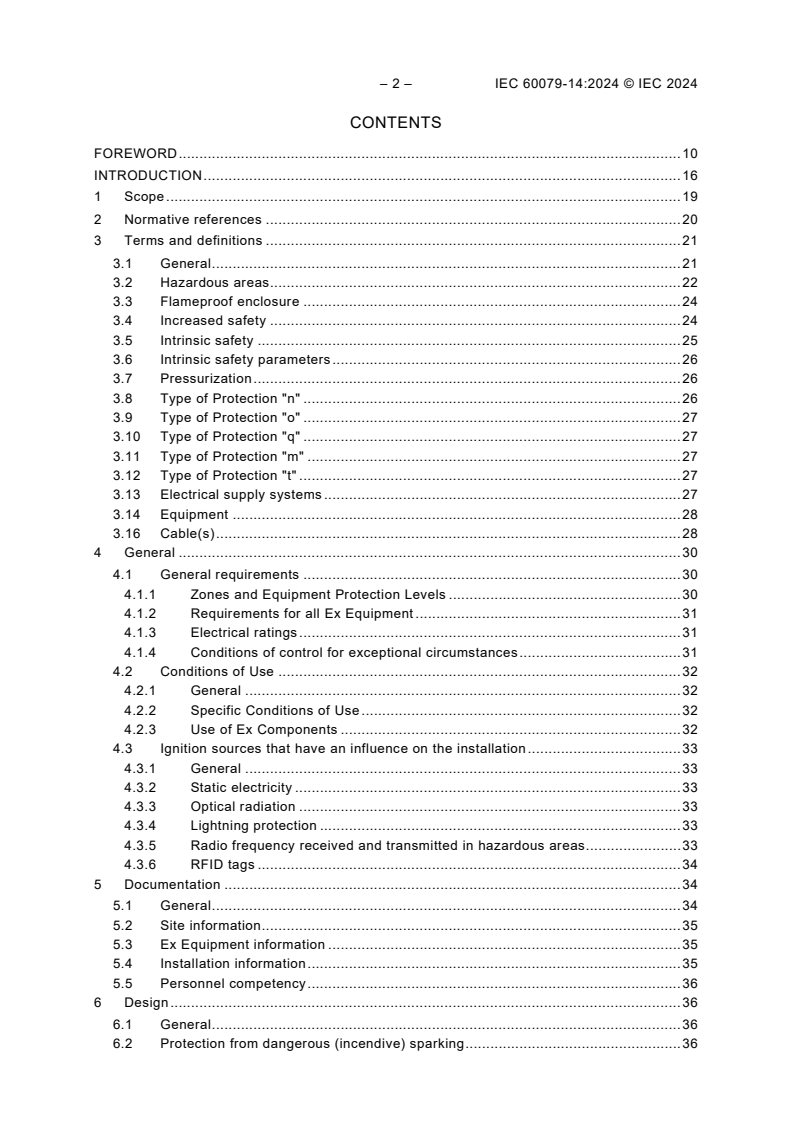
– 2 – IEC 60079-14:2024 © IEC 2024
CONTENTS
FOREWORD . 10
INTRODUCTION . 16
1 Scope . 19
2 Normative references . 20
3 Terms and definitions . 21
3.1 General . 21
3.2 Hazardous areas . 22
3.3 Flameproof enclosure . 24
3.4 Increased safety . 24
3.5 Intrinsic safety . 25
3.6 Intrinsic safety parameters . 26
3.7 Pressurization . 26
3.8 Type of Protection "n" . 26
3.9 Type of Protection "o" . 27
3.10 Type of Protection "q" . 27
3.11 Type of Protection "m" . 27
3.12 Type of Protection "t" . 27
3.13 Electrical supply systems . 27
3.14 Equipment . 28
3.16 Cable(s) . 28
4 General . 30
4.1 General requirements . 30
4.1.1 Zones and Equipment Protection Levels . 30
4.1.2 Requirements for all Ex Equipment . 31
4.1.3 Electrical ratings . 31
4.1.4 Conditions of control for exceptional circumstances . 31
4.2 Conditions of Use . 32
4.2.1 General . 32
4.2.2 Specific Conditions of Use . 32
4.2.3 Use of Ex Components . 32
4.3 Ignition sources that have an influence on the installation . 33
4.3.1 General . 33
4.3.2 Static electricity . 33
4.3.3 Optical radiation . 33
4.3.4 Lightning protection . 33
4.3.5 Radio frequency received and transmitted in hazardous areas . 33
4.3.6 RFID tags . 34
5 Documentation . 34
5.1 General . 34
5.2 Site information . 35
5.3 Ex Equipment information . 35
5.4 Installation information . 35
5.5 Personnel competency . 36
6 Design . 36
6.1 General . 36
6.2 Protection from dangerous (incendive) sparking . 36
6.2.1 Equipment (other than Ex Equipment) above hazardous areas . 36
6.2.2 Wiring systems traversing a hazardous area . 37
6.2.3 Construction materials . 37
6.2.4 Danger from live parts . 37
6.2.5 Danger from exposed and extraneous-conductive-parts . 38
6.2.6 Protective equipotential bonding . 39
6.2.7 Cathodically protected metallic parts . 40
6.3 Electrical protection . 41
6.4 Emergency stop . 41
6.5 Electrical isolation . 41
6.6 Cables . 42
6.6.1 External surface temperature . 42
6.6.2 Cables subjected to thermal insulation . 42
6.6.3 Overhead wiring . 42
6.7 Electrical machines . 42
6.7.1 General . 42
6.7.2 Electrical machines with Type of Protection "d" – Flameproof
enclosures, "p" – Pressurized enclosures and "t" – Protection by
enclosures . 43
6.7.3 Electrical machines with Level of Protection "eb" – Increased safety . 44
6.7.4 Electrical machines with Level of Protection "ec" and Type of Protection
"nA" . 46
6.7.5 Switching electrical machines above 1 kV AC . 47
6.7.6 Prevention of falling bodies . 48
6.8 Electric heating systems . 48
6.8.1 General . 48
6.8.2 Earth fault protection . 48
6.8.3 Limiting temperature . 49
6.8.4 Temperature safety device . 49
6.9 Plugs, socket outlets and couplers . 50
6.9.1 Specific requirements for explosive dust atmospheres . 50
6.9.2 Location . 50
6.10 Cells and batteries . 51
6.10.1 Charging of secondary cells and batteries . 51
6.10.2 Ventilation . 51
6.11 Gas detection systems . 51
6.12 Type of Protection "d" – Flameproof enclosures . 51
6.13 Type of Protection "e" – Increased safety . 51
6.13.1 Maximum dissipated power of junction boxes . 51
6.13.2 Maximum number of conductors . 52
6.14 Type of Protection "i" – Intrinsic safety . 53
6.14.1 General . 53
6.14.2 Cables . 54
6.14.3 Verification of intrinsically safe circuits . 54
6.14.4 Earthing of conducting screens . 56
6.14.5 Cable armour bonding . 57
6.14.6 Marking of cables . 57
6.14.7 Cables carrying more than one intrinsically safe circuit . 58
6.14.8 Types of cables carrying more than one intrinsically safe circuit and
applicable fault considerations . 58
– 4 – IEC 60079-14:2024 © IEC 2024
6.14.9 Earthing of intrinsically safe circuits . 58
6.14.10 Installations to meet the requirements of EPL Ga or EPL Da . 60
6.14.11 Simple apparatus . 61
6.14.12 Junction boxes . 62
6.14.13 Plugs and sockets used for external connections . 63
6.14.14 Special application: Combining intrinsically safe and non-intrinsically
safe circuits . 63
6.15 Type of Protection "m" – Encapsulation . 63
6.16 Type of Protection "n" . 63
6.16.1 General . 63
6.16.2 Type of Protection "nR" . 64
6.17 Type of Protection "o"– Liquid immersion (former Oil immersion) . 64
6.18 Type of Protection "p" . 64
6.18.1 General . 64
6.18.2 Ducting . 65
6.18.3 Action to be taken on failure of pressurization . 65
6.19 Pressurized rooms and artificially ventilated rooms . 69
6.20 Analyser houses . 69
6.21 Type of Protection "q" – Powder filling . 69
7 Selection . 69
7.1 General . 69
7.2 Assurance of conformity of Ex Equipment . 69
7.2.1 Ex Equipment based on IEC standards . 69
7.2.2 Ex Equipment not based on IEC standards . 69
7.2.3 Selection of used or repaired Ex Equipment . 70
7.3 Selection of Ex Equipment . 70
7.3.1 Information requirements . 70
7.3.2 External influences . 70
7.3.3 Selection of radiating equipment . 71
7.3.4 Selection of ultrasonic equipment . 72
7.3.5 Selection for pollution degree . 73
7.3.6 Selection for specific process hazards . 73
7.3.7 Selection of Ex Equipment according to EPLs . 74
7.3.8 Selection according to equipment grouping . 76
7.3.9 Selection according to the ignition temperature of the gas, vapour or
dust . 77
7.3.10 Selection according to the temperature range . 80
7.4 Selection of cables . 80
7.4.1 General . 80
7.4.2 Wiring systems for installation in areas requiring EPL Ga or EPL Da . 81
7.4.3 Cables for direct entries into flameproof enclosures . 81
7.4.4 Cables for direct entries into restricted breathing enclosures . 81
7.4.5 Resistance to flame propagation or flame spread . 81
7.4.6 UV or solar radiation . 81
7.4.7 Non-flexible cables for fixed equipment . 81
7.4.8 Flexible cables for fixed and transportable equipment (excluding
intrinsic safety circuits) . 81
7.4.9 Flexible cables for use for portable equipment . 82
7.4.10 Cables for intrinsic safety circuits . 82
7.4.11 Single insulated wires (excluding intrinsically safe circuits) . 82
7.4.12 Aluminium conductors. 82
7.5 Selection of entry devices and other fittings . 83
7.5.1 General . 83
7.5.2 Cable entry devices . 83
7.5.3 Adapters and Blanking Elements . 84
7.5.4 Breathing and draining devices . 84
7.5.5 Entry devices for fibre optic cables . 85
7.5.6 Other entry devices . 85
7.5.7 Cable entry device for Type of Protection "d" . 85
7.5.8 Cable entry device for Type of Protection "nR" . 86
7.6 Conduits . 87
7.6.1 Group II . 87
7.6.2 Group III . 87
7.7 Luminaires and lamps . 88
7.7.1 Luminaires . 88
7.7.2 Lamps . 88
7.8 Rotating electrical machines . 88
8 Installation of equipment . 88
8.1 General . 88
8.2 Cables and wiring systems . 88
8.2.1 Avoidance of damage . 88
8.2.2 Equipotential bonding connections . 89
8.2.3 Terminations . 89
8.2.4 Penetrations in structures . 90
8.2.5 Passage and collection of flammables . 90
8.2.6 Group III ‒ Accumulation of dust . 90
8.2.7 Jointing . 90
8.3 Entry devices and other fittings . 90
8.3.1 General . 90
8.3.2 Cable entry devices . 91
8.3.3 Additional entries . 93
8.3.4 Unused openings . 93
8.4 Conduit systems . 93
8.4.1 General . 93
8.4.2 Group II . 94
8.4.3 Group III . 94
8.4.4 Additional requirements for flameproof sealing devices for conduit . 95
8.5 Electrical heating systems. 95
8.5.1 General . 95
8.5.2 Trace heating system . 95
8.6 Protective coating of Ex Equipment . 95
8.7 Type of Protection "d" – Flameproof enclosures . 96
8.7.1 General . 96
8.7.2 Solid obstacles . 96
8.7.3 Protection of flamepaths . 96
8.8 Types of Protection "e" and "nA" . 97
8.8.1 Conductor terminations . 97
– 6 – IEC 60079-14:2024 © IEC 2024
8.8.2 Combinations of terminals and conductors for general connection and
junction boxes . 97
8.9 Types of Protection "i" – Intrinsic safety . 97
8.9.1 Earthing of conducting screens . 97
8.9.2 Cable armour bonding . 97
8.9.3 Installation of cables and wiring . 98
8.10 Type of Protection "nR" . 99
8.11 Type of Protection "o"– Liquid immersion (formerly Oil immersion) . 99
9 Initial inspection . 99
Annex A (normative) Knowledge, skills and competencies of designers, electricians
and technicians . 100
A.1 Scope . 100
A.2 Knowledge and skills . 100
A.2.1 Designers . 100
A.2.2 Electricians and technicians. 100
A.3 Competencies . 101
A.3.1 General . 101
A.3.2 Designers . 101
A.3.3 Electricians and technicians. 101
A.4 Assessment . 101
Annex B (informative) Safe work procedure guidelines for explosive gas atmospheres . 102
Annex C (normative) Pressure test procedure for cables into Ex "d" enclosures . 103
C.1 General . 103
C.2 Test apparatus . 103
C.3 Test method . 103
C.4 Test report . 104
Annex D (normative) Potential stator winding discharge hazard assessment – Ignition
risk factors . 106
Annex E (normative) Verification of intrinsically safe circuits with more than one
intrinsically safe power source with linear current/voltage characteristics . 107
E.1 General . 107
E.2 Intrinsic safety with Level of Protection "ib" . 107
E.3 Intrinsic safety with Level of Protection "ic" . 107
Annex F (informative) Methods of determining the maximum system voltages and
currents in intrinsically safe circuits with more than one intrinsically safe power source
with linear current and voltage characteristics . 108
F.1 Intrinsically safe circuits with linear current and voltage characteristics . 108
F.2 Intrinsically safe circuits with non-linear current or voltage characteristics . 109
Annex G (informative) Determination of intrinsic safety cable parameters . 110
G.1 Measurements . 110
G.2 Cables carrying more than one intrinsically safe circuit . 110
G.2.1 General . 110
G.2.2 Type A cables . 110
G.2.3 Type B cables . 111
G.2.4 Type C cables . 111
G.3 FISCO . 111
Annex H (informative) Hybrid mixtures . 112
H.1 General . 112
H.2 Concentration limits . 112
H.3 Electrostatic hazard . 112
H.4 Energy/temperature limits . 112
H.5 Selection of equipment . 112
H.6 Use of flameproof equipment . 112
H.7 Installation requirements . 112
Annex I (informative) Transportable, portable and personal equipment . 113
I.1 General . 113
I.2 Transportable and portable equipment . 113
I.3 Personal equipment . 114
Annex J (informative) Electrical machines operated from converters . 115
J.1 General . 115
J.2 Earthing, bonding and cabling . 116
J.2.1 Objectives of earthing . 116
J.2.2 Bonding of machines . 116
J.2.3 Machine power cables . 116
J.2.4 Cable terminations . 118
J.2.5 Interruption of the shielded machine supply line . 119
Annex K (informative) Surge protection of an intrinsically safe circuit . 120
K.1 General . 120
K.2 Installation to be protected . 120
K.3 Lightning induced surges . 120
K.4 Preventive measures . 120
K.5 Supporting documentation . 121
K.6 Further protection . 121
Annex L (informative) Adverse environmental conditions . 122
L.1 Climate classifications . 122
L.2 Cables and cable entry devices. 122
L.3 Seals and sealing materials . 122
L.4 Storage and transportation . 122
L.5 Low temperatures . 122
L.5.1 General . 122
L.5.2 Electrical machines . 123
L.6 High humidity . 123
L.7 Solar radiation . 123
L.7.1 General . 123
L.7.2 Equipment protection . 124
L.7.3 Cables and cable entry devices . 124
L.8 Atmospheres containing salt and chlorides . 124
L.9 Snow conditions . 124
L.10 Icing and winterization . 125
L.11 Rapid cooling . 125
Annex M (informative) Guidance on the different duty types S1 to S10 of electrical
machines . 126
Annex N (normative) High voltage installations with rated voltage up to 245 kV . 127
Annex O (informative) Inspection tables for initial inspections (from IEC 60079-17) . 128
Annex P (informative) Minimum degree of protection (IP Code) in accordance to Type
of Protection . 135
Annex Q (normative) Additional requirements for simple apparatus. 136
– 8 – IEC 60079-14:2024 © IEC 2024
Q.1 Temperature classification . 136
Q.1.1 Group II . 136
Q.1.2 Group III . 137
Q.2 Isolation and separation . 137
Q.3 Enclosures and cable entry devices . 137
Q.4 Assessment and documentation . 138
Bibliography . 141
Figure 1 – Correlation between the maximum permissible surface temperature and
thickness of dust layers . 79
Figure 2 – Selection of cable entry devices . 86
Figure C.1 – Example of a low pressure test arrangement . 103
Figure F.1 – Series connection – Summation of voltage . 108
Figure F.2 – Parallel connection – Summation of currents . 109
Figure F.3 – Series and parallel connections – Summations of voltages and
summations of currents . 109
Figure J.1 – Basic structure of a converter fed drive system . 115
Figure J.2 – Examples of shielded machine cables and connections . 117
Figure J.3 – Cable shield connection at the machine side . 119
Figure K.1 – Surge protection requirements of an instrument loop . 121
Figure Q.1 – Assessment process for simple apparatus . 138
Table 1 – Table of significant changes . 11
Table 2 – Clauses of this document for requirements for special types of equipment . 14
Table 3 – Clauses of this document for additional requirements for Types of Protection . 14
Table 4 – Equipment Protection Levels (EPLs) where only zones are assigned . 30
Table 5 – Radio frequency power thresholds . 33
Table 6 – Radio-frequency energy thresholds . 34
Table 7 – Requirements for the temperature safety devices . 50
Table 8 – Example of defined terminal/conductor arrangement – Maximum number of
wires in relation to the cross-section and the permissible continuous current . 52
Table 9 – Determination of Type of Protection (with no flammable release within the
enclosure) . 64
Table 10 – Use of spark and particle barriers . 65
Table 11 – Summary of protection requirements for enclosures without an internal
source of release . 66
Table 12 – Relationship between EPLs and Types of Protection . 75
Table 13 – Relationship between gas/vapour or dust subdivision and equipment group . 77
Table 14 – Relationship between gas or vapour ignition temperature and temperature
class of Ex Equipment . 78
Table 15 − Selection of cable entry devices, Type of Protection according to the
enclosure Type of Protection . 84
Table 16 – Minimum dista
...