

IEC 60127-4:2005
(Main)Miniature fuses - Part 4: Universal modular fuse-links (UMF) - Through-hole and surface mount types
General Information
- Abstract
This part of IEC 60127 relates to universal modular fuse-links (UMF) for printed circuits and other substrate systems, used for the protection of electric appliances, electronic equipment, and component parts thereof, normally intended to be used indoors. It does not apply to fuse-links for appliances intended to be used under special conditions, such as in a corrosive or explosive atmosphere. This standard applies in addition to the requirements of IEC 60127-1.
- Status
- Published
- Publication Date
- 06-Dec-2012
- Technical Committee
- SC 32C - Miniature fuses
- Drafting Committee
- WG 6 - TC 32/SC 32C/WG 6
Buy Documents
IEC 60127-4:2005 - Miniature fuses - Part 4: Universal modular fuse-links (UMF) - Through-hole and surface mount types Released:1/27/2005
IEC 60127-4:2005+AMD1:2008+AMD2:2012 CSV - Miniature fuses - Part 4: Universal modular fuse-links (UMF) -Through-hole and surface mount types Released:12/7/2012
Overview
IEC 60127-4:2005 is an international standard published by the International Electrotechnical Commission (IEC) that specifies the requirements for universal modular fuse-links (UMF) designed for printed circuit boards (PCBs) and other substrate systems. These miniature fuses are used primarily for the protection of electric appliances, electronic equipment, and related components intended for indoor applications. The standard covers both through-hole and surface mount types, providing guidance on design, ratings, electrical requirements, and testing procedures. It complements IEC 60127-1 by adding particular specifications for UMFs, notably focusing on non-interchangeability and the physical modularity of fuse-links.
Key Topics
Scope and Application
IEC 60127-4 applies to UMFs used indoors within a variety of electrical and electronic equipment, excluding those subjected to special conditions such as corrosive or explosive atmospheres. It defines requirements for fuse-links that are usually installed or replaced by skilled technicians using appropriate equipment.Design and Construction
The standard details dimensional requirements and construction methods for UMFs to ensure compatibility with printed circuit boards and substrate systems. Both through-hole and surface mount fuse-links are standardized to facilitate automated assembly and reliable mounting.Electrical Ratings and Characteristics
Rated voltages include 12.5 V, 25 V, 32 V, 50 V, 63 V, 125 V, and 250 V, covering a broad range of typical application needs. UMFs under this standard offer various tripping characteristics such as very quick acting (FF), quick acting (F), time-lag (T), and long time-lag (TT).Voltage Drop and Dissipation Limits
IEC 60127-4 specifies maximum permissible values for voltage drop and sustained power dissipation to ensure circuit protection without undue energy loss or overheating.Testing and Quality Assurance
The standard contains comprehensive test schedules, encompassing electrical, mechanical, and environmental evaluations including solderability, robustness of terminations, and breaking capacity. These tests validate fuse performance under typical operating conditions.Marking and Identification
Clear marking requirements identify the fuse ratings and types, incorporating unique identifying symbols specific to UMFs, assisting manufacturers and users in clear and reliable identification.
Applications
IEC 60127-4 UMFs are widely applied in:
Consumer Electronics
Protecting delicate electronic components in devices such as computers, entertainment systems, and household appliances.Industrial Electrical Equipment
Ensuring circuit safety within industrial control systems, machines, and instrumentation employing printed circuit boards.Telecommunication Devices
Providing overcurrent protection for telecommunication apparatus requiring miniature protective devices.Automotive Electronics
Applicable where surface mount or through-hole fuse-links protect embedded electronic control units inside vehicles.Medical Devices
Protecting sensitive electronic circuits in medical equipment that operate under controlled indoor environments.
The universal nature of these fuse-links allows flexibility across multiple sectors where miniaturized, reliable, and standard-compliant fuses are necessary.
Related Standards
IEC 60127-4 is part of the IEC 60127 series covering miniature fuses, including:
IEC 60127-1 – Definitions and general requirements for miniature fuse-links, providing the foundational concepts and requirements that support IEC 60127-4.
IEC 60127-2 – Cartridge fuse-links specification.
IEC 60127-3 – Sub-miniature fuse-links.
IEC 60127-5 – Guidelines for quality assessment of miniature fuse-links to ensure reliability and safety.
IEC 60127-6 – Fuse-holders for miniature fuse-links.
The standard also references critical environmental testing standards such as IEC 60068-2-20 and IEC 60068-2-58, which outline test methods for solderability and resistance to soldering heat, essential for surface mount device validation.
Keywords: IEC 60127-4, universal modular fuse-links, UMF, miniature fuses, through-hole fuse-links, surface mount fuse-links, printed circuit board fuses, electrical protection, fuse standards, fuse testing, electronic equipment protection
Relations
- Effective Date
- 05-Sep-2023
- Effective Date
- 05-Sep-2023
- Effective Date
- 10-Nov-2023
- Effective Date
- 05-Sep-2023
- Effective Date
- 05-Sep-2023
Buy Documents
IEC 60127-4:2005 - Miniature fuses - Part 4: Universal modular fuse-links (UMF) - Through-hole and surface mount types Released:1/27/2005
IEC 60127-4:2005+AMD1:2008+AMD2:2012 CSV - Miniature fuses - Part 4: Universal modular fuse-links (UMF) -Through-hole and surface mount types Released:12/7/2012
Get Certified
Connect with accredited certification bodies for this standard

IMQ S.p.A. (Certification)
Italian electrical product certification.

SLG Prüf- und Zertifizierungs GmbH
German testing and certification body.

UL Solutions
Global safety science company with testing, inspection and certification.
Sponsored listings
Frequently Asked Questions
IEC 60127-4:2005 is a standard published by the International Electrotechnical Commission (IEC). Its full title is "Miniature fuses - Part 4: Universal modular fuse-links (UMF) - Through-hole and surface mount types". This standard covers: This part of IEC 60127 relates to universal modular fuse-links (UMF) for printed circuits and other substrate systems, used for the protection of electric appliances, electronic equipment, and component parts thereof, normally intended to be used indoors. It does not apply to fuse-links for appliances intended to be used under special conditions, such as in a corrosive or explosive atmosphere. This standard applies in addition to the requirements of IEC 60127-1.
This part of IEC 60127 relates to universal modular fuse-links (UMF) for printed circuits and other substrate systems, used for the protection of electric appliances, electronic equipment, and component parts thereof, normally intended to be used indoors. It does not apply to fuse-links for appliances intended to be used under special conditions, such as in a corrosive or explosive atmosphere. This standard applies in addition to the requirements of IEC 60127-1.
IEC 60127-4:2005 is classified under the following ICS (International Classification for Standards) categories: 29.120.50 - Fuses and other overcurrent protection devices. The ICS classification helps identify the subject area and facilitates finding related standards.
IEC 60127-4:2005 has the following relationships with other standards: It is inter standard links to IEC 60127-4:2005/AMD1:2008, IEC 60127-4:2005/AMD2:2012, IEC 60127-4:2026, IEC 60127-4:1996/AMD1:2002, IEC 60127-4:1996/AMD2:2003. Understanding these relationships helps ensure you are using the most current and applicable version of the standard.
IEC 60127-4:2005 is available in PDF format for immediate download after purchase. The document can be added to your cart and obtained through the secure checkout process. Digital delivery ensures instant access to the complete standard document.
Standards Content (Sample)
NORME CEI
INTERNATIONALE IEC
60127-4
INTERNATIONAL
Troisième édition
STANDARD
Third edition
2005-01
Coupe-circuit miniatures –
Partie 4:
Eléments de remplacement modulaires
universels (UMF) – Types de montage
en surface et montage par trous
Miniature fuses –
Part 4:
Universal modular fuse-links (UMF) –
Through-hole and surface mount types
Numéro de référence
Reference number
CEI/IEC 60127-4:2005
Numérotation des publications Publication numbering
Depuis le 1er janvier 1997, les publications de la CEI As from 1 January 1997 all IEC publications are
sont numérotées à partir de 60000. Ainsi, la CEI 34-1 issued with a designation in the 60000 series. For
devient la CEI 60034-1. example, IEC 34-1 is now referred to as IEC 60034-1.
Editions consolidées Consolidated editions
Les versions consolidées de certaines publications de la The IEC is now publishing consolidated versions of its
CEI incorporant les amendements sont disponibles. Par publications. For example, edition numbers 1.0, 1.1
exemple, les numéros d’édition 1.0, 1.1 et 1.2 indiquent and 1.2 refer, respectively, to the base publication,
respectivement la publication de base, la publication de the base publication incorporating amendment 1 and
base incorporant l’amendement 1, et la publication de the base publication incorporating amendments 1
base incorporant les amendements 1 et 2. and 2.
Informations supplémentaires Further information on IEC publications
sur les publications de la CEI
Le contenu technique des publications de la CEI est The technical content of IEC publications is kept
constamment revu par la CEI afin qu'il reflète l'état under constant review by the IEC, thus ensuring that
actuel de la technique. Des renseignements relatifs à the content reflects current technology. Information
cette publication, y compris sa validité, sont dispo- relating to this publication, including its validity, is
nibles dans le Catalogue des publications de la CEI available in the IEC Catalogue of publications
(voir ci-dessous) en plus des nouvelles éditions, (see below) in addition to new editions, amendments
amendements et corrigenda. Des informations sur les and corrigenda. Information on the subjects under
sujets à l’étude et l’avancement des travaux entrepris consideration and work in progress undertaken by the
par le comité d’études qui a élaboré cette publication, technical committee which has prepared this
ainsi que la liste des publications parues, sont publication, as well as the list of publications issued,
également disponibles par l’intermédiaire de: is also available from the following:
• Site web de la CEI (www.iec.ch) • IEC Web Site (www.iec.ch)
• Catalogue des publications de la CEI • Catalogue of IEC publications
Le catalogue en ligne sur le site web de la CEI The on-line catalogue on the IEC web site
(www.iec.ch/searchpub) vous permet de faire des (www.iec.ch/searchpub) enables you to search by a
recherches en utilisant de nombreux critères, variety of criteria including text searches,
comprenant des recherches textuelles, par comité technical committees and date of publication. On-
d’études ou date de publication. Des informations en line information is also available on recently
ligne sont également disponibles sur les nouvelles issued publications, withdrawn and replaced
publications, les publications remplacées ou retirées, publications, as well as corrigenda.
ainsi que sur les corrigenda.
• IEC Just Published • IEC Just Published
Ce résumé des dernières publications parues This summary of recently issued publications
(www.iec.ch/online_news/justpub) est aussi dispo- (www.iec.ch/online_news/justpub) is also available
nible par courrier électronique. Veuillez prendre by email. Please contact the Customer Service
contact avec le Service client (voir ci-dessous) Centre (see below) for further information.
pour plus d’informations.
• Service clients • Customer Service Centre
Si vous avez des questions au sujet de cette If you have any questions regarding this
publication ou avez besoin de renseignements publication or need further assistance, please
supplémentaires, prenez contact avec le Service contact the Customer Service Centre:
clients:
Email: custserv@iec.ch Email: custserv@iec.ch
Tél: +41 22 919 02 11 Tel: +41 22 919 02 11
Fax: +41 22 919 03 00 Fax: +41 22 919 03 00
.
NORME CEI
INTERNATIONALE IEC
60127-4
INTERNATIONAL
Troisième édition
STANDARD
Third edition
2005-01
Coupe-circuit miniatures –
Partie 4:
Eléments de remplacement modulaires
universels (UMF) – Types de montage
en surface et montage par trous
Miniature fuses –
Part 4:
Universal modular fuse-links (UMF) –
Through-hole and surface mount types
IEC 2005 Droits de reproduction réservés Copyright - all rights reserved
Aucune partie de cette publication ne peut être reproduite ni No part of this publication may be reproduced or utilized in any
utilisée sous quelque forme que ce soit et par aucun procédé, form or by any means, electronic or mechanical, including
électronique ou mécanique, y compris la photocopie et les photocopying and microfilm, without permission in writing from
microfilms, sans l'accord écrit de l'éditeur. the publisher.
International Electrotechnical Commission, 3, rue de Varembé, PO Box 131, CH-1211 Geneva 20, Switzerland
Telephone: +41 22 919 02 11 Telefax: +41 22 919 03 00 E-mail: inmail@iec.ch Web: www.iec.ch
CODE PRIX
Commission Electrotechnique Internationale PRICE CODE U
International Electrotechnical Commission
Международная Электротехническая Комиссия
Pour prix, voir catalogue en vigueur
For price, see current catalogue
− 2 − 60127-4 CEI:2005
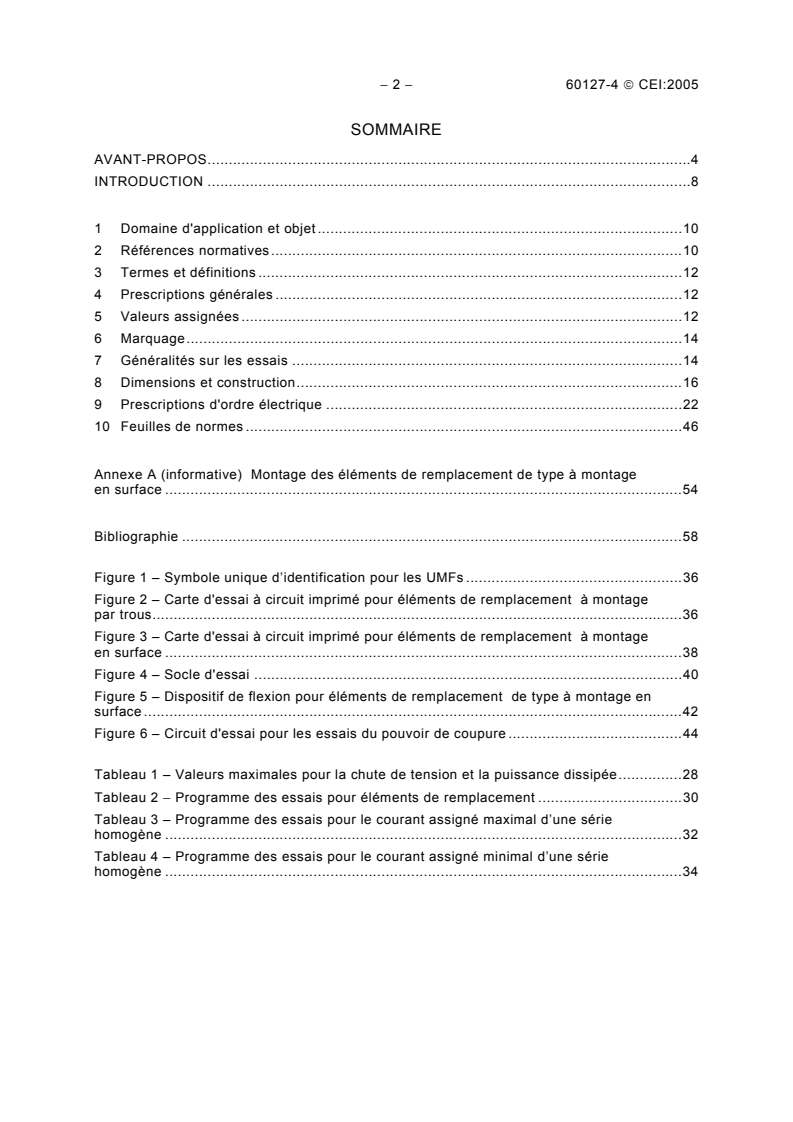
SOMMAIRE
AVANT-PROPOS.4
INTRODUCTION .8
1 Domaine d'application et objet .10
2 Références normatives.10
3 Termes et définitions .12
4 Prescriptions générales .12
5 Valeurs assignées .12
6 Marquage.14
7 Généralités sur les essais .14
8 Dimensions et construction.16
9 Prescriptions d'ordre électrique .22
10 Feuilles de normes .46
Annexe A (informative) Montage des éléments de remplacement de type à montage
en surface .54
Bibliographie .58
Figure 1 – Symbole unique d’identification pour les UMFs .36
Figure 2 – Carte d'essai à circuit imprimé pour éléments de remplacement à montage
par trous.36
Figure 3 – Carte d'essai à circuit imprimé pour éléments de remplacement à montage
en surface .38
Figure 4 – Socle d'essai .40
Figure 5 – Dispositif de flexion pour éléments de remplacement de type à montage en
surface .42
Figure 6 – Circuit d'essai pour les essais du pouvoir de coupure .44
Tableau 1 – Valeurs maximales pour la chute de tension et la puissance dissipée.28
Tableau 2 − Programme des essais pour éléments de remplacement .30
Tableau 3 – Programme des essais pour le courant assigné maximal d’une série
homogène .32
Tableau 4 – Programme des essais pour le courant assigné minimal d’une série
homogène .34
60127-4 IEC:2005 – 3 –
CONTENTS
FOREWORD .5
INTRODUCTION .9
1 Scope and object.11
2 Normative references .11
3 Terms and definitions .13
4 General requirements.13
5 Standard ratings.13
6 Marking.15
7 General notes on tests .15
8 Dimensions and construction .17
9 Electrical requirements .23
10 Standard sheets .47
Annex A (informative) Mounting for surface mount fuse-links.55
Bibliography .59
Figure 1 – Unique identifying symbol for UMFs .37
Figure 2 – Test board for through-hole fuse-links .37
Figure 3 − Test board for surface mount fuse-links .39
Figure 4 – Test fuse base .41
Figure 5 – Bending jig for surface mount fuse-links .43
Figure 6 – Test circuits for breaking capacity tests .45
Table 1 – Maximum values of voltage drop and sustained dissipation .29
Table 2 − Testing schedule for individual ampere ratings.31
Table 3 – Testing schedule for maximum ampere rating of a homogeneous series.33
Table 4 – Testing schedule for minimum ampere rating of a homogeneous series.35
− 4 − 60127-4 CEI:2005
COMMISSION ÉLECTROTECHNIQUE INTERNATIONALE
___________
COUPE-CIRCUIT MINIATURES –
Partie 4: Eléments de remplacement modulaires universels (UMF) –
Types de montage en surface et montage par trous
AVANT-PROPOS
1) La Commission Electrotechnique Internationale (CEI) est une organisation mondiale de normalisation
composée de l'ensemble des comités électrotechniques nationaux (Comités nationaux de la CEI). La CEI a
pour objet de favoriser la coopération internationale pour toutes les questions de normalisation dans les
domaines de l'électricité et de l'électronique. A cet effet, la CEI – entre autres activités – publie des Normes
internationales, des Spécifications techniques, des Rapports techniques, des Spécifications accessibles au
public (PAS) et des Guides (ci-après dénommés "Publication(s) de la CEI"). Leur élaboration est confiée à des
comités d'études, aux travaux desquels tout Comité national intéressé par le sujet traité peut participer. Les
organisations internationales, gouvernementales et non gouvernementales, en liaison avec la CEI, participent
également aux travaux. La CEI collabore étroitement avec l'Organisation Internationale de Normalisation (ISO),
selon des conditions fixées par accord entre les deux organisations.
2) Les décisions ou accords officiels de la CEI concernant les questions techniques représentent, dans la mesure
du possible, un accord international sur les sujets étudiés, étant donné que les Comités nationaux de la CEI
intéressés sont représentés dans chaque comité d’études.
3) Les Publications de la CEI se présentent sous la forme de recommandations internationales et sont agréées
comme telles par les Comités nationaux de la CEI. Tous les efforts raisonnables sont entrepris afin que la CEI
s'assure de l'exactitude du contenu technique de ses publications; la CEI ne peut pas être tenue responsable
de l'éventuelle mauvaise utilisation ou interprétation qui en est faite par un quelconque utilisateur final.
4) Dans le but d'encourager l'uniformité internationale, les Comités nationaux de la CEI s'engagent, dans toute la
mesure possible, à appliquer de façon transparente les Publications de la CEI dans leurs publications
nationales et régionales. Toutes divergences entre toutes Publications de la CEI et toutes publications
nationales ou régionales correspondantes doivent être indiquées en termes clairs dans ces dernières.
5) La CEI n’a prévu aucune procédure de marquage valant indication d’approbation et n'engage pas sa
responsabilité pour les équipements déclarés conformes à une de ses Publications.
6) Tous les utilisateurs doivent s'assurer qu'ils sont en possession de la dernière édition de cette publication.
7) Aucune responsabilité ne doit être imputée à la CEI, à ses administrateurs, employés, auxiliaires ou
mandataires, y compris ses experts particuliers et les membres de ses comités d'études et des Comités
nationaux de la CEI, pour tout préjudice causé en cas de dommages corporels et matériels, ou de tout autre
dommage de quelque nature que ce soit, directe ou indirecte, ou pour supporter les coûts (y compris les frais
de justice) et les dépenses découlant de la publication ou de l'utilisation de cette Publication de la CEI ou de
toute autre Publication de la CEI, ou au crédit qui lui est accordé.
8) L'attention est attirée sur les références normatives citées dans cette publication. L'utilisation de publications
référencées est obligatoire pour une application correcte de la présente publication.
9) L’attention est attirée sur le fait que certains des éléments de la présente Publication de la CEI peuvent faire
l’objet de droits de propriété intellectuelle ou de droits analogues. La CEI ne saurait être tenue pour
responsable de ne pas avoir identifié de tels droits de propriété et de ne pas avoir signalé leur existence.
La Norme internationale CEI 60127-4 a été établie par le sous-comité 32C: Coupe-circuit à
fusibles miniatures, du comité d'études 32 de la CEI: Coupe-circuit à fusibles.
Cette troisième édition annule et remplace la deuxième édition (1996), ainsi que l’amende-
ment 1 (2002) et l’amendement 2 (2003), et constitue une révision technique.
Les modifications techniques majeures par rapport à l'édition précédente sont les suivantes:
introduction de dispositifs physiquement plus petits avec des tensions assignées inférieures.
L'essai de la température de l'élément de remplacement (9.7) est modifié.
60127-4 IEC:2005 – 5 –
INTERNATIONAL ELECTROTECHNICAL COMMISSION
_________
MINIATURE FUSES –
Part 4: Universal modular fuse-links (UMF) –
Through-hole and surface mount types
FOREWORD
1) The International Electrotechnical Commission (IEC) is a worldwide organization for standardization comprising
all national electrotechnical committees (IEC National Committees). The object of IEC is to promote
international co-operation on all questions concerning standardization in the electrical and electronic fields. To
this end and in addition to other activities, IEC publishes International Standards, Technical Specifications,
Technical Reports, Publicly Available Specifications (PAS) and Guides (hereafter referred to as “IEC
Publication(s)”). Their preparation is entrusted to technical committees; any IEC National Committee interested
in the subject dealt with may participate in this preparatory work. International, governmental and non-
governmental organizations liaising with the IEC also participate in this preparation. IEC collaborates closely
with the International Organization for Standardization (ISO) in accordance with conditions determined by
agreement between the two organizations.
2) The formal decisions or agreements of IEC on technical matters express, as nearly as possible, an
international consensus of opinion on the relevant subjects since each technical committee has representation
from all interested IEC National Committees.
3) IEC Publications have the form of recommendations for international use and are accepted by IEC National
Committees in that sense. While all reasonable efforts are made to ensure that the technical content of IEC
Publications is accurate, IEC cannot be held responsible for the way in which they are used or for any
misinterpretation by any end user.
4) In order to promote international uniformity, IEC National Committees undertake to apply IEC Publications
transparently to the maximum extent possible in their national and regional publications. Any divergence
between any IEC Publication and the corresponding national or regional publication shall be clearly indicated in
the latter.
5) IEC provides no marking procedure to indicate its approval and cannot be rendered responsible for any
equipment declared to be in conformity with an IEC Publication.
6) All users should ensure that they have the latest edition of this publication.
7) No liability shall attach to IEC or its directors, employees, servants or agents including individual experts and
members of its technical committees and IEC National Committees for any personal injury, property damage or
other damage of any nature whatsoever, whether direct or indirect, or for costs (including legal fees) and
expenses arising out of the publication, use of, or reliance upon, this IEC Publication or any other IEC
Publications.
8) Attention is drawn to the Normative references cited in this publication. Use of the referenced publications is
indispensable for the correct application of this publication.
9) Attention is drawn to the possibility that some of the elements of this IEC Publication may be the subject of
patent rights. IEC shall not be held responsible for identifying any or all such patent rights.
International Standard IEC 60127-4 has been prepared by subcommittee 32C: Miniature
fuses, of IEC technical committee 32: Fuses.
This third edition cancels and replaces the second edition (1996), together with amendment 1
(2002) and amendment 2 (2003), and constitutes a technical revision.
The major technical changes with regard to the previous edition are as follows: introduction
of physically smaller devices with lower rated voltages. Fuse-link temperature test (9.7) is
modified.
− 6 − 60127-4 CEI:2005
Le texte de cette norme est issu des documents suivants:
FDIS Rapport de vote
32C/362/FDIS 32C/366/RVD
Le rapport de vote indiqué dans le tableau ci-dessus donne toute information sur le vote
ayant abouti à l'approbation de cette norme.
Cette publication a été rédigée selon les Directives ISO/CEI, Partie 2.
Les articles de cette norme complètent, modifient ou remplacent les articles correspondants
de la CEI 60127-1.
Lorsqu'il n'y a pas d'article ou de paragraphe correspondants dans cette norme, l'article ou le
paragraphe de la CEI 60127-1 s'applique sans modification dans la mesure du possible.
Lorsque cette norme indique "addition", "modification" ou "remplacement", le texte corres-
pondant de la CEI 60127-1 doit être adapté en conséquence.
La série CEI 60127 est subdivisée comme suit:
Partie 1: Définitions pour coupe-circuit miniatures et prescriptions générales pour éléments
de remplacement miniatures
Partie 2: Cartouches
Partie 3: Eléments de remplacement subminiatures
Partie 4: Eléments de remplacement modulaires universels (UMF)
Partie 5: Directives pour l'évaluation de la qualité des éléments de remplacement
miniatures
Partie 6: Ensembles-porteurs pour éléments de remplacement miniatures
Partie 7: (Libre pour d'autres documents)
Partie 8: (Libre pour d'autres documents)
Partie 9: (Libre pour d'autres documents)
Partie 10: Guide d’utilisation pour coupe-circuit miniatures
Le comité a décidé que le contenu de cette publication ne sera pas modifié avant la date de
maintenance indiquée sur le site web de la CEI sous «http://webstore.iec.ch» dans les
données relatives à la publication recherchée. A cette date, la publication sera
• reconduite;
• supprimée;
• remplacée par une édition révisée, ou
• amendée.
60127-4 IEC:2005 – 7 –
The text of this standard is based on the following documents:
FDIS Report on voting
32C/362/FDIS 32C/366/RVD
Full information on the voting for the approval of this standard can be found in the report on
voting indicated in the above table.
This publication has been drafted in accordance with the ISO/IEC Directives, Part 2.
The clauses of this standard supplement, modify or replace the corresponding clauses in
IEC 60127-1.
Where there is no corresponding clause or subclause in this standard, the clause or
subclause of IEC 60127-1 applies without modification as far as is reasonable. When this
standard states “addition”, “modification” or “replacement”, the relevant text in IEC 60127-1 is
to be adapted accordingly.
The IEC 60127 series is subdivided as follows:
Part 1: Definitions for miniature fuses and general requirements for miniature fuse-links
Part 2: Cartridge fuse-links
Part 3: Sub-miniature fuse-links
Part 4: Universal modular fuse-links (UMF)
Part 5: Guidelines for quality assessment of miniature fuse-links
Part 6: Fuse-holders for miniature fuse-links
Part 7: (Free for further documents)
Part 8: (Free for further documents)
Part 9: (Free for further documents)
Part 10: User guide for miniature fuses
The committee has decided that the contents of this publication will remain unchanged until
the maintenance result date indicated on the IEC web site under "http://webstore.iec.ch" in
the data related to the specific publication. At this date, the publication will be
• reconfirmed;
• withdrawn;
• replaced by a revised edition, or
• amended.
− 8 − 60127-4 CEI:2005
INTRODUCTION
La tendance à la miniaturisation des équipements électroniques a conduit les utilisateurs à
exiger des éléments de remplacement de petites dimensions et de conception appropriée
pour les circuits imprimés ou les autres systèmes de substrats, si possible avec des moyens
automatiques. Il est recommandé que ces éléments de remplacement soient conçus pour
incorporer un degré de non-interchangeabilité.
Les tensions assignées de 12,5 V, 25 V, 32 V, 50 V, 63 V, 125 V et 250 V sont spécifiées
ainsi que les caractéristiques suivantes: la fusion très rapide (FF), la fusion rapide (F), la
fusion retardée (T) et la fusion très retardée (TT).
En raison de l’importance croissante de la limitation des surtensions transitoires dans la
nouvelle technologie, des recommandations sont incluses pour les limites des surtensions
produites par ces fusibles dans des conditions d’essai spécifiées relatives aux configurations
typiques des circuits.
Le choix est donné de spécifier le pouvoir de coupure en courant alternatif ou en courant
continu. Il est considéré que les fusibles satisfaisant aux exigences en courant continu
satisfont également au courant alternatif; cependant, des essais sont requis pour les valider.
Les fusibles peuvent avoir deux caractéristiques assignées, auquel cas il convient que la
documentation du constructeur y fasse référence.
Les utilisateurs de coupe-circuit miniatures expriment le voeu de n'avoir à considérer qu'un
seul numéro de publication pour toutes les normes, recommandations et autres documents
concernant les coupe-circuit miniatures, afin de faciliter tout renvoi aux coupe-circuit à
fusibles dans d'autres spécifications, par exemple celles relatives aux équipements.
De plus, un seul numéro de publication et une subdivision en parties faciliteront la mise en
oeuvre de nouvelles normes, car les articles et paragraphes comprenant des exigences
générales n'auront pas à être répétés.
60127-4 IEC:2005 – 9 –
INTRODUCTION
The trend towards miniaturization of electronic equipment has caused users to require fuse-
links of small dimensions, and of appropriate design for application to printed circuit boards
or other substrate systems, possibly by automatic means. These fuse-links should be
designed to incorporate a degree of non-interchangeability.
Rated voltages of 12,5 V, 25 V, 32 V, 50 V, 63 V, 125 V, and 250 V are specified together
with the following characteristics: very quick acting (FF), quick acting (F), time-lag (T) and
long time-lag (TT).
Because of the increasing importance of limitation of transient overvoltages in new
technology, recommendations are included for limits to the overvoltages produced by these
fuses under specified test conditions related to typical circuit configurations.
The option is given to specify the breaking capacity with alternating current or direct current;
it is considered that fuses that meet the d.c. requirement will meet the a.c. requirement;
however, testing is required to validate this. Fuses may be dual rated, in which case the
manufacturer's literature should be referred to.
The users of miniature fuses express the wish that all standards, recommendations and other
documents relating to miniature fuses should have the same publication number in order to
facilitate reference to fuses in other specifications, for example, equipment specifications.
Furthermore, a single publication number and subdivision into parts would facilitate the
establishment of new standards, because clauses and subclauses containing general
requirements need not be repeated.
− 10 − 60127-4 CEI:2005
COUPE-CIRCUIT MINIATURES –
Partie 4: Eléments de remplacement modulaires universels (UMF) –
Types de montage en surface et montage par trous
1 Domaine d'application et objet
La présente partie de la CEI 60127 s'applique aux éléments de remplacement modulaires
universels (UMF) conçus pour le montage sur circuit imprimé et autres substrats, et
employés pour la protection d'appareils électriques, de matériels électroniques et de leurs
éléments constituants, normalement utilisés à l'intérieur.
Elle n'est pas applicable aux éléments de remplacement pour les appareils destinés à être
employés dans des conditions particulières, telles que des atmosphères corrosives ou
explosives.
Ces coupe-circuit sont normalement destinés à être montés ou remplacés uniquement par
des personnes qualifiées, en utilisant des outils spéciaux.
Les éléments de remplacement pour utilisation dans les ensembles-porteurs sont à l’étude.
La présente norme renvoie en outre aux exigences de la CEI 60127-1.
L'objet de cette partie de la CEI 60127 est tel que donné dans la CEI 60127-1, avec
l’exigence supplémentaire d'un degré de non-interchangeabilité.
2 Références normatives
Les documents de référence suivants sont indispensables pour l'application du présent
document. Pour les références datées, seule l'édition citée s'applique. Pour les références
non datées, la dernière édition du document de référence s'applique (y compris les éventuels
amendements).
CEI 60068-2-20:1979, Essais fondamentaux climatiques et de robustesse mécanique −
Deuxième partie: Essais – Essai T: Soudure
Amendement 2 (1987)
CEI 60068-2-21:1999, Essais d'environnement – Partie 2-21: Essais – Essai U: Robustesse
des sorties et des dispositifs de montage incorporés
CEI 60068-2-58:2004, Essais d'environnement – Partie 2-58: Essais – Essai Td: Soudabilité,
résistance de la métallisation à la dissolution et résistance à la chaleur de soudage des
composants pour montage en surface (CMS) (en anglais seulement)
CEI 60127-1:1988, Coupe-circuit miniatures – Partie 1: Définitions pour coupe-circuit
miniatures et prescriptions générales pour éléments de remplacement miniatures
Amendement 1 (1999)
Amendement 2 (2002)
CEI 60194:1999, Conception, fabrication et assemblage des cartes imprimées – Termes et
définitions
___________
Il existe une version consolidée (2003).
60127-4 IEC:2005 – 11 –
MINIATURE FUSES –
Part 4: Universal modular fuse-links (UMF) –
Through-hole and surface mount types
1 Scope and object
This part of IEC 60127 relates to universal modular fuse-links (UMF) for printed circuits and
other substrate systems, used for the protection of electric appliances, electronic equipment,
and component parts thereof, normally intended to be used indoors.
It does not apply to fuse-links for appliances intended to be used under special conditions,
such as in a corrosive or explosive atmosphere.
These fuses are normally intended to be mounted or replaced only by appropriately skilled
persons using specialized equipment.
Fuse-links for use in fuse-holders are under consideration.
This standard applies in addition to the requirements of IEC 60127-1.
The objectives of this part of IEC 60127 are as given in IEC 60127-1, with the additional
requirement of a degree of non-interchangeability.
2 Normative references
The following referenced documents are indispensable for the application of this document.
For dated references, only the edition cited applies. For undated references, the latest edition
of the referenced document (including any amendments) applies.
IEC 60068-2-20:1979, Basic environmental testing procedures – Part 2: Tests – Test T:
Soldering
Amendment 2 (1987)
IEC 60068-2-21:1999, Environmental testing – Part 2-21: Tests – Test U: Robustness of
terminations and integral mounting devices
IEC 60068-2-58:2004, Environmental testing – Part 2-58: Tests – Test Td: Test methods for
solderability, resistance to dissolution of metallization and to soldering heat of surface
mounting devices (SMD)
IEC 60127-1:1988, Miniature fuses – Part 1: Definitions for miniature fuses and general
requirements for miniature fuse-links
Amendment 1 (1999)
Amendment 2 (2002)
IEC 60194:1999, Printed board design, manufacture and assembly – Terms and definitions
___________
There exists a consolidated version (2003).
− 12 − 60127-4 CEI:2005
CEI 60664-1:1992, Coordination de l'isolement des matériels dans les systèmes (réseaux) à
basse tension – Partie 1: Principes, prescriptions et essais
Amendement 1 (2000)
Amendement 2 (2002)
CEI 61249-2-7:2002, Matériaux pour circuits imprimés et autres structures d'interconnexion –
Partie 2-7: Matériaux de base renforcés, plaqués et non plaqués – Feuille stratifiée tissée de
verre E avec de la résine époxyde, d'inflammabilité définie (essai de combustion verticale),
plaquée cuivre
ISO 3:1973, Nombres normaux – Séries de nombres normaux
3 Termes et définitions
Pour les besoins du présent document, les termes et définitions donnés à l'Article 3 de la
CEI 60127-1 s’appliquent, ainsi que les suivants:
3.1
élément de remplacement de type à montage par trous
élément de remplacement modulaire universel (UMF) conçu pour le montage direct sur des
circuits imprimés par soudage, les sorties étant insérées dans des trous conçus pour un tel
montage
3.2
élément de remplacement de type à montage en surface
élément de remplacement modulaire universel (UMF) conçu pour la fixation conductrice
directe sur la surface d'un substrat par soudage ou d'autres méthodes, sans que les sorties
soient insérées dans des trous ou socles conçus pour un tel montage
3.3
pastille
partie d'impression conductrice utilisée usuellement – mais non exclusivement – pour la
connexion et/ou la fixation des composants (voir CEI 60194)
NOTE D'autres définitions applicables pour l'utilisation des éléments de remplacement de type à montage en
surface peuvent être trouvées dans la CEI 60115-1 et la CEI 60115-8 .
4 Prescriptions générales
Voir la CEI 60127-1.
5 Valeurs assignées
5.1 Tension assignée
Voir les feuilles de norme.
5.2 Courant assigné
Voir le Tableau 1 pour les caractéristiques assignées préférentielles.
5.3 Pouvoir de coupure assigné
Voir les feuilles de norme.
___________
Il existe une version consolidée (2002).
Cette norme a été supprimée.
60127-4 IEC:2005 – 13 –
IEC 60664-1:1992, Insulation coordination for equipment within low-voltage systems – Part 1:
Principles, requirements and tests
Amendment 1 (2000)
Amendment 2 (2002)
IEC 61249-2-7:2002, Materials for printed boards and other interconnecting structures –
Part 2-7: Reinforced base materials clad and unclad - Epoxide woven E-glass laminated
sheet of defined flammability (vertical burning test), copper-clad
ISO 3:1973, Preferred numbers – Series of preferred numbers
3 Terms and definitions
For the purposes of this document, the terms and definitions given in Clause 3 of IEC 60127-
1, together with the following definitions, apply.
3.1
through-hole fuse-link
UMF designed for soldering directly into a printed wiring board, with insertion of its leads in
suitably designed holes
3.2
surface mount fuse-link
UMF designed for direct conductive attachment by solder or other means on to the surface of
a substrate, without insertion of its leads in suitably designed holes or sockets
3.3
land
portion of a conductive pattern usually but not exclusively used for the connection and/or
attachment of components (see IEC 60194)
NOTE Further definitions which may be useful in the application of surface mount fuse-links may be found in
3.
IEC 60115-1 and IEC 60115-8
4 General requirements
See IEC 60127-1.
5 Standard ratings
5.1 Rated voltage
See standard sheets.
5.2 Rated current
See Table 1 for preferred ratings.
5.3 Rated breaking capacity
See standard sheets.
___________
There exists a consolidated version (2002).
This standard has been withdrawn.
− 14 − 60127-4 CEI:2005
6 Marquage
En plus des exigences données à l'Article 6 de la CEI 60127-1, les critères suivants
concernant un UMF doivent être respectés et marqués:
6.1 Supplément
e) pour les éléments de remplacement d'une tension assignée de 250 V, un symbole
indiquant le pouvoir de coupure doit figurer. Ce symbole doit être placé entre l'indication
du courant assigné et celle de la tension assignée.
Ces symboles sont les suivants:
H: à haut pouvoir de coupure;
I: à pouvoir de coupure intermédiaire;
L: à faible pouvoir de coupure.
f) le symbole distinctif donné à la Figure 1;
g) les lettres c.a. avant la tension pour éléments de remplacement conçus uniquement pour
des applications en courant alternatif.
6.4 Codage des éléments de remplacement modulaires universels par bandes de
couleur
A l'étude.
6.5 Si le marquage est impossible en raison de leur taille réduite, il est recommandé que les
informations correspondantes apparaissent sur le plus petit emballage et dans la documen-
tation technique du constructeur.
7 Généralités sur les essais
En plus des exigences données à l'Article 7 de la CEI 60127-1, les règles suivantes sont à
respecter:
7.2 Supplément:
7.2.1 Pour les essais des courants assignés individuels des fusibles selon les feuilles de
norme 1 et 2, voir le Tableau 2. Pour des éléments de remplacement définis et assignés à la
fois pour les courants alternatif et continu, le nombre d'éléments de remplacement requis est
de 63. Pour des éléments de remplacement définis uniquement pour le courant alternatif, le
nombre d'éléments de remplacement requis est de 48. Neuf sont gardés en réserve.
Pour le courant assigné maximal d'une série homogène selon les feuilles de norme 1 et 2,
voir le Tableau 3. Pour des éléments de remplacement définis et assignés à la fois pour les
courants alternatif et continu, le nombre d'éléments de remplacement requis est de 53. Pour
des éléments de remplacement définis uniquement pour le courant alternatif, le nombre
d'éléments de remplacement requis est de 48. 19 sont gardés en réserve.
Pour le courant assigné minimal d’une série homogène selon les feuilles de norme 1 et 2,
voir le Tableau 4. Pour des éléments de remplacement définis et assignés à la fois pour les
courants alternatif et continu, le nombre d'éléments de remplacement requis est de 38. Pour
des éléments de remplacement définis uniquement pour le courant alternatif, le nombre
d'éléments de remplacement requis est de 33. 16 sont gardés en réserve.
60127-4 IEC:2005 – 15 –
6 Marking
In addition to the requirements of Clause 6 in IEC 60127-1, the following criteria concerning
UMF shall be observed and marked:
6.1 Addition:
e) For fuse-links rated at 250 V, a symbol denoting the breaking capacity. This symbol shall
be placed between the marking for rated current and the marking for rated voltage.
These symbols are as follows:
H: denoting high-breaking capacity;
I: denoting intermediate-breaking capacity;
L: denoting low-breaking capacity.
f) The distinctive symbol shown in Figure 1.
g) The letters a.c. before the voltage for devices designed solely for alternating current
application.
6.4 Colour coding for universal modular fuse-links
Under consideration.
6.5 Where marking is impractical due to space limitations, the relevant information should
appear on the smallest package and in the manufacturer’s technical literature.
7 General notes on tests
In addition to the requirements of Clause 7 in IEC 60127-1, the following criteria shall be
observed:
7.2 Addition:
7.2.1 For testing of individual fuse ratings according to standard sheets 1 and 2, see Table
2. For fuse-links designed and rated both for a.c. and d.c., the number of fuse-links required
is 63. For fuse-links designed only for a.c., the number of fuse-links required is 48. There are
nine spares.
For the maximum ampere rating of a homogeneous series according to standard sheets 1
and 2, see Table 3. For fuse-links designed and rated both for a.c. and d.c., the number of
fuse-links required is 53. For fuse-links designed only for a.c., the number of fuse-links
required is 48. There are 19 spares.
For the minimum ampere rating of a homogeneous series according to standard sheets 1 and
2, see Table 4. For fuse-links designed and rated both for a.c. and d.c., the number of fuse-
links required is 38. For fuse-links designed only for a.c., the number of fuse-links required
is 33. There are 16 spares.
− 16 − 60127-4 CEI:2005
7.3 Socles d'essai
7.3.1 Exigences générales
Les éléments de remplacement doivent être montés sur un circuit imprimé d'essai approprié
(voir 7.3.2 ou 7.3.3, selon le cas) par soudage.
Ce circuit imprimé d'essai doit ensuite être monté sur le socle d'essai (Figure 4). Le circuit
imprimé d'essai doit être réalisé en feuille stratifiée de tissu de verre époxyde recouverte de
cuivre telle que définie dans la CEI 61249-2-7:
− l'épaisseur nominale de la feuille doit être de 1,6 mm;
− l'épaisseur nominale de la couche de cuivre doit être de 0,035 mm (0,070 mm au-dessus
de 6,3 A).
Les pièces métalliques du socle doivent être en laiton avec une teneur en cuivre comprise
entre 58 % et 70 %. Les contacts doivent être argentés.
Si deux éléments de remplacement ou plus sont essayés en série, les socles d'essai doivent
être disposés de manière qu'une distance de 50 mm au moins sépare deux éléments de
remplacement en essai. Les fils conducteurs raccordant les socles d'essai entre eux et
servant au raccordement des socles d'essai à l'ampèremètre et à la source de courant
doivent être réalisés en fil de cuivre isolé. Chaque conducteur doit avoir une longueur de
250 mm et une section de 1 mm² environ.
7.3.2 Eléments de remplacement de type à montage par trous (feuille de norme 1)
Pour les essais électriques sur les éléments de remplacement conformes à la feuille de
norme 1, l'élément de remplacement doit être monté dans le circuit imprimé d'essai donné à
la Figure 2 dans les deux trous appropriés à l'espacement entre les sorties.
7.3.3 Eléments de remplacement de type à montage en surface (feuille de norme 2)
Pour les essais électriques sur les éléments de remplacement conformes à la feuille de
norme 2, l'élément de remplacement doit être monté sur le circuit imprimé d'essai donné à la
Figure 3. Voir l’Annexe A pour les informations.
8 Dimensions et construction
8.1 Dimensions
Les dimensions des UMFs doivent être conformes aux exigences des feuilles de norme
correspondantes.
La conformité est vérifiée par la mesure de la longueur, de l'épaisseur et de la hauteur.
Pour les éléments de remplacement conformes à la feuille de norme 1, l'espacement entre
les sorties est vérifié. La sortie doit aussi passer à travers un trou de 1 mm. La longueur de
la sortie n'est pas spécifiée car elle dépend du mode de conditionnement.
8.2 Construction
L’élément fusible doit être complètement enfermé.
L’UMF doit résister à la chaleur et à l’exposition chimique d'un circuit imprimé ou autres
opérations d'assemblage du substrat sans altération de ses performances.
La conformité est vérifiée par l'essai de la résistance à la chaleur de soudage (voir 8.7).
60127-4 IEC:2005 – 17 –
7.3 Fuse-bases for tests
7.3.1 General requirements
Fuse-links shall be mounted upon the appropriate test board (see 7.3.2 or 7.3.3 as
appropriate) by soldering.
This test board shall then be mounted on the test fuse-base (Figure 4). The test board shall
be made of epoxide woven glass fabric copper-clad laminated sheet, as defined in
IEC 61249-2-7:
− the nominal sheet thickness shall be 1,6 mm;
− the nominal thickness of copper layer shall be 0,035 mm (0,070 mm above 6,3 A).
Metal parts of the fuse-base shall be made of brass with a copper content between 58 % and
70 %. Contact parts shall be silver-plated.
When two or more fuse-links are tested in series, the test fuse-bases shall be located so that
there will be a spacing of not less than 50 mm between any two fuse-links under test. The
conductor connecting the test fuse-bases together, and connecting the test fuse-bases to the
ammeter and the source of supply shall be insulated copper wir
...
IEC 60127-4 ®
Edition 3.2 2012-12
CONSOLIDATED VERSION
INTERNATIONAL
STANDARD
NORME
INTERNATIONALE
colour
inside
Miniature fuses –
Part 4: Universal modular fuse-links (UMF) – Through-hole and surface mount
types
Coupe-circuit miniatures –
Partie 4: Eléments de remplacement modulaires universels (UMF) – Types de
montage en surface et montage par trous
All rights reserved. Unless otherwise specified, no part of this publication may be reproduced or utilized in any form
or by any means, electronic or mechanical, including photocopying and microfilm, without permission in writing from
either IEC or IEC's member National Committee in the country of the requester. If you have any questions about IEC
copyright or have an enquiry about obtaining additional rights to this publication, please contact the address below or
your local IEC member National Committee for further information.
Droits de reproduction réservés. Sauf indication contraire, aucune partie de cette publication ne peut être reproduite
ni utilisée sous quelque forme que ce soit et par aucun procédé, électronique ou mécanique, y compris la photocopie
et les microfilms, sans l'accord écrit de l'IEC ou du Comité national de l'IEC du pays du demandeur. Si vous avez des
questions sur le copyright de l'IEC ou si vous désirez obtenir des droits supplémentaires sur cette publication, utilisez
les coordonnées ci-après ou contactez le Comité national de l'IEC de votre pays de résidence.
IEC Central Office Tel.: +41 22 919 02 11
3, rue de Varembé Fax: +41 22 919 03 00
CH-1211 Geneva 20 info@iec.ch
Switzerland www.iec.ch
About the IEC
The International Electrotechnical Commission (IEC) is the leading global organization that prepares and publishes
International Standards for all electrical, electronic and related technologies.
About IEC publications
The technical content of IEC publications is kept under constant review by the IEC. Please make sure that you have the
latest edition, a corrigenda or an amendment might have been published.
IEC Catalogue - webstore.iec.ch/catalogue Electropedia - www.electropedia.org
The stand-alone application for consulting the entire The world's leading online dictionary of electronic and
bibliographical information on IEC International Standards, electrical terms containing 20 000 terms and definitions in
Technical Specifications, Technical Reports and other English and French, with equivalent terms in 15 additional
documents. Available for PC, Mac OS, Android Tablets and languages. Also known as the International Electrotechnical
iPad. Vocabulary (IEV) online.
IEC publications search - www.iec.ch/searchpub IEC Glossary - std.iec.ch/glossary
The advanced search enables to find IEC publications by a 65 000 electrotechnical terminology entries in English and
variety of criteria (reference number, text, technical French extracted from the Terms and Definitions clause of
committee,…). It also gives information on projects, replaced IEC publications issued since 2002. Some entries have been
and withdrawn publications. collected from earlier publications of IEC TC 37, 77, 86 and
CISPR.
IEC Just Published - webstore.iec.ch/justpublished
Stay up to date on all new IEC publications. Just Published IEC Customer Service Centre - webstore.iec.ch/csc
details all new publications released. Available online and If you wish to give us your feedback on this publication or
also once a month by email. need further assistance, please contact the Customer Service
Centre: csc@iec.ch.
A propos de l'IEC
La Commission Electrotechnique Internationale (IEC) est la première organisation mondiale qui élabore et publie des
Normes internationales pour tout ce qui a trait à l'électricité, à l'électronique et aux technologies apparentées.
A propos des publications IEC
Le contenu technique des publications IEC est constamment revu. Veuillez vous assurer que vous possédez l’édition la
plus récente, un corrigendum ou amendement peut avoir été publié.
Catalogue IEC - webstore.iec.ch/catalogue Electropedia - www.electropedia.org
Application autonome pour consulter tous les renseignements
Le premier dictionnaire en ligne de termes électroniques et
bibliographiques sur les Normes internationales,
électriques. Il contient 20 000 termes et définitions en anglais
Spécifications techniques, Rapports techniques et autres
et en français, ainsi que les termes équivalents dans 15
documents de l'IEC. Disponible pour PC, Mac OS, tablettes
langues additionnelles. Egalement appelé Vocabulaire
Android et iPad.
Electrotechnique International (IEV) en ligne.
Recherche de publications IEC - www.iec.ch/searchpub
Glossaire IEC - std.iec.ch/glossary
La recherche avancée permet de trouver des publications IEC
65 000 entrées terminologiques électrotechniques, en anglais
en utilisant différents critères (numéro de référence, texte,
et en français, extraites des articles Termes et Définitions des
comité d’études,…). Elle donne aussi des informations sur les
publications IEC parues depuis 2002. Plus certaines entrées
projets et les publications remplacées ou retirées.
antérieures extraites des publications des CE 37, 77, 86 et
CISPR de l'IEC.
IEC Just Published - webstore.iec.ch/justpublished
Restez informé sur les nouvelles publications IEC. Just Service Clients - webstore.iec.ch/csc
Published détaille les nouvelles publications parues. Si vous désirez nous donner des commentaires sur cette
Disponible en ligne et aussi une fois par mois par email. publication ou si vous avez des questions contactez-nous:
csc@iec.ch.
IEC 60127-4 ®
Edition 3.2 2012-12
CONSOLIDATED VERSION
INTERNATIONAL
STANDARD
NORME
INTERNATIONALE
colour
inside
Miniature fuses –
Part 4: Universal modular fuse-links (UMF) – Through-hole and surface mount
types
Coupe-circuit miniatures –
Partie 4: Eléments de remplacement modulaires universels (UMF) – Types de
montage en surface et montage par trous
INTERNATIONAL
ELECTROTECHNICAL
COMMISSION
COMMISSION
ELECTROTECHNIQUE
INTERNATIONALE
ICS 29.120.50 ISBN 978-2-8322-0554-9
– 2 – 60127-4 IEC:2005+A1:2008+A2:2012
CONTENTS
FOREWORD . 3
INTRODUCTION . 5
1 Scope and object . 6
2 Normative references. 6
3 Terms and definitions . 7
4 General requirements . 7
5 Standard ratings . 7
6 Marking . 8
7 General notes on tests . 8
8 Dimensions and construction . 9
9 Electrical requirements . 12
10 Standard sheets . 24
Annex A (informative) Mounting for surface mount fuse-links . 28
Bibliography . 31
Figure 1 – Unique identifying symbol for UMFs . 19
Figure 2 – Test board for through-hole fuse-links . 19
Figure 3 − Test board for surface mount fuse-links . 20
Figure 4 – Test fuse base . 21
Figure 5 – Bending jig for surface mount fuse-links . 22
Figure 6 – Test circuits for breaking capacity tests . 23
Figure A.1 – Parameters for reflow temperature . 29
Table 1 – Maximum values of voltage drop and sustained dissipation . 15
Table 2 − Testing schedule for individual ampere ratings . 16
Table 3 – Testing schedule for maximum ampere rating of a homogeneous series . 17
Table 4 – Testing schedule for minimum ampere rating of a homogeneous series . 18
60127-4 IEC:2005+A1:2008+A2:2012 – 3 –
INTERNATIONAL ELECTROTECHNICAL COMMISSION
_________
MINIATURE FUSES –
Part 4: Universal modular fuse-links (UMF) –
Through-hole and surface mount types
FOREWORD
1) The International Electrotechnical Commission (IEC) is a worldwide organization for standardization comprising
all national electrotechnical committees (IEC National Committees). The object of IEC is to promote
international co-operation on all questions concerning standardization in the electrical and electronic fields. To
this end and in addition to other activities, IEC publishes International Standards, Technical Specifications,
Technical Reports, Publicly Available Specifications (PAS) and Guides (hereafter referred to as “IEC
Publication(s)”). Their preparation is entrusted to technical committees; any IEC National Committee interested
in the subject dealt with may participate in this preparatory work. International, governmental and non-
governmental organizations liaising with the IEC also participate in this preparation. IEC collaborates closely
with the International Organization for Standardization (ISO) in accordance with conditions determined by
agreement between the two organizations.
2) The formal decisions or agreements of IEC on technical matters express, as nearly as possible, an international
consensus of opinion on the relevant subjects since each technical committee has representation from all
interested IEC National Committees.
3) IEC Publications have the form of recommendations for international use and are accepted by IEC National
Committees in that sense. While all reasonable efforts are made to ensure that the technical content of IEC
Publications is accurate, IEC cannot be held responsible for the way in which they are used or for any
misinterpretation by any end user.
4) In order to promote international uniformity, IEC National Committees undertake to apply IEC Publications
transparently to the maximum extent possible in their national and regional publications. Any divergence
between any IEC Publication and the corresponding national or regional publication shall be clearly indicated in
the latter.
5) IEC itself does not provide any attestation of conformity. Independent certification bodies provide conformity
assessment services and, in some areas, access to IEC marks of conformity. IEC is not responsible for any
services carried out by independent certification bodies.
6) All users should ensure that they have the latest edition of this publication.
7) No liability shall attach to IEC or its directors, employees, servants or agents including individual experts and
members of its technical committees and IEC National Committees for any personal injury, property damage or
other damage of any nature whatsoever, whether direct or indirect, or for costs (including legal fees) and
expenses arising out of the publication, use of, or reliance upon, this IEC Publication or any other IEC
Publications.
8) Attention is drawn to the Normative references cited in this publication. Use of the referenced publications is
indispensable for the correct application of this publication.
9) Attention is drawn to the possibility that some of the elements of this IEC Publication may be the subject of
patent rights. IEC shall not be held responsible for identifying any or all such patent rights.
This consolidated version of the official IEC Standard and its amendments has been prepared
for user convenience.
IEC 60127-4 edition 3.2 contains the third edition (2005) [documents 32C/362/FDIS and 32C/366/
RVD], its amendment 1 (2008) [documents 32C/411/FDIS and 32C/412/RVD] and its amendment
2 (2012) [documents 32C/456/CDV and 32C/463/RVC].
A vertical line in the margin shows where the base publication has been modified by
amendments 1 and 2. Additions and deletions are displayed in red, with deletions being struck
through.
– 4 – 60127-4 IEC:2005+A1:2008+A2:2012
International Standard IEC 60127-4 has been prepared by subcommittee 32C: Miniature fuses,
of IEC technical committee 32: Fuses.
The major technical changes with regard to the previous edition are as follows: introduction of
physically smaller devices with lower rated voltages. Fuse-link temperature test (9.7) is
modified.
This publication has been drafted in accordance with the ISO/IEC Directives, Part 2.
The clauses of this standard supplement, modify or replace the corresponding clauses in
IEC 60127-1.
Where there is no corresponding clause or subclause in this standard, the clause or subclause
of IEC 60127-1 applies without modification as far as is reasonable. When this standard states
“addition”, “modification” or “replacement”, the relevant text in IEC 60127-1 is to be adapted
accordingly.
The IEC 60127 series is subdivided as follows:
Part 1: Definitions for miniature fuses and general requirements for miniature fuse-links
Part 2: Cartridge fuse-links
Part 3: Sub-miniature fuse-links
Part 4: Universal modular fuse-links (UMF)
Part 5: Guidelines for quality assessment of miniature fuse-links
Part 6: Fuse-holders for miniature fuse-links
Part 7: (Free for further documents)
Part 8: (Free for further documents)
Part 9: (Free for further documents)
Part 10: User guide for miniature fuses
The committee has decided that the contents of the base publication and its amendments will
remain unchanged until the stability date indicated on the IEC web site under
"http://webstore.iec.ch" in the data related to the specific publication. At this date, the
publication will be
• reconfirmed,
• withdrawn,
• replaced by a revised edition, or
• amended.
The “colour inside” logo on the cover page of this publication indicates
IMPORTANT –
that it contains colours which are considered to be useful for the correct understanding
of its contents. Users should therefore print this publication using a colour printer.
60127-4 IEC:2005+A1:2008+A2:2012 – 5 –
INTRODUCTION
The trend towards miniaturization of electronic equipment has caused users to require fuse-
links of small dimensions, and of appropriate design for application to printed circuit boards or
other substrate systems, possibly by automatic means. These fuse-links should be designed to
incorporate a degree of non-interchangeability.
Rated voltages of 12,5 V, 25 V, 32 V, 50 V, 63 V, 125 V, and 250 V are specified together with
the following characteristics: very quick acting (FF), quick acting (F), time-lag (T) and long
time-lag (TT).
Because of the increasing importance of limitation of transient overvoltages in new technology,
recommendations are included for limits to the overvoltages produced by these fuses under
specified test conditions related to typical circuit configurations.
The option is given to specify the breaking capacity with alternating current or direct current;
it is considered that fuses that meet the d.c. requirement will meet the a.c. requirement;
however, testing is required to validate this. Fuses may be dual rated, in which case the
manufacturer's literature should be referred to.
The users of miniature fuses express the wish that all standards, recommendations and other
documents relating to miniature fuses should have the same publication number in order to
facilitate reference to fuses in other specifications, for example, equipment specifications.
Furthermore, a single publication number and subdivision into parts would facilitate the
establishment of new standards, because clauses and subclauses containing general require-
ments need not be repeated.
– 6 – 60127-4 IEC:2005+A1:2008+A2:2012
MINIATURE FUSES –
Part 4: Universal modular fuse-links (UMF) –
Through-hole and surface mount types
1 Scope and object
This part of IEC 60127 relates to universal modular fuse-links (UMF) for printed circuits and
other substrate systems, used for the protection of electric appliances, electronic equipment,
and component parts thereof, normally intended to be used indoors.
It does not apply to fuse-links for appliances intended to be used under special conditions,
such as in a corrosive or explosive atmosphere.
These fuses are normally intended to be mounted or replaced only by appropriately skilled
persons using specialized equipment.
Fuse-links for use in fuse-holders are under consideration.
This standard applies in addition to the requirements of IEC 60127-1.
The objectives of this part of IEC 60127 are as given in IEC 60127-1, with the additional
requirement of a degree of non-interchangeability.
2 Normative references
The following referenced documents are indispensable for the application of this document. For
dated references, only the edition cited applies. For undated references, the latest edition of
the referenced document (including any amendments) applies.
IEC 60068-2-20:1979, Basic environmental testing procedures – Part 2: Tests – Test T:
Soldering
Amendment 2 (1987)
IEC 60068-2-20:2008, Environmental testing – Part 2-20: Tests – Test T: Test methods for
solderability and resistance to soldering heat of devices with leads
IEC 60068-2-21:1999, Environmental testing – Part 2-21: Tests – Test U: Robustness of
terminations and integral mounting devices
IEC 60068-2-58:2004, Environmental testing – Part 2-58: Tests – Test Td: Test methods for
solderability, resistance to dissolution of metallization and to soldering heat of surface
mounting devices (SMD)
IEC 60127-1:1988, Miniature fuses – Part 1: Definitions for miniature fuses and general
requirements for miniature fuse-links
Amendment 1 (1999)
Amendment 2 (2002)
IEC 60194:1999, Printed board design, manufacture and assembly – Terms and definitions
___________
There exists a consolidated version (2003).
60127-4 IEC:2005+A1:2008+A2:2012 – 7 –
IEC 60664-1:1992, Insulation coordination for equipment within low-voltage systems – Part 1:
Principles, requirements and tests
Amendment 1 (2000)
Amendment 2 (2002)
IEC 61249-2-7:2002, Materials for printed boards and other interconnecting structures –
Part 2-7: Reinforced base materials clad and unclad - Epoxide woven E-glass laminated sheet
of defined flammability (vertical burning test), copper-clad
ISO 3:1973, Preferred numbers – Series of preferred numbers
3 Terms and definitions
For the purposes of this document, the terms and definitions given in Clause 3 of IEC 60127-1,
together with the following definitions, apply.
3.1
through-hole fuse-link
UMF designed for soldering directly into a printed wiring board, with insertion of its leads in
suitably designed holes
3.2
surface mount fuse-link
UMF designed for direct conductive attachment by solder or other means on to the surface of a
substrate, without insertion of its leads in suitably designed holes or sockets
3.3
land
portion of a conductive pattern usually but not exclusively used for the connection and/or
attachment of components (see IEC 60194)
NOTE Further definitions which may be useful in the application of surface mount fuse-links may be found in
3.
IEC 60115-1 and IEC 60115-8
4 General requirements
See IEC 60127-1.
5 Standard ratings
5.1 Rated voltage
See standard sheets.
5.2 Rated current
See Table 1 for preferred ratings.
5.3 Rated breaking capacity
See standard sheets.
___________
There exists a consolidated version (2002).
This standard has been withdrawn.
– 8 – 60127-4 IEC:2005+A1:2008+A2:2012
6 Marking
In addition to the requirements of Clause 6 in IEC 60127-1, the following criteria concerning
UMF shall be observed and marked:
6.1 Addition:
e) For fuse-links rated at 250 V, a symbol denoting the breaking capacity. This symbol shall
be placed between the marking for rated current and the marking for rated voltage.
These symbols are as follows:
H: denoting high-breaking capacity;
I: denoting intermediate-breaking capacity;
L: denoting low-breaking capacity.
f) The distinctive symbol shown in Figure 1.
g) The letters a.c. before the voltage for devices designed solely for alternating current
application.
6.4 Colour coding for universal modular fuse-links
Under consideration.
6.5 Where marking is impractical due to space limitations, the relevant information should
appear on the smallest package and in the manufacturer’s technical literature.
7 General notes on tests
In addition to the requirements of Clause 7 in IEC 60127-1, the following criteria shall be
observed:
7.2 Addition:
7.2.1 For testing of individual fuse ratings according to standard sheets 1 and 2, see Table 2.
For fuse-links designed and rated both for a.c. and d.c., the number of fuse-links required
is 63. For fuse-links designed only for a.c., the number of fuse-links required is 48. There are
nine spares.
For the maximum ampere rating of a homogeneous series according to standard sheets 1
and 2, see Table 3. For fuse-links designed and rated both for a.c. and d.c., the number of
fuse-links required is 53. For fuse-links designed only for a.c., the number of fuse-links
required is 48. There are 19 spares.
For the minimum ampere rating of a homogeneous series according to standard sheets 1 and
2, see Table 4. For fuse-links designed and rated both for a.c. and d.c., the number of fuse-
links required is 38. For fuse-links designed only for a.c., the number of fuse-links required
is 33. There are 16 spares.
60127-4 IEC:2005+A1:2008+A2:2012 – 9 –
7.3 Fuse-bases for tests
7.3.1 General requirements
Fuse-links shall be mounted upon the appropriate test board (see 7.3.2 or 7.3.3 as appropriate)
by soldering.
This test board shall then be mounted on the test fuse-base (Figure 4). The test board shall be
made of epoxide woven glass fabric copper-clad laminated sheet, as defined in IEC 61249-2-7:
− the nominal sheet thickness shall be 1,6 mm;
− the nominal thickness of copper layer shall be 0,035 mm (0,070 mm above 6,3 A for rated
currents above 5 A).
Metal parts of the fuse-base shall be made of brass with a copper content between 58 % and
70 %. Contact parts shall be silver-plated.
When two or more fuse-links are tested in series, the test fuse-bases shall be located so that
there will be a spacing of not less than 50 mm between any two fuse-links under test. The
conductor connecting the test fuse-bases together, and connecting the test fuse-bases to the
ammeter and the source of supply shall be insulated copper wire. The length of each conductor
shall be 250 mm, and the cross-sectional area of the wire shall be approximately 1 mm².
7.3.2 Through-hole fuse-links (standard sheet 1)
For electrical tests upon fuse-links covered by standard sheet 1, the fuse-link shall be mounted
on the test board, as shown in Figure 2 in the pair of holes appropriate to the spacing of the
terminations.
7.3.3 Surface mount fuse-links (standard sheet 2)
For electrical tests upon fuse-links covered by standard sheet 2, the fuse-link shall be mounted
on the test board, as shown in Figure 3. See Annex A for guidance.
8 Dimensions and construction
8.1 Dimensions
The dimensions of the UMFs shall comply with the relevant standard sheets.
Compliance is checked by measurement of length, width and height.
For fuse-links to standard sheet 1, the termination spacing is checked. The termination shall
also pass through a 1 mm hole. The length of the termination is not specified as this is subject
to the method of packaging.
8.2 Construction
The fuse-element shall be completely enclosed.
The UMF shall withstand the heat and chemical exposure of a printed circuit board or other
substrate assembly operations with its performance unimpaired.
Compliance is checked by the resistance to soldering heat test as specified in 8.7.
– 10 – 60127-4 IEC:2005+A1:2008+A2:2012
8.3 Terminations
8.3.1 Through-hole fuse-links
Terminations shall be firmly attached so that it is not possible to remove them without
damaging the UMF.
Compliance is checked by carrying out the following test.
The samples are preconditioned by immersion in water for 24 h at a temperature between
15 °C and 35 °C.
The tests are carried out in accordance with IEC 60068-2-21.
The following tests shall be applied:
− tensile test Ua , applied force 10 N;
− thrust test Ua , applied force 2 N;
− bending test Ub, applied force 5 N, number of bends: 1.
The sample size is two fuses for each test. After testing, the terminations shall remain firmly
attached. The voltage drop shall be measured in accordance with 9.1, and shall not exceed the
maximum allowed in Table 1. Bending test Ub is omitted if the terminations are less than
5 mm.
8.3.2 Surface mount fuse-links
The fuse-links shall be mounted on the test board as shown in Figure 3. The test board, with
the fuse-links on the underside, shall be placed in the bending jig as shown in Figure 5. The
board shall then be bent by 1 mm at a rate of 1 mm/s. The test board shall be allowed to
recover from the bent position, and then be removed from the test jig.
After the test, the terminations shall remain firmly attached, and the voltage drop shall be
measured in accordance with 9.1, and shall not exceed the maximum allowed in Table 1.
8.4 Alignment and configuration of terminations
The termination configuration and spacing shall be as specified in the standard sheets.
NOTE 1 Through-hole fuse-links
For through-hole mounting of UMFs (standard sheet 1), the dimensions shown on the standard sheets are such as
to permit installation on printed circuit boards having a grid system of holes located on centres of distance
e = 2,5 mm. Attention is drawn to the fact that in some parts of the world the value e = 2,54 mm is still in use by
printed circuit designers.
Electrical and electronic circuit designers are advised to apply the requirements of IEC 60326-3.
NOTE 2 Surface mount fuse-links
For surface mounting of UMFs (standard sheet 2), electrical and electronic circuit designers are advised to design
substrate land areas to receive UMFs with due consideration for achieving the maximum area of contact in the
application, taking into account the tolerance applied to mechanical placing of the component and the dimensions
and tolerances for terminals in this standard.
8.5 Soldered joints
See IEC 60127-1.
60127-4 IEC:2005+A1:2008+A2:2012 – 11 –
8.6 Solderability of terminations
8.6.1 Through-hole fuse-links
The fuse-links shall be subjected to Test Ta of IEC 60068-2-20:2008, using Method 1, with the
following conditions:
Ageing: None (as received)
Immersion conditions: 235 °C ± 5 °C, 2 s ± 0,5 s 250 °C ± 3 °C, 3 s ± 0,3 s
Depth of immersion: 2,0 mm ± 0,5 mm (from seating plane)
Flux type: Non-activated
Screen: A screen should be used.
After the test, the dipped surface shall be covered with a smooth and bright solder coating, with
no more than small amounts of scattered imperfections such as pin-holes or un-wetted or de-
wetted areas. These imperfections shall not be concentrated in one area. 10 × magnification
shall be used.
A different solder bath temperature may be chosen because of the usage of various solders.
The relevant combination of the solder bath temperature and the solder alloy shall be chosen
according to IEC 60068-2-20:2008, Table 1.
8.6.2 Surface mount fuse-links
The fuse-links shall be subjected to Test Td tested according to 6.2 of IEC 60068-2-58:2004,
with the following conditions:
Ageing: None (as received)
Immersion conditions: 235 °C ± 5 °C, 2 s ± 0,2 s for wave soldering application
215 °C ± 3 °C, 3 s ± 0,3 s for reflow soldering application
245 °C ± 5 °C, 3 s ± 0,3 s
Depth of immersion: The terminations shall be immersed successively in such a way
that the entire metal surfaces are covered by the solder bath
Flux type: Non-activated
After the test, the contact areas shall be covered with a smooth and bright solder coating with
no more than small amounts of scattered imperfections such as pin-holes or un-wetted or de-
wetted areas. These imperfections shall not be concentrated in one area. 10 × magnification
shall be used.
A different solder bath temperature may be chosen because of the usage of various solders.
The relevant combination of the solder bath temperature and the solder alloy shall be chosen
according to IEC 60068-2-58:2004 Table 2.
8.7 Resistance to soldering heat
8.7.1 Through-hole fuse-links
The fuse-links shall be subjected to Test Tb of IEC 60068-2-20:2008, Method 1A, with the
following conditions:
Ageing: None (as received)
Immersion conditions: 260 °C ± 5 °C, 10 s ± 1 s
Depth of immersion: 2,0 mm ± 0,5 mm (from seating plane)
Flux type: Activated
Screen: A screen should be used.
– 12 – 60127-4 IEC:2005+A1:2008+A2:2012
After the test, the fuse-link shall not be cracked. Marking shall be readable, and colour coding,
if used, shall not have changed colour.
The voltage drop is measured as specified in 9.1, and shall not exceed the maximum values
specified in Table 1.
8.7.2 Surface mount fuse-links
The fuse-links shall be subjected to Test Td tested according to 6.2 of IEC 60068-2-58, with
the following conditions:
Ageing: None (as received)
Immersion conditions: 260 °C ± 5 °C, 10 s ± 1 s
Depth of immersion: 10 mm
Flux type: Activated
After the test, the fuse-link shall not be cracked. Marking shall be readable and colour coding,
if used, shall not have changed colour.
The voltage drop is measured as specified in 9.1, and shall not exceed the maximum values
specified in Table 1.
NOTE For some designs, it may be necessary to use a less severe test. This should be in accordance with the
manufacturer’s recommendations, and should be recorded in the test report.
9 Electrical requirements
9.1 Voltage drop
For measurement of voltage drop, see IEC 60127-1.
The voltage drop shall be measured at the points marked U in Figure 2 for through-hole fuse-
links and in Figure 3 for surface mount fuse-links, using the test fuse-base shown in Figure 4
(see 7.3).
Values given in Table 1 apply.
9.2 Time/current characteristics
9.2.1 Time/current characteristics at normal ambient temperature
At 1,25 times rated current not less than 1 h (after completing endurance test).
At 2 times rated current not exceeding 2 min.
Pre-arcing time at 10 times rated current according to the following types:
Type FF: less than 0,001 s
Type F: from 0,001 s to 0,01 s
Type T: greater than 0,01 s to 0,1 s
Type TT: greater than 0,100 s to 1,00 s
9.2.2 Test at elevated temperature
None specified.
60127-4 IEC:2005+A1:2008+A2:2012 – 13 –
9.2.3 Test procedure
See IEC 60127-1.
9.2.4 Presentation of results
See IEC 60127-1.
9.3 Breaking capacity
9.3.1 Addition:
In the case of fuse-links in which any component is organic (such as with a moulded body), the
recovery voltage shall be maintained for 5 min after the fuse has operated.
Typical test circuits for a.c. and d.c. are given in Figure 6.
For low-breaking capacity fuse-links, the power factor of the a.c. test circuit shall be greater
than 0,95. To obtain this result, the circuit current shall be adjusted by the use of resistors of
negligible inductance.
For intermediate-breaking capacity fuse-links, the power factor of the a.c. test circuit shall be
between 0,8 and 0,9.
For high-breaking capacity fuse-links, the power factor of the a.c. test circuit shall be between
0,7 and 0,8.
The time constant of the d.c. test circuit for low-breaking capacity fuse-links shall be less than
1 ms. To obtain this result, the circuit current shall be adjusted by the use of resistors of
negligible inductance; additionally, the total inductance of the test circuit and source of supply
shall be less than 1 mH.
The time constant for the d.c. test circuit for intermediate-breaking capacity fuses shall be
+10 +10
1,5 ms % and for high-breaking capacity it shall be 2,3 ms %.
0 0
Where difficulties in testing arise, these limits may be exceeded with the permission of the
manufacturer. For tests at lower prospective currents, the inductance of the circuit shall remain
constant and the current shall be adjusted by changing the resistance only.
9.3.2 Criteria for satisfactory performance
Addition:
The UMF shall operate satisfactorily without any of the following phenomena:
− illegibility of marking after test.
The following phenomena are neglected:
− black spots or other marks on the fuse-link terminations.
9.3.3
Replacement:
After the breaking capacity test, the insulation resistance shall be measured with a d.c. voltage
equal to twice the rated voltage of the fuse-link. The resistance shall not be less than 0,1 MΩ.
– 14 – 60127-4 IEC:2005+A1:2008+A2:2012
9.4 Endurance tests
See IEC 60127-1.
9.5 Maximum sustained dissipation
See IEC 60127-1.
9.6 Pulse tests
None specified.
9.7 Fuse-link temperature
Replacement:
In place of the test in 9.7 of IEC 60127-1, the following test is performed during the final 5 min
of the endurance test at 1,25 I :
N
a) for fuse-links according to standard sheet 1 the temperature rise above ambient
temperature shall be measured at the hottest spot found on the surface of the fuse-link,
using a fine wire thermocouple (or other measuring methods that do not appreciably affect
the temperature). The temperature rise shall not exceed 70 75 K for fuse-links with rated
current up to and including 6,3 A and 85 95 K for rated current above 6,3 A;
b) for fuse-links according to standard sheet 2 the temperature rise above ambient
temperature shall be measured on the terminals of the fuse-link soldered to the relevant
test board, using a fine wire thermocouple not larger than 0,21 mm (or other measuring
methods that do not appreciably affect the temperature). The temperature rise shall not
exceed 85 95 K.
9.8 Operating overvoltage
During the breaking capacity tests, the voltage across the fuse shall be monitored by a suitable
oscilloscope and probe system, operated in such a way as to indicate and record the voltage
for a time which includes the interval from the moment of closure of the contactor until current
through the fuse-link is extinguished to a value of less than 10 mA (a suitable oscilloscope
should be capable of recording any overvoltage that persists for 5 µs or longer).
The maximum voltage in the interval shall be recorded. In no case shall it be higher than the
value of maximum operating overvoltage given on the standard sheet.
60127-4 IEC:2005+A1:2008+A2:2012 – 15 –
Table 1 – Maximum values of voltage drop and sustained dissipation
Rated current Maximum voltage drop Maximum sustained dissipation
mV mW
32 mA Under consideration Under consideration
50 mA Under consideration
Under consideration
63 mA Under consideration Under consideration
80 mA Under consideration Under consideration
100 mA 1 300 200
125 mA 1 000 200
160 mA 1 000 240
200 mA 1 000 500
250 mA 800 500
315 mA 750 500
400 mA 700 500
500 mA 600 500
630 mA 500 500
800 mA 400 500
1 A 300 500
1,25 A 300 1 000
1,6 A 300 1 000
2 A 300 1 000
2,5 A
300 1 200
3,15 A 300 1 500
4 A 300 2 000
5 A 300 2 500
6,3 A
300 3000
8 A 220 3000
10 A 220 3500
If intermediate rated currents are required, they shall be chosen from the series R20 or R40 according to ISO 3.
NOTE The values indicated in Table 1 apply to low-breaking capacity only. Values for intermediate-breaking
capacity and high-breaking capacity are under consideration.
– 16 – 60127-4 IEC:2005+A1:2008+A2:2012
Table 2 − Testing schedule for individual ampere ratings
Universal modular fuse-link number
Subclause Description
1 4 7 10 13 16 19 22 25 28 31 34 37 40 43 46 49 52 55 58 61
2 5 8 11 14 17 20 23 26 29 32 35 38 41 44 47 50 53 56 59 62
3 6 9 12 15 18 21 24 27 30 33 36 39 42 45 48 51 54 57 60 63
9.7 Temperature rise X X
9.5 Maximum sustained dissipation X X
9.4 Endurance test X X
9.2.1 Time/current characteristic 10 I X
N
2 I X
N
1,25 I X X
N
9.3 Breaking capacity
Rated breaking capacity a.c. X
d.c. X
5 times the rated current a.c. X
d.c. X
10 times the rated current a.c. X
d.c. X
50 times the rated current a.c. X
d.c. X
250 times the rated current a.c. X
d.c. X
9.3.3 Insulation resistance X X X X X X X X X X
8.3 Fuse-link terminations X X
8.5 Soldered joints X X X X
a
6.2 Legibility and indelibility of marking X X X X
8.6 Solderability X
8.7 Resistance to soldering heat X
A total of 63 fuse-links (48 for a.c. use only, omit d.c. breaking capacity samples) of which nine are kept as spares. Samples 1 to 12 are chosen at random.
Samples 13 to 63 (48) are soldered to the appropriate test board and sorted in descending order of voltage drop.
a
This subclause is to be found in IEC 60127-1.
60127-4 IEC:2005+A1:2008+A2:2012 – 17 –
Table 3 – Testing schedule for maximum ampere rating of a homogeneous series
Fuse-link numbers
Subclause Description 1-6 7 10 13-18 19 22-26 27-31 32-41 42 45 48 51
8 11 20 43 46 49 52
9 12 21 44 47 50 53
9.7 Temperature rise X
9.5 Maximum sustained dissipation X
9.4 Endurance test X
9.2.1 Time/current characteristics 10 I X
N
2 I X
N
1,25 I X
N
9.3 Rated breaking capacity a.c. X
d.c. X
9.3.3 Insulation resistance X X
8.3 Fuse-link terminations X
8.5 Soldered joints X X X
a
6.2 Legibility and indelibility of marking X X X
8.6 Solderability X
8.7 Resistance to soldering heat X
A total of 53 fuse-links (48 for a.c. use only, omit d.c. breaking capacity samples) of which 19 are kept as spares. Samples 1 to 12 are chosen at random.
Samples 13 to 53 (48) are soldered to the test board and sorted in descending order of voltage drop.
a
This subclause is to be found in IEC 60127-1.
– 18 – 60127-4 IEC:2005+A1:2008+A2:2012
Table 4 – Testing schedule for minimum ampere rating of a homogeneous series
Fuse-link numbers in decreasing value of voltage drop
Subclause Description
1-6 7 10 13-17 18-22 23-32 33 36
8 11 34 37
9 12 35 38
9.4 Endurance test X
9.2.1 Time/current 10 I X
N
characteristics
X
2 IN
9.3 Rated breaking a.c. X
capacity
d.c. (if X
applicable)
A total of 38 fuse-links (33 for a.c. use only, omit d.c. breaking capacity samples) of which 16 are kept as spares.
The samples are soldered to the test board and sorted in descending order of voltage drop.
60127-4 IEC:2005+A1:2008+A2:2012 − 19 −
Figure 1 – Unique identifying symbol for UMFs
Dimensions in millimetres
Key
O copper layer, thickness 0,035 mm (0,070 mm for rated currents above 6,3 5 A)
U connection for voltage drop measurement
n 1, 2, 3, 4 or 5
e 2,50 mm
W 5,0 mm for rated current up to and including 6,3 5 A
7,5 mm for rated current above 6,3 5 A
NOTE A mechanical device may be used as long as it is demonstrated that the results are the same.
Figure 2 – Test board for through-hole fuse-links
– 20 – 60127-4 IEC:2005+A1:2008+A2:2012
Dimensions in millimetres
2T
P
Track width
U O U
(20)
Solder resist
IEC 137/05
Key
O copper layer, thickness 0,035 mm (0,070 mm for rated currents above 6,3 5 A)
U connection for voltage drop measurement
W 5,0 mm (7,5 mm for rated currents above 6,3 5 A). For small devices, it may be necessary to use reduced
track widths, representing normal use of these devices. This should be recorded in the test report and in the
manufacturer's literature.
P terminal spacing
R refer to standard sheet 2, page 1
T refer to standard sheet 2, page 1
NOTE 1 Solder resist to be applied in hatched areas.
NOTE 2 The land areas should be suitably prepared for soldering.
NOTE 3 A mechanical device may be used as long as it is demonstrated that the results are the same (not
applicable to 8.7).
Figure 3 − Test board for surface mount fuse-links
10,0
∅4,2
R1,5
0,5
W
16,5
60127-4 IEC:2005+A1:2008+A2:2012 − 21 −
Figure 4a – Through-hole fuse-link (printed circuit track underneath)
Figure 4b – Surface mount fuse-link (printed circuit track on top)
Dimensions in millimetres
H
30 40
IEC 606/96
Key
A base of low heat conducting material, F printed circuit board (see Figures 2 and 3)
thickness 10 mm G space between UMF body and board equals
B brass electrodes 10 mm x 10 mm (0,5 ± 0,25) mm
C UMF soldered in place H top view of base with brass electrodes
D fixing screws J silver-plated brass washer (two places)
E contact screws holding solder terminal K silver-plated brass screw to make contact with the
conducting surface on top of the printed circuit board
(two places)
Figure 4 – Test fuse base
– 22 – 60127-4 IEC:2005+A1:2008+A2:2012
Dimensions in millimetres
Standard printed
Test sample
wiring board
Solder
Support
45 ± 2
45 ± 2
Radius = 340 Width = 45
IEC 607/96
Standard printed wiring
board before the test
Solder
...