

IEC 60400:2008/AMD1:2011
(Amendment)Amendment 1 - Lampholders for tubular fluorescent lamps and starterholders
General Information
- Abstract
- Status
- Published
- Publication Date
- 19-Apr-2011
- Technical Committee
- SC 34B - Fit systems for light sources
- Current Stage
- DELPUB - Deleted Publication
- Start Date
- 15-Jun-2017
- Completion Date
- 28-Aug-2026
Overview
IEC 60400:2008/AMD1:2011 is an important amendment to the international standard IEC 60400, which specifies requirements for lampholders for tubular fluorescent lamps and starterholders. Developed by the International Electrotechnical Commission (IEC), this amendment revises definitions, test procedures, classification, and construction requirements for lampholders, aiming to enhance safety, reliability, and performance in lighting systems using tubular fluorescent lamps. It ensures uniform standards for electrical and mechanical characteristics of lampholders used globally.
Key Topics
Scope Expansion
This amendment clarifies that the term “bi-pin lampholder” includes lampholders for wedged caps, broadening the scope of applicable components.Updated Terms and Definitions
Introduction of insulation-related terms such as:- Basic insulation
- Supplementary insulation
- Double insulation
- Reinforced insulation
Additional categories define the types of insulated lampholders like “enclosed reinforced insulated lampholder” and “partly reinforced insulated lampholder,” providing clarity on the protection levels against electric shock.
Tests and Measurements
Specifies testing methods with gauges and fixtures for:- Axial movement of contacts in lampholders G5, GX5, and G13
- Contact force and torque for insertion and removal of bi-pin lampholders
- Protection against electric shock using IEC 60061-3 standard sheets
The tests also include endurance loading with rated currents and insulation resistance verification.
Classification by Protection Level
Lampholders are classified according to their electric shock protection into:- Unenclosed lampholders
- Enclosed lampholders
- Independent lampholders
- Partly reinforced insulated lampholders
- Enclosed reinforced insulated lampholders
This classification assists manufacturers and users in selecting suitable lampholders for different applications and environmental conditions.
Marking and Identification
Emphasizes the importance of clear manufacturer documentation, catalog numbers, and type references for lampholders. Notes that variations in design irrelevant to safety or performance may be excluded from the type reference.Construction Details
Specific instructions on lampholder types, mounting distances, and allowable mechanical properties like contact force and torque requirements ensure compatibility and secure lamp installation.
Applications
Lighting Fixtures
IEC 60400 amendment is applicable to designers and manufacturers of fluorescent lamp fixtures requiring standardized and reliable lampholder components.Electrical Safety Compliance
Ensures lampholders meet global safety standards for electric shock protection, crucial in residential, commercial, and industrial lighting products.Quality Assurance and Testing
Provides test methods for confirming lampholder performance, durability, and electrical safety, beneficial to quality control engineers and certification bodies.Component Identification and Compatibility
Helps purchasers and engineers identify correct lampholder types for specific tubular fluorescent lamps and starters, supporting interoperability and safety.Product Development
Innovators developing new lampholder designs can use requirements from this amendment to maintain compliance with international standards.
Related Standards
- IEC 60061-3 – Standard sheets for lamp caps and holders, referenced for gauge dimensions and testing.
- IEC 60081 – Specifications for fluorescent lamps, important for defining lamp lengths related to lampholder mounting requirements.
- IEC 60598-1 – Luminaires part 1: general requirements and tests, referenced for electrical strength testing of reinforced insulated lampholders.
- IEC 60061 – Overall series concerning lamp caps and holders for various lamp types.
Conclusion
IEC 60400:2008/AMD1:2011 is a critical amendment reinforcing the international standard for lampholders intended for tubular fluorescent lamps and starterholders. It provides clear updated definitions, test methods, and classification that support enhanced safety, consistent performance, and product compatibility worldwide. Manufacturers, product designers, testing laboratories, and safety inspectors benefit from understanding and implementing this amendment to meet stringent international electrical and mechanical requirements, ultimately ensuring safer and more reliable lighting solutions.
Keywords: IEC 60400, lampholders, tubular fluorescent lamps, starterholders, electrical safety, lampholder testing, bi-pin lampholders, reinforced insulation, electric shock protection, IEC standards, fluorescent lighting components.
Relations
- Effective Date
- 05-Sep-2023
- Effective Date
- 05-Sep-2023
Get Certified
Connect with accredited certification bodies for this standard

IMQ S.p.A. (Certification)
Italian electrical product certification.

SLG Prüf- und Zertifizierungs GmbH
German testing and certification body.

UL Solutions
Global safety science company with testing, inspection and certification.
Sponsored listings
Frequently Asked Questions
IEC 60400:2008/AMD1:2011 is a standard published by the International Electrotechnical Commission (IEC). Its full title is "Amendment 1 - Lampholders for tubular fluorescent lamps and starterholders". This standard covers: Amendment 1 - Lampholders for tubular fluorescent lamps and starterholders
Amendment 1 - Lampholders for tubular fluorescent lamps and starterholders
IEC 60400:2008/AMD1:2011 is classified under the following ICS (International Classification for Standards) categories: 29.140.10 - Lamp caps and holders. The ICS classification helps identify the subject area and facilitates finding related standards.
IEC 60400:2008/AMD1:2011 has the following relationships with other standards: It is inter standard links to IEC 60400:2008, IEC 60400:2017. Understanding these relationships helps ensure you are using the most current and applicable version of the standard.
IEC 60400:2008/AMD1:2011 is available in PDF format for immediate download after purchase. The document can be added to your cart and obtained through the secure checkout process. Digital delivery ensures instant access to the complete standard document.
Standards Content (Sample)
IEC 60400 ®
Edition 7.0 2011-04
INTERNATIONAL
STANDARD
NORME
INTERNATIONALE
AMENDMENT 1
AMENDEMENT 1
Lampholders for tubular fluorescent lamps and starterholders
Douilles pour lampes tubulaires à fluorescence et douilles pour starters
IEC 60400:2008/A1:2011
All rights reserved. Unless otherwise specified, no part of this publication may be reproduced or utilized in any form or by
any means, electronic or mechanical, including photocopying and microfilm, without permission in writing from either IEC or
IEC's member National Committee in the country of the requester.
If you have any questions about IEC copyright or have an enquiry about obtaining additional rights to this publication,
please contact the address below or your local IEC member National Committee for further information.
Droits de reproduction réservés. Sauf indication contraire, aucune partie de cette publication ne peut être reproduite
ni utilisée sous quelque forme que ce soit et par aucun procédé, électronique ou mécanique, y compris la photocopie
et les microfilms, sans l'accord écrit de la CEI ou du Comité national de la CEI du pays du demandeur.
Si vous avez des questions sur le copyright de la CEI ou si vous désirez obtenir des droits supplémentaires sur cette
publication, utilisez les coordonnées ci-après ou contactez le Comité national de la CEI de votre pays de résidence.
IEC Central Office
3, rue de Varembé
CH-1211 Geneva 20
Switzerland
Email: inmail@iec.ch
Web: www.iec.ch
About the IEC
The International Electrotechnical Commission (IEC) is the leading global organization that prepares and publishes
International Standards for all electrical, electronic and related technologies.
About IEC publications
The technical content of IEC publications is kept under constant review by the IEC. Please make sure that you have the
latest edition, a corrigenda or an amendment might have been published.
Catalogue of IEC publications: www.iec.ch/searchpub
The IEC on-line Catalogue enables you to search by a variety of criteria (reference number, text, technical committee,…).
It also gives information on projects, withdrawn and replaced publications.
IEC Just Published: www.iec.ch/online_news/justpub
Stay up to date on all new IEC publications. Just Published details twice a month all new publications released. Available
on-line and also by email.
Electropedia: www.electropedia.org
The world's leading online dictionary of electronic and electrical terms containing more than 20 000 terms and definitions
in English and French, with equivalent terms in additional languages. Also known as the International Electrotechnical
Vocabulary online.
Customer Service Centre: www.iec.ch/webstore/custserv
If you wish to give us your feedback on this publication or need further assistance, please visit the Customer Service
Centre FAQ or contact us:
Email: csc@iec.ch
Tel.: +41 22 919 02 11
Fax: +41 22 919 03 00
A propos de la CEI
La Commission Electrotechnique Internationale (CEI) est la première organisation mondiale qui élabore et publie des
normes internationales pour tout ce qui a trait à l'électricité, à l'électronique et aux technologies apparentées.
A propos des publications CEI
Le contenu technique des publications de la CEI est constamment revu. Veuillez vous assurer que vous possédez
l’édition la plus récente, un corrigendum ou amendement peut avoir été publié.
Catalogue des publications de la CEI: www.iec.ch/searchpub/cur_fut-f.htm
Le Catalogue en-ligne de la CEI vous permet d’effectuer des recherches en utilisant différents critères (numéro de référence,
texte, comité d’études,…). Il donne aussi des informations sur les projets et les publications retirées ou remplacées.
Just Published CEI: www.iec.ch/online_news/justpub
Restez informé sur les nouvelles publications de la CEI. Just Published détaille deux fois par mois les nouvelles
publications parues. Disponible en-ligne et aussi par email.
Electropedia: www.electropedia.org
Le premier dictionnaire en ligne au monde de termes électroniques et électriques. Il contient plus de 20 000 termes et
définitions en anglais et en français, ainsi que les termes équivalents dans les langues additionnelles. Egalement appelé
Vocabulaire Electrotechnique International en ligne.
Service Clients: www.iec.ch/webstore/custserv/custserv_entry-f.htm
Si vous désirez nous donner des commentaires sur cette publication ou si vous avez des questions, visitez le FAQ du
Service clients ou contactez-nous:
Email: csc@iec.ch
Tél.: +41 22 919 02 11
Fax: +41 22 919 03 00
IEC 60400 ®
Edition 7.0 2011-04
INTERNATIONAL
STANDARD
NORME
INTERNATIONALE
AMENDMENT 1
AMENDEMENT 1
Lampholders for tubular fluorescent lamps and starterholders
Douilles pour lampes tubulaires à fluorescence et douilles pour starters
INTERNATIONAL
ELECTROTECHNICAL
COMMISSION
COMMISSION
ELECTROTECHNIQUE
INTERNATIONALE PRICE CODE
R
CODE PRIX
ICS 29.140.10 ISBN 978-2-88912-464-0
– 2 – 60400 Amend.1 © IEC:2011
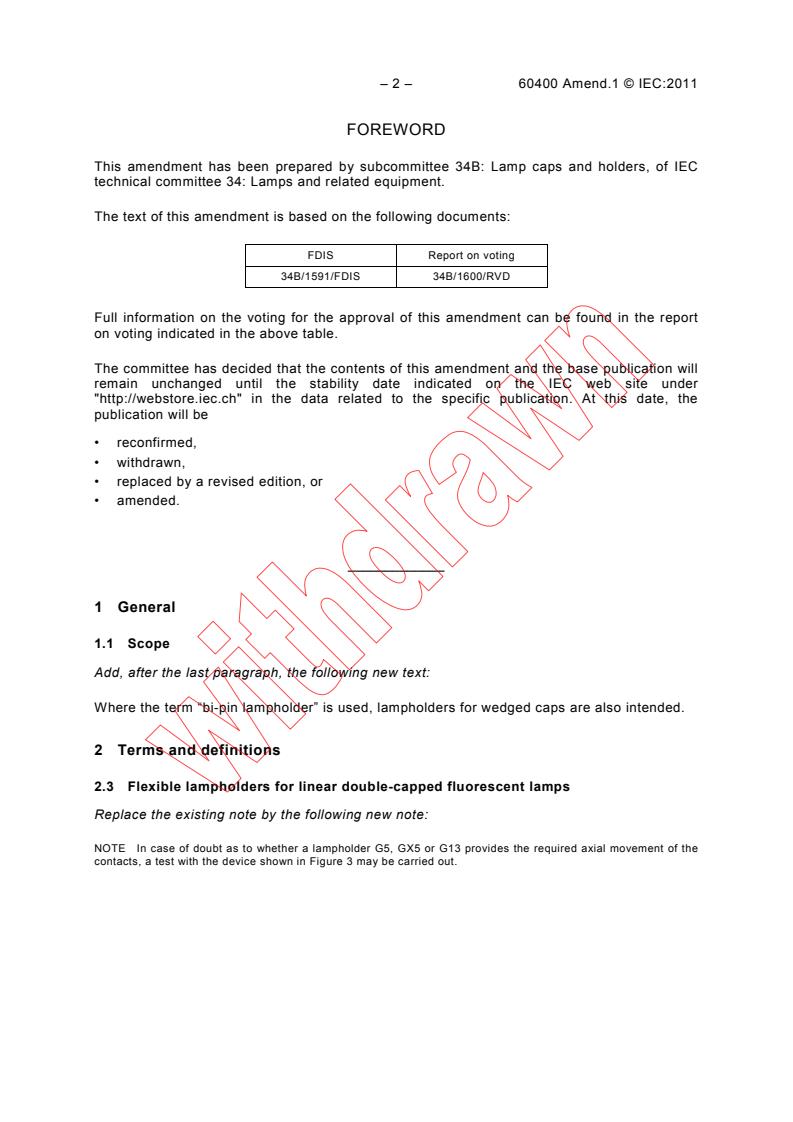
FOREWORD
This amendment has been prepared by subcommittee 34B: Lamp caps and holders, of IEC
technical committee 34: Lamps and related equipment.
The text of this amendment is based on the following documents:
FDIS Report on voting
34B/1591/FDIS 34B/1600/RVD
Full information on the voting for the approval of this amendment can be found in the report
on voting indicated in the above table.
The committee has decided that the contents of this amendment and the base publication will
remain unchanged until the stability date indicated on the IEC web site under
"http://webstore.iec.ch" in the data related to the specific publication. At this date, the
publication will be
• reconfirmed,
• withdrawn,
• replaced by a revised edition, or
• amended.
_____________
1 General
1.1 Scope
Add, after the last paragraph, the following new text:
Where the term “bi-pin lampholder” is used, lampholders for wedged caps are also intended.
2 Terms and definitions
2.3 Flexible lampholders for linear double-capped fluorescent lamps
Replace the existing note by the following new note:
NOTE In case of doubt as to whether a lampholder G5, GX5 or G13 provides the required axial movement of the
contacts, a test with the device shown in Figure 3 may be carried out.
60400 Amend.1 © IEC:2011 – 3 –
Add the following new definitions:
2.19
basic insulation
insulation applied to live parts to provide basic protection against electric shock
NOTE Basic insulation does not necessarily include insulation used exclusively for functional purposes.
2.20
supplementary insulation
independent insulation applied in addition to basic insulation in order to provide protection
against electric shock in the event of a failure of basic insulation
2.21
double insulation
insulation comprising both basic insulation and supplementary insulation
2.22
reinforced insulation
single insulation system applied to live parts, which provides a degree of protection against
electric shock equivalent to double insulation under the conditions specified
NOTE The term "insulation system" does not imply that the insulation must be one homogeneous piece. It may
comprise several layers which cannot be tested singly as supplementary or basic insulation.
2.23
enclosed reinforced insulated lampholder
lampholder for building-in so designed that on its own it fulfils the requirements for double or
reinforced insulated parts in class II applications
2.24
partly reinforced insulated lampholder
lampholder for building-in, so designed that some parts of the lampholder require additional
means to fulfil the requirements with regard to double or reinforced insulation
NOTE In some cases, the dimensions might be achieved only after mounting into the luminaire.
4 General conditions for tests
Replace, in 4.4, the paragraph following the second note (“In the case of …”) by the following
new paragraph:
In the case of flexible and inflexible lampholders G5, GX5 or G13 (see Definitions 2.3 and 2.4
respectively), the specimens are mounted on two pairs of mounting sheets as specified in
Figure 2.
5 Electrical rating
Replace the existing third dashed item by the following:
– not less than 2 A for lampholders GX5, G13, 2G8, 2G13, G20, Fa6, Fa8 and R17d.
– 4 – 60400 Amend.1 © IEC:2011
6 Classification
Replace the existing Subclause 6.1 by the following:
6.1 According to protection against electric shock:
− unenclosed lampholders;
− enclosed lampholders;
− independent lampholders;
− partly reinforced insulated lampholders;
− enclosed reinforced insulated lampholders.
NOTE Where a lampholder is used with a working voltage of 50 % or less of its maximum rating, it may be
regarded as equivalent to a reinforced insulated lampholder.
7 Marking
Add the following new note to Subclause 7.1 below item “b) type reference”:
NOTE Available technical documentation of the manufacturer like printed catalogues or online catalogues should
allow a clear identification of a lampholder either by a unique catalogue number or by an identifying reference on
the holder, specifying the essential characteristic features and the basic design of the product supplemented by a
clear description. Variations of the basic design like for example different cable length, fixing means, colours etc.,
which do not affect safety or performance of the lampholder, may be disregarded in the type reference marked on
the product. Variations included in the type testing procedure are listed in the corresponding test reports.
Replace, in Subclause 7.2, the fourth paragraph (“Lampholders and starterholders
complying…”), the note and the fifth paragraph by the following new text:
Enclosed reinforced insulated lampholders offer an adequate level of protection for use in
luminaires where they are accessible in normal use. This information shall be indicated in the
manufacturer’s catalogue ore the like.
For partly reinforced insulated lampholders, sufficient creepage distances and clearances to
outer accessible surfaces will require additional protection to some parts of the lampholder by
the luminaire design or by use of additional attachment(s) or cover(s). This information shall
be indicated in the manufacturer’s catalogue or the like.
8 Protection against electric shock
Replace, in Subclause 8.2, the third paragraph by the following:
In the case of side entry lampholders for linear G5, GX5 and G13 capped lamps, compliance
is checked:
– for lampholders G5 by means of gauge II as per IEC 60061-3, standard sheet 7006-47C,
and
– for lampholders GX5 by means of gauge II as per IEC 60061-3, standard sheet 7006-47E,
and
– for lampholders G13 by means of gauge II as per IEC 60061-3, standard sheet 7006-60C,
with the gauge face touching the lampholder face
60400 Amend.1 © IEC:2011 – 5 –
Add, in 8.2, after the second compliance paragraph (after Note 2), the following new dashed
item:
– for lampholders GX5, by means of the gauge as per IEC 60061-3, standard sheet
7006-47A, and in conjunction with gauge II as per IEC 60061-3, standard sheet 7006-47E
and the standard test finger shown in Figure 41;
10 Construction
Add, at the end of Subclause 10.2, the following new text:
Lampholders GX5 shall only be for side entry, requiring a single entry slot as shown in
Figures C.3 and C.4.
Lampholders GX5 shall be of flexible type or flexibly mounted. The maximum mounting
distance between a pair of GX5 lampholders without a lamp inserted shall be based on the
minimum lamp length as given in IEC 60081. This information shall be given in the lampholder
manufacturer’s or responsible vendor’s documents.
Replace item a) of Subclause 10.3.1 by the following:
10.3.1 a) For bi-pin lampholders G5, GX5, G13 and G20 making contact mainly along one
side of each pin of the cap, the contact force is measured with a single-ended gauge having
pin dimensions and pin distances according to the following sheets of IEC 60061-3:
– for lampholders G5: 7006-47B, gauges III and V;
– for lampholders GX5: 7006-47D, gauges IV and V;
– for lampholders G13: 7006-60B, gauges III and V;
– for lampholders G20: under consideration.
The contact force is between:
– 2 N and 30 N for lampholders not providing support for the lamp pins;
– 2 N and 35 N for lampholders G5 and GX5, when the lamp pins are supported by the
holder construction;
– 2 N and 45 N for lampholders G13 and G20, when the lamp pins are supported by the
holder construction.
First the maximum contact force is measured with a pin distance as shown for gauge V. This
is followed by measurement of the minimum contact force with the pin distance of gauge III for
lampholders G5 and G13 and with the pin distance of gauge IV for lampholders GX5.
Replace item d) of Subclause 10.3.1 by the following:
d) For bi-pin lampholders G5, GX5, G13 and G20 requiring a rotary motion for the insertion
and removal of the lamp, the torque required shall be measured with single-ended gauges
having pin dimensions and pin distances according to the following standard sheets of
IEC 60061-3:
– for lampholders G5: 7006-47B, gauge V, and a second gauge of the same dimensions
but with E and D changed to 2,44 mm and 4,4 mm respectively;
– for lampholders GX5: 7006-47D, gauge V, and a second gauge of the same dimensions
but with E2 and D changed to 2,75 mm and 4,4 mm respectively;
– for lampholders G13: 7006-60B, gauge V, and a second gauge of the same dimensions
but with E and D changed to 2,44 mm and 12,35 mm respectively;
– for lampholders G20: under consideration.
– 6 – 60400 Amend.1 © IEC:2011
The torque required to insert the gauges until the position representing the operating position
of the lamp is reached shall not exceed:
– 0,3 Nm for lampholders G5 and GX5;
– 0,5 Nm for lampholders G13 and G20.
The torque required to clear the gauges from the normal seated position shall be between:
– 0,02 Nm and 0,3 Nm for lampholders G5 and GX5;
– 0,1 Nm and 0,5 Nm for lampholders G13 and G20.
During complete removal of the gauges, the maximum values shall not be exceeded.
Add, to item a) of Subclause 10.5 a), the following new dashed items:
− 7005-51A: Mounting of combined pair of lampholders GX5
− 7005-82A: Lampholder 2GX11
− 7005-115: Lampholder W4.3x8.5d
− 7005-125: Lampholder 2GX13
− 7005-131: Lampholder GRZ10d
− 7005-132: Lampholder GRZ10t
− 7005-141: Lampholder 2G8
− 7005-142: Lampholder GX53
− 7005-156: Lampholder GR14q
− 7005-160: Lampholder G28d
Replace item d) of Subclause 10.5 by the following:
d) Compliance is checked as follows:
– For lampholders G5, GX5 and G13, with two pairs of matching holders mounted in the
mounting jig shown in Figure 1 and by use of the specified gauges, that is:
• for lampholders G5: "Go" gauges 7006-47C and the gauges for testing contact-
making 7006-47B;
• for lampholders GX5: "Go" gauges 7006-47E and the gauges for testing contact-
making 7006-47D;
• for lampholders G13: "Go" gauges 7006-60C and the gauges for testing contact-
making 7006-60B.
– Lampholders which, due to their design, do not allow testing in the mounting jig, and
flexibly mounted lampholders (see 2.5) shall be tested together with the relevant
luminaire and by use of the above gauges adapted to the specific lamp length
according to IEC 60081.
When testing holders, the force required to insert the "Go" gauge shall not exceed:
for lampholders G5 G13
– force in the direction of the lamp axis: 15 N 30 N
– force in the direction perpendicular under consideration under consideration
to the lamp axis:
___________
Not applicable for lampholders where the final seating position of the cap within the holder is reached without
an additional turning motion. These holders are already tested under 10.3.1 with single-ended gauges.
60400 Amend.1 © IEC:2011 – 7 –
When testing contact-making, the gauges are pushed in the direction of each of the holder
faces in turn with a force of:
– for lampholders G5 and GX5: 2 N;
– for lampholders G13: 5 N.
When testing in the mounting jig, this force can be achieved by vertical position of the gauge:
NOTE 3 For lampholders intended for use with more than one lamp at the same time, additional mass according
to the number of lamps is placed on the lampholder face.
– for lampholders R17d, by means of the gauges shown in standard sheets 7006-57A
and 7006-57B of IEC 60061-3;
– for lampholders Fa8, by means of the gauges shown in standard sheets 7006-58 and
7006-58G of IEC 60061-3;
– for lampholders 2G13, by means of the gauges shown in standard sheets 7006-33A
and 7006-33B of IEC 60061-3;
– for all other lampholders, by means of the relevant gauges shown in IEC 60061-3;
– for starterholders, by means of the gauges shown in Figures 11, 12 and 13;
– for starterholders intended for accepting only starters for class II luminaires,
dimensions V and W indicated in Figure 10a are measured in addition.
The manufacturer's mounting instructions shall show all information necessary for the correct
mounting of the holders.
For (multi-key) lampholders G24q and GX24q, allowing insertion of lamps with keys –3 and –4,
the lampholder manufacturer's documents shall include a warning notice about the restricted
application, stating that these holders may only be used with ballasts which are approved for
the operation of lamps with keys –3 and –4 (multilamp ballast).
NOTE 4 It is essential that the relevant safety and performance requirements are met with every lamp key.
11 Resistance to dust and moisture
Replace the penultimate and the last paragraph of Subclause 11.1 by the following:
The holders are mounted as in normal use and fitted either with test probes of minimum and
maximum diameter according to Figure 46 for which the holders are designed or, if available,
with lamps of the smallest and largest diameters as required by Figure 46.
Before the test, the holders are heated and brought to a stable operating temperature either
by operating the lamp or with the test probes by heating within the heating cabinet at a
temperature according to the T-marking or Tm-marking of the holder.
NOTE This test is for type test approval of the lampholder only and does not replace luminaire testing.
12 Insulation resistance and electrical strength
Add, in the third paragraph of Subclause 12.3, the following new dashed item to the existing
list:
– for enclosed and unenclosed reinforced insulated lampholders, the test voltage shall
be determined from Table 10.2 of IEC 60598-1.
– 8 – 60400 Amend.1 © IEC:2011
13 Endurance
Replace the existing fourth paragraph by the following:
After the test, the holder shall show no damage within the meaning of this standard and, being
fitted with a solid brass test cap or starter, complying with the corresponding Figures 6, 14 to
29, 39, 40 and 42 to 46, it is loaded for 1 h with rated current in an a. c. circuit of not more
than 6 V.
14 Mechanical strength
Change the heading of Subclause 14.1 to roman type.
Replace, in Subclause 14.3, the existing list of standard sheets by the following:
Gauges shall comply with the following standard sheets (see IEC 60061-3):
– 7006-47C, gauge I for lampholders G5;
– 7006-47E, gauge I for lampholders GX5;
– 7006-60C, gauge I for lampholders G13;
– 7006-33A: for lampholders 2G13;
– 7006-58: for lampholders Fa8;
– 7006-115: for lampholders W4.3x8.5d;
– gauges for other lampholders are under consideration.
After these tests, the lampholder shall show no damage.
60400 Amend.1 © IEC:2011 – 9 –
Table 3 – Minimum distances for a. c. (50 Hz/60 Hz) sinusoïdal voltages – Impulse
withstand category II
Replace the existing Table 3 by the following new table:
Rated voltage
Distances
V
mm
50 150 250 500
1 Between live parts of different polarity, and
2 Between live parts and external metal parts,
or the outer surface of parts of insulating
material which are permanently fixed to the
a
holder , including screws or devices for
fixing covers or fixing the holder to its
support:
Basic insulation
- Creepage distances
0,6 0,8 1,5 3
b
insulation PTI ≥ 600
1,2 1,6 2,5 5
b
PTI < 600
0,2 0,8 1,5 3
- Clearances
Reinforced Insulation
- 1,6 3 6
- Creepage distances
b
insulation PTI ≥ 600
- 3,2
5 6
b
PTI < 600
- 1,6 3 6
- Clearances
3 Between live parts and the mounting
surface or a loose metal cover, if any, if the
construction does not ensure that the
values under item 2 are maintained under
the most unfavourable circumstances:
- Clearances 0,6 0,8 1,5 3
In Japan, the values given in the table are not applicable. Japan requires larger values than
the values given in the table.
NOTE 1 The distances specified in the table apply to impulse withstand category II in accordance to IEC 60664-1
and refer to pollution degree 2, where normally only non-conductive pollution occurs but occasionally a temporary
conductivity caused by condensation must be expected. For information on distances for other impulse withstand
categories or higher pollution degrees, IEC 60598-1 and IEC 60664-1 should be consulted.
NOTE 2 Information on standard ratings for specific holder types is given in Clause 5.
NOTE 3 Values for creepage distances and clearances may be found for intermediate values of working voltages
by linear interpolation between tabulated values. No values are specified for working voltages below 25 V as the
voltage test of 12.3 is considered sufficient.
NOTE 4 Attention is drawn to the fact that the values for creepage distance and clearance given in this clause are
the absolute minimum.
a
The distances between live contacts and the lampholder face (reference plane) shall, however, be in
accordance with the relevant standard sheets of IEC 60061-2.
The distances for starter holders shall be in accordance with Figures 10 and 10a.
b
PTI (proof tracking index) in accordance with IEC 60112.
– In the case of creepage distances to parts not energized or not intended to be earthed, where no tracking can
occur, the values specified for material with PTI ≥ 600 apply for all materials (in spite of the real PTI).
– For creepage distances subjected to working voltages of less than 60 s duration, the values specified for
material with PTI ≥ 600 apply for all materials.
– For creepage distances not liable to contamination by dust or moisture, the values specified for material with
PTI ≥ 600 apply for all materials (independently of the real PTI).
– 10 – 60400 Amend.1 © IEC:2011
17 Resistance to heat, fire and tracking
Replace, in item b) of Subclause 17.1, the paragraph following Note 1 by the following new
paragraph:
G5 and GX5 lampholders are placed on a steel test cap with dimensions according to
Figure 9a.
Figure 1 – Mounting jig for the testing of lampholders
Replace footnote 1) below the table by the following:
1)
Z = 69,5 mm for testing lampholders G5 (derived from dimension Amax of a 4 W lamp, see IEC 60081). This
dimension is also applicable for testing GX5 lampholders.
Figure 3 – Fixture for the testing of lampholder flexibility
Replace the penultimate sentence of the testing clause by the following:
The force required shall not exceed 15 N for lampholders G5 and GX5 and 30 N for lampholders G13.
Figure 4 – Test caps G5 and G13
Replace the table and the title of the figure by the following table and title:
Dimension
Reference mm Tolerance
G5 and G13 mm
GX5
2) 15,5 25,6
± 0,1
A
D 4,75 12,7
± 0,05
E 2,37
± 0,02
F 7,1
± 0,05
2) 35,0 ± 0,1
H
+ 0,3
2) 0,5
r
– 0,0
2)
These test caps differ from the test caps used in Clause 14
by the material and the additional dimensions A, H and r.
1)
This part of the gauge and the cap pins shall be of hardened steel.
Figure 4 – Test caps G5, GX5 and G13
Delete the footnote with the asterisk.
60400 Amend.1 © IEC:2011 – 11 –
Figure 9a – Test cap and test assembly for testing of resistance to heat
of lampholders G5 with T marking (see 17.1)
Replace the existing figure and title by the following:
Thickness not less than 2 mm
Test cap carrier 1)
f
n
Test cap
Material: steel
Mass
100 g
Heat source - available space
Thermocouples
Lampholder
175 + 1*
20 ± 0,2*
20 ± 0,2*
25 ± 0,2*
45 ± 0,2*
a a
e (2x)
d b d b
e2 (2x)
e1 (2x)
IEC 712/11
Lampholders G5 Lampholders GX5
Test cap Tolerance
Reference
The test cap shall be provided with an internal heat source, for
mm mm
example a cartridge heater which provides equal heat
+ 0,0
distribution over the front side of the test cap.
a 15,75
– 0,1
+ 0,0
1)
2) Test cap and test cap carrier need not be separated parts.
b 16,0
– 0,1
2)
Dimension b refers to the nominal lamp diameters. It does
+ 0,05
not take into account the possible eccentricity of the caps
d 4,75
– 0,05
referred to the lamp tube.
+ 0,05
e 2,5
– 0,05
* Recommended design values for the test cap carrier.
+ 0,05
Adoption of these values will serve the unification of test
e1 1,6
– 0,05
devices.
+ 0,05
e2 2,75
– 0,05
+ 0,0
f 7,1
– 0,1
+ 0,1
n 8,71
– 0,0
Figure 9a – Test cap and test assembly for testing of resistance to heat
of lampholders G5 and GX5 with T marking (see 17.1)
– 12 – 60400 Amend.1 © IEC:2011
Add, after Figure 14, the following new Figure 14a:
E1
E
F
E/2
D
IEC 713/11
Dimension Tolerance
Reference
mm mm
D 4,75 ± 0,05
E 2,69
± 0,02
E1 1,6
± 0,05
F 7,1
± 0,05
Figure 14a – Test cap for the test of Clause 13 for lampholders GX5
60400 Amend.1 © IEC:2011 – 13 –
Add, after Figure 41, the following new Figures 42 to 46:
D
F
N
N
R1
R R
E
IEC 714/11
Dimension Tolerance
Reference
mm mm
D 4,2
± 0,05
E 1,0
± 0,02
F 5,0
± 0,05
N 4,3
± 0,05
R 0,3 ± 0,1
R1 0,8 ± 0,1
Figure 42 – Test cap for the test of Clause 13 for lampholders W4.3x8.5d
– 14 – 60400 Amend.1 © IEC:2011
D
F
J
E
IEC 715/11
Dimension Tolerance
Reference
mm mm
D 14
± 0,05
E 2,37
± 0,02
F 5,0
± 0,05
J 0,5 ± 0,1
Figure 43 – Test cap for the test of Clause 13 for lampholders GR14q
60400 Amend.1 © IEC:2011 – 15 –
D
F
J
E
IEC 716/11
Dimension Tolerance
Reference
mm mm
D 28
± 0,05
E 2,37
± 0,02
F 5,0 ± 0,05
J 0,5 ± 0,1
Figure 44 – Test cap for the test of Clause 13 for lampholders G28d
– 16 – 60400 Amend.1 © IEC:2011
D(2x)
B1 B
A
A1
F
J
E
IEC 717/11
Dimension Tolerance
Reference
mm mm
A 22
± 0,05
A1 43,6 ± 0,05
B 23,4
± 0,05
B1 14,8
± 0,05
D 11
± 0,05
E 2,37
± 0,02
F 6,4
± 0,05
J 0,5 ± 0,1
Figure 45 – Test cap for the test of Clause 13 for lampholders 2GX11
60400 Amend.1 © IEC:2011 – 17 –
Marking
IEC 718/11
Dimensions in mm
Dimension for nominal lamp diameter 2) 3)
Reference Tolerance
16 26 28 32 38
+ 0,01
A1
16,7 26,5 29,5 34,0 39,0
- 0,01
+ 0,01
A2
15,3 24,5 26,5 31,0 36,0
- 0,01
15 nominal
N 1)
+ 0,1
R 0,5
- 0,1
1) This part of the gauge shall not be used for sealing checking as in this area the glass tube of the lamp is not
defined in shape and tolerance. The test probe has to be fully inserted into the holder and the sealing position
shall not be within dimension N
2) Values for other nominal diameters are under consideration.
3) Coated lamps, e.g. fragment retention lamps, may need other dimen
...