

IEC 61869-13:2021
(Main)Instrument transformers - Part 13: Stand-alone merging unit (SAMU)
General Information
- Abstract
IEC 61869-13:2021 is a product standard and covers only additional requirements for stand-alone merging units (SAMUs) used for AC applications having rated frequencies from 15 Hz to 100 Hz. The digital output format specification is not covered by this document; it is standardized in IEC 61869-9 as an application of IEC 61850, which specifies the power utility communication architecture.
This document covers SAMUs having standardized analogue inputs (for example: 1 A, 5 A, 3,25 V / √3 or 100 V / √3) provided by instrument transformers compliant with relevant product standards (e.g. IEC 61869-2 to IEC 61869-5, IEC 61869-7, IEC 61869-8, IEC 61869-10, IEC 61869-11, IEC 60044-1 to IEC 60044-6, IEC 60185, IEC 60186, IEEE C57.13), and aims to convert them to the digital output compliant with IEC 61869-9. Other input and output types are outside the scope of this document. Appropriate SAMU functionality can be combined with switchgear controller functionality defined in IEC 62271-3 or other IED functionality defined in IEC 60255 (all parts).
Cyber security requirements are outside the scope of this document and are covered by the IEC 62351 series.
IEC 61869-13:2021 is to be used in conjunction with IEC 61869-9:2016, Digital interface for instrument transformers, and IEC 618696:2016, Additional general requirements for low-power instrument transformers, which, in turn, are based on IEC 61869-1:2007, General requirements.
- Status
- Published
- Publication Date
- 02-Feb-2021
- Technical Committee
- TC 38 - Instrument Transformers
- Drafting Committee
- WG 37 - TC 38/WG 37
- Current Stage
- PPUB - Publication issued
- Start Date
- 03-Feb-2021
- Completion Date
- 28-Aug-2026
Overview
IEC 61869-13:2021 is an international product standard developed by the International Electrotechnical Commission (IEC) that specifies additional requirements for stand-alone merging units (SAMUs) used in alternating current (AC) applications with rated frequencies ranging from 15 Hz to 100 Hz. SAMUs serve as critical digital interfaces that convert standardized analogue inputs from instrument transformers into digital outputs compliant with IEC 61869-9, facilitating advanced power utility communication architectures based on IEC 61850. This standard is intended to be used alongside IEC 61869-9:2016 and IEC 61869-6:2016, which provide digital interface and low-power instrument transformer requirements, respectively.
IEC 61869-13 focuses exclusively on SAMUs with analogue inputs such as 1 A, 5 A, 3.25 V/√3, or 100 V/√3, supplied by instrument transformers compliant with related standards including IEC 61869 parts 2 to 5, 7, 8, 10, 11, IEC 60044 series, IEC 60185, IEC 60186, and IEEE C57.13. Cybersecurity aspects are outside its scope and are covered by the IEC 62351 series.
Key Topics
- Scope and Applicability: Targets stand-alone merging units in AC power systems with a focus on standardized analogue inputs and their conversion to digital signals.
- Design and Construction: Sets guidelines for SAMU construction, ensuring compatibility with instrument transformers and operational reliability under normal and special service conditions.
- Accuracy and Performance: Defines measuring accuracy classes and limits for current and voltage channels of SAMUs, including limits for protection and metering purposes.
- Testing Requirements: Details comprehensive tests such as electromagnetic compatibility (EMC), environmental tests (heat, cold, humidity), and operational cycles to ensure device robustness and reliability.
- Safety: Outlines safety requirements to protect equipment, operators, and system integrity during normal operation and fault conditions.
- Integration with Other Equipment: Describes how SAMUs can be combined with switchgear controllers (IEC 62271-3) or Intelligent Electronic Devices (IEDs) per IEC 60255 to enhance system functionality.
Applications
IEC 61869-13:2021 plays a vital role in modern electrical power systems by enabling:
- Digital Substation Automation: SAMUs act as critical nodes converting analogue measurements to digital data for intelligent control and monitoring of substations.
- Enhanced Protection and Control: With precise and reliable signal conversion, SAMUs support accurate protective relaying and switchgear control functions.
- Improved Data Integration: Facilitates integration into IEC 61850-based digital communication networks, optimizing power system data exchange, fault analysis, and operational efficiency.
- Retrofit and Upgrade Projects: Assists utilities in upgrading existing instrument transformer setups with digital interface capabilities without comprehensive hardware changes.
- Low-Power Instrument Transformer Systems: Supports advanced measurement chains ensuring safer, efficient, and higher accuracy data acquisition.
Related Standards
- IEC 61869-1:2007 - General requirements for instrument transformers providing the foundational principles followed by IEC 61869-13.
- IEC 61869-6:2016 - Additional general requirements for low-power instrument transformers that complement stand-alone merging unit specifications.
- IEC 61869-9:2016 - Defines digital interface requirements for instrument transformers and standardizes digital output formats.
- IEC 62271-3 - Switchgear controller functionality which can be integrated with SAMU features to enhance digital substation roles.
- IEC 60255 - Covers IED functionality relevant to protection, monitoring, and controlling electrical power equipment.
- IEC 62351 series - Cybersecurity requirements applicable to power system communications and data integrity, complementing but not covered by IEC 61869-13.
IEC 61869-13:2021 establishes essential technical and performance criteria ensuring that stand-alone merging units operate reliably within digitalized power systems. By adhering to this standard, manufacturers and utilities can guarantee interoperability, accuracy, and safety in measurement and control functions critical to modern electrical grids.
Get Certified
Connect with accredited certification bodies for this standard

BSMI (Bureau of Standards, Metrology and Inspection)
Taiwan's standards and inspection authority.
Sponsored listings
Frequently Asked Questions
IEC 61869-13:2021 is a standard published by the International Electrotechnical Commission (IEC). Its full title is "Instrument transformers - Part 13: Stand-alone merging unit (SAMU)". This standard covers: IEC 61869-13:2021 is a product standard and covers only additional requirements for stand-alone merging units (SAMUs) used for AC applications having rated frequencies from 15 Hz to 100 Hz. The digital output format specification is not covered by this document; it is standardized in IEC 61869-9 as an application of IEC 61850, which specifies the power utility communication architecture. This document covers SAMUs having standardized analogue inputs (for example: 1 A, 5 A, 3,25 V / √3 or 100 V / √3) provided by instrument transformers compliant with relevant product standards (e.g. IEC 61869-2 to IEC 61869-5, IEC 61869-7, IEC 61869-8, IEC 61869-10, IEC 61869-11, IEC 60044-1 to IEC 60044-6, IEC 60185, IEC 60186, IEEE C57.13), and aims to convert them to the digital output compliant with IEC 61869-9. Other input and output types are outside the scope of this document. Appropriate SAMU functionality can be combined with switchgear controller functionality defined in IEC 62271-3 or other IED functionality defined in IEC 60255 (all parts). Cyber security requirements are outside the scope of this document and are covered by the IEC 62351 series. IEC 61869-13:2021 is to be used in conjunction with IEC 61869-9:2016, Digital interface for instrument transformers, and IEC 618696:2016, Additional general requirements for low-power instrument transformers, which, in turn, are based on IEC 61869-1:2007, General requirements.
IEC 61869-13:2021 is a product standard and covers only additional requirements for stand-alone merging units (SAMUs) used for AC applications having rated frequencies from 15 Hz to 100 Hz. The digital output format specification is not covered by this document; it is standardized in IEC 61869-9 as an application of IEC 61850, which specifies the power utility communication architecture. This document covers SAMUs having standardized analogue inputs (for example: 1 A, 5 A, 3,25 V / √3 or 100 V / √3) provided by instrument transformers compliant with relevant product standards (e.g. IEC 61869-2 to IEC 61869-5, IEC 61869-7, IEC 61869-8, IEC 61869-10, IEC 61869-11, IEC 60044-1 to IEC 60044-6, IEC 60185, IEC 60186, IEEE C57.13), and aims to convert them to the digital output compliant with IEC 61869-9. Other input and output types are outside the scope of this document. Appropriate SAMU functionality can be combined with switchgear controller functionality defined in IEC 62271-3 or other IED functionality defined in IEC 60255 (all parts). Cyber security requirements are outside the scope of this document and are covered by the IEC 62351 series. IEC 61869-13:2021 is to be used in conjunction with IEC 61869-9:2016, Digital interface for instrument transformers, and IEC 618696:2016, Additional general requirements for low-power instrument transformers, which, in turn, are based on IEC 61869-1:2007, General requirements.
IEC 61869-13:2021 is classified under the following ICS (International Classification for Standards) categories: 17.220.20 - Measurement of electrical and magnetic quantities. The ICS classification helps identify the subject area and facilitates finding related standards.
IEC 61869-13:2021 is available in PDF format for immediate download after purchase. The document can be added to your cart and obtained through the secure checkout process. Digital delivery ensures instant access to the complete standard document.
Standards Content (Sample)
IEC 61869-13 ®
Edition 1.0 2021-02
INTERNATIONAL
STANDARD
NORME
INTERNATIONALE
colour
inside
Instrument transformers –
Part 13: Stand-alone merging unit (SAMU)
Transformateurs de mesure –
Partie 13: Concentrateur autonome (SAMU)
All rights reserved. Unless otherwise specified, no part of this publication may be reproduced or utilized in any form
or by any means, electronic or mechanical, including photocopying and microfilm, without permission in writing from
either IEC or IEC's member National Committee in the country of the requester. If you have any questions about IEC
copyright or have an enquiry about obtaining additional rights to this publication, please contact the address below or
your local IEC member National Committee for further information.
Droits de reproduction réservés. Sauf indication contraire, aucune partie de cette publication ne peut être reproduite
ni utilisée sous quelque forme que ce soit et par aucun procédé, électronique ou mécanique, y compris la photocopie
et les microfilms, sans l'accord écrit de l'IEC ou du Comité national de l'IEC du pays du demandeur. Si vous avez des
questions sur le copyright de l'IEC ou si vous désirez obtenir des droits supplémentaires sur cette publication, utilisez
les coordonnées ci-après ou contactez le Comité national de l'IEC de votre pays de résidence.
IEC Central Office Tel.: +41 22 919 02 11
3, rue de Varembé info@iec.ch
CH-1211 Geneva 20 www.iec.ch
Switzerland
About the IEC
The International Electrotechnical Commission (IEC) is the leading global organization that prepares and publishes
International Standards for all electrical, electronic and related technologies.
About IEC publications
The technical content of IEC publications is kept under constant review by the IEC. Please make sure that you have the
latest edition, a corrigendum or an amendment might have been published.
IEC publications search - webstore.iec.ch/advsearchform IEC online collection - oc.iec.ch
The advanced search enables to find IEC publications by a Discover our powerful search engine and read freely all the
variety of criteria (reference number, text, technical publications previews. With a subscription you will always
committee, …). It also gives information on projects, replaced have access to up to date content tailored to your needs.
and withdrawn publications.
Electropedia - www.electropedia.org
IEC Just Published - webstore.iec.ch/justpublished
The world's leading online dictionary on electrotechnology,
Stay up to date on all new IEC publications. Just Published
containing more than 22 000 terminological entries in English
details all new publications released. Available online and
and French, with equivalent terms in 18 additional languages.
once a month by email.
Also known as the International Electrotechnical Vocabulary
(IEV) online.
IEC Customer Service Centre - webstore.iec.ch/csc
If you wish to give us your feedback on this publication or
need further assistance, please contact the Customer Service
Centre: sales@iec.ch.
A propos de l'IEC
La Commission Electrotechnique Internationale (IEC) est la première organisation mondiale qui élabore et publie des
Normes internationales pour tout ce qui a trait à l'électricité, à l'électronique et aux technologies apparentées.
A propos des publications IEC
Le contenu technique des publications IEC est constamment revu. Veuillez vous assurer que vous possédez l’édition la
plus récente, un corrigendum ou amendement peut avoir été publié.
Recherche de publications IEC - IEC online collection - oc.iec.ch
webstore.iec.ch/advsearchform Découvrez notre puissant moteur de recherche et consultez
La recherche avancée permet de trouver des publications IEC gratuitement tous les aperçus des publications. Avec un
en utilisant différents critères (numéro de référence, texte, abonnement, vous aurez toujours accès à un contenu à jour
comité d’études, …). Elle donne aussi des informations sur adapté à vos besoins.
les projets et les publications remplacées ou retirées.
Electropedia - www.electropedia.org
IEC Just Published - webstore.iec.ch/justpublished
Le premier dictionnaire d'électrotechnologie en ligne au
Restez informé sur les nouvelles publications IEC. Just
monde, avec plus de 22 000 articles terminologiques en
Published détaille les nouvelles publications parues.
anglais et en français, ainsi que les termes équivalents dans
Disponible en ligne et une fois par mois par email.
16 langues additionnelles. Egalement appelé Vocabulaire
Electrotechnique International (IEV) en ligne.
Service Clients - webstore.iec.ch/csc
Si vous désirez nous donner des commentaires sur cette
publication ou si vous avez des questions contactez-nous:
sales@iec.ch.
IEC 61869-13 ®
Edition 1.0 2021-02
INTERNATIONAL
STANDARD
NORME
INTERNATIONALE
colour
inside
Instrument transformers –
Part 13: Stand-alone merging unit (SAMU)
Transformateurs de mesure –
Partie 13: Concentrateur autonome (SAMU)
INTERNATIONAL
ELECTROTECHNICAL
COMMISSION
COMMISSION
ELECTROTECHNIQUE
INTERNATIONALE
ICS 17.220.20 ISBN 978-2-8322-9284-6
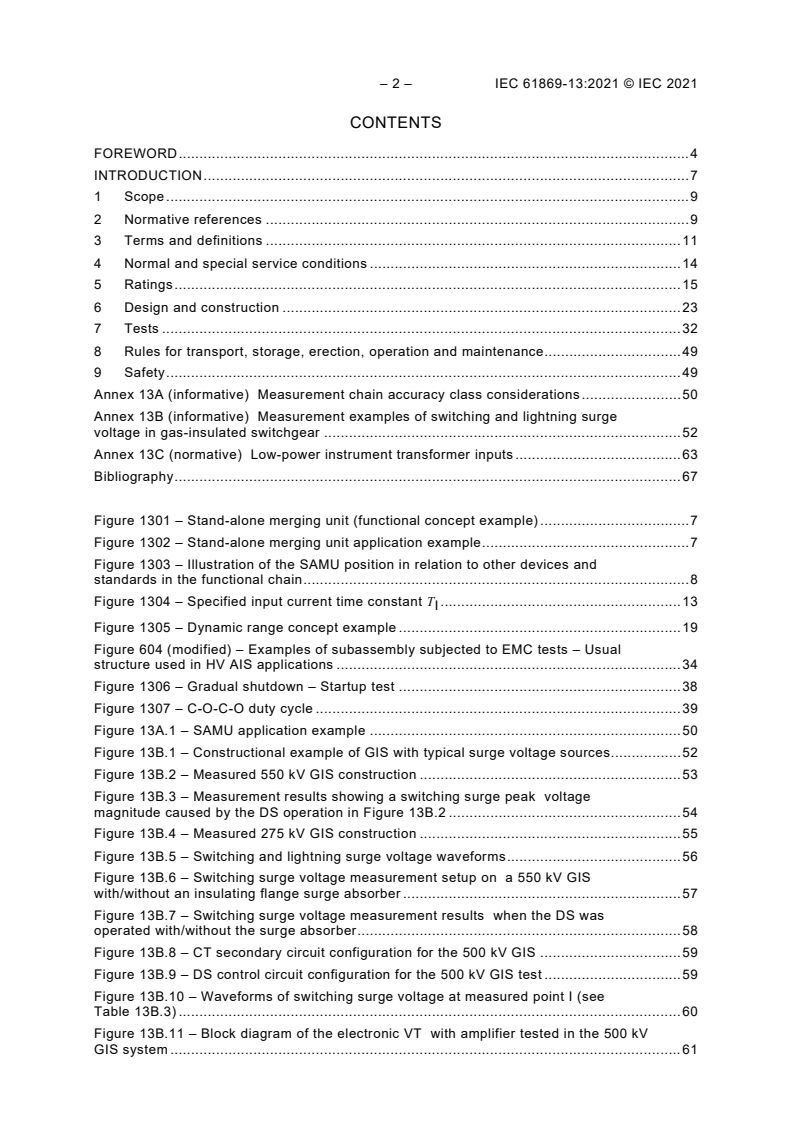
– 2 – IEC 61869-13:2021 © IEC 2021
CONTENTS
FOREWORD . 4
INTRODUCTION . 7
1 Scope . 9
2 Normative references . 9
3 Terms and definitions . 11
4 Normal and special service conditions . 14
5 Ratings . 15
6 Design and construction . 23
7 Tests . 32
8 Rules for transport, storage, erection, operation and maintenance . 49
9 Safety . 49
Annex 13A (informative) Measurement chain accuracy class considerations . 50
Annex 13B (informative) Measurement examples of switching and lightning surge
voltage in gas-insulated switchgear . 52
Annex 13C (normative) Low-power instrument transformer inputs . 63
Bibliography . 67
Figure 1301 – Stand-alone merging unit (functional concept example) . 7
Figure 1302 – Stand-alone merging unit application example . 7
Figure 1303 – Illustration of the SAMU position in relation to other devices and
standards in the functional chain . 8
Figure 1304 – Specified input current time constant T . 13
I
Figure 1305 – Dynamic range concept example . 19
Figure 604 (modified) – Examples of subassembly subjected to EMC tests – Usual
structure used in HV AIS applications . 34
Figure 1306 – Gradual shutdown – Startup test . 38
Figure 1307 – C-O-C-O duty cycle . 39
Figure 13A.1 – SAMU application example . 50
Figure 13B.1 – Constructional example of GIS with typical surge voltage sources. 52
Figure 13B.2 – Measured 550 kV GIS construction . 53
Figure 13B.3 – Measurement results showing a switching surge peak voltage
magnitude caused by the DS operation in Figure 13B.2 . 54
Figure 13B.4 – Measured 275 kV GIS construction . 55
Figure 13B.5 – Switching and lightning surge voltage waveforms . 56
Figure 13B.6 – Switching surge voltage measurement setup on a 550 kV GIS
with/without an insulating flange surge absorber . 57
Figure 13B.7 – Switching surge voltage measurement results when the DS was
operated with/without the surge absorber . 58
Figure 13B.8 – CT secondary circuit configuration for the 500 kV GIS . 59
Figure 13B.9 – DS control circuit configuration for the 500 kV GIS test . 59
Figure 13B.10 – Waveforms of switching surge voltage at measured point I (see
Table 13B.3) . 60
Figure 13B.11 – Block diagram of the electronic VT with amplifier tested in the 500 kV
GIS system . 61
Figure 13B.12 – Lightning surge voltage as a function of surge absorbing capacitor value . 61
Figure 13B.13 – Lightning surge voltage as a function of coaxial cable length . 62
Table 1301 – Insulation requirements for analogue inputs . 16
Table 1302 – Measuring accuracy class 0,05 . 17
Table 1303 – Limits of current error and phase error for SAMU measuring accuracy
current channels . 18
Table 1304 – Limits of current errors for SAMU TPM class rated protection accuracy
current channels . 20
Table 1305 – Limits of voltage error and phase error for SAMU voltage channels . 21
Table 1306 – SAMU TCTR class settings . 23
Table 1307 – SAMU TVTR class settings . 23
Table 1308 – Immunity requirements and tests . 24
Table 1309 – Acceptance criteria for EMC immunity tests . 25
Table 1310 – Radiated emissions tests . 27
Table 1311 – Conducted emissions tests . 27
Table 1312 – SAMU rating plate markings . 28
Table 1313 – Ratings defined in accordance with IEC 61850-7-4 . 32
Table 10 – List of tests. 33
Table 1314 – Dry-heat test – Operational . 44
Table 1315 – Cold test – Operational . 44
Table 1316 – Dry-heat test at maximum storage temperature . 45
Table 1317 – Cold test at minimum storage temperature . 45
Table 1318 – Change of temperature (Cyclic temperature test) . 46
Table 1319 – Damp heat steady state test . 47
Table 1320 – Cyclic temperature with humidity test . 48
Table 13A.1 – Combined accuracy class table . 50
Table 13B.1 – Measurement results showing switching and lightning surge voltage
recorded for the setup in Figure 13B.4 . 55
Table 13B.2 – Measurement results of switching surge voltage on CT secondary circuit . 59
Table 13B.3 – Measurement results showing the switching surge voltage coupling to
the DS control circuit . 59
Table 13C.1 – ITRat setting units . 65
Table 13C.2 – SAMU rating plate marking modifications . 65
– 4 – IEC 61869-13:2021 © IEC 2021
INTERNATIONAL ELECTROTECHNICAL COMMISSION
____________
INSTRUMENT TRANSFORMERS –
Part 13: Stand-alone merging unit (SAMU)
FOREWORD
1) The International Electrotechnical Commission (IEC) is a worldwide organization for standardization comprising
all national electrotechnical committees (IEC National Committees). The object of IEC is to promote international
co-operation on all questions concerning standardization in the electrical and electronic fields. To this end and
in addition to other activities, IEC publishes International Standards, Technical Specifications, Technical Reports,
Publicly Available Specifications (PAS) and Guides (hereafter referred to as "IEC Publication(s)"). Their
preparation is entrusted to technical committees; any IEC National Committee interested in the subject dealt with
may participate in this preparatory work. International, governmental and non-governmental organizations liaising
with the IEC also participate in this preparation. IEC collaborates closely with the International Organization for
Standardization (ISO) in accordance with conditions determined by agreement between the two organizations.
2) The formal decisions or agreements of IEC on technical matters express, as nearly as possible, an international
consensus of opinion on the relevant subjects since each technical committee has representation from all
interested IEC National Committees.
3) IEC Publications have the form of recommendations for international use and are accepted by IEC National
Committees in that sense. While all reasonable efforts are made to ensure that the technical content of IEC
Publications is accurate, IEC cannot be held responsible for the way in which they are used or for any
misinterpretation by any end user.
4) In order to promote international uniformity, IEC National Committees undertake to apply IEC Publications
transparently to the maximum extent possible in their national and regional publications. Any divergence between
any IEC Publication and the corresponding national or regional publication shall be clearly indicated in the latter.
5) IEC itself does not provide any attestation of conformity. Independent certification bodies provide conformity
assessment services and, in some areas, access to IEC marks of conformity. IEC is not responsible for any
services carried out by independent certification bodies.
6) All users should ensure that they have the latest edition of this publication.
7) No liability shall attach to IEC or its directors, employees, servants or agents including individual experts and
members of its technical committees and IEC National Committees for any personal injury, property damage or
other damage of any nature whatsoever, whether direct or indirect, or for costs (including legal fees) and
expenses arising out of the publication, use of, or reliance upon, this IEC Publication or any other IEC
Publications.
8) Attention is drawn to the Normative references cited in this publication. Use of the referenced publications is
indispensable for the correct application of this publication.
9) Attention is drawn to the possibility that some of the elements of this IEC Publication may be the subject of patent
rights. IEC shall not be held responsible for identifying any or all such patent rights.
International Standard IEC 61869-13 has been prepared by IEC technical committee 38:
Instrument transformers.
The text of this International Standard is based on the following documents:
FDIS Report on voting
38/634/FDIS 38/640/RVD
Full information on the voting for the approval of this International Standard can be found in the
report on voting indicated in the above table.
This document has been drafted in accordance with the ISO/IEC Directives, Part 2.
A list of all parts in the IEC 61869 series, published under the general title Instrument
transformers, can be found on the IEC website.
This Part 13 is to be used in conjunction with IEC 61869-9:2016, Digital interface for instrument
transformers, and IEC 61869-6:2016, Additional general requirements for low-power instrument
transformers, which, in turn, are based on IEC 61869-1:2007, General requirements.
This Part 13 follows the structure of IEC 61869-1:2007 and IEC 61869-6:2016 and supplements
or modifies their corresponding clauses.
When a particular clause/subclause of Part 1 or Part 6 is not mentioned in this Part 13, that
subclause applies. When this document states "addition", "modification" or "replacement", the
relevant text in Part 1 or Part 6 is to be adapted accordingly.
For additional clauses, subclauses, figures, tables, annexes or note, the following numbering
system is used:
– clauses, subclauses, tables, figures and notes that are numbered starting from 1301 are
additional to those in Part 1 and Part 6;
– additional annexes are lettered 13A, 13B, etc.
An overview of the planned set of standards at the date of publication of this document is given
below. The updated list of standards issued by IEC TC 38 is available at the website:
www.iec.ch.
– 6 – IEC 61869-13:2021 © IEC 2021
PRODUCT FAMILY STANDARDS PRODUCT PRODUCTS OLD
IEC STANDARD STANDARD
IEC IEC
61869-1 61869-2 ADDITIONAL REQUIREMENTS FOR 60044-1
CURRENT TRANSFORMERS 60044-6
GENERAL
REQUIREMENTS
61869-3 ADDITIONAL REQUIREMENTS FOR 60044-2
FOR
INDUCTIVE VOLTAGE TRANSFORMERS
INSTRUMENT
61869-4 ADDITIONAL REQUIREMENTS FOR 60044-3
TRANSFORMERS
COMBINED TRANSFORMERS
ADDITIONAL REQUIREMENTS FOR
61869-5 60044-5
CAPACITOR VOLTAGE TRANSFORMERS
61869-6 61869-7 ADDITIONAL REQUIREMENTS FOR 60044-7
ELECTRONIC VOLTAGE
ADDITIONAL
TRANSFORMERS
GENERAL
REQUIREMENTS 61869-8 ADDITIONAL REQUIREMENTS FOR 60044-8
FOR LOW-POWER
ELECTRONIC CURRENT
INSTRUMENT
TRANSFORMERS
TRANSFORMERS
61869-9 DIGITAL INTERFACE FOR INSTRUMENT
TRANSFORMERS
61869-10 ADDITIONAL REQUIREMENTS FOR
LOW-POWER PASSIVE CURRENT
TRANSFORMERS
61869-11 ADDITIONAL REQUIREMENTS FOR 60044-7
LOW-POWER PASSIVE VOLTAGE
TRANSFORMERS
61869-12 ADDITIONAL REQUIREMENTS FOR
COMBINED ELECTRONIC INSTRUMENT
TRANSFORMERS AND COMBINED
STAND-ALONE SENSORS
61869-13 STAND-ALONE MERGING UNIT
61869-14 ADDITIONAL REQUIREMENTS FOR
CURRENT TRANSFORMERS FOR DC
APPLICATIONS
61869-15 ADDITIONAL REQUIREMENTS FOR
VOLTAGE TRANSFORMERS FOR DC
APPLICATIONS
The committee has decided that the contents of this document will remain unchanged until the
stability date indicated on the IEC website under "http://webstore.iec.ch" in the data related to
the specific document. At this date, the document will be
• reconfirmed,
• withdrawn,
• replaced by a revised edition, or
• amended.
IMPORTANT – The "colour inside" logo on the cover page of this document indicates
that it contains colours which are considered to be useful for the correct understanding
of its contents. Users should therefore print this document using a colour printer.
INTRODUCTION
General
This document is an IEC 61869 series product standard which defines additional requirements
for a stand-alone merging unit (SAMU).
The general block diagram showing a typical SAMU application example is given in Figure 1301.
Figure 1301 – Stand-alone merging unit (functional concept example)
An application example showing a three-phase dead tank circuit breaker equipped with bushing
type current transformers and a stand-alone merging unit mounted inside the breaker control
cabinet is shown in Figure 1302.
Figure 1302 – Stand-alone merging unit application example
The SAMU output may be used by many devices and is therefore of interest to multiple technical
committees in addition to TC 38, for example: TC 57: Power systems management and
– 8 – IEC 61869-13:2021 © IEC 2021
associated information exchange, TC 95: Measuring relays and protection equipment, TC 13:
Electrical energy measurement and control, TC 85: Measuring equipment for electrical and
electromagnetic quantities, and TC 17: High-voltage switchgear and controlgear, as shown in
Figure 1303.
Figure 1303 – Illustration of the SAMU position in relation
to other devices and standards in the functional chain
Position of this document in relation to IEC 61850 (all parts) of TC 57
IEC 61850 (all parts) is a series used to define various aspects of power utility communications.
Its applicability to this document is inherited through IEC 61869-9 which defines applicable
sample rates and a digital interface in accordance with IEC 61850-9-2 and related standards.
Position of this document in relation to IEC 60255 (all parts) of TC 95
IEC 60255 (all parts) standardizes the design and performance aspects applicable to measuring
relays and protection equipment used in the various fields of electrical engineering. Since the
SAMU is an integral part of the digital substation-based protection system, its EMC performance
and environmental aspects are considered for harmonization with IEC 60255-1, IEC 60255-26
and safety aspects defined in IEC 60255-27. SAMU outputs are inputs for protection functions
covered by the IEC 60255-1xx series.
Position of this document in relation to IEC 62052 (all parts) and IEC 62053 (all parts) of
TC 13
IEC 62052 (all parts) and IEC 62053 (all parts) provide standardization in the field of AC and
DC electrical energy measurement and control. Since the SAMU digital output may be used as
input to energy measurement devices, its accuracy and EMC performance aspects should be
considered.
Position of this document in relation to IEC 62271 (all parts) of TC 17
IEC 62271 (all parts) applies to AC switchgear and controlgear designed for indoor and/or
outdoor installation and for operation at service frequencies up to and including 60 Hz on
systems having rated voltages above 1 000 V. Similar to IEC 62271-3 which defines the
switchgear interface based on IEC 61850, this document defines the SAMU which may be
installed inside the same switchgear cabinet and is therefore subject to the same environmental
stress.
INSTRUMENT TRANSFORMERS –
Part 13: Stand-alone merging unit (SAMU)
1 Scope
Clause 1 of IEC 61869-1:2007 is replaced by the following:
This part of IEC 61869 is a product standard and covers only additional requirements for stand-
alone merging units (SAMUs) used for AC applications having rated frequencies from 15 Hz to
100 Hz. The digital output format specification is not covered by this document; it is
standardized in IEC 61869-9 as an application of IEC 61850, which specifies the power utility
communication architecture.
This document covers SAMUs having standardized analogue inputs (for example: 1 A, 5 A,
3,25 V / √3 or 100 V / √3) provided by instrument transformers compliant with relevant product
standards (e.g. IEC 61869-2 to IEC 61869-5, IEC 61869-7, IEC 61869-8, IEC 61869-10,
IEC 61869-11, IEC 60044-1 to IEC 60044-6, IEC 60185, IEC 60186, IEEE C57.13), and aims
to convert them to the digital output compliant with IEC 61869-9. Other input and output types
are outside the scope of this document. Appropriate SAMU functionality can be combined with
switchgear controller functionality defined in IEC 62271-3 or other IED functionality defined in
IEC 60255 (all parts).
Cyber security requirements are outside the scope of this document and are covered by the
IEC 62351 series.
2 Normative references
The following documents are referred to in the text in such a way that some or all of their content
constitutes requirements of this document. For dated references, only the edition cited applies.
For undated references, the latest edition of the referenced document (including any
amendments) applies.
Clause 2 of IEC 61869-1:2007 is applicable with the following additions:
IEC 60068-2-1:2007, Environmental testing – Part 2-1: Tests – Test A: Cold
IEC 60068-2-2:2007, Environmental testing – Part 2-2: Tests – Test B: Dry heat
IEC 60068-2-14:2009, Environmental testing – Part 2-14: Tests – Test N: Change of
temperature
IEC 60068-2-30:2005, Environmental testing – Part 2-30: Tests – Test Db: Damp heat, cyclic
(12 + 12 h cycle)
IEC 60068-2-78:2012, Environmental testing – Part 2-78: Tests – Test Cab: Damp heat, steady
state
IEC 60255-27:2013, Measuring relays and protection equipment – Part 27: Product safety
requirements
IEC 60664-1:2020, Insulation coordination for equipment within low-voltage supply systems –
Part 1: Principles, requirements and tests
– 10 – IEC 61869-13:2021 © IEC 2021
IEC 61000-4-2:2008, Electromagnetic compatibility (EMC) – Part 4-2: Testing and
measurement techniques – Electrostatic discharge immunity test
IEC 61000-4-3:2006, Electromagnetic compatibility (EMC) – Part 4-3: Testing and
measurement techniques – Radiated, radio-frequency, electromagnetic field immunity test
IEC 61000-4-3:2006/AMD1:2007
IEC 61000-4-3:2006/AMD2:2010
IEC 61000-4-4:2012, Electromagnetic compatibility (EMC) – Part 4-4: Testing and
measurement techniques – Electrical fast transient/burst immunity test
IEC 61000-4-5:2014, Electromagnetic compatibility (EMC) – Part 4-5: Testing and
measurement techniques – Surge immunity test
IEC 61000-4-6:2013, Electromagnetic compatibility (EMC) – Part 4-6: Testing and
measurement techniques – Immunity to conducted disturbances, induced by radio-frequency
fields
IEC 61000-4-8:2009, Electromagnetic compatibility (EMC) – Part 4-8 Testing and measurement
techniques – Power frequency magnetic field immunity test
IEC 61000-4-9:2016, Electromagnetic compatibility (EMC) – Part 4-9 Testing and measurement
techniques – Impulse magnetic field immunity test
IEC 61000-4-10:2016, Electromagnetic compatibility (EMC) – Part 4-10 Testing and
measurement techniques – Damped oscillatory magnetic field immunity test
IEC 61000-4-11:2020, Electromagnetic compatibility (EMC) – Part 4-11 Testing and
measurement techniques – Voltage dips, short interruptions and voltage variations immunity
tests for equipment with input current up to 16 A per phase
IEC 61000-4-13, Electromagnetic compatibility (EMC) – Part 4-13: Testing and measurement
techniques – Harmonics and interharmonics including mains signalling at a.c. power port, low
frequency immunity tests
IEC 61000-4-16:2015, Electromagnetic compatibility (EMC) – Part 4-16 Testing and
measurement techniques – Test for immunity to conducted, common mode disturbances in the
frequency range 0 Hz to 150 kHz
IEC 61000-4-17:1999, Electromagnetic compatibility (EMC) – Part 4-17: Testing and
measurement techniques – Ripple on d.c. input power port immunity test
IEC 61000-4-17:1999/AMD1:2001
IEC 61000-4-17:1999/AMD1:2008
IEC 61000-4-18:2006, Electromagnetic compatibility (EMC) – Part 4-18 Testing and
measurement techniques – Damped oscillatory wave immunity test,
IEC 61000-4-18:2006/AMD1:2010
IEC 61000-4-29:2000, Electromagnetic compatibility (EMC) – Part 4-29 Testing and
measurement techniques – Voltage dips, short interruptions and voltage variations on d.c. input
power port immunity tests
IEC 61850-7-4, Communication networks and systems for power utility automation – Part 7-4:
Basic communication structure – Compatible logical node classes and data object classes
IEC 61869-1:2007, Instrument transformers – Part 1: General requirements
IEC 61869-2:2012, Instrument transformers – Part 2: Additional requirements for current
transformers
IEC 61869-6:2016, Instrument transformers – Part 6: Additional general requirements for low-
power instrument transformers
IEC 61869-9:2016, Instrument transformers – Part 9: Digital interface for instrument
transformers
IEC 61869-10:2017, Instrument transformers – Part 10: Additional requirements for low-power
passive current transformers
IEC 61869-11:2017, Instrument transformers – Part 11: Additional requirements for low-power
passive voltage transformers
CISPR 11, Industrial, scientific and medical equipment – Radio-frequency disturbance
characteristics – Limits and methods of measurement
CISPR 32:2015, Electromagnetic compatibility of multimedia equipment – Emission
requirements
CISPR 32:2015/AMD1:2019
3 Terms and definitions
Clause 3 of IEC 61869-1:2007, Clause 3 of IEC 61869-6:2016 and Clause 3 of
IEC 61869-9:2016 apply, with the following additions:
3.1 General terms and definitions
3.1.1301
port
access to a device or network where electromagnetic energy or signals may be supplied or
received or where the device or network variables may be observed or measured
EXAMPLE Auxiliary power supply terminals.
[SOURCE: IEC 60050-131:2002, 131-12-60, modified – Added example, deleted note.]
3.1.1302
digital channel
channel
digital representation describing a single measurement quantity
EXAMPLE Phase current, phase voltage.
Note 1 to entry: Channels are individually rated and may contain a mathematical combination of multiple inputs
(e.g. calculated neutral current).
Note 2 to entry: Multiple channels are grouped into a single stream and presented at the device digital output.
3.1.1303
digital stream
stream
group of channels brought together into a single digital message
Note 1 to entry: All channels in the stream share a common time stamp and a common sample rate in accordance
with IEC 61869-9.
– 12 – IEC 61869-13:2021 © IEC 2021
3.1.1304
channel group
set of channels with a common specification
Note 1 to entry: For example, set of three phase voltages or currents. All channels in the group share the same set
of rating plate specifications. If the neutral voltage or current channel shares the same specification as the individual
phases, then it is included in the same group.
3.1.1305
analogue input
device input intended to be fed by the secondary circuit of an instrument transformer with
analogue secondary signal
3.2 Terms and definitions related to dielectric ratings and voltages
3.2.1301
rated input voltage
U
ir
RMS value of the voltage on which the performance of a device voltage input is based
Note 1 to entry: This value may be defined as a range.
3.2.1302
rated voltage factor
F
V
multiplying factor to be applied to the rated primary voltage to determine the maximum voltage
at which a transformer must comply with the relevant thermal requirements for a specified time
and with the relevant accuracy requirements
Note 1 to entry: For SAMUs, the term primary voltage is understood as the input voltage.
[SOURCE: IEC 60050-321:1986, 321-03-12, modified – The symbol and the note have been
added.]
3.2.1303
rated insulation voltage
RMS withstand voltage value assigned by the manufacturer to the equipment or to a part of it,
characterizing the specified (long-term) withstand capability of its insulation
Note 1 to entry: The rated insulation voltage is not necessarily equal to the rated voltage of equipment which is
primarily related to functional performance.
[SOURCE: IEC 60050-312:2014, 312-06-02, modified – Deleted "rated value of the" and the
word "value" added.]
3.3 Terms and definitions related to current ratings
3.3.1301
rated primary current
I
pr
RMS value of the primary current on which the performance of the instrument transformer is
based
Note 1 to entry: A SAMU is not connected to the power system primary. For SAMUs, the term rated primary current
is interpreted as rated input current.
3.3.1302
rated short-circuit current
I
psc
RMS value of the AC component of a transient current on which the accuracy performance of
the device is based
Note 1 to entry: While I is related to the thermal limit, I is related to the accuracy limit. Usually, I is smaller
th psc psc
than I .
th
Note 2 to entry: For current transformers rated short-circuit current is applicable to the primary winding. In the case
of SAMUs, the rated short-circuit current is applicable to the current input.
3.3.1303
rated symmetrical short-circuit current factor
K
ssc
ratio of the rated short-circuit current to the rated primary current
Note 1 to entry: SAMU inputs are not connected to the power system primary. Rated primary current in the case of
SAMUs is interpreted as the rated input current.
I
psc
K =
ssc
I
pr
3.4 Terms and definitions related to accuracy
3.4.1301
specified input current time constant
T
I
specified value of the time constant of the DC component of the rated short-circuit current I
PSC
on which the transient performance of the device is based
Note 1 to entry: T is typically a result of the power system primary time constant T combined with the CT secondary
I P
loop time constant T (both are defined in IEC 61869-2). An example is shown in Figure 1304. T is used to specify
s I
the dynamic response performance.
Figure 1304 – Specified input current time constant T
I
3.4.1302
input filter time constant
T
sec
value of the device AC coupled input circuit high-pass filter cut-off frequency f reported in the
c
form of a time constant
– 14 – IEC 61869-13:2021 © IEC 2021
T =
sec
2πf
c
Note 1 to entry: For device inputs built using auxiliary current transformers, T is equal to the auxiliary transformer
sec
secondary loop time constant.
3.4.1303
measuring class dynamic range upper limit factor
K
I
max
ratio of the maximum input current to the rated input current defining the range over which the
stated accuracy applies
Note 1 to entry: This factor is expressed in per cent of rated current.
3.4.1304
measuring class dynamic range lower limit factor
K
I
min
ratio of the minimum input current to the rated input current defining the range over which the
stated accuracy applies
Note 1 to entry: This factor is expressed in per cent of rated current.
3.4.1305
clipping
form of limiting in which all the instantaneous values of a signal exceeding a predetermined
threshold value are reduced to values close to that of the threshold, all other instantaneous
values of the signal being preserved
[SOURCE: IEC 60050-702:1992, 702-04-33]
3.7 Index of abbreviations and symbols
Subclause 3.7 of IEC 61869-6:2016 is applicable with the following additions:
I rated primary current
pr
U rated input voltage
ir
F rated voltage factor
V
K
measuring class dynamic range upper limit factor
I
max
K
measuring class dynamic range lower limit factor
I
min
K rated symmetrical short-circuit-current factor
SSC
T specified input current time constant
I
T input filter time constant
sec
DR dynamic range
PEB protection by equipotential bonding
4 Normal and special service conditions
4.3 Special service conditions
4.3.3 Ambient temperature
Subclause 4.3.3 of IEC 61869-1:2007 is applicable with the following addition:
For a SAMU mounted inside an outdoor cabinet, the maximum temperature for very hot climates
shall be increased to +55 °C. In the most demanding applications, temperatures up to +70 °C
may be specified.
5 Ratings
5.3 Rated insulation levels
5.3.2 Rated primary terminal insulation level
Subclause 5.3.2 of IEC 61869-1:2007 is not applicable because a SAMU does not have
high-voltage primary terminals. Insulation requirements for analogue inputs connected to
instrument transformer secondary circuits are given in 5.3.1301.
5.3.3 Other requirements for primary terminals insulation
Subclause 5.3.3 of IEC 61869-1:2007 is not applicable because a SAMU does not have
high-voltage primary terminals.
5.3.4 Between-section insulation requirements
Subclause 5.3.4 of IEC 61869-1:2007 is not applicable because a SAMU does not have
high-voltage primary terminals.
5.3.5 Insulation requirements for secondary terminals
Subclause 5.3.5 of IEC 61869-6:2016 and of IEC 61869-1:2007 is not applicable because a
SAMU does not have high-voltage instrument transformer secondary terminals.
The SAMU output is Ethernet based and in case of optical implementation does not have
insulation requirements. In case galvanic interface is used (e.g. RJ45 based communication
port), insulation requirements shall be in accordance with IEC 60255-27. It is recommended not
to use galvanic interface. When present, the galvanic interface shall not be used for distances
above 10 m.
5.3.1301 Insulation requirements for inputs from instrument transformers
Analogue inputs connected to instrument transformer secondary circuits shall be rated for a
minimum working voltage of 300 V, pollution degree 2, overvoltage category III, in accordance
with IEC 60664-1.
When overvoltage above category III is expected (e.g., gas insulated substation installations
and direct connection to low-voltage mains systems), overvoltage category IV should be
considered in accordance with IEC 60664-1:2020, Annex B. See Annex 13B for GIS switching
and lightning surge voltages examples.
Minimum insulation requirements for analogue input terminals are summarized in Table 1301.
Requirements apply from the input terminals to any grounded part, and between independent
circuit terminals. Insulation voltage rating also depends on the circuit configuration (e.g.
insulation voltage for analogue inputs connected to open delta VT circuits is multiplied by a
square root of three).
– 16 – IEC 61869-13:2021 © IEC 2021
Table 1301 – Insulation requirements for analogue inputs
Overvoltage Insulation type Rated insulation Power-frequency Impulse-voltage
category voltage voltage withstand withstand capability
(RMS or DC) capability (1 min) (1,2/50 µs)
III Basic insulation 300 V 2,2 kV 4 kV
III Basic insulation 600 V 3,25 kV 6 kV
IV Basic insulation 300 V 2,2 kV 6 kV
IV Basic insulation 600 V 3,25 kV 8 kV
Table 1301 requirements assume that the protection from electrical shock is implemented using
basic insulation plus grounding. Use of double or reinforced insulation may also be applicable,
in accordance with IEC 60664-1.
See Annex 13C, Clause 13C.5 for low-power instrument transformer input requirements. For
other inputs and outputs, related to possible addition of embedded functions, insulation
requirements and tests shall follow the applicable product standards (e.g. IEC 60255 series).
5.5 Rated output
Subclause 5.5 of IEC 61869-6:2016 and of IEC 61869-1:2007 is not applicable.
5.6 Rated accuracy class
Subclause 5.6 of IEC 61869-6:2016 is applicable with the following additions:
Accuracy classes for SAMU instrument transformer channels are given in 5.6.1301 and
5.6.1302. Accuracy class specifications apply between the device analogue input terminals and
the digital output quantity contained in the corresponding digital stream. SAMU accuracy class
specifications include all errors introduced by the device and apply throughout the ambient
temperature range stated on the device rating plate. When protection rated channels are
present, the manufacturer shall declare separate temperature ranges for measurement
channels and protection channels.
Channels with common function shall have a common accuracy class designation (for example
set of three phase voltages or currents). For this purpose, channels are arranged in channel
groups and listed jointly on the device rating plate (see 6.13.1302).
SAMU output is expressed in SI units (V, A) and represents the power system primary quantities
as specified in IEC 61869-9. To accomplish this task, the SAMU shall support settings for the
external instrument transformer ratio (see 5.6.1305).
SAMU accuracy specifications directly incorporate all errors associated with time
synchronization. Time synchronization requirements are described in IEC 61869-9:2016, 6.904.
With regards to accuracy classes, SAMU current channels shall be classified as:
• measuring channels,
• protection channels.
In accordance with IEC 61869-9, all protection-capable current channels shall be specified with
dual accuracy class ratings. Dual rating is intended to document the measuring and protection
accuracy class applicable to a given current channel. Dual rating means that protection rated
current channels shall also meet all measuring specifications including the frequency response
defined in IEC 61869-6:2016, Table 6A.2 and the anti-aliasing requirements specified in
IEC 61869-6:2016, Clause 6A.1. Measuring accuracy classes 3 and 5 are not allowed in the
SAMU. Output current channels rated for quality metering shall meet the frequency response
specified in IEC 61869-6:2016, Clause 6A.3.
The SAMU protection channel accuracy designation shall be given as a slash "/" symbol
separated pair in accordance with IEC 61869-9:2016, 5.6.
EXAMPLE 0,2/10TPM means 0,2 % measuring accuracy and protection class 10TPM.
SAMU voltage channels can be used for both protection and metering, making it unnecessary
to have dual designation. Voltage channel suitability for protection is accomplished by selecting
the appropriate input voltage factor defined in 5.6.1302. Voltage channel frequency response
shall be consistent with current channels and is defined in IEC 61869-6:2016, Table 6A.2 with
the anti-aliasing requirements specified in IEC 61869-6:2016, Clause 6A.1.
EXAMPLE 0,5 means 0,5 % accuracy cl
...