


IEC TS 62656-2:2013
(Main)Standardized product ontology register and transfer by spreadsheets - Part 2: Application guide for use with the IEC common data dictionary (CDD)
Standardized product ontology register and transfer by spreadsheets - Part 2: Application guide for use with the IEC common data dictionary (CDD)
IEC 62656-2:2013 provides an application guide for the data parcels specified in IEC 62656-1 and used for the definition of a domain data dictionary that may be imported from and exported to the IEC common data dictionary, or IEC CDD for short, maintained as the IEC 61360-4 database. It provides instructions for the interpretation and use of the technical specification defined in IEC 62656-1 within a software application, to avoid misuse of the data constructs available in IEC 62656-1.
Enregistrement d'ontologie de produits normalisés et transfert par tableurs - Partie 2: Guide d'application pour l'utilisation avec le Dictionnaire de données communes de la CEI (le CEI CDD)
La CEI 62656-2:2013 propose un guide d'application des paquets de données spécifiés dans la CEI 62656-1, utilisé pour définir un dictionnaire de données d'un domaine qui peut être importé et exporté du Dictionnaire de données communes de la CEI (ou CEI CDD) et géré en tant que base de données CEI 61360-4. Elle donne des instructions d'interprétation et d'utilisation de la spécification technique définie dans la CEI 62656-1 au sein d'une application logicielle, afin d'éviter les mauvais usages des constructions de données de la CEI 62656-1.
General Information
- Status
- Published
- Publication Date
- 24-Sep-2013
- Technical Committee
- SC 3D - Classes, Properties and Identification of products - Common Data Dictionary (CDD)
- Drafting Committee
- MT 62656-2 - TC 3/SC 3D/MT 62656-2
- Current Stage
- PPUB - Publication issued
- Start Date
- 25-Sep-2013
- Completion Date
- 30-Nov-2013
Relations
- Effective Date
- 10-Feb-2026
Overview
IEC TS 62656-2:2013 is a technical specification published by the International Electrotechnical Commission (IEC) that provides an application guide for standardized product ontology register and transfer by spreadsheets. This part 2 of the series focuses on the use of data parcels specified in IEC 62656-1 for defining domain data dictionaries that can be imported from and exported to the IEC Common Data Dictionary (CDD). The IEC CDD, maintained as part of IEC 61360-4, serves as a global repository of standardized electronic data for product ontologies.
The document ensures the correct interpretation and use of IEC 62656-1 data constructs within software applications, minimizing the risks of misuse and promoting consistent data dictionary development and exchange. By leveraging spreadsheet-based parceling, it enables easier creation and transfer of complex ontology elements in compliance with international standards.
Key Topics
Data Dictionary Structure
Guidance on structuring domain-specific data dictionaries that align with the IEC CDD. It covers classification trees, composition trees, and reuse of properties, ensuring semantic consistency.Data Parcels in Spreadsheets
Instructions on implementing and exchanging data parcels via spreadsheets to register and transfer product ontology elements. This includes well-defined formats, cell delimiters, character encoding, and spreadsheet templates.Ontological Elements Definition
Methods for defining core ontological components including:- Semantic definitions and assigning unique identifiers
- Definition classes and attribute considerations
- Enumeration types, named data types, units of measurement, and external resource information
- Relationships between ontological elements and their representation in data parcels
Advanced Concepts
Handling complex ontology aspects such as:- Conditions and cardinality constraints
- Blocks and lists of properties (LOPs)
- Polymorphism, including alternate IDs for flexible data modeling
Conformance and Exchange
Guidance to ensure conformity with IEC CDD implementation and recommendations for consistent data file representations especially in CSV format.Supporting Annexes
Includes normative and informative annexes with examples of pattern constraints, attribute values, sample data, and parcellation tools to support implementation.
Applications
IEC TS 62656-2:2013 is essential for organizations and software developers engaged in:
Product Ontology Management
Developing and maintaining standardized ontologies that describe product characteristics, enabling global interoperability and data sharing.Data Dictionary Development
Creating domain-specific dictionaries that harmonize with the IEC CDD, facilitating streamlined import/export of standard-compliant product data.Software Integration
Implementing software solutions to read, write, and manage ontology data parcels through spreadsheets in compliance with IEC standards.Manufacturing and Product Lifecycle Management
Supporting digital continuity and semantic interoperability from product design through manufacturing and maintenance by adopting harmonized data models.International Standardization
Aligning product data exchanges across industries and countries by applying the standardized ontology register and transfer mechanisms defined by IEC.
Related Standards
IEC 62656-1 - Defines the technical specification for data parcels as a basis for standardized product ontology registration and transfer.
IEC 61360 Series - Contains the International Standard on Common Data Dictionary (CDD) structure (Part 1) and its maintenance (Part 4).
IEC 61360-4 - Provides specifications for maintaining the IEC CDD database holding the standardized electrotechnical terms and data.
ISO/IEC 11179 - Covers metadata registries related to data element definitions, related to standardized ontology practices.
By supporting structured and standardized product ontology transfer via spreadsheets, IEC TS 62656-2:2013 delivers a practical and interoperable approach to semantic data dictionary management consistent with global IEC standards. This makes it a critical resource for stakeholders seeking to enhance product data interoperability, reduce ontological confusion, and ensure compliance with internationally recognized practices.
Buy Documents
IEC TS 62656-2:2013 - Standardized product ontology register and transfer by spreadsheets - Part 2: Application guide for use with the IEC common data dictionary (CDD) Released:9/25/2013
Frequently Asked Questions
IEC TS 62656-2:2013 is a technical specification published by the International Electrotechnical Commission (IEC). Its full title is "Standardized product ontology register and transfer by spreadsheets - Part 2: Application guide for use with the IEC common data dictionary (CDD)". This standard covers: IEC 62656-2:2013 provides an application guide for the data parcels specified in IEC 62656-1 and used for the definition of a domain data dictionary that may be imported from and exported to the IEC common data dictionary, or IEC CDD for short, maintained as the IEC 61360-4 database. It provides instructions for the interpretation and use of the technical specification defined in IEC 62656-1 within a software application, to avoid misuse of the data constructs available in IEC 62656-1.
IEC 62656-2:2013 provides an application guide for the data parcels specified in IEC 62656-1 and used for the definition of a domain data dictionary that may be imported from and exported to the IEC common data dictionary, or IEC CDD for short, maintained as the IEC 61360-4 database. It provides instructions for the interpretation and use of the technical specification defined in IEC 62656-1 within a software application, to avoid misuse of the data constructs available in IEC 62656-1.
IEC TS 62656-2:2013 is classified under the following ICS (International Classification for Standards) categories: 01.040.01 - Generalities. Terminology. Standardization. Documentation (Vocabularies); 01.110 - Technical product documentation. The ICS classification helps identify the subject area and facilitates finding related standards.
IEC TS 62656-2:2013 has the following relationships with other standards: It is inter standard links to EN 61360-6:2017. Understanding these relationships helps ensure you are using the most current and applicable version of the standard.
IEC TS 62656-2:2013 is available in PDF format for immediate download after purchase. The document can be added to your cart and obtained through the secure checkout process. Digital delivery ensures instant access to the complete standard document.
Standards Content (Sample)
IEC/TS 62656-2 ®
Edition 1.0 2013-09
TECHNICAL
SPECIFICATION
SPÉCIFICATION
TECHNIQUE
colour
inside
Standardized product ontology register and transfer by spreadsheets –
Part 2: Application guide for use with the IEC common data dictionary (CDD)
Enregistrement d'ontologie de produits normalisés et transfert par tableurs –
Partie 2: Guide d'application pour l'utilisation avec le Dictionnaire de données
communes de la CEI (le CEI CDD)
IEC/TS 62656-2:2013
All rights reserved. Unless otherwise specified, no part of this publication may be reproduced or utilized in any form
or by any means, electronic or mechanical, including photocopying and microfilm, without permission in writing from
either IEC or IEC's member National Committee in the country of the requester.
If you have any questions about IEC copyright or have an enquiry about obtaining additional rights to this publication,
please contact the address below or your local IEC member National Committee for further information.
Droits de reproduction réservés. Sauf indication contraire, aucune partie de cette publication ne peut être reproduite ni
utilisée sous quelque forme que ce soit et par aucun procédé, électronique ou mécanique, y compris la photocopie et les
microfilms, sans l'accord écrit de la CEI ou du Comité national de la CEI du pays du demandeur.
Si vous avez des questions sur le copyright de la CEI ou si vous désirez obtenir des droits supplémentaires sur cette
publication, utilisez les coordonnées ci-après ou contactez le Comité national de la CEI de votre pays de résidence.
IEC Central Office Tel.: +41 22 919 02 11
3, rue de Varembé Fax: +41 22 919 03 00
CH-1211 Geneva 20 info@iec.ch
Switzerland www.iec.ch
About the IEC
The International Electrotechnical Commission (IEC) is the leading global organization that prepares and publishes
International Standards for all electrical, electronic and related technologies.
About IEC publications
The technical content of IEC publications is kept under constant review by the IEC. Please make sure that you have the
latest edition, a corrigenda or an amendment might have been published.
Useful links:
IEC publications search - www.iec.ch/searchpub Electropedia - www.electropedia.org
The advanced search enables you to find IEC publications The world's leading online dictionary of electronic and
by a variety of criteria (reference number, text, technical electrical terms containing more than 30 000 terms and
committee,…). definitions in English and French, with equivalent terms in
It also gives information on projects, replaced and additional languages. Also known as the International
withdrawn publications. Electrotechnical Vocabulary (IEV) on-line.
IEC Just Published - webstore.iec.ch/justpublished Customer Service Centre - webstore.iec.ch/csc
Stay up to date on all new IEC publications. Just Published If you wish to give us your feedback on this publication
details all new publications released. Available on-line and or need further assistance, please contact the
also once a month by email. Customer Service Centre: csc@iec.ch.
A propos de la CEI
La Commission Electrotechnique Internationale (CEI) est la première organisation mondiale qui élabore et publie des
Normes internationales pour tout ce qui a trait à l'électricité, à l'électronique et aux technologies apparentées.
A propos des publications CEI
Le contenu technique des publications de la CEI est constamment revu. Veuillez vous assurer que vous possédez
l’édition la plus récente, un corrigendum ou amendement peut avoir été publié.
Liens utiles:
Recherche de publications CEI - www.iec.ch/searchpub Electropedia - www.electropedia.org
La recherche avancée vous permet de trouver des Le premier dictionnaire en ligne au monde de termes
publications CEI en utilisant différents critères (numéro de électroniques et électriques. Il contient plus de 30 000
référence, texte, comité d’études,…). termes et définitions en anglais et en français, ainsi que
Elle donne aussi des informations sur les projets et les les termes équivalents dans les langues additionnelles.
publications remplacées ou retirées. Egalement appelé Vocabulaire Electrotechnique
International (VEI) en ligne.
Just Published CEI - webstore.iec.ch/justpublished
Service Clients - webstore.iec.ch/csc
Restez informé sur les nouvelles publications de la CEI.
Just Published détaille les nouvelles publications parues. Si vous désirez nous donner des commentaires sur
Disponible en ligne et aussi une fois par mois par email. cette publication ou si vous avez des questions
contactez-nous: csc@iec.ch.
IEC/TS 62656-2 ®
Edition 1.0 2013-09
TECHNICAL
SPECIFICATION
SPÉCIFICATION
TECHNIQUE
colour
inside
Standardized product ontology register and transfer by spreadsheets –
Part 2: Application guide for use with the IEC common data dictionary (CDD)
Enregistrement d'ontologie de produits normalisés et transfert par tableurs –
Partie 2: Guide d'application pour l'utilisation avec le Dictionnaire de données
communes de la CEI (le CEI CDD)
INTERNATIONAL
ELECTROTECHNICAL
COMMISSION
COMMISSION
ELECTROTECHNIQUE
PRICE CODE
INTERNATIONALE
CODE PRIX XB
ICS 01.040.01; 01.110 ISBN 978-2-8322-1114-4
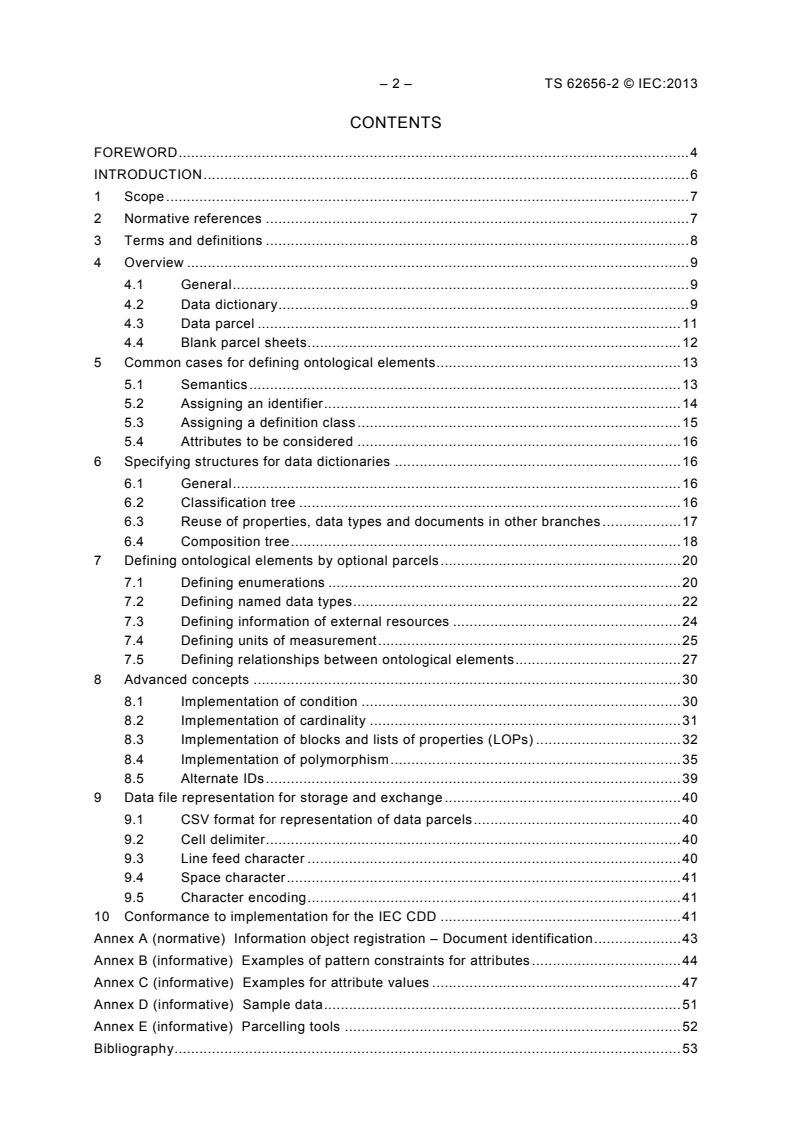
– 2 – TS 62656-2 © IEC:2013
CONTENTS
FOREWORD . 4
INTRODUCTION . 6
1 Scope . 7
2 Normative references . 7
3 Terms and definitions . 8
4 Overview . 9
4.1 General . 9
4.2 Data dictionary . 9
4.3 Data parcel . 11
4.4 Blank parcel sheets. 12
5 Common cases for defining ontological elements . 13
5.1 Semantics . 13
5.2 Assigning an identifier . 14
5.3 Assigning a definition class . 15
5.4 Attributes to be considered . 16
6 Specifying structures for data dictionaries . 16
6.1 General . 16
6.2 Classification tree . 16
6.3 Reuse of properties, data types and documents in other branches . 17
6.4 Composition tree . 18
7 Defining ontological elements by optional parcels . 20
7.1 Defining enumerations . 20
7.2 Defining named data types . 22
7.3 Defining information of external resources . 24
7.4 Defining units of measurement . 25
7.5 Defining relationships between ontological elements . 27
8 Advanced concepts . 30
8.1 Implementation of condition . 30
8.2 Implementation of cardinality . 31
8.3 Implementation of blocks and lists of properties (LOPs) . 32
8.4 Implementation of polymorphism . 35
8.5 Alternate IDs . 39
9 Data file representation for storage and exchange . 40
9.1 CSV format for representation of data parcels . 40
9.2 Cell delimiter . 40
9.3 Line feed character . 40
9.4 Space character . 41
9.5 Character encoding . 41
10 Conformance to implementation for the IEC CDD . 41
Annex A (normative) Information object registration – Document identification . 43
Annex B (informative) Examples of pattern constraints for attributes . 44
Annex C (informative) Examples for attribute values . 47
Annex D (informative) Sample data . 51
Annex E (informative) Parcelling tools . 52
Bibliography . 53
TS 62656-2 © IEC:2013 – 3 –
Figure 1 – Typical use scenario . 9
Figure 2 – Data dictionary . 10
Figure 3 – Spreadsheet implementation . 11
Figure 4 – Parcel sheet . 12
Figure 5 – Semantic definitions of ontological elements . 14
Figure 6 – Identification of ontological elements . 15
Figure 7 – Example of a simple classification tree . 17
Figure 8 – Parcel implementation for simple classification trees . 17
Figure 9 – Example of import mechanism. 18
Figure 10 – Parcel implementation for case of relationships . 18
Figure 11 – Composition relationship between two branches . 19
Figure 12 – Example of a composition tree . 19
Figure 13 – Parcel implementation for composition trees . 20
Figure 14 – Example of a use case of enumeration . 21
Figure 15 – Parcel implementation for enumerations . 22
Figure 16 – Parcel implementation for named data types . 24
Figure 17 – Parcel implementation for document references . 25
Figure 18 – Parcel implementation for unit of measurement . 27
Figure 19 – UML package diagram by relations . 28
Figure 20 – Parcel implementation of UML packages by predicate relations . 29
Figure 21 – UML package diagram by functions . 29
Figure 22 – Parcel implementation of UML packages by functions . 30
Figure 23 – Example of condition . 31
Figure 24 – Parcel implementation for condition . 31
Figure 25 – Example of cardinality . 32
Figure 26 – Parcel implementation for cardinality . 32
Figure 27 – View example of a LOP and nested blocks . 33
Figure 28 – Example of use case of blocks . 34
Figure 29 – Example of a composition view of an LOP . 34
Figure 30 – Parcel implementation for blocks . 35
Figure 31 – Example of a use case of polymorphism . 36
Figure 32 – Example of composition view for polymorphism . 36
Figure 33 – Parcel implementation for polymorphism . 37
Figure 34 – Example of a use case of polymorphism with multiple choices. 38
Figure 35 – Example of composition view for polymorphism with multiple choices . 38
Figure 36 – Parcel implementation for polymorphism with multiple choices . 39
Figure 38 – Example of how to escape the line feed characters . 41
Table 1 – Property data element type for condition . 31
Table 2 – POM conformance classes . 42
Table B.1 – Examples of pattern constraints for attributes (1 of 3) . 44
Table C.1 – Examples of attribute values (1 of 3) . 48
– 4 – TS 62656-2 © IEC:2013
INTERNATIONAL ELECTROTECHNICAL COMMISSION
____________
STANDARDIZED PRODUCT ONTOLOGY
REGISTER AND TRANSFER BY SPREADSHEETS –
Part 2: Application guide for use
with the IEC common data dictionary (CDD)
FOREWORD
1) The International Electrotechnical Commission (IEC) is a worldwide organization for standardization comprising
all national electrotechnical committees (IEC National Committees). The object of IEC is to promote
international co-operation on all questions concerning standardization in the electrical and electronic fields. To
this end and in addition to other activities, IEC publishes International Standards, Technical Specifications,
Technical Reports, Publicly Available Specifications (PAS) and Guides (hereafter referred to as “IEC
Publication(s)”). Their preparation is entrusted to technical committees; any IEC National Committee interested
in the subject dealt with may participate in this preparatory work. International, governmental and non-
governmental organizations liaising with the IEC also participate in this preparation. IEC collaborates closely
with the International Organization for Standardization (ISO) in accordance with conditions determined by
agreement between the two organizations.
2) The formal decisions or agreements of IEC on technical matters express, as nearly as possible, an international
consensus of opinion on the relevant subjects since each technical committee has representation from all
interested IEC National Committees.
3) IEC Publications have the form of recommendations for international use and are accepted by IEC National
Committees in that sense. While all reasonable efforts are made to ensure that the technical content of IEC
Publications is accurate, IEC cannot be held responsible for the way in which they are used or for any
misinterpretation by any end user.
4) In order to promote international uniformity, IEC National Committees undertake to apply IEC Publications
transparently to the maximum extent possible in their national and regional publications. Any divergence
between any IEC Publication and the corresponding national or regional publication shall be clearly indicated in
the latter.
5) IEC itself does not provide any attestation of conformity. Independent certification bodies provide conformity
assessment services and, in some areas, access to IEC marks of conformity. IEC is not responsible for any
services carried out by independent certification bodies.
6) All users should ensure that they have the latest edition of this publication.
7) No liability shall attach to IEC or its directors, employees, servants or agents including individual experts and
members of its technical committees and IEC National Committees for any personal injury, property damage or
other damage of any nature whatsoever, whether direct or indirect, or for costs (including legal fees) and
expenses arising out of the publication, use of, or reliance upon, this IEC Publication or any other IEC
Publications.
8) Attention is drawn to the Normative references cited in this publication. Use of the referenced publications is
indispensable for the correct application of this publication.
9) Attention is drawn to the possibility that some of the elements of this IEC Publication may be the subject of
patent rights. IEC shall not be held responsible for identifying any or all such patent rights.
The main task of IEC technical committees is to prepare International Standards. In
exceptional circumstances, a technical committee may propose the publication of a technical
specification when
• the required support cannot be obtained for the publication of an International Standard,
despite repeated efforts, or
• the subject is still under technical development or where, for any other reason, there is the
future but no immediate possibility of an agreement on an International Standard.
Technical specifications are subject to review within three years of publication to decide
whether they can be transformed into International Standards.
IEC 62656-2, which is a technical specification, has been prepared by subcommittee 3D,
Product properties and classes and their identification, of IEC technical committee 3:
Information structures, documentation and graphical symbols.
TS 62656-2 © IEC:2013 – 5 –
The text of this technical specification is based on the following documents:
Enquiry draft Report on voting
3D/202/DTS 3D/213/RVC
Full information on the voting for the approval of this technical specification can be found in
the report on voting indicated in the above table.
This publication has been drafted in accordance with the ISO/IEC Directives, Part 2.
A list of all the parts of the IEC 62656 series under the general title Standardized product
ontology register and transfer by spreadsheets can be found on the IEC website.
The committee has decided that the contents of this publication will remain unchanged until
the stability date indicated on the IEC web site under "http://webstore.iec.ch" in the data
related to the specific publication. At this date, the publication will be
• transformed into an International Standard,
• reconfirmed,
• withdrawn,
• replaced by a revised edition, or
• amended.
IMPORTANT – The 'colour inside' logo on the cover page of this publication indicates
that it contains colours which are considered to be useful for the correct
understanding of its contents. Users should therefore print this document using a
colour printer.
– 6 – TS 62656-2 © IEC:2013
INTRODUCTION
The IEC 62656 series entitled Standardized product ontology register and transfer by
spreadsheets defines the means and methods for registering and exchanging product
ontology(ies) expressed in spreadsheet forms.
IEC 62656 consists of the following parts:
– Part 1: Logical structure for data parcels ;
– Part 2: Application guide for use with the IEC common data dictionary (IEC CDD);
– Part 3: Interface for common information model .
—————————
To be published.
To be published.
TS 62656-2 © IEC:2013 – 7 –
STANDARDIZED PRODUCT ONTOLOGY
REGISTER AND TRANSFER BY SPREADSHEETS –
Part 2: Application guide for use
with the IEC common data dictionary (CDD)
1 Scope
This part of IEC 62656 provides an application guide for the data parcels specified in
IEC 62656-1 and used for the definition of a domain data dictionary that may be imported from
and exported to the IEC common data dictionary, or IEC CDD for short, maintained as the
IEC 61360-4 database [1] . This part of IEC 62656 provides instructions for the interpretation
and use of the technical specification defined in IEC 62656-1 within a software application, to
avoid misuse of the data constructs available in IEC 62656-1.
This application guide contains the following items:
• principal information for implementing data parcels for data dictionaries from/to the IEC
CDD,
• typical examples of how to implement typical features on data parcels,
• extension of conformance classes for implementation of parcel-based systems to
import/export data parcels from/to the IEC CDD.
The following items are outside the scope of this part of IEC 62656:
• procedures for building IEC 61360 compliant domain data dictionaries,
• semantics of a standard data dictionary itself,
• theoretical explanation of the logical structure of data parcels, which is considered in
IEC 62656-1,
• interface for the common information model (IEC 61970-301 [2]), which is considered in
IEC 62656-3 [3].
2 Normative references
The following documents, in whole or in part, are normatively referenced in this document and
are indispensable for its application. For dated references, only the edition cited applies. For
undated references, the latest edition of the referenced document (including any
amendments) applies.
IEC 61360-1, Standard data element types with associated classification scheme for electric
items – Part 1: Definitions – Principles and methods
IEC 61360-2, Standard data element types with associated classification scheme for electric
components – Part2: EXPRESS dictionary schema
IEC 61987-10:2009, Industrial-process measurement and control – Data structures and
elements in process equipment catalogues – Part 10: List of properties (LOPs) for industrial-
process measurement and control for electronic data exchange – Fundamentals
—————————
Numbers in square brackets refer to the Bibliography.
– 8 – TS 62656-2 © IEC:2013
IEC 62656-1:— , Standardized product ontology register and transfer by spreadsheets – Part
1: Logical structure for data parcels
IEC 62720, Identification of units of measurement for computer-based processing
ISO 13584-42, Industrial automation systems and integration – Parts library – Part 42:
Description methodology: Methodology or structuring parts families
ISO/IEC Guide 77-2:2008, Guide for specification of product properties and classes – Part 2:
Technical principles and guidance
3 Terms and definitions
For the purposes of this document, the terms and definitions given in IEC 62656-1:—, as well
as the following apply.
3.1
cardinality
minimum and maximum number of occurrences of elements within a collection
3.2
classification tree
inheritance tree
is-a tree
acyclic graph of classes and relations as nodes and edges, where each node represents a
concept and each edge represents a specialization, or so called “is-a” relationship between
the two concepts connected by the edge
3.3
composition tree
has-a tree
acyclic graph of classes and relations as nodes and edges, in which each node represents a
concept and each edge represents a part-whole relationship, or so called “has-a” relationship
between the two concepts connected by the edge
Note 1 to entry: A composition tree allows a node to contain several sub-nodes and is also called an aggregation.
3.4
condition property
property whose value affects a value decision of another property
3.5
ontological element
artifact instantiated by a meta class, that serves as metadata and is used to clarify the
semantics of a property or class, or to add information to it
Note 1 to entry: In general, the notion of ontological element subsumes properties within; however, it often refers
to the artifacts other than the properties, such as enumerations, data types, documents, units of measurement,
terms, relations, etc.
Note 2 to entry: In this part of IEC 62656, all occurrences of “meta class” are replaced by “parcel sheet” for ease
of understanding.
3.6
polymorphism
pattern that allows substitution of a single concept in the same context by a different concept
—————————
To be published.
TS 62656-2 © IEC:2013 – 9 –
[SOURCE: IEC 61987-10:2009, 3.1.21, modified — "more specific (specialized)" and the
notes to entry have been deleted.]
4 Overview
4.1 General
This part of IEC 62656 is an application guide for parcel users such as:
– domain experts who implement data parcels for their domain data dictionary, for
registration in the IEC CDD online database by parcelling tools,
– users who download a (piece of) data dictionary from the IEC CDD online database,
– users who edit or exchange a (piece of) data dictionary,
– application vendors who develop a parcelling tool, such as an editor, viewer or equivalent.
A typical use scenario of the IEC 62656 series for the IEC CDD is depicted in Figure 1.
Maintaining IEC CDD Registering or updating
ontological elements to
IEC CDD
Dictionary
parcels
IEC Server
Administrator of
Secretary of SC3D
IEC CDD
Parcelling tool
Maintaining domain
ontological elements
Server manager
Domain administrator
Dictionary
parcels
Retrieving part or
whole of IEC CDD
Defining domain ontological elements
Modifying domain ontological elements
Viewing part or whole of IEC CDD
Domain
IEC 2288/13
Editor & User
Figure 1 – Typical use scenario
For ease of reading of this part of IEC 62656, “parcel” and “attribute” are used instead of
“meta-class” and “meta-property”, respectively. For example, “class meta-class” is reworded
as “class parcel”.
4.2 Data dictionary
ISO/IEC Guide 77-2 recommends that each data dictionary should conform to the
ISO 13584-42/IEC 61360-2 common dictionary model. In the ISO 13584-42/IEC 61360-2
common dictionary model, each data dictionary is represented by a set of classes and their
associated characteristic properties. The IEC CDD is a data dictionary maintained as a
database that defines an ontology of products and services, including components, materials,
systems, and concepts, that are essential in electro-technical domains.
For a data dictionary, classes and properties are fundamental elements. A class is a concept
embodied as a data structure for representing a real world object, such as a product, material,
etc., while a property is a concept embodied as another data structure for characterizing a
– 10 – TS 62656-2 © IEC:2013
class or classes. A class has a set of characteristic properties (though in extreme cases it
only has one property) and shall be clearly distinguishable from other classes by the member
properties in the set. In other words, if two classes have exactly the same sets of properties,
those two classes are not distinguishable in a machine sensible manner. However, such a
style of class modelling is not recommended in IEC 61360-1.
If there are classes which conceptually share some characteristics in common, a generalized
class of those classes may be defined. Such a generalized class is called a “superclass” of
those grouped classes, and each of the grouped classes is called a “subclass” with respect to
the superclass. Such a relationship between a superclass and a subclass is called more
familiarly an “is-a” relationship. Note that in accordance with the ISO 13584-42/IEC 61360-2
common dictionary model, each class may have one class as its superclass and each class
may have multiple subclasses. For a number of classes, if there is no apparent superclass, a
virtual class called a “universal class” will be assumed to exist, acting as a single common
superclass. As a result, the entirety of relationships among the classes forms a tree (to be
exact, an acyclic graph) structure.
If there are characteristics which are shared among several classes, such characteristics are
modelled as “properties” and they shall be defined at a general class of the classes, and then
inherited into its subclasses.
Figure 2 gives a simple example of a data dictionary. In this figure, the concepts of “Gasoline-
powered vehicle” and “Electric vehicle” are two different kinds of vehicles, so their superclass
“Vehicle” may be defined with common properties, i.e. those named “product name”,
“manufacturer“ and “tyre” are defined at this level in the class tree. Likewise, “Vehicle” and
“Computer” are different kinds of product concepts, so their superclass “Product” is defined
with common properties, i.e. those named “product name” and “manufacturer” are defined at
this level. As a consequence, the data dictionary containing those classes comprises a tree
structure, as illustrated in Figure 2.
Code: AAE004
Name: central processing unit
Code: AAA200
Definition: portion of .
Name: Vehicle
Definition class: AAA300
Definition: device that .
product name
Data type: STRING_TYPE
Superclass: AAA100
Product
Unit:
manufacturer
tyre Vehicle Computer central processing unit
class
Gasoline-powered
Electric vehicle motor power
displacement
property
vehicle
specialization
applicable to
information field
IEC 2289/13
Figure 2 – Data dictionary
In accordance with the ISO 13584-42/IEC 61360-2 common dictionary model, each entity has
its own unique identifier, containing structural information, to make the entity distinguishable
from others. For example, a class has information fields such as name, definition, superclass,
respectively, while a property has information fields such as name, definition, definition class,
data type, and unit. The boxes linked by the dashed lines in Figure 2 are examples of
information fields contained in a class and a property.
TS 62656-2 © IEC:2013 – 11 –
4.3 Data parcel
IEC 62656-1, sometimes referred to as the “parcel standard”, defines a set of containers for
product ontology information, (i.e. a tree of product families and their characteristics), by
sorting the information into a few homogeneous data collections, such as a list of classes, a
list of properties, and a list of enumerations. Every such collection is called a “data parcel”. To
be precise, a data parcel may be used not only for defining a data dictionary, but also for
representing a library or catalogue of products with specific values of individual products.
However, for the readers of this document, the primary interest lies in the use of data parcels
to represent a product ontology. In this context, the readers are expected to see that each of
the data parcels carries a homogeneous collection of product ontology. A typical form for
implementation of such a data collection is a sheet within a spreadsheet, often used in day to
day engineering. Thus in the rest of this Technical Specification, a data parcel will be
rephrased as a “parcel sheet” to visually represent the likely form of implementation.
A class parcel (i.e. class meta-class) is for designing and instantiating classes. The class
parcel has attributes (i.e. meta-properties) for describing the characteristics of a class, such
as its class code, preferred name, definition and superclass. Likewise, a property parcel (i.e.
property meta-class) is for designing properties. The property parcel has attributes for
describing property information such as property code, preferred name, definition, definition
class, data type and unit. In order to implement a data dictionary within homogeneous data
collections in parcels, a few spreadsheets should be prepared, each implementing only one
category of the overall parcel. For example, in the case depicted within Figure 2, a sheet for
class parcel and another for property parcel are required (as shown in Figure 3).
implementation
implementation
Code: AAE004
Name: central processing unit
Code: AAA200
AAE001
Definition: portion of .
Name: Vehicle
Definition class: AAA300
product name
Definition: device that .
AAA100
Data type: STRING_TYPE
Superclass: AAA100
Product
Unit:
AAE002
manufacturer
AAE003 AAA200 AAA300 AAE004
tyre Vehicle Computer central processing unit
AAA500 AAE006
AAA400
AAE005
Electric vehicle motor power
Gasoline-powered
IEC 2290/13
displacement
vehicle
Figure 3 – Spreadsheet implementation
– 12 – TS 62656-2 © IEC:2013
Figure 4 shows the basic structure of a parcel sheet. Each parcel sheet consists of its header
section and data section.
The header section further consists of the class header section and schema header section.
In the class header section, the information contained in the parcel sheet is described, e.g.
the identifier of the data parcel and the default values which may be applied to any attribute of
the parcel in the header section (see 5.2). In the schema header section, which contains
metadata for describing values in the data section, each attribute of the parcel is specified in
each cell column.
In the data section, each ontological element is described in each row. In each cell, the value
of the attribute, which is specified in its corresponding column, is described for defining such
an ontological element.
Instruction
Cell columns
column
#CLASS_ID:=MDC_C002
#CLASS_NAME.EN:=
Class meta-class
#CLASS_DEFINITION.EN:=
Meta-class being characterized by
meta-properties that are necessary
to identify and specify each class in
a reference dictionary
#DEFAULT_SUPPLIER:=0112/2///6
2656_1
#DEFAULT_VERSION:=1
#PROPERTY_ID MDC_P001_5 MDC_P002_2 MDC_P004_1.en MDC_P010 MDC_P014
#PROPERTY_NAME.EN Code Revision number Preferred name Superclass Applicable properties
globally unique revision of the name of an item (in class that is properties that are
#DEFINITION.EN identifier of class same version of full length whenever designated as the newly specified as
in a reference . an item possible) used for . canonical . applicable for .
TRANSLATABLE_ SET(0,?) OF
#DATATYPE STRING_TYPE STRING_TYPE STRING_TYPE
STRING_TYPE STRING_TYPE
#VALUE_FORMAT M.255 M.3 M.70 M.255 M.0
#DEFAULT_DATA_SUPPLIER 0112/2///62656_2 0112/2///62656_2 0112/2///62656_2
#DEFAULT_DATA_VERSION 1 1 1
#REQUIREMENT KEY MAND MAND
AAA100 1 Product UNIVERSE {AAE001,AAE002}
AAA200 1 Vehicle AAA100 {AAE003}
AAA300 1 Computer AAA100 {AAE004}
Gasoline-powered
AAA400 1 AAA200 {AAE005}
vehicle
AAA500 1 Electric vehicle AAA200 {AAE006}
IEC 2291/13
Figure 4 – Parcel sheet
4.4 Blank parcel sheets
Blank parcel sheets for editing a data dictionary from scratch will be obtained from:
– IEC CDD website at the following URL:
or can be generated by:
– a parcelling tool.
In Annex E, a list of tools that conform to this Technical Specification is given.
Four sheets comprising dictionary, class, property and supplier sheets, are mandatory for
implementing a data dictionary. The other sheets are optional and they are prepared only
Schema header Class header
Data section
section section
Header section
TS 62656-2 © IEC:2013 – 13 –
when they are required in the process of completing the information described in the four
mandatory sheets.
5 Common cases for defining ontological elements
5.1 Semantics
In the IEC 62656 series and ISO 13584/IEC 61360 series, principal concepts of products are
represented by classes, and their characteristics are modelled by properties. Some attributes
of the classes and properties require the use of other parcels, such as data type, enumeration
and term parcels. Thus, in many cases, determining the semantics of each ontological
element modelled by the corresponding parcel will be the first step for describing the data
dictionary by the data parcels. The aforementioned parcels have a basic set of attributes for
describing the names and meanings of their ontological elements.
For describing names, there are 3 kinds of attributes defined in IEC 62656-1, i.e.
MDC_P004_1 (Preferred name), MDC_P004_2 (Synonymous name), MDC_P004_3 (Short
name). Likewise, for describing the meaning of an ontological element, or for clarifying the
meaning, there are 3 kinds of attributes, i.e. MDC_P005 (Definition), MDC_P007_1 (Note) and
MDC_P007_2 (Remark).
The above attributes except MDC_P004_2 are defined as TRANSLATABLE_STRING_TYPE
for localization of the content which is described in a language specified as the source
language. These attributes may comprise multiple columns which are identified by a specified
language code (which may be combined with a country code to show a language variant, if
needed). For example, if there are names in two languages, English and French, appearing in
a parcel sheet, then columns identified by “MDC_P004_1.en” and “MDC_P004_1.fr” shall be
prepared for describing preferred names in the sheet.
By contrast, the attribute MDC_P004_2 is defined as SET(0,?) OF LIST(2,2) OF
STRING_TYPE. Therefore, only one column is provided and a synonymous name in any
language shall be described as a value of this attribute. In each field of this attribute, a set
containing the combination of a name and a language code (and with country code, if needed)
in order is expected as a valid value. For example, if “battery” in English and its French
translation “batterie” are given as the synonymous names of an ontological element, then the
value will be described as “{(battery,en),(batterie,fr)}” or “{(batterie,fr),(battery,en)}”.
In each parcel sheet, there is an optional instruction #SOURCE_LANGUAGE which specifies
the language in which the original semantic content in the parcel is prepared. For example, if
there is a description “#SOURCE_LANGUAGE:=en” in the instruction column of a parcel,
English content shall be the source and the content in the other languages shall be
considered as a translation from the English content in the sheet. If no language is specified
in the field, or the instruction cannot be found in the parcel sheet, by default, English shall be
assumed as the source language for the sheet.
NOTE The description of values of the above attributes follows IEC 61360-6 [4].
Figure 5 gives an example of a class parcel sheet which only comprises the attributes
describing the semantics of ontological elements. There are three classes described in the
data section, i.e. a capacitor and its subclasses, which can be actually found in the IEC CDD.
– 14 – TS 62656-2 © IEC:2013
#CLASS_ID:=
MDC_C002
#CLASS_NAME.en:=
Class meta-class
#PROPERTY_ID MDC_ MDC_P004_2 MDC_ MDC_P005.en MDC_P007_1.en MDC_
P004_1.en P004_3.en P007_2.en
#PROPERTY_ Preferred Synonymous Short Definition Note Remark
NAME.en name name name
#DEFAULT_
DATA_SUPPLIER
#DEFAULT_
DATA_VERSION
Capacitor {(capacitor,en)} system of two conductors (plates) Since capacitance is a function
separated over the extent of its of temperature, it may still vary
surfaces by a thin insulating medium with temperature.
(dielectric), its intended
characteristic being capacitance
Fixed {(fixed,en)} capacitor that has no designed Since capacitance is a function
capacitor provision for changing its of temperature, it may still vary
capacitance value with temperature.
Variable {(variable,en)} capacitor designed so that its main
capacitor property can be varied by
mechanically changing the spatial
relationship of their parts
IEC 2292/13
Figure 5 – Semantic definitions of ontological elements
5.2 Assigning an identifier
Each ontological element shall be identified in conformance with the international concept
identifier (ICID), which is defined as the primary identification scheme in IEC 62656-1. Such
an identifier is not only used for distinguishing ontological elements from each other, but also
for identifying a relationship between the ontological elements.
Each parcel sheet for a data dictionary contains its own attribute to describe identifiers of its
ontological elements. This kind of attribute is identified as MDC_P001_X (Code), where X is a
positive integer. For example, MDC_P001_5 is provided for a class parcel, and MDC_P001_6
is provided for a property parcel.
Each identifier comprises a concatenation of RAI (registration authority identifier), DI (data
identifier) and VI (version identifier) in this order. Firstly, the RAI indicates the responsible
supplier of a piece of data in conformity with ISO/IEC 6523 [5]. For example,
“0112/2///61360_4” is the default RAI for the IEC CDD; next, the DI indicates the code
assigned to each ontological element which shall be allocated uniquely within the ontological
elements administered by the same RAI. In the IEC CDD, it is requested that the DI consists
of six letters; the first three letters are roman-alphabetic characters and the last three letters
are whole numbers (format AAANNN). Finally, the VI indicates the version number of each
ontological element which shall be incremented with each new version. A new version of an
ontological element shall be backward compatible with any former version of the same
concept.
The capital letters “I” and “O” should be avoided in identifiers because it is difficult to
distinguish such letters from numeric characters “1” and “0”, respectively, on some computer
systems which can cause problems due to misreading identifiers.
IEC 62656-1 provides a means of shorthand notation for identifiers in the header section and
the data section. Because almost all items in a data dictionary at each meta-layer may have a
c
...
Questions, Comments and Discussion
Ask us and Technical Secretary will try to provide an answer. You can facilitate discussion about the standard in here.
Loading comments...