

IEC TS 63163:2021
(Main)Terrestrial photovoltaic (PV) modules for consumer products - Design qualification and type approval
General Information
- Abstract
IEC TS 63163:2021 is intended to apply to terrestrial modules for consumer applications for outdoor operation shorter than those qualified to IEC 61215. The useful service life of modules so qualified depends on their design, their environment and the conditions under which they are operated. This document classes those PV modules into Category 1, Category 2, and Category 3 with respectively low, medium and high expected outdoor exposure. This specification is intended to qualify the PV portion of these devices. It may, however, be used as a basis for testing such PV modules, but does not qualify the electronic portion. The purpose of the test sequence is to determine the electrical, thermal, and mechanical durability characteristics of the module, and to show that the module is capable of withstanding outdoor exposure for different outdoor durations designated as “low”, “medium”, and “high”. Mobile and attached applications are considered to require lower mechanical durability than portable applications, which are more prone to mechanical damage.
- Status
- Published
- Publication Date
- 13-Sep-2021
- Technical Committee
- TC 82 - Solar photovoltaic energy systems
- Drafting Committee
- WG 2 - TC 82/WG 2
- Current Stage
- PPUB - Publication issued
- Start Date
- 14-Sep-2021
- Completion Date
- 08-Oct-2021
Overview
IEC TS 63163:2021 - "Terrestrial photovoltaic (PV) modules for consumer products – Design qualification and type approval" - is a Technical Specification from the IEC that defines design qualification and type-approval testing for terrestrial PV modules intended for consumer products with shorter outdoor service lives than modules qualified to IEC 61215. It focuses on qualifying the PV portion of consumer devices (not the integrated electronics such as batteries or charge controllers) and classifies modules into three exposure categories (low, medium, high) to reflect expected outdoor use.
Key topics and requirements
- Product categorization:
- Category 1 (low exposure, mobile) - e.g., smartphone chargers; modules/components intended for user-accessible installations. Limits include system voltages ≤ 35 V, short-circuit current < 8 A, and maximum power < 240 W.
- Category 2 (medium exposure, portable) - e.g., emergency, hiking/camping products; requires stronger mechanical durability for repeated deployment.
- Category 3 (high exposure, attached) - e.g., motor-home mounted modules; higher outdoor exposure but not intended for long-term rooftop utility service.
- Scope limitation: Specifies tests to qualify the PV module portion only; does not certify integrated electronics or energy storage systems.
- Test sequences and durability evaluation: Test sequences are defined per category to determine electrical, thermal and mechanical durability. Typical test procedures included are:
- Visual inspection and performance at STC
- Thermal cycling, damp heat, humidity-freeze
- UV preconditioning, hot-spot endurance, bypass diode thermal test
- Mechanical tests: bending, folding, drop, static mechanical load, hail, robustness of terminations
- Electrical safety: wet leakage, insulation testing, stabilization and maximum power verification
- Marking and documentation: Requirements for nameplate data, minimum documentation and assembly instructions are specified to support safe operation and correct installation.
- Pass criteria and reporting: Defines general pass/fail criteria, major visual defects and required test reporting.
Applications and users
- Who uses it: PV module manufacturers for consumer products, design engineers, test laboratories, certification bodies, product compliance teams, and procurement/specification writers.
- Typical applications: Mobile solar chargers, portable camping and emergency power panels, modules attached to vehicles (RVs, motor homes), and other consumer solar devices intended for limited-duration outdoor exposure.
- Practical value: Helps manufacturers demonstrate durability under realistic consumer-use exposure levels, supports reliable product claims, and guides test labs on category-appropriate qualification sequences.
Related standards
- IEC 61215 series (longer-life terrestrial PV module qualification)
- IEC 60904 series (PV measurement standards)
- IEC 61140 (protection against electric shock)
- IEC 60269-6 (fuse requirements for PV systems)
Keywords: IEC TS 63163, PV modules for consumer products, design qualification, type approval, outdoor exposure categories, portable solar, mobile solar chargers, durability testing.
Get Certified
Connect with accredited certification bodies for this standard

DNV
DNV is an independent assurance and risk management provider.

Lloyd's Register
Lloyd's Register is a global professional services organisation specialising in engineering and technology.
DNV Energy Systems
Energy and renewable energy certification.
Sponsored listings
Frequently Asked Questions
IEC TS 63163:2021 is a technical specification published by the International Electrotechnical Commission (IEC). Its full title is "Terrestrial photovoltaic (PV) modules for consumer products - Design qualification and type approval". This standard covers: IEC TS 63163:2021 is intended to apply to terrestrial modules for consumer applications for outdoor operation shorter than those qualified to IEC 61215. The useful service life of modules so qualified depends on their design, their environment and the conditions under which they are operated. This document classes those PV modules into Category 1, Category 2, and Category 3 with respectively low, medium and high expected outdoor exposure. This specification is intended to qualify the PV portion of these devices. It may, however, be used as a basis for testing such PV modules, but does not qualify the electronic portion. The purpose of the test sequence is to determine the electrical, thermal, and mechanical durability characteristics of the module, and to show that the module is capable of withstanding outdoor exposure for different outdoor durations designated as “low”, “medium”, and “high”. Mobile and attached applications are considered to require lower mechanical durability than portable applications, which are more prone to mechanical damage.
IEC TS 63163:2021 is intended to apply to terrestrial modules for consumer applications for outdoor operation shorter than those qualified to IEC 61215. The useful service life of modules so qualified depends on their design, their environment and the conditions under which they are operated. This document classes those PV modules into Category 1, Category 2, and Category 3 with respectively low, medium and high expected outdoor exposure. This specification is intended to qualify the PV portion of these devices. It may, however, be used as a basis for testing such PV modules, but does not qualify the electronic portion. The purpose of the test sequence is to determine the electrical, thermal, and mechanical durability characteristics of the module, and to show that the module is capable of withstanding outdoor exposure for different outdoor durations designated as “low”, “medium”, and “high”. Mobile and attached applications are considered to require lower mechanical durability than portable applications, which are more prone to mechanical damage.
IEC TS 63163:2021 is classified under the following ICS (International Classification for Standards) categories: 27.160 - Solar energy engineering. The ICS classification helps identify the subject area and facilitates finding related standards.
IEC TS 63163:2021 is available in PDF format for immediate download after purchase. The document can be added to your cart and obtained through the secure checkout process. Digital delivery ensures instant access to the complete standard document.
Standards Content (Sample)
IEC TS 63163 ®
Edition 1.0 2021-09
TECHNICAL
SPECIFICATION
Terrestrial photovoltaic (PV) modules for consumer products – Design
qualification and type approval
All rights reserved. Unless otherwise specified, no part of this publication may be reproduced or utilized in any form
or by any means, electronic or mechanical, including photocopying and microfilm, without permission in writing from
either IEC or IEC's member National Committee in the country of the requester. If you have any questions about IEC
copyright or have an enquiry about obtaining additional rights to this publication, please contact the address below or
your local IEC member National Committee for further information.
IEC Central Office Tel.: +41 22 919 02 11
3, rue de Varembé info@iec.ch
CH-1211 Geneva 20 www.iec.ch
Switzerland
About the IEC
The International Electrotechnical Commission (IEC) is the leading global organization that prepares and publishes
International Standards for all electrical, electronic and related technologies.
About IEC publications
The technical content of IEC publications is kept under constant review by the IEC. Please make sure that you have the
latest edition, a corrigendum or an amendment might have been published.
IEC publications search - webstore.iec.ch/advsearchform IEC online collection - oc.iec.ch
The advanced search enables to find IEC publications by a Discover our powerful search engine and read freely all the
variety of criteria (reference number, text, technical publications previews. With a subscription you will always
committee, …). It also gives information on projects, replaced have access to up to date content tailored to your needs.
and withdrawn publications.
Electropedia - www.electropedia.org
IEC Just Published - webstore.iec.ch/justpublished
The world's leading online dictionary on electrotechnology,
Stay up to date on all new IEC publications. Just Published
containing more than 22 000 terminological entries in English
details all new publications released. Available online and
and French, with equivalent terms in 18 additional languages.
once a month by email.
Also known as the International Electrotechnical Vocabulary
(IEV) online.
IEC Customer Service Centre - webstore.iec.ch/csc
If you wish to give us your feedback on this publication or
need further assistance, please contact the Customer Service
Centre: sales@iec.ch.
IEC TS 63163 ®
Edition 1.0 2021-09
TECHNICAL
SPECIFICATION
Terrestrial photovoltaic (PV) modules for consumer products – Design
qualification and type approval
INTERNATIONAL
ELECTROTECHNICAL
COMMISSION
ICS 27.160 ISBN 978-2-8322-1024-3
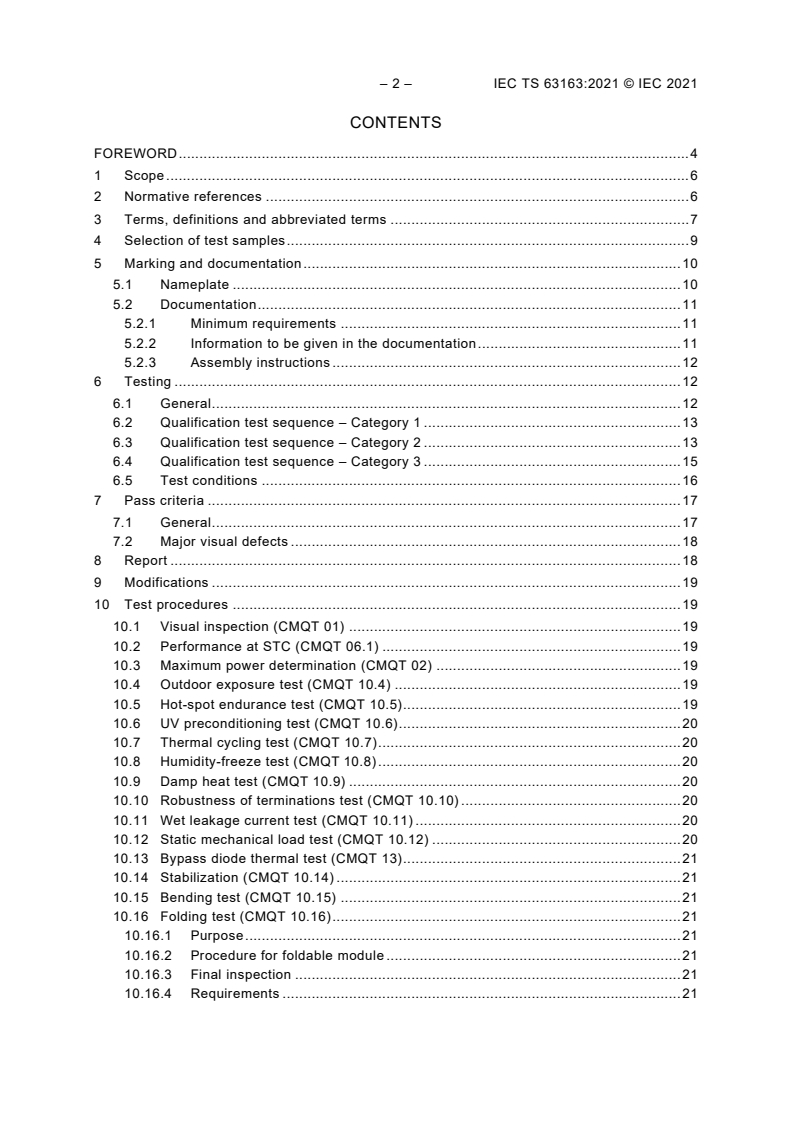
– 2 – IEC TS 63163:2021 © IEC 2021
CONTENTS
FOREWORD . 4
1 Scope . 6
2 Normative references . 6
3 Terms, definitions and abbreviated terms . 7
4 Selection of test samples . 9
5 Marking and documentation . 10
5.1 Nameplate . 10
5.2 Documentation . 11
5.2.1 Minimum requirements . 11
5.2.2 Information to be given in the documentation . 11
5.2.3 Assembly instructions . 12
6 Testing . 12
6.1 General . 12
6.2 Qualification test sequence – Category 1 . 13
6.3 Qualification test sequence – Category 2 . 13
6.4 Qualification test sequence – Category 3 . 15
6.5 Test conditions . 16
7 Pass criteria . 17
7.1 General . 17
7.2 Major visual defects . 18
8 Report . 18
9 Modifications . 19
10 Test procedures . 19
10.1 Visual inspection (CMQT 01) . 19
10.2 Performance at STC (CMQT 06.1) . 19
10.3 Maximum power determination (CMQT 02) . 19
10.4 Outdoor exposure test (CMQT 10.4) . 19
10.5 Hot-spot endurance test (CMQT 10.5) . 19
10.6 UV preconditioning test (CMQT 10.6) . 20
10.7 Thermal cycling test (CMQT 10.7) . 20
10.8 Humidity-freeze test (CMQT 10.8) . 20
10.9 Damp heat test (CMQT 10.9) . 20
10.10 Robustness of terminations test (CMQT 10.10) . 20
10.11 Wet leakage current test (CMQT 10.11) . 20
10.12 Static mechanical load test (CMQT 10.12) . 20
10.13 Bypass diode thermal test (CMQT 13) . 21
10.14 Stabilization (CMQT 10.14) . 21
10.15 Bending test (CMQT 10.15) . 21
10.16 Folding test (CMQT 10.16) . 21
10.16.1 Purpose . 21
10.16.2 Procedure for foldable module . 21
10.16.3 Final inspection . 21
10.16.4 Requirements . 21
10.17 Drop test (CMQT 10.17) . 21
10.17.1 General . 21
10.17.2 Drop the module from 1 m height onto a concrete floor. . 21
10.17.3 Final measurements . 22
10.17.4 Requirements . 22
10.18 Hail test (CMQT 10.18) . 22
10.19 Insulation test (CMQT 10.19) . 22
Annex A (informative) Overview of categories and potential applications . 23
Figure 1 – Geometry that shows radius of curvature of a flexible module . 8
Figure 2 – Qualification test sequence – Category 1 . 13
Figure 3 – Qualification test sequence – Category 2 . 14
Figure 4 – Qualification test sequence – Category 3 . 16
Figure 5 – Drop test . 22
Table 1 – Summary of test levels . 16
Table A.1 – Overview of categories and potential applications . 23
– 4 – IEC TS 63163:2021 © IEC 2021
INTERNATIONAL ELECTROTECHNICAL COMMISSION
____________
TERRESTRIAL PHOTOVOLTAIC (PV) MODULES FOR CONSUMER
PRODUCTS – DESIGN QUALIFICATION AND TYPE APPROVAL
FOREWORD
1) The International Electrotechnical Commission (IEC) is a worldwide organization for standardization comprising
all national electrotechnical committees (IEC National Committees). The object of IEC is to promote international
co-operation on all questions concerning standardization in the electrical and electronic fields. To this end and
in addition to other activities, IEC publishes International Standards, Technical Specifications, Technical Reports,
Publicly Available Specifications (PAS) and Guides (hereafter referred to as “IEC Publication(s)”). Their
preparation is entrusted to technical committees; any IEC National Committee interested in the subject dealt with
may participate in this preparatory work. International, governmental and non-governmental organizations liaising
with the IEC also participate in this preparation. IEC collaborates closely with the International Organization for
Standardization (ISO) in accordance with conditions determined by agreement between the two organizations.
2) The formal decisions or agreements of IEC on technical matters express, as nearly as possible, an international
consensus of opinion on the relevant subjects since each technical committee has representation from all
interested IEC National Committees.
3) IEC Publications have the form of recommendations for international use and are accepted by IEC National
Committees in that sense. While all reasonable efforts are made to ensure that the technical content of IEC
Publications is accurate, IEC cannot be held responsible for the way in which they are used or for any
misinterpretation by any end user.
4) In order to promote international uniformity, IEC National Committees undertake to apply IEC Publications
transparently to the maximum extent possible in their national and regional publications. Any divergence between
any IEC Publication and the corresponding national or regional publication shall be clearly indicated in the latter.
5) IEC itself does not provide any attestation of conformity. Independent certification bodies provide conformity
assessment services and, in some areas, access to IEC marks of conformity. IEC is not responsible for any
services carried out by independent certification bodies.
6) All users should ensure that they have the latest edition of this publication.
7) No liability shall attach to IEC or its directors, employees, servants or agents including individual experts and
members of its technical committees and IEC National Committees for any personal injury, property damage or
other damage of any nature whatsoever, whether direct or indirect, or for costs (including legal fees) and
expenses arising out of the publication, use of, or reliance upon, this IEC Publication or any other IEC
Publications.
8) Attention is drawn to the Normative references cited in this publication. Use of the referenced publications is
indispensable for the correct application of this publication.
9) Attention is drawn to the possibility that some of the elements of this IEC Publication may be the subject of patent
rights. IEC shall not be held responsible for identifying any or all such patent rights.
IEC TS 63163 has been prepared by IEC technical committee 82: Solar photovoltaic energy
systems.
The text of this document is based on the following documents:
Draft Report on voting
82/1899/DTS 82/1931/RVDTS
Full information on the voting for its approval can be found in the report on voting indicated in
the above table.
The language used for the development of this Technical Specification is English.
This document was drafted in accordance with ISO/IEC Directives, Part 2, and developed in
accordance with ISO/IEC Directives, Part 1 and ISO/IEC Directives, IEC Supplement, available
at www.iec.ch/members_experts/refdocs. The main document types developed by IEC are
described in greater detail at www.iec.ch/standardsdev/publications.
The committee has decided that the contents of this document will remain unchanged until the
stability date indicated on the IEC website under webstore.iec.ch in the data related to the
specific document. At this date, the document will be
• reconfirmed,
• withdrawn,
• replaced by a revised edition, or
• amended.
– 6 – IEC TS 63163:2021 © IEC 2021
TERRESTRIAL PHOTOVOLTAIC (PV) MODULES FOR CONSUMER
PRODUCTS – DESIGN QUALIFICATION AND TYPE APPROVAL
1 Scope
This document is intended to apply to terrestrial modules for consumer applications for outdoor
operation shorter than those qualified to IEC 61215. The useful service life of modules so
qualified depends on their design, their environment and the conditions under which they are
operated.
This document classes those PV modules into Category 1, Category 2, and Category 3 with
respectively low, medium and high expected outdoor exposure. For the purposes of designing
this document, Category 1 (mobile applications) is for applications such as smart phone
charging which most likely have “low” outdoor exposure. Category 2 (portable applications) is
for emergency power/hiking/camping applications with “medium” outdoor exposure and it needs
to have mechanical durability testing due to repeated deployment, potential for being dropped,
and other mechanical stresses. Category 3 (attached applications) is for “high” outdoor
exposure for applications, such as for motor homes, but is not intended for long-term utility or
long-term household rooftop applications. A summary of product categories and potential
applications is presented in Annex A.
Category 1 products are intended for installation where general user access and contact to
uninsulated live parts is anticipated. Modules are not be combined in series strings operating
at more than 35 V (V ) and do not have a system voltage rating above 35 V. These PV modules
oc
are not intended for use in parallel with other PV modules or energy sources, unless the
combination provides protection from reverse current and overvoltage protection. The short-
circuit current is less than 8 A and the maximum power is less than 240 W when tested under
standard test conditions.
This document does not address the particularities of PV modules with integrated electronics,
such as energy storage devices, charge controllers, batteries, inverters which may be sold in
conjunction with the PV modules. This specification is intended to qualify the PV portion of
these devices. It may, however, be used as a basis for testing such PV modules, but does not
qualify the electronic portion.
This document does not apply to modules used with concentrators.
The purpose of the test sequence is to determine the electrical, thermal, and mechanical
durability characteristics of the module, and to show that the module is capable of withstanding
outdoor exposure for different outdoor durations designated as “low”, “medium”, and “high”.
Mobile and attached applications are considered to require lower mechanical durability than
portable applications, which are more prone to mechanical damage. However, the actual
outdoor exposure limits of the modules depend on their design, their environment and the
conditions under which they are operated.
2 Normative references
The following documents are referred to in the text in such a way that some or all of their content
constitutes requirements of this document. For dated references, only the edition cited applies.
For undated references, the latest edition of the referenced document (including any
amendments) applies.
IEC 60269-6, Low-voltage fuses – Part 6: Supplementary requirements for fuse-links for the
protection of solar photovoltaic energy systems
IEC 60904-1, Photovoltaic devices – Part 1: Measurement of photovoltaic current-voltage
characteristics
IEC TS 60904-1-2:2019, Photovoltaic devices – Part 1-2: Measurement of current-voltage
characteristics of bifacial photovoltaic (PV) devices
IEC 60904-3, Photovoltaic devices – Part 3: Measurement principles for terrestrial photovoltaic
(PV) solar devices with reference spectral irradiance data
IEC 61140, Protection against electric shock – Common aspects for installation and equipment
IEC 61215-1:2021, Terrestrial photovoltaic (PV) modules – Design qualification and type
approval – Part 1: Test requirements
IEC 61215-1-1:2021, Terrestrial photovoltaic (PV) modules – Design qualification and type
approval – Part 1-1: Special requirements for testing of crystalline silicon photovoltaic (PV)
modules
IEC 61215-1-2:2021, Terrestrial photovoltaic (PV) modules – Design qualification and type
approval – Part 1-2: Special requirements for testing of thin-film Cadmium Telluride (CdTe)
based photovoltaic (PV) modules
IEC 61215-1-3:2021, Terrestrial photovoltaic (PV) modules – Design qualification and type
approval – Part 1-3: Special requirements for testing of thin-film amorphous silicon based
photovoltaic (PV) modules
IEC 61215-1-4:2021, Terrestrial photovoltaic (PV) modules – Design qualification and type
approval – Part 1-4: Special requirements for testing of thin-film Cu(In,GA)(S,Se)2 based
photovoltaic (PV) modules
IEC 61215-2:2021, Terrestrial photovoltaic (PV) modules – Design qualification and type
approval – Part 2: Test procedures
IEC 61730-1, Photovoltaic (PV) module safety qualification – Part 1 Requirements for
construction
IEC 61730-2, Photovoltaic (PV) module safety qualification – Part 2 Requirements for testing
IEC TS 61836, Solar photovoltaic energy systems – Terms, definitions and symbols
IEC TS 62915, Photovoltaic (PV) modules – Type approval, design and safety qualification –
Retesting
3 Terms, definitions and abbreviated terms
For the purposes of this document, the terms and definitions given in IEC TS 61836 apply.
ISO and IEC maintain terminological databases for use in standardization at the following
addresses:
• IEC Electropedia: available at http://www.electropedia.org/
• ISO Online browsing platform: available at http://www.iso.org/obp
3.1
flexible module
PV module that exhibits a radius of curvature of 500 mm or less in at least one direction
according to the manufacturer’s specification and is capable of bending to conform to a flat or
curved surface
Note 1 to entry: A curved module with a rigid shape is not considered a flexible module.
Note 2 to entry: Radius of curvature is defined as shown in Figure 1. During testing, the applied radius of curvature
is no smaller than that specified by the manufacturer.
– 8 – IEC TS 63163:2021 © IEC 2021
Figure 1 – Geometry that shows radius of curvature of a flexible module
[SOURCE: IEC 61215-1:2021, 3.6]
3.2
foldable module
PV module that is separated into distinct PV sections nominally of the same size and connected
by a section that does not contain cells, but has the interconnecting busbars
3.3
representative sample
sample that includes all the components of the module, except some repeated parts
Note 1 to entry: The representative samples shall use all key materials and subassemblies, as detailed in Clause
4 of IEC 61215-1:2021.
3.4
very large module
module that exceeds the size of standard 2,2 m × 1,5 m commercially-available simulators
Note 1 to entry: A very large module exceeds 2,2 m in length or width, or exceeds 1,5 m in both dimensions. Thus
a 3 m × 0,3 m module is considered very large, as is a 2,2 m × 2,2 m module.
Note 2 to entry: Very large modules are exempt from class A simulator spatial irradiance uniformity requirements,
as detailed in IEC 61215-2 MQT 02.
Note 3 to entry: During test sequences representative samples may be substituted for very large modules, within
the limits described in Clause 4.
Note 4 to entry: In future editions, the size threshold to be considered a very large module will likely increase to
larger dimensions.
[SOURCE: IEC 61215-1:2021, 3.8]
3.5
consumer product category 1 (mobile applications)
PV module for applications such as smart phone charging with low outdoor exposure
Note 1 to entry: Modules shall not be combined in series strings operating at more than 35 V (V ) and shall not
OC
have a system voltage rating above 35 V.
3.6
consumer product category 2 (portable applications)
PV module applications such as used for emergency power/hiking/camping applications with
medium outdoor exposure and mechanical strength withstanding repeated deployment,
potential for being dropped, and other mechanical stresses
3.7
consumer product category 3 (attached applications)
PV module for attached applications with high outdoor exposure, such as for motor homes, but
not for long-term utility or household rooftop applications
3.8
consumer product module quality test
CQMT
3.9
bifacial PV modules
modules that can convert irradiation received on both the front-side and rear-side into electric
energy by means of the photovoltaic effect
[SOURCE: IEC 61215-1:2021, 3.9]
3.10
bifaciality coefficients
ratios between the I-V characteristics of the rear-side and the front-side of a bifacial module
each measured under Standard Test Conditions (STC – IEC TS 61836), namely the short-circuit
, the open-circuit voltage bifaciality coefficient φ and the
current bifaciality coefficient φ
Isc Voc
maximum power bifaciality coefficient φ
Pmax
Note 1 to entry: Bifaciality coefficients are fully defined in IEC TS 60904-1-2:2019, 6.2.
[SOURCE: IEC 61215-1:2021, 3.10]
3.11
bifacial nameplate irradiance
BNPI
higher irradiance at which nameplate verification is performed for bifacial modules,
2 2
corresponding to 1 000 W/m on the module front and 135 W/m on the module rear, applied in
any method allowed by IEC TS 60904-1-2
[SOURCE: IEC 61215-1:2021, 3.11]
3.12
bifacial stress irradiance
higher irradiance at which currents for stress are measured on bifacial modules, corresponding
2 2
to 1 000 W/m on the module front and 300 W/m on the module rear, applied by any method
allowed in IEC TS 60904-1-2, I-V characteristic at which may be extrapolated from lower
irradiances
[SOURCE: IEC 61215-1:2021, 3.12]
3.13
type approval
conformity test made on one or more items representative of the production
4 Selection of test samples
The PV module samples shall have been manufactured from specified materials and
components in accordance with the relevant drawings and process sheets and have been
subjected to the manufacturer’s normal inspection, quality control and production acceptance
procedures. The PV modules shall be complete in every detail and shall be accompanied by
the manufacturer’s handling, mounting, and connection instructions. When the PV modules to
be tested are prototypes of a new design and not from production, this fact shall be noted in
the test report (see Clause 8).
The number of test samples required is derived from the applicable test sequences.
For very large modules (as defined in 3.4), representative samples (as defined in 3.3) may be
used for all qualification tests. During the design and manufacturing of the representative
samples, attention should be paid to reach the maximum similarity to the full-size product in all
electrical, mechanical, and thermal characteristics related to quality and reliability. The cell,
encapsulation methods, interconnects, terminations, clearance and creepage distances around
all edges, and distance through solid insulation (relied upon insulation and cemented joints)
shall be the same as on the actual full-size products.
– 10 – IEC TS 63163:2021 © IEC 2021
Limits are placed on how much one may reduce the dimensions of a very large module in making
representative samples for qualification testing. In other words, when reducing the shorter
dimension, the representative sample shall be at least 0,75 m wide. In reducing the longer
dimension, the representative sample shall be at least 1,1 m long. If representative samples
are used for any test, the test report shall include a table listing the dimensions of the product
being qualified, and for each CMQT, the dimensions of the samples tested. The table shall
contain the statement, "Smaller samples were used for some tests as noted above. Use of
smaller samples may affect test results.” However, for verification of power determination a
standard production product shall be measured, either at the test facility or utilizing a test at
the manufacturer monitored by the testing entity.
If representative samples are utilized in the damp heat sequence, then one extra module, full-
sized, is required, and shall be subjected only to CMQT 10.12 (static mechanical load test) and
the requirements therein.
Any representative sample used for CMQT 10.5 (hot-spot endurance test) shall contain the
same number of cells per bypass diode (i.e. the same substring size) as the full-size product.
For modules containing bypass diodes which are not accessible in the standard modules as
produced, a special sample can be prepared for the bypass diode thermal test (CMQT 10.13).
Smaller modules in Category 1 or 2 which might have only a few cells and may not have bypass
diodes do not need to undergo this test, however the remainder of the test sequence shall be
applied.
For the requirements in the IEC 61215 series, a module shall be considered “bifacial” if the
manufacturer claims bifaciality on the nameplate or datasheet, or if the module exhibits a
maximum power bifaciality coefficient ≥ 20 %. If a module is to be tested as a monofacial
module, the test laboratory shall verify that the module is monofacial by at least one of the
following methods:
• Information from the manufacturer showing that the rear of the cell is fully metallized;
• Spectrally-resolved backsheet transmission data from the module manufacturer; or
• Determination of bifaciality coefficient on one sample according to the procedure in IEC
TS 60904-1-2.
5 Marking and documentation
5.1 Nameplate
Each module shall include the following clear and indelible markings for the Category 1, 2 and
3, whichever is applicable:
a) full name of manufacturer or registered trademark of manufacturer;
b) type or model number designation;
c) category in accordance to IEC TS 63163
Consumer product Category 1: mobile applications or
Consu
...