


IEC 61264:1998
(Main)Ceramic pressurized hollow insulators for high-voltage switchgear and controlgear
Ceramic pressurized hollow insulators for high-voltage switchgear and controlgear
Applies to hollow insulators made of ceramic material, with their fixing devices, intended for use with a permanent gas pressure greater than 50 kPa gauge having an internal volume equal to or greater than 1 l (1 000 cm3). They are intended for use in electrical equipment operating on alternating current with a rated voltage greater than 1000 V and a frequency not greater than 100 Hz or for use in direct current equipment with a rated voltage greater than 1 500 V.
Enveloppes isolantes sous pression en matière céramique pour l'appareillage haute tension
S'applique aux isolateurs en matière céramique creux, avec leurs dispositifs de fixation, destinés à être utilisés avec une pression de gaz permanente supérieure à 50 kPa et ayant un volume interne égal ou supérieur à 1 l (1 000 cm3). Ils sont destinés à être utilisés dans des appareils électriques fontionnant en courant alternatif avec une tension nominale supérieure à 1 000 V et une fréquence de 100 Hz au maximum, ou dans des appareils à courant continu avec une tension nominale supérieure à 1 500 V.
General Information
- Status
- Replaced
- Publication Date
- 30-Sep-1998
- Technical Committee
- TC 36 - Insulators
- Drafting Committee
- WG 7 - TC 36/WG 7
- Current Stage
- DELPUB - Deleted Publication
- Start Date
- 26-May-2003
- Completion Date
- 14-Feb-2026
Relations
- Effective Date
- 05-Sep-2023
Buy Documents
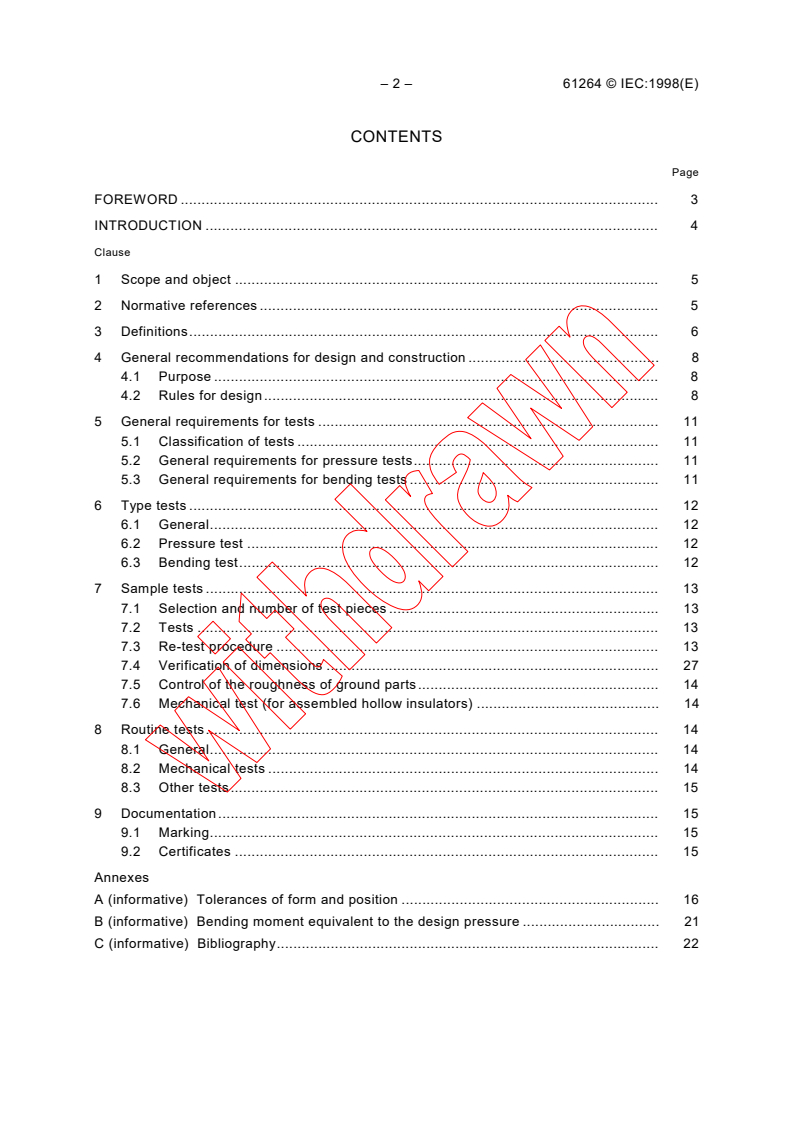
IEC 61264:1998 - Ceramic pressurized hollow insulators for high-voltage switchgear and controlgear Released:10/1/1998
IEC 61264:1998 - Ceramic pressurized hollow insulators for high-voltage switchgear and controlgear Released:10/1/1998
Get Certified
Connect with accredited certification bodies for this standard

Intertek Testing Services NA Inc.
Intertek certification services in North America.

UL Solutions
Global safety science company with testing, inspection and certification.

ANCE
Mexican certification and testing association.
Sponsored listings
Frequently Asked Questions
IEC 61264:1998 is a standard published by the International Electrotechnical Commission (IEC). Its full title is "Ceramic pressurized hollow insulators for high-voltage switchgear and controlgear". This standard covers: Applies to hollow insulators made of ceramic material, with their fixing devices, intended for use with a permanent gas pressure greater than 50 kPa gauge having an internal volume equal to or greater than 1 l (1 000 cm3). They are intended for use in electrical equipment operating on alternating current with a rated voltage greater than 1000 V and a frequency not greater than 100 Hz or for use in direct current equipment with a rated voltage greater than 1 500 V.
Applies to hollow insulators made of ceramic material, with their fixing devices, intended for use with a permanent gas pressure greater than 50 kPa gauge having an internal volume equal to or greater than 1 l (1 000 cm3). They are intended for use in electrical equipment operating on alternating current with a rated voltage greater than 1000 V and a frequency not greater than 100 Hz or for use in direct current equipment with a rated voltage greater than 1 500 V.
IEC 61264:1998 is classified under the following ICS (International Classification for Standards) categories: 29.080.10 - Insulators. The ICS classification helps identify the subject area and facilitates finding related standards.
IEC 61264:1998 has the following relationships with other standards: It is inter standard links to IEC 62155:2003. Understanding these relationships helps ensure you are using the most current and applicable version of the standard.
IEC 61264:1998 is available in PDF format for immediate download after purchase. The document can be added to your cart and obtained through the secure checkout process. Digital delivery ensures instant access to the complete standard document.
Standards Content (Sample)
INTERNATIONAL
IEC
STANDARD
Second edition
1998-10
Ceramic pressurized hollow insulators
for high-voltage switchgear and controlgear
Enveloppes isolantes sous pression en matière céramique
pour l’appareillage haute tension
Reference number
Numbering
As from 1 January 1997 all IEC publications are issued with a designation in
the 60 000 series.
Consolidated publications
Consolidated versions of some IEC publications including amendments are
available. For example, edition numbers 1.0, 1.1 and 1.2 refer, respectively, to the
base publication, the base publication incorporating amendment 1 and the base
publication incorporating amendments 1 and 2.
Validity of this publication
The technical content of IEC publications is kept under constant review by the IEC,
thus ensuring that the content reflects current technology.
Information relating to the date of the reconfirmation of the publication is available
in the IEC catalogue.
Information on the subjects under consideration and work in progress undertaken by
the technical committee which has prepared this publication, as well as the list of
publications issued, is to be found at the following IEC sources:
• IEC web site*
• Catalogue of IEC publications
Published yearly with regular updates
(On-line catalogue)*
• IEC Bulletin
Available both at the IEC web site* and as a printed periodical
Terminology, graphical and letter symbols
For general terminology, readers are referred to IEC 60050: International Electro-
technical Vocabulary (IEV).
For graphical symbols, and letter symbols and signs approved by the IEC for
general use, readers are referred to publications IEC 60027: Letter symbols to be
used in electrical technology, IEC 60417: Graphical symbols for use on equipment.
Index, survey and compilation of the single sheets and IEC 60 617: Graphical symbols
for diagrams.
* IEC web site http: //www.iec.ch.
INTERNATIONAL
IEC
STANDARD
Second edition
1998-10
Ceramic pressurized hollow insulators
for high-voltage switchgear and controlgear
Enveloppes isolantes sous pression en matière céramique
pour l’appareillage haute tension
IEC 1998 Copyright - all rights reserved
No part of this publication may be reproduced or utilized in any form or by any means, electronic or
mechanical, including photocopying and microfilm, without permission in writing from the publisher.
International Electrotechnical Commission 3, rue de Varembé Geneva, Switzerland
Telefax: +41 22 919 0300 e-mail: inmail@iec.ch IEC web site http: //www.iec.ch
Commission Electrotechnique Internationale
PRICE CODE
S
International Electrotechnical Commission
For price, see current catalogue
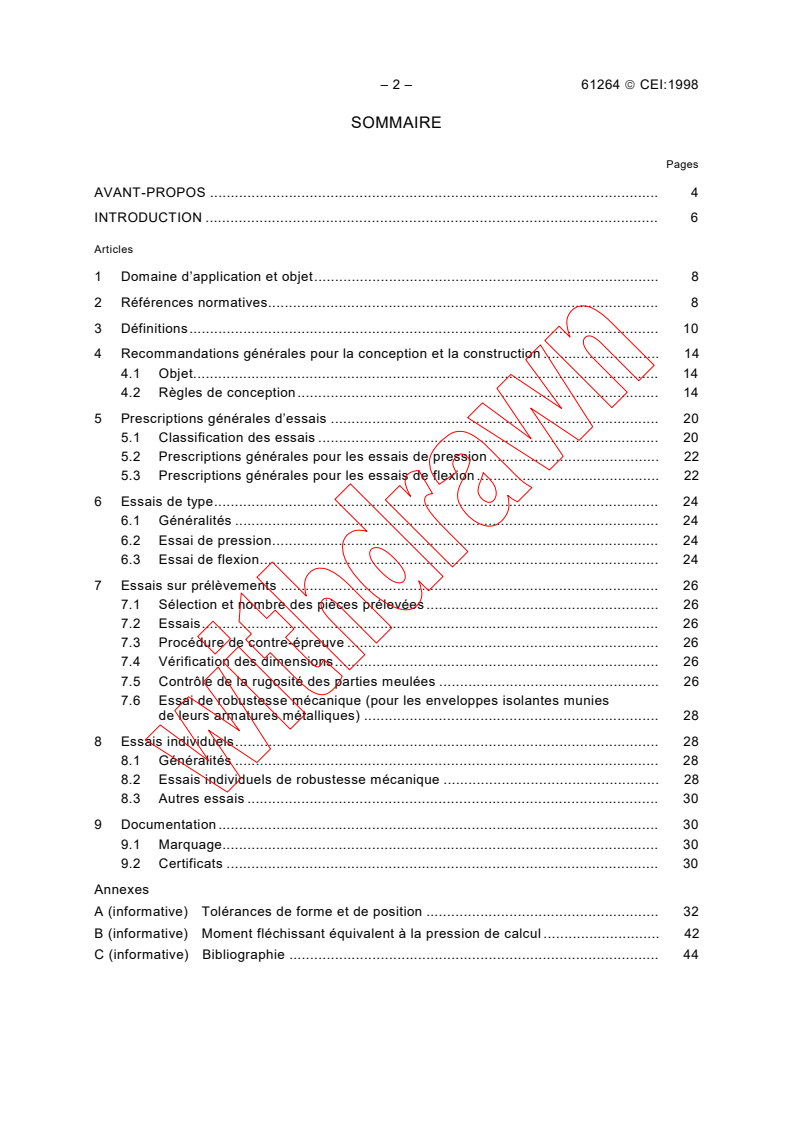
– 2 – 61264 © IEC:1998(E)
CONTENTS
Page
FOREWORD . 3
INTRODUCTION . 4
Clause
1 Scope and object . 5
2 Normative references. 5
3 Definitions. 6
4 General recommendations for design and construction . 8
4.1 Purpose. 8
4.2 Rules for design. 8
5 General requirements for tests . 11
5.1 Classification of tests . 11
5.2 General requirements for pressure tests. 11
5.3 General requirements for bending tests . 11
6 Type tests. 12
6.1 General. 12
6.2 Pressure test. 12
6.3 Bending test. 12
7 Sample tests. 13
7.1 Selection and number of test pieces . 13
7.2 Tests. 13
7.3 Re-test procedure. 13
7.4 Verification of dimensions . 27
7.5 Control of the roughness of ground parts. 14
7.6 Mechanical test (for assembled hollow insulators) . 14
8 Routine tests. 14
8.1 General. 14
8.2 Mechanical tests. 14
8.3 Other tests. 15
9 Documentation. 15
9.1 Marking. 15
9.2 Certificates. 15
Annexes
A (informative) Tolerances of form and position . 16
B (informative) Bending moment equivalent to the design pressure . 21
C (informative) Bibliography. 22
61264 © IEC:1998(E) – 3 –
INTERNATIONAL ELECTROTECHNICAL COMMISSION
_________
CERAMIC PRESSURIZED HOLLOW INSULATORS FOR HIGH-VOLTAGE
SWITCHGEAR AND CONTROLGEAR
FOREWORD
1) The IEC (International Electrotechnical Commission) is a worldwide organization for standardization comprising
all national electrotechnical committees (IEC National Committees). The object of the IEC is to promote
international co-operation on all questions concerning standardization in the electrical and electronic fields. To
this end and in addition to other activities, the IEC publishes International Standards. Their preparation is
entrusted to technical committees; any IEC National Committee interested in the subject dealt with may
participate in this preparatory work. International, governmental and non-governmental organizations liaising
with the IEC also participate in this preparation. The IEC collaborates closely with the International Organization
for Standardization (ISO) in accordance with conditions determined by agreement between the two
organizations.
2) The formal decisions or agreements of the IEC on technical matters express, as nearly as possible, an
international consensus of opinion on the relevant subjects since each technical committee has representation
from all interested National Committees.
3) The documents produced have the form of recommendations for international use and are published in the form
of standards, technical reports or guides and they are accepted by the National Committees in that sense.
4) In order to promote international unification, IEC National Committees undertake to apply IEC International
Standards transparently to the maximum extent possible in their national and regional standards. Any
divergence between the IEC Standard and the corresponding national or regional standard shall be clearly
indicated in the latter.
5) The IEC provides no marking procedure to indicate its approval and cannot be rendered responsible for any
equipment declared to be in conformity with one of its standards.
6) Attention is drawn to the possibility that some of the elements of this International Standard may be the subject
of patent rights. The IEC shall not be held responsible for identifying any or all such patent rights.
International Standard IEC 61264 has been prepared by subcommittee 36C: Insulators for
substations, of IEC technical committee 36: Insulators. It is based on CENELEC publication
EN 50062.
This second edition cancels and replaces the first edition published in 1994 and constitutes a
technical revision.
This standard supplements and modifies, if necessary, IEC 60233, which applies to
unpressurized hollow insulators.
The text of this standard is based on the following documents:
FDIS Report on voting
36C/94/FDIS 36C/101/RVD
Full information on the voting for the approval of this standard can be found in the report on
voting indicated in the above table.
Annexes A, B and C are for information only.
A bilingual version of this standard will be issued at a later date.
– 4 – 61264 © IEC:1998(E)
INTRODUCTION
Technical improvements to this International Standard have been made in the following areas:
– guidance for load combinations: it is made clear that other combinations might exist and
that operating loads, if existent, should be considered;
– information on mechanical strength: this should be collected during testing for a possibility
of statistical evaluation;
– geometrical tolerances.
61264 © IEC:1998(E) – 5 –
CERAMIC PRESSURIZED HOLLOW INSULATORS FOR HIGH-VOLTAGE
SWITCHGEAR AND CONTROLGEAR
1 Scope and object
This International Standard applies to hollow insulators made of ceramic material, with their
fixing devices, intended for use with a permanent gas pressure greater than 50 kPa gauge
having an internal volume equal to or greater than 1 I (1 000 cm ). They are intended for use in
electrical equipment operating on alternating current with a rated voltage greater than 1 000 V
and a frequency not greater than 100 Hz or for use in direct current equipment with a rated
voltage greater than 1 500 V.
NOTE 1 – The gas can be: dry air, inert gases, e.g. sulphur hexafluoride or nitrogen or a mixture of such gases.
NOTE 2 – Hollow insulators are intended for use in electrical equipment with a permanent gas pressure, for
example
– circuit-breakers,
– switch-disconnectors,
– disconnectors,
– earthing switches,
– instrument transformers,
– surge arresters,
– bushings,
– cable sealing ends.
The object of this standard is
– to define terms used;
– to prescribe design rules;
– to prescribe test procedures and test values
regarding pressure and bending stresses for hollow insulators.
It is not the object of this standard to prescribe dielectric tests, because the withstand voltages
are not characteristics of the hollow insulator itself, but of the apparatus of which it ultimately
forms a part.
2 Normative references
The following standards contain provisions which, through reference in this text, constitute
provisions of this International Standard. At the time of publication, the editions indicated were
valid. All standards are subject to revision, and parties to agreements based on this
International Standard are encouraged to investigate the possibility of applying the most recent
editions of the standards indicated below. Members of IEC and ISO maintain registers of
currently valid International Standards.
IEV 60050(471):1984, International Electrotechnical Vocabulary (IEV) – Chapter 471:
Insulators
IEC 60056:1987, High-voltage alternating-current circuit-breakers
IEC 60168:1994, Tests on indoor and outdoor post insulators of ceramic material or glass for
systems with nominal voltages greater than 1 000 V
IEC 60233:1974, Tests on hollow insulators for use in electrical equipment
IEC 60672-3:1997, Ceramic and glass insulating materials – Part 3: Specifications for
individual materials
– 6 – 61264 © IEC:1998(E)
IEC 60694:1996, Common specifications for high-voltage switchgear and controlgear standards
IEC 60865-1:1993, Short-circuit currents – Calculation of effects – Part 1: Definitions and
calculation methods
IEC 61166:1993, High-voltage alternating current circuit-breakers – Guide for seismic
qualification of high-voltage alternating current circuit-breakers
ISO 4287:1997, Geometrical Product Specification (GPS) – Surface texture: Profile method –
Terms, definitions and surface texture parameters
ISO 4287-2:1984, Surface roughness – Terminology – Part 2: Measurement of surface
roughness parameters
CENELEC EN 50062:1991, Ceramic pressurized hollow insulators for high-voltage switchgear
and controlgear
3 Definitions
For the purpose of this International Standard, the following definitions apply. The definitions
given below are those which either do not appear or differ from those given in IEC 60050(471)
3.1
hollow insulator body
a hollow insulating part body, which is open from end to end, with or without sheds, not
including the fixing devices or end fittings
3.2
hollow insulator
a hollow insulating part, which is open from end to end, with or without sheds, including the
fixing devices or end fittings [IEV 471-01-17, modified]
NOTE – This is a general term which also covers the definitions 3.4, 3.5 and 3.6.
3.3
fixing device or end fitting
a device forming part of a hollow insulator, intended to connect it to a supporting structure or to
an item of equipment, or to another insulator
NOTE – Where the fixing device is metallic, the term "metal fitting" is also used. [IEV 471-01-02, modified]
3.4
hollow post insulator
a hollow post insulator consists of one hollow post insulator unit or an assembly of more units
and is intended to give support to a live part, which is to be insulated from earth or from
another live part
3.5
hollow post insulator unit
a hollow post insulator unit consists of a permanent assembly of a hollow insulating body with
fixing devices and is intended to give support
3.6
chamber insulator
a chamber insulator is a hollow insulator, which is used as a housing for example the arc
extinction chamber of a circuit-breaker
61264 © IEC:1998(E) – 7 –
3.7
bushing
a device that enables one or several conductors to pass through a partition such as a wall or
tank and insulates the conductors from it. The means of attachment (flange or other fixing
device) to the partition forms part of the bushing. [IEV 471-02-01, modified]
3.8
design pressure
it is at least the upper limit of differential pressure reached between the interior and exterior of
the hollow insulator during operation at the design temperature
3.9
design temperature
the highest temperature reached inside the hollow insulator which can occur under service
conditions. This is generally the upper limit of ambient air temperature increased by the
temperature rise due to the flow of rated normal current, and to dielectric losses, if any
3.10
type test withstand bending moment
it is the withstand bending moment verified in a type test according to 6.3. The withstand
bending moment is based on load conditions specified in 4.2.3 of a pressurized hollow insulator
to be used in an electrical equipment
3.11
mechanical failing load
the maximum load reached when a hollow insulator is tested under the prescribed conditions of
test
3.12
manufacturer
the organization that produces the hollow insulators or hollow insulator bodies
3.13
equipment manufacturer
individual or organization which produces the electrical equipment utilizing the hollow insulators
or hollow insulator bodies
3.14
parallelism of the end faces
the maximum difference in the height of a hollow insulator measured across the surfaces of the
end fittings or the end surfaces of the hollow insulator body
3.15
eccentricity
the displacement, perpendicular to the axis of the hollow insulator, between the centres of the
pitch circles of the fixing holes of the turned fit in the top and bottom end fittings
3.16
angular deviation of the fixing holes
the rotational displacement, expressed as an angle, between corresponding fixing holes in the
end fittings at the top and bottom of a hollow insulator
3.17
lot
a group of insulators offered for acceptance from the same manufacturer, of the same design
and manufactured under similar conditions of production. One or more lots may be offered
together for acceptance; the lot(s) offered may consist of the whole, or part, of the quantity
ordered
– 8 – 61264 © IEC:1998(E)
4 General recommendations for design and construction
4.1 Purpose
The rules for the design of gas-pressurized hollow insulators for high-voltage equipment
prescribed in this clause take into account that these hollow insulators are subjected to
particular operating conditions which distinguish them from compressed air receivers and other
similar storage vessels.
4.2 Rules for design
When designing hollow insulators, the following points shall be taken into consideration.
– Deviations and tolerances of profile: circularity, run out, camber, parallelism, coaxiality,
eveness, differences in wall thickness, and angular and radial position of fixing holes shall
all take account of the parts to be fitted inside.
– It shall be considered that electrical strength, mechanical strength and technological
problems may influence the real construction but, due to the complexity of this subject, no
definitive guide can be given.
– A critical selection of materials for cementing and fittings is also necessary. The ceramic
material shall comply in its characteristics with IEC 60672-3, groups C100 and C200.
– An insulating pressurized enclosure may be considered as appropriate for its intended use
only after the electrical equipment of which it is a part has satisfactorily passed the type
tests provided for by the particular standards with which this equipment must comply.
4.2.1 Determination of the design pressure
The design pressure shall be the difference between the maximum absolute pressure, when
the equipment (of which the hollow insulator is a part) is carrying its rated normal current at
maximum ambient temperature, and the outside pressure.
The maximum absolute pressure of the gas inside the hollow insulator shall be determined by
the equipment manufacturer.
NOTE – In some special cases (e.g. circuit-breakers) the pressure rise occurring after a breaking operation should
be taken into account.
4.2.2 Determination of the design temperature
The equipment manufacturer shall determine this value taking account of 3.9.
Solar radiation shall be taken into account.
4.2.3 Determination of the type test withstand bending moment
The following factors may all contribute to the bending stress that may occur in electrical
equipment: mass, internal pressure, terminal loads, short-circuit loads, ice loads, operating
loads, wind loads, seismic loads (see table 1).
61264 © IEC:1998(E) – 9 –
The following sources shall be used for determining the values necessary for calculating the
relevant loads:
– terminal loads: 6.101.6.1 of IEC 60056;
– wind loads: 6.101.6.1 of IEC 60056 and 2.1.2 of IEC 60694;
– ice loads: 6.101.6.1 of IEC 60056 and 2.1.2 of IEC 60694;
– short-circuit loads: determined from the rated short-circuit level of the equipment.
Section 2 of IEC 60865-1;
– seismic loads: 8.1 of IEC 61166;
– operating loads: values depending on design of equipment.
The alternative combinations detailed in table 1 are typical examples of load combinations that
shall be considered in design. Column 1 of table 1 covers the routinely expected loads and has
been assigned a safety factor of 2,1 for the type test bending stress.
The three other conditions covering rarely occurring extreme loads have been assigned safety
factors of 1,2 for the type test bending stress, and for seismic stresses a safety factor of 1,0.
The most onerous of the applicable alternatives shall be used to determine the test withstand
bending stress.
From the test withstand bending stress, the test withstand bending moment can be calculated.
Table 1 – Typical examples of load combinations and weighting factors
Stress from
Loads routinely expected Stress from rarely occurring extreme loads
loads
ALT 1 ALT 2 ALT 3
Short-circuit load Ice load Seismic load
Design pressure * 100 % 100 % 100 % 100 %
Mass 100 % 100 % 100 % 100 %
Rated terminal load 100 % 50 % 0 % 70 %
Wind pressure 30 % 100 % 0 % 10 %
Short circuit load 0 % 100 % 0 % 0 %
Ice load 0 % 0 % 100 % 0 %
Seismic load 0 % 0 % 0 % 100 %
Safety factor 2,1 1,2 1,2 1,0
* See annex B
NOTE – For details see IEC 60056, IEC 60694, IEC 60865-1 and IEC 61166.
– 10 – 61264 © IEC:1998(E)
Figure 1 shows the relation between the testing values and the utilization values for the
bending moment of a hollow insulator or hollow post insulator.
Testing values Utilization values
100 %
Type test withstand
= 100 %
bending moment
10,
ALT 3 (table 1)
Rarely occurring extreme loads
= 83,%3
12,
ALT 1 or ALT 2 (table 1)
Rarely occurring extreme loads
Routine test 70 %
bending moment
50 %
= 47,%6
21,
(table 1)
Routinely expected loads
IEC 1 316/98
Figure 1 – Bending moments
61264 © IEC:1998(E) – 11 –
5 General requirements for tests
5.1 Classification of tests
The tests are divided into three groups as follows.
a) Ty
...
NORME
CEI
INTERNATIONALE
IEC
INTERNATIONAL
Deuxième édition
STANDARD
Second edition
1998-10
Enveloppes isolantes sous pression en matière
céramique pour l'appareillage haute tension
Ceramic pressurized hollow insulators for
high-voltage switchgear and controlgear
Numéro de référence
Reference number
CEI/IEC 61264: 1998
Numéros des publications Numbering
Depuis le 1er janvier 1997, les publications de la CEI As from 1 January 1997 all IEC publications are
sont numérotées à partir de 60000. issued with a designation in the 60000 series.
Publications consolidées Consolidated publications
Les versions consolidées de certaines publications de Consolidated versions of some IEC publications
la CEI incorporant les amendements sont disponibles. including amendments are available. For example,
Par exemple, les numéros d’édition 1.0, 1.1 et 1.2 edition numbers 1.0, 1.1 and 1.2 refer, respectively, to
indiquent respectivement la publication de base, la the base publication, the base publication
publication de base incorporant l’amendement 1, et la incorporating amendment 1 and the base publication
publication de base incorporant les amendements 1 incorporating amendments 1 and 2.
et 2.
Validité de la présente publication Validity of this publication
Le contenu technique des publications de la CEI est The technical content of IEC publications is kept under
constamment revu par la CEI afin qu'il reflète l'état constant review by the IEC, thus ensuring that the
actuel de la technique. content reflects current technology.
Des renseignements relatifs à la date de Information relating to the date of the reconfirmation of
reconfirmation de la publication sont disponibles dans the publication is available in the IEC catalogue.
le Catalogue de la CEI.
Les renseignements relatifs à des questions à l’étude et Information on the subjects under consideration and
des travaux en cours entrepris par le comité technique work in progress undertaken by the technical
qui a établi cette publication, ainsi que la liste des committee which has prepared this publication, as well
publications établies, se trouvent dans les documents ci- as the list of publications issued, is to be found at the
dessous: following IEC sources:
• «Site web» de la CEI* • IEC web site*
• Catalogue des publications de la CEI • Catalogue of IEC publications
Publié annuellement et mis à jour régulièrement Published yearly with regular updates
(Catalogue en ligne)* (On-line catalogue)*
• Bulletin de la CEI • IEC Bulletin
Disponible à la fois au «site web» de la CEI* et Available both at the IEC web site* and as a
comme périodique imprimé printed periodical
Terminologie, symboles graphiques Terminology, graphical and letter
et littéraux symbols
En ce qui concerne la terminologie générale, le lecteur For general terminology, readers are referred to
se reportera à la CEI 60050: Vocabulaire Electro- IEC 60050: International Electrotechnical Vocabulary
technique International (VEI). (IEV).
Pour les symboles graphiques, les symboles littéraux For graphical symbols, and letter symbols and signs
et les signes d'usage général approuvés par la CEI, le approved by the IEC for general use, readers are
lecteur consultera la CEI 60027: Symboles littéraux à referred to publications IEC 60027: Letter symbols to
utiliser en électrotechnique, la CEI 60417: Symboles be used in electrical technology, IEC 60417: Graphical
graphiques utilisables sur le matériel. Index, relevé et symbols for use on equipment. Index, survey and
compilation des feuilles individuelles, et la CEI 60617: compilation of the single sheets and IEC 60617:
Symboles graphiques pour schémas. Graphical symbols for diagrams.
* Voir adresse «site web» sur la page de titre. * See web site address on title page.
NORME
CEI
INTERNATIONALE
IEC
INTERNATIONAL
Deuxième édition
STANDARD
Second edition
1998-10
Enveloppes isolantes sous pression en matière
céramique pour l'appareillage haute tension
Ceramic pressurized hollow insulators for
high-voltage switchgear and controlgear
IEC 1998 Droits de reproduction réservés Copyright - all rights reserved
Aucune partie de cette publication ne peut être reproduite ni No part of this publication may be reproduced or utilized in
utilisée sous quelque forme que ce soit et par aucun any form or by any means, electronic or mechanical,
procédé, électronique ou mécanique, y compris la photo- including photocopying and microfilm, without permission in
copie et les microfilms, sans l'accord écrit de l'éditeur. writing from the publisher.
International Electrotechnical Commission 3, rue de Varembé Geneva, Switzerland
Telefax: +41 22 919 0300 e-mail: inmail@iec.ch IEC web site http: //www.iec.ch
CODE PRIX
Commission Electrotechnique Internationale
PRICE CODE S
International Electrotechnical Commission
Pour prix, voir catalogue en vigueur
For price, see current catalogue
– 2 – 61264 CEI:1998
SOMMAIRE
Pages
AVANT-PROPOS . 4
INTRODUCTION . 6
Articles
1 Domaine d’application et objet. 8
2 Références normatives. 8
3 Définitions. 10
4 Recommandations générales pour la conception et la construction . 14
4.1 Objet. 14
4.2 Règles de conception. 14
5 Prescriptions générales d’essais . 20
5.1 Classification des essais . 20
5.2 Prescriptions générales pour les essais de pression . 22
5.3 Prescriptions générales pour les essais de flexion . 22
6 Essais de type. 24
6.1 Généralités . 24
6.2 Essai de pression. 24
6.3 Essai de flexion. 24
7 Essais sur prélèvements . 26
7.1 Sélection et nombre des pièces prélevées . 26
7.2 Essais. 26
7.3 Procédure de contre-épreuve . 26
7.4 Vérification des dimensions. 26
7.5 Contrôle de la rugosité des parties meulées . 26
7.6 Essai de robustesse mécanique (pour les enveloppes isolantes munies
de leurs armatures métalliques) . 28
8 Essais individuels. 28
8.1 Généralités . 28
8.2 Essais individuels de robustesse mécanique . 28
8.3 Autres essais . 30
9 Documentation. 30
9.1 Marquage. 30
9.2 Certificats . 30
Annexes
A (informative) Tolérances de forme et de position . 32
B (informative) Moment fléchissant équivalent à la pression de calcul . 42
C (informative) Bibliographie . 44
61264 IEC:1998 – 3 –
CONTENTS
Page
FOREWORD . 5
INTRODUCTION . 7
Clause
1 Scope and object . 9
2 Normative references . 9
3 Definitions. 11
4 General recommendations for design and construction . 15
4.1 Purpose . 15
4.2 Rules for design. 15
5 General requirements for tests . 21
5.1 Classification of tests . 21
5.2 General requirements for pressure tests. 23
5.3 General requirements for bending tests . 23
6 Type tests . 25
6.1 General. 25
6.2 Pressure test . 25
6.3 Bending test. 25
7 Sample tests . 27
7.1 Selection and number of test pieces . 27
7.2 Tests . 27
7.3 Re-test procedure . 27
7.4 Verification of dimensions . 27
7.5 Control of the roughness of ground parts. 27
7.6 Mechanical test (for assembled hollow insulators) . 29
8 Routine tests. 29
8.1 General. 29
8.2 Mechanical tests . 29
8.3 Other tests. 31
9 Documentation. 31
9.1 Marking. 31
9.2 Certificates . 31
Annexes
A (informative) Tolerances of form and position . 33
B (informative) Bending moment equivalent to the design pressure . 43
C (informative) Bibliography. 45
– 4 – 61264 CEI:1998
COMMISSION ÉLECTROTECHNIQUE INTERNATIONALE
_________
ENVELOPPES ISOLANTES SOUS PRESSION EN MATIÈRE CÉRAMIQUE
POUR L’APPAREILLAGE HAUTE TENSION
AVANT-PROPOS
1) La CEI (Commission Electrotechnique Internationale) est une organisation mondiale de normalisation composée
de l'ensemble des comités électrotechniques nationaux (Comités nationaux de la CEI). La CEI a pour objet de
favoriser la coopération internationale pour toutes les questions de normalisation dans les domaines de
l'électricité et de l'électronique. A cet effet, la CEI, entre autres activités, publie des Normes internationales.
Leur élaboration est confiée à des comités d'études, aux travaux desquels tout Comité national intéressé par le
sujet traité peut participer. Les organisations internationales, gouvernementales et non gouvernementales, en
liaison avec la CEI, participent également aux travaux. La CEI collabore étroitement avec l'Organisation
Internationale de Normalisation (ISO), selon des conditions fixées par accord entre les deux organisations.
2) Les décisions ou accords officiels de la CEI concernant les questions techniques représentent, dans la mesure
du possible un accord international sur les sujets étudiés, étant donné que les Comités nationaux intéressés
sont représentés dans chaque comité d’études.
3) Les documents produits se présentent sous la forme de recommandations internationales. Ils sont publiés
comme normes, rapports techniques ou guides et agréés comme tels par les Comités nationaux.
4) Dans le but d'encourager l'unification internationale, les Comités nationaux de la CEI s'engagent à appliquer de
façon transparente, dans toute la mesure possible, les Normes internationales de la CEI dans leurs normes
nationales et régionales. Toute divergence entre la norme de la CEI et la norme nationale ou régionale
correspondante doit être indiquée en termes clairs dans cette dernière.
5) La CEI n’a fixé aucune procédure concernant le marquage comme indication d’approbation et sa responsabilité
n’est pas engagée quand un matériel est déclaré conforme à l’une de ses normes.
6) L’attention est attirée sur le fait que certains des éléments de la présente Norme internationale peuvent faire
l’objet de droits de propriété intellectuelle ou de droits analogues. La CEI ne saurait être tenue pour
responsable de ne pas avoir identifié de tels droits de propriété et de ne pas avoir signalé leur existence.
La Norme internationale CEI 61264 a été établie par le sous-comité 36C: Isolateurs pour sous-
stations, du comité d’études 36 de la CEI: Isolateurs. Elle est basée sur la publication
CENELEC EN 50062.
Cette deuxième édition annule et remplace la première édition parue en 1994 et constitue une
révision technique.
La présente norme complète et modifie, si nécessaire, la CEI 60233 qui s’applique aux
enveloppes isolantes non pressurisées.
Cette version bilingue (1999-01) remplace la version monolingue anglaise.
Le texte anglais de cette norme est issu des documents 36C/94/FDIS et 36C/101/RVD.
Le rapport de vote 36C/101/RVD donne toute information sur le vote ayant abouti à
l'approbation de cette norme.
La version française de cette norme n'a pas été soumise au vote.
Les annexes A, B et C sont données uniquement à titre d’information.
61264 IEC:1998 – 5 –
INTERNATIONAL ELECTROTECHNICAL COMMISSION
_________
CERAMIC PRESSURIZED HOLLOW INSULATORS FOR HIGH-VOLTAGE
SWITCHGEAR AND CONTROLGEAR
FOREWORD
1) The IEC (International Electrotechnical Commission) is a worldwide organization for standardization comprising
all national electrotechnical committees (IEC National Committees). The object of the IEC is to promote
international co-operation on all questions concerning standardization in the electrical and electronic fields. To
this end and in addition to other activities, the IEC publishes International Standards. Their preparation is
entrusted to technical committees; any IEC National Committee interested in the subject dealt with may
participate in this preparatory work. International, governmental and non-governmental organizations liaising
with the IEC also participate in this preparation. The IEC collaborates closely with the International Organization
for Standardization (ISO) in accordance with conditions determined by agreement between the two
organizations.
2) The formal decisions or agreements of the IEC on technical matters express, as nearly as possible, an
international consensus of opinion on the relevant subjects since each technical committee has representation
from all interested National Committees.
3) The documents produced have the form of recommendations for international use and are published in the form
of standards, technical reports or guides and they are accepted by the National Committees in that sense.
4) In order to promote international unification, IEC National Committees undertake to apply IEC International
Standards transparently to the maximum extent possible in their national and regional standards. Any
divergence between the IEC Standard and the corresponding national or regional standard shall be clearly
indicated in the latter.
5) The IEC provides no marking procedure to indicate its approval and cannot be rendered responsible for any
equipment declared to be in conformity with one of its standards.
6) Attention is drawn to the possibility that some of the elements of this International Standard may be the subject
of patent rights. The IEC shall not be held responsible for identifying any or all such patent rights.
International Standard IEC 61264 has been prepared by subcommittee 36C: Insulators for
substations, of IEC technical committee 36: Insulators. It is based on CENELEC publication
EN 50062.
This second edition cancels and replaces the first edition published in 1994 and constitutes a
technical revision.
This standard supplements and modifies, if necessary, IEC 60233, which applies to
unpressurized hollow insulators.
This bilingual version (1999-01) replaces the English version.
The text of this standard is based on the following documents:
FDIS Report on voting
36C/94/FDIS 36C/101/RVD
Full information on the voting for the approval of this standard can be found in the report on
voting indicated in the above table.
Annexes A, B and C are for information only.
The french version of this standard has not been voted upon.
– 6 – 61264 CEI:1998
INTRODUCTION
La présente Norme internationale a été améliorée sur le plan technique dans les domaines
suivants:
– les directives pour les combinaisons de charges stipulent clairement que d’autres
combinaisons peuvent exister et qu’il convient de tenir compte, le cas échéant, des charges
d’exploitation;
– pendant les essais, il convient de procéder à la collecte d’informations sur la résistance
mécanique pour voir s’il est possible d’effectuer une évaluation statistique;
– tolérances géométriques.
61264 IEC:1998 – 7 –
INTRODUCTION
Technical improvements to this International Standard have been made in the following areas:
– guidance for load combinations: it is made clear that other combinations might exist and
that operating loads, if existent, should be considered;
– information on mechanical strength: this should be collected during testing for a possibility
of statistical evaluation;
– geometrical tolerances.
– 8 – 61264 CEI:1998
ENVELOPPES ISOLANTES SOUS PRESSION EN MATIÈRE CÉRAMIQUE
POUR L’APPAREILLAGE HAUTE TENSION
1 Domaine d’application et objet
La présente Norme internationale s'applique aux isolateurs en matière céramique creux, avec leurs
dispositifs de fixation, destinés à être utilisés avec une pression de gaz permanente supérieure à
50 kPa et ayant un volume interne égal ou supérieur à 1 l (1 000 cm ). Ils sont destinés à être
utilisés dans des appareils électriques fonctionnant en courant alternatif avec une tension
nominale supérieure à 1 000 V et une fréquence de 100 Hz au maximum, ou dans des
appareils à courant continu avec une tension nominale supérieure à 1 500 V.
NOTE 1 – Le gaz peut être: de l'air sec, des gaz inertes, par exemple de l'hexafluorure de soufre ou de l'azote ou
un mélange de ces gaz.
NOTE 2 – Les isolateurs creux sont destinés à être utilisés dans des appareils électriques avec une pression de
gaz permanente, notamment
– des disjoncteurs,
– des interrupteurs-sectionneur,
– des sectionneurs,
– des sectionneurs de terre,
– des transformateurs de mesure,
– des parafoudres,
– des traversées,
– des extrémités de câble.
L'objet de cette norme est de
– définir les termes utilisés;
– prescrire des règles de conception;
– prescrire des procédures et des valeurs d'essai
concernant la pression et les contraintes de flexion pour les isolateurs creux.
La présente norme n'a pas pour objet de prescrire des essais diélectriques car les tensions de
tenue ne sont pas caractéristiques de l'isolateur creux lui-même mais de l'appareil dont, en fin
de compte, il fait partie.
2 Références normatives
Les documents normatifs suivants contiennent des dispositions qui, par suite de la référence
qui y est faite, constituent des dispositions valables pour la présente Norme internationale. Au
moment de la publication, les éditions indiquées étaient en vigueur. Tout document normatif
est sujet à révision et les parties prenantes aux accords fondés sur la présente Norme
internationale sont invitées à rechercher la possibilité d’appliquer les éditions les plus récentes
des documents normatifs indiqués ci-après. Les membres de la CEI et de l'ISO possèdent le
registre des Normes internationales en vigueur.
CEI 60050(471):1984, Vocabulaire Electrotechnique International (VEI) – Chapitre 471: Isolateurs
CEI 60056:1987, Disjoncteurs à courant alternatif à haute tension
61264 IEC:1998 – 9 –
CERAMIC PRESSURIZED HOLLOW INSULATORS FOR HIGH-VOLTAGE
SWITCHGEAR AND CONTROLGEAR
1 Scope and object
This International Standard applies to hollow insulators made of ceramic material, with their
fixing devices, intended for use with a permanent gas pressure greater than 50 kPa gauge
having an internal volume equal to or greater than 1 I (1 000 cm ). They are intended for use in
electrical equipment operating on alternating current with a rated voltage greater than 1 000 V
and a frequency not greater than 100 Hz or for use in direct current equipment with a rated
voltage greater than 1 500 V.
NOTE 1 – The gas can be: dry air, inert gases, e.g. sulphur hexafluoride or nitrogen or a mixture of such gases.
NOTE 2 – Hollow insulators are intended for use in electrical equipment with a permanent gas pressure, for
example
– circuit-breakers,
– switch-disconnectors,
– disconnectors,
– earthing switches,
– instrument transformers,
– surge arresters,
– bushings,
– cable sealing ends.
The object of this standard is
– to define terms used;
– to prescribe design rules;
– to prescribe test procedures and test values
regarding pressure and bending stresses for hollow insulators.
It is not the object of this standard to prescribe dielectric tests, because the withstand voltages
are not characteristics of the hollow insulator itself, but of the apparatus of which it ultimately
forms a part.
2 Normative references
The following normative documents contain provisions which, through reference in this text,
constitute provisions of this International Standard. For dated references, subsequent
amendments to, or revisions of, any of these publications do not apply. However, parties to
agreements based on this International Standard are encouraged to investigate the possibility
of applying the most recent editions of the normative documents indicated below. For undated
references, the latest edition of the normative document referred to applies. Members of IEC
and ISO maintain registers of currently valid International Standards.
IEV 60050(471):1984, International Electrotechnical Vocabulary (IEV) – Chapter 471:
Insulators
IEC 60056:1987, High-voltage alternating-current circuit-breakers
– 10 – 61264 CEI:1998
CEI 60168:1994, Essais des supports isolants d'intérieur et d'extérieur, en matière céramique
ou en verre, destinés à des installations de tension nominale supérieure à 1 000 V
CEI 60233:1974, Essais des enveloppes isolantes destinées à des appareils électriques
CEI 60672-3:1997, Matériaux isolants à base de céramique ou de verre – Partie 3:
Spécifications pour matériaux particuliers
CEI 60694:1996, Spécifications communes aux normes de l’appareillage à haute tension
CEI 60865-1:1993, Courants de court-circuit – Calcul des effets – Partie 1: Définitions et
méthodes de calcul
CEI 61166:1993, Disjoncteurs à courant alternatif à haute tension – Guide pour la qualification
sismique des disjoncteurs à courant alternatif à haute tension
ISO 4287:1997, Spécification géométrique des produits (GPS) – Etat de surface: Méthode du
profil – Termes, définitions et paramètres d’état de surface
ISO 4287-2:1984, Rugosité de surface – Terminologie – Partie 2: Mesurage des paramètres de
la rugosité de surface
CENELEC EN 50062:1991, Enveloppes isolantes sous pression en matière céramique pour
l’appareillage à haute tension
3 Définitions
Pour les besoins de la présente Norme internationale, les définitions suivantes s'appliquent.
Les définitions données ci-dessous sont celles qui soit n'apparaissent pas, soit diffèrent de
celles données dans la CEI 60050(471).
3.1
corps d’enveloppe
pièce isolante creuse ouverte de part en part, munie ou non d’ailettes, mais ne comprenant ni
dispositif de fixation ni armature métallique
3.2
enveloppe isolante
pièce isolante creuse ouverte de part en part, munie ou non d’ailettes, et comprenant des
dispositifs de fixation ou des armatures métalliques. [VEI 471-01-17, modifié]
NOTE – Ce terme général couvre aussi les définitions 3.4, 3.5 et 3.6.
3.3
dispositif de fixation ou armature métallique
dispositif faisant partie de l’enveloppe isolante, servant à fixer celle-ci à un support ou à un
élément d'équipement ou à une autre enveloppe isolante
NOTE – Lorsque le dispositif de fixation est métallique, l’appellation «armature métallique» est aussi utilisée.
[VEI 471-01-02, modifié]
61264 IEC:1998 – 11 –
IEC 60168:1994, Tests on indoor and outdoor post insulators of ceramic material or glass for
systems with nominal voltages greater than 1 000 V
IEC 60233:1974, Tests on hollow insulators for use in electrical equipment
IEC 60672-3:1997, Ceramic and glass insulating materials – Part 3: Specifications for
individual materials
IEC 60694:1996, Common specifications for high-voltage switchgear and controlgear standards
IEC 60865-1:1993, Short-circuit currents – Calculation of effects – Part 1: Definitions and
calculation methods
IEC 61166:1993, High-voltage alternating current circuit-breakers – Guide for seismic
qualification of high-voltage alternating current circuit-breakers
ISO 4287:1997, Geometrical Product Specification (GPS) – Surface texture: Profile method –
Terms, definitions and surface texture parameters
ISO 4287-2:1984, Surface roughness – Terminology – Part 2: Measurement of surface
roughness parameters
CENELEC EN 50062:1991, Ceramic pressurized hollow insulators for high-voltage switchgear
and controlgear
3 Definitions
For the purpose of this International Standard, the following definitions apply. The definitions
given below are those which either do not appear or differ from those given in IEC 60050(471).
3.1
hollow insulator body
a hollow insulating part body, which is open from end to end, with or without sheds, not
including the fixing devices or end fittings
3.2
hollow insulator
a hollow insulating part, which is open from end to end, with or without sheds, including the
fixing devices or end fittings [IEV 471-01-17, modified]
NOTE – This is a general term which also covers the definitions 3.4, 3.5 and 3.6.
3.3
fixing device or end fitting
a device forming part of a hollow insulator, intended to connect it to a supporting structure or to
an item of equipment, or to another insulator
NOTE – Where the fixing device is metallic, the term "metal fitting" is also used. [IEV 471-01-02, modified]
– 12 – 61264 CEI:1998
3.4
support isolant creux
élément de support isolant creux unique ou assemblage d’éléments de support isolant creux
servant à la fixation rigide d’une pièce sous tension, qui doit être isolée de la terre ou d’une
autre pièce sous tension
3.5
élément de support isolant creux
assemblage permanent d’un corps d’enveloppe isolante avec des dispositifs de fixation,
destiné à servir de support rigide
3.6
chambre isolante
enveloppe isolante utilisée comme contenant, par exemple: isolateur de la chambre
d’extinction d’un disjoncteur
3.7
traversée
dispositif servant à faire passer un ou plusieurs conducteurs à travers une paroi, telle qu’une
cloison ou une cuve, en isolant le ou les conducteurs de cette paroi. Les moyens de fixation (bride
ou autre dispositif) sur la paroi font partie de la traversée. [VEI 471-02-01, modifié]
3.8
pression de calcul
pression au moins égale à la pression différentielle maximale entre l’intérieur et l’extérieur de
l’enveloppe atteinte en service à la température de calcul
3.9
température de calcul
température maximale pouvant être atteinte, dans les conditions de service, à l’intérieur de l’enveloppe
isolante. C’est généralement la température maximale de l’air ambiant augmentée de l’échauffement
dû au passage du courant assigné en service continu et aux pertes diélectriques, s’il y a lieu
3.10
moment fléchissant tenu d'essai de type
moment fléchissant, tenu au cours d’un essai de type selon 6.3. Le moment fléchissant tenu est
déterminé d’après les cas de chargement de 4.2.3 pour une enveloppe isolante sous pression
destinée à un appareil électrique
3.11
charge de rupture mécanique
charge maximale atteinte lorsque l’enveloppe isolante est essayée dans les conditions d’essai
prescrites
3.12
fabricant
organisation qui produit l’enveloppe isolante
3.13
fabricant de l’appareil
personne ou organisation qui produit l’appareil électrique utilisant l’enveloppe isolante
61264 IEC:1998 – 13 –
3.4
hollow post insulator
a hollow post insulator consists of one hollow post insulator unit or an assembly of more units
and is intended to give support to a live part, which is to be insulated from earth or from
another live part
3.5
hollow post insulator unit
a hollow post insulator unit consists of a permanent assembly of a hollow insulating body with
fixing devices and is intended to give support
3.6
chamber insulator
a chamber insulator is a hollow insulator, which is used as a housing for example the arc
extinction chamber of a circuit-breaker
3.7
bushing
a device that enables one or several conductors to pass through a partition such as a wall or
tank and insulates the conductors from it. The means of attachment (flange or other fixing
device) to the partition forms part of the bushing. [IEV 471-02-01, modified]
3.8
design pressure
it is at least the upper limit of differential pressure reached between the interior and exterior of
the hollow insulator during operation at the design temperature
3.9
design temperature
the highest temperature reached inside the hollow insulator which can occur under service
conditions. This is generally the upper limit of ambient air temperature increased by the
temperature rise due to the flow of rated normal current, and to dielectric losses, if any
3.10
type test withstand bending moment
it is the withstand bending moment verified in a type test according to 6.3. The withstand
bending moment is based on load conditions specified in 4.2.3 of a pressurized hollow insulator
to be used in an electrical equipment
3.11
mechanical failing load
the maximum load reached when a hollow insulator is tested under the prescribed conditions of
test
3.12
manufacturer
the organization that produces the hollow insulators or hollow insulator bodies
3.13
equipment manufacturer
individual or organization which produces the electrical equipment utilizing the hollow insulators
or hollow insulator bodies
– 14 – 61264 CEI:1998
3.14
parallélisme des faces d'extrémité
différence maximale dans la hauteur d'une enveloppe isolante mesurée entre les surfaces des
armatures métalliques à chaque extrémité
3.15
excentricité
déplacement perpendiculaire à l'axe de l’enveloppe isolante entre les centres des cercles
primitifs des trous de fixation des armatures métalliques du haut et du bas
3.16
déviation angulaire des trous de fixation
déplacement angulaire, exprimé en angle, entre les trous de fixation dans les armatures
métalliques en vis-à-vis, en haut et en bas d'une enveloppe isolante
3.17
lot
groupe d'isolateurs présentés pour acceptation par le même fabricant, de même conception et
fabriqués dans les mêmes conditions de production. Un ou plusieurs lots peuvent être
présentés ensemble pour acceptation. Le ou les lots présentés peuvent constituer la totalité ou
une partie seulement de la quantité commandée
4 Recommandations générales pour la conception et la construction
4.1 Objet
Les règles de conception d’enveloppes isolantes sous pression de gaz pour appareils à haute
tension prescrites dans le présent article tiennent compte du fait que ces enveloppes isolantes
sont soumises à des conditions d'exploitation particulières qui les distinguent des récepteurs
d'air comprimé et autres réservoirs de stockage similaires.
4.2 Règles de conception
Lors de la conception d’enveloppes isolantes, on doit tenir compte des sujétions suivantes.
– Les écarts et les tolérances de forme: circularité, battement, flèche, parallélisme, coaxialité,
planéité, différences d’épaisseur des parois, décalage angulaire et axial des trous de
fixation doivent dépendre des pièces à monter à l’intérieur de l’enveloppe.
– On doit tenir compte de l’influence possible des contraintes électriques, des contraintes
mécaniques et des problèmes technologiques de fabrication, mais, à cause de la
complexité de ce sujet, aucun guide absolu ne peut être donné.
– Un choix critique des matériaux est également nécessaire pour le scellement et les
armatures métalliques. Les caractéristiques de la céramique doivent être conformes à la
CEI 60672-3, groupes C100 et C200.
– Un type d’enveloppe isolante sous pression ne peut être considéré comme convenant à
l’usage auquel il est destiné qu’après que l’appareil électrique dont il doit faire partie a subi
avec succès tous les essais de type prévus par les normes particulières auxquelles cet
appareil doit être conforme.
4.2.1 Détermination de la pression de calcul
La pression de calcul doit être la différence entre la pression absolue maximale, quand
l'appareil (dont l’enveloppe isolante fait partie) achemine son courant normal assigné à la
température ambiante maximale, et la pression extérieure.
61264 IEC:1998 – 15 –
3.14
parallelism of the end faces
the maximum difference in the height of a hollow insulator measured across the surfaces of the
end fittings or the end surfaces of the hollow insulator body
3.15
eccentricity
the displacement, perpendicular to the axis of the hollow insulator, between the centres of the
pitch circles of the fixing holes of the turned fit in the top and bottom end fittings
3.16
angular deviation of the fixing holes
the rotational displacement, expressed as an angle, between corresponding fixing holes in the
end fittings at the top and bottom of a hollow insulator
3.17
lot
a group of insulators offered for acceptance from the same manufacturer, of the same design
and manufactured under similar conditions of production. One or more lots may be offered
together for acceptance; the lot(s) offered may consist of the whole, or part, of the quantity
ordered
4 General recommendations for design and construction
4.1 Purpose
The rules for the design of gas-pressurized hollow insulators for high-voltage equipment
prescribed in this clause take into account that these hollow insulators are subjected to
particular operating conditions which distinguish them from compressed air receivers and other
similar storage vessels.
4.2 Rules for design
When designing hollow insulators, the following points shall be taken into consideration.
– Deviations and tolerances of profile: circularity, run out, camber, parallelism, coaxiality,
eveness, differences in wall thickness, and angular and radial position of fixing holes shall
all take account of the parts to be fitted inside.
– It shall be considered that electrical strength, mechanical strength and technological
problems may influence the real construction but, due to the complexity of this subject, no
definitive guide can be given.
– A critical selection of materials for cementing and fittings is also necessary. The ceramic
material shall comply in its characteristics with IEC 60672-3, groups C100 and C200.
– An insulating pressurized enclosure may be considered as appropriate for its intended use
only after the electrical equipment of which it is a part has satisfactorily passed the type
tests provided for by the particular standards with which this equipment must comply.
4.2.1 Determination of the design pressure
The design pressure shall be the difference between the maximum absolute pressure, when
the equipment (of which the hollow insulator is a part) is carrying its rated normal current at
maximum ambient temperature, and the outside pressure.
– 16 – 61264 CEI:1998
La pression absolue maximale du gaz à l'intérieur de l’enveloppe isolante doit être déterminée
par le fabricant de l'appareil.
NOTE – Dans certains cas spéciaux (par exemple disjoncteurs), il convient de prendre en compte l'augmentation de
pression intervenant après une coupure.
4.2.2 Détermination de la température de conception
Le fabricant de l’appareil doit déterminer cette valeur en tenant compte de 3.9.
Le rayonnement solaire doit être pris en compte.
4.2.3 Détermination du moment fléchissant tenu à l’essai de type
Les facteurs suivants susceptibles d’agir sur un appareil électrique peuvent tous contribuer à la
contrainte sous flexion: la pesanteur, la pression interne, les efforts mécaniques sur les
bornes, les efforts électrodynamiques de court-circuit, les efforts dus aux dépôts de glace,
les efforts de manoeuvre, les efforts dus au vent, les efforts dus aux séismes (voir tableau 1).
Les valeurs nécessaires au calcul des différentes charges doivent être déterminées d’après les
sources suivantes:
– efforts mécaniques sur les bornes: 6.101.6.1 de la CEI 60056;
– efforts dus au vent: 6.101.6.1 de la CEI 60056 et 2.1.2
de la CEI 60694;
– efforts dus aux dépôts de glace: 6.101.6.1 de la CEI 60056 et 2.1.2
de la CEI 60694;
– efforts électrodynamiques de court-circuit: d'après le courant de court-circuit assigné
de l’appareil. Section 2 de la CEI 60865-1;
– efforts dus aux séismes: 8.1 de la CEI 61166;
– charges d’exploitation: valeurs en fonction de la conception
de l’appareil.
Les différentes combinaisons indiquées au tableau 1 représentent des cas typiques à prendre
en compte lors de la conception. La colonne 1 du tableau 1 couvre le cas des charges
couramment supportées, et il lui est assigné un facteur de sécurité de 2,1 pour l'essai de
flexion.
Les trois colonnes suivantes couvrent des cas extrêmes se produisant rarement, et il leur est
assigné un facteur de sécurité de 1,2 pour l'essai de flexion, et de 1,0 pour les contraintes
sismiques.
Le cas des charges applicable le plus sévère doit être retenu pour déterminer la contrainte
sous flexion à tenir pendant l’essai.
Le moment fléchissant tenu d’essai de type peut ensuite être déduit de la contrainte sous
flexion à tenir pendant l'essai.
61264 IEC:1998 – 17 –
The maximum absolute pressure of the gas inside the hollow insulator shall be determined by
the equipment manufacturer.
NOTE – In some special cases (e.g. circuit-breakers) the pressure rise occurring after a breaking operation should
be taken into account.
4.2.2 Determination of the design temperature
The equipment manufacturer shall determine this value taking account of 3.9.
Solar radiation shall be taken into account.
4.2.3 Determination of the type test withstand bending moment
The following factors may all contribute to the bending stress that may occur in electrical
equipment: mass, internal pressure, terminal loads, short-circuit loads, ice loads, operating
loads, wind loads, seismic loads (see table 1).
The following sources shall be used for determining the values necessary for calculating the
relevant loads:
– terminal loads: 6.101.6.1 of IEC 60056;
– wind loads: 6.101.6.1 of IEC 60056 and 2.1.2 of IEC 60694;
– ice loads: 6.101.6.1 of IEC 60056 and 2.1.2 of IEC 60694;
– short-circuit loads: determined from the rated short-circuit level of the equipment.
Section 2 of IEC 60865-1;
– seismic loads: 8.1 of IEC 61166;
– operating loads: values depending on design of equipment.
The alternative combinations detailed in table 1 are typical examples of load combinations that
shall be considered in design. Column 1 of table 1 covers the routinely expected loads and has
been assigned a safety factor of 2,1 for the type test bending stress.
The three other conditions covering rarely occurring extreme loads have been assigned safety
factors of 1,2 for the type test bending stress, and for seismic stresses a safety factor of 1,0.
The most onerous of the applicable alternatives shall be used to determine the test withstand
bending stress.
From the test withstand bending stress, the test withstand bending moment can be calculated.
– 18 – 61264 CEI:1998
Tableau 1 – Exemples typiques des combinaisons de charge et des facteurs de pondération
Charges extrêmes rarement supportées
Charges Cas 1 Cas 2 Cas 3
Charges couramment
Efforts électro- Efforts dus aux Efforts dus
supportées
dynamiques de dépôts de glace aux séismes
court-circuit
Pression de calcul * 100 % 100 % 100 % 100 %
Pesanteur 100 % 100 % 100 % 100 %
Efforts mécaniques assignés 100 % 50 % 0 % 70 %
sur les bornes
Pression du vent 30 % 100 % 0 % 10 %
Efforts électrodynamiques 0 % 100 % 0 % 0 %
de court-circuit
Efforts dus aux dépôts de glace 0 % 0 % 100 % 0 %
Efforts dus aux séismes 0 % 0 % 0 % 100 %
Facteur de sécurité 2,1 1,2 1,2 1,0
* Voir annexe B
NOTE – Pour les détails, voir la CEI 60056, la CEI 60694, la CEI 60865-1 et la CEI 61166.
61264 IEC:1998 – 19 –
Table 1 – Typical examples of load combinations and weighting factors
Stress from rarely occurring extreme loads
Stress from
Loads routinely
ALT 1 ALT 2 ALT 3
expected loads
Short-circuit load Ice
...
Questions, Comments and Discussion
Ask us and Technical Secretary will try to provide an answer. You can facilitate discussion about the standard in here.
Loading comments...