


ISO/IEC 24775-7:2014
(Main)Information technology - Storage management - Part 7: Host elements
Information technology - Storage management - Part 7: Host elements
ISO/IEC 24775-7:2014(E) defines management profiles for autonomous, component and abstract profiles for management of host-based storage devices. The autonomous profiles describe the management of a stand-alone host-based storage entity. The component profiles (or subprofiles) describe management of aspects of host-based storage entities that may be used by other autonomous profiles. Finally, this standard describes abstract profiles that may be used as a basis for creating additional Host-based autonomous profiles. This International Standard, together with ISO/IEC 24775-1 to ISO/IEC 24775-6 and ISO/IEC 24775-8, replaces ISO/IEC 24775, second edition, published in 2011, and constitutes a technical revision. It includes the following technical changes:
- reorganization into eight parts;
- maturity identification using stages and new profiles.
General Information
- Status
- Published
- Publication Date
- 26-Nov-2014
- Technical Committee
- ISO/IEC JTC 1/SC 25 - Interconnection of information technology equipment
- Current Stage
- DELPUB - Deleted Publication
- Start Date
- 12-Apr-2021
- Completion Date
- 26-Oct-2025
Relations
- Effective Date
- 05-Sep-2023
Overview
ISO/IEC 24775-7:2014 - Information technology - Storage management - Part 7: Host elements defines management profiles for host-based storage devices. It specifies autonomous profiles (for standalone host storage entities), component/subprofiles (reusable management building blocks), and abstract profiles (templates for creating new host-based profiles). Part 7 is one of eight reorganized parts (ISO/IEC 24775-1 to -8) that together update and replace the 2011 second edition.
Key topics
- Management profile model: Defines autonomous, component (subprofile) and abstract profiles for consistent host storage management.
- Disk Partition Subprofile: Partitioning concepts, methods such as SetPartitionStyle and CreateOrModifyPartition, health/fault management considerations, and client “recipes” for common tasks.
- FC HBA (Fibre Channel Host Bus Adapter) Profile: Modeling of HBA attributes and operations (port statistics, persistent binding, LED control), health and fault handling, and related methods and use cases.
- Storage HBA Profile: Broader HBA modelling including initiator ports, software inventory/update, hot-swap events, and physical asset considerations.
- Host Discovered Resources: Modeling discovered hardware and logical resources presented to the host.
- CIM-based modeling: Extensive use of Common Information Model (CIM) classes and relationships (e.g., CIM_LogicalDisk, CIM_FCPort, CIM_PortController, CIM_DiskPartitionConfigurationService) to represent host elements and services.
- Maturity model and lifecycle: Introduces maturity identification stages (experimental, implemented, stable, finalized) and notation for deprecated material.
- Health and fault management: Guidance for detection, reporting and handling of faults in host elements.
Applications
- Enables interoperable management of host-side storage components in heterogeneous environments.
- Useful for designing storage management agents, host management software, and orchestration tools for servers, hypervisors, and SAN-connected hosts.
- Supports automation tasks such as partition creation, persistent binding of HBAs, device discovery, inventory and firmware/driver updates.
- Facilitates consistent monitoring and health reporting across vendor platforms using CIM-based schemas.
Who should use this standard
- Storage system architects and engineers
- Server/host firmware and driver developers
- Management software and monitoring tool vendors
- System integrators, cloud and data center operators implementing host-side storage automation
Related standards
- ISO/IEC 24775-1 to ISO/IEC 24775-6 and ISO/IEC 24775-8 (other parts of the Storage Management family)
- Replaces: ISO/IEC 24775 (2nd edition, 2011)
Keywords: ISO/IEC 24775-7, host elements, storage management, disk partition subprofile, FC HBA, Storage HBA, CIM, host-based storage, storage management profiles.
Frequently Asked Questions
ISO/IEC 24775-7:2014 is a standard published by the International Electrotechnical Commission (IEC). Its full title is "Information technology - Storage management - Part 7: Host elements". This standard covers: ISO/IEC 24775-7:2014(E) defines management profiles for autonomous, component and abstract profiles for management of host-based storage devices. The autonomous profiles describe the management of a stand-alone host-based storage entity. The component profiles (or subprofiles) describe management of aspects of host-based storage entities that may be used by other autonomous profiles. Finally, this standard describes abstract profiles that may be used as a basis for creating additional Host-based autonomous profiles. This International Standard, together with ISO/IEC 24775-1 to ISO/IEC 24775-6 and ISO/IEC 24775-8, replaces ISO/IEC 24775, second edition, published in 2011, and constitutes a technical revision. It includes the following technical changes: - reorganization into eight parts; - maturity identification using stages and new profiles.
ISO/IEC 24775-7:2014(E) defines management profiles for autonomous, component and abstract profiles for management of host-based storage devices. The autonomous profiles describe the management of a stand-alone host-based storage entity. The component profiles (or subprofiles) describe management of aspects of host-based storage entities that may be used by other autonomous profiles. Finally, this standard describes abstract profiles that may be used as a basis for creating additional Host-based autonomous profiles. This International Standard, together with ISO/IEC 24775-1 to ISO/IEC 24775-6 and ISO/IEC 24775-8, replaces ISO/IEC 24775, second edition, published in 2011, and constitutes a technical revision. It includes the following technical changes: - reorganization into eight parts; - maturity identification using stages and new profiles.
ISO/IEC 24775-7:2014 is classified under the following ICS (International Classification for Standards) categories: 35.200 - Interface and interconnection equipment. The ICS classification helps identify the subject area and facilitates finding related standards.
ISO/IEC 24775-7:2014 has the following relationships with other standards: It is inter standard links to ISO/IEC 24775:2011. Understanding these relationships helps ensure you are using the most current and applicable version of the standard.
ISO/IEC 24775-7:2014 is available in PDF format for immediate download after purchase. The document can be added to your cart and obtained through the secure checkout process. Digital delivery ensures instant access to the complete standard document.
Standards Content (Sample)
ISO/IEC 24775-7
Edition 1.0 2014-11
INTERNATIONAL
STANDARD
colour
inside
Information technology – Storage management –
Part 7: Host elements
All rights reserved. Unless otherwise specified, no part of this publication may be reproduced or utilized in any form
or by any means, electronic or mechanical, including photocopying and microfilm, without permission in writing from
either IEC or IEC's member National Committee in the country of the requester. If you have any questions about
ISO/IEC copyright or have an enquiry about obtaining additional rights to this publication, please contact the address
below or your local IEC member National Committee for further information.
IEC Central Office Tel.: +41 22 919 02 11
3, rue de Varembé Fax: +41 22 919 03 00
CH-1211 Geneva 20 info@iec.ch
Switzerland www.iec.ch
About the IEC
The International Electrotechnical Commission (IEC) is the leading global organization that prepares and publishes
International Standards for all electrical, electronic and related technologies.
About IEC publications
The technical content of IEC publications is kept under constant review by the IEC. Please make sure that you have the
latest edition, a corrigenda or an amendment might have been published.
IEC Catalogue - webstore.iec.ch/catalogue Electropedia - www.electropedia.org
The stand-alone application for consulting the entire The world's leading online dictionary of electronic and
bibliographical information on IEC International Standards, electrical terms containing more than 30 000 terms and
Technical Specifications, Technical Reports and other definitions in English and French, with equivalent terms in 14
documents. Available for PC, Mac OS, Android Tablets and additional languages. Also known as the International
iPad. Electrotechnical Vocabulary (IEV) online.
IEC publications search - www.iec.ch/searchpub IEC Glossary - std.iec.ch/glossary
The advanced search enables to find IEC publications by a More than 55 000 electrotechnical terminology entries in
variety of criteria (reference number, text, technical English and French extracted from the Terms and Definitions
committee,…). It also gives information on projects, replaced clause of IEC publications issued since 2002. Some entries
and withdrawn publications. have been collected from earlier publications of IEC TC 37,
77, 86 and CISPR.
IEC Just Published - webstore.iec.ch/justpublished
Stay up to date on all new IEC publications. Just Published IEC Customer Service Centre - webstore.iec.ch/csc
details all new publications released. Available online and If you wish to give us your feedback on this publication or
also once a month by email. need further assistance, please contact the Customer Service
Centre: csc@iec.ch.
ISO/IEC 24775-7
Edition 1.0 2014-11
INTERNATIONAL
STANDARD
colour
inside
Information technology – Storage management –
Part 7: Host elements
INTERNATIONAL
ELECTROTECHNICAL
COMMISSION
PRICE CODE
H
ICS 35.200 ISBN 978-2-8322-1955-3
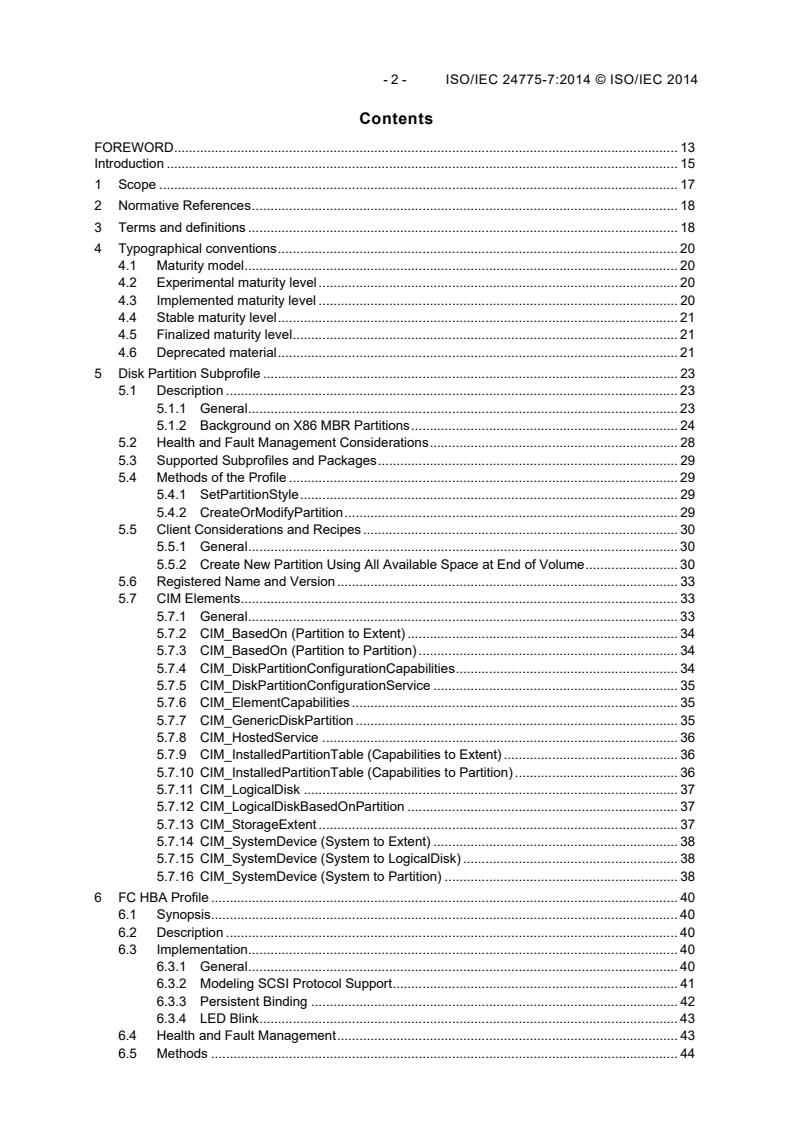
- 2 - ISO/IEC 24775-7:2014 © ISO/IEC 2014
Contents
FOREWORD. 13
Introduction . 15
1 Scope . 17
2 Normative References. 18
3 Terms and definitions . 18
4 Typographical conventions. 20
4.1 Maturity model. 20
4.2 Experimental maturity level. 20
4.3 Implemented maturity level . 20
4.4 Stable maturity level. 21
4.5 Finalized maturity level. 21
4.6 Deprecated material. 21
5 Disk Partition Subprofile . 23
5.1 Description . 23
5.1.1 General.23
5.1.2 Background on X86 MBR Partitions. 24
5.2 Health and Fault Management Considerations. 28
5.3 Supported Subprofiles and Packages. 29
5.4 Methods of the Profile . 29
5.4.1 SetPartitionStyle. 29
5.4.2 CreateOrModifyPartition. 29
5.5 Client Considerations and Recipes. 30
5.5.1 General.30
5.5.2 Create New Partition Using All Available Space at End of Volume. 30
5.6 Registered Name and Version. 33
5.7 CIM Elements. 33
5.7.1 General.33
5.7.2 CIM_BasedOn (Partition to Extent) . 34
5.7.3 CIM_BasedOn (Partition to Partition) . 34
5.7.4 CIM_DiskPartitionConfigurationCapabilities. 34
5.7.5 CIM_DiskPartitionConfigurationService . 35
5.7.6 CIM_ElementCapabilities . 35
5.7.7 CIM_GenericDiskPartition . 35
5.7.8 CIM_HostedService . 36
5.7.9 CIM_InstalledPartitionTable (Capabilities to Extent) . 36
5.7.10 CIM_InstalledPartitionTable (Capabilities to Partition) . 36
5.7.11 CIM_LogicalDisk . 37
5.7.12 CIM_LogicalDiskBasedOnPartition . 37
5.7.13 CIM_StorageExtent . 37
5.7.14 CIM_SystemDevice (System to Extent) . 38
5.7.15 CIM_SystemDevice (System to LogicalDisk) . 38
5.7.16 CIM_SystemDevice (System to Partition) . 38
6 FC HBA Profile . 40
6.1 Synopsis. 40
6.2 Description . 40
6.3 Implementation. 40
6.3.1 General.40
6.3.2 Modeling SCSI Protocol Support. 41
6.3.3 Persistent Binding . 42
6.3.4 LED Blink. 43
6.4 Health and Fault Management. 43
6.5 Methods . 44
6.5.1 Extrinsic Methods of this Profile . 44
6.5.2 StorageNameBindingService.CreateStorageNameBinding . 44
6.5.3 StorageNameBindingService.CreateOSStorageNameBinding . 44
6.5.4 CIM_AlarmDevice.SetAlarmState . 45
6.5.5 Intrinsic Methods of this Profile . 45
6.6 Client Considerations and Recipes. 46
6.6.1 General.46
6.6.2 Discovery HBA Topology and Attributes . 46
6.6.3 Get the statistics for each port. 48
6.6.4 Define a persistent binding to a target PWWN. 49
6.6.5 Define a persistent binding to an LUID. 51
6.6.6 Blink the LED. 52
6.7 CIM Elements. 53
6.7.1 General.53
6.7.2 CIM_AlarmDevice . 54
6.7.3 CIM_AssociatedAlarm. 55
6.7.4 CIM_ComputerSystem . 55
6.7.5 CIM_ControlledBy . 56
6.7.6 CIM_ElementCapabilities (Capabilities to FCPort). 56
6.7.7 CIM_ElementCapabilities (Capabilities to System) . 56
6.7.8 CIM_ElementSettingData. 57
6.7.9 CIM_ElementSoftwareIdentity (Driver). 57
6.7.10 CIM_ElementSoftwareIdentity (FCode/BIOS) . 57
6.7.11 CIM_ElementSoftwareIdentity (Firmware) . 58
6.7.12 CIM_FCPort . 58
6.7.13 CIM_HostedCollection. 58
6.7.14 CIM_HostedService . 59
6.7.15 CIM_InstalledSoftwareIdentity (Driver). 59
6.7.16 CIM_LogicalPortGroup. 59
6.7.17 CIM_MemberOfCollection . 60
6.7.18 CIM_OSStorageNameBinding . 60
6.7.19 CIM_PhysicalPackage . 61
6.7.20 CIM_PortController. 61
6.7.21 CIM_Product . 61
6.7.22 CIM_ProductPhysicalComponent . 62
6.7.23 CIM_Realizes . 62
6.7.24 CIM_ServiceAvailableToElement. 62
6.7.25 CIM_SoftwareIdentity (Driver) . 63
6.7.26 CIM_SoftwareIdentity (FCode/BIOS) . 63
6.7.27 CIM_SoftwareIdentity (Firmware). 63
6.7.28 CIM_StorageNameBinding. 64
6.7.29 CIM_StorageNameBindingCapabilities . 65
6.7.30 CIM_StorageNameBindingService. 65
6.7.31 CIM_SystemDevice (Associates System to PortController). 65
7 Storage HBA Profile . 67
7.1 Synopsis. 67
7.2 Description . 67
7.3 Implementation. 67
7.3.1 Health and Fault Management Consideration. 67
7.3.2 Cascading Considerations . 67
7.3.3 Storage HBA Model Overview. 67
7.3.4 CIM_ComputerSystem . 68
7.3.5 Profile Registration Profile. 68
7.3.6 Generic Initiator Ports Profile . 69
- 4 - ISO/IEC 24775-7:2014 © ISO/IEC 2014
7.3.7 Software Inventory Profile . 69
7.3.8 Software Update Profile . 71
7.3.9 HBA Hot Swap Events . 71
7.3.10 Physical Asset Profile. 71
7.3.11 Modeling Attached Disk, Tape, and Optical Drives . 72
7.3.12 Virtual System Considerations . 72
7.3.13 Fibre Channel HBAs. 72
7.4 Methods of the Profile . 73
7.4.1 General.73
7.4.2 Profile Conventions for Operations . 73
7.5 Use Cases. 73
7.6 CIM Elements. 74
7.6.1 General.74
7.6.2 CIM_ControlledBy . 74
7.6.3 CIM_PortController. 75
7.6.4 CIM_Product . 75
7.6.5 CIM_ProductElementComponent. 75
7.6.6 CIM_Realizes . 76
7.6.7 CIM_SystemDevice. 76
8 Host Discovered Resources Profile. 77
8.1 Description . 77
8.1.1 General.77
8.1.2 Host Disk Extent Class Name Conventions . 78
8.1.3 Discovered Hardware Resources. 78
8.2 Health and Fault Management Considerations. 82
8.3 Cascading Considerations . 82
8.4 Supported Subprofiles and Packages. 82
8.5 Extrinsic Methods of the Profile – StorageConfigurationService.ScsiScan. 82
8.6 Client Considerations and Recipes. 82
8.7 Registered Name and Version. 84
8.8 CIM Elements. 84
8.8.1 General.84
8.8.2 CIM_ATAInitiatorTargetLogicalUnitPath . 85
8.8.3 CIM_ATAProtocolEndpoint . 85
8.8.4 CIM_ComputerSystem . 86
8.8.5 CIM_HostedAccessPoint. 86
8.8.6 CIM_LogicalDisk . 87
8.8.7 CIM_SCSIArbitraryLogicalUnit . 87
8.8.8 CIM_SCSIInitiatorTargetLogicalUnitPath . 88
8.8.9 CIM_SCSIProtocolEndpoint . 88
8.8.10 CIM_StorageExtent . 88
8.8.11 CIM_SystemDevice. 89
8.8.12 CIM_TapeDrive . 89
8.8.13 SNIA_SBInitiatorTargetLogicalUnitPath. 90
8.8.14 SNIA_SBProtocolEndpoint. 90
9 Host Hardware RAID Controller Profile . 92
9.1 Synopsis. 92
9.2 Description . 92
9.3 Implementation. 93
9.3.1 Relationship to autonomous profiles . 93
9.3.2 CIM_PortController. 93
9.3.3 CIM_ComputerSystem . 93
9.3.4 CIM_AlarmDevice . 94
9.3.5 Server Profile. 94
9.3.6 Profile Registration . 94
9.3.7 Profile Discovery and Advertisement . 95
9.3.8 Physical Asset Profile. 95
9.3.9 Storage Enclosure Profile. 95
9.3.10 Implementation of Block Services Package . 95
9.3.11 Implementation of DAPort and SCSIProtocolController . 97
9.3.12 Implementation of Software Inventory Profile. 98
9.3.13 Implementation of Initiator Ports Profiles. 99
9.3.14 Models for Imported Storage. 100
9.3.15 Implementation of Extent Composition Profile . 102
9.3.16 Disk Sparing . 102
9.3.17 Multi-function controllers . 102
9.3.18 Health and Fault Management Consideration. 103
9.3.19 Cascading Considerations . 104
9.4 Methods . 104
9.4.1 Extrinsic Methods of the Profile. 104
9.4.2 Intrinsic Methods of this Profile . 104
9.5 Use Cases. 104
9.6 CIM Elements. 105
9.6.1 General. 105
9.6.2 CIM_AlarmDevice . 106
9.6.3 CIM_AssociatedAlarm. 107
9.6.4 CIM_ComputerSystem (Host Hardware RAID Controller). 107
9.6.5 CIM_ComputerSystemPackage
(Associates PhysicalPackage to ComputerSystem). 108
9.6.6 CIM_ControlledBy . 108
9.6.7 CIM_LogicalIdentity. 108
9.6.8 CIM_MediaAccessDevice . 109
9.6.9 CIM_PortController. 109
9.6.10 CIM_Product . 109
9.6.11 CIM_ProductPhysicalComponent . 110
9.6.12 CIM_ProtocolControllerForUnit (Extent or MediaAccessDevice) . 110
9.6.13 CIM_ProtocolControllerForUnit (Volume). 111
9.6.14 CIM_Realizes (Associates PhysicalPackage to PortController). 111
9.6.15 CIM_SAPAvailableForElement . 111
9.6.16 CIM_SCSIProtocolController. 112
9.6.17 CIM_SoftwareIdentity (Driver) . 112
9.6.18 CIM_SoftwareIdentity (FCode/BIOS) . 112
9.6.19 CIM_SoftwareIdentity (Firmware). 113
9.6.20 CIM_StorageExtent . 113
9.6.21 CIM_SystemComponent . 114
9.6.22 CIM_SystemDevice (Associates System to AlarmDevice). 114
9.6.23 CIM_SystemDevice (Associates controller system to PortController). 114
9.6.24 CIM_SystemDevice (System to SCSIProtocolController) . 115
10 iSCSI Initiator Profile . 116
10.1 Description . 116
10.1.1 General. 116
10.1.2 Sessions and Connections. 117
10.1.3 Durable Names and Correlatable IDs of the Profile . 118
10.2 Health and Fault Management Considerations. 119
10.3 Supported Subprofiles and Packages. 119
10.4 Methods of the Profile . 119
10.5 Client Considerations and Recipes. 119
10.5.1 Add an additional NIC port . 119
10.5.2 Find the health of an initiator . 119
- 6 - ISO/IEC 24775-7:2014 © ISO/IEC 2014
10.5.3 Enable/disable header and data digest . 119
10.6 Registered Name and Version. 119
10.7 CIM Elements. 120
10.7.1 General. 120
10.7.2 CIM_BindsTo (TCPProtocolEndpoint to IPProtocolEndpoint). 121
10.7.3 CIM_BindsTo (iSCSIProtocolEndpoint to TCPProtocolEndpoint) . 121
10.7.4 CIM_ComputerSystem (Host Hardware RAID Controller). 121
10.7.5 CIM_ControlledBy (Host Hardware RAID Controller). 122
10.7.6 CIM_DeviceSAPImplementation (EthernetPort to IPProtocolEndpoint). 122
10.7.7 CIM_DeviceSAPImplementation (EthernetPort to iSCSIProtocolEndpoint). 123
10.7.8 CIM_ElementSoftwareIdentity (Host Hardware RAID Controller) . 123
10.7.9 CIM_EndpointOfNetworkPipe
(Between iSCSI Session and iSCSIProtocolENdpoint) . 123
10.7.10CIM_EndpointOfNetworkPipe
(Between iSCSI connection and TCPProtocolENdpoint). 124
10.7.11CIM_InstalledSoftwareIdentity (Host Hardware RAID Controller). 124
10.7.12CIM_NetworkPipeComposition (Host Hardware RAID Controller). 124
10.7.13CIM_PhysicalPackage (Host Hardware RAID Controller). 124
10.7.14CIM_PortController (Host Hardware RAID Controller). 125
10.7.15CIM_Product (Host Hardware RAID Controller). 125
10.7.16CIM_ProductPhysicalComponent (Host Hardware RAID Controller). 125
10.7.17CIM_ProtocolControllerForPort (Host Hardware RAID Controller) . 126
10.7.18CIM_Realizes (Host Hardware RAID Controller) . 126
10.7.19CIM_SAPAvailableForElement (Host Hardware RAID Controller). 126
10.7.20CIM_SCSIProtocolController (Host Hardware RAID Controller). 127
10.7.21CIM_SoftwareIdentity (Host Hardware RAID Controller) . 127
10.7.22CIM_SystemDevice (to EthernetPort) . 128
10.7.23CIM_SystemDevice (to PortController) . 128
10.7.24CIM_SystemDevice (to ProtocolController) . 128
10.7.25CIM_iSCSIConnection (Host Hardware RAID Controller). 128
10.7.26CIM_iSCSISession (Host Hardware RAID Controller) . 129
11 SCSI Multipath Management Subprofile . 131
11.1 Description . 131
11.1.1 General. 131
11.1.2 Asymmetric Multipath Target Devices. 132
11.2 Health and Fault Management Considerations. 133
11.3 Cascading Considerations . 133
11.4 Supported Subprofiles and Packages. 133
11.5 Methods of the Profile . 133
11.5.1 General. 133
11.5.2 SCSIPathConfigurationService.SetTPGAccess. 133
11.5.3 SCSIPathConfigurationService.SetLoadBalanceAlgorithm. 133
11.5.4 SCSIPathConfigurationService.AssignLogicalUnitToPortGroup. 133
11.5.5 SCSIPathConfigurationService.SetOverridePath. 134
11.5.6 SCSIPathConfigurationService.CancelOverridePath. 134
11.6 Client Considerations and Recipes. 134
11.6.1 Discover All Paths to a Disk Volume . 134
11.6.2 Force Failover or change Load Balancing on a volume . 136
11.6.3 Change a LogicalDisk’s LoadBalance Algorithm. 138
11.7 Registered Name and Version. 140
11.8 CIM Elements. 140
11.8.1 General. 140
11.8.2 CIM_ConcreteComponent. 141
11.8.3 CIM_ConcreteDependency . 141
11.8.4 CIM_ElementCapabilities . 141
11.8.5 CIM_ElementSettingData. 142
11.8.6 CIM_ElementSoftwareIdentity (Driver). 142
11.8.7 CIM_ElementSoftwareIdentity (MP API Plugin) . 142
11.8.8 CIM_HostedService . 143
11.8.9 CIM_MemberOfCollection . 143
11.8.10CIM_Product . 143
11.8.11CIM_SCSIMultipathConfigurationCapabilities. 144
11.8.12CIM_SCSIMultipathSettings. 144
11.8.13CIM_SCSIPathConfigurationService . 145
11.8.14CIM_SCSITargetPortGroup . 145
11.8.15CIM_ServiceAvailableToElement. 146
11.8.16CIM_SoftwareIdentity (Driver). 146
11.8.17CIM_SoftwareIdentity (MP API Plugin) . 147
12 SB Multipath Management Profile. 148
12.1 General remark . 148
12.2 Description . 148
12.3 Health and Fault Management Consideration. 149
12.4 Cascading Considerations . 149
12.5 Supported Profiles, Subprofiles, and Packages. 149
12.6 Methods . 149
12.6.1 Extrinsic Methods of this Profile . 149
12.6.2 Intrinsic Methods of this Profile . 149
12.7 Client Considerations and Recipes. 149
12.8 Registered Name and Version. 150
12.9 CIM Elements. 150
12.9.1 General. 150
12.9.2 SNIA_SBInitiatorTargetLogicalUnitPath. 150
Annex A (informative) SMI-S Information Model. 151
Bibliography . 153
- 8 - ISO/IEC 24775-7:2014 © ISO/IEC 2014
Figure 1 - Experimental maturity level tag . 20
Figure 2 - Implemented maturity level tag. 21
Figure 3 - Stable maturity level tag . 21
Figure 4 - Deprecated tag . 22
Figure 5 - Disk Partition Class Hierarchy . 24
Figure 6 - Disk Partition Class Diagram. 24
Figure 7 - Disk MBR Partition Example . 25
Figure 8 - MBR Partition Instance Diagram . 26
Figure 9 - MBR and VTOC Partition Instance Diagram . 27
Figure 10 - Partition Instance Diagram for Size/Address Rules. 28
Figure 11 - FC HBA Instance Diagram . 41
Figure 12 - HBA Card with Two Ports. 42
Figure 13 - Persistent Binding Model. 43
Figure 14 - Model Overview. 68
Figure 15 - Profile Registration Profile . 69
Figure 16 - Software Inventory Profile in Storage HBA. 71
Figure 17 - HBA Card with Physical Classes. 72
Figure 18 - Host Discovered Resources Block Diagram. 77
Figure 19 - Host Discovered Resources Class Diagram . 79
Figure 20 - Single SPI Disk Model . 80
Figure 21 - Three FCP Logical Unit Instance Diagram . 80
Figure 22 - ATA Discovered Resource Model . 81
Figure 23 - SB Host Discovered Resources .81
Figure 24 - Host Hardware RAID Controller Package Diagram. 93
Figure 25 - Alarms in Host Hardware RAID Controller . 94
Figure 26 - Profile Registration with Host Hardware RAID Controller and Base Server Profiles. 94
Figure 27 - Implementation of Physical Asset Profile . 95
Figure 28 - Block Services Package in Host Hardware RAID Controller . 96
Figure 29 - DAPort Subprofile in Host Hardware Controller . 98
Figure 30 - Software Inventory Profile in Host Hardware RAID Controller . 98
Figure 31 - Initiator Port profiles and Disk Drive Lite Subprofile . 99
Figure 32 - Model for Imported Disks. 100
Figure 33 - Imported Virtual Volumes . 101
Figure 34 - Device “Pass Through” Example. 102
Figure 35 - Example of Mutli-Function Controllers. 103
Figure 36 - iSCSI Product and Package Model .
...
Questions, Comments and Discussion
Ask us and Technical Secretary will try to provide an answer. You can facilitate discussion about the standard in here.
Loading comments...