


ISO/IEC 24775:2011
(Main)Information technology - Storage management
General Information
- Abstract
ISO/IEC 24775:2011(E) defines an interface for the secure, extensible, and interoperable management of a distributed and heterogeneous storage system. This interface uses an object-oriented, XML-based, messagingbased protocol designed to support the specific requirements of managing devices and subsystems in this storage environment. Using this protocol, this International Standard describes the information available to a WBEM Client from an SMI-S compliant CIM WBEM Server. This second edition cancels and replaces the first edition published in 2007 and constitutes a technical. This edition includes the following significant changes with respect to the previous edition:
- Expanded scope: The range of SAN components modeled by the profiles defined in this specification has been greatly expanded. Many of the profiles that were identified as either future work or experimental content at the time of the initial publication have matured to full profiles. In addition, new areas have been modelled and included (e.g., SCSI Target Ports).
- Improved organization: The specification has been reorganized to provide more information more easily. The experimental content has been incorporated into the body of the document, rather than being segregated in an annex, to ease planning for adoption of emerging techniques.
- Additional documentation of best practices and deployment concerns: The specification now includes a more formal representation of common deployment and usage practices, a more complete treatment of backward compatibility issues and a more detailed discussion of the capabilities of the API, grouping them into a five-level architecture, spanning from physical devices to application-level manipulation, and addressing error conditions, configuration, accounting performance and security issues at each level.
- Status
- Replaced
- Publication Date
- 22-Feb-2011
- Technical Committee
- ISO/IEC JTC 1/SC 25 - Interconnection of information technology equipment
- Current Stage
- DELPUB - Deleted Publication
- Start Date
- 17-Dec-2014
- Completion Date
- 28-Aug-2026
Relations
- Effective Date
- 05-Sep-2023
- Replaced By
ISO/IEC 24775-8:2014 - Information technology - Storage management - Part 8: Media libraries - Effective Date
- 05-Sep-2023
- Replaced By
ISO/IEC 24775-3:2014 - Information technology - Storage management - Part 3: Common profiles - Effective Date
- 05-Sep-2023
- Replaced By
ISO/IEC 24775-7:2014 - Information technology - Storage management - Part 7: Host elements - Effective Date
- 05-Sep-2023
- Replaced By
ISO/IEC 24775-2:2014 - Information technology - Storage management - Part 2: Common architecture - Effective Date
- 05-Sep-2023
- Effective Date
- 05-Sep-2023
- Effective Date
- 05-Sep-2023
- Replaced By
ISO/IEC 24775-4:2014 - Information technology - Storage management - Part 4: Block devices - Effective Date
- 05-Sep-2023
- Effective Date
- 05-Sep-2023
Get Certified
Connect with accredited certification bodies for this standard

BSI Group
BSI (British Standards Institution) is the business standards company that helps organizations make excellence a habit.

NYCE
Mexican standards and certification body.
Sponsored listings
Frequently Asked Questions
ISO/IEC 24775:2011 is a standard published by the International Electrotechnical Commission (IEC). Its full title is "Information technology - Storage management". This standard covers: ISO/IEC 24775:2011(E) defines an interface for the secure, extensible, and interoperable management of a distributed and heterogeneous storage system. This interface uses an object-oriented, XML-based, messagingbased protocol designed to support the specific requirements of managing devices and subsystems in this storage environment. Using this protocol, this International Standard describes the information available to a WBEM Client from an SMI-S compliant CIM WBEM Server. This second edition cancels and replaces the first edition published in 2007 and constitutes a technical. This edition includes the following significant changes with respect to the previous edition: - Expanded scope: The range of SAN components modeled by the profiles defined in this specification has been greatly expanded. Many of the profiles that were identified as either future work or experimental content at the time of the initial publication have matured to full profiles. In addition, new areas have been modelled and included (e.g., SCSI Target Ports). - Improved organization: The specification has been reorganized to provide more information more easily. The experimental content has been incorporated into the body of the document, rather than being segregated in an annex, to ease planning for adoption of emerging techniques. - Additional documentation of best practices and deployment concerns: The specification now includes a more formal representation of common deployment and usage practices, a more complete treatment of backward compatibility issues and a more detailed discussion of the capabilities of the API, grouping them into a five-level architecture, spanning from physical devices to application-level manipulation, and addressing error conditions, configuration, accounting performance and security issues at each level.
ISO/IEC 24775:2011(E) defines an interface for the secure, extensible, and interoperable management of a distributed and heterogeneous storage system. This interface uses an object-oriented, XML-based, messagingbased protocol designed to support the specific requirements of managing devices and subsystems in this storage environment. Using this protocol, this International Standard describes the information available to a WBEM Client from an SMI-S compliant CIM WBEM Server. This second edition cancels and replaces the first edition published in 2007 and constitutes a technical. This edition includes the following significant changes with respect to the previous edition: - Expanded scope: The range of SAN components modeled by the profiles defined in this specification has been greatly expanded. Many of the profiles that were identified as either future work or experimental content at the time of the initial publication have matured to full profiles. In addition, new areas have been modelled and included (e.g., SCSI Target Ports). - Improved organization: The specification has been reorganized to provide more information more easily. The experimental content has been incorporated into the body of the document, rather than being segregated in an annex, to ease planning for adoption of emerging techniques. - Additional documentation of best practices and deployment concerns: The specification now includes a more formal representation of common deployment and usage practices, a more complete treatment of backward compatibility issues and a more detailed discussion of the capabilities of the API, grouping them into a five-level architecture, spanning from physical devices to application-level manipulation, and addressing error conditions, configuration, accounting performance and security issues at each level.
ISO/IEC 24775:2011 is classified under the following ICS (International Classification for Standards) categories: 35.200 - Interface and interconnection equipment. The ICS classification helps identify the subject area and facilitates finding related standards.
ISO/IEC 24775:2011 has the following relationships with other standards: It is inter standard links to ISO/IEC 24775-5:2014, ISO/IEC 24775-8:2014, ISO/IEC 24775-3:2014, ISO/IEC 24775-7:2014, ISO/IEC 24775-2:2014, ISO/IEC 24775-1:2014, ISO/IEC 24775-6:2014, ISO/IEC 24775-4:2014, ISO/IEC 24775:2007. Understanding these relationships helps ensure you are using the most current and applicable version of the standard.
ISO/IEC 24775:2011 is available in PDF format for immediate download after purchase. The document can be added to your cart and obtained through the secure checkout process. Digital delivery ensures instant access to the complete standard document.
Standards Content (Sample)
ISO/IEC 24775
Edition 2.0 2011-02
INTERNATIONAL
STANDARD
colour
inside
Information technology –
Storage management
All rights reserved. Unless otherwise specified, no part of this publication may be reproduced or utilized in any form
or by any means, electronic or mechanical, including photocopying and microfilm, without permission in writing from
either IEC or IEC's member National Committee in the country of the requester.
If you have any questions about ISO/IEC copyright or have an enquiry about obtaining additional rights to this
publication, please contact the address below or your local IEC member National Committee for further information.
IEC Central Office
3, rue de Varembé
CH-1211 Geneva 20
Switzerland
Email: inmail@iec.ch
Web: www.iec.ch
About the IEC
The International Electrotechnical Commission (IEC) is the leading global organization that prepares and publishes
International Standards for all electrical, electronic and related technologies.
About IEC publications
The technical content of IEC publications is kept under constant review by the IEC. Please make sure that you have the
latest edition, a corrigenda or an amendment might have been published.
Catalogue of IEC publications: www.iec.ch/searchpub
The IEC on-line Catalogue enables you to search by a variety of criteria (reference number, text, technical committee,…).
It also gives information on projects, withdrawn and replaced publications.
IEC Just Published: www.iec.ch/online_news/justpub
Stay up to date on all new IEC publications. Just Published details twice a month all new publications released. Available
on-line and also by email.
Electropedia: www.electropedia.org
The world's leading online dictionary of electronic and electrical terms containing more than 20 000 terms and definitions
in English and French, with equivalent terms in additional languages. Also known as the International Electrotechnical
Vocabulary online.
Customer Service Centre: www.iec.ch/webstore/custserv
If you wish to give us your feedback on this publication or need further assistance, please visit the Customer Service
Centre FAQ or contact us:
Email: csc@iec.ch
Tel.: +41 22 919 02 11
Fax: +41 22 919 03 00
ISO/IEC 24775
Edition 2.0 2011-02
INTERNATIONAL
STANDARD
colour
inside
Information technology –
Storage management
INTERNATIONAL
ELECTROTECHNICAL
COMMISSION
PRICE CODE
XC
ICS 35.200 ISBN 978-2-88912-367-4
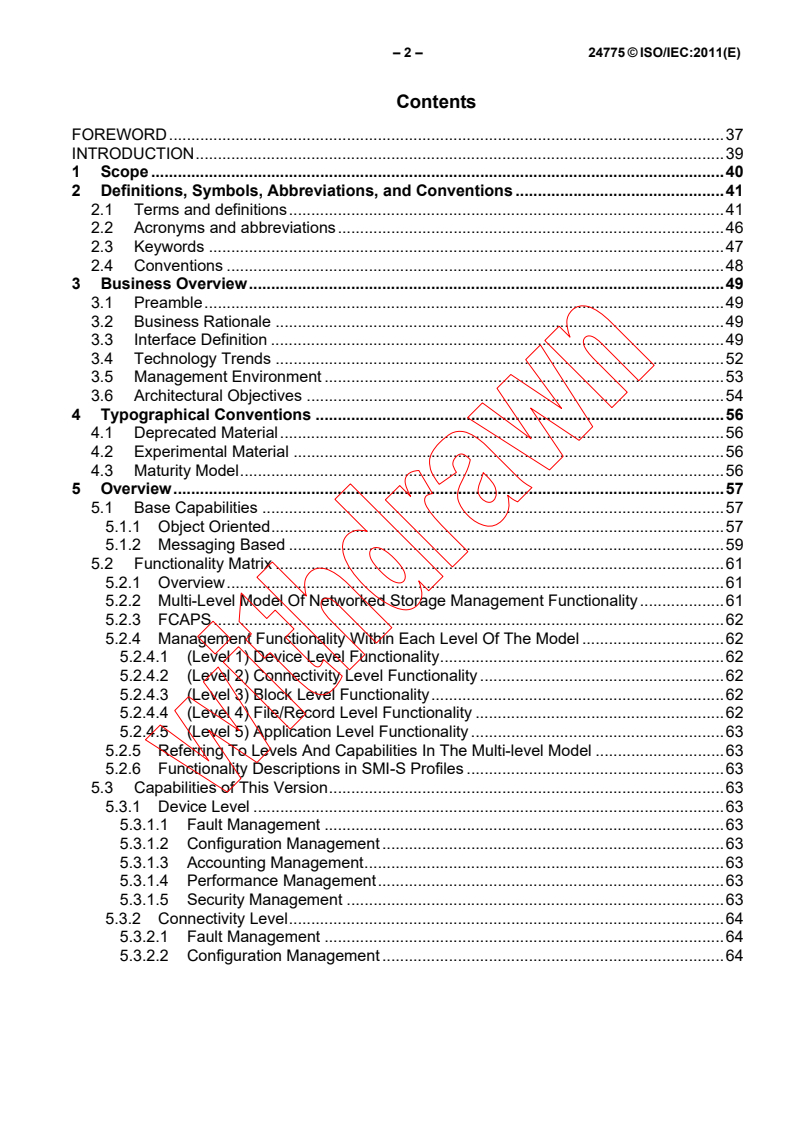
– 2 – 24775 © ISO/IEC:2011(E)
Contents
FOREWORD.37
INTRODUCTION.39
1 Scope .40
2 Definitions, Symbols, Abbreviations, and Conventions .41
2.1 Terms and definitions.41
2.2 Acronyms and abbreviations.46
2.3 Keywords .47
2.4 Conventions .48
3 Business Overview.49
3.1 Preamble.49
3.2 Business Rationale .49
3.3 Interface Definition .49
3.4 Technology Trends .52
3.5 Management Environment .53
3.6 Architectural Objectives .54
4 Typographical Conventions .56
4.1 Deprecated Material.56
4.2 Experimental Material .56
4.3 Maturity Model.56
5 Overview.57
5.1 Base Capabilities .57
5.1.1 Object Oriented.57
5.1.2 Messaging Based .59
5.2 Functionality Matrix .61
5.2.1 Overview.61
5.2.2 Multi-Level Model Of Networked Storage Management Functionality.61
5.2.3 FCAPS.62
5.2.4 Management Functionality Within Each Level Of The Model .62
5.2.4.1 (Level 1) Device Level Functionality.62
5.2.4.2 (Level 2) Connectivity Level Functionality .62
5.2.4.3 (Level 3) Block Level Functionality.62
5.2.4.4 (Level 4) File/Record Level Functionality .62
5.2.4.5 (Level 5) Application Level Functionality .63
5.2.5 Referring To Levels And Capabilities In The Multi-level Model .63
5.2.6 Functionality Descriptions in SMI-S Profiles .63
5.3 Capabilities of This Version.63
5.3.1 Device Level .63
5.3.1.1 Fault Management .63
5.3.1.2 Configuration Management .63
5.3.1.3 Accounting Management.63
5.3.1.4 Performance Management.63
5.3.1.5 Security Management .63
5.3.2 Connectivity Level.64
5.3.2.1 Fault Management .64
5.3.2.2 Configuration Management .64
24775 © ISO/IEC:2011(E) – 3 –
5.3.2.3 Accounting Management.64
5.3.2.4 Performance Management.64
5.3.2.5 Security Management .64
5.3.3 Block Level .64
5.3.3.1 Fault Management .64
5.3.3.2 Configuration Management .64
5.3.3.3 Accounting Management.64
5.3.3.4 Performance Management.64
5.3.3.5 Security Management .64
5.3.4 File/Record Level.65
5.3.4.1 Fault Management .65
5.3.4.2 Configuration Management .65
5.3.4.3 Accounting Management.65
5.3.4.4 Performance Management.65
5.3.4.5 Security Management .65
5.3.5 Application Level.65
5.4 Operational Environment . 66
5.5 Using this Specification .67
5.6 Language Bindings .67
6 Transport and Reference Model.68
6.1 Introduction .68
6.1.1 Overview.68
6.1.2 Language Requirements .68
6.1.3 Communications Requirements.68
6.1.4 XML Message Syntax and Semantics .68
6.2 Transport Stack.69
6.3 Reference Model.70
6.3.1 Overview.70
6.3.2 Roles for Interface Constituents .70
6.3.2.1 Client .70
6.3.2.2 Agent.70
6.3.2.3 CIM Server .71
6.3.2.4 Provider.71
6.3.2.5 Lock Manager.71
6.3.2.6 Directory Server (SLP Directory Agent) .71
6.3.3 Cascaded Agents .71
7 Object Model General Information .72
7.1 Model Overview (Key Resources).72
7.1.1 Overview.72
7.1.2 Introduction to CIM UML Notation .72
7.2 Techniques.73
7.2.1 CIM Fundamentals .73
7.2.2 Modeling Profiles .75
7.2.3 CIM Naming.76
7.2.4 Correlatable and Durable Names .77
7.2.4.1 Overview .77
– 4 – 24775 © ISO/IEC:2011(E)
7.2.4.2 Guidelines for SCSI Logical Unit Names.78
7.2.4.3 Guidelines for Port Names .78
7.2.4.4 Guidelines for Storage System Names .79
7.2.4.5 Standard Formats for Correlatable Names .79
7.2.4.6 Case Sensitivity.85
7.2.4.7 Testing Equality of correlatable Names.86
7.2.4.8 Operating System Device Names .86
7.2.4.9 iSCSI Names.86
7.3 Health and Fault Management.88
7.3.1 Objectives .88
7.3.2 Overview.88
7.3.3 Terms.88
7.3.4 Description of Health and Fault Management .89
7.3.4.1 Operational Status and Health State (Polling).89
7.3.4.2 Standard Errors and Events .90
7.3.4.3 Indications .90
7.3.4.4 Event Correlation and Fault Containment .90
7.3.4.5 Fault Regions .93
7.3.4.6 Examples.95
7.4 Policy.99
7.4.1 Objectives .99
7.4.2 Overview.99
7.4.3 Policy Terms .99
7.4.4 Policy Definition .100
7.4.4.1 Query Condition .100
7.4.4.2 Method Action .100
7.4.4.3 Query Condition Result .100
7.4.4.4 Method Action Result .100
7.4.4.5 Capabilities.101
7.4.5 Policy Recipes .101
7.5 Standard Messages .103
7.5.1 Overview.103
7.5.2 Required Characteristics of Standard Messages.103
7.5.2.1 Common Messages .105
7.5.2.2 Storage Messages .118
7.5.2.3 Fabric Messages.132
7.6 Recipe Overview .135
7.6.1 Recipe Definition.135
7.6.2 Recipe Pseudo Code Conventions.135
7.6.2.1 Overview .135
7.6.2.2 General Syntax.135
7.6.2.3 CIM related variable and methods .136
7.6.2.4 Data Structure .137
7.6.2.5 Operations.137
7.6.2.6 Control Operations .138
7.6.2.7 Functions.139
7.6.2.8 Exception Handling .139
24775 © ISO/IEC:2011(E) – 5 –
7.6.2.9 Built-in Functions.139
7.6.2.10 Extrinsic method calls.141
8 Normative References.142
8.1 Introduction to Profiles .144
8.1.1 Profile Content .144
8.1.1.1 Profile Definition .144
8.1.1.2 Format for Profile Specifications .145
9 Object Model .148
9.1 Registry of Profiles and Subprofiles .148
9.2 Packages, Subprofiles and Profile .154
9.2.1 Common Profiles .154
9.2.1.1 Access Points Subprofile.154
9.2.1.2 Cascading Subprofile .159
9.2.1.3 Cluster Subprofile (DEPRECATED).188
9.2.1.4 Device Credentials Subprofile .189
9.2.1.5 Extra Capacity Set Subprofile (DEPRECATED) .194
9.2.1.6 Health Package .195
9.2.1.7 Job Control Subprofile.203
9.2.1.8 Location Subprofile.216
9.2.1.9 Multiple Computer System Subprofile .219
9.2.1.10 Physical Package Package.231
9.2.1.11 Policy Package.238
9.2.1.12 Software Installation Service Subprofile.306
9.2.1.13 Software Package .313
9.2.1.14 Software Subprofile .316
9.2.1.15 Software Repository Subprofile.319
9.2.2 Common Target Port Subprofiles Overview .325
9.2.2.1 Parallel SCSI (SPI) Target Ports Subprofile.328
9.2.2.2 FC Target Port Subprofile .333
9.2.2.3 iSCSI Target Ports Subprofile .339
9.2.2.4 Direct Attach (DA) Port Subprofile.374
9.2.3 Common Initiator Port Subprofiles Overview.379
9.2.3.1 Parallel SCSI (SPI) Initiator Port Subprofile .381
9.2.3.2 Fibre Channel Initiator Port Subprofile .386
9.2.3.3 iSCSI Initiator Port Subprofile.393
9.2.3.4 Back End Ports Subprofile (DEPRECATED) .400
9.2.4 CIM Server Related Profiles .405
9.2.4.1 Server Profile.405
9.2.4.2 Indications Subprofile.436
9.2.4.3 Object Manager Adapter Subprofile .464
9.2.5 Security Profiles and Subprofiles.468
9.2.5.1 Security Profile .468
9.2.5.2 Authorization Subprofile .481
9.2.5.3 Security Resource Ownership Subprofile.499
9.2.5.4 Security Role Based Access Control Subprofile .516
9.2.5.5 IdentityManagement Subprofile.532
– 6 – 24775 © ISO/IEC:2011(E)
9.2.5.6 CredentialManagement Subprofile.557
9.2.5.7 3rd Party Authentication Subprofile.568
9.2.6 Fabric Topology Profiles .580
9.2.6.1 Fabric Profile .580
9.2.6.2 Enhanced Zoning Subprofile.611
9.2.6.3 Zone Control Subprofile .618
9.2.6.4 FDMI Subprofile .636
9.2.6.5 Fabric Path Performance Subprofile .649
9.2.6.6 Switch Profile.655
9.2.6.7 Switch Configuration Data Subprofile.693
9.2.6.8 Blades Subprofile .698
9.2.6.9 Extender Profile.704
9.2.7 Host Profiles .736
9.2.7.1 FC HBA Profile .736
9.2.7.2 iSCSI Initiator Profile .766
9.2.7.3 Host Discovered Resources Profile.779
9.2.7.4 SCSI Multipath Management Subprofile .792
9.2.7.5 Disk Partition Subprofile.805
9.2.8 Storage Profiles .822
9.2.8.1 Array Profile.822
9.2.8.2 Storage Virtualizer Profile.829
9.2.8.3 Volume Management Profile .838
9.2.8.4 NAS Head Profile .848
9.2.8.5 Self-Contained NAS Profile .889
9.2.8.6 Filesystem Manipulation Subprofile.926
9.2.8.7 File Export Manipulation Subprofile.963
9.2.8.8 Pool Management Policy Subprofile .994
9.2.8.9 Resource Ownership Subprofile.1014
9.2.8.10 Block Services Package.1022
9.2.8.11 Block Server Performance Subprofile .1091
9.2.8.12 Copy Services Subprofile .1162
9.2.8.13 Disk Drive Subprofile (DEPRECATED).1276
9.2.8.14 Disk Drive Lite Subprofile .1277
9.2.8.15 Disk Sparing Subprofile.1285
9.2.8.16 Extent Composition Subprofile .1303
9.2.8.17 Extent Mapping Subprofile (DEPRECATED) .1329
9.2.8.18 LUN Creation Subprofile (DEPRECATED) .1330
9.2.8.19 LUN Mapping and Masking Subprofile.1331
9.2.8.20 Masking and Mapping Subprofile.1332
9.2.8.21 Pool Manipulation Capabilities, and Settings Subprofile (DEPRECATED) .1370
9.2.8.22 Storage Library Profile.1371
9.2.8.23 Element Counting Subprofile.1388
9.2.8.24 InterLibraryPort Connection Subprofile .1394
9.2.8.25 Partitioned/Virtual Library Subprofile.1398
9.2.8.26 Library Capacity Subprofile .1402
9.2.8.27 LibraryAlert Events/Indications for Library Devices.1405
9.2.8.28 Media Movement Subprofile .1426
24775 © ISO/IEC:2011(E) – 7 –
9.2.8.29 Limited Access Port Elements Subprofile .1432
9.3 Cross Profile Considerations.1439
9.3.1 Overview.1439
9.3.2 HBA model.1439
9.3.2.1 Recipes .1439
9.3.3 Switch Model .1440
9.3.3.1 Recipes .1440
9.3.4 Array Model .1445
9.3.4.1 Storage Virtualization Model .1446
9.3.5 Fabric Topology (HBA, Switch, Array) .1447
9.3.5.1 Overview .1448
9.3.5.2 Main Recipe .1448
9.3.5.3 Array paths.1457
9.3.5.4 Host Discovered Resource.1460
9.3.5.5 Common Initiator Port .1461
9.3.5.6 Fabric Layer .1463
9.3.5.7 IP Network Layer.1472
9.3.5.8 Local Disk Layer.1473
9.3.5.9 Logical Disk Layers .1477
9.3.5.10 Multipath Layer.1480
9.3.5.11 Virtualizer Layer .1481
9.3.5.12 Volume Manager Layer .1487
10 SMI-S Roles .1492
10.1 Complete reference model.1492
10.2 Overview .1492
10.3 SMI-S Client .1493
10.3.1 Overview.1493
10.3.2 SLP Functions .1493
10.3.3 CIM-XML Protocol Functions.1493
10.3.4 Security Considerations.1493
10.3.5 Lock Management Functions.1494
10.4 Dedicated SMI-S Server .1494
10.4.1 Overview.1494
10.4.2 SLP Functions .1494
10.4.3 CIM-XML Protocol Functions.1494
10.4.3.1 General.1494
10.4.3.2 Required Intrinsic Methods.1495
10.4.3.3 Required Model Support .1495
10.4.4 Security Considerations.1496
10.4.5 Lock Management Functions.1496
10.5 General Purpose SMI-S Server .1496
10.5.1 Overview.1496
10.5.2 SLP Functions .1496
10.5.3 CIM-XML Protocol Functions.1496
10.5.3.1 General.1496
10.5.3.2 Required Intrinsic Methods.1496
– 8 – 24775 © ISO/IEC:2011(E)
10.5.3.3 Required Model Support .1496
10.5.3.4 Security Considerations .1496
10.5.4 Lock Management Functions.1497
10.5.5 Provider Subrole .1497
10.5.5.1 Overview .1497
10.5.5.2 Required Model Support .1497
10.6 Directory Server .1497
10.6.1 SLP Functions .1497
10.6.2 CIM-XML Protocol Functions.1497
10.6.3 Security Considerations.1497
10.6.4 Lock Management Functions.1497
10.7 Combined Roles on a Single System.1497
10.7.1 Overview.1497
10.7.2 General Purpose SMI-S Server as a Profile Aggregator .1497
10.7.2.1 SLP Functions .1497
10.7.2.2 CIM-XML Protocol Functions .1498
10.7.2.3 Security Considerations .1498
10.7.2.4 Lock Manager Functions.1498
11 Service Discovery.1499
11.1 Objectives .1499
11.2 Overview .1499
11.3 SLP Messages .1501
11.4 Scopes .1502
11.5 Services Definition .1503
11.5.1 Service Type.1503
11.5.2 Service Attributes.1503
11.6 User Agents (UA) .1505
11.7 Service Agents (SAs) .1505
11.8 Directory Agents (DAs) .1506
11.9 Service Agent Server (SA Server) .1506
11.9.1 General Information .1506
11.9.2 SA Server (SAS) Implementation .1506
11.9.3 SA Server (SAS) Clients.1507
11.9.3.1 Description .1507
11.9.3.2 SAS Client Requests – SA Server Responses .1507
11.9.4 SA Server Configuration .1507
11.9.4.1 Overview .1507
11.9.4.2 SLP Configuration File .1507
11.9.4.3 Programmatic Configuration.1508
11.9.4.4 DHCP Configuration.1508
11.9.4.5 Scope .1508
11.9.5 SA Server Discovery.1509
11.9.6 SAS Client Registration .1509
11.10 ‘Standard WBEM’ Service Type Templates .1509
12 Bibliography.1514
13 Installation and Upgrade.1515
13.1 Introduction .1515
24775 © ISO/IEC:2011(E) – 9 –
13.2 Role of the Administrator.1515
13.3 Goals.1515
13.3.1 Non-Disruptive Installation and De-installation .1515
13.3.2 Plug-and-Play .1515
13.4 Device Support.1516
13.4.1 Installation.1516
13.4.2 Discovery and Initialization of Device Support.1516
13.4.3 Uninstallation .1516
13.4.4 Update .1516
13.4.5 Reconfiguration.1517
13.4.6 Failure.1517
13.5 WBEM Service Support & Related Functions .1517
13.5.1 Installation.1517
13.5.2 Multiple CIM Servers on a Single Server System.1517
13.5.3 Uninstallation/Upgrade .1518
13.5.4 Reconfiguration.1518
13.5.5 Failure.1518
13.6 Client .1518
13.6.1 Uninstallation .1518
13.6.2 Reconfiguration.1518
13.7 Directory Service.1518
13.7.1 Installation.1518
13.7.2 Uninstallation/Failure .1518
13.8 Issues with Discovery Mechanisms.1518
Annex A (informative) Mapping CIM Objects to SNMP MIB Structures.1520
A.1 Purpose of this Annex .
...