

IEC 61855:2022
(Main)Household and similar use electrical hair care appliances - Methods for measuring the performance
General Information
- Abstract
IEC 61855:2022 applies to electrical appliances for household and similar use for drying and styling hair (including their accessories).
This document defines the main performance characteristics that are of interest to the user and specifies methods of measuring these characteristics.
Appliances to which this document applies include:
– Hair dryers;
– Hair curlers;
– Hair straighteners.
This document does not specify the requirements for performance.
This document does not deal with safety requirements (IEC 60335-2-23).
This document does not apply to electric hair clippers or trimmers.
This second edition cancels and replaces the first edition published in 2003. This edition constitutes a technical revision.
This edition includes the following significant technical changes with respect to the previous edition:
a) the definitions of hair dryers, hair curlers and hair straighteners are updated;
b) the measurement of temperature profile of the outlet air of hair dryers is added;
c) the measurement of temperature profile of the whole work area of hair curlers is added;
d) the measurement of temperature profile of the heating plate of hair straighteners is added;
e) the measurement method for air flow of hair dryers is introduced;
f) the measurement method for anion emission concentration of anion hair dryers is introduced;
g) the measurement method for tension of hair straighteners is introduced;
h) the service life test for hair dryers, hair curlers and hair straighteners is introduced.
The contents of the corrigendum of January 2024 have been included in this copy.
- Status
- Published
- Publication Date
- 11-Aug-2022
- Technical Committee
- SC 59L - Small household appliances
- Drafting Committee
- MT 3 - TC 59/SC 59L/MT 3
- Current Stage
- PPUB - Publication issued
- Start Date
- 12-Aug-2022
- Completion Date
- 26-Aug-2022
Overview
IEC 61855:2022 is an international standard issued by the International Electrotechnical Commission (IEC) that focuses on electrical hair care appliances designed for household and similar uses. This standard updates and replaces the 2003 edition, providing a comprehensive set of methods for measuring the performance of key hair care devices such as hair dryers, hair curlers, and hair straighteners. While IEC 61855:2022 does not set performance requirements or safety regulations (covered separately by IEC 60335-2-23), it specifies standardized testing procedures that help manufacturers, testers, and consumers evaluate the functional characteristics of these hair styling appliances.
The standard covers performance aspects that are of practical interest to users, including temperature profiles, airflow, drying rate, tension control, anion emission, and service life testing. Its aim is to provide reliable, repeatable measurement methods that support quality control, product development, and informed consumer choices.
Key Topics
IEC 61855:2022 introduces several significant technical updates to methods of testing hair care appliances:
- Updated Definitions: Refined terminology for hair dryers, curlers, and straighteners to align with current product designs.
- Temperature Profile Measurements:
- Outlet air temperature of hair dryers
- Entire work area temperature for hair curlers
- Heating plate temperature profile for hair straighteners
- Airflow Measurement: New method to assess the air flow rate of hair dryers, critical for performance and user comfort.
- Drying Rate Assessment: Detailed procedure using test fabrics to quantify the drying efficiency of hair dryers.
- Anion Emission Testing: Methodology to measure the concentration of anions released by anion hair dryers, highlighting features purported to benefit hair health.
- Tension Measurement: Precise technique for evaluating the tension applied by hair straighteners on hair bundles, influencing styling effectiveness and hair safety.
- Service Life Tests: Standardized endurance testing to simulate appliance wear and assess longevity under typical household use.
Additional features include measurements of appliance mass, cord length, heating-up time, acoustic noise, accessory attachment reliability and ease of handling, as well as comprehensive guidance on test environment and instrumentation requirements.
Applications
IEC 61855:2022 is highly valuable for multiple stakeholders involved with electrical hair care appliances:
- Manufacturers use these standardized methods to design, test, and optimize products for consistent quality and performance.
- Test Laboratories and Certification Bodies apply these techniques for objective verification of product characteristics, supporting compliance and market access.
- Retailers and Consumer Organizations rely on the data produced by these methods to inform marketing claims and consumer advice.
- Regulatory Authorities benefit from these clear measurement frameworks to establish or support performance-related regulations without overlap with safety standards.
The standard excludes electric hair clippers or trimmers, focusing uniquely on drying and styling appliances, making it a targeted resource for the growing hair care appliance market. By adopting the IEC 61855:2022 methodology, stakeholders ensure transparency and comparability in performance data that enhances consumer trust and drives innovation.
Related Standards
To comprehensively cover hair care appliance requirements, IEC 61855:2022 interfaces with other important IEC standards:
- IEC 60335-2-23: Safety requirements for hair care appliances, including electrical safety and fire hazards.
- IEC 60529: Degrees of protection provided by enclosures (IP codes), relevant for appliance durability.
- IEC 61000 series: Electromagnetic compatibility standards ensuring appliance operation without interference.
- Other specific IEC and ISO standards on household appliance testing and terminology, ensuring consistency and integration in product evaluation frameworks.
Summary
IEC 61855:2022 provides the essential methods for measuring the performance of household electrical hair care appliances, enabling standardized evaluation of critical user-relevant properties such as temperature uniformity, airflow, drying efficiency, ion emission, and product durability. This updated standard supports manufacturers, testers, and regulators by delivering clear, replicable test procedures that promote product innovation, quality assurance, and consumer confidence in hair dryers, curlers, and straighteners worldwide.
Relations
- Effective Date
- 26-Jan-2024
- Revises
IEC 61855:2003 - Household electrical hair care appliances - Methods of measuring the performance - Effective Date
- 05-Sep-2023
Frequently Asked Questions
IEC 61855:2022 is a standard published by the International Electrotechnical Commission (IEC). Its full title is "Household and similar use electrical hair care appliances - Methods for measuring the performance". This standard covers: IEC 61855:2022 applies to electrical appliances for household and similar use for drying and styling hair (including their accessories). This document defines the main performance characteristics that are of interest to the user and specifies methods of measuring these characteristics. Appliances to which this document applies include: – Hair dryers; – Hair curlers; – Hair straighteners. This document does not specify the requirements for performance. This document does not deal with safety requirements (IEC 60335-2-23). This document does not apply to electric hair clippers or trimmers. This second edition cancels and replaces the first edition published in 2003. This edition constitutes a technical revision. This edition includes the following significant technical changes with respect to the previous edition: a) the definitions of hair dryers, hair curlers and hair straighteners are updated; b) the measurement of temperature profile of the outlet air of hair dryers is added; c) the measurement of temperature profile of the whole work area of hair curlers is added; d) the measurement of temperature profile of the heating plate of hair straighteners is added; e) the measurement method for air flow of hair dryers is introduced; f) the measurement method for anion emission concentration of anion hair dryers is introduced; g) the measurement method for tension of hair straighteners is introduced; h) the service life test for hair dryers, hair curlers and hair straighteners is introduced. The contents of the corrigendum of January 2024 have been included in this copy.
IEC 61855:2022 applies to electrical appliances for household and similar use for drying and styling hair (including their accessories). This document defines the main performance characteristics that are of interest to the user and specifies methods of measuring these characteristics. Appliances to which this document applies include: – Hair dryers; – Hair curlers; – Hair straighteners. This document does not specify the requirements for performance. This document does not deal with safety requirements (IEC 60335-2-23). This document does not apply to electric hair clippers or trimmers. This second edition cancels and replaces the first edition published in 2003. This edition constitutes a technical revision. This edition includes the following significant technical changes with respect to the previous edition: a) the definitions of hair dryers, hair curlers and hair straighteners are updated; b) the measurement of temperature profile of the outlet air of hair dryers is added; c) the measurement of temperature profile of the whole work area of hair curlers is added; d) the measurement of temperature profile of the heating plate of hair straighteners is added; e) the measurement method for air flow of hair dryers is introduced; f) the measurement method for anion emission concentration of anion hair dryers is introduced; g) the measurement method for tension of hair straighteners is introduced; h) the service life test for hair dryers, hair curlers and hair straighteners is introduced. The contents of the corrigendum of January 2024 have been included in this copy.
IEC 61855:2022 is classified under the following ICS (International Classification for Standards) categories: 97.170 - Body care equipment. The ICS classification helps identify the subject area and facilitates finding related standards.
IEC 61855:2022 has the following relationships with other standards: It is inter standard links to IEC 61855:2022/COR1:2024, IEC 61855:2003. Understanding these relationships helps ensure you are using the most current and applicable version of the standard.
IEC 61855:2022 is available in PDF format for immediate download after purchase. The document can be added to your cart and obtained through the secure checkout process. Digital delivery ensures instant access to the complete standard document.
Standards Content (Sample)
IEC 61855 ®
Edition 2.0 2022-08
INTERNATIONAL
STANDARD
NORME
INTERNATIONALE
colour
inside
Household and similar use electrical hair care appliances – Methods for
measuring the performance
Appareils électriques destinés aux soins des cheveux pour usages domestiques
et analogues – Méthodes de mesure de l'aptitude à la fonction
All rights reserved. Unless otherwise specified, no part of this publication may be reproduced or utilized in any form
or by any means, electronic or mechanical, including photocopying and microfilm, without permission in writing from
either IEC or IEC's member National Committee in the country of the requester. If you have any questions about IEC
copyright or have an enquiry about obtaining additional rights to this publication, please contact the address below or
your local IEC member National Committee for further information.
Droits de reproduction réservés. Sauf indication contraire, aucune partie de cette publication ne peut être reproduite
ni utilisée sous quelque forme que ce soit et par aucun procédé, électronique ou mécanique, y compris la photocopie
et les microfilms, sans l'accord écrit de l'IEC ou du Comité national de l'IEC du pays du demandeur. Si vous avez des
questions sur le copyright de l'IEC ou si vous désirez obtenir des droits supplémentaires sur cette publication, utilisez
les coordonnées ci-après ou contactez le Comité national de l'IEC de votre pays de résidence.
IEC Secretariat Tel.: +41 22 919 02 11
3, rue de Varembé info@iec.ch
CH-1211 Geneva 20 www.iec.ch
Switzerland
About the IEC
The International Electrotechnical Commission (IEC) is the leading global organization that prepares and publishes
International Standards for all electrical, electronic and related technologies.
About IEC publications
The technical content of IEC publications is kept under constant review by the IEC. Please make sure that you have the
latest edition, a corrigendum or an amendment might have been published.
IEC publications search - webstore.iec.ch/advsearchform IEC Products & Services Portal - products.iec.ch
The advanced search enables to find IEC publications by a Discover our powerful search engine and read freely all the
variety of criteria (reference number, text, technical publications previews. With a subscription you will always
committee, …). It also gives information on projects, replaced have access to up to date content tailored to your needs.
and withdrawn publications.
Electropedia - www.electropedia.org
IEC Just Published - webstore.iec.ch/justpublished
The world's leading online dictionary on electrotechnology,
Stay up to date on all new IEC publications. Just Published
containing more than 22 300 terminological entries in English
details all new publications released. Available online and
and French, with equivalent terms in 19 additional languages.
once a month by email.
Also known as the International Electrotechnical Vocabulary
(IEV) online.
IEC Customer Service Centre - webstore.iec.ch/csc
If you wish to give us your feedback on this publication or
need further assistance, please contact the Customer Service
Centre: sales@iec.ch.
A propos de l'IEC
La Commission Electrotechnique Internationale (IEC) est la première organisation mondiale qui élabore et publie des
Normes internationales pour tout ce qui a trait à l'électricité, à l'électronique et aux technologies apparentées.
A propos des publications IEC
Le contenu technique des publications IEC est constamment revu. Veuillez vous assurer que vous possédez l’édition la
plus récente, un corrigendum ou amendement peut avoir été publié.
Recherche de publications IEC - IEC Products & Services Portal - products.iec.ch
webstore.iec.ch/advsearchform Découvrez notre puissant moteur de recherche et consultez
La recherche avancée permet de trouver des publications IEC gratuitement tous les aperçus des publications. Avec un
en utilisant différents critères (numéro de référence, texte, abonnement, vous aurez toujours accès à un contenu à jour
comité d’études, …). Elle donne aussi des informations sur adapté à vos besoins.
les projets et les publications remplacées ou retirées.
Electropedia - www.electropedia.org
IEC Just Published - webstore.iec.ch/justpublished
Le premier dictionnaire d'électrotechnologie en ligne au
Restez informé sur les nouvelles publications IEC. Just
monde, avec plus de 22 300 articles terminologiques en
Published détaille les nouvelles publications parues.
anglais et en français, ainsi que les termes équivalents dans
Disponible en ligne et une fois par mois par email.
19 langues additionnelles. Egalement appelé Vocabulaire
Electrotechnique International (IEV) en ligne.
Service Clients - webstore.iec.ch/csc
Si vous désirez nous donner des commentaires sur cette
publication ou si vous avez des questions contactez-nous:
sales@iec.ch.
IEC 61855 ®
Edition 2.0 2022-08
INTERNATIONAL
STANDARD
NORME
INTERNATIONALE
colour
inside
Household and similar use electrical hair care appliances – Methods for
measuring the performance
Appareils électriques destinés aux soins des cheveux pour usages domestiques
et analogues – Méthodes de mesure de l'aptitude à la fonction
INTERNATIONAL
ELECTROTECHNICAL
COMMISSION
COMMISSION
ELECTROTECHNIQUE
INTERNATIONALE
ICS 97.170 ISBN 978-2-8322-4074-8
– 2 – IEC 61855:2022 © IEC 2022
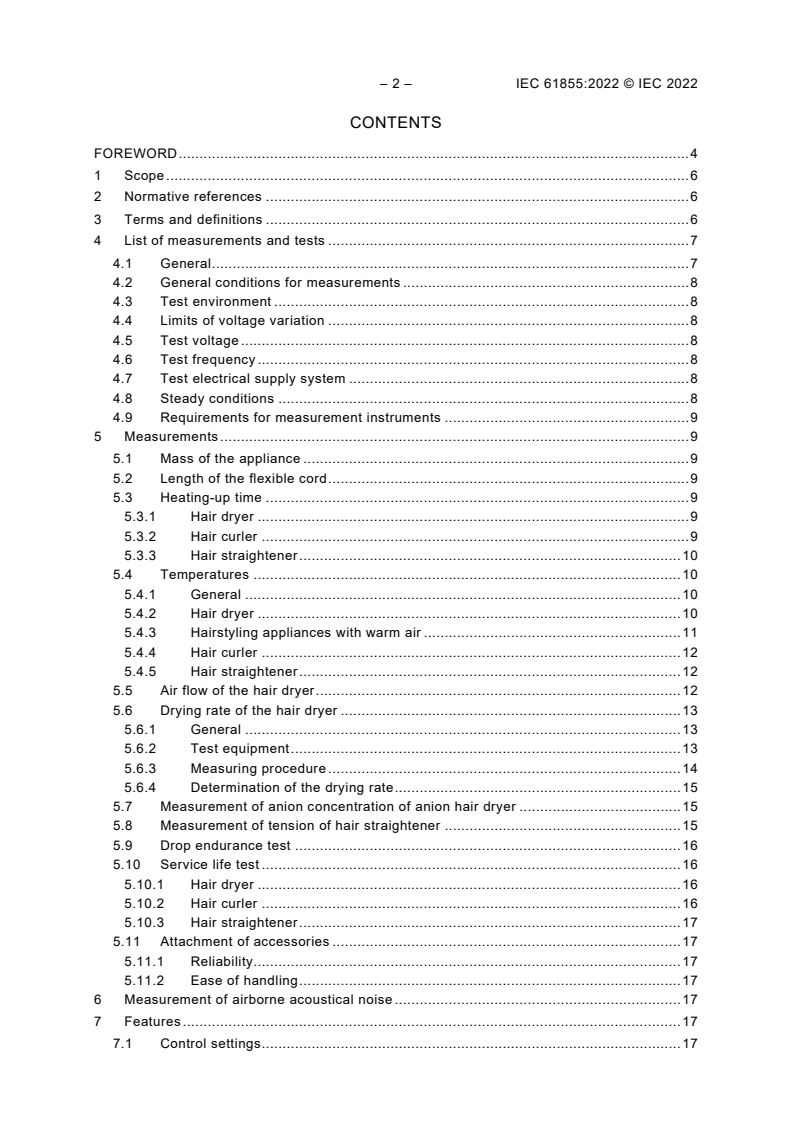
CONTENTS
FOREWORD . 4
1 Scope . 6
2 Normative references . 6
3 Terms and definitions . 6
4 List of measurements and tests . 7
4.1 General . 7
4.2 General conditions for measurements . 8
4.3 Test environment . 8
4.4 Limits of voltage variation . 8
4.5 Test voltage . 8
4.6 Test frequency . 8
4.7 Test electrical supply system . 8
4.8 Steady conditions . 8
4.9 Requirements for measurement instruments . 9
5 Measurements . 9
5.1 Mass of the appliance . 9
5.2 Length of the flexible cord . 9
5.3 Heating-up time . 9
5.3.1 Hair dryer . 9
5.3.2 Hair curler . 9
5.3.3 Hair straightener . 10
5.4 Temperatures . 10
5.4.1 General . 10
5.4.2 Hair dryer . 10
5.4.3 Hairstyling appliances with warm air . 11
5.4.4 Hair curler . 12
5.4.5 Hair straightener . 12
5.5 Air flow of the hair dryer . 12
5.6 Drying rate of the hair dryer . 13
5.6.1 General . 13
5.6.2 Test equipment . 13
5.6.3 Measuring procedure . 14
5.6.4 Determination of the drying rate . 15
5.7 Measurement of anion concentration of anion hair dryer . 15
5.8 Measurement of tension of hair straightener . 15
5.9 Drop endurance test . 16
5.10 Service life test . 16
5.10.1 Hair dryer . 16
5.10.2 Hair curler . 16
5.10.3 Hair straightener . 17
5.11 Attachment of accessories . 17
5.11.1 Reliability. 17
5.11.2 Ease of handling . 17
6 Measurement of airborne acoustical noise . 17
7 Features . 17
7.1 Control settings . 17
7.2 Accessories . 17
7.3 Additional features . 17
8 Instructions for use . 18
Annex A (informative) Additional information . 28
A.1 Measurement of the volumising effect of diffusers (volumisers) . 28
A.2 Measurement of hair intake . 28
A.3 Information at the point of sale . 28
A.4 List of accessories supplied . 28
Annex B (informative) Addresses of suppliers . 29
B.1 General . 29
B.2 Test cloth for measuring drying rate of the hair dryer . 29
B.3 Measurement of anion concentration. 29
Bibliography . 30
Figure 1 – Temperature measuring device (from UL 859) . 19
Figure 2 – Attachment of the thermocouples (from UL859) . 20
Figure 3 – Distance between the measuring device and the air outlet . 21
Figure 4 – Example of graph of air outlet temperature distribution of hair dryer or
hairstyling appliance with warm air. 22
Figure 5 – Hair curler, position of the measuring points. 22
Figure 6 – Example of temperature profile of the barrel of the hair curler . 23
Figure 7 – Hair straighter, position of the measuring points . 23
Figure 8 – Example of temperature profile of the heating plate of the hair straightener . 23
Figure 9 – Test set-up for measuring the air flow of the hair dryer . 24
Figure 10 – Test equipment for measuring the drying rate . 25
Figure 11 – Graphical derivation of distance D . 26
d
Figure 12 – Measurement setup of anion emission concentration . 26
Figure 13 – Test setup for measuring tension . 27
Figure 14 – Example of indication of tension uniformity . 27
Table 1 – Requirements for measurement instruments . 9
– 4 – IEC 61855:2022 © IEC 2022
INTERNATIONAL ELECTROTECHNICAL COMMISSION
____________
HOUSEHOLD AND SIMILAR USE ELECTRICAL HAIR CARE APPLIANCES –
METHODS FOR MEASURING THE PERFORMANCE
FOREWORD
1) The International Electrotechnical Commission (IEC) is a worldwide organization for standardization comprising
all national electrotechnical committees (IEC National Committees). The object of IEC is to promote international
co-operation on all questions concerning standardization in the electrical and electronic fields. To this end and
in addition to other activities, IEC publishes International Standards, Technical Specifications, Technical Reports,
Publicly Available Specifications (PAS) and Guides (hereafter referred to as “IEC Publication(s)”). Their
preparation is entrusted to technical committees; any IEC National Committee interested in the subject dealt with
may participate in this preparatory work. International, governmental and non-governmental organizations liaising
with the IEC also participate in this preparation. IEC collaborates closely with the International Organization for
Standardization (ISO) in accordance with conditions determined by agreement between the two organizations.
2) The formal decisions or agreements of IEC on technical matters express, as nearly as possible, an international
consensus of opinion on the relevant subjects since each technical committee has representation from all
interested IEC National Committees.
3) IEC Publications have the form of recommendations for international use and are accepted by IEC National
Committees in that sense. While all reasonable efforts are made to ensure that the technical content of IEC
Publications is accurate, IEC cannot be held responsible for the way in which they are used or for any
misinterpretation by any end user.
4) In order to promote international uniformity, IEC National Committees undertake to apply IEC Publications
transparently to the maximum extent possible in their national and regional publications. Any divergence between
any IEC Publication and the corresponding national or regional publication shall be clearly indicated in the latter.
5) IEC itself does not provide any attestation of conformity. Independent certification bodies provide conformity
assessment services and, in some areas, access to IEC marks of conformity. IEC is not responsible for any
services carried out by independent certification bodies.
6) All users should ensure that they have the latest edition of this publication.
7) No liability shall attach to IEC or its directors, employees, servants or agents including individual experts and
members of its technical committees and IEC National Committees for any personal injury, property damage or
other damage of any nature whatsoever, whether direct or indirect, or for costs (including legal fees) and
expenses arising out of the publication, use of, or reliance upon, this IEC Publication or any other IEC
Publications.
8) Attention is drawn to the Normative references cited in this publication. Use of the referenced publications is
indispensable for the correct application of this publication.
9) Attention is drawn to the possibility that some of the elements of this IEC Publication may be the subject of patent
rights. IEC shall not be held responsible for identifying any or all such patent rights.
IEC 61855 has been prepared by subcommittee 59L: Small household appliances, of IEC
technical committee 59: Performance of household and similar electrical appliances. It is an
International Standard.
This second edition cancels and replaces the first edition published in 2003. This edition
constitutes a technical revision.
This edition includes the following significant technical changes with respect to the previous
edition:
a) the definitions of hair dryers, hair curlers and hair straighteners are updated;
b) the measurement of temperature profile of the outlet air of hair dryers is added;
c) the measurement of temperature profile of the whole work area of hair curlers is added;
d) the measurement of temperature profile of the heating plate of hair straighteners is added;
e) the measurement method for air flow of hair dryers is introduced;
f) the measurement method for anion emission concentration of anion hair dryers is
introduced;
g) the measurement method for tension of hair straighteners is introduced;
h) the service life test for hair dryers, hair curlers and hair straighteners is introduced.
The text of this International Standard is based on the following documents:
Draft Report on voting
59L/215/FDIS 59L/218/RVD
Full information on the voting for its approval can be found in the report on voting indicated in
the above table.
The language used for the development of this International Standard is English.
This document was drafted in accordance with ISO/IEC Directives, Part 2, and developed in
accordance with ISO/IEC Directives, Part 1 and ISO/IEC Directives, IEC Supplement, available
at www.iec.ch/members_experts/refdocs. The main document types developed by IEC are
described in greater detail at www.iec.ch/standardsdev/publications.
In this document, the following print types are used:
• terms defined in Clause 3: bold type.
The committee has decided that the contents of this document will remain unchanged until the
stability date indicated on the IEC website under webstore.iec.ch in the data related to the
specific document. At this date, the document will be
• reconfirmed,
• withdrawn,
• replaced by a revised edition, or
• amended.
IMPORTANT – The "colour inside" logo on the cover page of this document indicates that it
contains colours which are considered to be useful for the correct understanding of its
contents. Users should therefore print this document using a colour printer.
– 6 – IEC 61855:2022 © IEC 2022
HOUSEHOLD AND SIMILAR USE ELECTRICAL HAIR CARE APPLIANCES –
METHODS FOR MEASURING THE PERFORMANCE
1 Scope
This document applies to electrical appliances for household and similar use for drying and
styling hair (including their accessories).
This document defines the main performance characteristics that are of interest to the user and
specifies methods of measuring these characteristics.
NOTE 1 Appliances to which this document applies include:
– Hair dryers;
– Hair curlers;
– Hair straighteners.
This document does not specify the requirements for performance.
This document does not deal with safety requirements (IEC 60335-2-23).
This document does not apply to electric hair clippers or trimmers.
NOTE 2 See IEC 62863 for the method of measuring the performance of electric hair clippers or trimmers for
household use.
2 Normative references
The following documents are referred to in the text in such a way that some or all of their content
constitutes requirements of this document. For dated references, only the edition cited applies.
For undated references, the latest edition of the referenced document (including any
amendments) applies.
IEC 60704-2-9, Household and similar electrical appliances – Test code for the determination
of airborne acoustical noise – Part 2-9: Particular requirements for electrical hair care
appliances
ISO 2267:1986, Surface active agents – Evaluation of certain effects of laundering – Methods
of preparation and use of unsoiled cotton control cloth
3 Terms and definitions
For the purposes of this document, the following terms and definitions apply.
ISO and IEC maintain terminological databases for use in standardization at the following
addresses:
• IEC Electropedia: available at https://www.electropedia.org/
• ISO Online browsing platform: available at https://www.iso.org/obp
3.1
hair dryer
appliance that applies electric energy to dry the hair by cool or warm air flow
3.1.1
portable hair dryer
hair dryer intended to be moved during normal use
3.1.2
anion hair dryer
hair dryer capable of releasing anion particles in normal use
3.2
hairstyling appliance
electric appliance in which heat is produced for styling the hair
3.2.1
hair curler
hairstyling appliance which is able to curl the hair
3.2.2
hair straightener
hairstyling appliance which is able to straighten the hair
3.3
concentrator
accessory used to concentrate the air flow in one direction
3.4
diffuser
volumiser
accessory for providing a wide distribution of the air flow
3.5
rated voltage
voltage assigned to the appliance by the manufacturer
3.6
rated voltage range
voltage range assigned to the appliance by the manufacturer
3.7
rated frequency
frequency assigned to the appliance by the manufacturer
3.8
rated frequency range
frequency range assigned to the appliance by the manufacturer
4 List of measurements and tests
4.1 General
Depending on the appliance, the following measurements or tests are relevant when assessing
the performance:
– mass, in accordance with 5.1;
– length of the flexible cord, in accordance with 5.2;
– heating-up time, in accordance with 5.3;
– temperatures, in accordance with 5.4;
– 8 – IEC 61855:2022 © IEC 2022
– air flow, in accordance with 5.5;
– drying rate, in accordance with 5.6;
– anion concentration of anion hair dryer, in accordance with 5.7;
– tension of hair straightener, in accordance with 5.8;
– drop endurance test, in accordance with 5.9;
– service life test, in accordance with 5.10;
– attachment of accessories, in accordance with 5.11;
– airborne acoustical noise, in accordance with Clause 6;
– features, in accordance with Clause 7;
– instructions for use, in accordance with Clause 8.
NOTE For other items, see Annex A for additional information.
4.2 General conditions for measurements
Unless otherwise specified, the measurements are carried out under the conditions of 4.2 to
4.9.
The measurements are made with controls adjusted to their highest setting and when steady
conditions in accordance with 4.8 are established.
NOTE 1 Due to the influence of environmental conditions, variations in time, origin of test materials and proficiency
of the operator, most of the described test methods will give more reliable results when applied for comparative
testing of a number of appliances at the same time, in the same laboratory, and by the same operator.
4.3 Test environment
The tests are carried out in a substantially draught-free room. The ambient temperature is
maintained at (23 ± 2) °C. The relative humidity is maintained at 50 % ± 5 %.
4.4 Limits of voltage variation
During the test, the variation in the voltage shall not exceed ±1 % of the test voltage.
4.5 Test voltage
Unless otherwise specified, the tests are carried out at a specific voltage within a rated voltage
range (e.g.100 V to 240 V) or at the rated voltage or voltages (e.g. 120 V, or 120 V and 240 V).
4.6 Test frequency
The appliances are tested at the rated frequency or within a rated frequency range (e.g. rated
as 50 Hz and 60 Hz, or 50 Hz to 60 Hz).
4.7 Test electrical supply system
Total harmonic distortion of the test electrical supply system shall be less than 5 %.
4.8 Steady conditions
For hair dryers, steady conditions are considered to be established 10 min after switching on
the appliance.
For other appliances, steady conditions are considered to be established 20 min after switching
on the appliance or when the thermostat has operated four times, if this occurs first.
4.9 Requirements for measurement instruments
The requirements for measurement instruments shall be in accordance with Table 1.
Table 1 – Requirements for measurement instruments
Parameter Unit Minimum resolution Instrument accuracy
Temperature °C 0,1 °C ±0,5 K
Mass g 0,1 g ±2 %
Time s 1 s ±1 %
Air flow m/s 0 to 9.99: 0.01 m/s ± 2% on indicated or
10 to 30:0.1 m/s 0.015 m/s, whichever is
bigger
Electrical energy W·h ±1 %
3 3
Anion concentration ±10 %
ion/cm 10 ion/cm
Tension N 0,01 N ±0,5 %
The thermocouples shall be type K, Ni-CrSi.
5 Measurements
5.1 Mass of the appliance
The mass of the appliance is determined including the flexible cord, but excluding any
accessory.
The mass of each accessory is measured separately.
The results are expressed in kg to the nearest 0,01 kg.
5.2 Length of the flexible cord
The length of the flexible cord is measured between the point where the cord or cord guard
enters the appliance and the cord entry point of the plug. Coiled cords are stretched with a pull
of 10 N before measurement.
The length is expressed in m rounded down to the nearest 0,05 m.
5.3 Heating-up time
5.3.1 Hair dryer
Not applicable.
5.3.2 Hair curler
The heating-up time of the hair curler is the time taken for the temperature rise of the barrel to
reach 100 K, measured in accordance with 5.4.4.1. The time is expressed in s.
NOTE This temperature rise implies a temperature of approximately 120 °C, which is considered to be the minimum
temperature necessary for curling dry hair.
– 10 – IEC 61855:2022 © IEC 2022
5.3.3 Hair straightener
The heating-up time of the hair straightener is the time taken for the temperature rise of the
heating plate to reach 100 K, measured in accordance with 5.4.5.1. The time is expressed in s.
NOTE This temperature rise implies a temperature of approximately 120 °C, which is considered to be the minimum
temperature necessary for straightening dry hair.
5.4 Temperatures
5.4.1 General
The test methods, which are considered to be reproducible, are only applicable for comparative
testing.
5.4.2 Hair dryer
5.4.2.1 Outlet air temperature of hair dryers
The measuring device is shown in Figure 1.
The thermocouple grid assembly shall consist of two pieces of 1,6 mm thick glass epoxy board
with the configuration and dimensions shown in Figure 1. The two boards are to be separated
by 3,2 mm by one 134 mm × 6,4 mm × 3,2 mm wood spacer at the top and bottom edges. Each
spacer is to be secured by four M3 × 12mm countersunk flat head machine screws, so that each
screw’s head is the same level with the front plate. Each end screw is to be threaded from the
face of the assembly into a nut against the rear epoxy board. Each of the middle screws is to
be located approximately 38 mm from the nearest longer edge of the board and threaded from
the face into a standoff leg of a sheet aluminium back plate. The 140 mm by 83 mm stand-off
back plate is to consist of sheet aluminium that is 1,3 mm thick, having a minimum 11 mm wide
integral standoff leg formed at each corner by means of an extension of the metal being bent
in two successive 90° angles to cause the back plate to stand away from the rear epoxy board
at 6,5 mm. The back plate is to be secured to the centre of the 140 mm × 83 mm section of the
board. The board assembly is to be provided with 53 thermocouples. The thermocouples are to
be located on the grid spaced as shown in Figure 1. The thermocouples are to be passed
through the two thicknesses of glass epoxy board, and the thermocouple junction is to be
cemented to the face of the board using epoxy cement, as shown in Figure 2.
Controls are adjusted to obtain the highest outlet air temperature.
The temperature is measured within 30 s after steady conditions have been reached, in
accordance with 4.8.
The measured outlet air temperature T of each measurement is the mean value of the five
i
measuring points with the highest values and is expressed in °C, rounded off to one decimal
place. The accuracy of measurement is to be within ±3 K.
In order to compensate the variation of the ambient temperature, the measured outlet air
temperature T has to be corrected in accordance with Formula (1):
i
T =TT− +°23 C (1)
[ ]
ii,comp actamb
where
T is the compensated outlet air temperature, expressed in °C;
i,comp
T is the measured outlet air temperature, expressed in °C;
i
T is the actual ambient temperature measured 100 mm from the air inlet side of the
actamb
appliance immediately before switching it on, expressed in °C;
23 is the nominal ambient temperature in °C.
The distance between the measuring device and the air outlet is:
• Without attachments: 25 mm and 100 mm, as shown in Figure 3a);
• With a concentrator: 100 mm, as shown in Figure 3b);
• With a diffuser: 50 mm, as shown in Figure 3c).
The measurement without attachments shall be carried out three times. The mean value of
these three measurements is the final outlet air temperature and is calculated from Formula (2):
TT++ T
1,comp 2,comp 3,comp
(2)
T °C
[ ]
fin
The measurement may be repeated with the control adjusted to lower settings, if any, except
for supplying cold air.
5.4.2.2 Outlet air temperature uniformity of hair dryers
During the measurement described in 5.4.2.1, all readings of 53 temperature measuring points
are recorded and a temperature distribution graph is plotted as shown in Figure 4 to indicate
the uniformity of outlet air temperatures of the hair dryer.
5.4.3 Hairstyling appliances with warm air
5.4.3.1 Outlet air temperature of hairstyling appliances with warm air
The appliance is placed in a horizontal position over the thermocouple grid, specified in Figure 1
and Figure 2. The appliance is centred with its axis parallel to the line of measuring points 2
and 52, the distance between the grid and the surface of the barrel holding the brush being
15 mm. The appliance is rotated about its horizontal axis to find out the position giving rise to
the highest temperatures.
NOTE A brush is used for disentangling and shaping the hair.
Controls are adjusted to obtain the highest outlet air temperature, and the measurement is
taken when the steady condition is reached.
The steady condition can be considered to be reached when the variation range of the mean
value of the five measuring points with the highest values is not over 2 K.
The outlet air temperature is the mean value of the five measuring points with the highest
temperature, expressed in °C. The temperature shall be corrected in accordance with
Formula (1).
The accuracy of the measurement is to be within ±3 K.
5.4.3.2 Outlet air temperature uniformity of hairstyling appliances with warm air
During the measurement described in 5.4.3.1, all readings of 53 temperature measuring points
are recorded and a temperature distribution graph is plotted as shown in Figure 4 to indicate
the uniformity of outlet air temperatures of the hairstyling appliance with warm air.
=
– 12 – IEC 61855:2022 © IEC 2022
5.4.4 Hair curler
5.4.4.1 Temperature measurement of the barrel of hair curler
The appliance is positioned horizontally and at a distance of at least 100 mm from the test table.
Appliances with a stand shall be placed directly on the test table.
Five thermocouples are evenly distributed along the longitudinal edge at the top of the curling
barrel (see Figure 5) on the side away from the test table. The thermocouples are not placed
under the curling tong.
The appliance is switched on, and the temperatures of 5 measuring points are measured after
it has reached steady condition.
The temperature of the barrel is the mean value of the 5 measuring points and is expressed
in °C. This temperature shall be corrected in accordance with Formula (1). The ambient
temperature shall be measured within 100 mm of the handle immediately before switching on
the appliance.
5.4.4.2 Temperature uniformity of the barrel of hair curler
In accordance with the setup of 5.4.4.1, except that the five thermocouples are not applied, the
thermal imaging viewer is used to scan the whole barrel area, and temperature uniformity is
expressed as the temperature profile, as shown in Figure 6.
5.4.5 Hair straightener
5.4.5.1 Temperature measurement of the heating plate of hair straightener
The appliance is positioned horizontally, and the plane of the straightening plates shall be kept
vertical. The bottom plane of the hair straightener shall be at least 100 mm away from the test
table. Appliances with a stand are placed directly on the test table.
The two straightening plates of the hair straightener shall be opened with an angle of 180°
during measurement. Five thermocouples are evenly distributed on the heating plate surface
along the longitudinal edge (see Figure 7). The two straightening plates shall be measured if
both of them are heating plates.
If the two plates are hinged together so that they cannot be opened with an angle of 180°,
before the test, the hinge may be made inoperative so that the plates can be opened, but the
thermal performance of the plates should not be affected by this action.
The appliance is switched on, and the temperatures of 5 measuring points are taken after it has
reached steady condition.
The temperature of the plate is the mean value of the 5 measuring points and is expressed
in °C. This temperature shall be corrected in accordance with Formula (1). The ambient
temperature is to be measured within 100 mm of the handle immediately before switching on
the appliance.
5.4.5.2 Temperature uniformity of the heating plate of the hair straightener
In accordance with the setup of 5.4.5.1, except that the five thermocouples are not applied, the
thermal imaging viewer is used to scan the heating plate area and temperature uniformity is
expressed as the temperature profile, as shown in Figure 8.
5.5 Air flow of the hair dryer
The measurement setup is shown in Figure 9.
The distance between the air outlet of hair dryer and the anemometers shall be D = 200 mm.
d
See Figure 9a).
The measurement shall be carried out with the maximum air flow setting of the hair dryer and
all attachments removed. The heating function shall be inoperable. The hair dryer is switched
on and the measurement is started after the steady condition has been reached.
Eight (or 10, or 12) hot wire anemometers shall be arranged along the horizontal test arm. The
distance between each anemometer shall be 5 mm. Initially, the arm of anemometer is placed
at the mid-height of the air outlet of the hair dryer, and is then moved up vertically with an
increment of 5 mm until the measurements of all anemometers fall below 24 m/min. The test
arm is returned to its starting point and is then moved down vertically with an increment of 5 mm
until the measurements of all anemometers fall below 24 m/min. The measurement is completed,
and the data shall be recorded.
The total flow rate shall be calculated by assuming that each measurement point (e.g. point A)
is indicative of the air velocity through a square of 5 mm × 5 mm centred about that point. See
Figure 9b). Therefore, the flow rate shall be calculated by multiplying the measured air velocity
by the area of each square.
2 2
The area of each square = 5 mm × 5 mm = 25 mm = 0,000 025 m
If each of the air velocity measurements is U (m/min), and the number of the squares with an
i
air velocity measurement not less than 24 m/min is N, then the total air flow rate of the hair
dryer will equal the sum of all individual air flow rates through each square as given by:
N
Total flow rate of hair dryer in m /min = (0.000025U)
∑ i
i=1
5.6 Drying rate of the hair dryer
5.6.1 General
The purpose of this test is to assess the drying ability of a hair dryer under standardized test
conditions.
The test is carried out at test conditions in accordance with 4.8. The relative humidity in the test
room shall be (50 ± 5) %.
Temperature and humidity conditions within the specified ranges are required for good
repeatability and reproducibility. Changes during a test should be avoided.
5.6.2 Test equipment
The test equipment, as shown in Figure 10, consists of a balance, a stand for the hair dryer, a
support for the test cloth and a stopwatch.
The balance shall have an accuracy of 0,02 g.
The test cloth shall be the control cloth defined in ISO 2267 and is fixed to the aluminium circular
frame by a rubber O-ring or other suitable means. Surplus cloth is removed.
NOTE Annex B lists two recommended suppliers of the test cloth.
The measurement of time shall be accurate to within 0,1 s.
– 14 – IEC 61855:2022 © IEC 2022
Comparative tests shall be carried out with the test cloth from the same manufacturing batch.
5.6.3 Measuring procedure
A new piece of test cloth is to be used for each test. The pieces of test cloth used for the same
test series are to come from the same batch.
The hair dryer without any attachment is supported by a stand and placed in front of the balance,
on which the support with the piece of test cloth is placed, as shown in Figure 10. The hair
dryer is positioned so that the airflow is perpendicular to the centre of the circular piece of test
between the front of the hair dryer and the test cloth is adjusted so that
cloth. The distance D
d
the outlet air temperature is 75 °C. D is determined by using the temperatures recorded for the
d
distances of 25 mm and 100 mm during the test in 5.4.2.1 and calculated from Formula (5),
rounded off to the nearest integer. This procedure is shown in Figure 11.
The hair dryer is operated at the maximum airflow and heating settings.
However, the minimum distance D is not less than 25 mm, even if the outlet temperature falls
d
below 75 °C.
T − 75
fin25
(3)
d × 75
x
TT−
fin25 fin100
Dd+ 25
(4)
dx
TT−−0,25 56,25
fin25 fin100
D ×100
d (5)
TT−
fin25 fin100
where
T is the outlet air temperature related to the distance of 25 mm;
fin25
T is the outlet air temperature related to the distance of 100 mm;
fin100
75 °C is the standard temperature for drying hair;
D is the distance to be used for measuring the drying rate.
d
NOTE 1 The temperature of 75 °C is considered to be an appropriate temperature for drying hair.
NOTE 2 The curve between T at 25 mm and T at 100 mm is non-linear but the error introduced by
fin25 fin100
Formula (5) is negligible.
The hair dryer is operated to obtain steady conditions in accordance with 4.8. The balance is
tared to zero. The test cloth is evenly moistened by spraying it with (10 ± 0,5) g of distilled water
at room temperature. Any surplus water is wiped off from the aluminium ring and the mass of
water (m ) is determined in g to two decimal places. Both the hair dryer and the stopwatch are
switched on for 60 s to dry the cloth. 5 s after the hair dryer has been switched off (waiting
time), the residual mass of water (m ) is determined in g to two decimal places.
NOTE The waiting time of 5 s is necessary for stabilisation.
=
=
=
5.6.4 Determination of the drying rate
The drying rate D is determined from the mass of water evaporated and calculated from
R
Formula (6).
mm−
D =
R
(6)
where
m is the mass of water measured before drying;
m is the mass of water measured after 60 s of drying and 5 s of stabilizing time.
The measurement is carried out three times. The mean drying rate is calculated as the average
value of these three measurements.
The drying rate is expressed in g/s, rounded off to one decimal place.
5.7 Measurement of anion concentration of anion hair dryer
For the anion hair dryer in which the anion outlet is combined with the air outlet, the control is
adjusted to maximum air speed setting and cold air setting (or natural air). If there is no cold
air (natural air) setting, the control is adjusted to the lowest temperature setting. The air outlet
of the anion hair dryer is placed parallel to the sensing plate of the anion tester, with the
distance as close to 0 mm as possible. See Figure 12.
For the anion hair dryer in which the anion outlet is separate from the air outlet, the control is
adjusted to maximum air speed setting and cold air setting (or natural air). If there is no cold
air (natural air) setting, the control is adjusted to the lowest temperature setting. The anion
outlet of the anion hair dryer is placed parallel to the sensing plate of the anion tester, with
the distance as close to 0 mm as possible. See Figure 12.
The anion tester with the accuracy of ±10 % is used.
NOTE Annex B lists a recommended supplier of the anion tester.
The anion hair dryer is supplied at the rated voltage. When the steady condition is reached,
the measurement of anion concentration is started for 5 min. During the period of 5 min, the
reading is taken every 30 s and 10 readings are obtained. The average of these 10 readings is
taken as the anion concentration.
The test is repeated three times, and the average of the three tests is taken. Repeat the test
after the appliance returns to the cold state.
5.8 Measurement of tension of hair st
...