


IEC TS 60904-1-2:2024
(Main)Photovoltaic devices - Part 1-2: Measurement of current-voltage characteristics of bifacial photovoltaic (PV) devices
Photovoltaic devices - Part 1-2: Measurement of current-voltage characteristics of bifacial photovoltaic (PV) devices
IEC TS 60904-1-2:2024 describes procedures for the measurement of the current-voltage (I-V) characteristics of single junction bifacial photovoltaic devices in natural or simulated sunlight. It is applicable to encapsulated solar cells, sub-assemblies of such cells or entire PV modules. For measurements of I-V characteristics of non-encapsulated solar cells, IEC TS 63202-3 applies.
The requirements for measurement of I-V characteristics of standard (monofacial) PV devices are covered by IEC 60904-1, whereas this document describes the additional requirements for the measurement of I-V characteristics of bifacial PV devices.
This second edition cancels and replaces the first edition published in 2019. This edition includes the following significant technical changes with respect to the previous edition:
a) The scope has been updated and refers to IEC TS 63202-3 for the measurement of non‑encapsulated solar cells.
b) The requirements for the non-uniformity of irradiance have been updated and now refer to classifications introduced in IEC 60904-9.
c) The requirement for non-irradiated background has been revised.
d) Spectral mismatch corrections are no longer mandatory, unless required by another standard. Spectral mismatch would have to be considered in the measurement uncertainty.
e) The requirement regarding the calculation of bifaciality has been modified: Equivalent irradiance shall not be calculated based on the minimum bifaciality value between ISC and Pmax, but on the bifaciality of ISC.
General Information
- Status
- Published
- Publication Date
- 06-Nov-2024
- Technical Committee
- TC 82 - Solar photovoltaic energy systems
- Drafting Committee
- WG 2 - TC 82/WG 2
- Current Stage
- PPUB - Publication issued
- Start Date
- 07-Nov-2024
- Completion Date
- 08-Nov-2024
Relations
- Effective Date
- 05-Sep-2023
Overview
IEC TS 60904-1-2:2024 is the 2024 Technical Specification from IEC that defines procedures for measuring the current‑voltage (I‑V) characteristics of single‑junction bifacial photovoltaic (PV) devices under natural or simulated sunlight. It applies to encapsulated solar cells, sub‑assemblies and complete PV modules. The document complements IEC 60904‑1 (monofacial I‑V measurement) by specifying the additional requirements needed for accurate characterization of bifacial PV devices.
This is Edition 2.0 (2024) and introduces key technical updates: reference to IEC TS 63202‑3 for non‑encapsulated cells, revised irradiance non‑uniformity classifications (now aligned with IEC 60904‑9), updated non‑irradiated background requirements, spectral mismatch no longer mandatory (but must be included in uncertainty when relevant), and a clarified rule for calculating bifaciality based on the short‑circuit current (Isc).
Key topics and technical requirements
- Scope and applicability: Single‑junction bifacial devices; encapsulated cells, sub‑assemblies and modules; outdoor and indoor (solar‑simulator) measurements.
- Apparatus requirements: Specifications for single‑side and double‑side adjustable solar simulators, natural sunlight measurement setups, temperature sensors and non‑irradiated background conditions.
- Irradiance management: Requirements for irradiance uniformity (referencing IEC 60904‑9 classifications) and measurement of front/rear irradiance with reference devices.
- Bifaciality metrics: Procedures to determine bifaciality coefficients (Isc, Voc, Pmax) and the revised rule that equivalent irradiance calculation shall use bifaciality of Isc.
- Rear irradiance power gain: Methods to derive the rear-side driven power gain (BiFi) via outdoor, single‑side or double‑side illumination tests.
- Measurement uncertainty and corrections: Spectral mismatch corrections are optional unless mandated elsewhere; spectral effects must be addressed within the uncertainty budget. Temperature and irradiance corrections follow related IEC methods (e.g., IEC 60891).
- Reporting: Required measurement data and test conditions to ensure repeatability and comparability.
Practical applications and who uses it
IEC TS 60904‑1‑2:2024 is intended for:
- PV module and cell manufacturers validating bifacial performance
- Test laboratories and calibration facilities performing indoor/outdoor I‑V measurements
- Certification and quality assurance bodies assessing bifacial modules
- R&D teams and system designers modeling energy yield from bifacial installations
- Field measurement teams validating bifacial gain under site albedo conditions
Using this TS helps ensure consistent, reproducible I‑V characterization of bifacial products for product development, performance claims, certification and system design.
Related standards
Relevant complementary standards include: IEC 60904‑1, IEC 60904‑2, IEC 60904‑3, IEC 60904‑7, IEC 60904‑8, IEC 60904‑9, IEC 60891, IEC 62788‑1‑4 and IEC TS 63202‑3 (for non‑encapsulated cells). These should be consulted for traceability, spectral responsivity, calibration and correction procedures.
Frequently Asked Questions
IEC TS 60904-1-2:2024 is a technical specification published by the International Electrotechnical Commission (IEC). Its full title is "Photovoltaic devices - Part 1-2: Measurement of current-voltage characteristics of bifacial photovoltaic (PV) devices". This standard covers: IEC TS 60904-1-2:2024 describes procedures for the measurement of the current-voltage (I-V) characteristics of single junction bifacial photovoltaic devices in natural or simulated sunlight. It is applicable to encapsulated solar cells, sub-assemblies of such cells or entire PV modules. For measurements of I-V characteristics of non-encapsulated solar cells, IEC TS 63202-3 applies. The requirements for measurement of I-V characteristics of standard (monofacial) PV devices are covered by IEC 60904-1, whereas this document describes the additional requirements for the measurement of I-V characteristics of bifacial PV devices. This second edition cancels and replaces the first edition published in 2019. This edition includes the following significant technical changes with respect to the previous edition: a) The scope has been updated and refers to IEC TS 63202-3 for the measurement of non‑encapsulated solar cells. b) The requirements for the non-uniformity of irradiance have been updated and now refer to classifications introduced in IEC 60904-9. c) The requirement for non-irradiated background has been revised. d) Spectral mismatch corrections are no longer mandatory, unless required by another standard. Spectral mismatch would have to be considered in the measurement uncertainty. e) The requirement regarding the calculation of bifaciality has been modified: Equivalent irradiance shall not be calculated based on the minimum bifaciality value between ISC and Pmax, but on the bifaciality of ISC.
IEC TS 60904-1-2:2024 describes procedures for the measurement of the current-voltage (I-V) characteristics of single junction bifacial photovoltaic devices in natural or simulated sunlight. It is applicable to encapsulated solar cells, sub-assemblies of such cells or entire PV modules. For measurements of I-V characteristics of non-encapsulated solar cells, IEC TS 63202-3 applies. The requirements for measurement of I-V characteristics of standard (monofacial) PV devices are covered by IEC 60904-1, whereas this document describes the additional requirements for the measurement of I-V characteristics of bifacial PV devices. This second edition cancels and replaces the first edition published in 2019. This edition includes the following significant technical changes with respect to the previous edition: a) The scope has been updated and refers to IEC TS 63202-3 for the measurement of non‑encapsulated solar cells. b) The requirements for the non-uniformity of irradiance have been updated and now refer to classifications introduced in IEC 60904-9. c) The requirement for non-irradiated background has been revised. d) Spectral mismatch corrections are no longer mandatory, unless required by another standard. Spectral mismatch would have to be considered in the measurement uncertainty. e) The requirement regarding the calculation of bifaciality has been modified: Equivalent irradiance shall not be calculated based on the minimum bifaciality value between ISC and Pmax, but on the bifaciality of ISC.
IEC TS 60904-1-2:2024 is classified under the following ICS (International Classification for Standards) categories: 27.160 - Solar energy engineering. The ICS classification helps identify the subject area and facilitates finding related standards.
IEC TS 60904-1-2:2024 has the following relationships with other standards: It is inter standard links to IEC TS 60904-1-2:2019. Understanding these relationships helps ensure you are using the most current and applicable version of the standard.
IEC TS 60904-1-2:2024 is available in PDF format for immediate download after purchase. The document can be added to your cart and obtained through the secure checkout process. Digital delivery ensures instant access to the complete standard document.
Standards Content (Sample)
IEC TS 60904-1-2 ®
Edition 2.0 2024-11
TECHNICAL
SPECIFICATION
Photovoltaic devices –
Part 1-2: Measurement of current-voltage characteristics of bifacial photovoltaic
(PV) devices
All rights reserved. Unless otherwise specified, no part of this publication may be reproduced or utilized in any form
or by any means, electronic or mechanical, including photocopying and microfilm, without permission in writing from
either IEC or IEC's member National Committee in the country of the requester. If you have any questions about IEC
copyright or have an enquiry about obtaining additional rights to this publication, please contact the address below or
your local IEC member National Committee for further information.
IEC Secretariat Tel.: +41 22 919 02 11
3, rue de Varembé info@iec.ch
CH-1211 Geneva 20 www.iec.ch
Switzerland
About the IEC
The International Electrotechnical Commission (IEC) is the leading global organization that prepares and publishes
International Standards for all electrical, electronic and related technologies.
About IEC publications
The technical content of IEC publications is kept under constant review by the IEC. Please make sure that you have the
latest edition, a corrigendum or an amendment might have been published.
IEC publications search - webstore.iec.ch/advsearchform IEC Products & Services Portal - products.iec.ch
The advanced search enables to find IEC publications by a Discover our powerful search engine and read freely all the
variety of criteria (reference number, text, technical publications previews, graphical symbols and the glossary.
committee, …). It also gives information on projects, replaced With a subscription you will always have access to up to date
and withdrawn publications. content tailored to your needs.
IEC Just Published - webstore.iec.ch/justpublished
Electropedia - www.electropedia.org
Stay up to date on all new IEC publications. Just Published
The world's leading online dictionary on electrotechnology,
details all new publications released. Available online and once
containing more than 22 500 terminological entries in English
a month by email.
and French, with equivalent terms in 25 additional languages.
Also known as the International Electrotechnical Vocabulary
IEC Customer Service Centre - webstore.iec.ch/csc
(IEV) online.
If you wish to give us your feedback on this publication or need
further assistance, please contact the Customer Service
Centre: sales@iec.ch.
IEC TS 60904-1-2 ®
Edition 2.0 2024-11
TECHNICAL
SPECIFICATION
Photovoltaic devices –
Part 1-2: Measurement of current-voltage characteristics of bifacial photovoltaic
(PV) devices
INTERNATIONAL
ELECTROTECHNICAL
COMMISSION
ICS 27.160 ISBN 978-2-8322-9832-9
– 2 – IEC TS 60904-1-2:2024 © IEC 2024
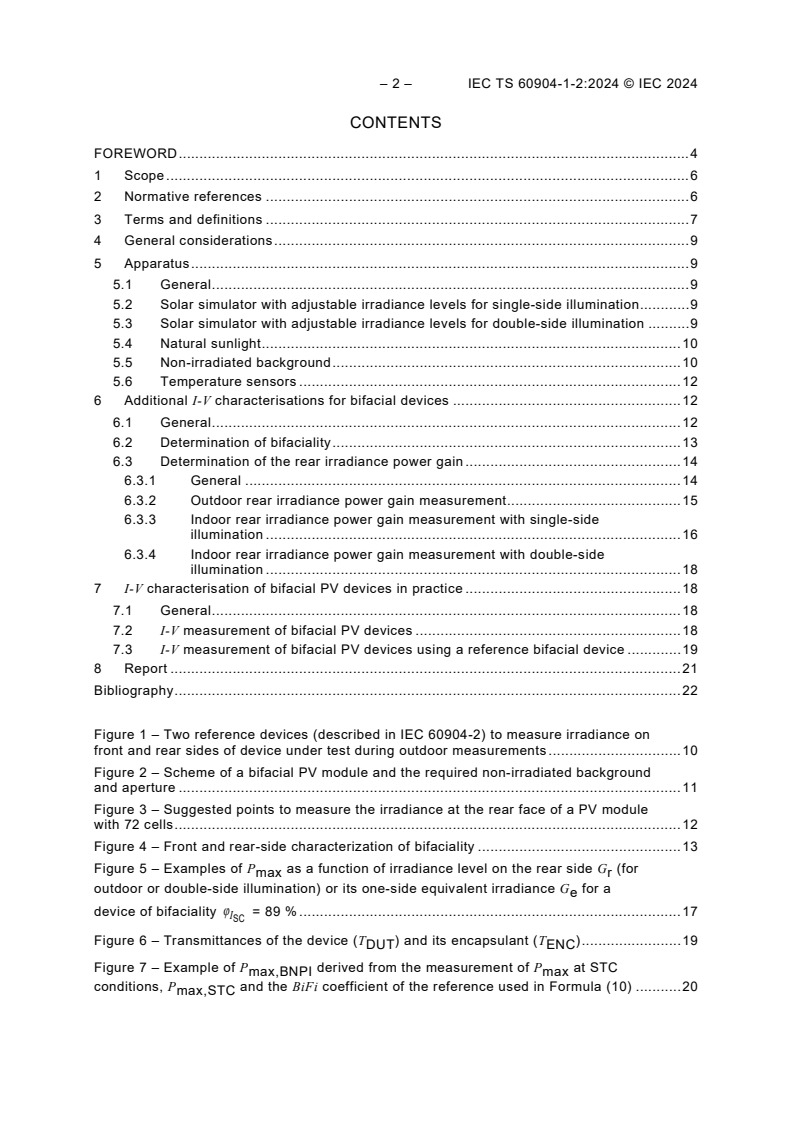
CONTENTS
FOREWORD . 4
1 Scope . 6
2 Normative references . 6
3 Terms and definitions . 7
4 General considerations . 9
5 Apparatus . 9
5.1 General . 9
5.2 Solar simulator with adjustable irradiance levels for single-side illumination . 9
5.3 Solar simulator with adjustable irradiance levels for double-side illumination . 9
5.4 Natural sunlight . 10
5.5 Non-irradiated background . 10
5.6 Temperature sensors . 12
6 Additional I-V characterisations for bifacial devices . 12
6.1 General . 12
6.2 Determination of bifaciality . 13
6.3 Determination of the rear irradiance power gain . 14
6.3.1 General . 14
6.3.2 Outdoor rear irradiance power gain measurement . 15
6.3.3 Indoor rear irradiance power gain measurement with single-side
illumination . 16
6.3.4 Indoor rear irradiance power gain measurement with double-side
illumination . 18
7 I-V characterisation of bifacial PV devices in practice . 18
7.1 General . 18
7.2 I-V measurement of bifacial PV devices . 18
7.3 I-V measurement of bifacial PV devices using a reference bifacial device . 19
8 Report . 21
Bibliography . 22
Figure 1 – Two reference devices (described in IEC 60904-2) to measure irradiance on
front and rear sides of device under test during outdoor measurements . 10
Figure 2 – Scheme of a bifacial PV module and the required non-irradiated background
and aperture . 11
Figure 3 – Suggested points to measure the irradiance at the rear face of a PV module
with 72 cells . 12
Figure 4 – Front and rear-side characterization of bifaciality . 13
Figure 5 – Examples of P as a function of irradiance level on the rear side G (for
max r
outdoor or double-side illumination) or its one-side equivalent irradiance G for a
e
φ
device of bifaciality = 89 % . 17
I
SC
Figure 6 – Transmittances of the device (T ) and its encapsulant (T ) . 19
DUT ENC
Figure 7 – Example of P derived from the measurement of P at STC
max,BNPI max
conditions, P and the BiFi coefficient of the reference used in Formula (10) . 20
max,STC
Table 1 – Maximum power, P , measured at different rear irradiances, G , (double-
max r
-2
sided with G = 1 000 Wm ) or alternatively equivalent front irradiances, G , and the
f E
rear irradiance driven power gain yield, BiFi, derived from the slope of the linear fit on
P (G ) . 17
max r
Table 2 – Example of P derived from the measurement at STC conditions
max,BNPI
(G = 0 and G = 1 000) and the rear irradiance power gain obtained from the bifacial
r f
reference device, BiFi . 20
ref
– 4 – IEC TS 60904-1-2:2024 © IEC 2024
INTERNATIONAL ELECTROTECHNICAL COMMISSION
____________
PHOTOVOLTAIC DEVICES –
Part 1-2: Measurement of current-voltage characteristics of
bifacial photovoltaic (PV) devices
FOREWORD
1) The International Electrotechnical Commission (IEC) is a worldwide organization for standardization comprising
all national electrotechnical committees (IEC National Committees). The object of IEC is to promote international
co-operation on all questions concerning standardization in the electrical and electronic fields. To this end and
in addition to other activities, IEC publishes International Standards, Technical Specifications, Technical Reports,
Publicly Available Specifications (PAS) and Guides (hereafter referred to as “IEC Publication(s)”). Their
preparation is entrusted to technical committees; any IEC National Committee interested in the subject dealt with
may participate in this preparatory work. International, governmental and non-governmental organizations liaising
with the IEC also participate in this preparation. IEC collaborates closely with the International Organization for
Standardization (ISO) in accordance with conditions determined by agreement between the two organizations.
2) The formal decisions or agreements of IEC on technical matters express, as nearly as possible, an international
consensus of opinion on the relevant subjects since each technical committee has representation from all
interested IEC National Committees.
3) IEC Publications have the form of recommendations for international use and are accepted by IEC National
Committees in that sense. While all reasonable efforts are made to ensure that the technical content of IEC
Publications is accurate, IEC cannot be held responsible for the way in which they are used or for any
misinterpretation by any end user.
4) In order to promote international uniformity, IEC National Committees undertake to apply IEC Publications
transparently to the maximum extent possible in their national and regional publications. Any divergence between
any IEC Publication and the corresponding national or regional publication shall be clearly indicated in the latter.
5) IEC itself does not provide any attestation of conformity. Independent certification bodies provide conformity
assessment services and, in some areas, access to IEC marks of conformity. IEC is not responsible for any
services carried out by independent certification bodies.
6) All users should ensure that they have the latest edition of this publication.
7) No liability shall attach to IEC or its directors, employees, servants or agents including individual experts and
members of its technical committees and IEC National Committees for any personal injury, property damage or
other damage of any nature whatsoever, whether direct or indirect, or for costs (including legal fees) and
expenses arising out of the publication, use of, or reliance upon, this IEC Publication or any other IEC
Publications.
8) Attention is drawn to the Normative references cited in this publication. Use of the referenced publications is
indispensable for the correct application of this publication.
9) IEC draws attention to the possibility that the implementation of this document may involve the use of (a)
patent(s). IEC takes no position concerning the evidence, validity or applicability of any claimed patent rights in
respect thereof. As of the date of publication of this document, IEC had not received notice of (a) patent(s), which
may be required to implement this document. However, implementers are cautioned that this may not represent
the latest information, which may be obtained from the patent database available at https://patents.iec.ch. IEC
shall not be held responsible for identifying any or all such patent rights.
IEC TS 60904-1-2 has been prepared by IEC technical committee 82: Solar photovoltaic energy
systems. It is a Technical Specification.
This second edition cancels and replaces the first edition published in 2019. This edition
constitutes a technical revision.
This edition includes the following significant technical changes with respect to the previous
edition:
a) The scope has been updated and refers to IEC TS 63202-3 for the measurement of
non-encapsulated solar cells.
b) The requirements for the non-uniformity of irradiance have been updated and now refer to
classifications introduced in IEC 60904-9.
c) The requirement for non-irradiated background has been revised.
d) Spectral mismatch corrections are no longer mandatory, unless required by another
standard. Spectral mismatch would have to be considered in the measurement uncertainty.
e) The requirement regarding the calculation of bifaciality has been modified: Equivalent
irradiance shall not be calculated based on the minimum bifaciality value between I and
SC
P , but on the bifaciality of I .
max SC
The text of this Technical Specification is based on the following documents:
Draft Report on voting
82/2278/DTS 82/2309/RVDTS
Full information on the voting for its approval can be found in the report on voting indicated in
the above table.
The language used for the development of this Technical Specification is English.
This document was drafted in accordance with ISO/IEC Directives, Part 2, and developed in
accordance with ISO/IEC Directives, Part 1 and ISO/IEC Directives, IEC Supplement, available
at www.iec.ch/members_experts/refdocs. The main document types developed by IEC are
described in greater detail at www.iec.ch/publications.
A list of all parts in the IEC 60904 series, published under the general title Photovoltaic devices,
can be found on the IEC website.
The committee has decided that the contents of this document will remain unchanged until the
stability date indicated on the IEC website under webstore.iec.ch in the data related to the
specific document. At this date, the document will be
• reconfirmed,
• withdrawn, or
• revised.
IMPORTANT – The "colour inside" logo on the cover page of this document indicates
that it contains colours which are considered to be useful for the correct understanding
of its contents. Users should therefore print this document using a colour printer.
– 6 – IEC TS 60904-1-2:2024 © IEC 2024
PHOTOVOLTAIC DEVICES –
Part 1-2: Measurement of current-voltage characteristics of
bifacial photovoltaic (PV) devices
1 Scope
This part of IEC 60904 describes procedures for the measurement of the current-voltage (I-V)
characteristics of single junction bifacial photovoltaic devices in natural or simulated sunlight.
It is applicable to encapsulated solar cells, sub-assemblies of such cells or entire PV modules.
For measurements of I-V characteristics of non-encapsulated solar cells, IEC TS 63202-3
applies.
The requirements for measurement of I-V characteristics of standard (monofacial) PV devices
are covered by IEC 60904-1, whereas this document describes the additional requirements for
the measurement of I-V characteristics of bifacial PV devices.
This document can be applicable to PV devices designed for use under concentrated irradiation
if they are measured without the optics for concentration, and irradiated using direct normal
irradiance and a mismatch correction with respect to a direct normal reference spectrum is
performed.
2 Normative references
The following documents are referred to in the text in such a way that some or all of their content
constitutes requirements of this document. For dated references, only the edition cited applies.
For undated references, the latest edition of the referenced document (including any
amendments) applies.
IEC 60891, Photovoltaic devices – Procedures for temperature and irradiance corrections to
measured I-V characteristics
IEC 60904-1, Photovoltaic devices – Part 1: Measurement of photovoltaic current-voltage
characteristics
IEC 60904-2, Photovoltaic devices – Part 2: Requirements for photovoltaic reference devices
IEC 60904-3, Photovoltaic devices – Part 3: Measurement principles for terrestrial photovoltaic
(PV) solar devices with reference spectral irradiance data
IEC 60904-4, Photovoltaic devices – Part 4: Photovoltaic reference devices – Procedures for
establishing calibration traceability
IEC 60904-7, Photovoltaic devices – Part 7: Computation of the spectral mismatch correction
for measurements of photovoltaic devices
IEC 60904-8, Photovoltaic devices – Part 8: Measurement of spectral responsivity of a
photovoltaic (PV) device
IEC 60904-9, Photovoltaic devices – Part 9: Classification of solar simulator characteristics
IEC TS 61836, Solar photovoltaic energy systems – Terms, definitions and symbols
IEC 62788-1-4, Measurement procedures for materials used in photovoltaic modules – Part 1-4:
Encapsulants – Measurement of optical transmittance and calculation of the solar-weighted
photon transmittance, yellowness index, and UV cut-off wavelength
3 Terms and definitions
For the purposes of this document, the terms and definitions given in IEC TS 61836 and the
following apply.
ISO and IEC maintain terminology databases for use in standardization at the following
addresses:
• IEC Electropedia: available at https://www.electropedia.org/
• ISO Online browsing platform: available at https://www.iso.org/obp
3.1
bifacial PV device
PV device, both surfaces of which (front and rear sides) are capable of power generation
3.2
front side
side of the PV device declared by the manufacturer as the front side, which is the side designed
to be oriented toward the sun
Note 1 to entry: If no declaration is provided, the front side is the side with the higher maximum power measured
under standard test conditions (STC).
3.3
rear side
side of the PV device declared by the manufacturer as the rear side, that is the side designed
to point away from the sun
Note 1 to entry: If no declaration is provided, the rear side is the side with the lower maximum power measured
under STC.
3.4
bifaciality
property expressing the ratio between the main characteristics of the rear side and the front
side of a bifacial PV device quantified by specific bifaciality coefficients
Note 1 to entry: Unless otherwise specified, the bifaciality refers to standard test conditions (STC). The bifaciality
of the performance parameters is expressed as:
φ
– Short-circuit current bifaciality:
Ι
SC
φ
– Open-circuit voltage bifaciality:
V
OC
– Maximum power bifaciality: φ
P .
max,BiFi
3.5
equivalent irradiance
G
E
irradiance required to illuminate the front of the device under test, so that it produces the same
-2
power output as if it were illuminated from the device front with irradiance 1 000 Wm and from
the rear with irradiance G
r
3.6
rear face irradiance
G
r
irradiance arriving at the rear face of the DUT
– 8 – IEC TS 60904-1-2:2024 © IEC 2024
3.7
bifacial nameplate irradiance
BNPI
irradiance at which nameplate characteristics are reported for bifacial modules, specifically
-2 -2
1 000 Wm on the module front and 135 Wm on the module rear
3.8
maximum power at BNPI
P
max,BNPI
maximum power output of the DUT under BNPI
Note 1 to entry: The quantity can be measured or calculated.
3.9
short-circuit current at BNPI
I
SC,BNPI
short-circuit current of the DUT under BNPI
Note 1 to entry: The quantity can be measured or calculated.
3.10
open-circuit voltage at BNPI
V
OC,BNPI
open-circuit voltage of the DUT under BNPI
Note 1 to entry: The quantity can be measured or calculated.
3.11
rear irradiance power gain
BiFi
quantity which indicates the power gain, in addition to that obtained at STC conditions, per unit
of rear irradiance
Note 1 to entry: Rear irradiance power gain is the slope derived from the linear fit of the P versus rear irradiance,
max
G .
r
-2 2
Note 2 to entry: BiFi is expressed in W/(Wm ) or m .
3.12
relative rear irradiance power gain
BiFi
rel
rear irradiance power gain, BiFi normalized by front-side irradiance and maximum power output
at STC
Note 1 to entry: BiFi is unitless.
rel
3.13
BiFi
ref
rear irradiance power gain of the bifacial device used as a reference
4 General considerations
The final performance of bifacial PV devices in a power plant depends not only on the spatial
distribution of the irradiance incident onto the front surface, but additionally on that incident
onto the rear surface of the device, which is strongly affected by site-specific conditions, such
as albedo, reflective surface size, the racking system, the device's elevation and its tilt angle.
Owing to these dependences and in order to obtain comparable measurement results, I-V
characterisation is extended to quantify the bifaciality of the device and the rear irradiance
power gain. Bifaciality is an intrinsic property of the device, unlike the site-specific conditions
such as albedo. The measurement conditions for bifacial devices should strive to generate extra
photocurrent proportional to their bifaciality. In general, this can be achieved with a test
spectrum close to the reference spectrum such as provided by natural sunlight or with a solar
simulator whose irradiance level is adjustable, a high albedo and minimal near object shading.
However, in practice, measurement conditions differ from the ideal and will deviate from the
reference conditions. This document sets limits on the permissible deviations for obtaining valid
measurements. In any case, the deviations of the measurement conditions from the reference
conditions shall be accounted for in the analysis of measurement uncertainty.
5 Apparatus
5.1 General
In addition to the apparatus requirements described in IEC 60904-1, one of the equipment sets
described in 5.2, 5.3 and 5.4 meeting the requirements for a non-irradiated background as
described in 5.5 is necessary for the characterisation of bifacial devices.
5.2 Solar simulator with adjustable irradiance levels for single-side illumination
A solar simulator, as defined in IEC 60904-9, with adjustable irradiance level shall be used for
the I-V characterisation of bifacial devices. Simulators shall be able to provide irradiance levels
-2 -2
above 1 000 Wm (typically up to 1 200 Wm ). The solar simulator's non-uniformity of
irradiance shall be Class B or better in accordance with IEC 60904-9 and shall maintain its
classification at irradiance levels used for the characterisation of bifacial devices. The non-
uniformity of irradiance, the spectral distribution and the temporal instability of irradiance shall
be measured at the irradiance levels used for the characterisation of bifacial devices.
5.3 Solar simulator with adjustable irradiance levels for double-side illumination
A solar simulator, as defined in IEC 60904-9, with the additional capability to simultaneously
illuminate the bifacial device on both sides shall be used. The non-uniformity, the spectral
distribution and the temporal instability of irradiance shall be measured on both sides while the
irradiance on the opposite side of the device under test is eliminated by appropriate measures
-2
as described in 5.5. In cases where a contribution larger than 5 Wm on the opposite side is
present, this contribution shall be corrected and incorporated into the evaluation of
-2
measurement uncertainty. In cases where a contribution lower than 5 Wm from the opposite
side is present, it is recommended that the contribution also be corrected (see 5.5) if its
magnitude is known. For individual measurements the non-uniformity of irradiance shall be
Class B or better in accordance with IEC 60904-9 and shall maintain its classification on both
sides, at the irradiance levels used for the characterisation of bifacial devices.
– 10 – IEC TS 60904-1-2:2024 © IEC 2024
NOTE A reflective cloth can be positioned directly under the device under test to minimise artefacts arising from
non-uniformity of irradiance at the rear face.
Figure 1 – Two reference devices (described in IEC 60904-2) to measure irradiance on
front and rear sides of device under test during outdoor measurements
5.4 Natural sunlight
I
...
Questions, Comments and Discussion
Ask us and Technical Secretary will try to provide an answer. You can facilitate discussion about the standard in here.
Loading comments...