


IEC PAS 62544:2008
(Main)Active filters in HVDC applications
General Information
- Abstract
It presents both DC and AC active filters, including the existing installations. The items of the report are basically arranged in two consecutive parts, the first one treating the DC application, and the second covering the AC filters. As active DC and AC filters share many concepts, the reader interested in such a subject is encouraged to search for it in both parts.
- Status
- Replaced
- Publication Date
- 06-Feb-2008
- Current Stage
- DELPUB - Deleted Publication
- Start Date
- 19-Aug-2011
- Completion Date
- 28-Aug-2026
Relations
- Replaced By
IEC TR 62544:2011 - High-voltage direct current (HVDC) systems - Application of active filters - Effective Date
- 05-Sep-2023
Get Certified
Connect with accredited certification bodies for this standard

IMQ S.p.A. (Certification)
Italian electrical product certification.

SLG Prüf- und Zertifizierungs GmbH
German testing and certification body.

UL Solutions
Global safety science company with testing, inspection and certification.
Sponsored listings
Frequently Asked Questions
IEC PAS 62544:2008 is a technical specification published by the International Electrotechnical Commission (IEC). Its full title is "Active filters in HVDC applications". This standard covers: It presents both DC and AC active filters, including the existing installations. The items of the report are basically arranged in two consecutive parts, the first one treating the DC application, and the second covering the AC filters. As active DC and AC filters share many concepts, the reader interested in such a subject is encouraged to search for it in both parts.
It presents both DC and AC active filters, including the existing installations. The items of the report are basically arranged in two consecutive parts, the first one treating the DC application, and the second covering the AC filters. As active DC and AC filters share many concepts, the reader interested in such a subject is encouraged to search for it in both parts.
IEC PAS 62544:2008 is classified under the following ICS (International Classification for Standards) categories: 29.240.99 - Other equipment related to power transmission and distribution networks. The ICS classification helps identify the subject area and facilitates finding related standards.
IEC PAS 62544:2008 has the following relationships with other standards: It is inter standard links to IEC TR 62544:2011. Understanding these relationships helps ensure you are using the most current and applicable version of the standard.
IEC PAS 62544:2008 is available in PDF format for immediate download after purchase. The document can be added to your cart and obtained through the secure checkout process. Digital delivery ensures instant access to the complete standard document.
Standards Content (Sample)
IEC/PAS 62544
Edition 1.0 2008-02
PUBLICLY AVAILABLE
SPECIFICATION
PRE-STANDARD
Active filters in HVDC applications
IEC/PAS 62544:2008(E)
All rights reserved. Unless otherwise specified, no part of this publication may be reproduced or utilized in any form
or by any means, electronic or mechanical, including photocopying and microfilm, without permission in writing from
either IEC or IEC's member National Committee in the country of the requester.
If you have any questions about IEC copyright or have an enquiry about obtaining additional rights to this publication,
please contact the address below or your local IEC member National Committee for further information.
IEC Central Office
3, rue de Varembé
CH-1211 Geneva 20
Switzerland
Email: inmail@iec.ch
Web: www.iec.ch
About the IEC
The International Electrotechnical Commission (IEC) is the leading global organization that prepares and publishes
International Standards for all electrical, electronic and related technologies.
About IEC publications
The technical content of IEC publications is kept under constant review by the IEC. Please make sure that you have the
latest edition, a corrigenda or an amendment might have been published.
ƒ Catalogue of IEC publications: www.iec.ch/searchpub
The IEC on-line Catalogue enables you to search by a variety of criteria (reference number, text, technical committee,…).
It also gives information on projects, withdrawn and replaced publications.
ƒ IEC Just Published: www.iec.ch/online_news/justpub
Stay up to date on all new IEC publications. Just Published details twice a month all new publications released. Available
on-line and also by email.
ƒ Electropedia: www.electropedia.org
The world's leading online dictionary of electronic and electrical terms containing more than 20 000 terms and definitions
in English and French, with equivalent terms in additional languages. Also known as the International Electrotechnical
Vocabulary online.
ƒ Customer Service Centre: www.iec.ch/webstore/custserv
If you wish to give us your feedback on this publication or need further assistance, please visit the Customer Service
Centre FAQ or contact us:
Email: csc@iec.ch
Tel.: +41 22 919 02 11
Fax: +41 22 919 03 00
IEC/PAS 62544
Edition 1.0 2008-02
PUBLICLY AVAILABLE
SPECIFICATION
PRE-STANDARD
Active filters in HVDC applications
INTERNATIONAL
ELECTROTECHNICAL
COMMISSION
PRICE CODE
XA
ICS 29.240.99 ISBN 2-8318-9595-2
– 2 – PAS 62544 © IEC:2008(E)
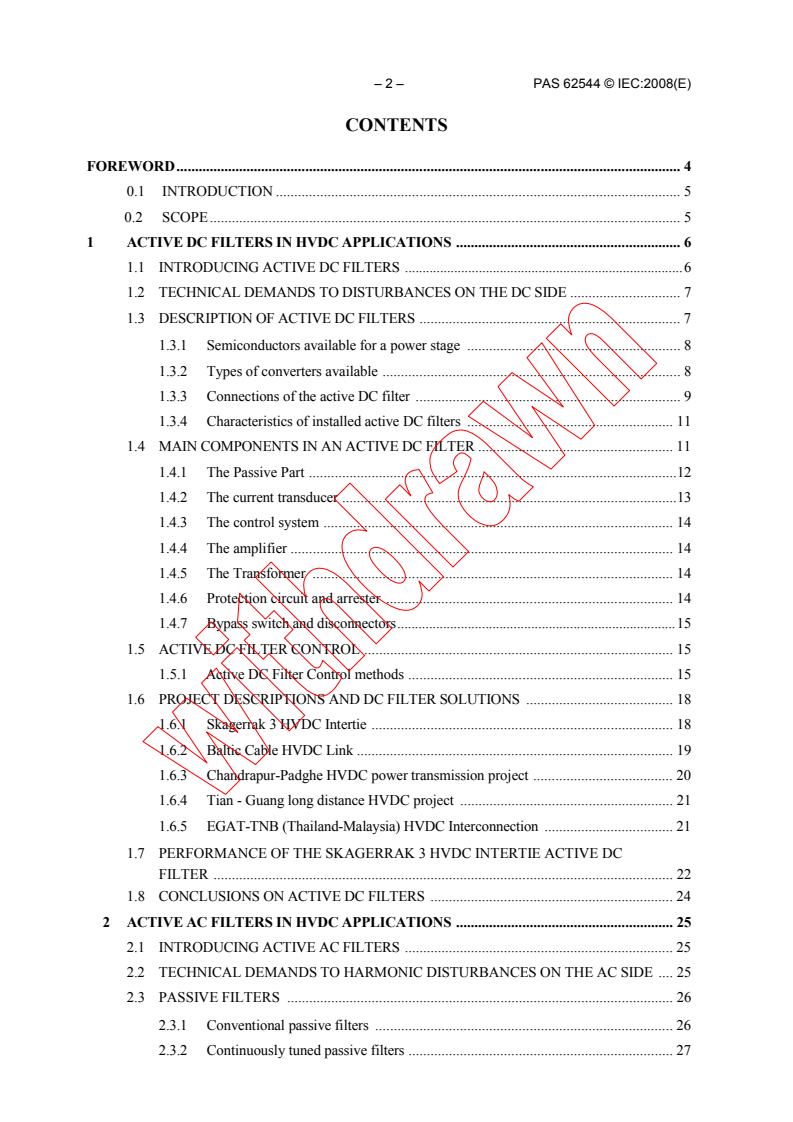
CONTENTS
FOREWORD. 4
0.1 INTRODUCTION . 5
0.2 SCOPE. 5
1 ACTIVE DC FILTERS IN HVDC APPLICATIONS . 6
1.1 INTRODUCING ACTIVE DC FILTERS .6
1.2 TECHNICAL DEMANDS TO DISTURBANCES ON THE DC SIDE . 7
1.3 DESCRIPTION OF ACTIVE DC FILTERS . 7
1.3.1 Semiconductors available for a power stage . 8
1.3.2 Types of converters available . 8
1.3.3 Connections of the active DC filter . 9
1.3.4 Characteristics of installed active DC filters . 11
1.4 MAIN COMPONENTS IN AN ACTIVE DC FILTER . 11
1.4.1 The Passive Part .12
1.4.2 The current transducer .13
1.4.3 The control system . 14
1.4.4 The amplifier . 14
1.4.5 The Transformer . 14
1.4.6 Protection circuit and arrester . 14
1.4.7 Bypass switch and disconnectors.15
1.5 ACTIVE DC FILTER CONTROL . 15
1.5.1 Active DC Filter Control methods . 15
1.6 PROJECT DESCRIPTIONS AND DC FILTER SOLUTIONS . 18
1.6.1 Skagerrak 3 HVDC Intertie . 18
1.6.2 Baltic Cable HVDC Link . 19
1.6.3 Chandrapur-Padghe HVDC power transmission project . 20
1.6.4 Tian - Guang long distance HVDC project . 21
1.6.5 EGAT-TNB (Thailand-Malaysia) HVDC Interconnection . 21
1.7 PERFORMANCE OF THE SKAGERRAK 3 HVDC INTERTIE ACTIVE DC
FILTER . 22
1.8 CONCLUSIONS ON ACTIVE DC FILTERS . 24
2 ACTIVE AC FILTERS IN HVDC APPLICATIONS . 25
2.1 INTRODUCING ACTIVE AC FILTERS . 25
2.2 TECHNICAL DEMANDS TO HARMONIC DISTURBANCES ON THE AC SIDE . 25
2.3 PASSIVE FILTERS .26
2.3.1 Conventional passive filters . 26
2.3.2 Continuously tuned passive filters . 27
PAS 62544 © IEC:2008(E) – 3 –
2.4 REASONS FOR USING ACTIVE FILTERS IN HVDC SCHEMES . 28
2.5 OPERATION PRINCIPLES OF ACTIVE FILTERS . 29
2.5.1 Shunt connected active filter . 29
2.5.2 Series connected active filter . 30
2.6 PARALLEL AND SERIES CONFIGURATION . 31
2.6.1 Hybrid filter schemes .32
2.7 CONVERTER CONFIGURATIONS .33
2.7.1 Converters . 33
2.7.2 STATCOM . 35
2.8 ACTIVE AC FILTER CONFIGURATIONS . 37
2.8.1 Active ac filters for low voltage application . 37
2.8.2 Active ac filters for medium voltage application . 37
2.8.3 Active ac filters for HVDC applications . 37
2.9 SERIES CONNECTED ACTIVE FILTERS . 38
2.10 CONTROL SYSTEM . 39
2.10.1 Introduction . 39
2.10.2 Description of a Generic Active Power Filter Controller . 39
2.10.3 Calculation of Reference Current . 40
2.10.4 Synchronous Reference Frame (SRF) . 41
2.10.5 Other Control Approaches . 42
2.10.6 HVDC AC Active Filter Control Approach . 43
2.11 EXISTING ACTIVE AC FILTER APPLICATIONS . 43
2.11.1 Low and medium voltage . 43
2.11.2 High voltage applications . 43
2.12 OVERVIEW ON FILTER SOLUTIONS FOR HVDC SYSTEMS . 46
2.12.1 Solution with conventional passive filters . 46
2.12.2 Solution with continuously tuned passive filters .47
2.12.3 Solution with active filters . 47
2.12.4 Solution with continuously tuned passive filters and active filters . 48
2.12.5 Study cases with the Cigré HVDC model . 48
2.13 FUTURE TECHNOLOGIES . 50
2.14 CONCLUSIONS ON ACTIVE AC FILTERS . 50
3 BIBLIOGRAPHY . 51
– 4 – PAS 62544 © IEC:2008(E)
INTERNATIONAL ELECTROTECHNICAL COMMISSION
____________
ACTIVE FILTERS IN HVDC APPLICATIONS
FOREWORD
1) The International Electrotechnical Commission (IEC) is a worldwide organization for standardization comprising all
national electrotechnical committees (IEC National Committees). The object of IEC is to promote international co-
operation on all questions concerning standardization in the electrical and electronic fields. To this end and in
addition to other activities, IEC publishes International Standards, Technical Specifications, Technical Reports,
Publicly Available Specifications (PAS) and Guides (hereafter referred to as “IEC Publication(s)”). Their
preparation is entrusted to technical committees; any IEC National Committee interested in the subject dealt with
may participate in this preparatory work. International, governmental and non-governmental organizations liaising
with the IEC also participate in this preparation. IEC collaborates closely with the International Organization for
Standardization (ISO) in accordance with conditions determined by agreement between the two organizations.
2) The formal decisions or agreements of IEC on technical matters express, as nearly as possible, an international
consensus of opinion on the relevant subjects since each technical committee has representation from all
interested IEC National Committees.
3) IEC Publications have the form of recommendations for international use and are accepted by IEC National
Committees in that sense. While all reasonable efforts are made to ensure that the technical content of IEC
Publications is accurate, IEC cannot be held responsible for the way in which they are used or for any
misinterpretation by any end user.
4) In order to promote international uniformity, IEC National Committees undertake to apply IEC Publications
transparently to the maximum extent possible in their national and regional publications. Any divergence between
any IEC Publication and the corresponding national or regional publication shall be clearly indicated in the latter.
5) IEC provides no marking procedure to indicate its approval and cannot be rendered responsible for any equipment
declared to be in conformity with an IEC Publication.
6) All users should ensure that they have the latest edition of this publication.
7) No liability shall attach to IEC or its directors, employees, servants or agents including individual experts and
members of its technical committees and IEC National Committees for any personal injury, property damage or
other damage of any nature whatsoever, whether direct or indirect, or for costs (including legal fees) and
expenses arising out of the publication, use of, or reliance upon, this IEC Publication or any other IEC
Publications.
8) Attention is drawn to the Normative references cited in this publication. Use of the referenced publications is
indispensable for the correct application of this publication.
9) Attention is drawn to the possibility that some of the elements of this IEC Publication may be the subject of patent
rights. IEC shall not be held responsible for identifying any or all such patent rights.
A PAS is a technical specification not fulfilling the requirements for a standard, but made
available to the public and established in an organization operating under given procedures.
IEC-PAS 62544 was submitted by the CIGRÉ (International Council on Large Electric Systems)
and has been processed by subcommittee 22F: Power electronics for electrical transmission and
distribution systems, of IEC technical committee 22: Power electronic systems and equipment.
The text of this PAS is based on the This PAS was approved for
following document: publication by the P-members of the
committee concerned as indicated in
the following document
Draft PAS Report on voting
22F/130/NP 22F/147/RVN
Following publication of this PAS, which is a pre-standard publication, the technical committee
or subcommittee concerned will transform it into an International Standard.
An IEC-PAS licence of copyright and assignment of copyright has been signed by the IEC and
CIGRÉ and is recorded at the Central Office.
This PAS shall remain valid for an initial maximum period of three years starting from the
publication date. The validity may be extended for a single three-year period, following which it
shall be revised to become another type of normative document or shall be withdrawn.
PAS 62544 © IEC:2008(E) – 5 –
ACTIVE FILTERS IN HVDC APPLICATIONS
By Cigré Working Group 14.28
0.1 INTRODUCTION
Fourteen active DC filters and one active AC filter exist already in HVDC converter stations. The
interest in active filters for HVDC systems is mainly due the fact that a single active filter is able to
mitigate effectively diverse harmonics simultaneously, which otherwise would require several passive
filters to achieve a comparable result. They can also contribute to reducing the size of the smoothing
reactors used at the DC side and to reducing losses. They are also able to cope with harmonic resonance
problems and to adapt themselves to changes in the harmonic impedance of the system, which are
important characteristics, especially for the connection to the AC side.
0.2 SCOPE
This report prepared by Working Group 14.28 presents both DC and AC active filters, including the
existing installations. The items of the report are basically arranged in two consecutive parts, the first one
treating the DC application, and the second covering the AC filters. As active DC and AC filters share
many concepts, the reader interested in such a subject is encouraged to search for it in both parts.
– 6 – PAS 62544 © IEC:2008(E)
1 ACTIVE DC FILTERS IN HVDC APPLICATIONS
1.1 INTRODUCING ACTIVE DC FILTERS
The conversion process in an HVDC transmission system introduces harmonic currents into the DC
transmission lines and the AC grid connected to the HVDC converters. These harmonic currents may
cause interference in the adjacent systems, such as telecommunication equipment. The conventional
1)
solution to reduce the harmonics has been to install passive filters in HVDC converter stations [1] .
When the power line consists of cables, this filtering is normally not necessary. The development of
power electronics devices and digital computers has made it possible to achieve a powerful new way for
further reduction of harmonic levels, namely, active filters.
The active filters can be divided into two groups,
active AC and DC filters. Active DC filter
installations are in operation in several HVDC links
and have been economically competitive due to
increased demand on telephone interference levels on
the DC overhead lines (Figure 1.1.1). An active AC
filter is already in operation as well. In addition to
the active DC filter function of mitigating the
harmonic currents on the DC overhead lines, the
active AC filters may be part of several solutions in
the HVDC scheme to improve reactive power
exchange with the AC grid and to improve the
dynamic stability.
Already in the 1960s there were attempts to
develop and install an active filter in a HVDC
converter station in Sweden, but the project turned
out unsuccessfully. In the middle of the 1980s the
Figure 1.1.1 Conceptual diagram of allowable
technological development of the presently
interference level and DC filter cost
installed active filters was initiated. Mainly two
reasons make the projects successful. Primarily,
the prices on semiconductors have decreased dramatically and secondly, digital computers are getting
more powerful.
The reasons to develop first the active DC Filter and subsequently the active AC filter, were:
• Active AC and DC filters consist of two parts, a passive part and a corresponding active part, which are
loaded with the same currents. Due to the fact that the passive AC filter is used to supply the HVDC
converter demand of reactive power and thereby loaded with the fundamental current, the required
rating of the DC filter active part is lower than that of the AC filter active part.
• The control philosophy for the active DC filter is less complex than for the AC one.
• The present HVDC applications where active AC filters are feasible will be limited, due to the fact
that AC filters are also required to supply the HVDC converter demand of reactive power. The filter
size is therefore often well above the filtering demand.
In future HVDC projects a new converter technology may be applied, implying that the reactive power
can be separated from the AC filters and thereby make the active AC filter more feasible. The most
promising technologies are the Capacitor Commutated Converters (CCC) and the Controlled Series
Capacitor Converter (CSCC), but GTO controlled converters are also able to keep the reactive power
balance from the converter within a minimum.
)
Figures in square brackets refer to the Bibliography.
PAS 62544 © IEC:2008(E) – 7 –
1.2 TECHNICAL DEMANDS TO DISTURBANCES ON THE DC SIDE
The main reason for specifying demands on the DC circuit is to keep disturbances in nearby telephone
lines within an acceptable limit, which will vary depending on whether the telephone system consists of
overhead lines or underground cables, which are generally shielded and therefore have a better immunity
[2]. A summary is given below to illustrate the demands which made it feasible to install the active
filters. As described, the demand on disturbances can appear as an harmonic current on the DC line or as
an induced voltage “U ” in a fictive telephone line. The reader should keep in mind that the harmonic
ind
demand, the specific HVDC system and surroundings (earth resistivity, telephone system etc.) all
together define the DC filter solution.
The specified demand:
• The induced voltage “U ” in a theoretically 1 km telephone line situated 1 km from the DC overhead
ind
line shall be below 10 mV for monopolar operation.
• A one-minute mean value of the equivalent psophometric current “I ” fed into the DC pole overhead
pe
line shall be below 400 mA.
The mentioned induced voltage and the equivalent psophometric current are defined as:
where f is the frequency of the n-th harmonic, M is the mutual inductance between the telephone line and
n
f1 * n
the power line, k = , I is the vectorial sum of the n-th harmonic current flowing in the line
n 80 0 n
conductors (Common mode/earth mode current). p is the n-th psophometric weighting factor defined by
n
th
CCITT Directives 1963 [3] (see also Table 1.2.1) and p is the 16 psophometric weighting factor. The
characteristic harmonics n=12, 24, 36, 48 as well as the non-characteristic harmonics up to n = 50 shall
be considered.
Table 1.2.1 The psophometric weighting factor at selected frequencies.
Frequency/Hz 50
100 300 600 800 1000 1200 1800 2400 3000
n 1
2 6 12 16 20 24 36 48 60
p Factor 0.0007
n
0.009 0.295 0.794 1.000 1.122 1.000 0.760 0.634 0.525
0.001 0.111 0.595 1.000 1.403 1.500 1.710 1.902 1.969
0.00004
p *k
n n
1.3 DESCRIPTION OF ACTIVE DC FILTER
Active DC filters use a controllable converter to introduce currents in the network, presenting a
waveform which counteracts the harmonics. This clause describes types of power stages, converters to be
– 8 – PAS 62544 © IEC:2008(E)
used in active filters and the possible connections in HVDC schemes.
1.3.1 Semiconductors available for a power stage
Three types of semiconductors, suitable for use in an active filter, are available at present:
• The MosFET
• The IGBT
• The GTO
The MosFET is an excellent switching device capable of switching at very high frequencies with
relatively low losses, but with limited power handling capability.
The IGBT has a switching frequency capability which, although very good and sufficient to handle the
frequencies within the active DC filter range, is inferior to the MosFET. However the IGBT power
handling is significantly higher than the MosFET.
The GTO has the highest power handling capacity, but with a relatively limited switching speed far below
the required frequency range for active DC filter. The use of GTO will probably be limited to handling
frequencies below a few hundred of Hertz.
The relatively high frequency band for active DC filtering excludes the use of thyristors and GTO. Even
though the MosFET and IGBT are suited as switching elements in a power stage, the limited power
handling capacity on MosFET and the installed cost evaluations tend to point to the use of IGBT in future
power stages.
1.3.2 Types of converters available
Two basic types of switching converters are possible in an active DC filter; the current-source converter
(CSC) using inductive energy storage and the voltage-source converter (VSC) using capacitive energy
storage.
In a CSC the DC element is a current source, which normally
consists of a DC voltage source power supply in series with an
inductor. For correct operation the current should flow
continuously in the inductor. Hence, if AC current is not
required, current must be by-passed within the converter. This
fact restricts the switching actions. A simple CSC is shown in
Figure 1.3.1 Simple current source converter
Figure 1.3.1.
1.3.2.2 Voltages source converters (VSC)
In the VSC the DC element is a voltage source. This may be a
DC power supply or, in the case of an active DC filter
application, an energy storage unit. In practice, the voltage
source for an active DC filter power stage is usually a capacitor
with a small power supply to offset the power stage losses. A
VSC also has the property that its AC output appears as a
voltage source.
A circuit of simple VSC is shown in Figure 1.3.2.
Figure 1.3.2 Simple voltage source converter
PAS 62544 © IEC:2008(E) – 9 –
1.3.2.3 Comparison between current and voltage source converters
The CSC has a high internal impedance for currents through the converter, while the VSC has a low
impedance. The VSC has no constraints on the switching pattern that can be employed, while the CSC is
restricted as described above. The necessity for continuous current in the CSC, combined with the fact
that (neglecting superconductivity) an inductor has higher losses than a capacitor, ensures that the losses
in the CSC are higher than those in the VSC. Another parameter influencing losses is that a CSC needs
switching devices which can block reverse voltage. Most of the operating semiconductors do not fulfil
this requirement. In this case an extra diode in series with each device is necessary and this again
increases the losses. Some GTOs are able to support reverse voltage, but these are less common than the
GTOs which do not support reverse voltage. The former have higher losses than the more common
devices.
Conclusion: Considering the above properties of CSC and VSC, the type most suited for power stage
applications, particularly high power, is the VSC. The VSC has been preferred in all HVDC projects
applicable today.
1.3.3 Connections of the active DC filter
Advantages and disadvantage of connecting the active filters at locations shown in Figure 1.3.3 have been
discussed in several papers [4,5,6,7,8,9,10]. The active filters can be connected either as shunt active
filters or as series active filters.
Figure 1.3.3 Possible connections of active DC filters
1.3.3.1 The "active filter 1" connection
The active DC filter realised in HVDC schemes today is connected as the shunt “active filter 1” in Figure
1.3.3. By connecting the active filter in series with the passive DC filter, usually a 12/24th double tuned
– 10 – PAS 62544 © IEC:2008(E)
filter, the active filter rating can be reduced. A VSC is chosen in order to make the smallest influence on
the original function of the passive filter, especially on frequencies where the control algorithm is not
active.
1.3.3.2 The "active filter 2" connection
The “active filter 2” in Figure 1.3.3 is similar to the shunt “active filter 1” solution. The power
consumption of the tuning circuit in the passive filter will probably reduce the efficiency for injecting
harmonic currents to counteract the disturbance current and thereby increase the rating of the converter.
There may be an additional inductance inserted in series with the active part.
1.3.3.3 The "active filter 3" connection
The “active filter 3” in Figure 1.3.3 is a series active filter described in [11], but there is a lack of
knowledge of such a system. The active filter converter must be connected to the HVDC system by a
coupling transformer “T ”. To prevent saturation of the coupling transformer “T ” by the DC load current
c c
of the HVDC converter “I ”, the core must have an air gap.
dconv
In this way, the coupling transformer “T ” is a DC reactor with a galvanic insulated auxiliary winding to
c
connect the active filter (converter). To achieve no ripple voltage at the point of connection of the passive
DC filter and therefor no ripple current in the DC pole line, the active filter must generate across the main
winding “T ” a voltage which compensates the ripple voltage “U” of the DC side of the HVDC
c r
converter.
The AC load current “I ” of the main winding of “T ” is determined by “U ” and its inductance value “L ”,
r c r r
the converter transformer inductance and the smoothing reactor inductance. The rating of “T ” is
c
2 2
determined by “(I + I ) *L . The rating of the active filter (converter) is determined by “U /L ”. Hence
dconv r r dr r
the economical optimisation between the active and passive part of the active filter can be adjusted by
increasing “L”. The rating of “T ” will be increased and the rating of the active filter part will be
r c
decreased or vice versa.
The smoothing reactor (which is already designed for “U ”) is eventually an alternative for “T ”,
dr c
although is must be relocated to the neutral side of the HVDC converter valve and provided with an
auxiliary winding.
The advantages of this connection are:
• there are no harmonics in the HVDC converter DC current;
• the control algorithm of a series filter will probably be simplified compared to the shunt filter control.
The disadvantages are:
• Even by an optimal design, the rating of “T ” and the active filter part will be considerable.
c
• The “T ” side of the HVDC converter has no earth potential, which should be considered in the design
c
of the HVDC converter and the transformer “T ”.
c
1.3.3.4 The "active filter 4" connection
The “active filter 4” in Figure 1.3.3 is a series active filter fundamentally with the same configuration and
problems as the “active filter 3”. The filter is connected at the pole bus on the line side of the DC filter
capacitor. The major advantage of this arrangement is that the active filter rating (due to the fact that the
HVDC converter output ripple voltage is attenuated already by the passive filter) will be considerably less
than the “active filter 3” connection. The disadvantage of this arrangement is that the filter is situated at
line potential and that the filter must conduct the whole DC current.
PAS 62544 © IEC:2008(E) – 11 –
1.3.3.5 The "active filter 5" connection
There has not been any article describing “active filter 5a and 5b” in Figure 1.3.3. The application of such
a filter is expected to be limited to either higher frequencies or lower frequencies and not the whole
frequency range as the “active filter 1 and 2”.
1.3.3.6 Conclusion on active filter connections
The advantages and disadvantages of the most possible connections of the active part of the DC filter
have been described above. The main conclusion is that series connections of active filters on the DC side
are possible, but in light of the facts available today are not recommendable.
The injected power for active filtering can be reduced by choosing the optimum line injection point on the
passive circuit or the DC line. All active DC filter applications implemented today and in the near future
will use the “active filter 1” solution in Figure 1.3.3. The remaining part of this document therefore
discusses the “active filter 1” solution.
1.3.4 Characteristics of installed active DC filters
The active DC filters today (Figure 1.4.1), are connected in feedback control loop. The line current is
measured by a current transducer. The current signal is passed through a light guide into a computer. The
computer calculates a signal to feed a VSC, so that the current injected at the pole line is in opposition to
the measured line current.
Characteristics of the active DC filters:
• frequency range 300 Hz -3000 Hz;
• the achieved harmonic current attenuation is high, at least 10 times more attenuation than that
achievements with the passive part alone, at all chosen frequencies in the whole frequency range
(Figure 1.7.1);
• adaptable to variations of network frequency;
• compensate detuning effects of the passive DC filter;
• comparatively small size: the active part of the active DC filter can be fully assembled and tested at the
factory and then transported to site;
• significant changes in characteristics of the active DC filter can be achieved any time after
commissioning within the active filter ratings by software changes without hardware modification.
1.4 MAIN COMPONENTS IN AN ACTIVE DC FILTER
The active DC filter is a hybrid filter consisting of a passive and an active part. The passive part can
usually be defined as a double tuned passive filter which connects the active part with the DC line. The
active part in the DC filter is defined as the components within the box shown in Figure 1.4.1. All the
components in the active part shall ensure proper function of the active filter in steady state conditions
and during faults.
Figure 1.4.1 shows the active filter components in the filters today.
– 12 – PAS 62544 © IEC:2008(E)
Figure 1.4.1 Filter components in the active filter
1.4.1 The Passive Part
The main function of the passive part is to connect the active part with the high voltage DC line. The
reasons for choosing a double tuned filter are both an optimisation of the VSC cost compared with the
double tuned circuit and to ensure a reasonable performance if the active part is not in operation.
The choice of the characteristics for the passive part, together with the size of the smoothing reactor, will
influence the rating of the active part. The following example illustrates the rating requirements of the
active part with a fixed size smoothing reator when
• only a capacitor is used;
• a single tuned 12 harmonic filter is used;
• a double tuned 12/24 harmonic filter is used.
Table 1.4.1 shows a scheme calculated from some typical measured current values from a 600 MW, 400
kV HVDC converter connected to a 400 kV 50 Hz AC grid. The smoothing reactor has 200 mH, the main
capacitor has 1 µF. The root sum of squares of a typical measured current spectrum through the
smoothing reactor gives 15.7 A . The current spectrum is used to calculate the assumed voltage which is
rms
required for the active part to compensate the harmonics for the three mentioned filter configurations
shown in Figure 1.4.2.
The reader should pay attention to the fact that the calculated case in Table 1.4.1 is a simplified case, with
a short overhead line connected to a long HVDC cable. The HVDC cable mitigates the influence from the
other HVDC converter. The calculated example will only illustrate the impact of rating on the active part
with selection of different passive parts. In the “real” rating of the DC filter design, the designer has to
include various other parameters.
PAS 62544 © IEC:2008(E) – 13 –
The primary costs in the design of a
conventional DC filter are the smoothing reactor
and the main DC filter capacitor connected to the
DC line. If one disregards the smoothing reactor,
which costs the same or more than the main
capacitor, the cost of the main capacitor is
approximately 90 % of the totals, while the
reactors, the low voltage capacitor and resistors
have small influence on the total cost.
The main difference between a conventional
passive DC filter and the passive part in the
active filter is the lack of resistive elements in
the filter. The reason is that the control algorithm
and VSC are able to compensate the frequency
deviation on the AC side of the HVDC converter
and the component deviation. Hence it is not
necessary for the filter designer to optimise the
filter in that respect. When an active DC filter is
used, the frequency deviation will change from a
Figure 1.4.2 Impedance Characteristic of different
performance issue to a rating question on the
passive filters
VSC. In a recent project with long HVDC lines,
resistive elements in the passive part of the DC
filter were inserted to reduce the resonance in the
Assumed Single Single Double
overall system.
frequency Capacitor Tuned Filter Tuned Filter
deviation
The DC capacitor will always be a part of the
0,0 Hz 6,7 kV 4,4 kV 2,8 kV
active DC filter, connecting the active part with
high voltage DC line. In future active DC filters,
±0,1 Hz 6,7 kV 4,4 kV 2,8 kV
parts of the resonance circuit or the additional
±1,0 Hz 6,8 kV 4,6 kV 3,1 kV
components in the passive filter are expected to
be replaced by larger power stages, since the
Table 1.4.1 Voltage to be supplied by the active part
price of the power stages decrease rapidly.
with different selections of passive parts
1.4.2 The current transducer
The function of the current transducer is to measure the line current. The Rogowski coil has been chosen
as the current transducer in all known projects [12],[13]. To get a correct functioning of the active DC
filter, it is required to have at least one current transducer at each pole line in the station where the active
DC filter(s) is/are installed. The current transducer may be connected to the control through a light guide
(Figure 1.4.1) and is fed from a power supply which utilizes the harmonic current flowing in the filter, or
by a photocell array at the sensor and a second light guide connected to the control equipment. The
following data has to be taken into account when designing the transducer.
• A very high DC current through the current transducer. The DC current makes it difficult to use an iron
core transformer.
• The second harmonic current can be of considerable size (more than 10 A ), where the harmonics at
rms
other frequencies is in the size of 10 mA, when the control is active.
• Some current transducers may need a power supply at the high voltage DC transmission level. The
current transducer can be equipped with an electronic unit to communicate with ground level
equipment.
– 14 – PAS 62544 © IEC:2008(E)
• The current measurement with the analogue/digital conversion must be accurate within a large
temperature range from minimum ambient temperature with minimum load in the winter to maximum
ambient temperature with sun and a maximum load in the summer.
• The current transducer shall be able to measure the current with sufficient bandwidth (typically 1,5 to
2 times the selected active range for the control) to secure a well-performing control in the active
frequency range (normally in the range 300 Hz to 3 000 Hz).
1.4.3 The control system
An A/D conversion is necessary before the signal from the current transducer enters the digital signal
processors (DSP) and, in some installations, also a D/A conversion before the calculated signal from the
computer enters the VSC. The duration of the control process from measured current on line to injected
current on line adds a delay, which the control algorithm shall be able to handle. At high frequencies the
phase shift will be considerable. The control will be further described in clause 1.5. To be able to control
the VSC at frequencies up to 3,0 kHz, the computer or parts of the computer shall process complex tasks
with a sample rate of at least 10 kHz. The control sample rate can be less, if the demand to the frequency
range to control is reduced.
Although analog control circuits are theoretically possible, preference is given to digital computer
assisted controls. The main reasons to choose digital computers are that they can supply the needed
flexibility to the complexity of the overall system of control and easy adaptability to new control
algorithms.
1.4.4 The amplifier
The voltage source converters in the first installed filters comprised a transformer and MosFET PWM
amplifiers with a switching frequency at 66 kHz and a voltage of 330 V peak. They are able to maintain
full power (3 dB limit) in the frequency range 100 Hz up to 3 kHz. New water cooled IGBT PWM
amplifiers with switching frequencies considerably lower than the MosFET amplifiers are expected to be
used in all future projects. The IGBT PWM amplifiers are expected to have sufficient high switching
frequency (at least 10 kHz), higher voltage and better power handling with lower losses.
When using switching devices, harmonic distortions in the PLC range (30 kHz – 500 kHz) outside the
active control range may be introduced. With the present active DC filter design, including a transformer
and a passive filter working as a low-pass filter particularly for frequencies in the PLC range, this
distortion is normally suppressed.
1.4.5 The Transformer
The transformer is used because the existing amplifiers, providing voltages in the range 300 V to 1 000 V,
are not able to deliver the necessary voltage above 3 kV. Because the transformer provides not only the
necessary voltage, but also the galvanic separation between the main circuit of the HVDC plant, it will be
still necessary in the future. The transformer is designed to produce the required voltage and to present a
low impedance, making a minimum impact on the original passive filter characteristic.
1.4.6 Protection circuit and arrester
The protection circuit measures the currents and voltages and hence ensures that the amplifier is not
stressed. The protection circuit consists of two thyristors able to carry the full fault current coming from
the main circuit. The thyristors can be fired from the voltage/current supervision as well as the own
supervision of the amplifiers. The arrester limits the voltage across the transformer and amplifier.
Adequate protection of the amplifier or power stage is essential for active DC filter schemes and has to
include a protection circuit to conduct the fault current past the amplifier.
PAS 62544 © IEC:2008(E) – 15 –
1.4.7 Bypass switch and disconnectors
The bypass switch and disconnectors are installed in all active DC filters and enable the operation of the
HVDC link without using the active part. This feature makes it possible to work on the active part
without taking the HVDC link out of operation.
1.5 ACTIVE DC FILTER CONTROL
The aim of an active DC filter control is to mitigate the harmonic currents on the pole line and/or the
electrode line current which are originated at the local HVDC converter station, so that the interference
on telephone lines, adjacent to the HVDC lines may be brought within allowable limits. The active DC
filter creates virtually a low impedance path between the pole and electrode lines (or ground, depending
on the configuration of the system) at the chosen harmonic frequencies. In this way, the harmonics are
guided through the DC filter and thereby prevented from entering the HVDC line, so that the disturbance
on the line is diminished.
Below are some of the items that meet an important part of the design specification of the active filter
control:
• the required distortion level;
• the modes of operation of the HVDC transmission;
• the type of HVDC transmission;
• the number of terminals in the HVDC system;
• single active DC filter / multiple active DC filters;
• the control system must be able to recover from abnormal system conditions.
1.5.1 Active DC Filter Control methods
Three basic different control principles are discussed in this section, namely, feedback control,
feedforward control or a combination of the two methods.
1.5.1.1 Feedback control
Feedback control forms the core of existing active DC filters in HVDC applications [14, 15] - such as
shown in Figure 1.5.1. This controller is not only able to practically eliminate the harmonic currents, but
it also compensates for inaccuracies of both the current measuring device and the control parameters.
The basic feedback control scheme is illustrated as a block diagram in Figure 1.5.1. The functionality of
the control has been proven, but the compromise between stability and response has to be considered.
The quantity Il is the measured harmonic current in the transmission line, I is the disturbance current
conv
from the HVDC converter and I l is the compensation current from the active DC filter. The total line
fi t
current Il is the sum of I and I l. The external process is the transfer function between the output
ine conv fi t
voltage from
...