

IEC 62271-200:2003
(Main)High-voltage switchgear and controlgear - Part 200: A.C. metal-enclosed switchgear and controlgear for rated voltages above 1 kV and up to and including 52 kV
General Information
- Abstract
Specifies requirements for factory-assembled metal-enclosed switchgear and controlgear for alternating current of rated voltages above 1 kV and up to and including 52 kV for indoor and outdoor installation, and for service frequencies up to and including 60 Hz. Enclosures may include fixed and removable components and may be filled with fluid (liquid or gas) to provide insulation. This standard defines several types of metal enclosed switchgear and controlgear which differ due to - the consequences on network service continuity in case of maintenance on the switchgear and controlgear; - the need and convenience of maintenance of the equipment. For metal-enclosed switchgear and controlgear containing gas-filled compartments, the design pressure is limited to a maximum of 300 kPa (relative pressure). Metal-enclosed switchgear and controlgear for special use, for example, in flammable atmospheres, in mines or on board ships, may be subject to additional requirements. Components contained in metal-enclosed switchgear and controlgear are to be designed and tested in accordance with their various relevant standards. This standard supplements the standards for the individual components regarding their installation in switchgear and controlgear assemblies. This standard does not preclude that other equipment may be included in the same enclosure. In such a case, any possible influence of that equipment on the switchgear and controlgear is to be taken into account. This first edition of IEC 62271-200 cancels and replaces the third edition of IEC 60298, published in 1990, and constitutes a technical revision. Significant technical changes from the third edition of IEC 60298 are as follows: This revised document has been basically changed to be updated to today's use of high- voltage switchgear and controlgear up to 52 kV. The main changes are: new definitions and classification of equipment, introduction of internal arc classes (IAC) and its testing. This standard is to be read in conjunction with IEC 60694 published in 1996. Clause numbering follows the clause numbering of that standard. Additional subclauses, as they relate to a particular clause or subclause from IEC 60694, are numbered 101, 102, etc.
- Status
- Published
- Publication Date
- 05-Nov-2003
- Technical Committee
- SC 17C - Assemblies
- Current Stage
- DELPUB - Deleted Publication
- Start Date
- 24-Oct-2011
- Completion Date
- 28-Aug-2026
Buy Documents
IEC 62271-200:2003 - High-voltage switchgear and controlgear - Part 200: A.C. metal-enclosed switchgear and controlgear for rated voltages above 1 kV and up to and including 52 kV Released:11/6/2003


IEC 62271-200:2003 - Appareillage a haute tension - Partie 200: Appareillage sous enveloppe métallique pour courant alternatif de tensions assignées supérieures a 1 kV et inférieures ou égales a 52 kV Released:11/6/2003
IEC 62271-200:2003 - High-voltage switchgear and controlgear - Part 200: A.C. metal-enclosed switchgear and controlgear for rated voltages above 1 kV and up to and including 52 kV Released:11/6/2003
Overview
IEC 62271-200:2003 specifies requirements for factory‑assembled, A.C. metal‑enclosed switchgear and controlgear for rated voltages above 1 kV and up to and including 52 kV for indoor and outdoor installations, and for service frequencies up to 60 Hz. Enclosures can contain fixed or removable parts and may be fluid‑filled (liquid or gas). The standard updates and replaces IEC 60298 (1990) and introduces modern classifications and internal arc (IAC) testing. It is intended to be read in conjunction with IEC 60694.
Key topics and technical requirements
- Rated values and ratings: rated voltage, insulation levels, rated frequency, normal current, short‑time and peak withstand currents, and duration of short circuit.
- Design and construction: enclosure types, earthing, creepage distances, position indication, interlocks, nameplates and degrees of protection (IP).
- Fluid and gas requirements: provisions for liquid‑ and gas‑filled compartments; gas‑filled compartment design pressure limited to 300 kPa (relative pressure).
- Internal arc classification (IAC): new definitions and internal arc testing (Annex A) to classify equipment for personnel safety and accessibility.
- Testing regime: type tests (dielectric, temperature‑rise, short‑time and peak withstand, EMC, tightness), routine tests, partial discharge measurement (Annex B) and additional auxiliary/control circuit tests.
- Service, installation and maintenance guidance: selection of rated values, transport/storage, installation, operation and maintenance rules.
- Safety and special applications: additional requirements for installations in flammable atmospheres, mines or ships; components must meet their own standards and this standard supplements their assembly requirements.
Applications and who uses it
IEC 62271-200 is used by:
- Switchgear manufacturers for design, factory assembly and type/routine testing.
- Utility and power plant engineers for specifying high‑voltage metal‑enclosed switchgear (1–52 kV).
- Specifiers and procurement teams writing technical tender and order documentation.
- Testing laboratories and certification bodies performing IAC, dielectric and EMC tests.
- Installation and maintenance teams following transport, installation, safety and maintenance rules.
- System integrators and consultants assessing equipment suitability for indoor/outdoor and special‑use environments.
Practical benefits: ensures interoperability of components, improves personnel safety through IAC classification, defines repeatable type and routine tests, and supports reliable network service continuity and maintainability.
Related standards
- IEC 60694 (reference for clause numbering and common provisions)
- Replaced: IEC 60298 (3rd edition, 1990)
- Part of the IEC high‑voltage switchgear family (use alongside component standards for circuit‑breakers, disconnectors, earthing switches and protection equipment).
Relations
- Effective Date
- 05-Sep-2023
- Effective Date
- 05-Sep-2023
- Effective Date
- 05-Sep-2023
Buy Documents
IEC 62271-200:2003 - High-voltage switchgear and controlgear - Part 200: A.C. metal-enclosed switchgear and controlgear for rated voltages above 1 kV and up to and including 52 kV Released:11/6/2003
IEC 62271-200:2003 - Appareillage a haute tension - Partie 200: Appareillage sous enveloppe métallique pour courant alternatif de tensions assignées supérieures a 1 kV et inférieures ou égales a 52 kV Released:11/6/2003
IEC 62271-200:2003 - High-voltage switchgear and controlgear - Part 200: A.C. metal-enclosed switchgear and controlgear for rated voltages above 1 kV and up to and including 52 kV Released:11/6/2003
Get Certified
Connect with accredited certification bodies for this standard

IMQ S.p.A. (Certification)
Italian electrical product certification.

SLG Prüf- und Zertifizierungs GmbH
German testing and certification body.

UL Solutions
Global safety science company with testing, inspection and certification.
Sponsored listings
Frequently Asked Questions
IEC 62271-200:2003 is a standard published by the International Electrotechnical Commission (IEC). Its full title is "High-voltage switchgear and controlgear - Part 200: A.C. metal-enclosed switchgear and controlgear for rated voltages above 1 kV and up to and including 52 kV". This standard covers: Specifies requirements for factory-assembled metal-enclosed switchgear and controlgear for alternating current of rated voltages above 1 kV and up to and including 52 kV for indoor and outdoor installation, and for service frequencies up to and including 60 Hz. Enclosures may include fixed and removable components and may be filled with fluid (liquid or gas) to provide insulation. This standard defines several types of metal enclosed switchgear and controlgear which differ due to - the consequences on network service continuity in case of maintenance on the switchgear and controlgear; - the need and convenience of maintenance of the equipment. For metal-enclosed switchgear and controlgear containing gas-filled compartments, the design pressure is limited to a maximum of 300 kPa (relative pressure). Metal-enclosed switchgear and controlgear for special use, for example, in flammable atmospheres, in mines or on board ships, may be subject to additional requirements. Components contained in metal-enclosed switchgear and controlgear are to be designed and tested in accordance with their various relevant standards. This standard supplements the standards for the individual components regarding their installation in switchgear and controlgear assemblies. This standard does not preclude that other equipment may be included in the same enclosure. In such a case, any possible influence of that equipment on the switchgear and controlgear is to be taken into account. This first edition of IEC 62271-200 cancels and replaces the third edition of IEC 60298, published in 1990, and constitutes a technical revision. Significant technical changes from the third edition of IEC 60298 are as follows: This revised document has been basically changed to be updated to today's use of high- voltage switchgear and controlgear up to 52 kV. The main changes are: new definitions and classification of equipment, introduction of internal arc classes (IAC) and its testing. This standard is to be read in conjunction with IEC 60694 published in 1996. Clause numbering follows the clause numbering of that standard. Additional subclauses, as they relate to a particular clause or subclause from IEC 60694, are numbered 101, 102, etc.
Specifies requirements for factory-assembled metal-enclosed switchgear and controlgear for alternating current of rated voltages above 1 kV and up to and including 52 kV for indoor and outdoor installation, and for service frequencies up to and including 60 Hz. Enclosures may include fixed and removable components and may be filled with fluid (liquid or gas) to provide insulation. This standard defines several types of metal enclosed switchgear and controlgear which differ due to - the consequences on network service continuity in case of maintenance on the switchgear and controlgear; - the need and convenience of maintenance of the equipment. For metal-enclosed switchgear and controlgear containing gas-filled compartments, the design pressure is limited to a maximum of 300 kPa (relative pressure). Metal-enclosed switchgear and controlgear for special use, for example, in flammable atmospheres, in mines or on board ships, may be subject to additional requirements. Components contained in metal-enclosed switchgear and controlgear are to be designed and tested in accordance with their various relevant standards. This standard supplements the standards for the individual components regarding their installation in switchgear and controlgear assemblies. This standard does not preclude that other equipment may be included in the same enclosure. In such a case, any possible influence of that equipment on the switchgear and controlgear is to be taken into account. This first edition of IEC 62271-200 cancels and replaces the third edition of IEC 60298, published in 1990, and constitutes a technical revision. Significant technical changes from the third edition of IEC 60298 are as follows: This revised document has been basically changed to be updated to today's use of high- voltage switchgear and controlgear up to 52 kV. The main changes are: new definitions and classification of equipment, introduction of internal arc classes (IAC) and its testing. This standard is to be read in conjunction with IEC 60694 published in 1996. Clause numbering follows the clause numbering of that standard. Additional subclauses, as they relate to a particular clause or subclause from IEC 60694, are numbered 101, 102, etc.
IEC 62271-200:2003 is classified under the following ICS (International Classification for Standards) categories: 29.130.10 - High voltage switchgear and controlgear. The ICS classification helps identify the subject area and facilitates finding related standards.
IEC 62271-200:2003 has the following relationships with other standards: It is inter standard links to IEC 60298:1990, IEC 60298:1990/COR2:1998, IEC 62271-200:2011. Understanding these relationships helps ensure you are using the most current and applicable version of the standard.
IEC 62271-200:2003 is available in PDF format for immediate download after purchase. The document can be added to your cart and obtained through the secure checkout process. Digital delivery ensures instant access to the complete standard document.
Standards Content (Sample)
INTERNATIONAL IEC
STANDARD 62271-200
First edition
2003-11
High-voltage switchgear and controlgear –
Part 200:
AC metal-enclosed switchgear and controlgear
for rated voltages above 1 kV and up to
and including 52 kV
This English-language version is derived from the original
bilingual publication by leaving out all French-language
pages. Missing page numbers correspond to the French-
language pages.
Reference number
Publication numbering
As from 1 January 1997 all IEC publications are issued with a designation in the
60000 series. For example, IEC 34-1 is now referred to as IEC 60034-1.
Consolidated editions
The IEC is now publishing consolidated versions of its publications. For example,
edition numbers 1.0, 1.1 and 1.2 refer, respectively, to the base publication, the
base publication incorporating amendment 1 and the base publication incorporating
amendments 1 and 2.
Further information on IEC publications
The technical content of IEC publications is kept under constant review by the IEC,
thus ensuring that the content reflects current technology. Information relating to
this publication, including its validity, is available in the IEC Catalogue of
publications (see below) in addition to new editions, amendments and corrigenda.
Information on the subjects under consideration and work in progress undertaken
by the technical committee which has prepared this publication, as well as the list
of publications issued, is also available from the following:
• IEC Web Site (www.iec.ch)
• Catalogue of IEC publications
The on-line catalogue on the IEC web site (www.iec.ch/searchpub) enables you to
search by a variety of criteria including text searches, technical committees
and date of publication. On-line information is also available on recently issued
publications, withdrawn and replaced publications, as well as corrigenda.
• IEC Just Published
This summary of recently issued publications (www.iec.ch/online_news/ justpub)
is also available by email. Please contact the Customer Service Centre (see
below) for further information.
• Customer Service Centre
If you have any questions regarding this publication or need further assistance,
please contact the Customer Service Centre:
Email: custserv@iec.ch
Tel: +41 22 919 02 11
Fax: +41 22 919 03 00
INTERNATIONAL IEC
STANDARD 62271-200
First edition
2003-11
High-voltage switchgear and controlgear –
Part 200:
AC metal-enclosed switchgear and controlgear
for rated voltages above 1 kV and up to
and including 52 kV
IEC 2003 Copyright - all rights reserved
No part of this publication may be reproduced or utilized in any form or by any means, electronic or mechanical,
including photocopying and microfilm, without permission in writing from the publisher.
International Electrotechnical Commission, 3, rue de Varembé, PO Box 131, CH-1211 Geneva 20, Switzerland
Telephone: +41 22 919 02 11 Telefax: +41 22 919 03 00 E-mail: inmail@iec.ch Web: www.iec.ch
PRICE CODE
Commission Electrotechnique Internationale XC
International Electrotechnical Commission
Международная Электротехническая Комиссия
For price, see current catalogue
62271-200 © IEC:2003 – 3 –
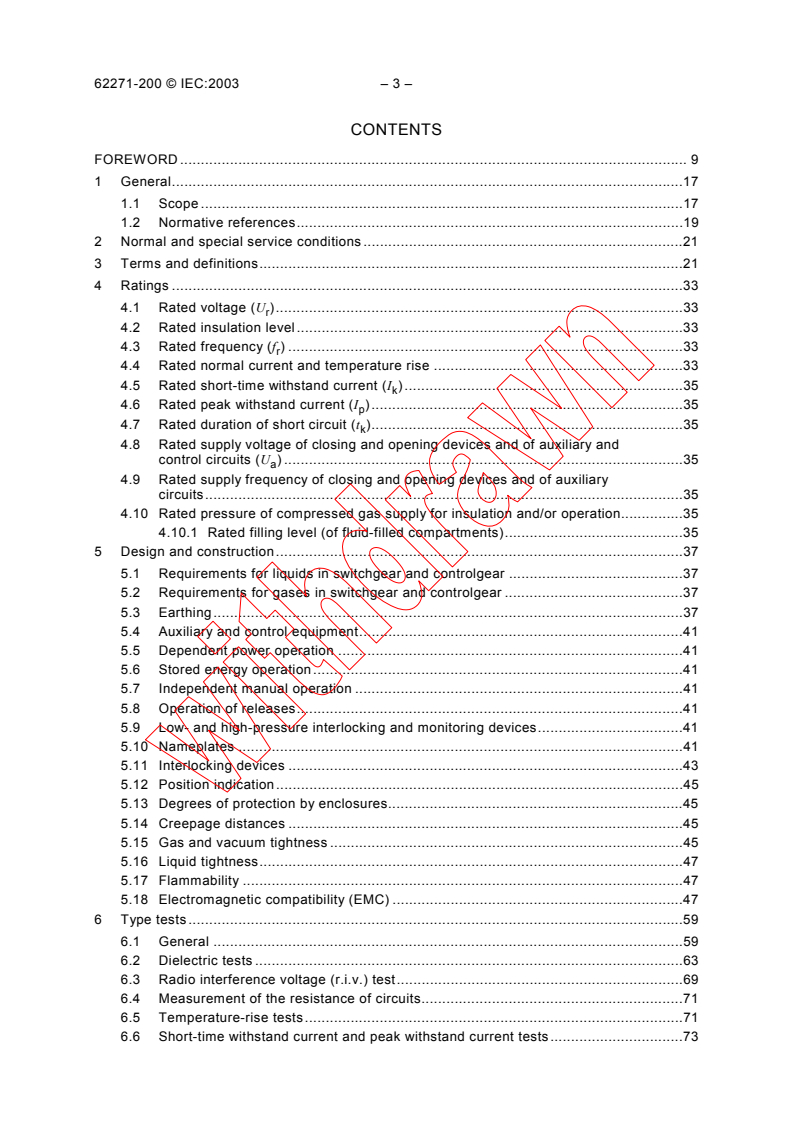
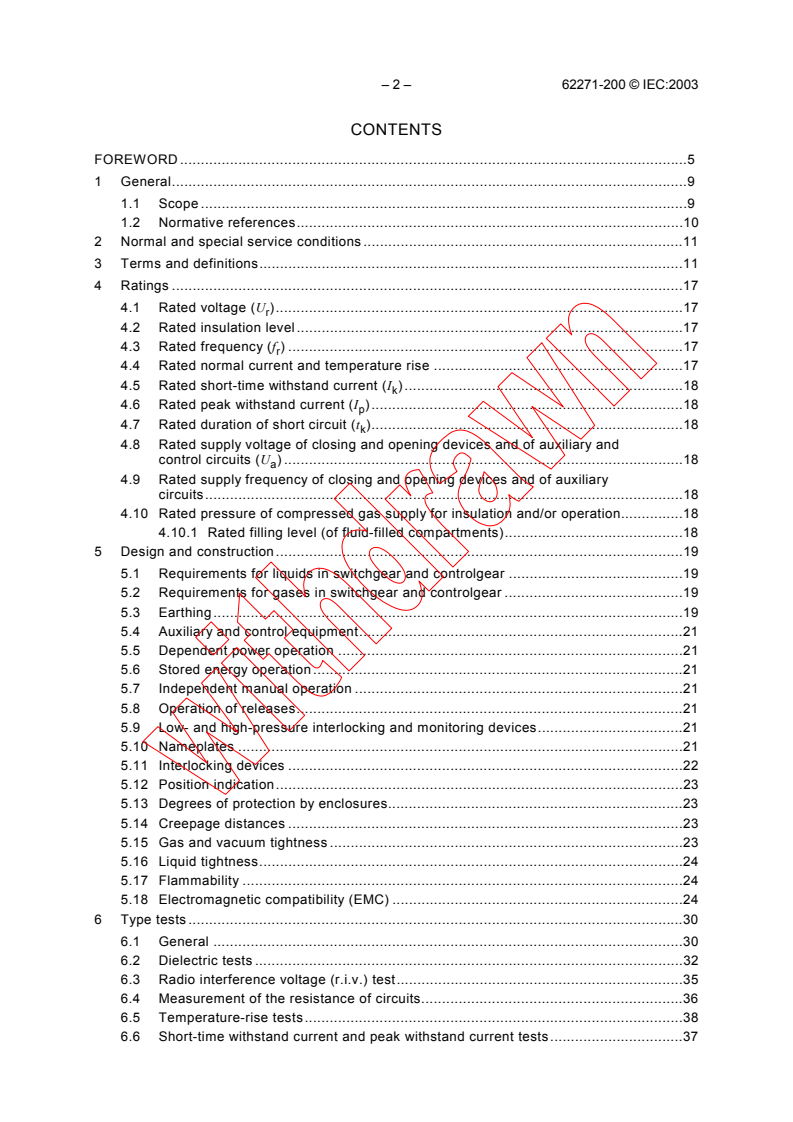
CONTENTS
FOREWORD . 9
1 General.17
1.1 Scope .17
1.2 Normative references.19
2 Normal and special service conditions .21
3 Terms and definitions.21
4 Ratings .33
4.1 Rated voltage (U ).33
r
4.2 Rated insulation level.33
4.3 Rated frequency (f ) .33
r
4.4 Rated normal current and temperature rise .33
4.5 Rated short-time withstand current (I ) .35
k
4.6 Rated peak withstand current (I ).35
p
4.7 Rated duration of short circuit (t ).35
k
4.8 Rated supply voltage of closing and opening devices and of auxiliary and
control circuits (U ) .35
a
4.9 Rated supply frequency of closing and opening devices and of auxiliary
circuits.35
4.10 Rated pressure of compressed gas supply for insulation and/or operation.35
4.10.1 Rated filling level (of fluid-filled compartments).35
5 Design and construction.37
5.1 Requirements for liquids in switchgear and controlgear .37
5.2 Requirements for gases in switchgear and controlgear .37
5.3 Earthing.37
5.4 Auxiliary and control equipment.41
5.5 Dependent power operation .41
5.6 Stored energy operation.41
5.7 Independent manual operation .41
5.8 Operation of releases.41
5.9 Low- and high-pressure interlocking and monitoring devices.41
5.10 Nameplates .41
5.11 Interlocking devices .43
5.12 Position indication.45
5.13 Degrees of protection by enclosures.45
5.14 Creepage distances .45
5.15 Gas and vacuum tightness .45
5.16 Liquid tightness.47
5.17 Flammability .47
5.18 Electromagnetic compatibility (EMC) .47
6 Type tests .59
6.1 General .59
6.2 Dielectric tests .63
6.3 Radio interference voltage (r.i.v.) test.69
6.4 Measurement of the resistance of circuits.71
6.5 Temperature-rise tests.71
6.6 Short-time withstand current and peak withstand current tests.73
62271-200 © IEC:2003 – 5 –
6.7 Verification of the protection.77
6.8 Tightness tests .77
6.9 Electromagnetic compatibility tests (EMC).77
6.10 Additional tests on auxiliary and control circuits .77
7 Routine tests.85
7.1 Dielectric test on the main circuit.87
7.2 Tests on auxiliary and control circuits.87
7.3 Measurement of the resistance of the main circuit .87
7.4 Tightness test .87
7.5 Design and visual checks.87
8 Guide to the selection of metal-enclosed switchgear and controlgear for service.91
8.1 Selection of rated values.91
8.2 Selection of design and construction .91
8.3 Internal arc classification.97
9 Information to be given with enquiries, tenders and orders.105
10 Rules for transport, storage, installation, operation and maintenance.109
10.1 Conditions during transport, storage and installation.109
10.2 Installation .109
10.3 Operation.109
10.4 Maintenance .109
11 Safety .111
Annex A (normative) Internal fault − Method for testing the metal-enclosed switchgear
and controlgear under conditions of arcing due to an internal fault .113
A.1 Introduction.113
A.2 Types of accessibility .115
A.3 Test arrangements.115
A.4 Current and voltage applied.123
A.5 Test procedure.125
A.6 Acceptance criteria .127
A.7 Test report .129
A.8 Designation of IAC classification.131
Annex B (normative) Partial discharge measurement .145
B.1 General.145
B.2 Application .145
B.3 Test circuits and measuring instruments.147
B.4 Test procedure.147
B.5 Maximum permissible partial discharge quantity .149
Annex C (informative) Explanatory notes .157
C.1 Changes in classifications, compared to the third edition (1990) of IEC 60298 .157
C.2 ANSI defined metal-clad.163
62271-200 © IEC:2003 – 7 –
C.3 Former IEC defined metal-clad in terms of IEC 62271-200 definitions .163
C.4 Example of modular fuse-switch type.165
Bibliography .169
Figure A.1 – Mounting frame for vertical indicators.133
Figure A.2 – Horizontal indicator.133
Figure A.3 – Position of the indicators.135
Figure A.4 – Room simulation and indicator positioning for accessibility A, functional
unit at or above 1,5 m.137
Figure A.5 – Room simulation and indicator positioning for accessibility B, functional
unit above 2 m high .139
Figure A.6 – Room simulation and indicator positioning for accessibility B, functional
unit below 2 m high .141
Figure A.7 – Test arrangement for overhead connected pole-mounted switchgear and
controlgear.143
Figure B.1 – Partial discharge test circuit (three-phase arrangement).153
Figure B.2 – Partial-discharge test circuit (system without earthed neutral).155
Table 1 – Nameplate information .41
Table 2– Locations, causes and examples of measures to decrease the probability of
internal faults .99
Table 3 – Summary of technical requirements, ratings and optional tests for metal
enclosed switchgear .101
Table B.1 – Test circuits and procedures .151
Table C.1 – Comparison of IEC and IEEE definition of metal-clad .157
Table C.2 – Classification related to personnel safety in case of internal arc .159
62271-200 © IEC:2003 – 9 –
INTERNATIONAL ELECTROTECHNICAL COMMISSION
____________
HIGH-VOLTAGE SWITCHGEAR AND CONTROLGEAR –
Part 200: AC metal-enclosed switchgear and controlgear
for rated voltages above 1 kV and up to and including 52 kV
FOREWORD
1) The International Electrotechnical Commission (IEC) is a worldwide organization for standardization comprising
all national electrotechnical committees (IEC National Committees). The object of IEC is to promote
international co-operation on all questions concerning standardization in the electrical and electronic fields. To
this end and in addition to other activities, IEC publishes International Standards, Technical Specifications,
Technical Reports, Publicly Available Specifications (PAS) and Guides (hereafter referred to as “IEC
Publication(s)”). Their preparation is entrusted to technical committees; any IEC National Committee interested
in the subject dealt with may participate in this preparatory work. International, governmental and non-
governmental organizations liaising with the IEC also participate in this preparation. IEC collaborates closely
with the International Organization for Standardization (ISO) in accordance with conditions determined by
agreement between the two organizations.
2) The formal decisions or agreements of IEC on technical matters express, as nearly as possible, an international
consensus of opinion on the relevant subjects since each technical committee has representation from all
interested IEC National Committees.
3) IEC Publications have the form of recommendations for international use and are accepted by IEC National
Committees in that sense. While all reasonable efforts are made to ensure that the technical content of IEC
Publications is accurate, IEC cannot be held responsible for the way in which they are used or for any
misinterpretation by any end user.
4) In order to promote international uniformity, IEC National Committees undertake to apply IEC Publications
transparently to the maximum extent possible in their national and regional publications. Any divergence
between any IEC Publication and the corresponding national or regional publication shall be clearly indicated in
the latter.
5) IEC provides no marking procedure to indicate its approval and cannot be rendered responsible for any
equipment declared to be in conformity with an IEC Publication.
6) All users should ensure that they have the latest edition of this publication.
7) No liability shall attach to IEC or its directors, employees, servants or agents including individual experts and
members of its technical committees and IEC National Committees for any personal injury, property damage or
other damage of any nature whatsoever, whether direct or indirect, or for costs (including legal fees) and
expenses arising out of the publication, use of, or reliance upon, this IEC Publication or any other IEC
Publications.
8) Attention is drawn to the Normative references cited in this publication. Use of the referenced publications is
indispensable for the correct application of this publication.
9) Attention is drawn to the possibility that some of the elements of this IEC Publication may be the subject of
patent rights. IEC shall not be held responsible for identifying any or all such patent rights.
International Standard IEC 62271-200 has been prepared by subcommittee 17C: High-voltage
switchgear and controlgear assemblies, of IEC technical committee 17: Switchgear and
controlgear.
This first edition of IEC 62271-200 cancels and replaces the third edition of IEC 60298,
published in 1990, and constitutes a technical revision.
Significant technical changes from the third edition of IEC 60298 are as follows:
This revised document has been basically changed to be updated to today’s use of high-
voltage switchgear and controlgear up to 52 kV. The main changes are: new definitions and
classification of equipment, introduction of internal arc classes (IAC) and its testing.
62271-200 © IEC:2003 – 11 –
This standard is to be read in conjunction with IEC 60694 published in 1996. Clause
numbering follows the clause numbering of that standard. Additional subclauses, as they relate
to a particular clause or subclause from IEC 60694, are numbered 101, 102, etc.
The text of this standard is based on the following documents:
FDIS Report on voting
17C/311/FDIS 17C/315/RVD
Full information on the voting for the approval of this standard can be found in the report on
voting indicated in the above table.
This publication has been drafted in accordance with the ISO/IEC Directives, Part 2.
The committee has decided that the contents of this publication will remain unchanged until
2009. At this date, the publication will be
• reconfirmed;
• withdrawn;
• replaced by a revised edition, or
• amended.
___________
IEC 60694 (1996) will be replaced by IEC 62271-1 as soon as available.
62271-200 © IEC:2003 – 13 –
COMMON NUMBERING OF IEC 62271 PUBLICATIONS FALLING UNDER
THE RESPONSIBILITY OF SUBCOMMITTEES SC 17A AND SC 17C
In accordance with the decision taken at the joint SC 17A/SC 17C meeting in Frankfurt, June
1998 (item 20.7 of 17A/535/RM), a common numbering system has been established for the
publications falling under the responsibility of SC 17A and SC 17C. IEC 62271 – High-voltage
switchgear and controlgear is the publication number and main title element for the common
publications.
The numbering of these publications will apply the following principle.
a) Common standards prepared by SC 17A and SC 17C will start with IEC 62271-1.
b) Standards of SC 17A will start with IEC 62271-100.
c) Standards of SC 17C will start with number IEC 62271-200.
d) Publications prepared by SC 17A and SC 17C will start with number IEC 62271-300.
The table below relates the new numbers to the old numbers. The parts numbered (xxx) will be
given a final number pending the decision to publish the revised publication as standard or
technical report.
62271-200 © IEC:2003 – 15 –
Common numbering of IEC 62271 publications falling under the responsibility
of subcommittees SC 17A and SC 17C
IEC 62271 HIGH-VOLTAGE SWITCHGEAR AND CONTROLGEAR Old IEC number,
series if any
Part New title
1 Common specifications IEC 60694
2 Seismic qualification for rated voltages of 72,5 kV and above -
100 High-voltage alternating current circuit-breakers IEC 60056
101 Synthetic testing IEC 60427
102 High-voltage alternating current disconnectors and earthing switches IEC 60129
103 Switches for rated voltages above 1 kV and less than 52 kV IEC 60265-1
104 Switches for rated voltages of 52 kV and above IEC 60265-2
105 Alternating current switch-fuse combinations IEC 60420
106 Alternating current contactors and contactor-based motor-starters IEC 60470
107 Alternating current switchgear-fuse combinations -
108 Switchgear having combined functions -
109 Series capacitor by-pass switches -
200 AC metal-enclosed switchgear and controlgear for rated voltages above 1 kV IEC 60298
and up to and including 52 kV
201 Insulation-enclosed switchgear and controlgear for rated voltages up to and IEC 60466
including 52 kV
202 High-voltage/low-voltage prefabricated substations IEC 61330
203 Gas-insulated metal-enclosed switchgear for rated voltages above 52 kV IEC 60517
204 High-voltage gas-insulated transmission lines for rated voltages of 72,5 kV and IEC 61640
above
(300) Guide for seismic qualification of high-voltage alternating current circuit- IEC 61166
breakers
(301) Guide for inductive load switching IEC 61233
(302) Guide for short-circuit and switching test procedures for metal-enclosed and IEC 61633
dead tank circuit-breakers
(303) Use and handling of sulphur hexafluoride (SF ) in high-voltage switchgear and IEC 61634
controlgear
(304) Additional requirements for enclosed switchgear and controlgear from 1 kV to IEC 60932
72,5 kV to be used in severe climatic conditions
(305) Cable connections for gas-insulated metal-enclosed switchgear for rated IEC 60859
voltages above 52 kV
(306) Direct connection between power transformers and gas-insulated metal- IEC 61639
enclosed switchgear for rated voltages above 52 kV
(307) Use of electronic and associated technologies in auxiliary equipment of IEC 62063
switchgear and controlgear
308 Guide for asymmetrical short-circuit breaking test duty T100a –
309 TRV parameters for high-voltage switchgear and controlgear for rated voltages -
above 1 kV and less than 100 kV
310 Electrical endurance testing for circuit-breakers rated 72,5 kV and above -
62271-200 © IEC:2003 – 17 –
HIGH-VOLTAGE SWITCHGEAR AND CONTROLGEAR –
Part 200: AC metal-enclosed switchgear and controlgear
for rated voltages above 1 kV and up to and including 52 kV
1 General
1.1 Scope
This part of IEC 62271 specifies requirements for factory-assembled metal-enclosed
switchgear and controlgear for alternating current of rated voltages above 1 kV and up to and
including 52 kV for indoor and outdoor installation, and for service frequencies up to and
including 60 Hz. Enclosures may include fixed and removable components and may be filled
with fluid (liquid or gas) to provide insulation.
NOTE 1 Although primarily dedicated to three-phase systems, this standard can also be applied to single-phase or
two-phase systems.
This standard defines several types of metal enclosed switchgear and controlgear which differ
due to
– the consequences on network service continuity in case of maintenance on the switchgear
and controlgear;
– the need and convenience of maintenance of the equipment.
NOTE 2 Safety of an installation results from the design, implementation and coordination of products,
installations and operations.
For metal-enclosed switchgear and controlgear containing gas-filled compartments, the design
pressure is limited to a maximum of 300 kPa (relative pressure).
NOTE 3 Gas-filled compartments having a design pressure exceeding 300 kPa (relative pressure) should be
designed and tested in accordance with IEC 60517.
Metal-enclosed switchgear and controlgear for special use, for example, in flammable
atmospheres, in mines or on board ships, may be subject to additional requirements.
Components contained in metal-enclosed switchgear and controlgear are to be designed and
tested in accordance with their various relevant standards. This standard supplements the
standards for the individual components regarding their installation in switchgear and
controlgear assemblies.
This standard does not preclude that other equipment may be included in the same enclosure.
In such a case, any possible influence of that equipment on the switchgear and controlgear is
to be taken into account.
NOTE 4 Switchgear and controlgear assemblies having an insulation enclosure are covered by IEC 60466.
NOTE 5 Metal-enclosed switchgear and controlgear for rated voltages above 52 kV insulated by ambient air may
be covered by this standard taking into account the insulation levels of IEC 60694.
62271-200 © IEC:2003 – 19 –
1.2 Normative references
The following referenced documents are indispensable for the application of this document. For
dated references, only the edition cited applies. For undated references, the latest edition of
the referenced document (including any amendments) applies.
IEC 60050(151):2001, International Electrotechnical Vocabulary – Chapter 151: Electrical and
magnetic devices
IEC 60050(441):1984, International Electrotechnical Vocabulary – Chapter 441: Switchgear,
controlgear and fuses
IEC 60060-1:1989, High-voltage test techniques – Part 1: General definitions and test
requirements
IEC 60243-1:1998, Electrical strength of insulating materials – Test methods – Part 1: Tests at
power frequencies
IEC 60265-1:1998, High-voltage switches – Part 1: Switches for rated voltages above 1 kV and
less than 52 kV
IEC 60270:2000, High-voltage test techniques – Partial discharge measurements
IEC 60466:1987, AC insulation-enclosed switchgear and controlgear for rated voltages above 1
kV and up to and including 38 kV
IEC 60470:2000, High-voltage alternating current contactors and contactor-based motor-
starters
IEC 60480:1974, Guide to the checking of sulphur hexafluoride (SF ) taken from electrical
equipment
IEC 60529:1989, Degrees of protection provided by enclosures (IP Code)
IEC 60694:1996, Common specifications for high-voltage switchgear and controlgear standards
IEC 60909-0:2001, Short-circuit currents in three-phase a.c. systems – Part 0: Calculation of
currents
IEC 60932:1988, Additional requirements for enclosed switchgear and controlgear from 1 kV to
72,5 kV to be used in severe climatic conditions
IEC 61634:1995, High-voltage switchgear and controlgear – Use and handling of sulphur
hexafluoride (SF ) in high-voltage switchgear and controlgear
IEC 62271-100:2001, High-voltage alternating-current circuit-breakers
IEC 62271-102:2001, High-voltage switchgear and controlgear – Part 102: Alternating current
disconnectors and earthing switches
IEC 62271-105:2002, High-voltage switchgear and controlgear – Part 105: Alternating current
switch-fuse combinations
ISO/IEC Guide 51:1999, Safety aspects – Guidelines for their inclusion in standards
62271-200 © IEC:2003 – 21 –
2 Normal and special service conditions
Clause 2 of IEC 60694 is applicable with the following addition:
Unless otherwise specified in this standard, the metal-enclosed switchgear and controlgear is
designed to be used under normal service conditions.
3 Terms and definitions
For the purposes of this document, the following definitions as well as the definitions of
IEC 60050(441), IEC 60050(151) and IEC 60694 apply, except where indicated. Some standard
definitions are recalled here for ease of reference.
Additional definitions are classified so as to be aligned with the classification system used in IEC
60050(441).
3.101
switchgear and controlgear
general term covering switching devices and their combination with associated control,
measuring, protective and regulating equipment, also assemblies of such devices and
equipment with associated interconnections, accessories, enclosures and supporting structures
[IEV 441-11-01]
3.102
metal-enclosed switchgear and controlgear
switchgear and controlgear assemblies with an external metal enclosure intended to be earthed
and completely assembled, except for external connections
[IEV 441-12-04, modified]
3.103
functional unit (of an assembly)
part of metal-enclosed switchgear and controlgear comprising all the components of the
main circuits and auxiliary circuits that contribute to the fulfilment of a single function
[IEV 441-13-04, modified]
NOTE Functional units may be distinguished according to the function for which they are intended, for example,
incoming unit, outgoing unit, etc.
3.104
multi-tier
two or more functional units arranged vertically within a single enclosure
3.105
transport unit
part of metal-enclosed switchgear and controlgear suitable for shipment without being
dismantled
3.106
enclosure
part of metal-enclosed switchgear and controlgear providing a specified degree of protection of
equipment against external influences and a specified degree of protection against approach to
or contact with live parts and against contact with moving parts
[IEV 441-13-01 modified]
62271-200 © IEC:2003 – 23 –
3.107
compartment
part of metal-enclosed switchgear and controlgear enclosed except for openings necessary for
interconnection, control or ventilation
[IEV 441-13-05, modified]
Four types of compartments are distinguished, three that can be opened, called accessible
(see 3.107.1 to 3.107.3) and one that cannot be opened, called non-accessible (see 3.107.4)
NOTE Compartments are identified according to the main component(s) contained therein (refer to 5.103.1).
3.107.1
interlock-controlled accessible compartment
compartment containing high-voltage parts, intended to be opened for normal operation and/or
normal maintenance as stated by the manufacturer, in which access is controlled by integral
design of the switchgear and controlgear
NOTE Installation, extension, repairing, etc. are not considered as normal maintenance.
3.107.2
procedure-based accessible compartment
compartment containing high-voltage parts, intended to be opened for normal operation and/or
normal maintenance as stated by the manufacturer, in which access is controlled by a suitable
procedure combined with locking
NOTE Installation, extension, repairing, etc. are not considered as normal maintenance.
3.107.3
tool-based accessible compartment
compartment containing high-voltage parts, that may be opened, but not for normal operation
and maintenance. Special procedures are required. Tools are necessary for opening
3.107.4
non-accessible compartment
compartment containing high-voltage parts that must not be opened. Opening may destroy the
integrity of the compartment. Clear indication not to open is provided on/by the compartment
3.108
partition
part of metal-enclosed switchgear and controlgear separating one compartment from other
compartments
[IEV 441-13-06, modified]
3.109
partition class
class defining whether metallic or non-metallic material for separation to live parts is used
3.109.1
partition class PM
metal-enclosed switchgear and controlgear providing continuous metallic partitions and/or
shutters (if applicable), intended to be earthed, between opened accessible compartments and
live parts of the main circuit
62271-200 © IEC:2003 – 25 –
3.109.2
partition class PI
metal-enclosed switchgear and controlgear having one or more non-metallic partitions or
shutters between opened accessible compartments and live parts of the main circuit
3.110
shutter
part of metal-enclosed switchgear and controlgear that can be moved from a position where it
permits contacts of a removable part, or moving contact of a disconnector, to engage fixed
contacts, to a position where it becomes a part of the enclosure or partition shielding the fixed
contacts
[IEV 441-13-07, modified]
3.111
segregation (of conductors)
arrangement of conductors with earthed metal interposed between them in such a manner that
disruptive discharges can only occur to earth
[IEV 441-11-11]
NOTE A segregation may be established between the conductors as well as between the open contacts of a
switching device or disconnector.
3.112
bushing
structure carrying one or more conductors through an enclosure or partition and insulating it
therefrom, including the means of attachment
3.113
component
essential part of the main or earthing circuits of metal-enclosed switchgear and controlgear
which serves a specific function (for example, circuit-breaker, disconnector, switch, fuse,
instrument transformer, bushing, busbar)
3.114
main circuit (of an assembly)
all the conductive parts of metal-enclosed switchgear and controlgear included in a circuit
which is intended to transmit electrical energy
[IEV 441-13-02, modified]
3.115
earthing circuit
connection of each earthing device, or points provided for earthing purposes, to the terminal
intended to be connected to the earthing system of the installation
3.116
auxiliary circuit
all the conductive parts of metal-enclosed switchgear and controlgear included in a circuit
(other than the main circuit) intended to control, measure, signal and regulate
[IEV 441-13-03, modified]
NOTE The auxiliary circuits of metal-enclosed switchgear and controlgear include the control and auxiliary circuits
of the switching devices.
62271-200 © IEC:2003 – 27 –
3.117
pressure relief device
device intended to limit the pressure in a fluid-filled compartment
3.118
fluid-filled compartment
compartment of metal-enclosed switchgear and controlgear filled with a fluid, either gas, other
than ambient air, or liquid, for insulation purposes
3.118.1
gas-filled compartment
refer to 3.6.5.1 of IEC 60694
3.118.2
liquid-filled compartment
compartment of metal-enclosed switchgear and controlgear in which the liquid is at
atmospheric pressure, or under pressure that is maintained by one of the following systems:
a) controlled pressure system;
b) closed pressure system;
c) sealed pressure system.
For pressure systems, refer to 3.6.4 of IEC 60694
3.119
relative pressure
pressure, referred to the standard atmospheric pressure of 101,3 kPa
3.120
minimum functional level (of fluid-filled compartments)
gas pressure (relative pressure) in Pa (or density) or liquid mass at and above which the rated
values of the metal-enclosed switchgear and controlgear are maintained
3.121
design level (of fluid-filled compartments)
gas pressure (relative pressure) in Pa (or density) or liquid mass used to determine the design
of a gas-filled compartment or mass for a liquid-filled compartment
3.122
design temperature (of fluid-filled compartments)
highest temperature which can be reached by the gas or liquid under service conditions
3.123
ambient air temperature (of metal-enclosed switchgear and controlgear)
temperature, determined under prescribed conditions, of the air surrounding the enclosure of
metal-enclosed switchgear and controlgear
3.124
removable part
part of metal-enclosed switchgear and controlgear connected to the main circuit and that may
be removed entirely from the metal-enclosed switchgear and controlgear and replaced, even
though the main circuit of the functional unit is live
[IEV 441-13-08, modified]
62271-200 © IEC:2003 – 29 –
3.125
withdrawable part
removable part of metal-enclosed switchgear and controlgear that can be moved to positions in
which an isolating distance or segregation between open contacts is established, while the part
remains mechanically attached to the enclosure
[IEV 441-13-09, modified]
3.126
service position (connected position)
position of a removable part in which it is fully connected for its intended function
[IEV 441-16-25]
3.127
earthing position
position of a removable part or state of a disconnector in which the closing of a mechanical
switching device causes a main circuit to be short-circuited and earthed
[IEV 441-16-26, modified]
3.128
test position (of a withdrawable part)
position of a withdrawable part in which an isolating distance or segregation is established in
the main circuit and in which the auxiliary circuits are connected
[IEV 441-16-27]
3.129
disconnected position (of a withdrawable part)
position of a withdrawable part in which an isolating distance or segregation is established in
the circuits of the withdrawable part, that part remaining mechanically attached to the
enclosure
[IEV 441-16-28, modified]
NOTE In high-voltage metal-enclosed switchgear and controlgear, the auxiliary circuits may not be disconnected.
3.130
removed position (of a removable part)
position of a removable part when it is outside and mechanically and electrically separated
from the enclosure
[IEV 441-16-29, modified]
3.131
loss of service continuity category (LSC)
category defining the possibility to keep other compartments and/or functional units energised
when opening a main circuit compartment
NOTE 1 The LSC category describes the extent to which the switchgear and controlgear are intended to remain
operational in case access to a main-circuit compartment is necessary. The extent to which it is considered
necessary to open main-circuit compartments with a live installation might be dependent on several aspects (refer
to 8.2).
NOTE 2 The LSC category does not describe ranks of reliability of switchgear and controlgear (refer to 8.2).
62271-200 © IEC:2003 – 31 –
3.131.1
category LSC2 switchgear and controlgear
switchgear and controlgear having accessible compartments other than the busbar compart-
ment of a single busbar switchgear and controlgear
For metal-enclosed switchgear and controlgear, when any accessible compartment in a
functional unit is open, all other functional units are intended to remain energized and operated
normally. An exception applies in the case of the busbar compartment of single-busbar
switchgear and controlgear which, when opened, prevents service continuity.
Two subdivisions are recognized:
LSC2B: switchgear and controlgear of category LSC2 where the cable compartment is also
intended to remain energized when any other accessible compartment of the corresponding
functional unit is open.
LSC2A: LSC2 switchgear and controlgear, other than LSC2B
3.131.2
category LSC1 switchgear and controlgear
metal-enclosed switchgear and controlgear other than category LSC2
3.132
internal arc classified switchgear and controlgear (IAC)
metal-enclosed switchgear and controlgear for which prescribed criteria for protection of
persons are met in the event of internal arc as demonstrated by the appropriate tests
NOTE Refer to Annex A for additional information.
3.133
degree of protection
extent of protection provided by an enclosure, partition or shutter if applicable, against access
to hazardous parts, against ingress of solid foreign objects and/or ingress of water and verified
by standardized test methods
(see 3.3 of IEC 60529)
3.134
rated value
quantity value assigned, generally by a manufacturer, for a specified operating condition of a
component device or equipment
[IEV 151-16-08, modified]
NOTE Refer to Clause 4 for individual rated values.
3.135
disruptive discharge
phenomena associated with the failure of insulation under electric stress, in which the
discharge completely bridges the insulation under test, reducing the voltage between the
electrodes to zero or nearly to zero
NOTE 1 The term applies to discharges in solid, liquid and gaseous dielectrics and to combinations of these.
NOTE 2 A disruptive discharge in a solid dielectric produces permanent loss of dielectric strength (non-
self-restoring insulation); in a liquid or gaseous dielectric, the loss may be only temporary (self-restoring insulation).
NOTE 3 The term "sparkover" is used when a disruptive discharge occurs in a gaseous or liquid dielectric. The
term "flashover" is used when a disruptive discharge occurs over the surface of a solid dielectric in gaseous or
liquid medium. The term "puncture" is used when a disruptive discharge occurs through a solid dielectric.
62271-200 © IEC:2003 – 33 –
4 Ratings
The ratings of metal-enclosed switchgear and controlgear are the following:
a) rated voltage (U ) and number of phases;
r
b) rated insulation level;
c) rated frequency (f );
r
d) rated normal current (I ) (for main circuits);
r
e) rated short-time withstand current (I ) (for main and earthing circuits);
k
f) rated peak withstand current (I ), if applicable (for main and earthing circuits);
p
g) rated duration of short circuit (t ) (for main and earthing circuits);
k
h) rated values of the components forming part of the metal-enclosed switchgear and
controlgear including their operating devices and auxiliary equipment;
i) rated filling level (of fluid-filled compartments).
4.1 Rated voltage (U )
r
Subclauses 4.1 and 4.1.1 of IEC 60694 are applicable.
NOTE Components forming part of metal-enclosed switchgear and controlgear may have individual values of rated
voltage in accordance with their relevant standards.
4.2 Rated insulation level
Subclause 4.2 of IEC 60694 is applicable.
4.3 Rated frequency (f )
r
Subclause 4.3 of IEC 60694 is applicable.
4.4 Rated
...
NORME CEI
INTERNATIONALE 62271-200
Première édition
2003-11
Appareillage à haute tension –
Part 200:
Appareillage sous enveloppe métallique
pour courant alternatif de tensions assignées
supérieures à 1 kV et inférieures ou égales
à 52 kV
Cette version française découle de la publication d’origine
bilingue dont les pages anglaises ont été supprimées.
Les numéros de page manquants sont ceux des pages
supprimées.
Numéro de référence
CEI 62271-200:2003(F)
Numérotation des publications
Depuis le 1er janvier 1997, les publications de la CEI sont numérotées à partir de
60000. Ainsi, la CEI 34-1 devient la CEI 60034-1.
Editions consolidées
Les versions consolidées de certaines publications de la CEI incorporant les
amendements sont disponibles. Par exemple, les numéros d’édition 1.0, 1.1 et 1.2
indiquent respectivement la publication de base, la publication de base incorporant
l’amendement 1, et la publication de base incorporant les amendements 1 et 2
Informations supplémentaires sur les publications de la CEI
Le contenu technique des publications de la CEI est constamment revu par la CEI
afin qu'il reflète l'état actuel de la technique. Des renseignements relatifs à cette
publication, y compris sa validité, sont disponibles dans le Catalogue des
publications de la CEI (voir ci-dessous) en plus des nouvelles éditions, amende-
ments et corrigenda. Des informations sur les sujets à l’étude et l’avancement des
travaux entrepris par le comité d’études qui a élaboré cette publication, ainsi que la
liste des publications parues, sont également disponibles par l’intermédiaire de:
• Site web de la CEI (www.iec.ch)
• Catalogue des publications de la CEI
Le catalogue en ligne sur le site web de la CEI (www.iec.ch/searchpub) vous permet
de faire des recherches en utilisant de nombreux critères, comprenant des
recherches textuelles, par comité d’études ou date de publication. Des informations
en ligne sont également disponibles sur les nouvelles publications, les publications
remplacées ou retirées, ainsi que sur les corrigenda.
• IEC Just Published
Ce résumé des dernières publications parues (www.iec.ch/online_news/justpub)
est aussi disponible par courrier électronique. Veuillez prendre contact avec le
Service client (voir ci-dessous) pour plus d’informations.
• Service clients
Si vous avez des questions au sujet de cette publication ou avez besoin de
renseignements supplémentaires, prenez contact avec le Service clients:
Email: custserv@iec.ch
Tél: +41 22 919 02 11
Fax: +41 22 919 03 00
NORME CEI
INTERNATIONALE 62271-200
Première édition
2003-11
Appareillage à haute tension –
Part 200:
Appareillage sous enveloppe métallique
pour courant alternatif de tensions assignées
supérieures à 1 kV et inférieures ou égales
à 52 kV
IEC 2003 Droits de reproduction réservés
Aucune partie de cette publication ne peut être reproduite ni utilisée sous quelque forme que ce soit et par aucun
procédé, électronique ou mécanique, y compris la photocopie et les microfilms, sans l'accord écrit de l'éditeur.
International Electrotechnical Commission, 3, rue de Varembé, PO Box 131, CH-1211 Geneva 20, Switzerland
Telephone: +41 22 919 02 11 Telefax: +41 22 919 03 00 E-mail: inmail@iec.ch Web: www.iec.ch
CODE PRIX
Commission Electrotechnique Internationale XC
International Electrotechnical Commission
Международная Электротехническая Комиссия
Pour prix, voir catalogue en vigueur
– 2 – 62271-200 CEI:2003
SOMMAIRE
AVANT-PROPOS . 8
1 Généralités .16
1.1 Domaine d'application .16
1.2 Références normatives .18
2 Conditions de service normales et spéciales.20
3 Termes et définitions.20
4 Caractéristiques assignées .32
4.1 Tension assignée (U ) .32
r
4.2 Niveau d'isolement assigné.32
4.3 Fréquence assignée (f ) .32
r
4.4 Courant assigné en service continu et échauffement .32
4.5 Courant de courte durée admissible assigné(I ) .34
k
4.6 Valeur de crête du courant admissible assigné(I ).34
p
4.7 Durée de court-circuit assignée (t ) .34
k
4.8 Tension assignée d'alimentation des dispositifs de fermeture et d'ouverture et
des circuits auxiliaires et de commande (U ) .34
a
4.9 Fréquence assignée d'alimentation des dispositifs de fermeture et d’ouverture
et des circuits auxiliaires .34
4.10 Pression assignée d'alimentation en gaz comprimé pour l’isolation et/ou la
manœuvre .34
5 Conception et construction .36
5.1 Exigences pour les liquides utilisés dans l'appareillage.36
5.2 Exigences pour les gaz utilisés dans l'appareillage.36
5.3 Mise à la terre.36
5.4 Equipements auxiliaires et de commande.40
5.5 Manœuvre à source d'énergie extérieure.40
5.6 Manœuvre à accumulation d'énergie .40
5.7 Manœuvre manuelle indépendante.40
5.8 Fonctionnement des déclencheurs .40
5.9 Dispositifs de verrouillage et de surveillance basse et haute pression.40
5.10 Plaques signalétiques .40
5.11 Verrouillages.42
5.12 Indicateur de position.44
5.13 Degrés de protection procuré par les enveloppes .44
5.14 Lignes de fuite .44
5.15 Etanchéité au gaz et au vide .44
5.16 Etanchéité au liquide.46
5.17 Ininflammabilité.46
5.18 Compatibilité électromagnétique (CEM).46
6 Essais de type .58
6.1 Généralités .58
6.2 Essais diélectriques .62
6.3 Essais de tension de perturbation radioélectrique.68
6.4 Mesurage de la résistance du circuit principal.70
6.5 Essais d'échauffement .70
6.6 Essais au courant de courte durée et à la valeur de crête du courant admissible .72
– 4 – 62271-200 CEI:2003
6.7 Vérification de la protection.76
6.8 Essais d’étanchéité .76
6.9 Essais de compatibilité électromagnétique (CEM) .76
6.10 Essais complémentaires sur les circuits auxiliaires et de contrôle.76
7 Essais individuels de série .84
7.1 Essais diélectriques du circuit principal .86
7.2 Essais des circuits auxiliaires et de commande .86
7.3 Mesurage de la résistance du circuit principal.86
7.4 Essais d’étanchéité .86
7.5 Contrôles visuels et du modèle.86
8 Guide pour le choix de l’appareillage sous enveloppe métallique selon le service.90
8.1 Choix des valeurs assignées .90
8.2 Choix du modèle et de sa construction .90
8.3 Classe de tenue à l’arc interne .96
9 Renseignements à donner dans les appels d'offres, les soumissions et les
commandes .104
10 Règles pour le transport, le stockage, le montage, l'installation, la manoeuvre et la
maintenance .108
10.1 Conditions à respecter pendant le transport, le stockage et l'installation .108
10.2 Installation .108
10.3 Fonctionnement .108
10.4 Maintenance .108
11 Sûreté.110
Annexe A (normative) Défaut interne – Méthode pour essayer l'appareillage sous
enveloppe métallique dans des conditions d'arc du à un défaut interne .112
A.1 Introduction .112
A.2 Classes d'accessibilité.114
A.3 Montage d'essai .114
A.4 Courant et tension appliqués .122
A.5 Procédure d'essai.124
A.6 Critères d'acceptation.126
A.7 Rapport d'essai .128
A.8 Désignation de la classification IAC .130
Annexe B (normative) Mesure des décharges partielles .144
B.1 Généralités .144
B.2 Conditions d'application.144
B.3 Circuits d'essai et instruments de mesure.146
B.4 Méthode d'essai .146
B.5 Intensité maximale admissible des décharges partielles.148
Annexe C (informative) Notes explicatives .156
C.1 Changements dans les classifications, comparées à la troisième édition (1990) de
la CEI 60298 .156
C.2 Appareillage blindé «ANSI» .162
– 6 – 62271-200 CEI:2003
C.3 Ancien «blindé» défini par la CEI dans les termes de la CEI 62271-200 .162
C.4 Exemple d'un interrupteur-fusible en solution modulaire:.164
Bibliographie .168
Figure A.1 – Cadre de montage pour les indicateurs verticaux .132
Figure A.2 – Indicateur horizontal .132
Figure A.3 – Position des indicateurs .134
Figure A.4 – Simulation du local et position des indicateurs pour Classe d'accessibilité A,
équipement à 1,5 m ou plus.136
Figure A.5 – Simulation du local et position des indicateurs pour Classe d'accessibilité B,
équipement de plus de 2 m de haut .138
Figure A.6 – Simulation du local et position des indicateurs pour Classe d'accessibilité B,
équipement de moins de 2 m de haut .140
Figure A.7 – Montage d'essai pour un appareillage monté sur poteau connecté à une ligne
aérienne.142
Figure B.1 – Circuit d'essai de décharges partielles (montage triphasé) .152
Figure B.2 – Circuit d'essai de décharges partielles (système sans mise à la terre du
neutre) .154
Tableau 1 – Information pour la plaque signalétique.40
Tableau 2 – Emplacements, causes et exemples de mesures à prendre pour diminuer
la probabilité de défaut interne.98
Tableau 3 – Résumé des exigences techniques, des caractéristiques et des essais
optionnels pour l’appareillage sous enveloppe .100
Table B.1 – Circuits et méthodes d'essais.150
Tableau C.1 – Comparaison CEI et IEEE, définition du blindé .156
Tableau C.2 – Classification relative à la sécurité des personnes en cas de défaut
interne.158
– 8 – 62271-200 CEI:2003
COMMISSION ÉLECTROTECHNIQUE INTERNATIONALE
____________
APPAREILLAGE À HAUTE TENSION –
Partie 200: Appareillage sous enveloppe métallique
pour courant alternatif de tensions assignées supérieures à 1 kV
et inférieures ou égales à 52 kV
AVANT-PROPOS
1) La Commission Electrotechnique Internationale (CEI) est une organisation mondiale de normalisation composée
de l'ensemble des comités électrotechniques nationaux (Comités nationaux de la CEI). La CEI a pour objet de
favoriser la coopération internationale pour toutes les questions de normalisation dans les domaines de
l'électricité et de l'électronique. A cet effet, la CEI – entre autres activités – publie des Normes internationales,
des Spécifications techniques, des Rapports techniques, des Spécifications accessibles au public (PAS) et des
Guides (ci-après dénommés "Publication(s) de la CEI"). Leur élaboration est confiée à des comités d'études,
aux travaux desquels tout Comité national intéressé par le sujet traité peut participer. Les organisations
internationales, gouvernementales et non gouvernementales, en liaison avec la CEI, participent également aux
travaux. La CEI collabore étroitement avec l'Organisation Internationale de Normalisation (ISO), selon des
conditions fixées par accord entre les deux organisations.
2) Les décisions ou accords officiels de la CEI concernant les questions techniques représentent, dans la mesure
du possible, un accord international sur les sujets étudiés, étant donné que les Comités nationaux de la CEI
intéressés sont représentés dans chaque comité d’études.
3) Les Publications de la CEI se présentent sous la forme de recommandations internationales et sont agréées
comme telles par les Comités nationaux de la CEI. Tous les efforts raisonnables sont entrepris afin que la CEI
s'assure de l'exactitude du contenu technique de ses publications; la CEI ne peut pas être tenue responsable de
l'éventuelle mauvaise utilisation ou interprétation qui en est faite par un quelconque utilisateur final.
4) Dans le but d'encourager l'uniformité internationale, les Comités nationaux de la CEI s'engagent, dans toute la
mesure possible, à appliquer de façon transparente les Publications de la CEI dans leurs publications
nationales et régionales. Toutes divergences entre toutes Publications de la CEI et toutes publications
nationales ou régionales correspondantes doivent être indiquées en termes clairs dans ces dernières.
5) La CEI n’a prévu aucune procédure de marquage valant indication d’approbation et n'engage pas sa
responsabilité pour les équipements déclarés conformes à une de ses Publications.
6) Tous les utilisateurs doivent s'assurer qu'ils sont en possession de la dernière édition de cette publication.
7) Aucune responsabilité ne doit être imputée à la CEI, à ses administrateurs, employés, auxiliaires ou
mandataires, y compris ses experts particuliers et les membres de ses comités d'études et des Comités
nationaux de la CEI, pour tout préjudice causé en cas de dommages corporels et matériels, ou de tout autre
dommage de quelque nature que ce soit, directe ou indirecte, ou pour supporter les coûts (y compris les frais
de justice) et les dépenses découlant de la publication ou de l'utilisation de cette Publication de la CEI ou de
toute autre Publication de la CEI, ou au crédit qui lui est accordé.
8) L'attention est attirée sur les références normatives citées dans cette publication. L'utilisation de publications
référencées est obligatoire pour une application correcte de la présente publication.
9) L’attention est attirée sur le fait que certains des éléments de la présente Publication de la CEI peuvent faire
l’objet de droits de propriété intellectuelle ou de droits analogues. La CEI ne saurait être tenue pour
responsable de ne pas avoir identifié de tels droits de propriété et de ne pas avoir signalé leur existence.
La Norme internationale CEI 62271-200 a été établie par le sous-comité 17C: Ensembles
d’appareillages haute tension, du comité d'études 17 de la CEI: Appareillage.
Cette première édition de la CEI 62271-200 annule et remplace la troisième édition de la CEI
60298 parue en 1990 dont elle constitue une révision technique.
Cette édition inclut les modifications techniques majeures suivantes par rapport à la troisième
édition de la CEI 60298:
Le fondement des modifications de ce document révisé consiste en la prise en compte du
mode d’utilisation actuel de l’appareillage haute tension de moins de 52 kV. Les changements
principaux sont les nouvelles définitions et la classification des équipements, l’introduction
d’une classification arc interne (IAC) avec les essais correspondants.
– 10 – 62271-200 CEI:2003
Cette norme doit être lue avec la CEI 60694 parue en 1996. La numérotation des articles suit
celle de cette norme. Les paragraphes supplémentaires, qui traitent d’articles ou de
paragraphes particuliers de la CEI 60694, sont numérotés 101, 102, etc.
Le texte de cette norme est issu des documents suivants:
FDIS Rapport de vote
17C/311/FDIS 17C/315/RVD
Le rapport de vote indiqué dans le tableau ci-dessus donne toute information sur le vote ayant
abouti à l'approbation de cette norme.
Cette publication a été rédigée selon les Directives ISO/CEI, Partie 2.
Le comité a décidé que le contenu de cette publication ne sera pas modifié avant 2009. A cette
date, la publication sera
• reconduite;
• supprimée;
• remplacée par une édition révisée, ou
• amendée.
___________
La CEI 60694 (1996) sera remplacée par la CEI 62271-1 dès qu’elle sera disponible.
– 12 – 62271-200 CEI:2003
NUMÉROTATION COMMUNE DES PUBLICATIONS TOMBANT SOUS
LA RESPONSABILITÉ DU SC 17A ET DU SC 17C
En accord avec la décision prise lors du meeting commun des SC 17A et SC 17C à Frankfurt
(article 20.7 de 17A/535/RM), un système commun de numérotation a été établi pour les
publications tombant sous la responsabilité du SC 17A et du SC 17C. La CEI 62271 avec le
titre «Appareillage à haute tension» constitue la base de la publication commune.
La numérotation de ces publications suivra le principe suivant:
a) les normes communes préparées par le SC 17A et le SC 17C commenceront avec la CEI
62271-1;
b) les normes du SC 17A commenceront avec la CEI 62271-100;
c) les normes du SC 17C commenceront avec la CEI 62271-200;
d) les publications préparées par le SC 17A et le SC 17C commenceront avec la CEI 62271-
300.
Le tableau ci-dessous met en évidence les nouveaux numéros par rapport aux anciens. Les
parties numérotées (xxx) auront un numéro final selon la décision de les publier en tant que
norme ou en tant que rapport technique.
– 14 – 62271-200 CEI:2003
Numérotation commune des publications CEI 62271 tombant sous
la responsabilité du SC 17A et du SC 17C
Série APPAREILLAGE À HAUTE TENSION Ancien
CEI 62271
numéro CEI,
le cas échéant
Partie Titre
1 Spécifications communes IEC 60694
2 Qualification sismique pour tension assignée égale ou supérieure à 72,5 kV -
100 Disjoncteurs à courant alternatif à haute tension IEC 60056
101 Essais synthétiques IEC 60427
102 Sectionneurs et sectionneurs de terre à courant alternatif IEC 60129
103 Interrupteurs pour tensions assignées supérieures à 1 kV et inférieures à 52 kV IEC 60265-1
104 Interrupteurs pour tensions assignées égales ou supérieures à 52 kV IEC 60265-2
105 Combinés interrupteurs-fusibles pour courant alternatif IEC 60420
106 Contacteurs et démarreurs de moteurs à courant alternatif IEC 60470
107 Combinés appareillage-fusibles à courant alternatif -
108 Appareillage à fonctions combinées -
109 Interrupteur de shuntage pour condensateurs série -
200 Appareillage sous enveloppe métallique pour courant alternatif de tensions IEC 60298
assignées supérieures à 1 kV et inférieures ou égales à 52 kV
201 Appareillage sous enveloppe isolante de tensions assignées inférieures ou IEC 60466
égales à 38 kV
202 Postes préfabriqués haute tension/basse tension IEC 61330
203 Appareillage sous enveloppe métallique à isolation gazeuse de tensions IEC 60517
assignées supérieures à 52 kV
204 Lignes de transport hautes tensions de tensions assignées supérieures ou IEC 61640
égales à 72,5 kV
(300) Guide pour la qualification sismique des disjoncteurs à haute tension à courant IEC 61166
alternatif
(301) Guide pour l’établissement et la coupure de charge inductive IEC 61233
(302) Guide pour la procédure d'essai d'établissement et de coupure de courants de IEC 61633
court-circuit et de courants de charge pour les disjoncteurs sous enveloppe
métallique et à cuve mise à la terre
(303) Utilisation et manipulation de gaz hexafluorure de soufre (SF6) dans IEC 61634
l'appareillage à haute tension
(304) Spécifications complémentaires pour l'appareillage sous enveloppe de 1 kV à IEC 60932
72,5 kV destiné à être utilisé dans des conditions climatiques sévères
(305) Raccordement de câbles pour appareillage sous enveloppe métallique à IEC 60859
isolation gazeuse de tension assignée supérieure à 52 kV
(306) Raccordements directs entre transformateurs de puissance et appareillage sous IEC 61639
enveloppe métallique à isolation gazeuse de tension assignée supérieure à
52 kV
(307) Utilisation de l'électronique et des technologies associées dans les équipements IEC 62063
auxiliaires de l'appareillage
308 Guide pour la séquence d'essais T100a de coupure de courants de court-circuit -
asymétriques
309 Paramètres des TTR pour l’appareillage à haute tension de tensions assignées -
supérieures à 1 kV et inférieures à 100 kV
310 Essais d’endurance électrique pour les disjoncteurs de tension assignées -
égales ou supérieures à 72,5 kV
– 16 – 62271-200 CEI:2003
APPAREILLAGE A HAUTE TENSION –
Partie 200: Appareillage sous enveloppe métallique
pour courant alternatif de tensions assignées supérieures à 1 kV
et inférieures ou égales à 52 kV
1 Généralités
1.1 Domaine d'application
La présente partie de la CEI 62271 spécifie les exigences pour l'appareillage préfabriqué sous
enveloppe métallique pour courant alternatif, prévu pour être installé à l'intérieur et à
l'extérieur, pour des tensions assignées supérieures à 1 kV et inférieures ou égales à 52 kV et
pour des fréquences de service inférieures ou égales à 60 Hz. Les enveloppes peuvent
contenir des composants fixes et amovibles et peuvent être remplies de fluide (liquide ou gaz)
pour assurer l’isolation.
NOTE 1 Bien que principalement dédiée aux systèmes triphasés, cette norme peut s’appliquer également aux
systèmes monophasés et biphasés.
Cette norme définit plusieurs types d’appareillage sous enveloppe métallique qui diffèrent par
– les conséquences sur la continuité de service en cas de maintenance sur l’appareillage;
– les besoins et la facilité de maintenance des équipements.
NOTE 2 La sécurité des installations est le résultat de la conception, de la mise en œuvre et de la coordination
des produits, installations et utilisation.
Pour l'appareillage sous enveloppe métallique comprenant des compartiments à remplissage
de gaz, la pression effective de calcul est limitée à un maximum de 300 kPa (pression
relative).
NOTE 3 Il convient de concevoir et de tester les compartiments à remplissage de gaz dont la pression de calcul
dépasse 300 kPa (pression relative), selon la CEI 60517.
L'appareillage sous enveloppe métallique destiné à une utilisation spéciale, par exemple pour
atmosphères inflammables, dans les mines ou à bord des navires, peut faire l'objet
d'exigences complémentaires.
Il faut que les matériels compris dans l'appareillage sous enveloppe métallique soient conçus
et essayés suivant leurs différentes normes respectives. La présente norme complète les
normes des matériels spécifiques, concernant leur installation dans les ensembles
d'appareillage.
Cette norme n’interdit pas que d’autres équipements puissent être incorporés dans la même
enveloppe. Dans de tels cas, il faut tenir compte de l’influence de ces équipements sur
l’appareillage.
NOTE 4 Les ensembles d'appareillage ayant une enveloppe isolante relèvent de la CEI 60466.
NOTE 5 L'appareillage sous enveloppe métallique à isolation dans l'air ambiant de tension assignée supérieure à
52 kV peut être couvert par la présente norme en prenant en compte les niveaux d'isolement de la CEI 60694.
– 18 – 62271-200 CEI:2003
1.2 Références normatives
Les documents de référence suivants sont indispensables pour l'application du présent
document. Pour les références datées, seule l'édition citée s'applique. Pour les références non
datées, la dernière édition du document de référence s'applique (y compris les éventuels
amendements).
CEI 60050(151):2001, Vocabulaire Electrotechnique International – Chapitre 151: Dispositifs
électriques et magnétiques
CEI 60050(441):1984, Vocabulaire Electrotechnique International – Chapitre 441: Appareillage
et fusibles
CEI 60060-1:1989, Technique des essais à haute tension – Partie 1: Définitions et prescription
générales relatives aux essais
CEI 60243-1:1998, Rigidité diélectrique des matériaux isolants: – Méthodes d’essai – Partie 1:
Essais aux fréquences industrielles
CEI 60265-1:1998, Interrupteur à haute tension– Partie 1: Interrupteurs pour tensions
assignées supérieures à 1 kV et inférieures à 52 kV
CEI 60270:2000, Techniques des essais à haute tension – Mesures des décharges partielles
CEI 60466:1987, Appareillage sous enveloppe isolante pour courant alternatif de tension
assignée supérieure à 1 kV et inférieure à 38 kV
CEI 60470:2000, Contacteurs pour courant alternatif haute tension et démarreurs de moteurs
à contacteurs
CEI 60480:1974, Guide relatif au contrôle de l'hexafluorure de soufre (SF ) prélevé sur le
matériel électrique
CEI 60529:1989, Degrés de protection procures par les enveloppes (code IP)
CEI 60694:1996, Spécifications communes aux normes de l'appareillage à haute tension
CEI 60909-0:2001, Courants de court-circuit dans les réseaux triphasés à courant alternatif –
Partie 0: Calcul des courants
CEI 60932:1988, Spécifications complémentaires pour l’appareillage sous enveloppe de 1kV à
72,5 kV destiné à être utilisé dans des conditions climatiques sévères
CEI 61634:1995, Appareillage à haute tension – Utilisation et manipulation de gaz hexafluorure
de soufre (SF ) dans l'appareillage à haute tension
CEI 62271-100:2001, Appareillage à haute tension – Partie 100: Disjoncteurs à courant
alternatif à haute tension
CEI 62271-102:2001, Appareillage à haute tension – Partie 102: Sectionneurs et sectionneurs
de terre à courant alternatif (disponible en anglais seulement)
IEC 62271-105:2002, Appareillage à haute tension – Partie 105: Combinés interrupteurs-
fusibles pour courant alternatif
ISO/CEI Guide 51:1999, Aspects liés à la sécurité – Principes directeurs pour leur inclusion
dans les normes
– 20 – 62271-200 CEI:2003
2 Conditions de service normales et spéciales
L’Article 2 de la CEI 60694 est applicable avec les compléments suivants:
Sauf spécification contraire dans cette norme, l'appareillage sous enveloppe métallique est
prévu pour être utilisé dans les conditions normales de service.
3 Termes et définitions
Pour les besoins de ce document, les définitions suivantes ainsi que les définitions de la
CEI 60050(441), de la CEI 60050(151) et de la CEI 60694 s’appliquent, sauf indication
contraire. Certaines de ces définitions sont rappelées ici pour faciliter les références.
Les définitions additionnelles ont été classées suivant la classification utilisée dans la CEI
60050(441).
3.101
appareillage
terme général applicable aux appareils de connexion et à leur combinaison avec les appareils
de commande, de mesure, de protection et de réglage qui leur sont associés, ainsi qu'aux
ensembles de tels appareils avec les connexions, les accessoires, les enveloppes et les
charpentes correspondantes
[VEI 441-11-01]
3.102
appareillage sous enveloppe métallique
ensemble d'appareillage, avec une enveloppe métallique externe destinée à être mise à la
terre, complètement assemblé à l'exception des connexions extérieures
[VEI 441-12-04 modifié]
3.103
unité fonctionnelle
partie d'un appareillage sous enveloppe métallique comprenant tous les matériels des circuits
principaux et des circuits auxiliaires qui concourent à l'exécution d'une seule fonction
[VEI 441-13-04 modifié]
NOTE Les unités fonctionnelles peuvent se différencier selon la fonction pour laquelle elles sont prévues, par
exemple: unité d'arrivée, unité de départ, etc.
3.104
appareillage à niveau multiples
deux unités fonctionnelles ou plus, arrangées verticalement dans une enveloppe unique
3.105
unité de transport
partie d'un appareillage sous enveloppe métallique pouvant être transportée sans être
démontée
3.106
enveloppe
partie d'un appareillage sous enveloppe métallique procurant un degré de protection spécifié
de l'équipement contre les influences externes et un degré de protection spécifié contre
l'approche des parties actives ou le contact avec elles et contre le contact avec des parties en
mouvement
[VEI 441-13-01, modifié]
– 22 – 62271-200 CEI:2003
3.107
compartiment
partie d'un appareillage sous enveloppe métallique fermée à l'exception des ouvertures
nécessaires à l'interconnexion, à la commande ou à la ventilation
[VEI 441-13-05 modifié]
Quatre types de compartiments sont différenciés, trois qui peuvent être ouverts, appelés
accessible (voir 3.107.1à 3.107.3) et un qui ne peut pas être ouvert, appelé non accessible
(voir 3.107.4)
NOTE Les compartiments sont identifiés par le composant principal qu’ils contiennent (voir 5.103.1)
3.107.1
compartiment accessible contrôlé par verrouillage
compartiment contenant des parties à haute tension, et qui est destiné à être ouvert pour
l’utilisation et/ou pour la maintenance normale, telle que définie par le constructeur, dont le
contrôle d’ouverture fait partie intégrante de la conception de l’appareillage
NOTE L’installation, les extensions, réparations etc. ne sont pas considérées comme de la maintenance normale.
3.107.2
compartiment accessible selon procédure
compartiment contenant des parties à haute tension, et qui est destiné à être ouvert pour
l’utilisation et/ou pour la maintenance normale, telle que définie par le constructeur dont le
contrôle d’ouverture est assuré par des procédures et verrouillages appropriés
NOTE L’installation, les extensions, réparations etc. ne sont pas considérées comme de la maintenance normale.
3.107.3
compartiment accessible par outillage
compartiment contenant des parties à haute tension, et qui peut être ouvert mais pas pour
l’utilisation et/ou pour la maintenance normale. Des procédures spéciales sont exigées. Un
outillage est nécessaire pour l’ouverture
3.107.4
compartiment non accessible
compartiment contenant des parties à haute tension, et qu’il ne faut pas ouvrir. L’ouverture
peut détruire l’intégrité du compartiment. L’indication de ne pas ouvrir est donnée clairement
sur/par le compartiment
3.108
cloison
partie d'un appareillage sous enveloppe métallique séparant un compartiment des autres
compartiments
[VEI 441-13-06, modifié]
3.109
classe des cloisons
classe définissant si des matériaux métalliques ou non métalliques sont utilisés pour séparer
des parties sous tension
3.109.1
appareillage de Classe PM
appareillage sous enveloppe métallique dans lequel il y a des cloisons et/ou des volets (le cas
échéant) métalliques, destinés à être mis à la terre, en continu entre les compartiments
accessibles ouverts et les parties du circuit principal sous tension
– 24 – 62271-200 CEI:2003
3.109.2
appareillage de Classe PI
appareillage de sous enveloppe métallique dans lequel il y a une ou plusieurs cloisons ou
volets non métalliques entre les compartiments accessibles ouverts et les parties du circuit
principal sous tension
3.110
volet
partie d'un appareillage sous enveloppe métallique qui peut être déplacée d'une position
permettant l'embrochage des contacts d'une partie amovible sur des contacts fixes à une
position dans laquelle elle constitue une partie de l'enveloppe ou d'une cloison protégeant les
contacts fixes
[VEI 441-13-07, modifié]
3.111
cloisonnement métallique (entre conducteurs)
disposition de conducteurs avec interposition des éléments métalliques mis à la terre de telle
sorte que des décharges disruptives ne puissent s'écouler qu'à la terre
[VEI 441-11-11]
NOTE On peut prévoir un cloisonnement métallique aussi bien entre les conducteurs qu'entre les contacts ouverts
d'un appareil de connexion ou d’un sectionneur.
3.112
traversée
dispositif servant à conduire un ou plusieurs conducteurs à travers une enveloppe en l'isolant
de celle-ci; ce dispositif comporte les moyens de fixation sur l'enveloppe
3.113
matériel
partie essentielle du circuit principal ou du circuit de terre de l'appareillage sous enveloppe
métallique, qui possède une fonction spécifique (par exemple disjoncteur, sectionneur, inter-
rupteur, fusible, transformateur de mesure, traversée, barre omnibus.)
3.114
circuit principal (d’un ensemble)
toutes les parties conductrices d'un appareillage sous enveloppe métallique comprises dans un
circuit destiné à transporter l'énergie électrique
[VEI 441-13-02, modifié]
3.115
circuit de terre
connexion de chaque dispositifs de mise à la terre ou points prévus à fin de mise à la terre
vers la borne destinée à être raccordée à la prise de terre de l'installation
3.116
circuit auxiliaire
toutes les parties conductrices d'un appareillage sous enveloppe métallique insérées dans un
circuit (autre que le circuit principal) prévues pour la commande, la mesure, la signalisation et
la régulation
[VEI 441-13-03, modifié]
NOTE Les circuits auxiliaires d'un appareillage sous enveloppe métallique comprennent les circuits de commande
et les circuits auxiliaires des appareils de connexion.
– 26 – 62271-200 CEI:2003
3.117
dispositif de décharge de pression
dispositif servant à limiter la pression dans un compartiment rempli de fluide
3.118
compartiment à remplissage de fluide
compartiment d'un appareillage sous enveloppe métallique rempli d’un fluide, soit un gaz autre
que l’air ambiant, soit un liquide, à des fins d’isolation
3.118.1
compartiment à remplissage de gaz
voir 3.6.5.1 de la CEI 60694.
3.118.2
compartiment à remplissage de liquide
compartiment d'un appareillage sous enveloppe métallique dans lequel le liquide est à pression
atmosphérique ou sous une pression qui est maintenue de l’une des manières suivantes:
a) système à pression entretenue;
b) système à pression autonome,
c) système à pression scellé.
Pour les systèmes à pression, voir 3.6.4 de la CEI 60694
3.119
pression relative
pression rapportée à la pression atmosphérique normalisée de 101,3 kPa.
3.120
pression minimale de fonctionnement (des compartiments à remplissage de fluide)
pression de gaz (pression relative) en Pa (ou densité), ou masse de liquide à laquelle et
au-dessus de laquelle les caractéristiques assignées de l'appareillage sont conservées
3.121
niveau de calcul (des compartiments à remplissage de fluide)
pression de gaz (pression relative) en Pa (ou densité), ou masse de liquide retenue pour la
conception d'un compartiment à remplissage de gaz ou d’un compartiment de remplissage de
liquide
3.122
température de calcul (des compartiments à remplissage de fluide)
température maximale pouvant être atteinte par le gaz ou le liquide dans les conditions de
service
3.123
température de l'air ambiant (de l'appareillage sous enveloppe métallique)
température, déterminée dans des conditions prescrites, de l'air qui entoure l'enveloppe de
l'appareillage sous enveloppe métallique
3.124
partie amovible
partie d'un appareillage sous enveloppe métallique connectée au circuit principal et qui peut
être enlevée entièrement de l'appareillage sous enveloppe métallique et remise en place,
même quand le circuit principal de l’unité fonctionnelle est sous tension
[VEI 441-13-08,modifié]
– 28 – 62271-200 CEI:2003
3.125
partie débrochable
partie amovible d'un appareillage sous enveloppe métallique qui, tout en demeurant reliée
mécaniquement à l'enveloppe, peut être déplacée jusqu'aux positions établissant une distance
de sectionnement ou un cloisonnement métallique entre les contacts ouverts
[VEI 441-13-09, modifié]
3.126
position de service (position raccordée)
position occupée par une partie amovible quand elle est entièrement connectée pour la
fonction à laquelle elle est destinée
[VEI 441-16-25]
3.127
position de mise à la terre
position occupée par une partie amovible ou état d’un sectionneur dans lequel la fermeture
d'un appareil mécanique de connexion provoque la mise en court-circuit et à la terre d'un
circuit principal
[VEI 441-16-26, modifié]
3.128
position d'essai (d'une partie débrochable)
position d'une partie débrochable dans laquelle une distance de sectionnement ou un
cloisonnement métallique est établi dans le circuit principal et dans laquelle les auxiliaires sont
raccordés
[VEI 441-16-27]
3.129
position de sectionnement (d'une partie débrochable)
position d'une partie débrochable dans laquelle une distance de sectionnement ou un
cloisonnement métallique est établi dans les circuits de la partie débrochable, cette partie
restant mécaniquement reliée à l'enveloppe
[VEI 441-16-28, modifié]
NOTE Dans l'appareillage sous enveloppe métallique à haute tension, les circuits auxiliaires peuvent ne pas être
déconnectés.
3.130
position de retrait (d'une partie amovible)
position d'une partie amovible quand elle est retirée et séparée mécaniquement et
électriquement de l'enveloppe
[VEI 441-16-29, modifié]
3.131
catégorie de perte de continuité de service (LSC)
catégories définissant les possibilités de maintenir sous tension d’autres compartiments ou
unités fonctionnelles quand un compartiment du circuit principal est ouvert.
NOTE 1 La catégorie LSC décrit dans quelle mesure l’appareillage peut rester opérationnel dans le cas où l’accès
au circuit principal est nécessaire. Le niveau jugé nécessaire pour l’ouverture d’un compartiment du circuit principal
avec l’installation sous tension peut dépendre de plusieurs aspects (voir 8.2)
NOTE 2 La catégorie LSC ne décrit pas de classement de l’appareillage selon la fiabilité (voir 8.2)
– 30 – 62271-200 CEI:2003
3.131.1
appareillage de catégorie LSC2
appareillage qui comporte d’autres compartiments que le compartiment jeu de barres pour
l’appareillage à simple jeu de barres
Appareillage sous enveloppe métallique pour lequel, quand un compartiment est ouvert dans
une unité fonctionnelle, toutes les autres unités fonctionnelles peuvent être maintenues sous
tension et utilisée normalement. Une exception est faite pour le cas du compartiment jeu de
barres des appareillages à simple jeu de barres, qui, quand il est ouvert, empêche toute
continuité de service.
On distingue deux sous-catégories:
LSC2B: appareillage de catégorie LSC2 dans lequel le compartiment câble correspondant à
l’unité fonctionnelle
...
IEC 62271-200
Edition 1.0 2003-11
INTERNATIONAL
STANDARD
NORME
INTERNATIONALE
High-voltage switchgear and controlgear –
Part 200: AC metal-enclosed switchgear and controlgear for rated voltages
above 1 kV and up to and including 52 kV
Appareillage à haute tension –
Partie 200: Appareillage sous enveloppe métallique pour courant alternatif
de tensions assignées supérieures à 1 kV et inférieures ou égales à 52 kV
All rights reserved. Unless otherwise specified, no part of this publication may be reproduced or utilized in any form or by
any means, electronic or mechanical, including photocopying and microfilm, without permission in writing from either IEC or
IEC's member National Committee in the country of the requester.
If you have any questions about IEC copyright or have an enquiry about obtaining additional rights to this publication,
please contact the address below or your local IEC member National Committee for further information.
Droits de reproduction réservés. Sauf indication contraire, aucune partie de cette publication ne peut être reproduite
ni utilisée sous quelque forme que ce soit et par aucun procédé, électronique ou mécanique, y compris la photocopie
et les microfilms, sans l'accord écrit de la CEI ou du Comité national de la CEI du pays du demandeur.
Si vous avez des questions sur le copyright de la CEI ou si vous désirez obtenir des droits supplémentaires sur cette
publication, utilisez les coordonnées ci-après ou contactez le Comité national de la CEI de votre pays de résidence.
IEC Central Office
3, rue de Varembé
CH-1211 Geneva 20
Switzerland
Email: inmail@iec.ch
Web: www.iec.ch
About the IEC
The International Electrotechnical Commission (IEC) is the leading global organization that prepares and publishes
International Standards for all electrical, electronic and related technologies.
About IEC publications
The technical content of IEC publications is kept under constant review by the IEC. Please make sure that you have the
latest edition, a corrigenda or an amendment might have been published.
ƒ Catalogue of IEC publications: www.iec.ch/searchpub
The IEC on-line Catalogue enables you to search by a variety of criteria (reference number, text, technical committee,…).
It also gives information on projects, withdrawn and replaced publications.
ƒ IEC Just Published: www.iec.ch/online_news/justpub
Stay up to date on all new IEC publications. Just Published details twice a month all new publications released. Available
on-line and also by email.
ƒ Electropedia: www.electropedia.org
The world's leading online dictionary of electronic and electrical terms containing more than 20 000 terms and definitions
in English and French, with equivalent terms in additional languages. Also known as the International Electrotechnical
Vocabulary online.
ƒ Customer Service Centre: www.iec.ch/webstore/custserv
If you wish to give us your feedback on this publication or need further assistance, please visit the Customer Service
Centre FAQ or contact us:
Email: csc@iec.ch
Tel.: +41 22 919 02 11
Fax: +41 22 919 03 00
A propos de la CEI
La Commission Electrotechnique Internationale (CEI) est la première organisation mondiale qui élabore et publie des
normes internationales pour tout ce qui a trait à l'électricité, à l'électronique et aux technologies apparentées.
A propos des publications CEI
Le contenu technique des publications de la CEI est constamment revu. Veuillez vous assurer que vous possédez
l’édition la plus récente, un corrigendum ou amendement peut avoir été publié.
ƒ Catalogue des publications de la CEI: www.iec.ch/searchpub/cur_fut-f.htm
Le Catalogue en-ligne de la CEI vous permet d’effectuer des recherches en utilisant différents critères (numéro de référence,
texte, comité d’études,…). Il donne aussi des informations sur les projets et les publications retirées ou remplacées.
ƒ Just Published CEI: www.iec.ch/online_news/justpub
Restez informé sur les nouvelles publications de la CEI. Just Published détaille deux fois par mois les nouvelles
publications parues. Disponible en-ligne et aussi par email.
ƒ Electropedia: www.electropedia.org
Le premier dictionnaire en ligne au monde de termes électroniques et électriques. Il contient plus de 20 000 termes et
définitions en anglais et en français, ainsi que les termes équivalents dans les langues additionnelles. Egalement appelé
Vocabulaire Electrotechnique International en ligne.
ƒ Service Clients: www.iec.ch/webstore/custserv/custserv_entry-f.htm
Si vous désirez nous donner des commentaires sur cette publication ou si vous avez des questions, visitez le FAQ du
Service clients ou contactez-nous:
Email: csc@iec.ch
Tél.: +41 22 919 02 11
Fax: +41 22 919 03 00
IEC 62271-200
Edition 1.0 2003-11
INTERNATIONAL
STANDARD
NORME
INTERNATIONALE
High-voltage switchgear and controlgear –
Part 200: AC metal-enclosed switchgear and controlgear for rated voltages
above 1 kV and up to and including 52 kV
Appareillage à haute tension –
Partie 200: Appareillage sous enveloppe métallique pour courant alternatif
de tensions assignées supérieures à 1 kV et inférieures ou égales à 52 kV
INTERNATIONAL
ELECTROTECHNICAL
COMMISSION
COMMISSION
ELECTROTECHNIQUE
PRICE CODE
INTERNATIONALE
XC
CODE PRIX
ICS 29.130.10 ISBN 2-8318-7240-5
62271-200 © IEC:2003 – 3 –
– 2 – 62271-200 © IEC:2003
CONTENTS
FOREWORD .5
1 General.9
1.1 Scope .9
1.2 Normative references.10
2 Normal and special service conditions .11
3 Terms and definitions.11
4 Ratings .17
4.1 Rated voltage (U ).17
r
4.2 Rated insulation level.17
4.3 Rated frequency (f ) .17
r
4.4 Rated normal current and temperature rise .17
4.5 Rated short-time withstand current (I ) .18
k
4.6 Rated peak withstand current (I ).18
p
4.7 Rated duration of short circuit (t ).18
k
4.8 Rated supply voltage of closing and opening devices and of auxiliary and
control circuits (U ) .18
a
4.9 Rated supply frequency of closing and opening devices and of auxiliary
circuits.18
4.10 Rated pressure of compressed gas supply for insulation and/or operation.18
4.10.1 Rated filling level (of fluid-filled compartments).18
5 Design and construction.19
5.1 Requirements for liquids in switchgear and controlgear .19
5.2 Requirements for gases in switchgear and controlgear .19
5.3 Earthing.19
5.4 Auxiliary and control equipment.21
5.5 Dependent power operation .21
5.6 Stored energy operation.21
5.7 Independent manual operation .21
5.8 Operation of releases.21
5.9 Low- and high-pressure interlocking and monitoring devices.21
5.10 Nameplates .21
5.11 Interlocking devices .22
5.12 Position indication.23
5.13 Degrees of protection by enclosures.23
5.14 Creepage distances .23
5.15 Gas and vacuum tightness .23
5.16 Liquid tightness.24
5.17 Flammability .24
5.18 Electromagnetic compatibility (EMC) .24
6 Type tests .30
6.1 General .30
6.2 Dielectric tests .32
6.3 Radio interference voltage (r.i.v.) test.35
6.4 Measurement of the resistance of circuits.36
6.5 Temperature-rise tests.38
6.6 Short-time withstand current and peak withstand current tests.37
62271-200 © IEC:2003 – 5 –
62271-200 © IEC:2003 – 3 –
6.7 Verification of the protection.39
6.8 Tightness tests .39
6.9 Electromagnetic compatibility tests (EMC).39
6.10 Additional tests on auxiliary and control circuits .39
7 Routine tests.43
7.1 Dielectric test on the main circuit.44
7.2 Tests on auxiliary and control circuits.44
7.3 Measurement of the resistance of the main circuit .44
7.4 Tightness test .44
7.5 Design and visual checks.44
8 Guide to the selection of metal-enclosed switchgear and controlgear for service.46
8.1 Selection of rated values.46
8.2 Selection of design and construction .46
8.3 Internal arc classification.49
9 Information to be given with enquiries, tenders and orders.53
10 Rules for transport, storage, installation, operation and maintenance.55
10.1 Conditions during transport, storage and installation.55
10.2 Installation .55
10.3 Operation.55
10.4 Maintenance .55
11 Safety .56
Annex A (normative) Internal fault − Method for testing the metal-enclosed switchgear
and controlgear under conditions of arcing due to an internal fault .57
A.1 Introduction.57
A.2 Types of accessibility .58
A.3 Test arrangements.58
A.4 Current and voltage applied.62
A.5 Test procedure.63
A.6 Acceptance criteria .64
A.7 Test report .65
A.8 Designation of IAC classification.66
Annex B (normative) Partial discharge measurement .73
B.1 General.73
B.2 Application .73
B.3 Test circuits and measuring instruments.74
B.4 Test procedure.74
B.5 Maximum permissible partial discharge quantity .75
Annex C (informative) Explanatory notes .79
C.1 Changes in classifications, compared to the third edition (1990) of IEC 60298 .79
C.2 ANSI defined metal-clad.82
62271-200 © IEC:2003 – 7 –
– 4 – 62271-200 © IEC:2003
C.3 Former IEC defined metal-clad in terms of IEC 62271-200 definitions .82
C.4 Example of modular fuse-switch type.83
Bibliography .85
Figure A.1 – Mounting frame for vertical indicators.67
Figure A.2 – Horizontal indicator.67
Figure A.3 – Position of the indicators.68
Figure A.4 – Room simulation and indicator positioning for accessibility A, functional
unit at or above 1,5 m.69
Figure A.5 – Room simulation and indicator positioning for accessibility B, functional
unit above 2 m high .70
Figure A.6 – Room simulation and indicator positioning for accessibility B, functional
unit below 2 m high .71
Figure A.7 – Test arrangement for overhead connected pole-mounted switchgear and
controlgear.72
Figure B.1 – Partial discharge test circuit (three-phase arrangement).77
Figure B.2 – Partial-discharge test circuit (system without earthed neutral).78
Table 1 – Nameplate information .21
Table 2– Locations, causes and examples of measures to decrease the probability of
internal faults .50
Table 3 – Summary of technical requirements, ratings and optional tests for metal
enclosed switchgear .51
Table B.1 – Test circuits and procedures .76
Table C.1 – Comparison of IEC and IEEE definition of metal-clad .79
Table C.2 – Classification related to personnel safety in case of internal arc .80
62271-200 © IEC:2003 – 9 –
62271-200 © IEC:2003 – 5 –
INTERNATIONAL ELECTROTECHNICAL COMMISSION
____________
HIGH-VOLTAGE SWITCHGEAR AND CONTROLGEAR –
Part 200: AC metal-enclosed switchgear and controlgear
for rated voltages above 1 kV and up to and including 52 kV
FOREWORD
1) The International Electrotechnical Commission (IEC) is a worldwide organization for standardization comprising
all national electrotechnical committees (IEC National Committees). The object of IEC is to promote
international co-operation on all questions concerning standardization in the electrical and electronic fields. To
this end and in addition to other activities, IEC publishes International Standards, Technical Specifications,
Technical Reports, Publicly Available Specifications (PAS) and Guides (hereafter referred to as “IEC
Publication(s)”). Their preparation is entrusted to technical committees; any IEC National Committee interested
in the subject dealt with may participate in this preparatory work. International, governmental and non-
governmental organizations liaising with the IEC also participate in this preparation. IEC collaborates closely
with the International Organization for Standardization (ISO) in accordance with conditions determined by
agreement between the two organizations.
2) The formal decisions or agreements of IEC on technical matters express, as nearly as possible, an international
consensus of opinion on the relevant subjects since each technical committee has representation from all
interested IEC National Committees.
3) IEC Publications have the form of recommendations for international use and are accepted by IEC National
Committees in that sense. While all reasonable efforts are made to ensure that the technical content of IEC
Publications is accurate, IEC cannot be held responsible for the way in which they are used or for any
misinterpretation by any end user.
4) In order to promote international uniformity, IEC National Committees undertake to apply IEC Publications
transparently to the maximum extent possible in their national and regional publications. Any divergence
between any IEC Publication and the corresponding national or regional publication shall be clearly indicated in
the latter.
5) IEC provides no marking procedure to indicate its approval and cannot be rendered responsible for any
equipment declared to be in conformity with an IEC Publication.
6) All users should ensure that they have the latest edition of this publication.
7) No liability shall attach to IEC or its directors, employees, servants or agents including individual experts and
members of its technical committees and IEC National Committees for any personal injury, property damage or
other damage of any nature whatsoever, whether direct or indirect, or for costs (including legal fees) and
expenses arising out of the publication, use of, or reliance upon, this IEC Publication or any other IEC
Publications.
8) Attention is drawn to the Normative references cited in this publication. Use of the referenced publications is
indispensable for the correct application of this publication.
9) Attention is drawn to the possibility that some of the elements of this IEC Publication may be the subject of
patent rights. IEC shall not be held responsible for identifying any or all such patent rights.
International Standard IEC 62271-200 has been prepared by subcommittee 17C: High-voltage
switchgear and controlgear assemblies, of IEC technical committee 17: Switchgear and
controlgear.
This first edition of IEC 62271-200 cancels and replaces the third edition of IEC 60298,
published in 1990, and constitutes a technical revision.
Significant technical changes from the third edition of IEC 60298 are as follows:
This revised document has been basically changed to be updated to today’s use of high-
voltage switchgear and controlgear up to 52 kV. The main changes are: new definitions and
classification of equipment, introduction of internal arc classes (IAC) and its testing.
62271-200 © IEC:2003 – 11 –
– 6 – 62271-200 © IEC:2003
This standard is to be read in conjunction with IEC 60694 published in 1996. Clause
numbering follows the clause numbering of that standard. Additional subclauses, as they relate
to a particular clause or subclause from IEC 60694, are numbered 101, 102, etc.
The text of this standard is based on the following documents:
FDIS Report on voting
17C/311/FDIS 17C/315/RVD
Full information on the voting for the approval of this standard can be found in the report on
voting indicated in the above table.
This publication has been drafted in accordance with the ISO/IEC Directives, Part 2.
The committee has decided that the contents of this publication will remain unchanged until
2009. At this date, the publication will be
• reconfirmed;
• withdrawn;
• replaced by a revised edition, or
• amended.
___________
IEC 60694 (1996) will be replaced by IEC 62271-1 as soon as available.
62271-200 © IEC:2003 – 13 –
62271-200 © IEC:2003 – 7 –
COMMON NUMBERING OF IEC 62271 PUBLICATIONS FALLING UNDER
THE RESPONSIBILITY OF SUBCOMMITTEES SC 17A AND SC 17C
In accordance with the decision taken at the joint SC 17A/SC 17C meeting in Frankfurt, June
1998 (item 20.7 of 17A/535/RM), a common numbering system has been established for the
publications falling under the responsibility of SC 17A and SC 17C. IEC 62271 – High-voltage
switchgear and controlgear is the publication number and main title element for the common
publications.
The numbering of these publications will apply the following principle.
a) Common standards prepared by SC 17A and SC 17C will start with IEC 62271-1.
b) Standards of SC 17A will start with IEC 62271-100.
c) Standards of SC 17C will start with number IEC 62271-200.
d) Publications prepared by SC 17A and SC 17C will start with number IEC 62271-300.
The table below relates the new numbers to the old numbers. The parts numbered (xxx) will be
given a final number pending the decision to publish the revised publication as standard or
technical report.
62271-200 © IEC:2003 – 15 –
– 8 – 62271-200 © IEC:2003
Common numbering of IEC 62271 publications falling under the responsibility
of subcommittees SC 17A and SC 17C
IEC 62271 HIGH-VOLTAGE SWITCHGEAR AND CONTROLGEAR Old IEC number,
series if any
Part New title
1 Common specifications IEC 60694
2 Seismic qualification for rated voltages of 72,5 kV and above -
100 High-voltage alternating current circuit-breakers IEC 60056
101 Synthetic testing IEC 60427
102 High-voltage alternating current disconnectors and earthing switches IEC 60129
103 Switches for rated voltages above 1 kV and less than 52 kV IEC 60265-1
104 Switches for rated voltages of 52 kV and above IEC 60265-2
105 Alternating current switch-fuse combinations IEC 60420
106 Alternating current contactors and contactor-based motor-starters IEC 60470
107 Alternating current switchgear-fuse combinations -
108 Switchgear having combined functions -
109 Series capacitor by-pass switches -
200 AC metal-enclosed switchgear and controlgear for rated voltages above 1 kV IEC 60298
and up to and including 52 kV
201 Insulation-enclosed switchgear and controlgear for rated voltages up to and IEC 60466
including 52 kV
202 High-voltage/low-voltage prefabricated substations IEC 61330
203 Gas-insulated metal-enclosed switchgear for rated voltages above 52 kV IEC 60517
204 High-voltage gas-insulated transmission lines for rated voltages of 72,5 kV and IEC 61640
above
(300) Guide for seismic qualification of high-voltage alternating current circuit- IEC 61166
breakers
(301) Guide for inductive load switching IEC 61233
(302) Guide for short-circuit and switching test procedures for metal-enclosed and IEC 61633
dead tank circuit-breakers
(303) Use and handling of sulphur hexafluoride (SF ) in high-voltage switchgear and IEC 61634
controlgear
(304) Additional requirements for enclosed switchgear and controlgear from 1 kV to IEC 60932
72,5 kV to be used in severe climatic conditions
(305) Cable connections for gas-insulated metal-enclosed switchgear for rated IEC 60859
voltages above 52 kV
(306) Direct connection between power transformers and gas-insulated metal- IEC 61639
enclosed switchgear for rated voltages above 52 kV
(307) Use of electronic and associated technologies in auxiliary equipment of IEC 62063
switchgear and controlgear
308 Guide for asymmetrical short-circuit breaking test duty T100a –
309 TRV parameters for high-voltage switchgear and controlgear for rated voltages -
above 1 kV and less than 100 kV
310 Electrical endurance testing for circuit-breakers rated 72,5 kV and above -
62271-200 © IEC:2003 – 17 –
62271-200 © IEC:2003 – 9 –
HIGH-VOLTAGE SWITCHGEAR AND CONTROLGEAR –
Part 200: AC metal-enclosed switchgear and controlgear
for rated voltages above 1 kV and up to and including 52 kV
1 General
1.1 Scope
This part of IEC 62271 specifies requirements for factory-assembled metal-enclosed
switchgear and controlgear for alternating current of rated voltages above 1 kV and up to and
including 52 kV for indoor and outdoor installation, and for service frequencies up to and
including 60 Hz. Enclosures may include fixed and removable components and may be filled
with fluid (liquid or gas) to provide insulation.
NOTE 1 Although primarily dedicated to three-phase systems, this standard can also be applied to single-phase or
two-phase systems.
This standard defines several types of metal enclosed switchgear and controlgear which differ
due to
– the consequences on network service continuity in case of maintenance on the switchgear
and controlgear;
– the need and convenience of maintenance of the equipment.
NOTE 2 Safety of an installation results from the design, implementation and coordination of products,
installations and operations.
For metal-enclosed switchgear and controlgear containing gas-filled compartments, the design
pressure is limited to a maximum of 300 kPa (relative pressure).
NOTE 3 Gas-filled compartments having a design pressure exceeding 300 kPa (relative pressure) should be
designed and tested in accordance with IEC 60517.
Metal-enclosed switchgear and controlgear for special use, for example, in flammable
atmospheres, in mines or on board ships, may be subject to additional requirements.
Components contained in metal-enclosed switchgear and controlgear are to be designed and
tested in accordance with their various relevant standards. This standard supplements the
standards for the individual components regarding their installation in switchgear and
controlgear assemblies.
This standard does not preclude that other equipment may be included in the same enclosure.
In such a case, any possible influence of that equipment on the switchgear and controlgear is
to be taken into account.
NOTE 4 Switchgear and controlgear assemblies having an insulation enclosure are covered by IEC 60466.
NOTE 5 Metal-enclosed switchgear and controlgear for rated voltages above 52 kV insulated by ambient air may
be covered by this standard taking into account the insulation levels of IEC 60694.
62271-200 © IEC:2003 – 19 –
– 10 – 62271-200 © IEC:2003
1.2 Normative references
The following referenced documents are indispensable for the application of this document. For
dated references, only the edition cited applies. For undated references, the latest edition of
the referenced document (including any amendments) applies.
IEC 60050(151):2001, International Electrotechnical Vocabulary – Chapter 151: Electrical and
magnetic devices
IEC 60050(441):1984, International Electrotechnical Vocabulary – Chapter 441: Switchgear,
controlgear and fuses
IEC 60060-1:1989, High-voltage test techniques – Part 1: General definitions and test
requirements
IEC 60243-1:1998, Electrical strength of insulating materials – Test methods – Part 1: Tests at
power frequencies
IEC 60265-1:1998, High-voltage switches – Part 1: Switches for rated voltages above 1 kV and
less than 52 kV
IEC 60270:2000, High-voltage test techniques – Partial discharge measurements
IEC 60466:1987, AC insulation-enclosed switchgear and controlgear for rated voltages above 1
kV and up to and including 38 kV
IEC 60470:2000, High-voltage alternating current contactors and contactor-based motor-
starters
IEC 60480:1974, Guide to the checking of sulphur hexafluoride (SF ) taken from electrical
equipment
IEC 60529:1989, Degrees of protection provided by enclosures (IP Code)
IEC 60694:1996, Common specifications for high-voltage switchgear and controlgear standards
IEC 60909-0:2001, Short-circuit currents in three-phase a.c. systems – Part 0: Calculation of
currents
IEC 60932:1988, Additional requirements for enclosed switchgear and controlgear from 1 kV to
72,5 kV to be used in severe climatic conditions
IEC 61634:1995, High-voltage switchgear and controlgear – Use and handling of sulphur
hexafluoride (SF ) in high-voltage switchgear and controlgear
IEC 62271-100:2001, High-voltage alternating-current circuit-breakers
IEC 62271-102:2001, High-voltage switchgear and controlgear – Part 102: Alternating current
disconnectors and earthing switches
IEC 62271-105:2002, High-voltage switchgear and controlgear – Part 105: Alternating current
switch-fuse combinations
ISO/IEC Guide 51:1999, Safety aspects – Guidelines for their inclusion in standards
62271-200 © IEC:2003 – 21 –
62271-200 © IEC:2003 – 11 –
2 Normal and special service conditions
Clause 2 of IEC 60694 is applicable with the following addition:
Unless otherwise specified in this standard, the metal-enclosed switchgear and controlgear is
designed to be used under normal service conditions.
3 Terms and definitions
For the purposes of this document, the following definitions as well as the definitions of
IEC 60050(441), IEC 60050(151) and IEC 60694 apply, except where indicated. Some standard
definitions are recalled here for ease of reference.
Additional definitions are classified so as to be aligned with the classification system used in IEC
60050(441).
3.101
switchgear and controlgear
general term covering switching devices and their combination with associated control,
measuring, protective and regulating equipment, also assemblies of such devices and
equipment with associated interconnections, accessories, enclosures and supporting structures
[IEV 441-11-01]
3.102
metal-enclosed switchgear and controlgear
switchgear and controlgear assemblies with an external metal enclosure intended to be earthed
and completely assembled, except for external connections
[IEV 441-12-04, modified]
3.103
functional unit (of an assembly)
part of metal-enclosed switchgear and controlgear comprising all the components of the
main circuits and auxiliary circuits that contribute to the fulfilment of a single function
[IEV 441-13-04, modified]
NOTE Functional units may be distinguished according to the function for which they are intended, for example,
incoming unit, outgoing unit, etc.
3.104
multi-tier
two or more functional units arranged vertically within a single enclosure
3.105
transport unit
part of metal-enclosed switchgear and controlgear suitable for shipment without being
dismantled
3.106
enclosure
part of metal-enclosed switchgear and controlgear providing a specified degree of protection of
equipment against external influences and a specified degree of protection against approach to
or contact with live parts and against contact with moving parts
[IEV 441-13-01 modified]
62271-200 © IEC:2003 – 23 –
– 12 – 62271-200 © IEC:2003
3.107
compartment
part of metal-enclosed switchgear and controlgear enclosed except for openings necessary for
interconnection, control or ventilation
[IEV 441-13-05, modified]
Four types of compartments are distinguished, three that can be opened, called accessible
(see 3.107.1 to 3.107.3) and one that cannot be opened, called non-accessible (see 3.107.4)
NOTE Compartments are identified according to the main component(s) contained therein (refer to 5.103.1).
3.107.1
interlock-controlled accessible compartment
compartment containing high-voltage parts, intended to be opened for normal operation and/or
normal maintenance as stated by the manufacturer, in which access is controlled by integral
design of the switchgear and controlgear
NOTE Installation, extension, repairing, etc. are not considered as normal maintenance.
3.107.2
procedure-based accessible compartment
compartment containing high-voltage parts, intended to be opened for normal operation and/or
normal maintenance as stated by the manufacturer, in which access is controlled by a suitable
procedure combined with locking
NOTE Installation, extension, repairing, etc. are not considered as normal maintenance.
3.107.3
tool-based accessible compartment
compartment containing high-voltage parts, that may be opened, but not for normal operation
and maintenance. Special procedures are required. Tools are necessary for opening
3.107.4
non-accessible compartment
compartment containing high-voltage parts that must not be opened. Opening may destroy the
integrity of the compartment. Clear indication not to open is provided on/by the compartment
3.108
partition
part of metal-enclosed switchgear and controlgear separating one compartment from other
compartments
[IEV 441-13-06, modified]
3.109
partition class
class defining whether metallic or non-metallic material for separation to live parts is used
3.109.1
partition class PM
metal-enclosed switchgear and controlgear providing continuous metallic partitions and/or
shutters (if applicable), intended to be earthed, between opened accessible compartments and
live parts of the main circuit
62271-200 © IEC:2003 – 25 –
62271-200 © IEC:2003 – 13 –
3.109.2
partition class PI
metal-enclosed switchgear and controlgear having one or more non-metallic partitions or
shutters between opened accessible compartments and live parts of the main circuit
3.110
shutter
part of metal-enclosed switchgear and controlgear that can be moved from a position where it
permits contacts of a removable part, or moving contact of a disconnector, to engage fixed
contacts, to a position where it becomes a part of the enclosure or partition shielding the fixed
contacts
[IEV 441-13-07, modified]
3.111
segregation (of conductors)
arrangement of conductors with earthed metal interposed between them in such a manner that
disruptive discharges can only occur to earth
[IEV 441-11-11]
NOTE A segregation may be established between the conductors as well as between the open contacts of a
switching device or disconnector.
3.112
bushing
structure carrying one or more conductors through an enclosure or partition and insulating it
therefrom, including the means of attachment
3.113
component
essential part of the main or earthing circuits of metal-enclosed switchgear and controlgear
which serves a specific function (for example, circuit-breaker, disconnector, switch, fuse,
instrument transformer, bushing, busbar)
3.114
main circuit (of an assembly)
all the conductive parts of metal-enclosed switchgear and controlgear included in a circuit
which is intended to transmit electrical energy
[IEV 441-13-02, modified]
3.115
earthing circuit
connection of each earthing device, or points provided for earthing purposes, to the terminal
intended to be connected to the earthing system of the installation
3.116
auxiliary circuit
all the conductive parts of metal-enclosed switchgear and controlgear included in a circuit
(other than the main circuit) intended to control, measure, signal and regulate
[IEV 441-13-03, modified]
NOTE The auxiliary circuits of metal-enclosed switchgear and controlgear include the control and auxiliary circuits
of the switching devices.
62271-200 © IEC:2003 – 27 –
– 14 – 62271-200 © IEC:2003
3.117
pressure relief device
device intended to limit the pressure in a fluid-filled compartment
3.118
fluid-filled compartment
compartment of metal-enclosed switchgear and controlgear filled with a fluid, either gas, other
than ambient air, or liquid, for insulation purposes
3.118.1
gas-filled compartment
refer to 3.6.5.1 of IEC 60694
3.118.2
liquid-filled compartment
compartment of metal-enclosed switchgear and controlgear in which the liquid is at
atmospheric pressure, or under pressure that is maintained by one of the following systems:
a) controlled pressure system;
b) closed pressure system;
c) sealed pressure system.
For pressure systems, refer to 3.6.4 of IEC 60694
3.119
relative pressure
pressure, referred to the standard atmospheric pressure of 101,3 kPa
3.120
minimum functional level (of fluid-filled compartments)
gas pressure (relative pressure) in Pa (or density) or liquid mass at and above which the rated
values of the metal-enclosed switchgear and controlgear are maintained
3.121
design level (of fluid-filled compartments)
gas pressure (relative pressure) in Pa (or density) or liquid mass used to determine the design
of a gas-filled compartment or mass for a liquid-filled compartment
3.122
design temperature (of fluid-filled compartments)
highest temperature which can be reached by the gas or liquid under service conditions
3.123
ambient air temperature (of metal-enclosed switchgear and controlgear)
temperature, determined under prescribed conditions, of the air surrounding the enclosure of
metal-enclosed switchgear and controlgear
3.124
removable part
part of metal-enclosed switchgear and controlgear connected to the main circuit and that may
be removed entirely from the metal-enclosed switchgear and controlgear and replaced, even
though the main circuit of the functional unit is live
[IEV 441-13-08, modified]
62271-200 © IEC:2003 – 29 –
62271-200 © IEC:2003 – 15 –
3.125
withdrawable part
removable part of metal-enclosed switchgear and controlgear that can be moved to positions in
which an isolating distance or segregation between open contacts is established, while the part
remains mechanically attached to the enclosure
[IEV 441-13-09, modified]
3.126
service position (connected position)
position of a removable part in which it is fully connected for its intended function
[IEV 441-16-25]
3.127
earthing position
position of a removable part or state of a disconnector in which the closing of a mechanical
switching device causes a main circuit to be short-circuited and earthed
[IEV 441-16-26, modified]
3.128
test position (of a withdrawable part)
position of a withdrawable part in which an isolating distance or segregation is established in
the main circuit and in which the auxiliary circuits are connected
[IEV 441-16-27]
3.129
disconnected position (of a withdrawable part)
position of a withdrawable part in which an isolating distance or segregation is established in
the circuits of the withdrawable part, that part remaining mechanically attached to the
enclosure
[IEV 441-16-28, modified]
NOTE In high-voltage metal-enclosed switchgear and controlgear, the auxiliary circuits may not be disconnected.
3.130
removed position (of a removable part)
position of a removable part when it is outside and mechanically and electrically separated
from the enclosure
[IEV 441-16-29, modified]
3.131
loss of service continuity category (LSC)
category defining the possibility to keep other compartments and/or functional units energised
when opening a main circuit compartment
NOTE 1 The LSC category describes the extent to which the switchgear and controlgear are intended to remain
operational in case access to a main-circuit compartment is necessary. The extent to which it is considered
necessary to open main-circuit compartments with a live installation might be dependent on several aspects (refer
to 8.2).
NOTE 2 The LSC category does not describe ranks of reliability of switchgear and controlgear (refer to 8.2).
62271-200 © IEC:2003 – 31 –
– 16 – 62271-200 © IEC:2003
3.131.1
category LSC2 switchgear and controlgear
switchgear and controlgear having accessible compartments other than the busbar compart-
ment of a single busbar switchgear and controlgear
For metal-enclosed switchgear and controlgear, when any accessible compartment in a
functional unit is open, all other functional units are intended to remain energized and operated
normally. An exception applies in the case of the busbar compartment of single-busbar
switchgear and controlgear which, when opened, prevents service continuity.
Two subdivisions are recognized:
LSC2B: switchgear and controlgear of category LSC2 where the cable compartment is also
intended to remain energized when any other accessible compartment of the corresponding
functional unit is open.
LSC2A: LSC2 switchgear and controlgear, other than LSC2B
3.131.2
category LSC1 switchgear and controlgear
metal-enclosed switchgear and controlgear other than category LSC2
3.132
internal arc classified switchgear and controlgear (IAC)
metal-enclosed switchgear and controlgear for which prescribed criteria for protection of
persons are met in the event of internal arc as demonstrated by the appropriate tests
NOTE Refer to Annex A for additional information.
3.133
degree of protection
extent of protection provided by an enclosure, partition or shutter if applicable, against access
to hazardous parts, against ingress of solid foreign objects and/or ingress of water and verified
by standardized test methods
(see 3.3 of IEC 60529)
3.134
rated value
quantity value assigned, generally by a manufacturer, for a specified operating condition of a
component device or eq
...