

IEC 60793-1-54:2018
(Main)Optical fibres - Part 1-54: Measurement methods and test procedures - Gamma irradiation
General Information
- Abstract
IEC 60793-1-54:2018 outlines a method for measuring the steady state response of optical fibres and optical cables exposed to gamma radiation. It can be employed to determine the level of radiation-induced attenuation produced in Class B single-mode or Class A, category A1 and A2 multimode optical fibres, in either cabled or uncabled form, due to exposure to gamma radiation. The attenuation of cabled and uncabled optical fibres generally increases when exposed to gamma radiation. This is primarily due to the trapping of radiolytic electrons and holes at defect sites in the glass (i.e. the formation of "colour centres"). This test procedure focuses on two regimes of interest: the low dose rate regime suitable for estimating the effect of environmental background radiation, and the high dose rate regime suitable for estimating the effect of adverse nuclear environments. The testing of the effects of environmental background radiation is achieved with an attenuation measurement approach similar to IEC 60793-1-40 method A, cut-back. The effects of adverse nuclear environments are tested by monitoring the power before, during and after exposure of the test sample to gamma radiation. The depopulation of colour centres by light (photo bleaching) or by heat causes recovery (lessening of radiation induced attenuation). Recovery can occur over a wide range of time which depends on the irradiation time and annealing temperature. This complicates the characterization of radiation induced attenuation since the attenuation depends on many variables including the temperature of the test environment, the configuration of the sample, the total dose and the dose rate applied to the sample and the light level used to measure it. This test is not a material test for the non-optical material components of a fibre optic cable. If degradation of cable materials exposed to irradiation is studied, other test methods will be used. This test method is written to contain a clear, concise listing of instructions. The background knowledge that is necessary to perform correct, relevant and expressive irradiation tests as well as to limit measurement uncertainty is presented separately in IEC TR 62283. This third edition cancels and replaces the second edition published in 2012. This edition constitutes a technical revision. This edition includes the following significant technical changes with respect to the previous edition:
- test conditions related to photobleaching have been changed;
- the test length has been modified to yield a total induced attenuation in the test sample at the end of the irradiation between 3 dB and 10 dB.
- Status
- Published
- Publication Date
- 11-Jan-2018
- Technical Committee
- SC 86A - Fibres and cables
- Drafting Committee
- WG 1 - TC 86/SC 86A/WG 1
- Current Stage
- PPUB - Publication issued
- Start Date
- 12-Jan-2018
- Completion Date
- 26-Jan-2018
Buy Documents
IEC 60793-1-54:2018 RLV - Optical fibres - Part 1-54: Measurement methods and test procedures - Gamma irradiation Released:1/12/2018
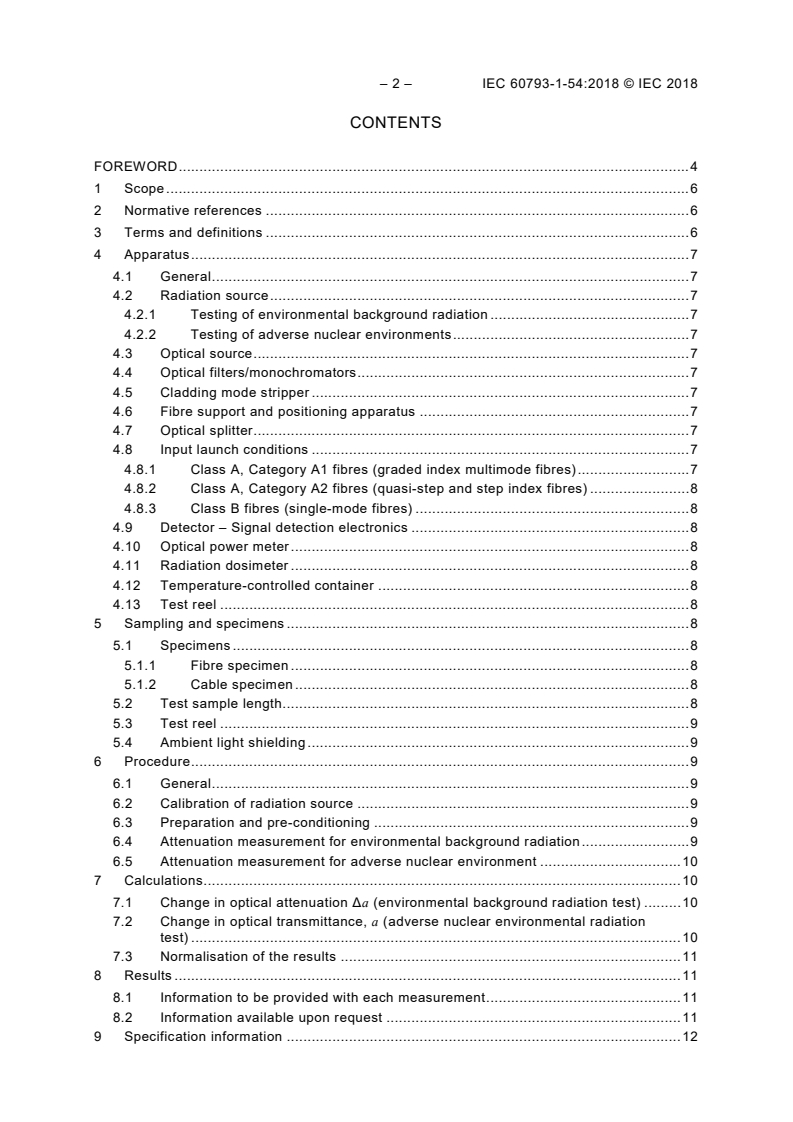
IEC 60793-1-54:2018 - Optical fibres - Part 1-54: Measurement methods and test procedures - Gamma irradiation Released:1/12/2018
Overview
IEC 60793-1-54:2018 - Optical fibres - Part 1-54: Measurement methods and test procedures - Gamma irradiation describes a standardised method for measuring the steady-state response of optical fibres and optical cables exposed to gamma radiation. The standard applies to Class B single‑mode and Class A multimode (A1, A2) fibres, in cabled or uncabled form, and addresses how radiation produces radiation‑induced attenuation (RIA) through the formation of glass defect sites (“colour centres”).
Key technical topics and requirements
- Test regimes
- Low dose‑rate (environmental background radiation): attenuation measured using a cut‑back approach comparable to IEC 60793-1-40 Method A.
- High dose‑rate (adverse nuclear environments): continuous monitoring of optical power before, during and after gamma exposure.
- Radiation source: 60Co or equivalent gamma sources are specified for both regimes.
- Apparatus and measurement elements: optical source (stable lamp/laser/LED at specified wavelengths), detectors/optical power meters, optical filters/monochromators, cladding‑mode strippers, fibre supports, dosimeters, temperature‑controlled container and test reels.
- Sample configuration: procedures cover both fibre specimens and cable specimens; ambient light shielding and sample handling instructions are defined.
- Recovery effects: addresses photobleaching (light‑induced depopulation of colour centres) and thermal annealing, and notes that recovery timing depends on dose, dose rate, irradiation time and temperature.
- Specification changes in the 2018 edition:
- Modified test conditions related to photobleaching.
- Test length adjusted to target a total induced attenuation between 3 dB and 10 dB at end of irradiation.
- Limitations: the method is not intended as a material test for non‑optical cable components; separate tests are required for cable material degradation.
Practical applications and users
Who uses IEC 60793-1-54:2018:
- Fibre and optical cable manufacturers validating radiation hardness
- Accredited test laboratories performing gamma irradiation qualification
- Procurement and qualification engineers specifying components for nuclear or radiation‑exposed installations
- Research teams characterising RIA behavior of single‑mode and multimode fibres
Practical value:
- Quantifies RIA for selection and qualification of optical fibres in radiation environments
- Distinguishes behaviour under long‑term low dose exposure (background) vs. short‑term high dose events (nuclear incidents)
- Helps assess measurement uncertainty and reproducible test setups for supplier acceptance and regulatory compliance
Related standards
- IEC 60793-1-40 (Attenuation measurement, cut‑back)
- IEC 60793-1-44 (Cut‑off wavelength)
- IEC 60793-1-46 (Monitoring changes in optical transmittance)
- IEC 61280-4-1 (Multimode attenuation measurement)
- IEC TR 62283 (background knowledge and guidance for irradiation tests)
Keywords: IEC 60793-1-54:2018, gamma irradiation, optical fibres, radiation‑induced attenuation, photobleaching, colour centres, single‑mode, multimode, attenuation measurement, 60Co.
Relations
- Effective Date
- 05-Sep-2023
Buy Documents
IEC 60793-1-54:2018 RLV - Optical fibres - Part 1-54: Measurement methods and test procedures - Gamma irradiation Released:1/12/2018
IEC 60793-1-54:2018 - Optical fibres - Part 1-54: Measurement methods and test procedures - Gamma irradiation Released:1/12/2018
Get Certified
Connect with accredited certification bodies for this standard

ANCE
Mexican certification and testing association.

Intertek Slovenia
Intertek testing, inspection, and certification services in Slovenia.

LNE (Laboratoire National de Métrologie et d'Essais)
French national laboratory for metrology and testing.
Sponsored listings
Frequently Asked Questions
IEC 60793-1-54:2018 is a standard published by the International Electrotechnical Commission (IEC). Its full title is "Optical fibres - Part 1-54: Measurement methods and test procedures - Gamma irradiation". This standard covers: IEC 60793-1-54:2018 outlines a method for measuring the steady state response of optical fibres and optical cables exposed to gamma radiation. It can be employed to determine the level of radiation-induced attenuation produced in Class B single-mode or Class A, category A1 and A2 multimode optical fibres, in either cabled or uncabled form, due to exposure to gamma radiation. The attenuation of cabled and uncabled optical fibres generally increases when exposed to gamma radiation. This is primarily due to the trapping of radiolytic electrons and holes at defect sites in the glass (i.e. the formation of "colour centres"). This test procedure focuses on two regimes of interest: the low dose rate regime suitable for estimating the effect of environmental background radiation, and the high dose rate regime suitable for estimating the effect of adverse nuclear environments. The testing of the effects of environmental background radiation is achieved with an attenuation measurement approach similar to IEC 60793-1-40 method A, cut-back. The effects of adverse nuclear environments are tested by monitoring the power before, during and after exposure of the test sample to gamma radiation. The depopulation of colour centres by light (photo bleaching) or by heat causes recovery (lessening of radiation induced attenuation). Recovery can occur over a wide range of time which depends on the irradiation time and annealing temperature. This complicates the characterization of radiation induced attenuation since the attenuation depends on many variables including the temperature of the test environment, the configuration of the sample, the total dose and the dose rate applied to the sample and the light level used to measure it. This test is not a material test for the non-optical material components of a fibre optic cable. If degradation of cable materials exposed to irradiation is studied, other test methods will be used. This test method is written to contain a clear, concise listing of instructions. The background knowledge that is necessary to perform correct, relevant and expressive irradiation tests as well as to limit measurement uncertainty is presented separately in IEC TR 62283. This third edition cancels and replaces the second edition published in 2012. This edition constitutes a technical revision. This edition includes the following significant technical changes with respect to the previous edition: - test conditions related to photobleaching have been changed; - the test length has been modified to yield a total induced attenuation in the test sample at the end of the irradiation between 3 dB and 10 dB.
IEC 60793-1-54:2018 outlines a method for measuring the steady state response of optical fibres and optical cables exposed to gamma radiation. It can be employed to determine the level of radiation-induced attenuation produced in Class B single-mode or Class A, category A1 and A2 multimode optical fibres, in either cabled or uncabled form, due to exposure to gamma radiation. The attenuation of cabled and uncabled optical fibres generally increases when exposed to gamma radiation. This is primarily due to the trapping of radiolytic electrons and holes at defect sites in the glass (i.e. the formation of "colour centres"). This test procedure focuses on two regimes of interest: the low dose rate regime suitable for estimating the effect of environmental background radiation, and the high dose rate regime suitable for estimating the effect of adverse nuclear environments. The testing of the effects of environmental background radiation is achieved with an attenuation measurement approach similar to IEC 60793-1-40 method A, cut-back. The effects of adverse nuclear environments are tested by monitoring the power before, during and after exposure of the test sample to gamma radiation. The depopulation of colour centres by light (photo bleaching) or by heat causes recovery (lessening of radiation induced attenuation). Recovery can occur over a wide range of time which depends on the irradiation time and annealing temperature. This complicates the characterization of radiation induced attenuation since the attenuation depends on many variables including the temperature of the test environment, the configuration of the sample, the total dose and the dose rate applied to the sample and the light level used to measure it. This test is not a material test for the non-optical material components of a fibre optic cable. If degradation of cable materials exposed to irradiation is studied, other test methods will be used. This test method is written to contain a clear, concise listing of instructions. The background knowledge that is necessary to perform correct, relevant and expressive irradiation tests as well as to limit measurement uncertainty is presented separately in IEC TR 62283. This third edition cancels and replaces the second edition published in 2012. This edition constitutes a technical revision. This edition includes the following significant technical changes with respect to the previous edition: - test conditions related to photobleaching have been changed; - the test length has been modified to yield a total induced attenuation in the test sample at the end of the irradiation between 3 dB and 10 dB.
IEC 60793-1-54:2018 is classified under the following ICS (International Classification for Standards) categories: 01 - GENERALITIES. TERMINOLOGY. STANDARDIZATION. DOCUMENTATION; 33.180.10 - Fibres and cables. The ICS classification helps identify the subject area and facilitates finding related standards.
IEC 60793-1-54:2018 has the following relationships with other standards: It is inter standard links to IEC 60793-1-54:2012. Understanding these relationships helps ensure you are using the most current and applicable version of the standard.
IEC 60793-1-54:2018 is available in PDF format for immediate download after purchase. The document can be added to your cart and obtained through the secure checkout process. Digital delivery ensures instant access to the complete standard document.
Standards Content (Sample)
IEC 60793-1-54 ®
Edition 3.0 2018-01
REDLINE VERSION
INTERNATIONAL
STANDARD
colour
inside
Optical fibres –
Part 1-54: Measurement methods and test procedures – Gamma irradiation
All rights reserved. Unless otherwise specified, no part of this publication may be reproduced or utilized in any form
or by any means, electronic or mechanical, including photocopying and microfilm, without permission in writing from
either IEC or IEC's member National Committee in the country of the requester. If you have any questions about IEC
copyright or have an enquiry about obtaining additional rights to this publication, please contact the address below or
your local IEC member National Committee for further information.
IEC Central Office Tel.: +41 22 919 02 11
3, rue de Varembé info@iec.ch
CH-1211 Geneva 20 www.iec.ch
Switzerland
About the IEC
The International Electrotechnical Commission (IEC) is the leading global organization that prepares and publishes
International Standards for all electrical, electronic and related technologies.
About IEC publications
The technical content of IEC publications is kept under constant review by the IEC. Please make sure that you have the
latest edition, a corrigenda or an amendment might have been published.
IEC Catalogue - webstore.iec.ch/catalogue Electropedia - www.electropedia.org
The stand-alone application for consulting the entire The world's leading online dictionary of electronic and
bibliographical information on IEC International Standards, electrical terms containing 21 000 terms and definitions in
Technical Specifications, Technical Reports and other English and French, with equivalent terms in 16 additional
documents. Available for PC, Mac OS, Android Tablets and languages. Also known as the International Electrotechnical
iPad. Vocabulary (IEV) online.
IEC publications search - webstore.iec.ch/advsearchform IEC Glossary - std.iec.ch/glossary
The advanced search enables to find IEC publications by a 67 000 electrotechnical terminology entries in English and
variety of criteria (reference number, text, technical French extracted from the Terms and Definitions clause of
committee,…). It also gives information on projects, replaced IEC publications issued since 2002. Some entries have been
and withdrawn publications. collected from earlier publications of IEC TC 37, 77, 86 and
CISPR.
IEC Just Published - webstore.iec.ch/justpublished
Stay up to date on all new IEC publications. Just Published IEC Customer Service Centre - webstore.iec.ch/csc
details all new publications released. Available online and If you wish to give us your feedback on this publication or
also once a month by email. need further assistance, please contact the Customer Service
Centre: sales@iec.ch.
IEC 60793-1-54 ®
Edition 3.0 2018-01
REDLINE VERSION
INTERNATIONAL
STANDARD
colour
inside
Optical fibres –
Part 1-54: Measurement methods and test procedures – Gamma irradiation
INTERNATIONAL
ELECTROTECHNICAL
COMMISSION
ICS 33.180.10 ISBN 978-2-8322-5277-2
– 2 – IEC 60793-1-54:2018 RLV © IEC 2018
CONTENTS
FOREWORD . 4
1 Scope . 6
2 Normative references . 6
3 Terms and definitions . 7
4 Apparatus . 7
4.1 General . 7
4.2 Radiation source . 7
4.2.1 Testing of environmental background radiation . 7
4.2.2 Testing of adverse nuclear environments . 7
4.3 Optical source . 7
4.4 Optical filters/monochromators . 7
4.5 Cladding mode stripper . 7
4.6 Fibre support and positioning apparatus . 7
4.7 Optical splitter . 7
4.8 Input launch conditions . 8
4.8.1 Class A, Category A1 fibres (graded index multimode fibres) . 8
4.8.2 Class A, Category A2 fibres (quasi-step and step index fibres) . 8
4.8.3 Class B fibres (single-mode fibres) . 8
4.9 Detector – Signal detection electronics . 8
4.10 Optical power meter . 8
4.11 Radiation dosimeter . 8
4.12 Temperature-controlled container . 8
4.13 Test reel . 8
5 Sampling and specimens . 8
5.1 Specimens . 8
5.1.1 Fibre specimen . 8
5.1.2 Cable specimen . 8
Specimen for environmental background radiation test .
Specimen for testing adverse nuclear environments .
5.2 Test sample length. 9
5.3 Test reel . 9
5.4 Ambient light shielding . 9
6 Procedure . 9
6.1 General . 9
6.2 Calibration of radiation source . 9
6.3 Preparation and pre-conditioning . 9
6.4 Attenuation measurement for environmental background radiation . 10
6.5 Attenuation measurement for adverse nuclear environment . 10
7 Calculations . 11
7.1 Change in optical attenuation Δa (environmental background radiation test) . 11
7.2 Change in optical transmittance, a (adverse nuclear environmental radiation
test) . 11
7.3 Normalisation of the results . 11
8 Results . 11
8.1 Information to be provided with each measurement . 11
8.2 Information available upon request . 12
9 Specification information . 12
Bibliography . 13
– 4 – IEC 60793-1-54:2018 RLV © IEC 2018
INTERNATIONAL ELECTROTECHNICAL COMMISSION
____________
OPTICAL FIBRES –
Part 1-54: Measurement methods and test procedures –
Gamma irradiation
FOREWORD
1) The International Electrotechnical Commission (IEC) is a worldwide organization for standardization comprising
all national electrotechnical committees (IEC National Committees). The object of IEC is to promote
international co-operation on all questions concerning standardization in the electrical and electronic fields. To
this end and in addition to other activities, IEC publishes International Standards, Technical Specifications,
Technical Reports, Publicly Available Specifications (PAS) and Guides (hereafter referred to as "IEC
Publication(s)"). Their preparation is entrusted to technical committees; any IEC National Committee interested
in the subject dealt with may participate in this preparatory work. International, governmental and non-
governmental organizations liaising with the IEC also participate in this preparation. IEC collaborates closely
with the International Organization for Standardization (ISO) in accordance with conditions determined by
agreement between the two organizations.
2) The formal decisions or agreements of IEC on technical matters express, as nearly as possible, an international
consensus of opinion on the relevant subjects since each technical committee has representation from all
interested IEC National Committees.
3) IEC Publications have the form of recommendations for international use and are accepted by IEC National
Committees in that sense. While all reasonable efforts are made to ensure that the technical content of IEC
Publications is accurate, IEC cannot be held responsible for the way in which they are used or for any
misinterpretation by any end user.
4) In order to promote international uniformity, IEC National Committees undertake to apply IEC Publications
transparently to the maximum extent possible in their national and regional publications. Any divergence
between any IEC Publication and the corresponding national or regional publication shall be clearly indicated in
the latter.
5) IEC itself does not provide any attestation of conformity. Independent certification bodies provide conformity
assessment services and, in some areas, access to IEC marks of conformity. IEC is not responsible for any
services carried out by independent certification bodies.
6) All users should ensure that they have the latest edition of this publication.
7) No liability shall attach to IEC or its directors, employees, servants or agents including individual experts and
members of its technical committees and IEC National Committees for any personal injury, property damage or
other damage of any nature whatsoever, whether direct or indirect, or for costs (including legal fees) and
expenses arising out of the publication, use of, or reliance upon, this IEC Publication or any other IEC
Publications.
8) Attention is drawn to the Normative references cited in this publication. Use of the referenced publications is
indispensable for the correct application of this publication.
9) Attention is drawn to the possibility that some of the elements of this IEC Publication may be the subject of
patent rights. IEC shall not be held responsible for identifying any or all such patent rights.
This redline version of the official IEC Standard allows the user to identify the changes
made to the previous edition. A vertical bar appears in the margin wherever a change
has been made. Additions are in green text, deletions are in strikethrough red text.
International Standard IEC 60793-1-54 has been prepared by subcommittee 86A: Fibres and
cables, of IEC technical committee 86: Fibre optics.
This third edition cancels and replaces the second edition published in 2012. This edition
constitutes a technical revision.
This edition includes the following significant technical changes with respect to the previous
edition:
a) test conditions related to photobleaching have been changed;
b) the test length has been modified to yield a total induced attenuation in the test sample at
the end of the irradiation between 3 dB and 10 dB.
The text of this International Standard is based on the following documents:
FDIS Report on voting
86A/1833/FDIS 86A/1848/RVD
Full information on the voting for the approval of this International Standard can be found in
the report on voting indicated in the above table.
This document has been drafted in accordance with the ISO/IEC Directives, Part 2.
A list of all parts in the IEC 60793 series, published under the general title Optical fibres, can
be found on the IEC website.
The committee has decided that the contents of this document will remain unchanged until the
stability date indicated on the IEC website under "http://webstore.iec.ch" in the data related to
the specific document. At this date, the document will be
• reconfirmed,
• withdrawn,
• replaced by a revised edition, or
• amended.
IMPORTANT – The “colour inside” logo on the cover page of this publication indicates
that it contains colours which are considered to be useful for the correct understanding
of its contents. Users should therefore print this publication using a colour printer.
– 6 – IEC 60793-1-54:2018 RLV © IEC 2018
OPTICAL FIBRES –
Part 1-54: Measurement methods and test procedures –
Gamma irradiation
1 Scope
This document outlines a method for measuring the steady state response of optical fibres
and optical cables exposed to gamma radiation. It can be employed to determine the level of
radiation-induced attenuation produced in Class B single-mode or Class A, category A1 and
A2 multimode optical fibres, in either cabled or uncabled form, due to exposure to gamma
radiation.
The attenuation of cabled and uncabled optical fibres generally increases when exposed to
gamma radiation. This is primarily due to the trapping of radiolytic electrons and holes at
defect sites in the glass (i.e. the formation of "colour centres"). This test procedure focuses on
two regimes of interest: the low dose rate regime suitable for estimating the effect of
environmental background radiation, and the high dose rate regime suitable for estimating the
effect of adverse nuclear environments. The testing of the effects of environmental
background radiation is achieved with an attenuation measurement approach similar to
IEC 60793-1-40 method A, cut-back. The effects of adverse nuclear environments are tested
by monitoring the power before, during and after exposure of the test sample to gamma
radiation. The depopulation of colour centres by light (photo bleaching) or by heat causes
recovery (lessening of radiation induced attenuation). Recovery may can occur over a wide
range of time which depends on the irradiation time and annealing temperature. This
complicates the characterization of radiation induced attenuation since the attenuation
depends on many variables including the temperature of the test environment, the
configuration of the sample, the total dose and the dose rate applied to the sample and the
light level used to measure it.
This test is not a material test for the non-optical material components of a fibre optic cable. If
degradation of cable materials exposed to irradiation is to be studied, other test methods will
be required used.
This test method is written to contain a clear, concise listing of instructions. The background
knowledge that is necessary to perform correct, relevant and expressive irradiation tests as
well as to limit measurement uncertainty is presented separately in IEC TR 62283.
2 Normative references
The following documents are referred to in the text in such a way that some or all of their
content constitutes requirements of this document. For dated references, only the edition
cited applies. For undated references, the latest edition of the referenced document (including
any amendments) applies.
IEC 60793-1-40, Optical Fibres – Part 1-40: Measurement methods and test procedures –
Attenuation
IEC 60793-1-44, Optical fibres – Part 1-44: Measurement methods and test procedures –
Cut-off wavelength
IEC 60793-1-46, Optical fibres – Part 1-46: Measurement methods and test procedures –
Monitoring of changes in optical transmittance
IEC 61280-4-1, Fibre-optic communication subsystem test procedures – Part 4-1: Installed
cable plant – Multimode attenuation measurement
3 Terms and definitions
No terms and definitions are listed in this document.
ISO and IEC maintain terminological databases for use in standardization at the following
addresses:
• IEC Electropedia: available at http://www.electropedia.org/
• ISO Online browsing platform: available at http://www.iso.org/obp
4 Apparatus
4.1 General
Attention is drawn to the fact that strict regulations and suitable protective facilities are to be
adopted in the laboratory for this test. Carefully selected trained personnel shall be used to
perform this test. It can be extremely hazardous to test personnel if it is improperly performed
or without qualified conditions.
4.2 Radiation source
4.2.1 Testing of environmental background radiation
A Co or equivalent ionising source shall be used to deliver gamma radiation. This
environment is characterised by relatively low total dose and dose rate.
4.2.2 Testing of adverse nuclear environments
A Co or equivalent ionizing source(s) shall be used to deliver gamma radiation. This
environment is characterised by higher total dose and dose rate.
4.3 Optical source
An optical source such as a lamp white light source, laser or light emitting diode emitting at
wavelengths compatible with the optical fibres under test shall be used. The wavelength of the
source shall be according to the detailed specification.
The optical source shall be stable in intensity over a time period sufficient to perform the
measurement. The power coupled from the source into the test sample shall be <−30 dBm
(1,0 µW) with a tolerance of ± 2 dBm or as specified in the detail specification. The optical
source shall may be modulated with a pulsed signal at a 50 % duty cycle, if a lock-in amplifier
is used.
NOTE If a source that couples more than 1,0 µW is used, photo bleaching may occur.
4.4 Optical filters/monochromators
Unless otherwise specified, wavelength tolerances of ± 20 nm shall be obtained by filtering
the optical source with a set of optical filters or a monochromator. The 3 dB optical bandwidth
of the filters shall be less than or equal to 25 nm.
4.5 Cladding mode stripper
When necessary, a device that extracts cladding modes shall be employed at the input end
and output end of the test sample. If the fibre coating materials are designed to strip cladding
modes, a cladding mode stripper is not required.
4.6 Fibre support and positioning apparatus
A means of stable support for the input end of the test sample, such as a vacuum chuck, shall
be arranged. This support shall be mounted on a positioning device so that the end of the test
sample can be repeatedly positioned in the input beam.
4.7 Optical splitter
An optical splitter shall divert a small portion of the input light to a reference detector. The
reference path shall be used to monitor system fluctuations for the duration of the test.
– 8 – IEC 60793-1-54:2018 RLV © IEC 2018
4.8 Input launch conditions
4.8.1 Class A, Category A1 fibres (graded index multimode fibres)
An equilibrium mode simulator shall be used to attenuate higher order propagation modes and
to establish a steady-state mode condition near the input end of the fibre. The requirements
for the launch conditions for sub-category A1a graded index multimode fibre measurements
are defined in IEC 61280-4-1.
4.8.2 Class A, Category A2 fibres (quasi-step and step index fibres)
Launch conditions shall be created as specified in the detail specification.
4.8.3 Class B fibres (single-mode fibres)
An optical lens system or fibre pigtail may be employed to excite the test fibre. The power
coupled into the test sample shall be stable for the duration of the test. If an optical lens
system is used, a method of making the positioning of the fibre less sensitive is to overfill the
fibre end spatially and angularly. If a pigtail is used, it may be necessary to use index
matching material to eliminate interference effects. A high order mode filter shall be employed
to remove high order propagating modes in the wavelength range greater than or equal to the
cut-off wavelength of the test fibre. The test condition specified in IEC 60793-1-44, method C,
satisfies this requirement.
4.9 Detector – Signal detection electronics
An optical detector that is linear and stable over the range of intensities that are encountered
shall be used. A typical system might include a photovoltaic mode photodiode amplified by a
current input preamplifier, with synchronous detection by a lock-up amplifier.
4.10 Optical power meter
A suitable optical power meter shall be used to determine that the power coupled from the
optical source into the test sample is less than or equal to 1,0 µW or the level specified in the
detail specification.
4.11 Radiation dosimeter
Thermo luminescent LiF or CaF crystal detectors (TLDs) or an ion chamber detector shall be
used to measure the total radiation dose received by the specimen fibre.
4.12 Temperature-controlled container
Unless otherwise specified, the temperature-controlled container shall have the capability of
maintaining the specified temperatures to within ± 2 °C.
4.13 Test reel
The test reel shall not act as a shield or sink for the radiation used in this test. Reels of wood,
plastic or similar non-conducting materials would, in principle, act as transparent to the
radiation. The additional absorption shall be taken into account for exact measurements.
An appropriate dose build-up layer of similar material shall be used.
5 Sampling and specimens
5.1 Specimens
5.1.1 Fibre specimen
The test specimen shall be a representative sample of the fibre specified in the detail
specification.
5.1.2 Cable specimen
The test specimen shall be a representative sample of the cable described in the detail
specification and shall contain at least one of the specified fibres.
4.2 Specimen for environmental background radiation test
Unless otherwise specified in the detail specification, the length of the test sample shall be
(3 000 ± 30) m. (Where reactor constraints dictate smaller lengths, the length of the test
sample may be (1 100 ± 20) m.) A minimum length at the ends of the test sample (typically
5 m) shall reside outside of the test chamber and be used to connect the optical source to the
detector. The irradiated length of the test sample shall be reported.
4.3 Specimen for testing adverse nuclear environments
Unless otherwise specified in the detail specification, the length of the test sample shall be
(250 ± 2,5) m. (When test conditions require a high total dose and dose rate a shorter test
sample length may be necessary). A minimum length at the ends of the test sample (typically
5 m) shall remain outside of the test chamber and be used to connect the optical source to the
detector. The irradiated length of the test sample shall be reported.
5.2 Test sample length
Unless otherwise specified in the detail specification, the length of the test sample shall be
chosen according to the expected induced attenuation and depends on the fibre type to be
tested. The length shall be selected to yield a total induced attenuation in the test sample at
the end of the irradiation of between 3 dB and 10 dB. The influence of the fibre leads
connecting the test sample shall be minimised below 10 % of the total induced attenuation by
reducing their length, application of shielding, and selection of fibres with low radiation
sensitivity. The irradiated length of the test sample shall be reported.
5.3 Test reel
The test sample shall be spooled onto a reel with a drum diameter of more than or equal to
10 cm, or that is as specified in the detail specification. Allowance shall be made for the
unspooling of a measured length of the test sample from each end of the reel to allow for
attachment to the optical measurement equipment. An alternative deployment method allows
the fibre to be loosely wound in a coil of specified diameter. The minimum bending radius
shall be considered.
5.4 Ambient light shielding
The test sample shall be shielded from ambient light to prevent external photobleaching.
6 Procedure
6.1 General
The radiation tests differ in exposure dose, dose rate, exposure time and temperature. The
tests are an environmental background radiation test and an adverse nuclear radiation test.
6.2 Calibration of radiation source
Calibration of the radiation source for dose uniformity and level shall be made prior to the test
sample being set up in the chamber. Four TLDs shall be placed in the area of exposure and
the centre of the TLDs shall be placed where the axis of the test reel will be placed. (Four
TLDs are used to get a representative average value.) A dose equal to or greater than the
actual test dose shall be used to calibrate the system. To maintain the highest possible
accuracy in measuring the test dose, the TLDs shall not be used more than once. Dose and
dose rate measurements at four positions shall be made in the area of exposure where the
test reel will be placed (four positions are used to get a representative average value).
6.3 Preparation and pre-conditioning
The test sample shall be preconditioned in the temperature chamber at (25 ± 5) °C for 1 h
prior to testing, or at the test temperature for a preconditioned time as specified in the detail
specification.
The input end of the short test length shall be placed in the positioning device and aligned in
the test set to obtain maximum optical power as measured with a calibrated power meter.
– 10 – IEC 60793-1-54:2018 RLV © IEC 2018
The power at the input end of the test sample shall be measured with a calibrated power
meter. If necessary, the source power level shall be adjusted so that the power at the input
end of the fibre is less than 1,0 µW or as specified in the detail specification.
NOTE If a source that couples more than 1,0 µW is used, photobleaching may occur.
With the radiation source off, the input end of the test sample shall be positioned to obtain
maximum optical power at the detector. Once set, the input launch conditions shall not be
changed during the gamma irradiation portion of the test.
A chart recorder or suitable continuous measurement device shall be connected to the
detection system so that a continuous power measurement can be made. The measurement
equipment shall be set up such that the detection signal does not exceed the limits of the
equipment.
Before starting the irradiation the stability of the measurement setup shall be obtained. The
total fluctuation shall be below 10 % of the total induced attenuation at the end of irradiation.
A Co or equivalent ionizing source(s) shall be used to deliver gamma radiation at a desired
dose rate.
Dose rate levels are only approximate levels since the radiation source characteristics
change. A variation in dose rate as high as ± 50 % can be expected between sources. The
time required to turn the radiation source on or off shall be < 10 % of the total exposure time.
It is important that the temperature is kept constant during the tests. If the test should be
performed at different temperatures, then the attenuation prior to irradiation has to be
measured for different temperatures for each specified wavelength.
6.4 Attenuation measurement for environmental background radiation
An attenuation measurement of the test sample shall be performed, at the specified test
wavelengths, in accordance with IEC 60793-1-40, method A, cut-back. The attenuation a of
the fibre prior to exposure to the gamma radiation source shall be recorded. The
environmental temperature shall be the same as during the up-coming irradiation tests when
the initial attenuation measurement is performed.
Unless otherwise specified in the detailed specification, environmental background radiation
effects, due to exposure to gamma radiation, shall be determined by subjecting the test
sample to a nominal dose rate of 0,02 Gray/hour (Gy/h). The test sample shall be exposed to
a total dose of 0,1 Gray (Gy). Different dose rates and total dose values may can be called for
in the detail specification in order to simulate particular specific conditions.
Upon completion, and within 2 h of the irradiation process, an attenuation measurement of the
test sample shall be performed in accordance with IEC 60793-1-40, method A, cut-back. The
attenuation a of the test sample after exposure to the gamma radiation source shall be
recorded.
6.5 Attenuation measurement for adverse nuclear environment
The monitoring of the change of optical transmittance of the test sample shall be performed,
at the specified test wavelengths, in accordance with method IEC 60793-1-46.
The output power P from the sample prior exposure to the gamma radiation source shall be
B
recorded.
Unless otherwise specified in the detailed specification, adverse nuclear radiation effects, due
to exposure to gamma radiation, shall be determined by subjecting the test sample to a
nominal dose rate of 1 000 Gy/h. The test sample shall be exposed to a total dose of 1 000
Gy. Different dose rates and total dose values may can be called for in the detail specification
in order to simulate particular specific conditions.
The output power from the sample shall be recorded for the duration of the gamma irradiation
cycle. With help of the initial attenuation measurements, prior irradiation, one can determine
the radiation induced attenuation in the fibre.
The power shall also be recorded for at least 15 min after completion of the irradiation
process or as specified in the detail specification. The power level of the reference detector
shall also be recorded during the recovery time after completion of the irradiation process.
7 Calculations
7.1 Change in optical attenuation Δa (environmental background radiation test)
Δa = a − a dB (1)
2 1
where
a is the attenuation of the test sample prior to exposure to gamma radiation;
a is the attenuation of the test sample after exposure to gamma radiation.
7.2 Change in optical transmittance, a (adverse nuclear environmental radiation test)
The change in optical transmittance a shall be calculated for each wavelength by using the
following formula (testing of adverse nuclear environment):
a = −10 lg (P /P ) dB (2)
0 0 B
= −10 lg (P /P ) dB (3)
a
15 15 B
where
P is the power output of the test sample within 1 s after irradiation is discontinued, unless
otherwise specified;
P is the power output of the test sample 15 min after irradiation is discontinued, unless
otherwise specified;
P is the power output of the test sample before irradiation begins;
B
a is the change in optical transmittance of the test sample immediately after irradiation;
a is the change in optical transmittance of the test sample 15 min after irradiation.
7.3 Normalisation of the results
The results of the reference measurements should be used to normalize the test results if
significant system instability is noted.
a = −10 lg (P /P ) dB (4)
REF E′ B′
where
is the power measured by the reference detector at the end of the measurement;
P
E′
P is the power measured by the reference detector before irradiation begins.
B′
Normalized test results that account for system instability are calculated with the following
formulae:
a = a − a dB (5)
0NOR 0 REF
a = a − a dB (6)
15NOR 15 REF
8 Results
8.1 Information to be provided with each measurement
Report the following information with each measurement:
– 12 – IEC 60793-1-54:2018 RLV © IEC 2018
– date and title of test;
– length of test sample exposed to radiation;
– test wavelengths;
– test temperatures;
– material-, dimensions- and design of the test reel;
– test dose and dose rate;
– change in attenuation ∆a (environmental background radiation test);
– change in optical transmittances a and a (adverse nuclear environment);
0 15
– characteristics of test sample such as fibre type, cable type, dimensions and composition;
– chart recording of test events.
8.2 Information available upon request
The following information shall be available upon request:
– description of radiation source;
– description of dosimeters used;
– type of optical source, model number and manufacturer;
– description of optical filters or monochromator;
– description of cladding mode stripper;
– description of input launch simulator and launch conditions used;
– type of optical splitter used;
– description of detection and recording apparatus;
– description of the characteristics of temperature chamber;
– date of latest calibration of test equipment;
– name or identification number of operator.
9 Specification information
The detail specification shall specify the following information:
– type of test sample to be tested;
– test reel diameter;
– test temperature(s);
– failure or acceptance criteria;
– number of samples;
– test wavelengths;
– total dose and dose rate;
– other test conditions.
Bibliography
IEC 60793-2-10, Optical fibres – Part 2-10: Product specifications – Sectional specification for
category A1 multimode fibres
IEC 60793-2-20, Optical fibres – Part 2-20: Product specifications – Sectional specification for
category A2 multimode fibres
IEC 60793-2-50, Optical fibres – Part 2-50: Product specifications – Sectional specification for
class B single-mode fibres
IEC TR 62283, Optical fibres – Guidance for nuclear radiation tests
GUILLERMAIN, Élise et al. Macro-Bending Influence on Radiation Induced Attenuation
Measurement in Optical Fibres, IEEE Transactions on Nuclear Science, August 2014, vol. 61,
issue 4, pp 1834-1837, DOI 10.1109/TNS.2014.2306992
___________
IEC 60793-1-54 ®
Edition 3.0 2018-01
INTERNATIONAL
STANDARD
NORME
INTERNATIONALE
Optical fibres –
Part 1-54: Measurement methods and test procedures – Gamma irradiation
Fibres optiques –
Partie 1-54: Méthodes de mesure et procédures d'essai – Irradiation gamma
– 2 – IEC 60793-1-54:2018 © IEC 2018
CONTENTS
FOREWORD . 4
1 Scope . 6
2 Normative references . 6
3 Terms and definitions . 6
4 Apparatus . 7
4.1 General . 7
4.2 Radiation source . 7
4.2.1 Testing of environmental background radiation . 7
4.2.2 Testing of adverse nuclear environments . 7
4.3 Optical source . 7
4.4 Optical filters/monochromators . 7
4.5 Cladding mode stripper . 7
4.6 Fibre support and positioning apparatus . 7
4.7 Optical splitter . 7
4.8 Input launch conditions . 7
4.8.1 Class A, Category A1 fibres (graded index multimode fibres) . 7
4.8.2 Class A, Category A2 fibres (quasi-step and step index fibres) . 8
4.8.3 Class B fibres (single-mode fibres) . 8
4.9 Detector – Signal detection electronics . 8
4.10 Optical power meter . 8
4.11 Radiation dosimeter . 8
4.12 Temperature-controlled container . 8
4.13 Test reel . 8
5 Sampling and specimens . 8
5.1 Specimens . 8
5.1.1 Fibre specimen . 8
5.1.2 Cable specimen . 8
5.2 Test sample length. 8
5.3 Test reel . 9
5.4 Ambient light shielding . 9
6 Procedure . 9
6.1 General . 9
6.2 Calibration of radiation source . 9
6.3 Preparation and pre-conditioning . 9
6.4 Attenuation measurement for environmental background radiation . 9
6.5 Attenuation measurement for adverse nuclear environment . 10
7 Calculations . 10
7.1 Change in optical attenuation Δa (environmental background radiation test) . 10
7.2 Change in optical transmittance, a (adverse nuclear environmental radiation
test) . 10
7.3 Normalisation of the results . 11
8 Results . 11
8.1 Information to be provided with each measurement . 11
8.2 Information available upon request . 11
9 Specification information . 12
Bibliography . 13
– 4 – IEC 60793-1-54:2018 © IEC 2018
INTERNATIONAL ELECTROTECHNICAL COMMISSION
____________
OPTICAL FIBRES –
Part 1-54: Measurement methods and test procedures –
Gamma irradiation
FOREWORD
1) The International Electrotechnical Commission (IEC) is a worldwide organization for standardization comprising
all national electrotechnical committees (IEC National Committees). The object of IEC is to promote
international co-operation on all questions concerning standardization in the electrical and electronic fields. To
this end and in addition to other activities, IEC publishes International Standards, Technical Specifications,
Technical Reports, Publicly Available Specifications (PAS) and Guides (hereafter referred to as "IEC
Publication(s)"). Their preparation is entrusted to technical committees; any IEC National Committee interested
in the subject dealt with may participate in this preparatory work. International, governmental and non-
governmental organizations liaising with the IEC also participate in this preparation. IEC collaborates closely
with the International Organization for Standardization (ISO) in accordance with conditions determined by
agreement between the two organizations.
2) The formal decisions or agreements of IEC on technical matters express, as nearly as possible, an international
consensus of opinion on the relevant subjects since each technical committee has representation from all
interested IEC National Committees.
3) IEC Publications have the form of recommendations for international use and are accepted by IEC National
Committees in that sense. While all reasonable efforts are made to ensure that the technical content of IEC
Publications is accurate, IEC cannot be held responsible for the way in which they are used or for any
misinterpretation by any end user.
4) In order to promote international uniformity, IEC National Committees undertake to apply IEC Publications
transparently to the maximum extent possible in their national and regional publica
...
IEC 60793-1-54 ®
Edition 3.0 2018-01
INTERNATIONAL
STANDARD
NORME
INTERNATIONALE
Optical fibres –
Part 1-54: Measurement methods and test procedures – Gamma irradiation
Fibres optiques –
Partie 1-54: Méthodes de mesure et procédures d'essai – Irradiation gamma
All rights reserved. Unless otherwise specified, no part of this publication may be reproduced or utilized in any form
or by any means, electronic or mechanical, including photocopying and microfilm, without permission in writing from
either IEC or IEC's member National Committee in the country of the requester. If you have any questions about IEC
copyright or have an enquiry about obtaining additional rights to this publication, please contact the address below or
your local IEC member National Committee for further information.
Droits de reproduction réservés. Sauf indication contraire, aucune partie de cette publication ne peut être reproduite
ni utilisée sous quelque forme que ce soit et par aucun procédé, électronique ou mécanique, y compris la photocopie
et les microfilms, sans l'accord écrit de l'IEC ou du Comité national de l'IEC du pays du demandeur. Si vous avez des
questions sur le copyright de l'IEC ou si vous désirez obtenir des droits supplémentaires sur cette publication, utilisez
les coordonnées ci-après ou contactez le Comité national de l'IEC de votre pays de résidence.
IEC Central Office Tel.: +41 22 919 02 11
3, rue de Varembé info@iec.ch
CH-1211 Geneva 20 www.iec.ch
Switzerland
About the IEC
The International Electrotechnical Commission (IEC) is the leading global organization that prepares and publishes
International Standards for all electrical, electronic and related technologies.
About IEC publications
The technical content of IEC publications is kept under constant review by the IEC. Please make sure that you have the
latest edition, a corrigenda or an amendment might have been published.
IEC Catalogue - webstore.iec.ch/catalogue Electropedia - www.electropedia.org
The stand-alone application for consulting the entire The world's leading online dictionary of electronic and
bibliographical information on IEC International Standards, electrical terms containing 21 000 terms and definitions in
Technical Specifications, Technical Reports and other English and French, with equivalent terms in 16 additional
documents. Available for PC, Mac OS, Android Tablets and languages. Also known as the International Electrotechnical
iPad. Vocabulary (IEV) online.
IEC publications search - webstore.iec.ch/advsearchform IEC Glossary - std.iec.ch/glossary
The advanced search enables to find IEC publications by a 67 000 electrotechnical terminology entries in English and
variety of criteria (reference number, text, technical French extracted from the Terms and Definitions clause of
committee,…). It also gives information on projects, replaced IEC publications issued since 2002. Some entries have been
and withdrawn publications. collected from earlier publications of IEC TC 37, 77, 86 and
CISPR.
IEC Just Published - webstore.iec.ch/justpublished
Stay up to date on all new IEC publications. Just Published IEC Customer Service Centre - webstore.iec.ch/csc
details all new publications released. Available online and If you wish to give us your feedback on this publication or
also once a month by email. need further assistance, please contact the Customer Service
Centre: sales@iec.ch.
A propos de l'IEC
La Commission Electrotechnique Internationale (IEC) est la première organisation mondiale qui élabore et publie des
Normes internationales pour tout ce qui a trait à l'électricité, à l'électronique et aux technologies apparentées.
A propos des publications IEC
Le contenu technique des publications IEC est constamment revu. Veuillez vous assurer que vous possédez l’édition la
plus récente, un corrigendum ou amendement peut avoir été publié.
Catalogue IEC - webstore.iec.ch/catalogue Electropedia - www.electropedia.org
Application autonome pour consulter tous les renseignements
Le premier dictionnaire en ligne de termes électroniques et
bibliographiques sur les Normes internationales,
électriques. Il contient 21 000 termes et définitions en anglais
Spécifications techniques, Rapports techniques et autres
et en français, ainsi que les termes équivalents dans 16
documents de l'IEC. Disponible pour PC, Mac OS, tablettes
langues additionnelles. Egalement appelé Vocabulaire
Android et iPad.
Electrotechnique International (IEV) en ligne.
Recherche de publications IEC -
Glossaire IEC - std.iec.ch/glossary
webstore.iec.ch/advsearchform
67 000 entrées terminologiques électrotechniques, en anglais
La recherche avancée permet de trouver des publications IEC et en français, extraites des articles Termes et Définitions des
en utilisant différents critères (numéro de référence, texte, publications IEC parues depuis 2002. Plus certaines entrées
comité d’études,…). Elle donne aussi des informations sur les antérieures extraites des publications des CE 37, 77, 86 et
projets et les publications remplacées ou retirées. CISPR de l'IEC.
IEC Just Published - webstore.iec.ch/justpublished Service Clients - webstore.iec.ch/csc
Restez informé sur les nouvelles publications IEC. Just Si vous désirez nous donner des commentaires sur cette
Published détaille les nouvelles publications parues. publication ou si vous avez des questions contactez-nous:
Disponible en ligne et aussi une fois par mois par email. sales@iec.ch.
IEC 60793-1-54 ®
Edition 3.0 2018-01
INTERNATIONAL
STANDARD
NORME
INTERNATIONALE
Optical fibres –
Part 1-54: Measurement methods and test procedures – Gamma irradiation
Fibres optiques –
Partie 1-54: Méthodes de mesure et procédures d'essai – Irradiation gamma
INTERNATIONAL
ELECTROTECHNICAL
COMMISSION
COMMISSION
ELECTROTECHNIQUE
INTERNATIONALE
ICS 33.180.10 ISBN 978-2-8322-5209-3
– 2 – IEC 60793-1-54:2018 © IEC 2018
CONTENTS
FOREWORD . 4
1 Scope . 6
2 Normative references . 6
3 Terms and definitions . 6
4 Apparatus . 7
4.1 General . 7
4.2 Radiation source . 7
4.2.1 Testing of environmental background radiation . 7
4.2.2 Testing of adverse nuclear environments . 7
4.3 Optical source . 7
4.4 Optical filters/monochromators . 7
4.5 Cladding mode stripper . 7
4.6 Fibre support and positioning apparatus . 7
4.7 Optical splitter . 7
4.8 Input launch conditions . 7
4.8.1 Class A, Category A1 fibres (graded index multimode fibres) . 7
4.8.2 Class A, Category A2 fibres (quasi-step and step index fibres) . 8
4.8.3 Class B fibres (single-mode fibres) . 8
4.9 Detector – Signal detection electronics . 8
4.10 Optical power meter . 8
4.11 Radiation dosimeter . 8
4.12 Temperature-controlled container . 8
4.13 Test reel . 8
5 Sampling and specimens . 8
5.1 Specimens . 8
5.1.1 Fibre specimen . 8
5.1.2 Cable specimen . 8
5.2 Test sample length. 8
5.3 Test reel . 9
5.4 Ambient light shielding . 9
6 Procedure . 9
6.1 General . 9
6.2 Calibration of radiation source . 9
6.3 Preparation and pre-conditioning . 9
6.4 Attenuation measurement for environmental background radiation . 9
6.5 Attenuation measurement for adverse nuclear environment . 10
7 Calculations . 10
7.1 Change in optical attenuation Δa (environmental background radiation test) . 10
7.2 Change in optical transmittance, a (adverse nuclear environmental radiation
test) . 10
7.3 Normalisation of the results . 11
8 Results . 11
8.1 Information to be provided with each measurement . 11
8.2 Information available upon request . 11
9 Specification information . 12
Bibliography . 13
– 4 – IEC 60793-1-54:2018 © IEC 2018
INTERNATIONAL ELECTROTECHNICAL COMMISSION
____________
OPTICAL FIBRES –
Part 1-54: Measurement methods and test procedures –
Gamma irradiation
FOREWORD
1) The International Electrotechnical Commission (IEC) is a worldwide organization for standardization comprising
all national electrotechnical committees (IEC National Committees). The object of IEC is to promote
international co-operation on all questions concerning standardization in the electrical and electronic fields. To
this end and in addition to other activities, IEC publishes International Standards, Technical Specifications,
Technical Reports, Publicly Available Specifications (PAS) and Guides (hereafter referred to as "IEC
Publication(s)"). Their preparation is entrusted to technical committees; any IEC National Committee interested
in the subject dealt with may participate in this preparatory work. International, governmental and non-
governmental organizations liaising with the IEC also participate in this preparation. IEC collaborates closely
with the International Organization for Standardization (ISO) in accordance with conditions determined by
agreement between the two organizations.
2) The formal decisions or agreements of IEC on technical matters express, as nearly as possible, an international
consensus of opinion on the relevant subjects since each technical committee has representation from all
interested IEC National Committees.
3) IEC Publications have the form of recommendations for international use and are accepted by IEC National
Committees in that sense. While all reasonable efforts are made to ensure that the technical content of IEC
Publications is accurate, IEC cannot be held responsible for the way in which they are used or for any
misinterpretation by any end user.
4) In order to promote international uniformity, IEC National Committees undertake to apply IEC Publications
transparently to the maximum extent possible in their national and regional publications. Any divergence
between any IEC Publication and the corresponding national or regional publication shall be clearly indicated in
the latter.
5) IEC itself does not provide any attestation of conformity. Independent certification bodies provide conformity
assessment services and, in some areas, access to IEC marks of conformity. IEC is not responsible for any
services carried out by independent certification bodies.
6) All users should ensure that they have the latest edition of this publication.
7) No liability shall attach to IEC or its directors, employees, servants or agents including individual experts and
members of its technical committees and IEC National Committees for any personal injury, property damage or
other damage of any nature whatsoever, whether direct or indirect, or for costs (including legal fees) and
expenses arising out of the publication, use of, or reliance upon, this IEC Publication or any other IEC
Publications.
8) Attention is drawn to the Normative references cited in this publication. Use of the referenced publications is
indispensable for the correct application of this publication.
9) Attention is drawn to the possibility that some of the elements of this IEC Publication may be the subject of
patent rights. IEC shall not be held responsible for identifying any or all such patent rights.
International Standard IEC 60793-1-54 has been prepared by subcommittee 86A: Fibres and
cables, of IEC technical committee 86: Fibre optics.
This third edition cancels and replaces the second edition published in 2012. This edition
constitutes a technical revision.
This edition includes the following significant technical changes with respect to the previous
edition:
a) test conditions related to photobleaching have been changed;
b) the test length has been modified to yield a total induced attenuation in the test sample at
the end of the irradiation between 3 dB and 10 dB.
The text of this International Standard is based on the following documents:
FDIS Report on voting
86A/1833/FDIS 86A/1848/RVD
Full information on the voting for the approval of this International Standard can be found in
the report on voting indicated in the above table.
This document has been drafted in accordance with the ISO/IEC Directives, Part 2.
A list of all parts in the IEC 60793 series, published under the general title Optical fibres, can
be found on the IEC website.
The committee has decided that the contents of this document will remain unchanged until the
stability date indicated on the IEC website under "http://webstore.iec.ch" in the data related to
the specific document. At this date, the document will be
• reconfirmed,
• withdrawn,
• replaced by a revised edition, or
• amended.
– 6 – IEC 60793-1-54:2018 © IEC 2018
OPTICAL FIBRES –
Part 1-54: Measurement methods and test procedures –
Gamma irradiation
1 Scope
This document outlines a method for measuring the steady state response of optical fibres
and optical cables exposed to gamma radiation. It can be employed to determine the level of
radiation-induced attenuation produced in Class B single-mode or Class A, category A1 and
A2 multimode optical fibres, in either cabled or uncabled form, due to exposure to gamma
radiation.
The attenuation of cabled and uncabled optical fibres generally increases when exposed to
gamma radiation. This is primarily due to the trapping of radiolytic electrons and holes at
defect sites in the glass (i.e. the formation of "colour centres"). This test procedure focuses on
two regimes of interest: the low dose rate regime suitable for estimating the effect of
environmental background radiation, and the high dose rate regime suitable for estimating the
effect of adverse nuclear environments. The testing of the effects of environmental
background radiation is achieved with an attenuation measurement approach similar to
IEC 60793-1-40 method A, cut-back. The effects of adverse nuclear environments are tested
by monitoring the power before, during and after exposure of the test sample to gamma
radiation. The depopulation of colour centres by light (photo bleaching) or by heat causes
recovery (lessening of radiation induced attenuation). Recovery can occur over a wide range
of time which depends on the irradiation time and annealing temperature. This complicates
the characterization of radiation induced attenuation since the attenuation depends on many
variables including the temperature of the test environment, the configuration of the sample,
the total dose and the dose rate applied to the sample and the light level used to measure it.
This test is not a material test for the non-optical material components of a fibre optic cable. If
degradation of cable materials exposed to irradiation is studied, other test methods will be
used.
This test method is written to contain a clear, concise listing of instructions. The background
knowledge that is necessary to perform correct, relevant and expressive irradiation tests as
well as to limit measurement uncertainty is presented separately in IEC TR 62283.
2 Normative references
The following documents are referred to in the text in such a way that some or all of their
content constitutes requirements of this document. For dated references, only the edition
cited applies. For undated references, the latest edition of the referenced document (including
any amendments) applies.
IEC 60793-1-40, Optical Fibres – Part 1-40: Measurement methods and test procedures –
Attenuation
IEC 60793-1-44, Optical fibres – Part 1-44: Measurement methods and test procedures –
Cut-off wavelength
IEC 60793-1-46, Optical fibres – Part 1-46: Measurement methods and test procedures –
Monitoring of changes in optical transmittance
IEC 61280-4-1, Fibre-optic communication subsystem test procedures – Part 4-1: Installed
cable plant – Multimode attenuation measurement
3 Terms and definitions
No terms and definitions are listed in this document.
ISO and IEC maintain terminological databases for use in standardization at the following
addresses:
• IEC Electropedia: available at http://www.electropedia.org/
• ISO Online browsing platform: available at http://www.iso.org/obp
4 Apparatus
4.1 General
Attention is drawn to the fact that strict regulations and suitable protective facilities are to be
adopted in the laboratory for this test. Carefully selected trained personnel shall be used to
perform this test. It can be extremely hazardous to test personnel if it is improperly performed
or without qualified conditions.
4.2 Radiation source
4.2.1 Testing of environmental background radiation
Co or equivalent ionising source shall be used to deliver gamma radiation. This
A
environment is characterised by relatively low total dose and dose rate.
4.2.2 Testing of adverse nuclear environments
A Co or equivalent ionizing source(s) shall be used to deliver gamma radiation. This
environment is characterised by higher total dose and dose rate.
4.3 Optical source
An optical source such as a white light source, laser or light emitting diode emitting at
wavelengths compatible with the optical fibres under test shall be used. The wavelength of the
source shall be according to the detailed specification.
The optical source shall be stable in intensity over a time period sufficient to perform the
measurement. The power coupled from the source into the test sample shall be −30 dBm
(1,0 µW) with a tolerance of ± 2 dBm or as specified in the detail specification. The optical
source may be modulated with a pulsed signal at a 50 % duty cycle, if a lock-in amplifier is
used.
4.4 Optical filters/monochromators
Unless otherwise specified, wavelength tolerances of ± 20 nm shall be obtained by filtering
the optical source with a set of optical filters or a monochromator. The 3 dB optical bandwidth
of the filters shall be less than or equal to 25 nm.
4.5 Cladding mode stripper
When necessary, a device that extracts cladding modes shall be employed at the input end
and output end of the test sample. If the fibre coating materials are designed to strip cladding
modes, a cladding mode stripper is not required.
4.6 Fibre support and positioning apparatus
A means of stable support for the input end of the test sample, such as a vacuum chuck, shall
be arranged. This support shall be mounted on a positioning device so that the end of the test
sample can be repeatedly positioned in the input beam.
4.7 Optical splitter
An optical splitter shall divert a small portion of the input light to a reference detector. The
reference path shall be used to monitor system fluctuations for the duration of the test.
4.8 Input launch conditions
4.8.1 Class A, Category A1 fibres (graded index multimode fibres)
An equilibrium mode simulator shall be used to attenuate higher order propagation modes and
to establish a steady-state mode condition near the input end of the fibre. The requirements
– 8 – IEC 60793-1-54:2018 © IEC 2018
for the launch conditions for sub-category A1a graded index multimode fibre measurements
are defined in IEC 61280-4-1.
4.8.2 Class A, Category A2 fibres (quasi-step and step index fibres)
Launch conditions shall be created as specified in the detail specification.
4.8.3 Class B fibres (single-mode fibres)
An optical lens system or fibre pigtail may be employed to excite the test fibre. The power
coupled into the test sample shall be stable for the duration of the test. If an optical lens
system is used, a method of making the positioning of the fibre less sensitive is to overfill the
fibre end spatially and angularly. If a pigtail is used, it may be necessary to use index
matching material to eliminate interference effects. A high order mode filter shall be employed
to remove high order propagating modes in the wavelength range greater than or equal to the
cut-off wavelength of the test fibre. The test condition specified in IEC 60793-1-44, method C,
satisfies this requirement.
4.9 Detector – Signal detection electronics
An optical detector that is linear and stable over the range of intensities that are encountered
shall be used. A typical system might include a photovoltaic mode photodiode amplified by a
current input preamplifier, with synchronous detection by a lock-up amplifier.
4.10 Optical power meter
A suitable optical power meter shall be used to determine that the power coupled from the
optical source into the test sample is equal to 1,0 µW or the level specified in the detail
specification.
4.11 Radiation dosimeter
Thermo luminescent LiF or CaF crystal detectors (TLDs) or an ion chamber detector shall be
used to measure the total radiation dose received by the specimen fibre.
4.12 Temperature-controlled container
Unless otherwise specified, the temperature-controlled container shall have the capability of
maintaining the specified temperatures to within ± 2 °C.
4.13 Test reel
The test reel shall not act as a shield or sink for the radiation used in this test. Reels of wood,
plastic or similar non-conducting materials would, in principle, act as transparent to the
radiation. The additional absorption shall be taken into account for exact measurements.
An appropriate dose build-up layer of similar material shall be used.
5 Sampling and specimens
5.1 Specimens
5.1.1 Fibre specimen
The test specimen shall be a representative sample of the fibre specified in the detail
specification.
5.1.2 Cable specimen
The test specimen shall be a representative sample of the cable described in the detail
specification and shall contain at least one of the specified fibres.
5.2 Test sample length
Unless otherwise specified in the detail specification, the length of the test sample shall be
chosen according to the expected induced attenuation and depends on the fibre type to be
tested. The length shall be selected to yield a total induced attenuation in the test sample at
the end of the irradiation of between 3 dB and 10 dB. The influence of the fibre leads
connecting the test sample shall be minimised below 10 % of the total induced attenuation by
reducing their length, application of shielding, and selection of fibres with low radiation
sensitivity. The irradiated length of the test sample shall be reported.
5.3 Test reel
The test sample shall be spooled onto a reel with a drum diameter of more than or equal to
10 cm, or that as specified in the detail specification. Allowance shall be made for the
unspooling of a measured length of the test sample from each end of the reel to allow for
attachment to the optical measurement equipment. An alternative deployment method allows
the fibre to be loosely wound in a coil of specified diameter. The minimum bending radius
shall be considered.
5.4 Ambient light shielding
The test sample shall be shielded from ambient light to prevent external photobleaching.
6 Procedure
6.1 General
The radiation tests differ in exposure dose, dose rate, exposure time and temperature. The
tests are an environmental background radiation test and an adverse nuclear radiation test.
6.2 Calibration of radiation source
Calibration of the radiation source for dose uniformity and level shall be made prior to the test
sample being set up in the chamber. Dose and dose rate measurements at four positions shall
be made in the area of exposure where the test reel will be placed (four positions are used to
get a representative average value).
6.3 Preparation and pre-conditioning
The test sample shall be preconditioned in the temperature chamber at (25 ± 5) °C for 1 h
prior to testing, or at the test temperature for a preconditioned time as specified in the detail
specification.
The input end of the short test length shall be placed in the positioning device and aligned in
the test set to obtain maximum optical power as measured with a calibrated power meter.
The power at the input end of the test sample shall be measured with a calibrated power
meter. If necessary, the source power level shall be adjusted so that the power at the input
end of the fibre is 1,0 µW or as specified in the detail specification.
With the radiation source off, the input end of the test sample shall be positioned to obtain
maximum optical power at the detector. Once set, the input launch conditions shall not be
changed during the gamma irradiation portion of the test.
A suitable continuous measurement device shall be connected to the detection system so that
a continuous power measurement can be made. The measurement equipment shall be set up
such that the detection signal does not exceed the limits of the equipment.
Before starting the irradiation the stability of the measurement setup shall be obtained. The
total fluctuation shall be below 10 % of the total induced attenuation at the end of irradiation.
A Co or equivalent ionizing source(s) shall be used to deliver gamma radiation at a desired
dose rate. The time required to turn the radiation source on or off shall be < 10 % of the total
exposure time.
It is important that the temperature is kept constant during the tests. If the test should be
performed at different temperatures, then the attenuation prior to irradiation has to be
measured for different temperatures for each specified wavelength.
6.4 Attenuation measurement for environmental background radiation
An attenuation measurement of the test sample shall be performed, at the specified test
wavelengths, in accordance with IEC 60793-1-40, method A, cut-back. The attenuation a of
– 10 – IEC 60793-1-54:2018 © IEC 2018
the fibre prior to exposure to the gamma radiation source shall be recorded. The
environmental temperature shall be the same as during the up-coming irradiation tests when
the initial attenuation measurement is performed.
Unless otherwise specified in the detailed specification, environmental background radiation
effects, due to exposure to gamma radiation, shall be determined by subjecting the test
sample to a nominal dose rate of 0,02 Gray/hour (Gy/h). The test sample shall be exposed to
a total dose of 0,1 Gray (Gy). Different dose rates and total dose can be called for in the
detail specification in order to simulate particular specific conditions.
Upon completion, and within 2 h of the irradiation process, an attenuation measurement of the
test sample shall be performed in accordance with IEC 60793-1-40, method A, cut-back. The
attenuation a of the test sample after exposure to the gamma radiation source shall be
recorded.
6.5 Attenuation measurement for adverse nuclear environment
The monitoring of the change of optical transmittance of the test sample shall be performed,
at the specified test wavelengths, in accordance with method IEC 60793-1-46.
The output power P from the sample prior exposure to the gamma radiation source shall be
B
recorded.
Unless otherwise specified in the detailed specification, adverse nuclear radiation effects, due
to exposure to gamma radiation, shall be determined by subjecting the test sample to a
nominal dose rate of 1 000 Gy/h. The test sample shall be exposed to a dose of 1 000 Gy.
Different dose rates and total dose can be called for in the detail specification in order to
simulate particular specific conditions.
The output power from the sample shall be recorded for the duration of the gamma irradiation
cycle. With help of the initial attenuation measurements, prior irradiation, one can determine
the radiation induced attenuation in the fibre.
The power shall also be recorded for at least 15 min after completion of the irradiation
process or as specified in the detail specification. The power level of the reference detector
shall also be recorded during the recovery time after completion of the irradiation process.
7 Calculations
7.1 Change in optical attenuation Δa (environmental background radiation test)
Δa = a − a dB (1)
2 1
where
a is the attenuation of the test sample prior to exposure to gamma radiation;
a is the attenuation of the test sample after exposure to gamma radiation.
7.2 Change in optical transmittance, a (adverse nuclear environmental radiation test)
The change in optical transmittance a shall be calculated for each wavelength by using the
following formula (testing of adverse nuclear environment):
a = −10 lg (P /P ) dB (2)
0 0 B
a = −10 lg (P /P ) dB (3)
15 15 B
where
P is the power output of the test sample within 1 s after irradiation is discontinued, unless
otherwise specified;
P is the power output of the test sample 15 min after irradiation is discontinued, unless
otherwise specified;
P is the power output of the test sample before irradiation begins;
B
a is the change in optical transmittance of the test sample immediately after irradiation;
a is the change in optical transmittance of the test sample 15 min after irradiation.
7.3 Normalisation of the results
The results of the reference measurements should be used to normalize the test results if
significant system instability is noted.
a = −10 lg (P /P ) dB (4)
REF E′ B′
where
P is the power measured by the reference detector at the end of the measurement;
E′
P is the power measured by the reference detector before irradiation begins.
B′
Normalized test results that account for system instability are calculated with the following
formulae:
a = a − a dB (5)
0NOR 0 REF
a = a − a dB (6)
15NOR 15 REF
8 Results
8.1 Information to be provided with each measurement
Report the following information with each measurement:
– date and title of test;
– length of test sample exposed to radiation;
– test wavelengths;
– test temperatures;
– material-, dimensions- and design of the test reel;
– test dose and dose rate;
– change in attenuation ∆a (environmental background radiation test);
– change in optical transmittances a and a (adverse nuclear environment);
0 15
– characteristics of test sample such as fibre type, cable type, dimensions and composition;
– chart recording of test events.
8.2 Information available upon request
The following information shall be available upon request:
– description of radiation source;
– description of dosimeters used;
– type of optical source, model number and manufacturer;
– description of optical filters or monochromator;
– description of cladding mode stripper;
– description of input launch simulator and launch conditions used;
– type of optical splitter used;
– description of detection and recording apparatus;
– description of the characteristics of temperature chamber;
– date of latest calibration of test equipment;
– name or identification number of operator.
– 12 – IEC 60793-1-54:2018 © IEC 2018
9 Specification information
The detail specification shall specify the following information:
– type of test sample to be tested;
– test reel diameter;
– test temperature(s);
– failure or acceptance criteria;
– number of samples;
– test wavelengths;
– total dose and dose rate;
– other test conditions.
Bibliography
IEC 60793-2-10, Optical fibres – Part 2-10: Product specifications – Sectional specification for
category A1 multimode fibres
IEC 60793-2-20, Optical fibres – Part 2-20: Product specifications – Sectional specification for
category A2 multimode fibres
IEC 60793-2-50, Optical fibres – Part 2-50: Product specifications – Sectional specification for
class B single-mode fibres
IEC TR 62283, Optical fibres – Guidance for nuclear radiation tests
GUILLERMAIN, Élise et al. Macro-Bending Influence on Radiation Induced Attenuation
Measurement in Optical Fibres, IEEE Transactions on Nuclear Science, August 2014, vol. 61,
issue 4, pp 1834-1837, DOI 10.1109/TNS.2014.2306992
___________
– 14 – IEC 60793-1-54:2018 © IEC 2018
SOMMAIRE
AVANT-PROPOS . 16
1 Domaine d'application . 18
2 Références normatives . 18
3 Termes et définitions . 19
4 Appareillage . 19
4.1 Généralités . 19
4.2 Source de rayonnement . 19
4.2.1 Essais de rayonnement de l’environnement général . 19
4.2.2 Essais des environnements nucléaires hostiles . 19
4.3 Source optique . 19
4.4 Filtres optiques/monochromateurs . 19
4.5 Extracteur de modes de gaine. 20
4.6 Support de fibre et appareillage de positionnement . 20
4.7 Séparateur optique . 20
4.8 Conditions d’injection en entrée . 20
4.8.1 Fibres de Classe A, Catégorie A1 (fibres multimodales à gradient
d'indice) . 20
4.8.2 Fibres de classe A, Catégorie A2 (fibres à quasi-saut et à saut d'indice) . 20
4.8.3 Fibres de classe B (fibres unimodales) . 20
4.9 Détecteur – Électronique de détection de signaux . 20
4.10 Appareil de mesure de la puissance optique . 20
4.11 Dosimètre de rayonnement . 21
4.12 Bac à température contrôlée . 21
4.13 Touret d'essai . 21
5 Échantillonnage et éprouvettes . 21
5.1 Éprouvettes . 21
5.1.1 Éprouvette de fibre . 21
5.1.2 Éprouvette de câble . 21
5.2 Longueur de l'échantillon d'essai . 21
5.3 Touret d'essai . 21
5.4 Écran contre la lumière ambiante . 21
6 Procédure . 22
6.1 Généralités . 22
6.2 Étalonnage de source de rayonnement . 22
6.3 Préparation et préconditionnement. 22
6.4 Mesure d’affaiblissement pour le rayonnement de l’environnement général . 22
6.5 Mesure d’affaiblissement pour environnement nucléaire hostile . 23
7 Calculs . 23
7.1 Variation de l’affaiblissement optique Δa (essai de rayonnement de
l’environnement général) . 23
7.2 Variation du facteur de transmission optique, a (essai de rayonnement dû à
un environnement nucléaire hostile) . 23
7.3 Normalisation des résultats . 24
8 Résultats . 24
8.1 Informations à fournir pour chaque mesure . 24
8.2 Informations disponibles sur demande . 25
9 Informations à mentionner dans la spécification . 25
Bibliographie . 26
– 16 – IEC 60793-1-54:2018 © IEC 2018
COMMISSION ÉLECTROTECHNIQUE INTERNATIONALE
____________
FIBRES OPTIQUES –
Partie 1-54: Méthodes de mesure et procédures d'essai –
Irradiation gamma
AVANT-PROPOS
1) La Commission Electrotechnique Internationale (IEC) est une organisation mondiale de normalisation
composée de l'ensemble des comités électrotechniques nationaux (Comités nationaux de l’IEC). L’IEC a pour
objet de favoriser la coopération internationale pour toutes les questions de normalisation dans les domaines
de l'électricité et de l'électronique. A cet effet, l’IEC – entre autres activités – publie des Normes
internationales, des Spécifications techniques, des Rapports techniques, des Spécifications accessibles au
public (PAS) et des Guides (ci-après dénommés "Publication(s) de l’IEC"). Leur élaboration est confiée à des
comités d'études, aux travaux desquels tout Comité national intéressé par le sujet traité peut participer. Les
organisations internationales, gouvernementales et non gouvernementales, en liaison avec l’IEC, participent
également aux travaux. L’IEC collabore étroitement avec l'Organisation Internationale de Normalisation (ISO),
selon des conditions fixées par accord entre les deux organisations.
2) Les décisions ou accords officiels de l’IEC concernant les questions techniques représentent, dans la mesure
du possible, un accord international sur les sujets étudiés, étant donné que les Comités nationaux de l’IEC
intéressés sont représentés dans chaque comité d’études.
3) Les Publications de l’IEC se présentent sous la forme de recommandations internationales et sont agréées
comme telles par les Comités nationaux de l’IEC. Tous les efforts raisonnables sont entrepris afin que l’IEC
s'assure de l'exactitude du contenu technique de ses publications; l’IEC ne peut pas être tenue responsable de
l'éventuelle mauvaise utilisation ou interprétation qui en est faite par un quelconque utilisateur final.
4) Dans le but d'encourager l'uniformité international
...