

IEC TS 62746-3:2015
(Main)Systems interface between customer energy management system and the power management system - Part 3: Architecture
General Information
- Abstract
IEC TS 62746-3:2015(E) establishes an architecture that is supportive of interfaces between the Customer Energy Management System and the Power Management System. A DER Management System can also be a Customer Energy Management System.
- Status
- Published
- Publication Date
- 07-Oct-2015
- Technical Committee
- TC 57 - Power systems management and associated information exchange
- Drafting Committee
- WG 21 - TC 57/WG 21
- Current Stage
- PPUB - Publication issued
- Start Date
- 08-Oct-2015
- Completion Date
- 15-Jan-2016
Overview
IEC TS 62746-3:2015 defines an architecture for the systems interface between a Customer Energy Management System (CEMS) and the Power Management System. It is part of the IEC 62746 series and is intended to support management and coordinated control of customer energy resources, including Distributed Energy Resources (DER). The specification is transport‑independent, leverages the Internet for communication between grid and market actors, and bases its data modelling on the Common Information Model (CIM) and IEC 61850.
Key topics and technical requirements
- Architecture & components
- Defines actors, roles and relationships (e.g., VTNs/VENs roles within communication domains), components/entities and resource-level views.
- Introduces the concept of a communication domain for secure, authenticated associations between systems.
- Message transport and services
- Specifies transport requirements and supports multiple messaging patterns: transactional request/reply, query request/reply, event messages, presence notifications and publish/subscribe interactions.
- Addresses message construction and payload profiles (see Annex B for payload profiling).
- Aggregation & virtualization
- Supports aggregation of multiple resources into a single virtual resource for market and grid participation.
- Covers cascading events where published messages in one domain trigger actions in others.
- Security, scalability & availability
- Requires adherence to security frameworks and standards (references include IEC 62351 and IEC 62443).
- Discusses non‑functional requirements for scalability and high availability in system deployments.
- Requirements and use cases
- Includes informative annexes that enumerate functional and non‑functional requirements and message payload profiles. Part 2 (TR 62746-2) complements this with use cases and requirements.
Applications - who uses it and why
IEC TS 62746-3 is applicable to organizations and professionals working on integration of customer-side energy resources with grid operations:
- Grid operators, distribution system operators (DSOs) and market operators - for interoperable interfaces to customer resources.
- Electricity suppliers, aggregators and service providers - to manage DER, demand response and aggregated virtual resources.
- Vendors of CEMS, DER Management Systems and building energy management platforms - to design compliant architectures and messaging interfaces.
- System integrators and cybersecurity architects - to implement secure, scalable communication domains and messaging services.
Related standards
- IEC 62746 series (related parts)
- IEC 61850 (substation/data modelling)
- Common Information Model (CIM)
- IEC TR 62746-2 (use cases and requirements)
- IEC 61968-9 / IEC 61968-100 (utility application integration)
- IEC 62351, IEC 62443 (security)
Keywords: IEC TS 62746-3, customer energy management, power management system, DER management system, communication domain, VTN, VEN, IEC 61850, CIM, publish/subscribe, IEC 62351.
Get Certified
Connect with accredited certification bodies for this standard

ANCE
Mexican certification and testing association.

Intertek Slovenia
Intertek testing, inspection, and certification services in Slovenia.

LNE (Laboratoire National de Métrologie et d'Essais)
French national laboratory for metrology and testing.
Sponsored listings
Frequently Asked Questions
IEC TS 62746-3:2015 is a technical specification published by the International Electrotechnical Commission (IEC). Its full title is "Systems interface between customer energy management system and the power management system - Part 3: Architecture". This standard covers: IEC TS 62746-3:2015(E) establishes an architecture that is supportive of interfaces between the Customer Energy Management System and the Power Management System. A DER Management System can also be a Customer Energy Management System.
IEC TS 62746-3:2015(E) establishes an architecture that is supportive of interfaces between the Customer Energy Management System and the Power Management System. A DER Management System can also be a Customer Energy Management System.
IEC TS 62746-3:2015 is classified under the following ICS (International Classification for Standards) categories: 33.200 - Telecontrol. Telemetering. The ICS classification helps identify the subject area and facilitates finding related standards.
IEC TS 62746-3:2015 is available in PDF format for immediate download after purchase. The document can be added to your cart and obtained through the secure checkout process. Digital delivery ensures instant access to the complete standard document.
Standards Content (Sample)
IEC TS 62746-3 ®
Edition 1.0 2015-10
TECHNICAL
SPECIFICATION
colour
inside
Systems interface between customer energy management system and the power
management system –
Part 3: Architecture
All rights reserved. Unless otherwise specified, no part of this publication may be reproduced or utilized in any form
or by any means, electronic or mechanical, including photocopying and microfilm, without permission in writing from
either IEC or IEC's member National Committee in the country of the requester. If you have any questions about IEC
copyright or have an enquiry about obtaining additional rights to this publication, please contact the address below or
your local IEC member National Committee for further information.
IEC Central Office Tel.: +41 22 919 02 11
3, rue de Varembé Fax: +41 22 919 03 00
CH-1211 Geneva 20 info@iec.ch
Switzerland www.iec.ch
About the IEC
The International Electrotechnical Commission (IEC) is the leading global organization that prepares and publishes
International Standards for all electrical, electronic and related technologies.
About IEC publications
The technical content of IEC publications is kept under constant review by the IEC. Please make sure that you have the
latest edition, a corrigenda or an amendment might have been published.
IEC Catalogue - webstore.iec.ch/catalogue Electropedia - www.electropedia.org
The stand-alone application for consulting the entire The world's leading online dictionary of electronic and
bibliographical information on IEC International Standards, electrical terms containing more than 30 000 terms and
Technical Specifications, Technical Reports and other definitions in English and French, with equivalent terms in 15
documents. Available for PC, Mac OS, Android Tablets and additional languages. Also known as the International
iPad. Electrotechnical Vocabulary (IEV) online.
IEC publications search - www.iec.ch/searchpub IEC Glossary - std.iec.ch/glossary
The advanced search enables to find IEC publications by a More than 60 000 electrotechnical terminology entries in
variety of criteria (reference number, text, technical English and French extracted from the Terms and Definitions
committee,…). It also gives information on projects, replaced clause of IEC publications issued since 2002. Some entries
and withdrawn publications. have been collected from earlier publications of IEC TC 37,
77, 86 and CISPR.
IEC Just Published - webstore.iec.ch/justpublished
Stay up to date on all new IEC publications. Just Published IEC Customer Service Centre - webstore.iec.ch/csc
details all new publications released. Available online and If you wish to give us your feedback on this publication or
also once a month by email. need further assistance, please contact the Customer Service
Centre: csc@iec.ch.
IEC TS 62746-3 ®
Edition 1.0 2015-10
TECHNICAL
SPECIFICATION
colour
inside
Systems interface between customer energy management system and the power
management system –
Part 3: Architecture
INTERNATIONAL
ELECTROTECHNICAL
COMMISSION
ICS 33.200 ISBN 978-2-8322-2951-4
– 2 – IEC TS 62746-3:2015 IEC 2015
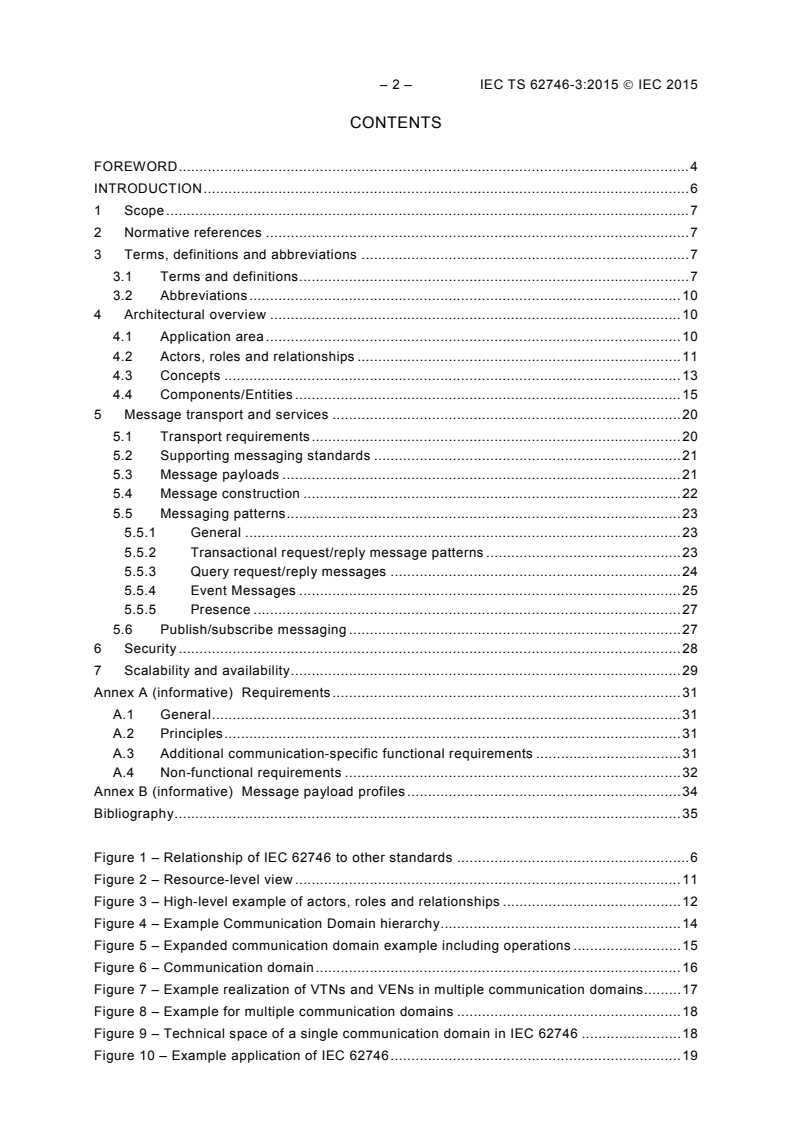
CONTENTS
FOREWORD . 4
INTRODUCTION . 6
1 Scope . 7
2 Normative references . 7
3 Terms, definitions and abbreviations . 7
3.1 Terms and definitions . 7
3.2 Abbreviations . 10
4 Architectural overview . 10
4.1 Application area . 10
4.2 Actors, roles and relationships . 11
4.3 Concepts . 13
4.4 Components/Entities . 15
5 Message transport and services . 20
5.1 Transport requirements . 20
5.2 Supporting messaging standards . 21
5.3 Message payloads . 21
5.4 Message construction . 22
5.5 Messaging patterns . 23
5.5.1 General . 23
5.5.2 Transactional request/reply message patterns . 23
5.5.3 Query request/reply messages . 24
5.5.4 Event Messages . 25
5.5.5 Presence . 27
5.6 Publish/subscribe messaging . 27
6 Security . 28
7 Scalability and availability . 29
Annex A (informative) Requirements . 31
A.1 General . 31
A.2 Principles . 31
A.3 Additional communication-specific functional requirements . 31
A.4 Non-functional requirements . 32
Annex B (informative) Message payload profiles . 34
Bibliography . 35
Figure 1 – Relationship of IEC 62746 to other standards . 6
Figure 2 – Resource-level view . 11
Figure 3 – High-level example of actors, roles and relationships . 12
Figure 4 – Example Communication Domain hierarchy . 14
Figure 5 – Expanded communication domain example including operations . 15
Figure 6 – Communication domain . 16
Figure 7 – Example realization of VTNs and VENs in multiple communication domains . 17
Figure 8 – Example for multiple communication domains . 18
Figure 9 – Technical space of a single communication domain in IEC 62746 . 18
Figure 10 – Example application of IEC 62746 . 19
Figure 11 – CEM and resource relationships . 20
Figure 12 – Example payload . 22
Figure 13 – Transactional request/reply initiated by VTN . 24
Figure 14 – Transaction request/reply initiated by VEN . 24
Figure 15 – Query request initiated by VTN . 25
Figure 16 – Query request initiated by VEN . 25
Figure 17 – Example of VTN initiated events . 26
Figure 18 – VEN initiated events . 26
Figure 19 – Example of publish/subscribe nodes. 27
Figure 20 – Security overview . 29
Figure 21 – Configuration for scalability and availability . 30
Figure B.1 – Profile structure . 34
– 4 – IEC TS 62746-3:2015 IEC 2015
INTERNATIONAL ELECTROTECHNICAL COMMISSION
____________
SYSTEMS INTERFACE BETWEEN CUSTOMER ENERGY
MANAGEMENT SYSTEM AND THE POWER MANAGEMENT SYSTEM –
Part 3: Architecture
FOREWORD
1) The International Electrotechnical Commission (IEC) is a worldwide organization for standardization comprising
all national electrotechnical committees (IEC National Committees). The object of IEC is to promote
international co-operation on all questions concerning standardization in the electrical and electronic fields. To
this end and in addition to other activities, IEC publishes International Standards, Technical Specifications,
Technical Reports, Publicly Available Specifications (PAS) and Guides (hereafter referred to as “IEC
Publication(s)”). Their preparation is entrusted to technical committees; any IEC National Committee interested
in the subject dealt with may participate in this preparatory work. International, governmental and non-
governmental organizations liaising with the IEC also participate in this preparation. IEC collaborates closely
with the International Organization for Standardization (ISO) in accordance with conditions determined by
agreement between the two organizations.
2) The formal decisions or agreements of IEC on technical matters express, as nearly as possible, an international
consensus of opinion on the relevant subjects since each technical committee has representation from all
interested IEC National Committees.
3) IEC Publications have the form of recommendations for international use and are accepted by IEC National
Committees in that sense. While all reasonable efforts are made to ensure that the technical content of IEC
Publications is accurate, IEC cannot be held responsible for the way in which they are used or for any
misinterpretation by any end user.
4) In order to promote international uniformity, IEC National Committees undertake to apply IEC Publications
transparently to the maximum extent possible in their national and regional publications. Any divergence
between any IEC Publication and the corresponding national or regional publication shall be clearly indicated in
the latter.
5) IEC itself does not provide any attestation of conformity. Independent certification bodies provide conformity
assessment services and, in some areas, access to IEC marks of conformity. IEC is not responsible for any
services carried out by independent certification bodies.
6) All users should ensure that they have the latest edition of this publication.
7) No liability shall attach to IEC or its directors, employees, servants or agents including individual experts and
members of its technical committees and IEC National Committees for any personal injury, property damage or
other damage of any nature whatsoever, whether direct or indirect, or for costs (including legal fees) and
expenses arising out of the publication, use of, or reliance upon, this IEC Publication or any other IEC
Publications.
8) Attention is drawn to the Normative references cited in this publication. Use of the referenced publications is
indispensable for the correct application of this publication.
9) Attention is drawn to the possibility that some of the elements of this IEC Publication may be the subject of
patent rights. IEC shall not be held responsible for identifying any or all such patent rights.
The main task of IEC technical committees is to prepare International Standards. In
exceptional circumstances, a technical committee may propose the publication of a technical
specification when
• the required support cannot be obtained for the publication of an International Standard,
despite repeated efforts, or
• the subject is still under technical development or where, for any other reason, there is the
future but no immediate possibility of an agreement on an International Standard.
Technical specifications are subject to review within three years of publication to decide
whether they can be transformed into International Standards.
IEC TS 62746-3, which is a technical specification, has been prepared by IEC technical
committee 57: Power systems management and associated information exchange.
The text of this technical specification is based on the following documents:
Enquiry draft Report on voting
57/1527/DTS 57/1610/RVC
Full information on the voting for the approval of this technical specification can be found in
the report on voting indicated in the above table.
This publication has been drafted in accordance with the ISO/IEC Directives, Part 2.
A list of all parts in the IEC 62746 series, published under the general title Systems interface
between customer energy management system and the power management system, can be
found on the IEC website.
The committee has decided that the contents of this publication will remain unchanged until
the stability date indicated on the IEC website under "http://webstore.iec.ch" in the data
related to the specific publication. At this date, the publication will be
• transformed into an International standard,
• reconfirmed,
• withdrawn,
• replaced by a revised edition, or
• amended.
A bilingual version of this publication may be issued at a later date.
IMPORTANT – The 'colour inside' logo on the cover page of this publication indicates
that it contains colours which are considered to be useful for the correct
understanding of its contents. Users should therefore print this document using a
colour printer.
– 6 – IEC TS 62746-3:2015 IEC 2015
INTRODUCTION
The purpose of this part of IEC 62746 is to define an architecture for IEC 62746 series of
standards that can be leveraged for the management of customer energy resources and DER.
These resources may be a combination of load, generation and storage resources that can be
managed to respond to signals provided by grid and/or market operators. These resources
may be identified and managed as individual resources with specific capabilities, or as virtual
resources with an aggregated set of capabilities.
The focus of this architecture is to leverage the Internet for communications between grid
operators, market operators, distribution system operators, electricity suppliers, aggregators,
service providers and energy resources.
This Technical Specification leverages existing IEC standards.The data model of IEC 62746 is
based on the Common Information Model and IEC 61850. IEC 62746 is transport-
independent.
Figure 1 shows the relationship of IEC 62746 to other IEC and ISO standards.
IEC
Figure 1 – Relationship of IEC 62746 to other standards
SYSTEMS INTERFACE BETWEEN CUSTOMER ENERGY
MANAGEMENT SYSTEM AND THE POWER MANAGEMENT SYSTEM –
Part 3: Architecture
1 Scope
This part of IEC 62746, which is a Technical Specification, establishes an architecture that is
supportive of interfaces between the Customer Energy Management System and the Power
Management System.
A DER Management System can also be a Customer Energy Management System.
2 Normative references
The following documents, in whole or in part, are normatively referenced in this document and
are indispensable for its application. For dated references, only the edition cited applies. For
undated references, the latest edition of the referenced document (including any
amendments) applies.
IEC 61968-9:2013, Application integration at electric utilities – System interfaces for
distribution management – Part 9: Interfaces for meter reading and control
IEC 61968-100, Application integration at electric utilities – System interfaces for distribution
management – Part 100: Implementation profiles
IEC 62351 (all parts), Power systems management and associated information exchange –
Data and communications security
IEC TR 62746-2:2015, Systems interface between customer energy management system and
the power management system – Part 2: Use cases and requirements
IEC 62443 (all parts), Industrial communication networks – Network and system security
3 Terms, definitions and abbreviations
For the purposes of this document, the following terms, definitions and abbreviations apply.
3.1 Terms and definitions
3.1.1
aggregation
collection of the capabilities of multiple resources into a single virtual resource
Note 1 to entry: A common use of aggregation is to collect many small resources and offer their capabilities in the
form of a single larger resource to a market.
3.1.2
cascading
event which occurs when a message published in one communication domain causes another
message to be published in one or more other communication domains at a different level of a
hierarchy
– 8 – IEC TS 62746-3:2015 IEC 2015
3.1.3
communication domain
logical association of a VTN with a set of VENs supported by an underlying communication
infrastructure
Note 1 to entry: This provides for authentication of VENs and secure communication services. Since VTN and
VEN are roles within a Communication Domain, it is possible for an actor to take a VTN role in one Communication
Domain and potentially one or more VEN roles in other Communication Domains.
Note 2 to entry: This term is defined by this technical specification.
3.1.4
customer energy manager
CEM
central managing function used by the customer to manage the flow of information between
the grid and connected smart devices at the customer premises
Note 1 to entry: This is defined in more detail in IEC TR 62746-2.
3.1.5
demand response
DR
incentivizing of customers by costs, ecological information or others in order to initiate a
change in their consumption or feed-in pattern (“bottom-up approach” = Customer decides,
based on EURELECTRIC Views on Demand-Side Participation [1])
Note 1 to entry: Alternative definition: In IEC 60050-617:2009, 617-04-15 it is defined as: action resulting from
management of the electricity demand in response to supply conditions.
3.1.6
distributed energy resource
specialized energy resource with a flexible load and/or supply generally at the distribution
level
3.1.7
message
method of conveying information between parties in a communication network
Note 1 to entry: The information may reflect a description of an object and/or data related to the object.
3.1.8
node
logical destination address for messages that are published using a publish/subscribe
communication infrastructure
Note 1 to entry: Depending upon the specific communication infrastructure this may also be called a ‘topic’ or
‘subject’.
3.1.9
publish/subscribe
communication pattern where a message sent from a source may be received by zero or more
interested subscribers
SEE: IEC 61968-100
3.1.10
request/reply
communication pattern where a request message is sent from one process to another
process, where there is that the expectation that a response message will be returned by the
receiver of the request message
SEE: IEC 61968-100.
3.1.11
resource
provider or consumer of energy
Note 1 to entry: A VEN may be responsible for managing one or more energy resources.
Note 2 to entry: Resources may be physical or aggregated.
3.1.12
signal
message that is sent to indicate a condition or information of potential interest
3.1.13
smart grid connection point
SG CP
information access point from the grid to the customer premises
Note 1 to entry: This is a logical connection point but not the electrical connection point.
Note 2 to entry: This is described in more detail in IEC TR 62746-2.
3.1.14
technical role
role which identifies responsibilities associated with participation within information
exchanges with other actors
Note 1 to entry: Actors defined by use cases have assigned roles with associated responsibilities. Technical roles
are physically realized through software and associated systems integration infrastructure. This is a term defined
here for the purposes of this Technical Specification.
3.1.15
virtual end node
technical role assumed by an actor where the actor is a consumer and/or producer of
messages that are defined by this Technical Specification
Note 1 to entry: A Virtual End Node (VEN) can be associated with zero or more resources. A VEN can receive
messages pushed from a VTN or send requests or events to a VTN. A VEN may communicate with multiple VTNs,
where each VTN is part of a different Communication Domain.
Note 2 to entry: This term is defined by this Technical Specification as a technical role, noting that there is a
somewhat related definition for an ‘End Device’ as defined by IEC 61968-9. While the concept is generic, the
specific term is borrowed from OpenADR 2.0 with the normative definition being provided by this Technical
Specification.
3.1.16
virtual resource
set of one or more physical resources that is represented as a single, aggregated resource
Note 1 to entry: This may be comprised of multiple entities that may be geographically distributed. Virtual
Resources can be an aggregated model of many types of load, generation and storage, such as VPP, PV, factory,
building, home, etc. Since the Virtual Resource can include both energy consumer and energy provider, the related
“net load curve” can be positive (in this case the Virtual Resource acts as a consumer which consumes electrical
power), or negative (in this case the Virtual Resource acts as generation assets to produce electrical power).
3.1.17
virtual top node
technical role assumed by an actor that is assuming responsibility for the coordination of
VENs within a Communication Domain
Note 1 to entry: This is a special case of a VEN, where a Virtual Top Node (VTN) is effectively a parent of many
VENs with the responsibility for coordination of those VENs. A VTN is responsible for pushing to or receiving
message from many VENs. A market operator, grid operator or aggregator are examples of actors which will
typically implement a VTN interface.
– 10 – IEC TS 62746-3:2015 IEC 2015
Note 2 to entry: This term is defined by this Technical Specification as a technical role, noting that there is a
related definition provided by IEC 61968-9. While the concept is generic, the specific term is borrowed from
OpenADR 2.0 with the normative definition being provided by this Technical Specification.
3.1.18
wire protocol
in a network, the mechanism transmitting data from a sender to a receiver
Note 1 to entry: If the sender and receiver use the same wire protocol they are said to interoperate. This does not
literally mean that signals are conveyed over a metal wire, as the term is also used in conjunction with wireless and
fiber communication media.
Note 2 to entry: This is a widely used phrase without a specific normative definition, where a definition is provided
here for the purposes of this technical specification.
3.2 Abbreviations
Abbreviation Description
CEM Customer Energy Manager
CIM Common Information Model
DER Distributed Energy Resources
DMZ De-Militarized Zone, a perimeter network used to shield an internal
trusted network from attacks from external networks such as the
Internet
DoS Denial of service
DR Demand Response
EV Electric Vehicle
HAN Home area network
IEC International Electrotechnical Commission
IETF Internet Engineering Task Force
JMS Java Message Service
LAN Local area network
PAN Premise area network, could be a LAN or HAN
PV Photovoltaic generator
SG CP Smart Grid Connection Point
SM Smart Meter
VEN Virtual End Node
VPP Virtual Power Plant
VTN Virtual Top Node
XML Extensible Markup Language
XMPP Extensible Messaging and Presence Protocol
XSD XML Schema
W3C World-wide Web Consortium
4 Architectural overview
4.1 Application area
Figure 2 shows a resource-level view of the area to be addressed by this Technical
Specification, where examples of specific actors are provided as related to interactions
between the smart grid and the customer premises at what is called the ‘smart grid connection
point’ (SG CP).
IEC
Figure 2 – Resource-level view
However, the problem space is extended upward to support coordination of these resources
by actors representing markets, aggregators and operations. In order to support the
coordination of these actors, there are a variety of information exchanges that are conveyed
using IEC 62746. More examples are provided by the use cases of IEC TR 62746-2.
4.2 Actors, roles and relationships
The purpose of this subclause is to provide an architecture overview from the perspective of
the identification of technical roles and associated communication standards that can be
applied to a set of actors in support of their respective functional roles and relationships. The
definitions of specific actors are provided by IEC TR 62746-2. The intent of the architecture is
to enable communications (primarily using public wide area networks, such as Internet)
between a wide variety of actors, including (but not limited to) utilities, market operators,
service providers, aggregators and customers for the purposes of coordinating and operating
distributed energy resources (DER) and demand response (DR).
IEC TR 62746-2 defines a large number of actors. It can be readily seen that there are many
similarities in some of those actors as well as functional overlap in the roles of many of the
actors. However, from the perspective of defining a supporting architecture it is important to
define technical roles and responsibilities that can be taken on by those actors.
It is not the intent of this Technical Specification to provide examples of all actors defined by
IEC TR 62746-2 or restate the definitions of those actors, and consequentially some higher-
level categorization of actors will be used within this Technical Specification as opposed to
specific actors in describing the use of this Technical Specification. Additionally it is the intent
of this architecture to support specific actors who are yet unknown. The basic requirement is
that an actor can assume (either directly or by proxy) the technical roles of ‘VTN’ and/or ‘VEN’
as defined by this architecture.
– 12 – IEC TS 62746-3:2015 IEC 2015
The focus of this architecture is the support of operations and markets as they interact with
the customer at the smart grid connection point. As an example, within a market for DER/DR,
there are typically a set of hierarchical relationships. Examples of these hierarchical
relationships for different categories of actors include:
• Resource Provider to Market Operators
• Resource Provider to Aggregators/Service Providers
• Aggregators/Service Providers to Market Operators
At the same time it is important to recognize that resources may be grouped into virtual
resources, where virtual resources are typically grouped, managed and coordinated by
aggregators. These example relationships are shown in the example diagram for wholesale
and retail energy markets given in Figure 3:
IEC
Figure 3 – High-level example of actors, roles and relationships
From Figure 3, it can be seen that the relationships are typically (but not always) hierarchical.
Examples of non-hierarchical relationships could exist in the case of a resource that may
participate in multiple markets or where some capabilities of a resource may be managed by
different parties. It is also possible to have a service provider gather usage information after
the fact for resources that are managed by one or more aggregators. It is also possible that
an aggregator or virtual resource could participate in both wholesale and retail markets. The
restrictions upon this are left to the rules imposed by the market, but are not technical
restrictions per se.
Also, dependent on the individual realization, the SG CP can be at different locations in the
diagram. Resources or Virtual Resources correspond to to either CEM or CEM Aggregator in
IEC TR 62746-2.
However, the key point of Figure 3 is to show that the relationships are typically ‘upstream’ or
‘downstream’. There is not an explicit requirement for direct peer-to-peer communication
between actors when the actors are at a common level. Typically the fan out is downstream,
where for example a market operator will communicate with large numbers of resources,
service providers or aggregators. That is also to say that a resource, service provider or
aggregator will only interact with a small number of upstream entities.
It is important to note that resources may also have IEC 61850-based communications for the
purpose of grid operations. The architecture supports the communication with distribution
management systems. This communication infrastructure can also be used for grid operations
and potentially to transport IEC 61850 messages. The use of IEC 61850 is otherwise outside
of the scope of this document.
4.3 Concepts
The purpose of this subclause is to introduce key architectural concepts as needed for the
definition of this Technical Specification in support of the use cases and requirements. These
key architectural concepts include the following:
• Communication Domain
• VTN Interface
• VEN Interface
• Customer Energy Manager
• Resource
• Cascading
• Aggregation
It can also be seen that resources may be leveraged in more than one market, provided that
there are controls (technical or contractual) that prohibit a resource from unfairly making
commitments for the same energy at the same time in more than one market.
The hierarchical relationships can be represented as different communication domains.
Resources can be registered within a market or virtualized through an aggregator, and
therefore associated with a communication domain accordingly
The example diagram of Figure 4 provides a ‘communication domain’ perspective, where
there can be many actors of different types within each communication do
...