

IEC 60539-1:2002
(Main)Directly heated negative temperature coefficient thermistors - Part 1: Generic specification
General Information
- Abstract
Applicable to directly heated negative temperature coefficient thermistors, typically made from transition metal oxide materials with semiconducting properties.
- Status
- Published
- Publication Date
- 25-Feb-2002
- Technical Committee
- TC 40 - Capacitors and resistors for electronic equipment
- Current Stage
- DELPUB - Deleted Publication
- Start Date
- 13-Feb-2008
- Completion Date
- 28-Aug-2026
Overview
IEC 60539-1:2002 - "Directly heated negative temperature coefficient thermistors - Part 1: Generic specification" is the IEC generic standard for directly heated NTC thermistors. It applies to thermistors typically made from transition metal oxide materials with semiconducting properties and establishes standard terminology, inspection procedures and test methods to be used in sectional and detail specifications for quality assessment and component procurement.
This Part 1 document provides the generic framework used by manufacturers, test houses and specifiers to define detailed product requirements and to ensure consistent evaluation of directly heated NTC thermistors.
Key Topics
- Scope and definitions: Clear definitions for terms such as type, style, thermistor, negative temperature coefficient (NTC), directly heated and indirectly heated thermistors.
- Technical data and symbols: Guidance on units, letter symbols and graphical symbols referenced to IEC/ISO publications (IEC 60027, IEC 60050, ISO 1000).
- Quality assessment procedures: Requirements for primary manufacture checks, qualification approval, conformance inspection, sampling and certified test records (references to IECQ procedures).
- Comprehensive test and measurement methods, including (but not limited to):
- Zero‑power resistance and B‑value (resistance ratio)
- Resistance/temperature characteristic
- Insulation resistance and voltage proof (for insulated types)
- Dissipation factor and thermal time constants
- Mechanical robustness (terminations, shock, vibration, bump, free fall)
- Solderability and resistance to soldering heat (including surface-mount considerations)
- Environmental tests (dry heat, cold, thermal shock, damp heat steady/cyclic, salt mist, climatic sequence)
- Special SMD tests (mounting, shear/adhesion, substrate bending, solvent resistance)
- Normative references: Cross-references to the IEC 60068 environmental test series and other IEC standards (IEC 60410, IEC 61760-1, IEC 60249, etc.).
- Annexes: Includes normative guidance on sampling plans (Annex A), rules for detail specifications (Annex B) and mounting examples for measurements (Annex C).
Applications
- Component specification and procurement for electronic equipment where temperature sensing, inrush current limiting, or temperature-dependent resistance is required.
- Design and qualification of NTC thermistors used in temperature sensors, inrush current limiters, and circuit protection applications.
- Test laboratories and manufacturers implementing standardized test methods and quality assurance programs.
Who should use this standard
- Thermistor manufacturers and R&D teams
- Electronic component test labs and certification bodies
- Design engineers and procurement specialists specifying NTC components
- Quality assurance and compliance teams using IECQ or similar assessment schemes
Related standards (select)
- IEC 60068 series (environmental testing)
- IEC 60410 (sampling plans)
- IEC 61760-1 (SMD specification methods)
- IEC 60027 / IEC 60050 (symbols and vocabulary)
Keywords: IEC 60539-1, NTC thermistors, directly heated thermistor standard, thermistor test methods, thermistor quality assessment, electronic component standards.
Relations
- Effective Date
- 05-Sep-2023
Frequently Asked Questions
IEC 60539-1:2002 is a standard published by the International Electrotechnical Commission (IEC). Its full title is "Directly heated negative temperature coefficient thermistors - Part 1: Generic specification". This standard covers: Applicable to directly heated negative temperature coefficient thermistors, typically made from transition metal oxide materials with semiconducting properties.
Applicable to directly heated negative temperature coefficient thermistors, typically made from transition metal oxide materials with semiconducting properties.
IEC 60539-1:2002 is classified under the following ICS (International Classification for Standards) categories: 31.040.30 - Thermistors. The ICS classification helps identify the subject area and facilitates finding related standards.
IEC 60539-1:2002 has the following relationships with other standards: It is inter standard links to IEC 60539-1:2008. Understanding these relationships helps ensure you are using the most current and applicable version of the standard.
IEC 60539-1:2002 is available in PDF format for immediate download after purchase. The document can be added to your cart and obtained through the secure checkout process. Digital delivery ensures instant access to the complete standard document.
Standards Content (Sample)
INTERNATIONAL IEC
STANDARD
60539-1
QC 430000
First edition
2002-02
Directly heated negative temperature
coefficient thermistors –
Part 1:
Generic specification
Thermistors à coefficient de température négatif
à chauffage direct –
Partie 1:
Spécification générique
Reference number
Publication numbering
As from 1 January 1997 all IEC publications are issued with a designation in the
60000 series. For example, IEC 34-1 is now referred to as IEC 60034-1.
Consolidated editions
The IEC is now publishing consolidated versions of its publications. For example,
edition numbers 1.0, 1.1 and 1.2 refer, respectively, to the base publication, the
base publication incorporating amendment 1 and the base publication incorporating
amendments 1 and 2.
Further information on IEC publications
The technical content of IEC publications is kept under constant review by the IEC,
thus ensuring that the content reflects current technology. Information relating to
this publication, including its validity, is available in the IEC Catalogue of
publications (see below) in addition to new editions, amendments and corrigenda.
Information on the subjects under consideration and work in progress undertaken
by the technical committee which has prepared this publication, as well as the list
of publications issued, is also available from the following:
• IEC Web Site (www.iec.ch)
• Catalogue of IEC publications
The on-line catalogue on the IEC web site (www.iec.ch/catlg-e.htm) enables
you to search by a variety of criteria including text searches, technical
committees and date of publication. On-line information is also available on
recently issued publications, withdrawn and replaced publications, as well as
corrigenda.
• IEC Just Published
This summary of recently issued publications (www.iec.ch/JP.htm) is also
available by email. Please contact the Customer Service Centre (see below) for
further information.
• Customer Service Centre
If you have any questions regarding this publication or need further assistance,
please contact the Customer Service Centre:
Email: custserv@iec.ch
Tel: +41 22 919 02 11
Fax: +41 22 919 03 00
INTERNATIONAL IEC
STANDARD
60539-1
QC 430000
First edition
2002-02
Directly heated negative temperature
coefficient thermistors –
Part 1:
Generic specification
Thermistors à coefficient de température négatif
à chauffage direct –
Partie 1:
Spécification générique
IEC 2002 Copyright - all rights reserved
No part of this publication may be reproduced or utilized in any form or by any means, electronic or
mechanical, including photocopying and microfilm, without permission in writing from the publisher.
International Electrotechnical Commission 3, rue de Varembé Geneva, Switzerland
Telefax: +41 22 919 0300 e-mail: inmail@iec.ch IEC web site http://www.iec.ch
Commission Electrotechnique Internationale
PRICE CODE
X
International Electrotechnical Commission
For price, see current catalogue
– 2 – 60539-1 IEC:2002(E)
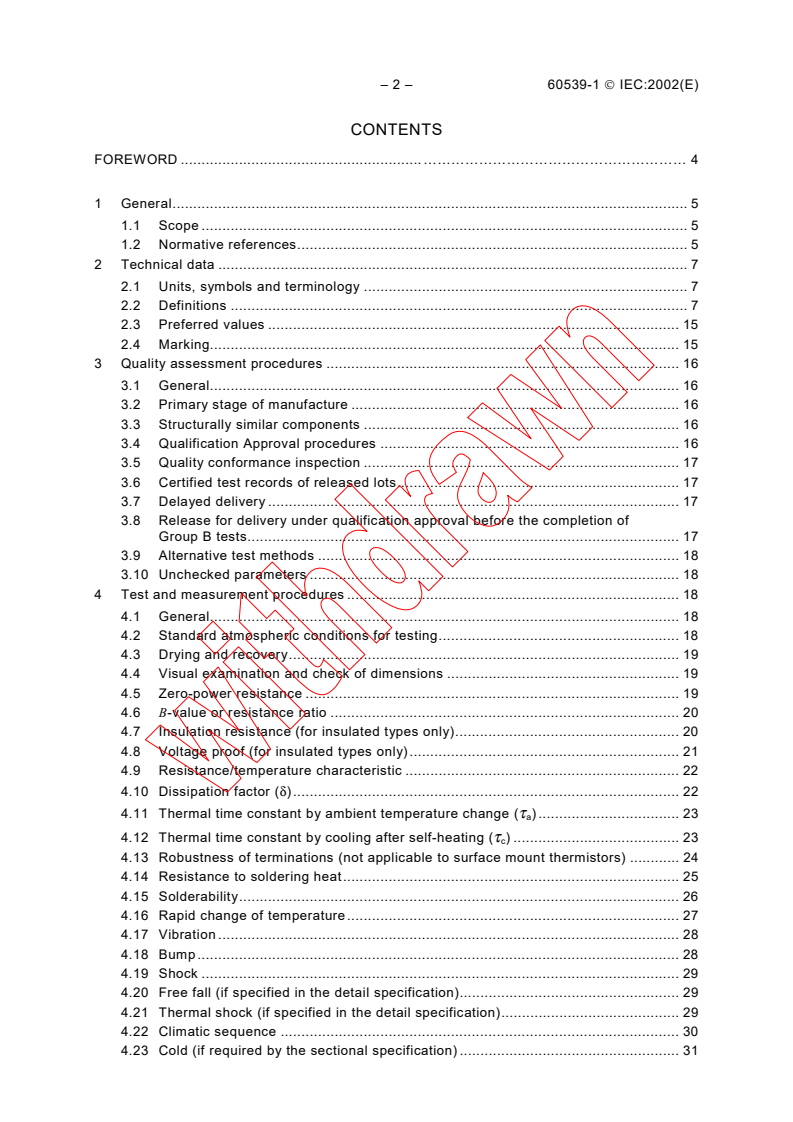
CONTENTS
FOREWORD .………………………………………………… 4
1 General. 5
1.1 Scope . 5
1.2 Normative references. 5
2 Technical data .7
2.1 Units, symbols and terminology . 7
2.2 Definitions . 7
2.3 Preferred values . 15
2.4 Marking. 15
3 Quality assessment procedures . 16
3.1 General. 16
3.2 Primary stage of manufacture . 16
3.3 Structurally similar components . 16
3.4 Qualification Approval procedures . 16
3.5 Quality conformance inspection . 17
3.6 Certified test records of released lots. 17
3.7 Delayed delivery . 17
3.8 Release for delivery under qualification approval before the completion of
Group B tests. 17
3.9 Alternative test methods . 18
3.10 Unchecked parameters . 18
4 Test and measurement procedures . 18
4.1 General. 18
4.2 Standard atmospheric conditions for testing. 18
4.3 Drying and recovery. 19
4.4 Visual examination and check of dimensions . 19
4.5 Zero-power resistance . 19
4.6 B-value or resistance ratio . 20
4.7 Insulation resistance (for insulated types only). 20
4.8 Voltage proof (for insulated types only). 21
4.9 Resistance/temperature characteristic . 22
4.10 Dissipation factor (δ). 22
4.11 Thermal time constant by ambient temperature change (τ ) . 23
a
4.12 Thermal time constant by cooling after self-heating (τ ) . 23
c
4.13 Robustness of terminations (not applicable to surface mount thermistors) . 24
4.14 Resistance to soldering heat. 25
4.15 Solderability. 26
4.16 Rapid change of temperature. 27
4.17 Vibration . 28
4.18 Bump. 28
4.19 Shock . 29
4.20 Free fall (if specified in the detail specification). 29
4.21 Thermal shock (if specified in the detail specification). 29
4.22 Climatic sequence . 30
4.23 Cold (if required by the sectional specification) . 31
60539-1 IEC:2002(E) – 3 –
4.24 Dry heat (if required by the sectional specification) . 32
4.25 Damp heat, steady state . 32
4.26 Endurance . 33
4.27 Mounting (for surface mount thermistors only) . 37
4.28 Shear (adhesion) test . 38
4.29 Substrate bending test . 39
4.30 Component solvent resistance . 39
4.31 Solvent resistance of marking . 39
4.32 Salt mist (if required by the sectional specification). 40
4.33 Sealing (if required by the sectional specification) . 40
Annex A (normative) Interpretation of sampling plans and procedures as described
in IEC 60410 for use within the IEC quality assessment system for electronic
components (IECQ). 41
Annex B (normative) Rules for the preparation of detail specifications for capacitors
and resistors for electronic equipment . 42
Annex C (informative) Typical examples of mountings for measurements of directly
heated thermistors . 43
– 4 – 60539-1 IEC:2002(E)
INTERNATIONAL ELECTROTECHNICAL COMMISSION
____________
DIRECTLY HEATED NEGATIVE TEMPERATURE COEFFICIENT
THERMISTORS –
Part 1: Generic specification
FOREWORD
1) The IEC (International Electrotechnical Commission) is a worldwide organization for standardization comprising
all national electrotechnical committees (IEC National Committees). The object of the IEC is to promote
international co-operation on all questions concerning standardization in the electrical and electronic fields. To
this end and in addition to other activities, the IEC publishes International Standards. Their preparation is
entrusted to technical committees; any IEC National Committee interested in the subject dealt with may
participate in this preparatory work. International, governmental and non-governmental organizations liaising
with the IEC also participate in this preparation. The IEC collaborates closely with the International
Organization for Standardization (ISO) in accordance with conditions determined by agreement between the
two organizations.
2) The formal decisions or agreements of the IEC on technical matters express, as nearly as possible, an
international consensus of opinion on the relevant subjects since each technical committee has representation
from all interested National Committees.
3) The documents produced have the form of recommendations for international use and are published in the form
of standards, technical specifications, technical reports or guides and they are accepted by the National
Committees in that sense.
4) In order to promote international unification, IEC National Committees undertake to apply IEC International
Standards transparently to the maximum extent possible in their national and regional standards. Any
divergence between the IEC Standard and the corresponding national or regional standard shall be clearly
indicated in the latter.
5) The IEC provides no marking procedure to indicate its approval and cannot be rendered responsible for any
equipment declared to be in conformity with one of its standards.
6) Attention is drawn to the possibility that some of the elements of this International Standard may be the subject
of patent rights. The IEC shall not be held responsible for identifying any or all such patent rights.
International Standard IEC 60539-1 has been prepared by IEC technical committee 40:
Capacitors and resistors for electronic equipment.
This edition cancels and replaces the first edition of IEC 60539 published in 1976.
The text of this standard is based on the following documents:
FDIS Report on voting
40/1193/FDIS 40/1249/RVD
Full information on the voting for the approval of this standard can be found in the report on
voting indicated in the above table.
This publication has been drafted in accordance with the ISO/IEC Directives, Part 2.
Annexes A, B and C form an integral part of this standard.
The committee has decided that the contents of this publication will remain unchanged until
2005. At this date, the publication will be
reconfirmed;
withdrawn;
replaced by a revised edition, or
amended.
60539-1 IEC:2002(E) – 5 –
DIRECTLY HEATED NEGATIVE TEMPERATURE COEFFICIENT
THERMISTORS –
Part 1: Generic specification
1 General
1.1 Scope
This part of IEC 60539 is applicable to directly heated negative temperature coefficient
thermistors, typically made from transition metal oxide materials with semiconducting
properties.
It establishes standard terms, inspection procedures and methods of test for use in sectional
and detail specifications of electronic components for quality assessment or any other
purpose.
1.2 Normative references
The following normative documents contain provisions which, through reference in this text,
constitute provisions of this part of IEC 60539. For dated references, subsequent amend-
ments to, or revisions of, any of these publications do not apply. However, parties to
agreements based on this part of IEC 60539 are encouraged to investigate the possibility of
applying the most recent editions of the normative documents indicated below. For undated
references, the latest edition of the normative document referred to applies. Members of IEC
and ISO maintain registers of currently valid International Standards.
NOTE In the case of IEC 60068 standards, use the referenced edition.
IEC 60027 (all parts), Letter symbols to be used in electrical technology
IEC 60050 (all parts), International Electrotechnical Vocabulary (IEV)
IEC 60062:1992, Marking codes for resistors and capacitors
IEC 60068-1:1988, Environmental testing – Part 1: General and guidance
Amendment 1 (1992)
IEC 60068-2-1:1990, Environmental testing – Part 2: Tests – Tests A: Cold
Amendment 1 (1993)
Amendment 2 (1994)
IEC 60068-2-2:1974, Environmental testing – Part 2: Tests – Tests B: Dry Heat
Amendment 1 (1993)
Amendment 2 (1994)
IEC 60068-2-3:1969, Environmental testing – Part 2: Tests – Test Ca: Damp heat, steady
state (incorporating Amendment 1 (1984))
IEC 60068-2-6:1995, Environmental testing – Part 2: Tests – Test Fc: Vibration (sinusoidal)
IEC 60068-2-11:1981, Environmental testing – Part 2: Tests – Test Ka: Salt mist
IEC 60068-2-13:1983, Environmental testing – Part 2: Tests – Test M: Low air pressure
– 6 – 60539-1 IEC:2002(E)
IEC 60068-2-14:1984, Environmental testing – Part 2: Tests – Test N: Change of temperature
Amendment 1 (1986)
IEC 60068-2-17:1994, Environmental testing – Part 2: Tests – Test Q: Sealing
IEC 60068-2-20:1979, Environmental testing – Part 2: Tests – Test T: Soldering
Amendment 2 (1987)
IEC 60068-2-21:1983, Environmental testing – Part 2: Tests – Test U: Robustness of
terminations and integral mounting devices
Amendment 2 (1991)
Amendment 3 (1992)
IEC 60068-2-27:1987, Environmental testing – Part 2: Tests – Test Ea and guidance: Shock
IEC 60068-2-29:1987, Environmental testing – Part 2: Tests – Test Eb and guidance: Bump
IEC 60068-2-30:1980, Environmental testing – Part 2: Tests – Test Db and guidance: Damp
heat, cyclic (12 + 12-hour cycle)
Amendment 1 (1985)
IEC 60068-2-45:1980, Environmental testing – Part 2: Tests – Test XA and guidance:
Immersion in cleaning solvents
Amendment 1 (1993)
IEC 60068-2-52:1984, Environmental testing – Part 2: Tests – Test Kb: Salt mist, cyclic
(sodium chloride solution)
IEC 60068-2-58:1989, Environmental testing – Part 2: Tests – Test Td: Solderability,
resistance to dissolution of metallization and to soldering heat of surface mounting devices
(SMD)
IEC 60249-2-4:1987, Base materials for printed circuits – Part 2: Specifications –
Specification No. 4: Epoxide woven glass fabric copper-clad laminated sheet, general purpose
grade
Amendment 3 (1993)
Amendment 4 (1994)
IEC 60294:1969, Measurement of the dimensions of a cylindrical component having two axial
terminations
IEC 60410:1973, Sampling plans and procedures for inspection by attributes
IEC 60617 (all parts), Graphical symbols for diagrams
IEC 60717:1981, Method for determination of the space required by capacitors and resistors
with unidirectional terminations
IEC 61760-1:1998, Surface mounting technology – Part 1: Standard method for the
specification of surface mounting components (SMDs)
IEC QC 001002-3:1998, IEC Quality Assessment System for Electronic Components (IECQ) –
Rules of procedure – Part 3: Approval procedures
ISO 1 000:1992, SI units and recommendations for the use of their multiples and of certain
other units
60539-1 IEC:2002(E) – 7 –
2 Technical data
2.1 Units, symbols and terminology
Units, graphical symbols, letter symbols and terminology should, whenever possible, be taken
from the following publications:
– IEC 60027
– IEC 60050
– IEC 60617
– ISO 1000
When further items are required they should be derived in accordance with the principles of
the publications listed above.
2.2 Definitions
For the purpose of this part of IEC 60539, the following definitions apply:
2.2.1
type
products having similar design features manufactured by the same techniques and falling
within the manufacturer's usual range of ratings for these products
NOTE 1 Mounting accessories are ignored, provided they have no significant effect on the test results.
NOTE 2 Ratings cover the combination of:
– electrical ratings;
– sizes;
– climatic category.
NOTE 3 The limits of the range of ratings shall be given in the detail specification.
2.2.2
style
variation within a type having specific nominal dimensions and characteristics
2.2.3
thermistor
thermally sensitive semiconducting resistor whose primary function is to exhibit an important
change in electrical resistance with a change in body temperature
2.2.4
negative temperature coefficient thermistor (NTC)
thermistor in which the resistance decreases with increasing temperature
2.2.5
directly heated negative temperature coefficient thermistor
it obtains its resistance variation by the changes of physical conditions such as current
through the thermistor, ambient temperature, humidity, wind velocity, gas, etc.
2.2.6
indirectly heated negative temperature coefficient thermistor
it obtains its resistance variation primarily by the change of temperature of the thermistor, due
to the change of a current through a separate heater which is in close contact with, but
electrically insulated from, the thermistor element
NOTE Temperature of the thermistor can also be changed by the changes of physical conditions such as current
through the thermistor element itself, ambient temperature, humidity, wind velocity, gas, etc.
– 8 – 60539-1 IEC:2002(E)
2.2.7
positive temperature coefficient (PTC) thermistor (for information only)
thermistor in which the resistance increases with increasing temperature
2.2.8
thermistor with wire terminations
thermistor provided with wire terminations
2.2.9
thermistor without wire terminations
thermistor provided only with two metallized faces, to be used as electrical contacts
2.2.10
insulated thermistor
thermistor coated with materials such as resin, glass or ceramic, capable of meeting the
requirements of the insulation resistance and voltage proof tests when specified in the test
schedule
2.2.11
non-insulated thermistor
thermistor with or without coating materials for surfacing of elements but not intended to meet
the requirements of the insulation resistance and voltage proof tests when specified in the
test schedule
2.2.12
surface mount thermistor
thermistor whose small dimensions and nature or shape of terminations make them suitable
for use in hybrid circuits and on printed board
2.2.13
assembled thermistor (probe)
thermistor encapsulated in different materials such as tubes, plastic and metal housing and/or
assembled with cables and/or connectors
2.2.14
thermistor for sensing
thermistor which responds to temperature changes and therefore is used for temperature
sensing and control
2.2.15
inrush current limiting thermistor
thermistor which limits the inrush current just after switching on the power
2.2.16
residual resistance (only for inrush current limiting thermistors)
value of the d.c. resistance of a thermistor when its thermal stability is reached with the
maximum current passing
2.2.17
maximum permissible capacitance (only for inrush current limiting thermistors)
maximum permissible capacitance value of a capacitor which can be connected to a
thermistor under loading
2.2.18
zero-power resistance, R
T
value of the d.c. resistance of a thermistor, when measured at a specified temperature, under
such conditions that the change in resistance due to the internal generation of heat is
negligible with respect to the total error of measurement
60539-1 IEC:2002(E) – 9 –
2.2.19
rated zero-power resistance
nominal value at the standard reference temperature of 25 °C, unless otherwise specified
2.2.20
resistance-temperature characteristic
relationship between the zero-power resistance and the body temperature of a thermistor
The resistance law follows approximately the formula:
1 1
B −
R = R ×e
T T
a
a
where
R is the zero-power resistance in ohms (Ω) at absolute temperature T in kelvins (K);
R is the zero-power resistance in ohms (Ω) at absolute temperature T in kelvins (K);
a a
B is the thermal sensitivity index (see 2.2.22).
NOTE This formula is only applicable for representing the resistance variation over a restricted temperature
range. For more precise representation of the R/T-curve, a resistance/temperature relation should be specified in
tabulated form in the detail specification.
ln R
R
a
R
R
b
(K)
Ta T Tb T
Figure 1 – Typical resistance-temperature characteristic for NTC thermistors
2.2.21
resistance ratio
ratio of the zero-power resistance of a thermistor measured at the reference temperature of
25 °C to that measured at 85 °C, or at such other pairs of temperatures as may be prescribed
in the detail specification
2.2.22
B-value
index of the thermal sensitivity expressed by the formula:
B = [(T × T )/(T – T )] × ln(R /R )
a b b a a b
or
B = 2,303 × [(T × T )/(T – T )] × log(R /R )
a b b a a b
– 10 – 60539-1 IEC:2002(E)
where
B is a constant in kelvins (K);
R is the zero-power resistance in ohms (Ω) at temperature T in kelvins (K);
a a
R is the zero-power resistance in ohms (Ω) at temperature T in kelvins (K);
b b
*)
T = 298,15 K ;
a
*)
T = 358,15 K .
b
*)The values given above for T and T are the preferred values and are equivalent to +25 °C and +85 °C
a b
respectively.
NOTE Where the detail specification prescribes that the B-value shall be measured at other temperatures, the
specified values (in kelvins) shall be used for T and T in the calculation in place of the preferred values and the
a b
B-value may be expressed by “B ”.
a/b
2.2.23
zero-power temperature coefficient of resistance, α
T
the ratio at a specified temperature (T) of the rate of change of zero-power resistance with
temperature to the zero-power resistance of the thermistor, expressed by the formula:
α = 1/R × dR /dT × 100
T T T
The value α can be approximately calculated by the formula:
T
α = –B/T × 100
T
where
α is the zero-power temperature coefficient of resistance in %/K;
T
R is the zero-power resistance in ohms at temperature T in kelvins (K);
T
B is the index of the thermal sensitivity in kelvins (K).
2.2.24
category temperature range
range of ambient temperatures for which the thermistor has been designed to operate
continuously at zero-power, defined by the temperature limits of the appropriate category
2.2.25
upper category temperature, θ
max
maximum ambient temperature for which a thermistor has been designed to operate
continuously at zero-power
2.2.26
lower category temperature, θ
min
minimum ambient temperature for which a thermistor has been designed to operate
continuously at zero-power
2.2.27
storage temperature range
range of ambient temperatures for which a thermistor can be stored continuously under no-
load condition
2.2.28
decreased power dissipation curve (not for inrush current limiting thermistors)
relation between the ambient temperature and the maximum power dissipation P , which is
maxθ
usually expressed as curve a or alternatively as curve b in figure 2
60539-1 IEC:2002(E) – 11 –
Pmax
θ
P
max
θ
R
θ
θ θ θ θR θ θ θ
min 1 2
3 4 max
Curve a
P
max
θ
P
max
θ
R
θ
θ θ = θ
R θ θ
2 max.
Curve b
Figure 2 – Decreased power dissipation curve
2.2.29
maximum power dissipation at rated ambient temperature θ (P )
R max
θ
R
maximum value of the power dissipation which can be continuously applied to the thermistor
at the rated ambient temperature θ (see curve a, θ ≤ θ ≤θ or curve b, θ ≤ θ = θ in
R R R
2 3 2 3
figure 2)
The rated ambient temperature θ is the ambient temperature specified in the detail
R
specification and is usually 25 °C.
2.2.30
maximum power dissipation at ambient temperature θ (P )
maxθ
maximum value of the power dissipation which can be continuously applied to the thermistor
at an ambient temperature θ
Curve a
The maximum power dissipation rises at a temperature θ linearly to a temperature θ .
1 2
Between temperature θ and θ the power dissipation is constant. When the temperature
2 3
exceeds θ , the power dissipation must be decreased linearly to zero at a temperature θ .
3 4
The maximum power dissipation at ambient temperature θ in general is calculated as follows:
P = I × U
maxθ maxθ
where U is the voltage across the thermistor (for I , see 2.2.32).
maxθ
– 12 – 60539-1 IEC:2002(E)
The maximum power dissipation can be expressed by the following formula:
θ − θ
θ ≤ θ ≤θ P = P ×
1 2:
max.θ max.θ
R
θ − θ
2 1
θ − θ
θ ≤ θ ≤θ P = P ×
3 4:
max.θ max .θ
R
θ − θ
4 3
where
θ is the rated ambient temperature in Celsius (°C);
R
θ is the temperature in Celsius (°C) specified in the detail specification below which zero-
power shall be applied. θ is equal to the lower category temperature θ (°C) or
1 min
.
higher;
θ is the lowest temperature at which P can be applied. θ = 0 °C, unless otherwise
2 max.θ 2
specified in the detail specification;
θ is the maximum temperature at which P can be applied. θ = 55 °C, unless
3 max.θ 3
otherwise specified in the detail specification;
θ is the temperature in Celsius (°C) specified in the detail specification, above which zero-
power shall be applied. θ is equal to, or lower than the upper category temperature
θ (°C).
max.
Curve b
The maximum power dissipation is constant between temperature θ and θ . θ = 0 °C, unless
2 R 2
otherwise specified in the detail specification. When the temperature exceeds θ , the power
R
dissipation must be decreased linearly to zero at a temperature θ .
The maximum power dissipation at ambient temperature θ in general is calculated as follows:
P = I × U
maxθ maxθ
where U is the voltage across the thermistor (for I , see 2.2.32).
max.θ
The maximum power dissipation can be expressed by the following formula:
θ −θ
θ ≤ θ ≤θ P = P ×
R 4:
maxθ maxθ
R
θ −θ
4 R
where
θR is the rated ambient temperature in Celsius ( °C). θR = 25 °C, unless otherwise
specified in the detail specification;
θ4 is the temperature in Celsius (°C) specified in the detail specification, above which zero-
power shall be applied. θ4 is equal to, or lower than the upper category temperature
θ (°C).
max.
2.2.31
maximum current at ambient temperature of 25 °C (I ) (for inrush current limiting
max25
thermistors)
maximum value of current (d.c. or r.m.s. values for sine-shaped a.c.) which can be conti-
nuously applied to the thermistor at an ambient temperature of 25 °C (see curve c, θ ≤ 25 °C
≤ θ or curve d, θ ≤ θ = θ in figure 3)
3 2 R 3
NOTE The maximum power dissipation at ambient temperature of 25 °C (P ) is calculated by:
max25
P = I × U, where U is the voltage drop across the thermistor.
max25 max25
60539-1 IEC:2002(E) – 13 –
Imax
θ
I
max25
θ
θ θ θ θ θ θ θ
R
min 1 2
3 4 max.
Curve c
I
maxθ
I
max25
θ
θ θ = θ
R θ θ
2 max.
Curve d
Figure 3 – Maximum current derating
2.2.32
θ
maximum current at ambient temperature (I )
maxθ
maximum value of the current which can pass continuously through the thermistor at an
ambient temperature θ
Curve c
The maximum current rises at a temperature θ linearly to a temperature θ . Between
1 2
temperature θ and θ the current is constant. When the temperature exceeds θ , the current
2 3 3
must be decreased linearly to zero at a temperature θ .
The maximum current can be expressed by the following formula:
θ −θ
θ ≤ θ ≤θ I = I ×
1 2:
maxθ max25
θ −θ
2 1
θ ≤ θ ≤θ
3 4:
where
θ is the ambient temperature in Celsius ( °C);
θ is the temperature in Celsius (°C) specified in the detail specification, which is equal to the
lower category temperature θ (°C) or higher;
min
θ is the ambient temperature at 0 °C, unless otherwise specified in the relevant detail
specification;
θ is the ambient temperature at 55 °C, unless otherwise specified in the relevant detail
specification;
θ is the temperature in Celsius (°C) specified in the detail specification, which is equal to the
upper category temperature θ (°C) or lower.
max
– 14 – 60539-1 IEC:2002(E)
Curve d
The maximum current is constant between temperature θ and θ . θ = 0 °C, unless otherwise
2 R 2
specified in the detail specification. When the temperature exceeds θ , the current must be
R
decreased linearly to zero at a temperature θ .
The maximum current can be expressed by the following formula:
θ − θ
θ ≤ θ ≤θ I = I ×
R 4:
maxθ max25
θ − θ
4 R
where
θ is the rated ambient temperature specified in the detail specification. θ = 25 °C, unless
R R
otherwise specified in the detail specification;
θ is the temperature in Celsius (°C) specified in the detail specification, which is equal to the
upper category temperature θ (°C) or lower.
max.
2.2.33
dissipation factor, δ
the power dissipation required for a thermistor to raise its temperature by 1 K and which is
generally the ratio of the power dissipation change to the resulting thermistor body
temperature change at a specified ambient temperature
2.2.34
response time
the time (in s) required for a thermistor to change its temperature between two defined
conditions when subjected to a change in ambient temperature, power or a combination of
temperature and power
NOTE Because of the impracticability, to measure response time directly, two methods are defined to measure
the thermal time constant directly.
2.2.34.1
thermal time constant by ambient temperature change, τ
a
the time (in seconds) required for a thermistor to respond to 63,2 % of an external step
change in ambient temperature in a defined medium
NOTE Step change and medium are specified in the detail specification.
2.2.34.2
thermal time constant by cooling after self-heating, τ
c
the time (in seconds) required for a thermistor to cool by 63,2 % of its temperature excess
induced by self-heating, in a defined medium
2.2.35
heat capacity, C
th
the energy (in joules) the thermistor needs to raise 1 K in temperature. It is completely
determined by the component design
NOTE The heat capacity is calculated by the following formula: C = δ × τ
th c
2.2.36
voltage-current characteristic
relationship between the voltage (d.c., a.c. r.m.s.) across the thermistor and the applied
steady-state current when the thermistor reaches a thermal equilibrium condition in still air or
in the still medium specified in the detail specification, at 25 °C or at the temperature
specified in the detail specification
60539-1 IEC:2002(E) – 15 –
2.3 Preferred values
Each sectional specification shall prescribe the preferred values appropriate to the sub-family.
2.3.1 Climatic categories
The thermistors covered by this standard are classified into climatic categories according to
the general rules given in appendix A of IEC 60068-1.
The upper and lower category temperatures and the duration of the damp heat, steady state
test shall be selected from table 1.
Table 1 – Upper and lower category temperatures and duration of the damp heat test
Lower category temperature –90, –80, –65, –55, –40, –25, –10,
–5, +5
ºC
Upper category temperature 30, 40, 55, 70, 85, 100, 105, 125,
150, 155, 175, 200, 250, 315, 400,
ºC
500, 630, 800, 1000
Damp heat, steady state 4, 21, 42, 56
days
The detail specification shall prescribe the appropriate category.
2.4 Marking
2.4.1 General
The following shall be clearly marked on the thermistor in the following order of precedence
as space permits:
a) rated zero-power resistance;
b) manufacturer's name and/or trade mark;
c) date of manufacture;
d) tolerance on rated zero-power resistance;
e) the number of the detail specification and style.
The package containing the thermistor(s) shall be clearly marked with all the information
listed above.
Any additional marking shall be so applied that no confusion can arise.
2.4.2 Small size types such as surface mount thermistors are generally not marked on the
body. If some marking can be applied, they shall be clearly marked with as many as possible
of the above items as is considered useful. Any duplication of information in the marking on
the thermistor should be avoided.
2.4.3 Coding
Where coding for resistance value, tolerance or date is used, the method shall be one
selected from those given in IEC 60062.
– 16 – 60539-1 IEC:2002(E)
3 Quality assessment procedures
3.1 General
When this standard and any related standards are used for the purpose of a full quality
assessment system such as the IEC Quality Assessment System for Electronic Components
(IECQ), compliance with 3.4 and 3.5 is required.
When such standards are used outside such quality assessment systems as the IECQ system
for purposes such as design proving or type testing, the procedures and requirements of 3.4.1
and 3.4.2 b) may be used, but the tests and parts of tests shall be applied in the order given
in the test schedules.
3.2 Primary stage of manufacture
The primary stage of manufacture is defined as the initial mixing process of ingredients.
3.3 Structurally similar components
Thermistors may be grouped as structurally similar for the purpose of forming inspection lots
provided that the following requirements are met:
– they shall be produced by one manufacturer on one site using essentially the same
design, materials, processes and methods;
– the sample taken shall be determined from the total lot size of the grouped devices;
– structurally similar devices should preferably be included in one detail specification but the
details of all claims to structural similarity shall be declared in the qualification approval
test reports.
3.3.1 For electrical tests, devices having the same electrical characteristics may be grouped
provided that the element determining the characteristics is similar for all the devices
concerned.
For environmental tests, devices having the same encapsulation, basic internal
3.3.2
structure and finishing processes, may be grouped.
3.3.3 For visual inspection (except marking), devices may be grouped if they have been
made on the same production line, have the same dimensions, encapsulation and external
finish.
This grouping may also be used for robustness of terminations and soldering tests where it is
convenient to group devices with different internal structures.
3.3.4 For endurance tests, thermistors may be grouped if they have been made on the same
production line using the same design and differing only in electrical characteristics. If it can
be shown that one type from the group is more heavily stressed than the others then tests on
this type may be accepted for the remaining members of the group.
3.4 Qualification approval procedures
The manufacturer shall comply with:
3.4.1
a) the general requirements of clause 3 of IEC QC 001002-3 governing qualification
approval, and
b) the requirements for the primary stage of manufacture (see 3.2).
In addition to the requirements of 3.4.1, the procedures a) or b) below shall apply.
3.4.2
60539-1 IEC:2002(E) – 17 –
a) the manufacturer shall produce test evidence of conformance to the specification
requirements on three lots taken in as short a time as possible for lot-by-lot inspection and
on one lot for periodic inspection.
Samples shall be taken from the lots in accordance with IEC 60410 (see annex A). Normal
inspection shall be used, but where the sample size would give acceptance on zero non-
conformances, additional specimens shall be taken to meet the sample size required to
give acceptance on one non-conforming item.
b) the manufacturer may, as an alternative to the procedure specified in 3.4.2 a), produce
test evidence to show conformance to the specification requirements on one of the fixed
sample size test schedules given in the sectional specification.
The specimens taken to form the sample shall be selected at random from current
production or as agreed with the National Supervising Inspectorate.
For the two procedures the sample sizes and the permissible number of non-conformances
shall be of comparative order. The test conditions and requirements shall be the same.
3.4.3 Qualification approval obtained as part of a quality assessment system, shall be
maintained by regular demonstration of compliance with the requirements for quality
conformance (see 3.5). Otherwise, this qualification approval must be verified by the rules for
the maintenance of qualification approval given in 3.1.7 of IEC QC 001002-3.
3.5 Quality conformance inspection
Blank detail specifications associated with the sectional specifications shall prescribe the test
schedule for quality conformance inspection. This schedule shall also specify the grouping,
sampling and periodicity for the lot-by-lot and periodic inspection.
Inspection levels and sampling plans shall be selected from those given in IEC 60410.
If required, more then one test schedule may be specified.
3.6 Certified test records of released lots
When certified test records are requested by a purchaser, they shall be specified in the detail
specification.
3.7 Delayed delivery
Thermistors held for a period exceeding two years (unless otherwise specified in the sectional
specification), following the release of the lot shall, before delivery, be re-examined as
specified in the sectional specification.
The re-examination procedure adopted by the manufacturer's Designated Management
Representative shall be approved by the National Supervising Inspectorate.
Once a lot has been satisfactorily re-inspected, its quality is reassured for the specified
period.
3.8 Release for delivery under qualification approval before the completion of
group B tests
When the conditions of IEC 60410 for changing to reduced inspection have been satisfied for
all group B tests, the manufacturer is permitted to release components before the completion
of such tests.
– 18 – 60539-1 IEC:2002(E)
3.9 Alternative test methods
See 3.2.3.7 of IEC QC 001002-3 with the following details:
In case of dispute, for referee and reference purposes only the specified methods shall be
used.
3.10 Unchecked parameters
Only those parameters of a component which have been specified in a detail specification and
which were subject to testing shall be assumed to be within the specified limits.
It cannot be assumed that any unspecified parameter will remain unchanged from one
component to another. Should, for any reason, it be necessary for further parameters to be
controlled, then a new, more extensive specification shall be used.
The additional test method(s) shall be fully described and appropriate limits, sampling plans
and inspection levels specified.
4 Test and measurement procedures
4.1 General
The sectional and/or blank detail specifications shall contain tables showing the tests to be
made, which measurements are to be made before and after each test or sub-group of tests,
and the sequence in which they shall be carried out. The stages of each test shall be carried
out in the order written. The measuring conditions shall be the same for initial and final
measurements.
If national specifications within any quality assessment system include methods other than
those specified in the above documents, they shall be fully described.
The issue and amendment status of any IEC 60068 test in this clause is given in 1.2.
4.2 Standard atmospheric conditions for testing
Unless otherwise specified, all tests and measurements shall be made under standard
atmospheric conditions for testing as given in 5.3 of IEC 60068-1:
– temperature: 15 °C to 35 °C;
– relative humidity: 25 % to 75 %;
– air pressure: 86 kPa to 106 kPa.
Before the measurements are made, the thermistor shall be stored at the measuring
temperature for a time sufficient to allow the entire thermistor to reach this temperature. The
same period as is prescribed for recovery at the end of a test is normally sufficient for this
purpose.
During measurements, the thermistor shall not be exposed to draughts, direct sun-rays or
other influences likely to cause error.
When measurements are made at a temperature other than the specified temperature, the
results shall, when necessary, be corrected to the specified temperature. The ambient
temperature during the measurements shall be stated in the test report.
When tests are conducted in a sequence, the final measurements of one test may be taken as
the initial measurements for the succeeding test.
60539-1 IEC:2002(E) – 19 –
4.3 Drying and recovery
4.3.1 Drying
Where drying is called for in the specification, the thermistor shall be conditioned before
measurement is made, using procedure I or procedure II as called for in the detail
specification.
Procedure I
For 24 h ± 4 h in an oven at a temperature of 55 °C ± 2 °C and relative humidity not
exceeding 20 %.
Procedure II
For 96 h ± 4 h in an oven at 100 °C ± 5 °C.
The thermistor shall then be allowed to cool in a desiccator using a suitable desiccant, such
as activated alumina or silica gel, and shall be kept therein from the time of removal from the
oven to the beginning of the specified tests.
4.3.2 Recovery
Unless otherwise specified, recovery shall take place under the standard atmospheric
conditions for testing (4.2). If recovery has to be made under closely controlled conditi
...