

ISO/IEC 14763-4:2018
(Main)Information technology - Implementation and operation of customer premises cabling - Part 4: Measurement of end-to-end (E2E) links
General Information
- Abstract
ISO/IEC 14763-4:2018(E) specifies the measurement at frequencies of end-to-end links of two- and four-pair balanced cabling of 100 MHz of Class D and 250 MHz of Class E including free connectors which terminate two and four pairs in both field and laboratory conditions.
- Status
- Published
- Publication Date
- 26-Feb-2018
- Technical Committee
- ISO/IEC JTC 1/SC 25 - Interconnection of information technology equipment
- Drafting Committee
- WG 3 - ISO/IEC JTC 1/SC 25/WG 3
- Current Stage
- DELPUB - Deleted Publication
- Start Date
- 22-Mar-2021
- Completion Date
- 30-Sep-2019

Overview
ISO/IEC 14763-4:2018 is an international standard developed by the International Electrotechnical Commission (IEC) in collaboration with ISO, focusing on the measurement of end-to-end (E2E) links in customer premises cabling systems. It specifies procedures and requirements for measuring two- and four-pair balanced cabling systems at frequencies of up to 100 MHz for Class D and up to 250 MHz for Class E cabling. This includes cabling terminated with free connectors, both in laboratory and field environments.
The standard supports reliable assessment of cabling performance, ensuring effective data transmission and compliance with relevant generic cabling standards like ISO/IEC 11801-1. Its purpose is to address the influence of terminations and connectors on the overall cabling link performance, which traditional channel-level tests do not fully capture.
Key Topics
- End-to-end (E2E) Link Definition: The complete transmission path through structured cabling including the passive components and terminations attached to equipment at both ends.
- Measurement Frequency Range: Focuses on 100 MHz for Class D cabling and 250 MHz for Class E cabling, covering balanced copper cabling systems terminated with free connectors.
- Test Environments: Defines testing methods for both laboratory and field conditions, ensuring consistency and accuracy in diverse settings.
- Test Configuration and Limits: Specifies configuration steps and performance limits according to ISO/IEC TR 11801-9902 and the use of compatible cabling components as outlined in ISO/IEC 11801-1.
- Test Heads and Equipment Requirements: Includes detailed requirements for test heads compliant with IEC connector series (e.g., IEC 60603-7, IEC 61076 series) to assure measurement accuracy and consistency.
- Conformance Criteria: Sets forth criteria that tests must meet for valid E2E link measurements, incorporating electrical parameters and physical cabling structure assessments.
- Visual Inspection Protocols: Stresses the importance of initial visual inspections in the field to identify obvious installation issues before measurement.
- References to Related Standards: Explicit connections to other standards such as IEC 61935 for test methods, and ISO/IEC 14763-2 covering planning and installation for comprehensive cabling implementation.
Applications
- Customer Premises Cabling Verification: Ensures complete verification of installed copper cabling systems from one end node to another, helping installers and system integrators confirm proper termination and wiring performance.
- Performance Assessment: Enables testing labs and field engineers to assess cabling according to Class D and Class E performance limits, including the impact of connectors and terminations that traditional channel tests may miss.
- Quality Assurance in Installation: Supports acceptance testing post-installation with clear pass/fail criteria for E2E links, enhancing network reliability and reducing troubleshooting costs.
- Production and Manufacturing Testing: Used in production environments to verify cable assemblies and components before deployment, ensuring compliance with international standards.
- Third-party Compliance Testing: Provides a standard methodology for independent organizations evaluating cabling products and installations for regulatory or contractual compliance.
Related Standards
ISO/IEC 14763-4:2018 should be used alongside several key standards for a comprehensive approach to customer premises cabling:
- ISO/IEC 11801-1: Defines generic cabling requirements and structured cabling system design principles.
- ISO/IEC TR 11801-9902: Details end-to-end link configurations and performance limits critical for E2E measurements.
- ISO/IEC 14763-2: Guides planning, installation, and operational processes for structured cabling systems.
- IEC 61935-1 and IEC 61935-2: Specify test procedures and accuracy requirements for installed balanced cabling and cord assemblies.
- IEC 60603-7 and IEC 61076 Series: Provide connector standards that relate directly to test head requirements and electrical interfaces.
- IEC 61918: Focuses on the installation of communication networks in industrial environments, complementing cabling standards with installation best practices.
By adhering to ISO/IEC 14763-4:2018, professionals in information technology cabling can better ensure the integrity, reliability, and industry compliance of end-to-end balanced copper cabling links within customer premises, optimizing network performance and minimizing operational disruptions.
Relations
- Effective Date
- 05-Sep-2023
Get Certified
Connect with accredited certification bodies for this standard

BSI Group
BSI (British Standards Institution) is the business standards company that helps organizations make excellence a habit.

NYCE
Mexican standards and certification body.
Sponsored listings
Frequently Asked Questions
ISO/IEC 14763-4:2018 is a standard published by the International Electrotechnical Commission (IEC). Its full title is "Information technology - Implementation and operation of customer premises cabling - Part 4: Measurement of end-to-end (E2E) links". This standard covers: ISO/IEC 14763-4:2018(E) specifies the measurement at frequencies of end-to-end links of two- and four-pair balanced cabling of 100 MHz of Class D and 250 MHz of Class E including free connectors which terminate two and four pairs in both field and laboratory conditions.
ISO/IEC 14763-4:2018(E) specifies the measurement at frequencies of end-to-end links of two- and four-pair balanced cabling of 100 MHz of Class D and 250 MHz of Class E including free connectors which terminate two and four pairs in both field and laboratory conditions.
ISO/IEC 14763-4:2018 is classified under the following ICS (International Classification for Standards) categories: 01 - GENERALITIES. TERMINOLOGY. STANDARDIZATION. DOCUMENTATION; 35.200 - Interface and interconnection equipment. The ICS classification helps identify the subject area and facilitates finding related standards.
ISO/IEC 14763-4:2018 has the following relationships with other standards: It is inter standard links to ISO/IEC 14763-4:2021. Understanding these relationships helps ensure you are using the most current and applicable version of the standard.
ISO/IEC 14763-4:2018 is available in PDF format for immediate download after purchase. The document can be added to your cart and obtained through the secure checkout process. Digital delivery ensures instant access to the complete standard document.
Standards Content (Sample)
ISO/IEC 14763-4
Edition 1.0 2018-02
INTERNATIONAL
STANDARD
Information technology – Implementation and operation of customer premises
cabling –
Part 4: Measurement of end-to-end (E2E) links
All rights reserved. Unless otherwise specified, no part of this publication may be reproduced or utilized in any form
or by any means, electronic or mechanical, including photocopying and microfilm, without permission in writing from
either IEC or IEC's member National Committee in the country of the requester. If you have any questions about
ISO/IEC copyright or have an enquiry about obtaining additional rights to this publication, please contact the address
below or your local IEC member National Committee for further information.
IEC Central Office Tel.: +41 22 919 02 11
3, rue de Varembé info@iec.ch
CH-1211 Geneva 20 www.iec.ch
Switzerland
About the IEC
The International Electrotechnical Commission (IEC) is the leading global organization that prepares and publishes
International Standards for all electrical, electronic and related technologies.
About IEC publications
The technical content of IEC publications is kept under constant review by the IEC. Please make sure that you have the
latest edition, a corrigenda or an amendment might have been published.
IEC Catalogue - webstore.iec.ch/catalogue Electropedia - www.electropedia.org
The stand-alone application for consulting the entire The world's leading online dictionary of electronic and
bibliographical information on IEC International Standards, electrical terms containing 21 000 terms and definitions in
Technical Specifications, Technical Reports and other English and French, with equivalent terms in 16 additional
documents. Available for PC, Mac OS, Android Tablets and languages. Also known as the International Electrotechnical
iPad. Vocabulary (IEV) online.
IEC publications search - webstore.iec.ch/advsearchform IEC Glossary - std.iec.ch/glossary
The advanced search enables to find IEC publications by a 67 000 electrotechnical terminology entries in English and
variety of criteria (reference number, text, technical French extracted from the Terms and Definitions clause of
committee,…). It also gives information on projects, replaced IEC publications issued since 2002. Some entries have been
and withdrawn publications. collected from earlier publications of IEC TC 37, 77, 86 and
CISPR.
IEC Just Published - webstore.iec.ch/justpublished
Stay up to date on all new IEC publications. Just Published IEC Customer Service Centre - webstore.iec.ch/csc
details all new publications released. Available online and If you wish to give us your feedback on this publication or
also once a month by email. need further assistance, please contact the Customer Service
Centre: sales@iec.ch.
ISO/IEC 14763-4
Edition 1.0 2018-02
INTERNATIONAL
STANDARD
Information technology – Implementation and operation of customer premises
cabling –
Part 4: Measurement of end-to-end (E2E) links
INTERNATIONAL
ELECTROTECHNICAL
COMMISSION
ICS 35.200 ISBN 978-2-8322-5444-8
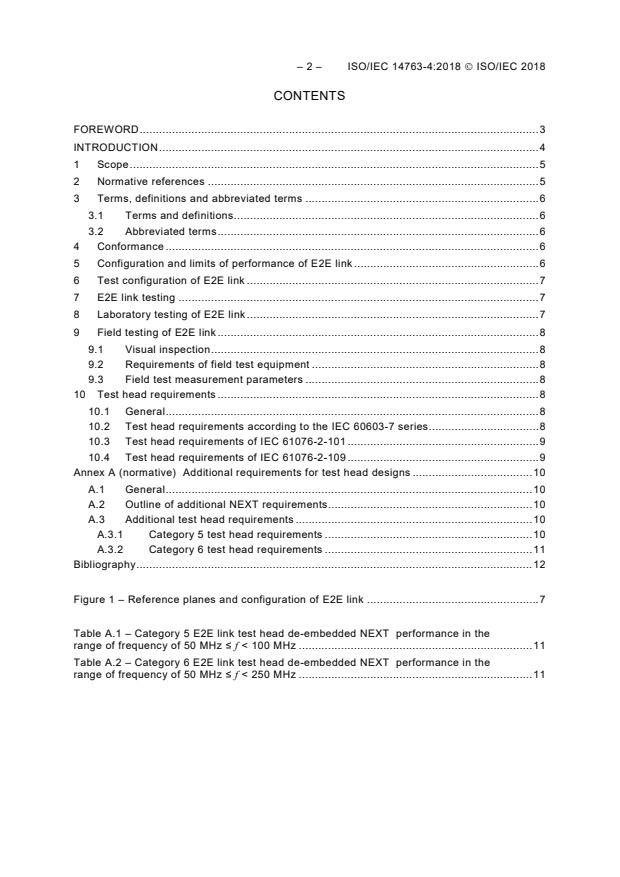
– 2 – ISO/IEC 14763-4:2018 ISO/IEC 2018
CONTENTS
FOREWORD . 3
INTRODUCTION . 4
1 Scope . 5
2 Normative references . 5
3 Terms, definitions and abbreviated terms . 6
3.1 Terms and definitions . 6
3.2 Abbreviated terms . 6
4 Conformance . 6
5 Configuration and limits of performance of E2E link . 6
6 Test configuration of E2E link . 7
7 E2E link testing . 7
8 Laboratory testing of E2E link . 7
9 Field testing of E2E link . 8
9.1 Visual inspection . 8
9.2 Requirements of field test equipment . 8
9.3 Field test measurement parameters . 8
10 Test head requirements . 8
10.1 General . 8
10.2 Test head requirements according to the IEC 60603-7 series . 8
10.3 Test head requirements of IEC 61076-2-101 . 9
10.4 Test head requirements of IEC 61076-2-109 . 9
Annex A (normative) Additional requirements for test head designs . 10
A.1 General . 10
A.2 Outline of additional NEXT requirements. 10
A.3 Additional test head requirements . 10
A.3.1 Category 5 test head requirements . 10
A.3.2 Category 6 test head requirements . 11
Bibliography . 12
Figure 1 – Reference planes and configuration of E2E link . 7
Table A.1 – Category 5 E2E link test head de-embedded NEXT performance in the
range of frequency of 50 MHz ≤ f < 100 MHz . 11
Table A.2 – Category 6 E2E link test head de-embedded NEXT performance in the
range of frequency of 50 MHz ≤ f < 250 MHz . 11
INFORMATION TECHNOLOGY –
IMPLEMENTATION AND OPERATION
OF CUSTOMER PREMISES CABLING –
Part 4: Measurement of end-to-end (E2E) links
FOREWORD
1) ISO (the International Organization for Standardization) and IEC (the International Electrotechnical Commission)
form the specialized system for worldwide standardization. National bodies that are members of ISO or IEC
participate in the development of International Standards through technical committees established by the
respective organization to deal with particular fields of technical activity. ISO and IEC technical committees
collaborate in fields of mutual interest. Other international organizations, governmental and non-governmental, in
liaison with ISO and IEC, also take part in the work. In the field of information technology, ISO and IEC have
established a joint technical committee, ISO/IEC JTC 1.
2) The formal decisions or agreements of IEC and ISO on technical matters express, as nearly as possible, an
international consensus of opinion on the relevant subjects since each technical committee has representation
from all interested IEC National Committees and ISO member bodies.
3) IEC, ISO and ISO/IEC publications have the form of recommendations for international use and are accepted
by IEC National Committees and ISO member bodies in that sense. While all reasonable efforts are made to
ensure that the technical content of IEC, ISO and ISO/IEC publications is accurate, IEC or ISO cannot be held
responsible for the way in which they are used or for any misinterpretation by any end user.
4) In order to promote international uniformity, IEC National Committees and ISO member bodies undertake to
apply IEC, ISO and ISO/IEC publications transparently to the maximum extent possible in their national and
regional publications. Any divergence between any ISO, IEC or ISO/IEC publication and the corresponding
national or regional publication should be clearly indicated in the latter.
5) ISO and IEC do not provide any attestation of conformity. Independent certification bodies provide conformity
assessment services and, in some areas, access to IEC marks of conformity. ISO or IEC are not responsible
for any services carried out by independent certification bodies.
6) All users should ensure that they have the latest edition of this publication.
7) No liability shall attach to IEC or ISO or its directors, employees, servants or agents including individual experts
and members of their technical committees and IEC National Committees or ISO member bodies for any
personal injury, property damage or other damage of any nature whatsoever, whether direct or indirect, or for
costs (including legal fees) and expenses arising out of the publication of, use of, or reliance upon, this ISO/IEC
publication or any other IEC, ISO or ISO/IEC publications.
8) Attention is drawn to the normative references cited in this publication. Use of the referenced publications is
indispensable for the correct application of this publication.
9) Attention is drawn to the possibility that some of the elements of this ISO/IEC publication may be the subject of
patent rights. ISO and IEC shall not be held responsible for identifying any or all such patent rights.
International Standard ISO/IEC 14763-4 has been prepared by subcommittee SC 25:
Interconnection of information technology equipment, of ISO/IEC joint technical committee 1:
Information technology.
This International Standard has been approved by vote of the member bodies, and the voting
results can be obtained from the address given on the second title page.
This document has been drafted in accordance with the ISO/IEC Directives, Part 2.
A list of all parts of the ISO/IEC 14763 series, published under the general title Information
technology – Implementation and operation of customer premises cabling, can be found on
the IEC and ISO websites.
– 4 – ISO/IEC 14763-4:2018 ISO/IEC 2018
INTRODUCTION
Balanced cabling is constructed for connecting equipment using free connectors. It is known
that field termination in all parts of the channel has an influence on the channel performance.
Poor termination can cause problems in the channel performance and may affect reliable data
transmission.
Until now, a verification of the field terminated cabling was done by measurement of the
channel performance of Channel Class D or E according to ISO/IEC 11801-1. The
measurement of Channel Class D or E excludes the connections at the end of the cable. The
measurement of Channel Class D or E does not identify the influence to the performance
caused by bad terminations of the connections at the end.
The measurement of performance of end-to-end (E2E) link includes the termination on both
ends of balanced cabling.
This document describes the measurement of E2E links of two- and four-pair balanced
cabling of 100 MHz of Class D and 250 MHz of Class E using laboratory and field tester
measurement procedures.
The performance of E2E links is described in ISO/IEC TR 11801-9902.
INFORMATION TECHNOLOGY –
IMPLEMENTATION AND OPERATION
OF CUSTOMER PREMISES CABLING –
Part 4: Measurement of end-to-end (E2E) links
1 Scope
This part of ISO/IEC 14763 specifies the measurement at frequencies of E2E links of two- and
four-pair balanced cabling of 100 MHz of Class D and 250 MHz of Class E including free
connectors which terminate two and four pairs in both field and laboratory conditions.
The specifications for E2E links are described in ISO/IEC TR 11801-9902.
This document specifies laboratory and field measurement procedures. The requirements for
accuracy to measure cabling parameters identified in ISO/IEC TR 11801-9902 are provided in
IEC 61935-1 and IEC 61935-2.
2 Normative references
The following documents are referred to in the text in such a way that some or all of their
content constitutes requirements of this document. For dated references, only the edition
cited applies. For undated references, the latest edition of the referenced document (including
any amendments) applies.
ISO/IEC 11801-1, Information technology – Generic cabling for customer premises – Part 1:
General requirements
ISO/IEC TR 11801-9902:2017, Information technology – Generic cabling for customer
premises – Part 9902: End-to-end link configur
...