


IEC 61960:2011
(Main)Secondary cells and batteries containing alkaline or other non-acid electrolytes - Secondary lithium cells and batteries for portable applications
General Information
- Abstract
IEC 61960:2011 specifies performance tests, designations, markings, dimensions and other requirements for secondary lithium single cells and batteries for portable applications. The objective of this standard is to provide the purchasers and users of secondary lithium cells and batteries with a set of criteria with which they can judge the performance of secondary lithium cells and batteries offered by various manufacturers. This second edition cancels and replaces the first edition published in 2003. It is a technical revision. This edition includes the following significant technical changes with respect to the previous edition:
- 7.6 Endurance in cycles: addition of an accelerated test procedure.
- Status
- Replaced
- Publication Date
- 15-Jun-2011
- Technical Committee
- SC 21A - Secondary cells and batteries containing alkaline or other non-acid electrolytes
- Drafting Committee
- WG 3 - TC 21/SC 21A/WG 3
- Current Stage
- WPUB - Publication withdrawn
- Start Date
- 07-Feb-2017
- Completion Date
- 28-Aug-2026
Buy Documents
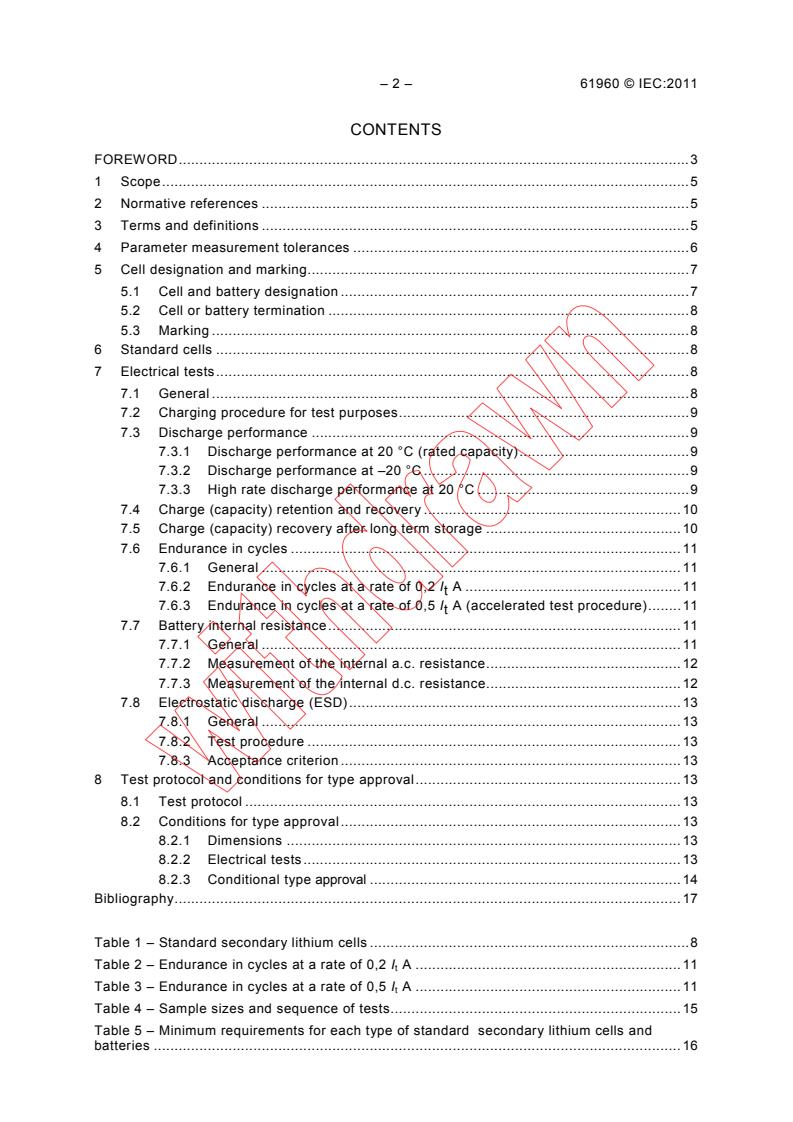
IEC 61960:2011 - Secondary cells and batteries containing alkaline or other non-acid electrolytes - Secondary lithium cells and batteries for portable applications Released:6/16/2011
Relations
- Effective Date
- 05-Sep-2023
- Effective Date
- 05-Sep-2023
- Effective Date
- 05-Sep-2023
Buy Documents
IEC 61960:2011 - Secondary cells and batteries containing alkaline or other non-acid electrolytes - Secondary lithium cells and batteries for portable applications Released:6/16/2011
Get Certified
Connect with accredited certification bodies for this standard

IMQ S.p.A. (Certification)
Italian electrical product certification.

SLG Prüf- und Zertifizierungs GmbH
German testing and certification body.

UL Solutions
Global safety science company with testing, inspection and certification.
Sponsored listings
Frequently Asked Questions
IEC 61960:2011 is a standard published by the International Electrotechnical Commission (IEC). Its full title is "Secondary cells and batteries containing alkaline or other non-acid electrolytes - Secondary lithium cells and batteries for portable applications". This standard covers: IEC 61960:2011 specifies performance tests, designations, markings, dimensions and other requirements for secondary lithium single cells and batteries for portable applications. The objective of this standard is to provide the purchasers and users of secondary lithium cells and batteries with a set of criteria with which they can judge the performance of secondary lithium cells and batteries offered by various manufacturers. This second edition cancels and replaces the first edition published in 2003. It is a technical revision. This edition includes the following significant technical changes with respect to the previous edition: - 7.6 Endurance in cycles: addition of an accelerated test procedure.
IEC 61960:2011 specifies performance tests, designations, markings, dimensions and other requirements for secondary lithium single cells and batteries for portable applications. The objective of this standard is to provide the purchasers and users of secondary lithium cells and batteries with a set of criteria with which they can judge the performance of secondary lithium cells and batteries offered by various manufacturers. This second edition cancels and replaces the first edition published in 2003. It is a technical revision. This edition includes the following significant technical changes with respect to the previous edition: - 7.6 Endurance in cycles: addition of an accelerated test procedure.
IEC 61960:2011 is classified under the following ICS (International Classification for Standards) categories: 29.220.99 - Other cells and batteries. The ICS classification helps identify the subject area and facilitates finding related standards.
IEC 61960:2011 has the following relationships with other standards: It is inter standard links to IEC 61960-4:2020, IEC 61960-3:2017, IEC 61960:2003. Understanding these relationships helps ensure you are using the most current and applicable version of the standard.
IEC 61960:2011 is available in PDF format for immediate download after purchase. The document can be added to your cart and obtained through the secure checkout process. Digital delivery ensures instant access to the complete standard document.
Standards Content (Sample)
IEC 61960 ®
Edition 2.0 2011-06
INTERNATIONAL
STANDARD
NORME
INTERNATIONALE
Secondary cells and batteries containing alkaline or other non-acid
electrolytes – Secondary lithium cells and batteries for portable applications
Accumulateurs alcalins et autres accumulateurs à électrolyte non acide –
Éléments et batteries d'accumulateurs au lithium pour applications portables
All rights reserved. Unless otherwise specified, no part of this publication may be reproduced or utilized in any form or by
any means, electronic or mechanical, including photocopying and microfilm, without permission in writing from either IEC or
IEC's member National Committee in the country of the requester.
If you have any questions about IEC copyright or have an enquiry about obtaining additional rights to this publication,
please contact the address below or your local IEC member National Committee for further information.
Droits de reproduction réservés. Sauf indication contraire, aucune partie de cette publication ne peut être reproduite
ni utilisée sous quelque forme que ce soit et par aucun procédé, électronique ou mécanique, y compris la photocopie
et les microfilms, sans l'accord écrit de la CEI ou du Comité national de la CEI du pays du demandeur.
Si vous avez des questions sur le copyright de la CEI ou si vous désirez obtenir des droits supplémentaires sur cette
publication, utilisez les coordonnées ci-après ou contactez le Comité national de la CEI de votre pays de résidence.
IEC Central Office
3, rue de Varembé
CH-1211 Geneva 20
Switzerland
Email: inmail@iec.ch
Web: www.iec.ch
About the IEC
The International Electrotechnical Commission (IEC) is the leading global organization that prepares and publishes
International Standards for all electrical, electronic and related technologies.
About IEC publications
The technical content of IEC publications is kept under constant review by the IEC. Please make sure that you have the
latest edition, a corrigenda or an amendment might have been published.
Catalogue of IEC publications: www.iec.ch/searchpub
The IEC on-line Catalogue enables you to search by a variety of criteria (reference number, text, technical committee,…).
It also gives information on projects, withdrawn and replaced publications.
IEC Just Published: www.iec.ch/online_news/justpub
Stay up to date on all new IEC publications. Just Published details twice a month all new publications released. Available
on-line and also by email.
Electropedia: www.electropedia.org
The world's leading online dictionary of electronic and electrical terms containing more than 20 000 terms and definitions
in English and French, with equivalent terms in additional languages. Also known as the International Electrotechnical
Vocabulary online.
Customer Service Centre: www.iec.ch/webstore/custserv
If you wish to give us your feedback on this publication or need further assistance, please visit the Customer Service
Centre FAQ or contact us:
Email: csc@iec.ch
Tel.: +41 22 919 02 11
Fax: +41 22 919 03 00
A propos de la CEI
La Commission Electrotechnique Internationale (CEI) est la première organisation mondiale qui élabore et publie des
normes internationales pour tout ce qui a trait à l'électricité, à l'électronique et aux technologies apparentées.
A propos des publications CEI
Le contenu technique des publications de la CEI est constamment revu. Veuillez vous assurer que vous possédez
l’édition la plus récente, un corrigendum ou amendement peut avoir été publié.
Catalogue des publications de la CEI: www.iec.ch/searchpub/cur_fut-f.htm
Le Catalogue en-ligne de la CEI vous permet d’effectuer des recherches en utilisant différents critères (numéro de référence,
texte, comité d’études,…). Il donne aussi des informations sur les projets et les publications retirées ou remplacées.
Just Published CEI: www.iec.ch/online_news/justpub
Restez informé sur les nouvelles publications de la CEI. Just Published détaille deux fois par mois les nouvelles
publications parues. Disponible en-ligne et aussi par email.
Electropedia: www.electropedia.org
Le premier dictionnaire en ligne au monde de termes électroniques et électriques. Il contient plus de 20 000 termes et
définitions en anglais et en français, ainsi que les termes équivalents dans les langues additionnelles. Egalement appelé
Vocabulaire Electrotechnique International en ligne.
Service Clients: www.iec.ch/webstore/custserv/custserv_entry-f.htm
Si vous désirez nous donner des commentaires sur cette publication ou si vous avez des questions, visitez le FAQ du
Service clients ou contactez-nous:
Email: csc@iec.ch
Tél.: +41 22 919 02 11
Fax: +41 22 919 03 00
IEC 61960 ®
Edition 2.0 2011-06
INTERNATIONAL
STANDARD
NORME
INTERNATIONALE
Secondary cells and batteries containing alkaline or other non-acid
electrolytes – Secondary lithium cells and batteries for portable applications
Accumulateurs alcalins et autres accumulateurs à électrolyte non acide –
Éléments et batteries d'accumulateurs au lithium pour applications portables
INTERNATIONAL
ELECTROTECHNICAL
COMMISSION
COMMISSION
ELECTROTECHNIQUE
PRICE CODE
INTERNATIONALE
CODE PRIX Q
ICS 29.220.99 ISBN 978-2-88912-538-8
– 2 – 61960 © IEC:2011
CONTENTS
FOREWORD . 3
1 Scope . 5
2 Normative references . 5
3 Terms and definitions . 5
4 Parameter measurement tolerances . 6
5 Cell designation and marking. 7
5.1 Cell and battery designation . 7
5.2 Cell or battery termination . 8
5.3 Marking . 8
6 Standard cells . 8
7 Electrical tests . 8
7.1 General . 8
7.2 Charging procedure for test purposes . 9
7.3 Discharge performance . 9
7.3.1 Discharge performance at 20 °C (rated capacity) . 9
7.3.2 Discharge performance at –20 °C . 9
7.3.3 High rate discharge performance at 20 °C . 9
7.4 Charge (capacity) retention and recovery . 10
7.5 Charge (capacity) recovery after long term storage . 10
7.6 Endurance in cycles . 11
7.6.1 General . 11
7.6.2 Endurance in cycles at a rate of 0,2 I A . 11
t
7.6.3 Endurance in cycles at a rate of 0,5 I A (accelerated test procedure) . 11
t
7.7 Battery internal resistance . 11
7.7.1 General . 11
7.7.2 Measurement of the internal a.c. resistance . 12
7.7.3 Measurement of the internal d.c. resistance . 12
7.8 Electrostatic discharge (ESD) . 13
7.8.1 General . 13
7.8.2 Test procedure . 13
7.8.3 Acceptance criterion . 13
8 Test protocol and conditions for type approval . 13
8.1 Test protocol . 13
8.2 Conditions for type approval . 13
8.2.1 Dimensions . 13
8.2.2 Electrical tests . 13
8.2.3 Conditional type approval . 14
Bibliography . 17
Table 1 – Standard secondary lithium cells . 8
Table 2 – Endurance in cycles at a rate of 0,2 I A . 11
t
Table 3 – Endurance in cycles at a rate of 0,5 I A . 11
t
Table 4 – Sample sizes and sequence of tests . 15
Table 5 – Minimum requirements for each type of standard secondary lithium cells and
batteries . 16
61960 © IEC:2011 – 3 –
INTERNATIONAL ELECTROTECHNICAL COMMISSION
____________
SECONDARY CELLS AND BATTERIES CONTAINING
ALKALINE OR OTHER NON-ACID ELECTROLYTES –
SECONDARY LITHIUM CELLS AND BATTERIES
FOR PORTABLE APPLICATIONS
FOREWORD
1) The International Electrotechnical Commission (IEC) is a worldwide organization for standardization comprising
all national electrotechnical committees (IEC National Committees). The object of IEC is to promote
international co-operation on all questions concerning standardization in the electrical and electronic fields. To
this end and in addition to other activities, IEC publishes International Standards, Technical Specifications,
Technical Reports, Publicly Available Specifications (PAS) and Guides (hereafter referred to as “IEC
Publication(s)”). Their preparation is entrusted to technical committees; any IEC National Committee interested
in the subject dealt with may participate in this preparatory work. International, governmental and non-
governmental organizations liaising with the IEC also participate in this preparation. IEC collaborates closely
with the International Organization for Standardization (ISO) in accordance with conditions determined by
agreement between the two organizations.
2) The formal decisions or agreements of IEC on technical matters express, as nearly as possible, an international
consensus of opinion on the relevant subjects since each technical committee has representation from all
interested IEC National Committees.
3) IEC Publications have the form of recommendations for international use and are accepted by IEC National
Committees in that sense. While all reasonable efforts are made to ensure that the technical content of IEC
Publications is accurate, IEC cannot be held responsible for the way in which they are used or for any
misinterpretation by any end user.
4) In order to promote international uniformity, IEC National Committees undertake to apply IEC Publications
transparently to the maximum extent possible in their national and regional publications. Any divergence
between any IEC Publication and the corresponding national or regional publication shall be clearly indicated in
the latter.
5) IEC itself does not provide any attestation of conformity. Independent certification bodies provide conformity
assessment services and, in some areas, access to IEC marks of conformity. IEC is not responsible for any
services carried out by independent certification bodies.
6) All users should ensure that they have the latest edition of this publication.
7) No liability shall attach to IEC or its directors, employees, servants or agents including individual experts and
members of its technical committees and IEC National Committees for any personal injury, property damage or
other damage of any nature whatsoever, whether direct or indirect, or for costs (including legal fees) and
expenses arising out of the publication, use of, or reliance upon, this IEC Publication or any other IEC
Publications.
8) Attention is drawn to the Normative references cited in this publication. Use of the referenced publications is
indispensable for the correct application of this publication.
9) Attention is drawn to the possibility that some of the elements of this IEC Publication may be the subject of
patent rights. IEC shall not be held responsible for identifying any or all such patent rights.
International Standard IEC 61960 has been prepared by subcommittee 21A: Secondary cells
and batteries containing alkaline or other non-acid electrolytes, of IEC technical committee 21:
Secondary cells and batteries.
This second edition cancels and replaces the first edition published in 2003. It is a technical
revision.
This edition includes the following significant technical changes with respect to the previous
edition:
• 7.6 Endurance in cycles: addition of an accelerated test procedure.
– 4 – 61960 © IEC:2011
The text of this standard is based on the following documents:
FDIS Report on voting
21A/486/FDIS 21A/490/RVD
Full information on the voting for the approval of this standard can be found in the report on
voting indicated in the above table.
This publication has been drafted in accordance with the ISO/IEC Directives, Part 2.
The committee has decided that the contents of this publication will remain unchanged until
the stability date indicated on the IEC web site under "http://webstore.iec.ch" in the data
related to the specific publication. At this date, the publication will be
• reconfirmed,
• withdrawn,
• replaced by a revised edition, or
• amended.
61960 © IEC:2011 – 5 –
SECONDARY CELLS AND BATTERIES CONTAINING
ALKALINE OR OTHER NON-ACID ELECTROLYTES –
SECONDARY LITHIUM CELLS AND BATTERIES
FOR PORTABLE APPLICATIONS
1 Scope
This International Standard specifies performance tests, designations, markings, dimensions
and other requirements for secondary lithium single cells and batteries for portable
applications.
The objective of this standard is to provide the purchasers and users of secondary lithium
cells and batteries with a set of criteria with which they can judge the performance of
secondary lithium cells and batteries offered by various manufacturers.
This standard defines a minimum required level of performance and a standardized
methodology by which testing is performed and the results of this testing reported to the user.
Hence, users will be able to establish the viability of commercially available cells and
batteries via the declared specification and thus be able to select the cell or battery best
suited for their intended application.
This standard covers secondary lithium cells and batteries with a range of chemistries. Each
electrochemical couple has a characteristic voltage range over which it releases its electrical
capacity, a characteristic nominal voltage and a characteristic end-of-discharge voltage during
discharge. Users of secondary lithium cells and batteries are requested to consult the
manufacturer for advice.
2 Normative references
The following referenced documents are indispensable for the application of this document.
For dated references, only the edition cited applies. For undated references, the latest edition
of the referenced document (including any amendments) applies.
IEC 60050-482, International Electrotechnical Vocabulary (IEV) – Part 482: Primary and
secondary cells and batteries
IEC 61000-4-2, Electromagnetic compatibility (EMC) – Part 4-2: Testing and measurement
techniques – Electrostatic discharge immunity test
3 Terms and definitions
For the purposes of this document, the terms and definitions given in the IEC 60050-482, as
well as the following apply.
3.1
charge recovery
capacity that a cell or battery can deliver after the charge following the charge retention test
according to 3.2
– 6 – 61960 © IEC:2011
3.2
charge retention
capacity retention
capacity that a cell or battery can deliver after storage, at a specific temperature, for a
specific time without subsequent recharging as a percentage of the rated capacity
3.3
final voltage
end-of-discharge voltage
specified closed circuit voltage at which a discharge of a cell or battery is terminated
3.4
nominal voltage
suitable approximate value of voltage used to designate or identify a cell, or a battery
NOTE 1 The nominal voltages of secondary lithium cells are given in Table 1.
NOTE 2 The nominal voltage of a battery of n series connected cells is equal to n times the nominal voltage of a
single cell.
3.5
rated capacity
quantity of electricity C Ah (ampere-hours) declared by the manufacturer which a single cell
or battery can deliver during a 5-h period, when charged, stored and discharged under the
conditions specified in 7.3.1
3.6
secondary lithium battery
unit which incorporates one or more secondary lithium cells and which is ready for use. It
incorporates adequate housing and a terminal arrangement and may have electronic control
devices
3.7
secondary lithium cell
secondary single cell whose electrical energy is derived from the oxidation and the reduction
of lithium. It is not ready for use in an application because it is not yet fitted with its final
housing, terminal arrangement and electronic control device
4 Parameter measurement tolerances
The overall accuracy of controlled or measured values, relative to the specified or actual
values, shall be within the following tolerances:
a) ± 1 % for voltage;
b) ± 1 % for current;
c) ± 1 % for capacity;
d) ± 2 °C for temperature;
e) ± 0,1 % for time;
f) ± 0,1 % for mass;
g) ± 0,1 mm for dimensions.
These tolerances comprise the combined accuracy of the measuring instruments, the
measurement techniques used, and all other sources of error in the test procedure.
The details of the instrumentation used shall be provided in any report of results.
61960 © IEC:2011 – 7 –
5 Cell designation and marking
5.1 Cell and battery designation
Batteries shall be designated with following form:
N A A A N / N / N – N
1 1 2 3 2 3 4 5
Cells shall be designated with following form:
A A N / N / N
A
1 2 3 2 3 4
where
N is the number of series connected cells in the battery;
A designates the negative electrode system in which
I is lithium ion;
L is lithium metal or lithium alloy;
A designates the positive electrode basis in which
C is cobalt;
N is nickel;
M is manganese;
V is vanadium;
T is titanium;
A designates the shape of the cell in which
R is cylindrical;
P is prismatic;
N is the maximum diameter (if R) or the maximum thickness (if P) in mm rounded up to the
next whole number;
N is the maximum width (if P) in mm rounded up to the next whole number (N not shown if
3 3
R);
N is the maximum overall height in mm rounded up to the next whole number;
NOTE If any dimension is less than 1 mm, the units used are tenths of millimetres and the single number is
written tN.
N is the number of parallel connected cells if 2 or greater (not shown if value is 1).
EXAMPLE 1 ICR19/66 would designate a cylindrical Li-ion secondary cell, with a cobalt-based positive electrode,
a maximum diameter between 18 mm and 19 mm, and a maximum overall height between 65 mm and 66 mm.
EXAMPLE 2 ICP9/35/150 would designate a prismatic Li-ion secondary lithium cell, with a cobalt-based positive
electrode, a maximum thickness between 8 mm and 9 mm, a maximum width between 34 mm and 35 mm, and a
maximum overall height between 149 mm and 150 mm.
EXAMPLE 3 ICPt9/35/48 would designate a prismatic Li-ion secondary lithium cell, with a cobalt-based positive
electrode, a maximum thickness between 0,8 mm and 0,9 mm, a maximum width between 34 mm and 35 mm, and
a maximum overall height between 47 mm and 48 mm.
EXAMPLE 4 1ICR20/70 would designate a cylindrical Li-ion secondary battery with one single cell, a cobalt-based
positive electrode, a maximum diameter between 19 mm and 20 mm, and a maximum overall height between
69 mm and 70 mm.
EXAMPLE 5 2ICP20/34/70 would designate a prismatic Li-ion secondary battery with two series connected cells,
a cobalt-based positive electrode, a maximum thickness between 19 mm and 20 mm, a maximum width between
33 mm and 34 mm, and a maximum overall height between 69 mm and 70 mm.
– 8 – 61960 © IEC:2011
EXAMPLE 6 1ICP20/68/70-2 would designate a prismatic Li-ion secondary battery with two parallel connected
cells, a cobalt-based positive electrode, a maximum thickness between 19 mm and 20 mm, a maximum width
between 67 mm and 68 mm, and a maximum overall height between 69 mm and 70 mm.
5.2 Cell or battery termination
This standard does not specify cell or battery termination.
5.3 Marking
Each cell or battery shall carry clear and durable markings giving the following information:
• secondary (rechargeable) Li or Li-ion;
• battery or cell designation as specified in 5.1;
• polarity;
• date of manufacture (which may be in code);
• name or identification of manufacturer or supplier.
Battery markings shall provide the following additional information:
• rated capacity;
• nominal voltage.
6 Standard cells
Table 1 lists the secondary lithium cell(s) that are suitable for standardization and used in
assembling batteries.
Table 1 – Standard secondary lithium cells
1 2 3
Secondary lithium cell ICR19/66 ICP9/35/48 ICR18/68
Height (mm) 64,0/65,2 47,2/48,0 65,9/67,2
Diameter (mm) 17,8/18,5 NA 16,2/17,1
Width (mm) NA 33,4/34,2 NA
Thickness (mm) NA 7,6/8,8 NA
Nominal voltage (V) 3,6 3,6 3,6
End-of-discharge voltage (V) 2,50 2,50 2,50
End-of-discharge voltage (V)
2,75 2,75 2,75
for endurance (cycle life)
NOTE The end-of-discharge voltage of a battery of n series connected cells is equal to n times the end-of
discharge voltage of a single cell as given in Table 1.
7 Electrical tests
7.1 General
Unless otherwise stated, all tests that are described in this clause shall be performed in still
air. Charge and discharge currents for the tests shall be based on the value of the rated
capacity (C Ah). These currents are expressed as a multiple of I A, where: I A = C Ah/1 h.
t t
5 n
The minimum values required for each electrical test are stated in Table 5. Sample sizes and
sequence of tests are described in Table 4.
61960 © IEC:2011 – 9 –
7.2 Charging procedure for test purposes
Prior to charging, the cell or battery shall be discharged at 20 °C ± 5 °C at a constant current
of 0,2 I A, down to a specified end-of-discharge voltage.
t
Unless otherwise stated in this standard, cells or batteries shall be charged, in an ambient
temperature of 20 °C ± 5 °C, using the method declared by the manufacturer.
7.3 Discharge performance
7.3.1 Discharge performance at 20 °C (rated capacity)
This test verifies the rated capacity of a cell or battery.
Step 1 – The cell or battery shall be charged in accordance with 7.2.
Step 2 – The cell or battery shall be stored, in an ambient temperature of 20 °C ± 5 °C, for not
less than 1 h and not more than 4 h.
Step 3 – The cell or battery shall be discharged, in an ambient temperature of 20 °C ± 5 °C, at
a constant current of 0,2 I A, until its voltage is equal to the specified end-of-discharge
t
voltage.
Step 4 – The capacity (Ah) delivered during step 3 shall be not less than 100 % of the rated
capacity declared by the manufacturer. Steps 1 to 4 may be repeated up to four additional
times, as necessary to satisfy this requirement.
7.3.2 Discharge performance at –20 °C
This test determines the capacity of the cell or battery at a low temperature.
Step 1 – The cell or battery shall be charged in accordance with 7.2.
Step 2 – The cell or battery shall be stored, in an ambient temperature of −20 °C ± 2 °C, for
not less than 16 h and not more than 24 h.
Step 3 – The cell or battery shall be discharged, in an ambient temperature of −20 °C ± 2 °C,
at a constant current of 0,2 I A, until its voltage is equal to the specified end-of-discharge
t
voltage.
Step 4 – The capacity (Ah), delivered during step 3, shall be not less than that specified for
this characteristic in Table 5.
7.3.3 High rate discharge performance at 20 °C
This test determines the capacity of a cell or battery when discharged at a high rate. This test
is not required if the cell or battery is not designed to be used at this rate.
Step 1 –The cell or battery shall be charged in accordance with 7.2.
Step 2 –The cell or battery shall be stored, in an ambient temperature of 20 °C ± 5 °C, for not
less than 1 h and not more than 4 h.
Step 3 –The cell or battery shall be discharged, in an ambient temperature of 20 °C ± 5 °C, at
a constant current of 1,0 I A, until its voltage is equal to the specified end-of-discharge
t
voltage.
– 10 – 61960 © IEC:2011
Step 4 – The capacity (Ah) delivered during step 3 shall be not less than that specified for this
characteristic in Table 5.
7.4 Charge (capacity) retention and recovery
This test determines firstly the capacity which a cell or battery retains after storage for an
extended period of time, and secondly the capacity that can be recovered by a subsequent
recharge.
Step 1 – The cell or battery shall be charged in accordance with 7.2.
Step 2 – The cell or battery shall be stored in an ambient temperature of 20 °C ± 5 °C,
for 28 days.
Step 3 – The cell or battery shall be discharged, in an ambient temperature of 20 °C ± 5 °C, at
a constant current of 0,2 I A, until its voltage is equal to the specified end-of-discharge
t
voltage.
Step 4 – The 28-day retained capacity (Ah) delivered, during step 3, shall be not less than
that specified for this characteristic in Table 5.
Step 5 – The cell or battery shall then be charged in accordance with 7.2, within 24 h
following the discharge of step 3.
Step 6 – The cell or battery shall be stored, in an ambient temperature of 20 °C ± 5 °C, for not
less than 1 h and not more than 4 h.
Step 7 – The cell or battery shall be discharged, in an ambient temperature of 20 °C ± 5 °C, at
a constant current of 0,2 I A, until its voltage is equal to the specified end-of-discharge
t
voltage.
Step 8 – The recovery capacity (Ah) delivered, during step 6, shall be not less than that
specified for this characteristic in Table 5.
7.5 Charge (capacity) recovery after long term storage
This test determines the capacity of a cell or battery after extended storage at 50 % state of
charge, followed by a subsequent charge.
Step 1 – The cell or battery shall be charged in accordance with 7.2.
Step 2 – The cell or battery shall be discharged, in an ambient temperature of 20 °C ± 5 °C, at
a constant current of 0,2 I A, for 2,5 h.
t
Step 3 – The cell or battery shall be stored in an ambient temperature of 40 °C ± 2 °C,
for 90 days.
Step 4 – The cell or battery shall be charged, in an ambient temperature of 20 °C ± 5 °C,
using the method declared by the manufacturer.
Step 5 – The cell or battery shall be stored, in an ambient temperature of 20 °C ± 5 °C, for not
less than 1 h and not more than 4 h.
Step 6 – The cell or battery shall be discharged, in an ambient temperature of 20 °C ± 5 °C, at
a constant current of 0,2 I A, until its voltage is equal to the specified end-of-discharge
t
voltage.
61960 © IEC:2011 – 11 –
Step 7 – The capacity (Ah) delivered during step 5 shall be not less than that specified for this
characteristic in Table 5. Steps 4 and 5 may be repeated up to four additional times, as
necessary to satisfy this requirement.
7.6 Endurance in cycles
7.6.1 General
This test determines the number of charge/discharge cycles which a cell or battery can
endure before its useful capacity has been significantly depleted or the remaining capacity
after a specified number of cycles.
Prior to charging, the cell or battery shall be discharged at 20 °C ± 5 °C at a constant current
of 0,2 I A, down to a specified end-of-discharge voltage.
t
The following endurance test shall then be carried out, irrespective of cell designation, in an
ambient temperature of 20 °C ± 5 °C. Charge and discharge shall be carried out in
accordance with the conditions specified in either Tables 4 or 5.
7.6.2 Endurance in cycles at a rate of 0,2 I A
t
Table 2 – Endurance in cycles at a rate of 0,2 I A
t
Stand in
Cycle number Charge Discharge
charged condition
Method declared
Until capacity delivered is less
by the 0-1 h 0,2 I A to final voltage
t
than 60 % of the rated capacity
manufacturer
The total number of cycles obtained when the test is completed shall be not less than that
specified for this characteristic in Table 5.
7.6.3 Endurance in cycles at a rate of 0,5 I A (accelerated test procedure)
t
In order to accelerate the test, following alternative procedures may be carried out as an
alternative to 7.6.2.
Table 3 – Endurance in cycles at a rate of 0,5 I A
t
Stand in
a
Cycle number Charge Discharge
charged condition
A: 1-400
Method declared
or by the 0-1 h 0,5 I A to final voltage
t
manufacturer
B: 1-300
a
A: for cells, B: for batteries.
The remaining capacity obtained when the test is completed shall be not less than that
specified for this characteristic in Table 5.
7.7 Battery internal resistance
7.7.1 General
This test determines the internal resistance of a secondary lithium battery by either the
alternating current (a.c.) or by the direct current (d.c.) method.
– 12 – 61960 © IEC:2011
Should the need arise for the internal resistance to be measured by both a.c. and d.c.
methods on the same battery, then the a.c. method shall be used first followed by the d.c.
method. It is not necessary to discharge and charge the battery between conducting a.c. and
d.c. measurements.
Step 1 – The battery shall be charged in accordance with 7.2.
Step 2 – The battery shall be stored, in an ambient temperature of 20 °C ± 5 °C, for not less
than 1 h and not more than 4 h.
Step 3 – The measurement of internal resistance shall be performed in accordance with 7.7.2
or 7.7.3 in an ambient temperature of 20 °C ± 5 °C.
7.7.2 Measurement of the internal a.c. resistance
7.7.2.1 Measurement
The alternating r.m.s. voltage, U , shall be measured while applying an alternating r.m.s.
a
current, I , at the frequency of 1,0 kHz ± 0,1 kHz, to the battery, for a period of 1 s to 5 s.
a
All voltage measurements shall be made at the terminals of the battery independently of the
contacts used to carry current.
The internal a.c. resistance, R , is given by:
ac
U
a
R = (Ω)
ac
I
a
where
U is the alternating r.m.s. voltage;
a
I is the alternating r.m.s. current.
a
NOTE 1 The alternating current should be selected so that the peak voltage stays below 20 mV.
NOTE 2 This method will in fact measure the impedance, which at the frequency specified, is approximately equal
to the resistance.
7.7.2.2 Acceptance criterion
, declared
The internal a.c. resistance of the battery shall be not greater than the value of R
ac
by the manufacturer.
7.7.3 Measurement of the internal d.c. resistance
7.7.3.1 Measurement
= 0,2 I A. At the end of a discharge
The battery shall be discharged at a constant current of I
t
period of 10 s, the discharge voltage U under load shall be measured and recorded. The
discharge current shall then be immediately increased to a value of I = 1,0 I A and the
t
corresponding discharge voltage U measured under load and recorded again at the end of a
discharge period of 1 s.
All voltage measurements shall be made at the terminals of the battery independently of the
contacts used to carry current.
The internal d.c. resistance, R , of the cell shall be calculated using the following formula:
dc
61960 © IEC:2011 – 13 –
U−U
1 2
R = (Ω)
dc
I −I
2 1
where
I , I are the constant discharge currents;
1 2
U , U are the appropriate voltages measured during discharge.
1 2
7.7.3.2 Acceptance criterion
The internal d.c. resistance of the battery shall be not greater than the value of R , declared
dc
by the manufacturer.
7.8 Electrostatic discharge (ESD)
7.8.1 General
This test is to evaluate the ability of a battery to withstand electrostatic discharge.
This test shall be conducted on a battery containing electronic protection devices, such as
diodes, transistors or integrated circuits.
7.8.2 Test procedure
This test shall be carried out in accordance with IEC 61000-4-2, which concerns electronic
discharge requirements (see Clauses 1 to 8).
The batteries shall be tested for contact discharge at 4 kV and air discharge at 8 kV.
7.8.3 Acceptance criterion
The battery shall operate with all protection circuits operational.
8 Test protocol and conditions for type approval
8.1 Test protocol
The sample size and protocol for conducting the electrical tests in Clause 7 are given
in Table 4.
8.2 Conditions for type approval
8.2.1 Dimensions
The dimensions of the cell or battery shall not exceed the manufacturers' specified values and
those values listed in Table 1.
8.2.2 Electrical tests
8.2.2.1 The manufacturer shall declare the rated capacity (C Ah) of the cell or battery based
on its performance under the conditions specified in 7.3.1 and in Table 5.
8.2.2.2 In order to meet the requirements of this standard, all samples shall meet all the
performances specified in Table 5. The minimum levels for meeting the requirements of the
electrical tests are expressed as percentages of the rated capacity.
– 14 – 61960 © IEC:2011
8.2.2.3 If the test results do not meet the conditions of 8.2.2.2, the test can be repeated with
new samples, provided that, on any test, not more than one sample failed to reach the
performance specified in Table 5.
8.2.2.4 As an alternative to repeating the tests, a manufacturer may reduce the declared
rated capacity of the battery to a value such that all test results do meet the conditions of
8.2.2.2.
8.2.3 Conditional type approval
The cell or battery can be considered conditionally type approved prior to the completion of
the charge (capacity) recovery after storage test specified in 7.5 and the endurance in cycles
test specified in 7.6.2 if:
a) 20 % of the required cycles of the endurance test have been completed and the capacity
delivered during any discharge remains above 85 % of the rated capacity, and
b) the requirements of all the other tests specified in Clause 7 have been met.
61960 © IEC:2011 – 15 –
Table 4 – Sample sizes and sequence of tests
Electrical tests Electrical tests
30 cells 15 batteries
Discharge capacity at 20 °C Discharge capacity at 20 °C
(rated capacity) (rated capacity)
(7.3.1) (7.3.1)
25 cells 3 batteries
Discharge capacity at Discharge capacity at
–20 °C –20 °C
(7.3.2) (7.3.2)
5 cells 3 batteries
High rate discharge capacity at 20 °C High rate discharge capacity at 20 °C
(7.3.3) (7.3.3)
5 cells 3 batteries
Charge (capacity) retention and Charge (capacity) retention and
recovery recovery
(7.4) (7.4)
5 cells 3 batteries
Capacity recovery after storage Capacity recovery after storage
(7.5) (7.5)
5 cells 3 batteries
Endurance in cycles Endurance in cycles
(7.6) (7.6)
5 cells 3 batteries
Internal resistance
NOTE Total number of cells includes
(7.7)
several spare cells
3 batteries
Electrostatic discharge
(7.8)
3 batteries
– 16 – 61960 © IEC:2011
Table 5 – Minimum requirements for each type of standard
secondary lithium cells and batteries
Acceptance Acceptance
Reference
Parameter criteria – criteria –
subclause
cells batteries
7.3.1 100 % C Ah 100 % C Ah
Capacity at 20 °C ± 5 °C (rated capacity) 5 5
Capacity at -20 °C ± 2 °C 7.3.2 30 % C Ah 30 % C Ah
5 5
High rate discharge capacity at 20 °C ± 5 °C 7.3.3 70 % C Ah 60 % C Ah
5 5
Charge (capacity) retention 7.4 70 % C Ah 60 % C Ah
5 5
Charge (capacity) recovery 7.4 85 % C Ah 85 % C Ah
5 5
Capacity recovery after storage 7.5 50 % C Ah 50 % C Ah
5 5
Endurance in cycles 7.6.2 400 cycles 300 cycles
Endurance in cycles (accelerated) 7.6.3 60 % C Ah 60 % C Ah
5 5
Electrostatic discharge 7.8 n.a. Operational
61960 © IEC:2011 – 17 –
Bibliography
IEC 60051 (all parts), Direct acting indicating analogue electrical measuring instruments and
their accessories
IEC 60485, Digital electronic d.c. voltmeters and d.c. electronic analogue-to-digital
convertors
IEC 61434, Secondary cells and batteries containing alkaline or other non-acid electrolytes –
Guide to the designation of current in alkaline secondary cell and battery standards
IEC 61959, Secondary cells and batteries containing alkaline or other non-acid electrolytes –
Mechanical tests for sealed portable secondary cells and batteries
IEC 62133, Secondary cells and batteries containing alkaline or other non-acid electrolytes –
Safety requirements for portable sealed secondary cells and for batteries made from them, for
use in portable applications
IEC 62281, Safety of primary and secondary lithium cells and batteries during transport
___________
———————
This publication was withdrawn.
– 18 – 61960 © CEI:2011
SOMMAIRE
AVANT-PROPOS . 20
1 Domaine d'application . 22
2 Références normatives . 22
3 Termes et définitions . 22
4 Tolérances de mesures relatives aux paramètres . 23
5 Désignation et marquage . 24
5.1 Désignation des éléments et des batteries . 24
5.2 Sorties électriques des éléments ou des batteries . 25
5.3 Marquage . 25
6 Eléments normalisés . 25
7 Essais électriques . 26
7.1 Généralités. 26
7.2 Mode de charge pour les essais . 26
7.3 Caractéristiques de décharge . 26
7.3.1 Caractéristiques de décharge à 20 °C (capacité assignée) . 26
7.3.2 Caractéristiques de décharge à –20 °C . 26
7.3.3 Caractéristiques de décharge à fort régime à 20 °C . 27
7.4 Conservation de charge et récupération de capacité . 27
7.5 Restitution de capacité après stockage de longue durée . 27
7.6 Endurance en cycles . 28
7.6.1 Généralités . 28
7.6.2 Endurance en cycles à un courant de 0,2 I A . 28
t
7.6.3 Endurance en cycles à un courant de 0,5 I A (méthode d’essai
t
accéléré) . 29
7.7 Résistance interne d'une batterie . 29
7.7.1 Généralités . 29
7.7.2 Mesure de la résistance interne en courant alternatif . 29
7.7.3 Mesure de la résistance interne en courant continu . 30
7.8 Décharge électrostatique (ESD) . 30
7.8.1 Généralités . 30
7.8.2 Procédure d’essai . 30
7.8.3 Critère d’acceptation . 31
8 Procédures d'essai et conditions d'homologation . 31
8.1 Procédures d’essai . 31
8.2 Conditions d'homologation . 31
8.2.1 Dimensions . 31
8.2.2 Essais électriques . 31
8.2.3 Homologation conditionnelle . 31
Bibliographie . 34
Tableau 1 – Eléments d’accumulateur normalisés au lithium . 25
Tableau 2 – Endurance en cycles à un courant de 0,2 I A . 28
t
Tableau 3 – Endurance en cycles à un courant de 0,5 I A .
...