


IEC TR 61850-7-510:2021
(Main)Communication networks and systems for power utility automation - Part 7-510: Basic communication structure - Hydroelectric power plants, steam and gas turbines - Modelling concepts and guidelines
Communication networks and systems for power utility automation - Part 7-510: Basic communication structure - Hydroelectric power plants, steam and gas turbines - Modelling concepts and guidelines
IEC TR 61850-7-510:2021(E), which is a technical report, is intended to provide explanations on how to use the Logical Nodes defined in IEC 61850-7-410 as well as other documents in the IEC 61850 series to model complex control functions in power plants, including variable speed pumped storage power plants.
IEC 61850-7-410 introduced the general modelling concepts of IEC 61850 for power plants. It is however not obvious from the standard how the modelling concepts can be implemented in actual power plants.
This document explains how the data model and the concepts defined in the IEC 61850 standard can be applied in Hydro; both directly at the process control level, but also for data structuring and data exchange at a higher level. Application of the data model for Thermal is limited to power evacuation (in principle the extraction of the generated electrical power) and the prime mover shaft and bearing system. The interfaces of the fuel and steam valves are modelled for the purpose of process control.
Communication services, and description of the use of mappings of the IEC 61850 data model to different communication protocols, are outside the scope of this document.
This second edition cancels and replaces the first edition published in 2012. This edition constitutes a technical revision.
This edition includes the following significant technical changes with respect to the previous edition:
a) Process modelling according to IEC 61850-6:2009, including IEC 61850-6:2009/AMD1:2018.
b) Examples of application of Reference Designation System together with the process modelling, in particular application of IEC/ISO 81346.
c) Description of modelling related to Steam- and Gas turbines.
d) Annexes with examples of application of SCL according to the examples in the Technical Report.
e) The dynamic exchange of values by using polling, GOOSE, Reporting or Sampled Values is no longer included in the Technical Report.
General Information
- Status
- Published
- Publication Date
- 15-Dec-2021
- Technical Committee
- TC 57 - Power systems management and associated information exchange
- Drafting Committee
- WG 18 - TC 57/WG 18
- Current Stage
- PPUB - Publication issued
- Start Date
- 16-Dec-2021
- Completion Date
- 11-Jan-2022
Relations
- Effective Date
- 05-Sep-2023
Overview
IEC TR 61850-7-510:2021 is a technical report published by the International Electrotechnical Commission (IEC) as part of the IEC 61850 series, which addresses communication networks and systems for power utility automation. This report specifically focuses on the modeling concepts and guidelines for hydroelectric power plants and steam and gas turbines. It provides practical explanations on the implementation of Logical Nodes defined in IEC 61850-7-410 and guides users on how to model complex control functions for both hydro and thermal power plants.
This document is designed to bridge the gap between the theoretical modeling concepts of IEC 61850 and their practical application in real-world power plant environments. It addresses both the process control level and higher-level data structuring and exchange. The scope for thermal applications is limited to power evacuation, the prime mover shaft and bearing system, and interfaces for fuel and steam valves at the process control level.
Key Topics
- Application of Logical Nodes: Clarifies how to apply Logical Nodes as defined in IEC 61850-7-410 and related standards for modeling plant components and controls.
- Process Modeling: Explains structuring of power plant systems using the Reference Designation System (RDS), particularly the application of IEC/ISO 81346.
- Structuring Principles: Provides guidelines for data modeling at various plant levels, from process equipment to system interactions.
- System Configuration Language (SCL): Offers examples of SCL modeling to represent plant structures and process flows according to the standard.
- Hydroelectric and Thermal Power Domains: Details the unique modeling requirements and control system structures for hydroelectric, steam, and gas turbine power plants.
- Control Function Modeling: Includes examples for modeling controls such as active and reactive power management, excitation systems, sequencing, and specific process equipment.
Applications
The practical applications of IEC TR 61850-7-510:2021 are significant for the modernization and integration of automation systems in the power generation sector, especially in:
- Design and Integration of Power Plant Control Systems: Enables systems engineers and integrators to implement standardized data models for efficient information exchange within and between plant automation systems.
- Hydroelectric Power Plant Automation: Provides structured methodologies for modeling variable speed pumped storage plants and other advanced hydroelectric configurations.
- Thermal Power Plant Process Control: Offers tailored data structuring for process elements related to power evacuation, shaft, bearing systems, and the interfaces of fuel and steam valve controls.
- Reference Designation and System Structuring: Facilitates unambiguous identification and structuring of plant components, supporting complex project documentation and asset management.
- Interoperability and Scalability: Promotes the use of standardized Logical Nodes and data structures to enhance interoperability across multi-vendor environments and support scalable automation solutions.
Related Standards
To fully leverage the modeling concepts and guidelines in IEC TR 61850-7-510:2021, the following related standards should be considered:
- IEC 61850-7-410: Defines Logical Nodes for hydroelectric power plants, forming the foundational reference for this technical report.
- IEC 61850-6: Specifies the System Configuration Language (SCL), essential for describing communication and process structures in power utility environments.
- IEC/ISO 81346: Provides the Reference Designation System essential for structuring and unambiguous identification of system components and functions.
- IEC 61850-7-3: Covers common data classes used within the IEC 61850 standard for power utility automation.
- IEC 61850-7-4: Specifies compatible Logical Node classes and data object classes across power utility automation systems.
Practical Value
Implementing the guidelines in IEC TR 61850-7-510:2021 enhances the efficiency, clarity, and reliability of power plant automation projects. It addresses the real-world need for interpretability and consistency, enabling seamless integration, advanced automation, and robust data exchange within the utility sector. The standard is particularly valuable for engineers, system integrators, and asset managers committed to adopting best practices in digitalization and automation of power generation facilities.
Buy Documents
IEC TR 61850-7-510:2021 - Communication networks and systems for power utility automation - Part 7-510: Basic communication structure - Hydroelectric power plants, steam and gas turbines - Modelling concepts and guidelines Released:12/16/2021
Get Certified
Connect with accredited certification bodies for this standard

ANCE
Mexican certification and testing association.

Intertek Slovenia
Intertek testing, inspection, and certification services in Slovenia.

LNE (Laboratoire National de Métrologie et d'Essais)
French national laboratory for metrology and testing.
Sponsored listings
Frequently Asked Questions
IEC TR 61850-7-510:2021 is a technical report published by the International Electrotechnical Commission (IEC). Its full title is "Communication networks and systems for power utility automation - Part 7-510: Basic communication structure - Hydroelectric power plants, steam and gas turbines - Modelling concepts and guidelines". This standard covers: IEC TR 61850-7-510:2021(E), which is a technical report, is intended to provide explanations on how to use the Logical Nodes defined in IEC 61850-7-410 as well as other documents in the IEC 61850 series to model complex control functions in power plants, including variable speed pumped storage power plants. IEC 61850-7-410 introduced the general modelling concepts of IEC 61850 for power plants. It is however not obvious from the standard how the modelling concepts can be implemented in actual power plants. This document explains how the data model and the concepts defined in the IEC 61850 standard can be applied in Hydro; both directly at the process control level, but also for data structuring and data exchange at a higher level. Application of the data model for Thermal is limited to power evacuation (in principle the extraction of the generated electrical power) and the prime mover shaft and bearing system. The interfaces of the fuel and steam valves are modelled for the purpose of process control. Communication services, and description of the use of mappings of the IEC 61850 data model to different communication protocols, are outside the scope of this document. This second edition cancels and replaces the first edition published in 2012. This edition constitutes a technical revision. This edition includes the following significant technical changes with respect to the previous edition: a) Process modelling according to IEC 61850-6:2009, including IEC 61850-6:2009/AMD1:2018. b) Examples of application of Reference Designation System together with the process modelling, in particular application of IEC/ISO 81346. c) Description of modelling related to Steam- and Gas turbines. d) Annexes with examples of application of SCL according to the examples in the Technical Report. e) The dynamic exchange of values by using polling, GOOSE, Reporting or Sampled Values is no longer included in the Technical Report.
IEC TR 61850-7-510:2021(E), which is a technical report, is intended to provide explanations on how to use the Logical Nodes defined in IEC 61850-7-410 as well as other documents in the IEC 61850 series to model complex control functions in power plants, including variable speed pumped storage power plants. IEC 61850-7-410 introduced the general modelling concepts of IEC 61850 for power plants. It is however not obvious from the standard how the modelling concepts can be implemented in actual power plants. This document explains how the data model and the concepts defined in the IEC 61850 standard can be applied in Hydro; both directly at the process control level, but also for data structuring and data exchange at a higher level. Application of the data model for Thermal is limited to power evacuation (in principle the extraction of the generated electrical power) and the prime mover shaft and bearing system. The interfaces of the fuel and steam valves are modelled for the purpose of process control. Communication services, and description of the use of mappings of the IEC 61850 data model to different communication protocols, are outside the scope of this document. This second edition cancels and replaces the first edition published in 2012. This edition constitutes a technical revision. This edition includes the following significant technical changes with respect to the previous edition: a) Process modelling according to IEC 61850-6:2009, including IEC 61850-6:2009/AMD1:2018. b) Examples of application of Reference Designation System together with the process modelling, in particular application of IEC/ISO 81346. c) Description of modelling related to Steam- and Gas turbines. d) Annexes with examples of application of SCL according to the examples in the Technical Report. e) The dynamic exchange of values by using polling, GOOSE, Reporting or Sampled Values is no longer included in the Technical Report.
IEC TR 61850-7-510:2021 is classified under the following ICS (International Classification for Standards) categories: 33.200 - Telecontrol. Telemetering. The ICS classification helps identify the subject area and facilitates finding related standards.
IEC TR 61850-7-510:2021 has the following relationships with other standards: It is inter standard links to IEC TR 61850-7-510:2012. Understanding these relationships helps ensure you are using the most current and applicable version of the standard.
IEC TR 61850-7-510:2021 is available in PDF format for immediate download after purchase. The document can be added to your cart and obtained through the secure checkout process. Digital delivery ensures instant access to the complete standard document.
Standards Content (Sample)
IEC TR 61850-7-510 ®
Edition 2.0 2021-12
TECHNICAL
REPORT
colour
inside
Communication networks and systems for power utility automation –
Part 7-510: Basic communication structure – Hydroelectric power plants, steam
and gas turbines – Modelling concepts and guidelines
All rights reserved. Unless otherwise specified, no part of this publication may be reproduced or utilized in any form
or by any means, electronic or mechanical, including photocopying and microfilm, without permission in writing from
either IEC or IEC's member National Committee in the country of the requester. If you have any questions about IEC
copyright or have an enquiry about obtaining additional rights to this publication, please contact the address below or
your local IEC member National Committee for further information.
IEC Central Office Tel.: +41 22 919 02 11
3, rue de Varembé info@iec.ch
CH-1211 Geneva 20 www.iec.ch
Switzerland
About the IEC
The International Electrotechnical Commission (IEC) is the leading global organization that prepares and publishes
International Standards for all electrical, electronic and related technologies.
About IEC publications
The technical content of IEC publications is kept under constant review by the IEC. Please make sure that you have the
latest edition, a corrigendum or an amendment might have been published.
IEC publications search - webstore.iec.ch/advsearchform IEC online collection - oc.iec.ch
The advanced search enables to find IEC publications by a Discover our powerful search engine and read freely all the
variety of criteria (reference number, text, technical publications previews. With a subscription you will always
committee, …). It also gives information on projects, replaced have access to up to date content tailored to your needs.
and withdrawn publications.
Electropedia - www.electropedia.org
IEC Just Published - webstore.iec.ch/justpublished
The world's leading online dictionary on electrotechnology,
Stay up to date on all new IEC publications. Just Published
containing more than 22 000 terminological entries in English
details all new publications released. Available online and
and French, with equivalent terms in 18 additional languages.
once a month by email.
Also known as the International Electrotechnical Vocabulary
(IEV) online.
IEC Customer Service Centre - webstore.iec.ch/csc
If you wish to give us your feedback on this publication or
need further assistance, please contact the Customer Service
Centre: sales@iec.ch.
IEC TR 61850-7-510 ®
Edition 2.0 2021-12
TECHNICAL
REPORT
colour
inside
Communication networks and systems for power utility automation –
Part 7-510: Basic communication structure – Hydroelectric power plants, steam
and gas turbines – Modelling concepts and guidelines
INTERNATIONAL
ELECTROTECHNICAL
COMMISSION
ICS 33.200 ISBN 978-2-8322-1062-2
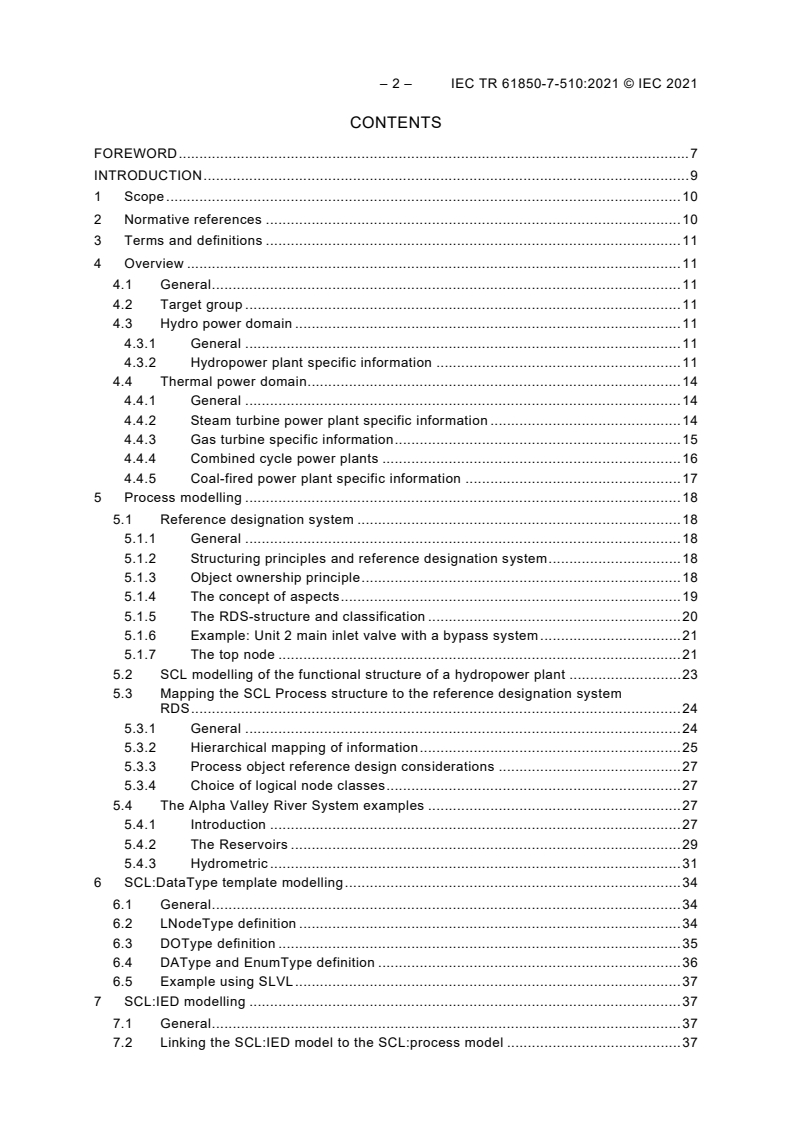
– 2 – IEC TR 61850-7-510:2021 © IEC 2021
CONTENTS
FOREWORD . 7
INTRODUCTION . 9
1 Scope . 10
2 Normative references . 10
3 Terms and definitions . 11
4 Overview . 11
4.1 General . 11
4.2 Target group . 11
4.3 Hydro power domain . 11
4.3.1 General . 11
4.3.2 Hydropower plant specific information . 11
4.4 Thermal power domain . 14
4.4.1 General . 14
4.4.2 Steam turbine power plant specific information . 14
4.4.3 Gas turbine specific information . 15
4.4.4 Combined cycle power plants . 16
4.4.5 Coal-fired power plant specific information . 17
5 Process modelling . 18
5.1 Reference designation system . 18
5.1.1 General . 18
5.1.2 Structuring principles and reference designation system . 18
5.1.3 Object ownership principle . 18
5.1.4 The concept of aspects . 19
5.1.5 The RDS-structure and classification . 20
5.1.6 Example: Unit 2 main inlet valve with a bypass system . 21
5.1.7 The top node . 21
5.2 SCL modelling of the functional structure of a hydropower plant . 23
5.3 Mapping the SCL Process structure to the reference designation system
RDS . 24
5.3.1 General . 24
5.3.2 Hierarchical mapping of information . 25
5.3.3 Process object reference design considerations . 27
5.3.4 Choice of logical node classes . 27
5.4 The Alpha Valley River System examples . 27
5.4.1 Introduction . 27
5.4.2 The Reservoirs . 29
5.4.3 Hydrometric . 31
6 SCL:DataType template modelling . 34
6.1 General . 34
6.2 LNodeType definition . 34
6.3 DOType definition . 35
6.4 DAType and EnumType definition . 36
6.5 Example using SLVL . 37
7 SCL:IED modelling . 37
7.1 General . 37
7.2 Linking the SCL:IED model to the SCL:process model . 37
7.3 Referencing the Logical Device . 37
7.4 SCL:Function element . 39
8 Communication Modelling . 39
8.1 General . 39
8.2 Communication structure in hydro power plants . 41
8.2.1 General . 41
8.2.2 Process bus level . 41
8.2.3 Station Bus . 42
8.2.4 Enterprise Bus . 42
8.3 Communication structure in thermal power plants . 42
9 Modelling of controls . 46
9.1 General . 46
9.2 Operational modes for hydropower plants . 46
9.3 Operational modes for thermal power plants . 47
9.4 Fundamental control strategies for hydropower plants. 47
9.5 Joint control modelling examples . 48
9.5.1 General . 48
9.5.2 Joint control of active power . 48
9.5.3 Joint Control of Reactive Power . 50
9.5.4 Joint Control of Water . 52
9.6 Scheduling Example . 53
9.7 Example of application for an excitation system . 54
9.7.1 General . 54
9.7.2 Voltage regulation example . 59
9.7.3 PSS example . 61
9.8 Example of application for a turbine governor system . 62
9.8.1 General . 62
9.8.2 Signal hierarchy . 62
9.8.3 Basic overview . 62
9.8.4 Detailed description of used IED structure . 64
9.9 Example of a braking system . 71
9.9.1 General . 71
9.9.2 Brake control with mandatory data objects in LN: HMBR . 71
9.9.3 Brake control with process indications . 72
9.10 Example of a heater system . 72
9.10.1 General . 72
9.10.2 Example of a LN: KHTR usage . 73
9.11 Examples of how to reference a start / stop sequencer of a hydropower unit . 73
9.11.1 General . 73
9.11.2 Unit sequences definition with IEC 61850 . 74
9.11.3 Start sequence from a state "stopped" to a state "speed no load not
excited" (Sequence 1). 75
9.11.4 Start sequence from state "speed no load not excited" to state
"synchronised" (Sequence 2) . 76
9.11.5 Stop sequence from state "synchronised" to state "speed no load not
excited" (sequence 3) . 78
9.11.6 Shutdown sequence from state " synchronised " to state "stopped"
(Sequence 4) . 79
9.11.7 Fast shutdown sequence from state " synchronised " to state "stopped"
(Sequence 5) . 82
– 4 – IEC TR 61850-7-510:2021 © IEC 2021
9.11.8 Emergency shutdown sequence from state " synchronised " to state
"stopped" (sequence 6). 84
9.12 Example of a capability chart representation . 86
9.12.1 General . 86
9.12.2 Example of a capability curve . 86
9.12.3 Example of a Hill chart . 88
9.12.4 Example of a multi-layer capability chart . 89
9.13 Pump start priorities of a high-pressure oil system . 91
9.13.1 General . 91
9.13.2 Sequence to manage a pump start priorities . 92
9.13.3 Sequence to manage a pump . 94
9.14 Examples of how to use various types of curves and curve shape
descriptions . 95
9.15 Examples of voltage matching function . 96
Annex A (informative) Electrical single line diagrams of thermal power plants . 97
Annex B (informative) System Specification Description for the Alpha 2 power plant . 100
Annex C (informative) RDS schema for the Alpha 2 power plant . 163
Bibliography . 169
Figure 1 – Principles for the joint control function . 12
Figure 2 – Water flow control of a turbine . 13
Figure 3 – Example of a large steam turbine . 14
Figure 4 – Simplified example of a large steam turbine power plant with typical control
system . 15
Figure 5 – Example of a gas turbine . 16
Figure 6 – Example of a combined cycle power plant with one GT and one ST in a
multi-shaft configuration . 16
Figure 7 – Example of a combined cycle power plant with one GT and one ST in a
single shaft configuration . 17
Figure 8 – Example of heat flow diagram of a coal-fired power plant . 18
Figure 9 – IEC/ISO 81346 ownership principle . 19
Figure 10 – A system breakdown structure showing the recursive phenomenon of
system elements also being systems . 20
Figure 11 – Three levels of classes within RDS . 20
Figure 12 – A system breakdown structure for a system of interest . 21
Figure 13 – Example of an RDS top node implementation . 22
Figure 14 – SCL process elements are structured according to the RDS Power Supply
system designations . 24
Figure 15 – SCL process elements are structured according to the RDS Construction
Works designations . 24
Figure 16 – IED model (LNs) linked to the SCL Process structure with the Power
Supply ystem profile . 25
Figure 17 – IED model (LNs) linked to the SCL Process structure with the Construction
works profile . 25
Figure 18 – The Alpha Valley River System example . 28
Figure 19 – Primary and supporting system to SCL overview . 29
Figure 20 – Mapping between IEC/ISO 81346 (RDS) and IEC 61850 (SCL) . 29
Figure 21 – Reservoir locations. 30
Figure 22 – Mapping of water levels with logical node TLVL. 31
Figure 23 – Mapping of water levels with logical HLVL . 32
Figure 24 – Mapping of water levels with logical MHYD . 32
Figure 25 – Mapping of the rate of discharge with logical node TFLW . 33
Figure 26 – Mapping of the rate of discharge with logical node HWCL . 33
Figure 27 – Mapping of the rate of discharge with logical node MHYD . 34
Figure 28 – The structure of LN SLVL . 37
Figure 29 – Schematic mapping of the process element to IED . 38
Figure 30 – Mapping the process element to IED and DataTemplate. 39
Figure 31 – Bus and services example . 40
Figure 32 – Hydro bus and services . 41
Figure 33 – Typical communication structure with two GTs and one ST, with the use of
IEC 61850 interface controller . 43
Figure 34 – Typical communication structure with two GTs and one ST, with IEC 61850
interface of process controllers . 44
Figure 35 – Typical communication structure with two GTs and one ST, with IEC 61850
interface of process controllers from different manufacturers . 45
Figure 36 – Typical communication structure with one ST, with IEC 61850 interface of
process controllers . 46
Figure 37 – Joint Control of active power . 50
Figure 38 – Joint control of reactive power (SCL:Function:Fct2) . 51
Figure 39 – Example of joint control of water . 53
Figure 40 – An example of scheduling of active power output . 54
Figure 41 – Examples of logical nodes used in an excitation system . 55
Figure 42 – Example of an excitation a functional breakdown . 57
Figure 43 – Example of logical devices of the regulation part of an excitation system . 58
Figure 44 – AVR basic regulator . 59
Figure 45 – Superimposed regulators, power factor regulator . 59
Figure 46 – Superimposed regulators, over-excitation limiter . 60
Figure 47 – Superimposed regulators, under-excitation limiter . 60
Figure 48 – Superimposed regulators, follow up . 61
Figure 49 – Power system stabilizer function . 61
Figure 50 – Signal hierarchy . 62
Figure 51 – Use of Logical Node HGOV with RDS-PS . 63
Figure 52 – Governor control . 66
Figure 53 – Flow control . 67
Figure 54 – Level control . 68
Figure 55 – Speed control . 69
Figure 56 – Limitations . 70
Figure 57 – Actuator control . 71
Figure 58 – Brake control with mandatory data objects . 72
Figure 59 – Brake control with indications . 72
Figure 60 – Oil tank heater using a step controller . 73
Figure 61 – Sequencer overview . 74
– 6 – IEC TR 61850-7-510:2021 © IEC 2021
Figure 62 – An example of a capability curve . 87
Figure 63 – An example of a Hill chart (five variables) . 88
Figure 64 – An example of a multi layered capability chart (five dimensions) . 89
Figure 65 – Graphical representation of the high-pressure oil pumping unit . 91
Figure 66 – Example of pump priority start logic sequence . 93
Figure 67 – Example of pump start logic sequence . 94
Figure 68 – Gate flow correlation . 95
Figure 69 – Turbine correlation curve. 95
Figure 70 – Example of traditional voltage adjusting pulses . 96
Figure 71 – Example of mapping of the pulse time in IEC 61850 . 96
Figure 72 – Example of an IEC 61850 voltage adjusting command . 96
Figure A.1 – Typical Single Line Diagram of a steam turbine power plant . 97
Figure A.2 – Typical Single Line Diagram of a gas turbine power plant or a combined
cycle power plant in single shaft configuration . 98
Figure A.3 – Typical Single Line Diagram of a combined cycle power plant in multi-
shaft configuration with separate step-up transformers . 99
Figure A.4 – Typical Single Line Diagram of a combined cycle power plant in multi-
shaft configuration with 3-winding step-up transformers . 99
Table 1 – IEC/ISO 81346 aspects . 19
Table 2 – Mapping SCL to RDS-PS . 26
Table 3 – Reservoir descriptions . 30
Table 4 – Examples of water level measurements . 31
Table 5 – Examples of the rate of discharge measurements . 33
Table 6 – Functional breakdown of an RDS component with functions for joint control . 48
Table 7 – Joint Control active power setpoints data flow . 50
Table 8 – Joint Control reactive power setpoints data flow . 52
Table 9 – Joint Control flow setpoints data flow . 53
Table 10 – Functional breakdown of a Process child RDS component with functions . 56
Table 11 – Functional breakdown of a Process child RDS component with functions . 64
Table 12 – Alpha2 Typical sequences . 74
Table 13 – Capability table . 87
Table 14 – Mapping of Hill charts . 88
Table 15 – Five-dimensional capability chart . 90
Table 16 – Alpha2 Typical pump sequences . 91
INTERNATIONAL ELECTROTECHNICAL COMMISSION
____________
COMMUNICATION NETWORKS AND SYSTEMS
FOR POWER UTILITY AUTOMATION –
Part 7-510: Basic communication structure – Hydroelectric power plants,
steam and gas turbines – Modelling concepts and guidelines
FOREWORD
1) The International Electrotechnical Commission (IEC) is a worldwide organization for standardization comprising
all national electrotechnical committees (IEC National Committees). The object of IEC is to promote international
co-operation on all questions concerning standardization in the electrical and electronic fields. To this end and
in addition to other activities, IEC publishes International Standards, Technical Specifications, Technical Reports,
Publicly Available Specifications (PAS) and Guides (hereafter referred to as "IEC Publication(s)"). Their
preparation is entrusted to technical committees; any IEC National Committee interested in the subject dealt with
may participate in this preparatory work. International, governmental and non-governmental organizations liaising
with the IEC also participate in this preparation. IEC collaborates closely with the International Organization for
Standardization (ISO) in accordance with conditions determined by agreement between the two organizations.
2) The formal decisions or agreements of IEC on technical matters express, as nearly as possible, an international
consensus of opinion on the relevant subjects since each technical committee has representation from all
interested IEC National Committees.
3) IEC Publications have the form of recommendations for international use and are accepted by IEC National
Committees in that sense. While all reasonable efforts are made to ensure that the technical content of IEC
Publications is accurate, IEC cannot be held responsible for the way in which they are used or for any
misinterpretation by any end user.
4) In order to promote international uniformity, IEC National Committees undertake to apply IEC Publications
transparently to the maximum extent possible in their national and regional publications. Any divergence between
any IEC Publication and the corresponding national or regional publication shall be clearly indicated in the latter.
5) IEC itself does not provide any attestation of conformity. Independent certification bodies provide conformity
assessment services and, in some areas, access to IEC marks of conformity. IEC is not responsible for any
services carried out by independent certification bodies.
6) All users should ensure that they have the latest edition of this publication.
7) No liability shall attach to IEC or its directors, employees, servants or agents including individual experts and
members of its technical committees and IEC National Committees for any personal injury, property damage or
other damage of any nature whatsoever, whether direct or indirect, or for costs (including legal fees) and
expenses arising out of the publication, use of, or reliance upon, this IEC Publication or any other IEC
Publications.
8) Attention is drawn to the Normative references cited in this publication. Use of the referenced publications is
indispensable for the correct application of this publication.
9) Attention is drawn to the possibility that some of the elements of this IEC Publication may be the subject of patent
rights. IEC shall not be held responsible for identifying any or all such patent rights.
IEC TR 61850-7-510 has been prepared by IEC technical committee 57: Power systems
management and associated information exchange. It is a Technical Report.
This second edition cancels and replaces the first edition published in 2012. This edition
constitutes a technical revision.
This edition includes the following significant technical changes with respect to the previous
edition:
a) Process modelling according to IEC 61850-6:2009, including IEC 61850-6:2009/AMD1:2018.
b) Examples of application of Reference Designation System together with the process
modelling, in particular application of IEC/ISO 81346.
c) Description of modelling related to Steam- and Gas turbines.
d) Annexes with examples of application of SCL according to the examples in the Technical
Report.
– 8 – IEC TR 61850-7-510:2021 © IEC 2021
e) The dynamic exchange of values by using polling, GOOSE, Reporting or Sampled Values is no
longer included in the Technical Report.
f) Updated examples of application of SCL:Process and IED modelling applying the Logical Nodes
defined in IEC 61850-7-410:2012, including IEC 61850-7-410:2012/AMD1:2015.
The text of this Technical Report is based on the following documents:
DTR Report on voting
57/2391/DTR 57/2432/RVDTR
Full information on the voting for its approval can be found in the report on voting indicated in
the above table.
The language used for the development of this Technical Report is English.
This document was drafted in accordance with ISO/IEC Directives, Part 2, and developed in
accordance with ISO/IEC Directives, Part 1 and ISO/IEC Directives, IEC Supplement, available
at www.iec.ch/members_experts/refdocs. The main document types developed by IEC are
described in greater detail at www.iec.ch/standardsdev/publications.
A list of all parts of the IEC 61850 series, under the general title: Communication networks and
systems for power utility automation, can be found on the IEC website.
The committee has decided that the contents of this document will remain unchanged until the
stability date indicated on the IEC website under webstore.iec.ch in the data related to the
specific document. At this date, the document will be
• reconfirmed,
• withdrawn,
• replaced by a revised edition, or
• amended.
IMPORTANT – The "colour inside" logo on the cover page of this document indicates that it
contains colours which are considered to be useful for the correct understanding of its
contents. Users should therefore print this document using a colour printer.
INTRODUCTION
This Technical Report is connected with IEC 61850-7-410, as well as IEC 61850-7-4:2010,
explaining how the control system and other functions in a hydropower, steam or gas turbine
plant can use logical nodes and information exchange services within the complete IEC 61850
package to specify the information needed and generated by, and exchanged between
functions.
The dynamic exchange of values by using polling, GOOSE, Reporting or Sampled Values is
beyond the scope of this document.
This document applies the SCL Process element structure for modelling of the processes.
Examples of application of SCL Code according to the modelling examples in this document
are presented in Annex B and Annex C.
– 10 – IEC TR 61850-7-510:2021 © IEC 2021
COMMUNICATION NETWORKS AND SYSTEMS
FOR POWER UTILITY AUTOMATION –
Part 7-510: Basic communication structure – Hydroelectric power plants,
steam and gas turbines – Modelling concepts and guidelines
1 Scope
This part of IEC 61850, which is a technical report, is intended to provide explanations on how
to use the Logical Nodes defined in IEC 61850-7-410 as well as other documents in the
IEC 61850 series to model complex control functions in power plants, including variable speed
pumped storage power plants.
IEC 61850-7-410 introduced the general modelling concepts of IEC 61850 for power plants. It
is however not obvious from the standard how the modelling concepts can be implemented in
actual power plants.
This document explains how the data model and the concepts defined in the IEC 61850
standard can be applied in Hydro; both directly at the process control level, but also for data
structuring and data exchange at a higher level. Application of the data model for Thermal is
limited to power evacuation (in principle the extraction of the generated electrical power) and
the prime mover shaft and bearing system. The interfaces of the fuel and steam valves are
modelled for the purpose of process control.
Communication services, and description of the use of mappings of the IEC 61850 data model
to different communication protocols, are outside the scope of this document.
2 Normative references
The following documents are referred to in the text in such a way that some or all of their content
constitutes requirements of this document. For dated references, only the edition cited applies.
For undated references, the latest edition of the referenced document (including any
amendments) applies.
IEC 61362:2012, Guide to specification of hydraulic turbine governing systems
IEC 61850-6:2009, Communication networks and systems for power utility automation – Part 6:
Configuration description language for communication in electrical substations related to IEDs
IEC 61850-7-3:2010, Communication networks and systems for power utility automation – Part
7-3: Basic communication structure – Common data classes
IEC 61850-7-3:2010/AMD1:2020
IEC 61850-7-4:2010, Communication networks and systems for power utility automation – Part
7-4: Basic communication structure – Compatible logical node classes and data object classes
IEC 61850-7-4:2010/AMD1:2020
IEC 61850-7-410:2012, Communication networks and systems for power utility automation –
Part 7-410: Basic communication structure – Hydroelectric power plants – Communication for
monitoring and control
IEC 61850-7-410:2012/AMD1:2015
ISO 81346-10:— , Industrial systems, installations and equipment and industrial products –
Structuring principles and reference designations – Part 10: Power Supply systems
3 Terms and definitions
No terms and definitions are listed in this document.
ISO and IEC maintain terminological databases for use in standardization at the following
addresses:
• IEC Electropedia: available at http://www.electropedia.org/
• ISO Online browsing platform: available at http://www.iso.org/obp
4 Overview
4.1 General
This clause describes the target group of the document and introduces the modelled power
plant domain.
4.2 Target group
This document targets engineers and system integrators working with control and modelling of
Hydro Power and Thermal Power plant processes.
The document gives an overview of the process control in the different contexts and provides
examples on how to structure and name the systems in a model, and how to use the
DataObjects in control and supervision of the power plant processes. The document provides
guidance on how to apply the IEC 61850 data model defined in IEC 61850-7-410.
4.3 Hydro power domain
4.3.1 General
In hydro power, the power is derived from the potential energy difference of water transferred
from a higher to a lower level through a rotating turbine. The turbine transfers the power from
the flowing water to a rotating shaft, and a generator transforms the mechanical power into
electrical power. To handle the water level and the flow of water several types of gates are
used.
4.3.2 Hydropower plant specific information
Different devices handle active and reactive power control. The turbine governor provides the
active power control by regulating the water flow through the turbine and thus the pole angle
between the rotating magnetic flux and the rotor. The excitation system provides the reactive
power control by regulating the voltage of the generator. The magnetic flux corresponds to the
shaft torque to keep the generator synchronised to the grid.
Figure 1 shows an example of an arrangement including a joint control function. The set-points
will be issued from a dispatch centre and could be one of three optional values. Therefore, the
type of set-point that will be used depends on the water control mode that is used for the plant.
_____________
Under preparation. Stage at the time of publication: ISO/DIS 81346-10:2021.
– 12 – IEC TR 61850-7-510:2021 © IEC 2021
Figure 1 – Principles for the joint control function
In case of a reservoir without any power production, the water control function will get the water
control set-points from a dispatch centre; in case of a power plant, it will normally be the joint
control function that sets the values. The set-point will be either water level or water flow set-
points.
The total water flow is the sum of flow through turbines and gates. The turbine control system
can, due to this, be provided with different set-points for the control.
• Water flow set-point. The control system will base the regulation on the given water flow
level and try to optimise the production.
• Active power set-point. The control system will try to meet the active power, the water flow
will be reported back to the overall water control system.
• Active power control with speed droop. This is the mode when the unit is contributing to the
network frequency control. The active power set-point is balanced over the speed droop
setting to obtain the desired power/frequency amplification.
• Frequency set-point. In case of an islanded system or a power plant in peak load duty, the
active power will be controlled to exactly meet the demand. This control mode is also used
during start-up of the unit, up to the point when the generator is synchronised. Water flow
will be reported.
Figure 2 – Water flow control of a turbine
Figure 2 shows an example of water flow control for a turbine. Direct measurement of the water
flow, as indicated in the figure, is less common. The flow is normally calculated, using the net
head, the opening angle of the guide vanes and a correlation curve.
Main inlet valves to shut off the turbine chamber are used for pumped storage plants and power
plants with high penstocks.
It is important to differentiate between the water levels of the dam and at the intake. Due to the
intake design or if the turbine is running close to rated power, the water level at the intake might
be considerably lower than the average for the dam.
The measurement of under-pressure below the turbine chamber is a safety measure, to ensure
that the operation of the guide vanes does not cause any dangerous conditions in the tailrace
part.
– 14 – IEC TR 61850-7-510:2021 © IEC 2021
4.4 Thermal power domain
4.4.1 General
In thermal power the power is derived from the change in enthalpy of a medium flowing through
a system. Commonly the combustion of a fuel is used to boil water into heated and pressurized
steam which is directed through one or several turbines. Other ways of heating water are also
in use in thermal power (thermal solar, geothermal, nuclear). The turbine transfers the power
from the flowing steam to a rotating shaft, and a generator transforms the mechanical power
into electrical power. To handle the steam pressure and temperatures several valves are used.
4.4.2 Steam turbine power plant specific information
As in hydropower plants, different devices handle active and reactive power control.
A steam turbine gets its power from the steam produced e.g. in a boiler or a steam generator.
Usually a steam turbine consists of several sta
...
Questions, Comments and Discussion
Ask us and Technical Secretary will try to provide an answer. You can facilitate discussion about the standard in here.
Loading comments...