

IEC 62906-5-7:2022
(Main)Laser displays - Part 5-7: Measuring methods of image quality affected by speckle for scanning laser displays
General Information
- Abstract
IEC 62906-5-7:2022 specifies the standard measurement conditions and methods for determining the quality of images projected by a scanning laser display on a visible light fluorescence-free screen, when observed as being affected by speckle noise due to laser coherence.
- Status
- Published
- Publication Date
- 26-Jan-2022
- Technical Committee
- TC 110 - Electronic displays
- Drafting Committee
- WG 10 - TC 110/WG 10
- Current Stage
- PPUB - Publication issued
- Start Date
- 27-Jan-2022
- Completion Date
- 28-Jan-2022


Overview
IEC 62906-5-7:2022 is an international standard developed by the International Electrotechnical Commission (IEC) that addresses the measurement of image quality in scanning laser displays affected by speckle noise. Speckle, caused by coherent laser light scattering, can significantly deteriorate the visual quality of projected images. This standard provides precise measurement methods and conditions to determine image quality on fluorescence-free screens under the influence of speckle, enhancing the reliability and comparability of test results across different manufacturers and applications.
By defining uniform procedures and equipment requirements, IEC 62906-5-7:2022 supports the consistent assessment of laser display image quality, contributing to quality control, product evaluation, and innovation in the field of laser projection technology.
Key Topics
Speckle-Affected Image Quality
The standard focuses on aspects of display image quality that are directly influenced by speckle, including spatial contrast, spatial noise, and their distribution across colors and image regions.Measurement Environments and Setups
Specifications for environmental conditions (temperature, humidity, dark-room requirements), device under test (DUT) stabilization, and screen types (Lambertian diffuse reflectance white standard) are outlined for repeatable results.Light Measuring Devices (LMD) Requirements
IEC 62906-5-7 details the accuracy, calibration, and operational requirements for various instruments, such as spectroradiometers, wavelength meters, Fourier transform spectrometers, colorimeters, and dedicated speckle meters.Standardized Measurement Methods
- Direct Measurement: For determining primary optical properties at specific screen positions.
- Diffuse Reflectance Measurement: Using a diffuse white standard to assess radiance and speckle at defined positions.
- Full-Screen Measurement: Comprehensive evaluation using a standard full-size screen.
Speckle Quantification
Procedures for measuring monochromatic and color speckle contrast, resolution degradation due to speckle, and spatial non-uniformity are specified, improving the assessment of real-world visual impacts.
Applications
IEC 62906-5-7:2022 is essential for:
- Manufacturers of Scanning Laser Displays
Ensuring accurate and consistent product qualification, research, and development processes by applying reliable speckle measurement methods. - Quality Assurance and Compliance Testing
Providing a standardized reference for verifying image quality claims and meeting regulatory or market requirements. - Performance Benchmarking
Facilitating comparative performance analysis between different display technologies or models by standardizing how speckle-induced image degradation is measured. - Research and Development
Enabling innovation in speckle reduction techniques by providing clear evaluation metrics for new approaches in laser displays. - Procurement and Product Selection
Assisting display integrators and end-users in understanding and comparing the speckle performance of laser-based projection systems.
Related Standards
IEC 62906-5-7:2022 references and complements several other international standards:
- IEC 60825-1 – Safety of laser products: Equipment classification and requirements
- IEC 62471 – Photobiological safety of lamps and lamp systems
- IEC 62906-5-2 – Optical measuring methods of speckle contrast
- IEC 62906-5-4 – Optical measuring methods of colour speckle
- IEC 62906-5-6 – Measuring methods for optical performance of projection screens
These related standards cover essential areas such as laser safety, photobiological hazards, and foundational measurement techniques for display devices, ensuring a comprehensive approach to laser display quality evaluation.
Keywords: IEC 62906-5-7, laser displays, speckle measurement, image quality, scanning laser display, international standard, optical measurement, display calibration, speckle noise, projection screen, photometric measurement, colorimetric measurement, laser display testing.
Frequently Asked Questions
IEC 62906-5-7:2022 is a standard published by the International Electrotechnical Commission (IEC). Its full title is "Laser displays - Part 5-7: Measuring methods of image quality affected by speckle for scanning laser displays". This standard covers: IEC 62906-5-7:2022 specifies the standard measurement conditions and methods for determining the quality of images projected by a scanning laser display on a visible light fluorescence-free screen, when observed as being affected by speckle noise due to laser coherence.
IEC 62906-5-7:2022 specifies the standard measurement conditions and methods for determining the quality of images projected by a scanning laser display on a visible light fluorescence-free screen, when observed as being affected by speckle noise due to laser coherence.
IEC 62906-5-7:2022 is classified under the following ICS (International Classification for Standards) categories: 31.260 - Optoelectronics. Laser equipment. The ICS classification helps identify the subject area and facilitates finding related standards.
IEC 62906-5-7:2022 is available in PDF format for immediate download after purchase. The document can be added to your cart and obtained through the secure checkout process. Digital delivery ensures instant access to the complete standard document.
Standards Content (Sample)
IEC 62906-5-7 ®
Edition 1.0 2022-01
INTERNATIONAL
STANDARD
NORME
INTERNATIONALE
colour
inside
Laser displays –
Part 5-7: Measuring methods of image quality affected by speckle for scanning
laser displays
Affichages laser –
Partie 5-7: Méthodes de mesure de la qualité d’image affectée par la tacheture
pour les affichages laser à balayage
All rights reserved. Unless otherwise specified, no part of this publication may be reproduced or utilized in any form
or by any means, electronic or mechanical, including photocopying and microfilm, without permission in writing from
either IEC or IEC's member National Committee in the country of the requester. If you have any questions about IEC
copyright or have an enquiry about obtaining additional rights to this publication, please contact the address below or
your local IEC member National Committee for further information.
Droits de reproduction réservés. Sauf indication contraire, aucune partie de cette publication ne peut être reproduite
ni utilisée sous quelque forme que ce soit et par aucun procédé, électronique ou mécanique, y compris la photocopie
et les microfilms, sans l'accord écrit de l'IEC ou du Comité national de l'IEC du pays du demandeur. Si vous avez des
questions sur le copyright de l'IEC ou si vous désirez obtenir des droits supplémentaires sur cette publication, utilisez
les coordonnées ci-après ou contactez le Comité national de l'IEC de votre pays de résidence.
IEC Secretariat Tel.: +41 22 919 02 11
3, rue de Varembé info@iec.ch
CH-1211 Geneva 20 www.iec.ch
Switzerland
About the IEC
The International Electrotechnical Commission (IEC) is the leading global organization that prepares and publishes
International Standards for all electrical, electronic and related technologies.
About IEC publications
The technical content of IEC publications is kept under constant review by the IEC. Please make sure that you have the
latest edition, a corrigendum or an amendment might have been published.
IEC publications search - webstore.iec.ch/advsearchform IEC Products & Services Portal - products.iec.ch
The advanced search enables to find IEC publications by a Discover our powerful search engine and read freely all the
variety of criteria (reference number, text, technical publications previews. With a subscription you will always
committee, …). It also gives information on projects, replaced have access to up to date content tailored to your needs.
and withdrawn publications.
Electropedia - www.electropedia.org
IEC Just Published - webstore.iec.ch/justpublished
The world's leading online dictionary on electrotechnology,
Stay up to date on all new IEC publications. Just Published
containing more than 22 300 terminological entries in English
details all new publications released. Available online and
and French, with equivalent terms in 19 additional languages.
once a month by email.
Also known as the International Electrotechnical Vocabulary
(IEV) online.
IEC Customer Service Centre - webstore.iec.ch/csc
If you wish to give us your feedback on this publication or
need further assistance, please contact the Customer Service
Centre: sales@iec.ch.
A propos de l'IEC
La Commission Electrotechnique Internationale (IEC) est la première organisation mondiale qui élabore et publie des
Normes internationales pour tout ce qui a trait à l'électricité, à l'électronique et aux technologies apparentées.
A propos des publications IEC
Le contenu technique des publications IEC est constamment revu. Veuillez vous assurer que vous possédez l’édition la
plus récente, un corrigendum ou amendement peut avoir été publié.
Recherche de publications IEC - IEC Products & Services Portal - products.iec.ch
webstore.iec.ch/advsearchform Découvrez notre puissant moteur de recherche et consultez
La recherche avancée permet de trouver des publications IEC gratuitement tous les aperçus des publications. Avec un
en utilisant différents critères (numéro de référence, texte, abonnement, vous aurez toujours accès à un contenu à jour
comité d’études, …). Elle donne aussi des informations sur adapté à vos besoins.
les projets et les publications remplacées ou retirées.
Electropedia - www.electropedia.org
IEC Just Published - webstore.iec.ch/justpublished
Le premier dictionnaire d'électrotechnologie en ligne au
Restez informé sur les nouvelles publications IEC. Just
monde, avec plus de 22 300 articles terminologiques en
Published détaille les nouvelles publications parues.
anglais et en français, ainsi que les termes équivalents dans
Disponible en ligne et une fois par mois par email.
19 langues additionnelles. Egalement appelé Vocabulaire
Electrotechnique International (IEV) en ligne.
Service Clients - webstore.iec.ch/csc
Si vous désirez nous donner des commentaires sur cette
publication ou si vous avez des questions contactez-nous:
sales@iec.ch.
IEC 62906-5-7 ®
Edition 1.0 2022-01
INTERNATIONAL
STANDARD
NORME
INTERNATIONALE
colour
inside
Laser displays –
Part 5-7: Measuring methods of image quality affected by speckle for scanning
laser displays
Affichages laser –
Partie 5-7: Méthodes de mesure de la qualité d’image affectée par la tacheture
pour les affichages laser à balayage
INTERNATIONAL
ELECTROTECHNICAL
COMMISSION
COMMISSION
ELECTROTECHNIQUE
INTERNATIONALE
ICS 31.260 ISBN 978-2-8322-1069-5
– 2 – IEC 62906-5-7:2022 © IEC 2022
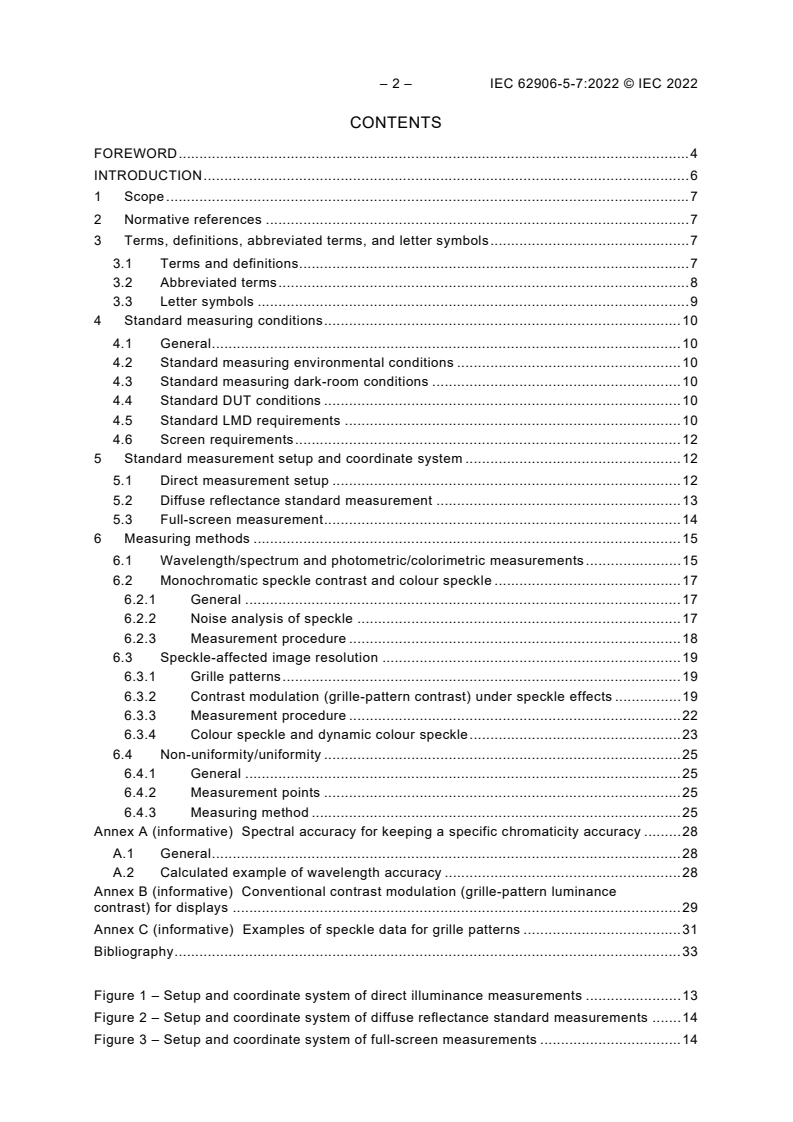
CONTENTS
FOREWORD . 4
INTRODUCTION . 6
1 Scope . 7
2 Normative references . 7
3 Terms, definitions, abbreviated terms, and letter symbols . 7
3.1 Terms and definitions . 7
3.2 Abbreviated terms . 8
3.3 Letter symbols . 9
4 Standard measuring conditions . 10
4.1 General . 10
4.2 Standard measuring environmental conditions . 10
4.3 Standard measuring dark-room conditions . 10
4.4 Standard DUT conditions . 10
4.5 Standard LMD requirements . 10
4.6 Screen requirements . 12
5 Standard measurement setup and coordinate system . 12
5.1 Direct measurement setup . 12
5.2 Diffuse reflectance standard measurement . 13
5.3 Full-screen measurement . 14
6 Measuring methods . 15
6.1 Wavelength/spectrum and photometric/colorimetric measurements . 15
6.2 Monochromatic speckle contrast and colour speckle . 17
6.2.1 General . 17
6.2.2 Noise analysis of speckle . 17
6.2.3 Measurement procedure . 18
6.3 Speckle-affected image resolution . 19
6.3.1 Grille patterns . 19
6.3.2 Contrast modulation (grille-pattern contrast) under speckle effects . 19
6.3.3 Measurement procedure . 22
6.3.4 Colour speckle and dynamic colour speckle . 23
6.4 Non-uniformity/uniformity . 25
6.4.1 General . 25
6.4.2 Measurement points . 25
6.4.3 Measuring method . 25
Annex A (informative) Spectral accuracy for keeping a specific chromaticity accuracy . 28
A.1 General . 28
A.2 Calculated example of wavelength accuracy . 28
Annex B (informative) Conventional contrast modulation (grille-pattern luminance
contrast) for displays . 29
Annex C (informative) Examples of speckle data for grille patterns . 31
Bibliography . 33
Figure 1 – Setup and coordinate system of direct illuminance measurements . 13
Figure 2 – Setup and coordinate system of diffuse reflectance standard measurements . 14
Figure 3 – Setup and coordinate system of full-screen measurements . 14
Figure 4 – Example of spectra of single-longitudinal mode RGB lasers . 15
Figure 5 – Example of spectrum of multi-longitudinal modes . 16
Figure 6 – Grille patterns in both horizontal and vertical directions. 19
Figure 7 – Measured data of speckled grille pattern and lines along the grille direction . 21
Figure 8 – Eye-diagram representation of normalized illuminance distribution of
speckle . 22
Figure 9 – Example of chromaticity distribution for the colour speckle observed in the
uniform image region (CIE 1976 plot) . 24
Figure 10 – Example of dynamic colour speckle in a period (CIE 1976 plot) . 25
Figure 11 – Non-uniformity measurement positions (rectangular pattern) . 26
Figure 12 – Non-uniformity measurement positions (grille pattern) . 27
Figure A.1 – Calculated wavelength accuracy to keep |Δu’|, |Δv’| < 0,001 . 28
Figure B.1 – Example of the measured grille pattern . 29
Figure B.2 – Example of C plot . 30
M
Figure C.1 – Example of visualized 2D-captured data for R, G, B monochromatic
speckle, and for colour speckle of colour W (white) . 31
Figure C.2 – Example of C plot under the effects of speckle . 32
M-speckle
Table 1 – Letter symbols (quantity symbols / unit symbols) . 9
– 4 – IEC 62906-5-7:2022 © IEC 2022
INTERNATIONAL ELECTROTECHNICAL COMMISSION
____________
LASER DISPLAYS –
Part 5-7: Measuring methods of image quality affected
by speckle for scanning laser displays
FOREWORD
1) The International Electrotechnical Commission (IEC) is a worldwide organization for standardization comprising
all national electrotechnical committees (IEC National Committees). The object of IEC is to promote international
co-operation on all questions concerning standardization in the electrical and electronic fields. To this end and
in addition to other activities, IEC publishes International Standards, Technical Specifications, Technical Reports,
Publicly Available Specifications (PAS) and Guides (hereafter referred to as “IEC Publication(s)”). Their
preparation is entrusted to technical committees; any IEC National Committee interested in the subject dealt with
may participate in this preparatory work. International, governmental and non-governmental organizations liaising
with the IEC also participate in this preparation. IEC collaborates closely with the International Organization for
Standardization (ISO) in accordance with conditions determined by agreement between the two organizations.
2) The formal decisions or agreements of IEC on technical matters express, as nearly as possible, an international
consensus of opinion on the relevant subjects since each technical committee has representation from all
interested IEC National Committees.
3) IEC Publications have the form of recommendations for international use and are accepted by IEC National
Committees in that sense. While all reasonable efforts are made to ensure that the technical content of IEC
Publications is accurate, IEC cannot be held responsible for the way in which they are used or for any
misinterpretation by any end user.
4) In order to promote international uniformity, IEC National Committees undertake to apply IEC Publications
transparently to the maximum extent possible in their national and regional publications. Any divergence between
any IEC Publication and the corresponding national or regional publication shall be clearly indicated in the latter.
5) IEC itself does not provide any attestation of conformity. Independent certification bodies provide conformity
assessment services and, in some areas, access to IEC marks of conformity. IEC is not responsible for any
services carried out by independent certification bodies.
6) All users should ensure that they have the latest edition of this publication.
7) No liability shall attach to IEC or its directors, employees, servants or agents including individual experts and
members of its technical committees and IEC National Committees for any personal injury, property damage or
other damage of any nature whatsoever, whether direct or indirect, or for costs (including legal fees) and
expenses arising out of the publication, use of, or reliance upon, this IEC Publication or any other IEC
Publications.
8) Attention is drawn to the Normative references cited in this publication. Use of the referenced publications is
indispensable for the correct application of this publication.
9) Attention is drawn to the possibility that some of the elements of this IEC Publication may be the subject of patent
rights. IEC shall not be held responsible for identifying any or all such patent rights.
IEC 62906-5-7 has been prepared by IEC technical committee 110: Electronic displays. It is an
International Standard.
The text of this International Standard is based on the following documents:
Draft Report on voting
110/1366/FDIS 110/1390/RVD
Full information on the voting for its approval can be found in the report on voting indicated in
the above table.
The language used for the development of this International Standard is English.
A list of all parts in the IEC 62906 series, published under the general title Laser displays, can
be found on the IEC website.
This document was drafted in accordance with ISO/IEC Directives, Part 2, and developed in
accordance with ISO/IEC Directives, Part 1 and ISO/IEC Directives, IEC Supplement, available
at www.iec.ch/members_experts/refdocs. The main document types developed by IEC are
described in greater detail at www.iec.ch/standardsdev/publications.
The committee has decided that the contents of this document will remain unchanged until the
stability date indicated on the IEC website under webstore.iec.ch in the data related to the
specific document. At this date, the document will be
• reconfirmed,
• withdrawn,
• replaced by a revised edition, or
• amended.
IMPORTANT – The "colour inside" logo on the cover page of this document indicates that it
contains colours which are considered to be useful for the correct understanding of its
contents. Users should therefore print this document using a colour printer.
– 6 – IEC 62906-5-7:2022 © IEC 2022
INTRODUCTION
Beam-scanning laser displays have specific features which are quite different from full-frame
(FF) laser displays using a spatial light modulator (SLM) and other electronic displays.
The image of the beam-scanning laser displays is usually projected on a planar or curved screen.
Scanning laser displays that excite or pump full or patterned phosphor layers on a separate
screen are excluded. The image pixels are virtually created by high-speed modulation of a
scanning laser beam combining at least R, G, B primary colour beams, which is sometimes
called "flying spot". Compared with displays with spatial light modulators, the image formed on
the screen can have additional spatio-temporal blur and non-uniformities. Therefore, to
measure the image quality projected on the screen, the dynamic scan mechanism even for still
images is considered.
Furthermore, speckle greatly affects the image quality because a speckle pattern is created on
the retina by interference of the coherent or partially coherent laser lights scattered on the
screen. It is more difficult for the beam-scanning laser displays to reduce speckle effects than
other laser displays. This is because some of the effective speckle-reducing techniques such
as moving diffusers and angular compounding are not applicable to a laser beam. Therefore,
the speckle more greatly affects the measurements of illuminance, chromaticity and resolution,
that is, speckle effects are more dominant in that type of displays and therefore it is necessary
to use light measuring equipment designed for measurements under the effect of speckle.
The speckle-affected image quality of scanning laser displays strongly depends on the optical
quality of the laser beam, such as scanning speed, scanning angle, image-signal modulation,
and speckle. The detail of the measuring methods of the laser beam emitted out of laser
.
modules is specified in IEC 62595-2-4 [1]
___________
Numbers in square brackets refer to the Bibliography.
LASER DISPLAYS –
Part 5-7: Measuring methods of image quality affected
by speckle for scanning laser displays
1 Scope
This part of IEC 62906 specifies the standard measurement conditions and methods for
determining the quality of images projected by a scanning laser display on a visible light
fluorescence-free screen, when observed as being affected by speckle noise due to laser
coherence.
2 Normative references
The following documents are referred to in the text in such a way that some or all of their content
constitutes requirements of this document. For dated references, only the edition cited applies.
For undated references, the latest edition of the referenced document (including any
amendments) applies.
IEC 60825-1, Safety of laser products – Part 1: Equipment classification and requirements
IEC 62471 (all parts), Photobiological safety of lamps and lamp systems
IEC 62906-5-2, Laser display devices – Part 5-2: Optical measuring methods of speckle
contrast
IEC 62906-5-4, Laser display devices – Part 5-4: Optical measuring methods of colour speckle
IEC 62906-5-6, Laser displays – Part 5-6: Measuring methods for optical performance of
projection screens
3 Terms, definitions, abbreviated terms, and letter symbols
3.1 Terms and definitions
For the purposes of this document, the following terms and definitions apply.
ISO and IEC maintain terminological databases for use in standardization at the following
addresses:
• IEC Electropedia: available at http://www.electropedia.org/
• ISO Online browsing platform: available at http://www.iso.org/obp
3.1.1
scanning laser display
laser display capable of projecting an image on a planar or curved screen by spatially scanning
one or several laser beams
3.1.2
raster-scan laser display
laser display capable of projecting an image on a planar or curved screen by scanning one or
several laser beams line-by-line
– 8 – IEC 62906-5-7:2022 © IEC 2022
3.1.3
FF laser display
full-frame laser display
laser display capable of projecting an image on a screen via one or several spatial light
modulators using one or several light sources including lasers
3.1.4
speckle-affected image quality
attributes of display image particularly affected by speckle, captured by human eyes, and
described by spatially dependent optical properties, spatial contrast, spatial noise and its spatial
distribution, each of which depends on input colours
3.1.5
speckle-affected image resolution
resolution of display image particularly affected by speckle, captured by human eyes, and
described by spatially dependent optical properties, spatial contrast, spatial noise and its spatial
distribution, each of which depends on input colours, measured separately for different
directions
3.1.6
dynamic colour speckle
colour speckle observed in the edge regions of an image pattern
as the input signal levels of a scanning laser beam vary
3.1.7
laser multi-meter
light measuring device based on non-spectrometric methods using absorption filters with linear
wavelength ramps capable of measuring centroid wavelength and optical power of laser light
sources operating in single or multiple longitudinal mode, from which the tristimulus values XYZ
are calculated to derive colorimetric and photometric quantities using the CIE colour-matching
functions
Note 1 to entry: See [2].
3.1.8
wavelength meter
light measuring device based on the principle of interference which is used for precise
wavelength measurements of laser devices
3.1.9
Fourier transform spectrometer
light measuring device based on the principle of interference in which the length of a cavity is
temporally scanned, calculating the spectrum by Fourier transforming the raw data recorded in
the time domain
3.2 Abbreviated terms
DUT device under test
LD laser diode
LMD light measuring device
MTF modulation transfer function
ND neutral density
NF noise factor
RGB red, green, blue
RMS root mean square
SLM spatial light modulator
SNR signal-to-noise ratio
W white colour
3.3 Letter symbols
The letter symbols are shown in Table 1.
Table 1 – Letter symbols (quantity symbols / unit symbols)
D
Distance from screen to DUT m
D
Distance from screen to LMD (speckle, luminance) m
Azimuth angle φ degree
Angle between the optical axis of DUT and LMD ∆θ degree
Cartesian coordinate on the screen or the virtual screen x, y, z -
Subscript denoting primary colours, R, G, B Q -
Optical output power P W
P
Optical output power of primary colours W
Q
E
Irradiance W/m
e
E
Irradiance of primary colours
W/m
e-Q
E
Illuminance
lm/m
v
E
Illuminance of primary colours lm/m
v-Q
L
Radiance of primary colours W/sr/m
Q
Wavelength λ nm
λ
Wavelength of primary colours nm
Q
λ
Centroid wavelength nm
c
λ nm
Reference wavelength
r
Wavelength difference δ nm
CIE tristimulus values X, Y, Z -
x(λ), yz(λλ), ( ),
CIE colour matching functions -
CIE 1931 coordinates x, y -
CIE 1976 coordinates u’, v’ -
E
Root mean square of illuminance lm/m
v-rms
C
Monochromatic speckle contrast of primary colours -
s-Q
C
Photometric speckle contrast -
ps
Contrast modulation, grille-pattern luminance contrast
C
-
M
for the conventional displays
C
Contrast modulation, grille-pattern contrast (average) -
M-ave
C
Contrast modulation, grille-pattern contrast (speckled) -
M-speckle
Illuminance along a line at local maximum or local
E E
lm/m
v-H, v-L
minimum used in the calculation of C
M-speckle
Average illuminance along a line at local maximum or
E E
v-H, v-L lm/m
local minimum used in the calculation of C
M-speckle
Luminance along a line at local maximum or local
L L
lm
H, L
minimum used in the calculation of C
M
Nonuniformity NU %
– 10 – IEC 62906-5-7:2022 © IEC 2022
Uniformity U %
Maximum or minimum illuminance of the thirteen
E E
lm/m
v-max v-min
windows for nonuniformity measurement
CIE 1976 chromaticity difference ∆u’ v’ -
Maximum of chromaticity difference of the thirteen
(∆u’ v’)
-
max
windows for nonuniformity measurement
4 Standard measuring conditions
4.1 General
Unless stated otherwise, the following conditions shall be applied.
Measurements shall be performed according to the laser safety regulation in IEC 60825-1 for
the products classified above Class 2M, and/or IEC 62471 (all parts) for RG2 and RG3.
4.2 Standard measuring environmental conditions
Measurements shall be carried out under the standard environmental conditions:
– temperature: 25 °C ± 3 °C
– relative humidity: 25 % to 85 %
– pressure: 86 kPa to 106 kPa
When different environmental conditions are used, they shall be noted in the report.
4.3 Standard measuring dark-room conditions
The background illuminance of the standard dark room shall be less than 0,01 lx.
NOTE The maximum illuminance depends on the direction of the LMD.
4.4 Standard DUT conditions
Measurements shall be started after the DUT achieves stability, keeping the same operating
mode. The operating mode of the DUT shall be noted in the report. The stability shall be
achieved when the output power of the DUT varies within ±3 % over the entire measurement
timeframe.
4.5 Standard LMD requirements
The LMD performance shall be as follows:
a) optical power meter
– accuracy: ±5 %
– spectral range: covering at least the R, G, B laser wavelengths
b) spectral irradiance meter
– wavelength accuracy: ±0,3 nm
– spectral range: covering at least the R, G, B laser wavelengths
– spectral bandwidth: ≤ 5 nm
c) spectral radiance meter
– wavelength accuracy: ±0,3 nm
– spectral range: covering at least the R, G, B laser wavelengths
– spectral bandwidth: ≤ 5 nm
d) filter-based illuminance meter
– calibrated by the spectroradiometer
NOTE 1 It is used for the setup in Figure 1.
e) filter-based luminance meter
– calibrated by the spectroradiometer
NOTE 2 It is used for the setup in Figure 2 or Figure 3.
f) filter-based colorimeter
– calibrated by the spectroradiometer
g) wavelength meter
– spectral range: covering at least the R, G, B laser wavelengths
– wavelength accuracy: ±0,3 nm
h) laser multi-meter
– calibrated by the spectroradiometer
– wavelength range: covering the R, G, B laser wavelengths
– wavelength accuracy: ±0,3 nm
i) spectroradiometer
– spectral range: covering at least the R, G, B laser wavelengths
– wavelength accuracy: ±0,3 nm
– spectral bandwidth: ≤ 5 nm
– spectral stray light inside: shall be corrected
NOTE 3 For calibrating array spectroradiometers, see [3], [4].
j) Fourier transform spectrometer
– spectral range: covering at least the R, G, B laser wavelengths
– wavelength accuracy: ±0,3 nm
– spectral bandwidth: ≤ 1 nm
k) optical spectrum analyzer
– wavelength range: covering at least the R, G, B laser wavelengths
– wavelength accuracy: ±0,3 nm
– spectral bandwidth: ≤ 0,1 nm
NOTE 4 The optical spectrum analyzer is used particularly for precisely analysing the spectral structure of the
longitudinal modes of the laser devices.
l) speckle measurement equipment (speckle meter)
– fundamental requirements shall be compliant with IEC 62906-5-2 and IEC 62906-5-4
– wavelength range: covering at least the R, G, B laser wavelengths
– synchronised with the frame refresh signal of the DUT to avoid the measurement
errors due to an unfinished frame scan
NOTE 5 The R, G, B speckle patterns are obtained using calibrated R, G, B filters. When the XYZ filters are used,
more careful calibration is done.
– 12 – IEC 62906-5-7:2022 © IEC 2022
The LMDs shall have sufficient sensitivity and dynamic range to obtain accurate measurement
results. That is, the LMD shall be capable of measuring accurately up to the absolute maximum
rating of the DUT. However, a calibrated ND filter or other calibrated optics shall be used if the
LMD is saturated by a too large optical output of the DUT.
When an LMD with a different performance is used, its specifications shall be noted in the report.
The optical filters used in the LMDs shall be calibrated appropriately.
The laser emission spectra are very narrow, and their chromaticity coordinates are almost on
the wavelength locus of the chromaticity diagrams. Therefore, the chromaticity accuracy is
sensitive to wavelength. The curvature of the wavelength locus at the laser wavelength greatly
affects the chromaticity accuracy. The wavelength accuracy of ±0,3 nm specified in b), c), g),
h), i), j) and k) above is a practical value mostly common to the conventional display
measurements. To keep a specific value of chromaticity accuracy at a specific wavelength, the
wavelength accuracy shall be evaluated [1]. Examples of the wavelength accuracy curves for
various visible wavelengths are shown in Annex A.
4.6 Screen requirements
For the measurements using a full-size screen, a small screen or small screens, the screen
materials shall be the Lambertian diffuse reflectance surface white standard. They shall be
mechanically fixed in order to prevent blur or speckle reduction effect caused by unintentional
movement. The screen shall have Lambertian diffusive reflectance values over 98 % and under
102 % at least for the RGB wavelengths. Otherwise, the screen specifications related to screen
gain such as viewing angle characteristic, peak gain, half-gain angle, and so on shall be
reported (see IEC 62906-5-6). The projection distance from the DUT to the screen, the
projection direction, viewing mode, height, and tilted angle of the setup shall be also reported
(see Figure 3).
NOTE The scattering properties and the spectral reflectance of the screen will affect the measurement results.
5 Standard measurement setup and coordinate system
5.1 Direct measurement setup
The fundamental properties of the DUT, such as R, G, B wavelengths/spectra, R, G, B
irradiance, R, G, B illuminance, the illuminance and chromaticity of the RGB colours, and their
non-uniformity, shall be accurately measured, unaffected by the screen and speckle behaviours,
which means speckle and resolution shall not be measured directly. In this method, the above
items can be measured by setting an LMD at one of the positions on a virtual screen where the
screen measurements are supposed to be carried out. The LMD may be moved along the virtual
screen from one position to another.
The setup, including the coordinate system for the direct measurements, is shown in Figure 1.
The projection axis of the DUT is assumed to coincide with the z-axis normal to the centre of
the projection area on the virtual screen (the origin of the x-y plane). If the projection axis is
tilted against the virtual screen and the projection area is calibrated, the tilt angle β shall be
added to Figure 1, as in IEC 62906-5-6. If the virtual screen is curved and the projection area
is calibrated, the curvature shall be added to Figure 1. The LMD shall have an aperture larger
than the incident beam diameter. Multiple LMDs may be prepared and set at every measurement
position for simultaneous measurements as an alternative setup. In this case, all the LMDs shall
be calibrated to minimize instrumental error.
5.2 Diffuse reflectance standard measurement
An alternative setup including the coordinate system for measuring R, G, B wavelengths/spectra,
R, G, B radiance, monochromatic/colour speckle or their nonuniformity using a small diffuse
reflectance white standard is shown in Figure 2. The small diffuse reflectance white standard
specified in 4.6 shall be used and set firmly at one of the positions on the virtual screen. The
small diffuse reflectance standard may be moved along the virtual screen from one position to
another, or multiple small diffuse reflectance standards may be prepared and set at every
position. The setup in Figure 2 may also be used instead of the full-screen measurement in
Figure 3 if the full-size standard diffuse reflectance white screen is not available nor cost-
effective.
The measured radiance values at the small diffuse reflectance shall be converted into irradiance.
The radiance shall be measured normal to the diffuse reflectance standard. However, the DUT
sometimes comes into the LMD field of view, or the LMD sometimes makes its shadow in the
projection area because the DUT and the LMD are set on the same side. To avoid this problem,
the angle of the LMD may be set slightly apart from the optical axis of the DUT, usually normal
to the virtual screen. The angular difference between them is denoted by ∆θ in Figure 2. It shall
be kept small to have a negligibly small error in radiance measurement, or the measured
radiance value shall be calibrated. The coherent or partially coherent light diffused on the
reflectance standard causes speckle. Therefore, the reproducibility of the radiance
measurement shall be confirmed. For speckle measurement, the size of the small diffuse
reflectance or the area for measuring speckle contrast shall be optimized considering the
captured 2D data size of the speckle measurement equipment or the number of measurement
repetitions, as in the statistical error analysis in IEC 62906-5-4.
φ
Figure 1 – Setup and coordinate system of direct illuminance measurements
– 14 – IEC 62906-5-7:2022 © IEC 2022
Figure 2 – Setup and coordinate system of diffuse reflectance standard measurements
5.3 Full-screen measurement
The measurement setup including the coordinate system of measurements using a full-size
screen is shown in Figure 3. This setup shall be used for measuring R, G, B
wavelengths/spectra, R, G, B radiance, monochromatic/colour speckle or their nonuniformity.
The standard Lambertian diffuse surface reflectance white screen specified in 4.6 shall be used
as a full-size screen. The contents in 5.2 shall be applied except usage of the full-size screen.
Figure 3 – Setup and coordinate system of full-screen measurements
6 Measuring methods
6.1 Wavelength/spectrum and photometric/colorimetric measurements
The spectra shall be measured using a spectroradiometer, Fourier transform spectrometer, or
spectrum analyzer. The wavelengths shall be measured using a wavelength meter or a laser
multi-meter. The LMD shall be set at the position shown in Figure 1, Figure 2, or Figure 3.
Many scanning laser displays use single transverse/longitudinal modes R, G, B laser devices
with very narrow spectral linewidth much smaller than 1 nm. Each of the R, G, B spectra can
be represented by a single value of wavelength. An example of the R, G, B spectra is shown in
Figure 4.
Some of the scanning laser displays require high-power laser devices operating in multiple
transverse/longitudinal modes. A multi-longitudinal mode spectrum is much broader than a
single-longitudinal mode spectrum, as in the example shown in Figure 5. Multiple longitudinal
mode operation can cause complicated dynamic variations in the mode structure due to
temporal mode-competition and/or spatial/spectral hole burning. An example of asymmetric
longitudinal mode structures within a bandwidth of a few nanometres is shown in Figure 5. For
such a complicated spectral structure, it is quite beneficial to use the centroid wavelength λ .
c
The calculated chromaticity errors can be kept small if using λ [1],[2]. The centroid
c
wavelength λ for the multi-longitudinal mode spectrum in Figure 5 is calculated to be
c
445,26 nm.
The tristimulus values X, Y, Z should be calculated from the spectra or wavelengths. The RGB
peak intensity shall not be used to calculate chromaticity because the spectral linewidth and/or
shape can be different among R, G, B laser devices. Therefore, irradiance E , E , E for
e-R e-G e-B
each R, G, B colour shall be independently measured using the setup shown in Figure 1. To
calculate the irradiance values, optical power P , P , P may be measured using the setup
R G B
shown in Figure 1 or the radiance values L , L , L may be measured using the setup shown
R G B
in Figure 2 or Figure 3.
Figure 4 – Example of spectra of single-longitudinal mode RGB lasers
– 16 – IEC 62906-5-7:2022 © IEC 2022
Figure 5 – Example of spectrum of multi-longitudinal modes
A single wavelength value may be simply used for tristimulus calculations in the case of the
narrow spectral linewidth of laser devices operating in a single longitudinal mode. As mentioned
above, the centroid wavelength (the approximated single wavelength value) can be applied for
the asymmetric multi-longitudinal mode spectral structures within a bandwidth of a few
nanometres. Then, using CIE colour matching functions at the wavelength of each primary
colour , (Q = R, G, B), the tristimulus values X, Y, Z can be calculated by the
x()λ , yλ(), z()λ
Q QQ
following formulae:
Xx= (λ )E++x(λ )E x()λ E ,
R e-R G e-G B e-B
Yy= (λ )E++yλ( )E yλ()E , (1)
R e-R G e-G B e-B
Zz= (λ )E++zλ( )E zλ()E
R e-R G e-G B e-B
For the special case of using laser devices emitting at a much wider bandwidth (e.g., high-
frequency signal superposition, usage of multiple laser devices, etc.), the usual integral
tristimulus formulae should be used.
CIE 1931 chromaticity (x, y) and CIE 1976 chromaticity (u’, v’) are given as follows, respectively.
XY
x , y (2)
XY++ Z XY++ Z
49XY
uv' ,'
(3)
X ++15YZ3 X ++15YZ3
Illuminance shall be obtained by
EY683×
(4)
v
=
==
==
6.2 Monochromatic speckle contrast and colour speckle
6.2.1 General
Monochromatic speckle and colour speckle are recognized as an optical noise pattern on the
human retina, created by interference of the coherent or partially coherent lights scattered on
a diffuse surface. The monochromatic speckle pattern consists of grains of various sizes with
high/low retinal illuminance [5], [6], [7]. The colour speckle pattern consists of various-sized
grains of various colours with high/low retinal illuminance. As the standardized speckle
measuring method, a standard external full-size diffuse screen, a small standard diffuse screen
or screens shall be used. The screen materials shall be the Lambertian diffuse reflectance
surface white standard as specified in 4.6.
The definition of the minimum speckle grain size is given in IEC 62906-1-2 [8]. The grain size
depends on the wavelength. For longer wavelengths, the grain size tends to be larger. That is,
the grain size of red (R) is larger, and that of the blue (B) is smaller.
The measuring methods of monochromatic speckle contrast shall be carried out in accordance
with IEC 62906-5-2, and those of colour speckle shall be carried out in accordance with
IEC 62906-5-4.
The formulation in 6.1 shall also be applied to colour speckle measurements, as in
IEC 62906-5-4. Each of the R, G, B monochromatic speckle patterns is measured by a 2D
sensor in the LMD. The sensor pixel of the 2D sensor shall be smaller than the minimum speckle
grain size. The colour speckle pattern is created by colour addition of the R, G, B speckle
patterns. The complicated colour speckle pattern is separated into the primary colours to
analyse the original R, G, B patterns. An LMD with an automatic changer of optical bandpass
filters is recommended. The R, G, B irradiance values in Formula (1) correspond to the colour-
separated speckle irradiance at a specific position of the sensor pixels. Chromaticity and
illuminance of the colour speckle at the sensor pixel can be obtained using Formula (2) to
Formula (4) based on the tristimulus values.
The DUT shall be primary-colour additive, or the DUT operating in the colour-additive mode
shall be used. Colour additivity can be checked by comparing the average of the chromaticity
distribution with the chromaticity measured directly by the setup shown in Figure 1.
NOTE The 2D sensor is planar, not curved as with the retina. The unit for illuminance on the 2D sensor is not the
same as the unit for retinal illuminance (troland). The measured values of speckle illuminance are relative values
and the measured image is assumed to be that which the human brain recognizes.
Particularly for speckle measurement of the scanning laser displays, the exposure time of the
LMD shall be synchronised with the frame refresh signal of the DUT. A high-speed LMD capable
of setting an exposure time much shorter than a frame period should be used for checking the
effect of unfinished frame scan.
6.2.2 Noise analysis of speckle
Based on the noise analysis theory, the speckle noise shall be analysed using the root mean
square (RMS) of illuminance superposed on the average. For 2D-captured illuminance data
(data size: M), the RMS value of the speckle noise is expressed as follows:
M
E (E− EM)/ (5)
v-rms ∑ v-m v
m=1
=
– 18 – IEC 62906-5-7:2022 © IEC 2022
where,
E (m = 1,2, …., M) is the m-th data,
v-m
is the average of speckle illuminance values.
E
v
The RMS noise of speckle, E , is equal to the standard deviation of speckle distribution σ.
v-rms
Therefore, E is exactly equal to photometric speckle contrast C when the illuminance
v-rms ps
�
values are normalised by the average 𝐸𝐸. That is, the following formula holds.
E / EC=
(6)
v-rms v ps
From a viewpoint of noise analysis, C is the inverse of the signal-to-noise ratio (SNR). (Instead
ps
of C , speckle contrast C
...