

IEC 60079-19:2006
(Main)Explosive atmospheres - Part 19: Equipment repair, overhaul and reclamation
General Information
- Abstract
This part of IEC 60079 gives instructions, principally of a technical nature, on the repair, overhaul, reclamation and modification of a certified equipment designed for use in explosive atmospheres; it is not applicable to maintenance, other than when repair and overhaul cannot be disassociated from maintenance, neither does it give advice on cable entry systems which may require renewal when the equipment is re-installed.
- Status
- Published
- Publication Date
- 26-Oct-2006
- Technical Committee
- SC 31J - Classification of hazardous areas and installation requirements
- Drafting Committee
- MT 60079-19 - TC 31/SC 31J/MT 60079-19
- Current Stage
- DELPUB - Deleted Publication
- Start Date
- 29-Nov-2010
- Completion Date
- 28-Aug-2026
Overview
IEC 60079-19:2006 is a key standard from the International Electrotechnical Commission (IEC) dedicated to the repair, overhaul, and reclamation of certified equipment intended for use in explosive atmospheres. This standard provides detailed, technical guidance to ensure that repaired or overhauled electrical equipment continues to meet stringent safety and performance requirements necessary for hazardous environments where flammable gases, vapors, mists, or dusts may be present.
IEC 60079-19 is part of the broader IEC 60079 series addressing explosive atmospheres, with this section focused specifically on procedures and competencies required to return equipment to service following faults, wear, or damage - all while maintaining compliance with original certification and safety expectations.
Key Topics
- Repair and Overhaul Procedures: The standard outlines technical instructions for repairing and overhauling explosion-protected equipment. This includes the recovery of damaged parts, assessment of the equipment’s status, and ensuring compliance with certification requirements.
- Reclamation: Guidance on restoring damaged or worn components through processes such as material removal or addition - always in alignment with the original standards and certification.
- Modification: Instructions regarding permissible modifications to equipment and ensuring that any changes do not compromise its explosion protection capability.
- Competency and Documentation: Detailed competencies required for “Responsible Persons” and “Operatives”, as well as critical recordkeeping procedures, including job reports, inspection records, and quality management system requirements.
- Types of Protection: The standard covers specific procedures for different types of explosion protection, including:
- Flameproof enclosures (“d”)
- Intrinsic safety (“i”)
- Pressurization (“p”)
- Increased safety (“e”)
- Non-sparking (“n”)
- Dust ignition protection (“tD”, “pD”)
- Certification and Conformity: Emphasizes compliance with existing certificates of conformity and relevant explosion-protection standards.
Applications
IEC 60079-19:2006 has significant practical value for:
- Repair Facilities and Service Centers: Essential for workshops and service providers responsible for repairing or overhauling explosion-protected equipment. It requires the implementation of robust quality management systems and staff training aligned with ISO 9000 standards.
- Industrial Operators and Equipment Users: Provides users in sectors such as oil and gas, chemical processing, pharmaceuticals, and mining with clear guidance for selecting competent repair partners and overseeing equipment safety following maintenance events.
- Manufacturers: Offers direction on supporting independent repairers, supplying technical information, and ensuring that after-market service maintains equipment compliance.
- Inspection and Certification Bodies: Serves as a benchmark for assessing the adequacy of repair and overhaul operations, including documentation and traceability of repairs.
Adhering to IEC 60079-19 ensures that equipment continues to prevent ignition risks after repair, helping to maintain legal and insurance compliance and secure safe working environments.
Related Standards
- IEC 60079 Series: The foundational set of standards covering equipment and installation requirements for explosive atmospheres.
- IEC 60079-0: General requirements for explosion-protected equipment.
- IEC 60079-14: Electrical installations design, selection, and erection in explosive atmospheres.
- IEC 60085: Electrical insulation – Thermal classification.
- IEC 60529: Degrees of protection provided by enclosures (IP Code).
- IEC 61241 Series: Electrical apparatus for use in the presence of combustible dust.
- ISO 9000: Quality management systems.
Practical Value
Implementing IEC 60079-19 helps organizations minimize explosion hazards associated with faulty repairs, ensures operational uptime, and safeguards workers and assets. By following the standard’s structured procedures for repair, overhaul, and reclamation, users and service providers maintain compliance with national and international safety regulations in hazardous areas.
Relations
- Effective Date
- 25-Aug-2026
- Effective Date
- 25-Aug-2026
- Effective Date
- 25-Aug-2026
- Revised
IEC 60079-19:2010 - Explosive atmospheres - Part 19: Equipment repair, overhaul and reclamation - Effective Date
- 05-Sep-2023
Get Certified
Connect with accredited certification bodies for this standard

IMQ S.p.A. (Certification)
Italian electrical product certification.

SLG Prüf- und Zertifizierungs GmbH
German testing and certification body.

UL Solutions
Global safety science company with testing, inspection and certification.
Sponsored listings
Frequently Asked Questions
IEC 60079-19:2006 is a standard published by the International Electrotechnical Commission (IEC). Its full title is "Explosive atmospheres - Part 19: Equipment repair, overhaul and reclamation". This standard covers: This part of IEC 60079 gives instructions, principally of a technical nature, on the repair, overhaul, reclamation and modification of a certified equipment designed for use in explosive atmospheres; it is not applicable to maintenance, other than when repair and overhaul cannot be disassociated from maintenance, neither does it give advice on cable entry systems which may require renewal when the equipment is re-installed.
This part of IEC 60079 gives instructions, principally of a technical nature, on the repair, overhaul, reclamation and modification of a certified equipment designed for use in explosive atmospheres; it is not applicable to maintenance, other than when repair and overhaul cannot be disassociated from maintenance, neither does it give advice on cable entry systems which may require renewal when the equipment is re-installed.
IEC 60079-19:2006 is classified under the following ICS (International Classification for Standards) categories: 29.260.20 - Electrical apparatus for explosive atmospheres. The ICS classification helps identify the subject area and facilitates finding related standards.
IEC 60079-19:2006 has the following relationships with other standards: It is inter standard links to EN ISO 13705:2006, EN 1473:2007, EN ISO 10438-1:2007, IEC 60079-19:2010. Understanding these relationships helps ensure you are using the most current and applicable version of the standard.
IEC 60079-19:2006 is available in PDF format for immediate download after purchase. The document can be added to your cart and obtained through the secure checkout process. Digital delivery ensures instant access to the complete standard document.
Standards Content (Sample)
IEC 60079-19
Edition 2.0 2006-10
INTERNATIONAL
STANDARD
NORME
INTERNATIONALE
Explosive atmospheres –
Part 19: Equipment repair, overhaul and reclamation
Atmosphères explosives –
Partie 19: Réparation, révision et remise en état du matériel
All rights reserved. Unless otherwise specified, no part of this publication may be reproduced or utilized in any form or by
any means, electronic or mechanical, including photocopying and microfilm, without permission in writing from either IEC or
IEC's member National Committee in the country of the requester.
If you have any questions about IEC copyright or have an enquiry about obtaining additional rights to this publication,
please contact the address below or your local IEC member National Committee for further information.
Droits de reproduction réservés. Sauf indication contraire, aucune partie de cette publication ne peut être reproduite
ni utilisée sous quelque forme que ce soit et par aucun procédé, électronique ou mécanique, y compris la photocopie
et les microfilms, sans l'accord écrit de la CEI ou du Comité national de la CEI du pays du demandeur.
Si vous avez des questions sur le copyright de la CEI ou si vous désirez obtenir des droits supplémentaires sur cette
publication, utilisez les coordonnées ci-après ou contactez le Comité national de la CEI de votre pays de résidence.
IEC Central Office
3, rue de Varembé
CH-1211 Geneva 20
Switzerland
Email: inmail@iec.ch
Web: www.iec.ch
About the IEC
The International Electrotechnical Commission (IEC) is the leading global organization that prepares and publishes
International Standards for all electrical, electronic and related technologies.
About IEC publications
The technical content of IEC publications is kept under constant review by the IEC. Please make sure that you have the
latest edition, a corrigenda or an amendment might have been published.
ƒ Catalogue of IEC publications: www.iec.ch/searchpub
The IEC on-line Catalogue enables you to search by a variety of criteria (reference number, text, technical committee,…).
It also gives information on projects, withdrawn and replaced publications.
ƒ IEC Just Published: www.iec.ch/online_news/justpub
Stay up to date on all new IEC publications. Just Published details twice a month all new publications released. Available
on-line and also by email.
ƒ Electropedia: www.electropedia.org
The world's leading online dictionary of electronic and electrical terms containing more than 20 000 terms and definitions
in English and French, with equivalent terms in additional languages. Also known as the International Electrotechnical
Vocabulary online.
ƒ Customer Service Centre: www.iec.ch/webstore/custserv
If you wish to give us your feedback on this publication or need further assistance, please visit the Customer Service
Centre FAQ or contact us:
Email: csc@iec.ch
Tel.: +41 22 919 02 11
Fax: +41 22 919 03 00
A propos de la CEI
La Commission Electrotechnique Internationale (CEI) est la première organisation mondiale qui élabore et publie des
normes internationales pour tout ce qui a trait à l'électricité, à l'électronique et aux technologies apparentées.
A propos des publications CEI
Le contenu technique des publications de la CEI est constamment revu. Veuillez vous assurer que vous possédez
l’édition la plus récente, un corrigendum ou amendement peut avoir été publié.
ƒ Catalogue des publications de la CEI: www.iec.ch/searchpub/cur_fut-f.htm
Le Catalogue en-ligne de la CEI vous permet d’effectuer des recherches en utilisant différents critères (numéro de référence,
texte, comité d’études,…). Il donne aussi des informations sur les projets et les publications retirées ou remplacées.
ƒ Just Published CEI: www.iec.ch/online_news/justpub
Restez informé sur les nouvelles publications de la CEI. Just Published détaille deux fois par mois les nouvelles
publications parues. Disponible en-ligne et aussi par email.
ƒ Electropedia: www.electropedia.org
Le premier dictionnaire en ligne au monde de termes électroniques et électriques. Il contient plus de 20 000 termes et
définitions en anglais et en français, ainsi que les termes équivalents dans les langues additionnelles. Egalement appelé
Vocabulaire Electrotechnique International en ligne.
ƒ Service Clients: www.iec.ch/webstore/custserv/custserv_entry-f.htm
Si vous désirez nous donner des commentaires sur cette publication ou si vous avez des questions, visitez le FAQ du
Service clients ou contactez-nous:
Email: csc@iec.ch
Tél.: +41 22 919 02 11
Fax: +41 22 919 03 00
IEC 60079-19
Edition 2.0 2006-10
INTERNATIONAL
STANDARD
NORME
INTERNATIONALE
Explosive atmospheres –
Part 19: Equipment repair, overhaul and reclamation
Atmosphères explosives –
Partie 19: Réparation, révision et remise en état du matériel
INTERNATIONAL
ELECTROTECHNICAL
COMMISSION
COMMISSION
ELECTROTECHNIQUE
PRICE CODE
INTERNATIONALE
XA
CODE PRIX
ICS 29.260.20 ISBN 2-8318-8858-1
60079-19 © IEC:2006 –– 2 – 3 – 60079-19 © IEC:2006
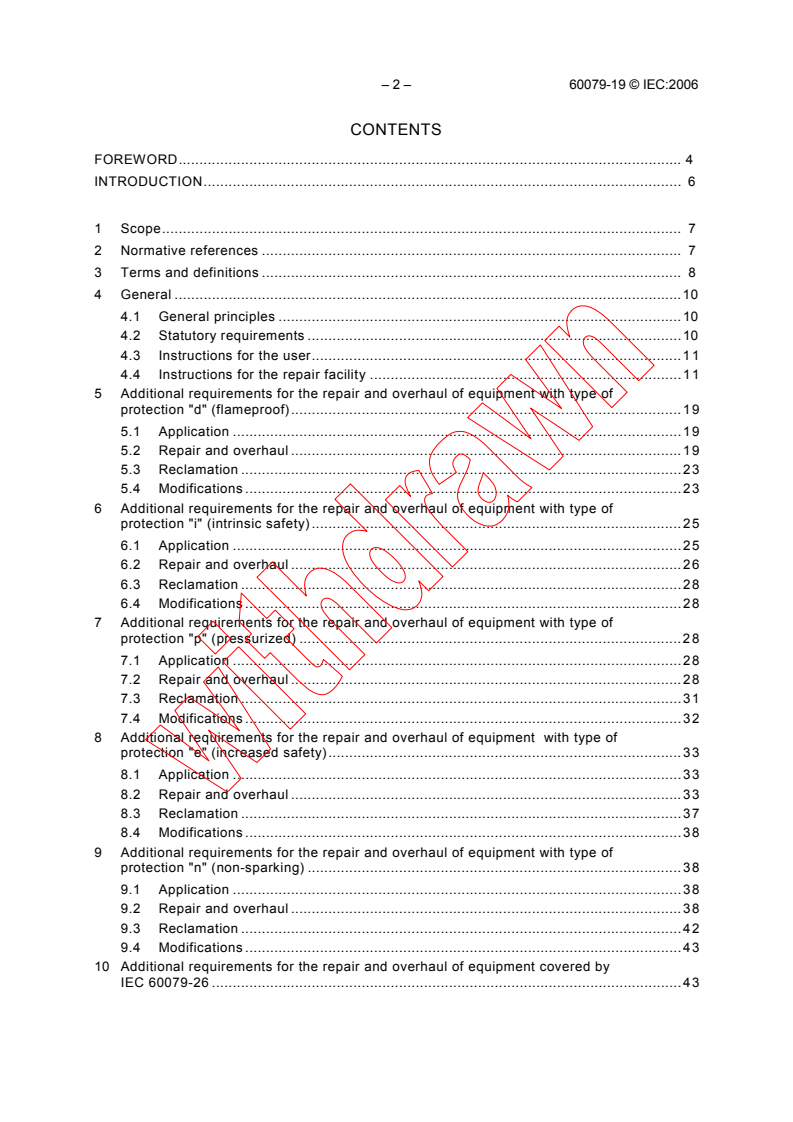
CONTENTS
FOREWORD. 4
INTRODUCTION. 6
1 Scope. 7
2 Normative references . 7
3 Terms and definitions . 8
4 General .10
4.1 General principles .10
4.2 Statutory requirements .10
4.3 Instructions for the user.11
4.4 Instructions for the repair facility .11
5 Additional requirements for the repair and overhaul of equipment with type of
protection "d" (flameproof).19
5.1 Application .19
5.2 Repair and overhaul .19
5.3 Reclamation .23
5.4 Modifications .23
6 Additional requirements for the repair and overhaul of equipment with type of
protection "i" (intrinsic safety) .25
6.1 Application .25
6.2 Repair and overhaul .26
6.3 Reclamation .28
6.4 Modifications .28
7 Additional requirements for the repair and overhaul of equipment with type of
protection "p" (pressurized) .28
7.1 Application .28
7.2 Repair and overhaul .28
7.3 Reclamation .31
7.4 Modifications .32
8 Additional requirements for the repair and overhaul of equipment with type of
protection "e" (increased safety).33
8.1 Application .33
8.2 Repair and overhaul .33
8.3 Reclamation .37
8.4 Modifications .38
9 Additional requirements for the repair and overhaul of equipment with type of
protection "n" (non-sparking) .38
9.1 Application .38
9.2 Repair and overhaul .38
9.3 Reclamation .42
9.4 Modifications .43
10 Additional requirements for the repair and overhaul of equipment covered by
IEC 60079-26 .43
60079-19 © IEC:200660079-19 © IEC:2006 –– 3 – 5 –
11 Additional requirements for the repair and overhaul of equipment with type of
protection ‘tD’ .43
11.1 Application .43
11.2 Repair and overhaul .44
11.3 Reclamation .46
11.4 Modifications .47
12 Additional requirements for the repair and overhaul of equipment with type of
protection pressurization “pD”.48
12.1 Application .48
12.2 Repair and overhaul .48
12.3 Reclamation .48
12.4 Modifications .48
Annex A (normative) Identification of repaired equipment by marking .49
Annex B (normative) Knowledge, skills and competencies of “Responsible Persons”
and “Operatives” . 51
Annex C (normative) Requirements for measurements in flameproof equipment during
overhaul, repair and reclamation (including guidance on tolerances). 53
Figure C.1 – Determination of maximum gap of reclaimed parts. 55
Table C.1 – Determination of maximum gap of reclaimed parts . 54
– 4 – 60079-19 © IEC:2006
INTERNATIONAL ELECTROTECHNICAL COMMISSION
____________
EXPLOSIVE ATMOSPHERES –
Part 19: Equipment repair, overhaul and reclamation
FOREWORD
1) The International Electrotechnical Commission (IEC) is a worldwide organization for standardization comprising
all national electrotechnical committees (IEC National Committees). The object of IEC is to promote
international co-operation on all questions concerning standardization in the electrical and electronic fields. To
this end and in addition to other activities, IEC publishes International Standards, Technical Specifications,
Technical Reports, Publicly Available Specifications (PAS) and Guides (hereafter referred to as “IEC
Publication(s)”). Their preparation is entrusted to technical committees; any IEC National Committee interested
in the subject dealt with may participate in this preparatory work. International, governmental and non-
governmental organizations liaising with the IEC also participate in this preparation. IEC collaborates closely
with the International Organization for Standardization (ISO) in accordance with conditions determined by
agreement between the two organizations.
2) The formal decisions or agreements of IEC on technical matters express, as nearly as possible, an international
consensus of opinion on the relevant subjects since each technical committee has representation from all
interested IEC National Committees.
3) IEC Publications have the form of recommendations for international use and are accepted by IEC National
Committees in that sense. While all reasonable efforts are made to ensure that the technical content of IEC
Publications is accurate, IEC cannot be held responsible for the way in which they are used or for any
misinterpretation by any end user.
4) In order to promote international uniformity, IEC National Committees undertake to apply IEC Publications
transparently to the maximum extent possible in their national and regional publications. Any divergence
between any IEC Publication and the corresponding national or regional publication shall be clearly indicated in
the latter.
5) IEC itself does not provide any attestation of conformity. Independent certification bodies provide conformity
assessment services and, in some areas, access to IEC marks of conformity. IEC is not responsible for any
services carried out by independent certification bodies.
6) All users should ensure that they have the latest edition of this publication.
7) No liability shall attach to IEC or its directors, employees, servants or agents including individual experts and
members of its technical committees and IEC National Committees for any personal injury, property damage or
other damage of any nature whatsoever, whether direct or indirect, or for costs (including legal fees) and
expenses arising out of the publication, use of, or reliance upon, this IEC Publication or any other IEC
Publications.
8) Attention is drawn to the Normative references cited in this publication. Use of the referenced publications is
indispensable for the correct application of this publication.
9) Attention is drawn to the possibility that some of the elements of this IEC Publication may be the subject of
patent rights. IEC shall not be held responsible for identifying any or all such patent rights.
International Standard IEC 60079-19 has been prepared by subcommittee 31J: Classification
of hazardous areas and installation requirements, of IEC technical committee 31: Equipment
for explosive atmospheres.
This second edition cancels and replaces the first edition published in 1993 and constitutes a
technical revision.
The significant technical changes with respect to the previous edition are as follows:
• additional requirements for repair and overhaul of equipment covered by IEC 60079-26
are included;
• additional requirements for repair and overhaul of equipment with type of protection 'tD'
and 'pD' for combustible dusts are included;
60079-19 © IEC:200660079-19 © IEC:2006 –– 5 – 9 –
• knowlege, skills and competencies of "Responsible Persons" and "Operatives" are
explained;
• requirements for measurements in flameproof equipment during overhaul, repair and
reclamation (including guidance on tolerances) are added.
The text of this standard is based on the following documents:
FDIS Report on voting
31J/124/FDIS 31J/135/RVD
Full information on the voting for the approval of this standard can be found in the report on
voting indicated in the above table.
This publication has been drafted in accordance with the ISO/IEC Directives, Part 2.
A list of all parts of the IEC 60079 series, under the general title Explosive atmospheres, can
be found on the the IEC website.
The committee has decided that the contents of this publication will remain unchanged until
the maintenance result date indicated on the IEC web site under "http://webstore.iec.ch" in
the data related to the specific publication. At this date, the publication will be
• reconfirmed;
• withdrawn;
• replaced by a revised edition, or
• amended.
60079-19 © IEC:2006 –– 6 – 11 – 60079-19 © IEC:2006
INTRODUCTION
When electrical equipment is installed in areas where dangerous concentrations and
quantities of flammable gases, vapours, mists or dusts may be present in the atmosphere,
protective measures are to be applied to reduce the likelihood of explosion due to ignition by
arcs, sparks or hot surfaces produced either in normal operation or under specified fault
conditions.
This part of IEC 60079 is supplementary to other relevant IEC standards, for example
IEC 60364, as regards installation requirements, and also refers to IEC 60079 and its
appropriate parts for the design requirements of suitable electrical equipment.
Clause 4 of this part of IEC 60079 contains general requirements for the repair and overhaul
of equipment and should be read in conjunction with the other relevant clauses of this
standard dealing with the detailed requirements for individual types of protection.
In cases where protected equipment incorporates more than one type of protection, reference
should be made to all clauses involved.
This part not only gives guidance on the practical means of maintaining the electrical safety
and performance requirements of repaired equipment, but also defines procedures for
maintaining, after repair, overhaul or reclamation, compliance of the equipment with the
provisions of the certificate of conformity or with the provisions of the appropriate explosion
protection standard where a certificate is not available.
The nature of the explosion protection offered by each type of protection varies according to
its unique features. Reference should be made to the appropriate standard(s) for details.
Users will utilize the most appropriate repair facilities for any particular item of equipment,
whether they be the facilities of the manufacturer or a suitably competent and equipped
repairer (see note).
This part recognizes the necessity of a required level of competence for the repair, overhaul
and reclamation of the equipment. Some manufacturers may recommend that the equipment
be repaired only by them.
In the case of the repair, overhaul or reclamation of equipment which has been the subject of
design certification, it may be necessary to clarify the position of the continued conformity of
the equipment with the certificate.
NOTE Whilst some manufacturers recommend that certain equipment be returned to them for repair or
reclamation, there are also competent independent repair organizations who have the facilities to carry out repair
work on equipment employing some or all of the types of protection covered by IEC 60079. For repaired equipment
to retain the integrity of the type(s) of protection employed in its design and construction, detailed knowledge of the
original manufacturer’s design (which may only be obtainable from design and manufacturing drawings) and any
certification documentation may be necessary. Where equipment is not being returned to the original manufacturer
for repair or reclamation, the use of repair organizations that are recommended by the original manufacturer should
be considered.
60079-19 © IEC:200660079-19 © IEC:2006 –– 7 – 13 –
EXPLOSIVE ATMOSPHERES –
Part 19: Equipment repair, overhaul and reclamation
1 Scope
This part of IEC 60079
– gives instructions, principally of a technical nature, on the repair, overhaul, reclamation
and modification of a certified equipment designed for use in explosive atmospheres;
– is not applicable to maintenance, other than when repair and overhaul cannot be
disassociated from maintenance, neither does it give advice on cable entry systems which
may require renewal when the equipment is re-installed;
– is not applicable to type of protection 'm';
– assumes that good engineering practices are adopted throughout.
NOTE Much of the content of this standard is concerned with the repair and overhaul of electrical rotating
machines. This is not because they are the most important items of explosion-protected equipment but rather
because they are often major items of repairable capital equipment in which, whatever type of protection is
involved, sufficient commonality of construction exists as to make possible more detailed instructions for their
repair, overhaul, reclamation or modification.
2 Normative references
The following referenced documents are indispensable for the application of this document.
For dated references, only the edition cited applies. For undated references, the latest edition
of the referenced document (including any amendments) applies.
IEC 60079 (all parts), Explosive atmospheres
IEC 60085, Electrical insulation – Thermal classification
IEC 60529, Degrees of protection provided by enclosures (IP Code)
IEC 61241-0, Electrical apparatus for use in the presence of combustible dust – Part 0:
General requirements
IEC 61241-2, Electrical apparatus for use in the presence of combustible dust – Part 2: Test
methods
ISO 4526, Metallic coatings – Electroplated coatings of nickel for engineering purposes
ISO 6158, Metallic coatings – Electrodeposited coatings of chromium for engineering
purposes
ISO 9000, Quality management and systems – Fundamentals and vocabulary
60079-19 © IEC:2006 –– 8 – 15 – 60079-19 © IEC:2006
3 Terms and definitions
For the purposes of this document, the following terms and definitions apply.
3.1
serviceable condition
condition which permits a replacement or reclaimed component part to be used without
prejudice to the performance or explosion protection aspects of the equipment, with due
regard to the certification requirements as applicable, in which such a component part is used
3.2
repair
action to restore faulty equipment to its fully serviceable condition and in compliance with the
relevant standard
NOTE The relevant standard means the standard to which the equipment was originally designed.
3.3
overhaul
action to restore to a fully serviceable condition equipment which has been in use or in
storage for a period of time but which is not faulty
3.4
maintenance
routine actions taken to preserve the fully serviceable condition of the installed equipment
(see Clause 1)
3.5
component part
an indivisible item
NOTE The assembly of such items may form equipment.
3.6
reclamation
means of repair involving, for example, the removal or addition of material to reclaim
component parts which have sustained damage, in order to restore such parts to a
serviceable condition in accordance with the relevant standard
NOTE The relevant standard means the standard to which the individual parts were originally manufactured.
3.7
modification
change to the design of the equipment which affects material, fit, form or function
3.8
manufacturer
maker of the equipment (who may also be the supplier, the importer or the agent) in whose
name usually the certification, where appropriate, of the equipment was originally registered
3.9
user
user of the equipment
60079-19 © IEC:200660079-19 © IEC:2006 –– 9 – 17 –
3.10
repair facility
facility providing a service that consists of repairs, overhauls, or reclamations of explosion-
protected equipment who may be the manufacturer, the user or a third party (repair agency)
3.11
certification
certification leading to the issue of a certificate of conformity which refers primarily to
assessments of equipment carried out by a recognized testing authority.
This standard may also apply to equipment certified by other certification authorities, or to
equipment which has been self-certified by manufacturers or users as complying with
recognized standards.
3.12
certificate references
a certificate reference number may refer to a single design or a range of equipment of similar
design
3.13
symbol "X"
the symbol "X" is used to denote special conditions of safe use. The certification documents
need to be studied before such equipment is installed, repaired, overhauled, reclaimed or
modified.
3.14
copy winding
process by which a winding is totally or partially replaced by another, the characteristics and
properties of which are at least as good as those of the original
3.15
type of protection "d"
type of protection in which parts which can ignite an explosive atmosphere are placed in an
enclosure which can withstand the pressure developed during an explosion of an explosive
mixture and which prevents the transmission of the explosion to the explosive atmosphere
surrounding the enclosure
3.16
type of protection "i"
circuit in which no spark or any thermal effect produced in the test conditions prescribed in
the relevant standard(s) (which include normal operation and specific fault condition) is
capable of causing ignition of a given explosive atmosphere.
3.17
type of protection "p"
type of protection by which the entry of a surrounding atmosphere into the enclosure of the
electrical equipment is prevented by maintaining, inside the said enclosure, a protective gas
at a higher pressure than that of the surrounding atmosphere. The overpressure is maintained
either with or without a continuous flow of the protective gas.
3.18
type of protection "e"
type of protection by which measures are applied so as to prevent, with a higher degree of
security, the possibility of excessive temperatures and the occurrence of arcs or sparks in the
interior and on the external parts of the electrical equipment which would not produce them in
normal service
60079-19 © IEC:2006 –– 10 – 19 – 60079-19 © IEC:2006
3.19
type of protection "n"
type of protection applied to the electrical equipment such that, in normal operation, it is not
capable of igniting the surrounding explosive atmosphere and that a fault capable of causing
ignition is not likely to occur
3.20
type of protection “tD”
type of protection for explosive dust atmospheres where electrical equipment is provided with
an enclosure providing dust ingress protection and a means to limit surface temperatures
3.21
type of protection “pD”
type of protection reliant upon the enclosure being subjected to a continuous pressure,
according to IEC 61241-2, from a supply of uncontaminated air or other non-flammable gas
while electricity is connected to the enclosure
4 General
4.1 General principles
This clause covers those aspects of repair, overhaul, reclamation and modification which are
common to all explosion-protected equipment. Subsequent clauses provide instructions for
the additional requirements relevant to specific types of protection. When equipment
incorporates more than one type of protection, reference shall be made to the appropriate
clauses.
NOTE 1 Additional requirements for types of protection "o" and "q" have not been defined.
Assuming that repairs and overhauls are carried out using good engineering practices, then
a) if manufacturers' specified parts or parts as specified in the certification documentation
are used in a repair or overhaul, the equipment is presumed to be in conformity with the
certificate;
b) if repairs or modifications are carried out on the equipment specifically as detailed in the
certification documents, the equipment should still conform with the certificate.
In circumstances where the certification documents are not available, then the repair or
overhaul shall be carried out on the equipment in accordance with this standard and other
relevant standard(s). The steps taken to obtain the certification documents shall be recorded
in the repair facility records (see 4.4.1.5.3).
If other repair or modification techniques are used which are not in accordance with this
standard, then it will be necessary to ascertain, from the manufacturers, and/or the
certification authority, the suitability of the equipment for continued use in an explosive
atmosphere.
NOTE 2 Repair of equipment which has no marking plate should be avoided.
4.2 Statutory requirements
4.2.1 Repair facility
The repair facility shall be aware of any specific requirements in relevant national legislation
which may govern the repair or overhaul operation.
60079-19 © IEC:200660079-19 © IEC:2006 –– 11 – 21 –
4.2.2 User
The equipment user should be aware of any relevant legislation should he wish to undertake
the repair or overhaul of equipment himself. In addition, he should be aware of any changes in
responsibility for health and safety, should refurbishment and/or re-installation be carried out
by a third party.
4.3 Instructions for the user
4.3.1 Certificates and documents
The equipment design certificate and other related documents (see 4.4.1.5.1) should be
obtained as part of the original purchase contract.
4.3.2 Records and work instructions
All relevant documentation that is available shall be obtained as part of the original purchase
contract. Records of any previous repairs, overhauls or modifications shall be kept by the user
and made available to the repairer.
NOTE It will be in the interests of the user that the repairer is notified, whenever possible, of the fault and/or
nature of the work to be done.
Special requirements stipulated in the user's specifications, and which are supplementary to
the various standards, e.g. enhanced ingress protection, shall be brought to the attention of
the repairer.
The user shall inform the repairer of any statutory requirement for compliance with
certification (see note in the introduction).
4.3.3 Re-installation of repaired equipment
Before the repaired equipment is re-commissioned, cable/conduit entry systems shall be
checked to ensure that they are undamaged and are appropriate to the equipment type of
protection. Recommendations may be found in the wiring systems clause of IEC 60079-14.
4.3.4 Repair facilities
The user shall ascertain that the repair facility concerned can demonstrate compliance with
the relevant stipulations of this standard.
4.4 Instructions for the repair facility
4.4.1 Repair and overhaul
4.4.1.1 General
Repair facilities shall operate a Quality Management System that meets with the requirements
of the ISO 9000 series of standards.
The repair facility shall appoint a person ('Responsible Person') with the required competency
(see Annex B), within the management organization, to accept responsibility and authority for
ensuring that the overhauled/repaired equipment complies with the certification status agreed
with the user. The person so appointed shall have a working knowledge of the appropriate
explosion protection standards and an understanding of this standard.
60079-19 © IEC:2006 –– 12 – 23 – 60079-19 © IEC:2006
The repair facility must have adequate repair and overhaul facilities as well as the appropriate
equipment necessary and trained Operatives with the required competency (see Annex B)
and authority to carry out the activities, taking into account the specific type of protection.
The repair facility shall conduct an assessment of the status of the equipment to be repaired,
agree with the user the expected certification status of the equipment after repair and the
scope of work to be done. This should include the omission of any tests mentioned within this
document that the user could reasonably assume to be included. The assessment shall be
documented and shall address the relevant clauses of the appropriate equipment standard
and this standard and be included in the job report to the user. Such assessments shall be
conducted by the Responsible Person (supported by appropriate Operatives). The
Responsible Person shall only conduct assessments with the explosion protection techniques
for which he has demonstrated his competence.
The repair facility shall include procedures and systems to carry out overhaul/repair work at
sites external to the repair facility, where appropriate.
4.4.1.2 Certification and standards
The repairer’s attention is directed to the need to be informed of, and to comply with, the
relevant explosion-protection standards and certification requirements applicable to the
equipment to be repaired or overhauled.
4.4.1.3 Competency
The repairer of the equipment shall ensure that those operatives directly concerned with the
repair and/or overhaul of the certified equipment are trained, experienced, skilled,
knowledgeable and/or supervised on this type of work.
Training and competency assessments are specified in Annex B.
Appropriate training and assessment shall be undertaken from time to time at intervals
depending on the frequency of utilization of the technique or skill and change of standards or
regulations. The interval should normally not exceed three years.
4.4.1.4 Testing
Should it prove impracticable to carry out certain tests, e.g., a component of a complete
equipment taken off site for repair such as a rotor of a rotating machine, the repairer shall,
before putting the repaired equipment back into service, ascertain from the user or
manufacturer the consequences of omitting such tests.
NOTE In some countries, legal consequences may depend upon the extent to which the carrying out or not of
certain actions or tests is practicable.
4.4.1.5 Documentation
4.4.1.5.1 General
The repair facility should seek to obtain all necessary information/data from the manufacturer
or user for the repair and/or overhaul of the equipment. This may include information relating
to previous repairs, overhauls or modifications. He should also have available and refer to the
relevant explosion-protection standard.
60079-19 © IEC:200660079-19 © IEC:2006 –– 13 – 25 –
The data available for the repair and/or overhaul should include but need not be limited to,
details of the
– technical specification;
– drawings;
– explosion protection performance and conditions of use;
– dismantling and assembly instructions;
– certificate limitations (special conditions for safe use), where specified;
– marking (including certification marking);
– recommended methods of repair/overhaul for the equipment;
– list of spare parts.
The information may be subject to amendments including those relative to certification.
NOTE 1 It is not reasonably practicable to assume that adequate information is, or can be, so widely circulated
that it is always available where and when it is needed. Sources of adequate information are users, manufacturers
or certifying authorities.
NOTE 2 As from IEC 60079-0 (Edition 4), manufacturers are required to give instructions including repair.
The repair facility shall maintain controlled copies of any relevant explosion protection
standards with which repaired/overhauled equipment is claimed to comply.
4.4.1.5.2 Job report to the user
At the completion of the work, job reports shall be submitted to the user (see 4.3.2)
containing, at least, the following:
– details of fault detected;
– full details of repair and overhaul;
– list of replaced or reclaimed parts;
– results of all checks and tests (in sufficient detail to be useful if required by the next
repairer, see 4.3.2);
– summary of previous history of the repaired product including information as gathered
under 4.3.2;
– copy of the user contract or order.
The job reports of repairs/overhauls shall be retained for a period of time as agreed with the
user. Retained information shall be adequately controlled to ensure correct retrieval.
4.4.1.5.3 Repair facility records
The following records shall be retained by the repair facility:
– current and past copies of relevant Technical Standards;
– certification of Facility Quality Standard including:
1) details of Repair provider's Quality Assessment Scheme;
2) test instrument calibration;
3) competency and training records of personnel;
4) purchasing control system;
5) customer complaints system;
60079-19 © IEC:2006 –– 14 – 27 – 60079-19 © IEC:2006
6) internal and, where appropriate, external audit documentation;
7) management review;
8) process control procedures;
9) register of manufacturer’s drawings;
– job records including:
1) the steps taken to obtain the certification documents;
2) mechanical inspection record for compliance with relevant standards;
3) defect identification;
4) electrical test records before and after repair including traceability of instruments used
and pass/fail criteria;
5) certificates of conformity for replacement components;
6) recovery procedure for repaired components;
7) record of mechanical inspection during assembly and upon completion;
8) record of work undertaken by the repair facility.
The record of the recovery procedure for repaired components should, at least, identify the
following:
a) a detailed justification for the work carried out;
b) various options considered (e.g., welding, metal spraying);
c) technical parameters, e.g., bond strength;
d) the reasons for selecting the chosen technique;
e) consumables used and method of storage;
f) base material;
g) manufacturers’ instructions considered;
h) procedure utilized;
i) identity and competency of the operator;
j) inspection procedure used, e.g., ultra-sonic, dye-penetration, X-ray;
k) maintenance and calibration details of automatic systems.
These records shall be retained for a period of at least ten years or as agreed with the user.
4.4.1.6 Spare parts
4.4.1.6.1 General
It is preferable to obtain new parts from the manufacturer, and the repairer shall ensure that
only appropriate spare parts are used in the repair or overhaul of certified equipment.
Depending on the nature of the equipment, these spare parts may be identified by the
manufacturer, the equipment standard or the relevant certification documentation.
4.4.1.6.2 Sealed parts
Parts, which are required by the equipment specification and certificate documents to be
sealed, shall be replaced only by the particular spare part(s) detailed in the parts list.
60079-19 © IEC:200660079-19 © IEC:2006 –– 15 – 29 –
NOTE Devices incorporated in equipment to indicate interference by third parties (e.g., security seals) as distinct
from those required in the certification documents, are not intended to fall within the scope of this subclause.
4.4.1.7 Identification of repaired equipment
The equipment shall be marked to identify the repair or overhaul and the repairer's identity.
The marking for the repaired equipment is given in Annex A.
Marking may be provided on a separate label. It may be necessary to amend or remove or
supplement the label in certain circumstances as follows.
a) If after repair, overhaul or modification, an equipment is changed such that it no longer
conforms with the standard and certificate (see 3.11), the certification label shall be
removed unless a supplementary certificate has been obtained.
b) If the equipment is changed during repair or overhaul so that it still complies with the
restrictions imposed by this standard and the explosion protection standards to which it
was manufactured, but does not necessarily comply with the certificate, the certification
label should not normally be removed and the repair symbol "R" shall be written within an
inverted triangle (see Annex A).
c) Where the standards to which the previously certified equipment was manufactured are not
known, the requirements of this standard and the current edition of the relevant explosion
protection standards shall apply. An assessment, by a person competent in assessing
explosion protected equipment, shall be conducted to verify compliance with the relevant
level of safety prior to release of the equipment by the repairer.
4.4.2 Reclamations
4.4.2.1 General
Reclamations not affecting the explosion protection are not the subject of this subclause.
Such parts should be reclaimed using good engineering practices.
Where the repair process involves reclamation work, then, in addition to the requirements of
4.4.1 for repairs and overhauls, the requirements of 4.4.2 also apply.
4.4.2.2 Exclusions
Some component parts are considered not to be reclaimable and are therefore excluded from
the scope of this standard, such as:
– component parts made from the following materials: glass, plastics, or any material that is
not dimensionally stable;
– fasteners;
– component parts, e.g., some encapsulated assemblies, which have been stated by the
manufacturer to be not subject to repair.
4.4.2.3 Requirements
4.4.2.3.1 General
Any reclamation shall be carried out by competent personnel, skilled in the process to be
employed and using good engineering practices (see Annex B). Operators of reclamation
techniques, e.g. welding, metal spraying, shall be required to undertake a practical skill test in
the technique before being permitted to utilize the technique for the first time and every three
years thereafter. If the operator has not used the technique in the previous six months, he
shall undertake a re-test.
60079-19 © IEC:2006 –– 16 – 31 – 60079-19 © IEC:2006
If any proprietary process is used, the instructions of the originator of such a process should
be followed.
All reclamation shall be properly documented and records retained. Such records include:
– identification of the component part;
– method of reclamation;
– detail of any dimensions which differ from those in relevant certification documents or the
original dimensions of the component part;
– drawing showing reclamation details including material removed and replaced;
– date;
– name of the organization carrying out the reclamation.
If the reclamation is carried out other than by the user, the user shall be provided with a copy
of the record.
A reclamation procedure which would result in dimensions affecting explosion-protection
integrity being different from those given in relevant certification documents may be
permissible if such changed dimensions still meet the requirem
...