

ETSI EN 300 396-3 V1.4.1 (2011-12)
Terrestrial Trunked Radio (TETRA); Technical requirements for Direct Mode Operation (DMO); Part 3: Mobile Station to Mobile Station (MS-MS) Air Interface (AI) protocol
General Information
- Abstract
REN/TETRA-08193
- Status
- Published
- Publication Date
- 22-Dec-2011
- Technical Committee
- TCCE 8 - TCCE Off-network services
- Current Stage
- 12 - Completion
- Due Date
- 05-Jan-2012
- Completion Date
- 23-Dec-2011
- Mandate
- BC-T-344
Buy Documents


en_30039603v010400o - Terrestrial Trunked Radio (TETRA); Technical requirements for Direct Mode Operation (DMO); Part 3: Mobile Station to Mobile Station (MS-MS) Air Interface (AI) protocol
en_30039603v010401p - Terrestrial Trunked Radio (TETRA); Technical requirements for Direct Mode Operation (DMO); Part 3: Mobile Station to Mobile Station (MS-MS) Air Interface (AI) protocol


Overview
ETSI EN 300 396-3 V1.4.1 (2011-12) specifies the Mobile Station to Mobile Station (MS‑MS) Air Interface (AI) protocol for Terrestrial Trunked Radio (TETRA) Direct Mode Operation (DMO). This European (ETSI-origin) standard - adopted by SIST under reference REN/TETRA-08193 - defines protocol behaviour, message primitives and state machines that enable direct, radio-to-radio communication without network infrastructure.
Key topics and technical requirements
The standard provides detailed protocol-level requirements across Layer 2 and Layer 3 for DMO MS‑MS communication. Key technical topics include:
- Protocol overview and layering - structure and responsibilities of the DM air interface protocol stack (Layer 2 and Layer 3).
- DM channel and frame constraints - rules governing direct mode channels and frame structure.
- Call handling procedures - comprehensive flows for call setup, changeover, termination and pre-emption:
- Circuit mode calls (with and without presence check)
- Master/slave behaviour during occupation and reservation
- Use of DM‑OCCUPIED PDU and TPNI (Transmitting Party Number Identification)
- Short Data Service (SDS) - sending/receiving unacknowledged and acknowledged short data, including SDS-TL service details.
- Primitives and service interfaces - Layer 3 primitives (e.g., DMCC-SETUP, DMCC-REPORT, DMCC-SDS UNITDATA) and Layer 2 primitives (DMA-UNITDATA, DMA-REPORT) with parameter descriptions.
- State machines and procedures - explicit DMCC protocol states (IDLE, CALL SETUP, CALL ACTIVE TX/RX, PRE-EMPTION, ACK'D/UNACK'D short data) and step‑by‑step call/data procedures.
- Additional addressing and error protection - addressing mechanisms and optional extended error protection for SDS.
(These topics and message names are taken from the standard’s table of contents and normative sections.)
Practical applications
This standard is essential for ensuring interoperable, reliable direct-mode communication in scenarios where infrastructure is unavailable or undesirable:
- Public safety and emergency services requiring device-to-device voice and data in off-network conditions.
- Critical-communications device manufacturers implementing DMO MS‑MS protocol stacks.
- System integrators and test labs validating DMO compliance, call handling, SDS transactions and pre-emption behaviour.
- Procurement and regulatory bodies specifying conformity for TETRA equipment used in mission-critical deployments.
Who should use this standard
- Radio hardware and firmware engineers implementing TETRA DMO.
- Protocol and systems engineers designing TETRA terminals.
- Test engineers and certification bodies conducting interoperability and conformance testing.
- Emergency communications planners and procurement teams setting technical requirements.
Related standards
- ETSI/EN 300 396 series (other parts covering TETRA DMO and MS‑BS interfaces)
- ETSI publications defining TETRA architecture and general service definitions
Keywords: TETRA, DMO, MS‑MS, air interface, protocol, SDS, circuit mode, Layer 2, Layer 3, DM channel, pre‑emption, presence check, DM‑OCCUPIED PDU, TPNI.
Buy Documents
en_30039603v010400o - Terrestrial Trunked Radio (TETRA); Technical requirements for Direct Mode Operation (DMO); Part 3: Mobile Station to Mobile Station (MS-MS) Air Interface (AI) protocol
en_30039603v010401p - Terrestrial Trunked Radio (TETRA); Technical requirements for Direct Mode Operation (DMO); Part 3: Mobile Station to Mobile Station (MS-MS) Air Interface (AI) protocol
Frequently Asked Questions
ETSI EN 300 396-3 V1.4.1 (2011-12) is a standard published by the European Telecommunications Standards Institute (ETSI). Its full title is "Terrestrial Trunked Radio (TETRA); Technical requirements for Direct Mode Operation (DMO); Part 3: Mobile Station to Mobile Station (MS-MS) Air Interface (AI) protocol". This standard covers: REN/TETRA-08193
REN/TETRA-08193
ETSI EN 300 396-3 V1.4.1 (2011-12) is associated with the following European legislation: Standardization Mandates: BC-T-344. When a standard is cited in the Official Journal of the European Union, products manufactured in conformity with it benefit from a presumption of conformity with the essential requirements of the corresponding EU directive or regulation.
ETSI EN 300 396-3 V1.4.1 (2011-12) is available in PDF format for immediate download after purchase. The document can be added to your cart and obtained through the secure checkout process. Digital delivery ensures instant access to the complete standard document.
Standards Content (Sample)
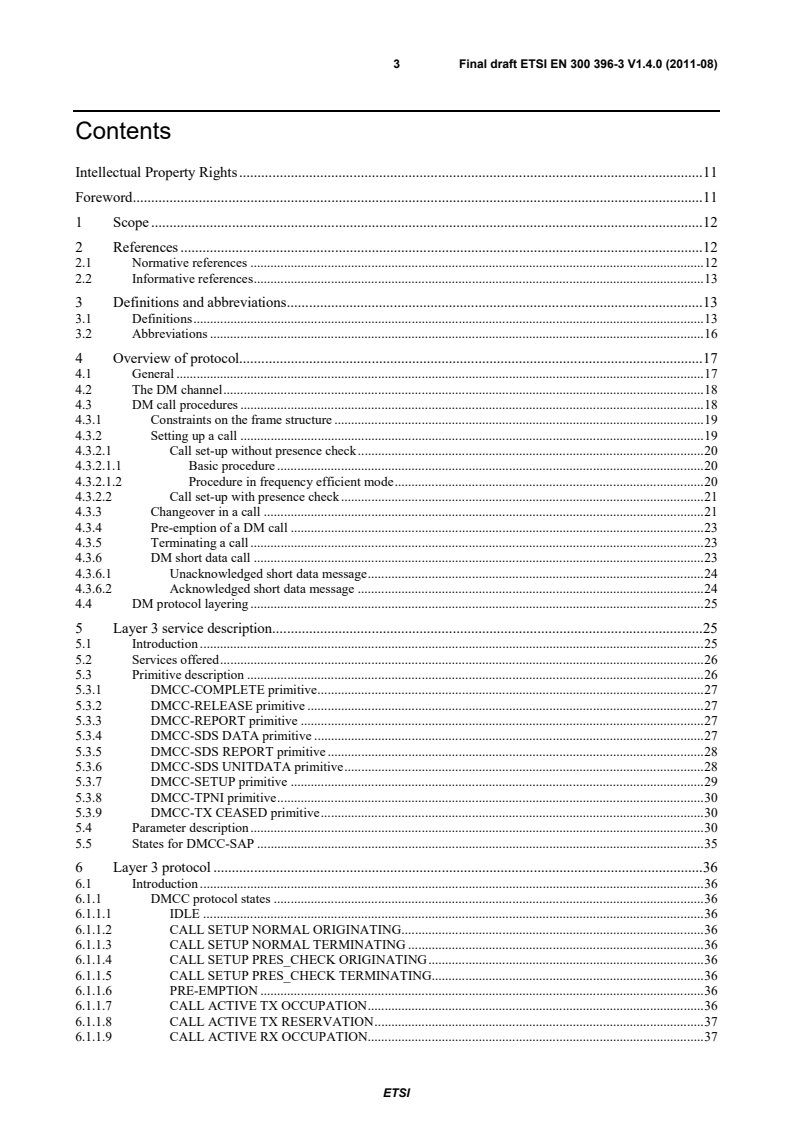
Final draft ETSI EN 300 396-3 V1.4.0 (2011-08)
European Standard
Terrestrial Trunked Radio (TETRA);
Technical requirements for Direct Mode Operation (DMO);
Part 3: Mobile Station to Mobile Station (MS-MS)
Air Interface (AI) protocol
2 Final draft ETSI EN 300 396-3 V1.4.0 (2011-08)
Reference
REN/TETRA-08193
Keywords
air interface, protocol, radio, TETRA
ETSI
650 Route des Lucioles
F-06921 Sophia Antipolis Cedex - FRANCE
Tel.: +33 4 92 94 42 00 Fax: +33 4 93 65 47 16
Siret N° 348 623 562 00017 - NAF 742 C
Association à but non lucratif enregistrée à la
Sous-Préfecture de Grasse (06) N° 7803/88
Important notice
Individual copies of the present document can be downloaded from:
http://www.etsi.org
The present document may be made available in more than one electronic version or in print. In any case of existing or
perceived difference in contents between such versions, the reference version is the Portable Document Format (PDF).
In case of dispute, the reference shall be the printing on ETSI printers of the PDF version kept on a specific network drive
within ETSI Secretariat.
Users of the present document should be aware that the document may be subject to revision or change of status.
Information on the current status of this and other ETSI documents is available at
http://portal.etsi.org/tb/status/status.asp
If you find errors in the present document, please send your comment to one of the following services:
http://portal.etsi.org/chaircor/ETSI_support.asp
Copyright Notification
No part may be reproduced except as authorized by written permission.
The copyright and the foregoing restriction extend to reproduction in all media.
© European Telecommunications Standards Institute 2011.
All rights reserved.
TM TM TM
DECT , PLUGTESTS , UMTS and the ETSI logo are Trade Marks of ETSI registered for the benefit of its Members.
TM
3GPP and LTE™ are Trade Marks of ETSI registered for the benefit of its Members and
of the 3GPP Organizational Partners.
GSM® and the GSM logo are Trade Marks registered and owned by the GSM Association.
ETSI
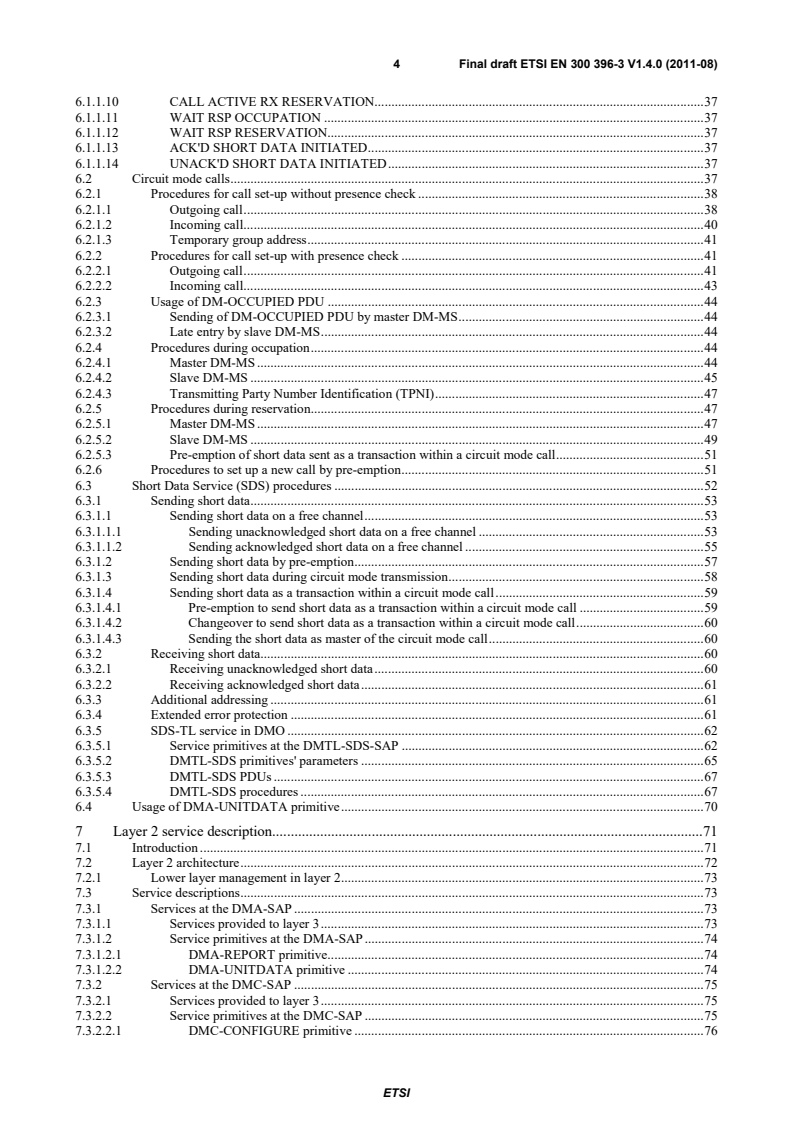
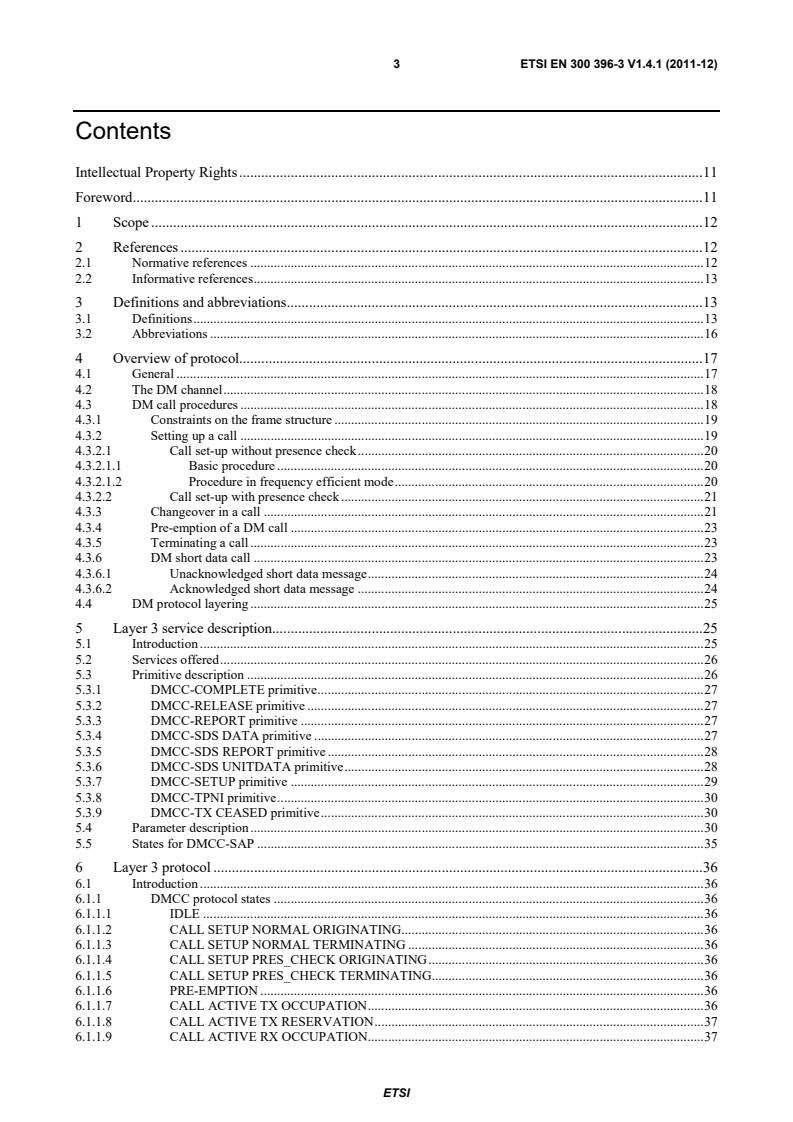
3 Final draft ETSI EN 300 396-3 V1.4.0 (2011-08)
Contents
Intellectual Property Rights . 11
Foreword . 11
1 Scope . 12
2 References . 12
2.1 Normative references . 12
2.2 Informative references . 13
3 Definitions and abbreviations . 13
3.1 Definitions . 13
3.2 Abbreviations . 16
4 Overview of protocol. . 17
4.1 General . 17
4.2 The DM channel . 18
4.3 DM call procedures . 18
4.3.1 Constraints on the frame structure . 19
4.3.2 Setting up a call . 19
4.3.2.1 Call set-up without presence check . 20
4.3.2.1.1 Basic procedure . 20
4.3.2.1.2 Procedure in frequency efficient mode . 20
4.3.2.2 Call set-up with presence check . 21
4.3.3 Changeover in a call . 21
4.3.4 Pre-emption of a DM call . 23
4.3.5 Terminating a call . 23
4.3.6 DM short data call . 23
4.3.6.1 Unacknowledged short data message . 24
4.3.6.2 Acknowledged short data message . 24
4.4 DM protocol layering . 25
5 Layer 3 service description . 25
5.1 Introduction . 25
5.2 Services offered . 26
5.3 Primitive description . 26
5.3.1 DMCC-COMPLETE primitive . 27
5.3.2 DMCC-RELEASE primitive . 27
5.3.3 DMCC-REPORT primitive . 27
5.3.4 DMCC-SDS DATA primitive . 27
5.3.5 DMCC-SDS REPORT primitive . 28
5.3.6 DMCC-SDS UNITDATA primitive . 28
5.3.7 DMCC-SETUP primitive . 29
5.3.8 DMCC-TPNI primitive . 30
5.3.9 DMCC-TX CEASED primitive . 30
5.4 Parameter description . 30
5.5 States for DMCC-SAP . 35
6 Layer 3 protocol . 36
6.1 Introduction . 36
6.1.1 DMCC protocol states . 36
6.1.1.1 IDLE . 36
6.1.1.2 CALL SETUP NORMAL ORIGINATING . 36
6.1.1.3 CALL SETUP NORMAL TERMINATING . 36
6.1.1.4 CALL SETUP PRES_CHECK ORIGINATING . 36
6.1.1.5 CALL SETUP PRES_CHECK TERMINATING. 36
6.1.1.6 PRE-EMPTION . 36
6.1.1.7 CALL ACTIVE TX OCCUPATION . 36
6.1.1.8 CALL ACTIVE TX RESERVATION . 37
6.1.1.9 CALL ACTIVE RX OCCUPATION. 37
ETSI
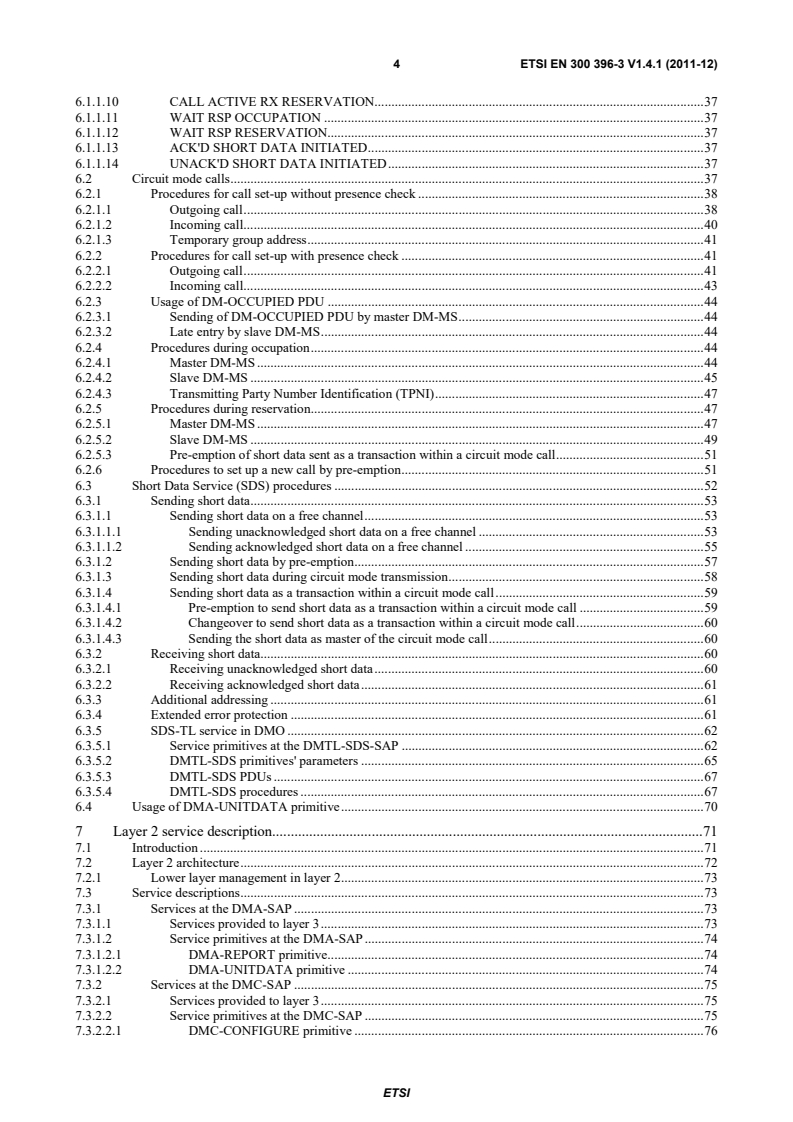
4 Final draft ETSI EN 300 396-3 V1.4.0 (2011-08)
6.1.1.10 CALL ACTIVE RX RESERVATION. 37
6.1.1.11 WAIT RSP OCCUPATION . 37
6.1.1.12 WAIT RSP RESERVATION. 37
6.1.1.13 ACK'D SHORT DATA INITIATED . 37
6.1.1.14 UNACK'D SHORT DATA INITIATED . 37
6.2 Circuit mode calls . 37
6.2.1 Procedures for call set-up without presence check . 38
6.2.1.1 Outgoing call . 38
6.2.1.2 Incoming call. 40
6.2.1.3 Temporary group address . 41
6.2.2 Procedures for call set-up with presence check . 41
6.2.2.1 Outgoing call . 41
6.2.2.2 Incoming call. 43
6.2.3 Usage of DM-OCCUPIED PDU . 44
6.2.3.1 Sending of DM-OCCUPIED PDU by master DM-MS . 44
6.2.3.2 Late entry by slave DM-MS . 44
6.2.4 Procedures during occupation . 44
6.2.4.1 Master DM-MS . 44
6.2.4.2 Slave DM-MS . 45
6.2.4.3 Transmitting Party Number Identification (TPNI) . 47
6.2.5 Procedures during reservation. 47
6.2.5.1 Master DM-MS . 47
6.2.5.2 Slave DM-MS . 49
6.2.5.3 Pre-emption of short data sent as a transaction within a circuit mode call . 51
6.2.6 Procedures to set up a new call by pre-emption . 51
6.3 Short Data Service (SDS) procedures . 52
6.3.1 Sending short data . 53
6.3.1.1 Sending short data on a free channel . 53
6.3.1.1.1 Sending unacknowledged short data on a free channel . 53
6.3.1.1.2 Sending acknowledged short data on a free channel . 55
6.3.1.2 Sending short data by pre-emption . 57
6.3.1.3 Sending short data during circuit mode transmission . 58
6.3.1.4 Sending short data as a transaction within a circuit mode call . 59
6.3.1.4.1 Pre-emption to send short data as a transaction within a circuit mode call . 59
6.3.1.4.2 Changeover to send short data as a transaction within a circuit mode call . 60
6.3.1.4.3 Sending the short data as master of the circuit mode call . 60
6.3.2 Receiving short data. 60
6.3.2.1 Receiving unacknowledged short data . 60
6.3.2.2 Receiving acknowledged short data . 61
6.3.3 Additional addressing . 61
6.3.4 Extended error protection . 61
6.3.5 SDS-TL service in DMO . 62
6.3.5.1 Service primitives at the DMTL-SDS-SAP . 62
6.3.5.2 DMTL-SDS primitives' parameters . 65
6.3.5.3 DMTL-SDS PDUs . 67
6.3.5.4 DMTL-SDS procedures . 67
6.4 Usage of DMA-UNITDATA primitive . 70
7 Layer 2 service description . 71
7.1 Introduction . 71
7.2 Layer 2 architecture . 72
7.2.1 Lower layer management in layer 2 . 73
7.3 Service descriptions . 73
7.3.1 Services at the DMA-SAP . 73
7.3.1.1 Services provided to layer 3 . 73
7.3.1.2 Service primitives at the DMA-SAP . 74
7.3.1.2.1 DMA-REPORT primitive. 74
7.3.1.2.2 DMA-UNITDATA primitive . 74
7.3.2 Services at the DMC-SAP . 75
7.3.2.1 Services provided to layer 3 . 75
7.3.2.2 Service primitives at the DMC-SAP . 75
7.3.2.2.1 DMC-CONFIGURE primitive . 76
ETSI
5 Final draft ETSI EN 300 396-3 V1.4.0 (2011-08)
7.3.2.2.2 DMC-REPORT primitive . 76
7.3.3 Services at the DMD-SAP . 76
7.3.3.1 Services provided to the U-plane application . 76
7.3.3.2 Service primitives at the DMD-SAP . 76
7.3.3.2.1 DMD-REPORT primitive. 77
7.3.3.2.2 DMD-UNITDATA primitive . 77
7.4 Parameter listing . 77
7.4.1 Air interface encryption information . 77
7.4.2 Air interface encryption state . 77
7.4.2A Called party in ongoing call . 78
7.4.3 Call release. 78
7.4.4 Call set-up after pre-emption or changeover . 78
7.4.5 Changeover request held during occupation . 78
7.4.5A Channel selection information . 78
7.4.6 Circuit mode information . 78
7.4.7 Circuit mode type . 78
7.4.8 Communication type . 78
7.4.9 Destination address . 78
7.4.10 Destination address type . 79
7.4.10A DM channel . 79
7.4.11 DM-SDU . 79
7.4.12 DM-SDU length . 79
7.4.12A Dual watch information . 79
7.4.13 FCS flag . 79
7.4.14 Half slot condition . 79
7.4.15 Half slot content . 79
7.4.16 Half slot importance. 79
7.4.17 Half slot position . 79
7.4.18 Half slot synchronization . 80
7.4.19 Handle to the request . 80
7.4.20 Immediate retransmission . 80
7.4.21 Incomplete DM-SDS DATA/ACK received . 80
7.4.21A Lower layer quality information . 80
7.4.21B Master of ongoing call . 80
7.4.22 Message type . 80
7.4.23 New call pre-emption. 80
7.4.24 Number of repeats . 81
7.4.25 Priority . 81
7.4.26 Priority of ongoing call . 81
7.4.27 Recent user changeover request . 81
7.4.28 Recent user priority . 81
7.4.29 Report . 81
7.4.30 Reservation time . 81
7.4.31 SDS transaction type . 81
7.4.32 Source address . 81
7.4.33 Source address type . 81
7.4.34 Stealing priority . 82
7.4.35 Stolen indication . 82
7.4.36 Type of pre-emption . 82
7.4.37 Valid addresses . 82
8 Layer 2 protocol . 82
8.1 Introduction . 82
8.1.1 Functions of lower MAC . 82
8.1.2 Functions of upper MAC . 83
8.2 Interface between lower and upper MAC . 83
8.2.1 Logical channels defined at the DMV-SAP . 83
8.2.2 Service primitives at the DMV-SAP . 84
8.2.3 PDU mapping of the logical channels at the DMV-SAP . 85
8.2.4 Scrambling mechanism . 85
8.2.5 PDU error detection . 86
8.2.6 Modes of operation . 86
ETSI
6 Final draft ETSI EN 300 396-3 V1.4.0 (2011-08)
8.2.6.1 DM-MS modes of operation . 86
8.2.6.1.1 Idle mode . 86
8.2.6.1.2 Signalling mode . 87
8.2.6.1.3 Traffic mode . 87
8.2.6.2 Operation in traffic mode . 88
8.2.6.2.1 Traffic transmission . 88
8.2.6.2.2 Stealing mechanism . 89
8.2.6.3 Selection of the mode of operation . 89
8.3 Basic capabilities of the Physical Layer (PL) . 90
8.3.1 DM-MS capabilitie s . 90
8.3.1.1 DM only and dual mode capable MS operation . 90
8.3.1.2 Dual watch capable MS operation . 91
8.3.1.2.1 Full Dual Watch Mobile Station (F-DW-MS) . 91
8.3.1.2.2 Idle Dual Watch Mobile Station (I-DW-MS) . 91
8.4 Usage of DM channel . 91
8.4.1 Definition of DM channel . 91
8.4.1.1 DM channel arrangement . 91
8.4.1.2 DM channel A operation . 91
8.4.1.3 DM channel B operation . 92
8.4.2 DM-MAC states . 93
8.4.2.1 DM-MAC state definitions . 93
8.4.2.2 DM-MS channel surveillance procedures . 94
8.4.2.2.1 Initial determination of DM channel state . 94
8.4.2.2.2 Fast call set-up surveillance in idle mode . 96
8.4.2.2.3 DM-MS channel surveillance at call set-up . 99
8.4.2.3 Master DM-MS channel maintenance procedures during a call . 101
8.4.2.4 Slave DM-MS channel maintenance procedures during a call . 101
8.4.2.4.1 Slave MS channel maintenance during call transaction . 102
8.4.2.4.2 Slave MS signal quality measurement during call transaction . 102
8.4.2.4.3 Slave MS channel maintenance during reservation . 102
8.4.2.5 Additional master MS procedures in frequency efficient mode . 102
8.4.2.5.1 Channel A master MS procedures . 103
8.4.2.5.2 Channel B master MS procedures . 103
8.4.3 Criteria for changing DM-MAC state . 103
8.4.3.1 Criteria for changing DM-MAC state for master DM-MS . 103
8.4.3.2 Criteria for changing DM-MAC state for slave DM-MS . 104
8.4.3.3 Criteria for changing DM-MAC state for idle DM-MS . 105
8.4.4 DM-MS channel monitoring procedures . 107
8.4.4.1 DM channel during call set-up with presence check . 108
8.4.4.2 DM channel in occupation during a circuit mode call. 108
8.4.4.3 DM channel in reservation during a circuit mode call . 108
8.4.4.4 DM channel in occupation during an SDS call . 108
8.4.4.5 DM channel usage during pre-emption signalling . 109
8.4.4.6 DM channel usage during timing change request signalling . 109
8.4.5 Transmission of layer 3 messages by DM-MAC . 109
8.4.5.1 Transmission of C-plane messages by DM-MAC. 109
8.4.5.1.1 Transmitting DM-SETUP. 109
8.4.5.1.2 Transmitting DM-SETUP PRES . 110
8.4.5.1.3 Transmitting DM-CONNECT . 111
8.4.5.1.4 Transmitting DM-DISCONNECT. 111
8.4.5.1.5 Transmitting DM-CONNECT ACK. 111
8.4.5.1.6 Transmitting DM-RELEASE . 111
8.4.5.1.7 Transmitting DM-OCCUPIED . 112
8.4.5.1.8 Transmitting DM-TX CEASED . 112
8.4.5.1.9 Transmitting DM-TX REQUEST. 113
8.4.5.1.10 Transmitting response to DM-TX REQUEST. 113
8.4.5.1.11 Transmitting DM-PREEMPT . 114
8.4.5.1.12 Transmitting response to DM-PREEMPT . 114
8.4.5.1.13 Transmitting DM-SDS UDATA and DM-SDS DATA . 115
8.4.5.1.14 Transmitting response to DM-SDS DATA . 116
8.4.5.1.15 Transmitting DM-INFO . 116
8.4.5.2 Transmission of U-plane messages by DM-MAC . 116
ETSI
7 Final draft ETSI EN 300 396-3 V1.4.0 (2011-08)
8.4.6 Transmission of layer 2 messages generated by DM-MAC . 116
8.4.6.1 Transmitting DM-RESERVED . 117
8.4.6.2 Transmitting DM-SDS OCCUPIED . 117
8.4.6.3 Transmitting DM-TIMING REQUEST . 118
8.4.6.4 Transmitting DM-TIMING ACK . 118
8.4.7 General DM-MAC procedures . 118
8.4.7.1 DM-MAC repeat transmissions . 118
8.4.7.2 DM-MAC frame countdown procedure . 118
8.4.7.3 Use of timers . 119
8.4.7.4 Linearization . 119
8.4.7.5 Fragmentation . 119
8.4.7.6 Fill bit indication . 119
8.4.7.7 Selection of pseudo address . 119
8.4.7.8 Slot flag indication . 120
8.4.7.9 Requests bitmap . 120
8.4.7.10 DM aspects of dual watch operation . 120
8.4.7.10.1 Full and idle dual watch operation. 120
8.4.7.10.2 DM aspects of full dual watch operation . 120
8.4.7.10.3 DM aspects of idle dual watch operation . 124
8.4.7.11 Air interface encryption . 126
8.4.7.12 Channel A or B operation . 126
8.4.7.13 Sending short data as a transaction within a circuit mode call . 126
8.4.7.14 SDS time remaining . 127
8.4.7.15 Timing change procedure . 127
8.4.7.16 Timing change at changeover or pre-emption . 129
8.5 MAC procedures for transfer of signalling messages . 129
8.5.1 Formation of MAC PDU . 129
8.5.2 Addressing . 130
8.5.2.1 Transmission of message . 130
8.5.2.1.1 Addressing in synchronization burst . 130
8.5.2.1.2 Addressing in normal burst. 132
8.5.2.2 Reception of message . 132
8.5.3 Use of air interface encryption . 133
8.5.4 Fragmentation and reconstruction . 134
8.5.4.1 Fragmentation . 134
8.5.4.2 Reconstruction . 135
8.5.5 Fill bit addition and deletion . 136
8.5.5.1 Fill bit addition . 136
8.5.5.2 Fill bit deletion . 137
8.5.5.3 Null PDU .
...
European Standard
Terrestrial Trunked Radio (TETRA);
Technical requirements for Direct Mode Operation (DMO);
Part 3: Mobile Station to Mobile Station (MS-MS)
Air Interface (AI) protocol
2 ETSI EN 300 396-3 V1.4.1 (2011-12)
Reference
REN/TETRA-08193
Keywords
air interface, protocol, radio, TETRA
ETSI
650 Route des Lucioles
F-06921 Sophia Antipolis Cedex - FRANCE
Tel.: +33 4 92 94 42 00 Fax: +33 4 93 65 47 16
Siret N° 348 623 562 00017 - NAF 742 C
Association à but non lucratif enregistrée à la
Sous-Préfecture de Grasse (06) N° 7803/88
Important notice
Individual copies of the present document can be downloaded from:
http://www.etsi.org
The present document may be made available in more than one electronic version or in print. In any case of existing or
perceived difference in contents between such versions, the reference version is the Portable Document Format (PDF).
In case of dispute, the reference shall be the printing on ETSI printers of the PDF version kept on a specific network drive
within ETSI Secretariat.
Users of the present document should be aware that the document may be subject to revision or change of status.
Information on the current status of this and other ETSI documents is available at
http://portal.etsi.org/tb/status/status.asp
If you find errors in the present document, please send your comment to one of the following services:
http://portal.etsi.org/chaircor/ETSI_support.asp
Copyright Notification
No part may be reproduced except as authorized by written permission.
The copyright and the foregoing restriction extend to reproduction in all media.
© European Telecommunications Standards Institute 2011.
All rights reserved.
TM TM TM
DECT , PLUGTESTS , UMTS and the ETSI logo are Trade Marks of ETSI registered for the benefit of its Members.
TM
3GPP and LTE™ are Trade Marks of ETSI registered for the benefit of its Members and
of the 3GPP Organizational Partners.
GSM® and the GSM logo are Trade Marks registered and owned by the GSM Association.
ETSI
3 ETSI EN 300 396-3 V1.4.1 (2011-12)
Contents
Intellectual Property Rights . 11
Foreword . 11
1 Scope . 12
2 References . 12
2.1 Normative references . 12
2.2 Informative references . 13
3 Definitions and abbreviations . 13
3.1 Definitions . 13
3.2 Abbreviations . 16
4 Overview of protocol. . 17
4.1 General . 17
4.2 The DM channel . 18
4.3 DM call procedures . 18
4.3.1 Constraints on the frame structure . 19
4.3.2 Setting up a call . 19
4.3.2.1 Call set-up without presence check . 20
4.3.2.1.1 Basic procedure . 20
4.3.2.1.2 Procedure in frequency efficient mode . 20
4.3.2.2 Call set-up with presence check . 21
4.3.3 Changeover in a call . 21
4.3.4 Pre-emption of a DM call . 23
4.3.5 Terminating a call . 23
4.3.6 DM short data call . 23
4.3.6.1 Unacknowledged short data message . 24
4.3.6.2 Acknowledged short data message . 24
4.4 DM protocol layering . 25
5 Layer 3 service description . 25
5.1 Introduction . 25
5.2 Services offered . 26
5.3 Primitive description . 26
5.3.1 DMCC-COMPLETE primitive . 27
5.3.2 DMCC-RELEASE primitive . 27
5.3.3 DMCC-REPORT primitive . 27
5.3.4 DMCC-SDS DATA primitive . 27
5.3.5 DMCC-SDS REPORT primitive . 28
5.3.6 DMCC-SDS UNITDATA primitive . 28
5.3.7 DMCC-SETUP primitive . 29
5.3.8 DMCC-TPNI primitive . 30
5.3.9 DMCC-TX CEASED primitive . 30
5.4 Parameter description . 30
5.5 States for DMCC-SAP . 35
6 Layer 3 protocol . 36
6.1 Introduction . 36
6.1.1 DMCC protocol states . 36
6.1.1.1 IDLE . 36
6.1.1.2 CALL SETUP NORMAL ORIGINATING . 36
6.1.1.3 CALL SETUP NORMAL TERMINATING . 36
6.1.1.4 CALL SETUP PRES_CHECK ORIGINATING . 36
6.1.1.5 CALL SETUP PRES_CHECK TERMINATING. 36
6.1.1.6 PRE-EMPTION . 36
6.1.1.7 CALL ACTIVE TX OCCUPATION . 36
6.1.1.8 CALL ACTIVE TX RESERVATION . 37
6.1.1.9 CALL ACTIVE RX OCCUPATION. 37
ETSI
4 ETSI EN 300 396-3 V1.4.1 (2011-12)
6.1.1.10 CALL ACTIVE RX RESERVATION. 37
6.1.1.11 WAIT RSP OCCUPATION . 37
6.1.1.12 WAIT RSP RESERVATION. 37
6.1.1.13 ACK'D SHORT DATA INITIATED . 37
6.1.1.14 UNACK'D SHORT DATA INITIATED . 37
6.2 Circuit mode calls . 37
6.2.1 Procedures for call set-up without presence check . 38
6.2.1.1 Outgoing call . 38
6.2.1.2 Incoming call. 40
6.2.1.3 Temporary group address . 41
6.2.2 Procedures for call set-up with presence check . 41
6.2.2.1 Outgoing call . 41
6.2.2.2 Incoming call. 43
6.2.3 Usage of DM-OCCUPIED PDU . 44
6.2.3.1 Sending of DM-OCCUPIED PDU by master DM-MS . 44
6.2.3.2 Late entry by slave DM-MS . 44
6.2.4 Procedures during occupation . 44
6.2.4.1 Master DM-MS . 44
6.2.4.2 Slave DM-MS . 45
6.2.4.3 Transmitting Party Number Identification (TPNI) . 47
6.2.5 Procedures during reservation. 47
6.2.5.1 Master DM-MS . 47
6.2.5.2 Slave DM-MS . 49
6.2.5.3 Pre-emption of short data sent as a transaction within a circuit mode call . 51
6.2.6 Procedures to set up a new call by pre-emption . 51
6.3 Short Data Service (SDS) procedures . 52
6.3.1 Sending short data . 53
6.3.1.1 Sending short data on a free channel . 53
6.3.1.1.1 Sending unacknowledged short data on a free channel . 53
6.3.1.1.2 Sending acknowledged short data on a free channel . 55
6.3.1.2 Sending short data by pre-emption . 57
6.3.1.3 Sending short data during circuit mode transmission . 58
6.3.1.4 Sending short data as a transaction within a circuit mode call . 59
6.3.1.4.1 Pre-emption to send short data as a transaction within a circuit mode call . 59
6.3.1.4.2 Changeover to send short data as a transaction within a circuit mode call . 60
6.3.1.4.3 Sending the short data as master of the circuit mode call . 60
6.3.2 Receiving short data. 60
6.3.2.1 Receiving unacknowledged short data . 60
6.3.2.2 Receiving acknowledged short data . 61
6.3.3 Additional addressing . 61
6.3.4 Extended error protection . 61
6.3.5 SDS-TL service in DMO . 62
6.3.5.1 Service primitives at the DMTL-SDS-SAP . 62
6.3.5.2 DMTL-SDS primitives' parameters . 65
6.3.5.3 DMTL-SDS PDUs . 67
6.3.5.4 DMTL-SDS procedures . 67
6.4 Usage of DMA-UNITDATA primitive . 70
7 Layer 2 service description . 71
7.1 Introduction . 71
7.2 Layer 2 architecture . 72
7.2.1 Lower layer management in layer 2 . 73
7.3 Service descriptions . 73
7.3.1 Services at the DMA-SAP . 73
7.3.1.1 Services provided to layer 3 . 73
7.3.1.2 Service primitives at the DMA-SAP . 74
7.3.1.2.1 DMA-REPORT primitive. 74
7.3.1.2.2 DMA-UNITDATA primitive . 74
7.3.2 Services at the DMC-SAP . 75
7.3.2.1 Services provided to layer 3 . 75
7.3.2.2 Service primitives at the DMC-SAP . 75
7.3.2.2.1 DMC-CONFIGURE primitive . 76
ETSI
5 ETSI EN 300 396-3 V1.4.1 (2011-12)
7.3.2.2.2 DMC-REPORT primitive . 76
7.3.3 Services at the DMD-SAP . 76
7.3.3.1 Services provided to the U-plane application . 76
7.3.3.2 Service primitives at the DMD-SAP . 76
7.3.3.2.1 DMD-REPORT primitive. 77
7.3.3.2.2 DMD-UNITDATA primitive . 77
7.4 Parameter listing . 77
7.4.1 Air interface encryption information . 77
7.4.2 Air interface encryption state . 77
7.4.2A Called party in ongoing call . 78
7.4.3 Call release. 78
7.4.4 Call set-up after pre-emption or changeover . 78
7.4.5 Changeover request held during occupation . 78
7.4.5A Channel selection information . 78
7.4.6 Circuit mode information . 78
7.4.7 Circuit mode type . 78
7.4.8 Communication type . 78
7.4.9 Destination address . 78
7.4.10 Destination address type . 79
7.4.10A DM channel . 79
7.4.11 DM-SDU . 79
7.4.12 DM-SDU length . 79
7.4.12A Dual watch information . 79
7.4.13 FCS flag . 79
7.4.14 Half slot condition . 79
7.4.15 Half slot content . 79
7.4.16 Half slot importance. 79
7.4.17 Half slot position . 79
7.4.18 Half slot synchronization . 80
7.4.19 Handle to the request . 80
7.4.20 Immediate retransmission . 80
7.4.21 Incomplete DM-SDS DATA/ACK received . 80
7.4.21A Lower layer quality information . 80
7.4.21B Master of ongoing call . 80
7.4.22 Message type . 80
7.4.23 New call pre-emption. 80
7.4.24 Number of repeats . 81
7.4.25 Priority . 81
7.4.26 Priority of ongoing call . 81
7.4.27 Recent user changeover request . 81
7.4.28 Recent user priority . 81
7.4.29 Report . 81
7.4.30 Reservation time . 81
7.4.31 SDS transaction type . 81
7.4.32 Source address . 81
7.4.33 Source address type . 81
7.4.34 Stealing priority . 82
7.4.35 Stolen indication . 82
7.4.36 Type of pre-emption . 82
7.4.37 Valid addresses . 82
8 Layer 2 protocol . 82
8.1 Introduction . 82
8.1.1 Functions of lower MAC . 82
8.1.2 Functions of upper MAC . 83
8.2 Interface between lower and upper MAC . 83
8.2.1 Logical channels defined at the DMV-SAP . 83
8.2.2 Service primitives at the DMV-SAP . 84
8.2.3 PDU mapping of the logical channels at the DMV-SAP . 85
8.2.4 Scrambling mechanism . 85
8.2.5 PDU error detection . 86
8.2.6 Modes of operation . 86
ETSI
6 ETSI EN 300 396-3 V1.4.1 (2011-12)
8.2.6.1 DM-MS modes of operation . 86
8.2.6.1.1 Idle mode . 86
8.2.6.1.2 Signalling mode . 87
8.2.6.1.3 Traffic mode . 87
8.2.6.2 Operation in traffic mode . 88
8.2.6.2.1 Traffic transmission . 88
8.2.6.2.2 Stealing mechanism . 89
8.2.6.3 Selection of the mode of operation . 89
8.3 Basic capabilities of the Physical Layer (PL) . 90
8.3.1 DM-MS capabilitie s . 90
8.3.1.1 DM only and dual mode capable MS operation . 90
8.3.1.2 Dual watch capable MS operation . 91
8.3.1.2.1 Full Dual Watch Mobile Station (F-DW-MS) . 91
8.3.1.2.2 Idle Dual Watch Mobile Station (I-DW-MS) . 91
8.4 Usage of DM channel . 91
8.4.1 Definition of DM channel . 91
8.4.1.1 DM channel arrangement . 91
8.4.1.2 DM channel A operation . 91
8.4.1.3 DM channel B operation . 92
8.4.2 DM-MAC states . 93
8.4.2.1 DM-MAC state definitions . 93
8.4.2.2 DM-MS channel surveillance procedures . 94
8.4.2.2.1 Initial determination of DM channel state . 94
8.4.2.2.2 Fast call set-up surveillance in idle mode . 96
8.4.2.2.3 DM-MS channel surveillance at call set-up . 99
8.4.2.3 Master DM-MS channel maintenance procedures during a call . 101
8.4.2.4 Slave DM-MS channel maintenance procedures during a call . 101
8.4.2.4.1 Slave MS channel maintenance during call transaction . 102
8.4.2.4.2 Slave MS signal quality measurement during call transaction . 102
8.4.2.4.3 Slave MS channel maintenance during reservation . 102
8.4.2.5 Additional master MS procedures in frequency efficient mode . 102
8.4.2.5.1 Channel A master MS procedures . 103
8.4.2.5.2 Channel B master MS procedures . 103
8.4.3 Criteria for changing DM-MAC state . 103
8.4.3.1 Criteria for changing DM-MAC state for master DM-MS . 103
8.4.3.2 Criteria for changing DM-MAC state for slave DM-MS . 104
8.4.3.3 Criteria for changing DM-MAC state for idle DM-MS . 105
8.4.4 DM-MS channel monitoring procedures . 107
8.4.4.1 DM channel during call set-up with presence check . 108
8.4.4.2 DM channel in occupation during a circuit mode call. 108
8.4.4.3 DM channel in reservation during a circuit mode call . 108
8.4.4.4 DM channel in occupation during an SDS call . 108
8.4.4.5 DM channel usage during pre-emption signalling . 109
8.4.4.6 DM channel usage during timing change request signalling . 109
8.4.5 Transmission of layer 3 messages by DM-MAC . 109
8.4.5.1 Transmission of C-plane messages by DM-MAC. 109
8.4.5.1.1 Transmitting DM-SETUP. 109
8.4.5.1.2 Transmitting DM-SETUP PRES . 110
8.4.5.1.3 Transmitting DM-CONNECT . 111
8.4.5.1.4 Transmitting DM-DISCONNECT. 111
8.4.5.1.5 Transmitting DM-CONNECT ACK. 111
8.4.5.1.6 Transmitting DM-RELEASE . 111
8.4.5.1.7 Transmitting DM-OCCUPIED . 112
8.4.5.1.8 Transmitting DM-TX CEASED . 112
8.4.5.1.9 Transmitting DM-TX REQUEST. 113
8.4.5.1.10 Transmitting response to DM-TX REQUEST. 113
8.4.5.1.11 Transmitting DM-PREEMPT . 114
8.4.5.1.12 Transmitting response to DM-PREEMPT . 114
8.4.5.1.13 Transmitting DM-SDS UDATA and DM-SDS DATA . 115
8.4.5.1.14 Transmitting response to DM-SDS DATA . 116
8.4.5.1.15 Transmitting DM-INFO . 116
8.4.5.2 Transmission of U-plane messages by DM-MAC . 116
ETSI
7 ETSI EN 300 396-3 V1.4.1 (2011-12)
8.4.6 Transmission of layer 2 messages generated by DM-MAC . 116
8.4.6.1 Transmitting DM-RESERVED . 117
8.4.6.2 Transmitting DM-SDS OCCUPIED . 117
8.4.6.3 Transmitting DM-TIMING REQUEST . 118
8.4.6.4 Transmitting DM-TIMING ACK . 118
8.4.7 General DM-MAC procedures . 118
8.4.7.1 DM-MAC repeat transmissions . 118
8.4.7.2 DM-MAC frame countdown procedure . 118
8.4.7.3 Use of timers . 119
8.4.7.4 Linearization . 119
8.4.7.5 Fragmentation . 119
8.4.7.6 Fill bit indication . 119
8.4.7.7 Selection of pseudo address . 119
8.4.7.8 Slot flag indication . 120
8.4.7.9 Requests bitmap . 120
8.4.7.10 DM aspects of dual watch operation . 120
8.4.7.10.1 Full and idle dual watch operation. 120
8.4.7.10.2 DM aspects of full dual watch operation . 120
8.4.7.10.3 DM aspects of idle dual watch operation . 124
8.4.7.11 Air interface encryption . 126
8.4.7.12 Channel A or B operation . 126
8.4.7.13 Sending short data as a transaction within a circuit mode call . 126
8.4.7.14 SDS time remaining . 127
8.4.7.15 Timing change procedure . 127
8.4.7.16 Timing change at changeover or pre-emption . 129
8.5 MAC procedures for transfer of signalling messages . 129
8.5.1 Formation of MAC PDU . 129
8.5.2 Addressing . 130
8.5.2.1 Transmission of message . 130
8.5.2.1.1 Addressing in synchronization burst . 130
8.5.2.1.2 Addressing in normal burst. 132
8.5.2.2 Reception of message . 132
8.5.3 Use of air interface encryption . 133
8.5.4 Fragmentation and reconstruction . 134
8.5.4.1 Fragmentation . 134
8.5.4.2 Reconstruction . 135
8.5.5 Fill bit addition and deletion . 136
8.5.5.1 Fill bit addition . 136
8.5.5.2 Fill bit deletion . 137
8.5.5.3 Null PDU . 137
8.5.6
...
2003-01.Slovenski inštitut za standardizacijo. Razmnoževanje celote ali delov tega standarda ni dovoljeno.QDþLQTerrestrial Trunked Radio (TETRA) - Technical requirements for Direct Mode Operation (DMO) - Part 3: Mobile Station to Mobile Station (MS-MS) Air Interface (AI) protocol33.070.10Prizemni snopovni radio (TETRA)Terrestrial Trunked Radio (TETRA)ICS:Ta slovenski standard je istoveten z:EN 300 396-3 Version 1.4.1SIST EN 300 396-3 V1.4.1:2012en01-februar-2012SIST EN 300 396-3 V1.4.1:2012SLOVENSKI
STANDARD
European Standard SIST EN 300 396-3 V1.4.1:2012
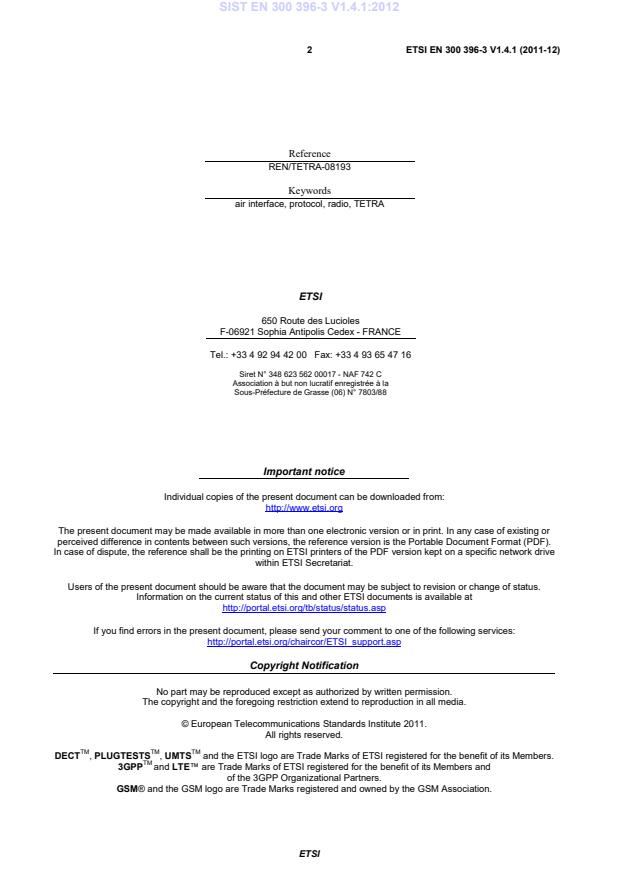
ETSI ETSI EN 300 396-3 V1.4.1 (2011-12) 2
Reference REN/TETRA-08193 Keywords air interface, protocol, radio, TETRA ETSI 650 Route des Lucioles F-06921 Sophia Antipolis Cedex - FRANCE
Tel.: +33 4 92 94 42 00
Fax: +33 4 93 65 47 16
Siret N° 348 623 562 00017 - NAF 742 C Association à but non lucratif enregistrée à la Sous-Préfecture de Grasse (06) N° 7803/88
Important notice Individual copies of the present document can be downloaded from: http://www.etsi.org The present document may be made available in more than one electronic version or in print. In any case of existing or perceived difference in contents between such versions, the reference version is the Portable Document Format (PDF). In case of dispute, the reference shall be the printing on ETSI printers of the PDF version kept on a specific network drive within ETSI Secretariat. Users of the present document should be aware that the document may be subject to revision or change of status. Information on the current status of this and other ETSI documents is available at http://portal.etsi.org/tb/status/status.asp If you find errors in the present document, please send your comment to one of the following services: http://portal.etsi.org/chaircor/ETSI_support.asp Copyright Notification No part may be reproduced except as authorized by written permission. The copyright and the foregoing restriction extend to reproduction in all media.
© European Telecommunications Standards Institute 2011. All rights reserved.
DECTTM, PLUGTESTSTM, UMTSTM and the ETSI logo are Trade Marks of ETSI registered for the benefit of its Members. 3GPPTM and LTE™ are Trade Marks of ETSI registered for the benefit of its Members and of the 3GPP Organizational Partners. GSM® and the GSM logo are Trade Marks registered and owned by the GSM Association. SIST EN 300 396-3 V1.4.1:2012
ETSI ETSI EN 300 396-3 V1.4.1 (2011-12) 3 Contents Intellectual Property Rights . 11 Foreword . 11 1 Scope . 12 2 References . 12 2.1 Normative references . 12 2.2 Informative references . 13 3 Definitions and abbreviations . 13 3.1 Definitions . 13 3.2 Abbreviations . 16 4 Overview of protocol. 17 4.1 General . 17 4.2 The DM channel . 18 4.3 DM call procedures . 18 4.3.1 Constraints on the frame structure . 19 4.3.2 Setting up a call . 19 4.3.2.1 Call set-up without presence check . 20 4.3.2.1.1 Basic procedure . 20 4.3.2.1.2 Procedure in frequency efficient mode . 20 4.3.2.2 Call set-up with presence check . 21 4.3.3 Changeover in a call . 21 4.3.4 Pre-emption of a DM call . 23 4.3.5 Terminating a call . 23 4.3.6 DM short data call . 23 4.3.6.1 Unacknowledged short data message . 24 4.3.6.2 Acknowledged short data message . 24 4.4 DM protocol layering . 25 5 Layer 3 service description . 25 5.1 Introduction . 25 5.2 Services offered . 26 5.3 Primitive description . 26 5.3.1 DMCC-COMPLETE primitive . 27 5.3.2 DMCC-RELEASE primitive . 27 5.3.3 DMCC-REPORT primitive . 27 5.3.4 DMCC-SDS DATA primitive . 27 5.3.5 DMCC-SDS REPORT primitive . 28 5.3.6 DMCC-SDS UNITDATA primitive . 28 5.3.7 DMCC-SETUP primitive . 29 5.3.8 DMCC-TPNI primitive . 30 5.3.9 DMCC-TX CEASED primitive . 30 5.4 Parameter description . 30 5.5 States for DMCC-SAP . 35 6 Layer 3 protocol . 36 6.1 Introduction . 36 6.1.1 DMCC protocol states . 36 6.1.1.1 IDLE . 36 6.1.1.2 CALL SETUP NORMAL ORIGINATING . 36 6.1.1.3 CALL SETUP NORMAL TERMINATING . 36 6.1.1.4 CALL SETUP PRES_CHECK ORIGINATING . 36 6.1.1.5 CALL SETUP PRES_CHECK TERMINATING. 36 6.1.1.6 PRE-EMPTION . 36 6.1.1.7 CALL ACTIVE TX OCCUPATION . 36 6.1.1.8 CALL ACTIVE TX RESERVATION . 37 6.1.1.9 CALL ACTIVE RX OCCUPATION. 37 SIST EN 300 396-3 V1.4.1:2012
ETSI ETSI EN 300 396-3 V1.4.1 (2011-12) 4 6.1.1.10 CALL ACTIVE RX RESERVATION. 37 6.1.1.11 WAIT RSP OCCUPATION . 37 6.1.1.12 WAIT RSP RESERVATION. 37 6.1.1.13 ACK'D SHORT DATA INITIATED . 37 6.1.1.14 UNACK'D SHORT DATA INITIATED . 37 6.2 Circuit mode calls . 37 6.2.1 Procedures for call set-up without presence check . 38 6.2.1.1 Outgoing call . 38 6.2.1.2 Incoming call. 40 6.2.1.3 Temporary group address . 41 6.2.2 Procedures for call set-up with presence check . 41 6.2.2.1 Outgoing call . 41 6.2.2.2 Incoming call. 43 6.2.3 Usage of DM-OCCUPIED PDU . 44 6.2.3.1 Sending of DM-OCCUPIED PDU by master DM-MS . 44 6.2.3.2 Late entry by slave DM-MS . 44 6.2.4 Procedures during occupation . 44 6.2.4.1 Master DM-MS . 44 6.2.4.2 Slave DM-MS . 45 6.2.4.3 Transmitting Party Number Identification (TPNI) . 47 6.2.5 Procedures during reservation. 47 6.2.5.1 Master DM-MS . 47 6.2.5.2 Slave DM-MS . 49 6.2.5.3 Pre-emption of short data sent as a transaction within a circuit mode call . 51 6.2.6 Procedures to set up a new call by pre-emption . 51 6.3 Short Data Service (SDS) procedures . 52 6.3.1 Sending short data . 53 6.3.1.1 Sending short data on a free channel . 53 6.3.1.1.1 Sending unacknowledged short data on a free channel . 53 6.3.1.1.2 Sending acknowledged short data on a free channel . 55 6.3.1.2 Sending short data by pre-emption . 57 6.3.1.3 Sending short data during circuit mode transmission . 58 6.3.1.4 Sending short data as a transaction within a circuit mode call . 59 6.3.1.4.1 Pre-emption to send short data as a transaction within a circuit mode call . 59 6.3.1.4.2 Changeover to send short data as a transaction within a circuit mode call . 60 6.3.1.4.3 Sending the short data as master of the circuit mode call . 60 6.3.2 Receiving short data. 60 6.3.2.1 Receiving unacknowledged short data . 60 6.3.2.2 Receiving acknowledged short data . 61 6.3.3 Additional addressing . 61 6.3.4 Extended error protection . 61 6.3.5 SDS-TL service in DMO . 62 6.3.5.1 Service primitives at the DMTL-SDS-SAP . 62 6.3.5.2 DMTL-SDS primitives' parameters . 65 6.3.5.3 DMTL-SDS PDUs . 67 6.3.5.4 DMTL-SDS procedures . 67 6.4 Usage of DMA-UNITDATA primitive . 70 7 Layer 2 service description . 71 7.1 Introduction . 71 7.2 Layer 2 architecture . 72 7.2.1 Lower layer management in layer 2 . 73 7.3 Service descriptions . 73 7.3.1 Services at the DMA-SAP . 73 7.3.1.1 Services provided to layer 3 . 73 7.3.1.2 Service primitives at the DMA-SAP . 74 7.3.1.2.1 DMA-REPORT primitive. 74 7.3.1.2.2 DMA-UNITDATA primitive . 74 7.3.2 Services at the DMC-SAP . 75 7.3.2.1 Services provided to layer 3 . 75 7.3.2.2 Service primitives at the DMC-SAP . 75 7.3.2.2.1 DMC-CONFIGURE primitive . 76 SIST EN 300 396-3 V1.4.1:2012
ETSI ETSI EN 300 396-3 V1.4.1 (2011-12) 5 7.3.2.2.2 DMC-REPORT primitive . 76 7.3.3 Services at the DMD-SAP . 76 7.3.3.1 Services provided to the U-plane application . 76 7.3.3.2 Service primitives at the DMD-SAP . 76 7.3.3.2.1 DMD-REPORT primitive. 77 7.3.3.2.2 DMD-UNITDATA primitive . 77 7.4 Parameter listing . 77 7.4.1 Air interface encryption information . 77 7.4.2 Air interface encryption state . 77 7.4.2A Called party in ongoing call . 78 7.4.3 Call release. 78 7.4.4 Call set-up after pre-emption or changeover . 78 7.4.5 Changeover request held during occupation . 78 7.4.5A Channel selection information . 78 7.4.6 Circuit mode information . 78 7.4.7 Circuit mode type . 78 7.4.8 Communication type . 78 7.4.9 Destination address . 78 7.4.10 Destination address type . 79 7.4.10A DM channel . 79 7.4.11 DM-SDU . 79 7.4.12 DM-SDU length . 79 7.4.12A Dual watch information . 79 7.4.13 FCS flag . 79 7.4.14 Half slot condition . 79 7.4.15 Half slot content . 79 7.4.16 Half slot importance. 79 7.4.17 Half slot position . 79 7.4.18 Half slot synchronization . 80 7.4.19 Handle to the request . 80 7.4.20 Immediate retransmission . 80 7.4.21 Incomplete DM-SDS DATA/ACK received . 80 7.4.21A Lower layer quality information . 80 7.4.21B Master of ongoing call . 80 7.4.22 Message type . 80 7.4.23 New call pre-emption. 80 7.4.24 Number of repeats . 81 7.4.25 Priority . 81 7.4.26 Priority of ongoing call . 81 7.4.27 Recent user changeover request . 81 7.4.28 Recent user priority . 81 7.4.29 Report . 81 7.4.30 Reservation time . 81 7.4.31 SDS transaction type . 81 7.4.32 Source address . 81 7.4.33 Source address type . 81 7.4.34 Stealing priority . 82 7.4.35 Stolen indication . 82 7.4.36 Type of pre-emption . 82 7.4.37 Valid addresses . 82 8 Layer 2 protocol . 82 8.1 Introduction . 82 8.1.1 Functions of lower MAC . 82 8.1.2 Functions of upper MAC . 83 8.2 Interface between lower and upper MAC . 83 8.2.1 Logical channels defined at the DMV-SAP . 83 8.2.2 Service primitives at the DMV-SAP . 84 8.2.3 PDU mapping of the logical channels at the DMV-SAP . 85 8.2.4 Scrambling mechanism . 85 8.2.5 PDU error detection . 86 8.2.6 Modes of operation . 86 SIST EN 300 396-3 V1.4.1:2012
ETSI ETSI EN 300 396-3 V1.4.1 (2011-12) 6 8.2.6.1 DM-MS modes of operation . 86 8.2.6.1.1 Idle mode . 86 8.2.6.1.2 Signalling mode . 87 8.2.6.1.3 Traffic mode . 87 8.2.6.2 Operation in traffic mode . 88 8.2.6.2.1 Traffic transmission . 88 8.2.6.2.2 Stealing mechanism . 89 8.2.6.3 Selection of the mode of operation . 89 8.3 Basic capabilities of the Physical Layer (PL) . 90 8.3.1 DM-MS capabilities . 90 8.3.1.1 DM only and dual mode capable MS operation . 90 8.3.1.2 Dual watch capable MS operation . 91 8.3.1.2.1 Full Dual Watch Mobile Station (F-DW-MS) . 91 8.3.1.2.2 Idle Dual Watch Mobile Station (I-DW-MS) . 91 8.4 Usage of DM channel . 91 8.4.1 Definition of DM channel . 91 8.4.1.1 DM channel arrangement . 91 8.4.1.2 DM channel A operation . 91 8.4.1.3 DM channel B operation . 92 8.4.2 DM-MAC states . 93 8.4.2.1 DM-MAC state definitions . 93 8.4.2.2 DM-MS channel surveillance procedures . 94 8.4.2.2.1 Initial determination of DM channel state . 94 8.4.2.2.2 Fast call set-up surveillance in idle mode . 96 8.4.2.2.3 DM-MS channel surveillance at call set-up . 99 8.4.2.3 Master DM-MS channel maintenance procedures during a call . 101 8.4.2.4 Slave DM-MS channel maintenance procedures during a call . 101 8.4.2.4.1 Slave MS channel maintenance during call transaction . 102 8.4.2.4.2 Slave MS signal quality measurement during call transaction . 102 8.4.2.4.3 Slave MS channel maintenance during reservation . 102 8.4.2.5 Additional master MS procedures in frequency efficient mode . 102 8.4.2.5.1 Channel A master MS procedures . 103 8.4.2.5.2 Channel B master MS procedures . 103 8.4.3 Criteria for changing DM-MAC state . 103 8.4.3.1 Criteria for changing DM-MAC state for master DM-MS . 103 8.4.3.2 Criteria for changing DM-MAC state for slave DM-MS . 104 8.4.3.3 Criteria for changing DM-MAC state for idle DM-MS . 105 8.4.4 DM-MS channel monitoring procedures . 107 8.4.4.1 DM channel during call set-up with presence check . 108 8.4.4.2 DM channel in occupation during a circuit mode call. 108 8.4.4.3 DM channel in reservation during a circuit mode call . 108 8.4.4.4 DM channel in occupation during an SDS call . 108 8.4.4.5 DM channel usage during pre-emption signalling . 109 8.4.4.6 DM channel usage during timing change request signalling . 109 8.4.5 Transmission of layer 3 messages by DM-MAC . 109 8.4.5.1 Transmission of C-plane messages by DM-MAC. 109 8.4.5.1.1 Transmitting DM-SETUP. 109 8.4.5.1.2 Transmitting DM-SETUP PRES . 110 8.4.5.1.3 Transmitting DM-CONNECT . 111 8.4.5.1.4 Transmitting DM-DISCONNECT. 111 8.4.5.1.5 Transmitting DM-CONNECT ACK. 111 8.4.5.1.6 Transmitting DM-RELEASE . 111 8.4.5.1.7 Transmitting DM-OCCUPIED . 112 8.4.5.1.8 Transmitting DM-TX CEASED . 112 8.4.5.1.9 Transmitting DM-TX REQUEST. 113 8.4.5.1.10 Transmitting response to DM-TX REQUEST. 113 8.4.5.1.11 Transmitting DM-PREEMPT . 114 8.4.5.1.12 Transmitting response to DM-PREEMPT . 114 8.4.5.1.13 Transmitting DM-SDS UDATA and DM-SDS DATA . 115 8.4.5.1.14 Transmitting response to DM-SDS DATA . 116 8.4.5.1.15 Transmitting DM-INFO . 116 8.4.5.2 Transmission of U-plane messages by DM-MAC . 116 SIST EN 300 396-3 V1.4.1:2012
ETSI ETSI EN 300 396-3 V1.4.1 (2011-12) 7 8.4.6 Transmission of layer 2 messages generated by DM-MAC . 116 8.4.6.1 Transmitting DM-RESERVED . 117 8.4.6.2 Transmitting DM-SDS OCCUPIED . 117 8.4.6.3 Transmitting DM-TIMING REQUEST . 118 8.4.6.4 Transmitting DM-TIMING ACK . 118 8.4.7 General DM-MAC procedures . 118 8.4.7.1 DM-MAC repeat transmissions . 118 8.4.7.2 DM-MAC frame countdown procedure . 118 8.4.7.3 Use of timers . 119 8.4.7.4 Linearization . 119 8.4.7.5 Fragmentation . 119 8.4.7.6 Fill bit indication . 119 8.4.7.7 Selection of pseudo address . 119 8.4.7.8 Slot flag indication . 120 8.4.7.9 Requests bitmap . 120 8.4.7.10 DM aspects of dual watch operation . 120 8.4.7.10.1 Full and idle dual watch operation. 120 8.4.7.10.2 DM aspects of full dual watch operation . 120 8.4.7.10.3 DM aspects of idle dual watch operation . 124 8.4.7.11 Air interface encryption . 126 8.4.7.12 Channel A or B operation . 126 8.4.7.13 Sending short data as a transaction within a circuit mode call . 126 8.4.7.14 SDS time remaining . 127 8.4.7.15 Timing change procedure . 127 8.4.7.16 Timing change at changeover or pre-emption . 129 8.5 MAC procedures for transfer of signalling messages . 129 8.5.1 Formation of MAC PDU . 129 8.5.2 Addressing . 130 8.5.2.1 Transmission of message . 130 8.5.2.1.1 Addressing in synchronization burst . 130 8.5.2.1.2 Addressing in normal burst. 132 8.5.2.2 Reception of message . 132 8.5.3 Use of air interface encryption . 133 8.5.4 Fragmentation and reconstruction . 134 8.5.4.1 Fragmentation . 134 8.5.4.2 Reconstruction . 135 8.5.5 Fill bit addition and deletion . 136 8.5.5.1 Fill bit addition . 136 8.5.5.2 Fill bit deletion . 137 8.5.5.3 Null PDU .
...