


ETSI EN 300 220-2 V3.3.1 (2025-01)
Short Range Devices (SRD) operating in the frequency range 25 MHz to 1 000 MHz with power levels ranging up to 500 mW e.r.p.; Part 2: Harmonised Standard for access to radio spectrum for non specific radio equipment
Short Range Devices (SRD) operating in the frequency range 25 MHz to 1 000 MHz with power levels ranging up to 500 mW e.r.p.; Part 2: Harmonised Standard for access to radio spectrum for non specific radio equipment
The present document specifies technical requirements, limits and test methods for Short Range Devices in the non-
specific category operating in the frequency range 25 MHz to 1 000 MHz.
The non specific SRD category is defined by the EU Commission Decision 2019/1345/EU [i.3] as:
"The non-specific short-range device category covers all kinds of radio devices, regardless of the application or the
purpose, which fulfil the technical conditions as specified for a given frequency band. Typical uses include telemetry,
telecommand, alarms, data transmissions in general and other applications".
These radio equipment types are capable of transmitting up to 500 mW effective radiated power and operating indoor or
outdoor.
NOTE: The relationship between the present document and the essential requirements of article 3.2 of
Directive 2014/53/EU [i.2] is given in Annex A
Naprave kratkega dosega (SRD), ki delujejo v frekvenčnem območju od 25 MHz do 1000 MHz z močnostnimi nivoji do 500 mW e.r.p. - 2. del: Harmonizirani standard za dostop do radijskega spektra za nespecifično radijsko opremo
Ta dokument določa tehnične zahteve, mejne vrednosti in preskusne metode za naprave kratkega dosega v nespecifični kategoriji, ki delujejo v frekvenčnem območju od 25 MHz do 1000 MHz. Kategorija nespecifičnih naprav kratkega dosega (SRD) je z odločbo Komisije 2019/1345/EU [i.3] opredeljena kot: »Nespecifične naprave kratkega dosega zajemajo vse vrste radijskih naprav, ne glede na uporabo ali njihov namen, ki izpolnjujejo tehnične pogoje, opredeljene za določen frekvenčni pas. Značilne uporabe so telemetrija, daljinsko upravljanje, alarmi, splošni prenosi podatkov in uporaba v druge namene.« Te vrste radijske opreme lahko prenesejo do 500 mW efektivne sevane moči ter delujejo v zaprtih prostorih ali na prostem. OPOMBA: Razmerje med tem dokumentom in bistvenimi zahtevami člena 3.2 Direktive 2014/53/EU [i.2] je podano v dodatku A.
General Information
Standards Content (Sample)
Final draft ETSI EN 300 220-2 V3.3.1 (2025-01)
HARMONISED EUROPEAN STANDARD
Short Range Devices (SRD) operating
in the frequency range 25 MHz to 1 000 MHz with power levels
ranging up to 500 mW e.r.p.;
Part 2: Harmonised Standard for access to radio spectrum
for non specific radio equipment
2 Final draft ETSI EN 300 220-2 V3.3.1 (2025-01)
Reference
REN/ERM-TG28-566
Keywords
harmonised standard, radio, SRD, testing
ETSI
650 Route des Lucioles
F-06921 Sophia Antipolis Cedex - FRANCE
Tel.: +33 4 92 94 42 00 Fax: +33 4 93 65 47 16
Siret N° 348 623 562 00017 - APE 7112B
Association à but non lucratif enregistrée à la
Sous-Préfecture de Grasse (06) N° w061004871
Important notice
The present document can be downloaded from the
ETSI Search & Browse Standards application.
The present document may be made available in electronic versions and/or in print. The content of any electronic and/or
print versions of the present document shall not be modified without the prior written authorization of ETSI. In case of any
existing or perceived difference in contents between such versions and/or in print, the prevailing version of an ETSI
deliverable is the one made publicly available in PDF format on ETSI deliver repository.
Users should be aware that the present document may be revised or have its status changed,
this information is available in the Milestones listing.
If you find errors in the present document, please send your comments to
the relevant service listed under Committee Support Staff.
If you find a security vulnerability in the present document, please report it through our
Coordinated Vulnerability Disclosure (CVD) program.
Notice of disclaimer & limitation of liability
The information provided in the present deliverable is directed solely to professionals who have the appropriate degree of
experience to understand and interpret its content in accordance with generally accepted engineering or
other professional standard and applicable regulations.
No recommendation as to products and services or vendors is made or should be implied.
In no event shall ETSI be held liable for loss of profits or any other incidental or consequential damages.
Any software contained in this deliverable is provided "AS IS" with no warranties, express or implied, including but not
limited to, the warranties of merchantability, fitness for a particular purpose and non-infringement of intellectual property
rights and ETSI shall not be held liable in any event for any damages whatsoever (including, without limitation, damages
for loss of profits, business interruption, loss of information, or any other pecuniary loss) arising out of or related to the use
of or inability to use the software.
Copyright Notification
No part may be reproduced or utilized in any form or by any means, electronic or mechanical, including photocopying and
microfilm except as authorized by written permission of ETSI.
The content of the PDF version shall not be modified without the written authorization of ETSI.
The copyright and the foregoing restriction extend to reproduction in all media.
© ETSI 2025.
All rights reserved.
ETSI
3 Final draft ETSI EN 300 220-2 V3.3.1 (2025-01)
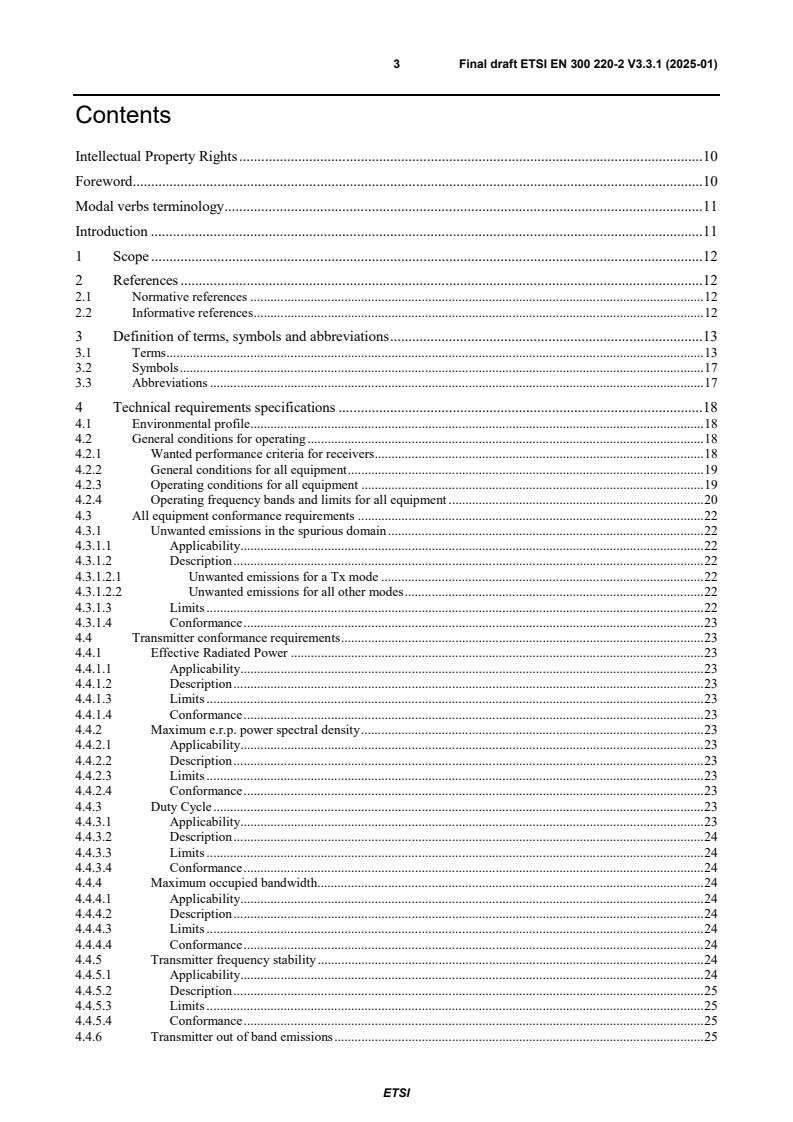
Contents
Intellectual Property Rights . 10
Foreword . 10
Modal verbs terminology . 11
Introduction . 11
1 Scope . 12
2 References . 12
2.1 Normative references . 12
2.2 Informative references . 12
3 Definition of terms, symbols and abbreviations . 13
3.1 Terms . 13
3.2 Symbols . 17
3.3 Abbreviations . 17
4 Technical requirements specifications . 18
4.1 Environmental profile . 18
4.2 General conditions for operating . 18
4.2.1 Wanted performance criteria for receivers . 18
4.2.2 General conditions for all equipment . 19
4.2.3 Operating conditions for all equipment . 19
4.2.4 Operating frequency bands and limits for all equipment . 20
4.3 All equipment conformance requirements . 22
4.3.1 Unwanted emissions in the spurious domain . 22
4.3.1.1 Applicability. 22
4.3.1.2 Description . 22
4.3.1.2.1 Unwanted emissions for a Tx mode . 22
4.3.1.2.2 Unwanted emissions for all other modes . 22
4.3.1.3 Limits . 22
4.3.1.4 Conformance . 23
4.4 Transmitter conformance requirements . 23
4.4.1 Effective Radiated Power . 23
4.4.1.1 Applicability. 23
4.4.1.2 Description . 23
4.4.1.3 Limits . 23
4.4.1.4 Conformance . 23
4.4.2 Maximum e.r.p. power spectral density . 23
4.4.2.1 Applicability. 23
4.4.2.2 Description . 23
4.4.2.3 Limits . 23
4.4.2.4 Conformance . 23
4.4.3 Duty Cycle . 23
4.4.3.1 Applicability. 23
4.4.3.2 Description . 24
4.4.3.3 Limits . 24
4.4.3.4 Conformance . 24
4.4.4 Maximum occupied bandwidth. 24
4.4.4.1 Applicability. 24
4.4.4.2 Description . 24
4.4.4.3 Limits . 24
4.4.4.4 Conformance . 24
4.4.5 Transmitter frequency stability . 24
4.4.5.1 Applicability. 24
4.4.5.2 Description . 25
4.4.5.3 Limits . 25
4.4.5.4 Conformance . 25
4.4.6 Transmitter out of band emissions . 25
ETSI
4 Final draft ETSI EN 300 220-2 V3.3.1 (2025-01)
4.4.6.1 Applicability. 25
4.4.6.2 Description . 25
4.4.6.3 Limits . 26
4.4.6.4 Conformance . 26
4.4.7 Adjacent Channel Power . 26
4.4.7.1 Applicability. 26
4.4.7.2 Description . 26
4.4.7.3 Limits . 27
4.4.7.4 Conformance . 27
4.4.8 Transmitter spectrum mask at permitted frequency band edges . 27
4.4.8.1 Applicability. 27
4.4.8.2 Description . 27
4.4.8.3 Limits . 27
4.4.8.4 Conformance . 28
4.4.9 Transient power . 28
4.4.9.1 Applicability. 28
4.4.9.2 Description . 28
4.4.9.3 Limits . 28
4.4.9.4 Conformance . 28
4.4.10 Transmitter behaviour under Low Voltage Conditions. 28
4.4.10.1 Applicability. 28
4.4.10.2 Description . 28
4.4.10.3 Limits . 29
4.4.10.4 Conformance . 29
4.4.11 FHSS equipment . 29
4.4.11.1 Applicability. 29
4.4.11.2 Description . 29
4.4.11.3 Limits . 29
4.4.11.4 Conformance . 29
4.4.12 Short term behaviour . 30
4.4.12.1 Applicability. 30
4.4.12.2 Description . 30
4.4.12.3 Limits . 30
4.4.12.4 Conformance . 30
4.5 Receivers conformance requirements . 30
4.5.1 Receiver sensitivity . 30
4.5.1.1 Applicability. 30
4.5.1.2 Description . 30
4.5.1.3 Limits for equipment employing polite spectrum access . 30
4.5.1.4 Limits for equipment not employing polite spectrum access . 30
4.5.1.5 Conformance . 31
4.5.2 Receiver dynamic range . 31
4.5.2.1 Applicability. 31
4.5.2.2 Description . 31
4.5.2.3 Limits . 31
4.5.2.4 Conformance . 31
4.5.3 Adjacent channel selectivity . 31
4.5.3.1 Applicability. 31
4.5.3.2 Description . 31
4.5.3.3 Limits . 31
4.5.3.4 Conformance . 31
4.5.4 Blocking . 32
4.5.4.1 Applicability. 32
4.5.4.2 Description . 32
4.5.4.3 Limits . 32
4.5.4.4 Conformance . 32
4.5.5 Receiver spurious response rejection . 32
4.5.5.1 Applicability. 32
4.5.5.2 Description . 32
4.5.5.3 Limits . 32
4.5.5.4 Conformance . 33
4.5.6 Receiver intermodulation rejection . 33
ETSI
5 Final draft ETSI EN 300 220-2 V3.3.1 (2025-01)
4.5.6.1 Applicability. 33
4.5.6.2 Description . 33
4.5.6.3 Limits . 33
4.5.6.4 Conformance . 33
4.6 Polite spectrum access conformance requirement . 33
4.6.1 Description . 33
4.6.1.0 General . 33
4.6.1.1 Adaptive Frequency Agility . 34
4.6.2 Clear Channel Assessment threshold . 34
4.6.2.1 Applicability. 34
4.6.2.2 Description . 34
4.6.2.3 Limits . 34
4.6.2.4 Conformance . 34
4.6.3 Polite spectrum access timing parameters . 34
4.6.3.1 Applicability. 34
4.6.3.2 Limits for polite spectrum access timing parameters . 34
4.6.3.3 Conformance . 35
5 Testing for compliance with technical requirements . 35
5.1 Environmental conditions for testing . 35
5.1.1 General consideration . 35
5.1.2 Normal test conditions . 35
5.1.2.1 Normal temperature and humidity . 35
5.1.2.2 Normal test power source . 35
5.1.2.2.1 Mains voltage . 35
5.1.2.2.2 Battery power source . 35
5.1.3 Extreme test conditions . 36
5.1.3.1 Extreme test temperature range . 36
5.1.3.2 Extreme test source voltage. 36
5.1.3.2.1 Mains voltage . 36
5.1.3.2.2 Regulated lead-acid battery power sources . 36
5.1.3.2.3 Other power sources . 36
5.2 General conditions for testing . 36
5.2.1 General considerations . 36
5.2.2 Presentation of equipment for testing purposes . 37
5.2.2.1 General Considerations . 37
5.2.2.1.1 General . 37
5.2.2.1.2 EUT with an external RF connector . 37
5.2.2.1.3 EUT without an external RF connector . 37
5.2.2.2 Testing of modular equipment . 37
5.2.3 Test power source . 38
5.2.3.1 General . 38
5.2.3.2 External test power source . 38
5.2.3.3 Internal test power source . 38
5.2.4 Thermal test conditions . 38
5.2.5 Testing of frequency agile or hopping equipment . 38
5.2.6 Conducted measurements . 38
5.2.6.1 Artificial antenna . 38
5.2.7 Radiated measurements . 39
5.2.8 Applicable measurement methods . 39
5.2.9 Test signals for data . 40
5.2.10 Measuring receiver . 41
5.2.10.1 Description . 41
5.2.10.2 Reference bandwidth . 41
5.3 Conformance methods of measurement for all equipment . 42
5.3.1 Unwanted emissions in the spurious domain . 42
5.3.1.1 Test conditions for Tx mode . 42
5.3.1.2 Test conditions for Rx and all other modes . 42
5.3.1.3 Measurement procedure . 43
5.3.1.3.1 Radiated measurement . 43
5.3.1.3.2 Conducted measurement. 44
5.3.1.3.3 Measurement of emissions identified during the pre-scan . 46
ETSI
6 Final draft ETSI EN 300 220-2 V3.3.1 (2025-01)
5.4 Conformance methods of measurement for transmitters . 47
5.4.1 Effective radiated power . 47
5.4.1.1 Effective radiated power (radiated measurement) . 47
5.4.1.1.1 General . 47
5.4.1.1.2 Test conditions . 47
5.4.1.1.3 Measurement procedure . 47
5.4.1.2 Effective Radiated Power (conducted measurement) . 47
5.4.1.2.1 General . 47
5.4.1.2.2 Test conditions . 47
5.4.1.2.3 Measurement procedure . 48
5.4.2 Maximum e.r.p. power spectral density . 48
5.4.2.1 Test conditions . 48
5.4.2.2 Radiated measurement . 48
5.4.2.3 Conducted measurement . 48
5.4.2.4 Measurement procedure . 48
5.4.3 Duty cycle . 49
5.4.3.1 Test conditions . 49
5.4.3.2 Radiated measurement . 50
5.4.3.3 Conducted measurement . 50
5.4.3.4 Measurement procedure . 50
5.4.4 Maximum occupied bandwidth. 50
5.4.4.1 Test conditions . 50
5.4.4.2 Radiated measurement . 50
5.4.4.3 Conducted measurement . 51
5.4.4.4 Measurement procedure . 51
5.4.5 Transmitter frequency stability . 52
5.4.5.1 Test condition . 52
5.4.5.2 Radiated measurement . 52
5.4.5.3 Conducted measurement . 52
5.4.5.4 Measurement procedure for D-M1 test signal . 52
5.4.5.5 Measurement procedure for other test signal . 53
5.4.6 Transmitter out of band emissions . 53
5.4.6.1 Test conditions . 53
5.4.6.2 Radiated measurement . 54
5.4.6.3 Conducted measurement . 54
5.4.6.4 Measurement procedure . 54
5.4.7 Adjacent channel power . 54
5.4.7.1 Test conditions . 54
5.4.7.2 Radiated measurement . 54
5.4.7.3 Conducted measurement . 55
5.4.7.4 Measurement procedure . 55
5.4.8 Transmitter spectrum mask at permitted frequency band edges . 55
5.4.8.1 Test conditions . 55
5.4.8.2 Radiated measurement . 56
5.4.8.3 Conducted measurement . 56
5.4.8.4 Measurement procedure . 56
5.4.9 Transient power . 56
5.4.9.1 Test conditions . 56
5.4.9.2 Radiated measurement . 57
5.4.9.3 Conducted measurement . 57
5.4.9.4 Measurement procedure . 57
5.4.10 Transmitter behaviour under low voltage conditions . 58
5.4.10.1 Test conditions . 58
5.4.10.2 Radiated measurement . 58
5.4.10.3 Conducted measurement . 58
5.4.10.4 Measurement procedure . 58
5.4.11 FHSS equipment . 59
5.4.11.1 Test conditions . 59
5.4.11.2 Radiated measurement . 59
5.4.11.3 Conducted measurement . 59
5.4.11.4 Measurement procedure . 59
5.4.11.4.0 General . 59
ETSI
7 Final draft ETSI EN 300 220-2 V3.3.1 (2025-01)
5.4.11.4.1 Hopping channels . 59
5.4.11.4.2 FHSS occupied bandwidth . 59
5.4.11.4.3 Dwell time . 60
5.4.11.4.4 Channel return time . 60
5.4.11.4.5 FHSS duty cycle . 60
5.4.11.4.6 FHSS CCA . 60
5.4.12 Short term behaviour . 60
5.4.12.1 Test conditions . 60
5.4.12.2 Radiated measurement . 60
5.4.12.3 Conducted measurement . 61
5.4.12.4 Measurement procedure . 61
5.5 Conformance methods of measurement for receivers . 62
5.5.1 Receiver sensitivity . 62
5.5.1.1 Test conditions . 62
5.5.1.2 Radiated measurement . 62
5.5.1.3 Conducted measurement . 62
5.5.1.4 Measurement procedure . 62
5.5.2 Receiver dynamic range . 63
5.5.2.1 Test conditions . 63
5.5.2.2 Radiated measurement . 63
5.5.2.3 Conducted measurement .
...
ETSI EN 300 220-2 V3.3.1 (2025-03)
HARMONISED EUROPEAN STANDARD
Short Range Devices (SRD) operating
in the frequency range 25 MHz to 1 000 MHz with power levels
ranging up to 500 mW e.r.p.;
Part 2: Harmonised Standard for access to radio spectrum
for non specific radio equipment
2 ETSI EN 300 220-2 V3.3.1 (2025-03)
Reference
REN/ERM-TG28-566
Keywords
harmonised standard, radio, SRD, testing
ETSI
650 Route des Lucioles
F-06921 Sophia Antipolis Cedex - FRANCE
Tel.: +33 4 92 94 42 00 Fax: +33 4 93 65 47 16
Siret N° 348 623 562 00017 - APE 7112B
Association à but non lucratif enregistrée à la
Sous-Préfecture de Grasse (06) N° w061004871
Important notice
The present document can be downloaded from the
ETSI Search & Browse Standards application.
The present document may be made available in electronic versions and/or in print. The content of any electronic and/or
print versions of the present document shall not be modified without the prior written authorization of ETSI. In case of any
existing or perceived difference in contents between such versions and/or in print, the prevailing version of an ETSI
deliverable is the one made publicly available in PDF format on ETSI deliver repository.
Users should be aware that the present document may be revised or have its status changed,
this information is available in the Milestones listing.
If you find errors in the present document, please send your comments to
the relevant service listed under Committee Support Staff.
If you find a security vulnerability in the present document, please report it through our
Coordinated Vulnerability Disclosure (CVD) program.
Notice of disclaimer & limitation of liability
The information provided in the present deliverable is directed solely to professionals who have the appropriate degree of
experience to understand and interpret its content in accordance with generally accepted engineering or
other professional standard and applicable regulations.
No recommendation as to products and services or vendors is made or should be implied.
In no event shall ETSI be held liable for loss of profits or any other incidental or consequential damages.
Any software contained in this deliverable is provided "AS IS" with no warranties, express or implied, including but not
limited to, the warranties of merchantability, fitness for a particular purpose and non-infringement of intellectual property
rights and ETSI shall not be held liable in any event for any damages whatsoever (including, without limitation, damages
for loss of profits, business interruption, loss of information, or any other pecuniary loss) arising out of or related to the use
of or inability to use the software.
Copyright Notification
No part may be reproduced or utilized in any form or by any means, electronic or mechanical, including photocopying and
microfilm except as authorized by written permission of ETSI.
The content of the PDF version shall not be modified without the written authorization of ETSI.
The copyright and the foregoing restriction extend to reproduction in all media.
© ETSI 2025.
All rights reserved.
ETSI
3 ETSI EN 300 220-2 V3.3.1 (2025-03)
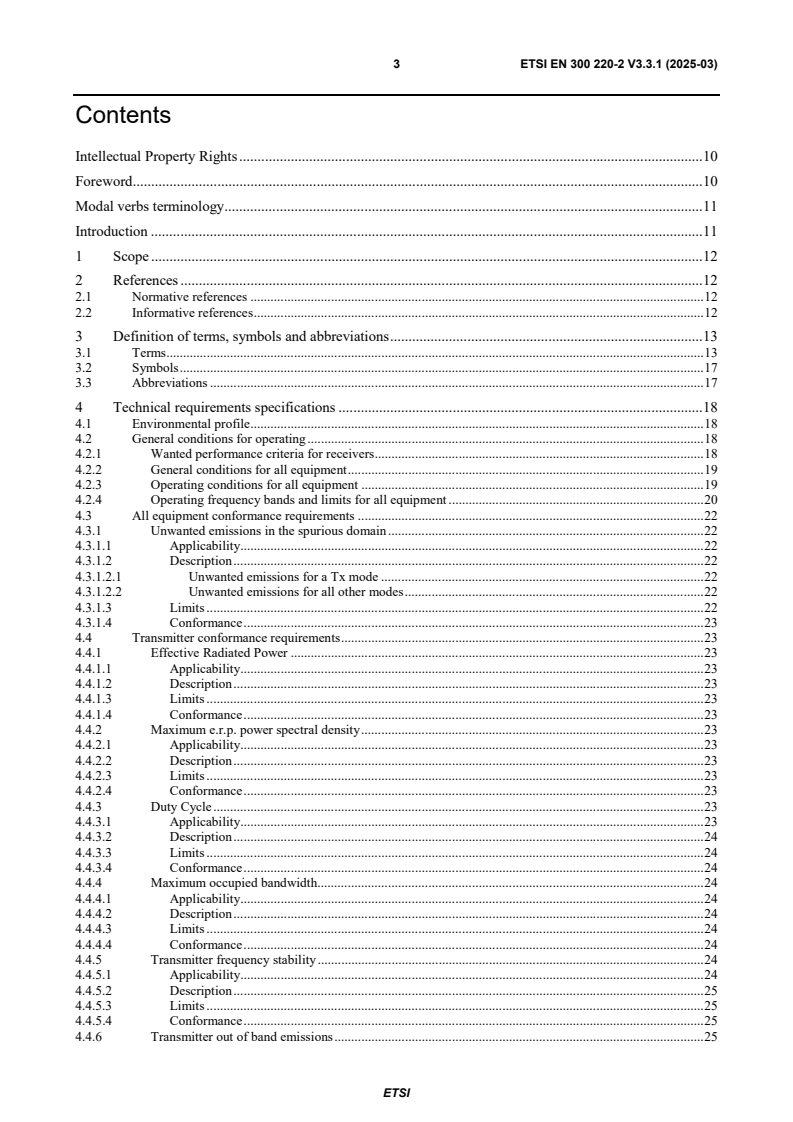
Contents
Intellectual Property Rights . 10
Foreword . 10
Modal verbs terminology . 11
Introduction . 11
1 Scope . 12
2 References . 12
2.1 Normative references . 12
2.2 Informative references . 12
3 Definition of terms, symbols and abbreviations . 13
3.1 Terms . 13
3.2 Symbols . 17
3.3 Abbreviations . 17
4 Technical requirements specifications . 18
4.1 Environmental profile . 18
4.2 General conditions for operating . 18
4.2.1 Wanted performance criteria for receivers . 18
4.2.2 General conditions for all equipment . 19
4.2.3 Operating conditions for all equipment . 19
4.2.4 Operating frequency bands and limits for all equipment . 20
4.3 All equipment conformance requirements . 22
4.3.1 Unwanted emissions in the spurious domain . 22
4.3.1.1 Applicability. 22
4.3.1.2 Description . 22
4.3.1.2.1 Unwanted emissions for a Tx mode . 22
4.3.1.2.2 Unwanted emissions for all other modes . 22
4.3.1.3 Limits . 22
4.3.1.4 Conformance . 23
4.4 Transmitter conformance requirements . 23
4.4.1 Effective Radiated Power . 23
4.4.1.1 Applicability. 23
4.4.1.2 Description . 23
4.4.1.3 Limits . 23
4.4.1.4 Conformance . 23
4.4.2 Maximum e.r.p. power spectral density . 23
4.4.2.1 Applicability. 23
4.4.2.2 Description . 23
4.4.2.3 Limits . 23
4.4.2.4 Conformance . 23
4.4.3 Duty Cycle . 23
4.4.3.1 Applicability. 23
4.4.3.2 Description . 24
4.4.3.3 Limits . 24
4.4.3.4 Conformance . 24
4.4.4 Maximum occupied bandwidth. 24
4.4.4.1 Applicability. 24
4.4.4.2 Description . 24
4.4.4.3 Limits . 24
4.4.4.4 Conformance . 24
4.4.5 Transmitter frequency stability . 24
4.4.5.1 Applicability. 24
4.4.5.2 Description . 25
4.4.5.3 Limits . 25
4.4.5.4 Conformance . 25
4.4.6 Transmitter out of band emissions . 25
ETSI
4 ETSI EN 300 220-2 V3.3.1 (2025-03)
4.4.6.1 Applicability. 25
4.4.6.2 Description . 25
4.4.6.3 Limits . 26
4.4.6.4 Conformance . 26
4.4.7 Adjacent Channel Power . 26
4.4.7.1 Applicability. 26
4.4.7.2 Description . 26
4.4.7.3 Limits . 27
4.4.7.4 Conformance . 27
4.4.8 Transmitter spectrum mask at permitted frequency band edges . 27
4.4.8.1 Applicability. 27
4.4.8.2 Description . 27
4.4.8.3 Limits . 27
4.4.8.4 Conformance . 28
4.4.9 Transient power . 28
4.4.9.1 Applicability. 28
4.4.9.2 Description . 28
4.4.9.3 Limits . 28
4.4.9.4 Conformance . 28
4.4.10 Transmitter behaviour under Low Voltage Conditions. 28
4.4.10.1 Applicability. 28
4.4.10.2 Description . 28
4.4.10.3 Limits . 29
4.4.10.4 Conformance . 29
4.4.11 FHSS equipment . 29
4.4.11.1 Applicability. 29
4.4.11.2 Description . 29
4.4.11.3 Limits . 29
4.4.11.4 Conformance . 29
4.4.12 Short term behaviour . 30
4.4.12.1 Applicability. 30
4.4.12.2 Description . 30
4.4.12.3 Limits . 30
4.4.12.4 Conformance . 30
4.5 Receivers conformance requirements . 30
4.5.1 Receiver sensitivity . 30
4.5.1.1 Applicability. 30
4.5.1.2 Description . 30
4.5.1.3 Limits for equipment employing polite spectrum access . 30
4.5.1.4 Limits for equipment not employing polite spectrum access . 30
4.5.1.5 Conformance . 31
4.5.2 Receiver dynamic range . 31
4.5.2.1 Applicability. 31
4.5.2.2 Description . 31
4.5.2.3 Limits . 31
4.5.2.4 Conformance . 31
4.5.3 Adjacent channel selectivity . 31
4.5.3.1 Applicability. 31
4.5.3.2 Description . 31
4.5.3.3 Limits . 31
4.5.3.4 Conformance . 31
4.5.4 Blocking . 32
4.5.4.1 Applicability. 32
4.5.4.2 Description . 32
4.5.4.3 Limits . 32
4.5.4.4 Conformance . 32
4.5.5 Receiver spurious response rejection . 32
4.5.5.1 Applicability. 32
4.5.5.2 Description . 32
4.5.5.3 Limits . 32
4.5.5.4 Conformance . 33
4.5.6 Receiver intermodulation rejection . 33
ETSI
5 ETSI EN 300 220-2 V3.3.1 (2025-03)
4.5.6.1 Applicability. 33
4.5.6.2 Description . 33
4.5.6.3 Limits . 33
4.5.6.4 Conformance . 33
4.6 Polite spectrum access conformance requirement . 33
4.6.1 Description . 33
4.6.1.0 General . 33
4.6.1.1 Adaptive Frequency Agility . 34
4.6.2 Clear Channel Assessment threshold . 34
4.6.2.1 Applicability. 34
4.6.2.2 Description . 34
4.6.2.3 Limits . 34
4.6.2.4 Conformance . 34
4.6.3 Polite spectrum access timing parameters . 34
4.6.3.1 Applicability. 34
4.6.3.2 Limits for polite spectrum access timing parameters . 34
4.6.3.3 Conformance . 35
5 Testing for compliance with technical requirements . 35
5.1 Environmental conditions for testing . 35
5.1.1 General consideration . 35
5.1.2 Normal test conditions . 35
5.1.2.1 Normal temperature and humidity . 35
5.1.2.2 Normal test power source . 35
5.1.2.2.1 Mains voltage . 35
5.1.2.2.2 Battery power source . 35
5.1.3 Extreme test conditions . 36
5.1.3.1 Extreme test temperature range . 36
5.1.3.2 Extreme test source voltage. 36
5.1.3.2.1 Mains voltage . 36
5.1.3.2.2 Regulated lead-acid battery power sources . 36
5.1.3.2.3 Other power sources . 36
5.2 General conditions for testing . 36
5.2.1 General considerations . 36
5.2.2 Presentation of equipment for testing purposes . 37
5.2.2.1 General Considerations . 37
5.2.2.1.1 General . 37
5.2.2.1.2 EUT with an external RF connector . 37
5.2.2.1.3 EUT without an external RF connector . 37
5.2.2.2 Testing of modular equipment . 37
5.2.3 Test power source . 38
5.2.3.1 General . 38
5.2.3.2 External test power source . 38
5.2.3.3 Internal test power source . 38
5.2.4 Thermal test conditions . 38
5.2.5 Testing of frequency agile or hopping equipment . 38
5.2.6 Conducted measurements . 38
5.2.6.1 Artificial antenna . 38
5.2.7 Radiated measurements . 39
5.2.8 Applicable measurement methods . 39
5.2.9 Test signals for data . 40
5.2.10 Measuring receiver . 41
5.2.10.1 Description . 41
5.2.10.2 Reference bandwidth . 41
5.3 Conformance methods of measurement for all equipment . 42
5.3.1 Unwanted emissions in the spurious domain . 42
5.3.1.1 Test conditions for Tx mode . 42
5.3.1.2 Test conditions for Rx and all other modes . 42
5.3.1.3 Measurement procedure . 43
5.3.1.3.1 Radiated measurement . 43
5.3.1.3.2 Conducted measurement. 44
5.3.1.3.3 Measurement of emissions identified during the pre-scan . 46
ETSI
6 ETSI EN 300 220-2 V3.3.1 (2025-03)
5.4 Conformance methods of measurement for transmitters . 47
5.4.1 Effective radiated power . 47
5.4.1.1 Effective radiated power (radiated measurement) . 47
5.4.1.1.1 General . 47
5.4.1.1.2 Test conditions . 47
5.4.1.1.3 Measurement procedure . 47
5.4.1.2 Effective Radiated Power (conducted measurement) . 47
5.4.1.2.1 General . 47
5.4.1.2.2 Test conditions . 47
5.4.1.2.3 Measurement procedure . 48
5.4.2 Maximum e.r.p. power spectral density . 48
5.4.2.1 Test conditions . 48
5.4.2.2 Radiated measurement . 48
5.4.2.3 Conducted measurement . 48
5.4.2.4 Measurement procedure . 48
5.4.3 Duty cycle . 49
5.4.3.1 Test conditions . 49
5.4.3.2 Radiated measurement . 50
5.4.3.3 Conducted measurement . 50
5.4.3.4 Measurement procedure . 50
5.4.4 Maximum occupied bandwidth. 50
5.4.4.1 Test conditions . 50
5.4.4.2 Radiated measurement . 50
5.4.4.3 Conducted measurement . 51
5.4.4.4 Measurement procedure . 51
5.4.5 Transmitter frequency stability . 52
5.4.5.1 Test condition . 52
5.4.5.2 Radiated measurement . 52
5.4.5.3 Conducted measurement . 52
5.4.5.4 Measurement procedure for D-M1 test signal . 52
5.4.5.5 Measurement procedure for other test signal . 53
5.4.6 Transmitter out of band emissions . 53
5.4.6.1 Test conditions . 53
5.4.6.2 Radiated measurement . 54
5.4.6.3 Conducted measurement . 54
5.4.6.4 Measurement procedure . 54
5.4.7 Adjacent channel power . 54
5.4.7.1 Test conditions . 54
5.4.7.2 Radiated measurement . 54
5.4.7.3 Conducted measurement . 55
5.4.7.4 Measurement procedure . 55
5.4.8 Transmitter spectrum mask at permitted frequency band edges . 55
5.4.8.1 Test conditions . 55
5.4.8.2 Radiated measurement . 56
5.4.8.3 Conducted measurement . 56
5.4.8.4 Measurement procedure . 56
5.4.9 Transient power . 56
5.4.9.1 Test conditions . 56
5.4.9.2 Radiated measurement . 57
5.4.9.3 Conducted measurement . 57
5.4.9.4 Measurement procedure . 57
5.4.10 Transmitter behaviour under low voltage conditions . 58
5.4.10.1 Test conditions . 58
5.4.10.2 Radiated measurement . 58
5.4.10.3 Conducted measurement . 58
5.4.10.4 Measurement procedure . 58
5.4.11 FHSS equipment . 59
5.4.11.1 Test conditions . 59
5.4.11.2 Radiated measurement . 59
5.4.11.3 Conducted measurement . 59
5.4.11.4 Measurement procedure . 59
5.4.11.4.0 General . 59
ETSI
7 ETSI EN 300 220-2 V3.3.1 (2025-03)
5.4.11.4.1 Hopping channels . 59
5.4.11.4.2 FHSS occupied bandwidth . 59
5.4.11.4.3 Dwell time . 60
5.4.11.4.4 Channel return time . 60
5.4.11.4.5 FHSS duty cycle . 60
5.4.11.4.6 FHSS CCA . 60
5.4.12 Short term behaviour . 60
5.4.12.1 Test conditions . 60
5.4.12.2 Radiated measurement . 60
5.4.12.3 Conducted measurement . 61
5.4.12.4 Measurement procedure . 61
5.5 Conformance methods of measurement for receivers . 62
5.5.1 Receiver sensitivity . 62
5.5.1.1 Test conditions . 62
5.5.1.2 Radiated measurement . 62
5.5.1.3 Conducted measurement . 62
5.5.1.4 Measurement procedure . 62
5.5.2 Receiver dynamic range . 63
5.5.2.1 Test conditions . 63
5.5.2.2 Radiated measurement . 63
5.5.2.3 Conducted measurement .
...
SLOVENSKI STANDARD
01-maj-2025
Naprave kratkega dosega (SRD), ki delujejo v frekvenčnem območju od 25 MHz do
1000 MHz z močnostnimi nivoji do 500 mW e.r.p. - 2. del: Harmonizirani standard
za dostop do radijskega spektra za nespecifično radijsko opremo
Short Range Devices (SRD) operating in the frequency range 25 MHz to 1 000 MHz with
power levels ranging up to 500 mW e.r.p. - Part 2: Harmonised Standard for access to
radio spectrum for non specific radio equipment
Ta slovenski standard je istoveten z: ETSI EN 300 220-2 V3.3.1 (2025-01)
ICS:
33.060.20 Sprejemna in oddajna Receiving and transmitting
oprema equipment
2003-01.Slovenski inštitut za standardizacijo. Razmnoževanje celote ali delov tega standarda ni dovoljeno.
Final draft ETSI EN 300 220-2 V3.3.1 (2025-01)
HARMONISED EUROPEAN STANDARD
Short Range Devices (SRD) operating
in the frequency range 25 MHz to 1 000 MHz with power levels
ranging up to 500 mW e.r.p.;
Part 2: Harmonised Standard for access to radio spectrum
for non specific radio equipment
2 Final draft ETSI EN 300 220-2 V3.3.1 (2025-01)
Reference
REN/ERM-TG28-566
Keywords
harmonised standard, radio, SRD, testing
ETSI
650 Route des Lucioles
F-06921 Sophia Antipolis Cedex - FRANCE
Tel.: +33 4 92 94 42 00 Fax: +33 4 93 65 47 16
Siret N° 348 623 562 00017 - APE 7112B
Association à but non lucratif enregistrée à la
Sous-Préfecture de Grasse (06) N° w061004871
Important notice
The present document can be downloaded from the
ETSI Search & Browse Standards application.
The present document may be made available in electronic versions and/or in print. The content of any electronic and/or
print versions of the present document shall not be modified without the prior written authorization of ETSI. In case of any
existing or perceived difference in contents between such versions and/or in print, the prevailing version of an ETSI
deliverable is the one made publicly available in PDF format on ETSI deliver repository.
Users should be aware that the present document may be revised or have its status changed,
this information is available in the Milestones listing.
If you find errors in the present document, please send your comments to
the relevant service listed under Committee Support Staff.
If you find a security vulnerability in the present document, please report it through our
Coordinated Vulnerability Disclosure (CVD) program.
Notice of disclaimer & limitation of liability
The information provided in the present deliverable is directed solely to professionals who have the appropriate degree of
experience to understand and interpret its content in accordance with generally accepted engineering or
other professional standard and applicable regulations.
No recommendation as to products and services or vendors is made or should be implied.
In no event shall ETSI be held liable for loss of profits or any other incidental or consequential damages.
Any software contained in this deliverable is provided "AS IS" with no warranties, express or implied, including but not
limited to, the warranties of merchantability, fitness for a particular purpose and non-infringement of intellectual property
rights and ETSI shall not be held liable in any event for any damages whatsoever (including, without limitation, damages
for loss of profits, business interruption, loss of information, or any other pecuniary loss) arising out of or related to the use
of or inability to use the software.
Copyright Notification
No part may be reproduced or utilized in any form or by any means, electronic or mechanical, including photocopying and
microfilm except as authorized by written permission of ETSI.
The content of the PDF version shall not be modified without the written authorization of ETSI.
The copyright and the foregoing restriction extend to reproduction in all media.
© ETSI 2025.
All rights reserved.
ETSI
3 Final draft ETSI EN 300 220-2 V3.3.1 (2025-01)
Contents
Intellectual Property Rights . 10
Foreword . 10
Modal verbs terminology . 11
Introduction . 11
1 Scope . 12
2 References . 12
2.1 Normative references . 12
2.2 Informative references . 12
3 Definition of terms, symbols and abbreviations . 13
3.1 Terms . 13
3.2 Symbols . 17
3.3 Abbreviations . 17
4 Technical requirements specifications . 18
4.1 Environmental profile . 18
4.2 General conditions for operating . 18
4.2.1 Wanted performance criteria for receivers . 18
4.2.2 General conditions for all equipment . 19
4.2.3 Operating conditions for all equipment . 19
4.2.4 Operating frequency bands and limits for all equipment . 20
4.3 All equipment conformance requirements . 22
4.3.1 Unwanted emissions in the spurious domain . 22
4.3.1.1 Applicability. 22
4.3.1.2 Description . 22
4.3.1.2.1 Unwanted emissions for a Tx mode . 22
4.3.1.2.2 Unwanted emissions for all other modes . 22
4.3.1.3 Limits . 22
4.3.1.4 Conformance . 23
4.4 Transmitter conformance requirements . 23
4.4.1 Effective Radiated Power . 23
4.4.1.1 Applicability. 23
4.4.1.2 Description . 23
4.4.1.3 Limits . 23
4.4.1.4 Conformance . 23
4.4.2 Maximum e.r.p. power spectral density . 23
4.4.2.1 Applicability. 23
4.4.2.2 Description . 23
4.4.2.3 Limits . 23
4.4.2.4 Conformance . 23
4.4.3 Duty Cycle . 23
4.4.3.1 Applicability. 23
4.4.3.2 Description . 24
4.4.3.3 Limits . 24
4.4.3.4 Conformance . 24
4.4.4 Maximum occupied bandwidth. 24
4.4.4.1 Applicability. 24
4.4.4.2 Description . 24
4.4.4.3 Limits . 24
4.4.4.4 Conformance . 24
4.4.5 Transmitter frequency stability . 24
4.4.5.1 Applicability. 24
4.4.5.2 Description . 25
4.4.5.3 Limits . 25
4.4.5.4 Conformance . 25
4.4.6 Transmitter out of band emissions . 25
ETSI
4 Final draft ETSI EN 300 220-2 V3.3.1 (2025-01)
4.4.6.1 Applicability. 25
4.4.6.2 Description . 25
4.4.6.3 Limits . 26
4.4.6.4 Conformance . 26
4.4.7 Adjacent Channel Power . 26
4.4.7.1 Applicability. 26
4.4.7.2 Description . 26
4.4.7.3 Limits . 27
4.4.7.4 Conformance . 27
4.4.8 Transmitter spectrum mask at permitted frequency band edges . 27
4.4.8.1 Applicability. 27
4.4.8.2 Description . 27
4.4.8.3 Limits . 27
4.4.8.4 Conformance . 28
4.4.9 Transient power . 28
4.4.9.1 Applicability. 28
4.4.9.2 Description . 28
4.4.9.3 Limits . 28
4.4.9.4 Conformance . 28
4.4.10 Transmitter behaviour under Low Voltage Conditions. 28
4.4.10.1 Applicability. 28
4.4.10.2 Description . 28
4.4.10.3 Limits . 29
4.4.10.4 Conformance . 29
4.4.11 FHSS equipment . 29
4.4.11.1 Applicability. 29
4.4.11.2 Description . 29
4.4.11.3 Limits . 29
4.4.11.4 Conformance . 29
4.4.12 Short term behaviour . 30
4.4.12.1 Applicability. 30
4.4.12.2 Description . 30
4.4.12.3 Limits . 30
4.4.12.4 Conformance . 30
4.5 Receivers conformance requirements . 30
4.5.1 Receiver sensitivity . 30
4.5.1.1 Applicability. 30
4.5.1.2 Description . 30
4.5.1.3 Limits for equipment employing polite spectrum access . 30
4.5.1.4 Limits for equipment not employing polite spectrum access . 30
4.5.1.5 Conformance . 31
4.5.2 Receiver dynamic range . 31
4.5.2.1 Applicability. 31
4.5.2.2 Description . 31
4.5.2.3 Limits . 31
4.5.2.4 Conformance . 31
4.5.3 Adjacent channel selectivity . 31
4.5.3.1 Applicability. 31
4.5.3.2 Description . 31
4.5.3.3 Limits . 31
4.5.3.4 Conformance . 31
4.5.4 Blocking . 32
4.5.4.1 Applicability. 32
4.5.4.2 Description . 32
4.5.4.3 Limits . 32
4.5.4.4 Conformance . 32
4.5.5 Receiver spurious response rejection . 32
4.5.5.1 Applicability. 32
4.5.5.2 Description . 32
4.5.5.3 Limits . 32
4.5.5.4 Conformance . 33
4.5.6 Receiver intermodulation rejection . 33
ETSI
5 Final draft ETSI EN 300 220-2 V3.3.1 (2025-01)
4.5.6.1 Applicability. 33
4.5.6.2 Description . 33
4.5.6.3 Limits . 33
4.5.6.4 Conformance . 33
4.6 Polite spectrum access conformance requirement . 33
4.6.1 Description . 33
4.6.1.0 General . 33
4.6.1.1 Adaptive Frequency Agility . 34
4.6.2 Clear Channel Assessment threshold . 34
4.6.2.1 Applicability. 34
4.6.2.2 Description . 34
4.6.2.3 Limits . 34
4.6.2.4 Conformance . 34
4.6.3 Polite spectrum access timing parameters . 34
4.6.3.1 Applicability. 34
4.6.3.2 Limits for polite spectrum access timing parameters . 34
4.6.3.3 Conformance . 35
5 Testing for compliance with technical requirements . 35
5.1 Environmental conditions for testing . 35
5.1.1 General consideration . 35
5.1.2 Normal test conditions . 35
5.1.2.1 Normal temperature and humidity . 35
5.1.2.2 Normal test power source . 35
5.1.2.2.1 Mains voltage . 35
5.1.2.2.2 Battery power source . 35
5.1.3 Extreme test conditions . 36
5.1.3.1 Extreme test temperature range . 36
5.1.3.2 Extreme test source voltage. 36
5.1.3.2.1 Mains voltage . 36
5.1.3.2.2 Regulated lead-acid battery power sources . 36
5.1.3.2.3 Other power sources . 36
5.2 General conditions for testing . 36
5.2.1 General considerations . 36
5.2.2 Presentation of equipment for testing purposes . 37
5.2.2.1 General Considerations . 37
5.2.2.1.1 General . 37
5.2.2.1.2 EUT with an external RF connector . 37
5.2.2.1.3 EUT without an external RF connector . 37
5.2.2.2 Testing of modular equipment . 37
5.2.3 Test power source . 38
5.2.3.1 General . 38
5.2.3.2 External test power source . 38
5.2.3.3 Internal test power source . 38
5.2.4 Thermal test conditions . 38
5.2.5 Testing of frequency agile or hopping equipment . 38
5.2.6 Conducted measurements . 38
5.2.6.1 Artificial antenna . 38
5.2.7 Radiated measurements . 39
5.2.8 Applicable measurement methods . 39
5.2.9 Test signals for data . 40
5.2.10 Measuring receiver . 41
5.2.10.1 Description . 41
5.2.10.2 Reference bandwidth . 41
5.3 Conformance methods of measurement for all equipment . 42
5.3.1 Unwanted emissions in the spurious domain . 42
5.3.1.1 Test conditions for Tx mode . 42
5.3.1.2 Test conditions for Rx and all other modes . 42
5.3.1.3 Measurement procedure . 43
5.3.1.3.1 Radiated measurement . 43
5.3.1.3.2 Conducted measurement. 44
5.3.1.3.3 Measurement of emissions identified during the pre-scan . 46
ETSI
6 Final draft ETSI EN 300 220-2 V3.3.1 (2025-01)
5.4 Conformance methods of measurement for transmitters . 47
5.4.1 Effective radiated power . 47
5.4.1.1 Effective radiated power (radiated measurement) . 47
5.4.1.1.1 General . 47
5.4.1.1.2 Test conditions . 47
5.4.1.1.3 Measurement procedure . 47
5.4.1.2 Effective Radiated Power (conducted measurement) . 47
5.4.1.2.1 General . 47
5.4.1.2.2 Test conditions . 47
5.4.1.2.3 Measurement procedure . 48
5.4.2 Maximum e.r.p. power spectral density . 48
5.4.2.1 Test conditions . 48
5.4.2.2 Radiated measurement . 48
5.4.2.3 Conducted measurement . 48
5.4.2.4 Measurement procedure . 48
5.4.3 Duty cycle . 49
5.4.3.1 Test conditions . 49
5.4.3.2 Radiated measurement . 50
5.4.3.3 Conducted measurement . 50
5.4.3.4 Measurement procedure . 50
5.4.4 Maximum occupied bandwidth. 50
5.4.4.1 Test conditions . 50
5.4.4.2 Radiated measurement . 50
5.4.4.3 Conducted measurement . 51
5.4.4.4 Measurement procedure . 51
5.4.5 Transmitter frequency stability . 52
5.4.5.1 Test condition . 52
5.4.5.2 Radiated measurement . 52
5.4.5.3 Conducted measurement . 52
5.4.5.4 Measurement procedure for D-M1 test signal . 52
5.4.5.5 Measurement procedure for other test signal . 53
5.4.6 Transmitter out of band emissions . 53
5.4.6.1 Test conditions . 53
5.4.6.2 Radiated measurement . 54
5.4.6.3 Conducted measurement . 54
5.4.6.4 Measurement procedure . 54
5.4.7 Adjacent channel power . 54
5.4.7.1 Test conditions . 54
5.4.7.2 Radiated measurement . 54
5.4.7.3 Conducted measurement . 55
5.4.7.4 Measurement procedure . 55
5.4.8 Transmitter spectrum mask at permitted frequency band edges . 55
5.4.8.1 Test conditions . 55
5.4.8.2 Radiated measurement . 56
5.4.8.3 Conducted measurement . 56
5.4.8.4 Measurement procedure . 56
5.4.9 Transient power . 56
5.4.9.1 Test conditions . 56
5.4.9.2 Radiated measurement . 57
5.4.9.3 Conducted measurement . 57
5.4.9.4 Measurement procedure . 57
5.4.10 Transmitter behaviour under low voltage conditions . 58
5.4.10.1 Test conditions . 58
5.4.10.2 Radiated measurement . 58
5.4.10.3 Conducted measurement . 58
5.4.10.4 Measurement procedure . 58
5.4.11 FHSS equipment . 59
5.4.11.1 Test conditions . 59
5.4.11.2 Radiated measurement . 59
5.4.11.3 Conducted measurement . 59
5.4.11.4 Measurement procedure . 59
5.4.11.4.0 General . 59
ETSI
7 Final draft ETSI EN 300 220-2 V3.3.1 (2025-01)
5.4.11.4.1 Hopping channels . 59
5.4.11.4.2 FHSS occupied bandwidth . 59
5.4.11.4.3 Dwell time . 60
5.4.11.4.4 Channel return time . 60
5.4.11.4.5 FHSS duty cycle . 60
5.4.11.4.6 FHSS CCA . 60
5.4.12 Short term behaviour . 60
5.4.12.1 Test conditions . 60
5.4.12.2 Radiated measurement . 60
5.4.12.3 Conducted measurement . 61
5.4.12.4 Measurement procedure . 61
5.5 Conformance methods of measurement for receivers . 62
5.5.1 Receiver sensitivity .
...
Questions, Comments and Discussion
Ask us and Technical Secretary will try to provide an answer. You can facilitate discussion about the standard in here.
Loading comments...