


ETSI TR 102 612 V1.1.1 (2009-03)
Human Factors (HF); European accessibility requirements for public procurement of products and services in the ICT domain (European Commission Mandate M 376, Phase 1)
Human Factors (HF); European accessibility requirements for public procurement of products and services in the ICT domain (European Commission Mandate M 376, Phase 1)
DTR/HF-00095
General Information
Standards Content (Sample)
Technical Report
Human Factors (HF);
European accessibility requirements for public procurement
of products and services in the ICT domain
(European Commission Mandate M 376, Phase 1)
2 ETSI TR 102 612 V1.1.1 (2009-03)
Reference
DTR/HF-00095
Keywords
disability, HF, ICT, public
ETSI
650 Route des Lucioles
F-06921 Sophia Antipolis Cedex - FRANCE
Tel.: +33 4 92 94 42 00 Fax: +33 4 93 65 47 16
Siret N° 348 623 562 00017 - NAF 742 C
Association à but non lucratif enregistrée à la
Sous-Préfecture de Grasse (06) N° 7803/88
Important notice
Individual copies of the present document can be downloaded from:
http://www.etsi.org
The present document may be made available in more than one electronic version or in print. In any case of existing or
perceived difference in contents between such versions, the reference version is the Portable Document Format (PDF).
In case of dispute, the reference shall be the printing on ETSI printers of the PDF version kept on a specific network drive
within ETSI Secretariat.
Users of the present document should be aware that the document may be subject to revision or change of status.
Information on the current status of this and other ETSI documents is available at
http://portal.etsi.org/tb/status/status.asp
If you find errors in the present document, please send your comment to one of the following services:
http://portal.etsi.org/chaircor/ETSI_support.asp
Copyright Notification
No part may be reproduced except as authorized by written permission.
The copyright and the foregoing restriction extend to reproduction in all media.
© European Telecommunications Standards Institute 2009.
All rights reserved.
TM TM TM TM
DECT , PLUGTESTS , UMTS , TIPHON , the TIPHON logo and the ETSI logo are Trade Marks of ETSI registered
for the benefit of its Members.
TM
3GPP is a Trade Mark of ETSI registered for the benefit of its Members and of the 3GPP Organizational Partners.
LTE™ is a Trade Mark of ETSI currently being registered
for the benefit of its Members and of the 3GPP Organizational Partners.
GSM® and the GSM logo are Trade Marks registered and owned by the GSM Association.
ETSI
3 ETSI TR 102 612 V1.1.1 (2009-03)
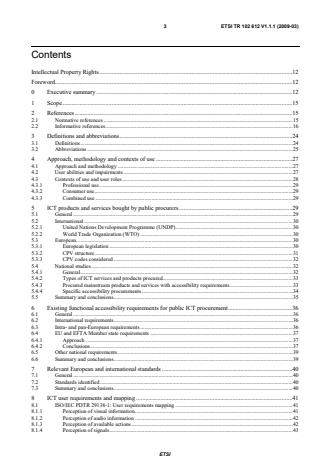
Contents
Intellectual Property Rights.12
Foreword.12
0 Executive summary.12
1 Scope.15
2 References.15
2.1 Normative references.15
2.2 Informative references.16
3 Definitions and abbreviations.24
3.1 Definitions.24
3.2 Abbreviations.25
4 Approach, methodology and contexts of use .27
4.1 Approach and methodology .27
4.2 User abilities and impairments .27
4.3 Contexts of use and user roles.28
4.3.1 Professional use.29
4.3.2 Consumer use.29
4.3.3 Combined use.29
5 ICT products and services bought by public procurers.29
5.1 General.29
5.2 International.30
5.2.1 United Nations Development Programme (UNDP).30
5.2.2 World Trade Organization (WTO) .30
5.3 European.30
5.3.1 European legislation.30
5.3.2 CPV structure.31
5.3.3 CPV codes considered .32
5.4 National studies .32
5.4.1 General.32
5.4.2 Types of ICT services and products procured.33
5.4.3 Procured mainstream products and services with accessibility requirements.33
5.4.4 Specific accessibility procurements.34
5.5 Summary and conclusions.35
6 Existing functional accessibility requirements for public ICT procurement.36
6.1 General.36
6.2 International requirements.36
6.3 Intra- and pan-European requirements .36
6.4 EU and EFTA Member state requirements .37
6.4.1 Approach.37
6.4.2 Conclusions.37
6.5 Other national requirements .39
6.6 Summary and conclusions.39
7 Relevant European and international standards .40
7.1 General.40
7.2 Standards identified.40
7.3 Summary and conclusions.40
8 ICT user requirements and mapping .41
8.1 ISO/IEC PDTR 29138-1: User requirements mapping .41
8.1.1 Perception of visual information.41
8.1.2 Perception of audio information .42
8.1.3 Perception of available actions .42
8.1.4 Perception of signals.43
ETSI
4 ETSI TR 102 612 V1.1.1 (2009-03)
8.1.5 Perception of feedback.43
8.1.6 Performing actions.44
8.1.7 Time to complete actions.45
8.1.8 Intentional activation.45
8.1.9 Recovery from errors.45
8.1.10 Security and privacy .45
8.1.11 Safety.46
8.1.12 Efficient operation.46
8.1.13 Understanding how to use.47
8.1.14 Understanding output.48
8.1.15 Using assistive technology.48
8.1.16 Cross-cutting issues.49
8.2 UN Convention on the Rights of Persons with Disabilities: User requirements mapping .49
8.2.1 General.49
8.2.2 Article 9: Accessibility .50
8.2.3 Article 21: Freedom of expression and opinion, and access to information .50
8.3 EG 202 320: User requirements mapping .50
8.3.1 General.50
8.3.2 Real-time communication.51
9 Functional requirements.51
9.1 Introduction.51
9.2 Functional requirements.52
9.2.1 Closed functionality.52
9.2.1.1 Analysis.52
9.2.2 Biometric ID.53
9.2.2.1 Analysis.53
9.2.3 Pass through.53
9.2.3.1 Analysis.53
9.2.4 Audio information alternatives .54
9.2.4.1 Analysis.54
9.2.5 Visual information alternatives.55
9.2.5.1 Analysis.56
9.2.6 Colour.56
9.2.6.1 Analysis.57
9.2.7 Text size.58
9.2.7.1 Analysis.59
9.2.8 Speech operation alternatives .59
9.2.8.1 Analysis.59
9.3 Hardware.60
9.3.1 Reflectance contrast for legends and displays .60
9.3.1.1 Analysis.61
9.3.2 Flashing.62
9.3.2.1 Analysis.62
9.3.3 Mechanically operated controls .63
9.3.3.1 Analysis.65
9.3.4 Touch operated controls.66
9.3.4.1 Analysis.66
9.3.5 Standard connection.67
9.3.5.1 Analysis.68
9.3.6 Installed or free-standing products.68
9.3.6.1 Analysis.69
9.3.7 Hardware products with speech output or throughput .69
9.3.7.1 Magnetic coupling.69
9.3.7.1.1 Analysis.69
9.3.7.2 Interference with hearing device.70
9.3.7.2.1 Analysis.70
9.3.7.3 Audio connection.70
9.3.7.3.1 Analysis.70
9.3.7.4 Volume.71
9.3.7.4.1 Analysis.71
9.3.7.5 Volume (gain).72
ETSI
5 ETSI TR 102 612 V1.1.1 (2009-03)
9.3.7.5.1 Analysis.72
9.3.7.6 Volume reset.73
9.3.7.6.1 Analysis.73
9.4 Software and electronic content .73
9.4.1 Colour.73
9.4.1.1 Analysis.74
9.4.2 Contrast.75
9.4.2.1 Analysis.76
9.4.3 Perceptual characteristics.77
9.4.3.1 Analysis.77
9.4.4 User preferences.78
9.4.4.1 Analysis.79
9.4.5 Colour adjustment.80
9.4.5.1 Analysis.80
9.4.6 Non-text objects.81
9.4.6.1 Analysis.81
9.4.7 Human (natural) language .82
9.4.7.1 Analysis.82
9.4.8 Language of parts .82
9.4.8.1 Analysis.83
9.4.9 Pausing.83
9.4.9.1 Analysis.83
9.4.10 Flashing.84
9.4.10.1 Analysis.84
9.4.11 Consistent identification.85
9.4.11.1 Analysis.86
9.4.12 Audio turn-off.86
9.4.12.1 Analysis.86
9.4.13 Reading sequence.87
9.4.13.1 Analysis.87
9.4.14 Link purpose.87
9.4.14.1 Analysis.87
9.4.15 Information and relationships .88
9.4.15.1 Analysis.88
9.4.16 User interface components.88
9.4.16.1 Analysis.88
9.4.17 Disruption of access features .88
9.4.17.1 Analysis.89
9.4.18 Timing.89
9.4.18.1 Analysis.89
9.4.19 Keyboard operation.90
9.4.19.1 Analysis.90
9.4.20 Keyboard shortcuts.91
9.4.20.1 Analysis.91
9.4.21 Focus indicator.91
9.4.21.1 Analysis.91
9.4.22 AT interoperability.92
9.4.22.1 Analysis.92
9.4.23 Accessibility services.93
9.4.23.1 Analysis.93
9.4.24 Assistive technology.93
9.4.24.1 Analysis.93
9.4.25 Multiple ways.93
9.4.25.1 Analysis.93
9.4.26 Labels or instructions.94
9.4.26.1 Analysis.94
9.4.27 On focus.94
9.4.27.1 Analysis.95
9.4.28 On input.95
9.4.28.1 Analysis.95
9.4.29 Error identification.95
9.4.29.1 Analysis.96
ETSI
6 ETSI TR 102 612 V1.1.1 (2009-03)
9.4.30 Headings and labels .96
9.4.30.1 Analysis.96
9.4.31 Advisory recommendations.96
9.4.31.1 Suppression of unneeded function .96
9.4.31.1.1 Analysis.96
9.4.31.2 Writing guidelines.97
9.4.31.2.1 Analysis.98
9.4.31.3 Interaction guidelines.98
9.4.31.3.1 Analysis.99
9.4.31.4 Parsing.99
9.4.31.4.1 Analysis.99
9.4.31.5 User preferences (non-visual) .99
9.4.31.5.1 Analysis.99
9.5 Audio visual equipment.100
9.5.1 Captioning/subtitling playback.100
9.5.1.1 Analysis.100
9.5.2 Supplemental audio playback .100
9.5.2.1 Analysis.100
9.5.3 Access to controls .101
9.5.3.1 Analysis.101
9.6 Audio/visual content.102
9.6.1 Captions and transcripts.102
9.6.1.1 Analysis.102
9.6.2 Audio description.102
9.6.2.1 Analysis.103
9.6.3 Interactive elements .103
9.6.3.1 Analysis.103
9.7 Real-time conversation.103
9.7.1 Real-time text reliability and interoperability.103
9.7.1.1 Analysis.103
9.7.2 Voice terminal hardware and software .104
9.7.2.1 Analysis.104
9.7.3 Voice mail, stored voice services and messaging .104
9.7.3.1 Analysis.104
9.7.4 Caller and status information.104
9.7.4.1 Analysis.105
9.7.5 Video support.105
9.7.5.1 Analysis.105
9.7.6 Audio clarity for VoIP .105
9.7.6.1 Analysis.105
9.7.7 External alerting devices.105
9.7.7.1 Analysis.105
9.8 Authoring tools.106
9.8.1 Accessible output.106
9.8.1.1 Analysis.106
9.8.2 Preserve accessibility information .106
9.8.2.1 Analysis.107
9.8.3 Prompts.107
9.8.3.1 Analysis.107
9.8.4 Accessible templates.107
9.8.4.1 Analysis.107
9.9 Information documentation and technical support .108
9.9.1 Accessible documentation.108
9.9.1.1 Analysis.109
9.9.2 Keyboard shortcuts documentation.109
9.9.2.1 Analysis.110
9.9.3 Support services.110
9.9.3.1 Analysis.110
9.10 Implementation, operation and maintenance.110
9.10.1 Relay services accessibility.110
9.10.1.1 Analysis.110
9.10.2 Video support.111
ETSI
7 ETSI TR 102 612 V1.1.1 (2009-03)
9.10.2.1 Analysis.111
9.10.3 Accessibility configuration.111
9.10.3.1 Analysis.111
9.10.4 Accessible content.112
9.10.4.1 Analysis.112
9.11 Documents consulted.112
9.11.1 Published documents consulted .112
9.11.2 Draft documents consulted .116
10 Gaps in accessibility requirements .117
10.1 New user accessibility requirements .117
10.2 Additional functional requirements.117
10.2.1 Non speech audio.117
10.2.2 Vibration patterns.118
10.2.3 Monaural audio.118
10.2.4 Foreground audio discrimination.118
10.2.5 Adjustable pitch and balance .118
10.2.6 Information describing layout.118
10.2.7 Adjustable pitch and balance .118
10.2.8 Co-location of feedback.118
10.2.9 Physical connection feedback.119
10.2.10 No direct contact.119
10.2.11 Signed description.119
10.2.12 Speech only operation.119
10.2.13 Protection of information.119
10.2.14 Security of information.120
10.2.15 Avoiding hazards .120
10.2.16 Avoiding injury.
...
Questions, Comments and Discussion
Ask us and Technical Secretary will try to provide an answer. You can facilitate discussion about the standard in here.
Loading comments...