


ETSI TR 104 077-3 V1.1.1 (2025-02)
Human Factors (HF); Age Verification Pre-Standardization Study Part 3 : Proposed Standardization Roadmap
Human Factors (HF); Age Verification Pre-Standardization Study Part 3 : Proposed Standardization Roadmap
DTR/HF-00301569
General Information
Standards Content (Sample)
TECHNICAL REPORT
Human Factors (HF);
Age Verification Pre-Standardization Study
Part 3: Proposed Standardization Roadmap
2 ETSI TR 104 077-3 V1.1.1 (2025-02)
Reference
DTR/HF-00301569
Keywords
age verification, privacy, security, user
ETSI
650 Route des Lucioles
F-06921 Sophia Antipolis Cedex - FRANCE
Tel.: +33 4 92 94 42 00 Fax: +33 4 93 65 47 16
Siret N° 348 623 562 00017 - APE 7112B
Association à but non lucratif enregistrée à la
Sous-Préfecture de Grasse (06) N° w061004871
Important notice
The present document can be downloaded from the
ETSI Search & Browse Standards application.
The present document may be made available in electronic versions and/or in print. The content of any electronic and/or
print versions of the present document shall not be modified without the prior written authorization of ETSI. In case of any
existing or perceived difference in contents between such versions and/or in print, the prevailing version of an ETSI
deliverable is the one made publicly available in PDF format on ETSI deliver repository.
Users should be aware that the present document may be revised or have its status changed,
this information is available in the Milestones listing.
If you find errors in the present document, please send your comments to
the relevant service listed under Committee Support Staff.
If you find a security vulnerability in the present document, please report it through our
Coordinated Vulnerability Disclosure (CVD) program.
Notice of disclaimer & limitation of liability
The information provided in the present deliverable is directed solely to professionals who have the appropriate degree of
experience to understand and interpret its content in accordance with generally accepted engineering or
other professional standard and applicable regulations.
No recommendation as to products and services or vendors is made or should be implied.
No representation or warranty is made that this deliverable is technically accurate or sufficient or conforms to any law
and/or governmental rule and/or regulation and further, no representation or warranty is made of merchantability or fitness
for any particular purpose or against infringement of intellectual property rights.
In no event shall ETSI be held liable for loss of profits or any other incidental or consequential damages.
Any software contained in this deliverable is provided "AS IS" with no warranties, express or implied, including but not
limited to, the warranties of merchantability, fitness for a particular purpose and non-infringement of intellectual property
rights and ETSI shall not be held liable in any event for any damages whatsoever (including, without limitation, damages
for loss of profits, business interruption, loss of information, or any other pecuniary loss) arising out of or related to the use
of or inability to use the software.
Copyright Notification
No part may be reproduced or utilized in any form or by any means, electronic or mechanical, including photocopying and
microfilm except as authorized by written permission of ETSI.
The content of the PDF version shall not be modified without the written authorization of ETSI.
The copyright and the foregoing restriction extend to reproduction in all media.
© ETSI 2025.
All rights reserved.
ETSI
3 ETSI TR 104 077-3 V1.1.1 (2025-02)
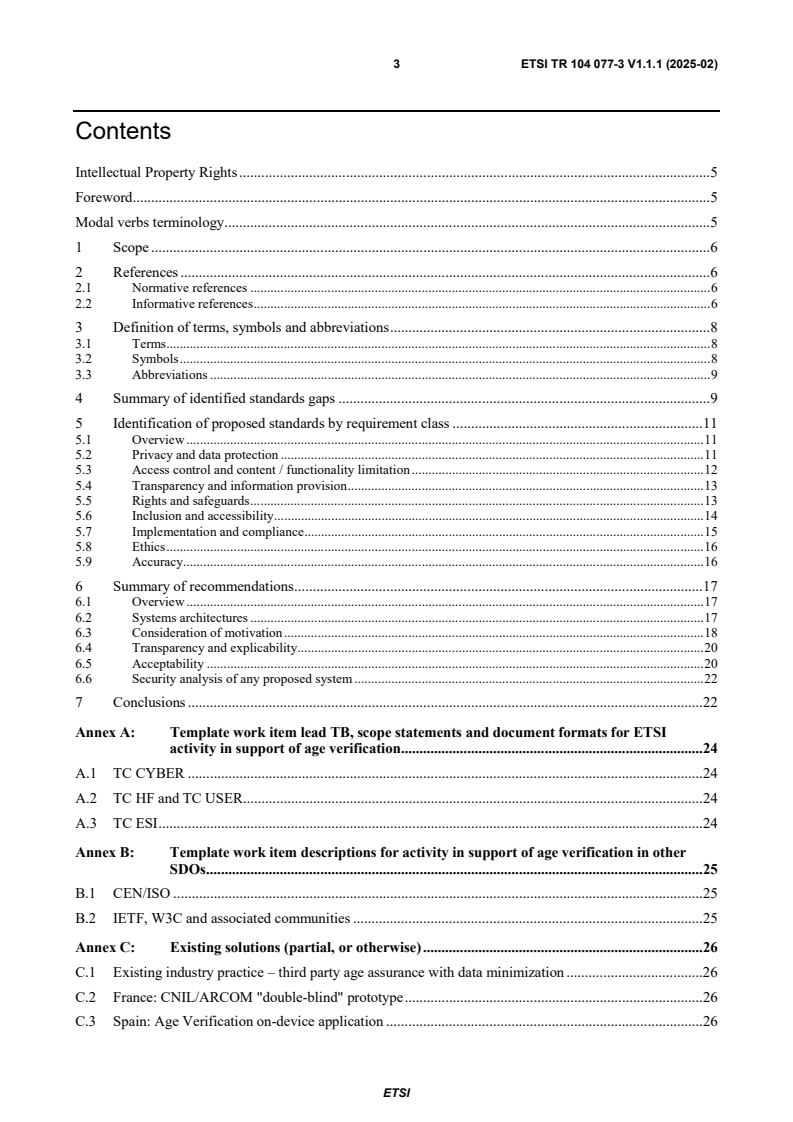
Contents
Intellectual Property Rights . 5
Foreword . 5
Modal verbs terminology . 5
1 Scope . 6
2 References . 6
2.1 Normative references . 6
2.2 Informative references . 6
3 Definition of terms, symbols and abbreviations . 8
3.1 Terms . 8
3.2 Symbols . 8
3.3 Abbreviations . 9
4 Summary of identified standards gaps . 9
5 Identification of proposed standards by requirement class . 11
5.1 Overview . 11
5.2 Privacy and data protection . 11
5.3 Access control and content / functionality limitation . 12
5.4 Transparency and information provision . 13
5.5 Rights and safeguards . 13
5.6 Inclusion and accessibility . 14
5.7 Implementation and compliance . 15
5.8 Ethics . 16
5.9 Accuracy. 16
6 Summary of recommendations . 17
6.1 Overview . 17
6.2 Systems architectures . 17
6.3 Consideration of motivation . 18
6.4 Transparency and explicability . 20
6.5 Acceptability . 20
6.6 Security analysis of any proposed system . 22
7 Conclusions . 22
Annex A: Template work item lead TB, scope statements and document formats for ETSI
activity in support of age verification . 24
A.1 TC CYBER . 24
A.2 TC HF and TC USER . 24
A.3 TC ESI . 24
Annex B: Template work item descriptions for activity in support of age verification in other
SDOs . 25
B.1 CEN/ISO . 25
B.2 IETF, W3C and associated communities . 25
Annex C: Existing solutions (partial, or otherwise) . 26
C.1 Existing industry practice – third party age assurance with data minimization . 26
C.2 France: CNIL/ARCOM "double-blind" prototype . 26
C.3 Spain: Age Verification on-device application . 26
ETSI
4 ETSI TR 104 077-3 V1.1.1 (2025-02)
C.4 Italy: AGCOM Public Digital Identity System (SPID) "double anonymity" model . 26 ®
C.5 euCONSENT: AgeAware tokenized ecosystem . 27
C.6 EUDI Wallet: batch issuance . 27
Annex D (informative): Bibliography . 28
History . 29
ETSI
5 ETSI TR 104 077-3 V1.1.1 (2025-02)
Intellectual Property Rights
Essential patents
IPRs essential or potentially essential to normative deliverables may have been declared to ETSI. The declarations
pertaining to these essential IPRs, if any, are publicly available for ETSI members and non-members, and can be
found in ETSI SR 000 314: "Intellectual Property Rights (IPRs); Essential, or potentially Essential, IPRs notified to
ETSI in respect of ETSI standards", which is available from the ETSI Secretariat. Latest updates are available on the
ETSI IPR online database.
Pursuant to the ETSI Directives including the ETSI IPR Policy, no investigation regarding the essentiality of IPRs,
including IPR searches, has been carried out by ETSI. No guarantee can be given as to the existence of other IPRs not
referenced in ETSI SR 000 314 (or the updates on the ETSI Web server) which are, or may be, or may become,
essential to the present document.
Trademarks
The present document may include trademarks and/or tradenames which are asserted and/or registered by their owners.
ETSI claims no ownership of these except for any which are indicated as being the property of ETSI, and conveys no
right to use or reproduce any trademark and/or tradename. Mention of those trademarks in the present document does
not constitute an endorsement by ETSI of products, services or organizations associated with those trademarks.
DECT™, PLUGTESTS™, UMTS™ and the ETSI logo are trademarks of ETSI registered for the benefit of its
Members. 3GPP™, LTE™ and 5G™ logo are trademarks of ETSI registered for the benefit of its Members and of the
3GPP Organizational Partners. oneM2M™ logo is a trademark of ETSI registered for the benefit of its Members and of ®
the oneM2M Partners. GSM and the GSM logo are trademarks registered and owned by the GSM Association.
Foreword
This Technical Report (TR) has been produced by ETSI Technical Committee Human Factors (HF).
The present document is part 3 of a multi-part deliverable covering Age Verification Pre-Standardization Study, as
identified below:
Part 1: "Stakeholder Requirements";
Part 2: "Solutions and Standards Landscape";
Part 3: "Proposed Standardization Roadmap".
Modal verbs terminology
In the present document "should", "should not", "may", "need not", "will", "will not", "can" and "cannot" are to be
interpreted as described in clause 3.2 of the ETSI Drafting Rules (Verbal forms for the expression of provisions).
"must" and "must not" are NOT allowed in ETSI deliverables except when used in direct citation.
ETSI
6 ETSI TR 104 077-3 V1.1.1 (2025-02)
1 Scope
The present document elaborates a set of proposals for further definition of work items within the standardization
community to address the requirements identified in ETSI TR 104 077-1 [i.1] against the gaps identified and
summarized in ETSI TR 104 077-2 [i.2].
The present document is intended for the SDOs identified in the proposals for their further consideration.
2 References
2.1 Normative references
Normative references are not applicable in the present document.
2.2 Informative references
References are either specific (identified by date of publication and/or edition number or version number) or
non-specific. For specific references, only the cited version applies. For non-specific references, the latest version of the
referenced document (including any amendments) applies.
NOTE: While any hyperlinks included in this clause were valid at the time of publication ETSI cannot guarantee
their long-term validity.
The following referenced documents are not necessary for the application of the present document but they assist the
user with regard to a particular subject area.
[i.1] ETSI TR 104 077-1: "Human Factors (HF); Age Verification Pre-Standardization Study Part 1:
Stakeholder Requirements".
[i.2] ETSI TR 104 077-2: "Human Factors (HF); Age Verification Pre-Standardization Study Part 2:
Solutions and Standards Landscape".
[i.3] Rudyard Kipling: "The Elephant's child", in Just So Stories, 1902.
[i.4] ETSI TR 103 370: "Practical introductory guide to Technical Standards for Privacy".
[i.5] ETSI TR 103 305-5: "Cyber Security (CYBER); Critical Security Controls for Effective Cyber
Defence; Part 5: Privacy and personal data protection enhancement".
[i.6] European Commission, Working party on the protection of individuals with regard to the
processing of personal data: "Opinion 05/2014 on Anonymisation Techniques".
[i.7] ETSI Technical Committee Securing Artificial Intelligence (SAI) Work programme.
[i.8] CEN/CENELEC JTC21 Work programme.
NOTE: CEN/CENELEC JTC21 works alongside ISO SC42 and is expected to consider the adoption of their
output.
[i.9] Regulation (EU) 2024/1689 of the European Parliament and of the Council of 13 June 2024 laying
down harmonised rules on artificial intelligence and amending Regulations (EC) No 300/2008,
(EU) No 167/2013, (EU) No 168/2013, (EU) 2018/858, (EU) 2018/1139 and (EU) 2019/2144 and
Directives 2014/90/EU, (EU) 2016/797 and (EU) 2020/1828 (Artificial Intelligence act).
[i.10] Regulation (EU) 2022/2065 of the European Parliament and of the Council of 19 October 2022 on
a Single Market for Digital Services and amending Directive 2000/31/EC (Digital Services Act).
ETSI
7 ETSI TR 104 077-3 V1.1.1 (2025-02)
[i.11] ETSI TS 102 165-2 (V4.2.1) (02-2007): "Telecommunications and Internet converged Services
and Protocols for Advanced Networking (TISPAN); Methods and protocols; Part 2: Protocol
Framework Definition; Security Counter Measures".
NOTE: An update is in development in ETSI TC CYBER planned for completion in late Q2-2025.
[i.12] ISO 7010:2019: "Graphical symbols — Safety colours and safety signs — Registered safety
signs".
[i.13] Directive (EU) 2019/882 of the European Parliament and of the Council of 17 April 2019 on the
accessibility requirements for products and services (Text with EEA relevance).
[i.14] ETSI EN 301 549 (V3.2.1) (2021-03): "Accessibility requirements for ICT products and services".
[i.15] ISO 9241-210:2019: "Ergonomics of human-system interaction; Part 210: Human-centred design
for interactive systems; Edition 2; 2019".
[i.16] Interaction Design Foundation: "Design for All".
[i.17] Centre for Excellence in Universal Design: "The 7 Principles".
[i.18] PubMed Central: "Exploring the Feasibility and Acceptability of Technological Interventions to
Prevent Adolescents' Exposure to Online Pornography: Qualitative Research", JMIR Pediatrics
and Parenting, 5 November 2024; 7:e58684. doi: 10.2196/58684.
[i.19] Yonder Consulting: "Adult Users' Attitudes to Age Verification on Adult Sites", 2022.
[i.20] IEA: "Why Online Age Verification will give us the worst of both worlds", 2024.
[i.21] EDRi (European Digital Rights): "Online age verification and children's rights", Position paper,
4 October 2023.
[i.22] ETSI TS 102 165-1: "CYBER; Methods and protocols; Part 1: Method and pro forma for Threat,
Vulnerability, Risk Analysis (TVRA)".
[i.23] Regulation (EU) 2019/881 on the European Union Agency for Cybersecurity and on information
and communications technology cybersecurity certification (Cybersecurity Act).
[i.24] Regulation (EU) 2024/2847 of the European Parliament and of the Council of 23 October 2024 on
horizontal cybersecurity requirements for products with digital elements and amending
Regulations (EU) No 168/2013 and (EU) No 2019/1020 and Directive (EU) 2020/1828 (Cyber
Resilience Act).
[i.25] Regulation (EU) 2016/679 of the European Parliament and of the Council of 27 April 2016 on the
protection of natural persons with regard to the processing of personal data and on the free
movement of such data, and repealing Directive 95/46/EC (General Data Protection Regulation).
[i.26] Regulation (EU) 2024/1183 of the European Parliament and of the Council amending Regulation
(EU) No 910/2014 as regards establishing the European Digital Identity Framework.
[i.27] Architecture Proposal for the German eIDAS Implementation.
NOTE: The proposal above includes an option to issue credentials in batches.
[i.28] ETSI TS 102 165-3: "Cyber Security (CYBER); Methods and Protocols for Security Part 3:
Vulnerability Assessment extension for TVRA".
[i.29] UNICEF: "The United Nations Convention on the Rights of the Child".
NOTE: A slightly modified children's version is available from https://www.unicef.org/child-rights-
convention/convention-text-childrens-version.
[i.30] ETSI TR 103 936: "Cyber Security (CYBER); Implementing Design practices to mitigate
consumer IoT-enabled coercive control".
[i.31] CNIL: "Online age verification: balancing privacy and the protection of minors".
ETSI
8 ETSI TR 104 077-3 V1.1.1 (2025-02)
[i.32] euCONSENT home webpage. ®
[i.33] euCONSENT: "AgeAware Specification - Consultation Document".
[i.34] "Age verification system for access to online content: Age verification protocol". ®
[i.35] W3C Group Note: "Verifiable Credentials Overview".
[i.36] Italian Legislative Decree 15 September 2023: "Urgent measures to combat youth hardship,
educational poverty and juvenile crime, as well as for the safety of minors in the digital
environment", (Caivano Decree).
[i.37] AGCOM Public Digital Identity System (SPID).
[i.38] ETSI TS 102 940: "Intelligent Transport Systems (ITS); Security; ITS communications security
architecture and security management; Release 2".
[i.39] CEN/TC 224/WG 18 Work programme: "Interoperability of Biometric Recorded Data".
3 Definition of terms, symbols and abbreviations
3.1 Terms
For the purposes of the present document, the terms given in ETSI TR 104 077-1 [i.1], ETSI TR 104 077-2 [i.2] and the
following apply:
estimation: determination of the value of a thing based on subjective criteria
NOTE 1: This is derived from the definition of age estimation given in ETSI TR 104 077-1 [i.1] and ETSI
TR 104 077-2 [i.2] to distinguish from the term verification that relies on objective criteria.
NOTE 2: Estimation can itself use objective criteria in support of its determination.
high assurance level: assurance that ICT products, ICT services and ICT processes where the corresponding security
requirements, including security functionalities, are provided at a level intended to minimize the known cybersecurity
risks, and the risk of incidents and cyberattacks carried out by actors with significant skills and resources
NOTE 1: A contextual definition is given in CSA Article 52.7 [i.23].
NOTE 2: A mapping from the CSA [i.23] definition to the metrics for risk analysis is given in ETSI
TS 102 165-3 [i.28] and in ETSI TS 102 165-1 [i.22].
minor: someone who has not yet reached the age when they get full legal rights and responsibilities
NOTE: Taken from the law dictionary at https://www.legalchoices.org.uk/dictionary/minor.
substantial assurance level: assurance that the ICT products, ICT services and ICT processes where the corresponding
security requirements, including security functionalities, are provided at a level intended to minimize the known
cybersecurity risks, and the risk of incidents and cyberattacks carried out by actors with limited skills and resources
NOTE 1: A contextual definition is given in CSA Article 52.6 [i.23].
NOTE 2: A mapping from the CSA [i.23] definition to the metrics for risk analysis is given in ETSI
TS 102 165-3 [i.28] and ETSI TS 102 165-1 [i.22].
verification: confirmation, through the provision of objective evidence, that specified requirements have been fulfilled
3.2 Symbols
Void.
ETSI
9 ETSI TR 104 077-3 V1.1.1 (2025-02)
3.3 Abbreviations
For the purposes of the present document, the abbreviations given in ETSI TR 104 077-1 [i.1], ETSI TR 104 077-2 [i.2]
and the following apply:
AI Artificial Intelligence
AV Age Verification
CAB Conformity Assessment Bodies
CEN European Committee for Standardization
CENELEC European Committee for Electrotechnical Standardization
CNIL Commission nationale de l'informatique et des libertés
CRA Cyber Resilience Act
CSA Cyber Security Act
DAC Discretionary Access Control
EN European Standard
ETSI European Telecommunications Standards Institute
HF Human Factors
IEEE Institution of Electrical and Electronic Engineers
ISO International Organization for Standardization
ITU International Telecommunications Union
MAC Mandatory Access Control
SDO Standards Development Organization
TC Technical Committee
TR Technical Report
TS Technical Specification
4 Summary of identified standards gaps
From the analysis summarized in clause 7 of ETSI TR 104 077-2 [i.2], it can be shown that whilst standards exist across
the SDO eco-system (see also ETSI TR 104 077-1 [i.1]) there are some gaps in the overall availability of standards. It is
also clear from the analysis that there is a potential overlap of standardization activity that needs to be either eradicated,
or clear guidance given to the applicability of each available standard to give assurance of age attestations. Table 1 is
taken from clause 7 of [i.2] and has been copied and further annotated below using a traffic light system (summarized in
the second column for accessibility purpose):
• Red (summarized by R and highlighted with corresponding row in darker colour) is used to indicate that there
is no clear candidate standard available from an evaluated SDO;
• Amber (A) is used to indicate that multiple standards exist where clarification of their role in age verification
is required; and
• Green (G) is used to indicate that a single standard exists that may be directly applied in age estimation subject
to further analysis. The result from the applied colour coding is given in plain text after the table.
NOTE: The list of SDOs that have been analysed is necessarily truncated as a consequence of the resources
available to prepare the present document and any follow-on activity recommended in the present
document may identify additional resources that may be applied to age verification.
ETSI
10 ETSI TR 104 077-3 V1.1.1 (2025-02)
Table 1: A summary of SDO activity mapped to the requirements from ETSI TR 104 077-1 [i.1]
Requirement R/A/G CEN ETSI ETSI ETSI IEEE ISO/IEC ITU
(from ETSI TR 104 077-1 [i.1]) Cyber ESI HF
Access control & content limitation A 4 1
Compliance and governance A 6 4 1
Data security A 4
Enhanced security A 3
Ethical guidelines and user rights G 1
EUDI wallets and audits A
Implementation and best practices A 1 5 7
Implementation and compliance A 1 4 1
Implementation and governance A 5 4
Inclusion and accessibility A 1 4
Parental consent mechanisms R
Privacy and data protection A 8 1 5
Privacy by design A 2
Privacy-preserving methods A 3
Redress mechanisms A
Rights and safeguards A 1 2
Support and education R
Transparency & information provision G 1
User-friendly solutions A 1 4 1
In summary, for each of the two topics of Ethics, and Transparency and Information Provision, only one SDO has been
identified in the context of the study for the present document, given in ETSI TR 104 077-2 [i.2], namely IEEE for
work on Ethics (see also clause 5.8 of the present document) and ETSI TC HF for matters relating to Transparency and
Information Provision (see also clause 5.4 of the present document). No provisions from the SDOs that have been
examined provide standards to address Support and Education, and similarly no SDO has been explicitly identified that
addresses Parental Control, although for the latter many of the provisions for Access Control apply and this is addressed
in more detail in clause 5.3 of the present document.
In similar manner to Table 1, a similar exercise filtering and classification of nation state activity has been summarized
in ETSI TR 104 077-2 [i.2] and given in Table 2 below, using a similar traffic light indication of readiness as for
Table 1, where green in this case indicates broad support of the topic, amber indicating only a single nation addressing
the topic, and red indicating no support. The result from the applied colour coding is given in plain text after the table.
Table 2: A summary of nation state activity mapped to the requirements from ETSI TR 104 077-1 [i.1]
Requirement R/A/G
France Germany Italy Ireland Spain UK
(from ETSI TR 104 077-1 [i.1])
Access control & content limitation G 1 1 1 2
Compliance and governance G 1 1 1 1 3
Data security R
Enhanced security R
Ethical guidelines and user rights A 1
EUDI wallets and audits G 1 1 3
Implementation and best practices G 1 1 1
Implementation and compliance G 1 1 1 1
Implementation and governance A 1
Inclusion and accessibility A 1
Parental consent mechanisms G 1 1
Privacy and data protection G 1 3 2
Privacy by design A 1
Privacy-preserving methods A 1
Redress mechanisms R
Rights and safeguards G 1 1 1
Support and education R
Transparency & information provision G 2
User-friendly solutions R
NOTE: The Digital Services Act [i.10], where applicable, may give pan-EU support to provisions of Rights and
safeguards
ETSI
11 ETSI TR 104 077-3 V1.1.1 (2025-02)
In summary of the national provisions for age verification, none of the Member States that have been examined address
the following topics for age verification: Data Security; Enhanced Security; Redress mechanisms; Support and
Education; and User-friendly solutions. However, Table 2 has been composed with respect to standards and may be
misleading as each of these topics is addressed by a mix of national law and by measures offered by more general
standards and legislation.
5 Identification of proposed standards by requirement
class
5.1 Overview
NOTE: The sub-headings in this clause are derived from the structure given in ETSI TR 104 077-1 [i.1].
Age verification can be viewed as a societal problem, a privacy problem and as a security problem. Standards in
general, in the technical domain, do not seek to fix societal problems. It is considered naïve in the context of
standardization for a complex societal issue such as age verification to expect a single standard, or even a suite of
standards, to be able to tackle every eventuality. In particular, it is noted that there are a range of liabilities for violating
age appropriate rules, laws and norms. It is also noted that some age appropriate restrictions require identification of the
requesting party, whereas in many other instances age appropriate restrictions can be allowed to be wholly anonymous.
In light of this, a solution for age verification that requires identification is not easily transposed to support a solution
where anonymity is required or expected. Similarly, as social and national rules and conventions for age restrictions
may differ across EU Member States (MS), and the material that such restrictions address is sufficiently diverse that it
is considered unreasonable for the present document to recommend the development of a single solution supported by a
single set of standards.
EXAMPLE: Classification of the age appropriateness of films has historically been treated differently in
different regions. This is in part because of the local interpretation of the some or all of the
following criteria:
1) Cultural Sensitivities: Different cultures have varying tolerance levels for violence, sexual content, and
profanity.
2) Legal Standards: Each country has its own laws regarding media and censorship, influencing how films are
rated.
3) Historical Context: Historical events and social movements can shape a country's perspective on certain
content.
4) Market Considerations: Distributors may choose to appeal to broader audiences in certain countries,
influencing how films are presented and rated.
The preceding reports (ETSI TR 104 077-1 [i.1] and ETSI TR 104 077-2 [i.2]) identify a large number of use cases, and
those in turn identify a large number of regulatory constraints, and in some cases place legal liabilities on both the
provider and accessor of age restricted services.
In light of the above, the present document does not recommend a single standard to address the topic of age assurance
but does identify the areas where the requirements for age assurance have no corresponding standards and provide
guidance and make recommendations on how to fill those gaps.
5.2 Privacy and data protection
The general security provisions that apply to both privacy protection, and data protection, are those of least privilege
and least persistence. In both cases the role of data minimization is critical. A number of approaches to this exist, and
many require the detailed process of a privacy and data impact assessment exercise. This essentially requires that the
technical design, and policy design, of a system determines the answer to a number of questions prior to, and in the
execution of, a system.
ETSI
12 ETSI TR 104 077-3 V1.1.1 (2025-02)
NOTE 1: The principle of least privilege is one that has a very long history predating the ICT domain and embraces
a number of concepts. The first of these is that an asset is of value and that things of value should not be
shared to those not needing to have it, this then as a second concept introduces the idea that it is possible
to determine who has the right to access, and this then extends to identifying the things that can be done
with an asset and applying restricted rights to each of them. As an example, in the ICT domain a privilege
may be one of read, edit, delete, copy and a user may be granted one or more of these privileges. In
summary least privilege access to a protected asset is to only allow those rights or privileges that are
essential to perform the required task. In most access control systems that adopt least privilege the default
is to deny (i.e. the least privilege is no privilege).
NOTE 2: Similarly to least privilege the concept of least persistence has a very long history that predates the ICT
era. The concept of least persistence is that access to an asset is not granted forever, rather that access is
granted for only sufficient time to perform the requested action. Least persistence is seen in most network
systems where a resource is limited and shared (e.g. radio bandwidth, network capacity). Least
persistence then ties into resource management as well as to security by taking steps to ensure that a
resource is not hogged by any user.
Across ETSI a number of reports that address privacy have been published, in particular ETSI TR 103 370 [i.4], and the
application of security controls defined in ETSI TR 103 305-5 [i.5] apply. As regards anonymity the Opinion 05/2014
on Anonymisation Techniques from the working party on the protection of individuals regarding the processing of
personal data (article 29 group) [i.6] remains valid and underlines the technical difficulties of successful anonymisation
as a tool of privacy. Further study into the role of Machine Learning and other Artificial Intelligence techniques on the
provision of, or attacks on, anonymity and privacy in general are being pursued in ETSI TC SAI [i.7] and in
CEN/CENELEC JTC21 [i.8] and are influenced by the EU Artificial Intelligence Act [i.9] and other global regulatory
initiatives.
The following criteria should be applied to determine the role of data in a system (see Table 3). If no contextual answer
can be given to any of the criteria it is reasonable to assert that the data should not be in the system.
NOTE 3: The criteria given below are named the Kipling criteria from their use in the short story "The Elephant's
child", published in 1902 [i.3].
Table 3: Determination of role of data in a system considered for age verification
Kipling criteria Example for data existence Example for data access
What What is the data? What is the entity accessing the data?
Why Why is that data in the system? Why is that entity accessing the data?
When When is the data meant to be available When is the data being accessed (is it being accessed
(e.g. is it ephemeral or persistent, if at a reasonable time)?
ephemeral how is it invoked and so forth)?
How How is the data used (e.g. what does it How does the data know and verify that access is
require in order to operate)? permitted?
Where Where is the data (logically and Where is the entity with relation to the data (local or
geographically)? remote)?
Who Who owns the data? Who is the entity accessing the data?
There are a very large number of publications, including both standards and reports, from SDOs that address data
privacy and data protection. The specific application of those standards to age verification is not defined and thus the
citations given above cannot easily be applied. The relatively abstract nature of most such standards is often deliberate
and where specific applications are considered they either exist in a vertical domain or as examples in a generic
document.
5.3 Access control and content / functionality limitation
A general model for the provision of access control is given in clause 6 of ETSI TS 102 165-2 [i.11] addressing the
technical means of achieving access control and the models of access control. In this there are two (2) primary models
that are considered:
• Mandatory Access Control (MAC) - access to, and use of, the thing to which access is granted is wholly
determined by the thing's owner.
ETSI
13 ETSI TR 104 077-3 V1.1.1 (2025-02)
• Discretionary Access Control (DAC) – the use of the thing to which access has been granted is at the
discretion of the user and not addressed by the thing's owner.
EXAMPLE: For a MAC scheme the owner should be able to monitor the way in which the age restricted item
to which access has been granted is used. This would make it difficult for an age appropriate user
to access the item and then pass on its use to an underage user, whereas in a DAC model this is
more feasible.
In addition, the means of asserting access are addressed by ETSI TS 102 165-2 [i.11] where the general model is
attribute and policy based access control. In some cases, such as parental control, a third party is involved in addition to
the owner of a protected resource. Whilst not strictly part of age verification, these are addressed here as they are
identified in ETSI TR 104 077-1 [i.1] as a significant concern. Whilst this is not made explicit in ETSI
TS 102 165-2 [i.11], the requirement to have parental consent can be modelled as an attribute of the access control
rd
scheme and further generalized as a requirement for 3 party approval. What is more complex is making an external
system aware of the relationship between the "parent" and the user.
RECOMMENDATION: Update ETSI TS 102 165-2 [i.11] to explicitly address the mechanisms for parental, or
third party,control using age assurance as an example.
5.4 Transparency and information provision
Where age restriction is applied it should be made clear to all parties that age restriction applies. Where a violation of
age restriction controls may lead to a penalty, it should be made clear what those penalties are and the jurisdiction that
applies.
The liability may be placed on either, or both, the delivering or the consuming party and in all cases the liability of each
party should be clearly identifiable at the point of delivery.
For age restricted content in the physical world, a large number of modes exist for signage and information but there
does not appear to be a common standard. This lack of a common standard is extended into the ICT and online domain,
where any such signage either copies the physical world format (e.g. for sale or supply of age restricted items such as
tobacco products) or makes assumptions regarding data supplied by the subscriber (e.g. for media consumption).
It should be obvious to any user that age restriction is in force and affected users should be informed of the means by
which age verification is carried out. In addition, where penalties exist for violation of age verification those penalties
should be clearly identifiable.
NOTE: This is a devolved matter (i.e. each Member State of the EU can address this without requiring a common
approach) and there may be no harmonisation of penalties.
A number of existing graphical symbols exist that may be modified to meet, at least in part, provisions for information
provision (in the context of awareness). However, there is no universally accepted age verification symbol to be applied
in either on-line or off-line systems.
5.5 Rights and safeguards
The United Nations convention on the rights of the child [i.29], in Article 17, protects the ability of children to access
the opportunities provided by the Internet and by default has to be a consideration for any age assurance solutions
deployed in a signatory jurisdiction. Consequently, for any age verification solution, safeguards have to be in place that
balance the risk of harm with the benefits of access. Where access is in some way limited, the burden should be
minimized on those who have a right to access.
NOTE: All UN member states except for the United States have ratified the Convention on the rights of the child
[i.29].
The applicable text from [i.29] is quoted below:
QUOTE ([i.29]): "Children have the right to get information from the Internet, radio, television, newspapers, books
and other sources. Adults should make sure the information they are getting is not harmful.
Governments should encourage the media to share information from lots of different sources, in
languages that all children can understand."
ETSI
14 ETSI TR 104 077-3 V1.1.1 (2025-02)
The phrase "… should make sure the information they are getting is not harmful" is difficult in a standard's setting as
harm is a moral and legal concept with many definitions. Standards which address objective criteria are often more
straightforward to assess and determine conformance as opposed to those which address subjective criteria. In broad
terms a guide or report can advise on the use of subjective criteria but cannot make mandates to follow that are allowed
in technical standards that state objective criteria.
Legislation requiring age assurance has to be distinguished from legislation requiring identity verification. The
technology deployed to prove age or age range should not inadvertently or deliberately disclose identity unless there is a
specific legal requirement.
Similarly, an age assurance process should not become a vector of attack for monitoring the activities of a user online,
unless there is a specific legal requirement for such surveillance.
Some forms of age assurance inevitably require the processing of personal data. The most obvious example would be
the use of a conventional form of physical identification through which a user is authenticated and then the date of birth
extracted as an age attribute. For as long as the age attribute is associated with a unique individual it would constitute
personal data. A more complex case arises around the use of biometrics in age estimation solutions where an image for
example may be the first input to the process, but it is then scanned and turned into a mathematical representation which
is no longer uniquely identifiable to an individual. Depending on where this takes place in the technical architecture, it
rd
can mean that such a solution does not require a 3 party to process any personal data because, for example the image
has been turned into an anonymous representation at the device level. In terms of European data protection law, there is
an argument that the data used for estimation purposes is not sensitive personal data because it can no longer be
associated with a unique individual. However, this is a conclusion that has only been endorsed by the United Kingdom
Information Commissioners Office and has not been confirmed by any European Union data protection authority, so the
position within EU law remains unclear.
Where any age verification system makes use of personal data, this has to be in accordance with the prevailing data
protection regime.
5.6 Inclusion and accessibility
No affected party can be excluded from participation in the age verification system. The provisions identified in
clause 5.4 therefore have to ensure access to all.
Age verification systems/services therefore have to comply with the European accessibility act [i.13] that aims to
improve the functioning of the internal market for accessible products and services by removing barriers created by
divergent rules in Member States.
The products and services covered by the accessibility act include:
• computers and operating systems
• ATMs, ticketing and check-in machines
• smartphones
• TV equipment related to digital television services
• telephony services and related equipment
• access to audio-visual media services such as television broadcasts and related consumer equipment
• services related to air, bus, rail and waterborne passenger transport
• banking services
• e-books
• e-commerce
Where age verification is ena
...
Questions, Comments and Discussion
Ask us and Technical Secretary will try to provide an answer. You can facilitate discussion about the standard in here.
Loading comments...