


ETSI EG 203 499 V3.1.1 (2024-07)
Human Factors (HF); User-centred terminology for existing and upcoming ICT devices, services and applications
Human Factors (HF); User-centred terminology for existing and upcoming ICT devices, services and applications
REG/HF-00301563
Človeški dejavniki (HF) - Uporabniško usmerjeno izrazoslovje za sedanje in prihodnje naprave, storitve in aplikacije IKT
Ta dokument je namenjen nadaljnji poenostavitvi dostopa končnih uporabnikov do naprav, storitev in aplikacij IKT z zagotavljanjem priporočenih izrazov za osnovne ter pogosto uporabljene predmete in dejavnosti, povezane z IKT, zlasti izrazov, na katere končni uporabniki pogosto naletijo. Priporočeni izrazi so na voljo v naslednjih 27 jezikih: angleški, bolgarski, češki, danski, estonski, finski, francoski, grški, hrvaški, irski, islandski, italijanski, latvijski, litovski, madžarski, malteški, nemški, nizozemski, norveški, poljski, portugalski, retoromanski, romunski, slovaški, slovenski, španski in švedski (kot se govorijo v njihovih evropskih državah).
Priporočeni izrazi se uporabljajo za mobilne naprave IKT in mobilne aplikacije (ne glede na to, ali so samostojne ali zagotavljajo dostop do povezanih storitev), ki se običajno uporabljajo v mobilnih napravah IKT. Čeprav so razviti v kontekstu mobilne IKT, se večina priporočenih izrazov uporablja za mobilne in fiksne omrežne naprave, storitve in aplikacije. Priporočeni izrazi se uporabljajo za zasnovo uporabniškega vmesnika (UI) za izdelek in tudi za vsako priloženo uporabniško dokumentacijo.
Zahteve uporabnikov ter dokumenti, ki izvirajo iz industrije, in rezultati standardizacijskega dela (kadar so bili na voljo) so bili upoštevani in vključeni v tem dokumentu, ki podaja na uvajanje osredotočene smernice.
Kjer koli je bilo mogoče, je bil sprejet pristop »oblikovanje za vse«, ki upošteva funkcionalne sposobnosti uporabnikov, tudi starejših uporabnikov in uporabnikov s kognitivnimi, fizičnimi ali senzoričnimi omejitvami.
Ta dokument vsebuje priporočila glede izrazov, ki jih lahko uporabljajo tisti, ki nameravajo podpreti jezike, obravnavane v prihodnjih izdelkih in storitvah. Ne vsebuje navodil za zasnovo niti ni njegov cilj omejiti zmožnost tržnih akterjev za nadaljnje izboljšave oziroma razvoj njihovih naprav in storitev. Prav tako ne omejuje njihovih možnosti, da elemente uporabniškega vmesnika zaščitijo z blagovno znamko ali profilirajo uporabniško izkušnjo pri uvedbah uporabniškega vmesnika, specifičnih za blagovno znamko, kot konkurenčno prednost.
General Information
Standards Content (Sample)
Final draft ETSI EG 203 499 V3.1.1 (2024-02)
ETSI GUIDE
Human Factors (HF);
User-centred terminology for existing and
upcoming ICT devices, services and applications
2 Final draft ETSI EG 203 499 V3.1.1 (2024-02)
Reference
REG/HF-00301563
Keywords
accessibility, device, end-user, ICT, interface,
localisation, telephony, terminology, user
ETSI
650 Route des Lucioles
F-06921 Sophia Antipolis Cedex - FRANCE
Tel.: +33 4 92 94 42 00 Fax: +33 4 93 65 47 16
Siret N° 348 623 562 00017 - APE 7112B
Association à but non lucratif enregistrée à la
Sous-Préfecture de Grasse (06) N° w061004871
Important notice
The present document can be downloaded from:
https://www.etsi.org/standards-search
The present document may be made available in electronic versions and/or in print. The content of any electronic and/or
print versions of the present document shall not be modified without the prior written authorization of ETSI. In case of any
existing or perceived difference in contents between such versions and/or in print, the prevailing version of an ETSI
deliverable is the one made publicly available in PDF format at www.etsi.org/deliver.
Users of the present document should be aware that the document may be subject to revision or change of status.
Information on the current status of this and other ETSI documents is available at
https://portal.etsi.org/TB/ETSIDeliverableStatus.aspx
If you find errors in the present document, please send your comment to one of the following services:
https://portal.etsi.org/People/CommiteeSupportStaff.aspx
If you find a security vulnerability in the present document, please report it through our
Coordinated Vulnerability Disclosure Program:
https://www.etsi.org/standards/coordinated-vulnerability-disclosure
Notice of disclaimer & limitation of liability
The information provided in the present deliverable is directed solely to professionals who have the appropriate degree of
experience to understand and interpret its content in accordance with generally accepted engineering or
other professional standard and applicable regulations.
No recommendation as to products and services or vendors is made or should be implied.
No representation or warranty is made that this deliverable is technically accurate or sufficient or conforms to any law
and/or governmental rule and/or regulation and further, no representation or warranty is made of merchantability or fitness
for any particular purpose or against infringement of intellectual property rights.
In no event shall ETSI be held liable for loss of profits or any other incidental or consequential damages.
Any software contained in this deliverable is provided "AS IS" with no warranties, express or implied, including but not
limited to, the warranties of merchantability, fitness for a particular purpose and non-infringement of intellectual property
rights and ETSI shall not be held liable in any event for any damages whatsoever (including, without limitation, damages
for loss of profits, business interruption, loss of information, or any other pecuniary loss) arising out of or related to the use
of or inability to use the software.
Copyright Notification
No part may be reproduced or utilized in any form or by any means, electronic or mechanical, including photocopying and
microfilm except as authorized by written permission of ETSI.
The content of the PDF version shall not be modified without the written authorization of ETSI.
The copyright and the foregoing restriction extend to reproduction in all media.
© ETSI 2024.
All rights reserved.
ETSI
3 Final draft ETSI EG 203 499 V3.1.1 (2024-02)
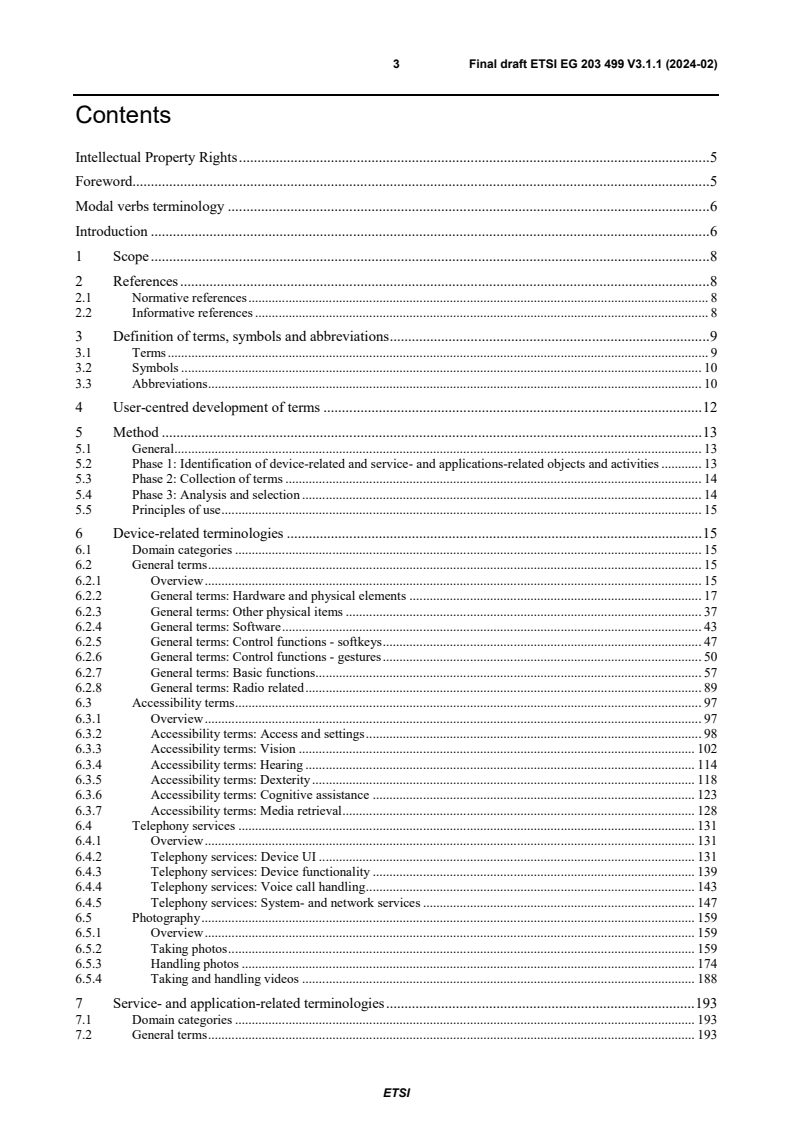
Contents
Intellectual Property Rights . 5
Foreword. 5
Modal verbs terminology . 6
Introduction . 6
1 Scope . 8
2 References . 8
2.1 Normative references . 8
2.2 Informative references . 8
3 Definition of terms, symbols and abbreviations . 9
3.1 Terms . 9
3.2 Symbols . 10
3.3 Abbreviations . 10
4 User-centred development of terms . 12
5 Method . 13
5.1 General . 13
5.2 Phase 1: Identification of device-related and service- and applications-related objects and activities . 13
5.3 Phase 2: Collection of terms . 14
5.4 Phase 3: Analysis and selection . 14
5.5 Principles of use . 15
6 Device-related terminologies . 15
6.1 Domain categories . 15
6.2 General terms . 15
6.2.1 Overview . 15
6.2.2 General terms: Hardware and physical elements . 17
6.2.3 General terms: Other physical items . 37
6.2.4 General terms: Software . 43
6.2.5 General terms: Control functions - softkeys . 47
6.2.6 General terms: Control functions - gestures . 50
6.2.7 General terms: Basic functions . 57
6.2.8 General terms: Radio related . 89
6.3 Accessibility terms . 97
6.3.1 Overview . 97
6.3.2 Accessibility terms: Access and settings . 98
6.3.3 Accessibility terms: Vision . 102
6.3.4 Accessibility terms: Hearing . 114
6.3.5 Accessibility terms: Dexterity . 118
6.3.6 Accessibility terms: Cognitive assistance . 123
6.3.7 Accessibility terms: Media retrieval . 128
6.4 Telephony services . 131
6.4.1 Overview . 131
6.4.2 Telephony services: Device UI . 131
6.4.3 Telephony services: Device functionality . 139
6.4.4 Telephony services: Voice call handling . 143
6.4.5 Telephony services: System- and network services . 147
6.5 Photography . 159
6.5.1 Overview . 159
6.5.2 Taking photos . 159
6.5.3 Handling photos . 174
6.5.4 Taking and handling videos . 188
7 Service- and application-related terminologies . 193
7.1 Domain categories . 193
7.2 General terms . 193
ETSI
4 Final draft ETSI EG 203 499 V3.1.1 (2024-02)
7.2.1 Overview . 193
7.2.2 General terms: Authentication, login and confirmation . 194
7.2.3 General terms: Setup and settings . 200
7.2.4 General terms: Common functionality . 209
7.3 Messaging services . 233
7.3.1 Overview . 233
7.3.2 Access and setup - text-based services . 234
7.3.3 Access and setup - voicemail, audio, and video messaging . 250
7.3.4 Basic functionalities - text and voice messaging . 255
7.3.5 Basic functionalities - voicemail services . 259
7.4 Media services . 263
7.4.1 Overview . 263
7.4.2 AV access, retrieval, and control. 263
7.4.3 Text access, retrieval, and control . 269
7.4.4 Streaming live media . 275
7.5 Societal services and communication . 286
7.5.1 Overview . 286
7.5.2 Societal services . 286
7.5.3 Communication . 293
7.5.4 Emergency communication . 297
7.6 Social media services . 305
7.6.1 Overview . 305
7.6.2 Configuration and access . 306
7.6.3 Service handling . 309
7.6.4 Online media handling . 320
7.7 Banking services . 325
7.7.1 Overview . 325
7.7.2 eBanking . 326
7.7.3 ePayment . 356
7.7.4 eCommerce . 366
7.7.5 Investment services . 378
7.8 eHealth services . 384
7.8.1 Overview . 384
7.8.2 Monitoring services . 384
7.8.3 Diagnosis and treatment . 387
7.8.4 Fitness . 402
7.9 Travel planning . 412
7.10 Navigation. 435
7.11 Games . 461
7.12 Searching and browsing . 470
7.12.1 Overview . 470
7.12.2 Web browser . 470
7.12.3 Search engine . 482
7.13 Tools . 494
History . 506
ETSI
5 Final draft ETSI EG 203 499 V3.1.1 (2024-02)
Intellectual Property Rights
Essential patents
IPRs essential or potentially essential to normative deliverables may have been declared to ETSI. The declarations
pertaining to these essential IPRs, if any, are publicly available for ETSI members and non-members, and can be
found in ETSI SR 000 314: "Intellectual Property Rights (IPRs); Essential, or potentially Essential, IPRs notified to
ETSI in respect of ETSI standards", which is available from the ETSI Secretariat. Latest updates are available on the
ETSI Web server (https://ipr.etsi.org/).
Pursuant to the ETSI Directives including the ETSI IPR Policy, no investigation regarding the essentiality of IPRs,
including IPR searches, has been carried out by ETSI. No guarantee can be given as to the existence of other IPRs not
referenced in ETSI SR 000 314 (or the updates on the ETSI Web server) which are, or may be, or may become,
essential to the present document.
Trademarks
The present document may include trademarks and/or tradenames which are asserted and/or registered by their owners.
ETSI claims no ownership of these except for any which are indicated as being the property of ETSI, and conveys no
right to use or reproduce any trademark and/or tradename. Mention of those trademarks in the present document does
not constitute an endorsement by ETSI of products, services or organizations associated with those trademarks.
DECT™, PLUGTESTS™, UMTS™ and the ETSI logo are trademarks of ETSI registered for the benefit of its
Members. 3GPP™ and LTE™ are trademarks of ETSI registered for the benefit of its Members and of the 3GPP
Organizational Partners. oneM2M™ logo is a trademark of ETSI registered for the benefit of its Members and of the ®
oneM2M Partners. GSM and the GSM logo are trademarks registered and owned by the GSM Association. ®
BLUETOOTH is a trademark registered and owned by Bluetooth SIG, Inc.
Foreword
This final draft ETSI Guide (EG) has been produced by ETSI Technical Committee Human Factors (HF), and is now
submitted for the ETSI Membership Approval Procedure.
The work has been conducted in an open collaboration with industry, user and consumer representatives, and other
relevant stakeholders. The present document is based upon desk research (documents and online sources), best
practices, expert knowledge, and an industry-wide consultation and consensus process, aimed at consensus building and
a quick uptake and the largest possible support in future product implementations.
Intended readers of the present document include, but are not limited to:
• device designers, developers, and manufacturers;
• application developers;
• service providers;
• network operators;
• technical writers and developers of marketing materials; and
• national and international standards bodies and regulatory institutions.
The terminologies contained in the present document are accessible in machine-readable format under
https://labs.etsi.org/rep/HF/eg203499/-/tree/v2.1.2.
ETSI
6 Final draft ETSI EG 203 499 V3.1.1 (2024-02)
Modal verbs terminology
In the present document "should", "should not", "may", "need not", "will", "will not", "can" and "cannot" are to be
interpreted as described in clause 3.2 of the ETSI Drafting Rules (Verbal forms for the expression of provisions).
"must" and "must not" are NOT allowed in ETSI deliverables except when used in direct citation.
Introduction
The terms (words, labels) used in the User Interface (UI) of a device, service or application may present an obstacle for
their users if they are not familiar with those terms or if they are unsure as to their meaning. While some terms are
introduced by manufacturers to denote a new class of features or to distinguish own features from those offered by
competitors, most other terms denoting device or service features are not necessarily intended for differentiation.
However, in the absence of a harmonized or recommended terminology, the use of those terms may differ considerably
among manufacturers and service providers, thereby introducing ambiguity for end users.
The alternative to a confusing plethora of terms is some degree of harmonization among devices, services, and
applications, at least for terms not intended to convey a certain brand feature or image. A harmonized terminology can
be employed to help prevent the negative effects of an uncontrolled expansion of terms and the resulting ambiguity of
the terms. Those negative effects include:
• increased user difficulties in understanding complex, ambiguous, and inconsistently-used terms, leading to
unnecessary confusion;
• increased efforts in user education (user guides);
• increased costs for user support (hotline calls and call agent training);
• limited feature discovery and unclear user expectations (customers who do not understand certain features may
not use them, hence some revenue may be missed);
• limited uptake (users may be reluctant to use a feature as they are not sure whether it has the expected effect);
• increase of cognitive complexity and subsequent learning effort; and
• abuse in the use of proprietary terms and lack of consistent use of terms.
The need for a harmonized terminology of device, service, and application features increases as new features and
functionalities are being developed. Device software, services, and applications are frequently updated, often without
even providing an update of the associated documentation to the users.
ETSI EG 202 132 [i.1] claims that in order to aid users' learning procedures and to enable and simplify transfer and
reuse of knowledge between devices, applications and services, it is relevant to support harmonized vocabularies for the
most common and generic mobile ICT functions.
Consistency across basic interactive elements increases the ease and transfer of learning and improves the overall
usability of complex mobile ICT environments. Such a transfer becomes even more important when older users or
people with cognitive functional limitations are addressed and expected to use smartphones, mobile services and
Internet applications in most segments of everyday life, such as: sending an email, transferring a call, or setting an
alarm, etc.
A harmonized terminology can also be fed into terminology management systems used within a company to ensure the
consistent use of terms across products and the internal and external documentation (e.g. design documents, user guides
and promotional materials), see clause 4.
ETSI
7 Final draft ETSI EG 203 499 V3.1.1 (2024-02)
ETSI EG 202 132 [i.1] contains harmonized English-language terms for a number of areas including user interfaces for
hardware and software, configuration of messaging and data services, call features, and terminal functionality. ETSI
TR 102 972 [i.2] extends the work done in ETSI EG 202 132 [i.1] towards 3G devices, mobile services, and
applications. This extended list of proposed terms forms the initial basis for the terms considered. However, ETSI
EG 202 132 [i.1] and ETSI TR 102 972 [i.2] were published a long time ago and require updating, inter alia to cover the
many features and services evolved or not available at that time, and to cover other main European languages in
addition to English.
The present document addresses this need on the basic level, covering 27 official EU and EFTA languages: Bulgarian,
Croatian, Czech, Danish, Dutch, English, Estonian, Finnish, French, German, Greek, Hungarian, Icelandic, Irish,
Italian, Latvian, Lithuanian, Maltese, Norwegian, Polish, Portuguese, Rhaeto Romance, Romanian, Slovak, Slovene,
Spanish, and Swedish. In addition, given the speed of change in the mobile ICT landscape, it will naturally require
updating to ensure continuing relevance. Furthermore, expansion to cover additional European languages and other
languages used in Europe will further increase the usefulness and applicability of the present document.
The selection and validation process of the terms applied throughout their development, performed in collaboration with
stakeholders is expected to add a quality dimension to the recommended vocabulary that would be difficult to achieve
through an individual effort and is expected to contribute to the use and uptake of this freely available, public resource.
ETSI
8 Final draft ETSI EG 203 499 V3.1.1 (2024-02)
1 Scope
The present document aims at further simplifying end-user access to ICT devices, services, and applications by
providing recommended terms for basic and commonly-used ICT-related objects and activities, notably those terms that
end users are commonly exposed to. Recommended terms are provided in 27 languages: Bulgarian, Croatian, Czech,
Danish, Dutch, English, Estonian, Finnish, French, German, Greek, Hungarian, Icelandic , Irish, Italian, Latvian,
Lithuanian, Maltese, Norwegian, Polish, Portuguese, Rhaeto Romance, Romanian, Slovak, Slovene, Spanish, and
Swedish (as spoken in their respective European countries).
The recommended terms apply to mobile ICT devices and mobile applications (whether they are standalone or provide
access to related services) commonly found in mobile ICT devices. Though developed in a mobile ICT context, most of
the recommended terms are applicable to both mobile and fixed-network devices, services, and applications. The
recommended terms are applicable to the User Interface (UI) design for a product as well as that of any user
documentation accompanying it.
User requirements and, when available, industry-originated documents as well as results of previous standardization
work have been considered and integrated in the present document, providing implementation-oriented guidance.
Wherever possible, a Design-for-All approach has been adopted, taking functional abilities of users, including elderly
users and users with cognitive, physical, or sensory limitations into account.
The present document provides recommendations for terms that may be used by those who consider supporting the
languages addressed in future products and services. It does not provide design guidance, nor does it intend to restrict
the ability of market players to further improve and develop their devices and services. Neither does it intend to limit
their options to trademark user interface elements or profile the user experience of brand-specific user interface
implementations as a competitive edge.
2 References
2.1 Normative references
Normative references are not applicable in the present document.
2.2 Informative references
References are either specific (identified by date of publication and/or edition number or version number) or
non-specific. For specific references, only the cited version applies. For non-specific references, the latest version of the
referenced document (including any amendments) applies.
NOTE: While any hyperlinks included in this clause were valid at the time of publication, ETSI cannot guarantee
their long term validity.
The following referenced documents are not necessary for the application of the present document but they assist the
user with regard to a particular subject area.
[i.1] ETSI EG 202 132: "Human Factors (HF); User Interfaces; Guidelines for generic user interface
elements for mobile terminals and services".
[i.2] ETSI TR 102 972: "Human Factors (HF); User Interfaces; Generic user interface elements for
3G/UMTS mobile devices, services and applications".
[i.3] ETSI EG 202 417: "Human Factors (HF); User education guidelines for mobile terminals and
services".
[i.4] ETSI ETR 095: "Human Factors (HF); Guide for usability evaluations of telecommunications
systems and services".
[i.5] ISO 9241-11:2018: "Ergonomics of human-system interaction - Part 11: Usability: Definitions and
concepts".
ETSI
9 Final draft ETSI EG 203 499 V3.1.1 (2024-02)
[i.6] ETSI ETR 116: "Human Factors (HF); Human factors guidelines for ISDN Terminal equipment
design".
[i.7] ETSI EN 301 549: "Accessibility requirements suitable for public procurement of ICT products
and services in Europe".
[i.8] IEEE 802.11™: "WiFi standards family specifications".
NOTE: Available at https://ieeexplore.ieee.org. ®
[i.9] Bluetooth SIG Core Specifications.
NOTE: Available at www.bluetooth.com/specifications/bluetooth-core-specification.
[i.10] Mobile & Wireless Forum (MWF) - Global Accessibility Reporting Initiative (GARI).
NOTE: Available at www.gari.info.
[i.11] CORDIS EU Research portal: "Terminology extraction, translation tools and comparable corpora".
NOTE: Available at https://cordis.europa.eu/project/rcn/93820_en.html.
[i.12] ISO 9999:2016: "Assistive products for persons with disability - Classification and terminology".
[i.13] ISO/IEC 29138-1:2018: "Information technology - User interface accessibility - Part 1: User
accessibility needs".
[i.14] ISO/TC 37: "Language and terminology".
NOTE: Available at https://www.iso.org/committee/48104.html.
3 Definition of terms, symbols and abbreviations
3.1 Terms
For the purposes of the present document, the following terms apply:
authentication: process or action of verifying the identity of a user or a process
consensus: general agreement, characterized by the absence of sustained opposition to substantial issues by any of the
concerned interests and by a process that involves taking into account the views of all parties concerned and to reconcile
any conflicting arguments
control function: operation that manages the interaction of the end user with a device, e.g. via buttons or gestures
design-for-all: design of products to be usable by all people, to the greatest extent possible, without the need for
specialized adoption
device: physical device which interfaces with a telecommunications network, and hence to a service provider, to enable
access to a telecommunications service, see ETSI TR 102 972 [i.2]
NOTE: A device also provides an interface to the user to enable the interchange of control actions and
information between the user and the device, network or service provider.
emergency call: call from a user to an emergency control centre
end user: See user.
function: abstract concept of a particular piece of functionality in a device or service
generic: generalized set or general purpose set, often in the sense of basic or ordinary
ICT devices and services: devices or services for processing information and/or supporting communication, which has
an interface to communicate with a user
ETSI
10 Final draft ETSI EG 203 499 V3.1.1 (2024-02)
impairment: any temporary or permanent; progressive, regressive or static; or intermittent or continuous reduction or
loss of psychological, physiological or anatomical function or structure of a user (environmental included)
login: username and password to enter a computer, program, or website
mobile device: personal communication device, e.g. a smartphone, capable of communicating by using one or several
radio technologies, including support for internet access
search engine: software system that is designed to carry out web searches based on keywords or characters specified by
a user
setting: adjustment in a software program or hardware device that adjusts it to the user's preference
setup: way in which a device is organized, or arranged
societal services: services relating to society or social relations
term: word or a phrase describing a thing or expressing a concept, in a specific language, domain or context
NOTE: Based on the Oxford dictionary definition.
terminal: physical device which interfaces with a telecommunications network, and hence to a service provider, to
enable access to a telecommunications service
NOTE: A terminal also provides an interface to the user to enable the interchange of control actions and
information between the user and the terminal, network or service provider.
terminology: vocabulary of technical terms in a particular field, subject, science, or art; nomenclature
usability: effectiveness, efficiency and satisfaction with which specified users can achieve specified goals (tasks) in a
specified context and particular environments, see ETSI ETR 095 [i.4] and ISO 9241-11 [i.5]
NOTE: In telecommunications, usability includes the concepts of learnability and flexibility; and reference to the
interaction of more than one user (the A and B parties) with each other and with the terminals and the
telecommunications system, see ETSI ETR 116 [i.6].
user: person who uses a telecommunications device to gain access to and control of a telecommunications service or
application
NOTE: The user may or may not be the person who has subscribed to the provision of the service or owns the
terminal. Also, the user may or may not be a person with impairments.
User Interface (UI): physical and logical interface through which a user communicates with a telecommunications
terminal or via a terminal to a telecommunications service (also called Man-Machine Interface (MMI))
NOTE: The communication is bi-directional in real time and the interface includes control, display, audio, haptic
or other elements, in software or hardware.
user requirements: requirements based on user needs and capabilities, on a telecommunication service and any of its
supporting components, terminals and interfaces, in order to make use of this service in the easiest, safest, most efficient
and most secure way
voice (spoken) command: verbal or other auditory dialogue format which enables the user to input commands to
control a device, service or application
3.2 Symbols
Void.
3.3 Abbreviations
For the purposes of the present document, the following abbreviations apply:
3D Three-Dimensional
ETSI
11 Final draft ETSI EG 203 499 V3.1.1 (2024-02)
rd
3G 3 Generation (mobile networks)
th
4G 4 Generation (mobile networks)
APN Access Point Name
ATM Automated Teller Machine
AV AudioVisual
B2B Business to Business
CC Closed Caption
CCNR Call Completion on No Reply
CEAM Carte Européenne d'Assurance Maladie
CLIP Caller Line Identification Presentation
CLIR Caller Line Identity Restriction
EDGE Enhanced Data rates for GSM Evolution
EHIC European Healthcare Identity Card
eSIM embedded SIM
FTP File Transfer Protocol
GARI Global Accessibility Reporting Initiative
GPRS General Packet Radio Service
GPS Global Positioning System
GSM Global System for Mobile telecommunication
HDR High Dynamic Range
HF Human Factors
HSPA High-Speed Packet Access
HSPA+ evolved High-Speed Packet Access
HTTP Hypertext Transfer Protocol
HTTPS Hypertext Transfer Protocol Secure
I/O Input/Output
IBAN International Bank Account Number
ICE In Case of Emergency
ICT Information and Communication Technologies
ID IDentification
IM Instant Messaging
IMEI International Mobile Equipment Identity
IP Internet Protocol
IR InfraRed
IrDA Infrared Data Association
ISDN Integrated Services Digital Network
ISO International Organization for Standardization
LED Light Emitting Diode
LTE Long Term Evolution
MMI Man-Machine Interface
MMS Multimedia Message Service
NFC Near-Field Communication
OS Operating System
PA Public Address
PC Personal Computer
PIN Personal Identity Number
PUK Personal Unblocking Key
RF Radio Frequency
RH RHesus
RTT Real-Time Text
SD Secure Digital
SEPA Single Euro Payments Area
SIM Subscriber Identity Module
SMS Short Message Service
SMTP Simple Mail Transfer Protocol
SOS Save Our Souls
TAN Transaction Number
TTS Text To Speech
TV Television
UI User Interface
UICC Universal Integrated Circuit Card
UMTS Universal Mobile Telecommunication System
ETSI
12 Final draft ETSI EG 203 499 V3.1.1 (2024-02)
URI Uniform Resource Identifier
URL Uniform Resource Locator
USB Universal Serial Bus
USB-C Universal Serial Bus - C type
USIM Universal Subscriber Identity Module
VPN Virtual Private Network
WAP Wireless Application Protocol ®
Wi-Fi Wireless-Fidelity
NOTE: Commercial name for the wireless network standard family 802.11, also known as WLAN (see [i.8]).
WLAN Wireless Local Area Network
4 User-centred development of terms
Intended users of the present document are those designing, developing, implementing, and deploying user interfaces
for interaction with mobile ICT devices, services, and applications.
Intended end users mentioned in the present document are people who use mobile ICT devices, services, and
applications ranging from first time users to experienced users.
Uniformity in the interactive elements increases the transfer of learning between different devices, services, and
applications. Such knowledge transfer becomes even more important in a world of ubiquitous devices and services used
by heterogeneous users. In particular, harmonized terms (used across devices, services, and applications from different
manufacturers and providers) improve the overall usability of the entire ICT ecosystem. Use of the harmonized
vocabulary in the present document for the development of ICT devices, services, and applications will enable end users
to apply knowledge and experience, ensuring a user-friendly experience.
The present work goes beyond the automatic generation of bilingual terminologies, e.g. [i.11], addressing the automatic
generation of bilingual terminologies, by applying a user-centred approach.
A consistent, harmonized, and accessible terminology will particularly benefit end users with temporary or
permanent functional variations, such as those with literacy difficulties, or people with visual or cognitive impairments.
A harmonized terminology should be easy to remember, recognize, and retrieve, and the individual terms should
represent their related concepts well. A well-designed user terminology should have a shallow learning curve and cover
most common tasks and use cases users are likely to encounter through the most common, every-day use patterns.
Finally, the terminology should also be useful for manufacturers' terminology management systems, a process to
organize and associate terms with a clear set of rules for their usage (e.g. through a term base), also fostering its
inclusion and, therefore, harmonization across user guides and user interfaces. Companies invest in terminology
management in order to ensure that the terms used in internal documents, external documents such as user guides, in
user interfaces, and for marketing information such as advertisements are used consistently.
Unmanaged and outdated terminology will easily become inconsistent, leading to time and resource-intensive
documentation processes. It typically also reduces user satisfaction, limits cognitive accessibility and is often a main
reason to the under-use of potentially beneficial functionality.
ETSI EG 202 417 [i.3] provides detailed guidelines on how terminology management can help improve the quality of
user documentation. Applying these assists the user-centred generation of harmonised terminologies. Furthermore,
prioritizing the user-centred view over "technical perfection" helps selecting terms the user will understand.
ISO 9999:2016 [i.12] and ISO/IEC TR 29138-1:2018 [i.13] are useful references and inspirational sources when
developing mobile accessibility solutions and have been consulted, together with other functionality-area specific
references (e.g. in the field of banking services or healthcare services, where terminology-related national regulations
may exist and apply, and should be respected).
ISO/TC 37 [i.14] Terminology Principles and coordination (see https://www.iso.org/committee/48104.html) covers the
standardization of descriptions, resources, technologies and services related to terminology, translation, and other
language-based activities in the multilingual information society - without focusing on ICT in the mobile context of use.
Last but not least, consistently extending the focus of these efforts beyond the written word to include symbols, icons,
pictograms and audiograms (often replacing text) will further benefit the user-centric product and service development.
ETSI
13 Final draft ETSI EG 203 499 V3.1.1 (2024-02)
5 Method
5.1 General
This clause describes the method applied for selecting the user-centred terminology presented in clauses 6 and 7.
The selection of device-related terms (clause 6) is inter alia based on the analysis of the documentation of the device
manufacturers with the largest market shares in Europe. As the landscape of vendors for applications and services is
much more diverse and fragmented across European regions, a different approach had to be selected for those
functionality areas (clause 7).
The method employed consists of three phases:
• Phase 1: Identification of objects and activities from a range of functional areas such as telephony or
photography;
TM TM TM TM
• Phase 2: Collection of t
...
ETSI GUIDE
Human Factors (HF);
User-centred terminology for existing and
upcoming ICT devices, services and applications
2 ETSI EG 203 499 V3.1.1 (2024-07)
Reference
REG/HF-00301563
Keywords
accessibility, device, end-user, ICT, interface,
localisation, telephony, terminology, user
ETSI
650 Route des Lucioles
F-06921 Sophia Antipolis Cedex - FRANCE
Tel.: +33 4 92 94 42 00 Fax: +33 4 93 65 47 16
Siret N° 348 623 562 00017 - APE 7112B
Association à but non lucratif enregistrée à la
Sous-Préfecture de Grasse (06) N° w061004871
Important notice
The present document can be downloaded from the
ETSI Search & Browse Standards application.
The present document may be made available in electronic versions and/or in print. The content of any electronic and/or
print versions of the present document shall not be modified without the prior written authorization of ETSI. In case of any
existing or perceived difference in contents between such versions and/or in print, the prevailing version of an ETSI
deliverable is the one made publicly available in PDF format on ETSI deliver.
Users should be aware that the present document may be revised or have its status changed,
this information is available in the Milestones listing.
If you find errors in the present document, please send your comments to
the relevant service listed under Committee Support Staff.
If you find a security vulnerability in the present document, please report it through our
Coordinated Vulnerability Disclosure (CVD) program.
Notice of disclaimer & limitation of liability
The information provided in the present deliverable is directed solely to professionals who have the appropriate degree of
experience to understand and interpret its content in accordance with generally accepted engineering or
other professional standard and applicable regulations.
No recommendation as to products and services or vendors is made or should be implied.
No representation or warranty is made that this deliverable is technically accurate or sufficient or conforms to any law
and/or governmental rule and/or regulation and further, no representation or warranty is made of merchantability or fitness
for any particular purpose or against infringement of intellectual property rights.
In no event shall ETSI be held liable for loss of profits or any other incidental or consequential damages.
Any software contained in this deliverable is provided "AS IS" with no warranties, express or implied, including but not
limited to, the warranties of merchantability, fitness for a particular purpose and non-infringement of intellectual property
rights and ETSI shall not be held liable in any event for any damages whatsoever (including, without limitation, damages
for loss of profits, business interruption, loss of information, or any other pecuniary loss) arising out of or related to the use
of or inability to use the software.
Copyright Notification
No part may be reproduced or utilized in any form or by any means, electronic or mechanical, including photocopying and
microfilm except as authorized by written permission of ETSI.
The content of the PDF version shall not be modified without the written authorization of ETSI.
The copyright and the foregoing restriction extend to reproduction in all media.
© ETSI 2024.
All rights reserved.
ETSI
3 ETSI EG 203 499 V3.1.1 (2024-07)
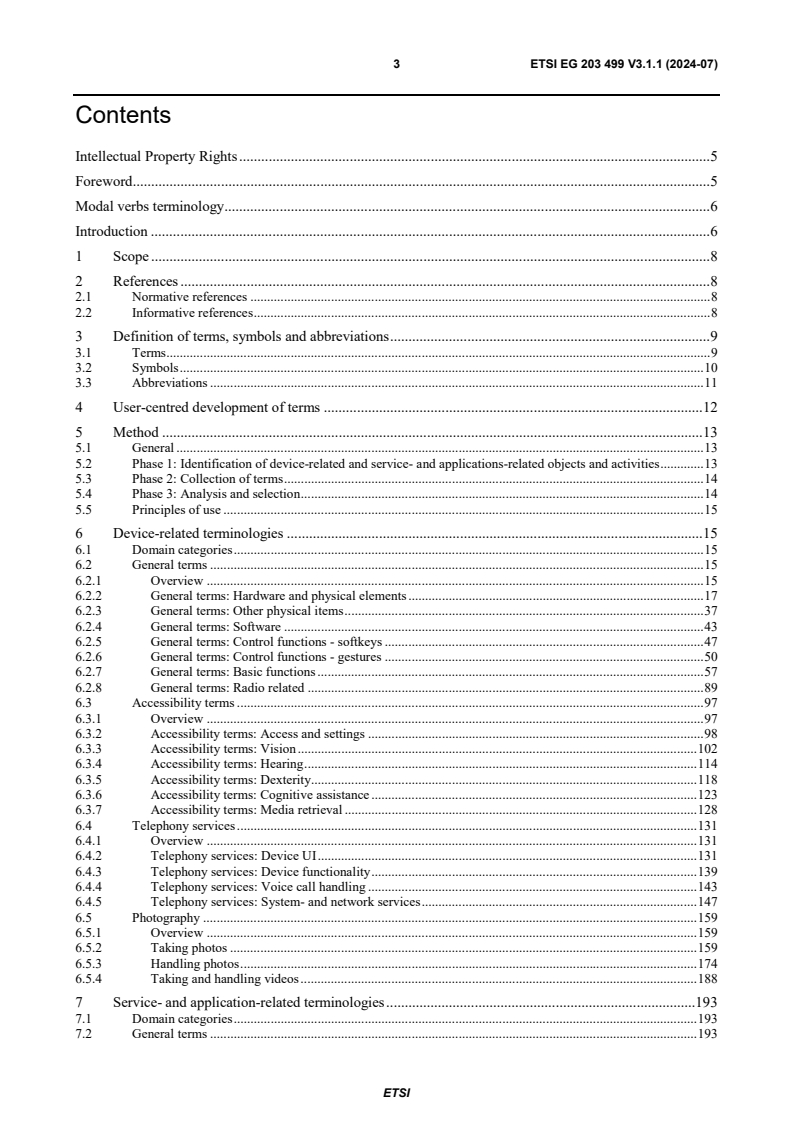
Contents
Intellectual Property Rights . 5
Foreword. 5
Modal verbs terminology . 6
Introduction . 6
1 Scope . 8
2 References . 8
2.1 Normative references . 8
2.2 Informative references . 8
3 Definition of terms, symbols and abbreviations . 9
3.1 Terms . 9
3.2 Symbols . 10
3.3 Abbreviations . 11
4 User-centred development of terms . 12
5 Method . 13
5.1 General . 13
5.2 Phase 1: Identification of device-related and service- and applications-related objects and activities .13
5.3 Phase 2: Collection of terms . 14
5.4 Phase 3: Analysis and selection . 14
5.5 Principles of use . 15
6 Device-related terminologies . 15
6.1 Domain categories . 15
6.2 General terms . 15
6.2.1 Overview . 15
6.2.2 General terms: Hardware and physical elements . 17
6.2.3 General terms: Other physical items . 37
6.2.4 General terms: Software . 43
6.2.5 General terms: Control functions - softkeys . 47
6.2.6 General terms: Control functions - gestures . 50
6.2.7 General terms: Basic functions . 57
6.2.8 General terms: Radio related . 89
6.3 Accessibility terms . 97
6.3.1 Overview . 97
6.3.2 Accessibility terms: Access and settings . 98
6.3.3 Accessibility terms: Vision . 102
6.3.4 Accessibility terms: Hearing . 114
6.3.5 Accessibility terms: Dexterity. 118
6.3.6 Accessibility terms: Cognitive assistance . 123
6.3.7 Accessibility terms: Media retrieval . 128
6.4 Telephony services . 131
6.4.1 Overview . 131
6.4.2 Telephony services: Device UI . 131
6.4.3 Telephony services: Device functionality . 139
6.4.4 Telephony services: Voice call handling . 143
6.4.5 Telephony services: System- and network services . 147
6.5 Photography . 159
6.5.1 Overview . 159
6.5.2 Taking photos . 159
6.5.3 Handling photos . 174
6.5.4 Taking and handling videos . 188
7 Service- and application-related terminologies . 193
7.1 Domain categories . 193
7.2 General terms . 193
ETSI
4 ETSI EG 203 499 V3.1.1 (2024-07)
7.2.1 Overview . 193
7.2.2 General terms: Authentication, login and confirmation . 194
7.2.3 General terms: Setup and settings. 200
7.2.4 General terms: Common functionality . 209
7.3 Messaging services . 233
7.3.1 Overview . 233
7.3.2 Access and setup - text-based services . 234
7.3.3 Access and setup - voicemail, audio, and video messaging . 250
7.3.4 Basic functionalities - text and voice messaging . 255
7.3.5 Basic functionalities - voicemail services . 259
7.4 Media services . 263
7.4.1 Overview . 263
7.4.2 AV access, retrieval, and control . 263
7.4.3 Text access, retrieval, and control . 269
7.4.4 Streaming live media . 275
7.5 Societal services and communication . 286
7.5.1 Overview . 286
7.5.2 Societal services . 286
7.5.3 Communication . 293
7.5.4 Emergency communication . 297
7.6 Social media services . 305
7.6.1 Overview . 305
7.6.2 Configuration and access . 306
7.6.3 Service handling . 309
7.6.4 Online media handling . 320
7.7 Banking services . 325
7.7.1 Overview . 325
7.7.2 eBanking . 326
7.7.3 ePayment . 356
7.7.4 eCommerce . 366
7.7.5 Investment services. 378
7.8 eHealth ser vices . 384
7.8.1 Overview . 384
7.8.2 Monitoring services . 384
7.8.3 Diagnosis and treatment . 387
7.8.4 Fitness . 402
7.9 Travel planning . 412
7.10 Navigation . 435
7.11 Games. 461
7.12 Searching and browsing . 470
7.12.1 Overview . 470
7.12.2 Web browser . 470
7.12.3 Search engine . 482
7.13 Tools . 494
History . 506
ETSI
5 ETSI EG 203 499 V3.1.1 (2024-07)
Intellectual Property Rights
Essential patents
IPRs essential or potentially essential to normative deliverables may have been declared to ETSI. The declarations
pertaining to these essential IPRs, if any, are publicly available for ETSI members and non-members, and can be
found in ETSI SR 000 314: "Intellectual Property Rights (IPRs); Essential, or potentially Essential, IPRs notified to
ETSI in respect of ETSI standards", which is available from the ETSI Secretariat. Latest updates are available on the
ETSI Web server (https://ipr.etsi.org/).
Pursuant to the ETSI Directives including the ETSI IPR Policy, no investigation regarding the essentiality of IPRs,
including IPR searches, has been carried out by ETSI. No guarantee can be given as to the existence of other IPRs not
referenced in ETSI SR 000 314 (or the updates on the ETSI Web server) which are, or may be, or may become,
essential to the present document.
Trademarks
The present document may include trademarks and/or tradenames which are asserted and/or registered by their owners.
ETSI claims no ownership of these except for any which are indicated as being the property of ETSI, and conveys no
right to use or reproduce any trademark and/or tradename. Mention of those trademarks in the present document does
not constitute an endorsement by ETSI of products, services or organizations associated with those trademarks.
DECT™, PLUGTESTS™, UMTS™ and the ETSI logo are trademarks of ETSI registered for the benefit of its
Members. 3GPP™ and LTE™ are trademarks of ETSI registered for the benefit of its Members and of the 3GPP
Organizational Partners. oneM2M™ logo is a trademark of ETSI registered for the benefit of its Members and of the ®
oneM2M Partners. GSM and the GSM logo are trademarks registered and owned by the GSM Association. ®
BLUETOOTH is a trademark registered and owned by Bluetooth SIG, Inc.
Foreword
This ETSI Guide (EG) has been produced by ETSI Technical Committee Human Factors (HF).
The work has been conducted in an open collaboration with industry, user and consumer representatives, and other
relevant stakeholders. The present document is based upon desk research (documents and online sources), best
practices, expert knowledge, and an industry-wide consultation and consensus process, aimed at consensus building and
a quick uptake and the largest possible support in future product implementations.
Intended readers of the present document include, but are not limited to:
• device designers, developers, and manufacturers;
• application developers;
• service providers;
• network operators;
• technical writers and developers of m arketing materials; and
• national and international standards bodies and regulatory institutions.
The terminologies contained in the present document are accessible in machine-readable format under
https://labs.etsi.org/rep/HF/eg203499/-/tree/v2.1.2.
ETSI
6 ETSI EG 203 499 V3.1.1 (2024-07)
Modal verbs terminology
In the present document "should", "should not", "may", "need not", "will", "will not", "can" and "cannot" are to be
interpreted as described in clause 3.2 of the ETSI Drafting Rules (Verbal forms for the expression of provisions).
"must" and "must not" are NOT allowed in ETSI deliverables except when used in direct citation.
Introduction
The terms (words, labels) used in the User Interface (UI) of a device, service or application may present an obstacle for
their users if they are not familiar with those terms or if they are unsure as to their meaning. While some terms are
introduced by manufacturers to denote a new class of features or to distinguish own features from those offered by
competitors, most other terms denoting device or service features are not necessarily intended for differentiation.
However, in the absence of a harmonized or recommended terminology, the use of those terms may differ considerably
among manufacturers and service providers, thereby introducing ambiguity for end users.
The alternative to a confusing plethora of terms is some degree of harmonization among devices, services, and
applications, at least for terms not intended to convey a certain brand feature or image. A harmonized terminology can
be employed to help prevent the negative effects of an uncontrolled expansion of terms and the resulting ambiguity of
the terms. Those negative effects include:
• increased user difficulties in understanding complex, ambiguous, and inconsistently-used terms, leading to
unnecessary confusion;
• increased efforts in user education (user guides);
• increased costs for user support (hotline calls and call agent training);
• limited feature discovery and unclear user expectations (customers who do not understand certain features may
not use them, hence some revenue may be missed);
• limited uptake (users may be reluctant to use a feature as they are not sure whether it has the expected effect);
• increase of cognitive complexity and subsequent learning effort; and
• abuse in the use of proprietary terms and lack of consistent use of terms.
The need for a harmonized terminology of device, service, and application features increases as new features and
functionalities are being developed. Device software, services, and applications are frequently updated, often without
even providing an update of the associated documentation to the users.
ETSI EG 202 132 [i.1] claims that in order to aid users' learning procedures and to enable and simplify transfer and
reuse of knowledge between devices, applications and services, it is relevant to support harmonized vocabularies for the
most common and generic mobile ICT functions.
Consistency across basic interactive elements increases the ease and transfer of learning and improves the overall
usability of complex mobile ICT environments. Such a transfer becomes even more important when older users or
people with cognitive functional limitations are addressed and expected to use smartphones, mobile services and
Internet applications in most segments of everyday life, such as: sending an email, transferring a call, or setting an
alarm, etc.
A h armonized terminology can also be fed into terminology management systems used within a company to ensure the
consistent use of terms across products and the internal and external documentation (e.g. design documents, user guides
and promotional materials), see clause 4.
ETSI
7 ETSI EG 203 499 V3.1.1 (2024-07)
ETSI EG 202 132 [i.1] contains harmonized English-language terms for a number of areas including user interfaces for
hardware and software, configuration of messaging and data services, call features, and terminal functionality. ETSI
TR 102 972 [i.2] extends the work done in ETSI EG 202 132 [i.1] towards 3G devices, mobile services, and
applications. This extended list of proposed terms forms the initial basis for the terms considered. However, ETSI
EG 202 132 [i.1] and ETSI TR 102 972 [i.2] were published a long time ago and require updating, inter alia to cover the
many features and services evolved or not available at that time, and to cover other main European languages in
addition to English.
The present document addresses this need on the basic level, covering 27 official EU and EFTA languages: Bulgarian,
Croatian, Czech, Danish, Dutch, English, Estonian, Finnish, French, German, Greek, Hungarian, Icelandic, Irish,
Italian, Latvian, Lithuanian, Maltese, Norwegian, Polish, Portuguese, Rhaeto Romance, Romanian, Slovak, Slovenian,
Spanish, and Swedish. In addition, given the speed of change in the mobile ICT landscape, it will naturally require
updating to ensure continuing relevance. Furthermore, expansion to cover additional European languages and other
languages used in Europe will further increase the usefulness and applicability of the present document.
The selection and validation process of the terms applied throughout their development, performed in collaboration with
stakeholders is expected to add a quality dimension to the recommended vocabulary that would be difficult to achieve
through an individual effort and is expected to contribute to the use and uptake of this freely available, public resource.
ETSI
8 ETSI EG 203 499 V3.1.1 (2024-07)
1 Scope
The present document aims at further simplifying end-user access to ICT devices, services, and applications by
providing recommended terms for basic and commonly-used ICT-related objects and activities, notably those terms that
end users are commonly exposed to. Recommended terms are provided in 27 languages: Bulgarian, Croatian, Czech,
Danish, Dutch, English, Estonian, Finnish, French, German, Greek, Hungarian, Icelandic , Irish, Italian, Latvian,
Lithuanian, Maltese, Norwegian, Polish, Portuguese, Rhaeto Romance, Romanian, Slovak, Slovenian, Spanish, and
Swedish (as spoken in their respective European countries).
The recommended terms apply to mobile ICT devices and mobile applications (whether they are standalone or provide
access to related services) commonly found in mobile ICT devices. Though developed in a mobile ICT context, most of
the recommended terms are applicable to both mobile and fixed-network devices, services, and applications. The
recommended terms are applicable to the User Interface (UI) design for a product as well as that of any user
documentation accompanying it.
User requirements and, when available, industry-originated documents as well as results of previous standardization
work have been considered and integrated in the present document, providing implementation-oriented guidance.
Wherever possible, a Design-for-All approach has been adopted, taking functional abilities of users, including elderly
users and users with cognitive, physical, or sensory limitations into account.
The present document provides recommendations for terms that may be used by those who consider supporting the
languages addressed in future products and services. It does not provide design guidance, nor does it intend to restrict
the ability of market players to further improve and develop their devices and services. Neither does it intend to limit
their options to trademark user interface elements or profile the user experience of brand-specific user interface
implementations as a competitive edge.
2 References
2.1 Normative references
Normative references are not applicable in the present document.
2.2 Informative references
References are either specific (identified by date of publication and/or edition number or version number) or
non-specific. For specific references, only the cited version applies. For non-specific references, the latest version of the
referenced document (including any amendments) applies.
NOTE: While any hyperlinks included in this clause were valid at the time of publication, ETSI cannot guarantee
their long term validity.
The following referenced documents are not necessary for the application of the present document but they assist the
user with regard to a particular subject area.
[i.1] ETSI EG 202 132: "Human Factors (HF); User Interfaces; Guidelines for generic user interface
elements for mobile terminals and services".
[i.2] ETSI TR 102 972: "Human Factors (HF); User Interfaces; Generic user interface elements for
3G/UMTS mobile devices, services and applications".
[i.3] ETSI EG 202 417: "Human Factors (HF); User education guidelines for mobile terminals and
services".
[i.4] ETSI ETR 095: "Human Factors (HF); Guide for usability evaluations of telecommunications
systems and services".
[i.5] ISO 9241-11:2018: "Ergonomics of human-system interaction - Part 11: Usability: Definitions and
concepts".
ETSI
9 ETSI EG 203 499 V3.1.1 (2024-07)
[i.6] ETSI ETR 116: "Human Factors (HF); Human factors guidelines for ISDN Terminal equipment
design".
[i.7] ETSI EN 301 549: "Accessibility requirements suitable for public procurement of ICT products
and services in Europe".
[i.8] IEEE 802.11™: "WiFi standards family specifications".
NOTE: Available at https://ieeexplore.ieee.org. ®
[i.9] Bluetooth SIG Core Specifications.
NOTE: Available at www.bluetooth.com/specifications/bluetooth-core-specification.
[i.10] Mobile & Wireless Forum (MWF) - Global Accessibility Reporting Initiative (GARI).
NOTE: Available at www.gari.info.
[i.11] CORDIS EU Research portal: "Terminology extraction, translation tools and comparable corpora".
NOTE: Available at https://cordis.europa.eu/project/rcn/93820_en.html.
[i.12] ISO 9999:2016: "Assistive products for persons with disability - Classification and terminology".
[i.13] ISO/IEC 29138-1:2018: "Information technology - User interface accessibility - Part 1: User
accessibility needs".
[i.14] ISO/TC 37: "Language and terminology".
NOTE: Available at https://www.iso.org/committee/48104.html.
3 Definition of terms, symbols and abbreviations
3.1 Terms
For the purposes of the present document, the following terms apply:
authentication: process or action of verifying the identity of a user or a process
consensus: general agreement, characterized by the absence of sustained opposition to substantial issues by any of the
concerned interests and by a process that involves taking into account the views of all parties concerned and to reconcile
any conflicting arguments
control function: operation that manages the interaction of the end user with a device, e.g. via buttons or gestures
design-for-all: design of products to be usable by all people, to the greatest extent possible, without the need for
specialized adoption
device: physical device which interfaces with a telecommunications network, and hence to a service provider, to enable
access to a telecommunications service, see ETSI TR 102 972 [i.2]
NOTE: A device also provides an interface to the user to enable the interchange of control actions and
information between the user and the device, network or service provider.
emergency call: call from a user to an emergency control centre
end user: See user.
function: abstract concept of a particular piece of functionality in a device or service
generic: generalized set or general purpose set, often in the sense of basic or ordinary
ICT devices and services: devices or services for processing information and/or supporting communication, which has
an interface to communicate with a user
ETSI
10 ETSI EG 203 499 V3.1.1 (2024-07)
impairment: any temporary or permanent; progressive, regressive or static; or intermittent or continuous reduction or
loss of psychological, physiological or anatomical function or structure of a user (environmental included)
login: username and password to enter a computer, program, or website
mobile device: personal communication device, e.g. a smartphone, capable of communicating by using one or several
radio technologies, including support for internet access
search engine: software system that is designed to carry out web searches based on keywords or characters specified by
a user
setting: adjustment in a software program or hardware device that adjusts it to the user's preference
setup: way in which a device is organized, or arranged
societal services: services relating to society or social relations
term: word or a phrase describing a thing or expressing a concept, in a specific language, domain or context
NOTE: Based on the Oxford dictionary definition.
terminal: physical device which interfaces with a telecommunications network, and hence to a service provider, to
enable access to a telecommunications service
NOTE: A terminal also provides an interface to the user to enable the interchange of control actions and
information between the user and the terminal, network or service provider.
terminology: vocabulary of technical terms in a particular field, subject, science, or art; nomenclature
usability: effectiveness, efficiency and satisfaction with which specified users can achieve specified goals (tasks) in a
specified context and particular environments, see ETSI ETR 095 [i.4] and ISO 9241-11 [i.5]
NOTE: In telecommunications, usability includes the concepts of learnability and flexibility; and reference to the
interaction of more than one user (the A and B parties) with each other and with the terminals and the
telecommunications system, see ETSI ETR 116 [i.6].
user: person who uses a telecommunications device to gain access to and control of a telecommunications service or
application
NOTE: The user may or may not be the person who has subscribed to the provision of the service or owns the
terminal. Also, the user may or may not be a person with impairments.
User Interface (UI): physical and logical interface through which a user communicates with a telecommunications
terminal or via a terminal to a telecommunications service (also called Man-Machine Interface (MMI))
NOTE: The communication is bi-directional in real time and the interface includes control, display, audio, haptic
or other elements, in software or hardware.
user requirements: requirements based on user needs and capabilities, on a telecommunication service and any of its
supporting components, terminals and interfaces, in order to make use of this service in the easiest, safest, most efficient
and most secure way
voice (spoken) command: verbal or other auditory dialogue format which enables the user to input commands to
control a device, service or application
3.2 Symbols
Void.
ETSI
11 ETSI EG 203 499 V3.1.1 (2024-07)
3.3 Abbreviations
For the purposes of the present document, the following abbreviations apply:
3D Three-Dimensional
rd
3G 3 Generation (mobile networks)
th
4G 4 Generation (mobile networks)
APN Access Point Name
ATM Automated Teller Machine
AV AudioVisual
B2B Business to Business
CC Closed Caption
CCNR Call Completion on No Reply
CEAM Carte Européenne d'Assurance Maladie
CLIP Caller Line Identification Presentation
CLIR Caller Line Identity Restriction
EDGE Enhanced Data rates for GSM Evolution
EHIC European Healthcare Identity Card
eSIM embedded SIM
FTP File Transfer Protocol
GARI Global Accessibility Reporting Initiative
GPRS General Packet Radio Service
GPS Global Positioning System
GSM Global System f or Mobile telecommunication
HDR High Dynamic Range
HF Human Factors
HSPA High-Speed Packet Access
HSPA+ evolved High-Speed Packet Access
HTTP Hypertext Transfer Protocol
HTTPS Hypertext Transfer Protocol Secure
I/O Input/Output
IBAN International Bank Account Number
ICE In Case of Emergency
ICT Information and Communication Technologies
ID IDentification
IM Instant Messaging
IMEI International Mobile Equipment Identity
IP Internet Protocol
IR InfraRed
IrDA Infrared Data Association
ISDN Integrated Services Digital Network
ISO International Organization for Standardization
LED Light Emitting Diode
LTE Long Term Evolution
MMI Man-Machine Interface
MMS Multimedia Message Service
NFC Near-Field Communication
OS Operating System
PA Public Address
PC Personal Computer
PIN Personal Identity Number
PUK Personal Unblocking Key
RF Radio Frequency
RH RHesus
RTT Real-Time Text
SD Secure Digital
SEPA Single Euro Payments Area
SIM Subscriber Identity Module
SMS Short Message Service
SMTP Simple Mail Transfer Protocol
SOS Save Our Souls
ETSI
12 ETSI EG 203 499 V3.1.1 (2024-07)
TAN Transaction Number
TTS Text To Speech
TV Television
UI User Interface
UICC Universal Integrated Circuit Card
UMTS Universal Mobile Telecommunication System
URI Uniform Resource Identifier
URL Uniform Resource Locator
USB Universal Serial Bus
USB-C Universal Serial Bus - C type
USIM Universal Subscriber Identity Module
VPN Virtual Private Network
WAP Wireless Application Protocol ®
Wi-Fi Wireless-Fidelity
NOTE: Commercial name for the wireless network standard family 802.11, also known as WLAN (see [i.8]).
WLAN Wireless Local Area Network
4 User-centred development of terms
Intended users of the present document are those designing, developing, implementing, and deploying user interfaces
for interaction with mobile ICT devices, services, and applications.
Intended end users mentioned in the present document are people who use mobile ICT devices, services, and
applications ranging from first time users to experienced users.
Uniformity in the interactive elements increases the transfer of learning between different devices, services, and
applications. Such knowledge transfer becomes even more important in a world of ubiquitous devices and services used
by heterogeneous users. In particular, harmonized terms (used across devices, services, and applications from different
manufacturers and providers) improve the overall usability of the entire ICT ecosystem. Use of the harmonized
vocabulary in the present document for the development of ICT devices, services, and applications will enable end users
to apply knowledge and experience, ensuring a user-friendly experience.
The present work goes beyond the automatic generation of bilingual terminologies, e.g. [i.11], addressing the automatic
generation of bilingual terminologies, by applying a user-centred approach.
A consistent, harmonized, and accessible terminology will particularly benefit end users with temporary or
permanent functional variations, such as those with literacy difficulties, or people with visual or cognitive impairments.
A harmonized terminology should be easy to remember, recognize, and retrieve, and the individual terms should
represent their related concepts well. A w ell-designed user terminology should have a shallow learning curve and cover
most common tasks and use cases users are likely to encounter through the most common, every-day use patterns.
Finally, the terminology should also be useful for manufacturers' terminology management systems, a process to
organize and associate terms with a clear set of rules for their usage (e.g. through a term base), also fostering its
inclusion and, therefore, harmonization across user guides and user interfaces. Companies invest in terminology
management in order to ensure that the terms used in internal documents, external documents such as user guides, in
user interfaces, and for marketing information such as advertisements are used consistently.
Unmanaged and outdated terminology will easily become inconsistent, leading to time and resource-intensive
documentation processes. It typically also reduces user satisfaction, limits cognitive accessibility and is often a main
reason to the under-use of potentially beneficial functionality.
ETSI EG 202 417 [i.3] provides detailed guidelines on how terminology management can help improve the quality of
user documentation. Applying these assists the user-centred generation of harmonised terminologies. Furthermore,
prioritizing the user-centred view over "technical perfection" helps selecting terms the user will understand.
ISO 9999:2016 [i.12] and ISO/IEC TR 29138-1:2018 [i.13] are useful references and inspirational sources when
developing mobile accessibility solutions and have been consulted, together with other functionality-area specific
references (e.g. in the field of banking services or healthcare services, where terminology-related national regulations
may exist and apply, and should be respected).
ETSI
13 ETSI EG 203 499 V3.1.1 (2024-07)
ISO/TC 37 [i.14] Terminology Principles and coordination (see https://www.iso.org/committee/48104.html) covers the
standardization of descriptions, resources, technologies and services related to terminology, translation, and other
language-based activities in the multilingual information society - without focusing on ICT in the mobile context of use.
Last but not least, consistently extending the focus of these efforts beyond the written word to include symbols, icons,
pictograms and audiograms (often replacing text) will further benefit the user-centric product and service development.
5 Method
5.1 General
This clause describes the method applied for selecting the user-centred terminology presented in clauses 6 and 7.
The selection of device-related terms (clause 6) is inter alia based on the analysis of the documentation of the device
manufacturers with the largest market shares in Europe. As the landscape of vendors for applications
...
SLOVENSKI STANDARD
01-september-2024
Človeški dejavniki (HF) - Uporabniško usmerjeno izrazoslovje za sedanje in
prihodnje naprave, storitve in aplikacije IKT
Human Factors (HF) - User-centred terminology for existing and upcoming ICT devices,
services and applications
Ta slovenski standard je istoveten z: ETSI EG 203 499 V3.1.1 (2024-07)
ICS:
33.040.01 Telekomunikacijski sistemi Telecommunication systems
na splošno in general
2003-01.Slovenski inštitut za standardizacijo. Razmnoževanje celote ali delov tega standarda ni dovoljeno.
ETSI GUIDE
Human Factors (HF);
User-centred terminology for existing and
upcoming ICT devices, services and applications
2 ETSI EG 203 499 V3.1.1 (2024-07)
Reference
REG/HF-00301563
Keywords
accessibility, device, end-user, ICT, interface,
localisation, telephony, terminology, user
ETSI
650 Route des Lucioles
F-06921 Sophia Antipolis Cedex - FRANCE
Tel.: +33 4 92 94 42 00 Fax: +33 4 93 65 47 16
Siret N° 348 623 562 00017 - APE 7112B
Association à but non lucratif enregistrée à la
Sous-Préfecture de Grasse (06) N° w061004871
Important notice
The present document can be downloaded from the
ETSI Search & Browse Standards application.
The present document may be made available in electronic versions and/or in print. The content of any electronic and/or
print versions of the present document shall not be modified without the prior written authorization of ETSI. In case of any
existing or perceived difference in contents between such versions and/or in print, the prevailing version of an ETSI
deliverable is the one made publicly available in PDF format on ETSI deliver.
Users should be aware that the present document may be revised or have its status changed,
this information is available in the Milestones listing.
If you find errors in the present document, please send your comments to
the relevant service listed under Committee Support Staff.
If you find a security vulnerability in the present document, please report it through our
Coordinated Vulnerability Disclosure (CVD) program.
Notice of disclaimer & limitation of liability
The information provided in the present deliverable is directed solely to professionals who have the appropriate degree of
experience to understand and interpret its content in accordance with generally accepted engineering or
other professional standard and applicable regulations.
No recommendation as to products and services or vendors is made or should be implied.
No representation or warranty is made that this deliverable is technically accurate or sufficient or conforms to any law
and/or governmental rule and/or regulation and further, no representation or warranty is made of merchantability or fitness
for any particular purpose or against infringement of intellectual property rights.
In no event shall ETSI be held liable for loss of profits or any other incidental or consequential damages.
Any software contained in this deliverable is provided "AS IS" with no warranties, express or implied, including but not
limited to, the warranties of merchantability, fitness for a particular purpose and non-infringement of intellectual property
rights and ETSI shall not be held liable in any event for any damages whatsoever (including, without limitation, damages
for loss of profits, business interruption, loss of information, or any other pecuniary loss) arising out of or related to the use
of or inability to use the software.
Copyright Notification
No part may be reproduced or utilized in any form or by any means, electronic or mechanical, including photocopying and
microfilm except as authorized by written permission of ETSI.
The content of the PDF version shall not be modified without the written authorization of ETSI.
The copyright and the foregoing restriction extend to reproduction in all media.
© ETSI 2024.
All rights reserved.
ETSI
3 ETSI EG 203 499 V3.1.1 (2024-07)
Contents
Intellectual Property Rights . 5
Foreword. 5
Modal verbs terminology . 6
Introduction . 6
1 Scope . 8
2 References . 8
2.1 Normative references . 8
2.2 Informative references . 8
3 Definition of terms, symbols and abbreviations . 9
3.1 Terms . 9
3.2 Symbols . 10
3.3 Abbreviations . 11
4 User-centred development of terms . 12
5 Method . 13
5.1 General . 13
5.2 Phase 1: Identification of device-related and service- and applications-related objects and activities .13
5.3 Phase 2: Collection of terms . 14
5.4 Phase 3: Analysis and selection . 14
5.5 Principles of use . 15
6 Device-related terminologies . 15
6.1 Domain categories . 15
6.2 General terms . 15
6.2.1 Overview . 15
6.2.2 General terms: Hardware and physical elements . 17
6.2.3 General terms: Other physical items . 37
6.2.4 General terms: Software . 43
6.2.5 General terms: Control functions - softkeys . 47
6.2.6 General terms: Control functions - gestures . 50
6.2.7 General terms: Basic functions . 57
6.2.8 General terms: Radio related . 89
6.3 Accessibility terms . 97
6.3.1 Overview . 97
6.3.2 Accessibility terms: Access and settings . 98
6.3.3 Accessibility terms: Vision . 102
6.3.4 Accessibility terms: Hearing . 114
6.3.5 Accessibility terms: Dexterity. 118
6.3.6 Accessibility terms: Cognitive assistance . 123
6.3.7 Accessibility terms: Media retrieval . 128
6.4 Telephony services . 131
6.4.1 Overview . 131
6.4.2 Telephony services: Device UI . 131
6.4.3 Telephony services: Device functionality . 139
6.4.4 Telephony services: Voice call handling . 143
6.4.5 Telephony services: System- and network services . 147
6.5 Photography . 159
6.5.1 Overview . 159
6.5.2 Taking photos . 159
6.5.3 Handling photos . 174
6.5.4 Taking and handling videos . 188
7 Service- and application-related terminologies . 193
7.1 Domain categories . 193
7.2 General terms . 193
ETSI
4 ETSI EG 203 499 V3.1.1 (2024-07)
7.2.1 Overview . 193
7.2.2 General terms: Authentication, login and confirmation . 194
7.2.3 General terms: Setup and settings. 200
7.2.4 General terms: Common functionality . 209
7.3 Messaging services . 233
7.3.1 Overview . 233
7.3.2 Access and setup - text-based services . 234
7.3.3 Access and setup - voicemail, audio, and video messaging . 250
7.3.4 Basic functionalities - text and voice messaging . 255
7.3.5 Basic functionalities - voicemail services . 259
7.4 Media services . 263
7.4.1 Overview . 263
7.4.2 AV access, retrieval, and control . 263
7.4.3 Text access, retrieval, and control . 269
7.4.4 Streaming live media . 275
7.5 Societal services and communication . 286
7.5.1 Overview . 286
7.5.2 Societal services . 286
7.5.3 Communication . 293
7.5.4 Emergency communication . 297
7.6 Social media services . 305
7.6.1 Overview . 305
7.6.2 Configuration and access . 306
7.6.3 Service handling . 309
7.6.4 Online media handling . 320
7.7 Banking services . 325
7.7.1 Overview . 325
7.7.2 eBanking . 326
7.7.3 ePayment . 356
7.7.4 eCommerce . 366
7.7.5 Investment services. 378
7.8 eHealth ser vices . 384
7.8.1 Overview . 384
7.8.2 Monitoring services . 384
7.8.3 Diagnosis and treatment . 387
7.8.4 Fitness . 402
7.9 Travel planning . 412
7.10 Navigation . 435
7.11 Games. 461
7.12 Searching and browsing . 470
7.12.1 Overview . 470
7.12.2 Web browser . 470
7.12.3 Search engine . 482
7.13 Tools . 494
History . 506
ETSI
5 ETSI EG 203 499 V3.1.1 (2024-07)
Intellectual Property Rights
Essential patents
IPRs essential or potentially essential to normative deliverables may have been declared to ETSI. The declarations
pertaining to these essential IPRs, if any, are publicly available for ETSI members and non-members, and can be
found in ETSI SR 000 314: "Intellectual Property Rights (IPRs); Essential, or potentially Essential, IPRs notified to
ETSI in respect of ETSI standards", which is available from the ETSI Secretariat. Latest updates are available on the
ETSI Web server (https://ipr.etsi.org/).
Pursuant to the ETSI Directives including the ETSI IPR Policy, no investigation regarding the essentiality of IPRs,
including IPR searches, has been carried out by ETSI. No guarantee can be given as to the existence of other IPRs not
referenced in ETSI SR 000 314 (or the updates on the ETSI Web server) which are, or may be, or may become,
essential to the present document.
Trademarks
The present document may include trademarks and/or tradenames which are asserted and/or registered by their owners.
ETSI claims no ownership of these except for any which are indicated as being the property of ETSI, and conveys no
right to use or reproduce any trademark and/or tradename. Mention of those trademarks in the present document does
not constitute an endorsement by ETSI of products, services or organizations associated with those trademarks.
DECT™, PLUGTESTS™, UMTS™ and the ETSI logo are trademarks of ETSI registered for the benefit of its
Members. 3GPP™ and LTE™ are trademarks of ETSI registered for the benefit of its Members and of the 3GPP
Organizational Partners. oneM2M™ logo is a trademark of ETSI registered for the benefit of its Members and of the ®
oneM2M Partners. GSM and the GSM logo are trademarks registered and owned by the GSM Association. ®
BLUETOOTH is a trademark registered and owned by Bluetooth SIG, Inc.
Foreword
This ETSI Guide (EG) has been produced by ETSI Technical Committee Human Factors (HF).
The work has been conducted in an open collaboration with industry, user and consumer representatives, and other
relevant stakeholders. The present document is based upon desk research (documents and online sources), best
practices, expert knowledge, and an industry-wide consultation and consensus process, aimed at consensus building and
a quick uptake and the largest possible support in future product implementations.
Intended readers of the present document include, but are not limited to:
• device designers, developers, and manufacturers;
• application developers;
• service providers;
• network operators;
• technical writers and developers of m arketing materials; and
• national and international standards bodies and regulatory institutions.
The terminologies contained in the present document are accessible in machine-readable format under
https://labs.etsi.org/rep/HF/eg203499/-/tree/v2.1.2.
ETSI
6 ETSI EG 203 499 V3.1.1 (2024-07)
Modal verbs terminology
In the present document "should", "should not", "may", "need not", "will", "will not", "can" and "cannot" are to be
interpreted as described in clause 3.2 of the ETSI Drafting Rules (Verbal forms for the expression of provisions).
"must" and "must not" are NOT allowed in ETSI deliverables except when used in direct citation.
Introduction
The terms (words, labels) used in the User Interface (UI) of a device, service or application may present an obstacle for
their users if they are not familiar with those terms or if they are unsure as to their meaning. While some terms are
introduced by manufacturers to denote a new class of features or to distinguish own features from those offered by
competitors, most other terms denoting device or service features are not necessarily intended for differentiation.
However, in the absence of a harmonized or recommended terminology, the use of those terms may differ considerably
among manufacturers and service providers, thereby introducing ambiguity for end users.
The alternative to a confusing plethora of terms is some degree of harmonization among devices, services, and
applications, at least for terms not intended to convey a certain brand feature or image. A harmonized terminology can
be employed to help prevent the negative effects of an uncontrolled expansion of terms and the resulting ambiguity of
the terms. Those negative effects include:
• increased user difficulties in understanding complex, ambiguous, and inconsistently-used terms, leading to
unnecessary confusion;
• increased efforts in user education (user guides);
• increased costs for user support (hotline calls and call agent training);
• limited feature discovery and unclear user expectations (customers who do not understand certain features may
not use them, hence some revenue may be missed);
• limited uptake (users may be reluctant to use a feature as they are not sure whether it has the expected effect);
• increase of cognitive complexity and subsequent learning effort; and
• abuse in the use of proprietary terms and lack of consistent use of terms.
The need for a harmonized terminology of device, service, and application features increases as new features and
functionalities are being developed. Device software, services, and applications are frequently updated, often without
even providing an update of the associated documentation to the users.
ETSI EG 202 132 [i.1] claims that in order to aid users' learning procedures and to enable and simplify transfer and
reuse of knowledge between devices, applications and services, it is relevant to support harmonized vocabularies for the
most common and generic mobile ICT functions.
Consistency across basic interactive elements increases the ease and transfer of learning and improves the overall
usability of complex mobile ICT environments. Such a transfer becomes even more important when older users or
people with cognitive functional limitations are addressed and expected to use smartphones, mobile services and
Internet applications in most segments of everyday life, such as: sending an email, transferring a call, or setting an
alarm, etc.
A h armonized terminology can also be fed into terminology management systems used within a company to ensure the
consistent use of terms across products and the internal and external documentation (e.g. design documents, user guides
and promotional materials), see clause 4.
ETSI
7 ETSI EG 203 499 V3.1.1 (2024-07)
ETSI EG 202 132 [i.1] contains harmonized English-language terms for a number of areas including user interfaces for
hardware and software, configuration of messaging and data services, call features, and terminal functionality. ETSI
TR 102 972 [i.2] extends the work done in ETSI EG 202 132 [i.1] towards 3G devices, mobile services, and
applications. This extended list of proposed terms forms the initial basis for the terms considered. However, ETSI
EG 202 132 [i.1] and ETSI TR 102 972 [i.2] were published a long time ago and require updating, inter alia to cover the
many features and services evolved or not available at that time, and to cover other main European languages in
addition to English.
The present document addresses this need on the basic level, covering 27 official EU and EFTA languages: Bulgarian,
Croatian, Czech, Danish, Dutch, English, Estonian, Finnish, French, German, Greek, Hungarian, Icelandic, Irish,
Italian, Latvian, Lithuanian, Maltese, Norwegian, Polish, Portuguese, Rhaeto Romance, Romanian, Slovak, Slovenian,
Spanish, and Swedish. In addition, given the speed of change in the mobile ICT landscape, it will naturally require
updating to ensure continuing relevance. Furthermore, expansion to cover additional European languages and other
languages used in Europe will further increase the usefulness and applicability of the present document.
The selection and validation process of the terms applied throughout their development, performed in collaboration with
stakeholders is expected to add a quality dimension to the recommended vocabulary that would be difficult to achieve
through an individual effort and is expected to contribute to the use and uptake of this freely available, public resource.
ETSI
8 ETSI EG 203 499 V3.1.1 (2024-07)
1 Scope
The present document aims at further simplifying end-user access to ICT devices, services, and applications by
providing recommended terms for basic and commonly-used ICT-related objects and activities, notably those terms that
end users are commonly exposed to. Recommended terms are provided in 27 languages: Bulgarian, Croatian, Czech,
Danish, Dutch, English, Estonian, Finnish, French, German, Greek, Hungarian, Icelandic , Irish, Italian, Latvian,
Lithuanian, Maltese, Norwegian, Polish, Portuguese, Rhaeto Romance, Romanian, Slovak, Slovenian, Spanish, and
Swedish (as spoken in their respective European countries).
The recommended terms apply to mobile ICT devices and mobile applications (whether they are standalone or provide
access to related services) commonly found in mobile ICT devices. Though developed in a mobile ICT context, most of
the recommended terms are applicable to both mobile and fixed-network devices, services, and applications. The
recommended terms are applicable to the User Interface (UI) design for a product as well as that of any user
documentation accompanying it.
User requirements and, when available, industry-originated documents as well as results of previous standardization
work have been considered and integrated in the present document, providing implementation-oriented guidance.
Wherever possible, a Design-for-All approach has been adopted, taking functional abilities of users, including elderly
users and users with cognitive, physical, or sensory limitations into account.
The present document provides recommendations for terms that may be used by those who consider supporting the
languages addressed in future products and services. It does not provide design guidance, nor does it intend to restrict
the ability of market players to further improve and develop their devices and services. Neither does it intend to limit
their options to trademark user interface elements or profile the user experience of brand-specific user interface
implementations as a competitive edge.
2 References
2.1 Normative references
Normative references are not applicable in the present document.
2.2 Informative references
References are either specific (identified by date of publication and/or edition number or version number) or
non-specific. For specific references, only the cited version applies. For non-specific references, the latest version of the
referenced document (including any amendments) applies.
NOTE: While any hyperlinks included in this clause were valid at the time of publication, ETSI cannot guarantee
their long term validity.
The following referenced documents are not necessary for the application of the present document but they assist the
user with regard to a particular subject area.
[i.1] ETSI EG 202 132: "Human Factors (HF); User Interfaces; Guidelines for generic user interface
elements for mobile terminals and services".
[i.2] ETSI TR 102 972: "Human Factors (HF); User Interfaces; Generic user interface elements for
3G/UMTS mobile devices, services and applications".
[i.3] ETSI EG 202 417: "Human Factors (HF); User education guidelines for mobile terminals and
services".
[i.4] ETSI ETR 095: "Human Factors (HF); Guide for usability evaluations of telecommunications
systems and services".
[i.5] ISO 9241-11:2018: "Ergonomics of human-system interaction - Part 11: Usability: Definitions and
concepts".
ETSI
9 ETSI EG 203 499 V3.1.1 (2024-07)
[i.6] ETSI ETR 116: "Human Factors (HF); Human factors guidelines for ISDN Terminal equipment
design".
[i.7] ETSI EN 301 549: "Accessibility requirements suitable for public procurement of ICT products
and services in Europe".
[i.8] IEEE 802.11™: "WiFi standards family specifications".
NOTE: Available at https://ieeexplore.ieee.org. ®
[i.9] Bluetooth SIG Core Specifications.
NOTE: Available at www.bluetooth.com/specifications/bluetooth-core-specification.
[i.10] Mobile & Wireless Forum (MWF) - Global Accessibility Reporting Initiative (GARI).
NOTE: Available at www.gari.info.
[i.11] CORDIS EU Research portal: "Terminology extraction, translation tools and comparable corpora".
NOTE: Available at https://cordis.europa.eu/project/rcn/93820_en.html.
[i.12] ISO 9999:2016: "Assistive products for persons with disability - Classification and terminology".
[i.13] ISO/IEC 29138-1:2018: "Information technology - User interface accessibility - Part 1: User
accessibility needs".
[i.14] ISO/TC 37: "Language and terminology".
NOTE: Available at https://www.iso.org/committee/48104.html.
3 Definition of terms, symbols and abbreviations
3.1 Terms
For the purposes of the present document, the following terms apply:
authentication: process or action of verifying the identity of a user or a process
consensus: general agreement, characterized by the absence of sustained opposition to substantial issues by any of the
concerned interests and by a process that involves taking into account the views of all parties concerned and to reconcile
any conflicting arguments
control function: operation that manages the interaction of the end user with a device, e.g. via buttons or gestures
design-for-all: design of products to be usable by all people, to the greatest extent possible, without the need for
specialized adoption
device: physical device which interfaces with a telecommunications network, and hence to a service provider, to enable
access to a telecommunications service, see ETSI TR 102 972 [i.2]
NOTE: A device also provides an interface to the user to enable the interchange of control actions and
information between the user and the device, network or service provider.
emergency call: call from a user to an emergency control centre
end user: See user.
function: abstract concept of a particular piece of functionality in a device or service
generic: generalized set or general purpose set, often in the sense of basic or ordinary
ICT devices and services: devices or services for processing information and/or supporting communication, which has
an interface to communicate with a user
ETSI
10 ETSI EG 203 499 V3.1.1 (2024-07)
impairment: any temporary or permanent; progressive, regressive or static; or intermittent or continuous reduction or
loss of psychological, physiological or anatomical function or structure of a user (environmental included)
login: username and password to enter a computer, program, or website
mobile device: personal communication device, e.g. a smartphone, capable of communicating by using one or several
radio technologies, including support for internet access
search engine: software system that is designed to carry out web searches based on keywords or characters specified by
a user
setting: adjustment in a software program or hardware device that adjusts it to the user's preference
setup: way in which a device is organized, or arranged
societal services: services relating to society or social relations
term: word or a phrase describing a thing or expressing a concept, in a specific language, domain or context
NOTE: Based on the Oxford dictionary definition.
terminal: physical device which interfaces with a telecommunications network, and hence to a service provider, to
enable access to a telecommunications service
NOTE: A terminal also provides an interface to the user to enable the interchange of control actions and
information between the user and the terminal, network or service provider.
terminology: vocabulary of technical terms in a particular field, subject, science, or art; nomenclature
usability: effectiveness, efficiency and satisfaction with which specified users can achieve specified goals (tasks) in a
specified context and particular environments, see ETSI ETR 095 [i.4] and ISO 9241-11 [i.5]
NOTE: In telecommunications, usability includes the concepts of learnability and flexibility; and reference to the
interaction of more than one user (the A and B parties) with each other and with the terminals and the
telecommunications system, see ETSI ETR 116 [i.6].
user: person who uses a telecommunications device to gain access to and control of a telecommunications service or
application
NOTE: The user may or may not be the person who has subscribed to the provision of the service or owns the
terminal. Also, the user may or may not be a person with impairments.
User Interface (UI): physical and logical interface through which a user communicates with a telecommunications
terminal or via a terminal to a telecommunications service (also called Man-Machine Interface (MMI))
NOTE: The communication is bi-directional in real time and the interface includes control, display, audio, haptic
or other elements, in software or hardware.
user requirements: requirements based on user needs and capabilities, on a telecommunication service and any of its
supporting components, terminals and interfaces, in order to make use of this service in the easiest, safest, most efficient
and most secure way
voice (spoken) command: verbal or other auditory dialogue format which enables the user to input commands to
control a device, service or application
3.2 Symbols
Void.
ETSI
11 ETSI EG 203 499 V3.1.1 (2024-07)
3.3 Abbreviations
For the purposes of the present document, the following abbreviations apply:
3D Three-Dimensional
rd
3G 3 Generation (mobile networks)
th
4G 4 Generation (mobile networks)
APN Access Point Name
ATM Automated Teller Machine
AV AudioVisual
B2B Business to Business
CC Closed Caption
CCNR Call Completion on No Reply
CEAM Carte Européenne d'Assurance Maladie
CLIP Caller Line Identification Presentation
CLIR Caller Line Identity Restriction
EDGE Enhanced Data rates for GSM Evolution
EHIC European Healthcare Identity Card
eSIM embedded SIM
FTP File Transfer Protocol
GARI Global Accessibility Reporting Initiative
GPRS General Packet Radio Service
GPS Global Positioning System
GSM Global System f or Mobile telecommunication
HDR High Dynamic Range
HF Human Factors
HSPA High-Speed Packet Access
HSPA+ evolved High-Speed Packet Access
HTTP Hypertext Transfer Protocol
HTTPS Hypertext Transfer Protocol Secure
I/O Input/Output
IBAN International Bank Account Number
ICE In Case of Emergency
ICT Information and Communication Technologies
ID IDentification
IM Instant Messaging
IMEI International Mobile Equipment Identity
IP Internet Protocol
IR InfraRed
IrDA Infrared Data Association
ISDN Integrated Services Digital Network
ISO International Organization for Standardization
LED Light Emitting Diode
LTE Long Term Evolution
MMI Man-Machine Interface
MMS Multimedia Message Service
NFC Near-Field Communication
OS Operating System
PA Public Address
PC Personal Computer
PIN Personal Identity Number
PUK Personal Unblocking Key
RF Radio Frequency
RH RHesus
RTT Real-Time Text
SD Secure Digital
SEPA Single Euro Payments Area
SIM Subscriber Identity Module
SMS Short Message Service
SMTP Simple Mail Transfer Protocol
SOS Save Our Souls
ETSI
12 ETSI EG 203 499 V3.1.1 (2024-07)
TAN Transaction Number
TTS Text To Speech
TV Television
UI User Interface
UICC Universal Integrated Circuit Card
UMTS Universal Mobile Telecommunication System
URI Uniform Resource Identifier
URL Uniform Resource Locator
USB Universal Serial Bus
USB-C Universal Serial Bus - C type
USIM Universal Subscriber Identity Module
VPN Virtual Private Network
WAP Wireless Application Protocol ®
Wi-Fi Wireless-Fidelity
NOTE: Commercial name for the wireless network standard family 802.11, also known as WLAN (see [i.8]).
WLAN Wireless Local Area Network
4 User-centred development of terms
Intended users of the present document are those designing, developing, implementing, and deploying user interfaces
for interaction with mobile ICT devices, services, and applications.
Intended end users mentioned in the present document are people who use mobile ICT devices, services, and
applications ranging from first time users to experienced users.
Uniformity in the interactive elements increases the transfer of learning between different devices, services, and
applications. Such knowledge transfer becomes even more important in a world of ubiquitous devices and services used
by heterogeneous users. In particular, harmonized terms (used across devices, services, and applications from different
manufacturers and providers) improve the overall usability of the entire ICT ecosystem. Use of the harmonized
vocabulary in the present document for the development of ICT devices, services, and applications will enable end users
to apply knowledge and experience, ensuring a user-friendly experience.
The present work goes beyond the automatic generation of bilingual terminologies, e.g. [i.11], addressing the automatic
generation of bilingual terminologies, by applying a user-centred approach.
A consistent, harmonized, and accessible terminology will particularly benefit end users with temporary or
permanent functional variations, such as those with literacy difficulties, or people with visual or cognitive impairments.
A harmonized terminology should be easy to remember, recognize, and retrieve, and the individual terms should
represent their related concepts well. A w ell-designed user terminology should have a shallow learning curve and cover
most common tasks and use cases users are likely to encounter through the most common, every-day use patterns.
Finally, the terminology should also be useful for manufacturers' terminology management systems, a process to
organize and associate terms with a clear set of rules for their usage (e.g. through a term base), also fostering its
inclusion and, therefore, harmonization across user guides and user interfaces. Companies invest in terminology
management in order to ensure that the terms used in internal documents, external documents such as user guides, in
user interfaces, and for marketing information such as advertisements are used consistently.
Unmanaged and outdated terminology will easily become inconsistent, leading to time and resource-intensive
documentation processes. It typically also reduces user satisfaction, limits cognitive accessibility and is often a main
reason to the under-use of potentially beneficial functionality.
ETSI EG 202 417 [i.3] provides detailed guidelines on how terminology management can help improve the quality of
user documentation. Applying these assists the user-centred generation of harmonised terminologies. Furthermore,
prioritizing the user-centred view over "technical perfection" helps selecting terms the user will understand.
ISO 9999:2016 [i.12] and ISO/IEC TR 29138-1:2018 [i.13] are useful references and inspirational sources when
developing mobile accessibility solutions and have been consulted, together with other functionality-area specific
references (e.g. in the field of banking services or healthcare services, where terminology-related national regulations
may exist and apply
...
Questions, Comments and Discussion
Ask us and Technical Secretary will try to provide an answer. You can facilitate discussion about the standard in here.
Loading comments...