


ETSI SR 001 996 V6.1.1 (2013-08)
Human Factors (HF); An annotated bibliography of documents dealing with Human Factors and disability
Human Factors (HF); An annotated bibliography of documents dealing with Human Factors and disability
RSR/HF-00142
General Information
Standards Content (Sample)
Special Report
Human Factors (HF);
An annotated bibliography of documents dealing
with Human Factors and disability
2 ETSI SR 001 996 V6.1.1 (2013-08)
Reference
RSR/HF-00142
Keywords
accessibility, ageing, disability, HF
ETSI
650 Route des Lucioles
F-06921 Sophia Antipolis Cedex - FRANCE
Tel.: +33 4 92 94 42 00 Fax: +33 4 93 65 47 16
Siret N° 348 623 562 00017 - NAF 742 C
Association à but non lucratif enregistrée à la
Sous-Préfecture de Grasse (06) N° 7803/88
Important notice
Individual copies of the present document can be downloaded from:
http://www.etsi.org
The present document may be made available in more than one electronic version or in print. In any case of existing or
perceived difference in contents between such versions, the reference version is the Portable Document Format (PDF).
In case of dispute, the reference shall be the printing on ETSI printers of the PDF version kept on a specific network drive
within ETSI Secretariat.
Users of the present document should be aware that the document may be subject to revision or change of status.
Information on the current status of this and other ETSI documents is available at
http://portal.etsi.org/tb/status/status.asp
If you find errors in the present document, please send your comment to one of the following services:
http://portal.etsi.org/chaircor/ETSI_support.asp
Copyright Notification
No part may be reproduced except as authorized by written permission.
The copyright and the foregoing restriction extend to reproduction in all media.
© European Telecommunications Standards Institute 2013.
All rights reserved.
TM TM TM
DECT , PLUGTESTS , UMTS and the ETSI logo are Trade Marks of ETSI registered for the benefit of its Members.
TM
3GPP and LTE™ are Trade Marks of ETSI registered for the benefit of its Members and
of the 3GPP Organizational Partners.
GSM® and the GSM logo are Trade Marks registered and owned by the GSM Association.
ETSI
3 ETSI SR 001 996 V6.1.1 (2013-08)
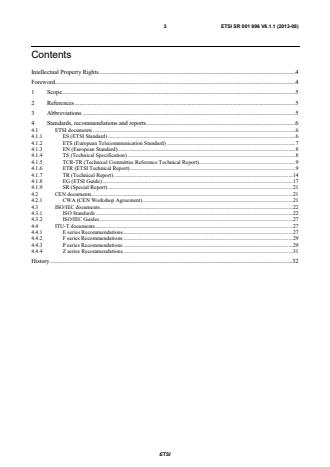
Contents
Intellectual Property Rights . 4
Foreword . 4
1 Scope . 5
2 References . 5
3 Abbreviations . 5
4 Standards, recommendations and reports . 6
4.1 ETSI documents . 6
4.1.1 ES (ETSI Standard) . 6
4.1.2 ETS (European Telecommunication Standard) . 7
4.1.3 EN (European Standard) . 8
4.1.4 TS (Technical Specification) . 8
4.1.5 TCR-TR (Technical Committee Reference Technical Report) . 9
4.1.6 ETR (ETSI Technical Report) . 9
4.1.7 TR (Technical Report) . 14
4.1.8 EG (ETSI Guide) . 17
4.1.9 SR (Special Report) . 21
4.2 CEN documents . 21
4.2.1 CWA (CEN Workshop Agreement) . 21
4.3 ISO/IEC documents . 22
4.3.1 ISO Standards . 22
4.3.2 ISO/IEC Guides . 27
4.4 ITU-T documents . 27
4.4.1 E series Recommendations . 27
4.4.2 F series Recommendations . 29
4.4.3 P series Recommendations . 29
4.4.4 Z series Recommendations . 31
History . 32
ETSI
4 ETSI SR 001 996 V6.1.1 (2013-08)
Intellectual Property Rights
IPRs essential or potentially essential to the present document may have been declared to ETSI. The information
pertaining to these essential IPRs, if any, is publicly available for ETSI members and non-members, and can be found
in ETSI SR 000 314: "Intellectual Property Rights (IPRs); Essential, or potentially Essential, IPRs notified to ETSI in
respect of ETSI standards", which is available from the ETSI Secretariat. Latest updates are available on the ETSI Web
server (http://ipr.etsi.org).
Pursuant to the ETSI IPR Policy, no investigation, including IPR searches, has been carried out by ETSI. No guarantee
can be given as to the existence of other IPRs not referenced in ETSI SR 000 314 (or the updates on the ETSI Web
server) which are, or may be, or may become, essential to the present document.
Foreword
This Special Report (SR) has been produced by ETSI Technical Committee Human Factors (HF).
ETSI
5 ETSI SR 001 996 V6.1.1 (2013-08)
1 Scope
The present document provides a listing of standardization documents relevant to ICT on the subjects of Human Factors
and accessibility and gives a brief outline of the content of the listed documents that are published and provides some
comments on their applicability.
The present document is a living document which will be updated at intervals.
2 References
As the document is itself a listing of reference documents, it contains no specific references.
3 Abbreviations
For the purposes of the present document, the following abbreviations apply:
AT Assistive Technology
AT&T American Company named AT&T
CCITT (The) International Telegraph and Telephone Consultative Committee
CEPT Conférence des Administrations Européennes des Postes et Télécommunications
CLI Calling Line Information
DTMF Dual Tone Multi-Frequency
DUST Duplex Universal Speech and Text
EFTA European Free Trade Association
ETNS European Telephony Numbering Space
GSM Group Special Mobile
HATS Head And Torso Simulator
HMI Human Machine Interface
ICT Information and Communication Technology
ISDN Integrated Services Digital Network
MIA Multiple Index Approach
MIRS Multimedia Information Retrieval Services
MMI Man-Machine Interface
MML Man-Machine Language
NGN New Generation Network
NTT Nippon Telegraph and Telephone Corp
PBI Phone Based Interface
PBX Private Branch Exchange
PSAP Public Safety Answering Point
PSTN Public Switched Telephone Network
SDL Specification and Description Language
SMS Short Messaging Service
TE Terminal Equipment
TETRA Trans-European Trunked Radio
TMN Telecommunications Management Network
UCI Universal Communications Identifier
UI User Inteface
UPT Universal Personal Telecommunications
VDT Visual Display Terminal
WCAG Web Content Accessibility Guidelines
ETSI
6 ETSI SR 001 996 V6.1.1 (2013-08)
4 Standards, recommendations and reports
4.1 ETSI documents
4.1.1 ES (ETSI Standard)
ES 200 381-1 (October 2012): Telephony for hearing impaired people; Inductive coupling of telephone earphones
to hearing aids; Part 1: Fixed-line speech terminals
This standard is intended to replace ETS 300 381 for fixed-line speech terminals. The test measurements are
based on the use of HATS as electro acoustical interface.
ES 200 381-2 (October 2012): Telephony for hearing impaired people; Inductive coupling of telephone earphones
to hearing aids; Part 2: Cellular speech terminals
This standard provides requirements and measurement methods for cellular speech terminals. The classes
defined in this ES are in line with ANSI-IEEE 63.19.
ES 201 125 (February 1998): Human Factors (HF); Universal Personal Telecommunications (UPT);
Specification of the minimum Man-Machine Interface (MMI) for Phase 1 UPT
ES 201 125 defines the minimum Man-Machine Interface for the phase 1 UPT service, describing the
requirements to be met by the service provider, the network operator and the terminal device.
The minimum transitions are illustrated with state transition diagrams and the UPT control procedures are
profusely described in Specification and Description Language (SDL) in a set of diagrams.
ES 201 275 (August 1998): Human Factors (HF); User control procedures in basic call, point-to-point
connections, for Integrated Services Digital Network (ISDN) videotelephony
ES 201 275 specifies the minimum set of user procedure necessary to control a basic call point to point
connection for the ISDN videotelephony service. It covers fallback to ordinary ISDN and PSTN telephony. It
describes the various videotelephony services available and the different communication modes.
User control procedures and the call handling processes are described in a set of SDL diagrams. Compliance
requirements and procedures are described.
ES 201 381 (December 1998): Human Factors (HF); Telecommunications keypads and keyboards; Tactile
identifiers
ES 201 381 specifies the form, dimensions and location of tactile identifiers on digit "5" of keypads and on the
"F" and "J" keys of keyboards.
ES 201 382 (December 2003): Human Factors (HF); Procedure for registering a supplementary service code
ES 201 382 describes the procedure to be followed when applying for a supplementary service code for use in
a public network that is to be registered in the ETSI register of supplementary service codes.
ES 201 930 (May 2001): Human Factors (HF); Specification of user requirements for use in ETSI deliverables
This document lays down a requirement that all ETSI deliverables should contain an annex setting out the
users of the product or service described, their goals, the equipment used, the tasks and feedback for users and
the circumstances in which the product or service is intended to be used. The annex should also state how the
answers have been validated.
ES 202 076 (August 2009): Human Factors (HF); User Interfaces; Generic spoken command vocabulary for ICT
devices and services
ES 202 076 specifies a set of spoken commands in five European languages that can be used to control the
functions of ICT devices equipped with speech recognition. All languages for the commands were user tested
in their respective countries.
ETSI
7 ETSI SR 001 996 V6.1.1 (2013-08)
The commands are applicable to the functions of navigation, information retrieval, basic call handling and the
configuration of preferences and they address the most common telecommunications services.
ES 202 130 (September 2007): Human Factors (HF); User Interfaces; Character repertoires, ordering rules and
assignments to the 12-key telephone keypad
ES 202 130 specifies the assignment of characters to the keys in a 12 button keypad to enable such a keypad to
be used for writing an SMS message or entering information into a database. It also deals with the ordering of
characters.
This latest version of the document is a tour de force of nearly 300 pages that covers Latin Greek and Cyrillic
script and is applicable to the official languages of the EU, those used in EFTA and Russian selected
non-European languages used by significant minorities. It now extends to 98 languages in all, with an
appendix dealing with three Indian languages.
This standard provides a major contribution to the work of handling cultural diversity in Europe.
ES 202 432 (November 2006): Human Factors (HF); Access symbols for use with video content and ICT devices
ES 202 432 is a simple document which defines the symbols to be used to identify the availability of
subtitling, audio description, signing, speech output and spoken command on a range of ICT devices and
services. The work of development and evaluation of these symbols is described in TR 102 520.
ES 202 642 (September 2010): Human Factors (HF); Personalization of eHealth systems by using eHealth user
profiles (eHealth)
This standard builds on ES 202 746 and specifies standardized elements of user profiles relevant to the eHealth
environment. It includes personalization of the eHealth information and interaction and deals with user profile
preference and information settings.
The document provides a large amount of background information in the eHealth field.
ES 202 746 (February 2010): Human Factors (HF); Personalization and User Profile Management; User Profile
Preferences and Information
This standard specifies a set of user profile preference and information settings for use in ICT services and
devices including a rule definition for functionality and objects including settings, values and operations.
The document provides detailed instructions, setting out how such information is to be handled, so as to permit
a profile to be migrated between User Profile Management systems.
ES 202 975 (October 2009): Human Factors (HF); Harmonized relay services
A standard based mainly on TR 101 806 that sets out the requirements for various types of relay services that
enable communication between hearing impaired and other users. It deals with text relay, speech to speech
relay, signing and lip reading services as well as text to text and facsimile relay. It is intended to be used
mainly by procurers commissioning such services.
4.1.2 ETS (European Telecommunication Standard)
ETS 300 375 (November 1994): Human Factors (HF); Pictograms for point to point videotelephony
ETS 300 375 specifies a set of pictograms representing eight point to point videotelephony functions.
ETS 300 381 (December 1994): Telephony for hearing impaired people; Inductive coupling of telephone
earphones to hearing aids
ETS 300 381 specifies the requirements for the magnetic field to be produced at the earphone to permit
satisfactory coupling to a hearing aid.
ETSI
8 ETSI SR 001 996 V6.1.1 (2013-08)
ETS 300 488 (January 1996): Terminal Equipment (TE); Telephony for hearing impaired people;
Characteristics of telephone sets that provide additional receiving amplification for the benefit of the hearing
impaired
ETS 300 488 specifies the electro-acoustic performance characteristics of telephones with receive
amplification greater than that normally provided.
ETS 300 640 (August 1996): Human Factors (HF); Assignment of alphabetical letters to digits on standard
telephone keypads
ETS 300 640 specifies which letters go on which keys on keypads for all terminals, both public and private. It
is fully harmonized with ITU-T Recommendation E.161 and with ISO/IEC 9995-8.
ETS 300 679 (September 1996): Terminal Equipment (TE); Telephony for the hearing impaired; Electrical
coupling of telephone sets to hearing aids
ETS 300 679 specifies the electrical and mechanical requirements for the direct electrical connection of a
telephone set to a hearing aid.
ETS 300 738 (June 1997): Human Factors (HF); Minimum Man-Machine Interface (MMI) to public network
based supplementary services
ETS 300 738 defines the format of the control actions required to gain access to and to control public network
based supplementary services. It describes the necessary information to be provided by the network during the
resultant dialogue.
It sets out to provide a complete listing of supplementary services and their codes based upon information
derived from CEPT, ETSI standards and common usage. Some of the codes listed appear never to have been
brought into use. No definitions are provided for the service names listed.
ETS 300 767 (July 1997): Human Factors (HF); Telephone Prepayment Cards; Tactile Identifier
ETS 300 767 specifies the form, dimensions and position of the shape cut out of the short edge of a machine
readable card as a tactile identifier.
4.1.3 EN (European Standard)
EN 301 104 (October 1998): Human Factors (HF); Human factors requirements for a European Telephony
Numbering Space (ETNS)
EN 301 104 specifies the human factor requirements dealing with aspects of a European telephony numbering
space. It covers those aspects of ETNS services of importance to users of those services and to other affected
users.
It provides rules for the formatting of numbers, for migrating from an ETNS service to a global service, for
CLI information, call charging information, delays and linguistic difficulties.
EN 301 462 (March 2000): Human Factors (HF); Symbols to identify telecommunications facilities for deaf and
hard of hearing people
EN 301 462 specifies a range of symbols to identify telecommunications facilities for deaf and hard of hearing
people. The symbols derive from the work described in TR 101 767. The document does not provide any
indication of preferred colours.
4.1.4 TS (Technical Specification)
TS 102 511 (August 2007): Human Factors (HF); AT Commands for Assistive Mobile Device Interfaces
TS 102 511 arises from and extends the work of TR 102 068 by making an extensive investigation of the use
of existing AT commands to interoperate with assistive devices to provides accessibility to mobile devices and
services. It reports on extensive research into existing user needs and current solutions, identifies the gaps
where the necessary commands do not exist and makes recommendations for a suggested syntax for some of
the missing commands.
ETSI
9 ETSI SR 001 996 V6.1.1 (2013-08)
Although the document is nominally a TS, most of the content is informative. Even so it presents a
comprehensive treatise on the subject
TS 102 577 (September 2008): Human Factors (HF); Public Internet Access points (PIAPs)
TS 102 577 gives guidance to suppliers of facilities publicly provided for general use to access the Internet. A
"Design for All" approach is followed so as to ensure that PIAPs are more readily accessible to all people
including elderly users and those with disabilities.
It provides a large amount of information on the background and use of PIAPs, gives a number of
recommendations that address their accessibility and makes proposals for new standards in the area.
TS 102 747 (December 2009): Human Factors (HF); Personalisation and User Profile Management;
Architectural framework
This document builds on the user profile concept described in EG 202 325 by specifying the requirements of
an architectural framework to support the personalization and user profile management concepts set out in that
document.
In addition, the standard also sets out requirements for the important security and privacy issues associated
with user profiles when transferred over networks.
It is intended to permit users to provide the necessary information for a range of differing products and
environments without the need for repeated input of the same information.
4.1.5 TCR-TR (Technical Committee Reference Technical Report)
TCR-TR 023 (October 1994): Human Factors (HF); Assignment of alphabetic letters to digits on push button
dialling keypads
A report formally stating that TC-HF supports option "A" of ITU-T Recommendation E.161 but with no
commitment to recommend any service that assumes this option.
4.1.6 ETR (ETSI Technical Report)
ETR 029 (October 1991): Human Factors (HF); Access to telecommunications for people with special needs.
Recommendations for improving and adapting telecommunication terminals and services for people with
impairments
ETR 029 identifies some of the main factors that can inhibit the access to and use of telecommunications
services by people with special needs, such as those caused by advanced age, temporary or permanent physical
disability, intellectual impairment, lack of education or membership of a cultural or linguistic minority group.
It is an early report which has now been superseded by EG 202 116 which incorporates much of its content.
ETR 039 (March 1992): Human Factors (HF); Human Factors standards for telecommunications applications
An early bibliography, now well out of date.
ETR 051 (December 1992): Human Factors (HF); Usability checklist for telephones - Basic requirements
A short report demonstrating the use of a simple usability checklist for the very basic operations of setting up
and clearing a call on a simple telephone.
ETR 068 (September 1993): Human Factors (HF); European standard situation of telecommunication facilities
for people with special needs
ETR 068 sets out to review the situation on standards and facilities for people with special needs in the major
European Countries. The methods used for the document survey are reported and some attempt is made to
predict future telecommunications trends. The report provides a somewhat out of date view of the facilities
available and makes proposals for further standardization work.
ETSI
10 ETSI SR 001 996 V6.1.1 (2013-08)
ETR 070 (June 1993): Human Factors (HF); The Multiple Index Approach (MIA) for the evaluation of
pictograms
A report describing one method of assessing the value of pictograms. It gives a reasonably detailed description
of the experimental procedures and gives an example of the use of a questionnaire for the evaluation of
pictograms for use with videotelephones.
The report gives no guidance on mathematical treatment of the results.
ETR 095 (September 1993): Human Factors (HF); Guide for usability evaluations of telecommunications
systems and services
A useful and detailed discussion on the concept of usability. The report provides definitions and descriptions
of the evaluation process. Descriptions of a number of methods of evaluating usability are provided and their
advantages and disadvantages discussed. Measurement theory and scales are described.
It provides a useful introduction to the field of work for anyone needing to assess the usability of a system and
gives a number of references for further study. ETR 095 has now been updated by EG 201 472.
ETR 096 (August 1993): Human Factors (HF); Phone Based Interfaces (PBI), Human factors guidelines for the
design of minimum phone based user interface to computer services
A very basic introduction in general terms to the use of a telephone with DTMF keypad for services with a
voice response.
ETR 113 (October 1993): Human Factors (HF); Results of an evaluation study of pictograms for point to point
videotelephony
ETR 113 gives the results of an evaluation study of pictograms for use in videotelephony. It was used to justify
the effectiveness of the Multiple Index Approach for evaluation. Unfortunately the results are only as good as
the design of the restricted number of original sets of pictograms offered for testing. The work was the basis
for ETS 300 375.
ETR 116 (June 1994): Human Factors (HF); Human Factors guidelines for ISDN - Terminal equipment design
ETR 116 has now been superseded by EG 202 116 where its contents have been largely reproduced and
expanded. It is a vade mecum and checklist for all of those aspects of a design that affect the user. ETR 116
was the chef-d'œuvre of the ETSI Human Factors group and covered most aspects of terminal design.
ETR 131 (June 1994): Terminal equipment (TE); An investigation into the need for standardisation in the area
of stored voice services
ETR 131 reports a study into a range of services which make use of stored voice. The description "Stored
Voice Services" was first used in this report which identified the need for guidelines on user procedures and
dialogues and on their usability.
ETR 147 (September 1994): Human Factors (HF); Usability checklist for Integrated Services Digital Network
(ISDN) telephone terminal equipment
ETR 147 provides a simple list of features of terminal design that should be checked to determine whether
human factors aspects have been properly dealt with in a design.
It should be useful both to designers and specifiers of terminal equipment.
ETR 160 (January 1995): Human Factors (HF); Human Factors aspects of multimedia telecommunications
ETR 160 defines and discusses many aspects of multimedia but deals mainly with automatically provided
multimedia services. It treats hypermedia issues such as links and navigation and in general provides advice on
the main Human Factors problems in multimedia.
ETSI
11 ETSI SR 001 996 V6.1.1 (2013-08)
ETR 165 (January 1995): Human Factors (HF); Recommendation for a tactile identifier on machine readable
cards for telecommunications terminals
ETR 165 presents the results of tests of tactile identifiers on a number of machine readable cards. The results
condemned the British Telecom phone cards then in use and a CEN TC 224 draft proposal. The design was
subsequently superseded by a different recommendation in ETS 300 767 which was adopted by British
Telecom and other manufacturers.
ETR 166 (January 1995): Human Factors (HF); Evaluation of telephones for people with special needs; An
evaluation method
ETR 166 is based on the checklist of ETR 051 applied to conventional telephones and adds evaluation criteria
said to be appropriate for groups of people with various disabilities. It does not apply to telephones for those
people so severely disabled as to need special devices or features which cannot be expected to be supplied in
conventional telephones.
It is an early report which has now been superseded by EG 202 116 which incorporates and updates much of
its content.
ETR 167 (January 1995): Human Factors (HF); User instructions for public telecommunications services
ETR 167 gives good advice for the design of user instructions intended to be placed on or near payphones. It
contains some references to additional source material and gives a couple of (Italian) examples of instruction
layouts.
ETR 170 (January 1995): Human Factors (HF); Generic user control procedures for telecommunication
terminals and services
ETR 170 describes general concepts related to user control procedures and interaction with telecommunication
terminals and services. A number of general rules are described and example user procedures are described in
SDL format.
The report is rather theoretical, being purely generic, with no detailed recommendations for particular
procedures.
ETR 175 (February 1995): Human Factors (HF); User procedures for multipoint videotelephony
ETR 175 deals with user procedures for setting up multipoint videotelephone calls, procedures for switching
multipoint video signals within the framework of the switched mode, and procedures for controlling the
mixture of video signals within the framework of the mixed mode.
Much of ETR 175 does little more than identify organizations working in the field. A little over two pages are
on preliminary recommendations for the broad outlines of procedures. Recommendations are made for more
research.
ETR 187 (April 1995): Human Factors (HF); Recommendation of characteristics of telephone service tones when
locally generated in telephony terminals
A largely discredited report based generally on ITU-T Recommendation E.180 written by the author of the
Recommendation. Contains the content of a putative ETS that failed its vote.
ETR 198 (October 1995): Human Factors (HF); User trials of user controlled procedures for ISDN
videotelephony
ETR 198 gives the results of four European experiments in videotelephony to evaluate a set of control
procedures for ITU-T Recommendation E.170. The experiment showed that the original procedures were
defective. The report provided the basis for further Human Factors work.
ETR 208 (September 1995): Human Factors (HF); Universal Personal Telecommunications (UPT) User
requirements
ETR 208 identifies types of UPT users by reference to a UPT model which was used to generate user
requirements. Interaction between users and between users and tasks are described.
The report provides a detailed description of the facilities that may be provided by UPT. An annex describes a
number of procedures in SDL.
ETSI
12 ETSI SR 001 996 V6.1.1 (2013-08)
ETR 261-1 (October 1996): Human Factors (HF); Assessment and definition of a harmonized minimum man-
machine interface (MMI) for accessing and controlling public network based supplementary services;
Part 1: General approach and summary of findings
ETR 261-1 presents the results of research to develop a harmonized MMI particularly for supplementary
services.
Part 1 describes the approach to the work and summarizes results from the data collected.
It sets out a useful introduction to the elements to be considered in the design of an MMI for supplementary
services.
ETR 261-2 (October 1996): Human Factors (HF); Assessment and definition of a harmonized minimum
man-machine interface (MMI) for accessing and controlling public network based supplementary services;
Part 2: Literature review - Memory and related issues for dialling supplementary services using number codes
ETR 261-2 presents the results of research to develop a harmonized MMI particularly for supplementary
services.
Part 2 gives a literature review on memory and other issues related to supplementary services accessed and
controlled with numeric codes.
ETR 261-2 provides a basic tutorial on memory and related issues and provides a useful bibliography of the
subject.
ETR 261-3 (October 1996): Human Factors (HF); Assessment and definition of a harmonized minimum man-
machine interface (MMI) for accessing and controlling public network based supplementary services;
Part 3: Experimental comparison of two MMIs - Simulated UPT access and prototype ISDN supplementary
services
ETR 261-3 presents the results of research to develop a harmonized MMI particularly for supplementary
services.
Part 3 describes the experimental comparison of two MMIs, one a phase 1 UPT simulation and the other an
ISDN prototype.
The experiment compared interfaces using a 12 button keypad, tones and announcements with another that
also had a text display. The results were limited and somewhat inconclusive.
ETR 261-4 (October 1996): Human Factors (HF); Assessment and definition of a harmonized minimum man-
machine interface (MMI) for accessing and controlling public network based supplementary services;
Part 4: Experimental comparison of the effect of categorized and non-categorized formats within user
instructions
ETR 261-4 presents the results of research to develop a harmonized MMI particularly for supplementary
services.
Part 4 describes the experimental comparison of two forms of instruction manual.
One form of manual is structured to reflect a user model of a supplementary service and the other is structured
to reflect the necessary user procedures. The report is at times difficult to follow due to editorial errors in the
figure and table numbering.
ETR 261-5 (October 1996): Human Factors (HF); Assessment and definition of a harmonized minimum man-
machine interface (MMI) for accessing and controlling public network based supplementary services;
Part 5: Experimental evaluation of the CEPT and GSM code schemes
ETR 261-5 presents the results of research to develop a harmonized MMI particularly for supplementary
services.
Part 5 describes the experimental comparison of CEPT and GSM code schemes used to access and control
supplementary services.
ETR 261-6 (October 1996): Human Factors (HF); Assessment and definition of a harmonized minimum man-
machine interface (MMI) for accessing and controlling public network based supplementary services;
Part 6: Survey of existing PSTN, ISDN and mobile networks, and a user survey of supplementary service use
within Centrex and PBX environments
ETR 261-6 presents the results of research to develop a harmonized MMI particularly for supplementary
services.
ETSI
13 ETSI SR 001 996 V6.1.1 (2013-08)
Part 6 describes the questionnaire and survey data collected in two surveys of supplementary services, one in
public networks and the other in Centrex and PBX environments.
ETR 261-7 (October 1996): Human Factors (HF); Assessment and definition of a harmonized minimum man-
machine interface (MMI) for accessing and controlling public network based supplementary services;
Part 7: Experimental evaluation of draft ETS 300 738
ETR 261-7 presents the results of research to develop a harmonized MMI particularly for supplementary
services.
Part 7 presents the results of an experimental evaluation of the harmonized MMI proposed in a draft ETS for
the minimum MMI for the control of public supplementary services.
ETR 294 (August 1996): Terrestrial Trunked Radio (TETRA); Voice + data and direct mode operation; Mobile
station man machine interface
ETR 294 sets out the minimum man machine interface required to gain access to and to control TETRA
services and supplementary services.
It describes a standard and an expanded keypad and provides information on supplementary service codes.
ETR 297 (July 1966): Human Factors (HF); Human Factors in videotelephony
ETR 297 identifies HF issues in videotelephony and stresses the need for usability. It provides advice on many
aspects of videotelephony. An annex provides recommended pictograms.
ETR 329 (December 1996): Human Factors (HF); Guidelines for procedures and announcements in Stored Voice
Services and Universal Personal Telecommunications
ETR 329 provides a set of generic user commands for access to and control of any service that uses recorded
voice announcements and also deals with the prompts and feedback for use with voice services, the use of
tones and the provision of equivalent text.
It provides a useful introduction to these services and gives advice on the creation of a satisfactory and usable
service.
ETR 333 (May 1998): Human Factors (HF); Text telephony; Basic user requirements and recommendations
ETR 333 summarizes in simple terms the basic user requirements for text telephony. It gives information on
existing text telephony methods and describes the characteristics of possible alternative implementations. It
also gives recommendations for the use of V.18 capable modems for implementation of text telephony in
different networks.
ETR 334 (December 1996): Human Factors (HF); The implications of human ageing for the design of telephone
terminals
ETR 334 gives much information on the characteristics of the elderly including demographic changes,
attitudes to technology, economic resources and employment. It also gives details of most kinds of age related
changes.
ETR 345 (January 1997): Human Factors (HF); Characteristics of telephone keypads and keyboards;
Requirements for elderly and disabled people
ETR 345 sets out to give recommendations about the physical characteristics of telephone keypads
corresponding to the requirements of elderly and disabled people.
No research results are given to support the recommendations provided.
ETSI
14 ETSI SR 001 996 V6.1.1 (2013-08)
4.1.7 TR (Technical Report)
TR 101 041-1 (May 1997): Human Factors (HF); European harmonization of network generated tones; Part 1: A
review and recommendations
TR 101 041-1 reports the results of a project to study and investigate the potential for the harmonization of
information tones generated by public networks. It reviews the range of tones currently in use within Europe
and world-wide. Suggestions are made for possible implementation strategies for the harmonization of tones
and the difficulties of doing so are identified. Little progress appears to have been made to use regulation to
encourage the process of harmonization.
TR 101 041-2 (May 1997): Human Factors (HF); European harmonization of network generated tones;
Part 2: Listing and analysis of European, World and Standardized tones
TR 101 041-2 provides the most up to date listing of tones in use throughout the world and is a useful
reference document for terminal designers working in the field of automatic tone detection.
TR 101 056 (June 1997): Human Factors (HF); Human Factors aspects of the European Telephony Numbering
Space (ETNS)
TR 101 056 deals with the human factors aspects of a European telephone number and was later developed
into a standard (EN 301 104) in accordance with the European Numbering Task force work programme. It
treats number length issues, portability issues, the identification of services and charging, routeing options
linguistic problems and usability testing.
TR 101 568 (February 2012): Human Factors (HF); A study of user context dependent multilingual
communications for interactive applications
This document gives an introduction to and an analysis of the issues and areas of relevance to the process of
adapting an interactive application to a specific country. It points out that localization is a more advanced
process than translation as it also deals with the adaptation of idiomatic and cultural characteristics.
It points out that localization is important in a number of fields such as eLearning, games, smart phones,
eCommerce and the automobile industry. The whole document is packed with interesting and useful
information in its field.
TR 101 767 (January 2000): Human Factors (HF); Symbols to identify telecommunications facilities for deaf and
hard of hearing people; Development and evaluation
TR 101 767 describes the background research on symbols development and evaluation of symbols to identify
telecommunications facilities for deaf and hard of hearing people that led to EN 301 462. The quality of the
evaluation was somewhat undermined by the difficulty of obtaining sufficient test results using voluntary
effort. Some difficulty was also found in reconciling the test results with requirements of international
standards bodies.
TR 101 806 (June 2000): Human Factors (HF); Guidelines for Telecommunications relay services for text
telephones
TR 101 806 provides guidelines for the provision of relay services, especially those which enable a text
telephone user to converse with a telephone user or with another text telephone user. It also deals with spoken
to spoken relays and relays using video telephones.
TR 102 015 (November 2001): Human Factors (HF); Supplementary Services; A review of ETSI deliverables
A slight document intended solely for internal HF use that reviewed HF documents dealing with
Supplementary Services and recommended changes to one of them and to the ETSI Web site.
TR 102 068 (November 2002): Human Factors (HF); Requirements for assistive technology devices in ICT
TR 102 068 reviews the requirements of those users in need of assistive technology and classifies the signal
information exchanged between assistive devices and ICT equipment. Interface technologies are reviewed and
recommendations made for protocols and interfaces appropriate to differing types of information.
Proposals are made for an AT command to identify specific commands from assistive devices.
ETSI
15 ETSI SR 001 996 V6.1.1 (2013-08)
TR 102 083 (January 1999): Human Factors (HF); Supplementary service codes for use in public network
services
TR 102 083 describes the use of those supplementary service codes that were identified in the answers to a
questionnaire sent out to the ETSI membership. The document provides categorized listing of supplementary
services and gives a set of network independent definitions.
It also describes the creation of an ETSI register of codes. The application and registration procedures are
described in ES 201 382.
TR 102 125 (October 2002): Human Factors (HF); Potential harmonized UI elements for mobile terminals and
services
TR 102 125 identifies common basic tasks and goals of users of mobile terminals, analyses them, and
examines the possibilities and difficulties of harmonization of the user interface.
It recommends the drawing up of a guide aimed at simplification of end user access to mobile information
communication devices and services.
TR 102 133 (April 2003): Human Factors (HF); Access to ICT by young people: issues and guidelines
TR 102 133 reviews the human interaction issues for access by children to ICT. The development of children
is described together with their use of ICT. Relevant ethical and legal issues are discussed. Conclusions are
drawn and recommendations made on the treatment of the identified issues.
A number of initiatives and projects in the field are described and a useful bibliography is provided.
TR 102 202 (May 2003): Human Factors (HF); Human Factors of work in call centres
TR 102 202 deals with the human factors aspects of work in call centres and gives some recommendations of
best practice. It is based on reviews of existing studies of call centre operation in the UK and other countries,
supported by some practical research. The document identifies jobs and tasks in call centres and the attributes
and skills of call handlers and related training issues. The practical issues of disability are considered.
It is aimed at managers of call centres, their customers, call centre equipment and software designers and
manufacturers, occupational health and human resources management. The focus is on call handlers, but the
advice is also pertinent to employees with other roles in call centres.
TR 102 274 (January 2004): Human Factors (HF); Guidelines for real time person to person communication
services
This report presents fitness for purpose human factors guidelines for real time person to person services
developed from the eye-to-eye project. The work addresses mainly business communications services and
provides initial guidelines and recommendations for their future development.
TR 102 279 (January 2004): Human Factors (HF); Two surveys on assistive technology
This is a minor document giving details of the results of two surveys on the requirements of assistive
technology devices in ICT systems. The information is provided solely t
...
Questions, Comments and Discussion
Ask us and Technical Secretary will try to provide an answer. You can facilitate discussion about the standard in here.
Loading comments...