


ETSI EN 300 444 V2.3.1 (2012-04)
Digital Enhanced Cordless Telecommunications (DECT); Generic Access Profile (GAP)
Digital Enhanced Cordless Telecommunications (DECT); Generic Access Profile (GAP)
REN/DECT-000256
Digitalne izboljšane brezvrvične telekomunikacije (DECT) - Profil generičnega dostopa (GAP)
Posodobitev standarda z vključitvijo novih funkcij, določenih za NG DECT, ko se lahko ponovno uporabijo za profil generičnega dostopa (GAP). Izboljšanje varnosti.
General Information
- Status
- Published
- Publication Date
- 23-Apr-2012
- Technical Committee
- DECT - Digital Enhanced Cordless Telecommunications (DECT)
- Current Stage
- 12 - Completion
- Due Date
- 03-May-2012
- Completion Date
- 24-Apr-2012
- Mandate
- T-317
Overview
ETSI EN 300 444 V2.3.1 (2012-04) - also published as ETSI EN 300 444 V2.3.1 (2012-04) - specifies the Digital Enhanced Cordless Telecommunications (DECT) Generic Access Profile (GAP). The 2012 update integrates new functions from next‑generation (NG) DECT that are reusable for the GAP profile and introduces enhancements to security. GAP defines the interoperability framework for cordless DECT terminals and fixed parts to support call setup, mobility, synchronization and basic services across vendors.
Key topics and technical requirements
- Interoperability layers: detailed requirements for NWK (network), DLC (data link control), MAC (medium access control) and PHL (physical layer) services to ensure multi‑vendor operation.
- Procedure and message definitions: complete procedure descriptions for outgoing/incoming call setup, connection, release, partial release, keypad signalling and internal/service calls.
- Feature and service mapping: mapping of NWK/DLC/MAC features to procedures and default GAP setup attributes to ensure consistent implementations.
- Security enhancements: updates to authentication and related procedures to align NG DECT security capabilities with GAP reuse.
- Speech coding and audio: definitions and interoperability requirements for speech codecs and audio handling within DECT devices.
- Timers and error handling: explicit timer management (examples in the standard include timers like P-<CC.03>, F-<CC.01>, P-<CC.05>) and rules for handling exceptions, collisions and message length/transaction identifiers.
- Coexistence and coding rules: guidance on coexistence of mobility management (MM) and call control (CC) procedures, encoding rules for information elements, and normative definitions of terms/symbols.
Applications - who uses this standard
- DECT terminal & base station manufacturers implementing GAP to ensure cross‑vendor compatibility.
- Firmware and protocol stack developers building NWK/DLC/MAC/PHL layers and speech/audio support.
- Test laboratories and certification bodies performing interoperability and conformance testing against GAP procedures and timers.
- System integrators and network operators deploying DECT cordless systems requiring guaranteed roaming, handover and secure operation.
- Security engineers implementing authentication and updated NG DECT security features within GAP.
Related standards
- ETSI EN 300 444 (reference version), alongside other ETSI DECT specifications and IMT-2000 related profiles for mobility, radio synchronization, TDD/TDMA operation.
- National adoption: ETSI EN 300 444 V2.3.1 (2012-04) (Slovenian national standard).
This standard is essential for anyone designing or certifying DECT equipment focused on interoperability, mobility, radio access, and secure cordless communications. Keywords: DECT, GAP, NG DECT, interoperability, DECT security, ETSI EN 300 444, speech coding, MAC, DLC, NWK.
Buy Documents
en_300444v020206o - Digital Enhanced Cordless Telecommunications (DECT); Generic Access Profile (GAP)
en_300444v020301p - Digital Enhanced Cordless Telecommunications (DECT); Generic Access Profile (GAP)

Frequently Asked Questions
ETSI EN 300 444 V2.3.1 (2012-04) is a standard published by the European Telecommunications Standards Institute (ETSI). Its full title is "Digital Enhanced Cordless Telecommunications (DECT); Generic Access Profile (GAP)". This standard covers: REN/DECT-000256
REN/DECT-000256
ETSI EN 300 444 V2.3.1 (2012-04) is associated with the following European legislation: Standardization Mandates: T-317. When a standard is cited in the Official Journal of the European Union, products manufactured in conformity with it benefit from a presumption of conformity with the essential requirements of the corresponding EU directive or regulation.
ETSI EN 300 444 V2.3.1 (2012-04) is available in PDF format for immediate download after purchase. The document can be added to your cart and obtained through the secure checkout process. Digital delivery ensures instant access to the complete standard document.
Standards Content (Sample)
Final draft ETSI EN 300 444 V2.2.6 (2011-12)
European Standard
Digital Enhanced Cordless Telecommunications (DECT);
Generic Access Profile (GAP)
2 Final draft ETSI EN 300 444 V2.2.6 (2011-12)
Reference
REN/DECT-000256
Keywords
access, DECT, generic, IMT-2000, mobility,
profile, radio, synchronization, TDD, TDMA
ETSI
650 Route des Lucioles
F-06921 Sophia Antipolis Cedex - FRANCE
Tel.: +33 4 92 94 42 00 Fax: +33 4 93 65 47 16
Siret N° 348 623 562 00017 - NAF 742 C
Association à but non lucratif enregistrée à la
Sous-Préfecture de Grasse (06) N° 7803/88
Important notice
Individual copies of the present document can be downloaded from:
http://www.etsi.org
The present document may be made available in more than one electronic version or in print. In any case of existing or
perceived difference in contents between such versions, the reference version is the Portable Document Format (PDF).
In case of dispute, the reference shall be the printing on ETSI printers of the PDF version kept on a specific network drive
within ETSI Secretariat.
Users of the present document should be aware that the document may be subject to revision or change of status.
Information on the current status of this and other ETSI documents is available at
http://portal.etsi.org/tb/status/status.asp
If you find errors in the present document, please send your comment to one of the following services:
http://portal.etsi.org/chaircor/ETSI_support.asp
Copyright Notification
No part may be reproduced except as authorized by written permission.
The copyright and the foregoing restriction extend to reproduction in all media.
© European Telecommunications Standards Institute 2011.
All rights reserved.
TM TM TM
DECT , PLUGTESTS , UMTS and the ETSI logo are Trade Marks of ETSI registered for the benefit of its Members.
TM
3GPP and LTE™ are Trade Marks of ETSI registered for the benefit of its Members and
of the 3GPP Organizational Partners.
GSM® and the GSM logo are Trade Marks registered and owned by the GSM Association.
ETSI
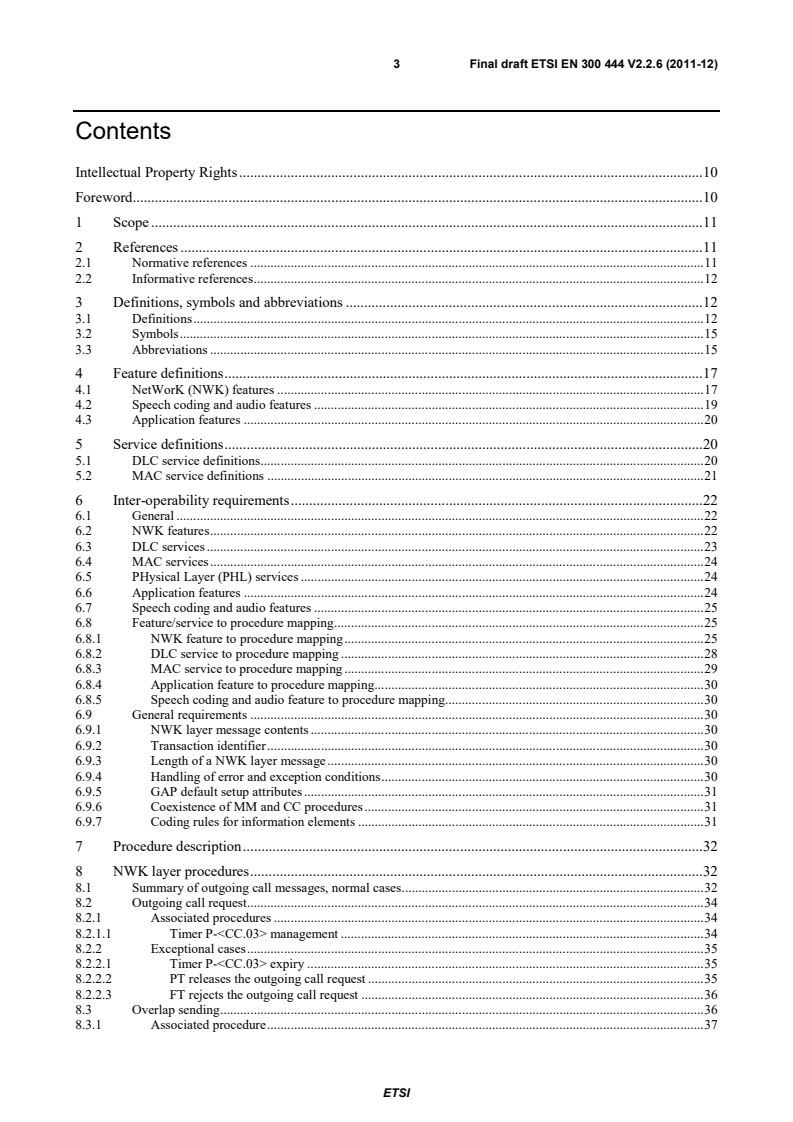
3 Final draft ETSI EN 300 444 V2.2.6 (2011-12)
Contents
Intellectual Property Rights . 10
Foreword . 10
1 Scope . 11
2 References . 11
2.1 Normative references . 11
2.2 Informative references . 12
3 Definitions, symbols and abbreviations . 12
3.1 Definitions . 12
3.2 Symbols . 15
3.3 Abbreviations . 15
4 Feature definitions . 17
4.1 NetWorK (NWK) features . 17
4.2 Speech coding and audio features . 19
4.3 Application features . 20
5 Service definitions . 20
5.1 DLC service definitions . 20
5.2 MAC service definitions . 21
6 Inter-operability requirements . 22
6.1 General . 22
6.2 NWK features . 22
6.3 DLC services . 23
6.4 MAC services . 24
6.5 PHysical Layer (PHL) services . 24
6.6 Application features . 24
6.7 Speech coding and audio features . 25
6.8 Feature/service to procedure mapping . 25
6.8.1 NWK feature to procedure mapping . 25
6.8.2 DLC service to procedure mapping . 28
6.8.3 MAC service to procedure mapping . 29
6.8.4 Application feature to procedure mapping . 30
6.8.5 Speech coding and audio feature to procedure mapping. 30
6.9 General requirements . 30
6.9.1 NWK layer message contents . 30
6.9.2 Transaction identifier . 30
6.9.3 Length of a NWK layer message . 30
6.9.4 Handling of error and exception conditions . 30
6.9.5 GAP default setup attributes . 31
6.9.6 Coexistence of MM and CC procedures . 31
6.9.7 Coding rules for information elements . 31
7 Procedure description . 32
8 NWK layer procedures . 32
8.1 Summary of outgoing call messages, normal cases . 32
8.2 Outgoing call request . 34
8.2.1 Associated procedures . 34
8.2.1.1 Timer P- management . 34
8.2.2 Exceptional cases . 35
8.2.2.1 Timer P- expiry . 35
8.2.2.2 PT releases the outgoing call request . 35
8.2.2.3 FT rejects the outgoing call request . 36
8.3 Overlap sending . 36
8.3.1 Associated procedure . 37
ETSI
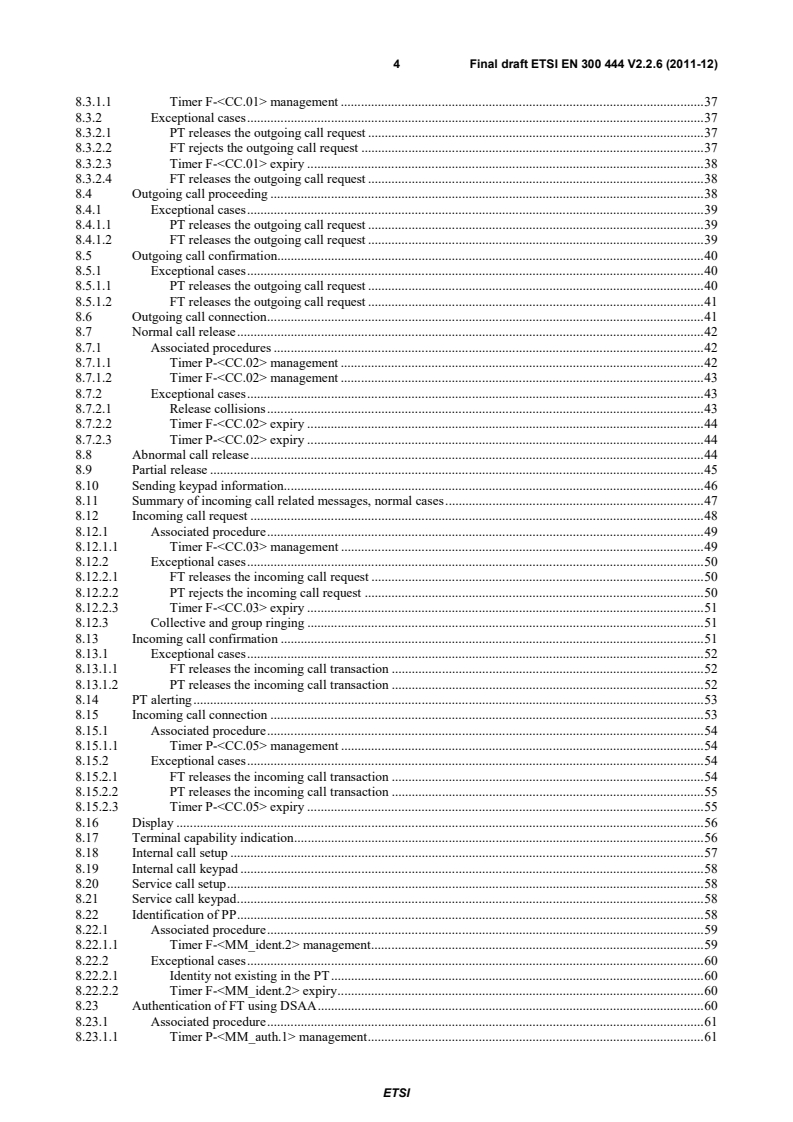
4 Final draft ETSI EN 300 444 V2.2.6 (2011-12)
8.3.1.1 Timer F- management . 37
8.3.2 Exceptional cases . 37
8.3.2.1 PT releases the outgoing call request . 37
8.3.2.2 FT rejects the outgoing call request . 37
8.3.2.3 Timer F- expiry . 38
8.3.2.4 FT releases the outgoing call request . 38
8.4 Outgoing call proceeding . 38
8.4.1 Exceptional cases . 39
8.4.1.1 PT releases the outgoing call request . 39
8.4.1.2 FT releases the outgoing call request . 39
8.5 Outgoing call confirmation. 40
8.5.1 Exceptional cases . 40
8.5.1.1 PT releases the outgoing call request . 40
8.5.1.2 FT releases the outgoing call request . 41
8.6 Outgoing call connection . 41
8.7 Normal call release . 42
8.7.1 Associated procedures . 42
8.7.1.1 Timer P- management . 42
8.7.1.2 Timer F- management . 43
8.7.2 Exceptional cases . 43
8.7.2.1 Release collisions . 43
8.7.2.2 Timer F- expiry . 44
8.7.2.3 Timer P- expiry . 44
8.8 Abnormal call release . 44
8.9 Partial release . 45
8.10 Sending keypad information. 46
8.11 Summary of incoming call related messages, normal cases . 47
8.12 Incoming call request . 48
8.12.1 Associated procedure . 49
8.12.1.1 Timer F- management . 49
8.12.2 Exceptional cases . 50
8.12.2.1 FT releases the incoming call request . 50
8.12.2.2 PT rejects the incoming call request . 50
8.12.2.3 Timer F- expiry . 51
8.12.3 Collective and group ringing . 51
8.13 Incoming call confirmation . 51
8.13.1 Exceptional cases . 52
8.13.1.1 FT releases the incoming call transaction . 52
8.13.1.2 PT releases the incoming call transaction . 52
8.14 PT alerting . 53
8.15 Incoming call connection . 53
8.15.1 Associated procedure . 54
8.15.1.1 Timer P- management . 54
8.15.2 Exceptional cases . 54
8.15.2.1 FT releases the incoming call transaction . 54
8.15.2.2 PT releases the incoming call transaction . 55
8.15.2.3 Timer P- expiry . 55
8.16 Display . 56
8.17 Terminal capability indication . 56
8.18 Internal call setup . 57
8.19 Internal call keypad . 58
8.20 Service call setup . 58
8.21 Service call keypad . 58
8.22 Identification of PP . 58
8.22.1 Associated procedure . 59
8.22.1.1 Timer F- management . 59
8.22.2 Exceptional cases . 60
8.22.2.1 Identity not existing in the PT . 60
8.22.2.2 Timer F- expiry . 60
8.23 Authentication of FT using DSAA . 60
8.23.1 Associated procedure . 61
8.23.1.1 Timer P- management . 61
ETSI
5 Final draft ETSI EN 300 444 V2.2.6 (2011-12)
8.23.2 Exceptional cases . 61
8.23.2.1 Authentication algorithm/key not supported . 61
8.23.2.2 FT Authentication failure (authentication challenge RES2 has wrong value) . 62
8.23.2.3 Timer P- expiry . 62
8.24 Authentication of PP using DSAA . 62
8.24.1 Associated procedure . 64
8.24.1.1 Timer F- management . 64
8.24.2 Exceptional cases . 64
8.24.2.1 Authentication algorithm/key not supported . 64
8.24.2.2 Timer F- expiry . 64
8.23.2.3 PP Authentication failure (authentication challenge RES1 has wrong value) . 64
8.25 Authentication of user using DSAA . 65
8.25.1 Associated procedure . 65
8.25.1.1 Timer F- management . 65
8.25.2 Exceptional cases . 66
8.25.2.1 Authentication algorithm/key not supported . 66
8.25.2.2 Timer F- expiry . 66
8.26 Incrementing the ZAP value . 66
8.27 Storing the DCK . 67
8.28 Location registration. 67
8.28.1 Associated procedures . 69
8.28.1.1 Timer P- management . 69
8.28.1.2 Timer F- management . 69
8.28.2 Exceptional cases . 69
8.28.2.1 FT rejects the location registration procedure . 69
8.28.2.2 Failure of location registration procedure . 70
8.28.2.3 PT rejects the identity assignment . 70
8.28.2.4 Timer F- expiry. 70
8.29 Location update . 70
8.30 Obtaining access rights . 71
8.30.1 Associated procedure . 73
8.30.1.1 Timer P- management . 73
8.30.2 Exceptional cases . 73
8.30.2.1 FT rejects the access rights . 73
8.30.2.2 Timer P- expiry. 74
8.31 FT terminating access rights . 74
8.31.1 Associated procedure . 75
8.31.1.1 Timer F- management . 75
8.31.2 Exceptional cases . 75
8.31.2.1 PT rejects the termination request . 75
8.31.2.2 Timer F- expiry. 75
8.32 Key allocation . 76
8.32.1 Associated procedures . 77
8.32.1.1 Timer F- management . 77
8.32.1.2 Timer P- management . 77
8.32.2 Exceptional cases . 78
8.32.2.1 Timer F- expiry . 78
8.32.2.2 Timer P- expiry . 78
8.32.2.3 Allocation-type element is unacceptable . 78
8.32.2.4 Authentication of PT fails . 78
8.32.2.5 Authentication of FT fails . 79
8.33 Cipher-switching initiated by FT using DSC . 79
8.33.1 Associated procedure . 80
8.33.1.1 Timer F- management . 80
8.33.2 Exceptional cases . 81
8.33.2.1 PT rejects the cipher request . 81
8.33.2.2 Timer F- expiry . 81
8.34 Cipher-switching initiated by PT using DSC . 81
8.34.1 Associated procedure . 83
8.34.1.1 Timer P- management . 83
8.34.2 Exceptional cases . 83
8.34.2.1 FT rejects the cipher request . 83
ETSI
6 Final draft ETSI EN 300 444 V2.2.6 (2011-12)
8.34.2.2 Timer P- expiry . 83
8.35 Indirect FT initiated link establishment . 84
8.35.1 Associated procedure . 85
8.35.1.1 Timer F- management . 85
8.35.2 Exceptional cases . 85
8.35.2.1 The IPUI received in the {LCE-PAGE-RESPONSE} does not match . 85
8.35.2.2 Timer expiry . 86
8.35.2.3 Release from the higher entity . 86
8.36 Direct PT initiated link establishment . 86
8.36.1 Exceptional case . 88
8.36.1.1 Link establishment failure . 88
8.37 Link release "normal" . 88
8.37.1 Associated procedure . 89
8.37.1.1 Timer management . 89
8.37.2 Exceptional cases . 90
8.37.2.1 Timer expiry . 90
8.37.2.2 Outstanding data has been discarded. 90
8.38 Link release "abnormal" . 91
8.39 Link release "maintain" . 91
8.39.1 Associated procedure . 91
8.39.1.1 Timer management . 91
8.40 Enhanced FT initiated U- plane connection . 91
8.41 Calling Line Identification Presentation (CLIP) Indication . 92
8.42 Calling Name Identification Presentation (CNIP) Indication . 92
8.43 Internal Call Calling Line Identification Presentation (CLIP) . 93
8.44 Internal Call Calling Name Identification Presentation (CNIP) . 94
8.45 Enhanced security procedures . 96
8.45.1 Encryption of all calls . 96
8.45.2 Re-keying during a call . 96
8.45.3 Early encryption . 97
8.45.4 Subscription requirements . 98
8.45.5 Enhanced security regarding legacy devices. 98
8.45.5.1 Behaviour of FPs regarding legacy PPs . 98
8.45.5.2 Behaviour of PPs regarding legacy FPs . 99
8.45.5.3 Behaviour regarding legacy 'repeater' devices . 99
8.45.6 Authentication of FT using DSAA2 . 100
8.45.6.1 Associated procedure . 101
8.45.6.1.1 Timer P- management . 101
8.45.6.2 Exceptional cases . 102
8.45.6.2.1 Authentication algorithm/key not supported . 102
8.45.6.2.2 FT Authentication failure (authentication challenge RES2 has wrong value) . 102
8.45.6.2.3 Timer P- expiry . 102
8.45.7 Authentication of PP using DSAA2 . 102
8.45.7.1 Associated procedure . 104
8.45.7.1.1 Timer F- management . 104
8.45.7.2 Exceptional cases . 105
8.45.7.2.1 Authentication algorithm/key not supported . 105
8.45.7.2.2 Timer F- expiry . 105
8.45.7.2.3 PP Authentication failure (authentication challenge RES1 has wrong value) . 105
8.45.8 Authentication of user using DSAA2 . 106
8.45.8.1 Associated procedure . 106
8.45.8.1.1 Timer F- management . 106
8.45.8.2 Exceptional cases . 106
8.45.8.2.1 Authentication algorithm/key not supported . 106
8.45.8.2.2 Timer F- expiry . 107
8.45.9 Key allocation using DSAA2. 107
8.45.9.1 Associated procedures . 109
8.45.9.1.1 Timer F- management . 109
8.45.9.1.2 Timer P- management . 109
8.45.9.2 Exceptional cases . 110
8.45.9.2.1 Timer F- expiry . 110
8.45.9.2.2 Timer P- expiry . 110
ETSI
7 Final draft ETSI EN 300 444 V2.2.6 (2011-12)
8.45.9.2.3 Allocation-type element is unacceptable . 110
8.45.9.2.4 Authentication of PT fails. 110
8.45.9.2.5 Authentication of FT fails. 111
8.45.10 Cipher-switching initiated by FT using DSC2 . 111
8.45.10.1 Associated procedure . 112
8.45.10.1.1 Timer F- management . 112
8.45.10.2 Exceptional cases . 113
8.45.10.2.1 PT rejects the cipher request . 113
8.45.10.2.2 Timer F- expiry . 113
8.45.11 Cipher-switching initiated by PT using DSC2 . 113
8.45.11.1 Associated procedure . 115
8.45.11.1.1 Timer P- management . 115
8.45.11.2 Exceptional cases . 115
8.45.11.2.1 FT rejects the cipher request . 115
8.45.11.2.2 Timer P- expiry . 115
9 DLC layer procedures . 116
9.1 Class A link establishment . 116
9.1.1 Associated procedures . 118
9.1.1.1 Timer P management . 118
9.1.1.2 Re-transmission counter management. 118
9.1.1.3 Multiple frame operation variables management . 118
9.1.1.4 Lower Layer Management Entity (LLME) establishment of a MAC connection . 118
9.1.2 Exceptional cases . 119
9.1.2.1 Timer P expiry . 119
9.1.2.2 Receipt of a request for link release . 120
9.1.2.3 Receipt of an indication for a connection release . 120
9.2 Class A Acknowledged Information transfer . 120
9.2.1 Acknowledgement with an I_frame . 120
9.2.2 Acknowledgement with a RR_frame . 121
9.2.3 Class A acknowledged information transfer with segment reassemble . 122
9.2.4 Associated procedures . 122
9.2.4.1 Timer management . 122
9.2.4.2 Re-transmission counter management. 122
9.2.4.3 Multiple frame operation variables management . 122
9.2.5 Exceptional cases . 123
9.2.5.1 Timer expiry .
...
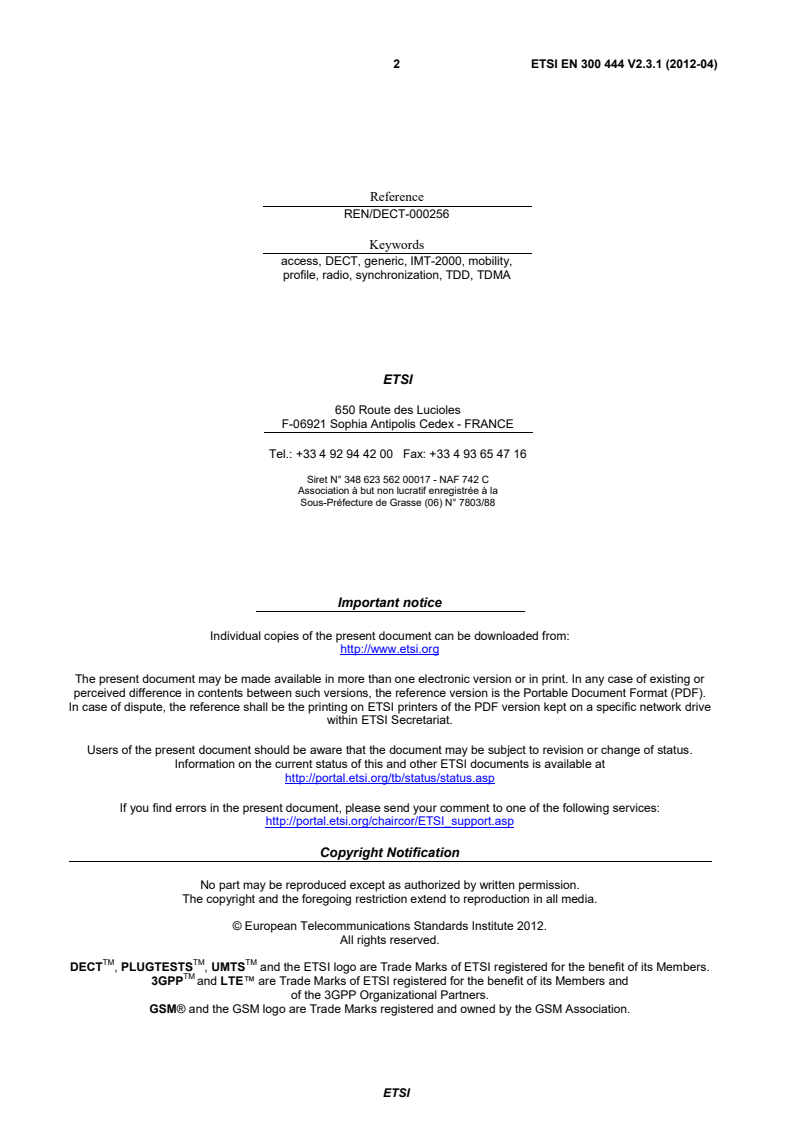
European Standard
Digital Enhanced Cordless Telecommunications (DECT);
Generic Access Profile (GAP)
2 ETSI EN 300 444 V2.3.1 (2012-04)
Reference
REN/DECT-000256
Keywords
access, DECT, generic, IMT-2000, mobility,
profile, radio, synchronization, TDD, TDMA
ETSI
650 Route des Lucioles
F-06921 Sophia Antipolis Cedex - FRANCE
Tel.: +33 4 92 94 42 00 Fax: +33 4 93 65 47 16
Siret N° 348 623 562 00017 - NAF 742 C
Association à but non lucratif enregistrée à la
Sous-Préfecture de Grasse (06) N° 7803/88
Important notice
Individual copies of the present document can be downloaded from:
http://www.etsi.org
The present document may be made available in more than one electronic version or in print. In any case of existing or
perceived difference in contents between such versions, the reference version is the Portable Document Format (PDF).
In case of dispute, the reference shall be the printing on ETSI printers of the PDF version kept on a specific network drive
within ETSI Secretariat.
Users of the present document should be aware that the document may be subject to revision or change of status.
Information on the current status of this and other ETSI documents is available at
http://portal.etsi.org/tb/status/status.asp
If you find errors in the present document, please send your comment to one of the following services:
http://portal.etsi.org/chaircor/ETSI_support.asp
Copyright Notification
No part may be reproduced except as authorized by written permission.
The copyright and the foregoing restriction extend to reproduction in all media.
© European Telecommunications Standards Institute 2012.
All rights reserved.
TM TM TM
DECT , PLUGTESTS , UMTS and the ETSI logo are Trade Marks of ETSI registered for the benefit of its Members.
TM
3GPP and LTE™ are Trade Marks of ETSI registered for the benefit of its Members and
of the 3GPP Organizational Partners.
GSM® and the GSM logo are Trade Marks registered and owned by the GSM Association.
ETSI
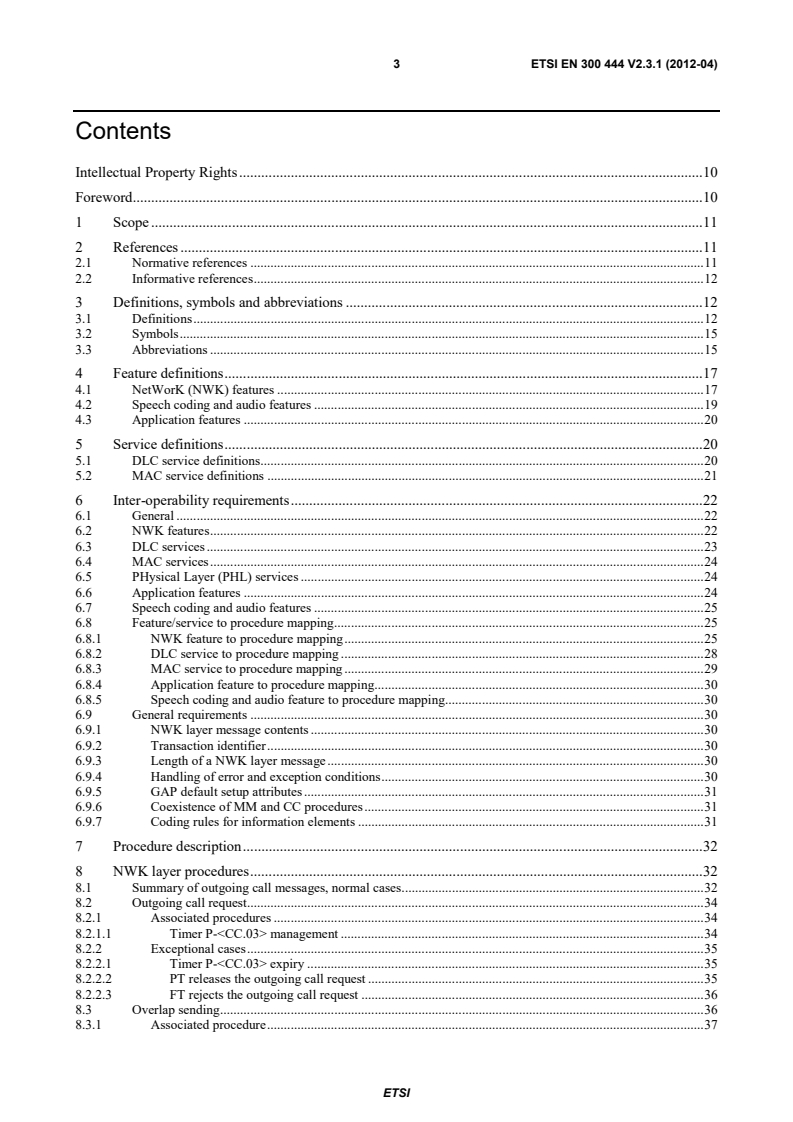
3 ETSI EN 300 444 V2.3.1 (2012-04)
Contents
Intellectual Property Rights . 10
Foreword . 10
1 Scope . 11
2 References . 11
2.1 Normative references . 11
2.2 Informative references . 12
3 Definitions, symbols and abbreviations . 12
3.1 Definitions . 12
3.2 Symbols . 15
3.3 Abbreviations . 15
4 Feature definitions . 17
4.1 NetWorK (NWK) features . 17
4.2 Speech coding and audio features . 19
4.3 Application features . 20
5 Service definitions . 20
5.1 DLC service definitions . 20
5.2 MAC service definitions . 21
6 Inter-operability requirements . 22
6.1 General . 22
6.2 NWK features . 22
6.3 DLC services . 23
6.4 MAC services . 24
6.5 PHysical Layer (PHL) services . 24
6.6 Application features . 24
6.7 Speech coding and audio features . 25
6.8 Feature/service to procedure mapping . 25
6.8.1 NWK feature to procedure mapping . 25
6.8.2 DLC service to procedure mapping . 28
6.8.3 MAC service to procedure mapping . 29
6.8.4 Application feature to procedure mapping . 30
6.8.5 Speech coding and audio feature to procedure mapping. 30
6.9 General requirements . 30
6.9.1 NWK layer message contents . 30
6.9.2 Transaction identifier . 30
6.9.3 Length of a NWK layer message . 30
6.9.4 Handling of error and exception conditions . 30
6.9.5 GAP default setup attributes . 31
6.9.6 Coexistence of MM and CC procedures . 31
6.9.7 Coding rules for information elements . 31
7 Procedure description . 32
8 NWK layer procedures . 32
8.1 Summary of outgoing call messages, normal cases . 32
8.2 Outgoing call request . 34
8.2.1 Associated procedures . 34
8.2.1.1 Timer P- management . 34
8.2.2 Exceptional cases . 35
8.2.2.1 Timer P- expiry . 35
8.2.2.2 PT releases the outgoing call request . 35
8.2.2.3 FT rejects the outgoing call request . 36
8.3 Overlap sending . 36
8.3.1 Associated procedure . 37
ETSI
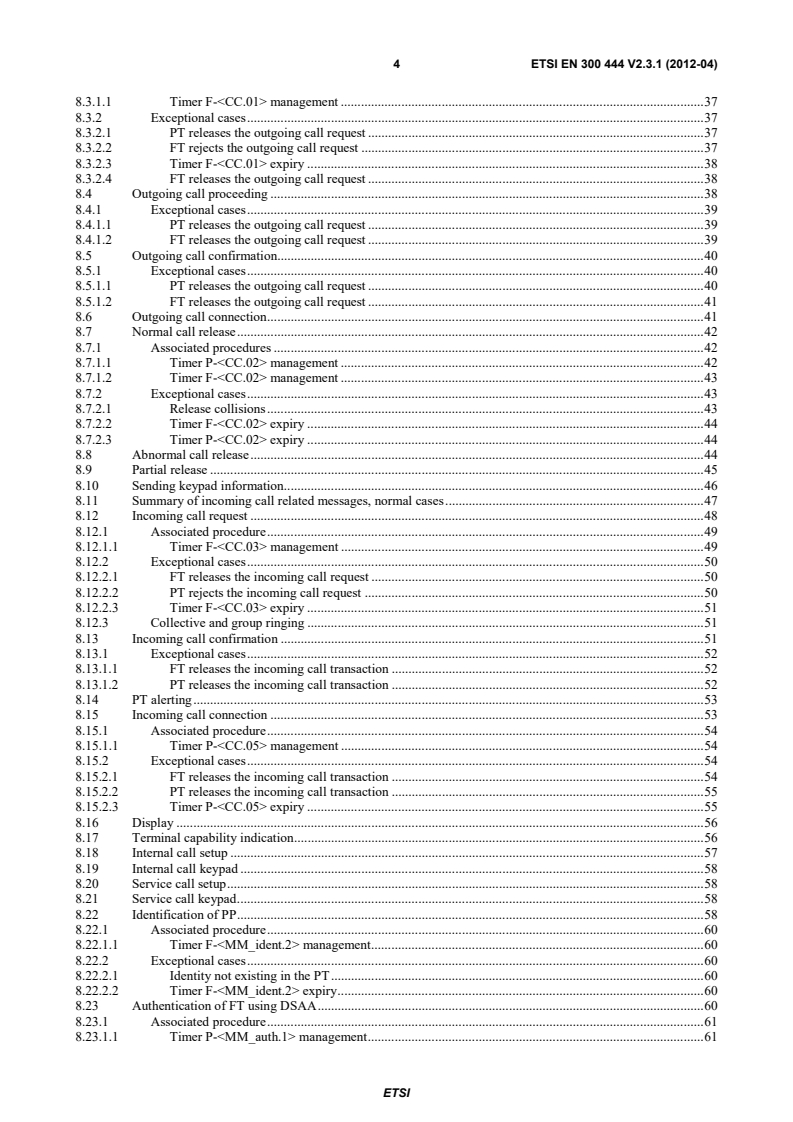
4 ETSI EN 300 444 V2.3.1 (2012-04)
8.3.1.1 Timer F- management . 37
8.3.2 Exceptional cases . 37
8.3.2.1 PT releases the outgoing call request . 37
8.3.2.2 FT rejects the outgoing call request . 37
8.3.2.3 Timer F- expiry . 38
8.3.2.4 FT releases the outgoing call request . 38
8.4 Outgoing call proceeding . 38
8.4.1 Exceptional cases . 39
8.4.1.1 PT releases the outgoing call request . 39
8.4.1.2 FT releases the outgoing call request . 39
8.5 Outgoing call confirmation. 40
8.5.1 Exceptional cases . 40
8.5.1.1 PT releases the outgoing call request . 40
8.5.1.2 FT releases the outgoing call request . 41
8.6 Outgoing call connection . 41
8.7 Normal call release . 42
8.7.1 Associated procedures . 42
8.7.1.1 Timer P- management . 42
8.7.1.2 Timer F- management . 43
8.7.2 Exceptional cases . 43
8.7.2.1 Release collisions . 43
8.7.2.2 Timer F- expiry . 44
8.7.2.3 Timer P- expiry . 44
8.8 Abnormal call release . 44
8.9 Partial release . 45
8.10 Sending keypad information. 46
8.11 Summary of incoming call related messages, normal cases . 47
8.12 Incoming call request . 48
8.12.1 Associated procedure . 49
8.12.1.1 Timer F- management . 49
8.12.2 Exceptional cases . 50
8.12.2.1 FT releases the incoming call request . 50
8.12.2.2 PT rejects the incoming call request . 50
8.12.2.3 Timer F- expiry . 51
8.12.3 Collective and group ringing . 51
8.13 Incoming call confirmation . 51
8.13.1 Exceptional cases . 52
8.13.1.1 FT releases the incoming call transaction . 52
8.13.1.2 PT releases the incoming call transaction . 52
8.14 PT alerting . 53
8.15 Incoming call connection . 53
8.15.1 Associated procedure . 54
8.15.1.1 Timer P- management . 54
8.15.2 Exceptional cases . 54
8.15.2.1 FT releases the incoming call transaction . 54
8.15.2.2 PT releases the incoming call transaction . 55
8.15.2.3 Timer P- expiry . 55
8.16 Display . 56
8.17 Terminal capability indication . 56
8.18 Internal call setup . 57
8.19 Internal call keypad . 58
8.20 Service call setup . 58
8.21 Service call keypad . 58
8.22 Identification of PP . 58
8.22.1 Associated procedure . 60
8.22.1.1 Timer F- management . 60
8.22.2 Exceptional cases . 60
8.22.2.1 Identity not existing in the PT . 60
8.22.2.2 Timer F- expiry . 60
8.23 Authentication of FT using DSAA . 60
8.23.1 Associated procedure . 61
8.23.1.1 Timer P- management . 61
ETSI
5 ETSI EN 300 444 V2.3.1 (2012-04)
8.23.2 Exceptional cases . 61
8.23.2.1 Authentication algorithm/key not supported . 61
8.23.2.2 FT Authentication failure (authentication challenge RES2 has wrong value) . 62
8.23.2.3 Timer P- expiry . 62
8.24 Authentication of PP using DSAA . 62
8.24.1 Associated procedure . 64
8.24.1.1 Timer F- management . 64
8.24.2 Exceptional cases . 64
8.24.2.1 Authentication algorithm/key not supported . 64
8.24.2.2 Timer F- expiry . 64
8.23.2.3 PP Authentication failure (authentication challenge RES1 has wrong value) . 64
8.25 Authentication of user using DSAA . 65
8.25.1 Associated procedure . 65
8.25.1.1 Timer F- management . 65
8.25.2 Exceptional cases . 66
8.25.2.1 Authentication algorithm/key not supported . 66
8.25.2.2 Timer F- expiry . 66
8.26 Incrementing the ZAP value . 66
8.27 Storing the DCK . 67
8.28 Location registration. 67
8.28.1 Associated procedures . 69
8.28.1.1 Timer P- management . 69
8.28.1.2 Timer F- management . 69
8.28.2 Exceptional cases . 69
8.28.2.1 FT rejects the location registration procedure . 69
8.28.2.2 Failure of location registration procedure . 70
8.28.2.3 PT rejects the identity assignment . 70
8.28.2.4 Timer F- expiry. 70
8.29 Location update . 70
8.30 Obtaining access rights . 71
8.30.1 Associated procedure . 73
8.30.1.1 Timer P- management . 73
8.30.2 Exceptional cases . 73
8.30.2.1 FT rejects the access rights . 73
8.30.2.2 Timer P- expiry. 74
8.31 FT terminating access rights . 74
8.31.1 Associated procedure . 75
8.31.1.1 Timer F- management . 75
8.31.2 Exceptional cases . 75
8.31.2.1 PT rejects the termination request . 75
8.31.2.2 Timer F- expiry. 75
8.32 Key allocation . 76
8.32.1 Associated procedures . 77
8.32.1.1 Timer F- management . 77
8.32.1.2 Timer P- management . 78
8.32.2 Exceptional cases . 78
8.32.2.1 Timer F- expiry . 78
8.32.2.2 Timer P- expiry . 78
8.32.2.3 Allocation-type element is unacceptable . 78
8.32.2.4 Authentication of PT fails . 79
8.32.2.5 Authentication of FT fails . 79
8.33 Cipher-switching initiated by FT using DSC . 79
8.33.1 Associated procedure . 81
8.33.1.1 Timer F- management . 81
8.33.2 Exceptional cases . 81
8.33.2.1 PT rejects the cipher request . 81
8.33.2.2 Timer F- expiry . 81
8.34 Cipher-switching initiated by PT using DSC . 82
8.34.1 Associated procedure . 83
8.34.1.1 Timer P- management . 83
8.34.2 Exceptional cases . 83
8.34.2.1 FT rejects the cipher request . 83
ETSI
6 ETSI EN 300 444 V2.3.1 (2012-04)
8.34.2.2 Timer P- expiry . 84
8.35 Indirect FT initiated link establishment . 84
8.35.1 Associated procedure . 85
8.35.1.1 Timer F- management . 85
8.35.2 Exceptional cases . 85
8.35.2.1 The IPUI received in the {LCE-PAGE-RESPONSE} does not match . 85
8.35.2.2 Timer expiry . 86
8.35.2.3 Release from the higher entity . 86
8.36 Direct PT initiated link establishment . 86
8.36.1 Exceptional case . 88
8.36.1.1 Link establishment failure . 88
8.37 Link release "normal" . 88
8.37.1 Associated procedure . 90
8.37.1.1 Timer management . 90
8.37.2 Exceptional cases . 90
8.37.2.1 Timer expiry . 90
8.37.2.2 Outstanding data has been discarded. 90
8.38 Link release "abnormal" . 91
8.39 Link release "maintain" . 91
8.39.1 Associated procedure . 91
8.39.1.1 Timer management . 91
8.40 Enhanced FT initiated U- plane connection . 92
8.41 Calling Line Identification Presentation (CLIP) Indication . 92
8.42 Calling Name Identification Presentation (CNIP) Indication . 93
8.43 Internal Call Calling Line Identification Presentation (CLIP) . 93
8.44 Internal Call Calling Name Identification Presentation (CNIP) . 94
8.45 Enhanced security procedures . 96
8.45.1 Encryption of all calls . 96
8.45.2 Re-keying during a call . 96
8.45.3 Early encryption . 97
8.45.4 Subscription requirements . 98
8.45.5 Enhanced security regarding legacy devices. 98
8.45.5.1 Behaviour of FPs regarding legacy PPs . 98
8.45.5.2 Behaviour of PPs regarding legacy FPs . 99
8.45.5.3 Behaviour regarding legacy 'repeater' devices . 99
8.45.6 Authentication of FT using DSAA2 . 100
8.45.6.1 Associated procedure . 101
8.45.6.1.1 Timer P- management . 101
8.45.6.2 Exceptional cases . 102
8.45.6.2.1 Authentication algorithm/key not supported . 102
8.45.6.2.2 FT Authentication failure (authentication challenge RES2 has wrong value) . 102
8.45.6.2.3 Timer P- expiry . 102
8.45.7 Authentication of PP using DSAA2 . 102
8.45.7.1 Associated procedure . 105
8.45.7.1.1 Timer F- management . 105
8.45.7.2 Exceptional cases . 105
8.45.7.2.1 Authentication algorithm/key not supported . 105
8.45.7.2.2 Timer F- expiry . 105
8.45.7.2.3 PP Authentication failure (authentication challenge RES1 has wrong value) . 105
8.45.8 Authentication of user using DSAA2 . 106
8.45.8.1 Associated procedure . 106
8.45.8.1.1 Timer F- management . 106
8.45.8.2 Exceptional cases . 106
8.45.8.2.1 Authentication algorithm/key not supported . 106
8.45.8.2.2 Timer F- expiry . 107
8.45.9 Key allocation using DSAA2. 107
8.45.9.1 Associated procedures . 109
8.45.9.1.1 Timer F- management . 109
8.45.9.1.2 Timer P- management . 109
8.45.9.2 Exceptional cases . 110
8.45.9.2.1 Timer F- expiry . 110
8.45.9.2.2 Timer P- expiry . 110
ETSI
7 ETSI EN 300 444 V2.3.1 (2012-04)
8.45.9.2.3 Allocation-type element is unacceptable . 110
8.45.9.2.4 Authentication of PT fails. 110
8.45.9.2.5 Authentication of FT fails. 111
8.45.10 Cipher-switching initiated by FT using DSC2 . 111
8.45.10.1 Associated procedure . 112
8.45.10.1.1 Timer F- management . 112
8.45.10.2 Exceptional cases . 112
8.45.10.2.1 PT rejects the cipher request . 112
8.45.10.2.2 Timer F- expiry . 113
8.45.11 Cipher-switching initiated by PT using DSC2 . 113
8.45.11.1 Associated procedure . 115
8.45.11.1.1 Timer P- management . 115
8.45.11.2 Exceptional cases . 115
8.45.11.2.1 FT rejects the cipher request . 115
8.45.11.2.2 Timer P- expiry . 115
9 DLC layer procedures . 116
9.1 Class A link establishment . 116
9.1.1 Associated procedures . 118
9.1.1.1 Timer P management . 118
9.1.1.2 Re-transmission counter management. 118
9.1.1.3 Multiple frame operation variables management . 118
9.1.1.4 Lower Layer Management Entity (LLME) establishment of a MAC connection . 118
9.1.2 Exceptional cases . 119
9.1.2.1 Timer P expiry . 119
9.1.2.2 Receipt of a request for link release . 120
9.1.2.3 Receipt of an indication for a connection release . 120
9.2 Class A Acknowledged Information transfer . 120
9.2.1 Acknowledgement with an I_frame . 120
9.2.2 Acknowledgement with a RR_frame . 121
9.2.3 Class A acknowledged information transfer with segment reassemble . 122
9.2.4 Associated procedures . 122
9.2.4.1 Timer management . 122
9.2.4.2 Re-transmission counter management. 122
9.2.4.3 Multiple frame operation variables management . 122
9.2.5 Exceptional cases . 123
9.2.5.1 Timer expiry . 123
...
2003-01.Slovenski inštitut za standardizacijo. Razmnoževanje celote ali delov tega standarda ni dovoljeno.Digital Enhanced Cordless Telecommunications (DECT) - Generic Access Profile (GAP)33.070.30'(&7Digital Enhanced Cordless Telecommunications (DECT)ICS:Ta slovenski standard je istoveten z:EN 300 444 Version 2.3.1SIST EN 300 444 V2.3.1:2012en01-junij-2012SIST EN 300 444 V2.3.1:2012SLOVENSKI
STANDARD
European Standard SIST EN 300 444 V2.3.1:2012
ETSI ETSI EN 300 444 V2.3.1 (2012-04) 2
Reference REN/DECT-000256 Keywords access, DECT, generic, IMT-2000, mobility, profile, radio, synchronization, TDD, TDMA ETSI 650 Route des Lucioles F-06921 Sophia Antipolis Cedex - FRANCE
Tel.: +33 4 92 94 42 00
Fax: +33 4 93 65 47 16
Siret N° 348 623 562 00017 - NAF 742 C Association à but non lucratif enregistrée à la Sous-Préfecture de Grasse (06) N° 7803/88
Important notice Individual copies of the present document can be downloaded from: http://www.etsi.org The present document may be made available in more than one electronic version or in print. In any case of existing or perceived difference in contents between such versions, the reference version is the Portable Document Format (PDF). In case of dispute, the reference shall be the printing on ETSI printers of the PDF version kept on a specific network drive within ETSI Secretariat. Users of the present document should be aware that the document may be subject to revision or change of status. Information on the current status of this and other ETSI documents is available at http://portal.etsi.org/tb/status/status.asp If you find errors in the present document, please send your comment to one of the following services: http://portal.etsi.org/chaircor/ETSI_support.asp Copyright Notification No part may be reproduced except as authorized by written permission. The copyright and the foregoing restriction extend to reproduction in all media.
© European Telecommunications Standards Institute 2012. All rights reserved.
DECTTM, PLUGTESTSTM, UMTSTM and the ETSI logo are Trade Marks of ETSI registered for the benefit of its Members. 3GPPTM and LTE™ are Trade Marks of ETSI registered for the benefit of its Members and of the 3GPP Organizational Partners. GSM® and the GSM logo are Trade Marks registered and owned by the GSM Association. SIST EN 300 444 V2.3.1:2012
ETSI ETSI EN 300 444 V2.3.1 (2012-04) 3 Contents Intellectual Property Rights . 10 Foreword . 10 1 Scope . 11 2 References . 11 2.1 Normative references . 11 2.2 Informative references . 12 3 Definitions, symbols and abbreviations . 12 3.1 Definitions . 12 3.2 Symbols . 15 3.3 Abbreviations . 15 4 Feature definitions . 17 4.1 NetWorK (NWK) features . 17 4.2 Speech coding and audio features . 19 4.3 Application features . 20 5 Service definitions . 20 5.1 DLC service definitions . 20 5.2 MAC service definitions . 21 6 Inter-operability requirements . 22 6.1 General . 22 6.2 NWK features . 22 6.3 DLC services . 23 6.4 MAC services . 24 6.5 PHysical Layer (PHL) services . 24 6.6 Application features . 24 6.7 Speech coding and audio features . 25 6.8 Feature/service to procedure mapping . 25 6.8.1 NWK feature to procedure mapping . 25 6.8.2 DLC service to procedure mapping . 28 6.8.3 MAC service to procedure mapping . 29 6.8.4 Application feature to procedure mapping . 30 6.8.5 Speech coding and audio feature to procedure mapping. 30 6.9 General requirements . 30 6.9.1 NWK layer message contents . 30 6.9.2 Transaction identifier . 30 6.9.3 Length of a NWK layer message . 30 6.9.4 Handling of error and exception conditions . 30 6.9.5 GAP default setup attributes . 31 6.9.6 Coexistence of MM and CC procedures . 31 6.9.7 Coding rules for information elements . 31 7 Procedure description . 32 8 NWK layer procedures . 32 8.1 Summary of outgoing call messages, normal cases . 32 8.2 Outgoing call request . 34 8.2.1 Associated procedures . 34 8.2.1.1 Timer P- management . 34 8.2.2 Exceptional cases . 35 8.2.2.1 Timer P- expiry . 35 8.2.2.2 PT releases the outgoing call request . 35 8.2.2.3 FT rejects the outgoing call request . 36 8.3 Overlap sending . 36 8.3.1 Associated procedure . 37 SIST EN 300 444 V2.3.1:2012
ETSI ETSI EN 300 444 V2.3.1 (2012-04) 4 8.3.1.1 Timer F- management . 37 8.3.2 Exceptional cases . 37 8.3.2.1 PT releases the outgoing call request . 37 8.3.2.2 FT rejects the outgoing call request . 37 8.3.2.3 Timer F- expiry . 38 8.3.2.4 FT releases the outgoing call request . 38 8.4 Outgoing call proceeding . 38 8.4.1 Exceptional cases . 39 8.4.1.1 PT releases the outgoing call request . 39 8.4.1.2 FT releases the outgoing call request . 39 8.5 Outgoing call confirmation. 40 8.5.1 Exceptional cases . 40 8.5.1.1 PT releases the outgoing call request . 40 8.5.1.2 FT releases the outgoing call request . 41 8.6 Outgoing call connection . 41 8.7 Normal call release . 42 8.7.1 Associated procedures . 42 8.7.1.1 Timer P- management . 42 8.7.1.2 Timer F- management . 43 8.7.2 Exceptional cases . 43 8.7.2.1 Release collisions . 43 8.7.2.2 Timer F- expiry . 44 8.7.2.3 Timer P- expiry . 44 8.8 Abnormal call release . 44 8.9 Partial release . 45 8.10 Sending keypad information. 46 8.11 Summary of incoming call related messages, normal cases . 47 8.12 Incoming call request . 48 8.12.1 Associated procedure . 49 8.12.1.1 Timer F- management . 49 8.12.2 Exceptional cases . 50 8.12.2.1 FT releases the incoming call request . 50 8.12.2.2 PT rejects the incoming call request . 50 8.12.2.3 Timer F- expiry . 51 8.12.3 Collective and group ringing . 51 8.13 Incoming call confirmation . 51 8.13.1 Exceptional cases . 52 8.13.1.1 FT releases the incoming call transaction . 52 8.13.1.2 PT releases the incoming call transaction . 52 8.14 PT alerting . 53 8.15 Incoming call connection . 53 8.15.1 Associated procedure . 54 8.15.1.1 Timer P- management . 54 8.15.2 Exceptional cases . 54 8.15.2.1 FT releases the incoming call transaction . 54 8.15.2.2 PT releases the incoming call transaction . 55 8.15.2.3 Timer P- expiry . 55 8.16 Display . 56 8.17 Terminal capability indication . 56 8.18 Internal call setup . 57 8.19 Internal call keypad . 58 8.20 Service call setup . 58 8.21 Service call keypad . 58 8.22 Identification of PP . 58 8.22.1 Associated procedure . 60 8.22.1.1 Timer F- management . 60 8.22.2 Exceptional cases . 60 8.22.2.1 Identity not existing in the PT . 60 8.22.2.2 Timer F- expiry . 60 8.23 Authentication of FT using DSAA . 60 8.23.1 Associated procedure . 61 8.23.1.1 Timer P- management . 61 SIST EN 300 444 V2.3.1:2012
ETSI ETSI EN 300 444 V2.3.1 (2012-04) 5 8.23.2 Exceptional cases . 61 8.23.2.1 Authentication algorithm/key not supported . 61 8.23.2.2 FT Authentication failure (authentication challenge RES2 has wrong value) . 62 8.23.2.3 Timer P- expiry . 62 8.24 Authentication of PP using DSAA . 62 8.24.1 Associated procedure . 64 8.24.1.1 Timer F- management . 64 8.24.2 Exceptional cases . 64 8.24.2.1 Authentication algorithm/key not supported . 64 8.24.2.2 Timer F- expiry . 64 8.23.2.3 PP Authentication failure (authentication challenge RES1 has wrong value) . 64 8.25 Authentication of user using DSAA . 65 8.25.1 Associated procedure . 65 8.25.1.1 Timer F- management . 65 8.25.2 Exceptional cases . 66 8.25.2.1 Authentication algorithm/key not supported . 66 8.25.2.2 Timer F- expiry . 66 8.26 Incrementing the ZAP value . 66 8.27 Storing the DCK . 67 8.28 Location registration. 67 8.28.1 Associated procedures . 69 8.28.1.1 Timer P- management . 69 8.28.1.2 Timer F- management . 69 8.28.2 Exceptional cases . 69 8.28.2.1 FT rejects the location registration procedure . 69 8.28.2.2 Failure of location registration procedure . 70 8.28.2.3 PT rejects the identity assignment . 70 8.28.2.4 Timer F- expiry. 70 8.29 Location update . 70 8.30 Obtaining access rights . 71 8.30.1 Associated procedure . 73 8.30.1.1 Timer P- management . 73 8.30.2 Exceptional cases . 73 8.30.2.1 FT rejects the access rights . 73 8.30.2.2 Timer P- expiry. 74 8.31 FT terminating access rights . 74 8.31.1 Associated procedure . 75 8.31.1.1 Timer F- management . 75 8.31.2 Exceptional cases . 75 8.31.2.1 PT rejects the termination request . 75 8.31.2.2 Timer F- expiry. 75 8.32 Key allocation . 76 8.32.1 Associated procedures . 77 8.32.1.1 Timer F- management . 77 8.32.1.2 Timer P- management . 78 8.32.2 Exceptional cases . 78 8.32.2.1 Timer F- expiry . 78 8.32.2.2 Timer P- expiry . 78 8.32.2.3 Allocation-type element is unacceptable . 78 8.32.2.4 Authentication of PT fails . 79 8.32.2.5 Authentication of FT fails . 79 8.33 Cipher-switching initiated by FT using DSC . 79 8.33.1 Associated procedure . 81 8.33.1.1 Timer F- management . 81 8.33.2 Exceptional cases . 81 8.33.2.1 PT rejects the cipher request . 81 8.33.2.2 Timer F- expiry . 81 8.34 Cipher-switching initiated by PT using DSC . 82 8.34.1 Associated procedure . 83 8.34.1.1 Timer P- management . 83 8.34.2 Exceptional cases . 83 8.34.2.1 FT rejects the cipher request . 83 SIST EN 300 444 V2.3.1:2012
ETSI ETSI EN 300 444 V2.3.1 (2012-04) 6 8.34.2.2 Timer P- expiry . 84 8.35 Indirect FT initiated link establishment . 84 8.35.1 Associated procedure . 85 8.35.1.1 Timer F- management . 85 8.35.2 Exceptional cases . 85 8.35.2.1 The IPUI received in the {LCE-PAGE-RESPONSE} does not match . 85 8.35.2.2 Timer expiry . 86 8.35.2.3 Release from the higher entity . 86 8.36 Direct PT initiated link establishment . 86 8.36.1 Exceptional case . 88 8.36.1.1 Link establishment failure . 88 8.37 Link release "normal" . 88 8.37.1 Associated procedure . 90 8.37.1.1 Timer management . 90 8.37.2 Exceptional cases . 90 8.37.2.1 Timer expiry . 90 8.37.2.2 Outstanding data has been discarded. 90 8.38 Link release "abnormal" . 91 8.39 Link release "maintain" . 91 8.39.1 Associated procedure . 91 8.39.1.1 Timer management . 91 8.40 Enhanced FT initiated U- plane connection . 92 8.41 Calling Line Identification Presentation (CLIP) Indication . 92 8.42 Calling Name Identification Presentation (CNIP) Indication . 93 8.43 Internal Call Calling Line Identification Presentation (CLIP) . 93 8.44 Internal Call Calling Name Identification Presentation (CNIP) . 94 8.45 Enhanced security procedures . 96 8.45.1 Encryption of all calls . 96 8.45.2 Re-keying during a call . 96 8.45.3 Early encryption . 97 8.45.4 Subscription requirements . 98 8.45.5 Enhanced security regarding legacy devices. 98 8.45.5.1 Behaviour of FPs regarding legacy PPs . 98 8.45.5.2 Behaviour of PPs regarding legacy FPs . 99 8.45.5.3 Behaviour regarding legacy 'repeater' devices . 99 8.45.6 Authentication of FT using DSAA2 . 100 8.45.6.1 Associated procedure . 101 8.45.6.1.1 Timer P- management . 101 8.45.6.2 Exceptional cases . 102 8.45.6.2.1 Authentication algorithm/key not supported . 102 8.45.6.2.2 FT Authentication failure (authentication challenge RES2 has wrong value) . 102 8.45.6.2.3 Timer P- expiry . 102 8.45.7 Authentication of PP using DSAA2 . 102 8.45.7.1 Associated procedure . 105 8.45.7.1.1 Timer F- management . 105 8.45.7.2 Exceptional cases . 105 8.45.7.2.1 Authentication algorithm/key not supported . 105 8.45.7.2.2 Timer F- expiry . 105 8.45.7.2.3 PP Authentication failure (authentication challenge RES1 has wrong value) . 105 8.45.8 Authentication of user using DSAA2 . 106 8.45.8.1 Associated procedure . 106 8.45.8.1.1 Timer F- management . 106 8.45.8.2 Exceptional cases . 106 8.45.8.2.1 Authentication algorithm/key not supported . 106 8.45.8.2.2 Timer F- expiry . 107 8.45.9 Key allocation using DSAA2. 107 8.45.9.1 Associated procedures . 109 8.45.9.1.1 Timer F- management . 109 8.45.9.1.2 Timer P- management . 109 8.45.9.2 Exceptional cases . 110 8.45.9.2.1 Timer F- expiry . 110 8.45.9.2.2 Timer P- expiry . 110 SIST EN 300 444 V2.3.1:2012
ETSI ETSI EN 300 444 V2.3.1 (2012-04) 7 8.45.9.2.3 Allocation-type element is unacceptable . 110 8.45.9.2.4 Authentication of PT fails. 110 8.45.9.2.5 Authentication of FT fails. 111 8.45.10 Cipher-switching initiated by FT using DSC2 . 111 8.45.10.1 Associated procedure . 112 8.45.10.1.1 Timer F- management . 112 8.45.10.2 Exceptional cases . 112 8.45.10.2.1 PT rejects the cipher request . 112 8.45.10.2.2 Timer F- expiry . 113 8.45.11 Cipher-switching initiated by PT using DSC2 . 113 8.45.11.1 Associated procedure . 115 8.45.11.1.1 Timer P- management . 115 8.45.11.2 Exceptional cases . 115 8.45.11.2.1 FT rejects the cipher request . 115 8.45.11.2.2 Timer P- expiry . 115 9 DLC layer procedures . 116 9.1 Class A link establishment . 116 9.1.1 Associated procedures . 118 9.1.1.1 Timer P management . 118 9.1.1.2 Re-transmission counter management. 118 9.1.1.3 Multiple frame operation variables management . 118 9.1.1.4 Lower Layer Management Entity (LLME) establishment of a MAC connection . 118 9.1.2 Exceptional cases . 119 9.1.2.1 Timer P expiry . 119 9.1.2.2 Receipt of a request for link release . 120 9.1.2.3 Receipt of an indication for a connection release . 120 9.2 Class A Acknowledged Information transfer . 120 9.2.1 Acknowledgement with an I_frame . 120 9.2.2 Acknowledgement with a RR_frame . 121 9.2.3 Class A acknowledged information transfer with segment reassemble . 122 9.2.4 Associated procedures . 122 9.2.4.1 Timer management . 122 9.2.4.2 Re-transmission counter management. 122 9.2.4.3 Multiple frame operation variables management . 122 9.2.5 Exceptional cases . 123 9.2.5.1 Timer expiry . 123 9.2.5.2 Receipt of a request for link release .
...
Questions, Comments and Discussion
Ask us and Technical Secretary will try to provide an answer. You can facilitate discussion about the standard in here.
Loading comments...