

EN 61959:2004
(Main)Secondary cells and batteries containing alkaline or other non-acid electrolytes - Mechanical tests for sealed portable secondary cells and batteries
General Information
- Abstract
This International standard specifies tests and requirements for verifying the mechanical behaviour of sealed portable secondary cells and batteries during handling and normal use
- Status
- Published
- Publication Date
- 22-Mar-2004
- Withdrawal Date
- 28-Feb-2007
- Technical Committee
- CLC/TC 21X - Secondary cells and batteries
- Drafting Committee
- IEC/SC 21A - IEC_SC_21A
- Parallel Committee
- IEC/SC 21A - IEC_SC_21A
- Current Stage
- 9093 - Decision to confirm - Review Enquiry
- Start Date
- 05-Jan-2026
- Completion Date
- 25-Aug-2026



Overview
EN 61959:2004 is a European standard developed by CLC that defines mechanical test methods for sealed portable secondary cells and batteries containing alkaline or other non-acid electrolytes. This standard ensures the mechanical robustness of rechargeable batteries such as Ni-Cd, Ni-MH, and lithium-based cells during handling and normal use. Mechanical testing focuses on vibration and free fall tests to evaluate the durability and safety of portable batteries, supporting reliable performance in diverse applications.
Key Topics
- Scope and Purpose: EN 61959:2004 specifies mechanical tests designed to verify the structural integrity and functionality of sealed portable secondary cells and batteries with non-acid electrolytes under typical mechanical stresses.
- Test Methods:
- Vibration Test: Conducted according to IEC 60068-2-6, this test exposes cells and batteries to sinusoidal vibrations across three perpendicular axes. Parameters include frequencies from 10 Hz to 500 Hz and amplitudes up to 0.35 mm peak or a maximum acceleration of 50 m/s².
- Free Fall Test: Based on IEC 60068-2-32, this test simulates drop impacts from specified heights onto hardwood surfaces for cells and hard pack batteries weighing up to 500 g. It involves one drop in each of three mutually perpendicular directions.
- Acceptance Criteria:
- Post-test open circuit voltage must meet minimum thresholds defined by cell chemistry (e.g., 1.0 V for Ni-Cd and Ni-MH, 3.0 V for lithium cells).
- Discharge duration at a constant current of 0.2 ItA should exceed 5 hours after testing.
- Visual inspection confirming absence of liquid leakage and venting is mandatory.
- Type Approval & Batch Acceptance: Defined sample sizes and acceptable defect tolerances for type approval; batch acceptance tests conducted based on supplier-purchaser agreements.
Applications
The standard applies to manufacturers, quality control personnel, and device designers involved in producing and validating rechargeable sealed cells and batteries for portable electronics. Typical uses include:
- Mobile phones, laptops, and portable communication devices
- Handheld tools and medical devices requiring robust power sources
- Consumer electronics with stringent safety and reliability demands
Compliance with EN 61959:2004 helps ensure batteries maintain mechanical integrity during transport, everyday handling, and accidental drops, reducing risks of failure, leakage, or ignition.
Related Standards
EN 61959:2004 references key international and European standards for electrical and mechanical testing of secondary cells and batteries:
- IEC 60068 Series: Environmental testing methods such as vibration (IEC 60068-2-6) and free fall/drop tests (IEC 60068-2-32) form the basis for mechanical testing procedures.
- IEC 60050-486: Provides essential terminology for secondary cells and batteries.
- IEC 61951-1 & IEC 61951-2: Related standards covering portable sealed rechargeable cells, specifically nickel-cadmium and nickel-metal hydride chemistries.
- IEC 61960: Covers secondary lithium cells and batteries for portable applications, harmonized with EN 61960:2004.
Adherence to these harmonized standards promotes international uniformity and safety in rechargeable battery design and testing.
Keywords: EN 61959:2004, mechanical tests, sealed portable secondary batteries, alkaline electrolytes, non-acid electrolytes, vibration test, free fall test, Ni-Cd batteries, Ni-MH batteries, lithium cells, battery mechanical robustness, IEC 60068-2-6, IEC 60068-2-32, secondary cells, battery safety standards
Relations
- Effective Date
- 29-Jan-2023
- Effective Date
- 29-Jan-2023
- Effective Date
- 03-Feb-2026
- Effective Date
- 03-Feb-2026
- Refers
EN 60068-2-32:1993 - Basic environmental testing procedures - Part 2: Tests - Test Ed: Free fall - Effective Date
- 03-Feb-2026
- Effective Date
- 03-Feb-2026
- Effective Date
- 03-Feb-2026
- Effective Date
- 03-Feb-2026
- Effective Date
- 03-Feb-2026
- Effective Date
- 03-Feb-2026
- Effective Date
- 03-Feb-2026
- Effective Date
- 03-Feb-2026
- Effective Date
- 03-Feb-2026
Get Certified
Connect with accredited certification bodies for this standard

IMQ S.p.A. (Certification)
Italian electrical product certification.

SLG Prüf- und Zertifizierungs GmbH
German testing and certification body.

UL Solutions
Global safety science company with testing, inspection and certification.
Sponsored listings
Frequently Asked Questions
EN 61959:2004 is a standard published by CLC. Its full title is "Secondary cells and batteries containing alkaline or other non-acid electrolytes - Mechanical tests for sealed portable secondary cells and batteries". This standard covers: This International standard specifies tests and requirements for verifying the mechanical behaviour of sealed portable secondary cells and batteries during handling and normal use
This International standard specifies tests and requirements for verifying the mechanical behaviour of sealed portable secondary cells and batteries during handling and normal use
EN 61959:2004 is classified under the following ICS (International Classification for Standards) categories: 29.220.99 - Other cells and batteries. The ICS classification helps identify the subject area and facilitates finding related standards.
EN 61959:2004 has the following relationships with other standards: It is inter standard links to EN 61960-1:2001, EN 61960-2:2001, EN 60068-2-47:1999, EN 60068-2-6:1995, EN 60068-2-32:1993, EN 61951-1:2014, EN 61951-1:2003, EN IEC 62368-1:2024, EN 61951-2:2003, EN IEC 62368-1:2020, EN 61951-1:2017, EN 61951-2:2011, EN 61951-2:2017. Understanding these relationships helps ensure you are using the most current and applicable version of the standard.
EN 61959:2004 is available in PDF format for immediate download after purchase. The document can be added to your cart and obtained through the secure checkout process. Digital delivery ensures instant access to the complete standard document.
Standards Content (Sample)
STANDARDSecondary cells and batteries containing alkaline or other non-acid electrolytes - Mechanical tests for sealed portable secondary cells and batteries©
Standard je založil in izdal Slovenski inštitut za standardizacijo. Razmnoževanje ali kopiranje celote ali delov tega dokumenta ni dovoljenoReferenčna številkaSIST EN 61959:2004(en)ICS29.220.30
EUROPEAN STANDARD
EN 61959 NORME EUROPÉENNE EUROPÄISCHE NORM
March 2004 CENELEC European Committee for Electrotechnical Standardization Comité Européen de Normalisation Electrotechnique Europäisches Komitee für Elektrotechnische Normung
Central Secretariat: rue de Stassart 35, B - 1050 Brussels
© 2004 CENELEC - All rights of exploitation in any form and by any means reserved worldwide for CENELEC members.
Ref. No. EN 61959:2004 E
ICS 29.220.99
English version
Secondary cells and batteries containing alkaline
or other non-acid electrolytes –
Mechanical tests for sealed portable secondary cells and batteries (IEC 61959:2004)
Accumulateurs alcalins et autres accumulateurs à électrolyte non acide - Essais mécaniques pour accumulateurs portables étanches (CEI 61959:2004)
Akkumulatoren und Batterien mit alkalischem oder anderen nichtsäurehaltigen Elektrolyten - Mechanische Prüfungen für tragbare gasdichte Akkumulatoren und Batterien (IEC 61959:2004)
This European Standard was approved by CENELEC on 2004-03-01. CENELEC members are bound to comply with the CEN/CENELEC Internal Regulations which stipulate the conditions for giving this European Standard the status of a national standard without any alteration.
Up-to-date lists and bibliographical references concerning such national standards may be obtained on application to the Central Secretariat or to any CENELEC member.
This European Standard exists in three official versions (English, French, German). A version in any other language made by translation under the responsibility of a CENELEC member into its own language and notified to the Central Secretariat has the same status as the official versions.
CENELEC members are the national electrotechnical committees of Austria, Belgium, Cyprus, Czech Republic, Denmark, Estonia, Finland, France, Germany, Greece, Hungary, Iceland, Ireland, Italy, Latvia, Lithuania, Luxembourg, Malta, Netherlands, Norway, Poland, Portugal, Slovakia, Slovenia, Spain, Sweden, Switzerland and United Kingdom.
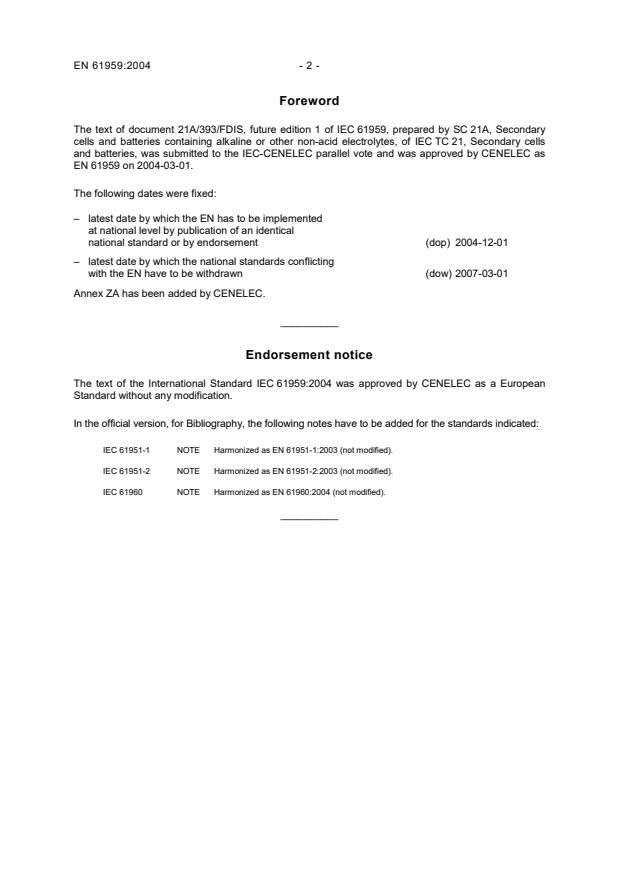
Foreword The text of document 21A/393/FDIS, future edition 1 of IEC 61959, prepared by SC 21A, Secondary cells and batteries containing alkaline or other non-acid electrolytes, of IEC TC 21, Secondary cells and batteries, was submitted to the IEC-CENELEC parallel vote and was approved by CENELEC as EN 61959 on 2004-03-01. The following dates were fixed: – latest date by which the EN has to be implemented
at national level by publication of an identical
national standard or by endorsement
(dop) 2004-12-01 – latest date by which the national standards conflicting
with the EN have to be withdrawn
(dow) 2007-03-01 Annex ZA has been added by CENELEC. __________ Endorsement notice The text of the International Standard IEC 61959:2004 was approved by CENELEC as a European Standard without any modification. In the official version, for Bibliography, the following notes have to be added for the standards indicated:
IEC 61951-1 NOTE Harmonized as EN 61951-1:2003 (not modified).
IEC 61951-2 NOTE Harmonized as EN 61951-2:2003 (not modified).
IEC 61960 NOTE Harmonized as EN 61960:2004 (not modified). __________
- 3 - EN 61959:2004
Annex ZA
(normative)
Normative references to international publications
with their corresponding European publications The following referenced documents are indispensable for the application of this document. For dated references, only the edition cited applies. For undated references, the latest edition of the referenced document (including any amendments) applies. NOTE Where an international publication has been modified by common modifications, indicated by (mod), the relevant EN/HD applies. Publication Year Title EN/HD Year IEC 60050-486 - 1) International Electrotechnical Vocabulary (IEV) Chapter 486: Secondary cells and batteries
- - IEC 60068-2-6 - 1) Environmental testing Part 2: Tests - Test Fc: Vibration (sinusoidal)
EN 60068-2-6 1995 2) IEC 60068-2-32 - 1) Part 2: Tests - Test Ed: Free fall
EN 60068-2-32 1993 2) IEC 60068-2-47 - 1) Part 2-47: Test methods - Mounting of components, equipment and other articles for vibration, impact and similar dynamic tests
EN 60068-2-47 + corr. June 1999 2) 2000
1) Undated reference. 2) Valid edition at date of issue.
NORMEINTERNATIONALECEIIECINTERNATIONALSTANDARD61959Première éditionFirst edition2004-01Accumulateurs alcalins et autres accumulateursà électrolyte non acide –Essais mécaniques pour accumulateursportables étanchesSecondary cells and batteries containingalkaline or other non-acid electrolytes –Mechanical tests for sealed portablesecondary cells and batteriesPour prix, voir catalogue en vigueurFor price, see current catalogue© IEC 2004
Droits de reproduction réservés
⎯
Copyright - all rights reservedAucune partie de cette publication ne peut être reproduite niutilisée sous quelque forme que ce soit et par aucun procédé,électronique ou mécanique, y compris la photocopie et lesmicrofilms, sans l'accord écrit de l'éditeur.No part of this publication may be reproduced or utilized in anyform or by any means, electronic or mechanical, includingphotocopying and microfilm, without permission in writing fromthe publisher.International Electrotechnical Commission,
3, rue de Varembé, PO Box 131, CH-1211 Geneva 20, SwitzerlandTelephone: +41 22 919 02 11
Telefax: +41 22 919 03 00
E-mail: inmail@iec.ch
Web: www.iec.chCODE PRIXPRICE CODEJCommission Electrotechnique InternationaleInternational Electrotechnical Commission
61959 © IEC:2004– 3 –CONTENTSFOREWORD.51Scope.92Normative references.93Terms and definitions.94Requirement for mechanical tests.114.1Vibration test.114.2Free fall test (cells and hard pack batteries only).135Type approval.156Batch acceptance.15Bibliography.17Table 1 – Conditions for vibration.11Table 2 – Open circuit voltages.11Table 3 – Conditions for free fall.13Table 4 – Height of fall as a function of weight.13Table 5 – Sample size for type tests.15
61959 © IEC:2004– 5 –INTERNATIONAL ELECTROTECHNICAL COMMISSION____________SECONDARY CELLS AND BATTERIES CONTAININGALKALINE OR OTHER NON-ACID ELECTROLYTES –MECHANICAL TESTS FOR SEALED PORTABLESECONDARY CELLS AND BATTERIESFOREWORD1)The International Electrotechnical Commission (IEC) is a worldwide organization for standardization comprisingall national electrotechnical committees (IEC National Committees). The object of IEC is to promoteinternational co-operation on all questions concerning standardization in the electrical and electronic fields. Tothis end and in addition to other activities, IEC publishes International Standards, Technical Specifications,Technical Reports, Publicly Available Specifications (PAS) and Guides (hereafter referred to as “IECPublication(s)”). Their preparation is entrusted to technical committees; any IEC National Committee interestedin the subject dealt with may participate in this preparatory work. International, governmental and non-governmental organizations liaising with the IEC also participate in this preparation. IEC collaborates closelywith the International Organization for Standardization (ISO) in accordance with conditions determined byagreement between the two organizations.2)The formal decisions or agreements of IEC on technical matters express, as nearly as possible, an internationalconsensus of opinion on the relevant subjects since each technical committee has representation from allinterested IEC National Committees.3)IEC Publications have the form of recommendations for international use and are accepted by IEC NationalCommittees in that sense. While all reasonable efforts are made to ensure that the technical content of IECPublications is accurate, IEC cannot be held responsible for the way in which they are used or for anymisinterpretation by any end user.4)In order to promote international uniformity, IEC National Committees undertake to apply IEC Publicationstransparently to the maximum extent possible in their national and regional publications. Any divergencebetween any IEC Publication and the corresponding national or regional
...