

EN 60312:2008
(Main)Vacuum cleaners for household use - Methods of measuring the performance
General Information
- Abstract
States and defines the principal performance characteristics of vacuum cleaners which are of interest to the user and describes the standard methods for measuring these characteristics.
- Status
- Published
- Publication Date
- 21-Feb-2008
- Withdrawal Date
- 31-Jan-2011
- Technical Committee
- CLC/TC 59X - Consumer information related to household electrical appliances
- Drafting Committee
- IEC/SC 59F - IEC_SC_59F
- Parallel Committee
- IEC/SC 59F - IEC_SC_59F
- Current Stage
- 6060 - Document made available - Publishing
- Start Date
- 22-Feb-2008
- Completion Date
- 22-Feb-2008



Overview
EN 60312:2008 (CENELEC) - identical to IEC 60312:2007 - defines standardized methods of measuring the performance of household vacuum cleaners. The standard sets out the principal performance characteristics of interest to users and prescribes how to measure them reproducibly in test laboratories. It supersedes earlier editions and includes updates (notably on performance with partly filled receptacles, dust emission measurement and energy consumption).
Keywords: EN 60312:2008, vacuum cleaner performance, methods of measuring, IEC 60312.
Key Topics
The standard organizes test methods and requirements across multiple technical areas, including:
- Dry vacuum cleaning tests
- Dust removal on hard floors, crevices and carpets
- Dust removal along walls, fibre and thread pickup
- Conditioning, dust distribution and embedding procedures
- Wet vacuum cleaning tests
- Wet cleaning effectiveness, soiling, cleaning cycles and drying
- Air and suction data
- Measurement of airflow, pressure (air data) and related equipment
- Dust emission
- Procedures to quantify particulate release from exhausts during use
- Performance with loaded dust receptacle
- Effect of partial/full dust bags or containers on cleaning performance
- Energy consumption and noise
- Measurement of electrical energy use during representative cleaning cycles and airborne acoustical noise
- Mechanical and durability tests
- Motion resistance, hose flexibility, impact and bump tests, dimensions, radius of operation, maximum usable dust receptacle volume
Test materials and equipment are specified (e.g., test carpets, standard test dust, moulding granules, carpet-beating machines and dust spreaders) to ensure repeatable results.
Keywords: dust removal, dust emission, energy consumption, noise level, test carpets, standard test dust.
Applications
EN 60312:2008 is used to:
- Validate product performance claims for consumer-facing documentation and marketing
- Provide test procedures for independent laboratories performing comparative tests
- Support product development and design trade-offs (suction vs. energy use, filtration vs. airflow)
- Inform regulatory compliance and voluntary labelling schemes (energy and noise)
- Serve as a reference for procurement specifications and retailer product evaluation
Who uses it: vacuum cleaner manufacturers, R&D and QA teams, test laboratories, certification bodies, retailers, standards committees and regulators.
Keywords: household vacuum cleaner testing, product certification, performance testing.
Related Standards
Relevant standards referenced in EN 60312:2008 include:
- IEC 60312:2007 (international edition)
- EN/IEC 60704-1 and EN/IEC 60704-2-1 (noise testing)
- IEC 60335-1 and IEC 60335-2-2 (safety of household appliances)
- ISO standards for atmospheric conditions and materials used in testing
Using EN 60312 ensures consistent, repeatable measurement of vacuum cleaner performance for trustworthy comparisons and regulatory or commercial use.
Relations
- Replaces
EN 60312:1998/A2:2004 - Vacuum cleaners for household use - Methods of measuring the performance - Effective Date
- 29-Jan-2023
- Effective Date
- 28-Jan-2023
- Replaces
EN 60312:1998/A1:2000 - Vacuum cleaners for household use - Methods of measuring the performance - Effective Date
- 28-Jan-2023
- Effective Date
- 29-Jan-2023
- Effective Date
- 28-Jan-2023
- Effective Date
- 10-Feb-2026
- Effective Date
- 09-Feb-2026
- Effective Date
- 09-Feb-2026
- Effective Date
- 09-Feb-2026
- Effective Date
- 09-Feb-2026
- Effective Date
- 03-Feb-2026
- Effective Date
- 03-Feb-2026
- Effective Date
- 03-Feb-2026
- Amended By
EN 60312:2008/prAA:2008 - Vacuum cleaners for household use - Methods of measuring the performance - Effective Date
- 28-Jan-2023
Frequently Asked Questions
EN 60312:2008 is a standard published by CLC. Its full title is "Vacuum cleaners for household use - Methods of measuring the performance". This standard covers: States and defines the principal performance characteristics of vacuum cleaners which are of interest to the user and describes the standard methods for measuring these characteristics.
States and defines the principal performance characteristics of vacuum cleaners which are of interest to the user and describes the standard methods for measuring these characteristics.
EN 60312:2008 is classified under the following ICS (International Classification for Standards) categories: 97.080 - Cleaning appliances. The ICS classification helps identify the subject area and facilitates finding related standards.
EN 60312:2008 has the following relationships with other standards: It is inter standard links to EN 60312:1998/A2:2004, EN 60312:1998, EN 60312:1998/A1:2000, FprEN 60312-2:2009, EN 60312-1:2013, ISO 554:1976, EN ISO 3386-1:1997, EN 915:1996, EN ISO 5167-1:2003, EN ISO 2439:2000, EN 60704-2-1:1994, EN 60704-1:1994, EN 60335-2-2:2010, EN 60312:2008/prAA:2008. Understanding these relationships helps ensure you are using the most current and applicable version of the standard.
EN 60312:2008 is available in PDF format for immediate download after purchase. The document can be added to your cart and obtained through the secure checkout process. Digital delivery ensures instant access to the complete standard document.
Standards Content (Sample)
2003-01.Slovenski inštitut za standardizacijo. Razmnoževanje celote ali delov tega standarda ni dovoljeno.Vacuum cleaners for household use - Methods of measuring the performanceSesalniki za uporabo v gospodinjstvu - Metode za merjenje lastnosti (IEC 60312:2007)Aspirateurs de poussière à usage domestique - Méthodes de mesure de l'aptitude à la fonctionStaubsauger für den Hausgebrauch - Prüfverfahren zur Bestimmung der Gebrauchseigenschaften97.080Aparati za nego talFloor treatment appliancesICS:SIST EN 60312:2008en,fr,deTa slovenski standard je istoveten z:EN 60312:200801-junij-2008SIST EN 60312:2008SLOVENSKI
STANDARDSIST EN 60312:2001/A2:2005SIST EN 60312:2001/A1:2001SIST EN 60312:20011DGRPHãþD
EUROPEAN STANDARD EN 60312 NORME EUROPÉENNE
EUROPÄISCHE NORM February 2008
CENELEC European Committee for Electrotechnical Standardization Comité Européen de Normalisation Electrotechnique Europäisches Komitee für Elektrotechnische Normung
Central Secretariat: rue de Stassart 35, B - 1050 Brussels
© 2008 CENELEC -
All rights of exploitation in any form and by any means reserved worldwide for CENELEC members.
Ref. No. EN 60312:2008 E
ICS 97.080 Supersedes EN 60312:1998 + A1:2000 + A2:2004
English version
Vacuum cleaners for household use -
Methods of measuring the performance (IEC 60312:2007)
Aspirateurs de poussière
à usage domestique -
Méthodes de mesure de l'aptitude
à la fonction (CEI 60312:2007)
Staubsauger für den Hausgebrauch -
Prüfverfahren zur Bestimmung
der Gebrauchseigenschaften (IEC 60312:2007)
This European Standard was approved by CENELEC on 2008-02-01. CENELEC members are bound to comply with the CEN/CENELEC Internal Regulations which stipulate the conditions for giving this European Standard the status of a national standard without any alteration.
Up-to-date lists and bibliographical references concerning such national standards may be obtained on application to the Central Secretariat or to any CENELEC member.
This European Standard exists in three official versions (English, French, German). A version in any other language made by translation under the responsibility of a CENELEC member into its own language and notified to the Central Secretariat has the same status as the official versions.
CENELEC members are the national electrotechnical committees of Austria, Belgium, Bulgaria, Cyprus, the Czech Republic, Denmark, Estonia, Finland, France, Germany, Greece, Hungary, Iceland, Ireland, Italy, Latvia, Lithuania, Luxembourg, Malta, the Netherlands, Norway, Poland, Portugal, Romania, Slovakia, Slovenia, Spain, Sweden, Switzerland and the United Kingdom.
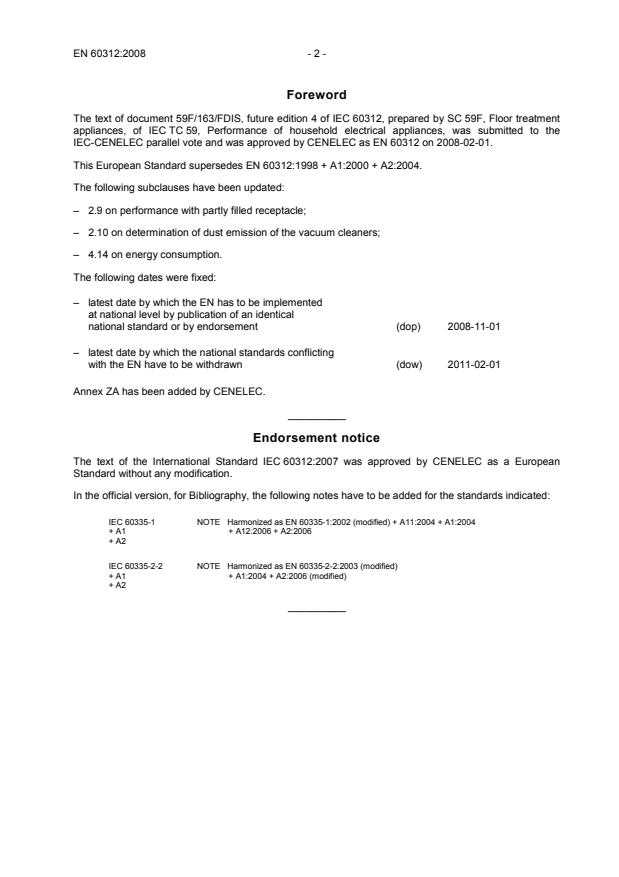
Foreword The text of document 59F/163/FDIS, future edition 4 of IEC 60312, prepared by SC 59F, Floor treatment appliances, of IEC TC 59, Performance of household electrical appliances, was submitted to the IEC-CENELEC parallel vote and was approved by CENELEC as EN 60312 on 2008-02-01. This European Standard supersedes EN 60312:1998 + A1:2000 + A2:2004. The following subclauses have been updated: – 2.9 on performance with partly filled receptacle; – 2.10 on determination of dust emission of the vacuum cleaners; – 4.14 on energy consumption. The following dates were fixed: – latest date by which the EN has to be implemented
at national level by publication of an identical
national standard or by endorsement
(dop)
2008-11-01 – latest date by which the national standards conflicting
with the EN have to be withdrawn
(dow)
2011-02-01 Annex ZA has been added by CENELEC. __________ Endorsement notice The text of the International Standard IEC 60312:2007 was approved by CENELEC as a European Standard without any modification. In the official version, for Bibliography, the following notes have to be added for the standards indicated: IEC 60335-1 + A1 + A2 NOTE
Harmonized as EN 60335-1:2002 (modified) + A11:2004 + A1:2004
+ A12:2006 + A2:2006 IEC 60335-2-2 + A1 + A2 NOTE
Harmonized as EN 60335-2-2:2003 (modified)
+ A1:2004 + A2:2006 (modified) __________
- 3 - EN 60312:2008 Annex ZA
(normative)
Normative references to international publications with their corresponding European publications
The following referenced documents are indispensable for the application of this document. For dated references, only the edition cited applies. For undated references, the latest edition of the referenced document (including any amendments) applies.
NOTE
When an international publication has been modified by common modifications, indicated by (mod), the relevant EN/HD applies.
Publication Year Title EN/HD Year
IEC 60704-1 1982 Test code for the determination of airborne acoustical noise emitted by household and similar electrical appliances -
Part 1: General requirements EN 60704-11)
IEC 60704-2-1 1984 Test code for the determination of airborne acoustical noise emitted by household and similar electrical appliances -
Part 2-1: Particular requirements for vacuum cleaners EN 60704-2-12)
ISO 554 1976 Standard atmospheres for conditioning
and/or testing - Specifications - -
ISO 679 1989 Methods of testing cements - Determination of strength - -
ISO 2439 1997 Flexible cellular polymeric materials - Determination of hardness (indentation technique) EN ISO 2439 2000
ISO 3386-1 1986 Polymeric materials, cellular flexible - Determination of stress-strain characteristics in compression -
Part 1: Low-density materials
EN ISO 3386-1 1997
ISO 5167 Series Measurement of fluid flow by means of pressure differential devices inserted in circular cross-section conduits running full EN ISO 5167 Series
CIE 15.2 1986 Colorimetry - -
1) EN 60704-1 is superseded by EN 60704-1:1997, which is based on IEC 60704-1:1997. 2) EN 60704-2-1 is superseded by EN 60704-2-1:2001, which is based on IEC 60704-2-1:2000.
INTERNATIONAL STANDARD IECCEI NORME INTERNATIONALE60312Fourth editionQuatrième édition2007-04 Vacuum cleaners for household use – Methods of measuring the performance
Aspirateurs de poussière à usage domestique – Méthodes de mesure de l’aptitude à la fonction
For price, see current cataloguePour prix, voir catalogue en vigueur PRICE CODE CODE PRIX XC Commission Electrotechnique InternationaleInternational Electrotechnical Commission
– 2 – 60312 © IEC:2007
CONTENTS
FOREWORD.7 1 Section 1: General 1.1 Scope.9 1.2 Normative references.9 1.3 Definitions.9 1.4 General conditions for testing.11 1.4.1 Atmospheric conditions.11 1.4.2 Test equipment and materials.12 1.4.3 Voltage and frequency.12 1.4.4 Running-in of vacuum cleaner and attachments.12 1.4.5 Equipment of the vacuum cleaner.12 1.4.6 Operation of the vacuum cleaner.13 1.4.7 Conditioning prior to tests.13 1.4.8 Initial application of dust.13 1.4.9 Mechanical operator.13 1.4.10 Number of samples.14 1.4.11 Reference cleaner system.14 2 Section 2: Dry vacuum cleaning tests 2.1 Dust removal from hard flat floors.14 2.1.1 Test equipment.14 2.1.2 Test area and stroke length.14 2.1.3 Distribution of test dust.14 2.1.4 Determination of track width and stroke width.14 2.1.5 Test method.15 2.1.6 Determination of dust removal ability.15 2.2 Dust removal from hard floors with crevices.16 2.2.1 Test equipment.16 2.2.2 Distribution of test dust.16 2.2.3 Determination of dust removal ability.16 2.3 Dust removal from carpets.16 2.3.1 Test carpet.16 2.3.2 Test area and stroke length.17 2.3.3 Cleaning cycle.17 2.3.4 Conditioning of test carpet.17 2.3.5 Distribution of test dust.18 2.3.6 Embedding of dust into carpet.18 2.3.7 Preconditioning of dust receptacle.18 2.3.8 Determination of dust removal ability.18 2.4 Dust removal along walls.19 2.4.1 Test equipment and materials.19 2.4.2 Distribution of test dust.19 2.4.3 Determination of dust removal ability along walls.19 2.5 Fibre removal from carpets and upholstery.19 2.5.1 Fibre removal from carpets.19 2.5.2 Fibre removal from upholstery.20
60312 © IEC:2007 – 3 –
2.6 Thread removal from carpets.21 2.6.1 Test carpet.21 2.6.2 Distribution of threads.21 2.6.3 Determination of thread removal ability.21 2.7 Maximum usable volume of the dust receptacle.22 2.7.1 Conditions for measurement.22 2.7.2 Introduction of moulding granules.22 2.7.3 Determination of maximum usable volume of dust receptacle.22 2.8 Air data.22 2.8.1 Conditions for measurement.22 2.8.2 Test equipment.23 2.8.3 Determination of air data.23 2.9 Performance with loaded dust receptacle.23 2.9.1 General.23 2.9.2 Suction with loaded dust receptacle.23 2.9.3 Throttling to simulate loaded dust receptacle.24 2.9.4 Determination of performance with loaded dust receptacle.24 2.10 Dust emission of the vacuum cleaner.25 2.10.1 Test procedure.25 2.10.2 Pre-test.26 2.10.3 Dust test.26 2.10.4 Calculating emission.27 2.10.5 Record.28 3 Section 3: Wet vacuum cleaning tests 3.1 Object of the test.28 3.2 Wet cleaning effectiveness on carpet.29 3.2.1 Test carpet samples.29 3.2.2 Soiling of carpet sample.29 3.2.3 Cleaning procedure.29 3.2.4 Drying of the carpet sample.30 3.2.5 Determination of wet cleaning effectiveness.30 3.2.6 Colorimetric measurements.31 3.2.7 Visual assessment.31 4 Section 4: Miscellaneous tests 4.1 Motion resistance.31 4.1.1 Test carpet and test equipment.31 4.1.2 Determination of motion resistance.32 4.2 Cleaning under furniture.32 4.2.1 Distribution of test dust.32 4.2.2 Determination of free furniture height.32 4.3 Radius of operation.32 4.3.1 Conditions for measurement.33 4.3.2 Determination of radius of operation.33 4.4 Impact resistance.33 4.4.1 Test equipment.33 4.4.2 Determination of impact resistance.33 4.5 Deformation of hose and connecting tubes.33 4.5.1 Test equipment.33
– 4 – 60312 © IEC:2007
4.5.2 Determination of permanent deformation.33 4.6 Bump test.34 4.6.1 Test equipment.34 4.6.2 Test cycle.34 4.6.3 Test procedure.34 4.7 Flexibility of the hose.35 4.7.1 Preparation of test object.35 4.7.2 Determination of the flexibility of the hose.35 4.8 Repeated bending of the hose.35 4.8.1 Test equipment.35 4.8.2 Test method.35 4.9 Operation with partly filled dust receptacle.36 4.10 Mass.36 4.11 Specific cleaning time.36 4.12 Dimensions.37 4.13 Noise level.37 4.14 Energy consumption.37 4.14.1 Energy consumption with vacuuming of carpets.37 4.14.2 Energy consumption with vacuuming of hard floors with crevices.39 5 Section 5: Test material and equipment 5.1 Material for measurements.39 5.1.1 Test carpets.39 5.1.2 Standard test dust.41 5.1.3 Fibre material.43 5.1.4 Thread material.43 5.1.5 Moulding granules.43 5.1.6 Test cushion.43 5.2 Equipment for measurements.44 5.2.1 Floor test plate.44 5.2.2 Test plate with crevice.44 5.2.3 Carpet-beating machine.44 5.2.4 Carpet hold-downs and guides.44 5.2.5 Dust spreader.44 5.2.6 Rollers for embedding.44 5.2.7 Void.45 5.2.8 Equipment for air data measurement.45 5.2.9 Equipment for dust emission measurement.47 5.2.10 Device for motion resistance test.49 5.2.11 Device for impact test.49 5.2.12 Device for determination of deformation of hoses and connecting tubes.49 5.2.13 Mechanical operator.49 5.2.14 Weighing machine.49 5.2.15 Testing surface for wet cleaning tests.50 5.2.16 Spectrophotometer.50 5.2.17 Test soil mixer.50 Annex A (informative)
Information on materials.73 Bibliography.76
60312 © IEC:2007 – 5 –
Table 1 – Values for the upper confidence value of a Poisson distribution for the 95 % confidence level.28 Table 2 – Classes for sizes 0,4 – 25 µm.48
Figure 1 – Zig-zag pattern.51 Figure 2 – Stroke length in measurements of dust removal from hard floors and of thread removal from carpets.51 Figure 3 – Grain size diagram for test dust.52 Figure 4 – Devices for distribution of mineral dust.53 Figure 5 – Test plate with crevice.53 Figure 6 – Carpet-beating machine.54 Figure 7a – Carpet hold-downs and guides.54 Figure 7b – Stroke length in the measurement of dust removal from carpets.55 Figure 7c – Dust spreader and roller for embedding dust into carpets.55 Figure 7d – Mechanical operator for the measurement of dust removal from carpets and of motion resistance.56 Figure 8 – Right-angled T.57 Figure 9 – Arrangement of threads in the thread removal test.57 Figure 10a – Stencil for distribution of fibres on test carpets.58 Figure 10b – Frame for test cushion.58 Figure 10c – Stencil for distribution of fibres on upholstery.59 Figure 11 – Nozzle adaptor for upright cleaners.59 Figure 12 – Air data curves.60 Figure 13a – Alternative A equipment for air data measurements.60 Figure 13b – Measuring box for alternative A.61 Figure 13c – Alternative B equipment for air data measurements.62 Figure 14a – Testing hood for measurement of dust emission.63 Figure 14b – Placing of upright cleaners in the testing hood.63 Figure 14c – Dust dispenser.64 Figure 15 – Insertion depth.65 Figure 16 – Drum for impact test.65 Figure 17a – Device for testing deformation of hoses and connecting tubes.66 Figure 17b – Position of test object and cross-section for measurement of deformation.66 Figure 18 – Preparation of hoses for testing flexibility.67 Figure 19 – Equipment for repeated bending of hoses.67 Figure 20a – Profile of threshold.68 Figure 20b – Arrangements for bump test.68 Figure 21 − Clamping arrangement for carpet sample.69 Figure 22a − Cleaning pattern for appliances with cleaning head used in forward and backward strokes.69 Figure 22b − Cleaning pattern for appliances with cleaning head only used in backward strokes.70 Figure 23a – Connecting tube openings.71
– 6 – 60312 © IEC:2007
Figure 23b – Dust spread uniformly on surface.71 Figure 24 – Test dust for loading dust receptacle.72
60312 © IEC:2007 – 7 –
INTERNATIONAL ELECTROTECHNICAL COMMISSION ____________
VACUUM CLEANERS FOR HOUSEHOLD USE – METHODS OF MEASURING THE PERFORMANCE
FOREWORD 1) The International Electrotechnical Commission (IEC) is a worldwide organization for standardization comprising all national electrotechnical committees (IEC National Committees). The object of IEC is to promote international co-operation on all questions concerning standardization in the electrical and electronic fields. To this end and in addition to other activities, IEC publishes International Standards, Technical Specifications, Technical Reports, Publicly Available Specifications (PAS) and Guides (hereafter referred to as “IEC Publication(s)”). Their preparation is entrusted to technical committees; any IEC National Committee interested in the subject dealt with may participate in this preparatory work. International, governmental and non-governmental organizations liaising with the IEC also participate in this preparation. IEC collaborates closely with the International Organization for Standardization (ISO) in accordance with conditions determined by agreement between the two organizations. 2) The formal decisions or agreements of IEC on technical matters express, as nearly as possible, an international consensus of opinion on the relevant subjects since each technical committee has representation from all interested IEC National Committees.
3) IEC Publications have the form of recommendations for international use and are accepted by IEC National Committees in that sense. While all reasonable efforts are made to ensure that the technical content of IEC Publications is accurate, IEC cannot be held responsible for the way in which they are used or for any misinterpretation by any end user. 4) In order to promote international uniformity, IEC National Committees undertake to apply IEC Publications transparently to the maximum extent possible in their national and regional publications. Any divergence between any IEC Publication and the corresponding national or regional publication shall be clearly indicated in the latter. 5) IEC provides no marking procedure to indicate its approval and cannot be rendered responsible for any equipment declared to be in conformity with an IEC Publication. 6) All users should ensure that they have the latest edition of this publication. 7) No liability shall attach to IEC or its directors, employees, servants or agents including individual experts and members of its technical committees and IEC National Committees for any personal injury, property damage or other damage of any nature whatsoever, whether direct or indirect, or for costs (including legal fees) and expenses arising out of the publication, use of, or reliance upon, this IEC Publication or any other IEC Publications.
8) Attention is drawn to the Normative references cited in this publication. Use of the referenced publications is indispensable for the correct application of this publication. 9) Attention is drawn to the possibility that some of the elements of this IEC Publication may be the subject of patent rights. IEC shall not be held responsible for identifying any or all such patent rights.
International Standard IEC 60312 has been prepared by subcommittee 59F: Floor treatment appliances, of IEC technical committee 59: Performance of household electrical appliances. This fourth edition cancels and replaces the third edition published in 1998, amendment 1 (2000) and amendment 2 (2004). The following subclauses have been updated: – 2.9 on performance with partly filled receptacle; – 2.10 on determination of dust emission of the vacuum cleaners; – 4.14 on energy consumption.
– 8 – 60312 © IEC:2007
The text of this standard is based on the following documents: FDIS Report on voting 59F/163/FDIS 59F/164/RVD
Full information on the voting for the approval of this standard can be found in the report on voting indicated in the above table. This publication has been drafted in accordance with the ISO/IEC Directives, Part 2. The committee has decided that the contents of this publication will remain unchanged until the maintenance result date indicated on the IEC web site under "http://webstore.iec.ch" in the data related to the specific publication. At this date, the publication will be
• reconfirmed; • withdrawn; • replaced by a revised edition, or • amended.
60312 © IEC:2007 – 9 –
VACUUM CLEANERS FOR HOUSEHOLD USE – METHODS OF MEASURING THE PERFORMANCE
1 Section 1: General 1.1 Scope This International Standard is applicable to vacuum cleaners for household use in or under conditions similar to those in households. The purpose of this standard is to specify essential performance characteristics of vacuum cleaners being of interest to the users and to describe methods for measuring these characteristics. NOTE Due to the influence of environmental conditions, variations in time, origin of test materials and proficiency of the operator, most of the described test methods will give more reliable results when applied for comparative testing of a number of appliances at the same time, in the same laboratory and by the same operator. For safety requirements, reference is made to IEC 60335-1 and IEC 60335-2-2. 1.2 Normative references The following referenced documents are indispensable for the application of this document. For dated references, only the edition cited applies. For undated references, the latest edition of the referenced document (including any amendments) applies. IEC 60704-1:1982, Test code for the determination of airborne acoustical noise emitted by household and similar electrical appliances − Part 1: General requirements IEC 60704-2-1:1984, Test code for the determination of airborne acoustical noise emitted by household and similar electrical appliances − Part 2-1: Particular requirements for vacuum cleaners ISO 554:1976, Standard atmospheres for conditioning and/or testing – Specifications ISO 679:1989, Methods of testing cements − Determination of strength ISO 2439:1997, Flexible cellular polymeric materials – Determination of hardness (indentation technique) ISO 3386-1:1986, Polymeric materials, cellular flexible – Determination of stress-strain characteristics in compression – Part 1: Low-density materials ISO 5167:2003 (all parts), Measurement of fluid flow by means of pressure differential devices inserted in circular cross-section conduits running full CIE 15.2:1986, Colorimetry 1.3 Definitions For the purposes of this International Standard, the following definitions apply:
– 10 – 60312 © IEC:2007
1.3.1 cleaning head that part of a vacuum cleaner which is applied to a surface to be cleaned NOTE The cleaning head may be a plain nozzle or a brush attached to a connecting tube, a power nozzle, or form part of the cleaner housing. 1.3.2 power nozzle cleaning head provided with an agitation device to assist dirt removal NOTE The agitation device may be driven by an incorporated electric motor (motorized nozzle), an incorporated turbine powered by the air flow (air-turbine nozzle) or an incorporated friction or gear mechanism actuated by moving the cleaning head over the surface to be cleaned (mechanical nozzle). 1.3.3 self-propelled cleaning head cleaning head provided with propulsion mechanism 1.3.4 upright cleaner vacuum cleaner with the cleaning head forming an integral part of or permanently connected to the cleaner housing, the cleaning head normally being provided with an agitation device to assist dirt removal and the complete cleaner housing being moved over the surface to be cleaned by means of an attached handle 1.3.5 double stroke one forward and one backward movement of the cleaning head between two parallel lines perpendicular to the direction of the forward movement 1.3.6 forward stroke forward movement of a double stroke NOTE On test carpets if not otherwise specified, forward strokes are carried out in the direction of the carpet pile (direction of manufacture). 1.3.7 return stroke backward movement of a double stroke 1.3.8 stroke length distance between the two parallel lines defining the limits of a double stroke 1.3.9 stroke pattern arrangement of the forward and return strokes on the surface to be cleaned 1.3.10 parallel pattern stroke pattern where the forward and the return strokes coincide 1.3.11 zig-zag pattern stroke pattern where the return stroke is directed slantwise towards the starting point of the next forward stroke (see figure 1)
60312 © IEC:2007 – 11 –
1.3.12 test width outside width of the cleaning head less 20 mm 1.3.13 track width width of the visible track left in the dust-covered area of a given surface after a forward stroke with the vacuum cleaner in operation, the cleaning head being in full contact with the surface and adjusted in accordance with the manufacturer's instructions 1.3.14 stroke width track width less 20 mm 1.3.15 active depth of cleaning head distance from the front edge of the cleaning head to its rear edge or a line 10 mm behind the rear edge of the suction opening on the underside of the cleaning head, whichever is the shortest 1.3.16 stroke speed speed of the cleaning head, moved as uniformly as possible, during a forward or a return stroke 1.3.17 cleaning cycle for a given measurement, the sequence of forward and return strokes to be carried out at a specified stroke speed over the test area according to the appropriate stroke pattern 1.3.18 specific cleaning time time required for one cleaning cycle of an unobstructed area of 1 m2 1.3.19 dust removal ability ratio, in per cent, of the quantity of dust removed during a specified number of cleaning cycles to the quantity of dust distributed on a test area 1.3.20 thread removal ability ratio, in per cent, of the number of threads removed during one cleaning cycle to the number of threads distributed on a test carpet 1.3.21 fibre removal ability time, in seconds, required to remove a quantity of fibres from a test surface 1.4 General conditions for testing 1.4.1 Atmospheric conditions Unless otherwise specified, the measurements shall be carried out under the following conditions (in accordance with ISO 554): Standard atmosphere 23/50
– 12 – 60312 © IEC:2007
Temperature: (23 ± 2) °C Relative humidity: (50 ± 5) % Air pressure: 86 kPa to 106 kPa NOTE 1 Temperature and humidity conditions within the specified ranges are required for good repeatability and reproducibility. Care should be taken to avoid changes during a test. NOTE 2 Reference for laboratories for setting the correct values: Wet-bulb temperature: 16,3 °C Vapour pressure: 1,41 kPa Water content: 8,8 g/kg dry air For measurements which may be carried out at other than standard atmospheric conditions, the ambient temperature shall be maintained at (23 ± 5) °C. 1.4.2 Test equipment and materials To minimize the influence of electrostatic phenomena, measurements on carpets shall be carried out on a flat floor consisting of a smooth untreated pine plywood or equivalent panel, at least 15 mm thick and of a size appropriate for the test. Equipment and materials for measurements (devices, test carpets, test dust etc.) to be used in a test shall, prior to the test, be kept for at least 24 h at standard atmospheric conditions according to 1.4.1. 1.4.3 Voltage and frequency Measurements shall be carried out at rated voltage with a tolerance of ±1 % and, if applicable, at rated frequency. Vacuum cleaners designed for d.c. only shall be operated at d.c. Vacuum cleaners designed for both a.c. and d.c. shall be operated at a.c. Vacuum cleaners not marked with rated frequency shall be operated at either 50 Hz or 60 Hz, as is common in the country of use. For vacuum cleaners with a rated voltage range, measurements shall be carried out at the mean value of the voltage range if the difference between the limits of the range does not exceed 10 % of the mean value. If the difference exceeds 10 % of the mean value, measurements shall be carried out both at the upper and lower limits of the voltage range. NOTE If the rated voltage differs from the nominal system voltage of the country concerned, measurements carried out at rated voltage may give test results misleading for the consumer and additional measurements may be required. If the test voltage differs from the rated voltage, this must be reported. 1.4.4 Running-in of vacuum cleaner and attachments Prior to the initial test, the vacuum cleaner and its attachments, if any, shall be kept running with unrestricted air flow for at least 2 h to ensure adequate running-in. For upright cleaners or power nozzles, the agitation device shall be running but not in contact with the floor. 1.4.5 Equipment of the vacuum cleaner If the vacuum cleaner is designed to be used with disposable dust receptacles, it shall, prior to each measurement, be equipped with a new dust receptacle of the type recommended or supplied by the manufacturer of the vacuum cleaner.
60312 © IEC:2007 – 13 –
If the vacuum cleaner is provided with a permanent dust receptacle (as the sole original dust receptacle or as an enclosure for disposable dust receptacles), the dust receptacle shall, prior to each measurement, be cleaned by shaking or beating until its weight is within 1 % of its original weight. Brushing or washing of textile receptacles is not allowed; however, plastic receptacles may be washed and dried thoroughly. NOTE If the vacuum cleaner has additional filter(s) and the manufacturer's instructions recommend periodic cleaning or replacement of the filter(s), the above requirements also apply, unless it is evident that reusing such filters will not significantly affect the test result. 1.4.6 Operation of the vacuum cleaner The vacuum cleaner and its accessories shall be used and adjusted in accordance with the manufacturer's instructions for normal operation for the test to be carried out. Height adjustment controls for the cleaning head shall be set as appropriate for the surface to be cleaned and the position noted. Any electrical controls shall be set for maximum continuous air flow and, unless the manufacturer's instruction states otherwise, any air by-pass openings for reduction of the suction power shall be closed. The tube grip of cleaners with suction hose or the handle of other cleaners shall be held as for normal operation at a height of (800 ± 50) mm above the test floor. During measurements where the agitation device of an upright cleaner or a power nozzles is not used as in normal operation, it shall be running but not in contact with the floor. 1.4.7 Conditioning prior to tests Prior to each test, the vacuum cleaner with its accessories, attachments, disposable dust receptacles and additional filters to be used during a test shall be kept for at least 24 h at standard atmospheric conditions according to 1.4.1. The vacuum cleaner and attachments to be used shall then be kept running for at least 10 min under the provisions given in 1.4.4 to allow them to stabilize. 1.4.8 Initial application of dust Prior to tests where the quantity of the dust collected is to be weighed, dust shall initially be applied to all parts of the vacuum cleaner through which the air passes before reaching the dust receptacle by carrying out, on the appropriate test surface, two preliminary measurements of dust removal, the results of which are not taken into account. 1.4.9 Mechanical operator In order to achieve reliable results, certain measurements require the cleaning head to be moved at uniform speed over the test area and without exerting an additional force pressing the cleaning head against the test surface. In such cases, it is recommended to simulate the handling of the vacuum cleaner by using a mechanical operator such as described in 5.2.13. The tube grip of cleaners with suction hose or the handle of other cleaners shall then be attached to the linear drive so that its centre pivots at a height of (800 ± 50) mm above the test surface. The linear drive may be motorized or operated by hand.
– 14 – 60312 © IEC:2007
1.4.10 Number of samples Measurements of performance, for instance for comparative testing, shall be carried out on a single sample of the vacuum cleaner with its accessories and attachments, if any. Tests carried out to simulate stresses a vacuum cleaner may be exposed to during normal use, possibly causing impairment of the cleaner’s performance, may require additional samples of replaceable parts. Such tests shall be carried out at the end of the test programme. 1.4.11 Reference cleaner system Test carpets used in a laboratory for the determination of dust removal ability will over time change from their original conditions, for instance due to wearing or gradual filling with dust. It is therefore recommended that an in-house reference cleaner system be used to regularly check the carpet conditions as a verification of the test results obtained. 2 Section 2: Dry vacuum cleaning tests 2.1 Dust removal from hard flat floors 2.1.1 Test equipment A floor test plate in accordance with 5.2.1 shall be used. 2.1.2 Test area and stroke length
The length and the width of the test area (dust-covered part of the floor test plate) shall be 0,7 m and 1,0 m, respectively. The stroke length shall be 0,7 m plus twice the active depth of the cleaning head by adding to each end of the test area a length equal to the active depth (see figure 2). 2.1.3 Distribution of test dust 35,0 g of mineral dust, in accordance with 5.1.2.1, shall be distributed as uniformly as possible over the test area. For uniform distribution of the test dust, a distribution device (see figure 4), handled by a skilled test operator, or any equivalent method, may be used. It is recommended to use a 0,7 m × 1,0 m frame to ensure that all test dust is distributed within the test area. 2.1.4 Determination of track width and stroke width Mineral dust shall be distributed over the test area in accordance with 2.1.3. Under normal operating conditions the cleaning head is passed over the test area with one forward stroke at a stroke speed of (0,50 ± 0,02) m/s. The track width, in millimetres, is determined as the mean value of five measurements of the width of the visible track along the stroke, at points approximate
...