

EN IEC 60958-1:2021
(Main)Digital audio interface - Part 1: General
General Information
- Abstract
IEC 60958-1:2021 is available as IEC 60958-1:2021 RLV which contains the International Standard and its Redline version, showing all changes of the technical content compared to the previous edition. IEC 60958-1:2021 describes a serial, uni-directional, self-clocking interface for the interconnection of digital audio equipment for consumer and professional applications. It provides the basic structure of the interface. Separate documents define items specific to particular applications. The interface is primarily intended to carry monophonic or stereophonic programmes, encoded using linear PCM and with a resolution of up to 24 bits per sample. When used for other purposes, the interface is able to carry audio data coded other than as linear PCM coded audio samples. Provision is also made to allow the interface to carry data related to computer software, multimedia technologies, or signals coded using non linear PCM. The format specification for these applications is not part of this document. The interface is intended for operation at audio sampling frequencies of 32 kHz and above. Auxiliary information is transmitted along with the programme. IEC 60958-1:2021c ancels and replaces the third edition published in 2008, and Amendment 1:2014. This edition constitutes a technical revision. This edition includes the following significant technical changes with respect to the previous edition: a) The relevant part of IEC 60958-5 is supported.
- Status
- Published
- Publication Date
- 07-Oct-2021
- Technical Committee
- CLC/TC 100X - Audio, video and multimedia systems and equipment and related sub-systems
- Drafting Committee
- IEC/TC 100 - IEC_TC_100
- Current Stage
- 9093 - Decision to confirm - Review Enquiry
- Start Date
- 27-Apr-2026
- Completion Date
- 25-Aug-2026



Overview
EN IEC 60958-1:2021 (IEC 60958-1:2021) defines a general-purpose digital audio interface for the interconnection of consumer and professional audio equipment. This fourth edition (2021) cancels and replaces the 2008 edition and its 2014 amendment and is published with a redline version showing technical changes. The standard specifies a serial, uni‑directional, self‑clocking interface intended primarily to carry mono or stereo programmes encoded as linear PCM (up to 24 bits per sample) at audio sampling frequencies of 32 kHz and above, while also allowing non‑linear PCM or other coded audio/data and auxiliary information.
Key topics and technical requirements
- Interface format: Defines sub‑frame and frame structure, channel coding and preamble patterns used to mark frame boundaries.
- Channel status & user data: Specifies channel status bits, category codes and user data fields for metadata, rights, and stream identification.
- Validity bit & preambles: Rules for the validity bit and preamble coding that distinguish audio samples and control information.
- Audio formats supported: Linear PCM up to 24‑bit resolution; provisions for carrying non‑linear PCM and other coded data (format specifications for those applications are outside this part).
- Electrical requirements: Defines signalling characteristics for consumer (unbalanced) and professional applications, timing accuracy, jitter tolerance, rise/fall times and eye‑diagram requirements.
- Optical requirements: Defines optical connection configurations, connector characteristics and transmitter/receiver parameters for optical interfaces.
- Conformance & revisions: This edition incorporates support for relevant elements of IEC 60958‑5 and is published as an international standard (IEC) and European adoption (EN IEC 60958‑1:2021).
Applications and typical users
- Who uses it: Audio equipment manufacturers, system integrators, broadcast and pro‑audio engineers, test and certification labs, and firmware/hardware designers.
- Typical applications: Interconnecting CD/DVD players, digital mixers, audio interfaces, AV receivers, set‑top boxes and optical/electrical links between consumer/professional devices; transporting audio plus metadata and auxiliary data streams.
- Practical value: Ensures interoperability, specifies electrical/optical link behaviour and metadata handling, and provides design and test criteria for reliable digital audio transmission.
Related standards
- EN/IEC 60958 series (other parts):
- IEC 60958‑3 (consumer applications)
- IEC 60958‑4 (professional applications)
- IEC 60958‑5 (consumer application enhancement)
Refer to the IEC 60958 series for application‑specific formats and connector/application documents.
Relations
- Effective Date
- 23-Jan-2023
- Effective Date
- 12-Oct-2021
- Effective Date
- 03-Feb-2026
- Effective Date
- 03-Feb-2026
- Effective Date
- 03-Feb-2026
- Effective Date
- 03-Feb-2026
- Effective Date
- 03-Feb-2026
- Referred By
EN 60958-4-1:2016 - Digital audio interface - Part 4-1: Professional applications - Audio content - Effective Date
- 03-Feb-2026
- Effective Date
- 03-Feb-2026
- Effective Date
- 03-Feb-2026
- Effective Date
- 03-Feb-2026
- Effective Date
- 03-Feb-2026
- Effective Date
- 03-Feb-2026
Get Certified
Connect with accredited certification bodies for this standard

ANCE
Mexican certification and testing association.

Intertek Slovenia
Intertek testing, inspection, and certification services in Slovenia.

LNE (Laboratoire National de Métrologie et d'Essais)
French national laboratory for metrology and testing.
Sponsored listings
Frequently Asked Questions
EN IEC 60958-1:2021 is a standard published by CLC. Its full title is "Digital audio interface - Part 1: General". This standard covers: IEC 60958-1:2021 is available as IEC 60958-1:2021 RLV which contains the International Standard and its Redline version, showing all changes of the technical content compared to the previous edition. IEC 60958-1:2021 describes a serial, uni-directional, self-clocking interface for the interconnection of digital audio equipment for consumer and professional applications. It provides the basic structure of the interface. Separate documents define items specific to particular applications. The interface is primarily intended to carry monophonic or stereophonic programmes, encoded using linear PCM and with a resolution of up to 24 bits per sample. When used for other purposes, the interface is able to carry audio data coded other than as linear PCM coded audio samples. Provision is also made to allow the interface to carry data related to computer software, multimedia technologies, or signals coded using non linear PCM. The format specification for these applications is not part of this document. The interface is intended for operation at audio sampling frequencies of 32 kHz and above. Auxiliary information is transmitted along with the programme. IEC 60958-1:2021c ancels and replaces the third edition published in 2008, and Amendment 1:2014. This edition constitutes a technical revision. This edition includes the following significant technical changes with respect to the previous edition: a) The relevant part of IEC 60958-5 is supported.
IEC 60958-1:2021 is available as IEC 60958-1:2021 RLV which contains the International Standard and its Redline version, showing all changes of the technical content compared to the previous edition. IEC 60958-1:2021 describes a serial, uni-directional, self-clocking interface for the interconnection of digital audio equipment for consumer and professional applications. It provides the basic structure of the interface. Separate documents define items specific to particular applications. The interface is primarily intended to carry monophonic or stereophonic programmes, encoded using linear PCM and with a resolution of up to 24 bits per sample. When used for other purposes, the interface is able to carry audio data coded other than as linear PCM coded audio samples. Provision is also made to allow the interface to carry data related to computer software, multimedia technologies, or signals coded using non linear PCM. The format specification for these applications is not part of this document. The interface is intended for operation at audio sampling frequencies of 32 kHz and above. Auxiliary information is transmitted along with the programme. IEC 60958-1:2021c ancels and replaces the third edition published in 2008, and Amendment 1:2014. This edition constitutes a technical revision. This edition includes the following significant technical changes with respect to the previous edition: a) The relevant part of IEC 60958-5 is supported.
EN IEC 60958-1:2021 is classified under the following ICS (International Classification for Standards) categories: 33.160.01 - Audio, video and audiovisual systems in general. The ICS classification helps identify the subject area and facilitates finding related standards.
EN IEC 60958-1:2021 has the following relationships with other standards: It is inter standard links to EN 60958-1:2008, EN 60958-1:2008/A1:2014, EN 60958-4-2:2016, EN 60958-4-4:2016, HD 483.11 S3:1993, EN IEC 62087-2:2023, EN IEC 60268-3:2018, EN 60958-4-1:2016, EN 61883-6:2014, EN IEC 60958-3:2021, EN IEC 60958-5:2021, EN IEC 61938:2018, EN 62379-5-2:2014. Understanding these relationships helps ensure you are using the most current and applicable version of the standard.
EN IEC 60958-1:2021 is available in PDF format for immediate download after purchase. The document can be added to your cart and obtained through the secure checkout process. Digital delivery ensures instant access to the complete standard document.
Standards Content (Sample)
SLOVENSKI STANDARD
01-april-2022
Nadomešča:
SIST EN 60958-1:2008
SIST EN 60958-1:2008/A1:2014
Digitalni zvokovni vmesnik - 1. del: Splošno (IEC 60958-1:2021)
Digital audio interface - Part 1: General (IEC 60958-1:2021)
Digitalton-Schnittstelle - Teil 1: Allgemeines (IEC 60958-1:2021)
Interface audionumérique - Partie 1: Généralités (IEC 60958-1:2021)
Ta slovenski standard je istoveten z: EN IEC 60958-1:2021
ICS:
33.160.30 Avdio sistemi Audio systems
35.200 Vmesniška in povezovalna Interface and interconnection
oprema equipment
2003-01.Slovenski inštitut za standardizacijo. Razmnoževanje celote ali delov tega standarda ni dovoljeno.
EUROPEAN STANDARD EN IEC 60958-1
NORME EUROPÉENNE
EUROPÄISCHE NORM
October 2021
ICS 33.160.01 Supersedes EN 60958-1:2008 and all of its amendments
and corrigenda (if any)
English Version
Digital audio interface - Part 1: General
(IEC 60958-1:2021)
Interface audionumérique - Partie 1: Généralités Digitalton-Schnittstelle - Teil 1: Allgemeines
(IEC 60958-1:2021) (IEC 60958-1:2021)
This European Standard was approved by CENELEC on 2021-10-06. CENELEC members are bound to comply with the CEN/CENELEC
Internal Regulations which stipulate the conditions for giving this European Standard the status of a national standard without any alteration.
Up-to-date lists and bibliographical references concerning such national standards may be obtained on application to the CEN-CENELEC
Management Centre or to any CENELEC member.
This European Standard exists in three official versions (English, French, German). A version in any other language made by translation
under the responsibility of a CENELEC member into its own language and notified to the CEN-CENELEC Management Centre has the
same status as the official versions.
CENELEC members are the national electrotechnical committees of Austria, Belgium, Bulgaria, Croatia, Cyprus, the Czech Republic,
Denmark, Estonia, Finland, France, Germany, Greece, Hungary, Iceland, Ireland, Italy, Latvia, Lithuania, Luxembourg, Malta, the
Netherlands, Norway, Poland, Portugal, Republic of North Macedonia, Romania, Serbia, Slovakia, Slovenia, Spain, Sweden, Switzerland,
Turkey and the United Kingdom.
European Committee for Electrotechnical Standardization
Comité Européen de Normalisation Electrotechnique
Europäisches Komitee für Elektrotechnische Normung
CEN-CENELEC Management Centre: Rue de la Science 23, B-1040 Brussels
© 2021 CENELEC All rights of exploitation in any form and by any means reserved worldwide for CENELEC Members.
Ref. No. EN IEC 60958-1:2021 E
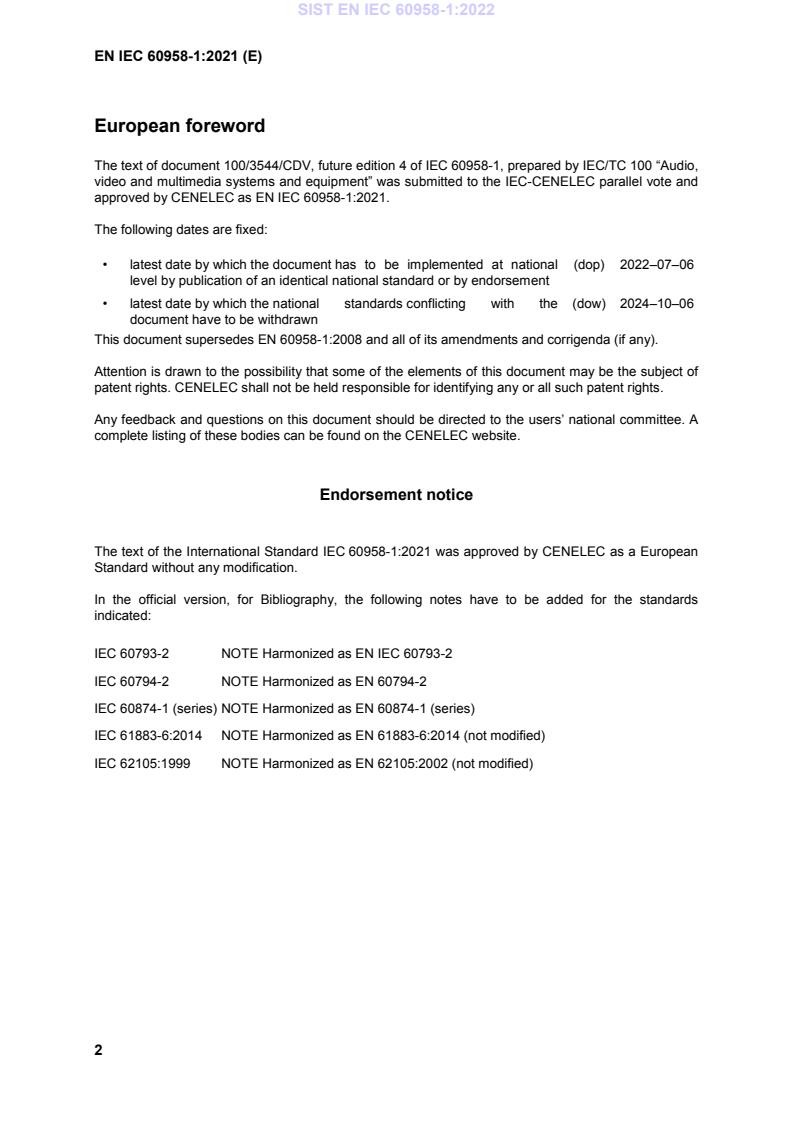
European foreword
The text of document 100/3544/CDV, future edition 4 of IEC 60958-1, prepared by IEC/TC 100 “Audio,
video and multimedia systems and equipment” was submitted to the IEC-CENELEC parallel vote and
approved by CENELEC as EN IEC 60958-1:2021.
The following dates are fixed:
• latest date by which the document has to be implemented at national (dop) 2022–07–06
level by publication of an identical national standard or by endorsement
• latest date by which the national standards conflicting with the (dow) 2024–10–06
document have to be withdrawn
This document supersedes EN 60958-1:2008 and all of its amendments and corrigenda (if any).
Attention is drawn to the possibility that some of the elements of this document may be the subject of
patent rights. CENELEC shall not be held responsible for identifying any or all such patent rights.
Any feedback and questions on this document should be directed to the users’ national committee. A
complete listing of these bodies can be found on the CENELEC website.
Endorsement notice
The text of the International Standard IEC 60958-1:2021 was approved by CENELEC as a European
Standard without any modification.
In the official version, for Bibliography, the following notes have to be added for the standards
indicated:
IEC 60793-2 NOTE Harmonized as EN IEC 60793-2
IEC 60794-2 NOTE Harmonized as EN 60794-2
IEC 60874-1 (series) NOTE Harmonized as EN 60874-1 (series)
IEC 61883-6:2014 NOTE Harmonized as EN 61883-6:2014 (not modified)
IEC 62105:1999 NOTE Harmonized as EN 62105:2002 (not modified)
Annex ZA
(normative)
Normative references to international publications
with their corresponding European publications
The following documents are referred to in the text in such a way that some or all of their content
constitutes requirements of this document. For dated references, only the edition cited applies. For
undated references, the latest edition of the referenced document (including any amendments)
applies.
NOTE 1 Where an International Publication has been modified by common modifications, indicated by (mod), the
relevant EN/HD applies.
NOTE 2 Up-to-date information on the latest versions of the European Standards listed in this annex is available
here: www.cenelec.eu.
Publication Year Title EN/HD Year
IEC 60268-11 1987 Sound system equipment - Part 11: HD 483.11 S3 1993
Application of connectors for the
interconnection of sound system
components
IEC 60958-3 - Digital audio interface - Part 3: Consumer - -
applications
IEC 60958-4 series Digital audio interface - Part 4–1: EN 60958-4 series
Professional applications
IEC 60958-5 - Digital audio interface - Part 5: Consumer EN IEC 60958-5 -
application enhancement
IEC 60958-1 ®
Edition 4.0 2021-09
INTERNATIONAL
STANDARD
Digital audio interface –
Part 1: General
INTERNATIONAL
ELECTROTECHNICAL
COMMISSION
ICS 33.160.01 ISBN 978-2-8322-1017-0
– 2 – IEC 60958-1:2021 © IEC 2021
CONTENTS
FOREWORD . 4
1 Scope . 6
2 Normative references. 6
3 Terms and definitions . 6
4 Interface format . 8
4.1 Structure of format . 8
4.1.1 Sub-frame format . 8
4.1.2 Frame format . 9
4.2 Channel coding . 10
4.3 Preambles . 10
4.4 Validity bit . 11
5 Channel status . 11
5.1 General . 11
5.2 Applications . 11
5.3 General assignment of the first and second channel status bits . 11
5.4 Category code . 12
6 User data . 14
6.1 General . 14
6.2 Applications . 14
6.2.1 Professional use . 14
6.2.2 Consumer use . 14
7 Electrical requirement . 14
7.1 Consumer application . 14
7.1.1 General . 14
7.1.2 Timing accuracy . 14
7.1.3 Unbalanced line . 15
7.2 Professional application . 18
8 Optical requirements . 18
8.1 Consumer application . 18
8.1.1 Configuration of optical connection . 18
8.1.2 Optical connector . 18
8.2 Professional applications . 19
Annex A (informative) The use of the validity bit . 20
Annex B (informative) Application documents and specifications . 21
Annex C (informative) A relationship of the IEC 60958 series families . 22
Annex D (informative) Transmission of CD data other than linear PCM audio . 24
Annex E (informative) The IEC 60958 series conformant data format . 25
Annex F (informative) Stream change . 26
Annex G (informative) Characteristics of optical connection . 28
Bibliography . 30
Figure 1 – Sub-frame format (linear PCM application) . 9
Figure 2 – Frame format . 9
Figure 3 – Channel coding . 10
IEC 60958-1:2021 © IEC 2021 – 3 –
Figure 4 – Preamble M (shown as 11100010) . 11
Figure 5 – Simplified example of the configuration of the circuit (unbalanced) . 15
Figure 6 – Rise and fall times . 16
Figure 7 – Intrinsic jitter measurement filter . 16
Figure 8 – Eye diagram . 17
Figure 9 – Receiver jitter tolerance template . 17
Figure 10 – Basic optical connection . 18
Figure C.1 – Relationships of the IEC 60958 families . 22
Figure F.1 – Audio sources and AV receiver model . 26
Figure F.2 – Switching from linear PCM to non linear PCM . 26
Figure F.3 – Switching from non linear PCM to linear PCM . 27
Figure F.4 – Switching from non-linear PCM to non-linear PCM . 27
Table 1 – Preamble coding . 10
Table 2 – Channel status data format . 13
Table B.1 – Application documents and specifications . 21
Table C.1 – data_type values and application . 23
Table G.1 – Characteristics of standard optical connection (optical interface) . 28
Table G.2 – Characteristics of optical transmitter (optical interface) . 28
Table G.3 – Characteristics of optical receiver (optical interface) . 29
Table G.4 – Characteristics of fibre optic cable . 29
Table G.5 – Optical power budget for the link with plastic fibre . 29
– 4 – IEC 60958-1:2021 © IEC 2021
INTERNATIONAL ELECTROTECHNICAL COMMISSION
____________
DIGITAL AUDIO INTERFACE –
Part 1: General
FOREWORD
1) The International Electrotechnical Commission (IEC) is a worldwide organization for standardization comprising
all national electrotechnical committees (IEC National Committees). The object of IEC is to promote international
co-operation on all questions concerning standardization in the electrical and electronic fields. To this end and
in addition to other activities, IEC publishes International Standards, Technical Specifications, Technical Reports,
Publicly Available Specifications (PAS) and Guides (hereafter referred to as “IEC Publication(s)”). Their
preparation is entrusted to technical committees; any IEC National Committee interested in the subject dealt with
may participate in this preparatory work. International, governmental and non-governmental organizations liaising
with the IEC also participate in this preparation. IEC collaborates closely with the International Organization for
Standardization (ISO) in accordance with conditions determined by agreement between the two organizations.
2) The formal decisions or agreements of IEC on technical matters express, as nearly as possible, an international
consensus of opinion on the relevant subjects since each technical committee has representation from all
interested IEC National Committees.
3) IEC Publications have the form of recommendations for international use and are accepted by IEC National
Committees in that sense. While all reasonable efforts are made to ensure that the technical content of IEC
Publications is accurate, IEC cannot be held responsible for the way in which they are used or for any
misinterpretation by any end user.
4) In order to promote international uniformity, IEC National Committees undertake to apply IEC Publications
transparently to the maximum extent possible in their national and regional publications. Any divergence between
any IEC Publication and the corresponding national or regional publication shall be clearly indicated in the latter.
5) IEC itself does not provide any attestation of conformity. Independent certification bodies provide conformity
assessment services and, in some areas, access to IEC marks of conformity. IEC is not responsible for any
services carried out by independent certification bodies.
6) All users should ensure that they have the latest edition of this publication.
7) No liability shall attach to IEC or its directors, employees, servants or agents including individual experts and
members of its technical committees and IEC National Committees for any personal injury, property damage or
other damage of any nature whatsoever, whether direct or indirect, or for costs (including legal fees) and
expenses arising out of the publication, use of, or reliance upon, this IEC Publication or any other IEC
Publications.
8) Attention is drawn to the Normative references cited in this publication. Use of the referenced publications is
indispensable for the correct application of this publication.
9) Attention is drawn to the possibility that some of the elements of this IEC Publication may be the subject of patent
rights. IEC shall not be held responsible for identifying any or all such patent rights.
IEC 60958-1 has been prepared by technical area 20: Analogue and digital audio, of IEC
technical committee 100: Audio, video and multimedia systems and equipment. It is an
International Standard.
This fourth edition cancels and replaces the third edition published in 2008, and
Amendment 1:2014. This edition constitutes a technical revision.
This edition includes the following significant technical changes with respect to the previous
edition:
a) The relevant part of IEC 60958-5 is supported.
IEC 60958-1:2021 © IEC 2021 – 5 –
The text of this International Standard is based on the following documents:
Draft Report on voting
100/3544/CDV 100/3593/RVC
Full information on the voting for its approval can be found in the report on voting indicated in
the above table.
The language used for the development of this International Standard is English.
A list of all parts of the IEC 60958 series, under the general title Digital audio interface, can be
found on the IEC website.
This document was drafted in accordance with ISO/IEC Directives, Part 2, and developed in
accordance with ISO/IEC Directives, Part 1 and ISO/IEC Directives, IEC Supplement, available
at www.iec.ch/members_experts/refdocs. The main document types developed by IEC are
described in greater detail at www.iec.ch/standardsdev/publications.
The committee has decided that the contents of this document will remain unchanged until the
stability date indicated on the IEC website under webstore.iec.ch in the data related to the
specific document. At this date, the document will be
• reconfirmed,
• withdrawn,
• replaced by a revised edition, or
• amended.
– 6 – IEC 60958-1:2021 © IEC 2021
DIGITAL AUDIO INTERFACE –
Part 1: General
1 Scope
This part of IEC 60958 describes a serial, uni-directional, self-clocking interface for the
interconnection of digital audio equipment for consumer and professional applications.
It provides the basic structure of the interface. Separate documents define items specific to
particular applications.
The interface is primarily intended to carry monophonic or stereophonic programmes, encoded
using linear PCM and with a resolution of up to 24 bits per sample.
When used for other purposes, the interface is able to carry audio data coded other than as
linear PCM coded audio samples. Provision is also made to allow the interface to carry data
related to computer software, multimedia technologies, or signals coded using non-linear PCM.
The format specification for these applications is not part of this document.
The interface is intended for operation at audio sampling frequencies of 32 kHz and above.
Auxiliary information is transmitted along with the programme.
2 Normative references
The following documents are referred to in the text in such a way that some or all of their content
constitutes requirements of this document. For dated references, only the edition cited applies.
For undated references, the latest edition of the referenced document (including any
amendments) applies.
IEC 60268-11:1987, Sound system equipment – Part 11: Application of connectors for the
interconnection of sound system components
IEC 60958-3, Digital audio interface – Part 3: Consumer applications
IEC 60958-4 (all parts), Digital audio interface – Part 4: Professional applications
IEC 60958-5, Digital audio interface – Part 5: Consumer application enhancement
3 Terms and definitions
For the purposes of this document, the following terms and definitions apply.
ISO and IEC maintain terminological databases for use in standardization at the following
addresses:
• IEC Electropedia: available at http://www.electropedia.org/
• ISO Online browsing platform: available at http://www.iso.org/obp
3.1
sampling frequency
frequency of the samples representing an audio signal
IEC 60958-1:2021 © IEC 2021 – 7 –
Note 1 to entry: When more than one signal is transmitted through the same interface, the sampling frequencies
are identical.
3.2
audio sample word
value of a digital audio sample; representation is linear in 2's complement binary form
Note 1 to entry: Positive numbers correspond to positive analogue voltages at the input of the analogue-to-digital
converter (ADC).
3.3
auxiliary sample bit
four least significant bits (LSBs) which can be assigned as auxiliary sample bits and used for
auxiliary information when the number of audio sample bits in the main data field is less than
or equal to 20
3.4
validity bit
bit indicating whether the main data field bits in the sub-frame (time slots 4 to 27 or 8 to 27,
depending on the audio word length as described in 4.1.1) are reliable or not
3.5
channel status
data carrying, in a fixed format, information associated with each main data field channel which
is decodable by any interface user
Note 1 to entry: Examples of information to be carried in the channel status are: length of audio sample words, pre-
emphasis, sampling frequency, time codes, alphanumeric source and destination codes.
3.6
user data
data provided to carry any other information
3.7
parity bit
bit provided to permit the detection of an odd number of errors resulting from malfunctions in
the interface
3.8
preamble
specific patterns used for synchronization
Note 1 to entry: There are three different preambles (see 4.3).
3.9
sub-frame
fixed structure used to carry information (see 4.1.1 and 4.1.2)
3.10
frame
sequence of two successive and associated sub-frames
3.11
block
group of 192 consecutive frames
Note 1 to entry: The start of a block is designated by a special sub-frame preamble (see 4.3).
3.12
channel coding
coding method by which the binary digits are represented for transmission through the interface
– 8 – IEC 60958-1:2021 © IEC 2021
3.13
unit interval (UI)
shortest nominal time interval in the coding scheme
Note 1 to entry: There are 128 UI in a sample frame.
3.14
interface jitter
deviation in the timing of interface data transitions (zero crossings) when compared with an
ideal clock
3.15
intrinsic jitter
output interface jitter of a device that is either free-running or is synchronized to a jitter-free
reference
3.16
jitter gain
ratio of the amplitude of jitter components at the output to their amplitude at the synchronization
input to the device under test
4 Interface format
4.1 Structure of format
4.1.1 Sub-frame format
Each sub-frame is divided into 32 time slots, numbered from 0 to 31 (see Figure 1).
Time slots 0 to 3 (preambles) carry one of the three permitted preambles (see 4.1.2 and 4.3;
also see Figure 2).
Time slots 4 to 27 (main data field) carry the audio sample word in linear 2's complement
representation. The most significant bit (MSB) is carried by time slot 27.
When a 24-bit coding range is used, the LSB is in time slot 4 (see Figure 1).
When a 20-bit coding range is used, time slots 8 to 27 carry the audio sample word with the LSB
in time slot 8. Time slots 4 to 7 may be used for other applications. Under these circumstances,
the bits in the time slots 4 to 7 are designated auxiliary sample bits (see Figure 1).
If the source provides fewer bits than the interface allows (either 20 or 24), the unused LSBs
are set to a logical "0".
For a non-linear PCM audio application or a data application the main data field may carry any
other information.
Time slot 28 (validity bit) carries the validity bit associated with the main data field (see 4.4).
Time slot 29 (user data bit) carries 1 bit of the user data channel associated with the main data
field channel transmitted in the same sub-frame. For the applications, refer to the other parts
of IEC 60958.
Time slot 30 (channel status bit) carries 1 bit of the channel status information associated with
the main data field channel transmitted in the same sub-frame. For details refer to the other
parts of IEC 60958.
IEC 60958-1:2021 © IEC 2021 – 9 –
Time slot 31 (parity bit) carries a parity bit such that time slots 4 to 31 inclusive carry an even
number of ones and an even number of zeroes (even parity).
NOTE The preambles have even parity as an explicit property.
Figure 1 – Sub-frame format (linear PCM application)
Annex E describes the IEC 60958 series conformant data format that utilises the sub-frame
format.
4.1.2 Frame format
A frame is uniquely composed of two sub-frames (see Figure 2). For linear coded audio
applications, the rate of transmission of frames normally corresponds exactly to the source
sampling frequency.
In 2-channel operation mode, the samples taken from both channels are transmitted by time
multiplexing in consecutive sub-frames. The first sub-frame (left or "A" channel in stereophonic
operation and primary channel in monophonic operation) normally starts with preamble "M".
However, the preamble changes to preamble "B" once every 192 frames to identify the start of
the block structure used to organize the channel status information. The second sub-frame
(right or "B" channel in stereophonic operation and secondary channel in monophonic operation)
always starts with preamble "W".
In single channel operation mode in a professional application, the frame format is the same as
in the 2-channel mode. Data is carried in the first sub-frame and may be duplicated in the
second sub-frame. If the second sub-frame is not carrying duplicate data, then time slot 28,
(validity flag) shall be set to logical "1".
NOTE For historical reasons preambles "B", "M" and "W" are, for use in professional applications, referred to as
"Z", "X" and "Y", respectively.
Annex C describes the relation of the IEC 60958 series families based on the frame format.
Figure 2 – Frame format
– 10 – IEC 60958-1:2021 © IEC 2021
4.2 Channel coding
To minimize the direct current (d.c.) component on the transmission line, to facilitate clock
recovery from the data stream and to make the interface insensitive to the polarity of
connections, time slots 4 to 31 are encoded in biphase-mark.
Each bit to be transmitted is represented by a symbol comprising two consecutive binary states.
The first state of a symbol is always different from the second state of the previous symbol. The
second state of the symbol is identical to the first if the bit to be transmitted is logical "0".
However, it is different if the bit is logical "1" (see Figure 3).
Figure 3 – Channel coding
4.3 Preambles
Preambles are specific patterns providing synchronization and identification of the sub-frames
and blocks.
To achieve synchronization within one sampling period and to make this process completely
reliable, these patterns violate the biphase-mark code rules, thereby avoiding the possibility of
data imitating the preambles.
A set of three preambles is used. These preambles are transmitted in the time allocated to four
time slots at the start of each sub-frame (time slots 0 to 3), and are represented by eight
successive states. The first state of the preamble is always different from the second state of
the previous symbol (representing the parity bit). Depending on this state, the preambles are
as shown in Table 1.
Table 1 – Preamble coding
Preceding state 0 1
Preamble code Channel coding
"B" or "Z" 11101000 00010111 Sub-frame 1 and
(see note to 4.1.2) the start of the block
"M" or "X" 11100010 00011101 Sub-frame 1
"W" or "Y" 11100100 00011011 Sub-frame 2
Like biphase code, these preambles are d.c. free and provide clock recovery. They differ in at
least two states from any valid biphase sequence.
Figure 4 represents preamble "M".
NOTE Owing to the even-parity bit in time slot 31, all preambles start with a transition in the same direction
(see 4.1.1). Thus, only one of these sets of preambles is, in practice, transmitted through the interface. However, it
is necessary for both sets to be decodable because either polarity is possible in a connection.
IEC 60958-1:2021 © IEC 2021 – 11 –
Figure 4 – Preamble M (shown as 11100010)
4.4 Validity bit
The validity bit is logical "0" if the information in the main data field is reliable, and it is logical
"1" if it is not. There is no default state for the validity bit.
NOTE For transmissions not using a linear PCM coding, this bit can be set. This is intended to prevent accidental
decoding of non-audio data to analogue before a complete channel status block is received. See Annex A.
5 Channel status
5.1 General
For every sub-frame, the channel status provides information related to the data carried in the
main data field of that same sub-frame.
Channel status information is organised in a 192-bit block, subdivided into 24 bytes. The first
bit of each block is carried in the frame with preamble "B". The chann
...