


EN IEC 62056-5-3:2023
(Main)Electricity metering data exchange - The DLMS®/COSEM suite - Part 5-3: DLMS®/COSEM application layer
Electricity metering data exchange - The DLMS®/COSEM suite - Part 5-3: DLMS®/COSEM application layer
This part of IEC 62056 specifies the DLMS®/COSEM application layer in terms of structure, services and protocols for DLMS®/COSEM clients and servers, and defines rules to specify the DLMS®/COSEM communication profiles. It defines services for establishing and releasing application associations, and data communication services for accessing the methods and attributes of COSEM interface objects, defined in IEC 62056-6-2:2021 using either logical name (LN) or short name (SN) referencing. Annex A (normative) defines how to use the COSEM application layer in various communication profiles. It specifies how various communication profiles can be constructed for exchanging data with metering equipment using the COSEM interface model, and what are the necessary elements to specify in each communication profile. The actual, media-specific communication profiles are specified in separate parts of the IEC 62056 series. Annex B (normative) specifies the SMS short wrapper. Annex C (normative) specifies the gateway protocol. Annex D, Annex E and Annex F (informative) include encoding examples for APDUs. Annex G (normative) provides NSA Suite B elliptic curves and domain parameters. Annex H (informative) provides an example of an End entity signature certificate using P-256 signed with P-256. Annex I (normative) specifies the use of key agreement schemes in DLMS®/COSEM. Annex J (informative) provides examples of exchanging protected xDLMS APDUs between a third party and a server. Annex K (informative) lists the main technical changes in this edition of the standard.
Datenkommunikation der elektrischen Energiemessung - DLMS®/COSEM - Teil 5-3: DLMS/COSEM-Anwendungsschicht
Échange des données de comptage de l'électricité - La suite DLMS®/COSEM - Partie 5-3: Couche application DLMS®/COSEM
IEC 62056-5-3:2023 spécifie la couche application DLMS®/COSEM concernant la structure, les services et les protocoles pour les clients et serveurs DLMS®/COSEM, et définit les règles de spécification des profils de communication DLMS®/COSEM. Elle définit les services permettant d’établir et de libérer des associations d’applications, ainsi que les services de communication de données permettant d’accéder aux méthodes et aux attributs des objets d’interface COSEM, définis dans l’IEC 62056-6-2:2021, à l’aide du référencement par nom logique (LN, Logical Name) ou par nom abrégé (SN, Short Name). L’Annexe A (normative) définit comment utiliser la couche application COSEM dans différents profils de communication. Elle indique comment différents profils de communication peuvent être construits de sorte à échanger des données avec le matériel de comptage à l’aide du modèle d’interface COSEM, ainsi que les éléments nécessaires à indiquer dans chaque profil de communication. Les profils de communication réels, spécifiques au support, sont spécifiés dans des parties distinctes de la série IEC 62056. L’Annexe B (normative) spécifie la couche d’adaptation réduite pour le système de messages courts (SMS, Short Message Service). L’Annexe C (normative) spécifie le protocole de passerelle. L’Annexe D, l’Annexe E et l’Annexe F (informatives) incluent des exemples de codage d’APDU. L’Annexe G (normative) spécifie des courbes elliptiques et des paramètres de domaine de la Suite B de la NSA. L’Annexe H (informative) donne un exemple de certificat de signature d’entité finale utilisant P-256 signé avec P-256. L’Annexe I (normative) spécifie l’utilisation de mécanismes d’agrément de clé dans DLMS®/COSEM. L’Annexe J (informative) donne des exemples d’échanges d’APDU xDLMS protégés entre une tierce partie et un serveur. L’Annexe K (informative) énumère les modifications techniques majeures contenues dans cette quatrième édition. Cette quatrième édition annule et remplace la troisième édition parue en 2017. Cette édition constitue une révision technique. Les modifications techniques majeures par rapport à l’édition précédente sont énumérées à l’Annexe K (informative)
Izmenjava podatkov pri merjenju električne energije - Niz DLMS/COSEM - 5-3. del: Aplikacijska plast DLMS/COSEM (IEC 62056-5-3:2023)
Ta del standarda IEC 62056 določa aplikacijsko plast DLMS/COSEM v smislu strukture, storitev in protokolov za odjemalce ter strežnike DLMS®/COSEM in opredeljuje pravila za določanje komunikacijskih profilov DLMS®/COSEM.
Določa storitve za vzpostavljanje in izdajanje povezav aplikacij ter podatkovne komunikacijske storitve za dostop do metod in atributov vmesniških objektov COSEM iz standarda IEC 62056-6-2:2021 z uporabo reference logičnega (LN) ali kratkega imena (SN).
Dodatek A (normativni) opredeljuje, kako se pri različnih komunikacijskih profilih uporablja aplikacijska plast COSEM. Določa, kako so lahko različni komunikacijski profili izdelani za izmenjavo podatkov z opremo za merjenje, ki uporablja vmesniški model COSEM, in kateri so potrebni elementi, ki jih je treba določiti v posameznem komunikacijskem profilu. Dejanski komunikacijski profili, ki se uporabljajo za medije, so opredeljeni v ločenih delih skupine standardov IEC 62056.
Dodatek B (normativni) določa kratko ovojnico za SMS.
Dodatek C (normativni) določa usmerjevalni protokol.
Dodatki D, E in F (informativni) vključujejo primere kodiranja za podatkovne enote aplikacijskega protokola (APDU).
Dodatek G (normativni) podaja eliptične krivulje NSA Suite B in domenske parametre.
Dodatek H (informativni) podaja primer certifikata podpisa končne entitete, ki uporablja krivuljo P-256 in je z njo tudi podpisan.
Dodatek I (normativni) določa uporabo shem za določanje ključa v okviru specifikacije DLMS®/COSEM.
Dodatek J (informativni) podaja primere izmenjave zaščitenih podatkovnih enot APDU xDLMS med tretjo osebo in strežnikom.
Dodatek K (informativni) navaja glavne tehnične spremembe v tej izdaji standarda.
General Information
- Status
- Published
- Publication Date
- 02-Nov-2023
- Technical Committee
- CLC/TC 13 - Equipment for electrical energy measurement and load control
- Drafting Committee
- IEC/TC 13 - IEC_TC_13
- Current Stage
- 6060 - Document made available - Publishing
- Start Date
- 03-Nov-2023
- Due Date
- 03-Jun-2022
- Completion Date
- 03-Nov-2023
Relations
- Effective Date
- 26-Jul-2021
- Effective Date
- 20-Feb-2026
- Effective Date
- 20-Feb-2026
- Effective Date
- 20-Feb-2026
- Effective Date
- 10-Feb-2026
- Effective Date
- 03-Feb-2026
- Effective Date
- 03-Feb-2026
- Effective Date
- 03-Feb-2026
- Effective Date
- 03-Feb-2026
- Effective Date
- 03-Feb-2026
- Effective Date
- 03-Feb-2026
- Effective Date
- 03-Feb-2026
- Effective Date
- 03-Feb-2026
- Effective Date
- 03-Feb-2026
- Effective Date
- 09-Feb-2026
Overview
EN IEC 62056-5-3:2023 (DLMS®/COSEM application layer) is the European adoption of IEC 62056‑5‑3:2023. It specifies the DLMS/COSEM application layer for electricity metering data exchange, defining the structure, services and protocols that DLMS/COSEM clients and servers must implement. The standard covers establishing and releasing application associations, data communication services for accessing COSEM interface objects (as defined in IEC 62056‑6‑2:2021) using Logical Name (LN) or Short Name (SN) referencing, and rules for specifying DLMS/COSEM communication profiles.
Key Topics
- Application layer structure and services
- Association management (establishing/releasing application associations)
- Data services for accessing COSEM object methods and attributes (LN and SN)
- ACSE (Association Control Service Element) and xDLMS service elements
- Communication profiles and interoperability
- Rules for constructing communication profiles and how profiles are used to exchange meter data
- Media‑specific profiles are defined in other parts of the IEC 62056 series
- Information security and cryptography
- Security concepts: identification, authentication, security contexts and access rights
- Cryptographic algorithm and key management guidance (suites, symmetric & public‑key usage)
- Annexes include Suite B elliptic curves, certificate examples and key agreement schemes
- Message encoding and examples
- APDU encoding examples (informative annexes)
- SMS short wrapper and gateway protocol (normative annexes)
- Normative and informative annexes
- Annex A: applying the COSEM application layer across communication profiles
- Annexes B–K: wrappers, gateway protocol, encoding examples, security parameters, examples and change history
Applications
EN IEC 62056‑5‑3:2023 is essential for:
- Smart meter manufacturers implementing DLMS/COSEM application layer behavior and security
- Utilities and metering system integrators designing interoperable metering networks and communication profiles
- Firmware/software developers building DLMS/COSEM clients/servers, APDU handlers and security modules
- Testing and certification labs verifying compliance, interoperability and secure key/certificate handling
- Regulators and procurement teams specifying compliant devices and secure data exchange for grid operations
Practical benefits include standardized meter‑to‑headend communication, improved interoperability across vendors, and defined mechanisms for secure meter data exchange (authentication, encryption, certificate use).
Related Standards
- IEC 62056‑6‑2:2021 - COSEM interface classes (object model referenced by this part)
- Other DLMS/COSEM profile parts (examples): IEC 62056‑7‑3, 62056‑7‑6, 62056‑8‑3, 62056‑8‑12, 62056‑9‑7
- Relevant cryptography and encoding references listed in the standard (ASN.1, X.509, RFCs)
Keywords: DLMS, COSEM, IEC 62056‑5‑3, electricity metering data exchange, application layer, smart meters, communication profiles, LN, SN, APDU, meter security.

Get Certified
Connect with accredited certification bodies for this standard

BSI Group
BSI (British Standards Institution) is the business standards company that helps organizations make excellence a habit.

ICC Evaluation Service
Building products evaluation and certification.

QAI Laboratories
Building and construction product testing and certification.
Sponsored listings
Frequently Asked Questions
EN IEC 62056-5-3:2023 is a standard published by CLC. Its full title is "Electricity metering data exchange - The DLMS®/COSEM suite - Part 5-3: DLMS®/COSEM application layer". This standard covers: This part of IEC 62056 specifies the DLMS®/COSEM application layer in terms of structure, services and protocols for DLMS®/COSEM clients and servers, and defines rules to specify the DLMS®/COSEM communication profiles. It defines services for establishing and releasing application associations, and data communication services for accessing the methods and attributes of COSEM interface objects, defined in IEC 62056-6-2:2021 using either logical name (LN) or short name (SN) referencing. Annex A (normative) defines how to use the COSEM application layer in various communication profiles. It specifies how various communication profiles can be constructed for exchanging data with metering equipment using the COSEM interface model, and what are the necessary elements to specify in each communication profile. The actual, media-specific communication profiles are specified in separate parts of the IEC 62056 series. Annex B (normative) specifies the SMS short wrapper. Annex C (normative) specifies the gateway protocol. Annex D, Annex E and Annex F (informative) include encoding examples for APDUs. Annex G (normative) provides NSA Suite B elliptic curves and domain parameters. Annex H (informative) provides an example of an End entity signature certificate using P-256 signed with P-256. Annex I (normative) specifies the use of key agreement schemes in DLMS®/COSEM. Annex J (informative) provides examples of exchanging protected xDLMS APDUs between a third party and a server. Annex K (informative) lists the main technical changes in this edition of the standard.
This part of IEC 62056 specifies the DLMS®/COSEM application layer in terms of structure, services and protocols for DLMS®/COSEM clients and servers, and defines rules to specify the DLMS®/COSEM communication profiles. It defines services for establishing and releasing application associations, and data communication services for accessing the methods and attributes of COSEM interface objects, defined in IEC 62056-6-2:2021 using either logical name (LN) or short name (SN) referencing. Annex A (normative) defines how to use the COSEM application layer in various communication profiles. It specifies how various communication profiles can be constructed for exchanging data with metering equipment using the COSEM interface model, and what are the necessary elements to specify in each communication profile. The actual, media-specific communication profiles are specified in separate parts of the IEC 62056 series. Annex B (normative) specifies the SMS short wrapper. Annex C (normative) specifies the gateway protocol. Annex D, Annex E and Annex F (informative) include encoding examples for APDUs. Annex G (normative) provides NSA Suite B elliptic curves and domain parameters. Annex H (informative) provides an example of an End entity signature certificate using P-256 signed with P-256. Annex I (normative) specifies the use of key agreement schemes in DLMS®/COSEM. Annex J (informative) provides examples of exchanging protected xDLMS APDUs between a third party and a server. Annex K (informative) lists the main technical changes in this edition of the standard.
EN IEC 62056-5-3:2023 is classified under the following ICS (International Classification for Standards) categories: 17.220 - Electricity. Magnetism. Electrical and magnetic measurements; 35.110 - Networking; 91.140.50 - Electricity supply systems. The ICS classification helps identify the subject area and facilitates finding related standards.
EN IEC 62056-5-3:2023 has the following relationships with other standards: It is inter standard links to EN 62056-5-3:2017, ISO/IEC 8825-1:2008, ISO/IEC 8824-1:2008, ISO/IEC 7498-1:1994, IEC TR 62051-1:2004, EN 61334-4-41:1996, EN 62056-7-6:2013, EN 61334-6:2000, EN 60705:2012, EN 62056-7-3:2017, prEN IEC 62056-8-11:2025, EN IEC 62056-8-12:2023, EN 62056-9-7:2013, EN 62056-8-3:2013, EN 13757-1:2014. Understanding these relationships helps ensure you are using the most current and applicable version of the standard.
EN IEC 62056-5-3:2023 is associated with the following European legislation: Standardization Mandates: M/441, M/490. When a standard is cited in the Official Journal of the European Union, products manufactured in conformity with it benefit from a presumption of conformity with the essential requirements of the corresponding EU directive or regulation.
EN IEC 62056-5-3:2023 is available in PDF format for immediate download after purchase. The document can be added to your cart and obtained through the secure checkout process. Digital delivery ensures instant access to the complete standard document.
Standards Content (Sample)
SLOVENSKI STANDARD
01-januar-2024
Izmenjava podatkov pri merjenju električne energije - Niz DLMS/COSEM - 5-3. del:
Aplikacijska plast DLMS/COSEM (IEC 62056-5-3:2023)
Electrcity metering data exchange - The DLMS/COSEM suite - Part 5-3: DLMS/COSEM
application layer (IEC 62056-5-3:2023)
Datenkommunikation der elektrischen Energiemessung - DLMS/COSEM - Teil 5-3:
DLMS/COSEM-Anwendungsschicht (IEC 62056-5-3:2023)
Echange des données de comptage de l'électricité - La suite DLMS/COSEM - Partie 5-3:
Couche application DLMS/COSEM (IEC 62056-5-3:2023)
Ta slovenski standard je istoveten z: EN IEC 62056-5-3:2023
ICS:
17.220.20 Merjenje električnih in Measurement of electrical
magnetnih veličin and magnetic quantities
35.100.70 Uporabniški sloj Application layer
91.140.50 Sistemi za oskrbo z elektriko Electricity supply systems
2003-01.Slovenski inštitut za standardizacijo. Razmnoževanje celote ali delov tega standarda ni dovoljeno.
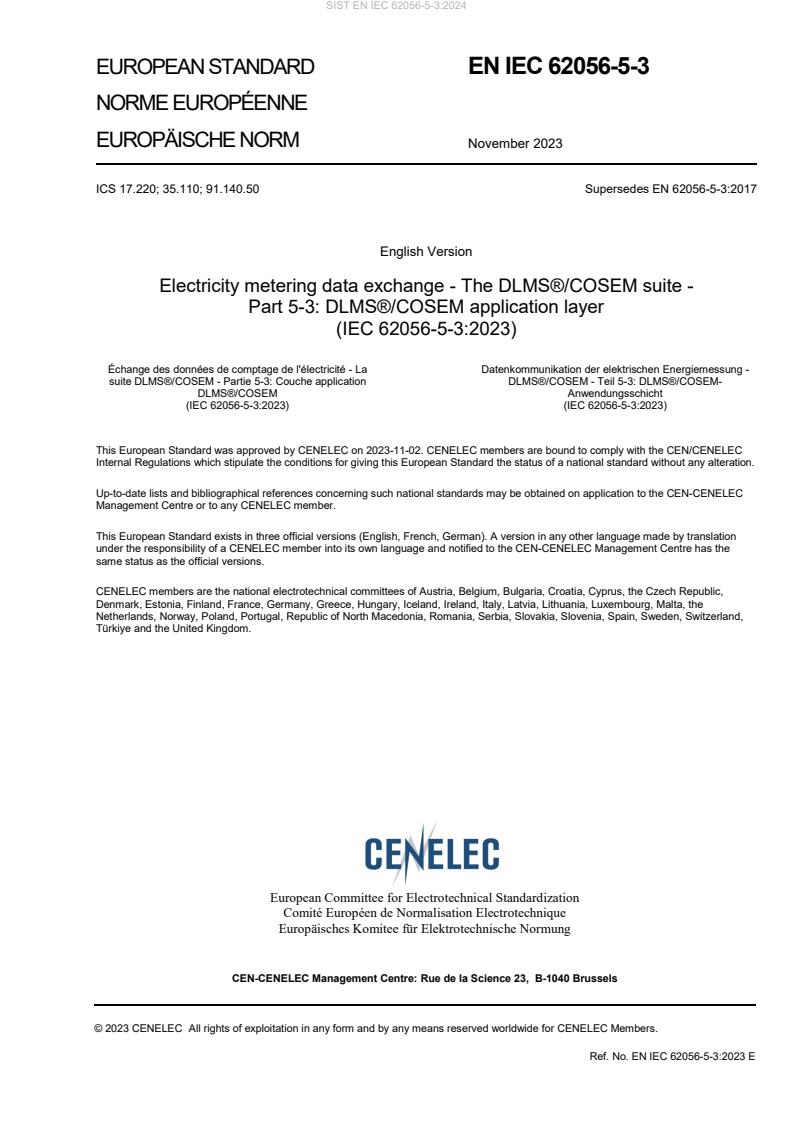
EUROPEAN STANDARD EN IEC 62056-5-3
NORME EUROPÉENNE
EUROPÄISCHE NORM November 2023
ICS 17.220; 35.110; 91.140.50 Supersedes EN 62056-5-3:2017
English Version
Electricity metering data exchange - The DLMS®/COSEM suite -
Part 5-3: DLMS®/COSEM application layer
(IEC 62056-5-3:2023)
Échange des données de comptage de l'électricité - La Datenkommunikation der elektrischen Energiemessung -
suite DLMS®/COSEM - Partie 5-3: Couche application DLMS®/COSEM - Teil 5-3: DLMS®/COSEM-
DLMS®/COSEM Anwendungsschicht
(IEC 62056-5-3:2023) (IEC 62056-5-3:2023)
This European Standard was approved by CENELEC on 2023-11-02. CENELEC members are bound to comply with the CEN/CENELEC
Internal Regulations which stipulate the conditions for giving this European Standard the status of a national standard without any alteration.
Up-to-date lists and bibliographical references concerning such national standards may be obtained on application to the CEN-CENELEC
Management Centre or to any CENELEC member.
This European Standard exists in three official versions (English, French, German). A version in any other language made by translation
under the responsibility of a CENELEC member into its own language and notified to the CEN-CENELEC Management Centre has the
same status as the official versions.
CENELEC members are the national electrotechnical committees of Austria, Belgium, Bulgaria, Croatia, Cyprus, the Czech Republic,
Denmark, Estonia, Finland, France, Germany, Greece, Hungary, Iceland, Ireland, Italy, Latvia, Lithuania, Luxembourg, Malta, the
Netherlands, Norway, Poland, Portugal, Republic of North Macedonia, Romania, Serbia, Slovakia, Slovenia, Spain, Sweden, Switzerland,
Türkiye and the United Kingdom.
European Committee for Electrotechnical Standardization
Comité Européen de Normalisation Electrotechnique
Europäisches Komitee für Elektrotechnische Normung
CEN-CENELEC Management Centre: Rue de la Science 23, B-1040 Brussels
© 2023 CENELEC All rights of exploitation in any form and by any means reserved worldwide for CENELEC Members.
Ref. No. EN IEC 62056-5-3:2023 E
European foreword
The text of document 13/1890/FDIS, future edition 4 of IEC 62056-5-3, prepared by IEC/TC 13
"Electrical energy measurement and control" was submitted to the IEC-CENELEC parallel vote and
approved by CENELEC as EN IEC 62056-5-3:2023.
The following dates are fixed:
• latest date by which the document has to be implemented at national (dop) 2024-08-02
level by publication of an identical national standard or by endorsement
• latest date by which the national standards conflicting with the (dow) 2026-11-02
document have to be withdrawn
This document supersedes EN 62056-5-3:2017 and all of its amendments and corrigenda (if any).
Attention is drawn to the possibility that some of the elements of this document may be the subject of
patent rights. CENELEC shall not be held responsible for identifying any or all such patent rights.
This document has been prepared under a Standardization Request addressed to CENELEC by the
European Commission.
Any feedback and questions on this document should be directed to the users’ national committee. A
complete listing of these bodies can be found on the CENELEC website.
Endorsement notice
The text of the International Standard IEC 62056-5-3:2023 was approved by CENELEC as a
European Standard without any modification.
In the official version, for Bibliography, the following note has to be added for the standard indicated:
ISO 3166 (series) NOTE Approved as EN ISO 3166 (series)
Annex ZA
(normative)
Normative references to international publications
with their corresponding European publications
The following documents are referred to in the text in such a way that some or all of their content
constitutes requirements of this document. For dated references, only the edition cited applies. For
undated references, the latest edition of the referenced document (including any amendments)
applies.
NOTE 1 Where an International Publication has been modified by common modifications, indicated by (mod), the
relevant EN/HD applies.
NOTE 2 Up-to-date information on the latest versions of the European Standards listed in this annex is available
here: www.cencenelec.eu.
Publication Year Title EN/HD Year
IEC 61334-4-41 1996 Distribution automation using distribution EN 61334-4-41 1996
line carrier systems - Part 4: Data
communication protocols - Section 41:
Application protocol - Distribution line
message specification
IEC 61334-6 2000 Distribution automation using distribution EN 61334-6 2000
line carrier systems - Part 6: A-XDR
encoding rule
IEC/TR 62051 1999 Electricity metering - Glossary of terms - -
IEC/TR 62051-1 2004 Electricity metering - Data exchange for - -
meter reading, tariff and load control -
Glossary of terms - Part 1: Terms related
to data exchange with metering equipment
using DLMS®/COSEM
IEC 62056-6-2 2023 Electricity metering data exchange - The EN IEC 62056-6-2 2023
DLMS®/COSEM suite - Part 6-2: COSEM
interface classes
IEC 62056-7-3 2017 Electricity metering data exchange - The EN 62056-7-3 2017
DLMS®/COSEM suite - Part 7-3: Wired
and wireless M-Bus communication
profiles for local and neighbourhood
networks
IEC 62056-7-6 2013 Electricity metering data exchange - The EN 62056-7-6 2013
DLMS®/COSEM suite - Part 7-6: The 3-
layer, connection-oriented HDLC based
communication profile
IEC 62056-8-3 2013 Electricity metering data exchange - The EN 62056-8-3 2013
DLMS®/COSEM suite - Part 8-3:
Communication profile for PLC S-FSK
neighbourhood networks
1 2
IEC 62056-8-11 — Electricity metering data exchange - The EN IEC 62056-8-11 —
DLMS®/COSEM suite - Part 8-11:
Communication profile for Wi-SUN field
area mesh networks
IEC 62056-8-12 2023 Electricity metering data exchange - The EN IEC 62056-8-12 2023
DLMS®/COSEM suite - Part 8-12:
Communication profile for Low-Power
Wide Area Networks (LPWANs)
IEC 62056-9-7 2013 Electricity metering data exchange - The EN 62056-9-7 2013
DLMS/COSEM suite - Part 9-7:
Communication profile for TCP-UDP/IP
networks
ISO/IEC 8824-1 2008 Information technology - Abstract Syntax - -
Notation One (ASN.1): Specification of
basic notation
ISO/IEC 8825-1 2008 Information technology - ASN.1 encoding - -
rules: Specification of Basic Encoding
Rules (BER), Canonical Encoding Rules
(CER) and Distinguished Encoding Rules
(DER)
ISO/IEC 15953 1999 Information technology - Open systems - -
interconnection - Service definition for the
Application service object association
control service element
ISO/IEC 15954 1999 Information technology - Open systems - -
interconnection - Connection-mode
protocol for the application service object
association control service element
ISO/IEC 7498-1 1994 Information technology - Open Systems - -
Interconnection - Basic reference model:
The basic model
ITU-T X.509 2008 Information technology - Open systems - -
interconnection - The Directory: Public-key
and attribute certificate frameworks
ITU-T X.693 2008 Information technology - ASN.1 encoding - -
rules: XML Encoding rules (XER)
ITU-T X.693 2011 Information technology - ASN.1 encoding - -
Corrigendum 1 rules: XML Encoding Rules (XER)
Technical Corrigendum 1
ITU-T X.694 2008 Information technology - ASN.1 encoding - -
rules: Mapping W3C XML schema
definitions into ASN.1
ITU-T X.694 2011 Information technology - ASN.1 encoding - -
Corrigendum rules: Mapping W3C XML schema
definitions into ASN.1 Technical
corrigendum 1
FIPS PUB 180-4 2012 Secure Hash Standard (SHS) - -
FIPS PUB 186-4 2013 Digital Signature Standard (DSS) - -
Under preparation. Stage at the time of publication: IEC CDV.
Under preparation. Stage at the time of publication: prEN IEC 62056-8-11:2023.
NIST SP 800-21 2005 Guideline for Implementing Cryptography - -
in the Federal Government
NIST SP 800-32 2001 Introduction to Public Key Technology and - -
the Federal PKI Infrastructure
NIST SP 800-56A 2013 Recommendation for Pair-Wise Key - -
rev2 Establishment Schemes Using Discrete
Logarithm Cryptography
NIST SP 800-57 2012 Recommendation for Key Management, - -
Part 1: General (Revision 3)
NSA2 - Suite B Implementer's guide to NIST - -
th
SP800-56A, 28 July 2009
NSA3 - NSA Suite B Base Certificate and CRL - -
th
Profile, 27 May 2008
SEC1 2009 Standards for Efficient Cryptography: - -
Elliptic Curve Cryptography. SECG.
Version 2.0
RFC 3394 2002 Internet Engineering Task Force (IETF). - -
Advanced Encryption Standard (AES) Key
Wrap Algorithm. Edited by J. Schaad
(Soaring Hawk Consulting) and R. Housley
(RSA Laboratories)
RFC 4106 - The Use of Galois/Counter Mode (GCM) in - -
IPsec Encapsulating Security Payload
(ESP)
RFC 4108 2005 Using Cryptographic Message Syntax - -
(CMS) to Protect Firmware Packages
RFC 5280 2008 Internet X.509 Public Key Infrastructure - -
Certificate and Certificate Revocation List
(CRL) Profile
IEC 62056-5-3 ®
Edition 4.0 2023-09
INTERNATIONAL
STANDARD
NORME
INTERNATIONALE
colour
inside
Electricity metering data exchange – The DLMS®/COSEM suite –
Part 5-3: DLMS®/COSEM application layer
Échange des données de comptage de l'électricité – La suite DLMS®/COSEM –
Partie 5-3: Couche application DLMS®/COSEM
INTERNATIONAL
ELECTROTECHNICAL
COMMISSION
COMMISSION
ELECTROTECHNIQUE
INTERNATIONALE
ICS 17.220, 35.110, 91.140.50 ISBN 978-2-8322-7223-7
– 2 – IEC 62056-5-3:2023 © IEC 2023
CONTENTS
FOREWORD . 12
INTRODUCTION . 14
1 Scope . 15
2 Normative references . 15
3 Terms, definitions, abbreviated terms and symbols . 17
3.1 General DLMS®/COSEM definitions . 17
3.2 Definitions related to cryptographic security . 22
3.3 Definitions and abbreviated terms related to the Galois/Counter Mode . 32
3.4 General abbreviated terms . 34
3.5 Symbols related to the Galois/Counter Mode . 38
3.6 Symbols related the ECDSA algorithm . 38
3.7 Symbols related to the key agreement algorithms . 39
4 Overview of DLMS®/COSEM . 39
4.1 Information exchange in DLMS®/COSEM . 39
4.1.1 General . 39
4.1.2 Communication model . 40
4.1.3 Naming and addressing . 41
4.1.4 Connection oriented operation . 44
4.1.5 Application associations . 45
4.1.6 Messaging patterns . 46
4.1.7 Data exchange between third parties and DLMS®/COSEM servers . 47
4.1.8 Communication profiles . 48
4.1.9 Model of a DLMS®/COSEM metering system . 50
4.1.10 Model of DLMS®/COSEM servers . 50
4.1.11 Model of a DLMS®/COSEM client . 52
4.1.12 Interoperability and interconnectivity in DLMS®/COSEM . 53
4.1.13 Ensuring interconnectivity: the protocol identification service . 53
4.1.14 System integration and meter installation . 53
4.2 DLMS®/COSEM application layer main features . 54
4.2.1 General . 54
4.2.2 DLMS®/COSEM application layer structure . 54
4.2.3 The Association Control Service Element, ACSE . 55
4.2.4 The xDLMS application service element . 56
4.2.5 Layer management services . 64
4.2.6 Summary of DLMS®/COSEM application layer services . 64
4.2.7 DLMS®/COSEM application layer protocols . 65
5 Information security in DLMS®/COSEM . 65
5.1 Overview. 65
5.2 The DLMS®/COSEM security concept . 65
5.2.1 Overview . 65
5.2.2 Identification and authentication . 66
5.2.3 Security context . 69
5.2.4 Access rights . 69
5.2.5 Application layer message security . 69
5.2.6 COSEM data security . 72
5.3 Cryptographic algorithms . 72
IEC 62056-5-3:2023 © IEC 2023 – 3 –
5.3.1 Overview . 72
5.3.2 Hash function . 72
5.3.3 Symmetric key algorithms . 73
5.3.4 Public key algorithms . 80
5.3.5 Random number generation . 90
5.3.6 Compression . 91
5.3.7 Security suite . 91
5.4 Cryptographic keys – overview . 92
5.5 Key used with symmetric key algorithms . 92
5.5.1 Symmetric keys types . 92
5.5.2 Key information with general-ciphering APDU and data protection . 94
5.5.3 Key identification . 94
5.5.4 Key wrapping . 95
5.5.5 Key agreement . 95
5.5.6 Symmetric key cryptoperiods . 96
5.6 Keys used with public key algorithms . 96
5.6.1 Overview . 96
5.6.2 Key pair generation . 96
5.6.3 Public key certificates and infrastructure . 97
5.6.4 Certificate and certificate extension profile . 100
5.6.5 Suite B end entity certificate types to be supported by DLMS®/COSEM
servers . 108
5.6.6 Management of certificates . 108
5.7 Applying cryptographic protection . 113
5.7.1 Overview . 113
5.7.2 Protecting xDLMS APDUs . 113
5.7.3 Multi-layer protection by multiple parties . 126
5.7.4 HLS authentication mechanisms . 127
5.7.5 Protecting COSEM data . 130
6 DLMS®/COSEM application layer service specification . 131
6.1 Service primitives and parameters . 131
6.2 The COSEM-OPEN service . 133
6.3 The COSEM-RELEASE service . 138
6.4 COSEM-ABORT service . 141
6.5 Protection and general block transfer parameters . 141
6.6 The GET service . 146
6.7 The SET service . 149
6.8 The ACTION service . 153
6.9 The ACCESS service . 156
6.9.1 Overview – Main features . 156
6.9.2 Service specification . 158
6.10 The DataNotification service . 162
6.11 The EventNotification service . 164
6.12 The TriggerEventNotificationSending service . 165
6.13 Variable access specification . 166
6.14 The Read service . 166
6.15 The Write service . 170
6.16 The UnconfirmedWrite service . 173
6.17 The InformationReport service . 175
– 4 – IEC 62056-5-3:2023 © IEC 2023
6.18 Client side layer management services: the SetMapperTable.request . 176
6.19 Summary of services and LN/SN data transfer service mapping . 176
7 DLMS®/COSEM application layer protocol specification . 177
7.1 The control function . 177
7.1.1 State definitions of the client side control function . 177
7.1.2 State definitions of the server side control function . 179
7.2 The ACSE services and APDUs . 181
7.2.1 ACSE functional units, services and service parameters . 181
7.2.2 Registered COSEM names . 184
7.2.3 APDU encoding rules . 187
7.2.4 Protocol for application association establishment . 187
7.2.5 Protocol for application association release . 193
7.3 Protocol for the data transfer services . 196
7.3.1 Negotiation of services and options – the conformance block . 196
7.3.2 Confirmed and unconfirmed service invocations . 197
7.3.3 Protocol for the GET service . 199
7.3.4 Protocol for the SET service . 202
7.3.5 Protocol for the ACTION service . 205
7.3.6 Protocol for the ACCESS service . 207
7.3.7 Protocol of the DataNotification service . 208
7.3.8 Protocol for the EventNotification service . 211
7.3.9 Protocol for the Read service . 212
7.3.10 Protocol for the Write service . 215
7.3.11 Protocol for the UnconfirmedWrite service . 219
7.3.12 Protocol for the InformationReport service . 220
7.3.13 Protocol of general block transfer mechanism . 221
7.3.14 Protocol of exception mechanism . 243
8 Abstract syntax of ACSE and COSEM APDUs . 244
9 COSEM APDU XML schema . 263
9.1 General . 263
9.2 XML Schema . 263
Annex A (normative) Using the DLMS®/COSEM application layer in various
communications profiles . 285
A.1 General . 285
A.2 Targeted communication environments . 285
A.3 The structure of the profile . 285
A.4 Identification and addressing schemes . 285
A.5 Supporting layer services and service mapping . 286
A.6 Communication profile specific parameters of the COSEM AL services . 286
A.7 Specific considerations / constraints using certain services within a given
profile . 286
A.8 The 3-layer, connection-oriented, HDLC based communication profile . 286
A.9 The TCP-UDP/IP based communication profiles (COSEM_on_IP) . 286
A.10 The wired and wireless M-Bus communication profiles . 286
A.11 The S-FSK PLC profile . 286
Annex B (normative) SMS short wrapper. 287
Annex C (normative) Gateway protocol . 288
C.1 General . 288
C.2 The gateway protocol . 289
IEC 62056-5-3:2023 © IEC 2023 – 5 –
C.3 HES in the WAN/NN acting as Initiator (Pull operation) . 290
C.4 End devices in the LAN acting as Initiators (Push operation) . 291
C.4.1 General . 291
C.4.2 End device with WAN/NN knowledge . 291
C.4.3 End devices without WAN/NN knowledge . 291
C.5 Security . 291
Annex D (informative) AARQ and AARE encoding examples . 292
D.1 General . 292
D.2 Encoding of the xDLMS InitiateRequest / InitiateResponse APDU . 292
D.3 Specification of the AARQ and AARE APDUs . 295
D.4 Data for the examples . 296
D.5 Encoding of the AARQ APDU . 297
D.6 Encoding of the AARE APDU . 300
Annex E (informative) Encoding examples: AARQ and AARE APDUs using a ciphered
application context . 306
E.1 A-XDR encoding of the xDLMS InitiateRequest APDU, carrying a dedicated
key. 306
E.2 Authenticated encryption of the xDLMS InitiateRequest APDU . 307
E.3 The AARQ APDU . 308
E.4 A-XDR encoding of the xDLMS InitiateResponse APDU . 310
E.5 Authenticated encryption of the xDLMS InitiateResponse APDU . 311
E.6 The AARE APDU . 312
E.7 The RLRQ APDU (carrying a ciphered xDLMS InitiateRequest APDU) . 314
E.8 The RLRE APDU (carrying a ciphered xDLMS InitiateResponse APDU) . 315
Annex F (informative) Data transfer service examples . 316
F.1 GET / Read, SET / Write examples . 316
F.2 ACCESS service example . 333
F.3 Compact array encoding example . 334
F.3.1 General . 334
F.3.2 The specification of compact-array . 335
F.3.3 Example 1: Compact array encoding an array of five long-unsigned
values . 336
F.3.4 Example 2: Compact-array encoding of five octet-string values . 337
F.3.5 Example 3: Encoding of the buffer of a Profile generic object . 338
F.4 Profile generic IC buffer attribute encoding examples . 339
F.4.1 General . 339
F.4.2 Get-response with Profile generic normal encoding example . 340
F.4.3 Get-response with Profile generic null-data compressed encoding
example . 342
F.4.4 Get-response with Profile generic compact-array encoding example . 345
F.4.5 Get-response with Profile generic null-data and delta-value encoding
example . 347
F.4.6 Comparison of various encoding methods for Get-response APDU . 350
F.4.7 Combination of the various encoding methods and V.44 compression . 350
Annex G (normative) NSA Suite B elliptic curves and domain parameters . 352
Annex H (informative) Example of an End entity signature certificate using P-256
signed with P-256 . 354
H.1 Fields of public key certificates . 354
H.2 Example of a Root-CA Certificate using P-256 signed with P-256 . 355
– 6 – IEC 62056-5-3:2023 © IEC 2023
H.3 Example of an end entity digital signature Certificate using P-256 signed
with P-256 . 356
Annex I (normative) Use of key agreement schemes in DLMS®/COSEM . 357
I.1 Ephemeral Unified Model C(2e, 0s, ECC CDH) scheme . 357
I.2 One-Pass Diffie-Hellman C(1e, 1s, ECC CDH) scheme . 360
I.3 Static Unified Model C(0e, 2s, ECC CDH) scheme . 363
Annex J (informative) Exchanging protected xDLMS APDUs between TP and server . 367
J.1 General . 367
J.2 Example 1: Protection is the same in the two directions . 367
J.3 Example 2: Protection is different in the two directions . 368
Annex K (informative) Significant technical changes with respect to
IEC 62056‑5‑3:2017 . 370
Bibliography . 373
Figure 1 – Client–server model and communication protocols . 41
Figure 2 – Naming and addressing in DLMS®/COSEM . 42
Figure 3 – A complete communication session in the CO environment . 44
Figure 4 – DLMS®/COSEM messaging patterns . 47
Figure 5 – DLMS®/COSEM generic communication profile . 49
Figure 6 – Model of a DLMS®/COSEM metering system . 50
Figure 7 – DLMS®/COSEM server model . 51
Figure 8 – Model of a DLMS®/COSEM client using multiple protocol stacks. 52
Figure 9 – The structure of the DLMS®/COSEM application layers . 54
Figure 10 – The concept of composable xDLMS messages . 61
Figure 11 – Summary of DLMS®/COSEM AL services . 64
Figure 12 – Authentication mechanisms . 67
Figure 13 – Client – server message security concept . 70
Figure 14 – End-to-end message security concept . 71
Figure 15 – Hash function . 73
Figure 16 – Encryption and decryption . 74
Figure 17 – Message Authentication Codes (MACs) . 75
Figure 18 – GCM functions . 77
Figure 19 – Digital signatures . 83
Figure 20 – C(2e, 0s) scheme: each party contributes only an ephemeral key pair . 85
Figure 21 – C(1e, 1s) schemes: party U contributes an ephemeral key pair, and party V
contributes a static key pair . 86
Figure 22 – C(0e, 2s) scheme: each party contributes only a static key pair . 88
Figure 23 – Architecture of a Public Key Infrastructure (example) . 99
Figure 24 – MSC for provisioning the server with CA certificates . 109
Figure 25 – MSC for security personalisation of the server . 110
Figure 26 – Provisioning the server with the certificate of the client . 111
Figure 27 – Provisioning the client / third party with a certificate of the server. 112
Figure 28 – Remove certificate from the server . 112
Figure 29 – Cryptographic protection of information using AES-GCM . 116
Figure 30 – Structure of service-specific global / dedicated ciphering xDLMS APDUs . 118
IEC 62056-5-3:2023 © IEC 2023 – 7 –
Figure 31 – Structure of general-glo-ciphering and general-ded-ciphering xDLMS
APDUs . 119
Figure 32 – Structure of general-ciphering xDLMS APDUs . 120
Figure 33 – Structure of general-signing APDUs . 126
Figure 34 – Service primitives . 131
Figure 35 – Time sequence diagrams . 132
Figure 36 – Additional service parameters to control cryptographic protection and GBT . 142
Figure 37 – Partial state machine for the client side control function . 178
Figure 38 – Partial state machine for the server side control function . 180
Figure 39 – MSC for successful AA establishment preceded by a successful lower
layer connection establishment . 189
Figure 40 – Graceful AA release using the A-RELEASE service . 194
Figure 41 – Graceful AA release by disconnecting the supporting layer . 195
Figure 42 – Aborting an AA following a PH-ABORT.indication . 196
Figure 43 – MSC of the GET service . 199
Figure 44 – MSC of the GET service with block transfer. 200
Figure 45 – MSC of the GET service with block transfer, long GET aborted . 202
Figure 46 – MSC of the SET service . 203
Figure 47 – MSC of the SET service with block transfer . 203
Figure 48 – MSC of the ACTION service . 205
Figure 49 – MSC of the ACTION service with block transfer . 207
Figure 50 – Access Service with long response . 208
Figure 51 – Access Service with long request and response . 208
Figure 52 – MSC for the DataNotification service, case 1) . 209
Figure 53 – MSC for the DataNotification service, case 2) . 210
Figure 54 – MSC for the DataNotification service, case 3) . 211
Figure 55 – MSC of the Read service used for reading an attribute . 214
Figure 56 – MSC of the Read service used for invoking a method . 214
Figure 57 – MSC of the Read Service used for reading an attribute, with block transfer . 215
Figure 58 – MSC of the Write service used for writing an attribute . 218
Figure 59 – MSC of the Write service used for invoking a method . 218
Figure 60 – MSC of the Write Service used for writing an attribute, with block transfer . 219
Figure 61 – MSC of the Unconfirmed Write service used for writing an attribute . 220
Figure 62 – Partial service invocations and GBT APDUs . 223
Figure 63 – The GBT procedure . 226
Figure 64 – Send GBT APDU stream sub-procedure . 230
Figure 65 – Process GBT APDU sub-procedure . 232
Figure 66 – Check RQ and fill gaps sub-procedure . 234
Figure 67 – GET service with GBT, switching to streaming . 235
th
Figure 68 – GET service with partial invocations, GBT and streaming, recovery of 4
nd
block sent in the 2 stream . 236
th
Figure 69 – GET service with partial invocations, GBT and streaming, recovery of 4
th
and 5 block . 238
– 8 – IEC 62056-5-3:2023 © IEC 2023
Figure 70 – GET service with partial invocations, GBT and streaming, recovery of last
block . 239
Figure 71 – SET service with GBT, with server not supporting streaming, recovery of
rd
3 block . 240
Figure 72 – ACTION-WITH-LIST service with bi-directional GBT and block recovery . 241
Figure 73 – DataNotification service with GBT with partial invocation . 243
Figure B.1 – Short wrapper . 287
Figure C.1 – General architecture with gateway . 288
Figure C.2 – The fields used for pre-fixing the COSEM APDUs . 289
Figure C.3 – Pull message sequence chart . 290
Figure C.4 – Push message sequence chart . 291
Figure I.1 – MSC for key agreement using the Ephem
...
Questions, Comments and Discussion
Ask us and Technical Secretary will try to provide an answer. You can facilitate discussion about the standard in here.
Loading comments...