


prEN IEC 62475:2025
(Main)High-current test techniques - Definitions and requirements for test currents and measuring systems
High-current test techniques - Definitions and requirements for test currents and measuring systems
2022-05-18 - IEC 62475/Ed1 has been withdrawn and will not be circulated on June 17th, 2022. TC 42 has found technical issues with the contents of the manuscript that need to be addressed. A new CDV will be submitted by TC 42 at a later date.
Hochstrom-Prüftechnik - Begriffe und Anforderungen für Hochstrom-Messungen
Techniques des essais à haute intensité - Définitions et exigences relatives aux courants d'essai et systèmes de mesure
Visokotokovne preskusne tehnike - Definicije in zahteve za preskusne toke in merilne sisteme
General Information
- Status
- Not Published
- Publication Date
- 02-Nov-2026
- Technical Committee
- CLC/SR 42 - High-voltage testing techniques
- Drafting Committee
- IEC/TC 42 - IEC_TC_42
- Current Stage
- 4060 - Enquiry results established and sent to TC, SR, BTTF - Enquiry
- Start Date
- 04-Jul-2025
- Completion Date
- 04-Jul-2025
Relations
- Effective Date
- 25-Jan-2023
Overview
The prEN IEC 62475:2025 standard, developed by the CLC and IEC Technical Committee 42 (TC 42), provides comprehensive guidelines on high-current test techniques, specifically focusing on definitions and requirements for test currents and measuring systems. This standard supersedes the earlier IEC 62475/Ed1, addressing technical issues recognized by TC 42 and introducing updated methods and procedures for the qualification, calibration, and performance evaluation of measuring systems used in high-current testing.
The document targets electrical and electronic testing applications, particularly in the domain of high-voltage and high-current scenarios such as electricity transmission and distribution. The standard aims to ensure precise and reliable measurements, reducing uncertainty and improving the safety and effectiveness of testing processes.
Key Topics
Definitions and Terminology:
Comprehensive terms and definitions covering measuring systems, components, scale factors, rated values, dynamic behavior, and uncertainties related to various current types including steady-state DC and AC, short-time currents, and impulse currents.Measuring System Requirements:
Detailed procedures for measuring system qualification, including schedules for performance tests and checks, calibration methods (both comparison-based and component-based), and strict record-keeping practices.Testing Procedures:
Clear guidelines on calibration, linearity tests, dynamic behavior analysis, short-term and long-term stability examinations, impact of ambient temperature and interference, and required withstand tests for measuring systems.Uncertainty Management:
Framework for calculating measurement and calibration uncertainties, including specialized methods for time-parameter uncertainty in impulse current measurements.High-Current Applications:
Specific requirements for steady-state direct and alternating currents, short-time direct and alternating currents, impulse currents, and current measurement during high-voltage dielectric testing.
Applications
prEN IEC 62475:2025 is crucial for industries and laboratories involved in electrical testing where high currents are encountered, such as:
Power Transmission and Distribution:
Ensuring accurate measurement of test currents during dielectric and high-current tests on transformers, cables, switchgear, and other equipment.High-Voltage Testing Laboratories:
Standardizing test methods and measurement accuracy to validate equipment integrity and safety under high-current stress conditions.Electrical Equipment Manufacturing:
Offering manufacturers a framework for verifying the performance and calibration status of test setups used for product validation.Quality Assurance and Compliance:
Helping regulators and testing bodies establish consistency and reliability in measurement practices to comply with international standards.
Related Standards
prEN IEC 62475:2025 complements and intersects with numerous other standards and technical committees, notably:
IEC TC 14, TC 17, TC 23, and TC 38:
Related to electrical apparatus, high-voltage switchgear, and dielectric testing methods.IEC 61000 Series:
Electromagnetic compatibility and interference testing standards, relevant for interference tests described in IEC 62475.ISO/IEC Guides on Calibration and Uncertainty:
Providing foundational principles for measurement uncertainty and calibration traceability.
This standard integrates with the global framework for electrical test measurements, helping establish harmonized procedures critical for safety, performance, and interoperability in electrical engineering domains.
Keywords:
High-current test techniques, measuring systems, test current requirements, electrical testing standards, high-voltage testing, calibration, measurement uncertainty, IEC 62475, power transmission testing, dielectric testing, electrical equipment calibration

Frequently Asked Questions
prEN IEC 62475:2025 is a draft published by CLC. Its full title is "High-current test techniques - Definitions and requirements for test currents and measuring systems". This standard covers: 2022-05-18 - IEC 62475/Ed1 has been withdrawn and will not be circulated on June 17th, 2022. TC 42 has found technical issues with the contents of the manuscript that need to be addressed. A new CDV will be submitted by TC 42 at a later date.
2022-05-18 - IEC 62475/Ed1 has been withdrawn and will not be circulated on June 17th, 2022. TC 42 has found technical issues with the contents of the manuscript that need to be addressed. A new CDV will be submitted by TC 42 at a later date.
prEN IEC 62475:2025 is classified under the following ICS (International Classification for Standards) categories: 19.080 - Electrical and electronic testing. The ICS classification helps identify the subject area and facilitates finding related standards.
prEN IEC 62475:2025 has the following relationships with other standards: It is inter standard links to EN 62475:2010. Understanding these relationships helps ensure you are using the most current and applicable version of the standard.
prEN IEC 62475:2025 is available in PDF format for immediate download after purchase. The document can be added to your cart and obtained through the secure checkout process. Digital delivery ensures instant access to the complete standard document.
Standards Content (Sample)
SLOVENSKI STANDARD
01-junij-2025
Visokotokovne preskusne tehnike - Definicije in zahteve za preskusne toke in
merilne sisteme
High-current test techniques - Definitions and requirements for test currents and
measuring systems
Techniques des essais à haute intensité - Définitions et exigences relatives aux courants
d'essai et systèmes de mesure
Ta slovenski standard je istoveten z: prEN IEC 62475:2025
ICS:
19.080 Električno in elektronsko Electrical and electronic
preskušanje testing
2003-01.Slovenski inštitut za standardizacijo. Razmnoževanje celote ali delov tega standarda ni dovoljeno.
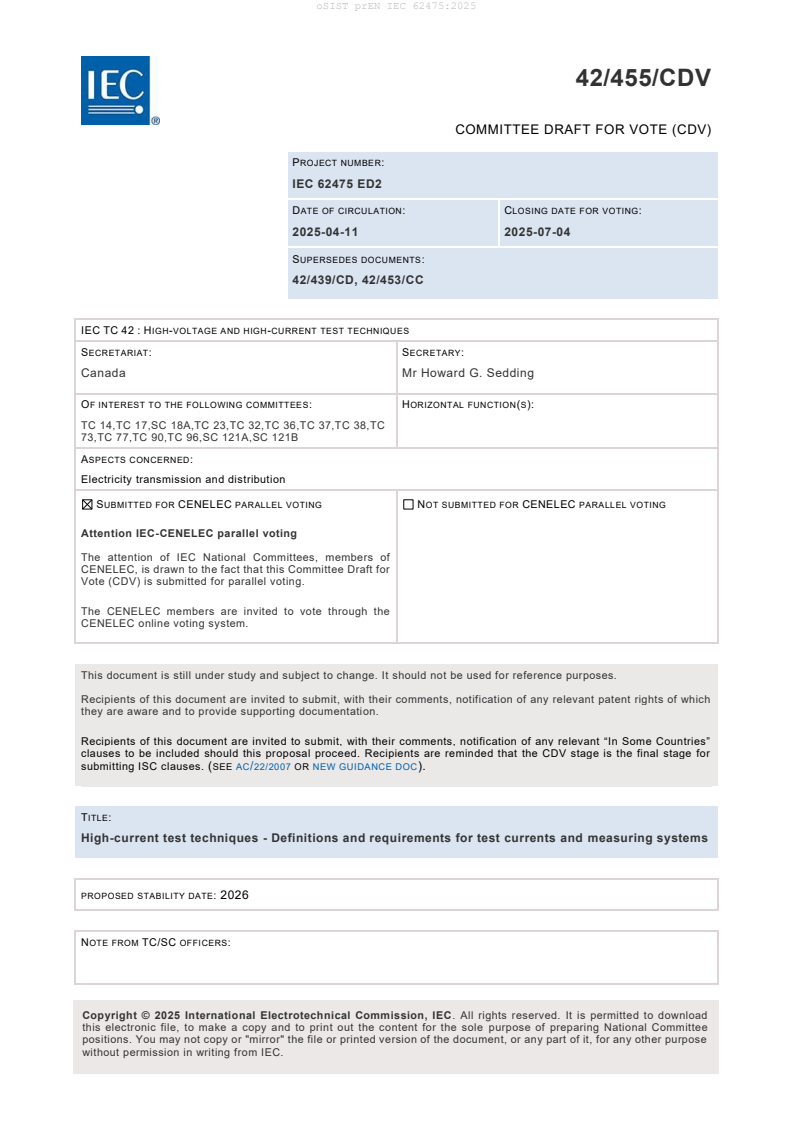
42/455/CDV
COMMITTEE DRAFT FOR VOTE (CDV)
PROJECT NUMBER:
IEC 62475 ED2
DATE OF CIRCULATION: CLOSING DATE FOR VOTING:
2025-04-11 2025-07-04
SUPERSEDES DOCUMENTS:
42/439/CD, 42/453/CC
IEC TC 42 : HIGH-VOLTAGE AND HIGH-CURRENT TEST TECHNIQUES
SECRETARIAT: SECRETARY:
Canada Mr Howard G. Sedding
OF INTEREST TO THE FOLLOWING COMMITTEES: HORIZONTAL FUNCTION(S):
TC 14,TC 17,SC 18A,TC 23,TC 32,TC 36,TC 37,TC 38,TC
73,TC 77,TC 90,TC 96,SC 121A,SC 121B
ASPECTS CONCERNED:
Electricity transmission and distribution
SUBMITTED FOR CENELEC PARALLEL VOTING NOT SUBMITTED FOR CENELEC PARALLEL VOTING
Attention IEC-CENELEC parallel voting
The attention of IEC National Committees, members of
CENELEC, is drawn to the fact that this Committee Draft for
Vote (CDV) is submitted for parallel voting.
The CENELEC members are invited to vote through the
CENELEC online voting system.
This document is still under study and subject to change. It should not be used for reference purposes.
Recipients of this document are invited to submit, with their comments, notification of any relevant patent rights of which
they are aware and to provide supporting documentation.
Recipients of this document are invited to submit, with their comments, notification of any relevant “In Some Countries”
clauses to be included should this proposal proceed. Recipients are reminded that the CDV stage is the final stage for
submitting ISC clauses. (SEE AC/22/2007 OR NEW GUIDANCE DOC).
TITLE:
High-current test techniques - Definitions and requirements for test currents and measuring systems
PROPOSED STABILITY DATE: 2026
NOTE FROM TC/SC OFFICERS:
this electronic file, to make a copy and to print out the content for the sole purpose of preparing National Committee
positions. You may not copy or "mirror" the file or printed version of the document, or any part of it, for any other purpose
without permission in writing from IEC.
42/455/CDV – 2 – IEC CDV 62475 © IEC 2025
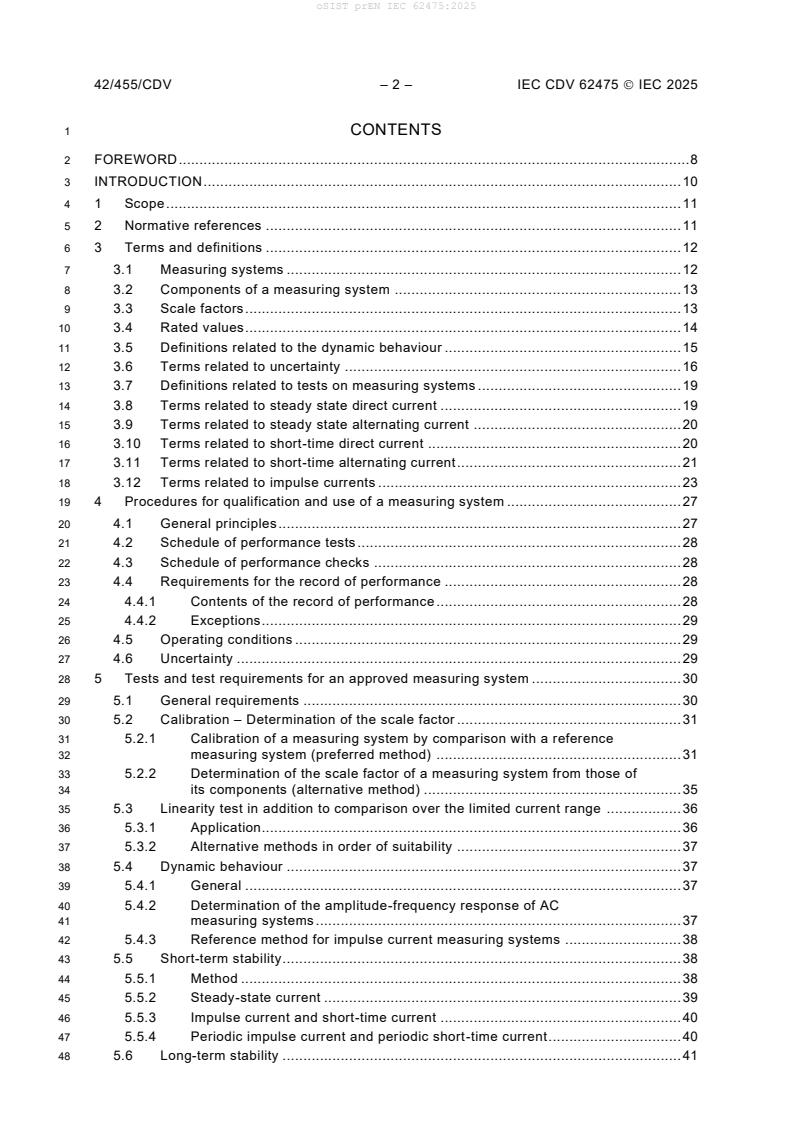
1 CONTENTS
2 FOREWORD . 8
3 INTRODUCTION . 10
4 1 Scope . 11
5 2 Normative references . 11
6 3 Terms and definitions . 12
7 3.1 Measuring systems . 12
8 3.2 Components of a measuring system . 13
9 3.3 Scale factors . 13
10 3.4 Rated values . 14
11 3.5 Definitions related to the dynamic behaviour . 15
12 3.6 Terms related to uncertainty . 16
13 3.7 Definitions related to tests on measuring systems . 19
14 3.8 Terms related to steady state direct current . 19
15 3.9 Terms related to steady state alternating current . 20
16 3.10 Terms related to short-time direct current . 20
17 3.11 Terms related to short-time alternating current . 21
18 3.12 Terms related to impulse currents . 23
19 4 Procedures for qualification and use of a measuring system . 27
20 4.1 General principles . 27
21 4.2 Schedule of performance tests . 28
22 4.3 Schedule of performance checks . 28
23 4.4 Requirements for the record of performance . 28
24 4.4.1 Contents of the record of performance . 28
25 4.4.2 Exceptions . 29
26 4.5 Operating conditions . 29
27 4.6 Uncertainty . 29
28 5 Tests and test requirements for an approved measuring system . 30
29 5.1 General requirements . 30
30 5.2 Calibration – Determination of the scale factor . 31
31 5.2.1 Calibration of a measuring system by comparison with a reference
32 measuring system (preferred method) . 31
33 5.2.2 Determination of the scale factor of a measuring system from those of
34 its components (alternative method) . 35
35 5.3 Linearity test in addition to comparison over the limited current range . 36
36 5.3.1 Application. 36
37 5.3.2 Alternative methods in order of suitability . 37
38 5.4 Dynamic behaviour . 37
39 5.4.1 General . 37
40 5.4.2 Determination of the amplitude-frequency response of AC
41 measuring systems . 37
42 5.4.3 Reference method for impulse current measuring systems . 38
43 5.5 Short-term stability . 38
44 5.5.1 Method . 38
45 5.5.2 Steady-state current . 39
46 5.5.3 Impulse current and short-time current . 40
47 5.5.4 Periodic impulse current and periodic short-time current . 40
48 5.6 Long-term stability . 41
IEC CDV 62475 © IEC 2025 – 3 – 42/455/CDV
49 5.7 Ambient temperature effect . 42
50 5.8 Effect of nearby current paths . 43
51 5.9 Software effect . 45
52 5.10 Uncertainty calculation . 45
53 5.10.1 General . 45
54 5.10.2 Uncertainty of calibration . 46
55 5.10.3 Uncertainty of measurement using an approved measuring system . 47
56 5.11 Uncertainty calculation of time-parameter measurements (impulse currents
57 only) . 47
58 5.11.1 General . 47
59 5.11.2 Uncertainty of the time-parameter calibration . 48
60 5.11.3 Uncertainty of a time-parameter measurement using an approved
61 measuring system. 49
62 5.12 Interference test. 50
63 5.12.1 Application. 50
64 5.12.2 Current-converting shunts and current transformers with iron . 51
65 5.12.3 Inductive measuring systems without iron (Rogowski coils) . 52
66 5.13 Withstand tests . 53
67 5.13.1 Voltage withstand tests . 53
68 5.13.2 Current withstand tests . 53
69 6 Steady-state direct current . 54
70 6.1 Application . 54
71 6.2 Test current . 54
72 6.2.1 Requirements . 54
73 6.2.2 Tolerances . 54
74 6.3 Measurement of the test current . 54
75 6.3.1 Requirements for an approved measuring system . 54
76 6.3.2 Uncertainty contributions . 54
77 6.3.3 Dynamic behaviour . 54
78 6.3.4 Calibrations and tests on an approved measuring system . 55
79 6.3.5 Performance check . 55
80 6.4 Measurement of ripple amplitude . 56
81 6.4.1 Requirements for an approved measuring system . 56
82 6.4.2 Uncertainty contributions . 56
83 6.4.3 Dynamic behaviour for ripple . 56
84 6.4.4 Calibrations and tests on an approved ripple-current measuring system . 56
85 6.4.5 Measurement of the scale factor at the ripple frequency . 57
86 6.4.6 Performance check for ripple current measuring system . 57
87 6.5 Test procedures . 57
88 7 Steady-state alternating current . 57
89 7.1 Application . 57
90 7.2 Test current . 57
91 7.2.1 Requirements . 57
92 7.2.2 Tolerances . 58
93 7.3 Measurement of the test current . 58
94 7.3.1 Requirements for an approved measuring system . 58
95 7.3.2 Uncertainty contributions . 58
96 7.3.3 Dynamic behaviour . 58
97 7.3.4 Calibrations and tests on an approved measuring system . 60
42/455/CDV – 4 – IEC CDV 62475 © IEC 2025
98 7.3.5 Performance check . 61
99 7.4 Test procedures . 61
100 8 Short-time direct current . 61
101 8.1 Application . 61
102 8.2 Test currents . 62
103 8.2.1 Requirements for the test current. 62
104 8.2.2 Tolerances . 62
105 8.3 Measurement of the test current . 62
106 8.3.1 Requirements for an approved measuring system . 62
107 8.3.2 Uncertainty contributions . 62
108 8.3.3 Dynamic behaviour . 62
109 8.3.4 Calibrations and tests on an approved measuring system . 63
110 8.3.5 Performance check . 64
111 8.3.6 Linearity test . 64
112 8.4 Test procedures . 64
113 9 Short-time alternating current . 64
114 9.1 Application . 64
115 9.2 Test current . 65
116 9.2.1 Requirements for the test current. 65
117 9.2.2 Tolerances . 65
118 9.3 Measurement of the test current . 66
119 9.3.1 Requirements for an approved measuring system . 66
120 9.3.2 Uncertainty contributions . 66
121 9.3.3 Dynamic behaviour . 66
122 9.3.4 Calibrations and tests on an approved measuring system . 67
123 9.3.5 Performance check . 68
124 9.3.6 Linearity test . 69
125 9.3.7 Interference test . 69
126 9.4 Test procedures . 69
127 10 Impulse currents . 69
128 10.1 Application . 69
129 10.2 Test current . 69
130 10.2.1 General . 69
131 10.2.2 Tolerances . 70
132 10.3 Measurement of the test current . 71
133 10.3.1 Requirements for an approved measuring system . 71
134 10.3.2 Uncertainty contributions . 71
135 10.3.3 Dynamic behaviour . 71
136 10.3.4 Calibrations and tests on an approved measuring system . 72
137 10.3.5 Performance check . 73
138 10.4 Test procedures . 74
139 11 Current measurement in high-voltage dielectric testing . 74
140 11.1 Application . 74
141 11.2 Terms and definitions. 74
142 11.3 Measurement of the test current . 74
143 11.3.1 Requirements for an approved measuring system . 74
144 11.3.2 Uncertainty contributions . 74
145 11.3.3 Dynamic behaviour . 75
IEC CDV 62475 © IEC 2025 – 5 – 42/455/CDV
146 11.3.4 Calibrations and tests on an approved measuring system . 75
147 11.3.5 Performance check . 75
148 11.3.6 Linearity test . 76
149 11.3.7 Interference test . 76
150 11.4 Test procedures . 76
151 12 Reference measuring systems . 76
152 12.1 General . 76
153 12.2 Interval between subsequent calibrations of reference measuring systems . 76
154 Annex A (informative) Uncertainty of measurement . 77
155 Annex B (informative) Examples of the uncertainty calculation in high-current
156 measurements . 84
157 Annex C (informative) Step-response measurements . 93
158 Annex D (informative) Convolution method for estimation of dynamic behaviour from
159 step-response measurements . 95
160 Annex E (informative) Constraints for certain wave shapes . 99
161 Annex F (informative) Temperature rise of measuring resistors . 101
162 Annex G (informative) Determination of RMS values of short-time AC current . 102
163 Annex H (informative) Examples of IEC standards with high-current tests . 112
164 Bibliography . 114
166 Figure 1 – Amplitude frequency response with examples for limit frequencies ( f ; f ) . 16
1 2
167 Figure 2 – Example of short-time direct current . 21
168 Figure 3 – Exponential impulse current . 23
169 Figure 4 – Exponential impulse current – Oscillating tail . 24
170 Figure 5 – Impulse current – Rectangular, smooth . 25
171 Figure 6 – Impulse current – Rectangular with oscillations . 25
172 Figure 7 – Calibration by comparison over full assigned measurement range, h = 5 . 33
173 Figure 8 – Uncertainty contributions for calibrations over five current levels. 33
174 Figure 9 – Combining calibration and linearity test . 35
175 Figure 10 – Linearity test in the extended current range . 36
176 Figure 11 – Short-term stability test for steady-state current . 39
177 Figure 12 – Short-term stability test for impulse current and short-time current . 40
178 Figure 13 – Short-term stability test for periodic impulse-current and periodic short-
179 time current . 41
180 Figure 14 – Test circuit for effect of nearby current path for current-converting shunts
181 and current transformers with iron. 44
182 Figure 15 – Test circuit for effect of nearby current path for inductive measuring
183 systems without iron (Rogowski coils) . 45
184 Figure 16 – Principle of interference test circuit . 51
185 Figure 17 – Interference test on the measuring system i (t) based on
186 current-converting shunt or current transformer with iron in a typical 3-phase
187 short-circuit set-up . 52
188 Figure 18 – Test circuit for interference test for inductive systems without iron
189 (Rogowski coils) . 53
190 Figure 19 – Acceptable normalized amplitude-frequency response of an AC measuring
191 system intended for a single fundamental frequency f . 59
nom
42/455/CDV – 6 – IEC CDV 62475 © IEC 2025
192 Figure 20 – Acceptable normalized amplitude-frequency response of an AC measuring
193 system intended for a range of fundamental frequencies f to f . 60
nom1 nom2
194 Figure 21 – Example of short-time alternating current . 65
195 Figure A.1 – Normal probability distribution p(x) of a continuous random variable x . 83
196 Figure A.2 – Rectangular probability distribution p(x) . 83
197 Figure B.1 – Comparison between the system under calibration X and the reference
198 system N . 84
199 Figure C.1 – Circuit to generate current step using a coaxial cable . 93
200 Figure C.2 – Circuit to generate current step using a capacitor . 94
201 Figure E.1 – Attainable time parameters (shaded area) for 8/20 µs current impulse . 100
202 Figure G.1 – Equivalent circuit of short-circuit test . 102
203 Figure G.2 – Symmetrical AC component of an alternating short-circuit current . 104
204 Figure G.3 – Numerical evaluation of RMS value showing both instantaneous current
205 and instantaneous squared value of the current . 105
206 Figure G.4 – Three-crest method . 106
207 Figure G.5 – Evaluation of conventional RMS value of an arc current using the three-
208 crest method . 107
209 Figure G.6 – Evaluation of equivalent RMS value of a short-time current during a short-
210 circuit test . 108
211 Figure G.7 – Relation between factor κ and power factor cos(φ). 110
212 Figure G.8 – Phase displacement based on an ohmic-inductive circuit. . 110
214 Table 1 – Required tests for steady-state direct current . 55
215 Table 2 – Required tests for ripple current . 56
216 Table 3 – Required tests for steady-state alternating current . 60
217 Table 4 – Tolerance requirement on test-current parameters for short-time direct
218 current . 62
219 Table 5 – Required tests for short-time direct current . 63
220 Table 6 – Tolerance requirements on the short-time alternating current test parameters . 65
221 Table 7 – List of typical tests in a high-power laboratory and required minimum
222 frequency range of the measuring system . 66
223 Table 8 – Tolerance requirements on scale factor . 67
224 Table 9 – Required tests for short-time alternating current . 67
225 Table 10 – Examples of exponential impulse-current types . 70
226 Table 11 – Tolerance requirements on exponential impulse current . 70
227 Table 12 – Tolerance requirements on rectangular impulse current. 70
228 Table 13 – Required tests for impulse current . 72
229 Table 14 – Required tests for impulse current in high-voltage dielectric testing . 75
230 Table A.1 – Coverage factor k for effective degrees of freedom ν (p = 95 %) . 82
eff
231 Table A.2 – Schematic of an uncertainty budget . 82
232 Table B.1 – Result of the comparison measurement . 86
233 Table B.2 – Result of the comparison measurement . 87
234 Table B.3 – Uncertainty budget for calibration of scale factor F . 87
x
235 Table B.4 – Result of linearity test . 89
IEC CDV 62475 © IEC 2025 – 7 – 42/455/CDV
236 Table B.5 – Uncertainty budget of scale factor F . 89
X,mes
237 Table B.6 – Uncertainty budget of the assigned scale factor F . 92
238 Table H.1 – List of typical tests with short-time alternating current . 112
239 Table H.2 –List of typical tests with exponential impulse current . 113
240 Table H.3 –List of typical tests with rectangular impulse current . 113
42/455/CDV – 8 – IEC CDV 62475 © IEC 2025
243 INTERNATIONAL ELECTROTECHNICAL COMMISSION
244 ______________
246 HIGH-CURRENT TEST TECHNIQUES –
247 DEFINITIONS AND REQUIREMENTS FOR TEST CURRENTS
248 AND MEASURING SYSTEMS
251 FOREWORD
252 1) The International Electrotechnical Commission (IEC) is a worldwide organization for standardization comprising
253 all national electrotechnical committees (IEC National Committees). The object of IEC is to promote international
254 co-operation on all questions concerning standardization in the electrical and electronic fields. To this end and
255 in addition to other activities, IEC publishes International Standards, Technical Specifications, Technical Reports,
256 Publicly Available Specifications (PAS) and Guides (hereafter referred to as “IEC Publication(s)”). Their
257 preparation is entrusted to technical committees; any IEC National Committee interested in the subject dealt with
258 may participate in this preparatory work. International, governmental and non-governmental organizations liaising
259 with the IEC also participate in this preparation. IEC collaborates closely with the International Organization for
260 Standardization (ISO) in accordance with conditions determined by agreement between the two organizations.
261 2) The formal decisions or agreements of IEC on technical matters express, as nearly as possible, an international
262 consensus of opinion on the relevant subjects since each technical committee has representation from all
263 interested IEC National Committees.
264 3) IEC Publications have the form of recommendations for international use and are accepted by IEC National
265 Committees in that sense. While all reasonable efforts are made to ensure that the technical content of IEC
266 Publications is accurate, IEC cannot be held responsible for the way in which they are used or for any
267 misinterpretation by any end user.
268 4) In order to promote international uniformity, IEC National Committees undertake to apply IEC Publications
269 transparently to the maximum extent possible in their national and regional publications. Any divergence between
270 any IEC Publication and the corresponding national or regional publication shall be clearly indicated in the latter.
271 5) IEC itself does not provide any attestation of conformity. Independent certification bodies provide conformity
272 assessment services and, in some areas, access to IEC marks of conformity. IEC is not responsible for any
273 services carried out by independent certification bodies.
274 6) All users should ensure that they have the latest edition of this publication.
275 7) No liability shall attach to IEC or its directors, employees, servants or agents including individual experts and
276 members of its technical committees and IEC National Committees for any personal injury, property damage or
277 other damage of any nature whatsoever, whether direct or indirect, or for costs (including legal fees) and
278 expenses arising out of the publication, use of, or reliance upon, this IEC Publication or any other IEC
279 Publications.
280 8) Attention is drawn to the Normative references cited in this publication. Use of the referenced publications is
281 indispensable for the correct application of this publication.
282 9) Attention is drawn to the possibility that some of the elements of this IEC Publication may be the subject of patent
283 rights. IEC shall not be held responsible for identifying any or all such patent rights.
284 International Standard IEC 62475 has been prepared by IEC technical committee 42: High-
285 voltage test techniques.
286 The text of this document is based on the following documents:
FDIS Report on voting
42/278/FDIS 42/283/RVD
288 Full information on the voting for the approval of this document can be found in the report on
289 voting indicated in the above table.
290 This publication has been drafted in accordance with the ISO/IEC Directives, Part 2.
IEC CDV 62475 © IEC 2025 – 9 – 42/455/CDV
292 The committee has decided that the contents of this publication will remain unchanged until the
293 stability date indicated on the IEC website under "http://webstore.iec.ch" in the data related to
294 this specific publication. At this date, the publication will be:
295 • reconfirmed;
296 • withdrawn;
297 • replaced by a revised edition; or
298 • amended.
IMPORTANT – The 'colour inside' logo on the cover page of this publication indicates that it
contains colours which are considered to be useful for the correct understanding of its
contents. Users should therefore print this document using a colour printer.
42/455/CDV – 10 – IEC CDV 62475 © IEC 2025
302 INTRODUCTION
303 Minor errors in edition 1 of the standard have been corrected.
304 Terms and definitions have been modified to achieve best possible adherence to IEC 60060-2:
305 2025.
306 Terms and definitions originating from IEC 60060-2: 2025 have been ascribed appropriate
307 [SOURCE].
308 Those terms and definitions that in Ed.1 were presented in clauses other than Clause 3 have
309 been moved into Clause 3.
310 Clauses 5.2.1.1 and 5.2.1.2 have been amended to use the same nomenclature (for average
311 values) as used in IEC 60060-2. The change is editorial.
312 Clause 5.8 has been amended to the proper equation for uncertainty. Figure 9 (now Figure 14)
313 has been amended to clarify how the currents are measured for proximity sensitivity tests.
314 Figure 10 (now Figure 15) has been amended to show proper positions for nearby current
315 versus proximity current.
316 In term 3.5.3, Note to entry has been deleted
317 Term 3.11.6 has been added
318 Former Clause 9.3.2 (now 9.2.2) has been amended to rectify the unit for cos ϕ in Table 6. (it
319 shall not be %)
320 Former Clause 9.4.3.1 (now 9.3.3.1) has been amended to refer to “Table 8” instead of “above”.
321 Former Clause 9.4.7 (now 9.3.7) has been amended to show correct clause reference in first
322 paragraph.
323 Annex A, clause A.1, first paragraph has been amended from “Guide 93” to “Guide 98-3”
324 Annex A, clause A.8 has been amended to refer coverage factor to a coverage probability of
325 95 %.
326 Annex B, clause B.4 has been amended to provide an example of uncertainty calculation for
327 the use of an approved measuring system.
328 Annex C2 has been deleted since the definitions given there are not referred to, with the
329 exception of the origin of the step, which is used in Annex D. The required information has been
330 added to Annex D as Note 1.
331 Annex G, clause G.8 has been amended to replace “peak factor” by “a factor”. Texts have been
332 clarified. Equations for relation between factor and cos ϕ have been developed to a simplified
333 form.
334 Annex G, clause G9 has been added
335 Using U as symbol both for expanded uncertainty and for voltage is strongly discouraged by
336 IEC. TC42 has discussed this matter and decided that the two usages will be retained in this
337 document.
IEC CDV 62475 © IEC 2025 – 11 – 42/455/CDV
339 HIGH-CURRENT TEST TECHNIQUES –
340 DEFINITIONS AND REQUIREMENTS FOR TEST CURRENTS
341 AND MEASURING SYSTEMS
345 1 Scope
346 This document is applicable to high-current testing and measurements on both high-voltage
347 and low-voltage equipment. It deals with steady-state and short-time direct current (as e.g.
348 encountered in high-power DC testing), steady-state and short-time alternating current (as e.g.
349 encountered in high-power AC testing), and impulse-current. In general, currents above 100 A
350 are considered in this document, although currents less than this can occur in tests.
351 NOTE This standard also covers fault detection during, for example, lightning impulse testing.
352 This document:
353 • defines the terms used;
354 • defines parameters and their tolerances;
355 • describes methods to estimate uncertainties of high-current measurements;
356 • states the requirements which a complete measuring system shall meet;
357 • describes the methods for approving a measuring system and checking its components;
358 • describes the procedure by which the user shall show that a measuring system meets the
359 requirements of this standard, including limits set for uncertainty of measurement.
360 2 Normative references
361 The following documents are referred to in the text in such a way that some or all of their content
362 constitutes requirements of this document. For dated references, only the edition cited applies.
363 For undated references, the latest edition of the referenced document (including any
364 amendments) applies.
365 IEC 60051-2:1984, Direct acting analogue electrical measuring instruments and their
366 accessories – Part 2: Special requirements for ammeters and voltmeters
367 IEC 60060-1:2025, High-voltage test techniques – Part 1: General definitions and test
368 requirements
369 IEC 61083-3: 2020, Instruments and software used for measurement in high-voltage and high-
370 current tests - Part 3: Requirements for hardware for tests with alternating and direct voltages
371 and currents
372 IEC 61083-4:20XX, Instruments and software used for measurement in high-voltage and high-
373 current tests – Part 4: Requirements for software for tests with alternating and direct currents
374 and voltages
375 IEC 61180: 2016, High-voltage test techniques for low-voltage equipment –Definitions, test and
376 procedure requirements, test equipment
377 ISO/IEC Guide 98-3:2008, Uncertainty of measurement – Part 3: Guide to the expression of
378 uncertainty in measurement (GUM: 1995)
379 NOTE Further related standards, guides, etc. on subjects included in this standard are given in the bibliography.
42/455/CDV – 12 – IEC CDV 62475 © IEC 2025
380 3 Terms and definitions
381 For the purposes of this document, the following terms and definitions apply.
382 ISO and IEC maintain terminology databases for use in standardization at the following
383 addresses:
384 • IEC Electropedia: available at https://www.electropedia.org/
385 • ISO Online browsing platform: available at https://www.iso.org/obp
386 3.1 Measuring systems
387 3.1.1
388 measuring system
389 complete set of devices suitable for performing measurements of a quantity to be measured
390 (measurand). Software used to obtain or calculate measurement results also forms a part of the
391 measuring system
392 Note 1 to entry: A high-current measuring system usually comprises the following components:
393 • converting device with either terminals to connect this device in circuit or appropriate coupling to the circuit, and
394 connections to earth;
395 • transmission system(s) connecting the output terminals of the converting device to the measuring instrument(s)
396 with its attenuating, terminating, and adapting impedances or networks;
397 • measuring instrument(s) together with any connections to the power supply. Measuring systems which comprise
398 only some of the above components or which are based on non-conventional principles are acceptable if they
399 meet the uncertainty requirements specified in this document;
400 • and in some cases the measuring system can include software to calculate the measurand.
401 NOTE 2 to entry: The environment in which a measuring system functions, its clearances to live, current carrying,
402 and earthed structures, and the presence of electromagnetic fields can significantly affect the measurement result
403 and its uncertainty.
404 [SOURCE: IEC 60060-2: 2025, 3.1.1]
405 3.1.2
406 record of performance
407 detailed record, established and maintained by the user, describing the measuring system and
408 containing evidence that the requirements given in this standard have been met
409 NOTE 1 to entry: This evidence includes the results of the initial performance test and the schedule and results
410 of each subsequent performance test and performance check.
411 [SOURCE: IEC 60060-2: 2025, 3.1.2]
412 3.1.3
413 approved measuring system
414 measuring system that is shown to comply with one or more of the sets of requirements set out
415 in IEC 62475
416 3.1.4
417 reference measuring system
418 measuring system with its calibration traceable to relevant national and/or international
419 standards of measurement, and having sufficient accuracy and stability for use in the approval
420 of other systems by making simultaneous comparative measurements with specific types of
421 waveform and ranges of current
422 NOTE 1 to entry: A reference measuring system (maintained in accordance with the requirements of this standard)
423 can be used as an approved measuring system but the converse is not true.
424 [SOURCE: IEC 60060-2: 2025, 3.1.4]
IEC CDV 62475 © IEC 2025 – 13 – 42/455/CDV
425 3.2 Components of a me
...
Questions, Comments and Discussion
Ask us and Technical Secretary will try to provide an answer. You can facilitate discussion about the standard in here.
Loading comments...