

EN IEC 60773:2021
(Main)Rotating electrical machines - Test methods and apparatus for the measurement of the operational characteristics of brushes
General Information
- Abstract
This document applies to test methods for the measurement of the operational characteristics of brushes designed to operate on commutating and slip ring machines under specified test conditions. By extension some tests may be relevant for other kinds of sliding electrical contacts for electrical appliances.
- Status
- Published
- Publication Date
- 20-May-2021
- Technical Committee
- CLC/TC 2 - Rotating machinery
- Drafting Committee
- IEC/TC 2 - IEC_TC_2
- Current Stage
- 6060 - Document made available - Publishing
- Start Date
- 21-May-2021
- Completion Date
- 21-May-2021



Overview
EN IEC 60773:2021 - Rotating electrical machines: Test methods and apparatus for the measurement of the operational characteristics of brushes defines standardized test methods, apparatus and measurement procedures for brushes used on commutating and slip‑ring machines. The standard covers test rig specifications, environmental and operating conditions, measurement intervals and reporting requirements. Some methods are also applicable to other sliding electrical contacts in electrical appliances.
Key topics and requirements
- Scope and terminology
- Definitions, symbols and abbreviations specific to brushes, brush‑holders, commutators and slip rings.
- Test rig specification
- Requirements for rings, test rings, brush arrangement, brush‑holders, power supply and instrumentation needed for repeatable measurements.
- Operating and environmental conditions
- Laboratory conditions, ambient and ring surface temperature, humidity, ring surface roughness and brush bedding procedures prior to testing.
- Measurement methods
- Friction coefficient: procedures, two test arrangement methods and calculation/reporting rules.
- Voltage drop: total brush voltage drop and contact voltage drop measurement techniques and calculation methods.
- Brush wear: measurement intervals, mass/length loss calculations and reporting.
- Commutation ability: a specific black‑band test on DC machines to assess commutation performance, interpretation of black‑band graphs and influencing factors (e.g., commutator skin thickness, contact resistance).
- Test schedule and data
- Test start procedures, duration, measurement frequency, required observations and data reporting formats.
- Annexes
- Informative guidance on friction calculation details, strain sensor adjustment and black‑band deviation cases.
Practical applications and users
EN IEC 60773:2021 is used by:
- Motor and generator manufacturers for validating brush performance during design and production.
- Brush and commutator suppliers to certify material grades and brush‑holder designs.
- Independent test laboratories and quality control departments for reproducible acceptance testing.
- R&D and reliability engineers evaluating friction, wear, voltage drop and commutation characteristics under controlled conditions.
- Maintenance teams seeking standardized test procedures to assess in‑service brush condition or select replacement brushes.
Benefits include consistent test data for product comparison, improved commutation reliability, better selection of brush materials and longer machine service life.
Related standards
Normative and referenced documents include, for example: IEC 60034‑19, IEC 60276, IEC 60136, IEC 60584‑1, IEC 60751, and ISO surface‑texture and materials standards (see Annex ZA of EN IEC 60773:2021). These references help align brush tests with commutator/machine and measurement conventions.
Relations
- Effective Date
- 10-Feb-2026
- Refers
ISO 1190-1:1982 - Copper and copper alloys — Code of designation — Part 1: Designation of materials - Effective Date
- 10-Feb-2026
- Effective Date
- 09-Feb-2026
- Effective Date
- 09-Feb-2026
- Effective Date
- 03-Feb-2026
- Effective Date
- 03-Feb-2026
- Effective Date
- 03-Feb-2026
- Effective Date
- 03-Feb-2026
Get Certified
Connect with accredited certification bodies for this standard

IMQ S.p.A. (Certification)
Italian electrical product certification.

SLG Prüf- und Zertifizierungs GmbH
German testing and certification body.

UL Solutions
Global safety science company with testing, inspection and certification.
Sponsored listings
Frequently Asked Questions
EN IEC 60773:2021 is a standard published by CLC. Its full title is "Rotating electrical machines - Test methods and apparatus for the measurement of the operational characteristics of brushes". This standard covers: This document applies to test methods for the measurement of the operational characteristics of brushes designed to operate on commutating and slip ring machines under specified test conditions. By extension some tests may be relevant for other kinds of sliding electrical contacts for electrical appliances.
This document applies to test methods for the measurement of the operational characteristics of brushes designed to operate on commutating and slip ring machines under specified test conditions. By extension some tests may be relevant for other kinds of sliding electrical contacts for electrical appliances.
EN IEC 60773:2021 is classified under the following ICS (International Classification for Standards) categories: 29.160.10 - Components for rotating machines. The ICS classification helps identify the subject area and facilitates finding related standards.
EN IEC 60773:2021 has the following relationships with other standards: It is inter standard links to ISO 15510:2014, ISO 1190-1:1982, EN ISO 3274:1997, EN 27787-1:1990, EN 60751:2008, EN 60034-19:2014, EN 60584-1:2013, EN IEC 60276:2019. Understanding these relationships helps ensure you are using the most current and applicable version of the standard.
EN IEC 60773:2021 is available in PDF format for immediate download after purchase. The document can be added to your cart and obtained through the secure checkout process. Digital delivery ensures instant access to the complete standard document.
Standards Content (Sample)
SLOVENSKI STANDARD
01-oktober-2021
Električni rotacijski stroji - Preskusne metode in aparati za merjenje obratovalnih
lastnosti ščetk (IEC 60773:2021)
Rotating electrical machines - Test methods and apparatus for the measurement of the
operational characteristics of brushes (IEC 60773:2021)
Drehende elektrische Maschinen - Prüfverfahren und -einrichtungen für die Messung der
Betriebseigenschaften von Kohlebürsten (IEC 60773:2021)
Machines électriques tournantes - Méthodes d'essai et appareils pour le mesurage des
caractéristiques opérationnelles des balais (IEC 60773:2021)
Ta slovenski standard je istoveten z: EN IEC 60773:2021
ICS:
29.160.01 Rotacijski stroji na splošno Rotating machinery in
general
2003-01.Slovenski inštitut za standardizacijo. Razmnoževanje celote ali delov tega standarda ni dovoljeno.
EUROPEAN STANDARD EN IEC 60773
NORME EUROPÉENNE
EUROPÄISCHE NORM
May 2021
ICS 29.160.10
English Version
Rotating electrical machines - Test methods and apparatus for
the measurement of the operational characteristics of brushes
(IEC 60773:2021)
Machines électriques tournantes - Méthodes d'essai et Drehende elektrische Maschinen - Prüfverfahren und -
appareils pour le mesurage des caractéristiques einrichtungen für die Messung der Betriebseigenschaften
opérationnelles des balais von Kohlebürsten
(IEC 60773:2021) (IEC 60773:2021)
This European Standard was approved by CENELEC on 2021-05-12. CENELEC members are bound to comply with the CEN/CENELEC
Internal Regulations which stipulate the conditions for giving this European Standard the status of a national standard without any alteration.
Up-to-date lists and bibliographical references concerning such national standards may be obtained on application to the CEN-CENELEC
Management Centre or to any CENELEC member.
This European Standard exists in three official versions (English, French, German). A version in any other language made by translation
under the responsibility of a CENELEC member into its own language and notified to the CEN-CENELEC Management Centre has the
same status as the official versions.
CENELEC members are the national electrotechnical committees of Austria, Belgium, Bulgaria, Croatia, Cyprus, the Czech Republic,
Denmark, Estonia, Finland, France, Germany, Greece, Hungary, Iceland, Ireland, Italy, Latvia, Lithuania, Luxembourg, Malta, the
Netherlands, Norway, Poland, Portugal, Republic of North Macedonia, Romania, Serbia, Slovakia, Slovenia, Spain, Sweden, Switzerland,
Turkey and the United Kingdom.
European Committee for Electrotechnical Standardization
Comité Européen de Normalisation Electrotechnique
Europäisches Komitee für Elektrotechnische Normung
CEN-CENELEC Management Centre: Rue de la Science 23, B-1040 Brussels
© 2021 CENELEC All rights of exploitation in any form and by any means reserved worldwide for CENELEC Members.
Ref. No. EN IEC 60773:2021 E
European foreword
The text of document 2/2045/FDIS, future edition 2 of IEC 60773, prepared by IEC/TC 2 "Rotating
machinery" was submitted to the IEC-CENELEC parallel vote and approved by CENELEC as
The following dates are fixed:
• latest date by which the document has to be implemented at national (dop) 2022-02-12
level by publication of an identical national standard or by endorsement
• latest date by which the national standards conflicting with the (dow) 2024-05-12
document have to be withdrawn
Attention is drawn to the possibility that some of the elements of this document may be the subject of
patent rights. CENELEC shall not be held responsible for identifying any or all such patent rights.
Endorsement notice
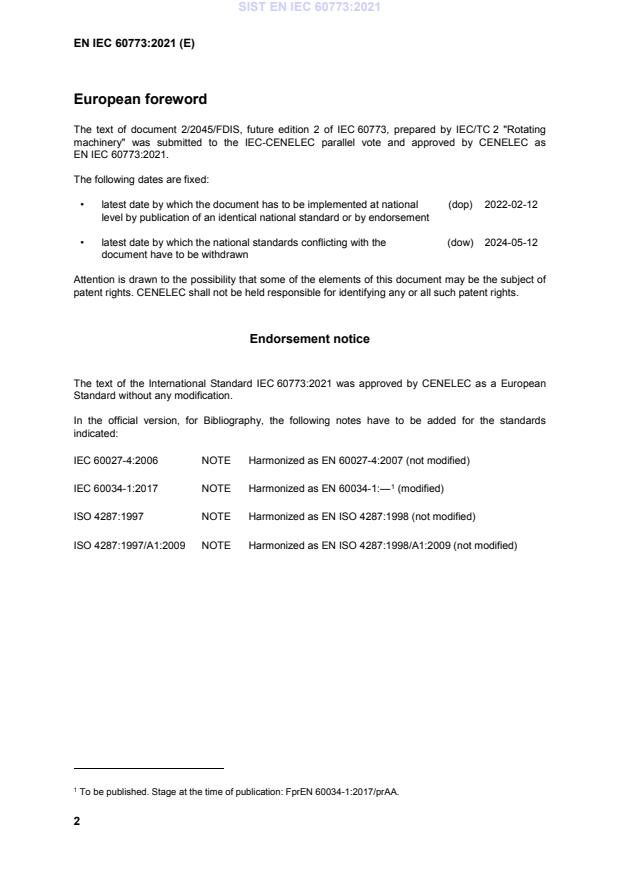
The text of the International Standard IEC 60773:2021 was approved by CENELEC as a European
Standard without any modification.
In the official version, for Bibliography, the following notes have to be added for the standards
indicated:
IEC 60027-4:2006 NOTE Harmonized as EN 60027-4:2007 (not modified)
IEC 60034-1:2017 NOTE Harmonized as EN 60034-1:— (modified)
ISO 4287:1997 NOTE Harmonized as EN ISO 4287:1998 (not modified)
ISO 4287:1997/A1:2009 NOTE Harmonized as EN ISO 4287:1998/A1:2009 (not modified)
To be published. Stage at the time of publication: FprEN 60034-1:2017/prAA.
Annex ZA
(normative)
Normative references to international publications
with their corresponding European publications
The following documents are referred to in the text in such a way that some or all of their content
constitutes requirements of this document. For dated references, only the edition cited applies. For
undated references, the latest edition of the referenced document (including any amendments)
applies.
NOTE 1 Where an International Publication has been modified by common modifications, indicated by (mod),
the relevant EN/HD applies.
NOTE 2 Up-to-date information on the latest versions of the European Standards listed in this annex is available
here: www.cenelec.eu.
Publication Year Title EN/HD Year
IEC 60034-19 2014 Rotating electrical machines - Part 19: EN 60034-19 2014
Specific test methods for d.c. machines on
conventional and rectifier-fed supplies
IEC 60136 - Dimensions of brushes and brush-holders - -
for electrical machinery
IEC 60276 2018 Carbon brushes, brush holders, EN IEC 60276 2019
commutators and slip-rings - Definitions and
nomenclature
IEC 60356 - Dimensions for commutators and slip-rings - -
IEC 60584-1 2013 Thermocouples - Part 1: EMF specifications EN 60584-1 2013
and tolerances
IEC 60751 2008 Industrial platinum resistance thermometers EN 60751 2008
and platinum temperature sensors
IEC/TR 61015 - Brush-holders for electrical machines. - -
Guide to the measurement of the static
thrust applied to brushes
ISO 1190-1 1982 Copper and copper alloys; Code of - -
designation; Part 1: Designation of
materials
ISO 3274 1996 Geometrical Product Specifications (GPS) - EN ISO 3274 1997
Surface texture: Profile method - Nominal
characteristics of contact (stylus)
instruments
ISO 15510 2014 Stainless steels - Chemical composition - -
IEC 60773 ®
Edition 2.0 2021-04
INTERNATIONAL
STANDARD
NORME
INTERNATIONALE
Rotating electrical machines – Test methods and apparatus for the
measurement of the operational characteristics of brushes
Machines électriques tournantes – Méthodes d'essai et appareils pour le
mesurage des caractéristiques opérationnelles des balais
INTERNATIONAL
ELECTROTECHNICAL
COMMISSION
COMMISSION
ELECTROTECHNIQUE
INTERNATIONALE
ICS 29.160.10 ISBN 978-2-8322-9656-1
– 2 – IEC 60773:2021 © IEC 2021
CONTENTS
FOREWORD . 6
1 Scope . 8
2 Normative references . 8
3 Terms, definitions, symbols and abbreviated terms . 8
3.1 Terms and definitions . 9
3.2 Symbols . 15
3.2.1 Symbols and units . 15
3.2.2 Subscripts . 16
3.3 Abbreviated terms . 17
4 Test rig specification. 18
4.1 Common specification . 18
4.1.1 General . 18
4.1.2 Rings . 18
4.1.3 Brushes . 19
4.1.4 Brush holders . 19
4.1.5 Power supply . 21
4.1.6 Instrumentation . 21
4.2 Test rig specification for commutators . 31
4.2.1 General . 31
4.2.2 Test rings . 31
4.2.3 Brushes arrangement . 34
4.2.4 Special brush for voltage drop measurement . 35
4.3 Test rig specification for slip rings . 36
4.3.1 General . 36
4.3.2 Ring. 36
4.3.3 Brushes . 38
4.3.4 Configuration for DC and AC operation . 38
5 Test schedule and operating conditions . 40
5.1 General . 40
5.2 Environmental conditions . 41
5.2.1 Laboratory environment . 41
5.2.2 Ambient air temperature and ring surface temperature . 41
5.2.3 Ambient humidity . 41
5.3 Operating conditions . 41
5.4 Test preparation and inspection . 42
5.4.1 General . 42
5.4.2 Test rig . 42
5.4.3 Brush-holders . 42
5.4.4 Test brushes . 42
5.4.5 Ring roughness . 42
5.4.6 Brush bedding . 43
5.4.7 Brushes measurement . 43
5.5 Test sequence . 43
5.5.1 Test starting . 43
5.5.2 Test duration . 43
5.6 Measurements and observations . 43
5.6.1 General . 43
IEC 60773:2021 © IEC 2021 – 3 –
5.6.2 Interval between measurements . 44
5.6.3 Before starting a test sequence . 44
5.6.4 Measurements during a test sequence . 45
5.6.5 Measurements after a test sequence . 45
6 Determination of friction coefficient . 45
6.1 General . 45
6.2 Test conditions . 46
6.3 Measurements . 46
6.3.1 General . 46
6.3.2 Test rig arrangement of Method a) . 46
6.3.3 Test rig arrangement of Method b) . 46
6.4 Calculation of friction coefficient . 46
6.4.1 Test rig arrangement of Method a) . 46
6.4.2 Test rig arrangement of Method b) . 47
6.5 Report. 47
7 Determination of voltage drop . 48
7.1 General . 48
7.2 Test conditions . 49
7.3 Measurements . 49
7.3.1 General . 49
7.3.2 Brush total voltage drop U . 49
B
7.3.3 Brush contact voltage drop U . 49
c
7.4 Calculation . 50
7.4.1 Brush total voltage drop U . 50
B
7.4.2 Brush contact voltage drop U . 50
c
7.5 Report. 51
8 Determination of brush wear . 52
8.1 General . 52
8.2 Test conditions . 52
8.3 Measurements . 52
8.4 Calculation of brush wear. 53
8.5 Report. 54
9 Determination of commutation ability of brush grades by a specific black-band test
on a DC machine . 54
9.1 General . 54
9.2 Set-up . 55
9.3 Test procedure . 58
9.3.1 Preparation of the test . 58
9.3.2 Operating conditions and test sequence . 58
9.4 Black-band graph . 59
9.5 Interpretation . 60
9.5.1 General . 60
9.5.2 Influence of commutator skin thickness on the black-band zone . 61
9.5.3 Influence of brush contact resistance . 62
9.5.4 Estimation of mechanical contact stability deviation by comparing the
black-band figures before and after longtime critical operation . 64
Annex A (informative) Additional information for friction coefficient measurement . 67
A.1 Details of calculation of friction coefficient by using method a) of 4.1.6.1.2 . 67
– 4 – IEC 60773:2021 © IEC 2021
A.2 Adjustment of strain sensor for calculation of friction coefficient by using
method b) of 4.1.6.1.3 . 68
A.2.1 General . 68
A.2.2 Correlation between output voltage and load . 68
A.2.3 Correlation between friction coefficient and load . 68
Annex B (informative) Black-band zone deviation cases . 71
B.1 Black-band zone in case of limited contact area . 71
B.2 Influence of brush mechanical contact instability of brush chattering on the
black-band zone . 72
B.3 Black-band zone hysteresis between increased I and decreased I . 73
a a
Annex C (informative) Test report example . 75
Bibliography . 77
Figure 1 – Profile and determination of height of profile elements . 9
Figure 2 – Forces acting on a brush . 12
Figure 3 – Voltage drops in a brush when in operation . 12
Figure 4 – Brush holder configuration . 20
Figure 5 – Measurement of the mechanical torque by Method a) . 22
Figure 6 – Brush test machine for Method b) . 23
Figure 7 – Test rig arrangement with a load cell . 24
Figure 8 – Brush contact probe application point for U . 27
c
Figure 9 – Thermocouples insertion position . 28
Figure 10 – Evaluation of contact temperature θ by interpolation . 29
c
Figure 11 – Illustration of bar grooves dimensions and preparation . 32
Figure 12 – Brush covering . 34
Figure 13 – Brushes configuration . 35
Figure 14 – Control brush arrangement . 36
Figure 15 – Characteristics of grooves . 37
Figure 16 – Test rig arrangement for DC operation with 2 brushes per polarity . 39
Figure 17 – Test rig arrangement for AC operation with 2 brushes . 40
Figure 18 – Example of friction coefficient µ graph as a function of peripheral speed ν . 48
p
Figure 19 – Example of brush total voltage drop U graph as a function of
B
current density J . 52
B
Figure 20 – Example of brush wear rate WR of brushes during the test for a test rig
i
with 4 brushes . 53
Figure 21 – Black-band test circuit configuration using DC generator and resistance
load 56
Figure 22 – Black-band test circuit configuration for Brondell’s loading-back method . 57
Figure 23 – Determination of black-band zone for a specified constant speed of
rotation . 60
Figure 24 – Influence of commutator film thickness on the black-band zone . 62
Figure 25 – Comparison of black-bands for a high contact resistance brush and a low
contact resistance brush in case of a motor . 63
Figure 26 – Comparison of black-bands for a high contact resistance brush and a low
contact resistance brush in case of a generator . 64
IEC 60773:2021 © IEC 2021 – 5 –
Figure 27 – Black-band figure deviation of before and after the critical operation of
repetitive peak load application of 225 %, for a "strong" grade . 65
Figure 28 – Black-band figure deviation of before and after the critical operation of
repetitive peak load application of 225 %, for a "weak" grade . 66
Figure A.1 – Correlation of load cell output voltage U with mass m . 68
lc
Figure A.2 – Example of correlation between load and friction coefficient µ . 69
Figure B.1 – Limited contact area and reduction of tangential dimension at contact . 71
Figure B.2 – Black-band zone in case of a limited contact area . 72
Figure B.3 – Influence of brush mechanical contact instability of brush chattering on
the black-band zone. 73
Figure B.4 – Black-band zone hysteresis between increasing I and decreasing I . 74
arm arm
Table 1 – Dimensions of test brushes . 19
Table 2 – Test conditions . 42
– 6 – IEC 60773:2021 © IEC 2021
INTERNATIONAL ELECTROTECHNICAL COMMISSION
____________
ROTATING ELECTRICAL MACHINES –
TEST METHODS AND APPARATUS FOR THE MEASUREMENT
OF THE OPERATIONAL CHARACTERISTICS OF BRUSHES
FOREWORD
1) The International Electrotechnical Commission (IEC) is a worldwide organization for standardization comprising
all national electrotechnical committees (IEC National Committees). The object of IEC is to promote international
co-operation on all questions concerning standardization in the electrical and electronic fields. To this end and
in addition to other activities, IEC publishes International Standards, Technical Specifications, Technical Reports,
Publicly Available Specifications (PAS) and Guides (hereafter referred to as "IEC Publication(s)"). Their
preparation is entrusted to technical committees; any IEC National Committee interested in the subject dealt with
may participate in this preparatory work. International, governmental and non-governmental organizations liaising
with the IEC also participate in this preparation. IEC collaborates closely with the International Organization for
Standardization (ISO) in accordance with conditions determined by agreement between the two organizations.
2) The formal decisions or agreements of IEC on technical matters express, as nearly as possible, an international
consensus of opinion on the relevant subjects since each technical committee has representation from all
interested IEC National Committees.
3) IEC Publications have the form of recommendations for international use and are accepted by IEC National
Committees in that sense. While all reasonable efforts are made to ensure that the technical content of IEC
Publications is accurate, IEC cannot be held responsible for the way in which they are used or for any
misinterpretation by any end user.
4) In order to promote international uniformity, IEC National Committees undertake to apply IEC Publications
transparently to the maximum extent possible in their national and regional publications. Any divergence between
any IEC Publication and the corresponding national or regional publication shall be clearly indicated in the latter.
5) IEC itself does not provide any attestation of conformity. Independent certification bodies provide conformity
assessment services and, in some areas, access to IEC marks of conformity. IEC is not responsible for any
services carried out by independent certification bodies.
6) All users should ensure that they have the latest edition of this publication.
7) No liability shall attach to IEC or its directors, employees, servants or agents including individual experts and
members of its technical committees and IEC National Committees for any personal injury, property damage or
other damage of any nature whatsoever, whether direct or indirect, or for costs (including legal fees) and
expenses arising out of the publication, use of, or reliance upon, this IEC Publication or any other IEC
Publications.
8) Attention is drawn to the Normative references cited in this publication. Use of the referenced publications is
indispensable for the correct application of this publication.
9) Attention is drawn to the possibility that some of the elements of this IEC Publication may be the subject of patent
rights. IEC shall not be held responsible for identifying any or all such patent rights.
International standard IEC 60773 has been prepared by IEC technical committee 2: Rotating
machinery.
This second edition cancels and replaces the first edition published in 1983. It constitutes a
technical revision.
This edition includes the following significant technical changes with respect to the previous
edition:
– The clause structure has been modified on the view point of a laboratory testing procedure.
The new sequence is as follows: test rig specification (Clause 4), general testing procedure
(Clause 5), and specific procedure for each operational characteristic (Clauses 6 to 8).
– A new Clause 9 has been added to introduce the black-band test for the characterisation of
the brush grades for DC machines.
IEC 60773:2021 © IEC 2021 – 7 –
The text of this International Standard is based on the following documents:
FDIS Report on voting
2/2045/FDIS 2/2050/RVD
Full information on the voting for the approval of this International Standard can be found in the
report on voting indicated in the above table.
This document has been drafted in accordance with the ISO/IEC Directives, Part 2.
The committee has decided that the contents of this document will remain unchanged until the
stability date indicated on the IEC website under "http://webstore.iec.ch" in the data related to
the specific document. At this date, the document will be
• reconfirmed,
• withdrawn,
• replaced by a revised edition, or
• amended.
– 8 – IEC 60773:2021 © IEC 2021
ROTATING ELECTRICAL MACHINES –
TEST METHODS AND APPARATUS FOR THE MEASUREMENT
OF THE OPERATIONAL CHARACTERISTICS OF BRUSHES
1 Scope
This document applies to test methods for the measurement of the operational characteristics
of brushes designed to operate on commutating and slip ring machines under specified test
conditions.
By extension some tests may be relevant for other kinds of sliding electrical contacts for
electrical appliances.
2 Normative references
The following documents are referred to in the text in such a way that some or all of their content
constitutes requirements of this document. For dated references, only the edition cited applies.
For undated references, the latest edition of the referenced document (including any
amendments) applies.
IEC 60034-19:2014, Rotating electrical machines – Part 19: Specific test methods for d.c.
machines on conventional and rectifier-fed supplies
IEC 60136, Dimensions of brushes and brush-holders for electrical machinery
IEC 60276:2018, Carbon brushes, brush holders, commutators and slip-rings – Definitions and
nomenclature
IEC 60356, Dimensions for commutators and slip-rings
IEC 60584-1:2013, Thermocouples – Part 1: EMF specifications and tolerances
IEC 60751:2008, Industrial platinum resistance thermometers and platinum temperature
sensors
IEC TR 61015, Brush-holders for electrical machines. Guide to the measurement of the static
thrust applied to brushes
ISO 1190-1:1982, Copper and copper alloys – code of designation – Part 1: Designation of
materials
ISO 3274:1996, Geometrical Product Specifications (GPS) – Surface texture: Profile method –
Nominal characteristics of contact (stylus) instruments
ISO 15510:2014, Stainless steels – Chemical composition
3 Terms, definitions, symbols and abbreviated terms
For the purposes of this document, the following terms and definitions apply.
IEC 60773:2021 © IEC 2021 – 9 –
ISO and IEC maintain terminological databases for use in standardization at the following
addresses:
• IEC Electropedia: available at http://www.electropedia.org/
• ISO Online browsing platform: available at http://www.iso.org/obp
3.1 Terms and definitions
3.1.1
run-out
runout
inaccuracy of the rotating system, measured on the surface of the ring while turning
Note 1 to entry: This includes out-of-round (that is, lacking sufficient roundness); eccentricity (that is, lacking
sufficient concentricity); or axial bending (regardless of whether the surfaces are perfectly round and concentric at
every cross-sectional point).
3.1.2
roughness
Ra
arithmetic mean of the absolute ordinate value Z(x) of a profile within a sampling length l
l
| |
Ra = × � Z(x) .dx
l
Example: Figure 1 shows an example of profile.
Key
Zt height of profile element i
i
l sampling length
ML mean line
C1 and C2 upper and lower intersection lines (respectively)
Figure 1 – Profile and determination of height of profile elements
[SOURCE: ISO 4287:1997, Figure 9]
– 10 – IEC 60773:2021 © IEC 2021
3.1.3
peak count
RPc
number of profile elements per centimeter of sampling length which exceed the upper
intersection line C1 and fall short of the lower intersection line C2
Note 1 to entry: Both intersection lines are parallel to the diagram mean line (see Figure 1).
[SOURCE: ISO 4287/A1:2009, 4.3.2]
3.1.4
abrasive stone
material used to grind a surface
Note 1 to entry: The quality of the material and the method of appliance depend on its use. Therefore, for the
purpose of this document, definitions 3.1.5, 3.1.7 and 3.1.8 are used.
3.1.5
grinding stone
abrasive stone used to grind the test ring
Note 1 to entry: It is generally made of hard abrasive grains.
3.1.6
brush fitting
operation at the end of which the brush contact surface is matching the ring profile
3.1.7
fitting stone
abrasive stone used for fitting the brush to the commutator/ring
3.1.8
roughness stone
abrasive stone used to obtain the proper range of roughness to the test ring, generally made of
soft abrasive grain
3.1.9
brush contact area
S
area of the brush in contact with the ring surface
Note 1 to entry: When radial brush is used the brush contact surface area S is the cross-section of the brush:
r
S = t × a (1)
where t and a are respectively the tangential and axial dimensions of the brush.
When inclined brush is used the bottom angle is part of the formula giving the brush contact surface area S :
α
t × a
S = (2)
α
cosα
where α is the contact angle (or bottom angle).
3.1.10
brush specific pressure
p
force per contact area of the brush, given by formula (3):
F
p
p = (3)
S
IEC 60773:2021 © IEC 2021 – 11 –
where F is the force applied by the pressure system;
p
and S is the brush contact surface area
Note 1 to entry: When F is expressed in grams force (gf) and brush contact surface in cm the calculated specific
p
2 2 2
pressure is in gf/cm . To convert into SI units: the result in gf/cm multiplied by 98,07 gives p in N/m (98,07 is the
gravitational acceleration in m/s multiplied by 10).
3.1.11
current ripple factor
q
i
ratio of the difference between the maximum value I and the minimum value I of an
max min
undulating current to two times the average value I̅ (mean value integrated over one period):
I –I
max min
q =
i
2 × I
Note 1 to entry: For small values of current ripple, the ripple factor may be approximated by the following
expression:
I –I
max min
q =
i
I +I
max min
Note 2 to entry: The above expression may be used as an approximation if the resulting calculated value of q is
i
equal to or less than 0,4.
[SOURCE: IEC 60034-1:2017, 3.29]
3.1.12
stable state
state of a physical system in which the relevant characteristics are considered to be sensibly
constant with time
[SOURCE: IEC 60050-103:2009, 103-05-01]
3.1.13
sensibly constant
a measurement result is considered as sensibly constant when deviation from mean value of a
minimum of 3 consecutive measurements is less than 2,5 % (except otherwise specified)
Note 1 to entry: Stability state may be determined from the time-measurement rise plot when the straight lines
between points at the beginning and end of two successive intervals of half hour each have a deviation of less than
the criteria of 2,5 %.
3.1.14
friction coefficient
µ
ratio of tangential force acting at the interface F to the radial force acting at the interface F :
t r
F
t
µ = (4)
F
r
Note 1 to entry: Figure 2 illustrates the forces acting on the brush when a radial brush-holder is applied. The
numerical value of radial force F is equal to the numerica value of the normal reaction force F (of the brush contact
r N
surface on the ring) and to the numerical value of the pressure system force F on the brush top.
p
– 12 – IEC 60773:2021 © IEC 2021
Key
1 Brush
2 Brush-holder
3 Test ring
ω Angular velocity (giving the rotation direction)
Figure 2 – Forces acting on a brush
3.1.15
brush voltage drop
U
B
total voltage drop between the brush terminal and the slip ring or commutator
Note 1 to entry: U is a complex parameter which is made up from the sum of the voltage drops U , U , U , and U
B s f i c
as illustrated in Figure 2 (which concerns a brush with a tamped flexible).
Figure 3 – Voltage drops in a brush when in operation
3.1.16
shunt voltage drop
U
s
voltage drop in the shunt (flexible) and in the shunt connection to the brush terminal
IEC 60773:2021 © IEC 2021 – 13 –
3.1.17
connection drop
U
f
voltage drop between the shunt (flexible) and the brush grade
Note 1 to entry: The connection drop U measurement is described in IEC 60136.
f
3.1.18
brush internal drop
U
i
internal voltage drop of the brush (due to the brush grade resistance)
3.1.19
brush contact drop
U
c
voltage contact drop between the brush grade and the ring
Note 1 to entry: The brush contact drop U is an operating characteristic of a brush. See Clause 7.
c
3.1.20
slot pitch
τ
Q
distance between two consecutive slots of the ring, defined by the periphery of the ring π × D
divided by the number of slots Q:
π × D
τ = (5)
Q
Q
where D is the diameter of the ring
[SOURCE: IEC 60027-4:2006,612]
3.1.21
covering ratio
coverage ratio
τ
B
number of segments spanned by the brush along t dimension, calculated from formula (6)
t
τ = (6)
B
τ
Q
3.1.22
peripheral speed
υ
p
speed of movement of a point on the surface of a body rotating about its axis expressed as a
distance per unit of time
It is calculated from formula (7)
D
n × 𝜋𝜋 ×
ν = (7)
p
where
D is the ring diameter, in metres, and n is the speed of rotation, in number of revolutions per
minute (r/min).
[SOURCE: IEC 60050-811:2017, 811-13-29, modified – formula is added]
– 14 – IEC 60773:2021 © IEC 2021
3.1.23
current density
J
B
quantity relative to one brush and equal to current I divided by the cross-section t x a of the
brush, as per formula (8):
I
J = (8)
B
t × a
Note 1 to entry: J is commonly expressed in A/cm when I is in A and t, a in cm.
B
3.1.24
ambient air temperature
average temperature of the air surrounding the carbon brushes samples
3.1.25
ring surface temperature
average temperature at the surface of the tested slip ring
3.1.26
brush bedding
operation at the end of which the brush contact surface is completely bedded and the patina
formed on the ring surface
3.1.27
patina
skin
film on the commutator or slip ring, principally constituted of the carbon brush material,
commutator/slip ring metal (and its oxides) and water
[SOURCE: IEC 60276:2018, 601]
3.1.28
brush wear
Δr
i
linear wear of a brush i during the test
For each brush i the brush wear is calculated from formula (9):
Δr = r r (9)
i 0i – i
where:
r is the r dimension of each brush i (brush length) before the test;
0i
r is the r dimension of each brush i (brush length) after the test
i
3.1.29
brush wear rate
WR
i
brush i linear wear during a period of time, which is calculated from formula (10):
Δr
i
WR = (10)
i
t
er
where t is the effective running time
er
IEC 60773:2021 © IEC 2021 – 15 –
Note 1 to entry: Generally it is expressed in mm/1 000 h (mm of brush wear/1 000 effective running hours) when
brush wear is expressed in mm and the result of formula above is multiplied by 1 000. See 8.4.
3.1.30
black-band zone
BB zone
interval defined by the minimum and maximum sparkless commutation limits (in between which
the commutation is achieved without sparks); the limits of sparkless commutation being
obtained by boosting or subtracting the excitation current in commutation poles for load currents
up to and including rated current
Note 1 to entry: It corresponds to a non spark zone. This test is sometimes called back boost test.
[SOURCE: IEC 60034-19:2014, 3.1.4 – modified: definition of limits is added]
3.2 Symbols
3.2.1 Symbols and units
a brush axial dimension (mm)
b slot or groove width (mm)
C1 upper intersection line (on roughness profile)
C2 lower intersection line (on roughness profile)
D diameter of test ring (m)
dr distance ratio
d distance in the brush radial direction from brush contact surface to brush top (mm)
B
f frequency (Hz)
F force applied (N or gf)
h pitch of helical groove (mm)
HA
absolute humidity (g/m of air)
HR relative humidity
I current (A)
2 2
J
current density in a brush (A/cm or A/m )
B
k number of grooves under the brush in tangential direction
R
l length or distance (m)
la lever arm length (m)
l distance travelled by the track under the brush during the effective running time
er
q ripple factor
i
m mass (g)
n rotational speed (revolutions per minute, r/min)
N number of brushes per machine
B
p
specific pressure applied on the brush (kN/m )
P power (W)
P power input when the brushes are in contact with the commutator or slip ring (W)
in
P power loss due to electrical losses (W)
el
P power loss due to friction (W)
f
P power input when the brushes are not in contact with (are not sliding on) the
commutator or slip ring (W)
– 16 – IEC 60773:2021 © IEC 2021
r radial dimension of brush (mm)
r dimension of brush number i after the test (mm)
i
r dimension of brush number i before the test (mm)
0i
R resistance (Ω)
Ra roughness, arithmetic value (µm)
RPc peak count (number of peaks per cm)
r radius of brush (mm)
B
S
brush contact surface area (cm )
t tangential dimension of brush (mm)
t effective running time (h)
er
T torque (N.m)
U voltage (V)
�����
mean brush wear rate (mm/1 000 h)
WR
WR brush wear rate (mm/1 000 h)
Δr wear of brush number i (mm)
i
���
Δr mean brush wear (mm)
μ friction coefficient
υ velocity or peripheral speed (m/s)
p
ρ brush grade resistivity (µΩ.cm)
τ slot pitch (mm)
Q
τ covering ratio (number of segments spanned under the brush)
B
α bottom angle (rad)
θ temperature (K)
−1
ω
angular velocity (rad.s )
NOTE …� means arithmetic average value.
3.2.2 Subscripts
0 initial condition
arm armature
B brush
c contact
cp commutation pole
er effective running (time)
f flexible (shunt) connection
H brush-holder
i internal (brush grade)
in input (power)
lc load cell
IEC 60773:2021 © IEC 2021 – 17 –
lin linear
min minimum value
max maximum
...