

prEN IEC 80000-15:2026
(Main)Quantities and units - Part 15: Logarithmic quantities and their units
General Information
- Abstract
- Status
- Not Published
- Publication Date
- 05-Dec-2027
- Technical Committee
- CLC/SR 25 - Quantities and units, and their letter symbols
- Current Stage
- 4060 - Enquiry results established and sent to TC, SR, BTTF - Enquiry
- Start Date
- 07-Aug-2026
- Completion Date
- 07-Aug-2026

Overview
prEN IEC 80000-15:2026 - Quantities and units – Part 15: Logarithmic quantities and their units is a draft international standard developed by the International Electrotechnical Commission (IEC) and the CENELEC (CLC) for harmonizing the concepts and notation associated with logarithmic quantities and their units. This part of the IEC 80000 series focuses on quantities commonly expressed on a logarithmic scale, such as levels in acoustics, signal amplitude ratios, and quantities used in information theory and musical acoustics.
By defining the units, symbols, and preferred practices for logarithmic quantities, the standard ensures precision, consistency, and mutual understanding in scientific and engineering communications across disciplines like electrical engineering, acoustics, and information science.
Key Topics
Logarithmic Functions and Quantities:
The standard details the types and mathematical properties of logarithmic functions (including binary, natural, and common logarithms), explaining their application to scientific measurements.Classification of Logarithmic Quantities:
- Logarithmic Ratio Quantities: Measures such as attenuation and gain, and levels relative to specified references, commonly used in acoustics and electrical engineering.
- Specialized Logarithmic Quantities: Applications in information theory (e.g., entropy, information content) and music theory (e.g., musical intervals).
Units and Symbols:
Defines and clarifies the use of international units for logarithmic quantities, such as:- Decibel (dB) and bel (B): Widely used for expressing sound, voltage, and power ratios.
- Neper (Np): Used for amplitude ratios, especially in signal processing.
- Shannon (Sh), nat, Hartley (Hart): Units specific to information content, depending on logarithmic base.
Levels and Level Differences:
Explains how to express absolute and relative levels with appropriate reference values, supporting clarity and comparability in measurements.Logarithmic Frequency Ranges:
Guidance on the representation of frequency intervals using logarithmic units such as the octave, decade, and their submultiples-vital in both technical analysis and music theory.
Applications
prEN IEC 80000-15:2026 is highly relevant to a broad range of technical and engineering fields where logarithmic measures are central to analysis and reporting:
- Electrical Engineering:
- Expressing power, voltage, and current levels with decibel units for system design, testing, and documentation.
- Acoustics:
- Measuring and communicating sound pressure levels, sound power levels, and octave/decade band analysis.
- Information Technology:
- Quantifying information, entropy, and channel capacity in digital and analog communications using shannons, nats, and hartleys.
- Building Acoustics and Audio Engineering:
- Estimating room acoustics, sound insulation, and audio signal transmission characteristics.
- Musical Acoustics:
- Describing musical intervals and frequency ranges in standardized logarithmic units, supporting instrument design and tuning.
By promoting internationally harmonized notation and units for logarithmic quantities, the standard underpins reliable data comparison and exchange across organizations, industries, and national borders.
Related Standards
For greater interoperability and alignment with global measurement practices, it is recommended to reference the following related standards:
- ISO 80000-1:2022 – Quantities and units – Part 1: General
Provides overarching guidance on physical quantities and the International System of Units (SI). - ISO 80000-2:2019 – Quantities and units – Part 2: Mathematics
Includes mathematical symbols and conventions for logarithmic functions. - ISO 80000-8:2020 – Quantities and units – Part 8: Acoustics
Specific standard for acoustical measurements and related quantities. - IEC 80000-13:2025 – Quantities and units – Part 13: Information science and technology
Focuses on quantities and units relevant to information theory and computing.
Adopting prEN IEC 80000-15:2026 in your workflows ensures compliance with leading international standards, fostering clarity and reducing ambiguity when expressing logarithmic quantities and their units across science, engineering, and technology sectors.
Frequently Asked Questions
prEN IEC 80000-15:2026 is a draft published by CLC. Its full title is "Quantities and units - Part 15: Logarithmic quantities and their units". This standard covers: Quantities and units - Part 15: Logarithmic quantities and their units
Quantities and units - Part 15: Logarithmic quantities and their units
prEN IEC 80000-15:2026 is classified under the following ICS (International Classification for Standards) categories: 01.060 - Quantities and units. The ICS classification helps identify the subject area and facilitates finding related standards.
prEN IEC 80000-15:2026 is available in PDF format for immediate download after purchase. The document can be added to your cart and obtained through the secure checkout process. Digital delivery ensures instant access to the complete standard document.
Standards Content (Sample)
SLOVENSKI STANDARD
01-julij-2026
Veličine in enote - 15. del: Logaritemske veličine in njihove enote
Quantities and units - Part 15: Logarithmic quantities and their units
Ta slovenski standard je istoveten z: prEN IEC 80000-15:2026
ICS:
01.060 Veličine in enote Quantities and units
2003-01.Slovenski inštitut za standardizacijo. Razmnoževanje celote ali delov tega standarda ni dovoljeno.
25/851/CDV
COMMITTEE DRAFT FOR VOTE (CDV)
PROJECT NUMBER:
IEC 80000-15 ED1
DATE OF CIRCULATION: CLOSING DATE FOR VOTING:
2026-05-15 2026-08-07
SUPERSEDES DOCUMENTS:
25/779/NP, 25/782A/RVN
IEC TC 25 : QUANTITIES AND UNITS
SECRETARIAT: SECRETARY:
Italy Ms Daniela Zambelli
OF INTEREST TO THE FOLLOWING COMMITTEES: HORIZONTAL FUNCTION(S):
ASPECTS CONCERNED:
SUBMITTED FOR CENELEC PARALLEL VOTING NOT SUBMITTED FOR CENELEC PARALLEL VOTING
Attention IEC-CENELEC parallel voting
The attention of IEC National Committees, members of
CENELEC, is drawn to the fact that this Committee Draft for
Vote (CDV) is submitted for parallel voting.
The CENELEC members are invited to vote through the
CENELEC online voting system.
This document is still under study and subject to change. It should not be used for reference purposes.
Recipients of this document are invited to submit, with their comments, notification of any relevant patent rights of which t hey
are aware and to provide supporting documentation.
Recipients of this document are invited to submit, with their comments, notification of any relevant “In Some Countries” clau ses
to be included should this proposal proceed. Recipients are reminded that the CDV stage is the final stage for submitting ISC
clauses. (SEE AC/22/2007 OR NEW GUIDANCE DOC).
TITLE:
Quantities and units - Part 15: Logarithmic quantities and their units
PROPOSED STABILITY DATE: 2030
NOTE FROM TC/SC OFFICERS:
electronic file, to make a copy and to print out the content for the sole purpose of preparing National Committee positions.
You may not copy or "mirror" the file or printed version of the document, or any part of it, for any other purpose without
permission in writing from IEC.
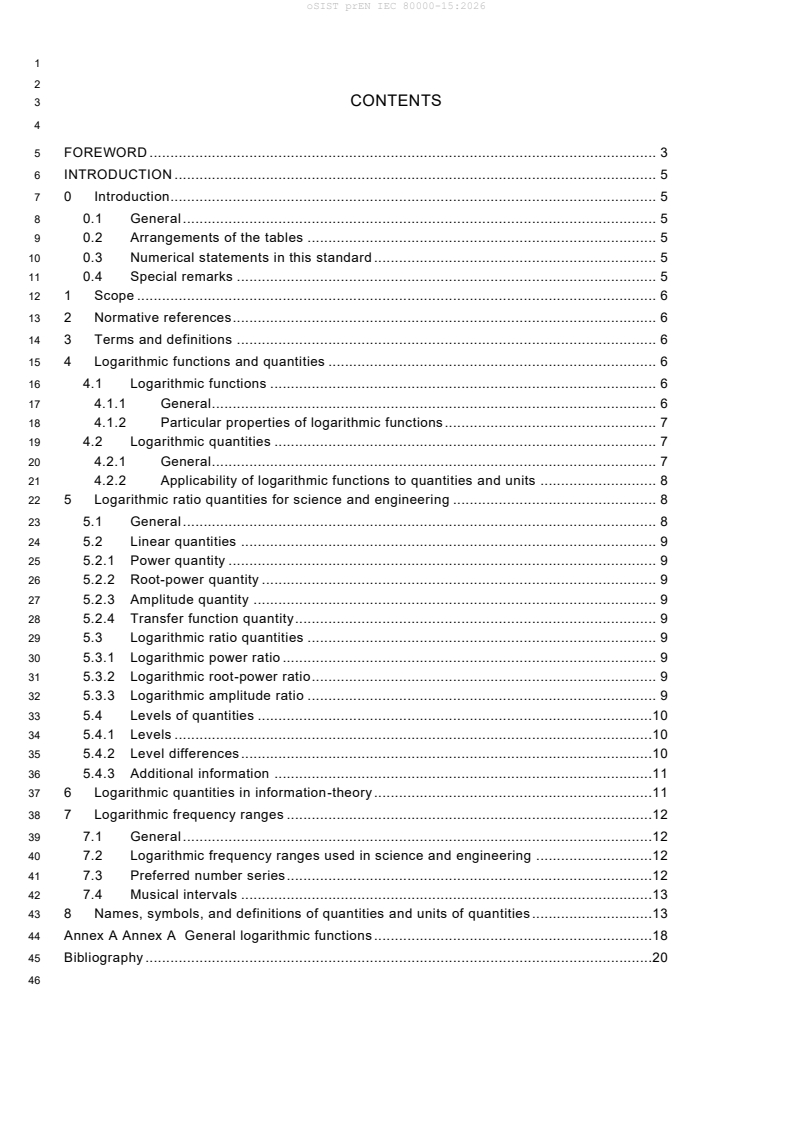
3 CONTENTS
5 FOREWORD . 3
6 INTRODUCTION . 5
7 0 Introduction. 5
8 0.1 General . 5
9 0.2 Arrangements of the tables . 5
10 0.3 Numerical statements in this standard . 5
11 0.4 Special remarks . 5
12 1 Scope . 6
13 2 Normative references . 6
14 3 Terms and definitions . 6
15 4 Logarithmic functions and quantities . 6
16 4.1 Logarithmic functions . 6
17 4.1.1 General . 6
18 4.1.2 Particular properties of logarithmic functions . 7
19 4.2 Logarithmic quantities . 7
20 4.2.1 General . 7
21 4.2.2 Applicability of logarithmic functions to quantities and units . 8
22 5 Logarithmic ratio quantities for science and engineering . 8
23 5.1 General . 8
24 5.2 Linear quantities . 9
25 5.2.1 Power quantity . 9
26 5.2.2 Root-power quantity . 9
27 5.2.3 Amplitude quantity . 9
28 5.2.4 Transfer function quantity . 9
29 5.3 Logarithmic ratio quantities . 9
30 5.3.1 Logarithmic power ratio . 9
31 5.3.2 Logarithmic root-power ratio . 9
32 5.3.3 Logarithmic amplitude ratio . 9
33 5.4 Levels of quantities .10
34 5.4.1 Levels .10
35 5.4.2 Level differences .10
36 5.4.3 Additional information .11
37 6 Logarithmic quantities in information-theory .11
38 7 Logarithmic frequency ranges .12
39 7.1 General .12
40 7.2 Logarithmic frequency ranges used in science and engineering .12
41 7.3 Preferred number series .12
42 7.4 Musical intervals .13
43 8 Names, symbols, and definitions of quantities and units of quantities .13
44 Annex A Annex A General logarithmic functions .18
45 Bibliography .20
IEC CDV 80000-15 ED1 © IEC 2026
47 Table 1 – Logarithmic quantities for science and engineering .14
48 Table 2 – Units of logarithmic quantities .15
49 Table 3 – Musical intervals .16
IEC CDV 80000-15 ED1 © IEC 2026
53 INTERNATIONAL ELECTROTECHNICAL COMMISSION
54 ____________
56 QUANTITIES AND UNITS –
58 Part 15: Logarithmic quantities and their units
60 FOREWORD
61 The International Electrotechnical Commission (IEC) is a worldwide organization for standardization
62 comprising all national electrotechnical committees (IEC National Committees). The object of IEC is to
63 promote international co-operation on all questions concerning standardization in the electrical and
64 electronic fields. To this end and in addition to other activities, IEC publishes International Standards,
65 Technical Specifications, Technical Reports, Publicly Available Specifications (PAS) and Guides
66 (hereafter referred to as “IEC Publication(s)”). Their preparation is entrusted to technical committees;
67 any IEC National Committee interested in the subject dealt with may participate in this preparatory work.
68 International, governmental and non-governmental organizations liaising with the IEC also participate in
69 this preparation. IEC collaborates closely with the International Organization for Standardization (ISO) in
70 accordance with conditions determined by agreement between the two organizations.
71 The formal decisions or agreements of IEC on technical matters express, as nearly as possible, an
72 international consensus of opinion on the relevant subjects since each technical committee has
73 representation from all interested IEC National Committees.
74 IEC Publications have the form of recommendations for international use and are accepted by IEC
75 National Committees in that sense. While all reasonable efforts are made to ensure that the technical
76 content of IEC Publications is accurate, IEC cannot be held responsible for the way in which they are
77 used or for any misinterpretation by any end user.
78 In order to promote international uniformity, IEC National Committees undertake to apply IEC
79 Publications transparently to the maximum extent possible in their national and regional publications.
80 Any divergence between any IEC Publication and the corresponding national or regional publication shall
81 be clearly indicated in the latter.
82 IEC itself does not provide any attestation of conformity. Independent certification bodies provide
83 conformity assessment services and, in some areas, access to IEC marks of conformity. IEC is not
84 responsible for any services carried out by independent certification bodies.
85 All users should ensure that they have the latest edition of this publication.
86 No liability shall attach to IEC or its directors, employees, servants or agents including individual experts
87 and members of its technical committees and IEC National Committees for any personal injury, property
88 damage or other damage of any nature whatsoever, whether direct or indirect, or for costs (including
89 legal fees) and expenses arising out of the publication, use of, or reliance upon, this IEC Publication or
90 any other IEC Publications.
91 Attention is drawn to the Normative references cited in this publication. Use of the referenced publications
92 is indispensable for the correct application of this publication.
93 Attention is drawn to the possibility that some of the elements of this IEC Publication may be the subject
94 of patent rights. IEC shall not be held responsible for identifying any or all such patent rights.
95 International Standard IEC 80000-15 has been prepared by subcommittee JWG 2: Revision and
96 amendments of IEC-related parts of ISO/IEC 80000 series of IEC technical committee TC25: Quantities
97 and units.
98 This 1st edition cancels and replaces the IEC 60027-3, 4th edition as 25/524/CD, closing date 2015-07-
99 03. This edition constitutes a technical revision.
100 This edition includes the following significant technical changes with respect to the previous edition:
IEC CDV 80000-15 ED1 © IEC 2026
101 − Template corresponding to the ISO/IEC 80000 series;
102 − Introduction corresponding to the ISO/IEC 80000 series;
103 − Extension of types of logarithmic quantities;
104 − In 4.2.2, dB and Np has been stressed as units, as well as Sh, nat, Hart in 5, and oct, dec in 6.2;
105 − Musical intervals have been added in 8 and Table 3;
106 − Tables 2 and 3 have been added;
107 − The original contents of IEC 60027-3 has been reduced to fit to the ISO/IEC 80000 series and
108 name “Logarithmic quantities”.
109 The text of this International Standard is based on + the following documents:
CD Report on voting
XX/XX/CD XX/XX/RVD
110 Full information on the voting for the approval of this International Standard can be found in the report
111 on voting indicated in the above table.
112 This document has been drafted in accordance with the ISO/IEC Directives, Part 2.
113 The committee has decided that the contents of this document will remain unchanged until the stability
114 date indicated on the IEC website under "http://webstore.iec.ch" in the data related to the specific
115 document. At this date, the document will be
116 • reconfirmed,
117 • withdrawn,
118 • replaced by a revised edition, or
119 • amended.
120 IEC 80000 consists of the following parts, published by IEC, under the general title Quantities and units:
121 – Part 6: Electromagnetism
122 – Part 13: Information science and technology
123 The following parts are published by ISO:
124 – Part 1: General
125 – Part 2: Mathematics
126 – Part 3: Space and time
127 – Part 4: Mechanics
128 – Part 5: Thermodynamics
129 – Part 7: Light and radiation
130 – Part 8: Acoustics
131 – Part 9: Physical chemistry and molecular physics
132 – Part 10: Atomic and nuclear physics
133 – Part 11: Characteristic numbers
134 – Part 12: Condensed matter physics
136 The National Committees are requested to note that for this document the stability date is 20XX.
137 THIS TEXT IS INCLUDED FOR THE INFORMATION OF THE NATIONAL COMMITTEES AND WILL BE DELETED AT THE
138 PUBLICATION STAGE.
IEC CDV 80000-15 ED1 © IEC 2026
139 INTRODUCTION
140 0 Introduction
141 0.1 General
142 This document provides general information about commonly used logarithmic quantities and their units.
143 These include those used in science and engineering, information theory and music.
144 There are logarithmic quantities other than those described here which have their own units and are
145 described in standards that cover the corresponding disciplines. Examples include optical density, pH,
146 loudness level, star brightness, and earthquake magnitude.
147 0.2 Arrangements of the tables
148 The tables of quantities and units in this document are arranged so that the quantities and the units are
149 presented on the same page.
150 The names of units for the corresponding quantities are given together with the international symbols
151 and the definitions. These unit names are language-dependent, but the symbols are international and
152 the same in all languages. For further information, see the SI Brochure (9th edition 2019) [1] from BIPM ,
153 ISO 80000-1 and ISO 80000-16 [2].
154 0.3 Numerical statements in this standard
155 The sign = is used to denote “is exactly equal to”, the sign is used to denote “is approximately equal
156 to”, and the sign := is used to denote “is by definition equal to”. Three dots after the last digit of a decimal
157 number mean that digits follow and the number is not rounded: π = 3,141 592 … . Here, mostly 6 decimal
158 digits are used but this is not obligatory. See ISO 80000-2:2019, items 2-8.1, 2-8.3, 2-8.5 and Clause 4.
159 0.4 Special remarks
160 The items given in IEC 80000-15 are generally in conformity with the International Electrotechnical
161 Vocabulary (IEV) with some exceptions. For each quantity, the reference to IEV is given in the form: “See
162 IEC 60050-xxx, item xxx-yy-yyy”.
IEC CDV 80000-15 ED1 © IEC 2026
166 QUANTITIES AND UNITS –
168 Part 15: Logarithmic quantities and their units
172 1 Scope
173 This part of ISO/IEC 80000 provides information about logarithmic quantities and their units.
174 The scope includes quantities and units commonly used for logarithmic ratios in science and engineering,
175 especially in acoustics and electrical engineering. Also included are logarithmic quantities used in
176 information theory, and logarithmic frequency ranges used in acoustics and musical theory.
177 Some logarithmic quantities describing logarithmic scales have been omitted from the scope. These have
178 their own units and are typically described in standards that cover the corresponding scientific disciplines
179 for those application fields. Examples include optical density, pH, loudness level, star brightness, and
180 earthquake magnitude.
181 2 Normative references
182 The following documents are referred to in the text in such a way that some or all of their content
183 constitutes requirements of this document. For dated references, only the edition cited applies. For
184 undated references, the latest edition of the referenced document (including any amendments) applies.
185 ISO 80000-1:2022, Quantities and units – Part 1: General
186 ISO 80000-2:2019, Quantities and units – Part 2: Mathematics
187 ISO 80000-8:2020, Quantities and units – Part 8: Acoustics
188 IEC 80000-13:2025, Quantities and units – Part 13: Information science and technology
189 3 Terms and definitions
190 For the purposes of this document, the terms and definitions in the ISO/IEC 80000 series of standards
191 apply.
192 Guidance is also available in the ISO and IEC terminological databases for use in standardization at the
193 following addresses:
194 • IEC Electropedia: available at http://www.electropedia.org/
195 • ISO Online browsing platform: available at http://www.iso.org/obp
196 For logarithmic quantities for science and engineering, a summary is given in Table 1.
197 The names, symbols, and definitions for units for logarithmic quantities are given in the Table 2.
198 Table 3 gives the names and definitions of frequency intervals used in music based on the octave (2 : 1)
199 and its musical subdivisions.
200 4 Logarithmic functions and quantities
201 4.1 Logarithmic functions
202 4.1.1 General
203 A general description of the logarithmic function is given in Annex A. For the purpose of the logarithmic
𝑐
204 quantities and units considered in this document, the following definition applies. If 𝑎 = 𝑏 , where the
205 base, 𝑏, is a positive real number and 𝑏 ≠ 1, and 𝑎 is a positive real number, then
IEC CDV 80000-15 ED1 © IEC 2026
𝑐 = log 𝑎 . (1)
𝑏
206 The following symbols for logarithmic functions are used (see ISO 80000-2, Chapter 13):
208 • log only (without any subscript) if valid for any base 𝑏, e.g.
log(𝑎 𝑎 ) = log 𝑎 + log 𝑎 ; (2)
1 2 1 2
210 • log for a specific base b; particularly;
b
211 - lb := log for binary logarithm;
212 - ln := log for natural logarithm where e = 2,718 281… is the Euler number;
e
213 - lg := log for decimal logarithm (also called common logarithm).
215 For any arguments x, y and any bases a, b, c:
log 𝑥 log 𝑥 log 𝑥
(3)
𝑎 𝑏 𝑐
= = .
log 𝑦 log 𝑦 log 𝑦
𝑎 𝑏 𝑐
216 For example, if a = e and b = y = 10, then
ln 𝑥 lg 𝑥
(4)
( )
= , ⟹ ln 𝑥 = 2,302 585 … lg 𝑥 .
ln 10 1
217 4.1.2 Particular properties of logarithmic functions
218 The argument of a logarithmic function is a number, i.e. a quantity of dimension 1 (a dimensionless
219 quantity) (see IEC 60050-112, item 112-01-13). This follows from the power series representation of a
220 logarithmic function (see Annex A).
221 The logarithmic scale occurs when a number proportional to the argument x is placed into the position of
222 the value log x: This is commonly used in the graphical representation of quantities that have a wide
223 range of values.
224 The logarithmic function and the logarithmic scale presenting logarithmic values equidistantly have some
225 advantageous properties:
226 • a logarithmic function converts a geometric sequence to an arithmetic one and thus converts a
227 range of positive arguments covering several orders of magnitude into a narrow range of values
228 (positive, zero and negative). An important example is in acoustics where the energies of audible
229 sounds can span 14 orders of magnitude.
230 • logarithmic conversion is “equidistant” in the sense that successive values have the same ratio
231 of their values (important for preferred number series), rather than the same difference in their
232 values on a linear scale.
233 • instead of multiplying arguments x, values log x are added (important for musical intervals).
235 4.2 Logarithmic quantities
236 4.2.1 General
237 The quantity 𝑄 is a logarithmic quantity if 𝑄 = log 𝑆. If the argument 𝑆 is a quantity of dimension 1
𝑏
238 (dimensionless), i.e. a quantity given by 𝑆 = 𝑥 ⁄𝑥 , then 𝑄 is considered to be a representation of the
2 1
239 quantity 𝑥 rather than of the quantity 𝑆. For a definition of a logarithmic quantity to be complete, the base
240 𝑏 of the logarithm shall be specified.
241 Depending on the nature of the argument 𝑆 of the logarithm, the logarithmic quantities covered by this
242 document can be classified as follows:
⁄
243 a) logarithmic ratio quantity [3], if the quantity 𝑆 is defined as 𝑆 = 𝑥 𝑥 , thus as a quotient of two
2 1
244 values of the same quantity 𝑥.
IEC CDV 80000-15 ED1 © IEC 2026
245 EXAMPLES
246 - attenuation and gain, where the argument may be the quotient of two voltages or of two powers;
247 - levels in acoustics, where the argument may be the quotient of a sound pressure or a sound power to a
248 reference value of the same quantity.
249 b) logarithmic quantity, in which the argument 𝑆 is given explicitly as a number.
250 EXAMPLES In information theory:
251 - the decision content, where the argument is a number of mutually exclusive events;
252 - the information content, where the argument is the inverse of a probability.
254 Related quantities are also included, which are a linear combination of logarithmic quantities, or a
255 derivative of a logarithmic quantity, or a quotient of a logarithmic quantity and another quantity, for
256 example attenuation coefficient.
257 The logarithm to any specified base of an argument gives the same information about the quantity under
258 consideration as does the argument itself. A double scale, arithmetic and logarithmic, is often used on
259 diagrams and instruments.
261 4.2.2 Applicability of logarithmic functions to quantities and units
263 The logarithmic identity in (3) shows there to be a proportionality between logarithmic quantities
264 expressed with different bases. In principle, any base can be used to express a logarithmic quantity
265 without detriment to coherence between SI units. To avoid ambiguity in applications, the unit shall be
266 written out explicitly after the numerical value of a logarithmic quantity.
268 The binary logarithm is convenient in situations where powers of 2 are used, namely in information theory
269 using binary systems or in probability theory.
271 In the case of frequency intervals, both the binary logarithm and the decimal logarithm are used. In the
( ⁄ ) ⁄
272 binary case, the unit is the octave, oct: lb 𝑓 𝑓 = 1 oct, if 𝑓 𝑓 = 2. In the decimal case the unit is the
2 1 2 1
273 decade, dec: lg (𝑓 ⁄𝑓 ) = 1 dec if 𝑓 ⁄𝑓 = 10.
2 1 2 1
274 The natural logarithm is convenient for the ratios of the amplitudes of quantities such as sinusoidal
275 signals. It is also useful for complex-valued quantities (see Annex A).
276 The decimal logarithm (common logarithm) is convenient for wide scales, where decimal scaling and
277 decimal prefixes for units are appropriate. The units used with the decimal logarithm are the bel, B, and
278 almost universally in practice, its submultiple the decibel, dB: lg(𝑥 ⁄𝑥 ) = 10 dB if 𝑥 ⁄𝑥 = 10.
2 1 2 1
280 5 Logarithmic ratio quantities for science and engineering
281 5.1 General
282 Logarithmic ratio quantities are used in some science and engineering disciplines (e.g. acoustics and
283 electrical engineering). For the purposes of this document, these have been categorized into four classes
284 of quantity: power quantity; root-power quantity; amplitude quantity; transfer function quantity. In each
285 case, the logarithmic ratio is based on a specified measure of the underlying time-varying quantity (e.g.
286 the mean squared value during a given time interval, or the amplitude of a sinusoidal quantity), rather
287 than on the instantaneous value itself.
289 Whereas any base can be used to express a logarithmic quantity (clause 4.2.2), f or logarithmic ratio
290 quantities logarithms of a specific base ar
...