

EN 50174-1:2018
(Main)Information technology - Cabling installation - Part 1: Installation specification and quality assurance
General Information
- Abstract
1.1 Scope This European Standard specifies requirements for the following aspects of information technology cabling: a) installation specification, quality assurance documentation and procedures; b) documentation and administration; c) operation and maintenance. This European Standard is applicable to all types of information technology cabling including generic cabling systems designed in accordance with the EN 50173 series. Safety (electrical safety and protection, optical power, fire, etc.) and electromagnetic compatibility (EMC) requirements are outside the scope of this European Standard and are covered by other standards and regulations. However, information given in this European Standard may be of assistance in meeting these standards and regulations. 1.2 Conformance For a cabling installation to conform to this European Standard: a) the specification of the installation shall meet the requirements of Clause 4; NOTE The requirements and recommendations of Clause 4 are primarily for owners of premises housing information technology systems. The owners may delegate selected responsibilities to designers, specifiers, operators and maintainers of installed information technology cabling. The party responsible for demonstrating conformance should be clearly stated in the appropriate section of the documentation. b) the installer shall meet the requirements of Clause 5; c) the bonding system within the premises shall be in accordance with EN 50310; d) where a lightning protection system is required, it shall conform to the "integrated lightning protection system" according to EN 62305 4; e) other lightning protection systems, including the "isolated lightning protection system" according to EN 62305-3 are allowed provided that specific restrictions are applied both to the implementation of the information technology cabling and the requirements of EN 50310 as agreed between the planners of the lightning protection system and the information technology cabling; f) local regulations shall be met.
- Status
- Published
- Publication Date
- 28-Jun-2018
- Technical Committee
- CLC/TC 215 - Electrotechnical aspects of telecommunication equipment
- Drafting Committee
- CLC/TC 215 - Electrotechnical aspects of telecommunication equipment
- Current Stage
- 9093 - Decision to confirm - Review Enquiry
- Start Date
- 09-Nov-2022
- Completion Date
- 25-Aug-2026


Overview
EN 50174-1:2018 - Information technology - Cabling installation - Part 1: Installation specification and quality assurance - defines how to specify, document and assure the quality of information technology cabling installations. It applies to all types of IT cabling, including generic cabling systems designed to the EN 50173 series. The standard focuses on installation specification, quality assurance documentation and procedures, administration, operation and maintenance of cabling installations. Note: electrical safety, optical power limits, fire protection and EMC requirements are outside its scope and are handled by other standards and regulations.
Key topics and technical requirements
- Installation specification and documentation: requirements for technical specifications, scope of work, change control, and detailed documentation for installed cabling (Clause 4 & Annex A).
- Quality assurance and quality plans: mandatory quality plans, acceptance criteria, sampling and marginal results (see Annex F).
- Installer obligations: responsibilities and procedures installers must follow (Clause 5), including product acceptance, test equipment calibration, labeling and installation instructions.
- Planning and infrastructure elements: guidance on building entrance facilities (BEF), pathways, cabinets/racks, closures and termination points (Clause 4.2).
- Products and processes: requirements for pathway systems, components, labeling and compatibility of cabling components (Clause 4.3 / 5.2).
- Operational procedures and maintenance: administration, protection from electrostatic discharge (ESD), maintenance schedules and documentation (Clause 4.5 / 4.6).
- Special topics covered in annexes: optical fibre polarity maintenance (Annex B/C), termination practices (Annex D), compatibility of mixed transmission systems (Annex E) and sampling plans (Annex F).
Important conformance points:
- The installation specification must meet Clause 4; the installer must meet Clause 5.
- Bonding within premises must conform to EN 50310.
- Where lightning protection is used, use EN 62305-4 (integrated systems) or apply specific restrictions when other lightning systems are in place.
- Local regulations must be observed.
Practical applications - who uses this standard
- Building owners and facility managers - to set requirements, delegate responsibilities and verify conformance.
- Designers and specifiers - to produce technical specifications and scope of work for cabling projects.
- Installers and contractors - to implement installations, follow quality plans and provide acceptance documentation.
- IT managers and maintenance teams - for operation, labeling, inventory and ongoing maintenance of cabling infrastructure.
- Auditors and compliance officers - to assess installation quality and documentation against EN 50174-1 requirements.
Related standards
- EN 50173 series (generic cabling system specifications)
- EN 50310 (bonding of cabling in buildings)
- EN 62305 (lightning protection)
- Local electrical, fire and EMC regulations
EN 50174-1:2018 is an essential reference for anyone managing or delivering IT cabling installation projects who needs robust installation specifications, quality assurance, and clear documentation practices.
Relations
- Effective Date
- 07-Jun-2022
- Effective Date
- 07-Jun-2022
- Effective Date
- 07-Jun-2022
- Effective Date
- 12-May-2026
- Effective Date
- 03-Feb-2026
- Effective Date
- 03-Feb-2026
- Effective Date
- 03-Feb-2026
- Effective Date
- 03-Feb-2026
- Referred By
CLC/TR 50174-99-1:2015 - Information technology - Cabling installation - Part 99-1: Remote powering - Effective Date
- 03-Feb-2026
- Effective Date
- 03-Feb-2026
- Effective Date
- 03-Feb-2026
- Effective Date
- 03-Feb-2026
- Referred By
EN 50173-10:2025 - Information technology - Generic cabling systems - Part 10: Single pair cabling - Effective Date
- 03-Feb-2026
- Effective Date
- 03-Feb-2026
- Effective Date
- 03-Feb-2026
Get Certified
Connect with accredited certification bodies for this standard

BSI Group
BSI (British Standards Institution) is the business standards company that helps organizations make excellence a habit.

NYCE
Mexican standards and certification body.
Sponsored listings
Frequently Asked Questions
EN 50174-1:2018 is a standard published by CLC. Its full title is "Information technology - Cabling installation - Part 1: Installation specification and quality assurance". This standard covers: 1.1 Scope This European Standard specifies requirements for the following aspects of information technology cabling: a) installation specification, quality assurance documentation and procedures; b) documentation and administration; c) operation and maintenance. This European Standard is applicable to all types of information technology cabling including generic cabling systems designed in accordance with the EN 50173 series. Safety (electrical safety and protection, optical power, fire, etc.) and electromagnetic compatibility (EMC) requirements are outside the scope of this European Standard and are covered by other standards and regulations. However, information given in this European Standard may be of assistance in meeting these standards and regulations. 1.2 Conformance For a cabling installation to conform to this European Standard: a) the specification of the installation shall meet the requirements of Clause 4; NOTE The requirements and recommendations of Clause 4 are primarily for owners of premises housing information technology systems. The owners may delegate selected responsibilities to designers, specifiers, operators and maintainers of installed information technology cabling. The party responsible for demonstrating conformance should be clearly stated in the appropriate section of the documentation. b) the installer shall meet the requirements of Clause 5; c) the bonding system within the premises shall be in accordance with EN 50310; d) where a lightning protection system is required, it shall conform to the "integrated lightning protection system" according to EN 62305 4; e) other lightning protection systems, including the "isolated lightning protection system" according to EN 62305-3 are allowed provided that specific restrictions are applied both to the implementation of the information technology cabling and the requirements of EN 50310 as agreed between the planners of the lightning protection system and the information technology cabling; f) local regulations shall be met.
1.1 Scope This European Standard specifies requirements for the following aspects of information technology cabling: a) installation specification, quality assurance documentation and procedures; b) documentation and administration; c) operation and maintenance. This European Standard is applicable to all types of information technology cabling including generic cabling systems designed in accordance with the EN 50173 series. Safety (electrical safety and protection, optical power, fire, etc.) and electromagnetic compatibility (EMC) requirements are outside the scope of this European Standard and are covered by other standards and regulations. However, information given in this European Standard may be of assistance in meeting these standards and regulations. 1.2 Conformance For a cabling installation to conform to this European Standard: a) the specification of the installation shall meet the requirements of Clause 4; NOTE The requirements and recommendations of Clause 4 are primarily for owners of premises housing information technology systems. The owners may delegate selected responsibilities to designers, specifiers, operators and maintainers of installed information technology cabling. The party responsible for demonstrating conformance should be clearly stated in the appropriate section of the documentation. b) the installer shall meet the requirements of Clause 5; c) the bonding system within the premises shall be in accordance with EN 50310; d) where a lightning protection system is required, it shall conform to the "integrated lightning protection system" according to EN 62305 4; e) other lightning protection systems, including the "isolated lightning protection system" according to EN 62305-3 are allowed provided that specific restrictions are applied both to the implementation of the information technology cabling and the requirements of EN 50310 as agreed between the planners of the lightning protection system and the information technology cabling; f) local regulations shall be met.
EN 50174-1:2018 is classified under the following ICS (International Classification for Standards) categories: 35.110 - Networking. The ICS classification helps identify the subject area and facilitates finding related standards.
EN 50174-1:2018 has the following relationships with other standards: It is inter standard links to EN 50174-1:2009/A2:2014, EN 50174-1:2009, EN 50174-1:2009/A1:2011, EN 50600-3-1:2026, EN 50600-2-1:2014, EN 50290-4-2:2008, CLC/TR 50174-99-2:2020, EN 50491-6-1:2014, CLC/TR 50174-99-1:2015, CLC/TR 50173-99-2:2020, EN 50700:2014, EN 50174-4:2025, EN 50173-10:2025, EN 50173-20:2022, EN 50600-2-4:2015. Understanding these relationships helps ensure you are using the most current and applicable version of the standard.
EN 50174-1:2018 is available in PDF format for immediate download after purchase. The document can be added to your cart and obtained through the secure checkout process. Digital delivery ensures instant access to the complete standard document.
Standards Content (Sample)
SLOVENSKI STANDARD
01-oktober-2018
Nadomešča:
SIST EN 50174-1:2009
SIST EN 50174-1:2009/A1:2011
SIST EN 50174-1:2009/A2:2014
Informacijska tehnologija - Kabelska inštalacija - 1. del: Specifikacija in
zagotavljanje kakovosti
Information technology - Cabling installation - Part 1: Installation specification and quality
assurance
Informationstechnik - Installation von Kommunikationsverkabelung - Teil 1:
Installationsspezifikation und Qualitätssicherung
Technologies de l'information - Installation de câblages - Partie 1 : Spécification de
l'installation et assurance de la qualité
Ta slovenski standard je istoveten z: EN 50174-1:2018
ICS:
33.040.50 Vodi, zveze in tokokrogi Lines, connections and
circuits
35.110 Omreževanje Networking
2003-01.Slovenski inštitut za standardizacijo. Razmnoževanje celote ali delov tega standarda ni dovoljeno.
EUROPEAN STANDARD EN 50174-1
NORME EUROPÉENNE
EUROPÄISCHE NORM
June 2018
ICS 35.110 Supersedes EN 50174-1:2009
English Version
Information technology - Cabling installation - Part 1: Installation
specification and quality assurance
Technologies de l'information - Installation de câblages - Informationstechnik - Installation von
Partie 1 : Spécification de l'installation et assurance de la Kommunikationsverkabelung - Teil 1:
qualité Installationsspezifikation und Qualitätssicherung
This European Standard was approved by CENELEC on 2018-05-21. CENELEC members are bound to comply with the CEN/CENELEC
Internal Regulations which stipulate the conditions for giving this European Standard the status of a national standard without any alteration.
Up-to-date lists and bibliographical references concerning such national standards may be obtained on application to the CEN-CENELEC
Management Centre or to any CENELEC member.
This European Standard exists in three official versions (English, French, German). A version in any other language made by translation
under the responsibility of a CENELEC member into its own language and notified to the CEN-CENELEC Management Centre has the
same status as the official versions.
CENELEC members are the national electrotechnical committees of Austria, Belgium, Bulgaria, Croatia, Cyprus, the Czech Republic,
Denmark, Estonia, Finland, Former Yugoslav Republic of Macedonia, France, Germany, Greece, Hungary, Iceland, Ireland, Italy, Latvia,
Lithuania, Luxembourg, Malta, the Netherlands, Norway, Poland, Portugal, Romania, Serbia, Slovakia, Slovenia, Spain, Sweden,
Switzerland, Turkey and the United Kingdom.
European Committee for Electrotechnical Standardization
Comité Européen de Normalisation Electrotechnique
Europäisches Komitee für Elektrotechnische Normung
CEN-CENELEC Management Centre: Rue de la Science 23, B-1040 Brussels
© 2018 CENELEC All rights of exploitation in any form and by any means reserved worldwide for CENELEC Members.
Ref. No. EN 50174-1:2018 E
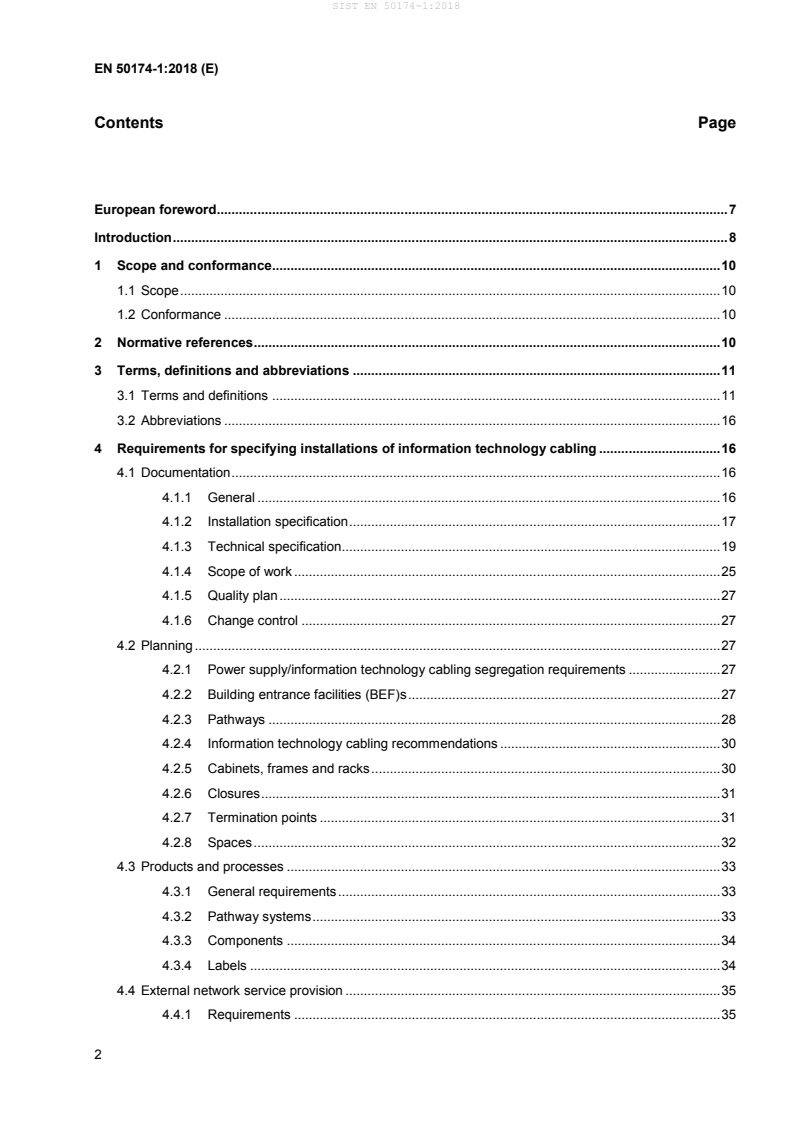
Contents Page
European foreword . 7
Introduction . 8
1 Scope and conformance . 10
1.1 Scope . 10
1.2 Conformance . 10
2 Normative references . 10
3 Terms, definitions and abbreviations . 11
3.1 Terms and definitions . 11
3.2 Abbreviations . 16
4 Requirements for specifying installations of information technology cabling . 16
4.1 Documentation . 16
4.1.1 General . 16
4.1.2 Installation specification . 17
4.1.3 Technical specification . 19
4.1.4 Scope of work . 25
4.1.5 Quality plan . 27
4.1.6 Change control . 27
4.2 Planning . 27
4.2.1 Power supply/information technology cabling segregation requirements . 27
4.2.2 Building entrance facilities (BEF)s . 27
4.2.3 Pathways . 28
4.2.4 Information technology cabling recommendations . 30
4.2.5 Cabinets, frames and racks . 30
4.2.6 Closures . 31
4.2.7 Termination points . 31
4.2.8 Spaces . 32
4.3 Products and processes . 33
4.3.1 General requirements . 33
4.3.2 Pathway systems . 33
4.3.3 Components . 34
4.3.4 Labels . 34
4.4 External network service provision . 35
4.4.1 Requirements . 35
4.4.2 Recommendations . 35
4.5 Operating procedures . 35
4.5.1 General requirements . 35
4.5.2 Administration requirements . 35
4.5.3 Protection from electrostatic discharge (ESD). 38
4.6 Maintenance . 39
4.6.1 Requirements . 39
4.6.2 Recommendations . 39
5 Requirements for installers of information technology cabling . 40
5.1 Documentation and administration . 40
5.1.1 Installation specification requirements . 40
5.1.2 Quality plan . 40
5.1.3 Installation schedule requirements . 41
5.1.4 Installation instructions requirements . 41
5.1.5 Change control requirements . 42
5.1.6 Documentation of the installed cabling . 42
5.2 Products and processes . 42
5.2.1 Compatibility of cabling components . 42
5.2.2 Cabling component acceptance . 42
5.2.3 Calibration and normalization of inspection and test equipment . 43
5.2.4 Pathway systems . 43
5.2.5 Labelling . 43
5.3 Power supplies . 43
5.4 Surveys . 43
5.4.1 Pathways . 43
5.4.2 Cabinets, frames and racks . 43
5.4.3 Closures . 43
6 Installation and operational complexity . 44
6.1 Requirements . 44
6.2 Recommendations . 44
Annex A (normative) Minimum requirements for technical specifications and quality plans . 45
A.1 General . 45
A.2 Technical specification . 45
A.3 Quality plan . 45
Annex B (normative) Polarity maintenance: Connecting hardware for multiple optical fibres . 46
B.1 General . 46
B.2 Duplex connecting hardware interfaces . 46
B.2.1 Duplex plugs, adapters and cords . 46
B.2.2 Polarity of installed cabling segments . 48
B.2.3 The Symmetrical Positioning Method . 48
B.2.4 The Reverse-Pair Positioning Method . 49
Annex C (informative) Polarity maintenance: Connecting hardware interfaces for arrays . 50
C.1 Connecting hardware interfaces for arrays with 12 optical fibres per row . 50
C.1.1 General . 50
C.1.2 Array connecting hardware components . 50
C.1.2.1 General . 50
C.1.2.2 Cables and array connector patch cords . 50
C.1.2.3 Array adapters . 51
C.1.2.4 Transition assemblies for duplex cabling . 51
C.1.3 Array Connectivity Method . 52
C.1.3.1 Duplex cabling . 52
C.1.3.2 Array cabling . 53
C.2 Connecting hardware interfaces for arrays with more than 12 optical fibres per row . 54
Annex D (informative) Terminating balanced cables on terminating blocks in distributors . 55
D.1 General . 55
D.2 The use of the same type of connector at each end of a cable . 55
D.3 The use of a different type of connector at each end of a cable . 55
D.4 Relation between the pins of connectors according to EN 60603-7 and the tags of a
terminating block . 55
Annex E (informative) Compatibility between transmission systems (balanced and unbalanced)
sharing the same cable sheath within information technology cabling . 57
E.1 General . 57
E.2 Recommendations concerning cable sharing . 57
E.3 Factors to be taken into account to ensure satisfactory performance . 57
E.3.1 General . 57
E.3.2 Factors concerning the disturbing transmission system. 58
E.3.3 Cabling characteristics. 58
E.3.3.1 Crosstalk loss . 58
E.3.3.2 Insertion loss . 58
E.3.3.3 Termination . 59
E.3.4 The disturbed transmission system . 59
E.4 Guidelines for reducing interference between transmission systems within the same cable
sheath . 59
E.5 Cabling qualification . 59
E.6 Particular installation requirements and recommendations . 59
E.7 Cable management . 59
E.8 Regulatory aspects . 60
Annex F (normative) Sampling plans and marginal results . 61
F.1 Sampling plans . 61
F.1.1 General . 61
F.1.2 Balanced cabling in accordance with the EN 50173 series of standards . 61
F.1.3 Optical fibre cabling in accordance with the EN 50173 series of standards . 63
F.2 Marginal results . 64
F.2.1 Marginal test results . 64
F.2.2 Requirements . 65
F.2.3 Recommendations . 65
F.2.4 Balanced cabling in accordance with the EN 50173 series of standards . 65
F.2.5 Optical fibre cabling . 65
F.3 Non-compliant results . 66
Annex G (informative) “Reaction to fire” performance of cables . 67
G.1 EuroClass designation . 67
G.2 Application of cables of a given EuroClass designation . 67
Bibliography . 69
Figures
Figure 1 — Schematic relationship between the EN 50174 series and other relevant standards . 9
Figure 2 — Quality assurance schematic . 17
Figure 3 — Conductor current for ISO/IEC/IEEE 8802-3 remote powering applications . 21
Figure 4 — Examples of labels indicating RP Category of remote powering installation . 38
Figure B.1 — Duplex connecting hardware plug . 47
Figure B.2 — Duplex connecting adapter . 47
Figure B.3 — Duplex patch cord . 47
Figure B.4 — Views of crossover patch cords . 48
Figure B.5 — Optical fibre sequences and adapter orientation in patch panel for the Symmetrical
Position Method . 49
Figure B.6 — Optical fibre sequences and adapter orientation in patch panel for the Reverse-Pair
Position Method . 49
Figure C.1 — Array connector cable or patch cord (key-up to key-up) . 51
Figure C.2 — Array adapter with aligned keyways . 51
Figure C.3 — Transition assembly . 52
Figure C.4 — Connectivity method for duplex cabling . 53
Figure C.5 — Connectivity method for array cabling . 54
Figure F.1 — Schematic of test result boundaries . 65
Tables
Table 1 — Contextual relationship between EN 50174 series and other standards relevant for
information technology cabling systems . 9
Table 2 — Remote powering cabling installation Categories and controls . 21
Table 3 — Minimum requirements of administration systems . 36
Table 4 — Minimum requirements of operational administration systems . 37
Table 5 — Level of installation complexity . 44
Table 6 — Level of operational complexity. 44
Table A.1 — Minimum requirements for technical specification. 45
Table A.2 — Minimum requirements for quality plan . 45
Table B.1 — Optical fibre colour code scheme . 46
Table D.1 — Examples of the relations between the EN 60603–7 series pins and the tags of the
terminating block . 56
Table F.1 — Installed balanced cabling test parameters . 61
Table F.2 — Installed optical fibre cabling test parameters . 64
Table G.1 — EuroClass designations and their foundation standards . 68
European foreword
This document (EN 50174-1:2018) has been prepared by Technical Committee CLC/TC 215,
"Electrotechnical aspects of telecommunication equipment".
The following dates are fixed:
• latest date by which this document has to be (dop) 2019-05-21
implemented at national level by publication of
an identical national standard or by
endorsement
• latest date by which the national standards (dow) 2021-05-21
conflicting with this document have to be
withdrawn
This document supersedes EN 50174-1:2009, EN 50174-1:2009/A1:2011 and EN 50174-1:2009/A2:2014.
EN 50174 comprises three parts. All three parts support the specification, implementation and operation of
information technology cabling. There are specific requirements for cabling systems that are in accordance
with the design requirements of the EN 50173 series. However, the three parts also apply to cabling systems
of any design including those in accordance with standards such as EN 50700.
This part, EN 50174-1, is concerned with specification, quality assurance, documentation and administration
of information technology cabling to be installed, together with its subsequent operation and maintenance. It
sets out the responsibilities of information technology cabling installers and premises owners or appointed
representatives separately, and is intended to be referenced in relevant contracts.
It does not cover those aspects of installation associated with the transmission of signals in free space
between transmitters, receivers or their associated antenna systems (e.g. wireless, radio, microwave or
satellite).
This edition of EN 50174-1:
a) revises the requirements for remote powering to support power levels offered by IEEE 802.3bt (in
preparation);
b) updates various requirements (e.g. in 4.2.5.1 on racks, frames and cabinets and in Table 4 on the level
of installation complexity);
c) revises Annex B on optical fibre connecting hardware, resulting an normative requirements (Annex B)
and informative recommendations (Annex C);
d) introduces a new Annex G with information regarding EuroClasses for the specification of the “reaction
to fire” performance of cables.
Introduction
The importance of services delivered by information technology cabling infrastructure is similar to that of
utilities such as heating, lighting and electricity supplies. As with those utilities, interruptions to service can
have a serious impact. Poor quality of service due to lack of planning, use of inappropriate components,
incorrect installation, poor administration or inadequate support can threaten an organization’s effectiveness.
There are four phases in the successful implementation of information technology cabling. These are:
a) design;
b) specification – the detailed requirement for the cabling, including the planning of its accommodation and
associated building services addressing specific environments (e.g. electromagnetic) together with the
quality assurance requirements to be applied;
c) installation – in accordance with the requirements of the specification;
d) operation – the management of connectivity and the maintenance of transmission performance during
the life of the cabling.
This European Standard is in three parts and addresses the specification, installation and operational
aspects. The EN 50173 series and other application standards cover design issues.
EN 50174-1 is used during the specification phase. It addresses the:
– installation specification, quality assurance procedures and documentation;
– documentation and administration;
– operation and maintenance.
This part, EN 50174-2 and EN 50174-3 are intended to be used by the personnel directly involved in the
planning aspects (of the specification phase) and installation phase. EN 50174-2 is applicable inside
buildings and EN 50174-3 is applicable outside buildings.
This European Standard is also relevant to:
• architects, building designers and builders;
• main contractors;
• designers, suppliers, installers, inspectors (auditors), maintainers and owners of information technology
cabling;
• public network providers and local service providers;
• end users.
The requirements and recommendations of Clause 4 are primarily for owners of premises housing
information technology systems. The owners may delegate selected responsibilities to designers, specifiers,
operators and maintainers of installed information technology cabling.
The requirements and recommendations of Clause 5 are primarily for the installers of information technology
cabling.
Figure 1 and Table 1 show the schematic and contextual relationships between the standards produced by
CLC/TC 215 for information technology cabling, namely:
1) this and other parts of the EN 50174 series;
2) generic cabling design (EN 50173 series);
3) application dependent cabling design (e.g. EN 50700);
4) bonding requirements (EN 50310).
Figure 1 — Schematic relationship between the EN 50174 series
and other relevant standards
Table 1 — Contextual relationship between EN 50174 series and other standards
relevant for information technology cabling systems
Building design Generic cabling Specification Installation Operation phase
phase design phase phase phase
EN 50173–2 EN 50174–1
EN 50173–3
Planning phase
EN 50173–4
EN 50174–2
EN 50173–5
EN 50310 EN 50174–3 EN 50174–1
EN 50173–6
EN 50174–2
EN 50310
EN 50174–3
(these ENs
EN 50310
reference general
requirements of
EN 50173–1)
1 Scope and conformance
1.1 Scope
This European Standard specifies requirements for the following aspects of information technology cabling:
a) installation specification, quality assurance documentation and procedures;
b) documentation and administration;
c) operation and maintenance.
This European Standard is applicable to all types of information technology cabling including generic cabling
systems designed in accordance with the EN 50173 series.
Safety (electrical safety and protection, optical power, fire, etc.) and electromagnetic compatibility (EMC)
requirements are outside the scope of this European Standard and are covered by other standards and
regulations. However, information given in this European Standard may be of assistance in meeting these
standards and regulations.
1.2 Conformance
For a cabling installation to conform to this European Standard:
a) the specification of the installation shall meet the requirements of Clause 4;
NOTE The requirements and recommendations of Clause 4 are primarily for owners of premises housing
information technology systems. The owners may delegate selected responsibilities to designers, specifiers,
operators and maintainers of installed information technology cabling. The party responsible for demonstrating
conformance should be clearly stated in the appropriate section of the documentation.
b) the installer shall meet the requirements of Clause 5;
c) the bonding system within the premises shall be in accordance with EN 50310;
d) where a lightning protection system is required, it shall conform to the “integrated lightning protection
system” according to EN 62305-4;
e) other lightning protection systems, including the “isolated lightning protection system” according to
EN 62305-3 are allowed provided that specific restrictions are applied both to the implementation of the
information technology cabling and the requirements of EN 50310 as agreed between the planners of
the lightning protection system and the information technology cabling;
f) local regulations shall be met.
2 Normative references
The following documents are referred to in the text in such a way that some or all of their content constitutes
requirements of this document. For dated references, only the edition cited applies. For undated references,
the latest edition of the referenced document (including any amendments) applies.
EN 13501-6, Fire classification of construction products and building elements – Part 6: Classification using
data from reaction to fire tests on electric cables
EN 50173-1:2018, Information technology – Generic cabling systems – Part 1: General requirements
EN 50173-2, Information technology – Generic cabling systems – Part 2: Office spaces
EN 50173-3, Information technology – Generic cabling systems – Part 3: Industrial spaces
EN 50173-4, Information technology – Generic cabling systems – Part 4: Homes
EN 50173-5, Information technology – Generic cabling systems – Part 5: Data centre spaces
EN 50173-6, Information technology – Generic cabling systems – Part 6: Distributed building services
EN 50174-2, Information technology – Cabling installation – Part 2: Installation planning and practices inside
buildings
EN 50174-3, Information technology – Cabling installation – Part 3: Installation planning and practices
outside buildings
EN 50310, Telecommunications bonding networks for buildings and other structures
EN 50667, Information technology – Automated infrastructure management (AIM) systems – Requirements,
data exchange and applications
EN 60332-1-2, Tests on electric and optical fibre cables under fire conditions – Part 1-2: Test for vertical
flame propagation for a single insulated wire or cable – Procedure for 1 kW pre-mixed flame (IEC 60332-1-2)
EN 61935-1, Specification for the testing of balanced and coaxial information technology cabling – Part 1:
Installed balanced cabling as specified in the standards series EN 50173 (IEC 61935-1:2009, modified)
EN 62305-4, Protection against lightning – Part 4: Electrical and electronic systems within structures
(IEC 62305-4)
EN 62368-3, Audio/video, information and communication technology equipment – Safety – Part 3: DC
power transfer through information technology communication cabling
HD 384 (all parts), Low-voltage electrical installations (IEC 60364 series, modified)
HD 60364 (all parts), Low-voltage electrical installations (IEC 60364 series, modified)
ISO/IEC/TR 14763-2-1, Information technology – Implementation and operation of customer premises
cabling – Part 2-1: Planning and installation – Identifiers within administration systems
IEC 60050-151:2001, International Electrotechnical Vocabulary – Chapter 151: Electrical and magnetic
devices
IEC 60050-161:1990, International Electrotechnical Vocabulary – Chapter 161: Electromagnetic compatibility
3 Terms, definitions and abbreviations
3.1 Terms and definitions
For the purposes of this document, the following terms and definitions apply.
Where the cabling is designed in accordance with standards in the EN 50173 series, the additional
definitions of those standards are applicable.
ISO and IEC maintain terminological databases for use in standardization at the following addresses:
— IEC Electropedia: available at http://www.electropedia.org/
— ISO Online browsing platform: available at http://www.iso.org/obp
3.1.1
acceptance test of installed cabling
contractual test to prove to the customer that the installed cabling meets specific conditions of its
specification
[SOURCE: IEC 60050-151:2001, 151-16-23 – modified: added “of installed cabling” to the term and replaced
“item” by “installed cabling”]
3.1.2
access provider
operator or another entity providing the means to enable external telecommunications service provision to a
subscriber
[SOURCE: EN 50700:2014, 3.1.1; EN 50174-3:2014, 3.1.2]
3.1.3
access provider space
location of access provider transmission and support equipment
3.1.4
array connector
optical fibre connector containing a single ferrule with multiple terminated fibres arranged in a line or a series
of lines
3.1.5
automated infrastructure management system
integrated hardware and software which automatically records the nature of, and identifies changes to,
connections between the cabling infrastructure and of the interconnected transmission and terminal
equipment
3.1.6
building entrance facility
facility that provides all necessary mechanical and electrical services for the entry of telecommunications
cables into a building and which may allow for transition from outdoor to indoor cable
[EN 50173-1:2018, 3.1.18]
3.1.7
cabinet
enclosed construction for housing closures and other information technology equipment
3.1.8
cable element
smallest construction unit in a cable
Note 1 to entry: A cable element may have a screen.
Note 2 to entry: A pair, a quad, a single isolated lead with coaxial screen and a single optical fibre are examples of a
cable element.
[EN 50173-1:2018, 3.1.20]
3.1.9
cable management system
system used for the support and/or containment, retention, protection of all types of cables, information and
communication lines, electrical power distribution conductors and their associated accessories (includes
ducts and tubes housing, or intended to house, blown information technology cables and/or cable elements)
3.1.10
cabling component
any product associated with the cabling installation including cables, connecting hardware, closures,
cabinets, frames, racks and pathway systems together with components used to provide earth connections
for the cabling installation
3.1.11
closure
fixture or fitting of either open or closed construction intended to contain connecting hardware
3.1.12
discoverable equipment
equipment with a network address
Note 1 to entry: Discoverable equipment can be treated as non-discoverable equipment per end user choice.
3.1.13
draw-box
space in a pathway that allows the routing of cables during the cable installation process
3.1.14
electrostatic discharge
transfer of electric charge between bodies of different electrostatic potential in proximity or through direct
contact
[IEC 60050-161:1990, 161-01-22]
3.1.15
electromagnetic disturbance
any electromagnetic phenomenon which may degrade the performance of a device, equipment or system, or
adversely affect living or inert matter
Note 1 to entry: An electromagnetic disturbance may be an electromagnetic noise, an unwanted signal or a change in
the propagation medium itself.
[IEC 60050-161:1990, 161-01-05]
3.1.16
entrance room
space within, or at the boundary of, a building housing the demarcation point where facilities owned by
access and/or service providers interface with the premises cabling
Note 1 to entry: For generic cabling in accordance with EN 50173–5, the demarcation point is the external network
interface (ENI) and the data centre cabling at that point is the network access cabling.
3.1.17
external fire barrier
boundary, designated by local fire authorities, that demarcates the extent of the fire zones or compartments
of a building
3.1.18
fire barrier
fire compartment boundary with appropriate levels of fire performance in order to prevent the spread of fire
and its effluent and minimize the extent of loss
3.1.19
fire-stop materials
sealing products that, at all times, take up imperfections of fit or design tolerance between the fire resisting
fixed elements of a building and which provide the same fire performance as the fixed elements in order to
restrict the passage of fire and smoke
3.1.20
fire-stopping techniques
processes, products and materials that reinstate the original fire rating of a fire barrier
3.1.21
frame
open construction, typically wall-mounted, for housing closures and other information technology equipment
3.1.22
identifier
unique item of information to distinguish a specific component of the cabling installation
3.1.23
information technology
telecommunications
technology concerned with the transmission, emission and reception of signs, signals, writing, images and
sounds by cable, radio, optical or other electromagnetic systems
Note 1 to entry: The term telecommunications has no legal meaning when used in this document.
[EN 50173-1:2018, 3.1.49]
3.1.24
information technology equipment
active or passive equipment necessary to deliver a specific application
Note 1 to entry: Examples include hubs, switches, routers, adapters.
3.1.25
installer
person installing cabling components
Note 1 to entry: No design functions are assumed.
3.1.26
jumper
one or more cable elements without connectors used to make a connection between terminated cables
3.1.27
label
means of marking a specific component of the information technology infrastructure with its identifier and
(optionally) other information and intended to be fixed to, or be part of, the component
3.1.28
minimum bend radius during installation
minimum radius as specified by the cable manufacturer, supplier or in accordance with the relevant product
standard to which a cable or cable element is allowed to be subjected during installation
3.1.29
minimum bend radius during operation – static
minimum radius as specified by the cable manufacturer, supplier or in accordance with the relevant product
standard to which a cable or cable element is allowed to be subjected following installation and fixed in its
final operating position
3.1.30
minimum bend radius during operation – dynamic
minimum radius as specified by the cable manufacturer, supplier or in accordance with the relevant product
standard to which a cable or cable element is allowed to be subjected under conditions where the cable or
cable element is subject to movement
3.1.31
pathway
defined route for cables between termination points
3.1.32
pathway system
cable management system, or other area or volume defined by markings
3.1.33
power supply cabling
cabling whose primary purpose is the supply of electrical power
3.1.34
rack
open construction, typically self-supporting and floor-mounted, for housing closures and other information
technology equipment
3.1.35
record
collection of information about, or related to, a specific element of the information technology infrastructure
3.1.36
remote powering
delivery of power to a device using the cable elements of information technology cable
3.1.37
scope of work
detailed definition of the tasks involved in an installation or particular phase of an installation
3.1.38
service loop
excess length of cable or cable element(s)
3.1.39
service provider
operator of any service that furnishes telecommunications content (transmi
...