

EN 50600-2-4:2023
(Main)Information technology - Data centre facilities and infrastructures - Part 2-4: Telecommunications cabling infrastructure
General Information
- Abstract
This document specifies design principles for information technology and network telecommunications cabling (e.g. SAN and LAN) in accordance with EN 50173 5, based upon the criteria and classifications for “availability” and “physical security” within EN 50600 1. This document addresses the telecommunications cabling infrastructures used in data centres. It describes: a) for design, the application of generic cabling standards in the EN 50173 series; b) for installation specification, planning and practices and quality assurance, the application of standards in the EN 50174 series (and related standards). In addition, this document specifies requirements and recommendations for the following: 1) general information technology cabling to support the IT operation of the data centre; 2) telecommunications cabling to monitor and control, as appropriate, power distribution, environmental control and physical security of the data centre; 3) other building automation cabling; 4) pathways, pathway systems, spaces and enclosures for the telecommunications cabling infrastructures. Safety and electromagnetic compatibility (EMC) requirements are outside the scope of this document and are covered by other standards and regulations. However, information given in this document can be of assistance in meeting these standards and regulations.
- Status
- Published
- Publication Date
- 30-Mar-2023
- Technical Committee
- CLC/TC 215 - Electrotechnical aspects of telecommunication equipment
- Drafting Committee
- CLC/TC 215 - Electrotechnical aspects of telecommunication equipment
- Current Stage
- 6060 - Document made available - Publishing
- Start Date
- 31-Mar-2023
- Due Date
- 03-May-2023
- Completion Date
- 31-Mar-2023



Overview
EN 50600-2-4:2023 - Information technology - Data centre facilities and infrastructures - Part 2-4: Telecommunications cabling infrastructure - specifies design principles and implementation guidance for telecommunications cabling inside data centres. It aligns generic cabling standards (EN 50173 series) with data‑centre availability and physical security classifications defined in EN 50600-1. The document addresses cabling for IT (LAN/SAN), monitoring and control of power and environmental systems, building automation, and the pathways, spaces and enclosures that host cabling infrastructure. Safety and EMC are outside its scope but the guidance can help meet those requirements.
Key topics and requirements
- Cabling design and topology: Guidance on structured cabling vs point‑to‑point approaches, fixed cabling practices and distribution strategies for computer rooms and supporting spaces.
- Standards application: Implements EN 50173 (generic cabling design) and EN 50174 (installation, planning and QA) for data‑centre environments.
- Distribution areas and spaces: Definitions and requirements for building entrance facilities, entrance rooms, distribution areas, racks/cabinets and pathway systems.
- Pathways and enclosures: Planning for cable routes, containment, segregation and capacity to support growth and maintain maintainability.
- Availability classes: Design requirements and recommendations for Availability Classes (AC 1–4) that map cabling resilience to data‑centre availability objectives.
- Physical security: New (2023) clause on protection against unauthorized access and internal events for pathways, spaces and rooms.
- Management & operation: Requirements for documentation, labeling, moves/adds/changes processes and optional automated infrastructure management (AIM) systems.
- Energy efficiency & practical examples: Informative annexes covering energy considerations, design concepts, infrastructure examples and colocation‑specific requirements (Annex F normative).
Practical applications - who uses it
- Data centre designers and architects planning telecommunications cabling and pathways
- Network engineers and system integrators implementing LAN, SAN and monitoring/control cabling
- Cabling contractors and installers following EN 50174 practices within a data‑centre context
- Facility managers and colocation operators aligning cabling to availability and security requirements
- Auditors, compliance officers and procurement teams specifying resilient cabling infrastructures
Related standards
- EN 50600-1 (overall data centre requirements: availability, physical security)
- EN 50173 series (generic cabling systems)
- EN 50174 series (cabling installation, planning and quality assurance)
- Other national/regulatory standards covering safety and EMC (outside EN 50600-2-4 scope)
EN 50600-2-4:2023 is a practical, standards‑based reference for building resilient, maintainable and secure telecommunications cabling infrastructure in modern data centres.
Relations
- Effective Date
- 26-May-2020
- Effective Date
- 12-May-2026
- Effective Date
- 03-Feb-2026
- Effective Date
- 03-Feb-2026
- Effective Date
- 03-Feb-2026
- Effective Date
- 03-Feb-2026
- Effective Date
- 03-Feb-2026
- Effective Date
- 03-Feb-2026
- Effective Date
- 03-Feb-2026
Get Certified
Connect with accredited certification bodies for this standard

BSI Group
BSI (British Standards Institution) is the business standards company that helps organizations make excellence a habit.

NYCE
Mexican standards and certification body.
Sponsored listings
Frequently Asked Questions
EN 50600-2-4:2023 is a standard published by CLC. Its full title is "Information technology - Data centre facilities and infrastructures - Part 2-4: Telecommunications cabling infrastructure". This standard covers: This document specifies design principles for information technology and network telecommunications cabling (e.g. SAN and LAN) in accordance with EN 50173 5, based upon the criteria and classifications for “availability” and “physical security” within EN 50600 1. This document addresses the telecommunications cabling infrastructures used in data centres. It describes: a) for design, the application of generic cabling standards in the EN 50173 series; b) for installation specification, planning and practices and quality assurance, the application of standards in the EN 50174 series (and related standards). In addition, this document specifies requirements and recommendations for the following: 1) general information technology cabling to support the IT operation of the data centre; 2) telecommunications cabling to monitor and control, as appropriate, power distribution, environmental control and physical security of the data centre; 3) other building automation cabling; 4) pathways, pathway systems, spaces and enclosures for the telecommunications cabling infrastructures. Safety and electromagnetic compatibility (EMC) requirements are outside the scope of this document and are covered by other standards and regulations. However, information given in this document can be of assistance in meeting these standards and regulations.
This document specifies design principles for information technology and network telecommunications cabling (e.g. SAN and LAN) in accordance with EN 50173 5, based upon the criteria and classifications for “availability” and “physical security” within EN 50600 1. This document addresses the telecommunications cabling infrastructures used in data centres. It describes: a) for design, the application of generic cabling standards in the EN 50173 series; b) for installation specification, planning and practices and quality assurance, the application of standards in the EN 50174 series (and related standards). In addition, this document specifies requirements and recommendations for the following: 1) general information technology cabling to support the IT operation of the data centre; 2) telecommunications cabling to monitor and control, as appropriate, power distribution, environmental control and physical security of the data centre; 3) other building automation cabling; 4) pathways, pathway systems, spaces and enclosures for the telecommunications cabling infrastructures. Safety and electromagnetic compatibility (EMC) requirements are outside the scope of this document and are covered by other standards and regulations. However, information given in this document can be of assistance in meeting these standards and regulations.
EN 50600-2-4:2023 is classified under the following ICS (International Classification for Standards) categories: 35.020 - Information technology (IT) in general; 35.110 - Networking; 35.160 - Microprocessor systems. The ICS classification helps identify the subject area and facilitates finding related standards.
EN 50600-2-4:2023 has the following relationships with other standards: It is inter standard links to EN 50600-2-4:2015, EN 50600-3-1:2026, EN 50600-2-1:2014, CLC/TS 50600-5-1:2023, EN 50600-2-5:2021, EN 50600-2-1:2021, EN 50600-2-2:2014, EN 50600-3-1:2016, EN 50600-2-5:2016. Understanding these relationships helps ensure you are using the most current and applicable version of the standard.
EN 50600-2-4:2023 is associated with the following European legislation: Standardization Mandates: M/462. When a standard is cited in the Official Journal of the European Union, products manufactured in conformity with it benefit from a presumption of conformity with the essential requirements of the corresponding EU directive or regulation.
EN 50600-2-4:2023 is available in PDF format for immediate download after purchase. The document can be added to your cart and obtained through the secure checkout process. Digital delivery ensures instant access to the complete standard document.
Standards Content (Sample)
SLOVENSKI STANDARD
01-junij-2023
Informacijska tehnologija - Naprave in infrastruktura podatkovnega centra - 2-4.
del: Pokabljenje za telekomunikacije
Information technology - Data centre facilities and infrastructures - Part 2-4:
Telecommunications cabling infrastructure
Informationstechnik - Einrichtungen und Infrastrukturen von Rechenzentren - Teil 2-4:
Infrastruktur der Telekommunikationsverkabelung
Technologie de l'information - Installation et infrastructures de centres de traitement de
données - Partie 2-4: Infrastructure du câblage dédié télécommunications
Ta slovenski standard je istoveten z: EN 50600-2-4:2023
ICS:
33.040.01 Telekomunikacijski sistemi Telecommunication systems
na splošno in general
35.110 Omreževanje Networking
2003-01.Slovenski inštitut za standardizacijo. Razmnoževanje celote ali delov tega standarda ni dovoljeno.
EUROPEAN STANDARD EN 50600-2-4
NORME EUROPÉENNE
EUROPÄISCHE NORM March 2023
ICS 35.110; 35.020; 35.160 Supersedes EN 50600-2-4:2015
English Version
Information technology - Data centre facilities and infrastructures
- Part 2-4: Telecommunications cabling infrastructure
Technologies de l'information - Installation et infrastructures Informationstechnik - Einrichtungen und Infrastrukturen von
de centres de traitement de données - Partie 2-4: Rechenzentren - Teil 2-4: Infrastruktur der
Infrastructure du câblage dédié aux télécommunications Telekommunikationsverkabelung
This European Standard was approved by CENELEC on 2023-03-20. CENELEC members are bound to comply with the CEN/CENELEC
Internal Regulations which stipulate the conditions for giving this European Standard the status of a national standard without any alteration.
Up-to-date lists and bibliographical references concerning such national standards may be obtained on application to the CEN-CENELEC
Management Centre or to any CENELEC member.
This European Standard exists in three official versions (English, French, German). A version in any other language made by translation
under the responsibility of a CENELEC member into its own language and notified to the CEN-CENELEC Management Centre has the
same status as the official versions.
CENELEC members are the national electrotechnical committees of Austria, Belgium, Bulgaria, Croatia, Cyprus, the Czech Republic,
Denmark, Estonia, Finland, France, Germany, Greece, Hungary, Iceland, Ireland, Italy, Latvia, Lithuania, Luxembourg, Malta, the
Netherlands, Norway, Poland, Portugal, Republic of North Macedonia, Romania, Serbia, Slovakia, Slovenia, Spain, Sweden, Switzerland,
Türkiye and the United Kingdom.
European Committee for Electrotechnical Standardization
Comité Européen de Normalisation Electrotechnique
Europäisches Komitee für Elektrotechnische Normung
CEN-CENELEC Management Centre: Rue de la Science 23, B-1040 Brussels
© 2023 CENELEC All rights of exploitation in any form and by any means reserved worldwide for CENELEC Members.
Ref. No. EN 50600-2-4:2023 E
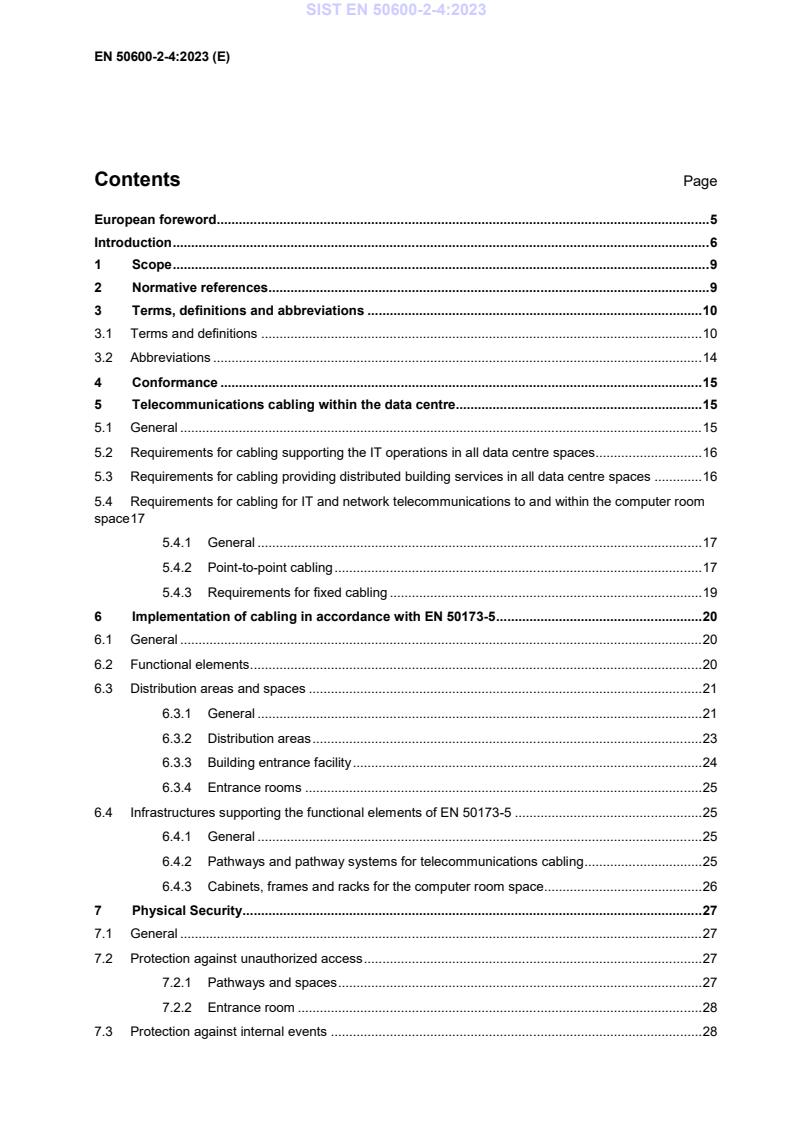
Contents Page
European foreword . 5
Introduction . 6
1 Scope . 9
2 Normative references. 9
3 Terms, definitions and abbreviations . 10
3.1 Terms and definitions . 10
3.2 Abbreviations . 14
4 Conformance . 15
5 Telecommunications cabling within the data centre . 15
5.1 General . 15
5.2 Requirements for cabling supporting the IT operations in all data centre spaces . 16
5.3 Requirements for cabling providing distributed building services in all data centre spaces . 16
5.4 Requirements for cabling for IT and network telecommunications to and within the computer room
space 17
5.4.1 General . 17
5.4.2 Point-to-point cabling . 17
5.4.3 Requirements for fixed cabling . 19
6 Implementation of cabling in accordance with EN 50173-5 . 20
6.1 General . 20
6.2 Functional elements . 20
6.3 Distribution areas and spaces . 21
6.3.1 General . 21
6.3.2 Distribution areas . 23
6.3.3 Building entrance facility . 24
6.3.4 Entrance rooms . 25
6.4 Infrastructures supporting the functional elements of EN 50173-5 . 25
6.4.1 General . 25
6.4.2 Pathways and pathway systems for telecommunications cabling . 25
6.4.3 Cabinets, frames and racks for the computer room space . 26
7 Physical Security . 27
7.1 General . 27
7.2 Protection against unauthorized access . 27
7.2.1 Pathways and spaces . 27
7.2.2 Entrance room . 28
7.3 Protection against internal events . 28
8 Availability classification for the telecommunications cabling infrastructure, infrastructure
elements, facilities and spaces . 28
8.1 General . 28
8.2 Availability design principles for telecommunications cabling infrastructure . 29
8.3 Overview about the availability classes for telecommunications cabling . 30
8.4 Availability Class design requirements and recommendations . 30
8.4.1 Transmission channel design for the network distribution cabling . 30
8.4.2 Availability Class 1 . 31
8.4.3 Availability Class 2 . 32
8.4.4 Availability Class 3 . 35
8.4.5 Availability Class 4 . 38
9 Management and operation of the telecommunications cabling infrastructure . 40
9.1 General . 40
9.2 Automated infrastructure management systems . 40
Annex A (informative) Design concepts for network distribution cabling . 41
Annex B (informative) Energy efficiency considerations for the telecommunications cabling
infrastructure . 50
Annex C (informative) Summary of requirements . 51
Annex D (informative) Examples of telecommunications cabling infrastructures including active
equipment. 53
Annex E (informative) Availability description . 56
Annex F (normative) Availability Classes for cabling infrastructures in colocation data centres . 57
Bibliography . 61
Figures
Figure 1 — Schematic relationship between the EN 50600 series of documents . 7
Figure 2 — Schematic relationship between the EN 50600-2-4 and other European cabling design and
installation standards . 8
Figure 3 — Impact of growth in an unstructured point-to-point cabling infrastructure . 18
Figure 4 — Structured cabling infrastructure: setup and growth . 19
Figure 5 — Functional elements and cabling subsystems of EN 50173-5 . 21
Figure 6 — Facilities and spaces relevant for cabling according EN 50173-5 . 22
Figure 7 — Areas providing accommodation for distributors of EN 50173-5 and connected active equipment
.............................................................................................................................................................. 23
Figure 8 — Principle of supply and distribution . 29
Figure 9 — Transmission channels (interconnect and cross-connect) . 31
Figure 10 — Telecommunication cabling Class 1 using direct attached cords . 32
Figure 11 — Telecommunication cabling Class 1 . 32
Figure 12 — Telecommunication cabling Class 2 . 33
Figure 13 — Managing moves, adds and changes . 34
Figure 14 — Telecommunication cabling Class 3 with one entrance room . 36
Figure 15 — Telecommunication cabling Class 3 with two entrance rooms . 36
Figure 16 — Telecommunication cabling Class 4 . 39
Figure A.1 — Symbols of network elements . 41
Figure A.2 — Example of a Class 1 cabling implementation . 42
Figure A.3 — Example for Class 2 EoR cabling implementation . 43
Figure A.4 — Example for Class 2 MoR cabling implementation . 44
Figure A.5 — Example for Class 2 ToR cabling implementation . 45
Figure A.6 — Example for Class 3 EoR cabling implementation . 46
Figure A.7 — Example for Class 3 ToR cabling implementation . 47
Figure A.8 — Example for Class 4 EoR cabling implementation . 48
Figure A.9 — Example for Class 4 ToR cabling implementation . 49
Figure D.1 — Example of Availability Class 3 cabling and active equipment with one entrance room . 53
Figure D.2 — Example of Availability Class 3 cabling and active equipment with two entrance rooms . 54
Figure D.3 — Example of Availability Class 4 cabling and active equipment . 54
Figure D.4 — Example of Availability Class 3 cabling and active equipment implemented across multiple
floors . 55
Figure D.5 — Example of Availability Class 3 cabling and active equipment implemented across multiple
floors . 55
Figure F.1 — Telecommunications supply cabling for a single building colocation (AC 3) . 59
Figure F.2 — Telecommunications supply cabling for a single building colocation (AC 4) . 59
Figure F.3 — Telecommunications supply cabling for a multi building colocation (AC 4) . 60
Tables
Table 1 — Telecommunication cabling Availability Classes per space and overall data centre Availability
Class. 30
Table C.1 — Telecommunications cabling infrastructure requirements per Availability Class . 51
Table E.1 — Summary of availability classification . 56
European foreword
This document (EN 50600-2-4:2023) has been prepared by CLC/TC 215 “Electrotechnical aspects of
telecommunication equipment”.
The following dates are fixed:
• latest date by which this document has to be (dop) 2024-03-20
implemented at national level by publication of
an identical national standard or by
endorsement
• latest date by which the national standards (dow) 2026-03-20
conflicting with this document have to be
withdrawn
This document supersedes EN 50600-2-4:2015.
The following major modifications have been made compared to EN 50600-2-4:2015:
a) the document structure has been completely revised;
b) the availability classes have been revised;
c) a clause on physical security has been added (Clause 7);
d) Annex C summarizing the requirements and recommendations of the document has been added;
e) Annex D with examples for cabling infrastructures including the location of active equipment has been
added;
f) Annex E with an availability description has been added;
g) Annex F with specific requirements for colocation data centres has been added.
Attention is drawn to the possibility that some of the elements of this document may be the subject of patent
rights. CENELEC shall not be held responsible for identifying any or all such patent rights.
This document has been prepared under a Standardizaton Request given to CENELEC by the European
Commission and the European Free Trade Association.
Any feedback and questions on this document should be directed to the users’ national committee. A complete
listing of these bodies can be found on the CENELEC website.
Introduction
The unrestricted access to internet-based information demanded by the information society has led to an
exponential growth of both internet traffic and the volume of stored/retrieved data. Data centres are housing
and supporting the information technology and network telecommunications equipment for data processing,
data storage and data transport. They are required both by network operators (delivering those services to
customer premises) and by enterprises within those customer premises.
Data centres usually provide modular, scalable and flexible facilities and infrastructures to easily accommodate
the rapidly changing requirements of the market. In addition, energy consumption of data centres has become
critical both from an environmental point of view (reduction of carbon footprint) and with respect to economical
considerations (cost of energy) for the data centre operator.
The implementation of data centres varies in terms of:
a) purpose (enterprise, co-location, co-hosting or network operator facilities);
b) security level;
c) physical size;
d) accommodation (mobile, temporary and permanent constructions).
The needs of data centres also vary in terms of availability of service, the provision of security and the
objectives for energy efficiency. These needs and objectives influence the design of data centres in terms of
building construction, power distribution, environmental control telecommunications cabling and physical
security as well as the operation of the data centre. Effective management and operational information is
required to monitor achievement of the defined needs and objectives.
Recognizing the substantial resource consumption, particularly of energy, of larger data centres, it is also
important to provide tools for the assessment of that consumption both in terms of overall value and of source
mix and to provide Key Performance Indicators (KPIs) to evaluate trends and drive performance
improvements.
At the time of publication of this document, the EN 50600 series is designed as a framework of standards,
technical specifications and technical reports covering the design, the operation and management, the key
performance indicators for energy efficient operation of the data centre as well as a data centre maturity model.
The EN 50600-2 series defines the requirements for the data centre design.
The EN 50600-3 series defines the requirements for the operation and the management of the data centre.
The EN 50600-4 series defines the key performance indicators for the data centre.
The CLC/TS 50600-5 series defines the data centre maturity model requirements and recommendations.
The CLC/TR 50600-99-X Technical Reports cover recommended practices and guidance for specific topics
around data centre operation and design.
This series of documents specifies requirements and recommendations to support the various parties involved
in the design, planning, procurement, integration, installation, operation and maintenance of facilities and
infrastructures within data centres. These parties include:
1) owners, operators, facility managers, ICT managers, project managers, main contractors;
2) consulting engineers, architects, building designers and builders, system and installation designers,
auditors, test and commissioning agents;
3) facility and infrastructure integrators, suppliers of equipment;
4) installers, maintainers.
At the time of publication of this document, the EN 50600-2 series comprises the following documents:
— EN 50600-2-1, Information technology - Data centre facilities and infrastructures - Part 2-1: Building
construction
— CLC/TS 50600-2-10, Information technology - Data centre facilities and infrastructures - Part 2-10:
Earthquake risk and impact analysis
— EN 50600-2-2, Information technology - Data centre facilities and infrastructures - Part 2-2: Power supply
and distribution
— EN 50600-2-3, Information technology - Data centre facilities and infrastructures - Part 2-3: Environmental
control
— EN 50600-2-4, Information technology - Data centre facilities and infrastructures - Part 2-4:
Telecommunications cabling infrastructure
— EN 50600-2-5, Information technology - Data centre facilities and infrastructures - Part 2-5: Security
systems
The inter-relationship of the documents within the EN 50600 series is shown in Figure 1.
Figure 1 — Schematic relationship between the EN 50600 series of documents
EN 50600-2-X documents specify requirements and recommendations for particular facilities and
infrastructures to support the relevant classification for “availability”, “physical security” and “energy efficiency
enablement” selected from EN 50600-1.
EN 50600-3-X documents specify requirements and recommendations for data centre operations, processes
and management.
EN 50600-4-X documents specify requirements and recommendations for key performance indicators (KPIs)
used to assess and improve the resource usage efficiency and effectiveness, respectively, of a data centre.
This document addresses the specific requirements for the telecommunications cabling infrastructure in data
centres used for the purpose of IT networking and building services (in accordance with the requirements of
EN 50600-1).
This document is intended for use by and collaboration between architects, building designers and builders,
system and installation designers.
This series of documents does not address the selection of information technology and network
telecommunications equipment, software and associated configuration issues.
Figure 2 shows the schematic and contextual relationships of the EN 50600-2-4 with other cabling and cabling
installation related European standards.
Figure 2 — Schematic relationship between the EN 50600-2-4 and other European cabling design and
installation standards
The importance of the information technology and network telecommunications cabling infrastructure is similar
to that of other infrastructures such as environmental control, power distribution and security systems. As with
other utilities, interruptions to service can have a serious impact. Poor quality of service due to lack of planning,
use of inappropriate components, incorrect installation, poor administration or inadequate support can threaten
an organization's effectiveness.
1 Scope
This document specifies design principles for information technology and network telecommunications cabling
(e.g. SAN and LAN) in accordance with EN 50173-5, based upon the criteria and classifications for “availability”
and “physical security” within EN 50600-1.
This document addresses the telecommunications cabling infrastructures used in data centres. It describes:
a) for design, the application of generic cabling standards in the EN 50173 series;
b) for installation specification, planning and practices and quality assurance, the application of standards in
the EN 50174 series (and related standards).
In addition, this document specifies requirements and recommendations for the following:
1) general information technology cabling to support the IT operation of the data centre;
2) telecommunications cabling to monitor and control, as appropriate, power distribution, environmental
control and physical security of the data centre;
3) other building automation cabling;
4) pathways, pathway systems, spaces and enclosures for the telecommunications cabling infrastructures.
Safety and electromagnetic compatibility (EMC) requirements are outside the scope of this document and are
covered by other standards and regulations. However, information given in this document can be of assistance
in meeting these standards and regulations.
2 Normative references
The following documents are referred to in the text in such a way that some or all of their content constitutes
requirements of this document. For dated references, only the edition cited applies. For undated references,
the latest edition of the referenced document (including any amendments) applies.
EN 50173-2, Information technology - Generic cabling systems - Part 2: Office spaces
EN 50173-5, Information technology - Generic cabling systems - Part 5: Data centre spaces
EN 50173-6, Information technology - Generic cabling systems - Part 6: Distributed building services
EN 50174-1:2018, Information technology — Cabling installation — Part 1: Installation specification and
quality assurance
EN 50174-2:2018, Information technology - Cabling installation - Part 2: Installation planning and practices
inside buildings
EN 50174-3, Information technology - Cabling installation - Part 3: Installation planning and practices outside
buildings
EN 50310, Telecommunications bonding networks for buildings and other structures
EN 50600-1:2019, Information technology - Data centre facilities and infrastructures - Part 1: General concepts
EN 50600-2-1, Information technology — Data centre facilities and infrastructures — Part 2-1: Building
construction
———————
As amended by EN 50174-1:2018/A1:2020.
EN 50600-2-2, Information technology - Data centre facilities and infrastructures - Part 2-2: Power supply and
distribution
EN 50600-2-3, Information technology - Data centre facilities and infrastructures - Part 2-3: Environmental
control
EN 50600-2-5, Information technology — Data centre facilities and infrastructures — Part 2-5: Security
systems
3 Terms, definitions and abbreviations
3.1 Terms and definitions
For the purposes of this document, the terms and definitions of EN 50600-1 and the following apply.
ISO and IEC maintain terminology databases for use in standardization at the following addresses:
— ISO Online browsing platform: available at https://www.iso.org/obp
— IEC Electropedia: available at https://www.electropedia.org/
3.1.1
application-specific cabling
structured cabling with a configuration and performance which is considered to provide a specific benefit for a
single, or limited number of applications, as compared to generic cabling
3.1.2
building entrance facility
facility that provides all necessary mechanical and electrical services for the entry of telecommunications
cables into a building and which can enable transition from outdoor to indoor cable
[SOURCE: EN 50173-1:2018, 3.1.18]
3.1.3
cabinet
enclosed construction for housing closures and other information technology equipment
3.1.4
central patching location
passive cross-connect to connect different functional elements of a data centre
Note 1 to entry: A central patching location can be located in the main distribution area and/or the intermediate distribution
area and is therefore a configuration of an MD and/or an ID in accordance with the cabling of EN 50173-5.
3.1.5
cross-connect
passive connection between cabling subsystems using a patch cord or jumper
[SOURCE: EN 50173-1:2018, 3.1.35]
3.1.6
customer space
part of a cabinet, a cabinet, a cage or a computer room in a colocation data centre that customers can rent to
host their IT
3.1.7
entrance room
space that houses the external telecommunications provider equipment and that provides the demarcation
points for the external telecommunications services
3.1.8
equipment outlet
fixed connecting device where the zone distribution cabling terminates and providing the interface to the
equipment cabling
[SOURCE: EN 50173-5:2018, 3.1.3]
3.1.9
equipment distribution area
area served by LDP(s) and EO(s) of cabling and accommodating the LDP(s), EO(s), servers, storage device
and other networking equipment and their connections to the EO(s)
Note 1 to entry: Cabling is in accordance with EN 50173-5.
3.1.10
external network interface
termination point providing demarcation of external telecommunications service provision
[SOURCE: EN 50173-1:2018, 3.1.42]
3.1.11
fixed cabling
cabling subsystem between closures which has either a peer-to-peer or hierarchical structure and which
enables the installation of cross-connects or interconnects at those closures
3.1.12
floor distributor
distributor used to connect between the horizontal cable and other cabling subsystems or equipment
3.1.13
floor distribution area
area accommodating the FD(s) of cabling and associated transmission equipment
Note 1 to entry: Cabling in accordance with EN 50173-2.
3.1.14
frame
open construction, typically wall-mounted, for housing closures and other information technology equipment
[SOURCE: EN 50174-1:2018, 3.1.21]
3.1.15
generic cabling
structured telecommunications cabling system, that is capable of supporting a wide range of standardized
applications
Note 1 to entry: Application-specific hardware is not a part of generic cabling.
Note 2 to entry: Generic cabling can be installed without prior knowledge of the required applications.
[SOURCE: EN 50173-1:2018, 3.1.46]
3.1.16
information technology equipment
equipment designed for the purpose of
a) receiving data from an external source (such as via network or via a keyboard);
b) performing processing and storage functions on the received data (such as computation, data
transformation or recording, filing, sorting, storage, transfer of data);
c) providing a data output (either to other equipment or by the reproduction of data or images)
3.1.17
interconnect
passive connection to a cabling subsystem without the use of a patch cord or jumper
[SOURCE: EN 50173-1:2018, 3.1.52]
3.1.18
intermediate distributor
distributor used to make connections between the main distribution cabling subsystem, intermediate
distribution cabling subsystem, network access cabling subsystem and active equipment
[SOURCE: EN 50173-5:2018, 3.1.5]
3.1.19
intermediate distribution area
area accommodating the ID(s) of cabling and associated transmission equipment
Note 1 to entry: Intermediate distributions areas (and IDs) are primarily used in larger data centres to enable data centre
growth or to provide segmentation for specific applications.
Note 2 to entry: cabling in accordance with EN 50173-5.
3.1.20
IT load
any active equipment providing data transport services, data processing or data storage inside the data centre
3.1.21
local distribution point
connection point in the zone distribution cabling subsystem between a zone distributor and one or more
equipment outlets
[SOURCE: EN 50173-5:2018, 3.1.6]
3.1.22
network telecommunication equipment
equipment within the data centre that provides data transport services inside or outside the data centre
3.1.23
main distributor
distributor used to make connections between the main distribution cabling subsystem, network access cabling
subsystem and active equipment
Note 1 to entry: A central patching location located in a main distribution area is a specific configuration of a MD in
accordance with the cabling of EN 50173-5.
[SOURCE: EN 50173-5:2018, 3.1.10 – modified: Note 1 to entry added]
3.1.24
main distribution area
area accommodating the main distributor(s) of cabling and associated transmission equipment
Note 1 to entry: A main distribution area can be in dedicated “main distributor space” or within the computer room of the
data centre.
Note 2 to entry: Cabling in accordance with EN 50173-5.
3.1.25
meet-me-room
space in a colocation data centre which enables the interconnection between data centre customer spaces
and/or between data centre customer spaces and telecommunications providers
3.1.26
pathway
defined route for cables between termination points
[SOURCE: EN 50174-1:2018, 3.1.31]
3.1.27
pathway system
cable management system, or other area or volume defined by markings
[SOURCE: EN 50174-1:2018, 3.1.32]
3.1.28
point-to-point connection
direct connection of two pieces of IT equipment using a dedicated cable rather than a generic cabling system
3.1.29
premises entrance facility
space that provides all necessary mechanical and electrical services for the entry of cables into the premises
[SOURCE: EN 50600-1:2019, 3.1.28]
3.1.30
rack
open construction, typically self-supporting and floor-mounted, for housing closures and other information
technology equipment
[SOURCE: EN 50174-1:2018, 3.1.34]
3.1.31
structured cabling
telecommunications cabling comprising fixed cables between points of distribution at which equipment or other
fixed cables can be connected
3.1.32
telecommunications provider
either an access provider or a service provider
Note 1 to entry: The term access provider is defined in EN 50174-1:2018, 3.1.2.
Note 2 to entry: The term service provider is defined in EN 50174-1:2018, 3.1.39.
3.1.33
zone distributor
distributor used to make connections between the main distribution cabling subsystem, zone distribution
cabling subsystem, network access cabling subsystem and active equipment
[SOURCE: EN 50173-5:2018, 3.1.13]
3.1.34
zone distribution area
area accommodating the ZD(s) of cabling and associated transmission equipment
Note 1 to entry: Cabling in accordance with EN 50173-5.
3.1.35
zone patching location
passive cross-connect to connect different functional elements of a data centre zone
Note 1 to entry: A zone patching location can be located in a zone distribution area and is therefore a specific configuration
of a ZD in accordance with the cabling of EN 50173-5.
3.2 Abbreviations
For the purposes of this document, the abbreviations of EN 50600-1 and the following apply.
BEF Building Entrance Facility
BD Building Distributor
Connection
CD Campus Distributor
CFR Cabinet/Frame/Rack
CP Consolidation Point
CPL Central Patching Location
ENI External Network Interface
ER Entrance Room
EDA Equipment Distribution Area
EO Equipment Outlet
EoR End of Row
EQP Transmission Equipment
FDA Floor Distribution Area
FD Floor Distributor
IDA Intermediate Distribution Area
ID Intermediate Distributor
ITE Information Technology Equipment
LDP Local Distribution Point
MDA Main Distribution Area
MD Main Distributor
MMR Meet-Me-Room
MoR Middle of Row
N/A Not Applicable
NOC Network Operating Centre
SCP Service Concentration Point
SD Service Distributor
SO Service Outlet
TE Terminal Equipment
TO Telecommunications Outlet
ToR Top of Rack
ZDA Zone Distribution Area
ZD Zone Distributor
ZPL Zone Patching Location
4 Conformance
For a data centre to conform to this document:
a) telecommunications cabling to support the IT operation of the data centre shall be in accordance with
Clause 5, Clause 6 and EN 50173-2;
b) telecommunications cabling for monitoring and/or control of power distribution, environmental control and
physical security of the data centre shall be in accordance with Clause 5 and EN 50173-6;
c) telecommunications cabling for information technology and network telecommunications to and within the
computer room space of the data centre shall:
1) be in accordance with Clause 5;
2) be installed within an infrastructure, facilities and spaces meeting the requirements of Clause 6;
3) meet the physical security aspects of Clause 7 and EN 50600-2-5;
4) have a design solution that meets the required Availability Class of Clause 8.
In addition:
d) the installation specification, quality assurance (including documentation) of the cabling shall be in
accordance with EN 50174 series (subject to additional requirements of Clause 6);
e) installation planning and practices of the cabling shall be in accordance with EN 50174 series;
f) telecommunications bonding networks for buildings and other structures shall be according to EN 50310.
5 Telecommunications cabling within the data centre
5.1 General
This clause defines the requirements and recommendations for the performance, design criteria and
architectures for the different cabling types in a data centre.
The telecommunications cabling within the data centre serves to support the following:
a) data centre information technology and network telecommunications;
b) monitoring and controlling of other data centre infrastructures;
c) building management and automation.
The design and planning of cabling infrastructures should be undertaken at an early stage of the data centre
design or refurbishment and should be integrated with the design and planning of:
1) building construction;
2) electrical power;
3) environmental control systems;
4) security systems;
5) lighting systems.
5.2 Requirements for cabling supporting the IT operations in all data centre spaces
Information technology cabling to support the IT operations of the data centre in all data centre spaces shall
be in accordance with EN 50173-2. The cabling infrastructure shall use a fixed cabling infrastructure (i.e.
according to EN 50173-2 or application-specific) in cabling subsystems in a single-path architecture. Any
required redundancy should be provided on backbone level.
Examples for spaces with IT operations are:
a) office space;
b) testing space;
c) NOC.
In cases where data centre owners agree to the use of application-specific cabling because of advantages
compared with generic cabling, those application-specific cabling systems shall have a fixed and structured
infrastructure approach in accordance with the cabling subsystem architecture of EN 50173-2.
5.3 Requirements for cabling providing distributed building services in all data centre
spaces
EN 50173-6 specifies generic cabling that supports a wide range of communication services within premises.
It reflects the increasing use of generic cabling in support of non-user specific services, including the monitoring
and control of data centre infrastructures. Many of these services require the use of remote powered devices
and include:
a) power distribution as described in EN 50600-2-2: e.g. lighting, power distribution, incoming utility metering;
b) environmental control as described in EN 50600-2-3; e.g. temperature, humidity;
c) security management as described in EN 50600-2-5, e.g. access control, cameras, motion/proximity
detectors, time and attendance monitoring.
The telecommunications cabling infrastructure for these purposes shall be in accordance with EN 50173-6 in
all data centre spaces and shall use a fixed cabling infrastructure (i.e. according to EN 50173-6 or application-
specific) in cabling subsystems. Any required redundancy should be provided by the number of SOs provided
throughout the data centre spaces.
In cases where data centre owners agree to the use of application-specific cabling because of advantages
compared with generic cabling, those application-specific cabling systems shall have a fixed and structured
infrastructure approach in accordance with the cabling subsystem architecture of EN 50173-6.
5.4 Requirements for cabling for IT and network telecommunications to and within the
computer room space
5.4.1 General
The cabling infrastructures to or within the computer room space of a data centre shall be appropriate to
provide networking and telecommunications capabilities and can comprise:
a) point-to-point cabling;
b) fixed cabling in accordance with EN 50173-5;
c) fixed application-specific cabling.
The cabling infrastructure shall meet the design requirements for the chosen availability class according to
Clause 8.
5.4.2 Point-to-point cabling
5.4.2.1 General
The point-to-point connection method uses cable assemblies (cords; typically factory-produced) that directly
connects between active equipment. Each cord connects a single port or a group of ports of one device to a
single port of another device or a group of devices.
Although point-to-point cabling seems to be the simplest and most cost-effective method of providing
connections, for several reasons this cabling type should only be used for connections within the same or two
adjacent CFRs. Point-to-point cabling has a limited lifetime because it is often not reusable when equipment
is replaced and/or its location changes. Continuous changes to the required interconnections increase both
the planning and the operational resources required for each change (see Figure 3). Additionally, it increases
the risk of interfering with other infrastructures - including those for environmental control.
Figure 3 — Impact of growth in an unstructured point-to-point cabling infrastructure
5.4.2.2 Requirements for point-to-point cabling
Where this document allows point-to-point cabling, it can be used subject to the following restrictions:
a) the mechanical performance of cords or cables used for point-to-point connections shall meet the
requirements of the installation environment (e.g. pathway systems);
b) connectors on cords shall be protected against damage during installation, disconnection or removal;
c) point-to-point connections shall only be used where the replacement of the cord following damage to either
connector can be performed without disruption to the data centre operation;
d) cords shall be managed so as to avoid mechanical damage and/or accidental disconnection to adjacent
connections during insertion or removal;
e) cords shall be labelled at both ends to show their origin and destination in accordance with the level 3
administration requirements of EN 50174-1;
f) the impact of point-to-point connections on the fire load of cabling shall be assessed and mitigation
provided if necessary;
g) cords providing point-to-point connections shall not be located where they restrict cooling airflow towards
active equipment.
5.4
...