

EN 50549-2:2019/A1:2023
(Amendment)Requirements for generating plants to be connected in parallel with distribution networks - Part 2: Connection to a MV distribution network - Generating plants up to and including Type B
General Information
- Abstract
This document specifies the technical requirements for the protection functions and the operational capabilities for generating plants, intended to operate in parallel with LV distribution networks. For practical reasons this document refers to the responsible party where requirements have to be defined by an actor other than the DSO e.g. TSO, member state, regulatory authorities according to the legal framework. Typically the DSO will inform the producer about these requirements.
- Status
- Published
- Publication Date
- 26-Oct-2023
- Technical Committee
- CLC/TC 8X - System aspects of electrical energy supply
- Current Stage
- 6060 - Document made available - Publishing
- Start Date
- 27-Oct-2023
- Due Date
- 12-Jun-2024
- Completion Date
- 27-Oct-2023
Buy Documents
EN 50549-2:019/A1:2024 - BARVE

Overview
EN 50549-2:2019/A1:2023 is a European standard developed by CLC that addresses the technical requirements for generating plants connected in parallel with medium voltage (MV) distribution networks, focusing particularly on generating plants classified up to and including Type B. This standard provides regulatory guidance on the protection functions and operational capabilities these generating units must meet to ensure safe, reliable, and efficient interaction with MV distribution grids.
The standard serves as an amendment to EN 50549-2:2019, incorporating essential updates such as phase jump immunity, harmonized Rate of Change of Frequency (ROCOF) immunity, and refined fault ride-through (FRT) requirements. It is crucial for distribution system operators (DSOs), regulators, and manufacturers to align their installations and products with the updated requirements to maintain grid stability and foster integration of distributed energy resources.
Key Topics
1. Technical Requirements for Generating Plants
- Protection functions: Guidelines on interface protection settings and immunity to network disturbances.
- Operational capabilities: Requirements ensuring generating units can operate resiliently during voltage and frequency anomalies.
- Fault ride-through (FRT): Mandatory ability to remain connected during voltage dips (UVRT) and over-voltage conditions (OVRT).
2. Immunity to Disturbances
- ROCOF immunity: Generating plants must sustain stable operation during rapid frequency changes with a minimum immunity value of 2 Hz/s, adjustable by the responsible party.
- Phase jump immunity: Plants must tolerate abrupt voltage phase shifts up to a symmetrical 20°, resuming power output swiftly within defined timeframes.
- Voltage ride-through: Detailed criteria specify the voltage magnitude and duration thresholds generating units must withstand without disconnection.
3. Active Power Response
- Frequency deviations: Generating sites are required to implement fast active power response mechanisms to counteract overfrequency events, with reaction times tailored to specific technologies (e.g., photovoltaics, wind turbines, fuel cells).
- Energy storage behavior: Energy storage systems (EES) must follow configurable droop control strategies and have defined modes for power output regulation, ensuring flexibility within network demands.
4. Standardized Conformance Testing
- EN 50549-10 complements this standard by providing test methods for conformity assessment of generating units, ensuring compliance with technical specifications.
Applications
- Distributed Energy Resources (DER) Integration: EN 50549-2:2019/A1:2023 guides the integration of renewable and conventional small to medium generating plants into MV distribution networks, crucial for decentralized generation.
- Grid Stability Enhancement: The requirements for fault ride-through and disturbance immunity help maintain continuous power supply and prevent widespread grid failures.
- Equipment Manufacturing and Certification: Manufacturers of generating units and interface protection equipment rely on this standard to develop compliant products aligned with European grid codes.
- Regulatory Compliance: DSOs and regulatory authorities use the document as a reference for defining connection conditions and operational limits for generation plants.
Related Standards
- EN 50549-1: Covers general requirements for generating plants connecting to the distribution network.
- EN 50549-10: Provides test procedures for assessing conformity of generating units and protection devices to the EN 50549 series.
- RfG (Requirements for Generators) Network Code: Sets EU-wide rules for generator connection, particularly relevant for voltage ride-through capabilities.
- IEC 60364 Series: Offers electrical installation guidelines relevant to distribution network safety and testing.
- EN 50465: Specific standards that may influence disconnection requirements for small CHP and fuel cell units under over-voltage conditions.
Adherence to EN 50549-2:2019/A1:2023 ensures generating plants operate reliably and harmoniously within MV distribution networks, supporting resilience and sustainability goals in modern energy systems. For DSOs, manufacturers, and grid operators, compliance is a critical step toward future-proof power infrastructure and compliant grid connection processes.
Relations
- Effective Date
- 03-Feb-2026
- Effective Date
- 22-Mar-2022
- Effective Date
- 16-Mar-2021
Buy Documents
EN 50549-2:019/A1:2024 - BARVE
Get Certified
Connect with accredited certification bodies for this standard

IMQ S.p.A. (Certification)
Italian electrical product certification.

SLG Prüf- und Zertifizierungs GmbH
German testing and certification body.

UL Solutions
Global safety science company with testing, inspection and certification.
Sponsored listings
Frequently Asked Questions
EN 50549-2:2019/A1:2023 is a addendum – translation published by CLC. Its full title is "Requirements for generating plants to be connected in parallel with distribution networks - Part 2: Connection to a MV distribution network - Generating plants up to and including Type B". This standard covers: This document specifies the technical requirements for the protection functions and the operational capabilities for generating plants, intended to operate in parallel with LV distribution networks. For practical reasons this document refers to the responsible party where requirements have to be defined by an actor other than the DSO e.g. TSO, member state, regulatory authorities according to the legal framework. Typically the DSO will inform the producer about these requirements.
This document specifies the technical requirements for the protection functions and the operational capabilities for generating plants, intended to operate in parallel with LV distribution networks. For practical reasons this document refers to the responsible party where requirements have to be defined by an actor other than the DSO e.g. TSO, member state, regulatory authorities according to the legal framework. Typically the DSO will inform the producer about these requirements.
EN 50549-2:2019/A1:2023 is classified under the following ICS (International Classification for Standards) categories: 29.160.20 - Generators. The ICS classification helps identify the subject area and facilitates finding related standards.
EN 50549-2:2019/A1:2023 has the following relationships with other standards: It is inter standard links to EN 50549-10:2022, EN 50549-2:2019, EN 50549-2:2019/AC:2019-03. Understanding these relationships helps ensure you are using the most current and applicable version of the standard.
EN 50549-2:2019/A1:2023 is associated with the following European legislation: EU Directives/Regulations: 2016/631. When a standard is cited in the Official Journal of the European Union, products manufactured in conformity with it benefit from a presumption of conformity with the essential requirements of the corresponding EU directive or regulation.
EN 50549-2:2019/A1:2023 is available in PDF format for immediate download after purchase. The document can be added to your cart and obtained through the secure checkout process. Digital delivery ensures instant access to the complete standard document.
Standards Content (Sample)
SIST EN 50549-2:2019/A1
SL O V EN S K I
S T ANDAR D februar 2024
Zahteve za vzporedno vezavo proizvodnih postrojev z distribucijskim
omrežjem – 2. del: Vezava s srednjenapetostnim distribucijskim omrežjem –
Proizvodni postroji do vključno tipa B – Dopolnilo A1
Requirements for generating plants to be connected in parallel with distribution
networks – Part 2: Connection to a MV distribution network – Generating plants
up to and including Type B
Exigences relatives aux centrales électriques destinées à être raccordées en
parallèle à des réseaux de distribution – Partie 2: Raccordement à un réseau de
distribution MT – Centrales électriques jusqu'au Type B inclus
Anforderungen für zum Parallelbetrieb mit einem Verteilnetz vorgesehene
Erzeugungsanlagen – Teil 2: Anschluss an das Niederspannungsverteilnetz –
Erzeugungsanlagen bis einschließlich Typ B
Referenčna oznaka
ICS 29.160.20; 29.240.01 SIST EN 50549-2:2019/A1:2024 (sl, en)
Nadaljevanje na straneh II in od 1 do 21
2026-02. Slovenski inštitut za standardizacijo. Razmnoževanje ali kopiranje celote ali delov tega dokumenta ni dovoljeno.
NACIONALNI UVOD
Dopolnilo k standardu SIST EN 50549-2:2019/A1 (sl, en), Zahteve za vzporedno vezavo proizvodnih
SIST EN 50549-2:2019/A1 : 2024
postrojev z distribucijskim omrežjem – 2. del: Vezava s srednjenapetostnim distribucijskim omrežjem –
Proizvodni postroji do vključno tipa B – Dopolnilo A1, 2024, ima status slovenskega dopolnila in je
istoveten z evropskim dopolnilom EN 50549-2:2019/A1 (en), Requirements for generating plants to be
connected in parallel with distribution networks – Part 2: Connection to a MV distribution network –
Generating plants up to and including Type B, 2023.
NACIONALNI PREDGOVOR
Evropsko dopolnilo EN 50549-2:2019/A1:2023 (en) je pripravil tehnični odbor Evropskega komiteja za
standardizacijo v elektrotehniki CLC/TC 8X Sistemski vidiki oskrbe z električno energijo.
Slovensko dopolnilo SIST EN 50549-2:2019/A1:2024 je prevod angleškega besedila EN 50549-
2:2019/A1:2023. V primeru spora glede besedila slovenskega prevoda je odločilno izvirno evropsko
dopolnilo v angleškem jeziku. Slovensko izdajo je pripravil tehnični odbor SIST/TC NTF Oskrba z
električno energijo.
Odločitev za privzem tega dopolnila je 1. februarja 2024 sprejel tehnični odbor SIST/TC NTF Oskrba z
električno energijo.
OSNOVA ZA IZDAJO DOPOLNILA
– privzem dopolnila EN 50549-2:2019/A1:2023
OPOMBE
– Povsod, kjer se v besedilu dokumenta uporablja izraz "evropsko dopolnilo", v SIST EN 50549-
2:2019/A1:2024 to pomeni "slovensko dopolnilo"
– Nacionalni uvod in nacionalni predgovor nista sestavni del standarda.
– Ta nacionalni dokument je istoveten z EN 50549-2:2019/A1:2023 in je objavljen z dovoljenjem
CEN-CENELEC
Upravni center
Rue de la Science 23
B-1040 Bruselj
This national document is identical with EN 50549-2:2019 and is published with the permission of
CEN-CENELEC
Management Centre
Rue de la Science 23
B-1040 Brussels
II
EVROPSKI STANDARD EN 50549-2:2019/A1
EUROPEAN STANDARD
oktober 2023
NORME EUROPÉENNE
EUROPÄISCHE NORM
ICS 29.160.20
Slovenska izdaja
Zahteve za vzporedno vezavo proizvodnih postrojev z distribucijskim
omrežjem – 2. del: Vezava s srednjenapetostnim distribucijskim omrežjem –
Proizvodni postroji do vključno tipa B – Dopolnilo A1
Requirements for generating Exigences relatives aux Anforderungen für zum
plants to be connected in centrales électriques destinées Parallelbetrieb mit einem
parallel with distribution à être raccordées en parallèle à Verteilnetz vorgesehene
networks – Part 2: Connection des réseaux de distribution - Erzeugungsanlagen - Teil 2:
to a MV distribution network - Partie 2: Raccordement à un Anschluss an das
Generating plants up to and réseau de distribution MT - Niederspannungsverteilnetz -
including Type B Centrales électriques jusqu'au Erzeugungsanlagen bis
Type B inclus einschließlich Typ B
To dopolnilo A1 spreminja evropski standard EN 50549-2:2019; CENELEC ga je odobril 21. septembra
2023. Člani CENELEC morajo izpolnjevati notranje predpise CEN/CENELEC, ki določajo pogoje, pod
katerimi dobi to dopolnilo status nacionalnega standarda brez kakršnihkoli sprememb.
Seznami najnovejših izdaj teh nacionalnih standardov in njihovi bibliografski podatki so na voljo pri
Upravnem centru CEN-CENELEC ali članih CENELEC.
To dopolnilo obstaja v treh uradnih izdajah (angleški, francoski in nemški). Izdaje v drugih jezikih, ki jih
člani CENELEC na lastno odgovornost prevedejo in izdajo ter prijavijo pri Upravnem centru CEN-
CENELEC, veljajo kot uradne izdaje.
Člani CENELEC so nacionalni elektrotehniški komiteji Avstrije, Belgije, Bolgarije, Cipra, Češke
republike, Danske, Estonije, Finske, Francije, Grčije, Hrvaške, Islandije, Irske, Italije, Latvije, Litve,
Luksemburga, Madžarske, Malte, Nemčije, Nizozemske, Norveške, Poljske, Portugalske, Republike
Severne Makedonije, Romunije, Srbije, Slovaške, Slovenije, Španije, Švedske, Švice, Turčije in
Združenega kraljestva.
CENELEC
Evropski komite za standardizacijo v elektrotehniki
European Committee for Electrotechnical Standardization
Comité Européen de Normalisation Electrotechnique
Europäisches Komitee für Elektrotechnische Normung
Upravni center: Rue de la Science 23, B-1040 Bruselj
© 2023 CENELEC Vse pravice do uporabe v kakršnikoli obliki in s kakršnimikoli Ref. oznaka EN 50549-2:2019/A1:2023 E
sredstvi so po vsem svetu pridržane za članice CENELEC.
SIST EN 50549-2:2019/A1 : 2024
Vsebina . Stran
Evropski predgovor . 4
1 Sprememba uvoda . 6
2 Sprememba poglavja 2: "Zveze s standardi" . 6
3 Sprememba poglavja 3: "Izrazi in definicije" . 6
4 Sprememba poglavja 4: "Zahteve za proizvodne postroje" . 8
5 Sprememba dodatka C: "Preglednica parametrov" . 18
6 Sprememba dodatka D: "Seznam nacionalnih zahtev, ki veljajo za
proizvodne postroje" . 18
7 Sprememba dodatka F: "Primeri zaščitnih strategij" . 18
SIST EN 50549-2:2019/A1 : 2024
Contens . Stran
European foreword . 5
1 Modification to Introduction . 7
2 Modification to Clause 2, "Normative references" . 7
3 Modification to Clause 2, "Normative references" . 7
4 Modification to Clause 4, "Requirements on generating plants" . 9
5 Modification to Annex C, "Parameter Table" . 19
6 Modification to Annex D, "List of national requirements applicable for
generating plants" . 19
7 Modification to Annex F, "Examples of protection strategies" . 19
SIST EN 50549-2:2019/A1 : 2024
Evropski predgovor
Ta dokument EN 50549-2:2019/A1:2023 je pripravil tehnični odbor CLC/TC 8X "Sistemski vidiki oskrbe
z električno energijo".
Določena sta naslednja datuma:
– zadnji datum, do katerega mora dobiti ta dokument (dop) 2024-09-21
status nacionalnega standarda z objavo istovetnega
besedila ali z razglasitvijo
2026-09-21
– zadnji datum, do katerega je treba razveljaviti (dow)
nacionalne standarde, ki so v nasprotju s tem
dokumentom
Ta dokument dopolnjuje EN 50549-2:2019.
To dopolnilo vključuje naslednje pomembne tehnične spremembe:
– uvedene so zahteve za odpornost proti faznemu skoku,
– usklajene so zahteve za stopnjo odpornosti proti spreminjanju frekvence (ROCOF) za sinhronsko
in nesinhronsko proizvodno tehnologijo,
– obratovanje ob okvari (FRT) za tip A je spremenjeno iz priporočila v zahtevo,
– zagotovljene so dodatne podrobnosti za sisteme za shranjevanje električne energije (EESS) pri
nadfrekvenci.
Opozoriti je treba na možnost, da so nekateri elementi tega dokumenta lahko predmet patentnih pravic.
IEC ne prevzema odgovornosti za prepoznavanje nobene ali vseh takih patentnih pravic.
Vse povratne informacije in vprašanja o tem dokumentu naj se naslovijo na uporabnikov nacionalni
komite. Celotni seznam teh organov je na voljo na spletni strani CENELEC.
SIST EN 50549-2:2019/A1 : 2024
European foreword
This document EN 50549-2:2019/A1:2023 has been prepared by TC 8X "System aspects of electrical
energy supply".
The following dates are fixed:
– latest date by which this document has to be (dop) 2024-09-21
implemented at national level by publication of an
identical national standard or by endorsement
2024-09-21
– latest date by which the national standards conflicting (dow)
with this document have to be withdrawn
This document amends EN 50549-2:2019.
This amendment includes the following significant technical changes:
– Introduction of a phase jump immunity requirement.
– Harmonizing the ROCOF immunity requirement for synchronous and non-synchronous generating
technology.
– Modifying FRT for type A from recommendation to requirement.
– Providing additional detail for EESS in case of overfrequency.
Attention is drawn to the possibility that some of the elements of this document may be the subject of
patent rights. CENELEC shall not be held responsible for identifying any or all such patent rights.
Any feedback and questions on this document should be directed to the users’ national committee. A
complete listing of these bodies can be found on the CENELEC website.
SIST EN 50549-2:2019/A1 : 2024
1 Sprememba uvoda
Nadomesti se točka 8 z naslednjim:
"8. Izvajanje UVRT in LFSM-U za izogibanje pravnemu sporu z RfG (zahteve za generatorje)
Zahteve za podnapetostno obratovanje (UVRT) so opredeljene v RfG za module tipa B, tipa C in tipa D.
Ta tema modulov tipa A ne omenja.
Kljub temu se UVRT v nekaterih državah članicah obravnava kot pomembna zahteva tudi pri majhnih
proizvodnih modulih, kot je tip A.
OPOMBA: V času pisanja so bile zahteve LVRT za module tipa A uvedene v naslednjih državah: Avstrija, Češka republika,
Nemčija, Portugalska (za PGM 15 kW in več), Švica.
S pravnega vidika obstajata dve nasprotujoči si mnenji o tem, ali je dovoljeno ali prepovedano zahtevati
UVRT za module tipa A.
– mnenje 1: se lahko zahteva, ker tema ni obravnavana za module tipa A;
– mnenje 2: ni mogoče zahtevati, ker se tema UVRT obravnava v okviru RfG. Ker UVRT za tip A v
RfG ni omenjen, pomeni, da ga za module tipa A ni mogoče zahtevati.
TC 8X WG 03 sprejema stališče ACER, kot je izraženo v »ACER Monitoring of the Implementation of
the Grid Connection Network Codes« z dne 11. november 2021, točka 3.3.4 #D, kjer navaja nemško
zahtevo UVRT za tip A kot skladno z NC RfG.
Enako razlago je mogoče uporabiti za zahteve, ki se nanašajo na omejeni frekvenčno občutljivi način
– podfrekvenco (LFSM -U). V RfG je ta LFSM-U določen izključno za module tipa C in tipa D. V EN
50549 je LFSM-U opredeljen kot priporočilo (naj) za proizvodne module tipa A in tipa B. Edina izjema
so sistemi za shranjevanje električne energije, za katere velja zahteva (morajo). Ti sistemi trenutno niso
vključeni v področje uporabe RfG."
2 Sprememba poglavja 2: "Zveze s standardi"
Doda se naslednje sklicevanje:
EN 50549-10 Zahteve za vzporedno vezavo generatorskih postrojev z javnim
nizkonapetostnim distribucijskim omrežjem – 10. del: Preskusi za ocenjevanje
skladnosti proizvodnih enot
Briše se sklicevanje na EN 60255-127.
3 Sprememba poglavja 3: "Izrazi in definicije"
Doda se naslednja opomba k točki 3.2.9:
"Opomba 3: Polnilne postaje za električna vozila, namenjene vračanju električne energije v omrežje, se štejejo za EESS,
medtem ko je vozilo priključeno."
Doda se naslednja opomba k točki 3.2.10:
"Opomba 2: Polnilne postaje za električna vozila, namenjene vračanju električne energije v omrežje, se štejejo za EES,
medtem ko je vozilo priključeno."
SIST EN 50549-2:2019/A1 : 2024
1 Modification to Introduction
Replace item 8. with the following:
"8. Implementation of UVRT and LFSM-U to avoid legal conflict with RfG
Under Voltage Ride Through (UVRT) requirements are defined in RfG for modules type B, type C and
type D. There is no mentioning of this topic for type A modules.
Nevertheless, UVRT is seen as an important requirement in some member states even for small
generation modules like type A.
Note: At the time of writing, LVRT requirements for type A modules have been implemented in the following countries:
Austria, Czech Republic, Germany, Portugal (for PGM of 15 kW and higher), Switzerland.
From a legal point of view there are two contradicting opinions on whether it is allowed or forbidden to
require UVRT for type A modules.
– Opinion 1: It can be required because the topic is not dealt with for type A modules.
– Option 2: It cannot be required because the topic UVRT is dealt within the RfG. Not mentioning
UVRT for type A in RfG therefore means that it cannot be required for type A modules.
TC8X WG03 adopts the view of ACER as expressed in "ACER Monitoring of the Implementation of the
Grid Connection Network Codes" 11 November 2021 Item 3.3.4 #D where it states the German UVRT
requirement for Type A as compliant with NC RfG.
This same explanation can be applied to the requirements regarding Limited Frequency Sensitive Mode
- Underfrequency (LFSM-U). In RfG, this LFSM-U is solely defined for type C and type D modules. In
EN 50549, LFSM-U is defined as a recommendation (should) for generating modules of type A and type
B. The sole exception is electrical energy storage systems having a requirement (shall). These systems
are currently not within the scope of the RfG. "
2 Modification to Clause 2, "Normative references"
Add the following reference:
EN 50549-10, Requirements for generating plants to be connected in parallel with
distribution networks - Part 10: Tests for conformity assessment of generating
units
Delete the reference EN 60255-127.
3 Modification to Clause 2, "Normative references"
Add the following note to entry to 3.2.9:
"
Note 3 to entry: Electric vehicle charging stations intended to feed power back to the grid are considered an EESS while a vehicle
is connected. "
Add the following note to entry to 3.2.10:
"
Note 2 to entry: Electric vehicle charging stations intended to feed power back to the grid are considered an EES while a vehicle
is connected. "
SIST EN 50549-2:2019/A1 : 2024
Dodajo se naslednji vpisi:
"3.4.9
faza
trenutna faza
ϑ
argument kosinusne funkcije v predstavitvi sinusne veličine
OPOMBA 1: Izraz "trenutna faza" se uporablja le, kadar je čas neodvisna spremenljivka.
OPOMBA 2: Za veličino je faza enaka ω +ϑ .
t 0
[VIR: IEV 103-07-04]
3.4.10
trenutna frekvenca
prvi odvod trenutne faze
3.4.11
stopnja spreminjanja frekvence
ROCOF
prvi odvod trenutne frekvence ali drugi odvod trenutne faze
3.4.12
fazni skok
nenadna sprememba faze napetosti izmeničnega električnega omrežja"
4 Sprememba poglavja 4: "Zahteve za proizvodne postroje"
4.1 Sprememba točke 4.1: "Splošno"
Doda se na koncu te točke naslednje:
"EN 50549-10 zagotavlja tehnična navodila za preskuse na proizvodnih enotah in zaščito na ločilnem
mestu za ovrednotenje njihovih električnih karakteristik. EN 50549-10 je treba uporabljati za vrednotenje
karakteristik proizvodnih enot in zaščite na ločilnem mestu, ki se uporabljajo v proizvodnih postrojih v
zvezi z zahtevami tega standarda. Električne karakteristike se lahko alternativno vrednotijo v skladu s
standardi, ki niso EN 50549-10, če so izpolnjeni naslednji predpogoji:
– alternativni postopek preverjanja zajema vse zahtevane tehnične vidike in značilne veličine,
določene v EN 50549-1 oziroma EN 50549-2;
– alternativni postopek preverjanja ne sme biti manj strog ali tehnično manj zahteven od ustreznega
postopka preverjanja v EN 50549-10;
– alternativni postopek preverjanja vodi do rezultatov z najmanj enakovredno stopnjo zaupanja kot
EN 50549-10;
– enako ali višjo stopnjo zaupanja alternativnega postopka preverjanja potrdi subjekt, ki izjavlja
skladnost na podlagi teh preskusov;
– subjekt, ki ugotavlja skladnost na podlagi teh preskusov, mora imeti dovolj strokovnega znanja tako
o EN 50549-10 kot o uporabljenem standardu.
OPOMBA: To velja tudi za delno uporabo drugega standarda samo za posebne funkcije ali obratovalne zmogljivosti."
SIST EN 50549-2:2019/A1 : 2024
Add the following term entries:
"3.4.9
phase
instantaneous phase
ϑ
argument of the cosine function in the representation of a sinusoidal quantity
Note 1 to entry: The term "instantaneous phase" is only used when the independent variable is time.
Note 2 to entry: For the quantity a(t) = , the phase is ω +ϑ .
t 0
[SOURCE: IEV 103-07-04]
3.4.10
instantaneous frequency
first derivative of instantaneous phase
3.4.11
rate of change of frequency
ROCOF
first derivative of instantaneous frequency or second derivative of instantaneous phase
3.4.12
phase jump
abrupt change in the phase of the voltage of an AC electrical network
"
4 Modification to Clause 4, "Requirements on generating plants"
4.1 Modifcation to subclause 4.1, "General"
Add the following at the end of the subclause:
"EN 50549-10 provides technical guidance for tests on generating units and interface protection to
evaluate their electrical characteristics. EN 50549-10 shall be applied to evaluate the characteristics of
generating units and interface protection used in generating plants relating to the requirements of this
Standard. Electrical characteristics may alternatively be evaluated according to standards other than
EN 50549-10, if the following prerequisites are fulfilled:
– The alternative verification procedure covers all required technical aspects and characteristic
quantities stipulated in EN 50549-1 and EN 50549-2, respectively.
– The alternative verification procedure shall not be less stringent or technically less demanding than
the correspondent verification procedure in EN 50549-10.
– The alternative verification procedure leads to results of at least equivalent confidence level as EN
50549-10.
– The equivalent or higher confidence level of the alternative verification procedure shall be
confirmed by the entity stating compliance based upon these tests.
– The entity stating compliance based upon these tests shall have sufficient expertise in both EN
50549-10 and the applied standard.
NOTE This also applies for a partial application of another standard only for specific functions or operational capabilities.
"
SIST EN 50549-2:2019/A1 : 2024
4.2 Sprememba točke 4.5: "Odpornost proti motnjam"
4.2.1 Sprememba točke 4.5.1: "Splošno"
Doda se na koncu te točke naslednje:
"Opisane zahteve za odpornost so neodvisne od nastavitev zaščite na ločilnem mestu. Nastavitve
odklopa zaščitnega releja vedno prevladajo nad tehničnimi zmožnostmi. Torej, ali bo proizvodni postroj
ostal priključen ali ne, bo odvisno tudi od teh nastavitev."
4.2.2 Sprememba točke 4.5.2: "Stopnja odpornosti proti spreminjanju frekvence (ROCOF)"
Zamenja se vsebina točke z naslednjim:
"Odpornost proti ROCOF v proizvodnem postroju pomeni, da proizvodni moduli v tem postroju ostanejo
povezani z distribucijskim omrežjem in lahko delujejo, ko se frekvenca v distribucijskem omrežju
spremeni z določenim ROCOF. Proizvodne enote in vsi elementi v proizvodnem postroju, ki bi lahko
povzročili njihov odklop ali vplivali na njihovo obnašanje, morajo imeti enako raven odpornosti.
Proizvodni moduli v proizvodnem postroju morajo imeti odpornost proti ROCOF za ROCOF, ki je enaka
ali večja od vrednosti, ki jo določi odgovorna stranka. Če odpornost proti ROCOF ni določena, je treba
uporabiti najmanj 2 Hz/s.
Odpornost proti ROCOF je opredeljena z drsečim merilnim oknom po 500 ms.
OPOMBA 1: Za regulacijo na podlagi merjenja frekvence se pričakuje, da bodo potrebna krajša merilna obdobja.
OPOMBA 2: Za majhna ločena distribucijska omrežja (tipično na otokih) bodo morda potrebne večje vrednosti odpornosti proti
ROCOF."
4.2.3 Sprememba točke 4.5.3: "Podnapetostno obratovanje (UVRT)"
4.2.3.1 Sprememba točke 4.5.3.1, "Splošno"
Zamenja se vsebina točke z naslednjim:
"Proizvodni moduli morajo izpolnjevati zahteve iz 4.5.3.2 in 4.5.3.3.
Iz te zahteve so izvzete male proizvodne enote pod 50 kW naslednjih proizvodnih tehnologij: SPTE,
gorivne celice, rotacijski stroji, hidro.
OPOMBA 1: Pričakuje se, da bo prag moči te izjeme v prihodnosti znižan ali pa bo izjema v celoti zbrisana, zlasti ko bo
nameščena zmogljivost postala pomembna za stabilnost omrežja.
Zahteve veljajo za vse vrste okvar (1-, 2- in 3-fazne).
OPOMBA 2: Izrazitejše razlikovanje 1-, 2- in 3-faznih okvar je v obravnavi.
OPOMBA 3: Krivulje FRT na slikah 6, 7 in 8 opisujejo minimalne zahteve za neprekinjeno priključitev proizvodnega postroja
na omrežje. Niso namenjene parametrizaciji zaščite na ločilnem mestu."
SIST EN 50549-2:2019/A1 : 2024
4.2 Modification to subclause 4.5, "Immunity to disturbances"
4.2.1 Modification to subclause 4.5.1, "General"
Add the following at the end of the subclause:
"The described immunity requirements are independent of the interface protection settings.
Disconnection settings of the interface protection relay always overrule technical capabilities. So,
whether the generating plant will stay connected or not will also depend upon those settings."
4.2.2 Modification to subclause 4.5.2, "Rate of change of frequency (ROCOF) immunity"
Replace the content of the subclause with the following:
"ROCOF immunity of a power generating plant means that the generating modules in this plant stay
connected with the distribution network and are able to operate when the frequency on the distribution
network changes with a specified ROCOF. The generating units and all elements in the generating plant
that might cause their disconnection or impact their behaviour shall have the same level of immunity.
The generating modules in a generating plant shall have ROCOF immunity to ROCOF equal or
exceeding the value specified by the responsible party. If no ROCOF immunity value is specified, at
least 2 Hz/s shall apply.
The ROCOF immunity is defined with a sliding measurement window of 500 ms.
NOTE 1: For control action based on frequency measurement shorter measurement periods are expected to be necessary.
NOTE 2: For small isolated distribution networks (typically on islands) higher ROCOF immunity values might be required."
4.2.3 Modification to subclause 4.5.3, "Under-voltage ride through (UVRT)"
4.2.3.1 Modification to subclause 4.5.3.1, "General"
Replace the content of the subclause with the following:
"Generating modules shall comply with the requirements of 4.5.3.2 and 4.5.3.3.
Exempted from this requirement are small generating units below 50 kW of the following generation
technologies: CHP, fuel cell, rotating machinery, hydro.
NOTE 1 The power threshold of this exemption is expected to be reduced in future or the exception might be deleted
completely especially once the installed capacity becomes relevant for the grid stability.
The requirements apply to all kinds of faults (1ph, 2ph and 3ph).
NOTE 2: A more distinctive differentiation for 1ph, 2ph and 3ph faults is under consideration.
NOTE 3: The FRT curves in Figure 6, Figure 7 and Figure 8 describe the minimum requirements for continued connection
of the generating plant to the grid. They are not designed for parameterising the interface protection."
SIST EN 50549-2:2019/A1 : 2024
4.2.4 Sprememba točke 4.5.4: "Nadnapetostno obratovanje (OVRT)"
Zamenja se vsebina točke z naslednjim:
"Proizvodni moduli morajo ostati povezani z distribucijskim omrežjem, dokler napetost na priključnem
mestu ostaja pod krivuljo napetost-čas na sliki 8.
Ovrednotiti je treba najvišjo fazno napetost, ali če ni nevtralnega vodnika, najnižjo medfazno napetost.
Kadar sta predokvarna napetost pod nazivno napetostjo in napetostni skok večji od 25 % U , je dovoljen
n
odklop.
Slika 8: Zmogljivost nadnapetostnega obratovanja
To pomeni, da morajo poleg proizvodnih enot izpolnjevati to zahtevo OVRT tudi vsi elementi v
proizvodnem postroju, ki bi lahko povzročili njegov odklop.
Iz te zahteve so izvzete male proizvodne enote pod 50 kW naslednjih proizvodnih tehnologij: SPTE
(kogenera
...
SLOVENSKI STANDARD
01-februar-2024
Zahteve za vzporedno vezavo generatorskih postrojev z razdelilnim omrežjem - 2.
del: Vezava s srednjenapetostnim razdelilnim omrežjem - Generatorski postroji do
vključno tipa B - Dopolnilo A1
Requirements for generating plants to be connected in parallel with distribution networks
- Part 2: Connection to a MV distribution network - Generating plants up to and including
Type B
Anforderungen für zum Parallelbetrieb mit einem Verteilnetz vorgesehene
Erzeugungsanlagen - Teil 2: Anschluss an das Niederspannungsverteilnetz -
Erzeugungsanlagen bis einschließlich Typ B
Exigences relatives aux centrales électriques destinées à être raccordées en parallèle à
des réseaux de distribution - Partie 2: Raccordement à un réseau de distribution MT -
Centrales électriques jusqu'au Type B inclus
Ta slovenski standard je istoveten z: EN 50549-2:2019/A1:2023
ICS:
29.160.20 Generatorji Generators
29.240.01 Omrežja za prenos in Power transmission and
distribucijo električne energije distribution networks in
na splošno general
2003-01.Slovenski inštitut za standardizacijo. Razmnoževanje celote ali delov tega standarda ni dovoljeno.
EUROPEAN STANDARD EN 50549-2:2019/A1
NORME EUROPÉENNE
EUROPÄISCHE NORM October 2023
ICS 29.160.20
English Version
Requirements for generating plants to be connected in parallel
with distribution networks - Part 2: Connection to a MV
distribution network - Generating plants up to and including
Type B
Exigences relatives aux centrales électriques destinées à Anforderungen für zum Parallelbetrieb mit einem Verteilnetz
être raccordées en parallèle à des réseaux de distribution - vorgesehene Erzeugungsanlagen - Teil 2: Anschluss an
Partie 2: Raccordement à un réseau de distribution MT - das Niederspannungsverteilnetz - Erzeugungsanlagen bis
Centrales électriques jusqu'au Type B inclus einschließlich Typ B
This amendment A1 modifies the European Standard EN 50549-2:2019; it was approved by CENELEC on 2023-09-21. CENELEC
members are bound to comply with the CEN/CENELEC Internal Regulations which stipulate the conditions for giving this amendment the
status of a national standard without any alteration.
Up-to-date lists and bibliographical references concerning such national standards may be obtained on application to the CEN-CENELEC
Management Centre or to any CENELEC member.
This amendment exists in three official versions (English, French, German). A version in any other language made by translation under the
responsibility of a CENELEC member into its own language and notified to the CEN-CENELEC Management Centre has the same status as
the official versions.
CENELEC members are the national electrotechnical committees of Austria, Belgium, Bulgaria, Croatia, Cyprus, the Czech Republic,
Denmark, Estonia, Finland, France, Germany, Greece, Hungary, Iceland, Ireland, Italy, Latvia, Lithuania, Luxembourg, Malta, the
Netherlands, Norway, Poland, Portugal, Republic of North Macedonia, Romania, Serbia, Slovakia, Slovenia, Spain, Sweden, Switzerland,
Türkiye and the United Kingdom.
European Committee for Electrotechnical Standardization
Comité Européen de Normalisation Electrotechnique
Europäisches Komitee für Elektrotechnische Normung
CEN-CENELEC Management Centre: Rue de la Science 23, B-1040 Brussels
© 2023 CENELEC All rights of exploitation in any form and by any means reserved worldwide for CENELEC Members.
Ref. No. EN 50549-2:2019/A1:2023 E
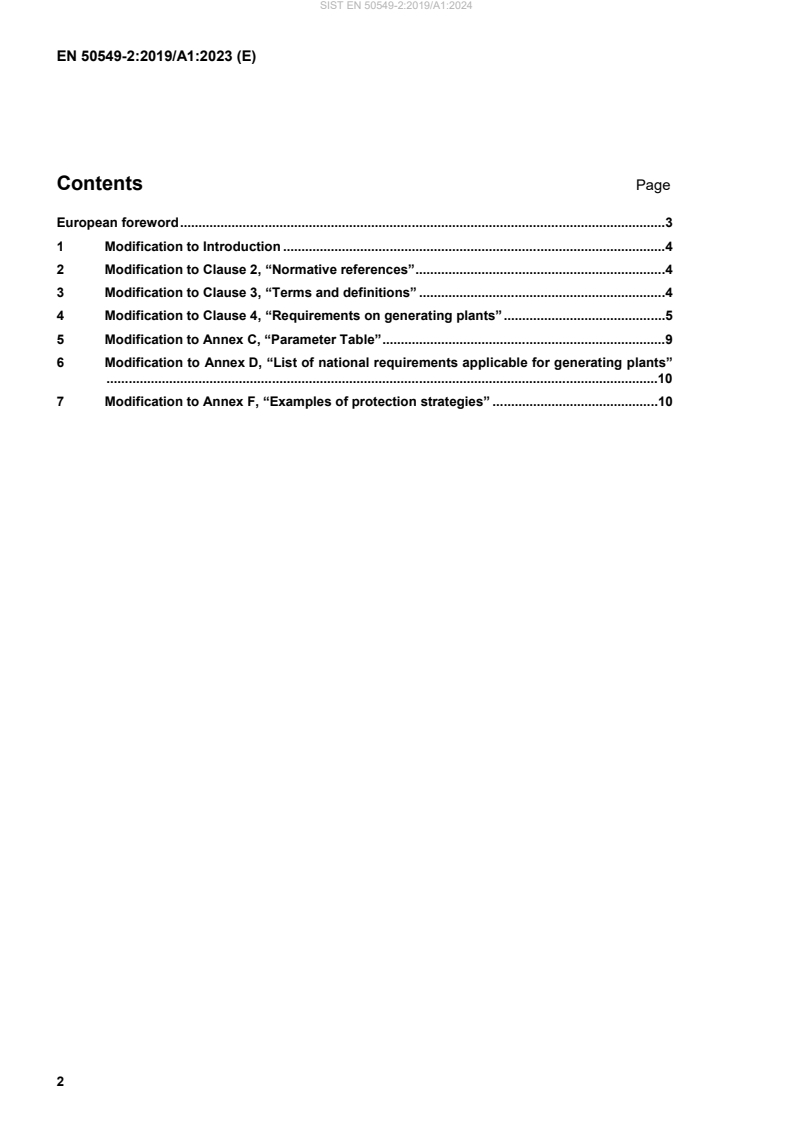
Contents Page
European foreword . 3
1 Modification to Introduction . 4
2 Modification to Clause 2, “Normative references” . 4
3 Modification to Clause 3, “Terms and definitions” . 4
4 Modification to Clause 4, “Requirements on generating plants” . 5
5 Modification to Annex C, “Parameter Table” . 9
6 Modification to Annex D, “List of national requirements applicable for generating plants”
......................................................................................................................................................10
7 Modification to Annex F, “Examples of protection strategies” .10
European foreword
This document EN 50549-2:2019/A1:2023 has been prepared by TC 8X “System aspects of electrical energy
supply”.
The following dates are fixed:
• latest date by which this document has to be (dop) 2024-09-21
implemented at national level by publication of
an identical national standard or by
endorsement
• latest date by which the national standards (dow) 2026-09-21
conflicting with this document have to be
withdrawn
This document amends EN 50549-2:2019.
This amendment includes the following significant technical changes:
— Introduction of a phase jump immunity requirement.
— Harmonizing the ROCOF immunity requirement for synchronous and non-synchronous generating
technology.
— Modifying FRT for type A from recommendation to requirement.
— Providing additional detail for EESS in case of overfrequency.
Attention is drawn to the possibility that some of the elements of this document may be the subject of patent
rights. CENELEC shall not be held responsible for identifying any or all such patent rights.
Any feedback and questions on this document should be directed to the users’ national committee. A complete
listing of these bodies can be found on the CENELEC website.
1 Modification to Introduction
Replace item 8. with the following:
“8. Implementation of UVRT and LFSM-U to avoid legal conflict with RfG
Under Voltage Ride Through (UVRT) requirements are defined in RfG for modules type B, type C and type D.
There is no mentioning of this topic for type A modules.
Nevertheless, UVRT is seen as an important requirement in some member states even for small generation
modules like type A.
NOTE At the time of writing, LVRT requirements for type A modules have been implemented in the following countries:
Austria, Czech Republic, Germany, Portugal (for PGM of 15 kW and higher), Switzerland.
From a legal point of view there are two contradicting opinions on whether it is allowed or forbidden to require
UVRT for type A modules.
— Opinion 1: It can be required because the topic is not dealt with for type A modules.
— Option 2: It cannot be required because the topic UVRT is dealt within the RfG. Not mentioning UVRT for
type A in RfG therefore means that it cannot be required for type A modules.
TC8X WG03 adopts the view of ACER as expressed in “ACER Monitoring of the Implementation of the Grid
Connection Network Codes” 11 November 2021 Item 3.3.4 #D where it states the German UVRT requirement
for Type A as compliant with NC RfG.
This same explanation can be applied to the requirements regarding Limited Frequency Sensitive Mode -
Underfrequency (LFSM-U). In RfG, this LFSM-U is solely defined for type C and type D modules. In EN 50549,
LFSM-U is defined as a recommendation (should) for generating modules of type A and type B. The sole
exception is electrical energy storage systems having a requirement (shall). These systems are currently not
within the scope of the RfG.”
2 Modification to Clause 2, “Normative references”
Add the following reference:
EN 50549-10, Requirements for generating plants to be connected in parallel with distribution networks -
Part 10: Tests for conformity assessment of generating units
Delete the reference EN 60255-127.
3 Modification to Clause 3, “Terms and definitions”
Add the following note to entry to 3.2.9:
“
Note 3 to entry: Electric vehicle charging stations intended to feed power back to the grid are considered an EESS while
a vehicle is connected.”
Add the following note to entry to 3.2.10:
“
Note 2 to entry: Electric vehicle charging stations intended to feed power back to the grid are considered an EES while a
vehicle is connected.”
Add the following term entries:
“
3.4.9
phase
instantaneous phase
ϑ
argument of the cosine function in the representation of a sinusoidal quantity
Note 1 to entry: The term “instantaneous phase” is only used when the independent variable is time.
ˆ
Note 2 to entry: For the quantity a(t) = Atcos ω +ϑ , the phase is ωt+ϑ .
( )
0 0
[SOURCE: IEV 103-07-04]
3.4.10
instantaneous frequency
first derivative of instantaneous phase
3.4.11
rate of change of frequency
ROCOF
first derivative of instantaneous frequency or second derivative of instantaneous phase
3.4.12
phase jump
abrupt change in the phase of the voltage of an AC electrical network
“
4 Modification to Clause 4, “Requirements on generating plants”
4.1 Modifcation to subclause 4.1, “General”
Add the following at the end of the subclause:
“EN 50549-10 provides technical guidance for tests on generating units and interface protection to evaluate
their electrical characteristics. EN 50549-10 shall be applied to evaluate the characteristics of generating units
and interface protection used in generating plants relating to the requirements of this Standard.
Electrical characteristics may alternatively be evaluated according to standards other than EN 50549-10, if the
following prerequisites are fulfilled:
— The alternative verification procedure covers all required technical aspects and characteristic quantities
stipulated in EN 50549-1 and EN 50549-2, respectively.
— The alternative verification procedure shall not be less stringent or technically less demanding than the
correspondent verification procedure in EN 50549-10.
— The alternative verification procedure leads to results of at least equivalent confidence level as
EN 50549-10.
— The equivalent or higher confidence level of the alternative verification procedure shall be confirmed by the
entity stating compliance based upon these tests
— The entity stating compliance based upon these tests shall have sufficient expertise in both EN 50549-10
and the applied standard.
NOTE This also applies for a partial application of another standard only for specific functions or operational
capabilities.”
4.2 Modification to subclause 4.5, “Immunity to disturbances”
4.2.1 Modification to subclause 4.5.1, “General”
Add the following at the end of the subclause:
“The described immunity requirements are independent of the interface protection settings. Disconnection
settings of the interface protection relay always overrule technical capabilities. So, whether the generating plant
will stay connected or not will also depend upon those settings.”
4.2.2 Modification to subclause 4.5.2, “Rate of change of frequency (ROCOF) immunity”
Replace the content of the subclause with the following:
“ROCOF immunity of a power generating plant means that the generating modules in this plant stay connected
with the distribution network and are able to operate when the frequency on the distribution network changes
with a specified ROCOF. The generating units and all elements in the generating plant that might cause their
disconnection or impact their behaviour shall have the same level of immunity.
The generating modules in a generating plant shall have ROCOF immunity to ROCOF equal or exceeding the
value specified by the responsible party. If no ROCOF immunity value is specified, at least 2 Hz/s shall apply.
The ROCOF immunity is defined with a sliding measurement window of 500 ms.
NOTE 1 For control action based on frequency measurement shorter measurement periods are expected to be
necessary.
NOTE 2 For small isolated distribution networks (typically on islands) higher ROCOF immunity values might be required.”
4.2.3 Modification to subclause 4.5.3, “Under-voltage ride through (UVRT)”
4.2.3.1 Modification to subclause 4.5.3.1, “General”
Replace the content of the subclause with the following:
“Generating modules shall comply with the requirements of 4.5.3.2 and 4.5.3.3.
Exempted from this requirement are small generating units below 50 kW of the following generation
technologies: CHP, fuel cell, rotating machinery, hydro.
NOTE 1 The power threshold of this exemption is expected to be reduced in future or the exception might be deleted
completely especially once the installed capacity becomes relevant for the grid stability.
The requirements apply to all kinds of faults (1ph, 2ph and 3ph).
NOTE 2 A more distinctive differentiation for 1ph, 2ph and 3ph faults is under consideration.
NOTE 3 The FRT curves in Figure 6, Figure 7 and Figure 8 describe the minimum requirements for continued connection
of the generating plant to the grid. They are not designed for parameterising the interface protection.”
4.2.4 Modification to subclause 4.5.4, “Over-voltage ride through (OVRT)”
Replace the content of the subclause with the following:
“Generating modules shall be capable of staying connected to the distribution network as long as the volt
...