EN IEC 62368-1:2020/A11:2020
(Amendment)Audio/video, information and communication technology equipment - Part 1: Safety requirements
Audio/video, information and communication technology equipment - Part 1: Safety requirements
2021-10-25: temporary removed link GPSD until feedback from EC
2019-10-01: BT decision D163/015.: decouple from OJEU citation process
2019-09-02 NEXT STEP: BT consultation on 1 Oct. 2019
2019-09-02: doc for BT meeting 1 Oct asking to decouple + no HAS assessment needed
2019-08-06 text for FV submitted, asking to decouple from OJEU
2019-05-24 TC 108X+CCMC+EC+HAS Cons comments resolution meeting
2019-03-15 - GEM - issues with ENQ text for PR= 67625 - way forward proposed to TC (incl. WS with EC)
2019-03-01 GEM: HAS assessment challenged
2018-11-09 - GEM - project is extremely important and urgent for industry. The standard needs to be 'harmonized', it is imperative to get to a positive assessment prior to launching ENQ. --> See GEM before starting any action
2018-07-09 - GEM - Common modifications to prEN 62368-1 (PR = 67625)..
Synchronyze enquiry with enquiry for adoption of IEC 62368-1 Ed.3 (PR=67625).
HAS Consultant assessment of main + amdt required - assessment to b
Einrichtungen für Audio/Video-, Informations- und Kommunikationstechnik - Teil 1: Sicherheitsanforderungen
Equipements des technologies de l'audio/vidéo, de l'information et de la communication - Partie 1 : Exigences de sécurité.
Oprema za avdio/video, informacijsko in komunikacijsko tehnologijo - 1. del: Varnostne zahteve
General Information
- Status
- Published
- Publication Date
- 05-Mar-2020
- Withdrawal Date
- 05-Jan-2023
- Current Stage
- 6060 - Document made available - Publishing
- Start Date
- 06-Mar-2020
- Completion Date
- 06-Mar-2020
Relations
- Effective Date
- 26-Jul-2021
- Effective Date
- 03-Jul-2018
Overview
EN IEC 62368-1:2020/A11:2020 is a CENELEC amendment to the safety standard for audio/video, information and communication technology equipment (AV/ICT). Published as an amendment to EN IEC 62368-1:2020, A11 updates definitions and adds specific safeguards against acoustic energy sources - in particular requirements for personal music players (PMPs), earphones and headphones - to protect users from hearing damage. The amendment was approved by CENELEC (CLC/TC 108X) in 2020 with national implementation dates set by CENELEC.
Key topics and technical requirements
- Definitions and metrics: introduces and clarifies sound-exposure terms such as momentary exposure level (MEL), sound exposure (E), sound exposure level (SEL), calculated sound dose (CSD) and digital level (dBFS). Measurements are A-weighted where specified.
- Safeguards against acoustic energy sources (Clause 10.6):
- Classification of acoustic sources into RS1, RS2, RS3 with legacy and new limits to reduce false warnings.
- New RS1 limits: package configurations ≤ 80 dB(A), or ≤ 15 mV (analogue) / -30 dBFS (digital) for standardized connectors.
- New RS2 limits: weekly sound exposure (per EN 50332-3) ≤ 80 dB or equivalent voltage/digital level limits (15 mV / -30 dBFS).
- RS3 denotes sources exceeding RS2.
- Dose-based systems:
- Devices using dose estimation per EN 50332-3 must warn at 100% CSD and at every subsequent 100% increase; if the user does not acknowledge the warning the output must reduce to RS1 compliance.
- Manufacturers may offer configurable notification settings but must allow administrative locking (e.g., parental controls).
- Exposure-based limiter (EL):
- EL must limit short-term exposure to 100 dB(A) or 150 mV integrated over the past 180 s; EL settling time ≤ 10 s.
- Measurement and testing: all volume controls set to maximum; test methods referenced to EN 50332-1 / EN 50332-2 / EN 50332-3.
- Other notes: references to non‑ionizing radiation guidance (ICNIRP) and applicability of toy limits (EN 71-1) for devices intended for children.
Practical applications and users
Who uses this standard:
- Product designers and firmware engineers implementing dose management, exposure limiters and user-warning flows.
- Compliance engineers and test laboratories performing CE/EN safety testing for AV/ICT equipment.
- Manufacturers of personal music players, smartphones, headphones and earphones to ensure market access and user safety.
- Regulatory and certification bodies assessing conformity and harmonization against European safety requirements.
Practical uses:
- Defining factory audio output limits and connector specifications.
- Implementing user interface warnings, acknowledgement flows and administrative locks.
- Designing test procedures and reporting for product safety files.
Related standards
- EN 50332-1, EN 50332-2, EN 50332-3 (sound level and dose measurement methods)
- EN 71-1 (toys - limits for products for children)
- EN 50360, EN 50566 (RF exposure for hand‑held/body‑mounted devices)
- ICNIRP guidelines; Commission Decision of 23 June 2009
Keywords: EN IEC 62368-1:2020/A11:2020, audio/video equipment safety, personal music player standards, hearing protection, acoustic energy safeguards, dose-based warning, exposure-based limiter.
Frequently Asked Questions
EN IEC 62368-1:2020/A11:2020 is a amendment published by CLC. Its full title is "Audio/video, information and communication technology equipment - Part 1: Safety requirements". This standard covers: 2021-10-25: temporary removed link GPSD until feedback from EC 2019-10-01: BT decision D163/015.: decouple from OJEU citation process 2019-09-02 NEXT STEP: BT consultation on 1 Oct. 2019 2019-09-02: doc for BT meeting 1 Oct asking to decouple + no HAS assessment needed 2019-08-06 text for FV submitted, asking to decouple from OJEU 2019-05-24 TC 108X+CCMC+EC+HAS Cons comments resolution meeting 2019-03-15 - GEM - issues with ENQ text for PR= 67625 - way forward proposed to TC (incl. WS with EC) 2019-03-01 GEM: HAS assessment challenged 2018-11-09 - GEM - project is extremely important and urgent for industry. The standard needs to be 'harmonized', it is imperative to get to a positive assessment prior to launching ENQ. --> See GEM before starting any action 2018-07-09 - GEM - Common modifications to prEN 62368-1 (PR = 67625).. Synchronyze enquiry with enquiry for adoption of IEC 62368-1 Ed.3 (PR=67625). HAS Consultant assessment of main + amdt required - assessment to b
2021-10-25: temporary removed link GPSD until feedback from EC 2019-10-01: BT decision D163/015.: decouple from OJEU citation process 2019-09-02 NEXT STEP: BT consultation on 1 Oct. 2019 2019-09-02: doc for BT meeting 1 Oct asking to decouple + no HAS assessment needed 2019-08-06 text for FV submitted, asking to decouple from OJEU 2019-05-24 TC 108X+CCMC+EC+HAS Cons comments resolution meeting 2019-03-15 - GEM - issues with ENQ text for PR= 67625 - way forward proposed to TC (incl. WS with EC) 2019-03-01 GEM: HAS assessment challenged 2018-11-09 - GEM - project is extremely important and urgent for industry. The standard needs to be 'harmonized', it is imperative to get to a positive assessment prior to launching ENQ. --> See GEM before starting any action 2018-07-09 - GEM - Common modifications to prEN 62368-1 (PR = 67625).. Synchronyze enquiry with enquiry for adoption of IEC 62368-1 Ed.3 (PR=67625). HAS Consultant assessment of main + amdt required - assessment to b
EN IEC 62368-1:2020/A11:2020 is classified under the following ICS (International Classification for Standards) categories: 33.160.01 - Audio, video and audiovisual systems in general; 35.020 - Information technology (IT) in general. The ICS classification helps identify the subject area and facilitates finding related standards.
EN IEC 62368-1:2020/A11:2020 has the following relationships with other standards: It is inter standard links to EN IEC 62368-1:2024, EN IEC 62368-1:2020. Understanding these relationships helps ensure you are using the most current and applicable version of the standard.
EN IEC 62368-1:2020/A11:2020 is associated with the following European legislation: EU Directives/Regulations: 2001/95/EC, 2014/35/EU, 2014/53/EU; Standardization Mandates: M/452, M/511, M/536. When a standard is cited in the Official Journal of the European Union, products manufactured in conformity with it benefit from a presumption of conformity with the essential requirements of the corresponding EU directive or regulation.
You can purchase EN IEC 62368-1:2020/A11:2020 directly from iTeh Standards. The document is available in PDF format and is delivered instantly after payment. Add the standard to your cart and complete the secure checkout process. iTeh Standards is an authorized distributor of CLC standards.
Standards Content (Sample)
SLOVENSKI STANDARD
SIST EN IEC 62368-1:2019/A11:2020
01-julij-2020
Oprema za avdio/video, informacijsko in komunikacijsko tehnologijo - 1. del:
Varnostne zahteve
Audio/video, information and communication technology equipment - Part 1: Safety
requirements
Einrichtungen für Audio/Video-, Informations- und Kommunikationstechnik - Teil 1:
Sicherheitsanforderungen
Equipements des technologies de l'audio/vidéo, de l'information et de la communication -
Partie 1 : Exigences de sécurité.
Ta slovenski standard je istoveten z: EN IEC 62368-1:2020/A11:2020
ICS:
33.160.01 Avdio, video in avdiovizualni Audio, video and audiovisual
sistemi na splošno systems in general
35.020 Informacijska tehnika in Information technology (IT) in
tehnologija na splošno general
SIST EN IEC 62368-1:2019/A11:2020 en,fr,de
2003-01.Slovenski inštitut za standardizacijo. Razmnoževanje celote ali delov tega standarda ni dovoljeno.
SIST EN IEC 62368-1:2019/A11:2020
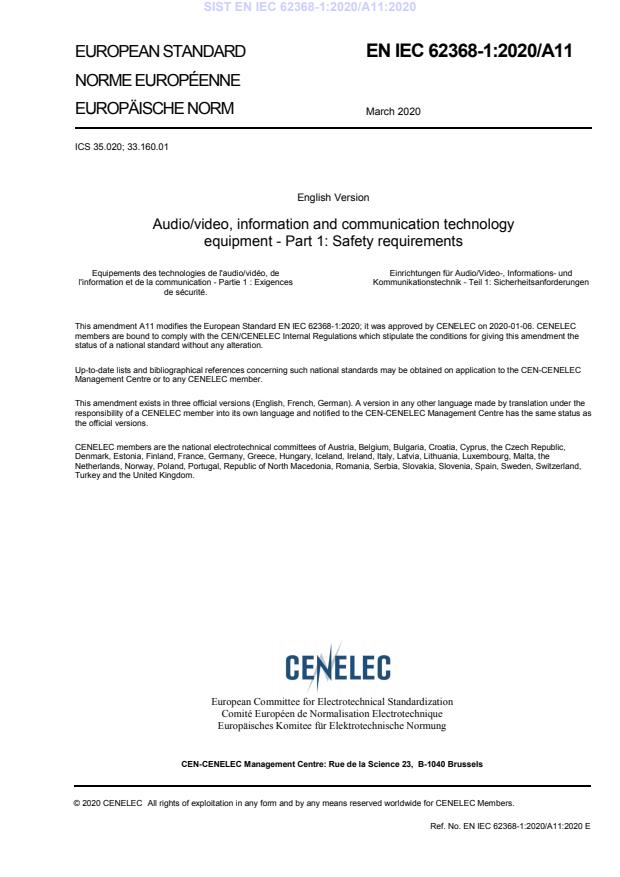
EUROPEAN STANDARD EN IEC 62368-1:2020/A11
NORME EUROPÉENNE
EUROPÄISCHE NORM
March 2020
ICS 35.020; 33.160.01
English Version
Audio/video, information and communication technology
equipment - Part 1: Safety requirements
Equipements des technologies de l'audio/vidéo, de Einrichtungen für Audio/Video-, Informations- und
l'information et de la communication - Partie 1 : Exigences Kommunikationstechnik - Teil 1: Sicherheitsanforderungen
de sécurité.
This amendment A11 modifies the European Standard EN IEC 62368-1:2020; it was approved by CENELEC on 2020-01-06. CENELEC
members are bound to comply with the CEN/CENELEC Internal Regulations which stipulate the conditions for giving this amendment the
status of a national standard without any alteration.
Up-to-date lists and bibliographical references concerning such national standards may be obtained on application to the CEN-CENELEC
Management Centre or to any CENELEC member.
This amendment exists in three official versions (English, French, German). A version in any other language made by translation under the
responsibility of a CENELEC member into its own language and notified to the CEN-CENELEC Management Centre has the same status as
the official versions.
CENELEC members are the national electrotechnical committees of Austria, Belgium, Bulgaria, Croatia, Cyprus, the Czech Republic,
Denmark, Estonia, Finland, France, Germany, Greece, Hungary, Iceland, Ireland, Italy, Latvia, Lithuania, Luxembourg, Malta, the
Netherlands, Norway, Poland, Portugal, Republic of North Macedonia, Romania, Serbia, Slovakia, Slovenia, Spain, Sweden, Switzerland,
Turkey and the United Kingdom.
European Committee for Electrotechnical Standardization
Comité Européen de Normalisation Electrotechnique
Europäisches Komitee für Elektrotechnische Normung
CEN-CENELEC Management Centre: Rue de la Science 23, B-1040 Brussels
© 2020 CENELEC All rights of exploitation in any form and by any means reserved worldwide for CENELEC Members.
Ref. No. EN IEC 62368-1:2020/A11:2020 E
SIST EN IEC 62368-1:2019/A11:2020
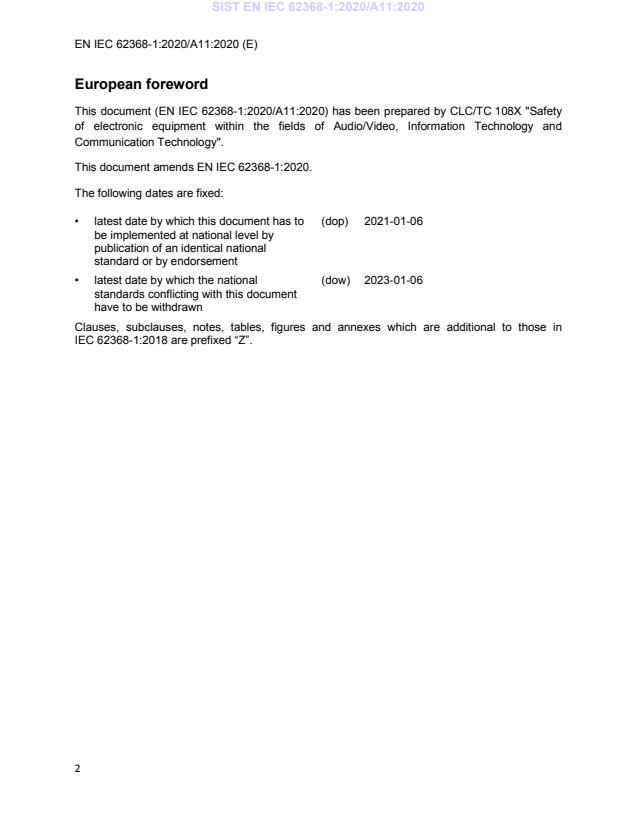
European foreword
This document (EN IEC 62368-1:2020/A11:2020) has been prepared by CLC/TC 108X "Safety
of electronic equipment within the fields of Audio/Video, Information Technology and
Communication Technology".
This document amends EN IEC 62368-1:2020.
The following dates are fixed:
• latest date by which this document has to (dop) 2021-01-06
be implemented at national level by
publication of an identical national
standard or by endorsement
• latest date by which the national (dow) 2023-01-06
standards conflicting with this document
have to be withdrawn
Clauses, subclauses, notes, tables, figures and annexes which are additional to those in
IEC 62368-1:2018 are prefixed “Z”.
SIST EN IEC 62368-1:2019/A11:2020
1 Modification to Clause 3
Replace 3.3.19 of IEC 62368-1 with the following definitions:
3.3.19 Sound exposure
3.3.19.1
momentary exposure level, MEL
metric for estimating 1 s sound exposure level from the HD 483-1 S2 test signal applied to both
channels, based on EN 50332-1:2013, 4.2.
Note 1 to entry: MEL is measured as A-weighted levels in dB.
Note 2 to entry: See B.3 of EN 50332-3:2017 for additional information.
3.3.19.2
calculated sound dose, CSD
one week rolling estimate of sound exposure expressed in percent of the maximum regarded as
safe
Note 1 to entry: See B.4 of EN 50332-3:2017 for additional information.
3.3.19.3
sound exposure, E
A-weighted sound pressure (p) squared and integrated over a stated period of time, T
Note 1 to entry: The SI unit is Pa s.
3.3.19.4
sound exposure level, SEL
, typically the 1 kHz
logarithmic measure of sound exposure relative to a reference value, E0
threshold of hearing in humans.
Note 1 to entry: SEL is measured as A-weighted levels in dB.
dB
Note 2 to entry: See B.4 of EN 50332-3:2017 for additional information.
3.3.19.5
digital signal level relative to full scale, dBFS
levels reported in dBFS are always r.m.s. full scale levels; 0 dBFS, is the level of a dc-free
997 Hz sine wave whose undithered positive peak value is positive digital full scale, leaving the
code corresponding to negative digital full scale unused
Note 1 to entry: It is invalid to use dBFS for non-r.m.s. levels. Because the definition of full scale is based on a sine
wave, the level of signals with a crest factor lower than that of a sine wave may exceed 0 dBFS. In particular, square-
wave signals may reach +3,01 dBFS.
SIST EN IEC 62368-1:2019/A11:2020
2 Modification to Clause 10
Replace 10.6 of IEC 62368-1 with the following:
10.6 Safeguards against acoustic energy sources
10.6.1 General
10.6.1.1 Introduction
Safeguard requirements for protection against long-term exposure to excessive sound pressure
levels from personal music players closely coupled to the ear are specified below. Requirements
for earphones and headphones intended for use with personal music players are also covered.
A personal music player is a portable equipment intended for use by an ordinary person, that:
– is designed to allow the user to listen to audio or audiovisual content / material; and
– uses a listening device, such as headphones or earphones that can be worn in or on or
around the ears; and
– has a player that can be body worn (of a size suitable to be carried in a clothing pocket) and
is intended for the user to walk around with while in continuous use (for example, on a street,
in a subway, at an airport, etc.).
EXAMPLES Portable CD players, MP3 audio players, mobile phones with MP3 type features, PDAs or similar
equipment.
Personal music players shall comply with the requirements of either 10.6.2 or 10.6.3.
NOTE 1 Protection against acoustic energy sources from telecom applications is referenced to ITU-T P.360.
NOTE 2 It is the intention of the Committee to allow the alternative methods for now, but to only use the dose
measurement method as given in 10.6.5 in future. Therefore, manufacturers are encouraged to implement 10.6.5 as
soon as possible.
Listening devices sold separately shall comply with the requirements of 10.6.6.
These requirements are valid for music or video mode only.
The requirements do not apply to:
– professional equipment;
NOTE 3 Professional equipment is equipment sold through special sales channels. All products sold through
normal electronics stores are considered not to be professional equipment.
– hearing aid equipment and other devices for assistive listening;
– the following type of analogue personal music players:
• long distance radio receiver (for example, a multiband radio receiver or world band radio
receiver, an AM radio receiver), and
• cassette player/recorder;
NOTE 4 This exemption has been allowed because this technology is falling out of use and it is expected that
within a few years it will no longer exist. This exemption will not be extended to other technologies.
– a player while connected to an external amplifier that does not allow the user to walk around
while in use.
For equipment that is clearly designed or intended primarily for use by children, the limits of the
relevant toy standards may apply.
The relevant requirements are given in EN 71-1:2011, 4.20 and the related tests methods and
measurement distances apply.
SIST EN IEC 62368-1:2019/A11:2020
10.6.1.2 Non-ionizing radiation from radio frequencies in the range 0 to 300 GHz
The amount of non-ionizing radiation is regulated by European Council Recommendation 1999/519/EC of
12 July 1999 on the limitation of exposure of the general public to electromagnetic fields (0 Hz to 300
GHz).
For intentional radiators, ICNIRP guidelines should be taken into account for Limiting Exposure to Time-
Varying Electric, Magnetic, and Electromagnetic Fields (up to 300 GHz). For hand-held and body-
mounted devices, attention is drawn to EN 50360 and EN 50566.
10.6.2 Classification of devices without the capacity to estimate sound dose
10.6.2.1 General
This standard is transitioning from short-term based (30 s) requirements to long-term based
(40 h) requirements. These clauses remain in effect only for devices that do not comply with
sound dose estimation as stipulated in EN 50332-3.
For classifying the acoustic output L , , measurements are based on the A-weighted equivalent
T
Aeq
sound pressure level over a 30 s period.
For music where the average sound pressure (long term L , ) measured over the duration of
T
Aeq
the song is lower than the average produced by the programme simulation noise, measurements
may be done over the duration of the complete song. In this case, T becomes the duration of the
song.
NOTE Classical music, acoustic music and broadcast typically has an average sound pressure (long term L , )
T
Aeq
which is much lower than the average programme simulation noise. Therefore, if the player is capable to analyse the
content and compare it with the programme simulation noise, the warning does not need to be given as long as the
average sound pressure of the song does not exceed the required limit.
For example, if the player is set with the programme simulation noise to 85 dB, but the average music level of the song
is only 65 dB, there is no need to give a warning or ask an acknowledgement as long as the average sound level of the
song is not above the basic limit of 85 dB.
10.6.2.2 RS1 limits (to be superseded, see 10.6.3.2)
RS1 is a class 1 acoustic energy source that does not exceed the following:
– for equipment provided as a package (player with its listening device), and with a proprietary
connector between the player and its listening device, or where the combination of player and
listening device is known by other means such as setting or automatic detection, the L ,
T
Aeq
acoustic output shall be ≤ 85 dB when playing the fixed “programme simulation noise”
described in EN 50332-1.
– for equipment provided with a standardized connector (for example, a 3,5 phone jack) that
allows connection to a listening device for general use, the unweighted r.m.s. output voltage
shall be ≤ 27 mV (analogue interface) or -25 dBFS (digital interface) when playing the fixed
“programme simulation noise” described in EN 50332-1.
– The RS1 limits will be updated for all devices as per 10.6.3.2.
10.6.2.3 RS2 limits (to be superseded, see 10.6.3.3)
RS2 is a class 2 acoustic energy source that does not exceed the following:
– for equipment provided as a package (player with its listening device), and with a proprietary
connector between the player and its listening device, or when the combination of player and
SIST EN IEC 62368-1:2019/A11:2020
listening device is known by other means such as setting or automatic detection, the L ,
T
Aeq
acoustic output shall be ≤ 100 dB(A) when playing the fixed “programme simulation noise” as
described in EN 50332-1.
– for equipment provided with a standardized connector (for example, a 3,5 phone jack) that
allows connection to a listening device for general use, the unweighted r.m.s. output voltage
shall be ≤ 150 mV (analogue interface) or -10 dBFS (digital interface) when playing the fixed
“programme simulation noise” as described in EN 50332-1.
10.6.2.4 RS3 limits
RS3 is a class 3 acoustic energy source that exceeds RS2 limits.
10.6.3 Classification of devices (new)
10.6.3.1 General
Previous limits (10.6.2) created abundant false negative and false positive PMP sound level
warnings. New limits, compliant with The Commission Decision of 23 June 2009, are given
below.
10.6.3.2 RS1 limits (new)
RS1 is a class 1 acoustic energy source that does not exceed the following:
– for equipment provided as a package (player with its listening device), and with a proprietary
connector between the player and its listening device, or where the combination of player and
listening device is known by other means such as setting or automatic detection, the L ,
T
Aeq
acoustic output shall be ≤ 80 dB when playing the fixed “programme simulation noise”
described in EN 50332-1.
– for equipment provided with a standardized connector (for example, a 3,5 phone jack) that
allows connection to a listening device for general use, the unweighted r.m.s. output voltage
shall be ≤ 15 mV (analogue interface) or -30 dBFS (digital interface) when playing the fixed
“programme simulation noise” described in EN 50332-1.
10.6.3.3 RS2 limits (new)
RS2 is a class 2 acoustic energy source that does not exceed the following:
– for equipment provided as a package (player with its listening device), and with a proprietary
connector between the player and its listening device, or where the combination of player and
listening device is known by other means such as setting or automatic detection, the weekly
sound exposure level, as described in EN 50332-3, shall be ≤ 80 dB when playing the fixed
"programme simulation noise" described in EN 50332-1.
– for equipment provided with a standardized connector (for example, a 3,5 phone jack) that
allows connection to a listening device for general use, the unweighted r.m.s. output level,
integrated over one week, as described in EN 50332-3, shall be ≤ 15 mV (analogue interface)
or -30 dBFS (digital interface) when playing the fixed “programme simulation noise” described
in EN 50332-1.
10.6.4 Requirements for maximum sound exposure
10.6.4.1 Measurement methods
All volume controls shall be turned to maximum during tests.
Measurements shall be made in accordance with EN 50332-1 or EN 50332-2 as applicable.
SIST EN IEC 62368-1:2019/A11:2020
10.6.4.2 Protection of persons
Except as given below, protection requirements for parts accessible to ordinary persons,
instructed persons and skilled persons are given in 4.3.
NOTE 1 Volume control is not considered a safeguard.
Between RS2 and an ordinary person, the basic safeguard may be replaced by an
instructional safeguard in accordance with Clause F.5, except that the instructional
safeguard shall be placed on the equipment, or on the packaging, or in the instruction manual.
Alternatively, the instructional safeguard may be given through the equipment display during
use.
The elements of the instructional safeguard shall be as follows:
– element 1a: the symbol , IEC 60417-6044 (2011-01)
– element 2: “High sound pressure” or equivalent wording
– element 3: “Hearing damage risk” or equivalent wording
– element 4: “Do not listen at high volume levels for long periods.” or equivalent wording
An equipment safeguard shall prevent exposure of an ordinary person to an RS2 source
without intentional physical action from the ordinary person and shall automatically return to an
output level not exceeding what is specified for an RS1 source when the power is switched off.
The equipment shall provide a means to actively inform the user of the increased sound level
when the equipment is operated with an output exceeding RS1. Any means used shall be
acknowledged by the user before activating a mode of operation which allows for an output
exceeding RS1. The acknowledgement does not need to be repeated more than once every 20 h
of cumulative listening time.
NOTE 2 Examples of means include visual or audible signals. Action from the user is always needed.
NOTE 3 The 20 h listening time is the accumulative listening time, independent of how often and how long the
personal music player has been switched off.
A skilled person shall not be unintentionally exposed to RS3.
10.6.5 Requirements for dose-based systems
10.6.5.1 General requirements
Personal music players shall give the warnings as provided below when tested according to
EN 50332-3, using the limits from this clause.
The manufacturer may offer optional settings to allow the users to modify when and how they
wish to receive the notifications and warnings to promote a better user experience without
defeating the safeguards. This allows the users to be informed in a method that best meets their
physical capabilities and device usage needs. If such optional settings are offered, an
administrator (for example, parental restrictions, business/educational administrators, etc.) shall
be able to lock any optional settings into a specific configuration.
The personal music player shall be supplied with easy to understand explanation to the user of
the dose management system, the risks involved, and how to use the system safely. The user
shall be made aware that other sources may significantly contribute to their sound exposure, for
example work, transportation, concerts, clubs, cinema, car races, etc.
SIST EN IEC 62368-1:2019/A11:2020
10.6.5.2 Dose-based warning and requirements
When a dose of 100 % CSD is reached, and at least at every 100 % further increase of CSD, the
device shall warn the user and require an acknowledgement. In case the user does not
acknowledge, the output level shall automatically decrease to compliance with class RS1.
The warning shall at least clearly indicate that listening above 100 % CSD leads to the risk of
hearing damage or loss.
10.6.5.3 Exposure-based requirements
With only dose-based requirements, cause and effect could be far separated in time, defying the
purpose of educating users about safe listening practice. In addition to dose-based requirements,
a PMP shall therefore also put a limit to the short-term sound level a user can listen at.
The exposure-based limiter (EL) shall automatically reduce the sound level not to exceed
100 dB(A) or 150 mV integrated over the past 180 s, based on methodology defined in EN
50332-3. The EL settling time (time from starting level reduction to reaching target output) shall
be 10 s or faster.
Test of EL functionality is conducted according to EN 50332-3, using the limits from this clause.
For equipment provided as a package (player with its listening device), the level integrated over
180 s shall be 100 dB or lower. For equipment provided with a standardized connector, the un-
weighted level integrated over 180 s shall be no more than 150 mV for an analogue interface and
no more than -10 dBFS for a digital interface.
NOTE In case the source is known not to be music (or test signal), the EL may be disabled.
10.6.6 Requirements for listening devices (headphones, earphones, etc.)
10.6.6.1 Corded listening devices with analogue input
With 94 dB L acoustic pressure output of the listening device, and with the volume and sound
Aeq
settings in the listening device (for example, built-in volume level control, additional sound
features like equalization, etc.) set to the combination of positions that maximize the measured
acoustic output, the input voltage of the listening device when playing the fixed “programme
simulation noise” as described in EN 50332-1 shall be ≥ 75 mV.
NOTE The values of 94 dB and 75 mV correspond with 85 dB and 27 mV or 100 dB and 150 mV.
10.6.6.2 Corded listening devices with digital input
With any playing device playing the fixed “programme simulation noise” described in
EN 50332-1, and with the volume and sound settings in the listening device (for example, built-in
volume level control, additional sound features like equalization, etc.) set to the combination of
positions that maximize the measured acoustic output, the L , acoustic output of the listening
T
Aeq
device shall be ≤ 100 dB with an input signal of -10 dBFS.
SIST EN IEC 62368-1:2019/A11:2020
10.6.6.3 Cordless listening devices
In cordless mode,
– with any playing and transmitting device playing the fixed programme simulation noise
described in EN
...
SLOVENSKI STANDARD
01-julij-2020
Oprema za avdio/video, informacijsko in komunikacijsko tehnologijo - 1. del:
Varnostne zahteve
Audio/video, information and communication technology equipment - Part 1: Safety
requirements
Einrichtungen für Audio/Video-, Informations- und Kommunikationstechnik - Teil 1:
Sicherheitsanforderungen
Equipements des technologies de l'audio/vidéo, de l'information et de la communication -
Partie 1 : Exigences de sécurité.
Ta slovenski standard je istoveten z: EN IEC 62368-1:2020/A11:2020
ICS:
33.160.01 Avdio, video in avdiovizualni Audio, video and audiovisual
sistemi na splošno systems in general
35.020 Informacijska tehnika in Information technology (IT) in
tehnologija na splošno general
2003-01.Slovenski inštitut za standardizacijo. Razmnoževanje celote ali delov tega standarda ni dovoljeno.
EUROPEAN STANDARD EN IEC 62368-1:2020/A11
NORME EUROPÉENNE
EUROPÄISCHE NORM
March 2020
ICS 35.020; 33.160.01
English Version
Audio/video, information and communication technology
equipment - Part 1: Safety requirements
Equipements des technologies de l'audio/vidéo, de Einrichtungen für Audio/Video-, Informations- und
l'information et de la communication - Partie 1 : Exigences Kommunikationstechnik - Teil 1: Sicherheitsanforderungen
de sécurité.
This amendment A11 modifies the European Standard EN IEC 62368-1:2020; it was approved by CENELEC on 2020-01-06. CENELEC
members are bound to comply with the CEN/CENELEC Internal Regulations which stipulate the conditions for giving this amendment the
status of a national standard without any alteration.
Up-to-date lists and bibliographical references concerning such national standards may be obtained on application to the CEN-CENELEC
Management Centre or to any CENELEC member.
This amendment exists in three official versions (English, French, German). A version in any other language made by translation under the
responsibility of a CENELEC member into its own language and notified to the CEN-CENELEC Management Centre has the same status as
the official versions.
CENELEC members are the national electrotechnical committees of Austria, Belgium, Bulgaria, Croatia, Cyprus, the Czech Republic,
Denmark, Estonia, Finland, France, Germany, Greece, Hungary, Iceland, Ireland, Italy, Latvia, Lithuania, Luxembourg, Malta, the
Netherlands, Norway, Poland, Portugal, Republic of North Macedonia, Romania, Serbia, Slovakia, Slovenia, Spain, Sweden, Switzerland,
Turkey and the United Kingdom.
European Committee for Electrotechnical Standardization
Comité Européen de Normalisation Electrotechnique
Europäisches Komitee für Elektrotechnische Normung
CEN-CENELEC Management Centre: Rue de la Science 23, B-1040 Brussels
© 2020 CENELEC All rights of exploitation in any form and by any means reserved worldwide for CENELEC Members.
Ref. No. EN IEC 62368-1:2020/A11:2020 E
European foreword
This document (EN IEC 62368-1:2020/A11:2020) has been prepared by CLC/TC 108X "Safety
of electronic equipment within the fields of Audio/Video, Information Technology and
Communication Technology".
This document amends EN IEC 62368-1:2020.
The following dates are fixed:
• latest date by which this document has to (dop) 2021-01-06
be implemented at national level by
publication of an identical national
standard or by endorsement
• latest date by which the national (dow) 2023-01-06
standards conflicting with this document
have to be withdrawn
Clauses, subclauses, notes, tables, figures and annexes which are additional to those in
IEC 62368-1:2018 are prefixed “Z”.
1 Modification to Clause 3
Replace 3.3.19 of IEC 62368-1 with the following definitions:
3.3.19 Sound exposure
3.3.19.1
momentary exposure level, MEL
metric for estimating 1 s sound exposure level from the HD 483-1 S2 test signal applied to both
channels, based on EN 50332-1:2013, 4.2.
Note 1 to entry: MEL is measured as A-weighted levels in dB.
Note 2 to entry: See B.3 of EN 50332-3:2017 for additional information.
3.3.19.2
calculated sound dose, CSD
one week rolling estimate of sound exposure expressed in percent of the maximum regarded as
safe
Note 1 to entry: See B.4 of EN 50332-3:2017 for additional information.
3.3.19.3
sound exposure, E
A-weighted sound pressure (p) squared and integrated over a stated period of time, T
Note 1 to entry: The SI unit is Pa s.
3.3.19.4
sound exposure level, SEL
, typically the 1 kHz
logarithmic measure of sound exposure relative to a reference value, E0
threshold of hearing in humans.
Note 1 to entry: SEL is measured as A-weighted levels in dB.
dB
Note 2 to entry: See B.4 of EN 50332-3:2017 for additional information.
3.3.19.5
digital signal level relative to full scale, dBFS
levels reported in dBFS are always r.m.s. full scale levels; 0 dBFS, is the level of a dc-free
997 Hz sine wave whose undithered positive peak value is positive digital full scale, leaving the
code corresponding to negative digital full scale unused
Note 1 to entry: It is invalid to use dBFS for non-r.m.s. levels. Because the definition of full scale is based on a sine
wave, the level of signals with a crest factor lower than that of a sine wave may exceed 0 dBFS. In particular, square-
wave signals may reach +3,01 dBFS.
2 Modification to Clause 10
Replace 10.6 of IEC 62368-1 with the following:
10.6 Safeguards against acoustic energy sources
10.6.1 General
10.6.1.1 Introduction
Safeguard requirements for protection against long-term exposure to excessive sound pressure
levels from personal music players closely coupled to the ear are specified below. Requirements
for earphones and headphones intended for use with personal music players are also covered.
A personal music player is a portable equipment intended for use by an ordinary person, that:
– is designed to allow the user to listen to audio or audiovisual content / material; and
– uses a listening device, such as headphones or earphones that can be worn in or on or
around the ears; and
– has a player that can be body worn (of a size suitable to be carried in a clothing pocket) and
is intended for the user to walk around with while in continuous use (for example, on a street,
in a subway, at an airport, etc.).
EXAMPLES Portable CD players, MP3 audio players, mobile phones with MP3 type features, PDAs or similar
equipment.
Personal music players shall comply with the requirements of either 10.6.2 or 10.6.3.
NOTE 1 Protection against acoustic energy sources from telecom applications is referenced to ITU-T P.360.
NOTE 2 It is the intention of the Committee to allow the alternative methods for now, but to only use the dose
measurement method as given in 10.6.5 in future. Therefore, manufacturers are encouraged to implement 10.6.5 as
soon as possible.
Listening devices sold separately shall comply with the requirements of 10.6.6.
These requirements are valid for music or video mode only.
The requirements do not apply to:
– professional equipment;
NOTE 3 Professional equipment is equipment sold through special sales channels. All products sold through
normal electronics stores are considered not to be professional equipment.
– hearing aid equipment and other devices for assistive listening;
– the following type of analogue personal music players:
• long distance radio receiver (for example, a multiband radio receiver or world band radio
receiver, an AM radio receiver), and
• cassette player/recorder;
NOTE 4 This exemption has been allowed because this technology is falling out of use and it is expected that
within a few years it will no longer exist. This exemption will not be extended to other technologies.
– a player while connected to an external amplifier that does not allow the user to walk around
while in use.
For equipment that is clearly designed or intended primarily for use by children, the limits of the
relevant toy standards may apply.
The relevant requirements are given in EN 71-1:2011, 4.20 and the related tests methods and
measurement distances apply.
10.6.1.2 Non-ionizing radiation from radio frequencies in the range 0 to 300 GHz
The amount of non-ionizing radiation is regulated by European Council Recommendation 1999/519/EC of
12 July 1999 on the limitation of exposure of the general public to electromagnetic fields (0 Hz to 300
GHz).
For intentional radiators, ICNIRP guidelines should be taken into account for Limiting Exposure to Time-
Varying Electric, Magnetic, and Electromagnetic Fields (up to 300 GHz). For hand-held and body-
mounted devices, attention is drawn to EN 50360 and EN 50566.
10.6.2 Classification of devices without the capacity to estimate sound dose
10.6.2.1 General
This standard is transitioning from short-term based (30 s) requirements to long-term based
(40 h) requirements. These clauses remain in effect only for devices that do not comply with
sound dose estimation as stipulated in EN 50332-3.
For classifying the acoustic output L , , measurements are based on the A-weighted equivalent
T
Aeq
sound pressure level over a 30 s period.
For music where the average sound pressure (long term L , ) measured over the duration of
T
Aeq
the song is lower than the average produced by the programme simulation noise, measurements
may be done over the duration of the complete song. In this case, T becomes the duration of the
song.
NOTE Classical music, acoustic music and broadcast typically has an average sound pressure (long term L , )
T
Aeq
which is much lower than the average programme simulation noise. Therefore, if the player is capable to analyse the
content and compare it with the programme simulation noise, the warning does not need to be given as long as the
average sound pressure of the song does not exceed the required limit.
For example, if the player is set with the programme simulation noise to 85 dB, but the average music level of the song
is only 65 dB, there is no need to give a warning or ask an acknowledgement as long as the average sound level of the
song is not above the basic limit of 85 dB.
10.6.2.2 RS1 limits (to be superseded, see 10.6.3.2)
RS1 is a class 1 acoustic energy source that does not exceed the following:
– for equipment provided as a package (player with its listening device), and with a proprietary
connector between the player and its listening device, or where the combination of player and
listening device is known by other means such as setting or automatic detection, the L ,
T
Aeq
acoustic output shall be ≤ 85 dB when playing the fixed “programme simulation noise”
described in EN 50332-1.
– for equipment provided with a standardized connector (for example, a 3,5 phone jack) that
allows connection to a listening device for general use, the unweighted r.m.s. output voltage
shall be ≤ 27 mV (analogue interface) or -25 dBFS (digital interface) when playing the fixed
“programme simulation noise” described in EN 50332-1.
– The RS1 limits will be updated for all devices as per 10.6.3.2.
10.6.2.3 RS2 limits (to be superseded, see 10.6.3.3)
RS2 is a class 2 acoustic energy source that does not exceed the following:
– for equipment provided as a package (player with its listening device), and with a proprietary
connector between the player and its listening device, or when the combination of player and
listening device is known by other means such as setting or automatic detection, the L ,
T
Aeq
acoustic output shall be ≤ 100 dB(A) when playing the fixed “programme simulation noise” as
described in EN 50332-1.
– for equipment provided with a standardized connector (for example, a 3,5 phone jack) that
allows connection to a listening device for general use, the unweighted r.m.s. output voltage
shall be ≤ 150 mV (analogue interface) or -10 dBFS (digital interface) when playing the fixed
“programme simulation noise” as described in EN 50332-1.
10.6.2.4 RS3 limits
RS3 is a class 3 acoustic energy source that exceeds RS2 limits.
10.6.3 Classification of devices (new)
10.6.3.1 General
Previous limits (10.6.2) created abundant false negative and false positive PMP sound level
warnings. New limits, compliant with The Commission Decision of 23 June 2009, are given
below.
10.6.3.2 RS1 limits (new)
RS1 is a class 1 acoustic energy source that does not exceed the following:
– for equipment provided as a package (player with its listening device), and with a proprietary
connector between the player and its listening device, or where the combination of player and
listening device is known by other means such as setting or automatic detection, the L ,
T
Aeq
acoustic output shall be ≤ 80 dB when playing the fixed “programme simulation noise”
described in EN 50332-1.
– for equipment provided with a standardized connector (for example, a 3,5 phone jack) that
allows connection to a listening device for general use, the unweighted r.m.s. output voltage
shall be ≤ 15 mV (analogue interface) or -30 dBFS (digital interface) when playing the fixed
“programme simulation noise” described in EN 50332-1.
10.6.3.3 RS2 limits (new)
RS2 is a class 2 acoustic energy source that does not exceed the following:
– for equipment provided as a package (player with its listening device), and with a proprietary
connector between the player and its listening device, or where the combination of player and
listening device is known by other means such as setting or automatic detection, the weekly
sound exposure level, as described in EN 50332-3, shall be ≤ 80 dB when playing the fixed
"programme simulation noise" described in EN 50332-1.
– for equipment provided with a standardized connector (for example, a 3,5 phone jack) that
allows connection to a listening device for general use, the unweighted r.m.s. output level,
integrated over one week, as described in EN 50332-3, shall be ≤ 15 mV (analogue interface)
or -30 dBFS (digital interface) when playing the fixed “programme simulation noise” described
in EN 50332-1.
10.6.4 Requirements for maximum sound exposure
10.6.4.1 Measurement methods
All volume controls shall be turned to maximum during tests.
Measurements shall be made in accordance with EN 50332-1 or EN 50332-2 as applicable.
10.6.4.2 Protection of persons
Except as given below, protection requirements for parts accessible to ordinary persons,
instructed persons and skilled persons are given in 4.3.
NOTE 1 Volume control is not considered a safeguard.
Between RS2 and an ordinary person, the basic safeguard may be replaced by an
instructional safeguard in accordance with Clause F.5, except that the instructional
safeguard shall be placed on the equipment, or on the packaging, or in the instruction manual.
Alternatively, the instructional safeguard may be given through the equipment display during
use.
The elements of the instructional safeguard shall be as follows:
– element 1a: the symbol , IEC 60417-6044 (2011-01)
– element 2: “High sound pressure” or equivalent wording
– element 3: “Hearing damage risk” or equivalent wording
– element 4: “Do not listen at high volume levels for long periods.” or equivalent wording
An equipment safeguard shall prevent exposure of an ordinary person to an RS2 source
without intentional physical action from the ordinary person and shall automatically return to an
output level not exceeding what is specified for an RS1 source when the power is switched off.
The equipment shall provide a means to actively inform the user of the increased sound level
when the equipment is operated with an output exceeding RS1. Any means used shall be
acknowledged by the user before activating a mode of operation which allows for an output
exceeding RS1. The acknowledgement does not need to be repeated more than once every 20 h
of cumulative listening time.
NOTE 2 Examples of means include visual or audible signals. Action from the user is always needed.
NOTE 3 The 20 h listening time is the accumulative listening time, independent of how often and how long the
personal music player has been switched off.
A skilled person shall not be unintentionally exposed to RS3.
10.6.5 Requirements for dose-based systems
10.6.5.1 General requirements
Personal music players shall give the warnings as provided below when tested according to
EN 50332-3, using the limits from this clause.
The manufacturer may offer optional settings to allow the users to modify when and how they
wish to receive the notifications and warnings to promote a better user experience without
defeating the safeguards. This allows the users to be informed in a method that best meets their
physical capabilities and device usage needs. If such optional settings are offered, an
administrator (for example, parental restrictions, business/educational administrators, etc.) shall
be able to lock any optional settings into a specific configuration.
The personal music player shall be supplied with easy to understand explanation to the user of
the dose management system, the risks involved, and how to use the system safely. The user
shall be made aware that other sources may significantly contribute to their sound exposure, for
example work, transportation, concerts, clubs, cinema, car races, etc.
10.6.5.2 Dose-based warning and requirements
When a dose of 100 % CSD is reached, and at least at every 100 % further increase of CSD, the
device shall warn the user and require an acknowledgement. In case the user does not
acknowledge, the output level shall automatically decrease to compliance with class RS1.
The warning shall at least clearly indicate that listening above 100 % CSD leads to the risk of
hearing damage or loss.
10.6.5.3 Exposure-based requirements
With only dose-based requirements, cause and effect could be far separated in time, defying the
purpose of educating users about safe listening practice. In addition to dose-based requirements,
a PMP shall therefore also put a limit to the short-term sound level a user can listen at.
The exposure-based limiter (EL) shall automatically reduce the sound level not to exceed
100 dB(A) or 150 mV integrated over the past 180 s, based on methodology defined in EN
50332-3. The EL settling time (time from starting level reduction to reaching target output) shall
be 10 s or faster.
Test of EL functionality is conducted according to EN 50332-3, using the limits from this clause.
For equipment provided as a package (player with its listening device), the level integrated over
180 s shall be 100 dB or lower. For equipment provided with a standardized connector, the un-
weighted level integrated over 180 s shall be no more than 150 mV for an analogue interface and
no more than -10 dBFS for a digital interface.
NOTE In case the source is known not to be music (or test signal), the EL may be disabled.
10.6.6 Requirements for listening devices (headphones, earphones, etc.)
10.6.6.1 Corded listening devices with analogue input
With 94 dB L acoustic pressure output of the listening device, and with the volume and sound
Aeq
settings in the listening device (for example, built-in volume level control, additional sound
features like equalization, etc.) set to the combination of positions that maximize the measured
acoustic output, the input voltage of the listening device when playing the fixed “programme
simulation noise” as described in EN 50332-1 shall be ≥ 75 mV.
NOTE The values of 94 dB and 75 mV correspond with 85 dB and 27 mV or 100 dB and 150 mV.
10.6.6.2 Corded listening devices with digital input
With any playing device playing the fixed “programme simulation noise” described in
EN 50332-1, and with the volume and sound settings in the listening device (for example, built-in
volume level control, additional sound features like equalization, etc.) set to the combination of
positions that maximize the measured acoustic output, the L , acoustic output of the listening
T
Aeq
device shall be ≤ 100 dB with an input signal of -10 dBFS.
10.6.6.3 Cordless listening devices
In cordless mode,
– with any playing and transmitting device playing the fixed programme simulation noise
described in EN
...
기사 제목: EN IEC 62368-1:2020/A11:2020 - 오디오/비디오, 정보 및 통신 기술 장비 - 파트 1: 안전 요구 사항 기사 내용: 2021-10-25: EC의 피드백을 받을 때까지 GPSD 링크 일시적으로 제거 2019-10-01: OJEU 인용 과정에서 분리 결정 2019-09-02 다음 단계: 2019년 10월 1일 BT 상담 2019-09-02: 2019년 10월 1일 BT 회의를 위해 분리 요청 + HAS 평가가 필요하지 않음 2019-08-06 FV 텍스트 제출, OJEU에서 분리 요청 2019-05-24 TC 108X + CCMC + EC + HAS 용어 해석 논의 회의 2019-03-15 - GEM - PR= 67625의 ENQ 텍스트 문제 - TC(포함 EC와의 워크샵)에게 제안된 방향 2019-03-01 GEM: HAS 평가에 이의 제기 2018-11-09 - GEM - 산업에 매우 중요하고 긴급한 프로젝트이다. 표준을 '조화'시켜야 하며, ENQ를 시작하기 전에 긍정적인 평가를 받는 것이 필수적이다. --> GEM을 참조하고 어떠한 조치도 취하기 전에 확인 2018-07-09 - GEM - prEN 62368-1 (PR = 67625)에 대한 공통 수정 사항.. IEC 62368-1 Ed.3 (PR=67625) 승인을 위한 조사와 동기화된 조사를 진행한다. 주요 및 수정이 필요한 HAS 컨설턴트 평가 - 평가를 위해 해당 기사는 EN IEC 62368-1:2020/A11:2020 표준과 관련된 여러 날짜와 조치에 대해 언급하고 있다. 이 표준은 오디오/비디오, 정보 및 통신 기술 장비의 안전 요구 사항을 다루고 있다. 일부 조치에는 EC(유럽 위원회)의 피드백을 받을 때까지 GPSD(일반 제품 안전 지침) 링크를 일시적으로 제거하는 내용, BT(브리티시 통신)의 OJEU(정식 유럽연합 공문) 인용 과정에서의 분리 결정, 2019년 10월 1일 BT의 상담, 표준 분리 및 HAS(위험 평가 사양) 평가의 필요성 없음을 요청하는 내용, 분리를 위해 FV 텍스트 제출, TC 108X, CCMC, EC 및 HAS가 참여하는 의견 해결 회의 등이 포함되어 있다. GEM(독일, 오스트리아, 스위스 기술위원회)에 의해 HAS 평가에 도전하는 내용과 산업에 대한 중요성과 긴급성, 조화화의 필요성이 강조되고 있다. 표준에 대한 공통 수정 사항에 대해서도 언급되어 있다.
記事のタイトル:EN IEC 62368-1:2020/A11:2020 - オーディオ/ビデオ、情報および通信技術機器 - パート1:安全要件 記事の内容:2021年10月25日:ECからのフィードバックがあるまで、一時的にGPSDリンクを削除 2019年10月1日:OJEU引用プロセスから分離することを決定したBTの決定D163/015。 2019年9月2日:BTのコンサルテーションが10月1日に開始された 2019年9月2日:10月1日のBT会議向けに分離要求とHAS評価不要を含む文書が提出された。 2019年8月6日:OJEUからの分離を要求する最終投票(FV)段階のテキストが提出された。 2019年5月24日:TC 108X、CCMC、EC、HASのコメント解決会議が開催された。 2019年3月15日:ENQテキストに関する問題が提起され、TC(ECとの作業セッションを含む)への進展案が提案された。 2019年3月1日:HAS評価に異議が唱えられた。 2018年11月9日:このプロジェクトは業界にとって非常に重要で緊急であり、ENQを開始する前に肯定的な評価を得ることが重要であると強調された。 2018年7月9日:prEN 62368-1(PR = 67625)に関する共通の修正が言及され、IEC 62368-1 Ed.3の採用に関する問い合わせと同期させる。 全体として、この記事はEN IEC 62368-1:2020/A11:2020標準に関連するさまざまな日付とアクションについて述べています。主なポイントは次のとおりです: - 2021年10月25日、欧州委員会(EC)からのフィードバックがあるまで、Global Product Safety Database(GPSD)へのリンクが一時的に削除されました。 - 2019年10月1日、BTの決定D163/015に基づいて、この規格を欧州連合公報(OJEU)への引用プロセスから分離することが決定されました。 - 2019年9月2日にBTによるコンサルテーションが開始され、2019年10月1日のBT会議用に分離要求が含まれた文書が提出されました。また、Hazardous Accessible Surface(HAS)の評価は不要とされました。 - 2019年8月6日には、OJEUからの分離を要求するためのテキストが最終投票(FV)段階で提出されました。 - 2019年には、さまざまな会議やコンサルテーションが行われ、規格に関する問題やコメントの解決が行われました。 - 2019年3月には、PR(プロジェクトリクエスト)67625に関連するENQのテキストに問題があり、TCへの進展案が提案されました(ECとの作業セッションを含む)。 - 2019年3月1日には、HAS評価に異議が唱えられました。 - 2018年11月には、このプロジェクトが業界にとって重要で緊急であることが強調され、ENQを開始する前に肯定的な評価を得ることが重要であるとされました。 - 2018年7月には、prEN 62368-1(PR = 67625)に関する共通の修正が言及され、IEC 62368-1 Ed.3の採用に関連して調査が行われました。 全体的に、この記事はEN IEC 62368-1:2020/A11:2020標準に関するタイムラインと最新情報を提供しています。
The article discusses various dates and actions related to the EN IEC 62368-1:2020/A11:2020 standard for audio/video, information, and communication technology equipment. Some key points include: - On October 25, 2021, a link to the Global Product Safety Database (GPSD) was temporarily removed until feedback from the European Commission (EC) is received. - On October 1, 2019, a decision was made to decouple the standard from the Official Journal of the European Union (OJEU) citation process, based on BT's (British Telecommunications) decision D163/015. - On September 2, 2019, a consultation by BT was initiated, and a document was submitted for a BT meeting on October 1, 2019, requesting decoupling and indicating that no Hazardous Accessible Surface (HAS) assessment is needed. - On August 6, 2019, a text was submitted for the Final Vote (FV) stage, requesting decoupling from the OJEU. - Various meetings and consultations took place in 2019 to address issues and resolve comments related to the standard, including a meeting with TC 108X, CCMC, EC, and HAS. - In March 2019, there were issues with the ENQ (Enquiry) text for PR (Project Request) 67625, and a way forward was proposed to the Technical Committee (TC), including a working session with the EC. - On March 1, 2019, a challenge was raised regarding the HAS assessment. - In November 2018, it was emphasized that the project is important and urgent for the industry, and a positive assessment prior to launching the ENQ was deemed imperative. - In July 2018, common modifications to prEN 62368-1 (PR = 67625) were mentioned, along with the synchronization of the inquiry for the adoption of IEC 62368-1 Ed.3 with the PR. Overall, the article provides a timeline and updates regarding the EN IEC 62368-1:2020/A11:2020 standard.
記事のタイトル:EN IEC 62368-1:2020/A11:2020 - オーディオ/ビデオ、情報および通信技術機器-パート1:安全要件 記事の内容:2021-10-25:ECからのフィードバックを受けるまで、GPSDのリンクは一時的に削除されました 2019-10-01:BTの決定D163/015によるOJEU引用プロセスからの分離 2019-09-02:10月1日のBT協議会に関するBTの意見収集 2019-09-02:BTミーティング用の文書、分離要求およびHAS評価不要 2019-08-06:OJEUからの分離を目指して提出されたFV文書 2019-05-24:TC 108X + CCMC + EC + HASの意見解決会議 2019-03-15:PR = 67625のENQテキストの問題についてのGEMの提案 2019-03-01:GEM:HAS評価に異議あり 2018-11-09:GEM:このプロジェクトは業界にとって非常に重要で緊急です。標準を「調和させる」ためには、ENQを開始する前に肯定的な評価を得ることが必要です。--> どんな行動を起こす前にGEMを確認してください 2018-07-09:GEM:prEN 62368-1(PR = 67625)の共通の修正.. IEC 62368-1 Ed.3(PR = 67625)の採択に関する調査問い合わせと同期させる。主要および修正に関するHASコンサルタントの評価が必要です-評価の確認 この記事は、オーディオ/ビデオ、情報、通信技術機器の安全要件であるEN IEC 62368-1:2020/A11:2020に関連するさまざまな日付と決定について説明しています。ECからのフィードバックを受けるまでGPSDのリンクが一時的に削除されたこと、OJEU引用プロセスからの分離を目指したBTの決定、BTの意見収集、分離要求およびHAS評価不要のリクエストについて言及されています。記事には会議、意見の解決、HAS評価への挑戦の日付も含まれています。業界にとってのプロジェクトの重要性と緊急性、調和の必要性が強調されています。
기사 제목: EN IEC 62368-1:2020/A11:2020 - 오디오/비디오, 정보 및 통신 기술 장비 - 제1부: 안전 요구 사항 기사 내용: 2021-10-25: EC로부터의 피드백을 받을 때까지 GPSD 링크 일시적으로 제거 2019-10-01: OJEU 인용 프로세스에서 분리하기 위한 BT 결정 D163/015. 2019-09-02: BT 의견 수렴을 위한 10월 1일 BT 협의회에 대한 자문 2019-09-02: BT 회의를 위한 문서, 분리 요청 및 HAS 평가 필요 없음 2019-08-06: OJEU와 분리하기 위해 FV 문서 제출 2019-05-24: TC 108X+CCMC+EC+HAS의 의견 조율 회의 2019-03-15: PR=67625를 위한 ENQ 텍스트의 문제에 대한 GEM의 제안 2019-03-01: GEM: HAS 평가에 대한 이의 제기 2018-11-09: GEM: 프로젝트는 산업에 매우 중요하고 긴급하다. 표준을 '조화되게' 만드는 것이 필수적이며, ENQ를 시작하기 전에 긍정적인 평가를 받아야 한다. --> 어떠한 조치도 취하기 전에 GEM 확인 2018-07-09: GEM: prEN 62368-1(PR=67625)의 공통 수정사항.. IEC 62368-1 Ed.3(PR=67625)의 채택을 위한 조사 문의와 동조화하기. 주요 및 수정사항에 대한 HAS 컨설턴트 평가가 필요하다 - 평가에 대해 확인 이 기사는 오디오/비디오, 정보 및 통신 기술 장비에 대한 안전 요구 사항인 EN IEC 62368-1:2020/A11:2020에 대한 다양한 날짜와 결정에 대해 다루고 있습니다. EC로부터의 피드백을 받을 때까지 GPSD 링크가 임시로 제거되었으며, OJEU 인용 프로세스에서 분리하기 위한 BT의 결정, BT의 의견 수렴을 위한 BT 협의회, 분리 요청 및 HAS 평가 필요 없음에 대해 언급하고 있습니다. 이 기사에는 회의, 의견 조율, HAS 평가에 대한 도전 사항의 날짜도 포함되어 있습니다. 산업에 대한 프로젝트의 중요성과 긴급성, 조화화의 필요성도 강조되고 있습니다.
기사 제목: EN IEC 62368-1:2020/A11:2020 - 오디오/비디오, 정보 및 통신 기술 장비 - 파트 1: 안전 요구 사항 기사 내용: 2021-10-25: EC의 피드백을 받기 전까지 GPSD 링크 일시적으로 제거 2019-10-01: OJEU 인용 과정과 분리하기로 결정 2019-09-02 다음 단계: 2019년 10월 1일 BT 컨설테이션 2019-09-02: BT 회의용 10월 1일 자료 제출, 분리 요청 및 HAS 평가 불필요 2019-08-06 최종 투표용 텍스트 제출, OJEU 분리 요청 2019-05-24 TC 108X+CCMC+EC+HAS 의견 해결 회의 2019-03-15 - GEM - PR= 67625에 대한 ENQ 텍스트에 문제점 제기, TC와 EC를 포함한 방향 제안 2019-03-01 GEM: HAS 평가 도전 2018-11-09 - GEM - 산업에 매우 중요하고 급한 프로젝트. 표준은 '조화'되어야 하며, ENQ 시작 전에 긍정적인 평가를 받아야 함. --> 모든 조치를 취하기 전에 GEM 확인 2018-07-09 - GEM - 공통 수정 사항을 포함한 prEN 62368-1 (PR = 67625).. IEC 62368-1 Ed.3 (PR=67625) 채택을 위한 문의 조사와 동기화. HAS 컨설턴트의 주요 및 수정이 필요한 평가 - 평가 필요
The article discusses various dates and decisions related to EN IEC 62368-1:2020/A11:2020, a safety requirements standard for audio/video, information, and communication technology equipment. It mentions the temporary removal of a link and the need for feedback from EC. It also discusses a BT decision to decouple from the OJEU citation process, a BT consultation, and the request to decouple and no HAS assessment needed. The article includes dates of meetings, comments resolution, and challenges to the HAS assessment. It emphasizes the importance and urgency of the project for the industry and the need for harmonization.
The article mentions various dates and actions related to the EN IEC 62368-1:2020/A11:2020, which is a standard for audio/video, information, and communication technology equipment safety requirements. Some of the actions include temporary removal of a link related to the GPSD (General Product Safety Directive) until feedback from EC (European Commission), a BT (British Telecommunications) decision to decouple the standard from the OJEU (Official Journal of the European Union) citation process, a consultation by BT on October 1, 2019, a request to decouple the standard and not require a HAS (Hazard Assessment Specification) assessment, the submission of text for FV (First Vote) asking for decoupling, a comments resolution meeting involving TC (Technical Committee) 108X, CCMC (Cenelec Central Secretariat Management Committee), EC, and HAS, and challenges to the HAS assessment by GEM (Germany, Austria, Switzerland Technical Committee). GEM emphasizes the importance and urgency of the project for the industry and the need for harmonization. There are also mentions of common modifications to the standard.
記事のタイトル:EN IEC 62368-1:2020/A11:2020 - オーディオ/ビデオ、情報および通信技術機器 - Part 1: 安全要件 記事の内容:2021-10-25: ECからのフィードバックがあるまで、一時的にGPSDリンクを削除 2019-10-01:OJEU引用プロセスからの分離をBTの決定D163/015 2019-09-02:関連するBT協議は2019年10月1日に実施 2019-09-02:BTの会議のための文書での分離要求とHASの評価不要 2019-08-06:FVテキストの提出、OJEUからの分離要求 2019-05-24:TC 108X + CCMC + EC + HASのコメント解決会議 2019-03-15:GEM - PR = 67625のENQテキストの問題 - TC(ECとの作業会を含む)に提案された方向性 2019-03-01:GEM:HASの評価に異議あり 2018-11-09:GEM - 産業にとって非常に重要で緊急なプロジェクト。標準を「調和」させるために、ENQを開始する前に肯定的な評価を得ることが必要です。 」-- ご確認のため、何のアクションも起こす前にGEMを参照してください 2018-07-09:GEM - prEN 62368-1(PR = 67625)への共通の修正.. IEC 62368-1 Ed.3(PR = 67625)の採用のための調査と、同期して行う調査。主要なおよび改訂が必要なHASコンサルタントの評価–評価のために。 この記事では、EN IEC 62368-1:2020/A11:2020の規格に関連するさまざまな日付と行動が言及されています。これは、オーディオ/ビデオ、情報、および通信技術機器の安全要件に関する規格です。一部の行動には、EC(欧州委員会)からのフィードバックを受けるまで、GPSD(一般的な製品安全指令)へのリンクが一時的に削除される、BT(ブリティッシュテレコム)のOJEU(欧州連合公式官報)引用プロセスからの分離の決定、2019年10月1日のBTの協議、規格の分離要求およびHAS(ハザードアセスメント仕様)評価の不要性に関する要求、分離を求めるFVテキストの提出、TC 108X、CCMC、EC、およびHASに関わるコメントの解決会議などが含まれます。また、GEM(Germany, Austria, Switzerland Technical Committee)によるHAS評価への挑戦や産業への重要性と緊急性、調和化の必要性が強調されています。また、標準に関する共通の修正にも言及されています。


Questions, Comments and Discussion
Ask us and Technical Secretary will try to provide an answer. You can facilitate discussion about the standard in here.
Loading comments...