

prEN 50562-1:2025
(Main)Fixed installations for railway applications - Safety of electric traction power supply systems - Part 1: Generic approach for conventional applications, functions and properties
General Information
- Abstract
This document defines the process, protective measures and demonstration of safety in accordance with EN 50126-1:2017 and EN 50126 2:2017 for AC and DC electric traction power supply systems for railways. This document can also be applied to urban rail and trolleybus systems. All these systems can be elevated, at-grade and underground. This document has two parts: — prEN 50562 1:2025 establishes the code of practice for conventional applications, functions and properties in electric traction power supply systems. — prEN 50562 2:2025 supports the implementation of non-conventional applications, functions and properties in electric traction power supply systems. This document applies to electric traction power supply systems, which are new or are undergoing major changes as defined in the legal framework. For similar technology and similar hazardous scenarios, the safety considerations can be used as a guideline. This document does not apply to: — underground mine traction systems, — cranes, transportable platforms and similar transportation equipment on rails, temporary structures (e.g. exhibition structures) in so far as these are not supplied directly or via transformers from the contact line system and are not endangered by the traction power supply system, — suspended cable cars, — funicular railways, — magnetic levitated systems, This document does not consider aspects like IT-security or protection against any other malevolent acts. It is assumed that those aspects are handled on the overall system level. NOTE For railways IT-security is covered in CLC/TS 50701. Because of the short life cycles of IT security applications it is advisable to separate IT-security functions from safety functions at least on virtual levels. E.g. the frequent patch processes for updating the IT-security applications is expected to be independent from safety applications.
- Status
- Not Published
- Publication Date
- 15-Oct-2026
- Technical Committee
- CLC/TC 9X - Electrical and electronic applications for railways
- Current Stage
- 4060 - Enquiry results established and sent to TC, SR, BTTF - Enquiry
- Start Date
- 22-Aug-2025
- Due Date
- 07-May-2025
- Completion Date
- 22-Aug-2025

Overview
The prEN 50562-1:2025 is a European standard developed by CLC/SC 9XC focusing on the safety of electric traction power supply systems used in fixed installations for railway applications. This standard provides a generic approach for conventional applications, integrating safety processes, protective measures, and demonstration of safety in line with EN 50126-1:2017 and EN 50126-2:2017.
The scope covers both AC and DC electric traction power supply systems across various railway types, including urban rail and trolleybus systems. Applicable to installations that are elevated, at-grade, or underground, this standard targets systems that are either newly built or undergoing major changes. It excludes systems such as underground mine traction, cranes or temporary rail structures, suspended cable cars, funicular railways, and magnetic levitated systems.
This document is part one of a two-part series:
- Part 1: Focuses on conventional applications, functions, and properties using a code of practice.
- Part 2: Supports non-conventional applications by applying distinct codes of practice and risk estimation.
Key Topics
Risk Assessment Process: Emphasizes system definition, identification of hazards related to conventional applications, and risk acceptance principles. Protective measures are tailored to the unique aspects of electric traction power supply systems to ensure safety for both people and the environment.
Generic Reference System: Defines the conventional electric traction power supply system including substations, switching stations, contact line systems, and extended return circuits. It covers equipment functions, control systems, and interfaces with rolling stock, signaling, communication systems, civil structures, and high voltage installations.
Protective Measures: Details safety controls at various system levels:
- Substations and switching stations protections
- Contact line system safeguards
- Extended return circuit protections
Safety Demonstration: Guides the demonstration of safety measures implemented for both conventional and non-conventional applications, complying fully with EN 50126-1:2017 and EN 50126-2:2017 lifecycle processes.
Exclusions & Limitations: Explicitly excludes IT-security and protection against malicious acts, which are managed through separate standards such as CLC/TS 50701. The standard recommends separation of IT-security functions from safety functions to ensure independent and reliable safety operations.
Applications
prEN 50562-1:2025 is critical for:
- Railway operators planning new or significantly upgrading existing electric traction power supply systems.
- Design and engineering teams requiring structured guidance on safety risk management and protective measures for conventional railway power installations.
- Safety managers and regulators ensuring compliance with European safety lifecycle standards EN 50126-1 and EN 50126-2.
- Urban rail and trolleybus systems adapting the standard’s generic approach to their traction power supply safety requirements.
- Projects involving elevated, at-grade, or underground electric traction power supply designs.
- Facilitating integration of safety practices with other railway subsystem interfaces including rolling stock, track, signaling, and communication systems.
Related Standards
This standard should be used in conjunction with:
- EN 50126-1:2017 - Railway applications - The specification and demonstration of reliability, availability, maintainability, and safety (RAMS).
- EN 50126-2:2017 - Focused on safety demonstration as part of the RAMS lifecycle.
- EN 50562:2018 - The previous version to be partially superseded by prEN 50562-1:2025.
- CLC/TS 50701 - Covers IT-security aspects relevant for railway systems.
- Product and application standards that relate to electrical traction equipment safety and performance.
Summary
prEN 50562-1:2025 delivers a harmonized, lifecycle-based framework for safety in electric traction power supply systems within railway infrastructure. It supports railway stakeholders in managing risks effectively by providing comprehensive guidelines for hazard identification, protective measures, and safety validation. Ideal for conventional electric traction systems, this standard enhances safety, reliability, and regulatory compliance across European rail transit networks.
Relations
- Effective Date
- 08-Dec-2020
Get Certified
Connect with accredited certification bodies for this standard

IMQ S.p.A. (Certification)
Italian electrical product certification.

SLG Prüf- und Zertifizierungs GmbH
German testing and certification body.

UL Solutions
Global safety science company with testing, inspection and certification.
Sponsored listings
Frequently Asked Questions
prEN 50562-1:2025 is a draft published by CLC. Its full title is "Fixed installations for railway applications - Safety of electric traction power supply systems - Part 1: Generic approach for conventional applications, functions and properties". This standard covers: This document defines the process, protective measures and demonstration of safety in accordance with EN 50126-1:2017 and EN 50126 2:2017 for AC and DC electric traction power supply systems for railways. This document can also be applied to urban rail and trolleybus systems. All these systems can be elevated, at-grade and underground. This document has two parts: — prEN 50562 1:2025 establishes the code of practice for conventional applications, functions and properties in electric traction power supply systems. — prEN 50562 2:2025 supports the implementation of non-conventional applications, functions and properties in electric traction power supply systems. This document applies to electric traction power supply systems, which are new or are undergoing major changes as defined in the legal framework. For similar technology and similar hazardous scenarios, the safety considerations can be used as a guideline. This document does not apply to: — underground mine traction systems, — cranes, transportable platforms and similar transportation equipment on rails, temporary structures (e.g. exhibition structures) in so far as these are not supplied directly or via transformers from the contact line system and are not endangered by the traction power supply system, — suspended cable cars, — funicular railways, — magnetic levitated systems, This document does not consider aspects like IT-security or protection against any other malevolent acts. It is assumed that those aspects are handled on the overall system level. NOTE For railways IT-security is covered in CLC/TS 50701. Because of the short life cycles of IT security applications it is advisable to separate IT-security functions from safety functions at least on virtual levels. E.g. the frequent patch processes for updating the IT-security applications is expected to be independent from safety applications.
This document defines the process, protective measures and demonstration of safety in accordance with EN 50126-1:2017 and EN 50126 2:2017 for AC and DC electric traction power supply systems for railways. This document can also be applied to urban rail and trolleybus systems. All these systems can be elevated, at-grade and underground. This document has two parts: — prEN 50562 1:2025 establishes the code of practice for conventional applications, functions and properties in electric traction power supply systems. — prEN 50562 2:2025 supports the implementation of non-conventional applications, functions and properties in electric traction power supply systems. This document applies to electric traction power supply systems, which are new or are undergoing major changes as defined in the legal framework. For similar technology and similar hazardous scenarios, the safety considerations can be used as a guideline. This document does not apply to: — underground mine traction systems, — cranes, transportable platforms and similar transportation equipment on rails, temporary structures (e.g. exhibition structures) in so far as these are not supplied directly or via transformers from the contact line system and are not endangered by the traction power supply system, — suspended cable cars, — funicular railways, — magnetic levitated systems, This document does not consider aspects like IT-security or protection against any other malevolent acts. It is assumed that those aspects are handled on the overall system level. NOTE For railways IT-security is covered in CLC/TS 50701. Because of the short life cycles of IT security applications it is advisable to separate IT-security functions from safety functions at least on virtual levels. E.g. the frequent patch processes for updating the IT-security applications is expected to be independent from safety applications.
prEN 50562-1:2025 is classified under the following ICS (International Classification for Standards) categories: 29.280 - Electric traction equipment. The ICS classification helps identify the subject area and facilitates finding related standards.
prEN 50562-1:2025 has the following relationships with other standards: It is inter standard links to EN 50562:2018. Understanding these relationships helps ensure you are using the most current and applicable version of the standard.
prEN 50562-1:2025 is associated with the following European legislation: EU Directives/Regulations: 2016/797/EU, 2016/797/EU, 2016/797/EU, 2016/797/EU, 2016/797/EU, 2016/797/EU, 2016/797/EU, 2016/797/EU, 2016/797/EU, 2016/797/EU, 2016/797/EU; Standardization Mandates: M/591. When a standard is cited in the Official Journal of the European Union, products manufactured in conformity with it benefit from a presumption of conformity with the essential requirements of the corresponding EU directive or regulation.
prEN 50562-1:2025 is available in PDF format for immediate download after purchase. The document can be added to your cart and obtained through the secure checkout process. Digital delivery ensures instant access to the complete standard document.
Standards Content (Sample)
SLOVENSKI STANDARD
01-julij-2025
Fiksni postroji za železniške naprave - Varnost napajalnih sistemov električne
vleke - 1. del: Splošni pristop za konvencionalne načine uporabe, funkcije in
lastnosti
Fixed installations for railway applications - Safety of electric traction power supply
systems - Part 1: Generic approach for conventional applications, functions and
properties
Ta slovenski standard je istoveten z: prEN 50562-1:2025
ICS:
29.280 Električna vlečna oprema Electric traction equipment
2003-01.Slovenski inštitut za standardizacijo. Razmnoževanje celote ali delov tega standarda ni dovoljeno.
EUROPEAN STANDARD DRAFT
prEN 50562-1
NORME EUROPÉENNE
EUROPÄISCHE NORM
May 2025
ICS 29.280 Will supersede EN 50562:2018 (PART)
English Version
Fixed installations for railway applications - Safety of electric
traction power supply systems - Part 1: Generic approach for
conventional applications, functions and properties
To be completed To be completed
This draft European Standard is submitted to CENELEC members for enquiry.
Deadline for CENELEC: 2025-08-22.
It has been drawn up by CLC/SC 9XC.
If this draft becomes a European Standard, CENELEC members are bound to comply with the CEN/CENELEC Internal Regulations which
stipulate the conditions for giving this European Standard the status of a national standard without any alteration.
This draft European Standard was established by CENELEC in three official versions (English, French, German).
A version in any other language made by translation under the responsibility of a CENELEC member into its own language and notified to
the CEN-CENELEC Management Centre has the same status as the official versions.
CENELEC members are the national electrotechnical committees of Austria, Belgium, Bulgaria, Croatia, Cyprus, the Czech Republic,
Denmark, Estonia, Finland, France, Germany, Greece, Hungary, Iceland, Ireland, Italy, Latvia, Lithuania, Luxembourg, Malta, the
Netherlands, Norway, Poland, Portugal, Republic of North Macedonia, Romania, Serbia, Slovakia, Slovenia, Spain, Sweden, Switzerland,
Türkiye and the United Kingdom.
Recipients of this draft are invited to submit, with their comments, notification of any relevant patent rights of which they are aware and to
provide supporting documentation.
Warning : This document is not a European Standard. It is distributed for review and comments. It is subject to change without notice and
shall not be referred to as a European Standard.
European Committee for Electrotechnical Standardization
Comité Européen de Normalisation Electrotechnique
Europäisches Komitee für Elektrotechnische Normung
CEN-CENELEC Management Centre: Rue de la Science 23, B-1040 Brussels
© 2025 CENELEC All rights of exploitation in any form and by any means reserved worldwide for CENELEC Members.
Project: 73167 Ref. No. prEN 50562-1:2025 E
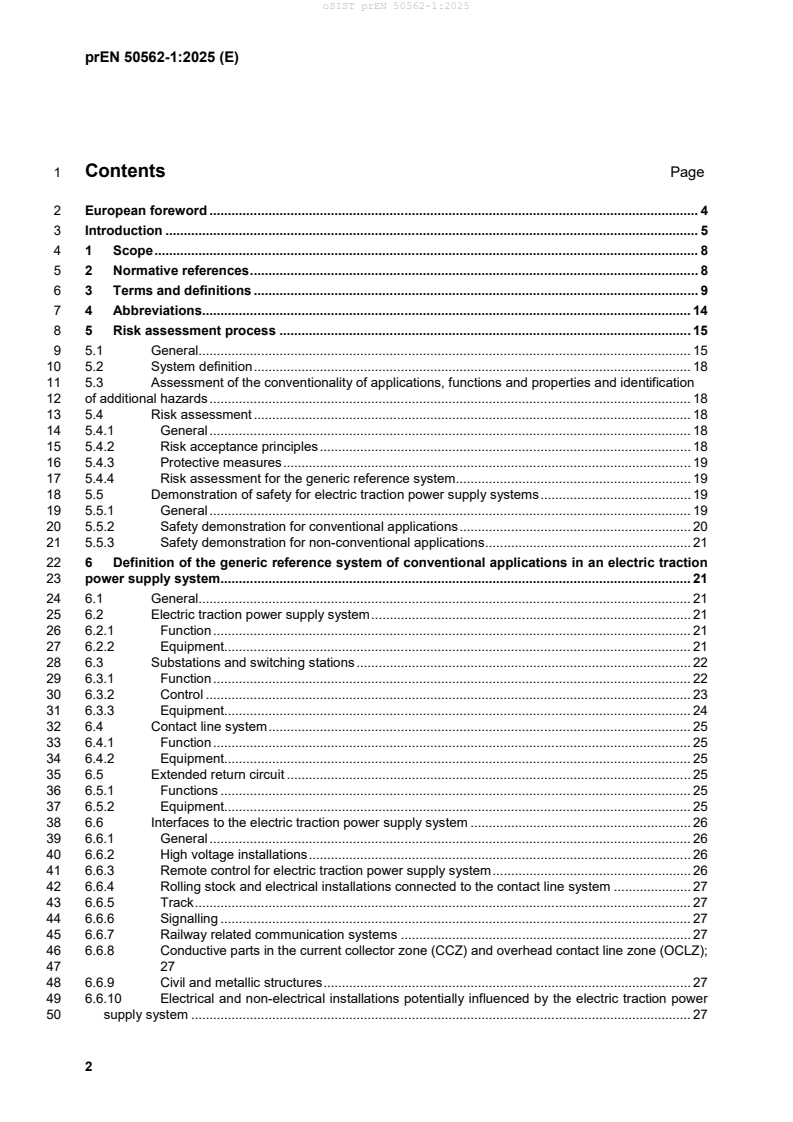
1 Contents Page
2 European foreword . 4
3 Introduction . 5
4 1 Scope . 8
5 2 Normative references . 8
6 3 Terms and definitions . 9
7 4 Abbreviations. 14
8 5 Risk assessment process . 15
9 5.1 General. 15
10 5.2 System definition . 18
11 5.3 Assessment of the conventionality of applications, functions and properties and identification
12 of additional hazards . 18
13 5.4 Risk assessment . 18
14 5.4.1 General . 18
15 5.4.2 Risk acceptance principles . 18
16 5.4.3 Protective measures . 19
17 5.4.4 Risk assessment for the generic reference system. 19
18 5.5 Demonstration of safety for electric traction power supply systems . 19
19 5.5.1 General . 19
20 5.5.2 Safety demonstration for conventional applications . 20
21 5.5.3 Safety demonstration for non-conventional applications . 21
22 6 Definition of the generic reference system of conventional applications in an electric traction
23 power supply system. 21
24 6.1 General. 21
25 6.2 Electric traction power supply system . 21
26 6.2.1 Function . 21
27 6.2.2 Equipment . 21
28 6.3 Substations and switching stations . 22
29 6.3.1 Function . 22
30 6.3.2 Control . 23
31 6.3.3 Equipment . 24
32 6.4 Contact line system . 25
33 6.4.1 Function . 25
34 6.4.2 Equipment . 25
35 6.5 Extended return circuit . 25
36 6.5.1 Functions . 25
37 6.5.2 Equipment . 25
38 6.6 Interfaces to the electric traction power supply system . 26
39 6.6.1 General . 26
40 6.6.2 High voltage installations . 26
41 6.6.3 Remote control for electric traction power supply system . 26
42 6.6.4 Rolling stock and electrical installations connected to the contact line system . 27
43 6.6.5 Track . 27
44 6.6.6 Signalling . 27
45 6.6.7 Railway related communication systems . 27
46 6.6.8 Conductive parts in the current collector zone (CCZ) and overhead contact line zone (OCLZ);
47 27
48 6.6.9 Civil and metallic structures . 27
49 6.6.10 Electrical and non-electrical installations potentially influenced by the electric traction power
50 supply system . 27
51 6.7 Interfaces to substations and switching stations . 27
52 6.7.1 Rolling stock . 27
53 6.7.2 Electrical installations connected to the contact line system . 28
54 6.7.3 Track . 28
55 6.7.4 Signalling . 28
56 6.7.5 Railway related communication systems . 28
57 6.7.6 High voltage feeding network . 28
58 6.8 Interfaces to contact line system . 28
59 6.8.1 Rolling stock and electrical installations connected to the contact line system . 28
60 6.8.2 Track . 28
61 6.8.3 Signalling . 29
62 6.8.4 Railway related communication systems . 29
63 6.8.5 High voltage network . 29
64 6.8.6 Conductive parts in the CCZ and OCLZ . 29
65 6.8.7 Civil structures . 29
66 6.9 Interfaces to extended return circuit . 29
67 6.9.1 Rolling stock and electrical installations connected to the contact line system . 29
68 6.9.2 Track . 29
69 6.9.3 Signalling . 30
70 6.9.4 Railway related communication systems . 30
71 6.9.5 High voltage feeding network . 30
72 6.9.6 Conductive parts in the CCZ and OCLZ . 30
73 6.9.7 Conductive parts within adjacent buildings and structures . 30
74 7 Protective measures of the generic electric traction power supply system . 30
75 7.1 General. 30
76 7.2 General protective measures . 30
77 7.3 Substations and switching stations . 32
78 7.3.1 General . 32
79 7.3.2 Control and protection . 32
80 7.4 Contact line system . 34
81 7.5 Extended return circuit . 34
82 Annex A (informative) Hazard log for the generic reference system . 35
83 Annex ZZ (informative) Relationship between this European Standard and the Essential
84 Requirements of EU Directive (EU) 2016/797 aimed to be covered . 51
85 Bibliography . 55
86 European foreword
87 This document (prEN 50562-1:2025) has been prepared by CLC/SC 9XC “Electric supply and earthing
88 systems for public transport equipment and ancillary apparatus (Fixed installations)” of CLC/TC 9X
89 “Electrical and electronic applications for railways”.
90 This document is currently submitted to the Enquiry.
91 The following dates are proposed:
• latest date by which the existence of this (doa) dav + 6 months
document has to be announced at national
level
• latest date by which this document has to be (dop) dav + 12 months
implemented at national level by publication of
an identical national standard or by
endorsement
• latest date by which the national standards (dow) dav + 36 months
conflicting with this document have to be (to be confirmed or
withdrawn modified when voting)
92 This document will partially supersede EN 50562:2018.
93 prEN 50562-1:2025 includes the following significant technical changes with respect to EN 50562:2018:
94 — The standard has been supplemented by a second part. Part 1 covers conventional applications,
95 functions and properties by the application of codes of practice. Part 2 covers non-conventional
96 applications, functions and properties by application of codes of practice of other provenance,
97 comparison with reference systems and explicit risk estimation.
98 — Annex B “Documents related to EN 50562” has been removed. The content has been shifted to the
99 Bibliography.
100 — The content of Annex C “Combination of risk acceptance principles” has been integrated in Part 2.
101 — The content of Annex D “Guidance of software for safety functions on system level” has been
102 integrated in Part 2.
103 The prEN 50562 series consists of the following parts:
104 — Part 1: Generic approach for conventional applications, functions and properties
105 — Part 2: Generic approach for non-conventional applications, functions and properties
106 This document has been prepared under a standardization request addressed to CENELEC by the
107 European Commission. The Standing Committee of the EFTA States subsequently approves these
108 requests for its Member States.
109 For the relationship with EU Legislation, see informative Annex ZZ, which is an integral part of this
110 document.
111 Introduction
112 This document supports the application of both parts of EN 50126 with the focus on safety but can also be
113 used independently as a standard for the process, protective measures and demonstration of safety for the
114 electric traction power supply systems. Within this document “safety” is used with respect to harm to people
115 and environment. Safety in terms of harm to assets is covered in the relevant product and application
116 standards.
117 This document has been developed specifically to support the realization of EN 50126-1:2017 and
118 EN 50126-2:2017 within the context of safety for electric traction power supply systems. It provides generic
119 building blocks which assist the fulfilment of the requirements of life cycle steps given in EN 50126-1:2017
120 and EN 50126-2:2017. Product and application standards are traditionally applied in fixed installations to
121 ensure safety and performance in terms of e.g. reliability and cost efficiency. Within this document the link
122 between existing product and application standards, technical specifications for interoperability and
123 EN 50126-1:2017 and EN 50126-2:2017 is given.
124 This document complies with the principles of the life cycle modelling according to EN 50126-1:2017 and
125 EN 50126-2:2017 by tailoring the risk assessment process, but it does not define the life cycle itself. The
126 relation between the process steps and the life cycle proposed in EN 50126-1:2017 and EN 50126-2:2017
127 is indicated in prEN 50562-1:2025, Clause 5. This means that this document encompasses major parts of
128 the EN 50126-1:2017 and EN 50126-2:2017 life cycle ranging from the concept and system description,
129 hazard identification to the demonstration of the implemented protective measures according to EN 50126-
130 1:2017 and EN 50126-2:2017. It is not intended to summarize any product and application standard but to
131 supplement and ease their application also within the framework of EN 50126-1:2017 and
132 EN 50126-2:2017.
133 During the preparation of this document, it became obvious that the residual risks associated with
134 conventional electric traction power supply systems are acceptable. This conclusion is based on long term
135 experience from several European railways. The technical systems used by these European railways in
136 their conventional electric traction power supply systems are equivalent to the generic reference system
137 described in this document. In 2006, confidential field data that were taken into account represent more
138 than 1 200 000 year km operational experience. To exemplify, the equivalent would be a network size of
139 about 80 000 km and the operational experience laid down in traceable field data would cover a period of
140 15 years of service. No fatality was reported caused by a product property or a failure of a specified function
141 of the conventional electric traction power supply systems.
142 Publications and public surveys from the European Union support the conclusions above even up today.
143 The document is split into two parts. Part 1 establishes the code of practice for electric traction power supply
144 systems. It provides a generic approach that is intended to serve for conventional applications, functions
145 and properties. It includes a systems description for the generic reference system (see Figure 1) and the
146 related subsystems. The interfaces with respect to safety at the system borders and the respective aspects
147 to be coordinated are described. Based on the list of top-level hazards and protective measures for risk
148 mitigation and hazard control are derived and indications for the verification and validation procedures are
149 given.
150 prEN 50562-2:2025 covers the specific approach that supports the implementation of non-conventional
151 applications, functions and properties in electric traction power supply systems in the sense of Part 1. It
152 includes the two risk acceptance principles that are not considered in Part 1. It describes the basic
153 procedure for the comparison with a similar system and an explicit risk estimation at the functional level
154 including SIL determination. In this way it is possible to use codes of practice or accepted solutions not
155 listed in this document.
157 Figure 1 — EN 50562 concept
158 prEN 50562-1:2025 and prEN 50562-2:2025 have been developed so that they can also be used for
159 assessing risks arising from technical changes within the legal framework of the European Union.
160 prEN 50562-1:2025 can be used as stand-alone standard, but prEN 50562-2:2025 requires the application
161 of prEN 50562-1:2025 to integrate non-conventional applications in an environment dominated by
162 conventional applications, functions and properties.
163 This document also supports the decision making regarding the assessment of changes, e.g. with respect
164 to the significance of changes in technologies. It includes in particular the risk acceptance principle
165 regarding the application of “codes of practice”. It also supports the application of the risk acceptance
166 principles “similar reference systems” and “explicit risk estimation” for electric traction power supply
167 systems in the framework of EN 50126-1:2017 and EN 50126-2:2017.
168 When applying TSIs, e.g. TSI Energy, this document supports the demonstration of safety of electric traction
169 power supply systems and supports the safe integration at overall system level.
170 The interrelation between the legal framework, the standards traditionally applied, and the set of standards
171 dedicated to safety is shown in Figure 2.
173 Figure 2 — Interrelationship between standards and the legal framework
174 1 Scope
175 This document defines the process, protective measures and demonstration of safety in accordance with
176 EN 50126-1:2017 and EN 50126-2:2017 for AC and DC electric traction power supply systems for railways.
177 This document can also be applied to urban rail and trolleybus systems. All these systems can be elevated,
178 at-grade and underground.
179 This document has two parts:
180 — prEN 50562-1:2025 establishes the code of practice for conventional applications, functions and
181 properties in electric traction power supply systems.
182 — prEN 50562-2:2025 supports the implementation of non-conventional applications, functions and
183 properties in electric traction power supply systems.
184 This document applies to electric traction power supply systems, which are new or are undergoing major
185 changes as defined in the legal framework. For similar technology and similar hazardous scenarios, the
186 safety considerations can be used as a guideline.
187 This document does not apply to:
188 — underground mine traction systems,
189 — cranes, transportable platforms and similar transportation equipment on rails, temporary structures
190 (e.g. exhibition structures) in so far as these are not supplied directly or via transformers from the
191 contact line system and are not endangered by the traction power supply system,
192 — suspended cable cars,
193 — funicular railways,
194 — magnetic levitated systems,
195 This document does not consider aspects like IT-security or protection against any other malevolent acts.
196 It is assumed that those aspects are handled on the overall system level.
197 NOTE For railways IT-security is covered in CLC/TS 50701. Because of the short life cycles of IT security
198 applications it is advisable to separate IT-security functions from safety functions at least on virtual levels. E.g. the
199 frequent patch processes for updating the IT-security applications is expected to be independent from safety
200 applications.
201 2 Normative references
202 The following documents are referred to in the text in such a way that some or all of their content constitutes
203 requirements of this document. For dated references, only the edition cited applies. For undated references,
204 the latest edition of the referenced document (including any amendments) applies.
205 EN 50119:2020, Railway applications - Fixed installations - Electric traction overhead contact lines
206 EN 50122-1:2022, Railway applications - Fixed installations - Electrical safety, earthing and the return
207 circuit - Part 1: Protective provisions against electric shock
208 EN 50122-2:2022, Railway applications - Fixed installations - Electrical safety, earthing and the return
209 circuit - Part 2: Provisions against the effects of stray currents caused by DC traction systems
210 EN 50122-3:2022, Railway applications - Fixed installations - Electrical safety, earthing and the return
211 circuit - Part 3: Mutual Interaction of AC and DC traction systems
212 EN 50124-1:2017, Railway applications - Insulation coordination - Part 1: Basic requirements - Clearances
213 and creepage distances for all electrical and electronic equipment
214 EN 50124-2:2017, Railway applications - Insulation coordination - Part 2: Overvoltages and related
215 protection
216 EN 50163:2004 , Railway applications - Supply voltages of traction systems
217 EN 50488:2021, Railway applications - Fixed installations - Electrical protective measures for working on
218 or near an overhead contact line system and/or its associated return circuit
219 EN 50633:2016, Railway applications - Fixed installations - Protection principles for AC and DC electric
220 traction systems
221 EN IEC 62305-1:2024, Protection against lightning - Part 1: General principles
222 EN IEC 62305-2:2024, Protection against lightning - Part 2: Risk management
223 EN IEC 62305-3:2024, Protection against lightning - Part 3: Physical damage to structures and life hazard
224 EN IEC 62305-4:2024, Protection against lightning - Part 4: Electrical and electronic systems within
225 structures
226 3 Terms and definitions
227 For the purposes of this document, the following terms and definitions apply.
228 ISO and IEC maintain terminology databases for use in standardization at the following addresses:
229 — ISO Online browsing platform: available at https://www.iso.org/obp
230 — IEC Electropedia: available at http://www.electropedia.org
231 3.1
232 contact line system
233 support system and contact line supplying electric energy to vehicles through current-collecting equipment
234 Note 1 to entry: The mechanical system can be comprised of:
235 — the contact line;
236 — structures and foundations;
237 — supports and any components supporting or registering the conductors;
238 — head and cross spans;
239 — along-track feeders, negative feeders, and other lines like earth wires and return conductors, including boosters,
240 as far as they are supported from contact line system structures;
241 — cross-track feeders;
242 — disconnectors;
243 — over-voltage protection devices;
244 — conductors connected permanently to the contact line for supply of other electrical equipment such as lights, signal
245 operation, point control and point heating;
———————
As impacted by EN 50163:2004/A1:2007, EN 50163:2004/corrigendum May 2010, EN 50163:2004/AC:2013,
EN 50163:2004/A2:2020 and EN 50163:2004/A3:2022.
246 — any other equipment necessary for operating the contact line.
247 [SOURCE: IEC 60050-811:2017, 811-33-59, modified — Note 1 to entry has been modified.]
248 3.2
249 conventional application in an electric traction power supply system
250 conventional application that is constructed, operated and maintained in accordance with the applicable
251 standards and common practice
252 Note 1 to entry: Common practice is understood as
253 — The application under consideration is covered by the generic reference system description given in
254 prEN 50562-1:2025, Clause 6,
255 — The technology applied is reliable, proven and defined in the standards for electric traction power systems and
256 general electric power supply,
257 — The safety rules according to EN 50110-1:2023 and EN 50488:2021 supplemented by operation and maintenance
258 manuals are applied as a minimum,
259 — Operation and maintenance is carried out only by qualified and authorized personnel,
260 — Operation is carried out according to experience gained in similar applications,
261 Common practice normally also includes aspects such as IT security, access control and work permits; but these are
262 covered at the level of the overall system.
263 EXAMPLE A non-conventional application can be found in workshops, where maintainer have access to the roof
264 of the train and are working in the direct vicinity of the contact line. If the maintenance process requires an automated
265 function for applying EN 50488, e.g. earthing of the contact line etc., there is currently no code of practice available for
266 this technical solution. Consequently, this function is non-conventional and is handled according to prEN 50562-2:2025.
267 3.3
268 current collector zone
269 CCZ
270 zone the limits of which are in general not exceeded by an energized collector no longer in contact with the
271 contact line or broken collector and its fragments
272 [SOURCE: EN 50122-1:2022, 3.5.11]
273 3.4
274 effective touch voltage
275 U
te
276 voltage between conductive parts when touched simultaneously by a human being
277 Note 1 to entry: The value of the effective touch voltage can be appreciably influenced by the impedance of the
278 human being in electric contact with these conductive parts.
279 Note 2 to entry: The conductive path through the body of a human being is conventionally from hand to both feet
280 (horizontal distance of 1 m) or from hand to hand.
281 [SOURCE: IEC 60050-195:2021, 195-05-11, modified — in the headline “touch voltage, ” was
282 replaced by “(effective) touch voltage”; “or livestock” in the end of the paragraph and in Note 1 have been
283 deleted, the symbol and the Note 2 to entry have been added]
284 3.5
285 electrical safety
286 freedom from unacceptable risk of harm caused by electrical systems
287 [SOURCE: EN 50122-1:2022, 3.1.1]
288 3.6
289 electric shock
290 physiological effect resulting from an electric current passing through a human body or livestock
291 [SOURCE: IEC 60050-195:2021, 195-01-04]
292 3.7
293 electric traction power supply system
294 railway electrical distribution network used to provide energy for rolling stock
295 Note 1 to entry: The system can comprise:
296 — contact line systems;
297 — extended return circuit;
298 — running rails of non-electrified tracks, which are in the vicinity of, and conductively connected to the running rails
299 of an electric traction power supply system;
300 — electrical installations, which are supplied from contact lines either directly or via a transformer;
301 — electrical installations in power plants in substations, which are utilized solely for distribution of power directly to
302 the contact line;
303 — electrical installations of switching stations.
304 [SOURCE: EN 50122-1:2022, 3.4.1]
305 3.8
306 emergency switching-off
307 opening operation of a switching device intended to remove electric power from an electrical installation to
308 avert or alleviate a hazardous situation
309 Note 1 to entry: Emergency switching-off is an immediate reaction with minimized delay. Within the context of electric
310 traction power supply systems, the emergency switching-off refers to electrical safety. It reduces but does not eliminate
311 the electric shock risk; referring to “the five safety rules” according to EN 50110-1:2023, 6.2.1.
312 [SOURCE: IEC 60050-826:2004, 826-17-03, modified – Note 1 to entry has been added]
313 3.9
314 functional switching
315 operation intended to switch on or off or vary the supply of electric energy to an electrical installation or
316 parts of it for normal operating purposes
317 Note 1 to entry: Functional switching also includes predefined switching sequences like general switching-off, which
318 is the opening operation of a group of switching devices intended to remove electric power from an electric installation
319 or from parts of it to achieve an intended switching state. The switchgears involved and the switching sequences
320 depend amongst others on the local conditions, the configuration of the system and the purpose of the intended
321 switching state.
322 [SOURCE: IEC 60050-826:2004, 826-17-05, modified – Note 1 to entry has been added]
323 3.10
324 function
325 mode of action or activity by which a product fulfils its purpose
326 [SOURCE: IEC 60050-821-12-25:2017, 821-12-25]
327 3.11
328 hazard
329 potential source of harm
330 Note 1 to entry: In English, the term “hazard” can be qualified in order to define the origin of the hazard or the nature
331 of the expected harm (e.g. “electric shock hazard”, “crushing hazard”, “cutting hazard”, “toxic hazard”, “fire hazard”,
332 “drowning hazard”).
333 Note 2 to entry: In French, the synonym “risque” is used together with a qualifier or a complement to define the origin
334 of the hazard or the nature of the expected harm (e.g. “risque de choc électrique”, “risque d'écrasement”, “risque de
335 coupure”, “risque toxique”, “risque d'incendie”, “risque de noyade”).
336 Note 3 to entry: In French, the term “risque” also denotes the combination of the probability of occurrence of harm and
337 the severity of that harm, in English “risk” (see IEC 60050-903-01-07).
338 [SOURCE: IEC 60050-903:2013, 903-01-02]
339 3.13
340 mechanical switching device
341 switching device designed to close and open one or more electric circuits by means of separable contacts
342 [SOURCE: IEC 60050-441:1984, 441-14-02, modified — "a" removed at the beginning of the definition.]
343 3.14
344 overhead contact line zone
345 OCLZ
346 zone the limits of which are in general not exceeded by a broken overhead contact wire or catenary wire
347 [SOURCE: EN 50122-1:2022, 3.5.10]
348 3.15
349 protection
350 provisions for detecting faults or other abnormal operating conditions in a power system, for enabling fault
351 clearance, for terminating abnormal operating conditions, and for initiating signals or indications
352 Note 1 to entry: The term “protection” is a generic term for protection equipment or protection systems.
353 Note 2 to entry: The term “protection” can be used to describe the protection of a complete power system or the
354 protection of individual plant items in a power system e.g. transformer protection, line protection, generator protection.
355 Note 3 to entry: Protection does not include items of power system plant provided, for example, to limit overvoltages
356 on the power system. However, it includes items provided to control the power system voltage or frequency deviations
357 such as automatic reactor switching, load-shedding, etc.
358 [SOURCE: IEC 60050-448:1995, 448-11-01, modified — “abnormal condition” has been replaced with
359 “abnormal operating conditions”.]
360 3.16
361 protective measure
362 measure intended to achieve adequate risk reduction, implemented:
363 — by the designer (inherent design, safeguarding and complementary protective measures, information
364 for use) and
365 — by the user (organization: safe working procedures, supervision, training; permit-to-work systems;
366 provision and use of additional safeguards; use of personal protective equipment)
367 [SOURCE: IEC 60050-903:2013, 903-01-17]
368 3.17
369 extended return circuit
370 part of the electric traction power supply system which is not live and which leads the current back from the
371 loads such as vehicles or other equipment to the source
372 EXAMPLE The conductors can be:
373 — running rails,
374 — return conductor rails,
375 — return conductors,
376 — substation return conductors;
377 — booster transformer return conductors
378 but not auto transformer system negative feeder conductors.
379 [SOURCE: EN 50122-1:2022, 3.3.1]
380 3.18
381 return conductor
382 conductor paralleling the track return system and connected to the running rails at periodic intervals
383 [SOURCE: IEC 60050-811:2017, 811-35-13]
384 3.19
385 return conductor rail
386 return current rail
387 conductor rail used instead of the running rails for the return traction currents
388 [SOURCE: IEC 60050-811:2017, 811-34-10]
389 3.20
390 safety
391 freedom from unacceptable risk
392 [SOURCE: IEC 60050-903:2013, 903-01-19]
393 3.21
394 semiconductor switching device
395 switching device designed to make or break the current in an electric circuit by means of the controlled
396 conductivity of a semiconductor
397 [SOURCE: IEC 60050-441:1984, 441-14-03, modified — “or break” has been added.]
398 3.22
399 signal for electric traction issues
400 signal providing information about electrical issues providing a human machine interface
401 EXAMPLE the status of the electrical supply which could require a driver reaction e.g. neutral sections and related
402 handling of the contact collector
403 Note 2 to entry: Examples can be found e.g. in EN 16494.
404 Note 3 to entry: Those signals for electric traction issues do not define or set routes for the operation of trains or provide
405 speed restrictions.
406 3.23
407 substation return conductor
408 conductor connecting the running rails or other parts of the return circuit to the substation
409 [SOURCE: EN 50122-1:2022, 3.3.7]
410 3.24
411 switchgear and controlgear
412 switchgear
413 switching devices and their combination with associated control, measuring, protective and regulating
414 equipment, also assemblies of such devices and equipment with associated interconnections, accessories,
415 enclosures and supporting structures, intended in principle for use in connection with generation,
416 transmission, distribution and conversion of electric energy
417 [SOURCE: IEC 60050-441:1984, 441-11-01, modified – “switchgear” was added as a synonym term]
418 3.25
419 system hazard
420 unintended condition within a technical system which contributes to a top-level hazard
421 Note 1 to entry: A system hazard can include defects and deficiencies of functions and properties.
422 3.26
423 top-level hazard
424 physical situation that provides a potential source of harm where no further barriers are specified
425 3.27
426 track circuit
427 electrical circuit of which the rails of a track section form a part, with usually a source of current connected
428 at one end and a detection device at the other end for detecting whether this track section is clear or
429 occupied by a vehicle
430 Note 1 to entry: In a continuous signalling system, the track circuit can be used to transmit information between the
431 ground and the train.
432 [SOURCE: IEC 60050-821:2017, 821-03-01]
433 4 Abbreviations
434 For the purposes of this document, the following abbreviations apply:
AC Alternating Current
ACRC Automated Connection to the Return Circuit
CCZ Current Collector Zone
CMMI Capability Maturity Model Integration
CoP Code of Practice
DC Direct Current
EHS Environmental Health and Safety
EMC ElectroMagnetic Compatibility
EMI ElectroMagnetic Interference
ERE Explicit Risk Estimation
HMI Human Machine Interface
IO Input/Output
ISA Independent Safety Assessor
IT Information Technology
NSA National Safety Authority
O&M Operation and Maintenance
OCLZ Overhead Contact Line Zone
OTHERS Other groups of persons besides PAX, PUB and STAFF, such as trespasser, vandals.
NOTE characteristic: knowing that there are residual risks when entering the vicinity of tracks,
power lines and contact line systems
PAX Passengers of the railway
NOTE characteristic: not expecting a risk
PFD average Probability of failure on demand
PFH average Frequency of dangerous failure
PUB General public, e.g. neighbourhood, passer-by, but not passengers.
NOTE characteristic: not expecting a risk
QM Quality Management
SIL Safety Integrity Level
SIM Comparison with a similar reference system
SRAC Safety Related Application Condition
STAFF Competent persons having the permission for access to and work on railway assets, e.g.
railway personnel, civil workers for railway construction, search and rescue.
NOTE characteristic: knowing that there are residual risks when entering electrical rooms or the
vicinity of tracks, power lines and contact line systems
T&C Testing and Commissioning
TFFR Tolerable Functional Failure Rate
THR Tolerable Hazard Rate
TLH Top Level Hazard
TSI Technical Specification for Interoperability
435 5 Risk assessment process
436 5.1 General
437 Precondition for the application of this document as a code of practice is that the design, construction,
438 operation, and maintenance of conventional applications, functions and properties within an electric traction
439 power supply system follow the relevant standards to ensure safety. For non-conventional applications,
440 functions and properties as a part of electric traction power supply systems, where no sector-specific
441 standards exist, safety shall be established by considering combinations of the risk acceptance principles
442 'application of codes of practice', 'comparison with a similar reference system' and/or 'explicit risk estimation'
443 according to prEN 50562-2:2025.
444 This clause describes how to:
445 — define the system under consideration and the relevant interfaces,
446 — apply this document as a code of practice or showing the link to prEN 50562-2:2025 for performing a
447 delta analysis and risk assessment for non-conventional applications, functions and properties,
448 — apply protective measures,
449 — demonstrate safety.
450 Clause 6 provides a system description of a conventional electric traction power supply system that serves
451 as a generic reference system. When using this document for the risk acceptance principles application of
452 a code of practice and for the
...