


prEN IEC 61514:2024
(Main)Industrial-process control systems - Methods of evaluating the performance of valve positioners with pneumatic outputs
Industrial-process control systems - Methods of evaluating the performance of valve positioners with pneumatic outputs
Systeme der industriellen Prozesstechnik - Methoden der Beurteilung des Betriebsverhaltens von Ventilstellungsreglern mit pneumatischen Ausgängen
Systèmes de commande des processus industriels - Méthodes d'évaluation des performances des positionneurs de vannes à sorties pneumatiques
Sistemi za upravljanje industrijskih procesov - Postopki za ocenjevanje lastnosti pozicionirnikovz ventili s pnevmatskimi izhodi
General Information
- Status
- Not Published
- Publication Date
- 25-Jan-2026
- Technical Committee
- CLC/TC 65X - Industrial-process measurement, control and automation
- Drafting Committee
- IEC/SC 65B - IEC_SC_65B
- Current Stage
- 4060 - Enquiry results established and sent to TC, SR, BTTF - Enquiry
- Start Date
- 27-Sep-2024
- Completion Date
- 27-Sep-2024
Relations
- Effective Date
- 03-Aug-2021
Overview
The prEN IEC 61514:2024 standard, titled "Industrial-process control systems - Methods of evaluating the performance of valve positioners with pneumatic outputs," is developed by the CLC and published by the International Electrotechnical Commission (IEC). It provides internationally recognized test methods and evaluation criteria to assess the static and dynamic performance of valve positioners used in industrial process control systems.
Designed for positioners with pneumatic outputs that receive analogue input signals, this standard addresses the measurement and control of valve positioning accuracy, reliability, and responsiveness. Its application spans both single-acting and double-acting analogue positioners, tested either independently or in connection with actuators.
The document facilitates a uniform approach for manufacturers, users, and independent testing bodies to validate product performance against consistent criteria, supporting improved quality assurance, safety, and operational efficiency in industrial valve control systems.
Key Topics
Scope and Objective
prEN IEC 61514:2024 specifies detailed testing procedures for analogue valve positioners with pneumatic outputs, excluding digital or pulsed input/output devices. The standard supports full and partial evaluation programs tailored to product design and intended operational conditions.Performance Test Procedures
It outlines methods to evaluate fundamental performance aspects, including:- Gain and travel characteristics
- Accuracy metrics such as inaccuracy, conformity error, hysteresis, and repeatability error
- Dead band measurements for input and output paths
- Airflow characteristics and steady-state air consumption
- Effects of influence quantities like supply pressure, temperature, humidity, vibration, shock, and electromagnetic interference
- Drift assessment (start-up and long-term)
- Dynamic response via frequency and step response tests
- Accelerated life testing
Test Conditions and Setup
The standard defines environmental test conditions such as ambient temperature and humidity limits, supply pressure tolerances, and proper test equipment arrangements. It distinguishes between testing a positioner alone versus as part of an actuator assembly.Documentation and Reporting
It emphasizes comprehensive test reporting, including manufacturer specifications, testing conditions, deviations, and results interpretation. Manufacturer input is encouraged to ensure accuracy and completeness of evaluation.Safety and Quality Assurance
Addresses safety considerations and conformity with protective enclosure degrees, routine maintenance, repair guidelines, and installation practices to support reliable operation and compliance with industrial standards.
Applications
prEN IEC 61514:2024 is essential for:
- Valve positioner manufacturers aiming to certify product performance and comply with international standards.
- Industrial process control engineers requiring validated performance data for pneumatic valve control systems in sectors such as chemical processing, oil and gas, power generation, and automation.
- Testing and certification bodies conducting performance assessments to verify manufacturer claims and ensure system reliability and safety.
- End-users and plant operators implementing maintenance and quality assurance programs using standardized performance benchmarks.
This standard enhances industrial automation, process safety, and maintenance efficiency by enabling rigorous and repeatable evaluation of valve positioners critical to precision flow control.
Related Standards
- IEC 60381 & IEC 60382 – Define analogue signal input standards for control devices, referenced for input signal conformity.
- IEC 61511 – Functional safety of safety instrumented systems within the process industry may use valve positioner performance data in safety validation.
- IEC 61508 – General functional safety standards related to programmable electronic safety-related systems.
- ISO/IEC Directives – Guide the formatting and publication of IEC standards, ensuring consistency across international documents.
These related standards collectively support the holistic evaluation and certification of industrial process control devices, driving interoperability, safety, and quality in automation systems.
Keywords: valve positioner performance, pneumatic valve control, industrial process control, valve positioning accuracy, IEC 61514, test procedures, static performance, dynamic response, analogue positioners, industrial automation standards, quality assurance, process safety

Get Certified
Connect with accredited certification bodies for this standard

National Aerospace and Defense Contractors Accreditation Program (NADCAP)
Global cooperative program for special process quality in aerospace.
Institut za varilstvo d.o.o. (Welding Institute)
Slovenia's leading welding institute since 1952. ISO 3834, EN 1090, pressure equipment certification, NDT personnel, welder qualification. Only IIW Au
CARES (UK Certification Authority for Reinforcing Steels)
UK certification for reinforcing steels and construction.
Sponsored listings
Frequently Asked Questions
prEN IEC 61514:2024 is a draft published by CLC. Its full title is "Industrial-process control systems - Methods of evaluating the performance of valve positioners with pneumatic outputs". This standard covers: Industrial-process control systems - Methods of evaluating the performance of valve positioners with pneumatic outputs
Industrial-process control systems - Methods of evaluating the performance of valve positioners with pneumatic outputs
prEN IEC 61514:2024 is classified under the following ICS (International Classification for Standards) categories: 23.060.99 - Other valves; 25.040.40 - Industrial process measurement and control. The ICS classification helps identify the subject area and facilitates finding related standards.
prEN IEC 61514:2024 has the following relationships with other standards: It is inter standard links to EN 61514:2002. Understanding these relationships helps ensure you are using the most current and applicable version of the standard.
prEN IEC 61514:2024 is available in PDF format for immediate download after purchase. The document can be added to your cart and obtained through the secure checkout process. Digital delivery ensures instant access to the complete standard document.
Standards Content (Sample)
SLOVENSKI STANDARD
01-september-2024
Sistemi za upravljanje industrijskih procesov - Postopki za ocenjevanje lastnosti
pozicionirnikovz ventili s pnevmatskimi izhodi
Industrial-process control systems - Methods of evaluating the performance of valve
positioners with pneumatic outputs
Systeme der industriellen Prozesstechnik - Methoden der Beurteilung des
Betriebsverhaltens von Ventilstellungsreglern mit pneumatischen Ausgängen
Systèmes de commande des processus industriels - Méthodes d'évaluation des
performances des positionneurs de vannes à sorties pneumatiques
Ta slovenski standard je istoveten z: prEN IEC 61514:2024
ICS:
23.060.99 Drugi ventili Other valves
25.040.40 Merjenje in krmiljenje Industrial process
industrijskih postopkov measurement and control
2003-01.Slovenski inštitut za standardizacijo. Razmnoževanje celote ali delov tega standarda ni dovoljeno.
65B/1256/CDV
COMMITTEE DRAFT FOR VOTE (CDV)
PROJECT NUMBER:
IEC 61514 ED2
DATE OF CIRCULATION: CLOSING DATE FOR VOTING:
2024-07-05 2024-09-27
SUPERSEDES DOCUMENTS:
65B/1202/RR, 65B/1249/CC
IEC SC 65B : MEASUREMENT AND CONTROL DEVICES
SECRETARIAT: SECRETARY:
United States of America Mr Wallie Zoller
OF INTEREST TO THE FOLLOWING COMMITTEES: PROPOSED HORIZONTAL STANDARD:
Other TC/SCs are requested to indicate their interest, if any, in
this CDV to the secretary.
FUNCTIONS CONCERNED:
EMC ENVIRONMENT QUALITY ASSURANCE SAFETY
SUBMITTED FOR CENELEC PARALLEL VOTING NOT SUBMITTED FOR CENELEC PARALLEL VOTING
Attention IEC-CENELEC parallel voting
The attention of IEC National Committees, members of
CENELEC, is drawn to the fact that this Committee Draft
for Vote (CDV) is submitted for parallel voting.
The CENELEC members are invited to vote through the
CENELEC online voting system.
This document is still under study and subject to change. It should not be used for reference purposes.
Recipients of this document are invited to submit, with their comments, notification of any relevant patent rights of which
they are aware and to provide supporting documentation.
Recipients of this document are invited to submit, with their comments, notification of any relevant “In Some Countries”
clauses to be included should this proposal proceed. Recipients are reminded that the CDV stage is the final stage for
submitting ISC clauses. (SEE AC/22/2007 OR NEW GUIDANCE DOC).
TITLE:
Industrial-process control systems - Methods of evaluating the performance of valve positioners with
pneumatic outputs
PROPOSED STABILITY DATE: 2027
NOTE FROM TC/SC OFFICERS:
file, to make a copy and to print out the content for the sole purpose of preparing National Committee positions. You may not copy
or "mirror" the file or printed version of the document, or any part of it, for any other purpose without permission in writing from IEC.
IEC CDV 61514 © IEC:2024 – 2 –
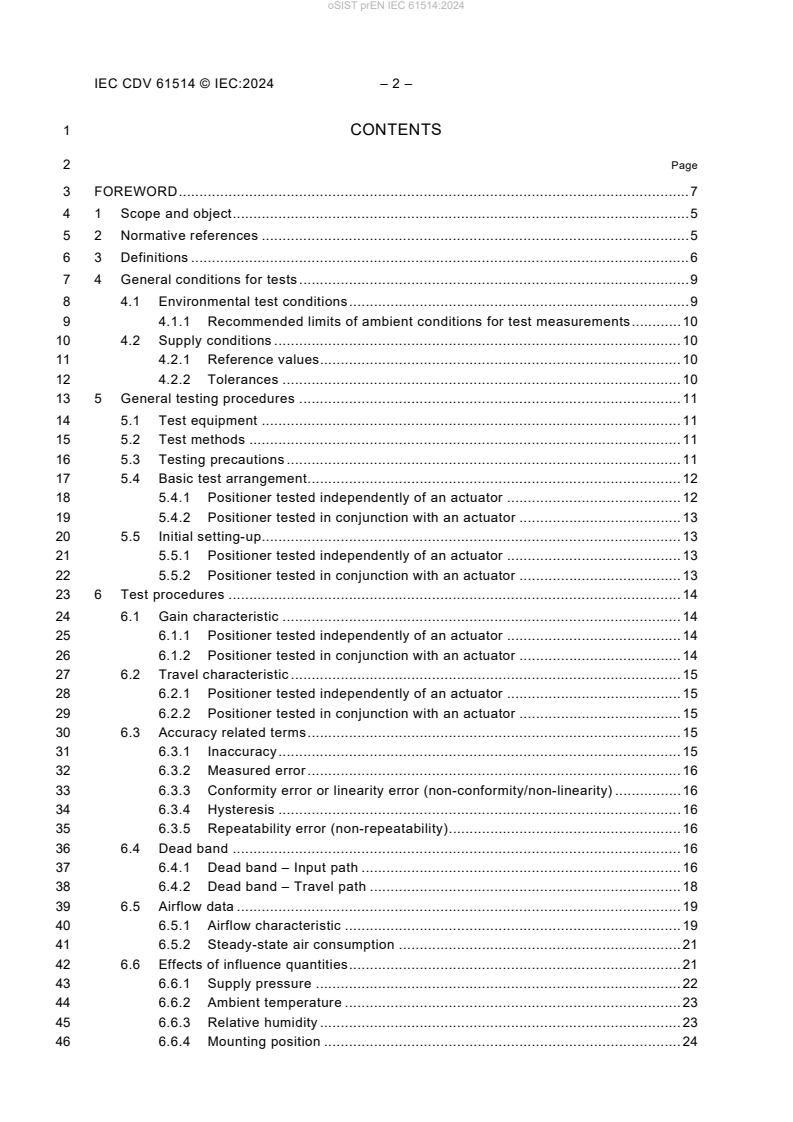
1 CONTENTS
2 Page
3 FOREWORD . 7
4 1 Scope and object . 5
5 2 Normative references . 5
3 Definitions . 6
7 4 General conditions for tests . 9
8 Environmental test conditions . 9
4.1
9 4.1.1 Recommended limits of ambient conditions for test measurements . 10
10 4.2 Supply conditions . 10
11 4.2.1 Reference values. 10
12 4.2.2 Tolerances . 10
13 5 General testing procedures . 11
14 5.1 Test equipment . 11
15 5.2 Test methods . 11
16 5.3 Testing precautions . 11
17 5.4 Basic test arrangement . 12
18 Positioner tested independently of an actuator . 12
5.4.1
19 5.4.2 Positioner tested in conjunction with an actuator . 13
20 5.5 Initial setting-up . 13
21 5.5.1 Positioner tested independently of an actuator . 13
22 5.5.2 Positioner tested in conjunction with an actuator . 13
23 6 Test procedures . 14
24 6.1 Gain characteristic . 14
25 6.1.1 Positioner tested independently of an actuator . 14
26 6.1.2 Positioner tested in conjunction with an actuator . 14
27 6.2 Travel characteristic . 15
28 Positioner tested independently of an actuator . 15
6.2.1
29 6.2.2 Positioner tested in conjunction with an actuator . 15
30 6.3 Accuracy related terms . 15
31 6.3.1 Inaccuracy . 15
32 6.3.2 Measured error . 16
33 6.3.3 Conformity error or linearity error (non-conformity/non-linearity) . 16
34 Hysteresis . 16
6.3.4
35 6.3.5 Repeatability error (non-repeatability) . 16
36 6.4 Dead band . 16
37 6.4.1 Dead band – Input path . 16
38 6.4.2 Dead band – Travel path . 18
39 6.5 Airflow data . 19
40 Airflow characteristic . 19
6.5.1
41 6.5.2 Steady-state air consumption . 21
42 6.6 Effects of influence quantities . 21
43 6.6.1 Supply pressure . 22
44 6.6.2 Ambient temperature . 23
45 6.6.3 Relative humidity . 23
46 Mounting position . 24
6.6.4
IEC CDV 61514 © IEC:2024 – 3 –
47 6.6.5 Mechanical shock . 25
48 6.6.6 Vibration . 25
49 6.6.7 Power-frequency magnetic field . 26
50 6.6.8 Radiated electromagnetic field interference . 27
51 6.6.9 Electrical fast transients (burst) . 28
52 Surge voltage immunity . 28
6.6.10
53 6.6.11 Series mode interference . 29
54 6.7 Input over-range . 30
55 6.7.1 Positioner tested independently of an actuator . 30
56 6.7.2 Positioner tested in conjunction with an actuator . 30
57 6.7.3 Common text for positioners tested independently of an actuator/with
an actuator . 30
59 6.8 Drift . 31
60 6.8.1 Start-up drift . 31
61 6.8.2 Long-term drift . 31
62 6.9 Accelerated life test . 32
63 6.9.1 Positioner tested independently of an actuator . 32
64 Positioner tested in conjunction with an actuator . 32
6.9.2
65 6.9.3 Common test for positioners tested in conjunction with/independently of
66 an actuator . 32
67 6.10 Dynamic response . 32
68 6.10.1 General considerations . 32
69 6.10.2 Basic test arrangement . 33
70 Frequency response . 33
6.10.3
71 6.10.4 Step response . 35
72 7 Other considerations . 36
73 7.1 General . 36
74 Safety . 37
7.2
75 7.3 Degree of protection provided by enclosures . 37
76 7.4 Documentary information . 37
77 7.5 Installation . 38
78 7.6 Routine maintenance and adjustment . 38
79 7.7 Repair . 38
80 Protective finishes . 38
7.8
81 7.9 Design features . 38
82 7.10 Variants . 38
83 7.11 Tools and equipment . 38
84 8 Test report and documentation . 38
85 9 Bibliography . 40
IEC CDV 61514 © IEC:2024 – 4 –
88 INTERNATIONAL ELECTROTECHNICAL COMMISSION
89 ____________
91 INDUSTRIAL-PROCESS CONTROL SYSTEMS –
92 Methods of evaluating the performance of valve positioners
93 with pneumatic outputs
95 FOREWORD
96 1) The IEC (International Electrotechnical Commission) is a worldwide organization for standardization comprising
97 all national electrotechnical committees (IEC National Committees). The object of the IEC is to promote
98 international co-operation on all questions concerning standardization in the electrical and electronic fields. To
99 this end and in addition to other activities, the IEC publishes International Standards. Their preparation is
100 entrusted to technical committees; any IEC National Committee interested in the subject dealt with may
101 participate in this preparatory work. International, governmental and non-governmental organizations liaising with
102 the IEC also participate in this preparation. The IEC collaborates closely with the International Organization for
103 Standardization (ISO) in accordance with conditions determined by agreement between the two organizations.
104 2) The formal decisions or agreements of the IEC on technical matters express, as nearly as possible, an
105 international consensus of opinion on the relevant subjects since each technical committee has representation
106 from all interested National Committees.
107 3) The documents produced have the form of recommendations for international use and are published in the form
108 of standards, technical specifications, technical reports or guides and they are accepted by the National
109 Committees in that sense.
110 4) In order to promote international unification, IEC National Committees undertake to apply IEC International
111 Standards transparently to the maximum extent possible in their national and regional standards. Any divergence
112 between the IEC Standard and the corresponding national or regional standard shall be clearly indicated in the
113 latter.
114 5) The IEC provides no marking procedure to indicate its approval and cannot be rendered responsible for any
115 equipment declared to be in conformity with one of its standards.
116 6) Attention is drawn to the possibility that some of the elements of this International Standard may be the subject
117 of patent rights. The IEC shall not be held responsible for identifying any or all such patent rights.
118 International Standard IEC 61514 has been prepared by subcommittee 65B: Devices, of IEC
119 technical committee 65: Industrial-process measurement and control.
120 The text of this standard is based on the following documents:
FDIS Report on voting
65B/394/FDIS 65B/403/RVD
122 Full information on the voting for the approval of this standard can be found in the report on
123 voting indicated in the above table.
124 This publication has been drafted in accordance with the ISO/IEC Directives, Part 3.
125 The committee has decided that the contents of this publication will remain unchanged
126 until 2006. At this date, the publication will be
127 • reconfirmed;
128 • withdrawn;
129 • replaced by a revised edition, or
130 • amended.
IEC CDV 61514 © IEC:2024 – 5 –
132 INDUSTRIAL-PROCESS CONTROL SYSTEMS –
133 Methods of evaluating the performance of valve positioners
134 with pneumatic outputs
135 1 Scope and object
136 This International Standard specifies tests designed to determine the static and dynamic
137 performance of single-acting or double-acting analogue positioners. The tests may be applied
138 to positioners which receive standard analogue input signals (as specified in IEC 60381 and
139 IEC 60382) and have a pneumatic output.
140 Positioners with pulsed or digital input signals, positioners with digital controllers and
141 positioners with pulsed outputs are outside the scope of this standard.
143 Testing may be conducted either on a positioner alone, independently of an actuator, or on a
144 positioner mounted and connected to a specific actuator, as a combined unit. The text makes
145 clear where different approaches are required.
146 The methods of evaluation given in this standard are intended for use by manufacturers to
147 determine the performance of their products, and by users, or independent testing establish-
148 ments, to verify manufacturers' performance specifications.
149 The closest liaison should be maintained between the evaluating body and the manufacturer.
150 Note should be taken of the manufacturer's specifications for the instrument when the test
151 programme is being decided, and the manufacturer should be invited to comment on both the
152 test programme and the results. His comments on the results should be included in any report
153 produced by the testing organization.
154 This standard is intended to provide definitions of positioner elements, actions, and
155 characteristics, to specify uniform methods of measuring performance errors and effects of
156 influence quantities on those characteristics, and to describe methods of reporting and
157 evaluating the results of the measurement data obtained.
158 The test conditions described in this publication (for example range of ambient temperatures
159 and power supply) relate to conditions which commonly arise in use. Consequently, the values
160 specified shall be used where no other values are specified by the manufacturer or user. If other
161 values are used, they should be stated. It is recognized that the manufacturer's specifications
162 and instructions for installation and operation should apply during all steps.
163 The tests specified in this standard are not necessarily sufficient for instruments specifically
164 designed for unusually arduous conditions. Conversely, a reduced series of tests may serve
165 adequately for instruments designed to perform within a more limited range of conditions.
166 When a full evaluation, in accordance with this standard, is not required or possible, those tests
167 which are required should be performed and the results reported in accordance with the relevant
168 parts of this standard. In such cases, the test report should state that it does not cover the full
169 number of tests specified herein.
170 2 Normative references
171 The following documents, in whole or in part, are normatively referenced in this document and
172 are indispensable for its application. For dated references, only the edition cited applies. For
173 undated references, the latest edition of the referenced document (including any amendments)
174 applies.
IEC CDV 61514 © IEC:2024 – 6 –
175 IEC 60050, International Electrotechnical Vocabulary (IEV):
176 - Part 311: Electrical and electronic measurements - General terms relating to electrical
177 measurements
178 - Part 351: Control technology
179 IEC 60068-2-1, Environmental testing – Part 2-1: Tests. Test A: Cold
180 IEC 60068-2-2, Environmental testing – Part 2-2: Tests. Test B: Dry heat
181 IEC 60068-2-6, Environmental testing – Part 2-6: Tests. Test Fc: Vibration (sinusoidal)
182 IEC 60068-2-31, Environmental testing - Part 2-31: Tests - Test Ec: Rough handling shocks,
183 primarily for equipment-type specimens
184 IEC 60068-2-78, Environmental testing – Part 2-78: Tests. Test Cab: Damp heat, steady state
185 IEC 60079 (all parts), Electrical apparatus for explosive gas atmospheres
186 IEC 60381-1, Analogue signals for process control systems – Part 1: Direct current signals
187 IEC 60381-2, Analogue signals for process control systems – Part 2: Direct voltage signals
188 IEC 60382, Analogue pneumatic signal for process control systems
189 IEC 60529, Degree of protection provided by enclosures (IP Code)
190 IEC 60534-1, Industrial-process control valves – Part 1: Control valve terminology and general
191 considerations
192 IEC 60654 (all parts), Operating conditions for industrial-process measurement and control
193 equipment
194 IEC 60721-3, Classification of environmental conditions – Part 3 Classification of groups of
195 environmental parameters and their severities
196 IEC 61010-1, Safety requirements for electrical equipment for measurement, control, and
197 laboratory use – Part 1: General requirements
198 IEC 61032, Protection of persons and equipment by enclosures – Probes for verification
199 IEC 61326-1:2020, Electrical equipment for measurement, control and laboratory use – EMC
200 requirements
202 IEC 62828-1: 2017, Reference conditions and procedures for testing industrial and process
203 measurement transmitters – Part 1: General procedures for all types of transmitters
204 3 Definitions
205 For the purpose of this standard, the terms and definitions given in IEC 60050 Part 311 and
206 351 as well as the following definitions shall be applied.
207 3.1
208 positioner
209 position controller connected to the moving part of a final control element or its actuator;
210 automatically adjusts its output signal Y to the actuator in order to maintain a desired travel
211 signal X that bears a predetermined relationship to the input signal W
212 NOTE In this standard, only positioners with pneumatic output signals Y are considered. The input signal W may
213 be an air pressure (pneumatic positioner), or an electric current or voltage (electro-pneumatic positioner).
IEC CDV 61514 © IEC:2024 – 7 –
214 3.1.1
215 single-acting positioner
216 positioner (see figure 1a) having one output signal Y which acts on one side of the actuator.
217 The returning force for the actuator is usually provided by springs
218 3.1.2
219 double-acting positioner
220 positioner (see figure 1b) providing two output signals Y and Y connected to opposite sides
D R
221 of the actuator diaphragm or piston
Actuator
Output
signal
Y
Input signal W
Travel
Positioner
signal
X
Friction Supply
P
s
IEC 340/2000
225 Figure 1a – Single-acting positioner/actuator
Actuator
Output
signal
Output
Y
D
signal Y
R
Input signal W
Travel
Positioner
signal
X
Friction
Supply
P
s
227 IEC 341/ 2000
228 Figure 1b – Double-acting positioner/actuator
229 Figure 1 – Single- and double-acting positioner/actuator
230 3.2
231 input signal W
232 reference input signal which represents the desired position of the associated control element
233 3.3
234 travel signal X
235 signal which results from the linear or angular travel caused by movement of the final control
236 element or its actuator
237 3.4
238 output signal Y
239 air pressure delivered to the actuator of the final control element
IEC CDV 61514 © IEC:2024 – 8 –
240 3.5
241 supply pressure P
s
242 air pressure at the supply connector of the positioner
243 3.6
244 action
245 action is direct when the output signal Y increases as the value of the input signal W increases.
246 The action is reverse when the output signal Y decreases as the value of the input signal W
247 increases
248 3.7
249 split ranging
250 special adjustment in which the full travel of the actuator is achieved from only part of the whole
251 input range (for example 0 % to 50 % or 50 % to 100 %)
252 3.8
253 gain characteristic
254 relationship between input signal W and output signal Y with travel signal X kept constant (i.e.
255 locked stem); see figure 2
256 Incremental gain ∆Y/∆W varies with pressure and the related pressure shall be stated.
257 3.9
258 proportional (average) gain factor K
p
259 gain over the full range of the actuator. The proportional gain factor for a single-acting positioner
260 may be derived from the gain characteristic (figure 2a):
ΔY
max
261 K =
p
ΔW
max
262 where ∆W is the change of input signal W as a percentage of span required to change the
max
263 output signal over the whole range (∆Y for 100 %). In this case ∆W (%) corresponds to
max max
264 the proportional band X (%). The output signal range ∆Y is taken to be the nominal range
p max
265 stated by the manufacturer.
266 For a double-acting positioner, a gain factor for each output may be derived separately (see
267 figure 2b):
∆Y ∆Y
max max
268 K = K =
pD pR
∆W ∆W
D max R max
269 The proportional gain factor K for a double-acting positioner may then be calculated as the
p
270 summation of the two individual gain factors, i.e.:
271 K = K + K
p pD pR
272 or derived from the differential pressure characteristic (Y – Y ); see figure 2b.
D R
273 The balance pressure Y is the cross-over point of the direct Y and reverse Y characteristics.
B D R
274 Generally, this value depends on the supply pressure applied to the positioner.
IEC CDV 61514 © IEC:2024 – 9 –
∆W
Rmax
100 %
100 %
Y
D
Y
∆Y R
max
Y
Y
B
Y
(Y - Y )
D R
∆W
0 %
max
0 %
∆W
Dmax
IEC 343/2000
W
IEC 342/2000
W
277 Figure 2a – Single-acting positioner Figure 2b – Double-acting positioner
278 Figure 2 – Gain characteristic
279 3.10
280 proportional band X
p
281 the proportional band X is defined as
p
100 %
X (%)=
p
K
p
283 3.11
284 local gain factor K
l
285 slope of the gain characteristic at a specific input value
286 3.12
287 travel characteristic
288 closed-loop relationship of a positioner/actuator between the input signal W and the travel
289 signal X
290 The intended relationship between input signal W and travel signal X (for example linear or
291 equal percentage) determines the ideal characteristic.
292 3.13
293 travel factor U
294 ratio between the travel span and the corresponding input span. This may be adjustable.
295 3.14
296 maximum measured error
297 largest positive or negative value of error of the average up-scale or down-scale value at each
298 point of measurement
299 4 General conditions for tests
300 4.1 Environmental test conditions
301 The tests shall be performed under the ambient test conditions recommended below:
IEC CDV 61514 © IEC:2024 – 10 –
304 Table 1 – Environmental conditions
Atmospheric test conditions Temperature Relative humidity Atmospheric pressure
°C % kPa
Standard reference
20 65 101,3
atmosphere
Recommended limits 15 to 25 45 to 75 86 to 106
Referee measurements a: 20 ± 2 65 ± 5 86 to 106
b: 23 ± 2 50 ± 5 86 to 106
306 The test values shall be corrected back to the standard reference atmosphere conditions listed
307 above. The standard reference atmosphere is equivalent to the normal reference operating
308 conditions commonly identified by the manufacturer.
309 It is recognized that there may not be a factor to correct for humidity. When measurements
310 within the recommended range of ambient conditions are unsatisfactory, and the correction
311 factors to adjust parameters to the standard atmosphere are unknown, repeat measurements
312 (referee measurements) may be conducted under the conditions listed in table 1, a or b, or
313 other reference operating conditions identified by the manufacturer.
314 NOTE Special equipment may be required to maintain the basic test conditions within the limits specified.
315 4.1.1 Recommended limits of ambient conditions for test measurements
316 Electromagnetic field: value to be stated, if relevant.
317 Maximum rate of change of ambient temperature permissible during any test: 1 °C in 10 min,
318 but not more than 3 °C/h.
319 4.2 Supply conditions
320 4.2.1 Reference values
321 Electrical supply: the values specified by the manufacturer.
322 Pneumatic supply: the values specified by the manufacturer, or a supply pressure of 4,0 bar
323 (400 kPa).
324 4.2.2 Tolerances
325 The tolerances given below apply, unless closer tolerances are agreed between user and
326 manufacturer.
327 a) Electrical supply
328 – Rated voltage: ±1 %.
329 – Rated frequency: ±1 %.
330 – Harmonic distortion (AC supply): less than 5 %.
331 – Ripple (DC supply): less than 0,1 %.
332 b) Pneumatic supply
333 – Rated pressure: ±3 %;
334 – Supply air temperature: ambient temperature ±2 °C.
335 – Supply air humidity: dew-point at least 10 °C below device body
336 temperature.
IEC CDV 61514 © IEC:2024 – 11 –
337 – Oil and dust content
–6
338 • oil: less than 10 by weight;
339 • dust: absence of particles greater than 3 µm in
340 diameter.
341 5 General testing procedures
342 5.1 Test equipment
343 When the accuracy rating of the reference measuring means is one-tenth or less than that of
344 the device under test, the accuracy rating of the reference measuring means may be ignored in
345 calculations, but shall be reported. When the accuracy rating of the reference measuring means
346 is one-third or less, but greater than one-tenth of that of the device under test, the accuracy
347 rating of the reference measuring means shall be stated in the report.
348 5.2 Test methods
349 Specific test methods and test configurations are described separately in clause 6.
350 5.3 Testing precautions
351 Unless affecting the influence condition being tested, the following conditions shall apply.
352 An adequate time, as specified by the manufacturer, shall be allowed after switching on the
353 power supply in order to allow stabilization of the positioner and/or associated test equipment.
354 In the absence of a manufacturer specification, a period of at least 15 min shall be allowed (at
355 least 30 min for electrical supplies).
356 Prior to recording observations, the device under test shall be exercised by three or more full
357 range traverses in each direction.
358 The measurement points used to determine the relevant performance characteristic should be
359 distributed over the range. They should include points at or near (within 10 %) the lower- and
360 upper-range values. There should be at least six measurement points, and preferably more.
361 The number and location of these measurement points should be consistent with the degree of
362 precision required and the characteristic being evaluated. Each measurement point should be
363 reached avoiding any overshoot of the input signal.
364 At each point being observed, the recording shall be made after the device becomes stabilized
365 at its apparent steady-state value.
366 Tapping or vibrating the device under test is not allowed unless the performance characteristic
367 under study requires such action.
368 All testing should be conducted with positioner covers in place.
369 Any mechanical stops should be adjusted so that they do not interfere with the measurements.
370 All tests shall be conducted with the device in an agreed mounting position(s), which shall be
371 stated in the report.
372 Characteristics and data which are dependent on the supply pressure value (for example air
373 consumption, flow capacity, etc.) should be measured at minimum and maximum values of the
374 specified supply pressure range.
375 Positioners fitted with a cam shall be tested with input/travel characteristics which are normally
376 linear.
IEC CDV 61514 © IEC:2024 – 12 –
377 5.4 Basic test arrangement
378 The basic test arrangements are shown in figures 3a and 3b.
379 5.4.1 Positioner tested independently of an actuator
380 Tests carried out on a positioner, tested independently of an actuator, are conducted with the
381 output Y of the positioner connected only to a dummy load (sometimes referred to as "open-
382 loop" operation).
383 Unless otherwise agreed, a 1 000 cm volume shall be connected to the output. In this way, the
384 performance of the positioner is not affected by the performance of the actuator.
385 This is the only test method which provides positioner data independent of an actuator, and
386 may be useful in comparing the performance of one positioner with another, or in checking a
387 manufacturer's specification for a positioner.
388 The travel adjustment can be made manually or by using an actuator (manually controlled).
389 The input signal W can be manually adjusted to obtain the required re-balance of output signal
390 Y, or a loop between output signal Y and input signal W can be arranged if desired, i.e.
391 automatic re-balance.
Dummy
load
Output
signal
Y
Travel
signal Positioner
Input signal W
X
Supply
P
s
392 IEC 344/2000
394 Figure 3a
Travel
Positioner
signal
Input
X
signal W
Output
signal
Y
P/E
Supply
P + I
P
s
W
IEC 345/2000
397 Figure 3b
398 Figure 3 – Basic test arrangement
399 NOTE 1 With positioners possessing an additional integral mode (i.e. PI control action) it is necessary to use an
400 automatic re-balance loop to achieve stable measurements. In this case, the output Y of the positioner is connected
401 to the input (+) of the pneumatic rebalance device (for example summing relay or PI controller), whose output is fed
402 back to the input W of the positioner. In cases where the input W is an electrical signal, a pressure/electrical convertor
IEC CDV 61514 © IEC:2024 – 13 –
403 must be included in the circuit, after the re-balance device. The arrangement for this additional test is shown in figure
404 3b.
405 NOTE 2 The input signal W can be a pressure or an electrical signal. The output signal Y is a pressure. The normal
406 test procedure will be to set the travel input signal X to some desired position and then to adjust the input signal W
407 sufficiently to balance a change in output signal Y.
408 5.4.2 Positioner tested in conjunction with an actuator
409 Tests carried out in conjunction with an actuator are conducted on a positioner when it is
410 mounted on and connected to an actuator, as a complete positioner/actuator assembly.
411 The positioner may be fitted to any commercially available actuator with which it is compatible.
412 The selected actuator is the choice of the user or the manufacturer. Generally, the results of
413 tests may be affected by performance of the actuator used for the test. Therefore, supporting
414 information about the actuator used (such as friction, inertia, type of packing material, etc.)
415 should be included in the presentation of the test report (see clause 8).
416 NOTE 1 The input signal W can be a pressure or an electrical signal. Some means of accurately measuring the
417 travel X is necessary. The normal test procedure will be to set the input signal W to some desired value and then to
418 read the corresponding value of the travel signal X.
419 NOTE 2 Since the output pressure signals Y (or Y and Y for a double-acting positioner) are connected to the
D R
420 actuator (sometimes referred to as "closed-loop" operation) and since their actual values are only an internal signal,
421 they need be measured only if specifically required.
422 5.5 Initial setting-up
423 The positioner shall be adjusted in accordance with the manufacturer's instructions.
424 5.5.1 Positioner tested independently of an actuator
425 Where the gain of the positioner can be altered, it should be set at a value K = 50 or at a
p
426 proportional band X = 2 %. If this is not convenient, another value recommended by the
p
427 manufacturer may be used.
428 If required, some characteristics and data may be measured at minimum or maximum K (X )
p p
429 values.
430 Adjust the travel span and input range as required. When a positioner can be set for a travel
431 span of 25 mm or 90° for a rotary-actuating positioner, this is preferred.
432 The output pressure range for a single-acting positioner will be 0,2 bar to 1 bar. For a double-
433 acting positioner it will be ±0,4 bar from the balance pressure Y . Other values may be specified
B
434 by the manufacturer.
435 With the normal characteristics (i.e. without splitting) the lower range point is determined by 0 %
436 input and 0 % travel, the upper range point is determined by 100 % input and 100 % travel.
437 5.5.2 Positioner tested in conjunction with an actuator
438 With a single range (i.e. not split) the lower range point is determined by 0 % input and 0 %
439 travel, and the upper range point is determined by 100 % input and 100 % travel.
440 Normally, the gain of the positioner should be set as high as possible in order to minimize the
441 deviations, but otherwise the gain shall be kept low enough to avoid "hunting" in the closed
442 loop. If a positioner with a fixed gain is under test, some other means of damping may be used
443 to avoid "hunting". If the positioner provides additional adjustment means (for example integral
444 control action), this should be adjusted as specified by the manufacturer. The set values of the
445 gain and/or other adjustment means should be reported.
IEC CDV 61514 © IEC:2024 – 14 –
446 6 Test procedures
447 6.1 Gain characteristic
448 Adjust the positioner input signal W to bring the output signal Y to 0 % of its range. Then slowly
449 vary the input signal W so that the output signal Y will successively assume values of 20 %,
450 40 %, 60 %, 80 %, and 100 % (or other sufficiently small increments) and back to 0 %.
451 At each setting, measure the input signal W and the output signal Y. Plot the values of the
452 output signal Y against the input signal W. A typical plot is shown in figure 2a.
453 From the gain characteristic (see figure 2) can be measured the proportional band X or gain
p
454 K , and if required the local gain factor K may be derived as the differential quotient.
p l
dY
455 K =
l
dW
456 Where the gain of the positioner can be adjusted, minimum and maximum K (or X ) values as
p p
457 specified by the manufacturer should be measured.
458 In order to check if the gain of the positioner is dependent on the supply pressure, the influence
459 of the supply pressure change on the gain value shall be measured.
460 The influence should be reported as the maximum change in gain per 0,1 bar change in supply
461 pressure.
462 When a single-acting positioner has options for direct and reverse action, the gain of each shall
463 be measured.
464 The same procedure as specified above may be used for a double-acting positioner, plotting a
465 separate gain characteristic for each output. A typical plot is shown in figure 2b.
466 6.1.1 Positioner tested independently of an actuator
467 Adjust the travel X to its mid-range (50 %) and secure it in this position. If required, the gain
468 characteristic may, in addition, be measured at travel X settings of approximately 10 % and
469 90 % of its range.
470 NOTE For positioners that include an additional integral mode (i.e. PI control action), the integral action should be
471 switched off or set to minimum effect.
472 6.1.2 Positioner tested in conjunction with an actuator
473 Set up the positioner/actuator assembly as described in 5.5.
474 Check the nominal pressure range of the actuator, i.e. read the output signal range Y which
max
475 is necessary to drive the actuator from 0 % to 100 % of its travel signal X (only with a single-
476 acting positioner).
477 Adjust the input signal W so that the travel signal X corresponds to its mid-range value
478 (i.e. 50 %) and lock the actuator stem in this position.
479 NOTE If required, the gain characteristic may, in addition, be measured at travel X settings of approximately 10 %
480 and 90 % of its range.
481 Disconnect the output Y (or outputs Y and Y in the case of a double-acting positioner) from
D R
482 the actuator, and seal off the outputs; the gain characteristic will be measured in so-called
483 "open loop".
484 NOTE 1 With positioners possessing an additional integral mode (i.e. PI control action), the integral action should
485 be switched off or set to its minimum effect.
IEC CDV 61514 © IEC:2024 – 15 –
486 NOTE 2 With single-acting positioners in conjunction with a spring-returned actuator, the nominal pressure range
487 of the actuator should be used as ∆Y for the calculation of the proportional gain factor (refer to 3.9).
max
488 NOTE 3 With double-acting positioners, the output pressure change ±40 kPa from the balance pressure Y should
489 be used as ∆Y for calculation of the proportional gain factor of each output (refer to 3.9).
max
490 When a single-acting positioner has options for direct and reverse action, the gain of each shall
491 be measured.
492 6.2 Travel characteristic
493 For assessment of non-conformity/non-linearity and non-repeatability, the measurement cycle
494 shall be made at least three times.
495 Present the measured values of input signal W and travel signal X in tabulated form (see
496 table 2).
497 If the positioner has been designed to give a non-linear travel characteristic, this can be shown
498 in graphical form, showing travel signal X against input signal W.
499 The results may also be presented as an error plot, as follows: at each measured value of input
500 signal W, calculate the error in travel signal X as the difference between the measured value of
501 signal X and its corresponding ideal value. This error may be expressed in terms of percentage
502 of ideal travel span. Plot the averaged error against the input signal W for both upscale and
503 downscale traverse. A typical plot is shown in figure 4.
504 6.2.1 Positioner tested independently of an actuator
505 Adjust the travel span and input range as required. When a positioner can be set for a travel
506 span of 25 mm, or 90° for a rotary actuator, this is preferred.
507 Slowly increase the input signal W from 0 % to 100 % and back to 0 % in steps of 20 % or less,
508 stopping after each step to allow the positioner to attain steady state. At each stage, re-balance
509 the output signal Y to 50 % by carefully adjusting the travel signal X, always approaching the
510 final balance point from the same direction. Note the corresponding values of the input signal
511 W and the travel signal X at each stage.
512 For a double-acting positioner, at each stage re-balance the output until both output signals Y
D
513 and Y are approximately equal or the difference in pressure (Y – Y ) is approximately zero.
R D R
514 6.2.2 Positioner tested in conjunction with an actuator
515 Adjust the travel span and the input range as required.
516 Slowly increase the input signal W from 0 % to 100 % and back to 0 % in steps of 20 % or less,
517 stopping after each step to allow the positioner to attain steady state. Note the corresponding
518 values of input signal W and travel signal X at each stage.
519 6.3 Accuracy related terms
520 6.3.1 Inaccuracy
521 Inaccuracy may be determ
...
Questions, Comments and Discussion
Ask us and Technical Secretary will try to provide an answer. You can facilitate discussion about the standard in here.
Loading comments...