


prEN IEC 61514-2:2024
(Main)Industrial process control systems - Part 2: Methods of evaluating the performance of intelligent valve positioners with pneumatic outputs mounted on an actuator valve assembly
Industrial process control systems - Part 2: Methods of evaluating the performance of intelligent valve positioners with pneumatic outputs mounted on an actuator valve assembly
Systeme der industriellen Prozessleittechnik – Teil 2: Verfahren zur Bewertung des Betriebsverhaltens von intelligenten Ventilstellungsreglern mit pneumatischem Ausgang, die an Ventil-Stellantrieben montiert sind
Systèmes de commande des processus industriels - Partie 2: Méthodes d'évaluation des performances des positionneurs de vanne intelligents à sorties pneumatiques montés sur un ensemble actionneur/valve
Sistemi za upravljanje industrijskih procesov - 2. del: Postopki za ocenjevanje lastnosti inteligentnih pozicionirnikov z ventili s pnevmatskimi izhodi, nameščenimi na sklop ventila aktuatorja
General Information
- Status
- Not Published
- Publication Date
- 25-Jan-2026
- Technical Committee
- CLC/TC 65X - Industrial-process measurement, control and automation
- Drafting Committee
- IEC/SC 65B - IEC_SC_65B
- Current Stage
- 4060 - Enquiry results established and sent to TC, SR, BTTF - Enquiry
- Start Date
- 27-Sep-2024
- Completion Date
- 27-Sep-2024
Relations
- Effective Date
- 03-Aug-2021
Overview
The prEN IEC 61514-2:2024 is an upcoming international standard developed by the CLC aimed at establishing methods for evaluating the performance of intelligent valve positioners with pneumatic outputs mounted on actuator valve assemblies. Intelligent valve positioners play a critical role in industrial process control systems, optimizing valve positioning through digital processing, decision-making, and communication capabilities. This standard focuses on both the design review of such intelligent positioners-including hardware and software components-and their performance testing under realistic operational conditions connected to actuator/valve assemblies.
Crucially, the standard addresses testing on positioners that interface using either standard analogue electrical inputs or digital communication links such as Fieldbus. The scope covers single-acting or double-acting intelligent valve positioners, equipped with advanced features such as self-testing, actuator monitoring, and alarms, reflecting the growing complexity beyond traditional cam-type devices.
Key Topics
Design Review of Intelligent Valve Positioners:
- Assessment of power supply units, sensor/input assemblies, auxiliary sensors, human interface, communication interfaces, data processing units, and output subsystems.
- Verification of performance aspects such as functionality, configurability, dependability, safety, and fail-safe behavior using detailed checklists.
- Documentation practices ensuring traceability and completeness of evaluation data.
Performance Testing Procedures:
- Tests are conducted with the positioner mounted on its corresponding actuator valve assembly to reflect true operational performance.
- Evaluation of static and dynamic characteristics such as step response, hysteresis, accuracy, and response to influence quantities like temperature and supply pressure.
- Calibration and tuning procedures for stem position and output performance.
- Standardized test set-up and precautions to ensure repeatability and reliability.
Functional and Communication Capabilities:
- Examination of digital data processing and bi-directional communication features.
- Support for additional functionalities beyond valve positioning, including condition monitoring and diagnostic alarms.
Safety, EMC, and Environmental Considerations:
- Evaluation of safety aspects, enclosures’ degree of protection, and electromagnetic emission compliance.
Applications
This standard is tailored for:
Manufacturers of Intelligent Valve Positioners:
Ensuring product performance meets international benchmarks early in development to enhance quality and reliability.Testing Laboratories and Certification Bodies:
Utilizing standardized evaluation methods to objectively verify the performance claims of intelligent valve positioners.Engineering and Maintenance Teams in Process Industries:
Leveraging guidelines to select, install, and maintain intelligent valve positioners with optimized performance and diagnostic capabilities.Process Control System Designers:
Integrating intelligent valve positioners that comply with rigorous design and performance standards to ensure smooth and precise control in industries like oil and gas, chemicals, power generation, and manufacturing.
Related Standards
IEC 61514 (General for Valve Positioners):
The primary standard for industrial process control valve positioners, with Part 2 (this document) providing specialized evaluation methods for intelligent variants.IEC 60381 (Analogue Electrical Input Signals):
Defines standard inputs for valve positioner controllers.IEC 61069 (Performance Testing of Control Valve Positioners):
Offers guidance complementing this standard, particularly for performance aspects.IEC/TS 62098 (Process Instrumentation Devices):
Provides a framework for evaluating control and measurement devices, influencing the structure of this standard.
Practical Value
Implementing the prEN IEC 61514-2:2024 standard enables manufacturers and testing facilities to:
- Perform robust and standardized assessments of intelligent valve positioner performance reflecting actual field conditions.
- Ensure intelligent positioners meet advanced functional, safety, and communication requirements, improving system reliability and reduce downtime.
- Provide end-users with detailed evaluation reports documenting design and performance parameters crucial for compliance and operational excellence.
By adopting this standardized approach, industries can benefit from improved process control accuracy, condition monitoring capabilities, and enhanced safety, leading to greater efficiency and cost savings in industrial automation environments.

Get Certified
Connect with accredited certification bodies for this standard

National Aerospace and Defense Contractors Accreditation Program (NADCAP)
Global cooperative program for special process quality in aerospace.
Institut za varilstvo d.o.o. (Welding Institute)
Slovenia's leading welding institute since 1952. ISO 3834, EN 1090, pressure equipment certification, NDT personnel, welder qualification. Only IIW Au
CARES (UK Certification Authority for Reinforcing Steels)
UK certification for reinforcing steels and construction.
Sponsored listings
Frequently Asked Questions
prEN IEC 61514-2:2024 is a draft published by CLC. Its full title is "Industrial process control systems - Part 2: Methods of evaluating the performance of intelligent valve positioners with pneumatic outputs mounted on an actuator valve assembly". This standard covers: Industrial process control systems - Part 2: Methods of evaluating the performance of intelligent valve positioners with pneumatic outputs mounted on an actuator valve assembly
Industrial process control systems - Part 2: Methods of evaluating the performance of intelligent valve positioners with pneumatic outputs mounted on an actuator valve assembly
prEN IEC 61514-2:2024 is classified under the following ICS (International Classification for Standards) categories: 23.060.99 - Other valves; 25.040.40 - Industrial process measurement and control. The ICS classification helps identify the subject area and facilitates finding related standards.
prEN IEC 61514-2:2024 has the following relationships with other standards: It is inter standard links to EN 61514-2:2013. Understanding these relationships helps ensure you are using the most current and applicable version of the standard.
prEN IEC 61514-2:2024 is available in PDF format for immediate download after purchase. The document can be added to your cart and obtained through the secure checkout process. Digital delivery ensures instant access to the complete standard document.
Standards Content (Sample)
SLOVENSKI STANDARD
01-september-2024
Sistemi za upravljanje industrijskih procesov - 2. del: Postopki za ocenjevanje
lastnosti inteligentnih pozicionirnikov z ventili s pnevmatskimi izhodi,
nameščenimi na sklop ventila aktuatorja
Industrial process control systems - Part 2: Methods of evaluating the performance of
intelligent valve positioners with pneumatic outputs mounted on an actuator valve
assembly
Systeme der industriellen Prozessleittechnik – Teil 2: Verfahren zur Bewertung des
Betriebsverhaltens von intelligenten Ventilstellungsreglern mit pneumatischem Ausgang,
die an Ventil-Stellantrieben montiert sind
Systèmes de commande des processus industriels - Partie 2: Méthodes d'évaluation des
performances des positionneurs de vanne intelligents à sorties pneumatiques montés
sur un ensemble actionneur/vanne
Ta slovenski standard je istoveten z: prEN IEC 61514-2:2024
ICS:
23.060.99 Drugi ventili Other valves
25.040.40 Merjenje in krmiljenje Industrial process
industrijskih postopkov measurement and control
2003-01.Slovenski inštitut za standardizacijo. Razmnoževanje celote ali delov tega standarda ni dovoljeno.
65B/1257/CDV
COMMITTEE DRAFT FOR VOTE (CDV)
PROJECT NUMBER:
IEC 61514-2 ED3
DATE OF CIRCULATION: CLOSING DATE FOR VOTING:
2024-07-05 2024-09-27
SUPERSEDES DOCUMENTS:
65B/1232/CD, 65B/1250/CC
IEC SC 65B : MEASUREMENT AND CONTROL DEVICES
SECRETARIAT: SECRETARY:
United States of America Mr Wallie Zoller
OF INTEREST TO THE FOLLOWING COMMITTEES: PROPOSED HORIZONTAL STANDARD:
Other TC/SCs are requested to indicate their interest, if any, in
this CDV to the secretary.
FUNCTIONS CONCERNED:
EMC ENVIRONMENT QUALITY ASSURANCE SAFETY
SUBMITTED FOR CENELEC PARALLEL VOTING NOT SUBMITTED FOR CENELEC PARALLEL VOTING
Attention IEC-CENELEC parallel voting
The attention of IEC National Committees, members of
CENELEC, is drawn to the fact that this Committee Draft
for Vote (CDV) is submitted for parallel voting.
The CENELEC members are invited to vote through the
CENELEC online voting system.
This document is still under study and subject to change. It should not be used for reference purposes.
Recipients of this document are invited to submit, with their comments, notification of any relevant patent rights of which
they are aware and to provide supporting documentation.
Recipients of this document are invited to submit, with their comments, notification of any relevant “In Some Countries”
clauses to be included should this proposal proceed. Recipients are reminded that the CDV stage is the final stage for
submitting ISC clauses. (SEE AC/22/2007 OR NEW GUIDANCE DOC).
TITLE:
Industrial process control systems - Part 2: Methods of evaluating the performance of intelligent valve
positioners with pneumatic outputs mounted on an actuator valve assembly
PROPOSED STABILITY DATE: 2027
NOTE FROM TC/SC OFFICERS:
file, to make a copy and to print out the content for the sole purpose of preparing National Committee positions. You may not copy
or "mirror" the file or printed version of the document, or any part of it, for any other purpose without permission in writing from IEC.
https://iecco-my.sharepoint.com/personal/iwi_iec_ch/Documents/65B/61514-2 Ed3/65B-1257-CDV.docx
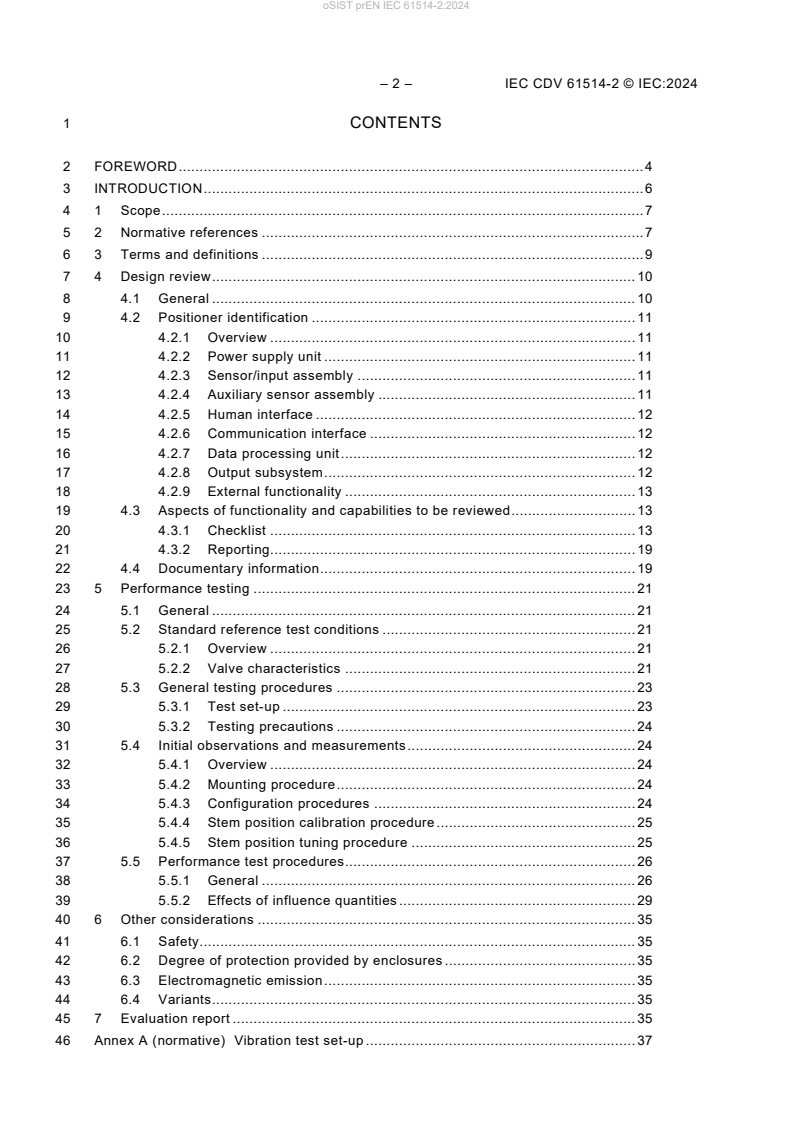
– 2 – IEC CDV 61514-2 © IEC:2024
1 CONTENTS
2 FOREWORD . 4
3 INTRODUCTION . 6
4 1 Scope . 7
5 2 Normative references . 7
6 3 Terms and definitions . 9
7 4 Design review . 10
8 4.1 General . 10
9 Positioner identification . 11
4.2
10 4.2.1 Overview . 11
11 4.2.2 Power supply unit . 11
12 4.2.3 Sensor/input assembly . 11
13 4.2.4 Auxiliary sensor assembly . 11
14 4.2.5 Human interface . 12
15 Communication interface . 12
4.2.6
16 4.2.7 Data processing unit . 12
17 4.2.8 Output subsystem . 12
18 4.2.9 External functionality . 13
19 4.3 Aspects of functionality and capabilities to be reviewed . 13
20 4.3.1 Checklist . 13
21 Reporting. 19
4.3.2
22 4.4 Documentary information . 19
23 5 Performance testing . 21
24 5.1 General . 21
25 Standard reference test conditions . 21
5.2
26 5.2.1 Overview . 21
27 5.2.2 Valve characteristics . 21
28 5.3 General testing procedures . 23
29 5.3.1 Test set-up . 23
30 5.3.2 Testing precautions . 24
31 Initial observations and measurements . 24
5.4
32 5.4.1 Overview . 24
33 5.4.2 Mounting procedure . 24
34 5.4.3 Configuration procedures . 24
35 5.4.4 Stem position calibration procedure . 25
36 5.4.5 Stem position tuning procedure . 25
37 Performance test procedures . 26
5.5
38 5.5.1 General . 26
39 5.5.2 Effects of influence quantities . 29
40 6 Other considerations . 35
41 Safety. 35
6.1
42 6.2 Degree of protection provided by enclosures . 35
43 6.3 Electromagnetic emission . 35
44 6.4 Variants . 35
45 7 Evaluation report . 35
46 Annex A (normative) Vibration test set-up . 37
61514-2 © IEC:202X – 3 –
47 Bibliography . 38
49 Figure 1 – Positioner model in extensive configuration . 11
50 Figure 2 – Basic design for positioners with analogue outputs . 13
51 Figure 3 – Basic design for positioners with pulsed output . 13
52 Figure 4 – Basic test set-up . 24
53 Figure 5 – Examples of step responses of positioners . 29
54 Figure A.1 – Test set-up for vibration test . 37
56 Table 1 – Functionality (1 of 2) . 14
57 Table 2 – Configurability . 16
58 Table 3 – Hardware configuration . 17
59 Table 4 – Operability . 17
60 Table 5 – Dependability (1 of 2) . 18
61 Table 6 – Fail safe behaviour . 19
62 Table 7 – Reporting . 19
63 Table 8 – Document information . 20
64 Table 9 – Test under reference conditions (1 of 3) . 26
65 Table 10 – Matrix of instrument properties and tests (1 of 6) . 30
– 4 – IEC CDV 61514-2 © IEC:2024
68 INTERNATIONAL ELECTROTECHNICAL COMMISSION
69 ____________
71 INDUSTRIAL PROCESS CONTROL SYSTEMS –
73 Part 2: Methods of evaluating the performance of intelligent
74 valve positioners with pneumatic outputs mounted
75 on an actuator valve assembly
77 FOREWORD
78 1) The International Electrotechnical Commission (IEC) is a worldwide organization for standardization comprising
79 all national electrotechnical committees (IEC National Committees). The object of IEC is to promote international
80 co-operation on all questions concerning standardization in the electrical and electronic fields. To this end and
81 in addition to other activities, IEC publishes International Standards, Technical Specifications, Technical Reports,
82 Publicly Available Specifications (PAS) and Guides (hereafter referred to as “IEC Publication(s)”). Their
83 preparation is entrusted to technical committees; any IEC National Committee interested in the subject dealt with
84 may participate in this preparatory work. International, governmental and non-governmental organizations liaising
85 with the IEC also participate in this preparation. IEC collaborates closely with the International Organization for
86 Standardization (ISO) in accordance with conditions determined by agreement between the two organizations.
87 2) The formal decisions or agreements of IEC on technical matters express, as nearly as possible, an international
88 consensus of opinion on the relevant subjects since each technical committee has representation from all
89 interested IEC National Committees.
90 3) IEC Publications have the form of recommendations for international use and are accepted by IEC National
91 Committees in that sense. While all reasonable efforts are made to ensure that the technical content of IEC
92 Publications is accurate, IEC cannot be held responsible for the way in which they are used or for any
93 misinterpretation by any end user.
94 4) In order to promote international uniformity, IEC National Committees undertake to apply IEC Publications
95 transparently to the maximum extent possible in their national and regional publications. Any divergence between
96 any IEC Publication and the corresponding national or regional publication shall be clearly indicated in the latter.
97 5) IEC itself does not provide any attestation of conformity. Independent certification bodies provide conformity
98 assessment services and, in some areas, access to IEC marks of conformity. IEC is not responsible for any
99 services carried out by independent certification bodies.
100 6) All users should ensure that they have the latest edition of this publication.
101 7) No liability shall attach to IEC or its directors, employees, servants or agents including individual experts and
102 members of its technical committees and IEC National Committees for any personal injury, property damage or
103 other damage of any nature whatsoever, whether direct or indirect, or for costs (including legal fees) and
104 expenses arising out of the publication, use of, or reliance upon, this IEC Publication or any other IEC
105 Publications.
106 8) Attention is drawn to the Normative references cited in this publication. Use of the referenced publications is
107 indispensable for the correct application of this publication.
108 9) Attention is drawn to the possibility that some of the elements of this IEC Publication may be the subject of patent
109 rights. IEC shall not be held responsible for identifying any or all such patent rights.
110 International Standard IEC 61514-2 has been prepared by subcommittee 65B: Measurement
111 and control devices, of IEC technical committee 65: Industrial-process measurement, control
112 and automation.
113 This part of IEC 61514-2 is to be used in conjunction with IEC 61514:202X.
114 This second edition cancels and replaces the first edition published in 2004. This edition
115 constitutes a technical revision.
116 The significant changes with respect to the previous edition are as follows:
117 – The standard has been optimized for usability.
118 – The test procedures have been reviewed regarding applicability for use in test facilities.
119 Impractical test procedures were removed or modified.
120 The text of this standard is based on the following documents:
61514-2 © IEC:202X – 5 –
FDIS Report on voting
65B/868/FDIS 65B/872/RVD
122 Full information on the voting for the approval of this standard can be found in the report on
123 voting indicated in the above table.
124 This publication has been drafted in accordance with the ISO/IEC Directives, Part 2.
125 A list of all parts of the IEC 61514 series, published under the general title Industrial process
126 control systems, can be found on the IEC website.
127 The committee has decided that the contents of this publication will remain unchanged until the
128 stability date indicated on the IEC web site under "http://webstore.iec.ch" in the data related to
129 the specific publication. At this date, the publication will be
130 • reconfirmed,
131 • withdrawn,
132 • replaced by a revised edition, or
133 • amended.
– 6 – IEC CDV 61514-2 © IEC:2024
136 INTRODUCTION
137 New instruments for process control and measurement including valve positioners are mainly
138 equipped with microprocessors, thereby utilising digital data processing and communication
139 methods and/or artificial intelligence, making them more complex and giving them a consider-
140 able added value.
141 Modern intelligent valve positioners are no longer only controlling the valve position, but they
142 are in many cases also equipped with various facilities for self-testing, actuator/valve condition
143 monitoring and alarming. The variety of added functionalities is large. They can no longer be
144 compared with the single function "cam-type" positioners. Therefore, accuracy related
145 performance testing, although still very important, is no longer sufficient to demonstrate their
146 flexibility, capabilities and other features with respect to engineering, installation, maintain-
147 ability, reliability and operability.
148 In this standard the evaluation considers performance testing and a design review of both
149 hardware and software. The layout of this document follows to some extent the framework of
150 IEC/TS 62098. A number of performance tests described in IEC 61514 are still valid for
151 intelligent valve positioners. Further reading of IEC 61069 is recommended.
61514-2 © IEC:202X – 7 –
153 INDUSTRIAL PROCESS CONTROL SYSTEMS –
155 Part 2: Methods of evaluating the performance of intelligent
156 valve positioners with pneumatic outputs mounted
157 on an actuator valve assembly
161 1 Scope
162 This part of IEC 61514 specifies design reviews and tests intended to measure and determine
163 the static and dynamic performance, the degree of intelligence and the communication
164 capabilities of single-acting or double-acting intelligent valve positioners. The tests may be
165 applied to positioners which receive standard analogue electrical input signals (as specified in
166 IEC 60381) and/or digital signals via a data communication link (for example Fieldbus) and
167 have a pneumatic output. An intelligent valve positioner as defined in Clause 3 is an instrument
168 that uses for performing its functions digital techniques for data processing, decision-making
169 and bi-directional communication. It may be equipped with additional sensors and additional
170 functionality supporting the main function.
171 The performance testing of an intelligent valve positioner needs to be conducted with the
172 positioner mounted on and connected to the actuator/valve assembly the positioner is to be
173 used on. The specific characteristic parameters of these combinations such as size, stroke,
174 friction, type of packing, spring package and supply pressure for the pneumatic part, should be
175 carefully chosen and reported, since the performance of a positioner is greatly dependent on
176 the used actuator.
177 The methods of evaluation given in this standard are intended for testing laboratories to verify
178 equipment performance specifications. The manufacturers of intelligent positioners are urged
179 to apply this standard at an early stage of development.
180 This standard is intended to provide guidance for designing evaluations of intelligent valve
181 positioners by providing:
182 – a checklist for reviewing their hardware and software design in a structured way;
183 – test methods for measuring and qualifying their performance under various environmental
184 and operational conditions;
185 – methods for reporting the data obtained.
186 When a full evaluation, in accordance with this standard, is not required or possible, the tests
187 which are required should be performed and the results should be reported in accordance with
188 the relevant parts of this standard. In such cases, the test report should state that it does not
189 cover the full number of tests specified herein. Furthermore, the items omitted should be
190 mentioned, to give the reader of the report a clear overview.
191 The standard is also applicable for non-intelligent microprocessor-based valve positioners
192 without means for bi-directional communication. In that case an evaluation should be reduced
193 to a limited programme of performance testing and a short review of the construction.
194 2 Normative references
195 The following documents, in whole or in part, are normatively referenced in this document and
196 are indispensable for its application. For dated references, only the edition cited applies. For
197 undated references, the latest edition of the referenced document (including any amendments)
198 applies.
– 8 – IEC CDV 61514-2 © IEC:2024
199 IEC 60050, International Electrotechnical Vocabulary (IEV):
200 - Part 311: Electrical and electronic measurements - General terms relating to electrical
201 measurements
202 - Part 351: Control technology
203 IEC 60068-2-1, Environmental testing – Part 2-1: Tests. Tests A: Cold
204 IEC 60068-2-2, Environmental testing – Part 2-2: Tests. Tests B: Dry heat
205 IEC 60068-2-6, Environmental testing – Part 2-6: Tests. Test Fc: Vibration (sinusoidal)
206 IEC 60068-2-31, Environmental testing – Part 2-31: Tests. Test Ec: Drop and topple, primarily
207 for equipment-type specimens
208 IEC 60068-2-78, Environmental testing – Part 2-78: Tests. Test Cab: Damp heat, steady state
209 IEC 60079 (all parts), Electrical apparatus for explosive gas atmospheres
210 IEC 60381-1, Analogue signals for process control systems – Part 1: Direct current signals
211 IEC 60381-2, Analogue signals for process control systems – Part 2: Direct voltage signals
212 IEC 60529, Degrees of protection provided by enclosures (IP Code)
213 IEC 60534-1, Industrial-process control valves – Part 1: Control valve terminology and general
214 considerations
215 IEC 60654 (all parts), Operating conditions for industrial-process measurement and control
216 equipment
217 IEC 60721-3, Classification of environmental conditions – Part 3 Classification of groups of
218 environmental parameters and their severities
219 IEC 61010-1, Safety requirements for electrical equipment for measurement, control, and
220 laboratory use – Part 1: General requirements
221 IEC 61032, Protection of persons and equipment by enclosures – Probes for verification
222 IEC 61069 (all parts), Industrial-process measurement and control – Evaluation of system
223 properties for the purpose of system assessment
224 IEC 61158 (all parts), Digital data communications for measurement and control – Fieldbus for
225 use in industrial control systems
226 IEC 61326-1:2020, Electrical equipment for measurement, control and laboratory use – EMC
227 requirements
228 IEC 61499 (all parts), Function blocks for industrial-process measurement and control systems
229 IEC 61508 Part 1 and 7, Functional safety of electrical/electronic/programmable electronic
230 safety-related systems
231 IEC 61511-Part 1 and 3, Functional safety - Safety instrumented systems for the process
232 industry sector
61514-2 © IEC:202X – 9 –
233 IEC 61514:202X, Industrial-process control systems – Methods of evaluating the performance
234 of valve positioners with pneumatic outputs
235 IEC 62061, Safety of machinery - Functional safety of safety-related control systems
236 IEC 62828-1:2017, Reference conditions and procedures for testing industrial and process
237 measurement transmitters – Part 1: General procedures for all types of transmitters
238 3 Terms and definitions
239 For the purposes of this standard, the terms and definitions given in IEC 60050 and IEC 61514,
240 as well as the following apply.
241 3.1
242 intelligent valve positioner
243 position controller based on microprocessor technology, and utilising digital techniques for data
244 processing, decision-making and bi-directional communication
245 Note 1to entry: It may be equipped with additional sensors and additional functionality supporting the main function.
246 Note 2 to entry: In this standard, only positioners with pneumatic output signals are considered, as defined in 3.1
247 of IEC 61514:202X. The input signal may be an electric current or voltage, or a digital signal via a fieldbus.
248 Note 3 to entry: For non-intelligent microprocessor-based position controllers without bi-directional communication
249 an evaluation is reduced to a limited amount of performance testing and an abridged design review of the
250 construction.
251 3.2
252 configuring
253 process of implementing the functionality required for a certain application
254 3.3
255 configurability
256 extent to which an intelligent positioner can be provided with functions to control various
257 applications
258 3.4
259 calibration
260 process of adjusting the range of travel to the required value for acquiring a defined input-to-
261 travel characteristic
262 Note 1 to entry: The adjusted travel can either be from stop to stop or to a value in between as defined by the valve
263 manufacturer.
264 Note 2 to entry: Instruments may exist that are provided with an automatic procedure for travel range adjustment,
265 which may then be addressed with the term auto-calibration.
266 [SOURCE: IEC 60050-311, 311-01-09, modified]
267 3.5
268 tuning
269 process of adjusting the various control parameters for a certain application
270 Note 1 to entry: The stem position tuning procedure can range from "trial and error" to an automatic proprietary
271 procedure provided by the manufacturer and often addressed as auto-tuning.
272 3.6
273 set-up
274 process of configuring, calibrating and tuning a positioner for optimal controlling of a specific
275 actuator/valve assembly
– 10 – IEC CDV 61514-2 © IEC:2024
276 3.7
277 travel cut-off
278 point close to the extreme end (low or high) of the characteristic curve at which the positioner
279 forces the valve to the corresponding mechanical stop (fully closed or fully open)
280 3.8
281 stroke time
282 time required to travel between two different positions under a defined set of conditions
283 3.9
284 dead band
285 finite range of values of the input variable within which a variation of the input variable does not
286 produce any measurable change in the output variable
287 [SOURCE: IEC 60050-351, 351-45-15]
288 3.10
289 operating mode
290 selected method of operation of the positioner
291 [SOURCE: IEC 60050-351, 351-55-01, modified]
292 3.11
293 setpoint
294 input variable, which sets the desired value of the controlled variable (travel)
295 Note 1 to entry: The input variable may originate from an analogue source (mA or voltage) or from a digital source
296 (fieldbus) or local keyboard).
297 3.12
298 balance pressure
299 average of the pressures on the opposite chambers of a double acting actuator in steady state
300 condition
301 Note 1 to entry: The balance pressure shall be expressed as a percentage of the positioner supply pressure to
302 evaluate the stiffness of the double acting system.
303 4 Design review
304 4.1 General
305 The observations of Clause 4 shall be based on open literature (manuals, instruction leaflets,
306 etc.) provided to a user on delivery of the instruments and whatever the manufacturer is willing
307 to disclose. They shall not contain confidential information.
308 The design review is meant to identify and make explicit the functionality and capabilities of the
309 intelligent valve positioner under consideration in a structured way. As intelligent positioners
310 appear in a great variety of designs a review has to show in a structured way the details of
311 – their physical structure;
312 – their functional structure.
313 Subclause 4.2 guides the evaluator in the process of describing the physical structure of
314 intelligent positioners through identifying the hardware modules and the I/Os to the operational
315 and environmental domains.
316 Thereafter the functional structure is described using the checklist of 4.3. The checklist gives a
317 structured framework of the relevant issues, which have to be addressed by the evaluator
318 through adequate qualitative and quantitative experiments.
61514-2 © IEC:202X – 11 –
319 4.2 Positioner identification
320 4.2.1 Overview
321 The structured identification process, based on the following considerations, leads to a block
322 scheme and a concise description of the positioner under test, which shall be included in the
323 evaluation report. It may be enhanced with photographs or drawings of important details.
324 The instrument, schematically shown in Figure 1, can have the following main physical modules
325 and provisions for connection to the external world:
To external system
Supply voltage
Power supply Communication
Supply pressure
interface
unit
Current input
Data
Sensor/input Output
E
processing
Feedback from actuator
assembly subsystem
Output pressure
P
unit
to actuator
Pos. output pressure
Aux. sensor
Pos. internal temp.
assembly
Human
Upstream line pressure mA position output
interface
Diff. pressure
Stuffing box
over valve
leakage
detector
To human operator
IEC 1305/13
327 Figure 1 – Positioner model in extensive configuration
328 4.2.2 Power supply unit
329 Instruments that require a separate connection to an AC or DC supply voltage may exist.
330 However, the majority of instruments are "loop powered" which means that they receive power
331 either through the current input for instruments that need an analogue signal (mA) setpoint, or
332 through the fieldbus when the setpoint is a digital signal.
333 4.2.3 Sensor/input assembly
334 The main sensor/input assembly is that part of the positioner to which the analogue setpoint is
335 connected and which also receives the feedback signal from the actuator/valve assembly (stem
336 movement). It supports the primary function of the positioner. Parts of the assembly may be
337 distributed at physically different locations in the positioner. In instruments that receive a digital
338 setpoint, the current input as shown in Figure 4 does not exist. The feedback signal may be
339 generated by a mechanical linkage or a non-mechanical interface between the positioner and
340 the valve stem.
341 4.2.4 Auxiliary sensor assembly
342 The auxiliary sensor assembly is for the electronics part integrated with the main sensor input
343 assembly. Many positioners are equipped with a pressure sensor in the pneumatic supply and
344 output circuit and a temperature sensor inside the electronics housing. Their signals may be
345 used in the stem position control algorithm. For safeguarding and condition monitoring of the
346 valve a positioner may be equipped with additional sensors. It may also be equipped with
347 circuits for digital inputs from switches.
– 12 – IEC CDV 61514-2 © IEC:2024
348 4.2.5 Human interface
349 A positioner can be classified as intelligent only when data produced by the positioner can be
350 communicated to the external world. The human interface is an important tool for
351 communication. It consists of integral means at the instrument for reading out data (local
352 display) and provisions for entering and requesting data (local pushbuttons). It may appear that
353 some instruments are not equipped with a human interface. In these cases access is provided
354 via the data communication interface and an external device (handheld terminal or PC).
355 4.2.6 Communication interface
356 Positioner intelligence is further supported by the communication interface, which connects the
357 positioner to external systems. Through the interface and a fieldbus, data transfer (setpoint,
358 configuration and process data) takes place between the positioner and the external system.
359 There are also hybrid instruments, which require an analogue input for control data where the
360 data communication interface is integrated in the input circuit and has no separate point of
361 connection for the fieldbus. The digital information is superimposed on the analogue input
362 current. There may be instruments which do not have a communication interface. Then
363 configuration and read-out of data take place via the human interface.
364 4.2.7 Data processing unit
365 The data processing unit provides the instrument with a number of functions that may vary
366 considerably from make to make. The functions that can be implemented include:
367 – control function;
368 – configuration;
369 – calibration;
370 – tuning;
371 – valve condition monitoring (valve diagnostics);
372 – external process control function;
373 – self-testing;
374 – trending and data storage;
375 – part of the functionality may be located in external devices that are temporarily or
376 continuously connected to the data communication interface (e.g. configuration, trending).
377 4.2.8 Output subsystem
378 In the single acting version the output subsystem converts the digital information via an electro-
379 pneumatic converter (E/P) into the pneumatic signal for controlling the actuator.
380 In the double acting version the output subsystem is equipped with two oppositely operating
381 E/P converters. In balanced (steady) position the converters provide pressures that, apart from
382 the friction force to the valve stem, are equal. The relation between the balance pressure and
383 the supply pressure determines the stiffness of a double acting system.
384 With respect to the pneumatic unit, the following two designs are, among others, commonly
385 used:
386 – analogue techniques of conventional E/P converters as shown in Figure 2;
387 – electronically controlled two-state pilot valves.
388 Moreover, the output subsystem can also be provided with isolated analogue signal outputs
389 proportional to one (or more) of the measured or calculated data and/or one or more
390 configurable output relays for alarm purposes. Such outputs usually require a separate power
391 supply.
61514-2 © IEC:202X – 13 –
393 Figure 2 – Basic design for positioners with analogue outputs
Control signal Control signal
open close
Pilot
Pilot
valve 1 valve 2
Supply
Venting
pressure
output
Actuator
Stem travel
IEC 1307/13
395 Figure 3 – Basic design for positioners with pulsed output
396 4.2.9 External functionality
397 Through the data communication interface and the fieldbus the instrument communicates with
398 PCs, handheld devices and DCS systems. In many cases a part of the functionality of the
399 positioner may reside in these devices. This may include the following functions:
400 – (Remote) configuration tool.
401 – Data storage (configuration, position trend, valve condition).
402 – Parts of the calibration and stem tuning procedure.
403 – Automated valve condition monitoring and alarming.
404 In an evaluation the external functionality (if present) shall be considered as well.
405 4.3 Aspects of functionality and capabilities to be reviewed
406 4.3.1 Checklist
407 The following Tables 1 through 5 shall serve as a checklist for the determination of the functions
408 and capabilities implemented in the positioner under consideration. An example of the reporting
409 format can be found in 4.4.
– 14 – IEC CDV 61514-2 © IEC:2024
410 Table 1 – Functionality (1 of 2)
Function/capability Aspects to be considered during evaluation
Suitable for rotary valve If so, also indicate the stroke range and describe the accessories required for
mechanical linkage.
Suitable for linear stroke valve If so, also indicate the stroke range and describe the accessories required for
mechanical linkage.
Direct/reverse action Check whether choice of direct/reverse action is possible and describe how
the mechanism operates.
Double acting version Check one of the following:
– always included
– can be retrofitted
– available with different order number
– not available
Stem position control algorithm For each control parameter give:
parameters
– name
– adjustment range if user-adjustable
– default values if applicable
– check whether invalid values are recognised and rejected
– check whether negative values are accepted, if so observe behaviour on
instability after step change
– check if outputs of internal sensors are used in the stem position control
algorithm and check whether and how backup is provided in case of sensor
failure
– some designs have a double set of control parameters for upscale or
downscale movement, verify
– what value defines indefinite (‘99999’ or ‘0’)?
Other parameters affecting For a number of parameters (supply pressure, valve and actuator data, etc.)
control values may be requested to be entered during configuration. They might be
used in the stem position control algorithm. Check whether they are indeed
used in the stem position control algorithm or are informative only.
Operating modes List the available operating modes, their hierarchy, span of control, switching
order (also check availability of bumpless transfer), degree of authorised
access to positioner database (configuration, control parameters, secondary
parameters).
Operating modes could be:
– out of service or standby
– automatic control
– manual control (local or remote)
Split range application Is split range operation possible?
If so, state the adjustable value range.
Stroke time Check whether the stroke time is user-adjustable. State the adjustable value
range.
Travel cut-off Cut-off is usually possible at the lower end of the characteristic (also known
as tight shut-off), but also cut-off at the upper end can be present. Indicate
which option is available and whether cut-off values are user-configurable.
Check whether a dead band is implemented and operational between
activation and release. Indicate whether it is related to the input signal or to
the feedback position signal.
Filters If filters are provided, are they analogue or digital?
External (process) control Can function blocks (according to IEC 61499) for an external control loop be
implemented?
Special functions Indicate if special functions are available (e.g. pressure sensor in actuator,
leak detection, flow measurement).
61514-2 © IEC:202X – 15 –
413 Table 1 (2 of 2)
Function/capability Aspects to be considered during evaluation
Valve diagnostics Check whether implemented Valve Diagnostics cover the following aspects:
– change in performance of control valve (dead band, resolution, etc.)
– change of friction
– wear of plug
– wear of stem
– packing leakage
– seat leakage
– break of stem
– cavitation
– broken actuator spring
– air leakage at actuator
– valve stuck
– torn diaphragm at actuator
– detection of reduction of performance by plugging of pneumatic
Other aspects
Checks on extent of and tools for Check how the aspects mentioned above are diagnosed, tested, stored,
valve diagnostics reported and presented by the positioner or the host system.
Does the diagnostic tool provide direct automatic interpretation by the
instrument or does it require a specific level of human expertise. For each
aspect check which of the tools (tests) mentioned below are used, check per
tool the following points:
– whether the diagnostic tests can be performed in-service
– whether it is an on-line automatic test or an operator-initiated
– check intervals between automatic tests
– check user-adaptability of test parameters
– check whether test affects the stem position
– indicate whether data can be stored and where (local or in PC)
– check whether there is a related direct alert/alarm message or whether it
has to be deduced by the user from other information given by the
positioner. (Example: Many positioners are equipped with a user-
adjustable alarm indicating that the valve is not reaching its position in a
certain time. Break of stem, and broken spring will most probably trigger
this alarm)
– check the action of the positioner on appearance of diagnostic alarms
Tools (tests) that can be present are amongst other things:
– high/low position alarms
– rate of change alarm
– cycle counter/accumulator
– ravel accumulator
– valve signature test
– step response test
– time to settle exceeds the set limit
Accumulator for time close to zero
– 16 – IEC CDV 61514-2 © IEC:2024
416 Table 2 – Configurability
Function/capability Aspects to be considered during evaluation
Fieldbus compatibility Check whether the instrument under test is suited for either: ®
– HART ®
– PROFIBUS PA ®
– PROFIBUS DP
– FOUNDATION™ FIELDBUS H1
– FOUNDATION™ FIELDBUS HSE
– Other (state details)
Configuration tools Check if the instrument can be configured:
– from local controls (human interface) on instrument
– remotely from PC or a host computer
– via handheld communication unit to be connected temporarily
– other
On-line (re)configuration Check whether parameters can be changed in control mode, if so whether the
position of the valve stem is unacceptably affected.
Check whether there is a security mechanism that prohibits on-line access to
all or some parameters.
Off-line configuration Check whether it is possible to set up and store configurations for a number of
positioners on a separate (off-line) PC, which is not connected to a positioner.
Up/download to/from PC Check if configuration upload is possible. Check if download of off-line
prepared configurations is possible.
Configurable travel Mention user-selectable characteristics that reside in the instrument, such as:
characteristics
– linear
– equal percentage (IEC 60534-1) 1:50; 1:30; 1:25, etc.
– quick opening
– segmental (user defined travel characteristic), mention number of
segments
NOTE The equal percentage characteristic is sometimes realised by
segmental approach. It is important to state the number of segments and their
size and to evaluate the maximum errors with respect to the theoretical equal
percentage characteristic.
Configurable “fail-safe” position Check the availability of a configurable fail-safe position. Note the behaviour
for the different failure modes. Use Table 6 to check behaviour.
Balance pressure Check whether the balance pressure for the double acting version is user-
adjustable.
Conditions on start-up after loss After a power down the user may want the positioner to return to a defined
of power or an instrument reset position. Positioners may be provided with:
– return to last value
– go to fail-safe
– go to a user-defined value
– return to control in manual mode
________________
1 HART® is the trade name of the non-profit consortium HART Communication Foundation. This information is
given for the convenience of users of this document and does not constitute an endorsement by IEC of the
products named. Equivalent products may be used if they can be shown to lead to the same results.
PROFIBUS PA and PROFIBUS DP are the trade names of products supplied by the non-profit organization
PROFIBUS Nutzerorganisation e.V. (PNO). This information is given for the convenience of users of this
document and does not constitute an endorsement by IEC of the products named. Equivalent products may be
used if they can be shown to lead to the same results.
3 FOUNDATION™ FIELDBUS H1 and FOUNDATION™ FIELDBUS HSE are the trade names of products sup
...
Questions, Comments and Discussion
Ask us and Technical Secretary will try to provide an answer. You can facilitate discussion about the standard in here.
Loading comments...