

EN IEC 62325-451-8:2022
(Main)Framework for energy market communications - Part 451-8: HVDC Scheduling process, contextual and assembly models for European style market
General Information
- Abstract
IEC 62325-451-8:2022 specifies a UML package for the HVDC Link scheduling business process and its associated document contextual models, assembly models and XML schemas for use within the European style electricity markets. This part of IEC 62325 is based on the European style market contextual model (IEC 62325-351). The business process covered by this part of IEC 62325 is described in Subclause 5.3. The relevant aggregate core components (ACCs) defined in IEC 62325-351 have been contextualised into aggregated business information entities (ABIEs) to satisfy the requirements of the European style market HVDC Link scheduling business process.
- Status
- Published
- Publication Date
- 05-May-2022
- Technical Committee
- CLC/TC 57 - Power systems management and associated information exchange
- Drafting Committee
- IEC/TC 57 - IEC_TC_57
- Current Stage
- 9093 - Decision to confirm - Review Enquiry
- Start Date
- 05-Jan-2026
- Completion Date
- 25-Aug-2026
Buy Documents



EN IEC 62325-451-8:2022 - BARVE. POZOR: ! k standardu IEC spada tudi datoteka "IEC_62325-451-8.XSD_Schema.1.1.light" (zip file)
Overview
EN IEC 62325-451-8:2022 (CLC) defines a standardized modelling and messaging framework for HVDC Link scheduling in European-style electricity markets. It specifies a UML package and accompanying document contextual models, message assembly models and XML schemas (notably the HVDCLink_MarketDocument) to support the HVDC scheduling business process. This part of IEC 62325 builds on the European style market contextual model (IEC 62325-351) and contextualizes Aggregate Core Components (ACCs) into Aggregated Business Information Entities (ABIEs) for consistent information exchange.
Key topics and requirements
- UML package for HVDC scheduling: formal model to represent actors, roles and data structures in the HVDC Link scheduling process.
- Document contextual models (DCM): definitions of business entities (e.g., TimeSeries, Series_Period, Point, Domain, MarketParticipant) required to describe HVDC schedules and constraints.
- Message assembly models (MAM): rules to assemble contextual classes into messages suitable for transmission across market systems.
- XML Schema (HVDCLink_MarketDocument): schema structure, namespace and URN rules for interoperable XML messages used in market communications.
- Business process mapping: explicit description of the HVDC Link scheduling process (see Subclause 5.3), roles such as Scheduling Area Responsible, and use cases (configuration, constraints, schedule publication).
- Data types and code lists: standardized datatypes, enumerations and code list URNs to ensure semantic interoperability.
- Rules and constraints: generic business rules for document instances, retransmission of historical information, and rules for TimeSeries handling.
Applications and who uses it
This standard is intended for organizations and systems involved in cross-border and market-based HVDC operation and scheduling:
- Transmission System Operators (TSOs) and HVDC operators implementing scheduling workflows and market interfaces.
- Market operators and Scheduling Area Responsible entities exchanging HVDC capacity, configurations and schedules.
- Software vendors and system integrators building market coupling, scheduling and energy trading platforms that require interoperable XML messages and CIM-based models.
- Consultants and regulators specifying market communication requirements and validating compliance with European market profiles.
Practical benefits include improved interoperability, reduced integration effort, consistent HVDC schedule publication and automated processing across European-style electricity markets.
Related standards
- IEC 62325-351 (CIM European market model exchange profile)
- IEC 62325-450 (Profile and context modelling rules)
- Other IEC 62325 parts (e.g., 451-1, 451-3, 451-7) and IEC 62361-100 for CIM-to-XML mapping
Keywords: EN IEC 62325-451-8, HVDC scheduling, European style market, HVDCLink_MarketDocument, UML package, XML schema, market communications, CLC.
Relations
- Effective Date
- 03-Feb-2026
- Effective Date
- 03-Feb-2026
- Effective Date
- 03-Feb-2026
- Effective Date
- 03-Feb-2026
- Effective Date
- 03-Feb-2026
- Effective Date
- 03-Feb-2026
Buy Documents
EN IEC 62325-451-8:2022 - BARVE. POZOR: ! k standardu IEC spada tudi datoteka "IEC_62325-451-8.XSD_Schema.1.1.light" (zip file)
Get Certified
Connect with accredited certification bodies for this standard

ANCE
Mexican certification and testing association.

Intertek Slovenia
Intertek testing, inspection, and certification services in Slovenia.

LNE (Laboratoire National de Métrologie et d'Essais)
French national laboratory for metrology and testing.
Sponsored listings
Frequently Asked Questions
EN IEC 62325-451-8:2022 is a standard published by CLC. Its full title is "Framework for energy market communications - Part 451-8: HVDC Scheduling process, contextual and assembly models for European style market". This standard covers: IEC 62325-451-8:2022 specifies a UML package for the HVDC Link scheduling business process and its associated document contextual models, assembly models and XML schemas for use within the European style electricity markets. This part of IEC 62325 is based on the European style market contextual model (IEC 62325-351). The business process covered by this part of IEC 62325 is described in Subclause 5.3. The relevant aggregate core components (ACCs) defined in IEC 62325-351 have been contextualised into aggregated business information entities (ABIEs) to satisfy the requirements of the European style market HVDC Link scheduling business process.
IEC 62325-451-8:2022 specifies a UML package for the HVDC Link scheduling business process and its associated document contextual models, assembly models and XML schemas for use within the European style electricity markets. This part of IEC 62325 is based on the European style market contextual model (IEC 62325-351). The business process covered by this part of IEC 62325 is described in Subclause 5.3. The relevant aggregate core components (ACCs) defined in IEC 62325-351 have been contextualised into aggregated business information entities (ABIEs) to satisfy the requirements of the European style market HVDC Link scheduling business process.
EN IEC 62325-451-8:2022 is classified under the following ICS (International Classification for Standards) categories: 33.200 - Telecontrol. Telemetering. The ICS classification helps identify the subject area and facilitates finding related standards.
EN IEC 62325-451-8:2022 has the following relationships with other standards: It is inter standard links to EN 62325-450:2013, EN 62361-100:2016, EN 62325-451-1:2017, EN 62325-351:2016, EN 62325-451-3:2014, CLC/TS 61970-2:2005. Understanding these relationships helps ensure you are using the most current and applicable version of the standard.
EN IEC 62325-451-8:2022 is available in PDF format for immediate download after purchase. The document can be added to your cart and obtained through the secure checkout process. Digital delivery ensures instant access to the complete standard document.
Standards Content (Sample)
SLOVENSKI STANDARD
01-julij-2022
Okvir za komunikacije na trgu z električno energijo - 451-8. del: Procesi HVDC,
kontekstni in združevalni modeli evropskega trga
Framework for energy market communications - Part 451-8: HVDC processes,
contextual and assembly models for European style market
Ta slovenski standard je istoveten z: EN IEC 62325-451-8:2022
ICS:
29.240.30 Krmilna oprema za Control equipment for electric
elektroenergetske sisteme power systems
33.200 Daljinsko krmiljenje, daljinske Telecontrol. Telemetering
meritve (telemetrija)
2003-01.Slovenski inštitut za standardizacijo. Razmnoževanje celote ali delov tega standarda ni dovoljeno.
EUROPEAN STANDARD EN IEC 62325-451-8
NORME EUROPÉENNE
EUROPÄISCHE NORM May 2022
ICS 33.200
English Version
Framework for energy market communications - Part 451-8:
HVDC Scheduling process, contextual and assembly models for
European style market
(IEC 62325-451-8:2022)
Cadre pour les communications pour le marché de l'énergie Kommunikation im Energiemarkt - Teil 451-8:
- Partie 451-8: Processus de programmation de liaisons Hochspannungsgleichstrom (HGÜ)- Prozesse,
HVDC, modèles contextuels et modèles d'assemblage pour Kontextbezogene Modelle und Einbindungsmodelle für den
le marché de style européen europäischen Markt
(IEC 62325-451-8:2022) (IEC 62325-451-8:2022)
This European Standard was approved by CENELEC on 2022-04-28. CENELEC members are bound to comply with the CEN/CENELEC
Internal Regulations which stipulate the conditions for giving this European Standard the status of a national standard without any alteration.
Up-to-date lists and bibliographical references concerning such national standards may be obtained on application to the CEN-CENELEC
Management Centre or to any CENELEC member.
This European Standard exists in three official versions (English, French, German). A version in any other language made by translation
under the responsibility of a CENELEC member into its own language and notified to the CEN-CENELEC Management Centre has the
same status as the official versions.
CENELEC members are the national electrotechnical committees of Austria, Belgium, Bulgaria, Croatia, Cyprus, the Czech Republic,
Denmark, Estonia, Finland, France, Germany, Greece, Hungary, Iceland, Ireland, Italy, Latvia, Lithuania, Luxembourg, Malta, the
Netherlands, Norway, Poland, Portugal, Republic of North Macedonia, Romania, Serbia, Slovakia, Slovenia, Spain, Sweden, Switzerland,
Turkey and the United Kingdom.
European Committee for Electrotechnical Standardization
Comité Européen de Normalisation Electrotechnique
Europäisches Komitee für Elektrotechnische Normung
CEN-CENELEC Management Centre: Rue de la Science 23, B-1040 Brussels
© 2022 CENELEC All rights of exploitation in any form and by any means reserved worldwide for CENELEC Members.
Ref. No. EN IEC 62325-451-8:2022 E
European foreword
The text of document 57/2452/FDIS, future edition 1 of IEC 62325-451-8, prepared by IEC/TC 57
"Power systems management and associated information exchange" was submitted to the IEC-
CENELEC parallel vote and approved by CENELEC as EN IEC 62325-451-8:2022.
The following dates are fixed:
• latest date by which the document has to be implemented at national (dop) 2023-01-28
level by publication of an identical national standard or by endorsement
• latest date by which the national standards conflicting with the (dow) 2025-04-28
document have to be withdrawn
Attention is drawn to the possibility that some of the elements of this document may be the subject of
patent rights. CENELEC shall not be held responsible for identifying any or all such patent rights.
Any feedback and questions on this document should be directed to the users’ national committee. A
complete listing of these bodies can be found on the CENELEC website.
Endorsement notice
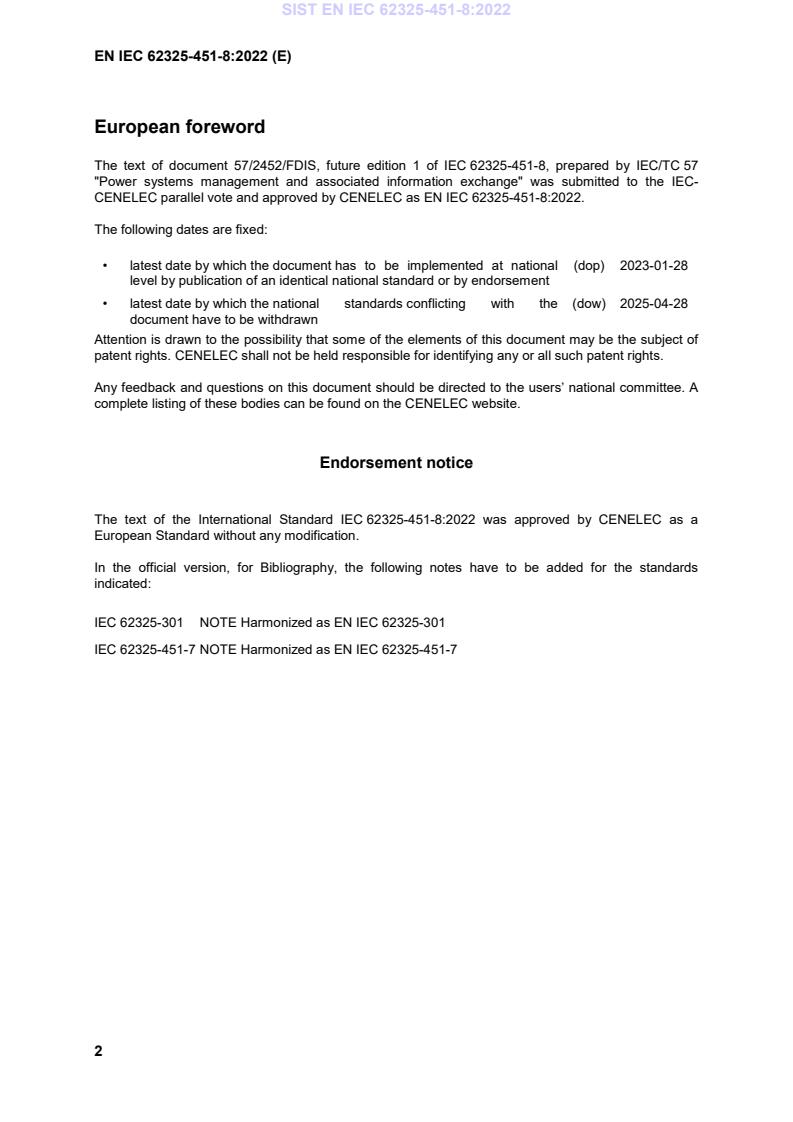
The text of the International Standard IEC 62325-451-8:2022 was approved by CENELEC as a
European Standard without any modification.
In the official version, for Bibliography, the following notes have to be added for the standards
indicated:
IEC 62325-301 NOTE Harmonized as EN IEC 62325-301
IEC 62325-451-7 NOTE Harmonized as EN IEC 62325-451-7
Annex ZA
(normative)
Normative references to international publications
with their corresponding European publications
The following documents are referred to in the text in such a way that some or all of their content
constitutes requirements of this document. For dated references, only the edition cited applies. For
undated references, the latest edition of the referenced document (including any amendments)
applies.
NOTE 1 Where an International Publication has been modified by common modifications, indicated by (mod), the
relevant EN/HD applies.
NOTE 2 Up-to-date information on the latest versions of the European Standards listed in this annex is available
here: www.cenelec.eu.
Publication Year Title EN/HD Year
IEC/TS 61970-2 - Energy management system application CLC/TS 61970-2 -
program interface (EMS-API) - Part 2:
Glossary
IEC 62325-351 2016 Framework for energy market EN 62325-351 2016
communications - Part 351: CIM European
market model exchange profile
IEC 62325-450 2013 Framework for energy market EN 62325-450 2013
communications - Part 450: Profile and
context modelling rules
IEC 62325-451-1 - Framework for energy market EN 62325-451-1 -
communications - Part 451-1:
Acknowledgement business process and
contextual model for CIM European market
IEC 62325-451-3 - Framework for energy market EN 62325-451-3 -
communications - Part 451-3:
Transmission capacity allocation business
process (explicit or implicit auction) and
contextual models for European market
IEC 62361-100 - Power systems management and EN 62361-100 -
associated information exchange -
Interoperability in the long term - Part 100:
CIM profiles to XML schema mapping
IEC 62325-451-8 ®
Edition 1.0 2022-03
INTERNATIONAL
STANDARD
NORME
INTERNATIONALE
colour
inside
Framework for energy market communications –
Part 451-8: HVDC Scheduling process, contextual and assembly models for
European style market
Cadre pour les communications pour le marché de l'énergie –
Partie 451-8: Processus de programmation de liaisons HVDC, modèles
contextuels et modèles d'assemblage pour le marché de style européen
INTERNATIONAL
ELECTROTECHNICAL
COMMISSION
COMMISSION
ELECTROTECHNIQUE
INTERNATIONALE
ICS 33.200 ISBN 978-2-8322-1081-4
– 2 – IEC 62325-451-8:2022 © IEC 2022
CONTENTS
FOREWORD . 6
INTRODUCTION . 8
1 Scope . 9
2 Normative references . 9
3 Terms and definitions . 10
4 Document contextual model and message assembly model basic concepts . 11
4.1 Overview. 11
4.2 European style market package structure (ESMP) . 12
4.3 From the European style market profile to the document contextual model . 14
4.4 From the document contextual model to the message assembly model . 14
4.5 From the assembly model to the XML schema . 14
5 The HVDC Link scheduling business process . 14
5.1 General . 14
5.2 Roles . 15
5.2.1 The Scheduling Area Responsible role . 15
5.2.2 Sub-roles . 15
5.3 HVDC Link scheduling business process . 15
5.4 Use Cases . 16
5.4.1 General Overview . 16
5.4.2 HVDC Link constraints . 16
5.4.3 HVDC Link configuration . 16
5.4.4 HVDC Link schedule . 17
5.5 Sequence Diagram . 17
5.6 Electronic documents used . 18
5.6.1 HVDC Link Document . 18
5.6.2 Capacity Document . 18
5.7 Generic business rules for documents . 19
5.7.1 General . 19
5.7.2 Document instance implementation . 19
5.8 Rules governing the HVDCLink_MarketDocument . 20
5.8.1 Retransmission of historical information . 20
5.8.2 Rules governing the TimeSeries class . 20
6 Contextual and assembly models. 20
6.1 HVDCLink document contextual model . 20
6.1.1 Overview of the model . 20
6.1.2 IsBasedOn relationships from the European style market profile . 21
6.1.3 Detailed HVDCLink document contextual model . 21
6.2 HVDCLink document assembly model . 29
6.2.1 Overview of the model . 29
6.2.2 IsBasedOn relationships from the European style market profile . 30
6.2.3 Detailed HVDCLink document assembly model . 31
6.2.4 Primitives . 35
6.2.5 Datatypes . 35
6.2.6 Enumerations . 43
7 XML Schema . 43
7.1 XML schema URN namespace rules . 43
IEC 62325-451-8:2022 © IEC 2022 – 3 –
7.2 Code list URN namespace rules . 44
7.3 URI rules for model documentation . 44
7.3.1 Datatype . 44
7.3.2 Class . 44
7.3.3 Attribute . 45
7.3.4 Association end role name . 45
7.4 HVDCLink_MarketDocument schema . 45
7.4.1 Schema structure . 45
7.4.2 Schema description . 48
Bibliography . 53
Figure 1 – IEC 62325-450 modelling framework . 12
Figure 2 – Overview of European style market profile dependency . 13
Figure 3 – Steps of the HVDC Link scheduling business process . 15
Figure 4 – HVDCLink Scheduling Process Overview . 16
Figure 5 – Generic sequence diagram of the information flows . 18
Figure 6 – HVDCLink document contextual model . 20
Figure 7 – HVDCLink document assembly model . 30
Figure 8 – HVDCLink_MarketDocument XML schema structure (1/2) . 46
Figure 9 – HVDCLink_MarketDocument XML schema structure (2/2) . 47
Table 1 – Dependency table outline for the HVDC Link scheduling process . 19
Table 2 – IsBasedOn dependency. 21
Table 3 – Attributes of HVDCLink document contextual
model::HVDCLink_MarketDocument . 22
Table 4 – Association ends of HVDCLink document contextual
model::HVDCLink_MarketDocument with other classes. 22
Table 5 – Attributes of HVDCLink document contextual model::DateAndOrTime . 23
Table 6 – Attributes of HVDCLink document contextual model::Domain . 23
Table 7 – Attributes of HVDCLink document contextual model::Exchange_Quantity . 23
Table 8 – Attributes of HVDCLink document contextual
model::HVDCMode_AttributeInstanceComponent . 24
Table 9 – Attributes of HVDCLink document contextual model::MarketParticipant . 24
Table 10 – Association ends of HVDCLink document contextual
model::MarketParticipant with other classes . 24
Table 11 – Attributes of HVDCLink document contextual model::MarketRole . 24
Table 12 – Attributes of HVDCLink document contextual model::Measure_Unit . 25
Table 13 – Attributes of HVDCLink document contextual model::Point . 25
Table 14 – Association ends of HVDCLink document contextual model:: Point with
other classes . 25
Table 15 – Attributes of HVDCLink document contextual model::Process . 26
Table 16 – Attributes of HVDCLink document contextual model::Quantity . 26
Table 17 – Attributes of HVDCLink document contextual model::Reason . 26
Table 18 – Attributes of HVDCLink document contextual model::RegisteredResource . 26
Table 19 – Attributes of HVDCLink document contextual model::Series_Period . 27
– 4 – IEC 62325-451-8:2022 © IEC 2022
Table 20 – Association ends of HVDCLink document contextual model:: Series_Period
with other classes . 27
Table 21 – Attributes of HVDCLink document contextual model::Time_Period . 27
Table 22 – Attributes of HVDCLink document contextual model::TimeSeries . 28
Table 23 – Association ends of HVDCLink document contextual model:: TimeSeries
with other classes . 28
Table 24 – IsBasedOn dependency . 30
Table 25 – Attributes of HVDCLink document assembly
model::HVDCLink_MarketDocument . 31
Table 26 – Association ends of HVDCLink document assembly
model::HVDCLink_MarketDocument with other classes. 32
Table 27 – Attributes of HVDCLink document assembly model::Point. 32
Table 28 – Attributes of HVDCLink document assembly model::Reason . 32
Table 29 – Attributes of HVDCLink document assembly model::Series_Period . 33
Table 30 – Association ends of HVDCLink document assembly model:: Series_Period
with other classes . 33
Table 31 – Attributes of HVDCLink document assembly model::TimeSeries . 33
Table 32 – Association ends of HVDCLink document assembly model:: TimeSeries
with other classes . 34
Table 33 – Attributes of ESMPDataTypes::Action_Status . 35
Table 34 – Attributes of ESMPDataTypes::ESMP_DateTimeInterval . 36
Table 35 – Attributes of ESMPDataTypes::AreaID_String. 36
Table 36 – Restrictions of attributes for ESMPDataTypes::AreaID_String . 36
Table 37 – Attributes of ESMPDataTypes::BusinessKind_String . 36
Table 38 – Attributes of ESMPDataTypes::CurveType_String . 37
Table 39 – Attributes of ESMPDataTypes::EnergyProductKind_String . 37
Table 40 – Attributes of ESMPDataTypes::ESMP_DateTime . 37
Table 41 – Restrictions of attributes for ESMPDataTypes::ESMP_DateTime . 37
Table 42 – Attributes of ESMPDataTypes::ESMPVersion_String . 38
Table 43 – Restrictions of attributes for ESMPDataTypes::ESMPVersion_String . 38
Table 44 – Attributes of ESMPDataTypes::HVDCMode_String . 38
Table 45 – Attributes of ESMPDataTypes::ID_String . 38
Table 46 – Restrictions of attributes for ESMPDataTypes::ID_String . 39
Table 47 – Attributes of ESMPDataTypes::MarketRoleKind_String . 39
Table 48 – Attributes of ESMPDataTypes::MeasurementUnitKind_String . 39
Table 49 – Attributes of ESMPDataTypes::MessageKind_String . 39
Table 50 – Attributes of ESMPDataTypes::ObjectAggregationKind_String . 40
Table 51 – Attributes of ESMPDataTypes::PartyID_String . 40
Table 52 – Restrictions of attributes for ESMPDataTypes::PartyID_String . 40
Table 53 – Attributes of ESMPDataTypes::Position_Integer . 40
Table 54 – Restrictions of attributes for ESMPDataTypes::Position_Integer . 41
Table 55 – Attributes of ESMPDataTypes::ProcessKind_String . 41
Table 56 – Attributes of ESMPDataTypes::ReasonCode_String . 41
Table 57 – Attributes of ESMPDataTypes::ReasonText_String . 41
Table 58 – Restrictions of attributes for ESMPDataTypes::ReasonText_String . 41
IEC 62325-451-8:2022 © IEC 2022 – 5 –
Table 59 – Attributes of ESMPDataTypes::ResourceID_String . 42
Table 60 – Restrictions of attributes for ESMPDataTypes::ResourceID_String . 42
Table 61 – Attributes of ESMPDataTypes::Status_String . 42
Table 62 – Attributes of ESMPDataTypes::YMDHM_DateTime . 42
Table 63 – Restrictions of attributes for ESMPDataTypes::YMDHM_DateTime . 43
– 6 – IEC 62325-451-8:2022 © IEC 2022
INTERNATIONAL ELECTROTECHNICAL COMMISSION
____________
FRAMEWORK FOR ENERGY MARKET COMMUNICATIONS –
Part 451-8: HVDC Scheduling process, contextual and assembly
models for European style market
FOREWORD
1) The International Electrotechnical Commission (IEC) is a worldwide organization for standardization comprising
all national electrotechnical committees (IEC National Committees). The object of IEC is to promote international
co-operation on all questions concerning standardization in the electrical and electronic fields. To this end and
in addition to other activities, IEC publishes International Standards, Technical Specifications, Technical Reports,
Publicly Available Specifications (PAS) and Guides (hereafter referred to as “IEC Publication(s)”). Their
preparation is entrusted to technical committees; any IEC National Committee interested in the subject dealt with
may participate in this preparatory work. International, governmental and non-governmental organizations liaising
with the IEC also participate in this preparation. IEC collaborates closely with the International Organization for
Standardization (ISO) in accordance with conditions determined by agreement between the two organizations.
2) The formal decisions or agreements of IEC on technical matters express, as nearly as possible, an international
consensus of opinion on the relevant subjects since each technical committee has representation from all
interested IEC National Committees.
3) IEC Publications have the form of recommendations for international use and are accepted by IEC National
Committees in that sense. While all reasonable efforts are made to ensure that the technical content of IEC
Publications is accurate, IEC cannot be held responsible for the way in which they are used or for any
misinterpretation by any end user.
4) In order to promote international uniformity, IEC National Committees undertake to apply IEC Publications
transparently to the maximum extent possible in their national and regional publications. Any divergence between
any IEC Publication and the corresponding national or regional publication shall be clearly indicated in the latter.
5) IEC itself does not provide any attestation of conformity. Independent certification bodies provide conformity
assessment services and, in some areas, access to IEC marks of conformity. IEC is not responsible for any
services carried out by independent certification bodies.
6) All users should ensure that they have the latest edition of this publication.
7) No liability shall attach to IEC or its directors, employees, servants or agents including individual experts and
members of its technical committees and IEC National Committees for any personal injury, property damage or
other damage of any nature whatsoever, whether direct or indirect, or for costs (including legal fees) and
expenses arising out of the publication, use of, or reliance upon, this IEC Publication or any other IEC
Publications.
8) Attention is drawn to the Normative references cited in this publication. Use of the referenced publications is
indispensable for the correct application of this publication.
9) Attention is drawn to the possibility that some of the elements of this IEC Publication may be the subject of patent
rights. IEC shall not be held responsible for identifying any or all such patent rights.
IEC 62325-451-8 has been prepared by IEC technical committee 57: Power systems
management and associated information exchange. It is an International Standard.
The text of this International Standard is based on the following documents:
Draft Report on voting
57/2452/FDIS 57/2468/RVD
Full information on the voting for its approval can be found in the report on voting indicated in
the above table.
The language used for the development of this International Standard is English.
This IEC standard includes Code Components i.e. components that are intended to be directly
processed by a computer.
IEC 62325-451-8:2022 © IEC 2022 – 7 –
Such content is any text found between the markers and , or
otherwise is clearly labelled in this standard as a Code Component. The code component of
this document is the XML schema file defined in Clause 7.
The purchase of this IEC standard carries a copyright license for the purchaser to sell software
containing Code Components from this standard to end users either directly or via distributors,
subject to IEC software licensing conditions, which can be found at: http://www.iec.ch/CCv1.
A list of all parts in the IEC 62325 series, published under the general title Framework for energy
market communications, can be found on the IEC website.
This document was drafted in accordance with ISO/IEC Directives, Part 2, and developed in
accordance with ISO/IEC Directives, Part 1 and ISO/IEC Directives, IEC Supplement, available
at www.iec.ch/members_experts/refdocs. The main document types developed by IEC are
described in greater detail at www.iec.ch/standardsdev/publications.
The committee has decided that the contents of this document will remain unchanged until the
stability date indicated on the IEC website under webstore.iec.ch in the data related to the
specific document. At this date, the document will be
• reconfirmed,
• withdrawn,
• replaced by a revised edition, or
• amended.
IMPORTANT – The 'colour inside' logo on the cover page of this publication indicates that it
contains colours which are considered to be useful for the correct understanding of its
contents. Users should therefore print this document using a colour printer.
– 8 – IEC 62325-451-8:2022 © IEC 2022
INTRODUCTION
This document is one part of the IEC 62325 series for deregulated energy market data
exchanges based on the European style market profile. This part of IEC 62325 defines the
document contextual models, the message assembly models as well as the XML schemas to
be used for the HVDC Link Scheduling process.
The principal objective of the IEC 62325 series is to produce standards which facilitate the
integration of market application software developed independently by different vendors into a
market management system, between market management systems and market participant
systems. This is accomplished by defining message exchanges to allow these applications or
systems access to public data and exchange information independent of how such information
is represented internally.
The common information model (CIM), i.e. IEC 62325-301, IEC 61970-301 and IEC 61968-11,
specifies the basis for the semantics for message exchange.
This European style market profile is based on different parts of the CIM IEC standards and
specifies the content of the messages exchanged.
This document provides, for the European style market profile, the necessary information to be
exchanged between Scheduling Area Responsibles (this role is mostly performed by
Transmission System Operators) about their HVDC Links. This part of IEC 62325 was originally
based upon the work of the European Network of Transmission System Operators (ENTSO-E)
CIM Expert Group (formerly Working Group EDI).
IEC 62325-451-8:2022 © IEC 2022 – 9 –
FRAMEWORK FOR ENERGY MARKET COMMUNICATIONS –
Part 451-8: HVDC Scheduling process, contextual and assembly
models for European style market
1 Scope
This part of IEC 62325 specifies a UML package for the HVDC Link scheduling business
process and its associated document contextual models, assembly models and XML schemas
for use within the European style electricity markets.
This part of IEC 62325 is based on the European style market contextual model
(IEC 62325-351). The business process covered by this part of IEC 62325 is described in
Subclause 5.3.
The relevant aggregate core components (ACCs) defined in IEC 62325-351 have been
contextualised into aggregated business information entities (ABIEs) to satisfy the requirements
of the European style market HVDC Link scheduling business process.
2 Normative references
The following documents are referred to in the text in such a way that some or all of their content
constitutes requirements of this document. For dated references, only the edition cited applies.
For undated references, the latest edition of the referenced document (including any
amendments) applies.
IEC TS 61970-2, Energy management system application program interface (EMS-API) – Part 2:
Glossary
IEC 62325-351:2016, Framework for energy market communications – Part 351: CIM European
market model exchange profile
IEC 62325-450:2013, Framework for energy market communications – Part 450: Profile and
context modelling rules
IEC 62325-451-1, Framework for energy market communications – Part 451-1:
Acknowledgement business process and contextual model for CIM European market
IEC 62325-451-3, Framework for energy market communications – Part 451-3: Transmission
capacity allocation business process (explicit or implicit auction) and contextual models for
European market
IEC 62361-100, Power systems management and associated information exchange –
Interoperability in the long term – Part 100: CIM profiles to XML schema mapping
– 10 – IEC 62325-451-8:2022 © IEC 2022
3 Terms and definitions
For the purposes of this document, the terms and definitions given in IEC TS 61970-2, as well
as the following apply.
ISO and IEC maintain terminological databases for use in standardization at the following
addresses:
• IEC Electropedia: available at http://www.electropedia.org/
• ISO Online browsing platform: available at http://www.iso.org/obp
NOTE General glossary definitions can be found in IEC 60050, International Electrotechnical Vocabulary.
3.1
aggregate business information entity
ABIE
re-use of an aggregate core component (ACC) in a specified business
3.2
aggregate core component
ACC
collection of related pieces of business information that together convey a distinct business
meaning, independent of any specific business context
Note 1 to entry: Expressed in modelling terms, this is the representation of an object class, independent of any
specific business context.
[SOURCE: ISO TS 15000-5:2005, Clause 9, modified (second sentence has been transformed
into Note 1 to entry)]
3.3
application program interface
API
set of public functions provided by an executable application component for use by other
executable application components
3.4
assembly model
assembly model is a model that prepares information in a business context for assembly into
electronic documents for data interchange
3.5
based on
IsBasedOn
use of an artefact that has been restricted according to the requirements of a specific business
context
[SOURCE: IEC 62325-450:2013, 3.4]
3.6
business context
formal description of a specific business circumstance as identified by the values of a set of
context categories, allowing different business circumstances to be uniquely distinguished
[SOURCE: UN/Cefact, Unified Context Methodology Technical Specification]
IEC 62325-451-8:2022 © IEC 2022 – 11 –
3.7
European style market profile
ESMP
European style market profile, the object of IEC 62325-351, describing the set of classes and
associations used to generate all the parts of the IEC 62325-451 series
3.8
information model
representation of concepts, relationships, constraints, rules, and operations to specify data
semantics for a chosen domain of discourse
Note 1 to entry: It can provide shareable, stable, and organized structure of information requirements for the domain
context.
[SOURCE: IEC 62325-450:2013, 3.6]
3.9
market management system
MMS
computer system comprised of a software platform providing basic support services and a set
of applications providing the functionality needed for the effective management of the electricity
market
Note 1 to entry: These software systems in an electricity market may include support for capacity allocation,
scheduling energy, ancillary or other services, real-time operations and settlements.
3.10
message business information entity
MBIE
aggregation of a set of ABIEs that respects a defined set of assembly rules
3.11
profile
basic outline of all the information that is required to satisfy a specific environment
[SOURCE: IEC 62325-450:2013, 3.7]
4 Document contextual model and message assembly model basic concepts
4.1 Overview
IEC 62325-450 defines a set of CIM profiles that follows a layered modelling framework as
outlined in Figure 1 going from the common information model (CIM), to different regional
contextual models and their subsequent contextualized documents for information exchange;
the final step being the message specifications for information interchange.
– 12 – IEC 62325-451-8:2022 © IEC 2022
Figure 1 – IEC 62325-450 modelling framework
The regional contextual models are the basic components that are necessary to build electronic
documents for information interchange. The European style market contextual model
(IEC 62325-351) is, as an example, a regional contextual model based on IEC 62325-301. The
components are also termed aggregate core components (ACCs).
A document contextual model is based upon a specific business requirements specification and
is constructed from the contextualisation of the ACCs that can be found in the European style
market contextual model. The contextualised ACCs at this stage are termed aggregate business
information entities (ABIEs). These ABIEs are the constructs that are assembled together into
a specific electronic document to satisfy the information requirements outlined in the business
requirements specification. The transformation from an ACC to an ABIE shall respect the rules
defined in IEC 62325-450.
Once a document contextual model that meets the business requirements has been built, a
message assembly model can be automatically generated from it. The automatic generation
respects the rules defined in IEC 62361-100.
XML schema then may be automatically generated from the message assembly model. If
necessary, specific mapping can take place at this stage to transform the CIM class and
attribute names into more market resilient names.
4.2 European style market package structure (ESMP)
The main package structure of the European style market profile is described in Figure 2.
IEC 62325-451-8:2022 © IEC 2022 – 13 –
Figure 2 – Overview of European style market profile dependency
For each business process, a business process package is described in an IEC 62325-451
standard. A business process package contains:
• the document contextual model (ABIE) and the automatically generated message assembly
model (MBIE) for each electronic document required to enable the completion of the
business process. Each document is a sub contextual model derived by restriction from the
European style market profile;
– 14 – IEC 62325-451-8:2022 © IEC 2022
• the XML schema of the business document that is automatically generated from the
message assembly model.
The European style market profile (ESMP), as defined in the IEC 62325-351, provides the core
components permitted for use in an IEC 62325-451 standard. All ABIEs shall be “based on” the
IEC 62325-351 core components:
• ESMPClasses: defining all the semi-contextual classes of the European style market profile
derived by restriction from the CIM information model;
• ESMPDataTypes: defining all the core Datatypes used within the ESMP classes.
All the core components that are used in every electronic document structure have been
harmonized and centralized in the European style market profile. These core components are
consequently the basic building blocks from which all electronic document ABIEs are derived.
4.3 From the European style market profile to the document contextual model
The document contextual model for a given business process is constructed by an information
analyst who identifies all the information requirements necessary to satisfy the business
process.
Once the information requirements have been identified, the information analyst identifies the
related ACCs that are available in the European style market profile and contextualises them
to meet the information requirements. This contextualisation step creates a set of aggregate
business Information entities (ABIEs).
In a final step the information analyst assembles together into a specific document contextual
model package the ABIEs to form a document model satisfying the business requirements.
4.4 From the document contextual model to the message assembly model
Once the document contextual model has been finalised, the message assembly model may be
automatically generated.
All document contextual models share the same core components and core datatypes. These
are defined in the European style market profile (IEC 62325-351) and are contextualised and
refined in all document contextual models (IEC 62325-451 series) respecting the rules as
described in IEC 62325-450.
4.5 From the assembly model to the XML schema
The final modelling step applies a standardized set of criteria in order to generate a uniform
XML schema from the assembly model. This transformation process respects the rules defined
in IEC 62361-100.
5 The HVDC Link scheduling business process
5.1 General
The HVDC Link Scheduling Process is carried out when two or more TSOs exchange
information about their cross-border HVDC Links, (that may be overhead lines or cables) on a
day ahead or an intra-day basis.
In many cases, active power schedules related to HVDC Links are drafted during the operational
planning phase and may be influenced by several operational planning processes but also by
the various purposes of the link.
IEC 62325-451-8:2022 © IEC 2022 – 15 –
HVDC Link schedules may be derived from market results or as a solution to an optimization
problem focusing on several physical targets.
Market-based scheduling of HVDC can be applied to calculate set points for HVDC links that
connect two different bidding zones (which are not necessarily in two different countries) or
scheduling areas.
In the operational planning process, TSOs must calculate and coordinate their HVDC schedules.
The HVDC schedules are determined according to certain criteria and aim at optimizing a given
objective function (such as maximizing active power transmission of the HVDC or minimizing
overall (AC + DC) losses or voltage angle difference).
The process encompasses three successive steps that are data dependent:
• the identification of HVDC constraints
• the definition of HVDC configuration
• the building of the HVDC schedule (this last step also incorporates information about the
HVDC offered capacity, from the Capacity Allocation Process)
Figure 3 – Steps of the HVDC Link scheduling business process
5.2 Roles
5.2.1 The Scheduling Area Responsible role
Each TSO involved in the HVDC Link scheduling process acts as a Scheduling Area
Responsible.
As far as the European Market Style profile is concerned, a Scheduling Area Responsible is a
party responsible for the coordination of nominated volumes within a scheduling area.
5.2.2 Sub-roles
For the HVDC Link scheduling process, two sub-roles can be distinguished:
• Participating Scheduling Area Responsible: the scheduling area responsible who delegates
the matching process to another Scheduling Area Responsible
• Matching Scheduling Area Responsible: the scheduling area responsible who is responsible
for the matching of all data on a HVDC Link (or on a border) and has the eventual possibility
of applying agreed rules to resolve mismatches
5.3 HVDC Link scheduling business process
Figure 4 provides the overview of the business process. This incorporates the information that
TSOs, acting as scheduling area responsibles, shall exchange about their HVDC Links.
– 16 – IEC 62325-451-8:2022 © IEC 2022
The use cases that outline the HVDC Link Scheduling process make use of the same generic
electronic document structure to provide the information to the market information aggregator.
The electronic document structure itself is detailed later in this document.
Figure 4 – HVDCLink Scheduling Process Overview
5.4 Use Cases
5.4.1 General Overview
Figure 4 outlines the three different basic processes that are carried out within the HVDC Link
Scheduling process.
In each basic process, the Scheduling Area Responsibles determine their own data, then the
Matching Responsible has the task to match, validate and share the matching data.
5.4.2 HVDC Link constrain
...