


EN 50083-4:1994
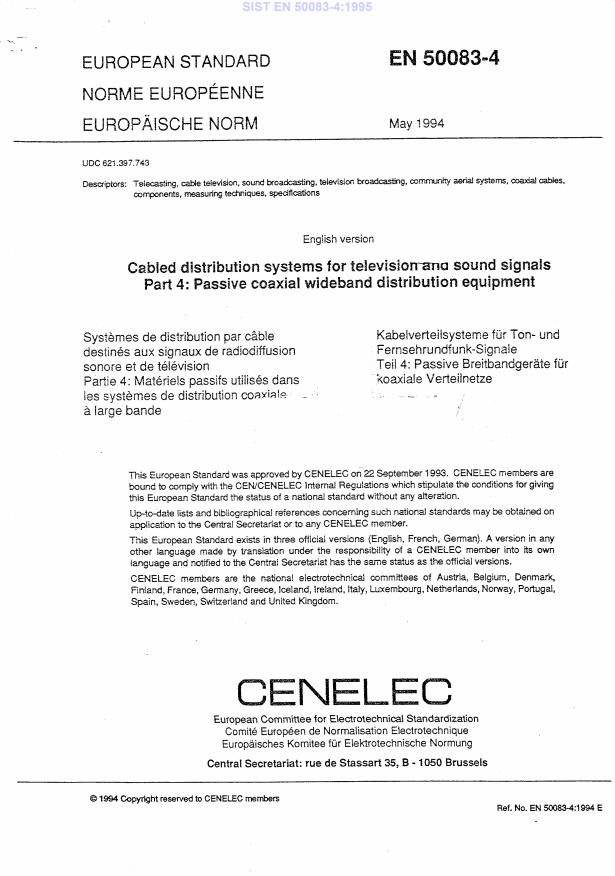
(Main)Cabled distribution systems for television and sound signals - Part 4: Passive coaxial wideband distribution equipment
Cabled distribution systems for television and sound signals - Part 4: Passive coaxial wideband distribution equipment
This standard applies to receiver leads, system outlets, splitters and subscriber taps, passive one and two port devices comprising filters, attenuators, equalizers, galvanic isolators, power injectors, cable splices, terminating resistors and transfer points, but excluding coaxial cables. It - covers the frequency range 5 MHz to 1 750 MHz; - identifies performance requirements for certain parameters; - lays down data publication requirements for certain parameters; - stipulates methods of measurement; - introduces minimum requirements defining quality (Q) grade(s). There are three Q grades for taps and splitters and two Q grades for passive one and two port devices. There is only one Q grade for system outlet and receiver lead. Different networks require the same performance and, when integrating networks, upgrading will be avoided. Practical experience has shown these types meet most of the technical requirements necessary for supplying a minimum signal quality to the subscribers. This classification shall not be considered as a requirement but as the information for users and manufacturers on the minimum quality criteria of the material required to install networks of different sizes. The system operator has to select appropriate material to meet the minimum signal quality at the subscriber's outlet and to optimize cost/performance, taking into account the size of the network and local circumstances. All requirements and published data shall be understood as guaranteed values within the specified frequency range and in well matched conditions. For passive equipment of quality grades other than mentioned above, manufacturers shall specify minimum values for : - return loss; - isolation; - directivity; using the relevant measurement methods and the presentation of table 1.
Kabelverteilsysteme für Ton- und Fernsehrundfunk-Signale - Teil 4: Passive Breitbandbandgeräte für koaxiale Verteilnetze
Systèmes de distribution par câble destinés aux signaux de radiodiffusion sonore et de télévision - Partie 4: Matériels passifs utilisés dans les systèmes de distribution coaxiale à large bande
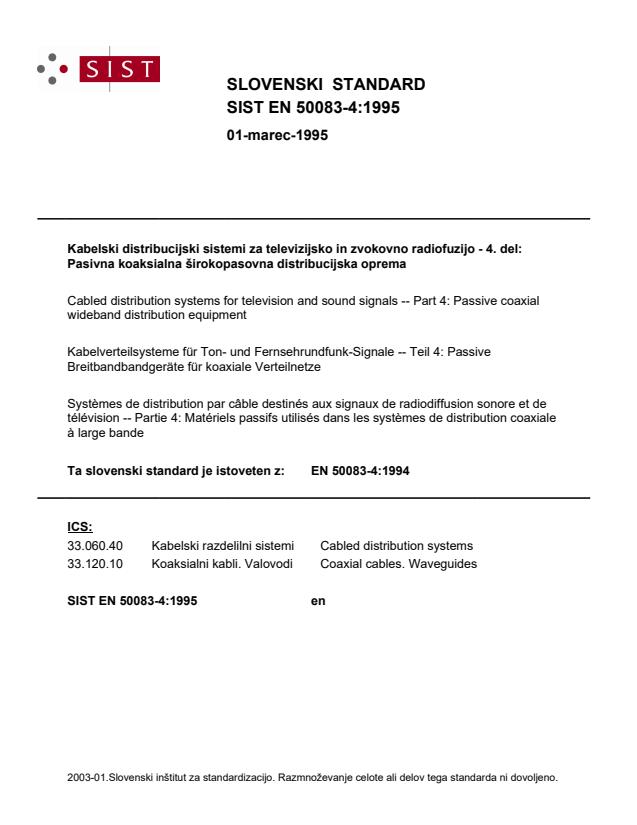
Kabelski distribucijski sistemi za televizijsko in zvokovno radiofuzijo - 4. del: Pasivna koaksialna širokopasovna distribucijska oprema
General Information
- Status
- Withdrawn
- Publication Date
- 17-May-1994
- Technical Committee
- CLC/TC 209 - Cable networks for television signals, sound signals and interactive services
- Drafting Committee
- IEC/TC 100 - IEC_TC_100
- Parallel Committee
- IEC/TC 100 - IEC_TC_100
- Current Stage
- 9960 - Withdrawal effective - Withdrawal
- Start Date
- 01-Dec-1999
- Completion Date
- 01-Dec-1999
Relations
- Effective Date
- 28-Jan-2023

Frequently Asked Questions
EN 50083-4:1994 is a standard published by CLC. Its full title is "Cabled distribution systems for television and sound signals - Part 4: Passive coaxial wideband distribution equipment". This standard covers: This standard applies to receiver leads, system outlets, splitters and subscriber taps, passive one and two port devices comprising filters, attenuators, equalizers, galvanic isolators, power injectors, cable splices, terminating resistors and transfer points, but excluding coaxial cables. It - covers the frequency range 5 MHz to 1 750 MHz; - identifies performance requirements for certain parameters; - lays down data publication requirements for certain parameters; - stipulates methods of measurement; - introduces minimum requirements defining quality (Q) grade(s). There are three Q grades for taps and splitters and two Q grades for passive one and two port devices. There is only one Q grade for system outlet and receiver lead. Different networks require the same performance and, when integrating networks, upgrading will be avoided. Practical experience has shown these types meet most of the technical requirements necessary for supplying a minimum signal quality to the subscribers. This classification shall not be considered as a requirement but as the information for users and manufacturers on the minimum quality criteria of the material required to install networks of different sizes. The system operator has to select appropriate material to meet the minimum signal quality at the subscriber's outlet and to optimize cost/performance, taking into account the size of the network and local circumstances. All requirements and published data shall be understood as guaranteed values within the specified frequency range and in well matched conditions. For passive equipment of quality grades other than mentioned above, manufacturers shall specify minimum values for : - return loss; - isolation; - directivity; using the relevant measurement methods and the presentation of table 1.
This standard applies to receiver leads, system outlets, splitters and subscriber taps, passive one and two port devices comprising filters, attenuators, equalizers, galvanic isolators, power injectors, cable splices, terminating resistors and transfer points, but excluding coaxial cables. It - covers the frequency range 5 MHz to 1 750 MHz; - identifies performance requirements for certain parameters; - lays down data publication requirements for certain parameters; - stipulates methods of measurement; - introduces minimum requirements defining quality (Q) grade(s). There are three Q grades for taps and splitters and two Q grades for passive one and two port devices. There is only one Q grade for system outlet and receiver lead. Different networks require the same performance and, when integrating networks, upgrading will be avoided. Practical experience has shown these types meet most of the technical requirements necessary for supplying a minimum signal quality to the subscribers. This classification shall not be considered as a requirement but as the information for users and manufacturers on the minimum quality criteria of the material required to install networks of different sizes. The system operator has to select appropriate material to meet the minimum signal quality at the subscriber's outlet and to optimize cost/performance, taking into account the size of the network and local circumstances. All requirements and published data shall be understood as guaranteed values within the specified frequency range and in well matched conditions. For passive equipment of quality grades other than mentioned above, manufacturers shall specify minimum values for : - return loss; - isolation; - directivity; using the relevant measurement methods and the presentation of table 1.
EN 50083-4:1994 has the following relationships with other standards: It is inter standard links to EN 50083-4:1998. Understanding these relationships helps ensure you are using the most current and applicable version of the standard.
EN 50083-4:1994 is associated with the following European legislation: EU Directives/Regulations: 2006/95/EC, 73/23/EEC. When a standard is cited in the Official Journal of the European Union, products manufactured in conformity with it benefit from a presumption of conformity with the essential requirements of the corresponding EU directive or regulation.
EN 50083-4:1994 is available in PDF format for immediate download after purchase. The document can be added to your cart and obtained through the secure checkout process. Digital delivery ensures instant access to the complete standard document.
Standards Content (Sample)
2003-01.Slovenski inštitut za standardizacijo. Razmnoževanje celote ali delov tega standarda ni dovoljeno.Kabelski distribucijski sistemi za televizijsko in zvokovno radiofuzijo - 4. del: Pasivna koaksialna širokopasovna distribucijska opremaKabelverteilsysteme für Ton- und Fernsehrundfunk-Signale -- Teil 4: Passive Breitbandbandgeräte für koaxiale VerteilnetzeSystèmes de distribution par câble destinés aux signaux de radiodiffusion sonore et de télévision -- Partie 4: Matériels passifs utilisés dans les systèmes de distribution coaxiale à large bandeCabled distribution systems for television and sound signals -- Part 4: Passive coaxial wideband distribution equipment33.120.10Koaksialni kabli. ValovodiCoax
...
Questions, Comments and Discussion
Ask us and Technical Secretary will try to provide an answer. You can facilitate discussion about the standard in here.
Loading comments...