

prEN IEC 80601-2-30:2025
(Main)Medical electrical equipment - Part 2-30: Particular requirements for the basic safety and essential performance of automated non-invasive sphygmomanometers
General Information
- Abstract
- Status
- Not Published
- Publication Date
- 31-Aug-2026
- Technical Committee
- CLC/TC 62 - Electrical equipment in medical practice
- Drafting Committee
- IEC/SC 62D - IEC_SC_62D
- Current Stage
- 4060 - Enquiry results established and sent to TC, SR, BTTF - Enquiry
- Start Date
- 02-May-2025
- Completion Date
- 02-May-2025


Overview
prEN IEC 80601-2-30:2025 sets particular requirements for the basic safety and essential performance of automated non-invasive sphygmomanometers (automated NIBP devices). This third edition is a technical revision prepared by IEC SC 62D and associated ISO WG and is published as a committee draft for vote (CDV). It updates normative references and introduces clarified definitions and additional safeguards to address clinical and home-use needs. The document also contains informative annexes on marking, usability, environmental aspects and digital connectivity.
Key Topics
- Scope and intent: Particular requirements that supplement the general IEC 60601 series for medical electrical equipment to ensure accurate, reliable and safe automated blood pressure measurement.
- Definitions and modes: Clarified definitions for patient populations (including neonate and infant) and associated operating modes to reduce ambiguity in device labeling and testing.
- Primary operating functions: Relabeling and clearer identification of primary functions to improve operator understanding and reduce misuse.
- Monitoring and data integrity: New requirements to prevent misuse of outdated or "stale" measurement data and to ensure monitoring displays and alarms support safe clinical decisions.
- Cuff and mechanical safety: Detailed treatment of cuff-related requirements (protection devices, maximum inflation time, connection tubing) and associated tests to guard against overpressure and prolonged inflation.
- Usability and risk control: Enhanced usability clauses and annex guidance to reduce user error in clinical, home healthcare and emergency settings.
- Connectivity framework: Informative guidance (API framework) for digital connectivity of automated blood pressure devices to support secure data exchange in health IT ecosystems.
Applications
This standard is intended for:
- Manufacturers designing automated non-invasive sphygmomanometers for hospitals, clinics, home healthcare and emergency medical services.
- Regulatory and conformity assessment bodies evaluating device safety and essential performance against IEC 80601-2-30 requirements.
- Clinical engineers and procurement teams seeking devices with validated accuracy, robust cuff protection and clear usability labeling.
Key practical benefits include improved measurement reliability, clearer user interfaces and reduced risk from misleading monitoring data.
Related Standards
- The general IEC 60601 series for medical electrical equipment (referenced normative base).
- Specific clauses and annexes in IEC 80601-2-30 link to usability, electromagnetic compatibility and home healthcare requirements.
- Informative annexes provide cross-reference to essential principles, environmental considerations and marking/labeling guidance.
Note: This document is a Committee Draft for Vote (CDV) and remains subject to change until final publication. Consult the IEC and CENELEC project pages for the latest edition and official normative texts.
Relations
- Effective Date
- 08-Mar-2022
Get Certified
Connect with accredited certification bodies for this standard

BSI Group
BSI (British Standards Institution) is the business standards company that helps organizations make excellence a habit.

TÜV Rheinland
TÜV Rheinland is a leading international provider of technical services.

TÜV SÜD
TÜV SÜD is a trusted partner of choice for safety, security and sustainability solutions.
Sponsored listings
Frequently Asked Questions
prEN IEC 80601-2-30:2025 is a draft published by CLC. Its full title is "Medical electrical equipment - Part 2-30: Particular requirements for the basic safety and essential performance of automated non-invasive sphygmomanometers". This standard covers: Medical electrical equipment - Part 2-30: Particular requirements for the basic safety and essential performance of automated non-invasive sphygmomanometers
Medical electrical equipment - Part 2-30: Particular requirements for the basic safety and essential performance of automated non-invasive sphygmomanometers
prEN IEC 80601-2-30:2025 is classified under the following ICS (International Classification for Standards) categories: 11.040.01 - Medical equipment in general. The ICS classification helps identify the subject area and facilitates finding related standards.
prEN IEC 80601-2-30:2025 has the following relationships with other standards: It is inter standard links to EN IEC 80601-2-30:2019. Understanding these relationships helps ensure you are using the most current and applicable version of the standard.
prEN IEC 80601-2-30:2025 is available in PDF format for immediate download after purchase. The document can be added to your cart and obtained through the secure checkout process. Digital delivery ensures instant access to the complete standard document.
Standards Content (Sample)
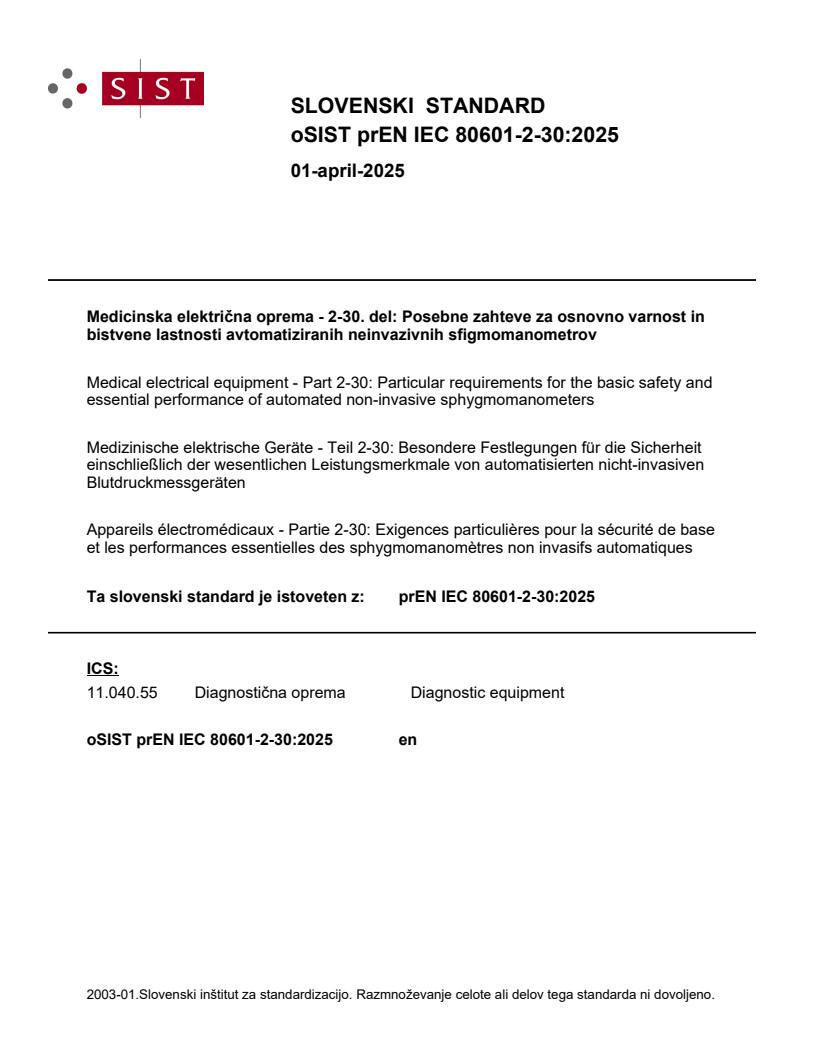
SLOVENSKI STANDARD
01-april-2025
Medicinska električna oprema - 2-30. del: Posebne zahteve za osnovno varnost in
bistvene lastnosti avtomatiziranih neinvazivnih sfigmomanometrov
Medical electrical equipment - Part 2-30: Particular requirements for the basic safety and
essential performance of automated non-invasive sphygmomanometers
Medizinische elektrische Geräte - Teil 2-30: Besondere Festlegungen für die Sicherheit
einschließlich der wesentlichen Leistungsmerkmale von automatisierten nicht-invasiven
Blutdruckmessgeräten
Appareils électromédicaux - Partie 2-30: Exigences particulières pour la sécurité de base
et les performances essentielles des sphygmomanomètres non invasifs automatiques
Ta slovenski standard je istoveten z: prEN IEC 80601-2-30:2025
ICS:
11.040.55 Diagnostična oprema Diagnostic equipment
2003-01.Slovenski inštitut za standardizacijo. Razmnoževanje celote ali delov tega standarda ni dovoljeno.
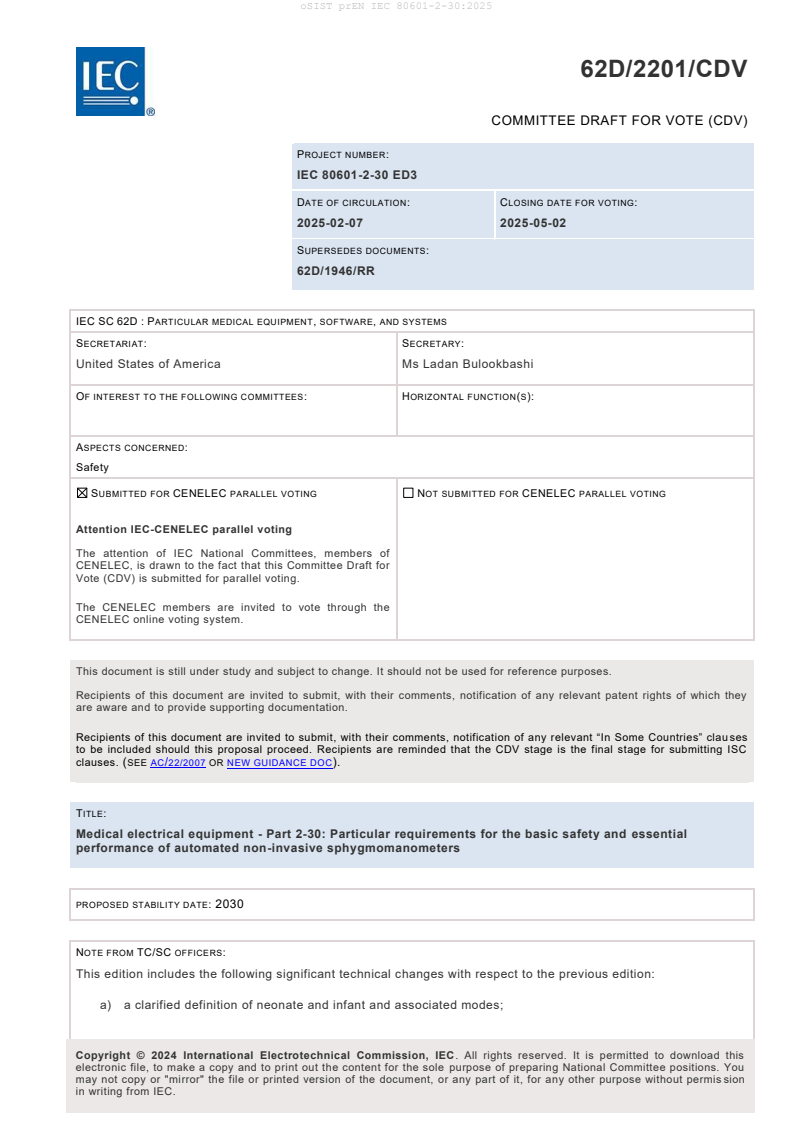
62D/2201/CDV
COMMITTEE DRAFT FOR VOTE (CDV)
PROJECT NUMBER:
IEC 80601-2-30 ED3
DATE OF CIRCULATION: CLOSING DATE FOR VOTING:
2025-02-07 2025-05-02
SUPERSEDES DOCUMENTS:
62D/1946/RR
IEC SC 62D : PARTICULAR MEDICAL EQUIPMENT, SOFTWARE, AND SYSTEMS
SECRETARIAT: SECRETARY:
United States of America Ms Ladan Bulookbashi
OF INTEREST TO THE FOLLOWING COMMITTEES: HORIZONTAL FUNCTION(S):
ASPECTS CONCERNED:
Safety
SUBMITTED FOR CENELEC PARALLEL VOTING NOT SUBMITTED FOR CENELEC PARALLEL VOTING
Attention IEC-CENELEC parallel voting
The attention of IEC National Committees, members of
CENELEC, is drawn to the fact that this Committee Draft for
Vote (CDV) is submitted for parallel voting.
The CENELEC members are invited to vote through the
CENELEC online voting system.
This document is still under study and subject to change. It should not be used for reference purposes.
Recipients of this document are invited to submit, with their comments, notification of any relevant patent rights of which they
are aware and to provide supporting documentation.
Recipients of this document are invited to submit, with their comments, notification of any relevant “In Some Countries” clau ses
to be included should this proposal proceed. Recipients are reminded that the CDV stage is the final stage for submitting ISC
clauses. (SEE AC/22/2007 OR NEW GUIDANCE DOC).
TITLE:
Medical electrical equipment - Part 2-30: Particular requirements for the basic safety and essential
performance of automated non-invasive sphygmomanometers
PROPOSED STABILITY DATE: 2030
NOTE FROM TC/SC OFFICERS:
This edition includes the following significant technical changes with respect to the previous edition:
a) a clarified definition of neonate and infant and associated modes;
electronic file, to make a copy and to print out the content for the sole purpose of preparing National Committee positions. You
may not copy or "mirror" the file or printed version of the document, or any part of it, for any other purpose without permis sion
in writing from IEC.
b) relabeling of some primary operating functions;
c) additional requirements for monitoring equipment to avoid the misuse of misleading or “stale” data;
d) updated normative references to the current versions where applicable.
IEC 80601-2-30 ED3 © IEC 2024 1 62D/2201/CDV
1 CONTENTS
2 FOREWORD . 3
3 INTRODUCTION . 7
4 201.1 Scope, object and related standards . 8
5 201.2 Normative references . 10
6 201.3 Terms and definitions. 11
7 201.4 General requirements . 13
8 201.5 General requirements for testing ME EQUIPMENT . 14
9 201.6 Classification of ME EQUIPMENT and ME SYSTEMS . 14
10 201.7 ME EQUIPMENT identification, marking and documents . 14
11 201.8 Protection against electrical HAZARDS from ME EQUIPMENT . 18
12 201.9 Protection against mechanical HAZARDS of ME EQUIPMENT and ME SYSTEMS . 18
13 201.10 Protection against unwanted and excessive radiation HAZARDS . 18
14 201.11 Protection against excessive temperatures and other HAZARDS . 18
15 201.12 Accuracy of controls and instruments and protection against hazardous
16 outputs . 19
17 201.13 HAZARDOUS SITUATIONS and fault conditions for ME EQUIPMENT . 24
18 201.14 PROGRAMMABLE ELECTRICAL MEDICAL SYSTEMS (PEMS) . 24
19 201.15 Construction of ME EQUIPMENT . 24
20 201.16 ME SYSTEMS . 25
21 201.17 Electromagnetic compatibility of ME EQUIPMENT and ME SYSTEMS . 25
22 201.101 Requirements for CUFFS . 25
23 201.102 * Connection tubing and CUFF connectors . 26
24 201.103 Unauthorized access. 26
25 201.104 * Maximum inflating time . 26
26 201.105 * Automatic cycling modes . 27
27 201.106 * Clinical accuracy . 31
28 202 Electromagnetic disturbances – Requirements and tests . 31
29 206 Usability . 34
30 210 Requirements for the development of physiologic closed-loop controllers . 36
31 211 Requirements for medical electrical equipment and medical electrical
32 systems used in the home healthcare environment . 36
33 212 Requirements for medical electrical equipment and medical electrical
34 systems intended for use in the emergency medical services environment . 36
35 Annexes . 38
36 Annex C (informative) Guide to marking and labelling requirements for ME EQUIPMENT
37 and ME SYSTEMS . 39
38 Annex AA (informative) Particular guidance and rationale . 42
39 Annex BB (informative) Environmental aspects . 52
40 Annex CC (informative) Reference to the ESSENTIAL PRINCIPLES . 53
41 Bibliography . 56
42 Index of defined terms . 59
62D/2201/CDV 2 IEC 80601-2-30 ED3 © IEC 2024
44 Figure 201.101 – CUFF pressure PROTECTION DEVICE, triggered by overpressure in SINGLE
45 FAULT CONDITION . 21
46 Figure 201.102 – CUFF pressure PROTECTION DEVICE, triggered by prolonged overpressure
47 in SINGLE FAULT CONDITION . 22
48 Figure 201.103 – CUFF pressure and maximum inflation time, NORMAL CONDITION and
49 SINGLE FAULT CONDITION . 27
50 Figure 201.104 – LONG-TERM AUTOMATIC MODE CUFF pressure in NORMAL CONDITION . 28
51 Figure 201.105 – LONG-TERM AUTOMATIC MODE CUFF pressure in SINGLE FAULT CONDITION . 28
52 Figure 201.106 – SHORT-TERM AUTOMATIC MODE CUFF pressure . 29
53 Figure 201.107 – SELF-MEASUREMENT AUTOMATIC MODE CUFF pressure . 30
54 Figure 202.101 – HF SURGICAL EQUIPMENT test layout . 33
55 Figure 202.102 – Simulated PATIENT test set-up for HF SURGICAL EQUIPMENT . 34
57 Table 201.101 – Distributed ESSENTIAL PERFORMANCE requirements . 13
58 Table 201.102 – CUFF deflation pressure . 18
59 Table 201.103 – CUFF inflation pressure . 26
60 Table 201.C.101 – Marking on the outside of AUTOMATED SPHYGMOMANOMETERS or
61 their parts . 39
62 Table 201.C.102 – Marking of controls and instruments of AUTOMATED
63 SPHYGMOMANOMETERS or their parts . 39
64 Table 201.C.103 – ACCOMPANYING DOCUMENTS, general information for AUTOMATED
65 SPHYGMOMANOMETERS . 40
66 Table 201.C.104 – ACCOMPANYING DOCUMENTS, instructions for use of AUTOMATED
67 SPHYGMOMANOMETERS . 40
68 Table 201.C.105 – ACCOMPANYING DOCUMENTS, technical description of AUTOMATED
69 SPHYGMOMANOMETERS . 41
70 Table AA.1 – Summary of requirements by mode . 49
71 Table BB.1 – Environmental aspects addressed by clauses of this document . 52
72 Table CC.1 – Correspondence between this particular standard and the ESSENTIAL
73 PRINCIPLES . 53
IEC 80601-2-30 ED3 © IEC 2024 3 62D/2201/CDV
76 INTERNATIONAL ELECTROTECHNICAL COMMISSION
77 ____________
79 MEDICAL ELECTRICAL EQUIPMENT –
81 Part 2-30: Particular requirements for the basic safety
82 and essential performance of automated non-invasive
83 sphygmomanometers
85 FOREWORD
86 1) The International Electrotechnical Commission (IEC) is a worldwide organization for standardization comprising
87 all national electrotechnical committees (IEC National Committees). The object of IEC is to promote
88 international co-operation on all questions concerning standardization in the electrical and electronic fields. To
89 this end and in addition to other activities, IEC publishes International Standards, Technical Specifications,
90 Technical Reports, Publicly Available Specifications (PAS) and Guides (hereafter referred to as "IEC
91 Publication(s)"). Their preparation is entrusted to technical committees; any IEC National Committee interested
92 in the subject dealt with may participate in this preparatory work. International, governmental and non -
93 governmental organizations liaising with the IEC also participate in this preparation. IEC collaborates closely
94 with the International Organization for Standardization (ISO) in accordance with conditions determined by
95 agreement between the two organizations.
96 2) The formal decisions or agreements of IEC on technical matters express, as nearly as possible, an international
97 consensus of opinion on the relevant subjects since each technical committee has representation from all
98 interested IEC National Committees.
99 3) IEC Publications have the form of recommendations for international use and are accepted by IEC National
100 Committees in that sense. While all reasonable efforts are made to ensure that the technical content of IEC
101 Publications is accurate, IEC cannot be held responsible for the way in which they are used or for any
102 misinterpretation by any end user.
103 4) In order to promote international uniformity, IEC National Committees undertake to apply IEC Publications
104 transparently to the maximum extent possible in their national and regional publications. Any divergence
105 between any IEC Publication and the corresponding national or regional publication shall be clearly indicated in
106 the latter.
107 5) IEC itself does not provide any attestation of conformity. Independent certification bodies provide conformity
108 assessment services and, in some areas, access to IEC marks of conformity. IEC is not responsible for any
109 services carried out by independent certification bodies.
110 6) All users should ensure that they have the latest edition of this publication.
111 7) No liability shall attach to IEC or its directors, employees, servants or agents including individual experts and
112 members of its technical committees and IEC National Committees for any personal injury, property damage or
113 other damage of any nature whatsoever, whether direct or indirect, or for costs (including legal fees) and
114 expenses arising out of the publication, use of, or reliance upon, this IEC Publication or any other IEC
115 Publications.
116 8) Attention is drawn to the Normative references cited in this publication. Use of the referenced publications is
117 indispensable for the correct application of this publication.
118 9) IEC draws attention to the possibility that the implementation of this document may involve the use of (a)
119 patent(s). IEC takes no position concerning the evidence, validity or applicability of any claimed patent rights in
120 respect thereof. As of the date of publication of this document, IEC had not received notice of (a) patent(s),
121 which may be required to implement this document. However, implementers are cautioned that this may not
122 represent the latest information, which may be obtained from the patent database available at
123 https://patents.iec.ch. IEC shall not be held responsible for identifying any or all such patent rights.
124 International standard IEC 80601-2-30 has been prepared by a Joint Working Group of
125 subcommittee 62D: Electromedical equipment, of IEC technical committee 62: Electrical
126 equipment in medical practice, and of subcommittee SC3: Lung ventilators and related
127 equipment, of ISO technical committee 121: Anaesthetic and respiratory equipment.
128 This third edition cancels and replaces the second edition published in 2018. This edition
129 constitutes a technical revision.
130 This edition includes the following significant technical changes with respect to the previous
131 edition:
62D/2201/CDV 4 IEC 80601-2-30 ED3 © IEC 2024
132 a) a clarified definition of neonate and infant and associated modes;
133 b) relabeling of some primary operating functions;
134 c) additional requirements for monitoring equipment to avoid the misuse of misleading or
135 “stale” data;
136 d) updated normative references to the current versions where applicable.
137 This publication is published as a double logo standard.
138 The text of this document is based on the following documents of IEC:
FDIS Report on voting
62D/1548/FDIS 62D/1560/RVD
140 Full information on the voting for the approval of this document can be found in the report on
141 voting indicated in the above table. In ISO, the standard has been approved by 14 P members
142 out of 15 having cast a vote.
143 This publication has been drafted in accordance with the ISO/IEC Directives, Part 2.
144 In this document, the following print types are used:
145 – requirements and definitions: roman type;
146 – test specifications: italic type;
147 – informative material appearing outside of tables, such as notes, examples and references: in smaller type.
148 Normative text of tables is also in a smaller type;
149 – TERMS DEFINED IN CLAUSE 3 OF THE GENERAL STANDARD, IN THIS PARTICULAR STANDARD OR AS
150 NOTED: SMALL CAPITALS.
151 In referring to the structure of this document, the term
152 – "clause" means one of the seventeen numbered divisions within the table of contents,
153 inclusive of all subdivisions (e.g. Clause 7 includes subclauses 7.1, 7.2, etc.) ;
154 – "subclause" means a numbered subdivision of a clause (e.g. 7.1, 7.2 and 7.2.1 are all
155 subclauses of Clause 7).
156 References to clauses within this document are preceded by the term "Clause" followed by
157 the clause number. References to subclauses within this particular standard are by number
158 only.
159 In this document, the conjunctive "or" is used as an "inclusive or" so a statement is true if any
160 combination of the conditions is true.
161 The verbal forms used in this document conform to usage described in Clause 7 of the
162 ISO/IEC Directives, Part 2. For the purposes of this document, the auxiliary verb:
163 – "shall" means that compliance with a requirement or a test is mandatory for compliance
164 with this document;
165 – "should" means that compliance with a requirement or a test is recommended but is not
166 mandatory for compliance with this document;
167 – "may" is used to describe a permissible way to achieve compliance with a requirement or
168 test.
IEC 80601-2-30 ED3 © IEC 2024 5 62D/2201/CDV
169 An asterisk (*) as the first character of a title or at the beginning of a
170 paragraph or table title indicates that there is guidance or rationale
171 related to that item in Annex D
172 (informative)
174 Application Programming Interface Framework
175 D.1 General guidance
176 This annex provides a minimal informative framework for Electronic Automated Blood Pressure device digital
177 connectivity. It is common for health monitoring devices that are being used at all levels of patient acuity to be
178 ”connected” for the purpose of direct transmission of device data to a distant dashboard, electronic medical
179 record and even from the patient’s home to their health provider. In this annex, the term Application Programming
180 Interface (API) is used in its most generic sense, representing the flow of data and commands to and from a
181 device that provides connectivity and has NIBP determination capability. A conceptual API is presented without
182 specifics of data structures or communication protocols. The annex is intended to serve as a starting point for
183 discussion about the design of an API for an NIBP device. It is by no means a comprehensive or required
184 framework but a starting point, listing basic functionality that an NIBP API should consider. There is no intention to
185 provide a comprehensive model for an API that meets all the needs of all server/client interactions. Nor is there
186 any intention to imply that the implementation of this API framework will provide any level of market acceptance or
187 interoperability of NIBP devices.
189 The committee presents the following minimum set of API functionality for your consideration in the development
190 of connected NIBP devices:
191 API shall include
192 - Start BP reading
193 - Stop BP reading
194 - Abort an NIBP cycle
195 - Get NIBP results - sys, dia, HR ,MAP, Error code
196 - Set BP mode to Neonate
197 - Set BP mode to Pediatric (if applicable)
198 - Set BP mode to Adult
199 - Set BP mode to special.
200 - Reset the API
201 - Set API Parameters (protocol, Baud …)
202 - Control Pump
203 - Control valve
204 - Calibrate or cal-check pressure transducers
205 - Capability to support testing of single-fault failsafe components and controls
206 Annex AA.
207 A list of all parts of the 80601 International standard, published under the general title Medical
208 electrical equipment, can be found on the IEC website.
62D/2201/CDV 6 IEC 80601-2-30 ED3 © IEC 2024
209 The committee has decided that the contents of this publication will remain unchanged until
210 the stability date indicated on the IEC website under "http://webstore.iec.ch" in the data
211 related to the specific publication. At this date, the publication will be
212 • reconfirmed,
213 • withdrawn,
214 • replaced by a revised edition, or
215 • amended.
217 NOTE The attention of users of this document is drawn to the fact that equipment manufacturers and testing
218 organizations may need a transitional period following publication of a new, amended or revised IEC publication in
219 which to make products in accordance with the new requirements and to equip themselves for conducting new or
220 revised tests. It is the recommendation of the committees that the content of this publication be adopted for
221 implementation nationally not earlier than 3 years from the date of publication.
IEC 80601-2-30 ED3 © IEC 2024 7 62D/2201/CDV
224 INTRODUCTION
225 The minimum safety requirements specified in this particular standard are considered to
226 provide for a practical degree of safety in the operation of an AUTOMATED SPHYGMOMANOMETER.
227 The requirements are followed by specifications for the relevant tests.
228 Following the decision taken by subcommittee 62D at the meeting in Washington DC in 1979,
229 a "General guidance and rationale" section giving some explanatory notes, where appropriate,
230 about the more important requirements is included in Annex AA. It is considered that
231 knowledge of the reasons for these requirements will not only facilitate the proper application
232 of the standard but will, in due course, expedite any revision necessitated by changes in
233 clinical practice or because of developments in technology. However, the Annex AA does not
234 form part of the requirements of this document.
62D/2201/CDV 8 IEC 80601-2-30 ED3 © IEC 2024
237 MEDICAL ELECTRICAL EQUIPMENT –
239 Part 2-30: Particular requirements for the basic safety and essential
240 performance of automated non-invasive sphygmomanometers
244 201.1 Scope, object and related standards
245 Clause 1 of the general standard applies, except as follows:
246 201.1.1 Scope
247 Replacement:
248 This part of the 80601 International Standard applies to the BASIC SAFETY and ESSENTIAL
249 PERFORMANCE of AUTOMATED SPHYGMOMANOMETERS, hereafter referred to as ME EQUIPMENT,
250 which by means of an inflatable CUFF, are used for non-continuous indirect estimation of the
251 BLOOD PRESSURE without arterial puncture.
252 NOTE 1 Equipment that performs indirect DETERMINATION of the BLOOD PRESSURE without arterial puncture does
253 not directly measure the BLOOD PRESSURE. It only estimates the BLOOD PRESSURE.
254 This document specifies requirements for the BASIC SAFETY and ESSENTIAL PERFORMANCE for
255 this ME EQUIPMENT and its ACCESSORIES, including the requirements for the accuracy of BLOOD
256 PRESSURE DETERMINATION.
257 This document covers automatic electrically-powered ME EQUIPMENT used for the intermittent,
258 indirect estimation of the BLOOD PRESSURE without arterial puncture, including BLOOD
259 PRESSURE monitors for the HOME HEALTHCARE ENVIRONMENT.
260 Requirements for indirect estimation of the BLOOD PRESSURE without arterial puncture
261 ME EQUIPMENT with an electrically-powered PRESSURE TRANSDUCER and/or displays used in
262 conjunction with a stethoscope or other manual methods for determining BLOOD PRESSURE
263 (NON-AUTOMATED SPHYGMOMANOMETERS) are specified in document ISO 81060-1 [2].
264 If a clause or subclause is specifically intended to be applicable to ME EQUIPMENT only, or to
265 ME SYSTEMS only, the title and content of that clause or subclause will say so. If that is not the
266 case, the clause or subclause applies both to ME EQUIPMENT and to ME SYSTEMS, as relevant.
267 HAZARDS inherent in the intended physiological function of ME EQUIPMENT or ME SYSTEMS
268 within the scope of this document are not covered by specific requirements in this document
269 except in 201.11 and 201.105.3.3, as well as 7.2.13 and 8.4.1 of IEC 60601-1:2022.
270 201.1.2 Object
271 Replacement:
272 The object of this particular standard is to establish particular BASIC SAFETY and ESSENTIAL
273 PERFORMANCE requirements for an AUTOMATED SPHYGMOMANOMETER as defined in 201.3.201.
274 201.1.3 Collateral standards
275 Addition:
276 This particular standard refers to those applicable collateral standards that are listed in
277 Clause 2 of the general standard and Clause 201.2 of this particular standard.
IEC 80601-2-30 ED3 © IEC 2024 9 62D/2201/CDV
278 IEC 60601-1-2, IEC 60601-1-6, IEC 60601-1-10, IEC 60601-1-11 and IEC 60601-1-12 apply
279 as modified in Clauses 202, 206, 210, 211 and 212 respectively. IEC 60601-1-3 [3] does not
280 apply. All other published collateral standards in the IEC 60601-1 series apply as
281 published [1] [4].
282 201.1.4 Particular standards
283 Replacement:
284 In the IEC 60601 series, particular standards may modify, replace or delete requirements
285 contained in the general standard and collateral standards as appropriate for the particular
286 ME EQUIPMENT under consideration, and may add other BASIC SAFETY and ESSENTIAL
287 PERFORMANCE requirements.
288 A requirement of a particular standard takes priority over the general standard.
289 For brevity, IEC 60601-1:2005 and IEC 60601-1:2005/AMD1:2012 are referred to in this
290 particular standard as the general standard. Collateral standards are referred to by their
291 document number.
292 The numbering of clauses and subclauses of this particular standard correspond to that of the
293 general standard with the prefix "201" (e.g. 201.1 in this document addresses the content of
294 Clause 1 of the general standard) or applicable collateral standard with the prefix "20x",
295 where x is the final digit(s) of the collateral standard document number (e.g. 202.4 in this
296 particular standard addresses the content of Clause 4 of the IEC 60601-1-2 collateral
297 standard, 203.4 in this particular standard addresses the content of Clause 4 of the
298 IEC 60601-1-3 collateral standard, etc.). The changes to the text of the general standard are
299 specified by the use of the following words:
300 "Replacement" means that the clause or subclause of the general standard or applicable
301 collateral standard is replaced completely by the text of this particular standard.
302 "Addition" means that the text of this particular standard is additional to the requirements of
303 the general standard or applicable collateral standard.
304 "Amendment" means that the clause or subclause of the general standard or applicable
305 collateral standard is amended as indicated by the text of this particular standard.
306 Subclauses, figures or tables which are additional to those of the general standard are
307 numbered starting from 201.101. However, due to the fact that definitions in the general
308 standard are numbered 3.1 through 3.147, additional definitions in this document are
309 numbered beginning from 201.3.201. Additional annexes are lettered AA, BB, etc., and
310 additional items aa), bb), etc.
311 Subclauses, figures or tables which are additional to those of a collateral standard are
312 numbered starting from 20x, where "x" is the number of the collateral standard, e.g. 202 for
313 IEC 60601-1-2, 203 for IEC 60601-1-3, etc.
314 The term "this document" is used to make reference to the general standard, any applicable
315 collateral standards and this particular standard taken together.
316 Where there is no corresponding clause or subclause in this particular standard, the clause or
317 subclause of the general standard or applicable collateral standard, although possibly not
318 relevant, applies without modification; where it is intended that any part of the general
319 standard or applicable collateral standard, although possibly relevant, is not to be applied, a
320 statement to that effect is given in this particular standard.
62D/2201/CDV 10 IEC 80601-2-30 ED3 © IEC 2024
321 201.2 Normative references
322 NOTE Informative references are listed in the bibliography beginning on page 56.
323 Clause 2 of the general standard applies, except as follows:
324 Replacement:
325 IEC 60601-1-2:2014, Medical electrical equipment – Part 1-2: General requirements for basic
326 safety and essential performance – Collateral Standard: Electromagnetic disturbances –
327 Requirements and tests
328 IEC 60601-1-2:2014/AMD 1:2020
329 IEC 60601-1-6:2010, Medical electrical equipment – Part 1-6: General requirements for basic
330 safety and essential performance – Collateral standard: Usability
331 IEC 60601-1-6:2010/AMD 1:2013
332 IEC 60601-1-6:2010/AMD 2:2020
333 Addition:
334 IEC 60068-2-27:2008, Environmental testing – Part 2-27: Tests – Test Ea and guidance:
335 Shock
336 IEC 60068-2-64:2008+AMD1:2019, Environmental testing – Part 2-64: Tests – Test Fh:
337 Vibration, broad-band random and guidance
338 IEC 60601-1:2005, Medical electrical equipment – Part 1: General requirements for basic
339 safety and essential performance
340 IEC 60601-1:2005/AMD 1:2012
341 IEC 60601-1-10:2007, Medical electrical equipment – Part 1-10: General requirements for
342 basic safety and essential performance – Collateral Standard: Requirements for the
343 development of physiologic closed-loop controllers
344 IEC 60601-1-10:2007/AMD1:2013
345 IEC 60601-1-10:2007/AMD2:2020
346 IEC 60601-1-11:2015, Medical electrical equipment – Part 1-11: General requirements for
347 basic safety and essential performance – Collateral Standard: Requirements for medical
348 electrical equipment and medical electrical systems used in the home healthcare environment
349 IEC 60601-1-11:2015/AMD1:2020
350 IEC 60601-1-12:2014, Medical electrical equipment – Part 1-12: General requirements for
351 basic safety and essential performance – Collateral Standard: Requirements for medical
352 electrical equipment and medical electrical systems intended for use in the emergency
353 medical services environment
354 IEC 60601-1-12:2014/AMD1:2020
355 IEC 60601-2-2:2017, Medical electrical equipment – Part 2-2: Particular requirements for the
356 basic safety and essential performance of high frequency surgical equipment and high
357 frequency surgical accessories
358 IEC 60601-2-2:2017/AMD1:2023
359 IEC 62366-1:2015, Medical devices – Part 1: Application of usability engineering to medical
360 devices
361 IEC 62366-1:2015/AMD1:2020
362 IEC 80369-5:2016, Small-bore connectors for liquids and gases in healthcare applications –
363 Part 5: Connectors for limb cuff inflation applications
IEC 80601-2-30 ED3 © IEC 2024 11 62D/2201/CDV
364 ISO 80369-1:2018, Small-bore connectors for liquids and gases in healthcare applications –
365 Part 1: General requirements
366 ISO 81060-2:— , Non-invasive sphygmomanometers – Part 2: Clinical investigation of
367 automated measurement type
368 201.3 Terms and definitions
369 For the purposes of this document, the terms and definitions given in IEC 60601-1,
370 IEC 60601-1-8, IEC 60601-2-2:2017, IEC 60601-2-2:2017/AMD1:2023, IEC 62366-1:2015 and
371 IEC 62366-1:2015/AMD1:2020 and the following apply.
372 ISO and IEC maintain terminological databases for use in standardization at the following
373 addresses:
374 • IEC Electropedia: available at http://www.electropedia.org/
375 • ISO Online browsing platform: available at http://www.iso.org/obp
376 NOTE An index of defined terms is found beginning on page 59.
377 Addition:
378 201.3.201
379 AUTOMATED SPHYGMOMANOMETER
380 ME EQUIPMENT used for the non-invasive estimation of the BLOOD PRESSURE by utilizing an
381 inflatable CUFF, a PRESSURE TRANSDUCER, a valve for deflation, and/or displays used in
382 conjunction with automatic methods for determining BLOOD PRESSURE
383 Note 1 to entry: Components of an AUTOMATED SPHYGMOMANOMETER include manometer, CUFF, valve for deflation
384 (often in combination with the valve for rapidly exhausting the PNEUMATIC SYSTEM), pump for inflation of the
385 BLADDER, and connection tubing.
386 201.3.202
387 CUFF
388 part of the AUTOMATED SPHYGMOMANOMETER that is wrapped around the limb of the PATIENT
389 Note 1 to entry: A CUFF usually comprises a BLADDER and an inelastic part that encloses the BLADDER, or has an
390 integral BLADDER (i.e., the CUFF, including the BLADDER, is one piece).
391 [SOURCE: ISO 81060-1:2007 [2], 3.5, modified – In the definition, "non-automated" has been
392 replaced by "automated", and in the Note 1 to entry "might comprise" has been replaced by
393 "usually comprises".]
394 201.3.203
395 DETERMINATION
396 DETERMINATION VALUE
397 result of the PROCESS of estimating BLOOD PRESSURE by the AUTOMATED SPHYGMOMANOMETER
398 201.3.204
399 DIASTOLIC BLOOD PRESSURE
400 DIASTOLIC BLOOD PRESSURE VALUE
401 minimum value of the BLOOD PRESSURE as a result of relaxation of the systemic ventricle
402 Note 1 to entry: Because of hydrostatic effects, this value should be determined with the CUFF at the same
403 elevation as the heart (phlebostatic axis).
_____________
New revision under preparation. Stage at the time of publication: ISO/xx 80601-2:20xx.
62D/2201/CDV 12 IEC 80601-2-30 ED3 © IEC 2024
404 201.3.205
405 LONG-TERM AUTOMATIC MODE
406 mode in which a timer, set by the OPERATOR, initiates multiple DETERMINATIONS
407 201.3.206
408 MEAN ARTERIAL PRESSURE
409 MEAN ARTERIAL PRESSURE VALUE
410 value of the integral of one heartbeat cycle of the BLOOD PRESSURE curve divided by the time
411 of that cycle
412 Note 1 to entry: Because of hydrostatic effects, this value should be determined with the transducer at the same
413 elevation as the heart (phlebostatic axis).
414 201.3.207
415 NEONATAL MODE
416 mode of an AUTOMATED SPHYGMOMANOMETER intended for use on neonate patients
417 Note 1 to entry: Some devices are designed to utilise a mode called “Neonatal Mode” that includes infants as well
418 as neonates.
419 Note 2 to entry: The approximate age range for a newborn (neonate) is from birth to 1 month [5] [6].
420 Note 3 to entry: The approximate age range for an infant is commonly from 1 month to 2 years [5] [6]. For the
421 purposes of this document, up to 3 years of age are considered infants (see ISO 81060-2:20xx, 6.1.3).
422 Note 4 to entry: The NEONATAL MODE is used to limit the maximum pressure to 150 mmHg and often has a
423 neonate-specific algorithm that is different than algorithms intended for older PATIENTS.
424 201.3.208
425 NON-AUTOMATED SPHYGMOMANOMETER
426 ME EQUIPMENT used for the non-invasive estimation of BLOOD PRESSURE by utilizing an
427 inflatable CUFF with a pressure-sensing element, a valve for deflation, and a display used in
428 conjunction with a stethoscope or other manual methods for estimating BLOOD PRESSURE
429 Note 1 to entry: Components of these instruments include a manometer, CUFF, valve for deflation (often in
430 combination with the valve for rapidly exhausting the PNEUMATIC SYSTEM), hand pump or electro-mechanical pump
431 for inflation of the BLADDER, and connection tubing. A NON-AUTOMATED SPHYGMOMANOMETER can also contain
432 electro-mechanical components for cuff pressure control.
433 [SOURCE: ISO 81060-1:2007 [2], 3.11, modified – The definition and the note to entry have
434 been rephrased.]
435 201.3.209
436 PATIENT SIMULATOR
437 equipment for simulating the oscillometric CUFF pulses and/or auscultatory signals during
438 inflation and deflation
439 Note 1 to entry: This equipment is not used for testing clinical accuracy but is used in assessing stability of
440 performance.
441 201.3.210
442 PNEUMATIC SYSTEM
443 part of the AUTOMATED SPHYGMOMANOMETER that includes all pressurized and pressure-
444 controlling components
445 EXAMPLES CUFF, tubing, connectors, valves, PRESSURE TRANSDUCER and pump.
446 [SOURCE: ISO 81060-1:2007 [2], 3.16, modified – In the definition, replacement of "non
447 automated" by "automated", and in the examples, addition of "pressure".]
448 201.3.211
449 PRESSURE TRANSDUCER
450 component that transforms sensed pressure into an electrical signal
IEC 80601-2-30 ED3 © IEC 2024 13 62D/2201/CDV
451 201.3.212
452 PROTECTION DEVICE
453 part of ME EQUIPMENT that, without intervention by the OPERATOR, protects the PATIENT from
454 hazardous output due to incorrect delivery of energy or substances
455 201.3.213
456 * SELF-MEASUREMENT AUTOMATIC MODE
457 mode of AUTOMATED SPHYGMOMANOMETER that is manually initiated and overseen by the
458 OPERATOR and in which a limited number of repeated DETERMINATIONS are made over a finite
459 period of time
460 Note 1 to entry: This mode is also referred to as “blood pressure averaging mode”.
461 201.3.214
462 * SHORT-TERM AUTOMATIC MODE
463 mode of AUTOMATED SPHYGMOMANOMETER that is manually initiated by the OPERATOR and in
464 which rapid repetitive, automatic DETERMINATIONS are made within a specified time period
465 201.3.215
466 * STALE DATA
467 data status where too much time has elapsed since the displayed determination was
468 performed for it to be relevant or reliable for use in the clinical circumstance
469 Note 1 to entry: A stale data indication alerts the user that stale data is being displayed.
470 201.3.216
471 SYSTOLIC BLOOD PRESSURE
472 SYSTOLIC BLOOD PRESSURE VALUE
473 maximum value of the BLOOD PRESSURE as a result of the contraction of the systemic ventricle
474 Note 1 to entry: Because of hydrostatic effects, this value should be determined with the CUFF at the level of the
475 heart.
476 201.4 General requirements
477 Clause 4 of the general standard applies, except as follows:
478 201.4.3 ESSENTIAL PERFORMANCE
479 Additional subclause:
480 201.4.3.101 Additional ESSENTIAL PERFORMANCE requirements
481 Additional ESSENTIAL PERFORMANCE requirements for an AUTOMATED SPHYGMOMANOMETER are
482 found in the subclauses listed in Table 201.101.
483 Table 201.101 – Distributed ESSENTIAL PERFORMANCE requirements
Requirement Subclause
Electrosurgery interference recovery 202.8.101
a
Limits of the error of the manometer , 201.12.1.102
or generation of a TECHNICAL ALARM CONDITION 201.11.8.102
201.12.1.101
Reproducibility of the BLOOD PRESSURE DETERMINATION and 201.12.1.107
low and high BLOOD PRESSURE PHYSIOLOGICAL ALARM CONDITIONS (if 201.12.3.101
provided),
or generation of a TECHNICAL ALARM CONDITION 201.11.8.102
201.12.1.101
62D/2201/CDV 14 IEC 80601-2-30 ED3 © IEC 2024
a
202.8.1.101 d) indicates methods of evaluating limits of the error of the manometer as
acceptance criteria following specific tests required by this document.
485 201.5 General requirements for testing ME EQUIPMENT
486 Clause 5 of the general standard applies.
487 201.6 Classification of ME EQUIPMENT and ME SYSTEMS
488 Clause 6 of the general standard applies.
489 201.7 ME EQUIPMENT identification, marking and documents
490 Clause 7 of the general standard applies, except as follows:
491 201.7.2 Marking on the outside of ME EQUIPMENT or ME EQUIPMENT parts
492 201.7.2.4 * ACCESSORIES
493 Addition:
494 A CUFF shall be marked with an indication of the correct positioning for the CUFF on the
495 designated limb over the artery.
496 Additional subclauses:
497 201.7.2.101 Display of AUTOMATED SPHYGMOMANOMETERS
498 If abbreviations are used on the display, they shall be as follows:
499 – "S" or "SYS" for the value of SYSTOLIC BLOOD PRESSURE;
500 – "D" or "DIA" for the value of DIASTOLIC BLOOD PRESSURE;
501 – "M" or "MAP" for the value of MEAN ARTERIAL PRESSURE.
502 Single letter abbreviations shall be positioned in such a way as to avoid confusion with
503 SI units.
504 The numerical step of BLOOD PRESSURE readings shall be 1 mmHg or 0,1 kPa.
505 201.7.2.102 * AUTOMATED SPHYGMOMANOMETER with NEONATAL MODE
506 If an AUTOMATED SPHYGMOMANOMETER is intended for use with neonatal PATIENTS and other
507 PATIENTS, it should have means for detecting that a CUFF intended for use with a neonatal
508 PATIENT is connected to the AUTOMATED SPHYGMOMANOMETER and means for automatically
509 placing the AUTOMATED SPHYGMOMANOMETER in NEONATAL MODE when such a CUFF is present.
510 If these means are not present, the instructions for use shall describe the method for placing
511 the AUTOMATED SPHYGMOMANOMETER into NEONATAL MODE and include a warning statement
512 describing the RISKS associated with using other than the NEONATAL MODE on a neonatal
513 PATIENT.
514 All ACCESSORIES intended for use only in the NEONATAL MODE and where the use in other
515 modes results in an unacceptable RISK shall be marked for neonatal use only.
IEC 80601-2-30 ED3 © IEC 2024 15 62D/2201/CDV
516 201.7.2.103 * AUTOMATED SPHYGMOMANOMETER intended for self-use in public areas
517 If the AUTOMATED SPHYGMOMANOMETER is intended for self-use in public areas, it shall be
518 marked on the USER INTERFACE with the following:
519 a) precautions for use, including a statement concerning the need to consult a physician for
520 interpretation of BLOOD PRESSURE values;
521 b) adequate operating instructions; and
522 c) this sphygmomanometer complies with IEC 80601-2-30:2017.
523 EXAMPLES Self-measurement station in a pharmacy, fitness centre, workplace intended for use by the general
524 population without professional assistance.
525 If intended for use with a single CUFF size, the AUTOMATED SPHYGMOMANOMETER shall be
526 marked on the USER INTERFACE with the following:
527 d) the range of arm circumference for which the CUFF is intended – specifically minimum and
528 maximum upper arm (midpoint) circumference thresholds in centimetres and in inches;
529 and
530 e) a statement to the ef
...