

prEN 50562-2:2025
(Main)Fixed installations for railway applications - Safety of electric traction power supply systems - Part 2: Generic approach for non-conventional applications, functions and properties
General Information
- Abstract
This document defines the process, protective measures and demonstration of safety in accordance with prEN 50126-1:2017 and prEN 50126-2:2017 for AC and DC electric traction power supply systems for railways. This document can also be applied to urban rail and trolleybus systems. All these systems can be elevated, at-grade and underground. This document has two parts: This document supports the implementation of non-conventional applications, functions and properties in electric traction power supply systems that remain after the application of prEN 50562 1:2025. NOTE EN 50562 1 establishes the code of practice for conventional applications, functions and properties in electric traction power supply systems. This document applies to electric traction power supply systems, which are new or are undergoing major changes as defined in the legal framework. For similar technology and similar hazardous scenarios, the safety considerations can be used as a guideline. This document does not apply to: — underground mine traction systems, — cranes, transportable platforms and similar transportation equipment on rails, temporary structures (e.g. exhibition structures) in so far as these are not supplied directly or via transformers from the contact line system and are not endangered by the traction power supply system, — suspended cable cars, — funicular railways, — magnetic levitated systems, This document does not consider aspects like IT-security or protection against other malevolent acts etc. It is assumed that those aspects are handled on the overall system level. NOTE For railways IT-security is covered in CLC/TS 50701. Because of the short life cycles of IT-security applications it is advisable to separate IT-security functions from safety functions at least on virtual levels. E.g. the frequent patch processes for updating the IT-security applications is expected to be independent from Safety applications.
- Status
- Not Published
- Publication Date
- 31-Mar-2030
- Technical Committee
- CLC/TC 9X - Electrical and electronic applications for railways
- Current Stage
- 4060 - Enquiry results established and sent to TC, SR, BTTF - Enquiry
- Start Date
- 22-Aug-2025
- Due Date
- 07-May-2025
- Completion Date
- 22-Aug-2025

Overview
prEN 50562-2:2025 - Fixed installations for railway applications - Safety of electric traction power supply systems - Part 2 - provides a generic approach for non‑conventional applications, functions and properties in AC and DC electric traction power supply systems. It defines the process, protective measures and demonstration of safety in line with prEN 50126‑1:2017 and prEN 50126‑2:2017. The document complements prEN 50562‑1:2025 (conventional code of practice) by covering cases that remain after applying Part 1 and by offering methods for comparing reference solutions and performing explicit risk estimation.
This standard applies to mainline railways, urban rail and trolleybus systems in elevated, at‑grade and underground environments, and targets new installations or systems undergoing major changes. It explicitly excludes certain systems (e.g., underground mine traction, suspended cable cars, funiculars, maglev) and does not address IT‑security or protection against deliberate malicious acts (see CLC/TS 50701 for railway IT‑security).
Key Topics
- Risk assessment process: Builds on the generic process in prEN 50562‑1 and EN 50126 to assess non‑conventional features.
- Delta analysis: Structured method to identify safety‑relevant differences between a reference solution and the new application; guides gap analysis and required adaptations.
- Comparison with codes of practice or accepted solutions: Procedures to identify reference solutions (Box B concept) and derive safety requirements.
- Explicit risk estimation: Quantitative and qualitative risk evaluation steps for novel applications (Box C).
- SIL allocation and implementation: Guidance on Safety Integrity Level (SIL) allocation (Box D), calibrated risk graphs, severity/frequency considerations, and practical SIL implementation (Box E).
- Software and system requirements: Selection of appropriate software standards, quality management, organisational aspects and platform considerations for safety functions.
- Demonstration of compliance: Evidence and documentation practices to show conformity with safety requirements (Box F).
- Annexes: Informative guidance on hazard identification and keywords for delta analysis.
Applications
- Assessing and certifying non‑conventional traction power features (new converters, novel protection schemes, atypical earthing or return systems).
- Integrating third‑party or cross‑domain solutions where existing CoPs do not fully apply.
- Supporting safety cases for major upgrades or new traction power installations on rail, urban rail or trolleybus networks.
- Performing structured safety justification when adapting solutions from similar technologies or accepted reference systems.
Who should use this standard
- Railway system engineers, traction power designers and project managers
- Safety assessors, RAMS (Reliability, Availability, Maintainability, Safety) professionals and certification bodies
- Rolling stock/infra integrators evaluating power supply changes or novel technologies
- Regulators and compliance teams preparing safety cases for new or modified traction power installations
Related standards
- prEN 50562‑1:2025 (Part 1 - conventional applications)
- EN 50126‑1:2017 / EN 50126‑2:2017 (RAMS / Systems Approach to Safety)
- CLC/TS 50701 (railway IT‑security guidance)
Keywords: prEN 50562‑2:2025, electric traction power supply systems, railway safety, non‑conventional applications, delta analysis, SIL allocation, risk assessment, urban rail, trolleybus.
Relations
- Effective Date
- 08-Dec-2020
Get Certified
Connect with accredited certification bodies for this standard

IMQ S.p.A. (Certification)
Italian electrical product certification.

SLG Prüf- und Zertifizierungs GmbH
German testing and certification body.

UL Solutions
Global safety science company with testing, inspection and certification.
Sponsored listings
Frequently Asked Questions
prEN 50562-2:2025 is a draft published by CLC. Its full title is "Fixed installations for railway applications - Safety of electric traction power supply systems - Part 2: Generic approach for non-conventional applications, functions and properties". This standard covers: This document defines the process, protective measures and demonstration of safety in accordance with prEN 50126-1:2017 and prEN 50126-2:2017 for AC and DC electric traction power supply systems for railways. This document can also be applied to urban rail and trolleybus systems. All these systems can be elevated, at-grade and underground. This document has two parts: This document supports the implementation of non-conventional applications, functions and properties in electric traction power supply systems that remain after the application of prEN 50562 1:2025. NOTE EN 50562 1 establishes the code of practice for conventional applications, functions and properties in electric traction power supply systems. This document applies to electric traction power supply systems, which are new or are undergoing major changes as defined in the legal framework. For similar technology and similar hazardous scenarios, the safety considerations can be used as a guideline. This document does not apply to: — underground mine traction systems, — cranes, transportable platforms and similar transportation equipment on rails, temporary structures (e.g. exhibition structures) in so far as these are not supplied directly or via transformers from the contact line system and are not endangered by the traction power supply system, — suspended cable cars, — funicular railways, — magnetic levitated systems, This document does not consider aspects like IT-security or protection against other malevolent acts etc. It is assumed that those aspects are handled on the overall system level. NOTE For railways IT-security is covered in CLC/TS 50701. Because of the short life cycles of IT-security applications it is advisable to separate IT-security functions from safety functions at least on virtual levels. E.g. the frequent patch processes for updating the IT-security applications is expected to be independent from Safety applications.
This document defines the process, protective measures and demonstration of safety in accordance with prEN 50126-1:2017 and prEN 50126-2:2017 for AC and DC electric traction power supply systems for railways. This document can also be applied to urban rail and trolleybus systems. All these systems can be elevated, at-grade and underground. This document has two parts: This document supports the implementation of non-conventional applications, functions and properties in electric traction power supply systems that remain after the application of prEN 50562 1:2025. NOTE EN 50562 1 establishes the code of practice for conventional applications, functions and properties in electric traction power supply systems. This document applies to electric traction power supply systems, which are new or are undergoing major changes as defined in the legal framework. For similar technology and similar hazardous scenarios, the safety considerations can be used as a guideline. This document does not apply to: — underground mine traction systems, — cranes, transportable platforms and similar transportation equipment on rails, temporary structures (e.g. exhibition structures) in so far as these are not supplied directly or via transformers from the contact line system and are not endangered by the traction power supply system, — suspended cable cars, — funicular railways, — magnetic levitated systems, This document does not consider aspects like IT-security or protection against other malevolent acts etc. It is assumed that those aspects are handled on the overall system level. NOTE For railways IT-security is covered in CLC/TS 50701. Because of the short life cycles of IT-security applications it is advisable to separate IT-security functions from safety functions at least on virtual levels. E.g. the frequent patch processes for updating the IT-security applications is expected to be independent from Safety applications.
prEN 50562-2:2025 is classified under the following ICS (International Classification for Standards) categories: 29.280 - Electric traction equipment. The ICS classification helps identify the subject area and facilitates finding related standards.
prEN 50562-2:2025 has the following relationships with other standards: It is inter standard links to EN 50562:2018. Understanding these relationships helps ensure you are using the most current and applicable version of the standard.
prEN 50562-2:2025 is associated with the following European legislation: EU Directives/Regulations: 2016/797/EU, 2016/797/EU, 2016/797/EU, 2016/797/EU, 2016/797/EU, 2016/797/EU, 2016/797/EU, 2016/797/EU, 2016/797/EU, 2016/797/EU, 2016/797/EU; Standardization Mandates: M/591. When a standard is cited in the Official Journal of the European Union, products manufactured in conformity with it benefit from a presumption of conformity with the essential requirements of the corresponding EU directive or regulation.
prEN 50562-2:2025 is available in PDF format for immediate download after purchase. The document can be added to your cart and obtained through the secure checkout process. Digital delivery ensures instant access to the complete standard document.
Standards Content (Sample)
SLOVENSKI STANDARD
01-julij-2025
Fiksni postroji za železniške naprave - Varnost napajalnih sistemov električne
vleke - 2. del: Splošni pristop za nekonvencionalne načine uporabe, funkcije in
lastnosti
Fixed installations for railway applications - Safety of electric traction power supply
systems - Part 2: Generic approach for non-conventional applications, functions and
properties
Ta slovenski standard je istoveten z: prEN 50562-2:2025
ICS:
29.280 Električna vlečna oprema Electric traction equipment
2003-01.Slovenski inštitut za standardizacijo. Razmnoževanje celote ali delov tega standarda ni dovoljeno.
EUROPEAN STANDARD DRAFT
prEN 50562-2
NORME EUROPÉENNE
EUROPÄISCHE NORM
May 2025
ICS 29.280 Will supersede EN 50562:2018 (PART)
English Version
Fixed installations for railway applications - Safety of electric
traction power supply systems - Part 2: Generic approach for
non-conventional applications, functions and properties
To be completed To be completed
This draft European Standard is submitted to CENELEC members for enquiry.
Deadline for CENELEC: 2025-08-22.
It has been drawn up by CLC/SC 9XC.
If this draft becomes a European Standard, CENELEC members are bound to comply with the CEN/CENELEC Internal Regulations which
stipulate the conditions for giving this European Standard the status of a national standard without any alteration.
This draft European Standard was established by CENELEC in three official versions (English, French, German).
A version in any other language made by translation under the responsibility of a CENELEC member into its own language and notified to
the CEN-CENELEC Management Centre has the same status as the official versions.
CENELEC members are the national electrotechnical committees of Austria, Belgium, Bulgaria, Croatia, Cyprus, the Czech Republic,
Denmark, Estonia, Finland, France, Germany, Greece, Hungary, Iceland, Ireland, Italy, Latvia, Lithuania, Luxembourg, Malta, the
Netherlands, Norway, Poland, Portugal, Republic of North Macedonia, Romania, Serbia, Slovakia, Slovenia, Spain, Sweden, Switzerland,
Türkiye and the United Kingdom.
Recipients of this draft are invited to submit, with their comments, notification of any relevant patent rights of which they are aware and to
provide supporting documentation.
Warning : This document is not a European Standard. It is distributed for review and comments. It is subject to change without notice and
shall not be referred to as a European Standard.
European Committee for Electrotechnical Standardization
Comité Européen de Normalisation Electrotechnique
Europäisches Komitee für Elektrotechnische Normung
CEN-CENELEC Management Centre: Rue de la Science 23, B-1040 Brussels
© 2025 CENELEC All rights of exploitation in any form and by any means reserved worldwide for CENELEC Members.
Project: 73168 Ref. No. prEN 50562-2:2025 E
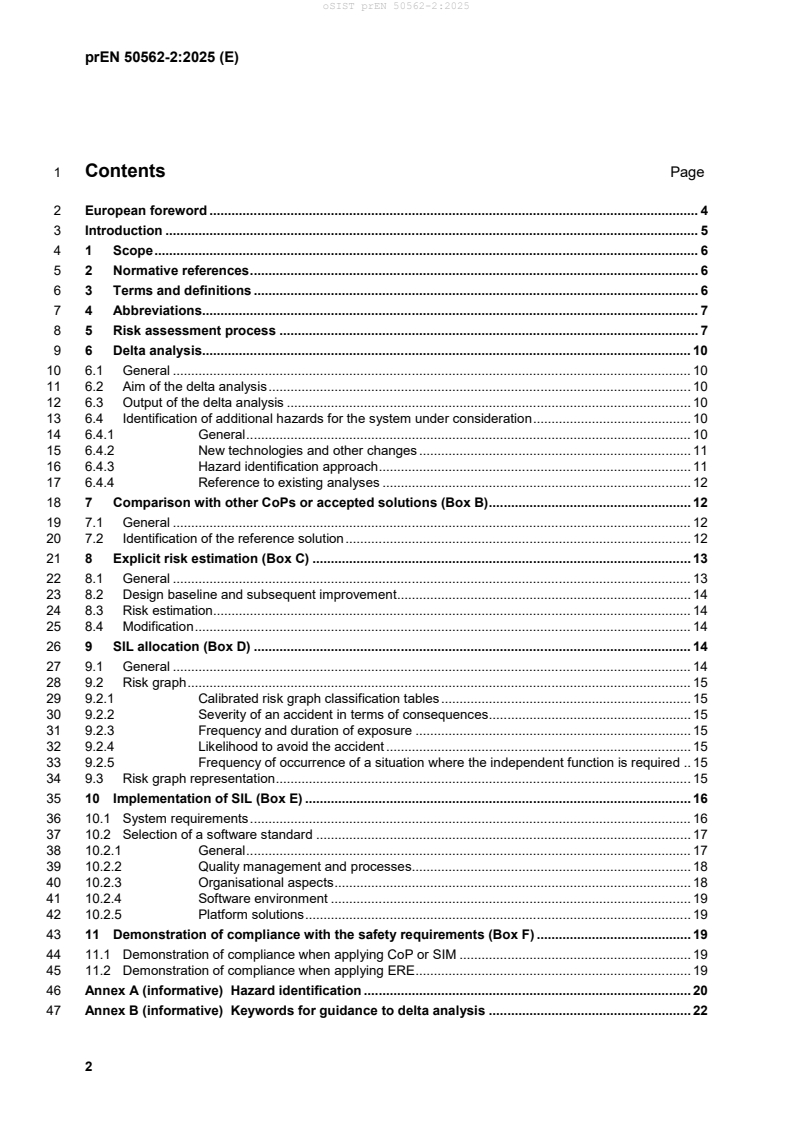
1 Contents Page
2 European foreword . 4
3 Introduction . 5
4 1 Scope . 6
5 2 Normative references . 6
6 3 Terms and definitions . 6
7 4 Abbreviations. 7
8 5 Risk assessment process . 7
9 6 Delta analysis. 10
10 6.1 General . 10
11 6.2 Aim of the delta analysis . 10
12 6.3 Output of the delta analysis . 10
13 6.4 Identification of additional hazards for the system under consideration . 10
14 6.4.1 General . 10
15 6.4.2 New technologies and other changes . 11
16 6.4.3 Hazard identification approach . 11
17 6.4.4 Reference to existing analyses . 12
18 7 Comparison with other CoPs or accepted solutions (Box B) . 12
19 7.1 General . 12
20 7.2 Identification of the reference solution . 12
21 8 Explicit risk estimation (Box C) . 13
22 8.1 General . 13
23 8.2 Design baseline and subsequent improvement . 14
24 8.3 Risk estimation . 14
25 8.4 Modification . 14
26 9 SIL allocation (Box D) . 14
27 9.1 General . 14
28 9.2 Risk graph . 15
29 9.2.1 Calibrated risk graph classification tables . 15
30 9.2.2 Severity of an accident in terms of consequences . 15
31 9.2.3 Frequency and duration of exposure . 15
32 9.2.4 Likelihood to avoid the accident . 15
33 9.2.5 Frequency of occurrence of a situation where the independent function is required . 15
34 9.3 Risk graph representation . 15
35 10 Implementation of SIL (Box E) . 16
36 10.1 System requirements . 16
37 10.2 Selection of a software standard . 17
38 10.2.1 General . 17
39 10.2.2 Quality management and processes . 18
40 10.2.3 Organisational aspects . 18
41 10.2.4 Software environment . 19
42 10.2.5 Platform solutions . 19
43 11 Demonstration of compliance with the safety requirements (Box F) . 19
44 11.1 Demonstration of compliance when applying CoP or SIM . 19
45 11.2 Demonstration of compliance when applying ERE . 19
46 Annex A (informative) Hazard identification . 20
47 Annex B (informative) Keywords for guidance to delta analysis . 22
48 Annex ZZ (informative) Relationship between this European Standard and the Essential
49 Requirements of EU Directive (EU) 2016/797 aimed to be covered . 28
50 Bibliography . 30
51 European foreword
52 This document (prEN 50562-2:2025) has been prepared by CLC/SC 9XC “Electric supply and earthing
53 systems for public transport equipment and ancillary apparatus (Fixed installations)” of CLC/TC 9X
54 “Electrical and electronic applications for railways”.
55 This document is currently submitted to the Enquiry.
56 The following dates are proposed:
• latest date by which the existence of this (doa) dav + 6 months
document has to be announced at national
level
• latest date by which this document has to be (dop) dav + 12 months
implemented at national level by publication of
an identical national standard or by
endorsement
• latest date by which the national standards (dow) dav + 36 months
conflicting with this document have to be (to be confirmed or
withdrawn modified when voting)
57 This document will partially supersede EN 50562:2018 and all of its amendments and corrigenda (if any).
58 prEN 50562-2:2025 includes the following significant technical changes with respect to EN 50562:2018:
59 — The standard has been supplemented by a second part; Part 1 covers conventional applications,
60 functions and properties by the application of codes of practice. Part 2 covers non-conventional
61 applications, functions and properties by application of codes of practice of other provenance,
62 comparison with reference systems and explicit risk estimation.
63 — Annex B “Documents related to EN 50562” has been removed; The content has been shifted to the
64 Bibliography.
65 — Annex C “Combination of risk acceptance principles” has been integrated in Part 2;
66 — Annex D “Guidance of software for safety functions on system level” has been integrated in Part 2.
67 The EN 50562 series consists of the following parts:
68 — Part 1: Generic approach for conventional applications, functions and properties
69 — Part 2: Generic approach for non-conventional applications, functions and properties
70 This document has been prepared under a standardization request addressed to CENELEC by the
71 European Commission. The Standing Committee of the EFTA States subsequently approves these
72 requests for its Member States.
73 For the relationship with EU Legislation, see informative Annex ZZ, which is an integral part of this
74 document.
75 Introduction
76 The introduction of prEN 50562-1:2025 covers this document.
77 1 Scope
78 This document defines the process, protective measures and demonstration of safety in accordance with
79 prEN 50126-1:2017 and prEN 50126-2:2017 for AC and DC electric traction power supply systems for
80 railways. This document can also be applied to urban rail and trolleybus systems. All these systems can be
81 elevated, at-grade and underground.
82 This document has two parts:
83 This document supports the implementation of non-conventional applications, functions and properties in
84 electric traction power supply systems that remain after the application of prEN 50562-1:2025.
85 NOTE EN 50562-1 establishes the code of practice for conventional applications, functions and properties in
86 electric traction power supply systems.
87 This document applies to electric traction power supply systems, which are new or are undergoing major
88 changes as defined in the legal framework. For similar technology and similar hazardous scenarios, the
89 safety considerations can be used as a guideline.
90 This document does not apply to:
91 — underground mine traction systems,
92 — cranes, transportable platforms and similar transportation equipment on rails, temporary structures
93 (e.g. exhibition structures) in so far as these are not supplied directly or via transformers from the
94 contact line system and are not endangered by the traction power supply system,
95 — suspended cable cars,
96 — funicular railways,
97 — magnetic levitated systems,
98 This document does not consider aspects like IT-security or protection against other malevolent acts etc. It
99 is assumed that those aspects are handled on the overall system level.
100 NOTE For railways IT-security is covered in CLC/TS 50701. Because of the short life cycles of IT-security
101 applications it is advisable to separate IT-security functions from safety functions at least on virtual levels. E.g. the
102 frequent patch processes for updating the IT-security applications is expected to be independent from Safety
103 applications.
104 2 Normative references
105 The following documents are referred to in the text in such a way that some or all of their content constitutes
106 requirements of this document. For dated references, only the edition cited applies. For undated references,
107 the latest edition of the referenced document (including any amendments) applies.
108 EN 50126-1:2017 , Railway applications – The specification and demonstration of Reliability, Availability,
109 Maintainability and Safety (RAMS) - Part 1: Generic RAMS Process
110 EN 50126-2:2017 , Railway applications – The specification and demonstration of Reliability, Availability,
111 Maintainability and Safety (RAMS) - Part 2: Systems Approach to Safety
112 3 Terms and definitions
113 For the purposes of this document, the terms and definitions given in prEN 50562-1:2025 apply.
———————
As impacted by EN 50126-1:2017/A1:2024
As impacted by EN 50126-2:2017/A1:2024
114 ISO and IEC maintain terminology databases for use in standardization at the following addresses:
115 — ISO Online browsing platform: available at https://www.iso.org/obp
116 — IEC Electropedia: available at http://www.electropedia.org
117 4 Abbreviations
118 For the purposes of this document, the abbreviations given in prEN 50562-1:2025 apply.
119 5 Risk assessment process
120 The risk assessment process is described in a generic way in prEN 50562-1:2025 (Figure 1 below). By the
121 application of prEN 50562-1:2025 the conventional applications, functions or properties are sufficiently
122 covered.
124 Figure 1 — Risk assessment process and relation to corresponding life cycle phases
125 (prEN 50562-1:2025, Figure 3)
126 For the application of all risk acceptance principles a more detailed representation is useful as shown in
127 Figure 2.
129 Figure 2 — EN 50562 concept
130 In prEN 50562-1:2025 the process steps for the application of a fixed installation's code of practice are
131 provided (Box A of Figure 2). The following clauses describe the elements necessary to cover the
132 application of remaining codes of practice of other provenance as well as the comparison with other
133 solutions and the application of the explicit risk estimation. The designation of the boxes quoted in the
134 headlines refer to Figure 2.
135 6 Delta analysis
136 6.1 General
137 The intention of a delta analysis is to reveal the differences important for safety. The delta analysis
138 compares the reference system or reference solution and the application under consideration to be
139 implemented in the electric traction power supply system. Within this context, the application under
140 consideration is regarded “non-conventional”, as it exceeds the stringent normative framework of
141 prEN 50562-1:2025.
142 6.2 Aim of the delta analysis
143 The aim of the delta analysis is to identify the differences or gaps important for safety between the reference
144 solution and the application under consideration. The identified differences shall be reviewed and assessed
145 with the focus on the positive or negative impact on safety. Annex B provides keywords as a guidance for
146 a delta analysis.
147 The level of the analyses depends on the specificities and the scope of the evaluation (system, sub-system,
148 function, component…).
149 The analysis shall be reviewed and repeated as necessary during the life cycle to ensure a robust process.
150 Refer to EN 50126-1:2017.
151 6.3 Output of the delta analysis
152 If the differences identified show in total no or only tolerable impacts on safety, then for the application
153 under consideration:
154 — the risks associated with the hazards covered by the reference solution are considered as acceptable
155 for the new application;
156 — the safety requirements for the hazards covered by the reference solution may be derived from the
157 documentation of the reference solution like the safety analyses or from an evaluation of safety
158 records;
159 — these safety requirements shall be registered. It is recommended to list them in the hazard log.
160 If differences between reference solution and application under consideration have a significant negative
161 impact on safety, the application under consideration needs further improvement e.g. by adaption to an
162 additional standard or design modification and a repetition of the delta analysis. Without sufficient
163 improvement the same safety level as the reference solution is not demonstrated and deviations need to
164 be compensated in the setting of the safety targets and/or use of the explicit risk estimation.
165 The evidence and considerations of the delta analysis shall be documented. It is recommended to list them
166 in the hazard log.
167 6.4 Identification of additional hazards for the system under consideration
168 6.4.1 General
169 The hazard identification for the system under consideration shall be performed and documented. Annex A
170 can be used as a guideline. Table 1 summarizes the top-level hazards and related foreseeable accidents.
171 If the approach used for the hazard identification of the reference system provides a complete and detailed
172 analysis, this approach is recommended to be followed in order to ensure consistency.
173 6.4.2 New technologies and other changes
174 Solutions using new technologies or changes in intended use or environmental conditions can introduce
175 specific hazards. The hazards shall be addressed firstly at the product level. Existing analyses or
176 documentation may be used to serve as an input to the system hazard analysis. Where standards for new
177 technologies exist, they are assumed to be applied. The list of keywords given in this document can be
178 used for inspiration of aspects during the delta analysis.
179 NOTE As an example, conventional electric traction power supply systems use mechanical switching devices e.g.
180 as circuit breakers or isolating switches. If semiconductor switching devices are applied the inevitable leakage current
181 might introduce hazards e.g. potentially dangerous voltage on equipment during maintenance. The reliability of the
182 semiconductor switching devices might be less than for mechanical switching devices, so consequences for the system
183 design e.g. prEN 50562-2:2025, 7.3.1 b) or for the protection concept can be expected.
184 6.4.3 Hazard identification approach
185 Hazard identification shall be performed following a structured approach and results in a list of system
186 hazards for the system and application under consideration in its operational context respectively. The
187 results of the hazard identification shall be documented, e.g. in a hazard log.
188 The hazard identification starts with the list of top-level hazards set out in Table 1, to ensure that the basis
189 for the identification of system hazards is comprehensive. All components are taken into account, but
190 components may be grouped, e.g. catenary comprising of contact wire, messenger wire and droppers,
191 where practicable. The question to be answered is, how the component or set of components could
192 contribute to a top-level hazard. This includes functions and properties, e.g. behaviour in the case of fire,
193 typical locations and operational situations.
194 NOTE 1 Within Annex A the description of the complete risk assessment process is provided. Figure A.1 shows the
195 relation between accidents, top-level hazards and system hazards.
196 Table 1 — List of top-level hazards and foreseeable accidents
Identification
code of
Top-level hazard Foreseeable accident
foreseeable
top-level hazard
Exposure of persons to situations where Harm due to electric shock TLH 1
they have access to hazardous voltages
Exposure of persons to situations where Harm due to striking / collision TLH 2
they experience relative movement
between objects and persons in direct
vicinity
Exposure of persons to unexpected or Harm due to striking / collision with
TLH 3
heavy acceleration or deceleration surroundings or due to slipping,
tripping and falling
Exposure of persons to heat source Harm due to arcs, hot surfaces, fire TLH 4
Exposure of persons and the environment Harm due to smoke, acids, toxic TLH 5
to hazardous amount and duration of substances
aggressive or toxic substances
Exposure of persons to severe pressure Harm due to explosion, TLH 6
waves overpressure
Exposure of persons to hazardous Harm due to electromagnetic fields TLH 7
electromagnetic fields
Exposure of persons to situations where Harm due to falling parts, trapping,
TLH 8
the design or condition of equipment is clamping, cutting
inappropriate for nearby persons, e.g. by
sharp edges, slippery surface.
Identification
code of
Top-level hazard Foreseeable accident
foreseeable
top-level hazard
Exposure of persons to excessive sound Harm due to reduction or loss of TLH 9
levels hearing
197 At the beginning of the hazard identification it is recommended to agree on terms like hazardous voltage or
198 excessive sound levels. Standards, related directives or local regulations can be used as reference for the
199 associated limits.
200 NOTE 2 For conventional electric traction power supply systems the top-level hazard list is regarded as
201 comprehensive. The top-level hazard “exposure to radio-active substances or hazardous radiation” can be excluded a
202 priori as in electric traction power supply system such scenarios do not apply. When using the approach of EN 50562
203 for other applications, it is necessary to assess whether additional top-level hazards can be applicable.
204 The following groups of persons are taken into account during the hazard identification:
205 — PAX
206 — STAFF
207 — PUB
208 — OTHERS
209 6.4.4 Reference to existing analyses
210 If the system under consideration or its modification is equivalent to the generic reference system or a
211 previous system used as reference system, the analyses, e.g. performed according to prEN 50562-1:2025
212 on the previous system, may be used as safety argument to avoid repeating analyses without additional
213 information in terms of risks.
214 7 Comparison with other CoPs or accepted solutions (Box B)
215 7.1 General
216 If a solution cannot be found within the framework of prEN 50562-1:2025, it is possible to implement codes
217 of practice from other sectors or accepted solutions e.g. to supplement a conventional electric traction
218 power supply system.
219 Both strategies, argumentation with an additional code of practice or an accepted solution, can be regarded
220 equivalent from a process perspective. In both cases a justification for the choice shall be provided. The
221 application of a reference system may be used as risk acceptance principle as per EN 50126-2:2017. The
222 reference solution shall comply with the 5 criteria (see 7.2). The strategy is either
223 — to analyse if one or more hazards are covered by the similar solution that could be taken as a reference
224 solution (risk-based approach).
225 — to identify whether an already existing solution is fit for purpose when implemented in a railway context
226 (technical condition-based approach).
227 7.2 Identification of the reference solution
228 The reference solution shall satisfy the following requirements based on EN 50126-2:2017, 8.3.2:
229 — it has already been proven in-use to have an acceptable safety level and would therefore still qualify
230 for approval.
231 — it has similar functions and interfaces as the system under consideration.
232 — it is used under similar operational conditions as the system under consideration for a sufficient period
233 of time and has given confidence with the range of observed hazards and accidents.
234 — it is used under similar environmental conditions as the system under consideration.
235 — it is used with similar intended use, SRACs and O&M manuals which are sufficiently known and can
236 be adapted to the application under consideration
237 The description of the reference solution shall be comprehensive to allow the subsequential safety
238 considerations, e.g. in terms of:
239 — configuration (hardware and software)
240 — functional and technical characteristics, including the list of the standards, technical and functional
241 specifications, calculation notes, electrical and mechanical drawings
242 — interfaces (technical, functional interfaces),
243 — operation and maintenance manuals and environmental (including climatic) characteristics,
244 — safety analysis, including up to date list of applicable hazards
245 — service profile, and operational records,
246 — other document when required and applicable, as for instance ISA certificates
247 The level of details shall be sufficient to provide a suitable description of the reference solution.
248 Additionally, the reference solution shall still be qualified for approval by the Authority at the time of the
249 performance of the safety analysis/studies of the application under consideration. The aim is to ensure
250 safety performance of the reference system. This is to be achieved e.g. by appropriate use of acceptable
251 technology or up to date standards.
252 When the solution complies with these requirements, the solution is considered as the reference solution.
253 Once identified, the reference solution shall be compared with the application under consideration. The aim
254 is to identify the differences.
255 8 Explicit risk estimation (Box C)
256 8.1 General
257 Explicit risk estimation is defined in EN 50126-2:2017, 8.4. This clause aims to explain the generic process.
258 It shows how explicit risk assessment can be applied in a field of application, where standards from different
259 sectors are used. Standards and other codes of practice e.g. from the industry and energy sector may differ
260 in details, so a guide line is useful for deciding which way to follow.
261 The explicit risk estimation is a set of process steps where a detailed design for a safety function is
262 developed. The process starts typically on a higher functional level. The aim is either to find a solution with
263 an acceptable risk or to provide the risk parameters needed for a SIL allocation. In this case an allocated
264 SIL defines safety requirements for hardware and software.
265 The preferred option is to detail the design to inde
...