


EN 60068-2-69:1996
(Main)Environmental testing - Part 2: Tests - Test Te: Solderability testing of electronic components for surface mount technology by the wetting balance method
General Information
- Abstract
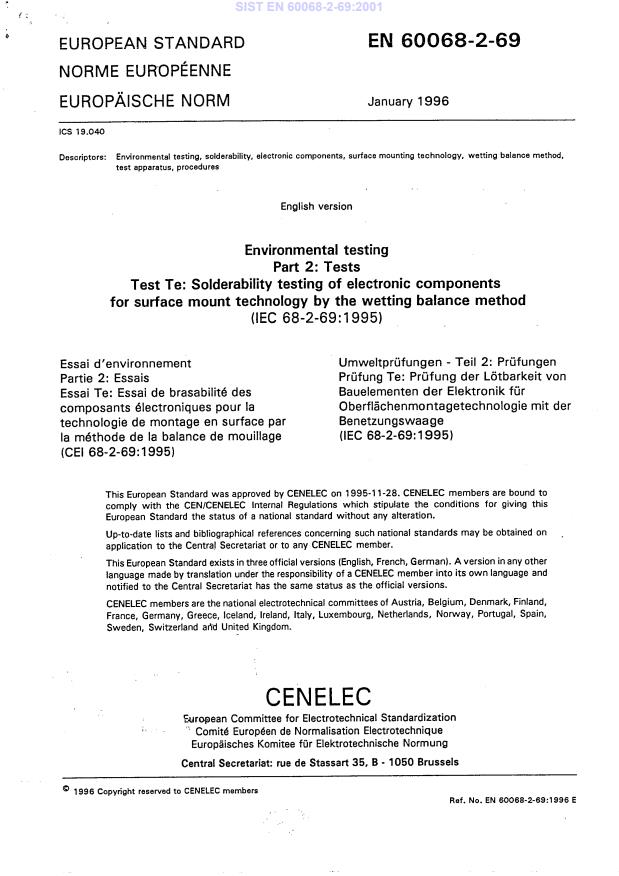
Describes two wetting balance methods. These methods determine quantitatively the solderability of terminations on surface mounted devices. The procedures describe the solder bath wetting balance method and the solder globuwetting balance method and are both applicable to components with metallic termination and metallized solder pads.
- Status
- Withdrawn
- Publication Date
- 10-Jan-1996
- Withdrawal Date
- 31-Aug-1996
- Technical Committee
- CLC/SR 91 - Electronics assembly technology
- Drafting Committee
- IEC/TC 91 - IEC_TC_91
- Parallel Committee
- IEC/TC 91 - IEC_TC_91
- Current Stage
- 9960 - Withdrawal effective - Withdrawal
- Start Date
- 01-Jun-2010
- Completion Date
- 01-Jun-2010

Relations
- Effective Date
- 29-Jan-2023
- Effective Date
- 10-Feb-2026
- Effective Date
- 09-Feb-2026
- Effective Date
- 03-Feb-2026
- Effective Date
- 03-Feb-2026
- Refers
HD 323.2.20 S3:1988 - Basic environmental testing procedures - Part 2: Tests - Test T: Soldering - Effective Date
- 03-Feb-2026
- Effective Date
- 03-Feb-2026
- Effective Date
- 03-Feb-2026
- Effective Date
- 03-Feb-2026
- Referred By
EN 61051-1:2008 - Varistors for use in electronic equipment - Part 1: Generic specification - Effective Date
- 03-Feb-2026
- Effective Date
- 03-Feb-2026
- Effective Date
- 03-Feb-2026
- Effective Date
- 03-Feb-2026
Get Certified
Connect with accredited certification bodies for this standard

IMP NDT d.o.o.
Non-destructive testing services. Radiography, ultrasonic, magnetic particle, penetrant, visual inspection.
Inštitut za kovinske materiale in tehnologije
Institute of Metals and Technology. Materials testing, metallurgical analysis, NDT.
Q Techna d.o.o.
NDT and quality assurance specialist. 30+ years experience. NDT personnel certification per ISO 9712, nuclear and thermal power plant inspections, QA/
Sponsored listings
Frequently Asked Questions
EN 60068-2-69:1996 is a standard published by CLC. Its full title is "Environmental testing - Part 2: Tests - Test Te: Solderability testing of electronic components for surface mount technology by the wetting balance method". This standard covers: Describes two wetting balance methods. These methods determine quantitatively the solderability of terminations on surface mounted devices. The procedures describe the solder bath wetting balance method and the solder globuwetting balance method and are both applicable to components with metallic termination and metallized solder pads.
Describes two wetting balance methods. These methods determine quantitatively the solderability of terminations on surface mounted devices. The procedures describe the solder bath wetting balance method and the solder globuwetting balance method and are both applicable to components with metallic termination and metallized solder pads.
EN 60068-2-69:1996 is classified under the following ICS (International Classification for Standards) categories: 19.040 - Environmental testing. The ICS classification helps identify the subject area and facilitates finding related standards.
EN 60068-2-69:1996 has the following relationships with other standards: It is inter standard links to EN 60068-2-69:2007, ISO 683-1:1987, EN 29454-1:1993, HD 323.2.54 S1:1987, EN 60068-2-44:1995, HD 323.2.20 S3:1988, EN 61760-1:1998, EN 60068-2-58:1999, EN 60252-2:2011, EN 61051-1:2008, EN 62047-4:2010, EN 62025-2:2005, EN 61969-1:2012. Understanding these relationships helps ensure you are using the most current and applicable version of the standard.
EN 60068-2-69:1996 is available in PDF format for immediate download after purchase. The document can be added to your cart and obtained through the secure checkout process. Digital delivery ensures instant access to the complete standard document.
Standards Content (Sample)
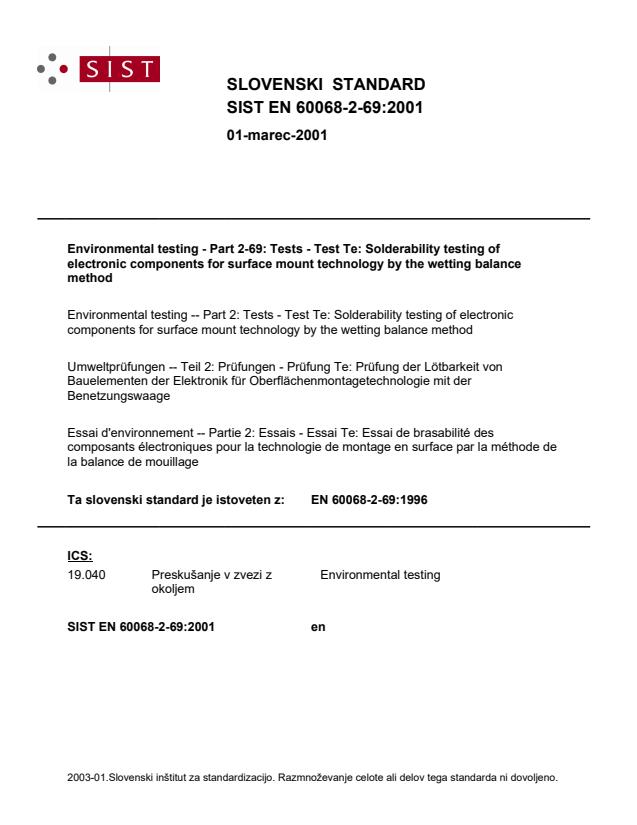
SLOVENSKI STANDARD
01-marec-2001
Environmental testing - Part 2-69: Tests - Test Te: Solderability testing of
electronic components for surface mount technology by the wetting balance
method
Environmental testing -- Part 2: Tests - Test Te: Solderability testing of electronic
components for surface mount technology by the wetting balance method
Umweltprüfungen -- Teil 2: Prüfungen - Prüfung Te: Prüfung der Lötbarkeit von
Bauelementen der Elektronik für Oberflächenmontagetechnologie mit der
Benetzungswaage
Essai d'environnement -- Partie 2: Essais - Essai Te: Essai de brasabilité des
composants électroniques pour la technologie de montage en surface par la méthode de
la balance de mouillage
Ta slovenski standard je istoveten z: EN 60068-2-69:1996
ICS:
19.040 Preskušanje v zvezi z Environmental testing
okoljem
2003-01.Slovenski inštitut za standardizacijo. Razmnoževanje celote ali delov tega standarda ni dovoljeno.
----
...