


prEN 50065-1:2025
(Main)Signalling on low-voltage electrical installations in the frequency range 3 kHz to 526,5 kHz - Part 1: General requirements, frequency bands and electromagnetic disturbances
Signalling on low-voltage electrical installations in the frequency range 3 kHz to 526,5 kHz - Part 1: General requirements, frequency bands and electromagnetic disturbances
This document applies to mains communicating equipment (MCE) using signals in the frequency range 3 kHz to 526,5 kHz to transmit information on low voltage electrical systems, either on the public electricity distribution network, within installations in consumers’ premises which are connected to the public electricity distribution network or within installations separated from the public electricity distribution network. NOTE 1 Installations separated from the public electricity distribution network can be operated in DC. Typical applications include MCS communication between photovoltaic panels and inverters over a DC bus in photovoltaic power generating system. Requirements specific to such installations are given in Annex G. It specifies the frequency bands allocated to the different applications as well as conducted and radiated emission limits, including conducted emission limits for the transmitter output signal voltage in the operating band. It also specifies the required measurement methods. It does not specify modulation methods, coding methods or functional features (except those for the prevention of mutual interference). Environmental requirements and tests are not included. NOTE 2 Compliance with this document does not imply permission to establish communication with locations outside the consumer’s installation or with other consumers through the public electricity distribution network where this would not otherwise be allowed. MCE can fall into one of the following categories: a) MCE implementing transmission or reception of information on low voltage electrical systems as the sole function. General requirements, frequency band allocation and emission limits applicable to such equipment are entirely covered by this document. b) MCE being equipment within the scope of other standards, integrating mains communication as one of their functions. In this case, only the general requirements, frequency band allocation and emission limits for the mains communication function of such equipment are covered by this document. Requirements for all other available functions of this equipment are covered by the relevant product standard. This document aims at contributing to EMC by limiting the mutual influence of different MCE or different mains communicating systems (MCS) operated in the same environment. In addition, this document is intended to limit interference caused by MCE signal transmission to general electrical equipment.
Signalübertragung auf elektrischen Niederspannungsnetzen im Frequenzbereich 3 kHz bis 148,5 kHz - Teil 1: Allgemeine Anforderungen, Frequenzbänder und elektromagnetische Störungen
Transmission de signaux sur les réseaux électriques basse tension dans la bande de fréquences de 3 kHz à 148,5 kHz - Partie 1: Règles générales, bandes de fréquences et perturbations électromagnétiques
Le présent document s'applique aux appareils de communication par le réseau d'alimentation (MCE, Mains Communicating Equipment) qui utilisent des signaux dans la bande de fréquences de 3 kHz à 526,5 kHz pour transmettre des informations sur les réseaux électriques basse tension, soit sur le réseau public de distribution d'électricité, soit à l'intérieur d'installations de locaux privatifs connectées au réseau public de distribution d'électricité, soit à l'intérieur d'installations séparées du réseau public de distribution d'électricité. NOTE 1 Les installations séparées du réseau public de distribution d'électricité peuvent fonctionner en courant continu. Les applications types comprennent la communication par système de communication par le réseau (MCS, Mains Communicating System) entre des panneaux photovoltaïques et des onduleurs par l'intermédiaire d'un bus en courant continu dans un système de production d'énergie photovoltaïque. Les exigences spécifiques à ces installations sont données à l'Annexe G. Le présent document spécifie les bandes de fréquences attribuées aux différentes applications ainsi que les limites d'émissions conduites et rayonnées, y compris les limites d'émissions conduites pour la tension du signal de sortie de l'émetteur dans la bande utilisée. Il spécifie également les méthodes de mesure exigées. Le présent document ne spécifie ni les méthodes de modulation, ni les méthodes de codage, ni les aspects fonctionnels (sauf s'ils concernent la prévention des perturbations mutuelles). Les exigences et les essais relatifs à l'environnement ne sont pas inclus. NOTE 2 La conformité au présent document n'implique pas l'autorisation d'établir la communication avec des sites situés à l'extérieur des installations de l'utilisateur ou avec d'autres utilisateurs par l'intermédiaire du réseau public de distribution d'électricité, si cela n'est pas autorisé par ailleurs. Les MCE peuvent être classés dans l'une des catégories suivantes: a) MCE dont la seule fonction est de mettre en œuvre l'émission ou la réception d'informations sur les réseaux électriques basse tension. Le présent document couvre intégralement les exigences générales, l'attribution des bandes de fréquences et les limites d'émissions applicables à ces appareils; b) MCE qui relèvent du domaine d'application d'autres normes et intègrent la communication sur le réseau parmi leurs fonctions. Dans ce cas, le présent document couvre uniquement les exigences générales, l'attribution des bandes de fréquences et les limites d'émissions associées à la fonction de communication sur le réseau de ces appareils. Les exigences relatives à toutes les autres fonctions disponibles de ces appareils sont couvertes par la norme de produit correspondante. Le présent document vise à contribuer à la compatibilité électromagnétique (CEM) en limitant les influences mutuelles de différents MCE ou de différents systèmes de communication par le réseau d'alimentation (MCS) qui fonctionnent dans le même environnement. De plus, le présent document est destiné à limiter les perturbations provoquées par l'émission de signaux de MCE sur le matériel électrique général.
Signalizacija po nizkonapetostnih električnih napeljavah v frekvenčnem območju od 3 kHz do 526,5 kHz - 1. del: Splošne zahteve, frekvenčna območja in elektromagnetne motnje
General Information
- Status
- Not Published
- Publication Date
- 17-Sep-2026
- Technical Committee
- CLC/TC 205A - Mains communicating systems
- Drafting Committee
- CLC/TC 205A/WG 09 - Revision of EN 50065
- Current Stage
- 4599 - Dispatch of FV draft to CMC - Finalization for Vote
- Start Date
- 20-Mar-2026
- Due Date
- 02-Jul-2025
- Completion Date
- 20-Mar-2026
Relations
- Effective Date
- 06-May-2021
Overview
prEN 50065-1:2025 (CLC) - Signalling on low-voltage electrical installations in the frequency range 3 kHz to 526.5 kHz - Part 1 - defines general requirements, frequency bands and electromagnetic disturbance limits for mains communicating equipment (MCE). The draft standard applies to MCE and mains communicating systems (MCS) that transmit information over low-voltage electrical systems on public distribution networks, within consumer premises, or within installations separated from the public grid (including DC systems such as PV DC buses). It focuses on EMC and coexistence by limiting mutual interference and restricting emissions; it does not define modulation, coding or higher-level functional features.
Key topics and technical requirements
- Frequency band allocation: band definitions covering 3 kHz up to 526.5 kHz, including sub-bands (e.g. up to 95 kHz, 95–148.5 kHz with sub‑ranges such as 125–140 kHz, and 148.5–526.5 kHz).
- Access protocol and coexistence: rules for band-in-use signalling and access to shared bands to reduce mutual interference between MCS.
- Transmitter output signal voltage: measurement methods and maximum output levels for single‑phase and three‑phase MCE (including measurement circuits and bandwidth determination).
- Disturbance limits: conducted and radiated emission limits (field-strength) and test conditions over ranges 3 kHz–30 MHz where applicable.
- Measurement methods and test setups: normative annexes cover measurement of detection bandwidth (Annex A), spectral distribution (Annex B), artificial mains network and impedances (Annex C), attenuation and overload assessment (Annex D), and measurement above 148.5 kHz (Annex H).
- DC installations and special cases: normative Annex G adapts requirements to DC installations separated from the public distribution network.
- Informative guidance: coexistence framework and mitigation techniques (Annex F).
Applications and practical value
- Ensures reliable power-line communication (PLC) and signalling for smart metering, home automation, photovoltaic plant monitoring, and other low-voltage MCS.
- Protects general electrical equipment and neighbouring MCS by defining emission limits and access rules.
- Provides measurement procedures for EMC testing, enabling consistent type‑approval, manufacturer compliance and product claims about signalling performance.
Who should use this standard
- Manufacturers and integrators of mains communicating equipment (MCE) and PLC devices.
- EMC test laboratories and certification bodies performing conducted/radiated emission testing.
- Power utilities, DER (distributed energy resource) and PV system designers implementing on‑bus signalling.
- Standards committees and regulatory bodies aligning national rules with CENELEC guidance.
Related standards and references
- Supersedes EN 50065-1:2011.
- Linked to CENELEC Guide 24 and to EMC regulatory requirements (e.g. Directive 2014/30/EU) as noted in the standard’s annexes.

Get Certified
Connect with accredited certification bodies for this standard

TL 9000 QuEST Forum
Telecommunications quality management system.

ANCE
Mexican certification and testing association.

Intertek Slovenia
Intertek testing, inspection, and certification services in Slovenia.
Sponsored listings
Frequently Asked Questions
prEN 50065-1:2025 is a draft published by CLC. Its full title is "Signalling on low-voltage electrical installations in the frequency range 3 kHz to 526,5 kHz - Part 1: General requirements, frequency bands and electromagnetic disturbances". This standard covers: This document applies to mains communicating equipment (MCE) using signals in the frequency range 3 kHz to 526,5 kHz to transmit information on low voltage electrical systems, either on the public electricity distribution network, within installations in consumers’ premises which are connected to the public electricity distribution network or within installations separated from the public electricity distribution network. NOTE 1 Installations separated from the public electricity distribution network can be operated in DC. Typical applications include MCS communication between photovoltaic panels and inverters over a DC bus in photovoltaic power generating system. Requirements specific to such installations are given in Annex G. It specifies the frequency bands allocated to the different applications as well as conducted and radiated emission limits, including conducted emission limits for the transmitter output signal voltage in the operating band. It also specifies the required measurement methods. It does not specify modulation methods, coding methods or functional features (except those for the prevention of mutual interference). Environmental requirements and tests are not included. NOTE 2 Compliance with this document does not imply permission to establish communication with locations outside the consumer’s installation or with other consumers through the public electricity distribution network where this would not otherwise be allowed. MCE can fall into one of the following categories: a) MCE implementing transmission or reception of information on low voltage electrical systems as the sole function. General requirements, frequency band allocation and emission limits applicable to such equipment are entirely covered by this document. b) MCE being equipment within the scope of other standards, integrating mains communication as one of their functions. In this case, only the general requirements, frequency band allocation and emission limits for the mains communication function of such equipment are covered by this document. Requirements for all other available functions of this equipment are covered by the relevant product standard. This document aims at contributing to EMC by limiting the mutual influence of different MCE or different mains communicating systems (MCS) operated in the same environment. In addition, this document is intended to limit interference caused by MCE signal transmission to general electrical equipment.
This document applies to mains communicating equipment (MCE) using signals in the frequency range 3 kHz to 526,5 kHz to transmit information on low voltage electrical systems, either on the public electricity distribution network, within installations in consumers’ premises which are connected to the public electricity distribution network or within installations separated from the public electricity distribution network. NOTE 1 Installations separated from the public electricity distribution network can be operated in DC. Typical applications include MCS communication between photovoltaic panels and inverters over a DC bus in photovoltaic power generating system. Requirements specific to such installations are given in Annex G. It specifies the frequency bands allocated to the different applications as well as conducted and radiated emission limits, including conducted emission limits for the transmitter output signal voltage in the operating band. It also specifies the required measurement methods. It does not specify modulation methods, coding methods or functional features (except those for the prevention of mutual interference). Environmental requirements and tests are not included. NOTE 2 Compliance with this document does not imply permission to establish communication with locations outside the consumer’s installation or with other consumers through the public electricity distribution network where this would not otherwise be allowed. MCE can fall into one of the following categories: a) MCE implementing transmission or reception of information on low voltage electrical systems as the sole function. General requirements, frequency band allocation and emission limits applicable to such equipment are entirely covered by this document. b) MCE being equipment within the scope of other standards, integrating mains communication as one of their functions. In this case, only the general requirements, frequency band allocation and emission limits for the mains communication function of such equipment are covered by this document. Requirements for all other available functions of this equipment are covered by the relevant product standard. This document aims at contributing to EMC by limiting the mutual influence of different MCE or different mains communicating systems (MCS) operated in the same environment. In addition, this document is intended to limit interference caused by MCE signal transmission to general electrical equipment.
prEN 50065-1:2025 is classified under the following ICS (International Classification for Standards) categories: 33.040.30 - Switching and signalling systems. The ICS classification helps identify the subject area and facilitates finding related standards.
prEN 50065-1:2025 has the following relationships with other standards: It is inter standard links to EN 50065-1:2011. Understanding these relationships helps ensure you are using the most current and applicable version of the standard.
prEN 50065-1:2025 is associated with the following European legislation: EU Directives/Regulations: 2014/30/EU; Standardization Mandates: M/552. When a standard is cited in the Official Journal of the European Union, products manufactured in conformity with it benefit from a presumption of conformity with the essential requirements of the corresponding EU directive or regulation.
prEN 50065-1:2025 is available in PDF format for immediate download after purchase. The document can be added to your cart and obtained through the secure checkout process. Digital delivery ensures instant access to the complete standard document.
Standards Content (Sample)
SLOVENSKI STANDARD
01-marec-2025
Signalizacija po nizkonapetostnih električnih napeljavah v frekvenčnem območju
od 3 kHz do 526,5 kHz - 1. del: Splošne zahteve, frekvenčna območja in
elektromagnetne motnje
Signalling on low-voltage electrical installations in the frequency range 3 kHz to 526,5
kHz - Part 1: General requirements, frequency bands and electromagnetic disturbances
Signalübertragung auf elektrischen Niederspannungsnetzen im Frequenzbereich 3 kHz
bis 148,5 kHz - Teil 1: Allgemeine Anforderungen, Frequenzbänder und
elektromagnetische Störungen
Transmission de signaux sur les réseaux électriques basse tension dans la bande de
fréquences de 3 kHz à 148,5 kHz - Partie 1: Règles générales, bandes de fréquences et
perturbations électromagnétiques
Ta slovenski standard je istoveten z: prEN 50065-1:2025
ICS:
33.040.30 Komutacijski in signalizacijski Switching and signalling
sistem systems
33.100.01 Elektromagnetna združljivost Electromagnetic compatibility
na splošno in general
91.140.50 Sistemi za oskrbo z elektriko Electricity supply systems
2003-01.Slovenski inštitut za standardizacijo. Razmnoževanje celote ali delov tega standarda ni dovoljeno.
EUROPEAN STANDARD DRAFT
prEN 50065-1
NORME EUROPÉENNE
EUROPÄISCHE NORM
January 2025
ICS 33.040.30 Will supersede EN 50065-1:2011
English Version
Signalling on low-voltage electrical installations in the frequency
range 3 kHz to 526,5 kHz - Part 1: General requirements,
frequency bands and electromagnetic disturbances
Transmission de signaux sur les réseaux électriques basse Signalübertragung auf elektrischen Niederspannungsnetzen
tension dans la bande de fréquences de 3 kHz à 148,5 kHz im Frequenzbereich 3 kHz bis 148,5 kHz - Teil 1:
- Partie 1: Règles générales, bandes de fréquences et Allgemeine Anforderungen, Frequenzbänder und
perturbations électromagnétiques elektromagnetische Störungen
This draft European Standard is submitted to CENELEC members for enquiry.
Deadline for CENELEC: 2025-04-18.
It has been drawn up by CLC/TC 219.
If this draft becomes a European Standard, CENELEC members are bound to comply with the CEN/CENELEC Internal Regulations which
stipulate the conditions for giving this European Standard the status of a national standard without any alteration.
This draft European Standard was established by CENELEC in three official versions (English, French, German).
A version in any other language made by translation under the responsibility of a CENELEC member into its own language and notified to
the CEN-CENELEC Management Centre has the same status as the official versions.
CENELEC members are the national electrotechnical committees of Austria, Belgium, Bulgaria, Croatia, Cyprus, the Czech Republic,
Denmark, Estonia, Finland, France, Germany, Greece, Hungary, Iceland, Ireland, Italy, Latvia, Lithuania, Luxembourg, Malta, the
Netherlands, Norway, Poland, Portugal, Republic of North Macedonia, Romania, Serbia, Slovakia, Slovenia, Spain, Sweden, Switzerland,
Türkiye and the United Kingdom.
Recipients of this draft are invited to submit, with their comments, notification of any relevant patent rights of which they are aware and to
provide supporting documentation.
Warning : This document is not a European Standard. It is distributed for review and comments. It is subject to change without notice and
shall not be referred to as a European Standard.
European Committee for Electrotechnical Standardization
Comité Européen de Normalisation Electrotechnique
Europäisches Komitee für Elektrotechnische Normung
CEN-CENELEC Management Centre: Rue de la Science 23, B-1040 Brussels
© 2025 CENELEC All rights of exploitation in any form and by any means reserved worldwide for CENELEC Members.
Project: 73918 Ref. No. prEN 50065-1:2025 E
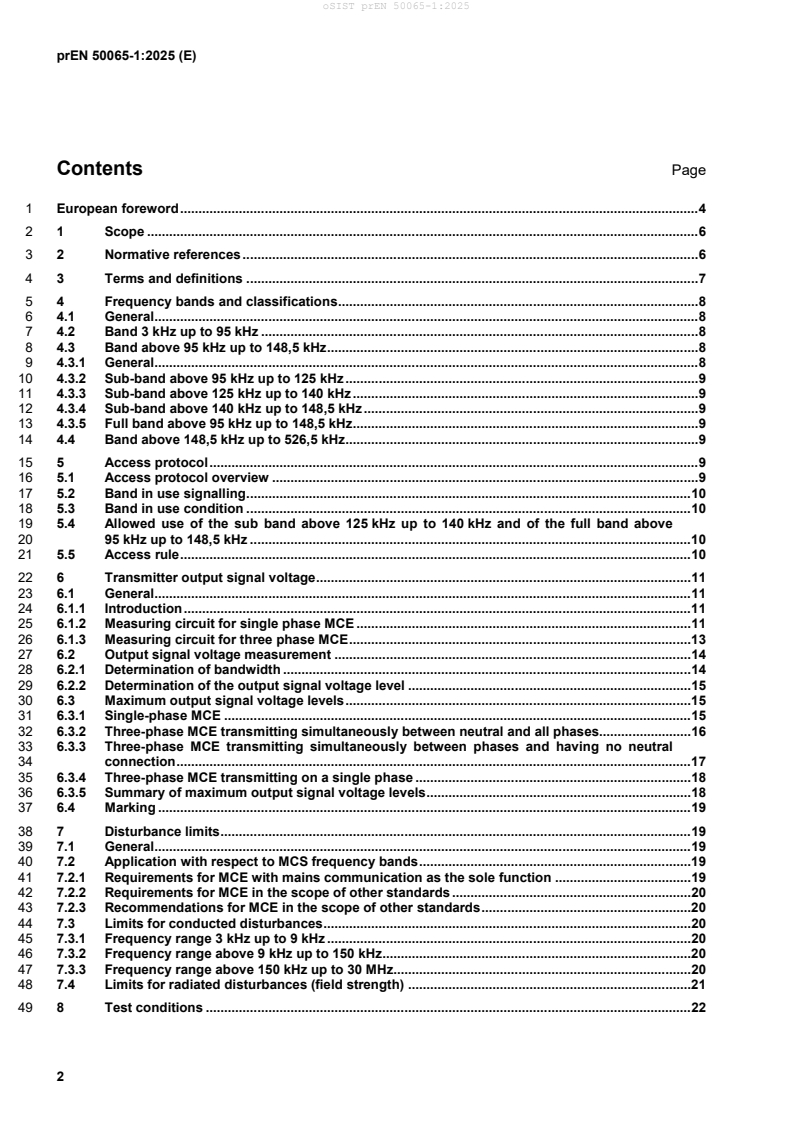
Contents Page
1 European foreword . 4
2 1 Scope . 6
3 2 Normative references . 6
4 3 Terms and definitions . 7
5 4 Frequency bands and classifications . 8
6 4.1 General . 8
7 4.2 Band 3 kHz up to 95 kHz . 8
8 4.3 Band above 95 kHz up to 148,5 kHz . 8
9 4.3.1 General . 8
10 4.3.2 Sub-band above 95 kHz up to 125 kHz . 9
11 4.3.3 Sub-band above 125 kHz up to 140 kHz . 9
12 4.3.4 Sub-band above 140 kHz up to 148,5 kHz . 9
13 4.3.5 Full band above 95 kHz up to 148,5 kHz . 9
14 4.4 Band above 148,5 kHz up to 526,5 kHz . 9
15 5 Access protocol . 9
16 5.1 Access protocol overview . 9
17 5.2 Band in use signalling . 10
18 5.3 Band in use condition . 10
19 5.4 Allowed use of the sub band above 125 kHz up to 140 kHz and of the full band above
20 95 kHz up to 148,5 kHz . 10
21 5.5 Access rule . 10
22 6 Transmitter output signal voltage . 11
23 6.1 General . 11
24 6.1.1 Introduction . 11
25 6.1.2 Measuring circuit for single phase MCE . 11
26 6.1.3 Measuring circuit for three phase MCE . 13
27 6.2 Output signal voltage measurement . 14
28 6.2.1 Determination of bandwidth . 14
29 6.2.2 Determination of the output signal voltage level . 15
30 6.3 Maximum output signal voltage levels . 15
31 6.3.1 Single-phase MCE . 15
32 6.3.2 Three-phase MCE transmitting simultaneously between neutral and all phases. 16
33 6.3.3 Three-phase MCE transmitting simultaneously between phases and having no neutral
34 connection . 17
35 6.3.4 Three-phase MCE transmitting on a single phase . 18
36 6.3.5 Summary of maximum output signal voltage levels . 18
37 6.4 Marking . 19
38 7 Disturbance limits . 19
39 7.1 General . 19
40 7.2 Application with respect to MCS frequency bands . 19
41 7.2.1 Requirements for MCE with mains communication as the sole function . 19
42 7.2.2 Requirements for MCE in the scope of other standards . 20
43 7.2.3 Recommendations for MCE in the scope of other standards . 20
44 7.3 Limits for conducted disturbances . 20
45 7.3.1 Frequency range 3 kHz up to 9 kHz . 20
46 7.3.2 Frequency range above 9 kHz up to 150 kHz. 20
47 7.3.3 Frequency range above 150 kHz up to 30 MHz. 20
48 7.4 Limits for radiated disturbances (field strength) . 21
49 8 Test conditions . 22
50 8.1 General . 22
51 8.2 Output signal and disturbance levels . 23
52 8.3 Supply voltage . 23
53 8.4 Multicarrier transmission . 23
54 8.5 Usage of associated equipment . 23
55 8.6 Synchronized transmission . 24
56 8.7 Test report . 24
57 Annex A (normative) Measurement method of the frequency range over which MCE detects a
58 signal from another device in the frequency range 125 kHz to 140 kHz . 25
59 A.1 Test setup . 25
60 A.2 Measuring receiver configuration . 25
61 A.3 Test sequence . 25
62 Annex B (normative) Measurement method of the spectral distribution of MCE output signal in
63 the frequency range 125 kHz to 140 kHz . 26
64 Annex C (normative) Measurement methods (3 kHz to 30 MHz) – Artificial mains network . 27
65 C.1 General . 27
66 C.2 Impedances . 27
67 Annex D (normative) Attenuation characteristics of the measurement setup above 150 kHz . 28
68 D.1 General . 28
69 D.2 Assessment of measuring receiver overload . 28
70 Annex E (informative) Design for a single artificial network intended to show the performance of
71 a signalling system in a low impedance environment . 29
72 Annex F (informative) Reference framework for coexistence cases between different mains
73 communicating systems . 34
74 F.1 General . 34
75 F.2 Coexistence framework . 34
76 F.3 Coexistence cases and mitigation techniques . 35
77 F.4 Effect of MCE on local impedance . 36
78 Annex G (normative) Requirements for MCE used in DC electrical installations separated from
79 the public electricity distribution network . 37
80 G.1 General . 37
81 G.2 MCE used in DC electrical installations separated from the public electricity distribution
82 network . 37
83 G.3 Measurement setup for the determination of MCE output signal voltage and conducted
84 disturbances at the MCE’s DC power port . 39
85 Annex H (normative) Maximum output signal voltage levels over a capacitive load for the
86 frequency range above 148,5 kHz up to 526,5 kHz . 41
87 H.1 General . 41
88 H.2 Measurement method . 41
89 H.3 Maximum output signal voltage levels . 42
90 Annex ZA (informative) Relationship between this European standard and the essential
91 requirements of Directive 2014/30/EU [2014 OJ L96] aimed to be covered . 43
92 Bibliography . 45
93 European foreword
94 This document (prEN 50065-1:2025) has been prepared by CLC/TC 219 “Mains communicating systems”.
95 This document is currently submitted to the Enquiry.
96 The following dates are proposed:
• latest date by which the existence of this (doa) dav + 6 months
document has to be announced at national
level
• latest date by which this document has to be (dop) dav + 12 months
implemented at national level by publication of
an identical national standard or by
endorsement
• latest date by which the national standards (dow) dav + 36 months
conflicting with this document have to be (to be confirmed or
withdrawn modified when voting)
97 This document will supersede EN 50065-1:2011 and all of its amendments and corrigenda (if any).
98 EN 50065-1:2025 includes the following significant technical changes with respect to EN 50065-1:2011:
99 This revision aligns EN 50065-1 with CENELEC Guide 24. It introduces requirements for signalling on low-
100 voltage electrical installations in the frequency range 148,5 kHz to 526,5 kHz, specifies the use of the full band
101 between 95 kHz and 148,5 kHz, and provides clarifications to the output signal voltage measurement method.
102 A new normative annex consists of the adaptation of this document’s requirements for signalling in direct
103 current electrical installations separated from the public electricity distribution network. A new normative annex
104 specifies additional requirements applicable to MCE operated above 148,5 kHz up to 526,5 kHz. A new
105 informative annex introduces a reference framework describing coexistence of different mains communicating
106 systems operating simultaneously. Outdated material (safety considerations, application to electric vehicle
107 charging systems) is withdrawn, as well as the limits for radiated disturbance power and the related
108 measurement method (only disturbances’ field strength limits are kept). Finally, general clarifications and
109 editorial enhancements are made throughout this document.
110 This document has been prepared under a standardization request addressed to CENELEC by the European
111 Commission. The Standing Committee of the EFTA States subsequently approves these requests for its
112 Member States.
113 For the relationship with EU Legislation, see informative Annex ZZ, which is an integral part of this document.
114 EN 50065 consists of the following parts, under the general title Signalling on low voltage electrical
115 installations in the frequency range 3 kHz to 526,5 kHz:
Part 1 General requirements, frequency bands and electromagnetic disturbances
Part 2-1 Immunity requirements for mains communications equipment and systems operating in the
range of frequencies 95 kHz to 148,5 kHz and intended for use in residential, commercial
and light industrial environments
Part 2-2 Immunity requirements for mains communications equipment and systems operating in the
range of frequencies 95 kHz to 148,5 kHz and intended for use in industrial environments
Part 2-3 Immunity requirements for mains communications equipment and systems operating in the
range of frequencies 3 kHz to 95 kHz and intended for use by electricity suppliers and
distributors
Part 4-1 Low voltage decoupling filters – Generic specification
Part 4-2 Low voltage decoupling filters – Safety requirements
Part 4-3 Low voltage decoupling filters – Incoming filter
Part 4-4 Low voltage decoupling filters – Impedance filter
Part 4-5 Low voltage decoupling filters – Segmentation filter
Part 4-6 Low voltage decoupling filters – Phase coupler
Part 7 Equipment impedance
116 1 Scope
117 This document applies to mains communicating equipment (MCE) using signals in the frequency range 3 kHz
118 to 526,5 kHz to transmit information on low voltage electrical systems, either on the public electricity
119 distribution network, within installations in consumers’ premises which are connected to the public electricity
120 distribution network or within installations separated from the public electricity distribution network.
121 NOTE 1 Installations separated from the public electricity distribution network can be operated in DC. Typical
122 applications include MCS communication between photovoltaic panels and inverters over a DC bus in photovoltaic power
123 generating system. Requirements specific to such installations are given in Annex G.
124 It specifies the frequency bands allocated to the different applications as well as conducted and radiated
125 emission limits, including conducted emission limits for the transmitter output signal voltage in the operating
126 band. It also specifies the required measurement methods.
127 It does not specify modulation methods, coding methods or functional features (except those for the
128 prevention of mutual interference).
129 Environmental requirements and tests are not included.
130 NOTE 2 Compliance with this document does not imply permission to establish communication with locations outside
131 the consumer’s installation or with other consumers through the public electricity distribution network where this would not
132 otherwise be allowed.
133 MCE can fall into one of the following categories:
134 a) MCE implementing transmission or reception of information on low voltage electrical systems as the sole
135 function. General requirements, frequency band allocation and emission limits applicable to such
136 equipment are entirely covered by this document.
137 b) MCE being equipment within the scope of other standards, integrating mains communication as one of
138 their functions. In this case, only the general requirements, frequency band allocation and emission limits
139 for the mains communication function of such equipment are covered by this document. Requirements for
140 all other available functions of this equipment are covered by the relevant product standard.
141 This document aims at contributing to EMC by limiting the mutual influence of different MCE or different mains
142 communicating systems (MCS) operated in the same environment. In addition, this document is intended to
143 limit interference caused by MCE signal transmission to general electrical equipment.
144 2 Normative references
145 The following documents are referred to in the text in such a way that some or all of their content constitutes
146 requirements of this document. For dated references, only the edition cited applies. For undated references,
147 the latest edition of the referenced document (including any amendments) applies.
148 EN 55011:2016, Industrial, scientific and medical equipment – Radio-frequency disturbance characteristics –
149 Limits and methods of measurement (CISPR 11:2015)
150 EN IEC 55016-1-1:2019, Specification for radio disturbance and immunity measuring apparatus and methods
151 - Part 1-1: Radio disturbance and immunity measuring apparatus - Measuring apparatus (CISPR 16-1-1:2019)
152 EN 55016-1-2:2014, Specification for radio disturbance and immunity measuring apparatus and methods –
153 Part 1-2: Radio disturbance and immunity measuring apparatus – Coupling devices for conducted disturbance
154 measurements Ancillary equipment – Conducted disturbances (CISPR 16-1-2:2014)
As impacted by EN 55011:2016/A1:2017, EN 55011:2016/A11:2020 and EN 55011:2016/A2:2021.
As impacted by EN 55016-1-2:2014/A1:2018.
155 EN IEC 55016-1-4:2019, Specification for radio disturbance and immunity measuring apparatus and methods
156 – Part 1-4: Radio disturbance and immunity measuring apparatus – Antennas and test sites for radiated
157 disturbance measurements (CISPR 16-1-4:2019)
158 EN 55016-2-1:2014, Specification for radio disturbance and immunity measuring apparatus and methods –
159 Part 2-1: methods of measurement of disturbances and immunity – Conducted disturbance measurements
160 (CISPR 16-2-1:2014)
161 EN 55016-2-3:2017, Specification for radio disturbance and immunity measuring apparatus and methods –
162 Part 2-3: methods of measurement of disturbances and immunity – Radiated disturbance measurements
163 (CISPR 16-2-3:2016)
164 EN IEC 61000-6-3:2021, Electromagnetic compatibility (EMC) - Part 6-3: Generic standards - Emission
165 standard for equipment in residential environments (IEC 61000-6-3:2020)
166 3 Terms and definitions
167 For the purposes of this document, the following terms and definitions apply.
168 ISO and IEC maintain terminology databases for use in standardization at the following addresses:
169 — ISO Online browsing platform: available at https://www.iso.org/obp/
170 — IEC Electropedia: available at https://www.electropedia.org/
171 3.1
172 application
173 use of a technology, system, or product
174 3.2
175 commercial or industrial premises
176 all premises other than residential premises
177 3.3
178 differential-mode signalling
179 form of signalling between two or more power conductors not requiring use of the protective conductor
180 3.4
181 electromagnetic compatibility
182 EMC
183 ability of equipment or a system to function satisfactorily in its electromagnetic environment without
184 introducing intolerable electromagnetic disturbances to anything in that environment
185 3.5
186 mains communicating equipment
187 MCE
188 electrical equipment using mains power lines either on the public electricity distribution network or within
189 installations of network users connected to the public electricity distribution network, for transmission and
190 reception of information signals
As impacted by EN IEC 55016-1-4:2019/A1:2020 and EN IEC 55016-1-4:2019/A2:2023.
As impacted by EN 55016-2-1:2014/A1:2017.
As impacted by EN 55016-2-3:2017/A1:2019 and EN 55016-2-3:2017/A2:2023.
191 3.6
192 mains communicating system
193 MCS
194 electrical system using mains power lines to transmit information signals, either on the public electricity
195 distribution network or within installations of network users
196 [SOURCE: EN 61000-2-2:2002, 3.1.8]
197 3.7
198 residential
199 premises which are normally used as homes for persons
200 3.8
201 signalling
202 mains signalling voltage
203 signal superimposed on the mains voltage for the purpose of transmission of information either on the public
204 electricity distribution network, within installations of network users or within installations separated from the
205 public electricity distribution network
206 Note 1 to entry: Installations are considered to be separated from the public electricity distribution network if they are
207 connected to the public electricity distribution network via a device providing an adequate level of attenuation over the
208 frequency range covered by this document (such as a filter or an isolation transformer) or if they are supplied by a network
209 which is independent from the public electricity distribution network.
210 4 Frequency bands and classifications
211 4.1 General
212 In order to provide coexistence between different applications and to prevent mutual interference, this
213 document designates frequency bands for well-established application types.
214 NOTE Early drafts of this document, based upon existing industry documents and an existing national standard, used
215 the terms A-band, B-band, C-band and D-band to designate the frequency bands 3 kHz to 95 kHz, 95 kHz to 125 kHz,
216 125 kHz to 140 kHz and 140 kHz to 148,5 kHz, respectively. Although these designations are not used in this document
217 they remain widely used in industry for convenience. Where such designations are used, they are understood as above.
218 Additional mitigation measures, such as frequency separation and notching, reducing MCE transmission duty
219 cycle, locally decreasing the output signal voltage levels, etc. can be implemented in the event of interference
220 to radio services.
221 4.2 Band 3 kHz up to 95 kHz
222 Frequencies in this band shall only be used for applications for monitoring or controlling the low-voltage public
223 electricity distribution network, including energy usage of equipment and premises connected to the low-
224 voltage public electricity distribution network.
225 NOTE A typical example of an application in this band would be communications for metering.
226 4.3 Band above 95 kHz up to 148,5 kHz
227 4.3.1 General
228 Frequencies in this band shall only be used for:
229 a) Applications within homes, commercial or industrial premises;
230 b) Applications in networks external to premises and separated from the low-voltage public electricity
231 distribution network with a transformer or an MCS blocking filter.
232 NOTE 1 Typical examples of a) would be home and building automation, load control, distributed energy resource
233 management, submetering, prepayment via an in-home device and security systems. Typical examples of b) would be
234 street lighting control and electric vehicle charging.
235 NOTE 2 Coexistence of different mains communicating systems and related mitigation measures are further described
236 in Annex F.
237 Equipment for use in this frequency band is designated as either Class 122 or as Class 134 equipment. Class
238 122 equipment is suitable for general use, while Class 134 equipment is not intended to be used in residential
239 electrical installations or in locations with direct connection to residential installations.
240 4.3.2 Sub-band above 95 kHz up to 125 kHz
241 The use of this sub-band does not require an access protocol.
242 4.3.3 Sub-band above 125 kHz up to 140 kHz
243 Signalling in this sub-band requires the use of the access protocol described in Clause 5.
244 4.3.4 Sub-band above 140 kHz up to 148,5 kHz
245 The use of this sub-band does not require an access protocol.
246 4.3.5 Full band above 95 kHz up to 148,5 kHz
247 Signalling in the full band from 95 kHz up to 148,5 kHz is possible and requires the use of the access protocol
248 described in Clause 5.
249 4.4 Band above 148,5 kHz up to 526,5 kHz
250 Frequencies in this band may be used for:
251 a) Applications for monitoring or controlling the low-voltage public electricity distribution network, including
252 energy usage of equipment and premises connected to the low-voltage public electricity distribution
253 network;
254 b) Applications within homes, commercial or industrial premises;
255 c) Applications in networks external to premises and separated from the low-voltage public electricity
256 distribution network with a transformer or an MCS blocking filter.
257 When different applications coexist in the same environment within this frequency band, MCS used for
258 applications other than monitoring or controlling the low-voltage public electricity distribution network shall
259 implement coexistence measures such as MCS blocking filters to ensure the correct operation of MCS on the
260 low-voltage public electricity distribution network.
261 NOTE Coexistence of different mains communicating systems and related mitigation measures are further described
262 in Annex F.
263 The use of this band does not require an access protocol.
264 5 Access protocol
265 5.1 Access protocol overview
266 A carrier-sense multiple-access (CSMA) protocol is used in the frequency sub-band 125 kHz to 140 kHz and
267 in the full band 95 kHz to 148,5 kHz to allow several systems to operate on the same, or electrically
268 connected, mains networks. These systems may use the same or different communication protocols but shall
269 use the access protocol given in this clause.
270 Signals transmitted by MCE operating in this sub-band are required to have a defined spectral distribution and
271 maximum duration such that their carrier may be detected by other devices on that network. The presence of
272 this characteristic signal on the network above a minimum level indicates that the frequency sub-band is being
273 used. This state is termed “band-in-use”. MCE with pending transmissions might not transmit whilst the band
274 is in use and until the band has been free for a minimum period.
275 To provide multiple access, MCE with pending transmissions are required to randomize their transmission
276 attempts over a time interval to reduce the possibility of collisions between two or more transmissions. The
277 most recent MCE to transmit is required to wait until the end of that time interval before attempting a further
278 transmission to prevent it taking too great a share of the available transmission capacity. The maximum length
279 of any transmission is limited for the same reason.
280 5.2 Band in use signalling
281 All MCE shall use the frequency 132,5 kHz to indicate that a transmission is in progress.
282 To enable band-in-use to be detected, MCE output signals shall meet a spectral distribution in accordance
283 with Annex B.
284 5.3 Band in use condition
285 Every MCE capable of transmitting shall be equipped with a signal detector which shall indicate when the sub
286 band is in use. Band in use is the condition when any signal of at least 86 dB(µV) rms is present anywhere in
287 the frequency range 131,5 kHz to 133,5 kHz for at least 4 ms. This shall be measured at the MCE’s main input
288 terminations and across the conductors used by the MCE’s own transmitter. The frequency range of detection
289 of a signal shall be tested as described in Annex A.
290 The band in use indication may be considered false if the output from the signal detector is present without
291 any interruption greater than 80 ms for a continuous period of at least 1,1 s immediately prior to each
292 transmission. For a transmitter or a group of transmitters, the measurement of this 1,1 s interval shall
293 recommence after the end of transmission by that transmitter or group of transmitters. Any gap in the band in
294 use indication greater than 80 ms shall reset the false band in use condition.
295 NOTE The measurement point referred to in this clause differs from that described in Clause 4 and Annex A of
296 EN 55016-1-2:2014.
297 5.4 Allowed use of the sub band above 125 kHz up to 140 kHz and of the full band above
298 95 kHz up to 148,5 kHz
299 A transmission is considered as a series of signals in which there is no gap greater than 80 ms without signal
300 transmission. A group of transmitters consists of several MCE, using the same protocol and co-ordinating their
301 actions so as to meet these requirements e.g. a demand-acknowledge-answer sequence.
302 No transmitter or group of transmitters shall transmit continuously for a period exceeding 1 s. After each
303 transmission a transmitter or a group of transmitters shall not transmit again for at least 125 ms.
304 The requirements of 5.4 and 5.5 shall be met either by each transmitter individually or by a group of
305 transmitters. In the second case, the access protocol allows a sequence of transmission, repetition and
306 answer-back signals to occupy the sub band for the maximum time otherwise permitted for a single message.
307 5.5 Access rule
308 Every MCE capable of transmitting shall only transmit if its band-in-use detector has shown that the sub band
309 has not been in use (as defined in 5.3) for a continuous period, randomly chosen on each occasion and
310 uniformly distributed between 85 ms and 115 ms with at least seven possible values in that range.
311 6 Transmitter output signal voltage
312 6.1 General
313 6.1.1 Introduction
314 To avoid damage to the device(s) under test or to the test equipment, the supply voltage applied to the
315 device(s) under test shall be within its nominal supply voltage range.
316 NOTE This is especially important in the case of three-phase MCE operating without neutral connection where
317 supply voltages can differ from those normally expected.
318 Differential-mode signalling shall generally be used.
319 Signalling on AC mains between the protective conductor (earth) and phase or neutral may be used:
320 a) Provided that MCE output signal voltage levels are below the out-of-band disturbance limits given in
321 Clause 7;
322 b) As long as there is no signalling below 5 kHz.
323 Maximum output signal voltage levels defined in 6.3 and Annex H shall apply.
324 Maximum output signal voltage levels and related requirements for MCE used in DC electrical installations
325 separated from the public electricity distribution network provided in Annex G shall apply.
326 6.1.2 Measuring circuit for single phase MCE
327 For the sub-band 3 kHz up to 9 kHz, the artificial mains network 50 Ω // 50 µH + 1,6 Ω shall be used. The
328 idealised impedance curve is shown in Figure 1 and a practical implementation of the curve, including
329 isolation from the supply, is shown in Figure 2.
330 NOTE 1 This artificial network forms half of what is commonly known as a V-Network.
332 Figure 1 — Idealised equivalent circuit model – DUT port impedance
334 Figure 2 — Artificial mains network 3 kHz to 9 kHz
336 Figure 3 — Measurement of output signal voltage level (single phase)
337 For the frequency range 9 kHz up to 526,5 kHz, an artificial network having the impedance versus frequency
338 characteristic according to Figure 1 of EN 55016-1-2:2014 as referred to in 4.3 of that standard shall be used.
339 This curve is shown by the broken line in Figure 4, which also gives an example of a suitable circuit. The
340 continuous curve in Figure 4 shows the frequency characteristic for the example network.
341 NOTE 2 Attention is drawn to the note in 4.3 of EN 55016-1-2:2014.
342 NOTE 3 EN 55016-1-2:2014 gives an example circuit in 4.10, Figure 5 with component values listed in Clause A.2 but
343 recommends compensation of the readings for frequencies in the range 9 kHz to 150 kHz. Alternative values of capacitor
344 C1 (according to Figure 5 in 4.10 of EN 55016-1-2:2014) are shown hereafter, in Figure 4 of this clause. These values are
345 appropriate for frequencies in the range 9 kHz to 95 kHz and 95 kHz to 148,5 kHz.
346 NOTE 4 Artificial networks conforming to Figure 1 of EN 55016-1-2:2014 as referred to in 4.3 of that standard are
347 available commercially, but circuit implementations can differ in detail from the example in Figure 4 of this clause.
348 Therefore, it is important for the user to check the appropriateness of the implementation with respect to the measurement
349 frequency.
350 NOTE 5 This artificial network forms half of what is commonly known as a V-Network.
352 Figure 4 — Example of artificial network covering the frequency ranges 9 kHz to 95 kHz and 95 kHz to
353 526,5 kHz
354 6.1.3 Measuring circuit for three phase MCE
355 For the sub-band 3 kHz to 9 kHz an artificial network conforming to the impedance characteristic of Figure 1
356 shall be used
357 For the frequency range 9 kHz up to 526,5 kHz a three-phase artificial mains network conforming to 4.3 of
358 EN 55016-1-2:2014 shall be used.
359 NOTE 1 Attention is drawn to the note in 4.3 of EN 55016-1-2:2014.
360 In case of simultaneous transmission between neutral and all three phases, the output signal voltage level
361 measurement shall be carried out according to Figure 5.
362 If the three-phase MCE has no neutral connection, the output signal voltage level measurement shall be
363 carried out according to Figure 5, except that the connection to AMN4 and neutral shall be omitted.
364 Where the equipment supplier’s instructions indicate that the three-phase MCE can also be used as a single
365 phase MCE by connecting all phase terminals to the same phase, the MCE shall also be tested as a single-
366 phase MCE. This is because the MCE’s performance may change as the loading conditions vary between
367 three-phase and single-phase use.
368 NOTE 2 Measurements are prescribed in differing manners for three-phase MCE which transmits on three phases
369 simultaneously and for three-phase MCE which transmits on only a single phase at any one time, even if they might
370 transmit on two or more phases in sequence.
371 NOTE 3 The use of the three-phase network for testing three-phase MCE that transmits between neutral and three
372 phases simultaneously changes the relationship between measurements made on the phases and measurements made
373 on the neutral when compared with practical applications. When using the three-phase network, the value measured on
374 the neutral is increased by 3,5 dB and those measured on the phase are decreased by 6 dB. The limit values given in
375 6.3.2, and which apply to the measured values, include corrections for these changes. No correction is required for three-
376 phase MCE transmitting only between phases without connection to the neutral.
378 Figure 5 — Measurement of output signal voltage level of three phase MCE transmitting
379 simultaneously between neutral and all phases
380 6.2 Output signal voltage measurement
381 6.2.1 Determination of bandwidth
382 The output signal spectrum is determined by the use of a spectrum analyser having a peak detector and a
383 100 Hz bandwidth.
384 The transmitter shall operate in such a way that the bandwidth and output signal voltage magnitude have the
385 greatest values permitted by the MCE specification.
386 The effective spectral width (B in Hertz) is defined by the sum of the lengths of each interval, within the
EFF
387 band or sub-band used by the transmitter, where frequency lines are less than 20 dB below the maximum
388 spectral line (see Figure 6). Single spectral lines shall be ignored in the assessment.
389 Additionally, the total spectral width (B in Hertz) is defined as the length of the interval between the lower
TOT
390 frequency of the lowest interval and the upper frequency of the highest interval of the effective spectral width
391 B .
EFF
393 Figure 6 — Example of measurement of BEFF and BTOT
394 6.2.2 Determination of the output signal voltage level
395 The output signal voltage level is measured over a period of 1 min using a peak detector. This measurement
396 shall be made by a spectrum analyser with a resolution
...
Questions, Comments and Discussion
Ask us and Technical Secretary will try to provide an answer. You can facilitate discussion about the standard in here.
Loading comments...