

CLC/TR 50510:2021
(Main)Fibre optic access to end-user - A guideline to building of FTTX fibre optic network
General Information
- Abstract
The purpose of this report is to be a guideline for those considering to install a high bandwidth (high bit-rate) FttX-network. After studying the report, operators, communities, energy companies, installers and others will understand the necessary steps to take to plan and install networks with high quality and cost effectiveness, and to secure a uniform structure and a high quality level on such networks.
- Status
- Published
- Publication Date
- 30-Sep-2021
- Technical Committee
- CLC/TC 86A - Optical fibres and optical fibre cables
- Drafting Committee
- CLC/TC 86A - Optical fibres and optical fibre cables
- Current Stage
- 6060 - Document made available - Publishing
- Start Date
- 01-Oct-2021
- Due Date
- 16-Apr-2020
- Completion Date
- 01-Oct-2021


Overview
CLC/TR 50510:2021 - "Fibre optic access to end-user - A guideline to building of FTTX fibre optic network" is a CENELEC technical report adopted as a Slovenian standard. It provides practical guidance for planning, designing, installing and operating high‑bandwidth FttX fibre optic access networks. The report helps operators, communities, energy companies, installers and planners achieve uniform structure, high quality and cost‑effective deployment of FTTH/FTTB/FTTC and other FTTX solutions.
Key topics and technical requirements
The report covers the full lifecycle of a fibre optic access project with emphasis on practical, deployable solutions:
- Network structure and nodes: topologies for access networks (P2P and PON), node placement and concentration strategies.
- FTTX communication systems: overview of PON technologies, optical budget classes and introduction of new PON technologies.
- Passive network components: selection and characteristics of optical fibres, cables, ducts, microducts, drop cables, and hybrid cables.
- Connectivity and splicing: guidance on connectors, fusion splicing, pre‑connectorised fibres and connector types used in access networks.
- Optical splitters and power budget: splitter selection, functional performance attributes and methods for optical power budget calculation and link dimensioning.
- Closures, ODFs and fibre organizers: recommended closure types, Optical Distribution Frame arrangements and fibre management practices.
- Installation methods: pulling, blowing, direct bury, aerial and indoor installation; trenching, Right of Way (RoW) solutions and jointing chambers.
- Design for different environments: specific guidance for Multi‑Dwelling Units (MDUs), detached houses and rural deployments.
- Planning, commissioning and quality: outline and detailed planning, installation acceptance, measurements, labelling, operation and maintenance.
- Health & safety: risk elimination and safety during civil works and fibre installation.
Practical applications and users
This guideline is practical for:
- Network operators and ISPs planning FTTH/FTTx rollouts.
- Municipalities and community networks coordinating infrastructure sharing and RoW.
- Utilities and energy companies integrating fibre in existing corridors.
- Design consultants and civil contractors executing trenching, ducting and aerial works.
- Installers and maintenance teams responsible for splicing, connectorisation, testing and documentation.
Use cases include designing PON access networks, choosing cable and ducting strategies, planning MDUs, performing optical budget calculations and implementing standardized testing and documentation.
Related standards and references
The report includes a normative/informative list of referenced standards (see Annex A). It is aligned with CLC/TR 50510:2021 and supersedes earlier editions (2012/2013). For compliance and interoperability, consult the referenced standards in Annex A and national electrotechnical regulations.
Relations
- Effective Date
- 07-Jun-2022
Get Certified
Connect with accredited certification bodies for this standard

ANCE
Mexican certification and testing association.

Intertek Slovenia
Intertek testing, inspection, and certification services in Slovenia.

LNE (Laboratoire National de Métrologie et d'Essais)
French national laboratory for metrology and testing.
Sponsored listings
Frequently Asked Questions
CLC/TR 50510:2021 is a technical report published by CLC. Its full title is "Fibre optic access to end-user - A guideline to building of FTTX fibre optic network". This standard covers: The purpose of this report is to be a guideline for those considering to install a high bandwidth (high bit-rate) FttX-network. After studying the report, operators, communities, energy companies, installers and others will understand the necessary steps to take to plan and install networks with high quality and cost effectiveness, and to secure a uniform structure and a high quality level on such networks.
The purpose of this report is to be a guideline for those considering to install a high bandwidth (high bit-rate) FttX-network. After studying the report, operators, communities, energy companies, installers and others will understand the necessary steps to take to plan and install networks with high quality and cost effectiveness, and to secure a uniform structure and a high quality level on such networks.
CLC/TR 50510:2021 is classified under the following ICS (International Classification for Standards) categories: 33.180.99 - Other fibre optic equipment. The ICS classification helps identify the subject area and facilitates finding related standards.
CLC/TR 50510:2021 has the following relationships with other standards: It is inter standard links to CLC/TR 50510:2012. Understanding these relationships helps ensure you are using the most current and applicable version of the standard.
CLC/TR 50510:2021 is associated with the following European legislation: EU Directives/Regulations: 2014/33/EU. When a standard is cited in the Official Journal of the European Union, products manufactured in conformity with it benefit from a presumption of conformity with the essential requirements of the corresponding EU directive or regulation.
CLC/TR 50510:2021 is available in PDF format for immediate download after purchase. The document can be added to your cart and obtained through the secure checkout process. Digital delivery ensures instant access to the complete standard document.
Standards Content (Sample)
SLOVENSKI STANDARD
01-december-2021
Nadomešča:
SIST-TP CLC/TR 50510:2013
Dostop prek optičnih vlaken do končnega uporabnika - Napotki za gradnjo
optičnega omrežja FTTX
Fibre optic access to end-user - A guideline to building of FTTX fibre optic network
Lichtwellenleiterzugang zum Endkunden - Leitfaden für die Erstellung von FTTx-
Lichtwellenleiternetzen
Accès à lutilisateur par fibres optiques - Lignes directrices relatives à la construction dun
réseau en fibres optiques de type FttX
Ta slovenski standard je istoveten z: CLC/TR 50510:2021
ICS:
33.180.99 Druga oprema za optična Other fibre optic equipment
vlakna
2003-01.Slovenski inštitut za standardizacijo. Razmnoževanje celote ali delov tega standarda ni dovoljeno.
TECHNICAL REPORT CLC/TR 50510
RAPPORT TECHNIQUE
TECHNISCHER BERICHT
October 2021
ICS 33.180.99 Supersedes CLC/TR 50510:2012
English Version
Fibre optic access to end-user - A guideline to building of FTTX
fibre optic network
Accès à l'utilisateur par fibres optiques - Lignes directrices Lichtwellenleiterzugang zum Endkunden - Leitfaden für die
relatives à la construction d'un réseau en fibres optiques de Erstellung von FTTx-Lichtwellenleiternetzen
type FttX
This Technical Report was approved by CENELEC on 2021-08-09.
CENELEC members are the national electrotechnical committees of Austria, Belgium, Bulgaria, Croatia, Cyprus, the Czech Republic,
Denmark, Estonia, Finland, France, Germany, Greece, Hungary, Iceland, Ireland, Italy, Latvia, Lithuania, Luxembourg, Malta, the
Netherlands, Norway, Poland, Portugal, Republic of North Macedonia, Romania, Serbia, Slovakia, Slovenia, Spain, Sweden, Switzerland,
Turkey and the United Kingdom.
European Committee for Electrotechnical Standardization
Comité Européen de Normalisation Electrotechnique
Europäisches Komitee für Elektrotechnische Normung
CEN-CENELEC Management Centre: Rue de la Science 23, B-1040 Brussels
© 2021 CENELEC All rights of exploitation in any form and by any means reserved worldwide for CENELEC Members.
Ref. No. CLC/TR 50510:2021 E
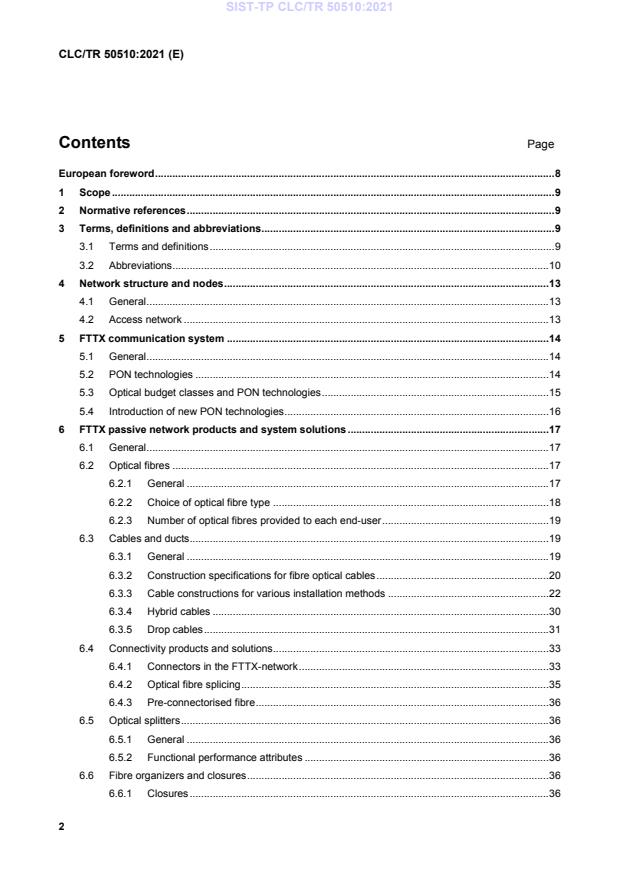
Contents Page
European foreword . 8
1 Scope . 9
2 Normative references . 9
3 Terms, definitions and abbreviations . 9
3.1 Terms and definitions . 9
3.2 Abbreviations . 10
4 Network structure and nodes . 13
4.1 General . 13
4.2 Access network . 13
5 FTTX communication system . 14
5.1 General . 14
5.2 PON technologies . 14
5.3 Optical budget classes and PON technologies . 15
5.4 Introduction of new PON technologies . 16
6 FTTX passive network products and system solutions . 17
6.1 General . 17
6.2 Optical fibres . 17
6.2.1 General . 17
6.2.2 Choice of optical fibre type . 18
6.2.3 Number of optical fibres provided to each end-user . 19
6.3 Cables and ducts. 19
6.3.1 General . 19
6.3.2 Construction specifications for fibre optical cables . 20
6.3.3 Cable constructions for various installation methods . 22
6.3.4 Hybrid cables . 30
6.3.5 Drop cables . 31
6.4 Connectivity products and solutions. 33
6.4.1 Connectors in the FTTX-network . 33
6.4.2 Optical fibre splicing . 35
6.4.3 Pre-connectorised fibre . 36
6.5 Optical splitters . 36
6.5.1 General . 36
6.5.2 Functional performance attributes . 36
6.6 Fibre organizers and closures . 36
6.6.1 Closures . 36
6.6.2 Optical Distribution Frame (ODF) . 37
6.7 System design . 38
6.7.1 Link dimensioning . 38
6.7.2 Calculation of an optical power budget . 39
7 Network design . 40
7.1 Overview . 40
7.2 Cabling implementation . 40
7.2.1 Optical fibre cabling . 40
7.2.2 Pulling, burying and blowing . 41
7.2.3 Trenching . 42
7.2.4 Right of Way (RoW) solution . 44
7.2.5 Access and jointing chambers . 48
7.3 Areas with Multi-Dwelling Units (MDUs) . 48
7.4 Areas with detached houses . 50
7.5 Rural areas . 51
7.6 General considerations when designing a network . 52
8 Planning. 52
8.1 General . 52
8.1.1 Outline planning . 52
8.1.2 Development of outline plans . 53
8.1.3 Detailed planning . 54
8.2 Installation – General advice . 55
8.2.1 Drilling . 55
8.2.2 Lift shaft . 55
8.2.3 Messages to residents . 55
8.2.4 Insurance and compensation for damage . 55
8.2.5 Certificate . 55
8.3 Installation in access nodes . 55
8.3.1 Access node . 55
8.3.2 Area for splice cabinet – Optical fibre concentration point (FCP) . 56
8.3.3 In a flat, a house or similar area (user node – subscriber node) . 57
9 Quality . 57
Annex A (Informative) List of standards . 58
Annex B (Informative) Examples of fibre optic cables – designs vs. application . 72
B.1 Direct buried fibre optic cables . 72
B.2 Fibre optic duct cables . 73
B.3 Fibre optic microduct cables . 75
B.4 All Dielectric Self Supporting aerial fibre optic cables . 75
B.5 Aerial fibre optic figure-8 cables . 76
B.6 OPGW aerial fibre optic cables . 77
B.7 Indoor extractable/pull back cable . 78
B.8 Indoor/outdoor drop cables . 79
Annex C (Informative) Examples of ducts and micro-ducts . 80
Annex D (Informative) Example of GPON access network in multi dwelling units (MDUs) with
pre-connectorised solution . 82
Annex E (Informative) Installation . 84
E.1 Introduction . 84
E.2 Underground work . 84
E.3 Aerial installation . 91
E.4 Indoor installation . 93
E.5 Commission and acceptance of completed networks . 93
E.6 Safety, risks and risk elimination . 94
Annex F (Informative) Measurements, documentation and operation . 96
F.1 Measurements . 96
F.2 Labels and marking . 96
F.3 Operation and maintenance . 101
Bibliography . 102
Figures
Figure 1 — Example for a Point-to-Point Access Network 13
Figure 3 — PON wavelengths allocation 14
Figure 4 — WDM1r: GPON and XG(S)-PON 17
Figure 5 — CEx: GPON, XG(S)-PON and NG PON2 17
Figure 6 — Duct filling optimization with low diameter cables 22
Figure 7 — Different constructions of direct buried cables 23
Figure 8 — Cable profile when installed on a horizontal span (F = force) 24
Figure 9 — Climatic load 24
Figure 10 — Different constructions of 144 optical fibre ADSS cables for FTTX 25
Figure 11 — Different constructions of 144 optical fibre reinforced double sheath ADSS cables for FTTX25
Figure 12 — Different constructions non-dielectric reinforcement - single sheath FTTX Figure-8 cables 26
Figure 13 — Indoor straight mid-span access riser cable and accessories 27
Figure 14 — Outdoor straight mid-span access cable 28
Figure 15 — Outdoor distribution box for straight mid-span access cable 28
Figure 16 — Examples of hybrid cables 31
Figure 17 — Examples of indoor drop cables for installation by pulling in a tube or along a wall 31
Figure 18 — Different constructions of flat pushable low friction all dielectric drop cables 32
Figure 19 — Indoor/outdoor drop cable – mono-sheath structure 32
Figure 20 — Indoor/outdoor drop cable –double sheath strippable structure 32
Figure 21 — Examples of single fibre ferrule based connector types 33
Figure 22 — Dome, Pan and Inline closures 36
Figure 23 — Different organizers 37
Figure 24 — “Y”, “T”, and “X” closures 37
Figure 25 — A model for calculation of optical attenuation 39
Figure 26 — Optical fibre installations planned in “cells” with the optical fibre volume focused to the
access node 41
Figure 27 — Optical fibre structure in sparsely populated areas with concentration of optical fibres to a
node 42
Figure 28 — Trenching (Source: DTAG) 43
Figure 29 — Milling wheel in the ditch (Source: Leonhard Weiss GmbH and Co. KG) 43
Figure 30 — Existing infrastructure – possible host for optical fibre cable deployment 45
Figure 31 — Schematic description of the installation of cables in sewer pipe systems 45
Figure 32 — Laying procedure pipeline section in a simplified sketch 46
Figure 33 — A house connection gas pipe is used to bridge the distance to the customer 47
Figure 34 — Adapter for getting in and outside the gas pipe 47
Figure 35 — A simplified sketch for a drinking water line 47
Figure 36 — A house connection water pipe is used to span the distance to the customer 48
Figure 37 — Network in an area of MDUs 49
Figure 38 — MDUs in cross-section 49
Figure 39 — Metropolitan/urban network for areas with detached/terraced houses 50
Figure 40 — direct connected houses 51
Figure 41 — Metropolitan/urban network for rural areas 52
Figure 42 — Curves illustrating influence and costs in an FTTX-project 53
Figure 43 — Proposal of the design of a node room 56
Figure B.1 — Central Loose Tube Fibre Optic Cable - Dry Core - Armored - Double Sheath 72
Figure B.2 — Loose Tube Fibre Optic Cable - Armoured - Dry Core - Double Sheath 72
Figure B.3 — Micromodule Optic Cable - Armoured (dielectric)- Dry Core - Double Sheath 72
Figure B.4 — Micromodule Optic Cable - Armoured (metallic)- Dry Core - Double Sheath 73
Figure B.5 — Loose Tube Fibre Optic Cable - Armoured - Dry Core - Double Sheath 73
Figure B.6 — Loose Tube Fibre Optic Cable - Non Armoured - Dielectric - Dry Core 73
Figure B.7 — Micro-module structure - dielectric reinforcement - watertight dry core - single sheath 74
Figure B.8 — Micro-module structure - dry core - stainless steel tape armour - peripheral metallic wires -
single sheath 74
Figure B.9 — Slotted Core Fibre Optic Ribbon Cable - Non Armoured - Dielectric - Dry Core – Single
Sheath 74
Figure B.10 — Loose buffer tube structure - central dielectric reinforcement - single sheath 75
Figure B.11 — Loose buffer tube structure - double sheath 75
Figure B.12 — Unitube structure - central dielectric reinforcement - single sheath 75
Figure B.13 — Micro-module structure - watertight dry core - dielectric reinforcement - single sheath 75
Figure B.14 — Micro-module structure - watertight dry core - dielectric reinforcement - double sheath 75
Figure B.15 — Loose tube structure - watertight dry core - dielectric reinforcement - double sheath 76
Figure B.16 — Loose tube structure - watertight dry core - dielectric reinforcement - double sheath 76
Figure B.17 — Unitube structure - dielectric reinforcement - single sheath 76
Figure B.18 — Micro-module structure - non-dielectric reinforcement - single sheath – Figure 8 76
Figure B.19 — Loose tube structure - non-dielectric reinforcement - single sheath – Figure 8 77
Figure B.20 — Unitube structure - dielectric reinforcement - single sheath – Figure 8 77
Figure B.21 — Aluminium tube/pipe OPGW 77
Figure B.22 — Strainless steel buffer tube OPGW 78
Figure B.23 — Riser extractable/pull back cable 78
Figure B.24 — Window cut and fibre unit extraction 78
Figure B.25 — Indoor cable with buffered fibre (simplex) 78
Figure B.26 — Indoor cable with buffered fibres (duplex) 79
Figure B.27 — Indoor buffered fibre cable 79
Figure B.28 — Indoor multi-fibre tube cable (micro distribution cable) 79
Figure B.29 — Indoor/outdoor drop cable – mono-sheath structure 79
Figure B.30 — Indoor/outdoor drop cable – double sheath strippable structure 79
Figure D.1 — Top view of roads and high riser buildings 82
Figure D.2 — Example of a high riser optical infrastructure 83
Figure E.1 — Duct preparation through ploughing 86
Figure E.2 — Duct installation with ploughing, milling and mini or micro milling 87
Figure E.3 — Installation of sub-ducts 88
Figure E.4 — Sub-ducts in 100 mm ducts 88
Figure E.5 — Installation with pulling rope 90
Figure E.6 — Installation with pulling rope 90
Figure E.7 — Installation with motor driven cable feeder. 91
Figure E.8 — Blocking coils at the immediate vicinity of the anchor clamps. 92
Figure E.9 — Blocking coils at the immediate vicinity of the anchor clamps. 92
Figure F.1 — Example of marking of fibre installation 97
Figure F.2 — Example of documentation for an FTTX-installation with a principle sketch of wiring 99
Figure F.3 — Example of an installation with physical lines (micro-ducts inserted into existing VP-20-ducts
to power central) 100
Figure F.4 — Example of final documentation for a property 100
Tables
Table 1 — GPON technology 15
Table 2 — XG-PON and XGS-PON technology 15
Table 3 — NGPON2 technology 16
Table 4 — Multi-PON Module cards 17
Table 5 — Single-mode fibre types as defined in ITU and CENELEC/IEC 18
Table 6 — Key features of EN IEC 60793-2-50 B-657 19
Table 7 — Attenuation of respectively 1 m and 2 m of fibres bent in 15 mm radius storage cassette
according to the B-657 fibre type 19
Table 8 — CPR classes summary 21
Table 9 — Typical micro-duct dimensions 30
Table 10 — Proposed connection requirements for FTTX infrastructures 34
Table C.1 — Examples of bundled micro-ducts 80
Table C.2 — Examples of micro-ducts in combination with HDPE main ducts 80
Table C.3 — Examples of micro- and mini-ducts 81
Table E.1 — Safety aspects 94
Table F.1 — Examples of duct identification 98
European foreword
This document (CLC/TR 50510:2021) has been prepared by CLC/TC 86A, “Optical fibres and optical fibre
cables”.
This document supersedes CLC/TR 50510:2012.
CLC/TR 50510:2012:
a) Complete restructuring of the document.
b) Addition of information on new PON systems and on overhead cables installations.
Attention is drawn to the possibility that some of the elements of this document may be the subject of patent
rights. CENELEC shall not be held responsible for identifying any or all such patent rights.
Any feedback and questions on this document should be directed to the users’ national committee. A
complete listing of these bodies can be found on the CENELEC website.
1 Scope
This document is a revision of CLC/TR 50510 Ed2 published in 2012. At the time that Ed2 was published,
no comprehensive document on fibre access networks was available, and few FTTX networks had been
deployed. Since then, massive deployments have occurred in most European countries, even if a lot more
remains to be rolled out, and guides are now available from organizations such as FTTH council Europe.
This new edition of CLC/TR 50510 takes lessons from the experience gained all along those deployments
and, and refers to existing documents where relevant. It addresses the impacts of the new generation of
communication systems on the access networks and components. More specifically, it provides guidelines
towards the IEC and CLC standards relating to the access networks and their technologies.
Like the first and second edition, this one addresses FTTX networks in general and includes:
— FTTC = Fibre to the Curb, meaning to the street (to a cabinet);
— FTTB = Fibre to the Building, normally into the basement;
— FTTH/P = Fibre to the Home/Premise, meaning to a building in a residential area.
It is as well of relevance for:
— FTTE = Fibre to the Enterprise,
— FTTA = Fibre to the Antenna.
This document is subdivided into five main clauses:
— Network Structure and Nodes: introduces the telecommunications infrastructures and provides an
overview of the basic structure for the FTTX network
— FTTX Communication System: introduces the next generation communication systems that will be run
on the FTTX networks
— FTTX passive network products and system solutions: describes system implementations for FTTX
including requirements on products and installation techniques
— Network design: provides guidance on how to create a network and gives an overview of applicable
network topologies.
— Planning: provides basic information in relation to various installation practises and the planning
relevant to those practises
Valuable information is also available in the annexes.
2 Normative references
There are no normative references in this document.
3 Terms, definitions and abbreviations
3.1 Terms and definitions
No terms and definitions are listed in this document.
3.2 Abbreviations
AAL Ambient Assisted Living, also known as Active Assisted Living
ADSL Asymmetric Digital Subscriber Line
APC Angled Physical Contact
APON Asynchronous transfer mode Passive Optical Network (ITU-T G.983)
ATM Asynchronous Transfer Mode
BPON Broadband Passive Optical Network (ITU-T G.983)
CAPEX CApital EXpenditures (investments)
CATV CAble TeleVision
CE Commission Européenne
CENELEC Comité Européen de Normalization en Electronique et en éLECtrotechnique
CEN Comité Européen de Normalization
CLC CENELEC
CPD Construction Product Directive
CPR Construction Product Regulation
CWDM Coarse Wavelength Division Multiplexing
DOCSIS Data Over Cable Service Interface Specification
DP Distribution Point
DWDM Dense Wavelength DIvision Multiplexing
EQF Equipment Frame (for transmission equipment)
EPON Ethernet Passive Optical Network (IEEE 802.3ah)
ETSI European Telecommunications Standards Institute
EU European Union
FCCN Fibre Cross Connect Node
FCP Fibre concentration point
FDF Fibre Distribution Field
FMS Fibre Management System
FMSC Fibre Management System Closure
FTTB Fibre To The Building
FTTC Fibre To The Curb
FTTH Fibre To The Home
FTTX FTT(X stands for B, C, H, etc.): Generic term for FTTB, FTTC, FTTH, etc.
FRNC Flame Retardant Non Chloric (halogen free)
FWA Fixed Wireless Access
GB Giga Byte
Gbit/s Giga bits per second
GPON Gigabit capable Passive Optical Network (ITU-T G.984)
HDPE High Density PolyEthylene
HFFR-LS Halogen Free Flame Retardant Low Smoke
IEEE Institute of Electrical and Electronics Engineers
IL Insertion Loss
IP Internet Protocol
ISO International Organization for Standardization
ITU International Telecommunication Union
ITU-R International Telecommunication Union - Radio-communications
ITU-T International Telecommunication Union - Telecommunications
LC Little Connector
LFH Low Fire Hazard
LI Local Interface
LSZH Low Smoke Zero Halogen
Mbit/s Mega bits per second
MDU Multi Dwelling Unit
MMF Multimode Fibre
NG-PON Next-Generation Passive Optical Network
ODF Optical Distribution Frame
OLT Optical Line Terminal
ONT Optical Network Terminal
OPGW Optical Ground Wire
OTDR Optical Time Domain Reflectometry
P2P Point to Point
P2MP Point to Multiple Points
PE PolyEthylene
Plenum Horizontal cabling (system)
PMD Polarization Mode Dispersion
PMF Patch cable Management Frame
PON Passive Optical Network
POP Point of Presence
PPF Patch Panel Frame
PtP Point to Point
PVC Polyvinylchloride
Riser Vertical cabling (system)
RL Return Loss
RoW Right of Way
SC Standard Connector
SDP Small Distribution Point
SDU Single Dwelling Unit
SMF Single Mode Fibre
S/N Signal to Noise
TC Technical Committee
TR Technical Report
UPS Uninterruptible Power System
VDSL Very high bitrate Digital Subscriber Line
WDM Wavelength Division Multiplexing
WLAN Wireless local area network
XG-PON 10 (X stands 10) Gigabit Passive Optical Network
XGS-PON 10 (X stands 10) Gigabit Symmetrical Passive Optical Network
4 Network structure and nodes
4.1 General
This clause provides an overview of a FTTX network and provides a foundation for terminology and
references made in subsequent clauses.
4.2 Access network
The following two pictures are basic illustrations of P2P (point-to-point) and PON (passive optical networks,
point-to-multi-points) access networks. P2P is in general passive, where one fibre from the central office is
routed directly to the customer and does not use splitters. With PON one fibre from the central office is
shared among a number of customers (usually 32, 64 or 128) by the use of one or several passive splitters
located within the network.
The pictures are examples from different countries in Europe.
Figure 1 — Example for a Point-to-Point Access Network
NOTE 1 A Point of Presence (PoP) is an artificial demarcation point or interface point between communicating
entities. An Internet Point of Presence typically houses servers, routers, network switches, multiplexers, and other
network interface equipment.
NOTE 2 The dashed line in Figure 1 and Figure 2 is an optional cable to provide protection switchover for ring
applications.
Figure 2 — Example of a Passive Optical Network (PON)
5 FTTX communication system
5.1 General
Deployed and planned FTTX passive networks are designed to last for several decades and need to be
agnostic with regard to the activation technologies. Therefore, they should be able to support commercially
available active technologies for point-to-multipoint (P2MP) or point-to-point (P2P) (e.g. G-PON, P2P, E-
PON, 10GE-PON, XG(S)-PON), as well as future standards (e.g. NG-PON2, 25 and 50 Gbit/s PON).
5.2 PON technologies
The following figure shows the different transmission technologies defined by the International
Telecommunication Union (ITU-T) and the Institute of Electrical and Electronics Engineers (IEEE), as well
as the wavelengths respectively used:
Figure 3 — PON wavelengths allocation
GPON technology: delivers 2.5 Gbit/s downstream and 1.25 Gbit/s upstream, on one fibre shared between
several users. This technology has been standardized under the reference ITU-T G.984.x
XG-PON technology: delivers 10 Gbit/s downstream and 2.5 Gbit/s upstream, on one fibre shared between
several users. This technology has been standardized under the reference ITU-T G.987.x
XGS-PON technology: delivers 10 Gbit/s downstream and 10 Gbit/s or 2.5 Gbit/s upstream, on one fibre
shared between several users. This technology has been standardized under the reference ITU-T G.9807.1
Technology NG PON2 TWDM PON: delivers 4 to 8 x10 Gbit/s downstream and 4 to 8 x10 Gbit/s or 4 to 8
x2,5 Gbit/s upstream, on one fibre shared between several users. This technology has been standardized
under the reference ITU-T G.989.x
NG PON2 Technology PtP WDM: offers a point-to-point architecture with a dedicated pair of channels for
each customer, offering balanced rates of 1.25 / 2.5 / 10 Gbit/s downstream and 1.25 / 2.5 / 10 Gbit/s
upstream. This technology has been standardized under the reference ITU-T G.989.x
EPON technology: delivers 1.25 Gbit/s downstream and 1.25 Gbit/s upstream on the same fibre shared
between several users. This technology has been standardized under the reference IEEE 802.3ah.
10G EPON technology: delivers 10 Gbit/s downstream and 1,25 Gbit/s or 10 Gbit/s upstream on the same
fibre shared between multiple users. This technology has been standardized under the reference
IEEE 802.3av.
Beyond these technologies new standards are being defined which will bring bit rates around 25 Gbit/s or 50
Gbit/s per channel. The wavelengths should be within the specified spectrum (1260nm - 1625nm; see
Figure 3). It is already worth to note that the new PON technologies will utilize the fibres at more extreme
wavelengths, at ranges both lower and higher than for existing telecommunication systems.
5.3 Optical budget classes and PON technologies
Each PON technology offers several optical budget classes.
This optical budget is defined by the optical specifications at the OLT and the ONT:
— in the downstream direction, minimal launched power at the OLT and the maximum sensitivity at the
ONT;
— in the upstream direction, minimal launched power at the ONT and the maximum sensitivity at the OLT.
This optical budget must be taken into consideration in network engineering (topology, design, coupling rate,
length of the local loop, etc.).
For GPON technology, the ITU-T G.984.2 standard defines 2 optical budget classes, B+ and C+ with
maximum losses of 28 dB and 32 dB, respectively.
Table 1 — GPON technology
Technology Standard Class Max optical budget
GPON G.984.2 B+ 28 dB
GPON G.984.2 C+ 32 dB
For XG-PON and XGS PON technologies, the ITU-T G.987.2 and G.9807.1 standards define 4 optical
budget classes N1, N2, E1 and E2 with 29 dB, 31 dB, 33 dB, 35 dB respectively.
Table 2 — XG-PON and XGS-PON technology
Technology Standard Class Max optical budget
XG-PON G.987.2 N1 29 dB
XG-PON G.987.2 N2 31 dB
XG-PON G.987.2 E1 33 dB
Technology Standard Class Max optical budget
XG-PON G.987.2 E2 35 dB
XGS-PON G.9807.1 N1 29 dB
XGS-PON G.9807.1 N2 31 dB
XGS-PON G.9807.1 E1 33 dB
XGS-PON G.9807.1 E2 35 dB
For NG-PON2 technology, the ITU-T G.989.2 standard defines 4 optical budget classes N1, N , E1 and E2
with 29 dB, 31 dB, 33 dB, 35 dB respectively
Table 3 — NGPON2 technology
Technology Standard Class Max optical budget
NG-PON2 G.989.2 N1 29 dB
NG-PON2 G.989.2 N 31 dB
NG-PON2 G.989.2 E1 33 dB
NG-PON2 G.989.2 E2 35 dB
5.4 Introduction of new PON technologies
For any introduction of new fibre activation technology, the possible coexistence of the wavelengths of each
technology should be verified.
In the current state of the standards and transmission technologies presented in this document, coexistence
is ensured only between standards / recommendations of the same body (ITU-T or IEEE). For example, it is
not possible to combine GPON and EPON (respectively XGS-PON and 10G EPON) on the same fibre.
The ultimate goal of coexistence, in addition to the possibility of a smooth transition (i.e. technological
migration requiring no optical mixing operation) when switching from one technology to the next, is to allow
optimal use of the fibre network deployed.
NOTE It is advisable that wiring in new housing corresponds to standards that allow provision of digital services
beyond 1 Gbit/s, or even 10 Gbit/s, in order to adequately support the new technologies envisaged.
The introduction of new PON technologies can be carried out in 3 possible ways:
Option 1: dedicated fibre per technology to the last distribution node with patching option
This option may require installation of additional optical fibre cables.
Option 2: introduction of a coexistence element
This option, based on an element of optical coexistence, makes it possible to multiplex different
wavelengths of the PON technologies. In this case, the optical budget available for the fibre local loop is the
optical budget of the active elements minus the insertion loss of this coexistence element.
The reference scheme for a fibre local loop with the introduction of new technologies by adding a
coexistence element is described below. The superposition of new technologies on the GPON technology is
realized via an optical component of the WDM1r, CEx or CEMx type. The characteristics of these
components are as follows (ITU-T G.984.5):
Figure 4 — WDM1r: GPON and XG(S)-PON
Figure 5 — CEx: GPON, XG(S)-PON and NG PON2
Option 3: OLT Multi-PON Module (MPM) also called “Combo”
This third option uses the capabilities of new OLT cards directly mixing 2 technologies (GPON and XGS-
PON) and integrating the WDM1r multiplexer.
There are 2 optical budget classes for these Multi-PON Module cards:
Table 4 — Multi-PON Module cards
MODE Standard Class Max optical budget
MPM B+ G.984.5 Amd 1 B+ 28 dB
MPM C+ G.984.5 Amd 1 C+ 32 dB
6 FTTX passive network products and system solutions
6.1 General
Optical fibre cables have been installed and widely used for more than 30 years in intercontinental,
transcontinental, regional or metropolitan networks, This clause provides information on optical fibres,
connectors, splices, link designs and optical power budgets. It discusses optical fibre cable technology and
various installation techniques, in relation to design and handling.
In FTTX, to cope with the always increasing needs of bandwidth, to permit the coexistence of several
system generations on the same fibre, all the fibre transmission bands will need to be used, from 1260 nm
to 1625 nm (and even 1650 nm for monitoring). This matter of fact should be considered when designing or
selecting the network components when dimensioning the network itself.
6.2 Optical fibres
6.2.1 General
As the used wavelength range will increase, it is important to understand what kind of issues may occur
regarding the longest wavelengths, and notably the microbend or macrobend concerns.
Microbend and macrobend loss both increase with the wavelength. They both could impact the possibility to
use the higher part of the wavelength range as planned for the new systems.
Macrobend loss increases when the bending radius of the fibre decreases. Bending can be related to the
deployment topology (tight bending of a drop cable in a building environment), to the selected accessories
(fibre storage in a cassette), or to accidental bend due to mishandling of the fibre or the cable in the field.
Added loss due to microbending occurs when localized lateral forces along the length of the fibre appear.
These may be caused by manufacturing and installation strains, as well as dimensional variations in the
cable materials due to temperature changes and or aging. Sensitivity to microbending is a function of the
difference in refractive indexes of the core and of the cladding, and of the diameters of the core and the
cladding. Coating structure and degree of softness also have an influence.
To reduce microbending losses the cable structure shall protect the optical fibres from lateral forces and
strains. Whatever the structure type (e.g. loose tube, central tube, ribbons, micro-modules,), the cable
construction should provide a fair protection of the fibres. However, in FTTH networks, cable size shall be
limited to optimize the utilization of the existing infrastructures and/or to limit the cost of new infrastructures.
Hence the use of fibres with limited microbend sensitivity becomes highly relevant.
In 2006, optical bend-insensitive single-mode fibres was added as a new fibre category (ITU-T G.657). The
rationale behind this was a new demand to install fibres with tighter bends. The 2016 ITU-T G.657 revision
has a new title “Characteristics of a bending-loss insensitive single-mode optical fibre and cable”, which
means that this fibre can be used for all applications, and not only for access networks. In addition, a fibre
with 200 µm coating has become popular, in comparison with standard fibres with a 250 µm coating, see
Annexes and Table 2 below. It is worth to note that ITU-T G.657 fibres offer reduced microbend losses as
well.
6.2.2 Choice of optical fibre type
The choice of optical fibre is determined by several parameters. The most important are:
— system cost,
— optical budget,
— transmission bit-rate,
— optical cable design,
— cable deployment strategy.
The advantages of single-mode fibres are high transmission capacity and low optical attenuation. If a single-
mode fibre is used in FTTX, the same type can be used throughout the network. This also simplifies service,
maintenance and new developments. Another advantage is that only tools and instruments for single-mode
fibres need to be procured.
Table 5 — Single-mode fibre types as defined in ITU and CENELEC/IEC
EN IEC 60793-2-50
Single-mode (SM) ITU-T
Old New
Unshifted dispersion B1.1 B-652.A, B G.652.A, B
Cut-off-shifted B1.2 B-654 G.654
Low water peak B1.3 B-652.C, D G.652.C, D
B6_a1 B-657.A1,
G.657.A1, A2,
Bending loss insensitive
a2, A2,
unshifted dispersion
B2, B3
b2, b3 B2, B3
Dispersion-shifted B2 B-653 G.653
Nonzero dispersion-shifted B4 B-655, 656 G.655, G.656
For FTTX-infrastructures single-mode optical fibre should be used. Recommended types are B-657.Ax.
The B-657 fibres were specially designed for access networks in terms of reduced bending sensitivity
(including applications inside buildings) but is now recommended for all applications. Types A1 and A2 are
fully compliant to B-652.D for all other transmission parameters; types B2 and B3 may deviate from B-652.D
in terms of mode field diameter, chromatic dispersion and polarization mode dispersion (PMD), but its
bending sensitivity is further reduced compared to type A1. Key features of EN IEC 60793-2-50 B-657.A2
fibres are summarized in Table 6 whereas Table 7 compares bending losses of respectively 1 m and 2 m of
fibres bent in 15 mm radius storage cassette according to the fibre type. G.657.A2 is the most optimized
fibre being both compliant to B-652.D type and offering extremely good bending performances. The coiling
of B-657.A2 fibre does not negatively impact the power budget even at the longest wavelengths. Further
information can be found in reference [5] of the bibliography.
Table 6 — Key features of EN IEC 60793-2-50 B-657
Compliance to
Type Specified bending radius
IEC EN 60793-2-50 B-652
B-657.A1 10 mm Yes
B-657.A2 7,5 mm Yes
B-657.B2 7,5 mm No
B-657.B3 5,0 mm No
Table 7 — Attenuation of respectively 1 m and 2 m of fibres bent in 15 mm radius storage cassette
according to the B-657 fibre type
Fibre Type Unit B-657.A1 B-657.A2/B2 B-657.B3
Length of stored m 1 2 1 2 1 2
fibres
Attenuation at dB 0,27 0,53 0,03 0,06 Not Not
1550 nm specified specified
Attenuation at dB 1,06 2,12 0,11 0,21 Not Not
1625 nm specified specified
6.2.3 Number of optical fibres provided to each end-user
The total number of fibres for each end-user depends on the opto-electrical components and installation
technique used in the network. Most systems for point-to-point connections are based on two-fibre solutions
with one fibre for uplink and one fibre
...