

FprEN 50121-1:2026
(Main)Railway applications - Electromagnetic compatibility - Part 1: General
- Abstract
This document outlines the structure and the content of the whole set. It provides information about the EMC management. It specifies the performance criteria applicable to the whole series. This part alone is not sufficient to give presumption of conformity to the essential requirements of the EMC-Directive and is intended to be used in conjunction with other parts of this series of standards. The informative Annex A describes the characteristics of the railway system which affect electromagnetic compatibility (EMC) behaviour. Phenomena excluded from the set are Nuclear EM pulse, abnormal operating conditions (e.g. fault conditions) and the induction effects of direct lightning strike. Emission limits at the railway system boundary do not apply to intentional transmitters within the railway system boundaries. Safety considerations are not covered by this set of standards. The biological effects of non-ionizing radiation as well as apparatus for medical assistance, such as pacemakers, are not considered here.
- Status
- Not Published
- Publication Date
- 03-Jan-2027
- Technical Committee
- CLC/TC 9X - Electrical and electronic applications for railways
- Current Stage
- 5020 - Vote circulated - Formal Approval
- Start Date
- 04-Sep-2026
- Due Date
- 27-May-2026
- Completion Date
- 04-Sep-2026

FprEN 50121-1:2026 is the CLC draft European standard for railway applications - Electromagnetic compatibility - Part 1: General. It sets the general framework for electromagnetic compatibility (EMC) across the EN 50121 series, including EMC management and the performance criteria used throughout the family. It is aimed at people who specify, integrate, test or manage railway subsystems and equipment.
What does FprEN 50121-1:2026 specify?
FprEN 50121-1:2026 specifies the structure of the railway EMC series, the management approach for EMC, and the performance criteria applied to the whole set. Part 1 is the general part of the series and is intended to be used together with the product-specific parts.
| Annex | What it covers |
|---|---|
| Annex A (informative) | The railway system: coupling mechanisms, immunity and emission phenomena, traction systems, internal noise sources, external disturbance |
| Annex B (informative) | EMC management plan: example structure, EMC matrix, compatibility margin, planning information |
The scope also makes clear what is outside the set: nuclear EM pulse, abnormal operating conditions such as fault conditions, and induction effects of direct lightning strike. It also excludes safety considerations and biological effects of non-ionizing radiation, including medical assistance equipment such as pacemakers.
What are the key requirements of FprEN 50121-1:2026?
FprEN 50121-1:2026 is mainly a framework document, but it still sets practical requirements for how EMC is handled in a railway project.
EMC management
Clause 4 says the railway system shall be treated as a complex installation and that all cases shall be considered in a formal EMC management plan. The plan should be established as early as possible in the project, because later changes are harder to manage.
Clause 4 also says that for any new subsystem introduced within the railway system boundary, the integrator shall consider potential sources, victims and coupling mechanisms. In practice, this means the team must look at how one subsystem can disturb another, and document the controls early rather than relying only on later testing.
The plan shall refer to the relevant basic EMC standards to be applied. Clause 4 allows the plan to be structured as an EMC matrix or another method comparing sources and victims inside the railway environment and outside it. Annex B gives an example.
Performance criteria
Clause 5 requires a functional description and the performance criteria used during or after EMC testing to be stated in the test report. This matters because the report must show what “acceptable performance” means for the equipment under test.
Clause 5 defines three performance criteria:
- Performance criterion A - the equipment continues to operate as intended during and after the test.
- Performance criterion B - the equipment continues to operate as intended after the test, while temporary degradation is allowed during the test.
- Performance criterion C - temporary loss of function is allowed during the test if the function is self-recoverable or can be restored by the controls.
In practice, these criteria help the supplier and customer agree whether a disturbance is a pass or fail.
System boundary and compatibility context
The introduction explains that the EN 50121 series covers emissions from the railway system to the outside world and emissions and immunity for equipment within the railway system. It also notes that the frequency range runs from DC to 400 GHz, and that measurements are not needed where no requirement is specified. That helps test teams avoid unnecessary work and focus on the required phenomena.
What terms does FprEN 50121-1:2026 define?
Integrator - the party responsible for the specification and/or integration of apparatus into a system or subsystem.
EMC - Electro Magnetic Compatibility; the ability of equipment and systems to function satisfactorily in their electromagnetic environment.
AC - Alternating Current; used in traction and supply systems discussed in Annex A.
DC - Direct Current; used in some traction systems and in the phenomena described for immunity and emission.
RF - Radio Frequency; used for radiated and conducted disturbance and emission topics in Annex A.
IGBT - Insulated Gate Bipolar Transistor; one of the semiconductor devices named as a source of noise in rolling stock.
Who uses FprEN 50121-1:2026?
FprEN 50121-1:2026 is used by railway system integrators, infrastructure managers, project managers, rolling stock suppliers, signalling engineers and fixed power supply engineers. It is also relevant to quality managers and buyers who need to decide which EN 50121 parts apply to a project and what EMC evidence should be documented.
The standard is especially useful when one project includes several interacting subsystems, such as trains, trackside equipment, telecoms, auxiliary power and operational control systems. It gives the common EMC language for that coordination work.
What changed in FprEN 50121-1:2026 from the previous edition?
This draft states that it will supersede EN 50121-1:2017. The listed technical changes are a clarification of Clause 4, added explanation in Annex A at A.1, A.2, A.4, A.5, A.7.2, A.7.3 and A.9, and a new informative Annex B, EMC management plan.
Which standards are used with FprEN 50121-1:2026?
The normative reference named in the document is IEC 60050-161:1990, which supplies EMC vocabulary and definitions.
The EN 50121 series parts named in the document provide the product-specific requirements used with this general part:
- EN 50121-2 - emission of the whole railway system to the outside world
- EN 50121-3-1 - rolling stock, train and complete vehicle
- EN 50121-3-2 - rolling stock, apparatus
- EN 50121-4 - signalling and telecommunications apparatus
- EN 50121-5 - fixed power supply installations and apparatus
Clause 5 also notes that it is based on EN IEC 61000-6-2:2019, which helps frame the immunity performance criteria used in this part.
What does the FprEN 50121-1:2026 document contain?
FprEN 50121-1:2026 contains a general introduction to railway EMC, a short terms-and-abbreviations section, and the main clauses on EMC management and performance criteria. Annex A expands the technical background with coupling mechanisms, immunity and emission phenomena, electric traction systems, internal noise sources and external disturbance.
Annex B provides an example EMC management plan, including an EMC matrix and the idea of a compatibility margin. It also points to the kinds of project information that matter in practice, such as selected performance criteria, applicable EN standards, test levels, source impedances and covered frequency ranges.
Relations
- Effective Date
- 09-Apr-2024
Get Certified
Connect with accredited certification bodies for this standard

IMQ S.p.A. (Certification)
Italian electrical product certification.

IRIS Certification (UNIFE)
International Railway Industry Standard certification.

SLG Prüf- und Zertifizierungs GmbH
German testing and certification body.
Sponsored listings
Frequently Asked Questions
FprEN 50121-1:2026 is a draft published by CLC. Its full title is "Railway applications - Electromagnetic compatibility - Part 1: General". This standard covers: This document outlines the structure and the content of the whole set. It provides information about the EMC management. It specifies the performance criteria applicable to the whole series. This part alone is not sufficient to give presumption of conformity to the essential requirements of the EMC-Directive and is intended to be used in conjunction with other parts of this series of standards. The informative Annex A describes the characteristics of the railway system which affect electromagnetic compatibility (EMC) behaviour. Phenomena excluded from the set are Nuclear EM pulse, abnormal operating conditions (e.g. fault conditions) and the induction effects of direct lightning strike. Emission limits at the railway system boundary do not apply to intentional transmitters within the railway system boundaries. Safety considerations are not covered by this set of standards. The biological effects of non-ionizing radiation as well as apparatus for medical assistance, such as pacemakers, are not considered here.
This document outlines the structure and the content of the whole set. It provides information about the EMC management. It specifies the performance criteria applicable to the whole series. This part alone is not sufficient to give presumption of conformity to the essential requirements of the EMC-Directive and is intended to be used in conjunction with other parts of this series of standards. The informative Annex A describes the characteristics of the railway system which affect electromagnetic compatibility (EMC) behaviour. Phenomena excluded from the set are Nuclear EM pulse, abnormal operating conditions (e.g. fault conditions) and the induction effects of direct lightning strike. Emission limits at the railway system boundary do not apply to intentional transmitters within the railway system boundaries. Safety considerations are not covered by this set of standards. The biological effects of non-ionizing radiation as well as apparatus for medical assistance, such as pacemakers, are not considered here.
FprEN 50121-1:2026 is classified under the following ICS (International Classification for Standards) categories: 29.280 - Electric traction equipment; 33.100.01 - Electromagnetic compatibility in general; 45.020 - Railway engineering in general. The ICS classification helps identify the subject area and facilitates finding related standards.
FprEN 50121-1:2026 has the following relationships with other standards: It is inter standard links to EN 50121-1:2017. Understanding these relationships helps ensure you are using the most current and applicable version of the standard.
FprEN 50121-1:2026 is available in PDF format for immediate download after purchase. The document can be added to your cart and obtained through the secure checkout process. Digital delivery ensures instant access to the complete standard document.
Standards Content (Sample)
SLOVENSKI STANDARD
01-september-2025
Železniške naprave - Elektromagnetna združljivost - 1. del: Splošno
Railway applications - Electromagnetic compatibility - Part 1: General
Bahnanwendungen - Elektromagnetische Verträglichkeit - Teil 1: Allgemeines
Applications ferroviaires - Compatibilité électromagnétique - Partie 1: Généralités
Ta slovenski standard je istoveten z: prEN 50121-1:2025
ICS:
33.100.01 Elektromagnetna združljivost Electromagnetic compatibility
na splošno in general
45.020 Železniška tehnika na Railway engineering in
splošno general
2003-01.Slovenski inštitut za standardizacijo. Razmnoževanje celote ali delov tega standarda ni dovoljeno.
EUROPEAN STANDARD DRAFT
prEN 50121-1
NORME EUROPÉENNE
EUROPÄISCHE NORM
August 2025
ICS 45.020; 29.280; 33.100.01 Will supersede EN 50121-1:2017
English Version
Railway applications - Electromagnetic compatibility - Part 1:
General
Applications ferroviaires - Compatibilité électromagnétique - Bahnanwendungen - Elektromagnetische Verträglichkeit -
Partie 1: Généralités Teil 1: Allgemeines
This draft European Standard is submitted to CENELEC members for enquiry.
Deadline for CENELEC: 2025-10-24.
It has been drawn up by CLC/TC 9X.
If this draft becomes a European Standard, CENELEC members are bound to comply with the CEN/CENELEC Internal Regulations which
stipulate the conditions for giving this European Standard the status of a national standard without any alteration.
This draft European Standard was established by CENELEC in three official versions (English, French, German).
A version in any other language made by translation under the responsibility of a CENELEC member into its own language and notified to
the CEN-CENELEC Management Centre has the same status as the official versions.
CENELEC members are the national electrotechnical committees of Austria, Belgium, Bulgaria, Croatia, Cyprus, the Czech Republic,
Denmark, Estonia, Finland, France, Germany, Greece, Hungary, Iceland, Ireland, Italy, Latvia, Lithuania, Luxembourg, Malta, the
Netherlands, Norway, Poland, Portugal, Republic of North Macedonia, Romania, Serbia, Slovakia, Slovenia, Spain, Sweden, Switzerland,
Türkiye and the United Kingdom.
Recipients of this draft are invited to submit, with their comments, notification of any relevant patent rights of which they are aware and to
provide supporting documentation.
Warning : This document is not a European Standard. It is distributed for review and comments. It is subject to change without notice and
shall not be referred to as a European Standard.
European Committee for Electrotechnical Standardization
Comité Européen de Normalisation Electrotechnique
Europäisches Komitee für Elektrotechnische Normung
CEN-CENELEC Management Centre: Rue de la Science 23, B-1040 Brussels
© 2025 CENELEC All rights of exploitation in any form and by any means reserved worldwide for CENELEC Members.
Project: 79747 Ref. No. prEN 50121-1:2025 E
prEN 50121-1:2025 (E)
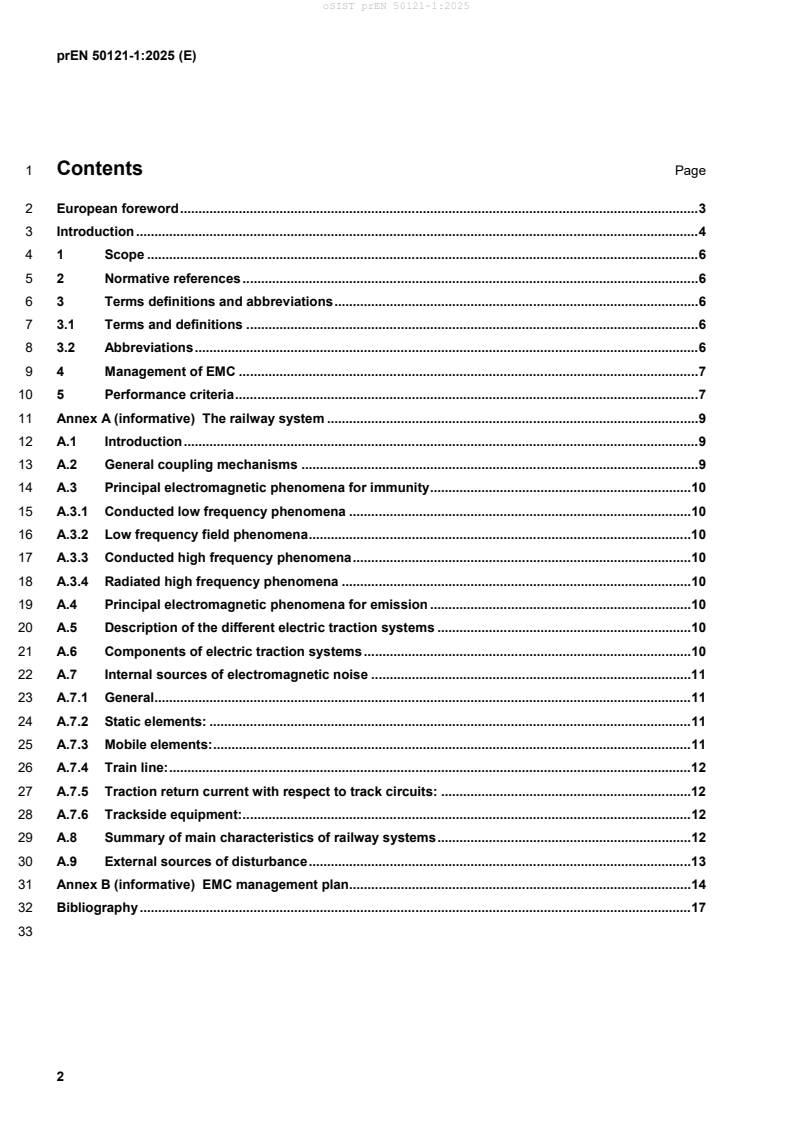
1 Contents Page
2 European foreword . 3
3 Introduction . 4
4 1 Scope . 6
5 2 Normative references . 6
6 3 Terms definitions and abbreviations . 6
7 3.1 Terms and definitions . 6
8 3.2 Abbreviations . 6
9 4 Management of EMC . 7
10 5 Performance criteria . 7
11 Annex A (informative) The railway system . 9
12 A.1 Introduction . 9
13 A.2 General coupling mechanisms . 9
14 A.3 Principal electromagnetic phenomena for immunity . 10
15 A.3.1 Conducted low frequency phenomena . 10
16 A.3.2 Low frequency field phenomena . 10
17 A.3.3 Conducted high frequency phenomena . 10
18 A.3.4 Radiated high frequency phenomena . 10
19 A.4 Principal electromagnetic phenomena for emission . 10
20 A.5 Description of the different electric traction systems . 10
21 A.6 Components of electric traction systems . 10
22 A.7 Internal sources of electromagnetic noise . 11
23 A.7.1 General . 11
24 A.7.2 Static elements: . 11
25 A.7.3 Mobile elements: . 11
26 A.7.4 Train line: . 12
27 A.7.5 Traction return current with respect to track circuits: . 12
28 A.7.6 Trackside equipment: . 12
29 A.8 Summary of main characteristics of railway systems . 12
30 A.9 External sources of disturbance . 13
31 Annex B (informative) EMC management plan . 14
32 Bibliography . 17
prEN 50121-1:2025 (E)
34 European foreword
35 This document (prEN 50121-1:2025) has been prepared by CLC/TC 9X “Electrical and electronic applications
36 for railways”.
37 This document is currently submitted to the Enquiry.
38 The following dates are proposed:
• latest date by which the existence of this (doa) dav + 6 months
document has to be announced at national
level
• latest date by which this document has to be (dop) dav + 12 months
implemented at national level by publication of
an identical national standard or by
endorsement
• latest date by which the national standards (dow) dav + 36 months
conflicting with this document have to be (to be confirmed or
withdrawn modified when voting)
39 This document has been prepared according to Decision 69/09 taken during the TC 9X meeting.
40 This document will supersede EN 50121-1:2017.
41 prEN 50121-1:2025 includes the following significant technical changes with respect to EN 50121-1:2017:
42 — clarification in Clause 4, Management of EMC;
43 — introduction of additional explanation in informative Annex A, A.1 Introduction, A.2 General coupling
44 mechanisms, A.4 Principal electromagnetic phenomena for emission, A.5 Description of the different
45 electric traction systems, A.7.2 Static elements, A.7.3 Mobile elements and A.9 External sources of
46 disturbance;
47 — introduction of new informative Annex B “EMC management plan”.
48 EN 50121, Railway applications — Electromagnetic compatibility, consists of the following parts:
49 — Part 1: General [the present document];
50 — Part 2: Emission of the whole railway system to the outside world;
51 — Part 3-1: Rolling stock — Train and complete vehicle;
52 — Part 3-2: Rolling stock — Apparatus;
53 — Part 4: Emission and immunity of the signalling and telecommunications apparatus;
54 — Part 5: Emission and immunity of fixed power supply installations and apparatus.
prEN 50121-1:2025 (E)
55 Introduction
56 The railway system EMC set of product-specific European Standards is intended, in the main, to permit
57 compliance with the EMC Directive, but also to provide a means of prescribing compatibility between internal
58 parts of the railway system. It consists of five parts described at the end of this Introduction.
59 The set of standards provides both a framework for managing the EMC for railway systems and also specifies
60 the limits for the electromagnetic (EM) emission of the railway system as a whole to the outside world and for
61 the EM emission and immunity for equipment operating within the railway system. The latter is intended to be
62 compatible with the emission limits set for the railway system as a whole and also provides for establishing
63 confidence in equipment being Fit For Purpose in the Railway environment. There are different stationary
64 emission limits set for trams/trolleybuses and for metro/mainline railway systems. The frequency covered by the
65 standards is in the range from DC to 400 GHz. No measurements need to be performed at frequencies where
66 no requirement is specified. The limits for EMC phenomena are set so that the railway system as a whole
67 satisfies the Directive on electromagnetic compatibility with the outside world, and so that EMC is achieved
68 between the various parts of the railway system. Any specific problems in complying with the limits are intended
69 to be addressed by the procedures given in the EMC Directive. Throughout the set of standards, the immunity
70 levels are chosen to ensure a reasonable level of EMC with other apparatus within the local railway environment
71 and with emissions which enter the railway system from the outside world. Limits are also placed on EM
72 emission by railway systems into the outside world.
73 The compatibility between railway system emissions and their external environment is based upon emission
74 limits from the railway systems being set by considering the results from measurements at the time that the
75 EMC Directive became enforceable. Given that the general compatibility between railway systems and their
76 environment was satisfactory at the time these measurements were made and subsequent experience of
77 applying the limits has confirmed their acceptability, compliance with this Standard has been judged to give
78 satisfactory compatibility. The immunity and emission levels do not of themselves guarantee that the railway
79 system will have satisfactory compliance with its neighbours. In exceptional circumstances, for instance near a
80 location which has unusually high levels of EM interference, the railway system can require additional measures
81 to be taken to ensure proper compatibility. Particular care should be taken when in proximity to equipment not
82 covered by the EMC Directive such as radio transmission equipment, military or medical installations. Attention
83 is particularly drawn to any magnetic imaging equipment in hospitals that can be near to urban transport. In all
84 these cases, compatibility should be achieved with consultation and co-operation between the interested
85 parties.
86 The immunity and emission levels themselves do not guarantee that integration of the apparatus within the
87 railway system will necessarily be satisfactory. The standard cannot cover all the possible configurations of
88 apparatus, but the test levels are sufficient to achieve satisfactory EMC in the majority of cases. In exceptional
89 circumstances, for instance near a location which has unusually high levels of EM interference, the system can
90 require additional measures to be taken to ensure proper operation. The resolution of this is a matter for
91 discussion between the equipment supplier and the project manager, infrastructure manager or equivalent.
92 The railway apparatus is assembled into large systems and installations, such as trains and signalling
93 operational control centres. Details are given in informative Annex A. It is not, therefore, possible to establish
94 immunity tests and limits for these large assemblies. The immunity levels for the apparatus will normally ensure
95 reliable operation, but it is important to prepare an EMC management plan to deal with complex situations or to
96 deal with specific circumstances; for example, the passage of the railway line close to a high power radio-
97 transmitter which produces abnormally high field strengths. Special conditions may have to be applied for
98 railway equipment which has to work near such a transmitter and these will be accepted as National Conditions
99 for the specification.
prEN 50121-1:2025 (E)
100 The series of standards EN 50121, Railway applications — Electromagnetic compatibility, contains the following
101 parts:
102 — Part 1: General: This part gives a description of the electromagnetic behaviour of a railway system; it
103 specifies the performance criteria for the whole set. A management process to achieve EMC at the interface
104 between the railway infrastructure and trains is referenced.
105 — Part 2: Emission of the whole railway system to the outside world: This part sets the emission limits
106 from the railway system to the outside world at radio frequencies. It defines the applied test methods and
107 gives information on typical field strength values at traction and radio frequency (cartography).
108 — Part 3-1: Rolling stock — Train and complete vehicle: This part specifies the emission and immunity
109 requirements for all types of rolling stock. It covers traction rolling stock and trainsets, as well as
110 independent hauled rolling stock. The scope of this part of the series ends at the interface of the rolling
111 stock with its respective energy inputs and outputs.
112 — Part 3-2: Rolling stock — Apparatus: This part applies to emission and immunity aspects of EMC for
113 electrical and electronic apparatus intended for use on railway rolling stock. It is also used as a means of
114 dealing with the impracticality of immunity testing a complete vehicle.
115 — Part 4: Emission and immunity of the signalling and telecommunications apparatus: This part
116 specifies limits for electromagnetic emission and immunity for signalling and telecommunications apparatus
117 installed within a Railway system. The EMC plan needs to state, if this part is also applicable for railway
118 operational equipment mounted trackside or at platforms.
119 — Part 5: Emission and immunity of fixed power supply installations and apparatus: This part applies
120 to emission and immunity aspects of EMC for electrical and electronic apparatus and components intended
121 for use in railway fixed installations associated with power supply.
122 EN 50121-1 and EN 50121-2 are product family standards which take precedence over generic standards.
123 EN 50121-3-1, EN 50121-3-2, EN 50121-4, and EN 50121-5 are product standards.
prEN 50121-1:2025 (E)
124 1 Scope
125 This document outlines the structure and the content of the whole set.
126 It provides information about the EMC management.
127 It specifies the performance criteria applicable to the whole standards series.
128 This part alone is not sufficient to give presumption of conformity to the essential requirements of the EMC-
129 Directive and is intended to be used in conjunction with other parts of this standard.
130 The informative Annex A describes the characteristics of the railway system which affect electromagnetic
131 compatibility (EMC) behaviour.
132 Phenomena excluded from the set are Nuclear EM pulse, abnormal operating conditions (e.g. fault conditions)
133 and the induction effects of direct lightning strike.
134 Emission limits at the railway system boundary do not apply to intentional transmitters within the railway system
135 boundaries.
136 Safety considerations are not covered by this set of standards.
137 The biological effects of non-ionizing radiation as well as apparatus for medical assistance, such as
138 pacemakers, are not considered here.
139 2 Normative references
140 The following documents are referred to in the text in such a way that some or all of their content constitutes
141 requirements of this document. For dated references, only the edition cited applies. For undated references, the
142 latest edition of the referenced document (including any amendments) applies.
143 IEC 60050-161:1990, International Electrotechnical Vocabulary. Chapter 161: Electromagnetic compatibility
144 3 Terms definitions and abbreviations
145 3.1 Terms and definitions
146 For the purposes of this document, the terms and definitions given in IEC 60050-161:1990 and the following
147 apply.
148 ISO and IEC maintain terminology databases for use in standardization at the following addresses:
149 — ISO Online browsing platform: available at https://www.iso.org/obp/
150 — IEC Electropedia: available at https://www.electropedia.org/
151 3.1.1
152 integrator
153 party who is responsible for the specification and/or the integration of the apparatus into a system or subsystem
154 3.2 Abbreviations
155 For the purposes of this document, the following abbreviations apply.
AC Alternating Current
CCTV Closed Circuit Television
DC Direct Current
E Electric (field)
EM Electromagnetic
prEN 50121-1:2025 (E)
EMC Electro Magnetic Compatibility
GTO Gate Turnoff (transistor)
H Magnetic (field)
IGBT Insulated Gate Bipolar Transistor
IT Information Technology
MOSFET Metal Oxide Semiconductor Field Effect Transistor
MRI Magnetic Resonance Imaging
MVA Megavoltampere
RF Radio Frequency
WIFI Wireless Fidelity
156 For the purpose of this document, definitions related to EMC and to relevant phenomena can be found in
157 IEC 60050-161:1990.
158 Other parts of this document can contain specific definitions.
159 4 Management of EMC
160 The railway system is a complex installation with moving sources of electromagnetic energy and the application
161 of the railway EMC standards is not a guarantee of satisfactory performance. There can be cases where the
162 apparatus has to be positioned in restricted spaces or added to an existing assembly,
...